



Abstract
In an educational context focused on student learning, class participation and feedback are key to improving students’ performance. Class participation grading methods are often unclear and subjective, therefore, providing feedback on class participation grades is challenging for lecturers. In this study, the Work-In-Class Assessment Tool (WICAT) designed by researchers is a multidimensional system that grades class participation by assessing students’ attendance, active listening, contribution to class activities, and performance in frequent small tasks. The WICAT allows lecturers to clearly and objectively grade class participation while providing students weekly feedback on their in-class performance. This study aims to analyze the effect of the WICAT and weekly feedback on students’ academic performance. The results from an experiment with 699 accounting students over the 2016 to 2019 period showed that students whose class participation grade was obtained through WICAT performed better on the final exam. Furthermore, the results showed that students assessed by WICAT were 2.28 times less likely to fail the final exam. However, the weekly feedback that WICAT allowed did not affect students’ performance. These results have important implications for curriculum designers and teaching staff on how to plan course syllabuses and where to focus in-class efforts.
Introduction
Since the European Higher Education Area (EHEA) was adopted, all stakeholders (communities, professional bodies, industries, employers, regulators, and students) have witnessed a shift toward more continuous assessment that has led to a diversification of evaluation tools (Macfarlane, 2016). Traditionally used as the only assessment task, the final exam is now combined with more complex assessment systems, including coursework assessment. This combination leads to higher grades than exams alone and appears to be preferred by students (Richardson, 2015). Within the concept of coursework, class participation has become a common requirement of many university courses (Xu & Qiu, 2022).
The classic conception of class participation, which is limited to verbal interactions, has been overtaken by a much broader view, including anything that causes students to be more involved in active learning forms (Orwat et al., 2018). Class participation is a multidimensional concept that comprises many aspects that suggest evidence of student engagement, such as preparation prior to class (Dancer & Kamvounias, 2005; Hard & RaoShah, 2022), attendance (Dancer & Kamvounias, 2005; Fritschner, 2000; Hard & RaoShah, 2022), contribution to class activities and discussions (Dallimore et al., 2010; Dancer & Kamvounias, 2005; Fritschner, 2000; Xu & Qiu, 2022) and frequent small tasks (Challis et al., 2010; Tang et al., 2020). Past research shows that these activities lead to personal and professional growth in students (Jones, 2008), result in a better understanding and retention of the material (Precourt & Gainor, 2019), enable students to demonstrate a broader range of skills (Richardson, 2015) and improve students’ performance (Paisey & Paisey, 2004; Papageorgiou, 2019; Precourt & Gainor, 2019). Furthermore, class participation is a motivational tool that has been proven to increase engagement and thus enhance students’ achievement (Fredricks et al., 2019; Martin et al., 2017), while disengagement and poor motivation lead to obstacles to learning (Liem & Chong, 2017). Grading class participation is one of the most popular techniques instructors use to encourage it, as students prioritize graded components in their coursework (Rocca, 2010). Most college courses include class participation as a component of course assessment in higher education (Lynch & Hennessy, 2017).
Highly connected with students’ assessment and class participation is the role played by feedback, which can be defined as “information provided by an agent (e.g., teacher, peer, book, parent, self, [or] experience) regarding aspects of one’s performance or understanding” (Hattie & Timperley, 2007, p. 81). Once class participation is graded, this grade should be communicated to students to take appropriate corrective actions (Macfarlane, 2016), as is done with any other graded component of the assessment, such as midterms or final exams. Furthermore, because the assessment occurs throughout the course and not on a single date, this feedback should be given frequently enough so students can take corrective actions in a timely fashion. Instructors should offer feedback on class participation at multiple points to help their students understand what they are doing wrong and how they can improve (Hard & RaoShah, 2022). When class participation grades are issued at the end of the course, students discover too late that their performance is unsatisfactory and they have no corrective options (Dancer & Kamvounias, 2005).
Although effective feedback is a critical strategy in education (Evans, 2013; Hattie & Timperley, 2007), grading class participation and giving effective feedback to students on it can be complex tasks for instructors. First, participation grading methods are subjective by nature (Precourt & Gainor, 2019), with grading criteria often unclear and difficult to define (Heyman & Sailors, 2011). This ambiguity in standards leads to a lack of transparency in the process of grading class participation (Xu & Qiu, 2022), which can lead to the use of class participation as a “fudge factor” to justify an increase in students’ final grades (Bean & Peterson, 1998). Second, giving feedback on unclear or subjective actions is challenging for lecturers. A growing concern in higher education regards the effectiveness and purpose served by feedback (Robinson et al., 2013). Although students demand timely (Marriott & Lau, 2008), constant and regular feedback (Watty et al., 2013), they usually complain about receiving grades too late or even never receiving them, which does not allow them to make corrections. The lack of frequent feedback concerns students, especially regarding class participation (Bouilheres, 2015; Rowe & Wood, 2009), and requires consideration since prompt feedback could enhance students’ weekly engagement (Challis et al., 2010).
Most studies examining the impact of class participation on students’ academic performance only assess one dimension of class participation: attendance (e.g., Matsoso & Iwu, 2017; Nyatanga & Mukorera, 2019; Papageorgiou, 2019; Sund & Bignoux, 2018), contribution to class activities (e.g., Dallimore et al., 2010; Dancer & Kamvounias, 2005; Park et al., 2019), or frequent small tasks (e.g., Einig, 2013; Massoudi et al., 2017; Mezzanotte, 2017; Tang et al., 2020). In the vast majority of the mentioned studies, feedback about class participation grades was only provided at the end of the course or not provided at all, which did not allow students to take corrective measures in case of poor performance.
Few studies have used a system to measure participation throughout the course in tandem with frequent feedback (e.g., Dancer & Kamvounias, 2005; Mezzanotte, 2017; Tang et al., 2020). In addition to the fact that all these studies assess only one component of class participation, there are other limitations. First, the class participation grading system used is qualitative in nature, without instructions about how to combine the different concepts in an overall class participation mark (e.g., Tang et al., 2020), which hinders the analysis of class participation’s impact on students’ final performance. Second, the grades are self-reported by students (e.g., Dancer & Kamvounias, 2005). Third, although these studies provide weekly or biweekly feedback (e.g., Mezzanotte, 2017; Tang et al., 2020) or, at least, feedback at mid-semester (e.g., Dancer & Kamvounias, 2005), they fail to isolate feedback effects on students’ performance.
Within accounting courses, as far as we know, the only two empirical studies about class participation and its effects on exam performance are Pérez-López and Ibarrondo-Dávila (2020) and Precourt and Gainor (2019). In both studies, participation grades were determined based on the contribution to class activities as well as attendance. They both demonstrated a positive link between class contribution to class activities and exam grades. However, these studies differed in terms of their findings on attendance impact on student performance. While Precourt and Gainor (2019) found a positive relationship, Pérez-López and Ibarrondo-Dávila (2020) showed no significant effect. Both studies have certain limitations. First, only two dimensions of class participation were assessed, leaving aside the frequent small tasks dimension. Second, the authors acknowledged that their system was, to a certain extent, subjective since it depended mainly on students’ self-assessments of their class participation. Finally, the authors did not analyze the effect of feedback on participation grades on students’ performance. In this study, we intend to solve two problems currently present in higher education: First, the lack of a clear, objective, and fair system to assess class participation, which, second, inevitably entails the impossibility of giving frequent feedback to students about their daily classwork in the course.
Grounding the study in engagement theory (Appleton et al., 2008; Astin, 1984), the participation-identification model (Finn, 1989), and previous literature on class participation, we designed a Work-In-Class Assessment Tool (WICAT) considering several items that can be used to measure students’ engagement: attendance (Dancer & Kamvounias, 2005; Fritschner, 2000), contribution to class activities and discussion (Dallimore et al., 2010; Xu & Qiu, 2022) and frequent small tasks (Tang et al., 2020). Each item is scored using a point system that allows instructors to obtain a weekly participation grade for each student in a clear, objective, and fair way. Doing so facilitates the transparency of the process and offers the ability to give weekly feedback to students on their class participation grades.
The purpose of this article is twofold: First, we analyze whether the application of a clear, objective and fair Work-In-Class Assessment Tool (WICAT) that considers the multidimensional aspect of class participation positively affects student performance. Second, we analyze whether giving weekly feedback on class participation performance leads to better student performance than merely providing feedback about this grade at the end of the course.
At a private, medium-sized university in Spain, we studied the effect of applying the WICAT and giving weekly feedback by conducting an experiment with 699 undergraduate accounting students over four academic years (2016–2019). The participants were randomly assigned into three groups: the control group and one of two experimental groups. In the control group, no WICAT was applied; thus, no weekly feedback was delivered to the students about their class participation grades. In Experimental Group 1, we applied the WICAT but without weekly feedback about the class participation grades, giving information about these grades only at the end of the course. Finally, in Experimental Group 2, we applied the WICAT along with weekly feedback on class participation grades. The results showed that the WICAT had a clear positive and significant effect on the students’ final exam grades. The students assessed by the WICAT scored on the final exam, on average, one point (over 10) more than the students not assessed by the WICAT. Furthermore, our results suggest that a student assessed by the WICAT was 2.28 times more likely to fail the final exam than a student who was not assessed by the tool. However, providing weekly feedback did not seem to have a significant effect on students’ final exam grades.
This study contributes to the existing accounting education literature in several ways. We introduce a clear, objective, and fair assessment tool to measure class participation, a problem that has been debated in higher education for decades. This assessment tool can be applied not only in accounting but also to a wide spectrum of disciplines in which attendance, daily work, and students’ commitment are crucial to achieving the required learning outcomes. We provide for the accounting education literature an improved class participation grading tool that has positive effects on students’ performance while adding an analysis of how weekly feedback on class participation grades can impact students’ ultimate performance.
Literature Review and Hypothesis Development
Class Participation and Performance
Class participation may be defined in its broadest form as student engagement in material across all modalities of instruction (Orwat et al., 2018). It is an active engagement process (Dancer & Kamvounias, 2005) considered essential to learning development by both faculty and students (Fritschner, 2000). As a multidimensional concept, it encompasses all aspects that suggest evidence of student engagement, from attendance at lectures to all kinds of contributions to class activities that can encourage students to learn on an ongoing basis and lead to improvements in their performance (Precourt & Gainor, 2019; Tang et al., 2020; Xu & Qiu, 2022).
Lecture attendance reflects students’ course engagement level and is critical to student success (Moores et al., 2019). Attendance generally enhances the learning process through direct interaction with instructors and peers and is considered an important predictor of a student’s academic performance (Al Hazaa et al., 2021). Several studies have investigated the relationship between attendance in lectures and student performance, and while some studies have reported a moderate effect (Clark et al., 2011; Sund & Bignoux, 2018), others have clearly identified a strong positive link (Al-Shammari, 2016; Nyatanga & Mukorera, 2019). Some have even shown that when students attend lectures more frequently, they obtain greater benefits from attending (Chen & Lin, 2008). The results in accounting education have also shown that lecture attendance has a significant influence on students’ overall performance at the undergraduate level (Alagiah et al., 2001; Paisey & Paisey, 2004). Although early studies found a low and not very meaningful relationship between the two factors (Schmulian & Coetzee, 2011), recent research has suggested that attending lectures is critical in accounting for student performance (Matsoso & Iwu, 2017; Papageorgiou, 2019).
Nevertheless, “attendance per se does not ensure that learning takes place” (Rodgers, 2002, p. 265). Whether students attend class may not be as important as how they attend class in terms of class engagement (Büchele, 2021). This aspect is especially relevant in accounting education, where a focus on technical details often leads students to perceive accounting as a difficult and boring subject (Geiger & Ogilby, 2000) and diminishes their interest in further study (Park et al., 2019). Efforts are needed to increase student interest and class engagement, as studies have shown that when students participate more actively in class activities, their learning in accounting is more effective (Dallimore et al., 2010; Park et al., 2019) and that class participation is positively and significantly associated with the final grade (Pérez-López & Ibarrondo-Dávila, 2020; Precourt & Gainor, 2019).
Therefore, students’ contribution to class activities should be encouraged with more opportunities for students to participate offered by instructors (Hard & RaoShah, 2022). Frequent small tasks promote engagement and can help students keep up with the material delivered (Challis et al., 2010). Studies have shown that intense weekly participation grading schemes can increase participation and overall course grades (Tang et al., 2020).
Considering all of this evidence, a class participation grading system based on attendance and students’ contribution to class activities, with frequent small tasks that encourage students to learn on an ongoing basis, could be positively linked to their academic performance. However, the challenge is not simply to design a class participation system that considers all these dimensions but also to establish a clear and objective grading system through which a fair participation grade can be obtained for all students. This task does not seem easy, especially considering that participation-rating methods have traditionally been subjective in nature (Precourt & Gainor, 2019), with unclear and difficult-to-define rating criteria (Heyman & Sailors, 2011) and characterized by a lack of transparency (Xu & Qiu, 2022).
We designed a system to measure class participation that considers all these issues: the WICAT assesses the three aforementioned dimensions (attendance, contribution to class, and frequent small tasks), establishing a point system to evaluate each dimension in a clear, objective, and fair way. The system is clear in the sense that it is explained in depth to students on the very first day of class. It is objective in that each evaluable concept is assigned a certain number of points to add or subtract, leaving no room for the teacher’s subjectivity. It is fair in that it applies equally to all students. We predict that, under these conditions, the WICAT may be positively related to student performance. Thus, our first hypothesis can be stated as follows:
Feedback From Class Participation and Performance
Class participation encourages students to learn on an ongoing basis (Trotter, 2006), enables the provision of feedback to students on their learning (Isaksson, 2008), and helps students decide what to pay attention to (Gibbs & Lucas, 1997). Studies in other disciplines have shown that class participation can support student learning through feedback and increase students’ motivation for learning (Hernández, 2012); furthermore, students can achieve substantially higher marks (Prowse et al., 2007; Tawafak et al., 2019). Instructors should offer feedback on class participation at multiple points to help their students understand what they are doing well and how they can improve (Hard & RaoShah, 2022). Several studies have shown that formative feedback on class participation midway through the semester and summative feedback at the end of the course have a significant impact on students’ grades (Dancer & Kamvounias, 2005) and that students who experience more intense weekly participation grading schemes have significantly higher participation rates and overall course grades (Tang et al., 2020).
However, despite this relevance, the accounting discipline lacks frequent feedback (Dean et al., 2020; Hart & Wang, 2016; Watty et al., 2013), especially regarding class participation (Bouilheres, 2015; Rowe & Wood, 2009). Providing timely feedback about class participation acquires greater relevance in subjects such as accounting, which can be considered scaffolded subjects, in which the internalization of new information should be built on prior knowledge (Azih & Nwosu, 2011).
In the accounting discipline, a wide range of studies demonstrate an improvement in student performance due to the regular and immediate feedback provided on a specific task. These studies use simple (Einig, 2013; Massoudi et al., 2017; Stuart, 2004) or more sophisticated tools to provide feedback (Marriott & Teoh, 2012; Perera et al., 2014; Shoulders & Hicks, 2008). Despite the difference in the feedback tools used, all studies agree on the importance of prompt and timely feedback on student performance: these features allow the student to value their knowledge and correct the most limited aspects of their learning in the future. When feedback is returned faster to students and it is clearer to them, its effect on learning is stronger (Narasimhan, 2001).
However, none of these studies provided feedback on students’ class participation and, therefore, on the different concepts included within it: this is the main contribution of our research. We developed an individual, iterative, and weekly feedback system for students’ class participation grades, provided periodically throughout the whole term. We think, as many other authors have highlighted in other disciplines (e.g., Dancer & Kamvounias, 2005; Prowse et al., 2007; Tawafak et al., 2019), that this feedback type could impact students’ final exam performance. Therefore, our second hypothesis is stated as follows:
Materials and Methods
Work in Class Assessment Tool (WICAT) and Feedback System
In Spain, Introduction to Accounting and Financial Accounting are courses usually taught in the first and second years, respectively, of the Degree in Business Administration program. At our university, each of these two courses is taught for one semester (14 weeks), with two face-to-face sessions of 2 hr per week and two additional hours of voluntary tutoring upon the students’ request. Approximately 50 students were enrolled in both courses.
Although the contents differed, both subjects followed the same assessment model,

where the final exam (FE) represents 60% of the final grade (FG), while the midterm (MT) and class participation (CP) account for 30% and 10%, respectively. The mandatory nature of class participation (10%) is intended to motivate the student to prepare for classes, but it is weighted so as not to cause discomfort among them toward the requirement to participate (Gainor & Precourt, 2017).
Traditionally, instructors have had no homogeneous criterion for assessing class participation. Our university’s accounting instructors tracked class participation by noting which students attended class, answered questions, or completed exercises regularly, focusing only on the number of interventions, the accuracy of the responses, and those students who stood out from their peers in regard to their consistency. This subjective method of assessing class participation also entails a high risk of “losing” students who are more shy or insecure. No clear, objective, and fair tool measured students’ class participation, so clear feedback could not be given on their performance on a day-to-day basis. Unfortunately, this lack of transparency in the class participation grading process led to this grade being sometimes used as a “fudge factor” (Bean & Peterson, 1998) to justify an increase in students’ final grades.
To solve this lack of clarity, objectivity, and fairness, accounting instructors developed, based on the previous literature, the WICAT. The WICAT is a multidimensional system that allows accounting instructors to track students’ participation in each class period. On the first day of class, the WICAT rules and point system were fully explained to the students, so they knew exactly what their instructors expected and how they would be assessed. At the start of the course, students had 50 of 100 points, so they all started with a “pass” (i.e., 50 over 100, or 5 over 10, is the cutoff value for a pass), and they could improve or worsen their grade by adding or subtracting points based on their performance along the different class participation dimensions assessed. The number of points to add or subtract for each dimension was discussed by the instructors based on their teaching experience and long careers in higher education until a consensus was reached. Details of the WICAT design are shown in Table 1.
WICAT design.

At the end of the semester, class participation could reach 100 points, and some students could even exceed it, but we transformed this mark to base-10. With this system, unmotivated students with poor performance in the class had only test and homework marks, so at the end of the semester, their score assessed by the WICAT would rarely be above 5 of 10 points. Motivated and high-performance students could improve their score assessed by the WICAT to 9 or even 10 of 10 points by working hard in class. To achieve this high grade, they needed at least 5 to 6 interventions during the semester and to perform well on the regular tests.
Thus, the smooth functioning of the WICAT and its fairness depend largely on the coordination between the accounting instructors. To guarantee fairness and coherence among the groups, the accounting instructors teaching these courses coordinated strongly, with frequent meetings and discussions about the different components of class participation. The instructors lecturing the courses had similar teaching styles, taught the same content in each subject, used the same class materials, and offered the same opportunities for active participation in all groups. The midterm and final exams were also coordinated for all groups and designed for objective correction.
Ensuring student participation opportunities for nearly 60 students in each class is quite difficult. However, each class period had many opportunities for students to participate: answering cold calls, asking additional questions, answering questions, and correcting exercises in a group setting with classmates.
The WICAT is designed to be a multidimensional tool that allows instructors to obtain a weekly class participation grade and to provide students with individual, iterative, and weekly feedback. With this feedback, students may judge their academic performance’s evolution throughout the course and take the required measures to improve the learning process.
This feedback is contained in a spreadsheet uploaded in Moodlerooms. Students (individually) can see every week (weekly) how many points they accumulated each day (iteratively). Thus, the WICAT feedback provides a class participation grade in a detailed, integrated, and weighted way. In addition to the class participation grades, this spreadsheet contains the midterm grades, which allow students to perform simulations with hypothetical final exam scores to obtain hypothetical final grades. Appendix 1 shows examples of how this feedback system works.
Participants and Intervention
We conducted an experiment with 699 undergraduate accounting students at a private, medium-sized university in Spain during the period 2016 to 2019. This sample is considered representative and random since (1) it includes students in all the degrees and dual degrees in which accounting is taught, (2) the total number of students enrolled in accounting subjects is approximately 1,000 per academic course, and (3) groups are randomly assigned to lecturers.
The students were randomly assigned into three groups: the control group and one of two experimental groups. In the control group, no WICAT was applied; thus, no weekly feedback was delivered to the students about their class participation grades (NO WICAT). In Experimental Group 1, we applied the WICAT but without weekly feedback about class participation grades. Instead, information about these grades was given only at the end of the course, called last-day feedback (WICAT LDF). Finally, in Experimental Group 2, we applied the WICAT with iterative, individual, and weekly feedback about the class participation grades (WICAT WF). The experiment was approved by the Ethics Committee, and all participants provided informed written consent to participate in the experiment.
Table 2 shows the characteristics of the three groups considered, including their grades on the university entrance exam (EvAU) and their gender.
Basic Statistics of the Participants Included in the Experiment.

Procedure and Results
Part 1: Crude Analysis
First, a crude analysis of the data was carried out to compare the three groups (NO WICAT, WICAT WF, and WICAT LDF). The Kruskal–Wallis test was applied to the three groups, equivalent to ANOVA in those cases where the normality assumption was violated.
The Kruskal–Wallis test showed statistically significant differences between the final exam grades in the three groups (NO WICAT, WICAT LDF, and WICAT WF), obtaining a contrast statistic of 71.89 (p value = 2.45E-16). A medium effect size was detected (eta2[H] = 0.10). To examine this difference, a post hoc analysis was developed using Wilcoxon’s test with Bonferroni correction (Table 3 and Figure 1). The boxplots in Figure 1 represent the first (lower horizontal line), median (inner horizontal line), and third quartiles (upper horizontal line). The points represent outliers. In this case, the effect size of NO WICAT versus WICAT LDF was moderate (eta2[H] = 0.08), as was that of NO WICAT versus WICAT WF (eta2[H] = 0.11). Therefore, the control group, in which no WICAT was applied, and both experimental groups, in which the WICAT was applied, exhibited significant differences. However, when only the two experimental groups (WICAT LDF; WICAT WF) were compared, no differences were exhibited regardless of the frequency of providing feedback.
Post-hoc Analysis Using Wilcoxon’s Test With Bonferroni Correction.


Post hoc analysis using Wilcoxon’s test with Bonferroni correction.
Figure 2 shows the smoothed density distributions of the three groups (smoothing kernel set to “Gaussian”), and the vertical lines represent the average grade in the final exam for each group. Again, the control and two experimental groups differed, but when the WICAT was applied, providing weekly or last-day feedback did not seem to be relevant.

Smoothed density distributions of the three groups.
When we focused on the application of the WICAT and ignored feedback about class participation frequency, the relative risk ratio between the two groups was substantially different. In the Spanish university system, the cutoff criterion for pass/fail is a grade of 5 on a 0 to 10 scale. With reference to this value, 34.1% of the control group (in which the WICAT was not applied) failed the subject, but only 14.9% of the two experimental groups combined (WICAT groups) scored below 5. Therefore, the relative risk ratio was 2.28, 95% CI [1.71, 3.04], p value = 3.12E-09, which means that a student from the control group (NO WICAT group) was 2.28 times more likely to fail the final exam than was a student from one of the two experimental groups (WICAT groups).
Part 2: OLS Model
In the second part of the analysis and using a multiple linear regression model (OLS), the effect of both WICAT and weekly feedback on final exam grades was evaluated, considering the possible effect of several confounding factors. According to previous studies, students’ performance is related to gender (Fritschner, 2000; Gainor & Precourt, 2017), performance prior to university entrance (Gainor & Precourt, 2017; Pérez-López & Ibarrondo-Dávila, 2020), and course level (Fritschner, 2000; Gainor & Precourt, 2017). Thus, gender, university entrance exam grade (Evaluación de Bachillerato para el Acceso a la Universidad, EvAU, on a 0–10 scale), and subject (introduction to accounting and financial accounting) were included as control variables. We detected the existence of heteroscedasticity; therefore, multivariate linear regression models with heteroscedasticity–consistent standard errors were used.
The results (Table 4) confirmed the conclusions obtained in the crude analysis: there were important differences among the NO WICAT (base level) and WICAT groups (WICAT WF and WICAT LDF), but providing weekly or last-day feedback did not seem to be relevant. The coefficients and their standard errors were almost identical among the groups with weekly (WICAT WF) and last-day feedback (WICAT LDF). The interaction with the EvAU grade was not significant. Regarding the control variables, the university entrance score (EvAU) was significant, which shows its relevance in predicting academic performance. However, gender and subject were not significant (α = .01). The R2 of the model, .23, without being excessively high, is acceptable, and as will be discussed below, it improves when incorporating student performance on the WICAT.
Regression Analysis (With Heteroscedasticity-Consistent Standard Errors).
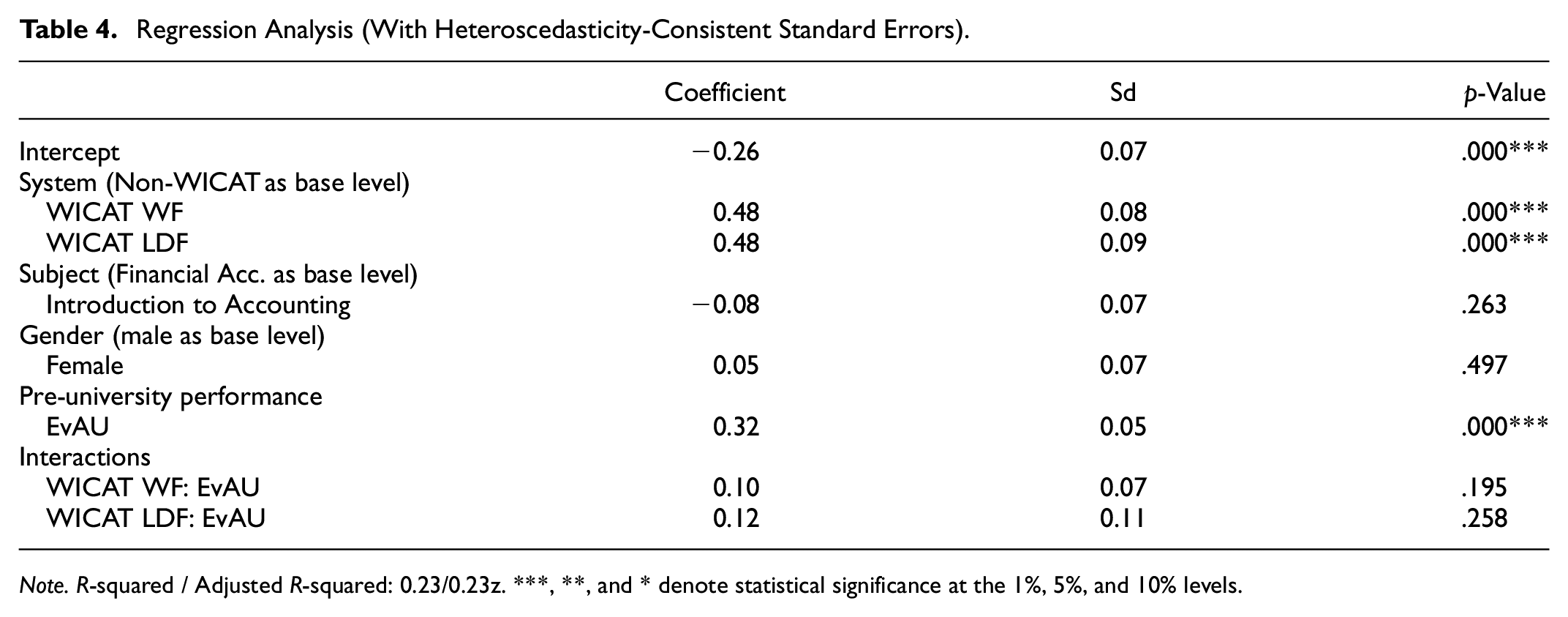
Note. R-squared / Adjusted R-squared: 0.23/0.23z. ***, **, and * denote statistical significance at the 1%, 5%, and 10% levels.
Part 3: OLS Model Considering the Exploitation of the WICAT
In the third part of the analysis, we developed a similar OLS model but including each student’s achievement level as assessed by the WICAT. Instead of considering only the overall class participation grade obtained by applying WICAT, we grouped the students according to their development throughout the 14 weeks of the course using the complete class participation grade time series. The objective was to verify whether the degree of taking advantage of the WICAT influenced the final exam grade. The groups were calculated using clustering techniques frequently employed to classify students in previous education studies (e.g., Cobo et al., 2010; Howard et al., 2018; Meehan & McCallig, 2019; Wook et al., 2009).
First, the cluster analysis allowed us to identify four or five different groups of students in relation to class participation performance (see dendrogram in Figure 3). The vertical axis of the dendrogram represents the dissimilarity between the clusters, and the horizontal axis represents the clusters. The splitting of a vertical line into two vertical lines represents the fusion of the two clusters.
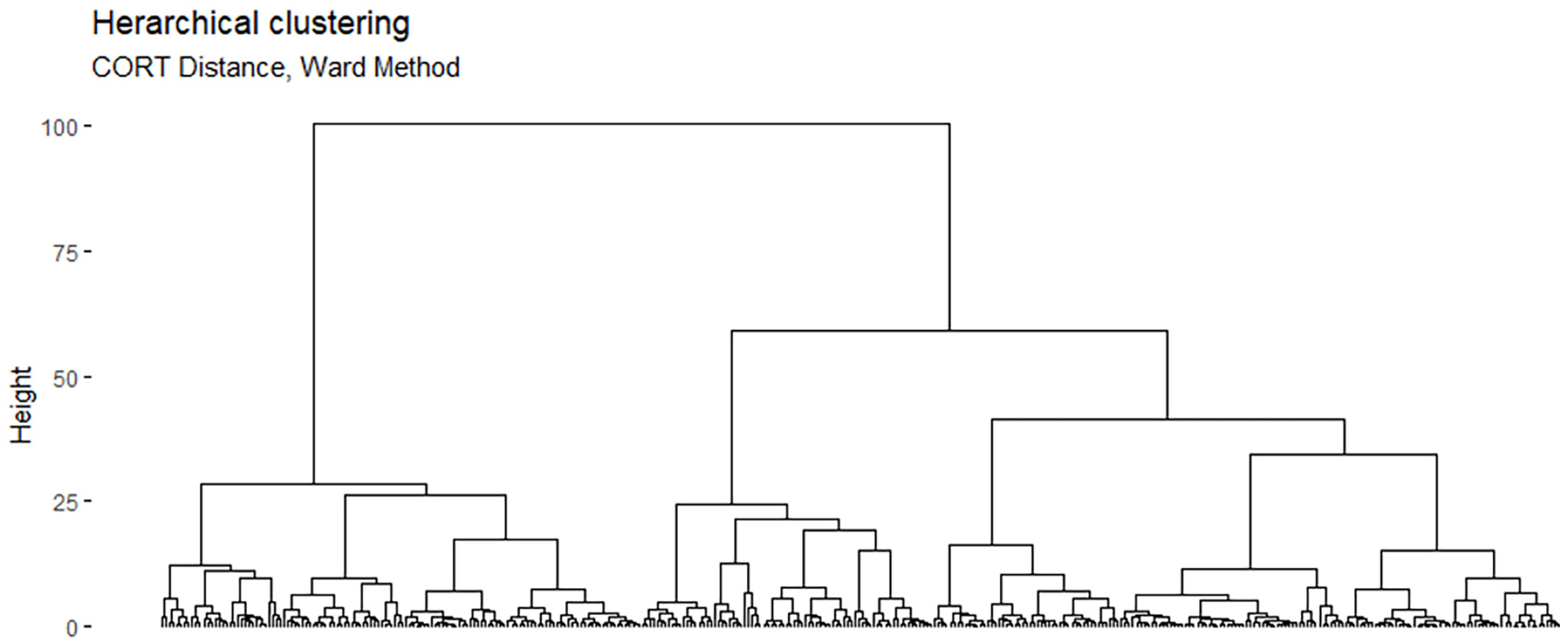
Dendrogram and identified clusters.
To determine whether it was more appropriate to consider 4 or 5 clusters, the average series in both scenarios was calculated (Figure 4). As seen, Clusters 1 and 4 (left side) behaved very similarly, so for interpretation purposes, the figure on the right, with four clusters, seemed more appropriate.

Average time series for the identified clusters (five and four clusters).
Regarding the four clusters, as shown in Figure 5, each cluster had a relatively different class participation performance. Cluster 1, composed of 116 students (32% of the WICAT group), had moderate performance, with an average score throughout the semester close to 6.7 (on a scale from 0 to 10) that hardly evolved over time. Cluster 2, composed of 126 students (34% of the WICAT group), included the best-performing students. Their average score was slightly over 8, and the time series showed a positive trend throughout the 14 weeks, so they ended the semester with a final assessment very close to 10. Cluster 3, composed of 77 students (21% of the WICAT group), had a low performance, oscillating around five, although a very slight positive evolution could be seen. Finally, Cluster 4, composed of 49 students (13% of the WICAT group), had learners who, having started the course with poor performance, improved through the semester. Their average score was slightly below that of Cluster 1 at 6.5.

Average time series of the four clusters, including their mean levels (dashed line).
The solid line indicates the weekly evolution of the grade assessed by the WICAT by cluster. The horizontal dashed line represents the average weekly grade assessed by the WICAT by cluster. Finally, the points show the average of the final exam grade by cluster.
Second, we recalculated the OLS model used in Part 2, incorporating as categorical variables the cluster to which each student belonged (Table 5). We obtained a similar result to that in the previous section, but we added an important nuance: the WICAT works well in Clusters 2 (high performers), 4 (medium performers—good evolution), and 1 (medium performers—stable behavior). In addition, we observed that the effect proceeded in the following order: it was highest in the high performers (Cluster 2,
Regression Analysis Considering the WICAT Performance (With Heteroscedasticity–Consistent Standard Errors).

Note. R-squared/Adjusted R-squared: 0.28/0.27. ***, **, and * denote statistical significance at the 1%, 5%, and 10% levels.
Thus, the class participation performance assessed by the WICAT has a positive effect on the final exam grade. The incorporated teaching innovation, based on a clear, objective, and fair class participation grading system, seems to have worked correctly. Nevertheless, individual, iterative, and weekly feedback does not appear to affect students’ performance.
Discussion
Our results show that class participation performance measured by the WICAT positively affected the students’ exam grades, confirming Hypothesis One. This finding is consistent with previous studies conducted in areas such as quantitative methods (Tang et al., 2020), language courses (Xu & Qiu, 2022), and accounting (Pérez-López & Ibarrondo-Dávila, 2020; Precourt & Gainor, 2019). The students in the NO WICAT group were 2.28 times more likely to fail the final exam than the students in the WICAT group. Therefore, class participation performance measured by the WICAT is a relevant predictor of the final exam score. Built-in teaching innovation, based on a relatively novel class participation grading system, appears to have worked well.
Engagement theory (Fredricks et al., 2019) posits that students who are actively involved in their learning and academic activities (e.g., class participation) improve their motivation (Appleton et al., 2008; Wang & Degol, 2014) and are more likely to achieve higher levels of academic performance (Martin et al., 2017). Fostering learning engagement and motivation becomes more relevant in the accounting discipline, which students perceive as difficult (Abbott & Palatnik, 2018; Ariff et al., 2022) and boring (Ariff et al., 2022; Karlsson & Noela, 2022; Malthus & Fowler, 2009). These circumstances reduce students’ motivation. Students prejudge the accounting subject, preventing them from choosing the accounting profession or the major and master’s in science (Karlsson & Noela, 2022; Malthus & Fowler, 2009). Therefore, WICAT can be a suitable vehicle to encourage student participation and to create a more dynamic and motivating learning environment that not only promotes better academic results but also makes the subject more attractive to students.
However, this study shows evidence that the WICAT works well with high- and middle-achieving students but, unfortunately, not with low-achieving students. The WICAT does not reach all students equally and fails to engage underperforming students in daily classwork. Daily classwork becomes essential in scaffolded disciplines such as accounting, where the correct learning of a specific topic is based on the knowledge of previous topics. This need, well known by accounting lecturers, may not be equally perceived by students. One possible explanation might be that some students do take advantage of the WICAT, motivated by a positive attitude toward the subject and a desire to acquire knowledge in the long term. Previous studies have shown that students’ academic attitudes positively and significantly predict their knowledge-seeking intentions and academic performance (Khuram, Wang, Khan, & Khalid, 2021; Khuram et al., 2022). However, another group of students may not benefit from the tool’s advantages. One possible explanation may be that the workload derived from the WICAT can overwhelm students, causing them a certain level of stress that can impair their academic performance (Khuram et al., 2021). Another possible explanation may be that these students might perceive that a contribution of 10% to the final grade is not enough of a reward for the massive effort involved in working on an ongoing basis in a subject such as accounting. In the first years of university, students very commonly find motivation only in their grades and do not consider the implications that constant work has on long-term learning (Wynn-Williams et al., 2016). In fact, in the cluster analysis, we can observe a clear uptick in the participation grade from week 11 in all four student types, coinciding with the last 3 weeks of the course, which is very close to the final exam, as previously shown in other studies (Precourt & Gainor, 2019).
Contrary to our expectations, weekly feedback did not have any significant effect on students’ final exam grades. This finding is not supported by previous research. Studies such as Aisbitt and Sangster (2005), Davis et al. (2001), Einig (2013), and Massoudi et al. (2017) report a statistically significant correlation between immediate feedback from multiple-choice questions or individualized accounting problems and higher exam performance. Stuart (2004) and Johnson et al. (2009) find a similar result in regard to rapid feedback about analytical review tasks and the use of an intelligent tutoring system, respectively.
One possible explanation for this unexpected result could be that students do not check the feedback spreadsheet uploaded in Moodle frequently enough. However, our review of the access logs of the students in Moodle confirmed that the access rate was, on average, 98%. Then, if they accessed the information, why did this feedback not affect their performance? The answer could be that the WICAT rules and the point system were so clear that they felt that the instructors’ feedback was not needed since the students could self-assess.
In relation to the control variables and as previous studies have shown, while the university entrance score (EvAU) had a positive and significant effect on the final grade (e.g., Massoudi et al., 2017; Pérez-López & Ibarrondo-Dávila, 2020), no relationship was observed for the gender or course level (Beatson et al., 2018; Einig, 2013; Gainor & Precourt, 2017).
Conclusions
Currently, grading class participation clearly, objectively, and fairly and providing feedback to students on this class participation grade are challenges in higher education in general and accounting education in particular. Building on the previous literature and improving on past empirical research, we developed a multidimensional Work-In-Class Assessment Tool (WICAT) that allows weekly feedback on class participation grades to be provided. This system allows both instructors and students to monitor the evolution of the learning process so they can make decisions in advance. This research aimed to analyze the impact of both the WICAT and weekly feedback on student performance on the final exam. At a private, medium-sized university in Spain, we conducted an experiment with 699 undergraduate accounting students over four academic years (2016–2019).
In summary, the WICAT is useful for improving students’ performance regardless of their gender or the course in which it is applied. The tool is versatile and easy to apply and can be implemented not only in accounting courses but also in finance, science, or languages. In fact, it can be used in any discipline that involves a scaffolding learning process, in which future knowledge is built on previous concepts. Finally, the WICAT allows instructors to provide immediate feedback on student performance. This feedback, although relevant and of great impact, a priori, has no real effect on student performance.
The results of this study have important implications for both curriculum designers and teaching staff. The former should consider the positive effect of class participation on students’ performance and, therefore, should include class participation as an evaluable concept within course subjects. The latter should focus students’ efforts on applying clear, objective class participation grading tools and not on providing feedback, which has been proven ineffective.
Regarding the limitations of our work, first, the sample comes from a single university. Our conclusions may not be directly generalizable to the same degrees at other universities. A second limitation is that the research design did not account for qualitative inputs in relation to student perceptions of the usefulness of this type of assessment and feedback regime. A third limitation is that we only analyzed the direct effect of the WICAT and feedback on students’ academic performance without considering other variables that could mediate this relationship, such as motivation, engagement, academic attitude, or learning style. These limitations give us another perspective and open up new lines of research. Future studies could expand the sample to other universities and countries and delve into the possible mechanisms that can better explain the relationship between class participation and feedback and students’ academic performance, especially about class participation impact on low-achieving students and feedback, where the results have not been as expected. Despite these limitations, our study reveals that in the class participation–feedback tandem, class participation is clearly the more important student academic performance enabler.
Footnotes
Appendix 1: Feedback Dashboard
The Excel spreadsheet on which weekly feedback is delivered is comprised of two sheets:
The first contains the grades assessed by the WICAT during the 14 weeks in terms of attendance; class contribution; and small, frequent tasks. The students started with 50 points of 100 and could add or subtract points, as explained in a prior section. An example of such a sheet follows (Figure A1):
The second sheet summarises the overall situation of the students, considering not only class participation but also midterm grades. The sheet allows the students to introduce hypothetical final exam grades to simulate the final grade they could expect to obtain at the end of the course (Figure A2).
Acknowledgements
The authors want to dedicate a special acknowledgment to SAGE Open Editor and the four anonymous reviewers for their detailed and constructive comments and suggestions. A special thank you is extended to Isabel Carrero Bosch (Universidad Pontificia Comillas) for her invaluable help with the article.
Author Contributions
Conceptualization: Javier Marquez, Laura Lazcano, Carmen Bada, José Luis Arroyo-Barrigüete. Methodology and Data collection: Javier Marquez, Laura Lazcano, Carmen Bada.Formal analysis: José Luis Arroyo-Barrigüete. Writing – review and editing: Javier Marquez, Laura Lazcano, Carmen Bada, José Luis Arroyo-Barrigüete.
Declaration of Conflicting Interests
The author(s) declared no potential conflicts of interest with respect to the research, authorship, and/or publication of this article.
Funding
The author(s) disclosed receipt of the following financial support for the research, authorship, and/or publication of this article: This research received financial support from the Spanish Ministry of Science and Innovation through the program Proyectos I+D+i “Retos Investigación” 2020 (Ref. PID202020-116293RB-I00).
Ethics
The experiment has the approval of the Ethics Committee (number 2022/20) and all participants provided informed written consent to participate in the experiment.
