




Abstract
Since the Gamified Entrepreneurship Courses have been applied to college students’ entrepreneurship courses, it has provided interactive and immersive course experiences to help improve the effect of course teaching. From the perspective of college students, Gamified Entrepreneurship Courses are a novel teaching method, and the satisfaction of college students with Gamified Entrepreneurship Courses will determine the future development of this course model. However, current research shows that college students’ satisfaction with Gamified Entrepreneurship Courses has not yet reached the desired level. Therefore, this study aims to study the factors and mechanisms that affect college students’ satisfaction with gamification entrepreneurship courses by constructing an integrated flow framework. A total of 205 college students who participated in the Gamified Entrepreneurship Courses were obtained, and the study used partial least squares (PLS) to analyze the measurement and structural models. The results show that the satisfaction of Gamified Entrepreneurship Courses is affected by presence and the competence needs, autonomy needs, and related needs in Self-determination Theory (SDT), and this effect is generated through the mediating variable of flow. Therefore, we verified that competence, autonomy, relatedness, and presence are key determinants in helping college students enter a state of flow, flow, in turn, reflects the level of satisfaction with the course. Our research provides empirical evidence for entrepreneurship curriculum teachers to improve college students’ satisfaction with the curriculum and continuous learning.
Introduction
In the context of the continuous impact of COVID-19 and the sharp increase in the number of college graduates year by year, the employment pressure on graduates is constantly escalating. The latest edition of the Organization for Economic Cooperation and Development (OECD) report, “Trends Shaping Education (2022),” highlights the impact of the pandemic on global economic growth. At this time, education must meet the needs of diverse learners while building 21st-century skills, OECD said. The “Global Competitiveness Report” released by the World Economic Forum in 2020 also reveals the path of economic stimulation and transformation in the era of the epidemic: Optimizing manpower capital, creating new jobs, and implementing large-scale skills training (Klaus Schwab & Zahidi, 2020). Employment pressure has a significant positive impact on the necessity of college students’ entrepreneurship, and entrepreneurship courses also play an increasingly important role in college students’ education (Yin, 2022). Learning sustainability, a measure of course satisfaction, and students’ acceptance of this course have become an active concern for most university education institutions (Fülöp et al., 2022). However, students are not satisfied with these traditional entrepreneurship courses for some reasons including teachers, course design, classroom interactivity, etc. Therefore, various entrepreneurship courses, such as flipped learning, online learning, and inquiry-based learning, have been proposed to improve the quality of entrepreneurship courses (Hwang et al., 2015; Senali et al., 2022). Among various entrepreneurial course models, gamified entrepreneurial courses that can provide immersive experiences and interactive fun for college students are considered one of the most effective courses to improve the quality of courses (Caponetto et al., 2014; Parra-González et al., 2021). Gamification technology is increasingly being used, especially gamification methods such as virtual reality educational environments and serious games are regarded as powerful tools (Antonaci et al., 2015), There are even academics who set up scales to specifically test the gamified experience of their subjects (Parra-González et al., 2022). Gamification aims to improve internal and external motivation and make people participate in work activities. A motivation measurement study shows that the penetration of learning spaces using active methods (gamification, escape rooms, and flipped learning) and emerging technologies (e.g., robotics, augmented reality, and virtual reality) is a daily task that offers the opportunity to change the traditional teaching and learning process (Segura-Robles et al., 2021). Previous studies have also shown that intrinsic motivation can continue to affect satisfaction, and students who participate in Gamified Entrepreneurship Courses tend to show stronger interest, higher engagement, and more satisfying course experience than other students, in the context of gamification, students’ influence, autonomy, creativity, and exploration ability can also be enhanced (Pozo-Sánchez et al., 2022; Senali et al., 2022). As a new type of entrepreneurship course, Gamified Entrepreneurship Courses have attracted many universities and related practitioners, and the ESG project (inspiring entrepreneurship through serious games) is a typical representative. ESG, a pioneering attempt to gamify co-curricular courses in the field of entrepreneurship education in non-commercial technical universities, is a 3-year project funded by the Education, Audiovisual and Cultural Executive Agency (EACEA) in 2011 (Antonaci et al., 2015), and then Gamified Entrepreneurship Courses are gradually being rolled out in various countries. However, the satisfaction of Gamified Entrepreneurship Courses is still at a level that needs to be improved. Therefore, scholars generally believe that it is a very meaningful study to understand the related factors of college students’ satisfaction with Gamified Entrepreneurship Courses.
Numerous studies have identified factors related to course satisfaction, and most literature focuses on the course itself, such as course design, quality and flexibility, and course interactivity (Choi, 2021; Stefanovic et al., 2011; Sun et al., 2008). There are also studies focusing on the influence of psychological factors on course satisfaction, such as perceived usefulness, perceived ease of use, and belonging in practice (Kim & Park, 2011; Sun et al., 2008). While these studies provide useful insights into satisfaction with traditional entrepreneurship courses, it is unclear whether these factors have the same effect on satisfaction with Gamified Entrepreneurship Courses. Therefore, it is necessary to re-examine the factors associated with satisfaction with Gamified Entrepreneurship Courses.
From the perspective of college students, the Gamified Entrepreneurship Courses are a brand-new educational model that provides a highly engaging and highly interactive classroom experience, and students’ satisfaction and continued learning of the Gamified Entrepreneurship Courses will determine the future of this educational model. Although Lee and Choi (2013) and Xiao and Li (2021) confirmed that flow can stimulate students’ satisfaction with online courses, the factors that trigger the flow state are still unclear. Flow is a state of mind that essentially makes a person appear in the form of an optimal experience that is pleasurable (Csikszentmihalyi, 1975, 1990). According to SDT and flow theory, learners’ intrinsic motivation (interest) and extrinsic motivation (perceived knowledge value) are the key factors that affect learner engagement and thus improve learner satisfaction (Liu et al., 2022), which also helps learners to enter a state of flow more efficiently. Therefore, the role of flow needs to be further studied in the satisfaction of college students’ Gamified Entrepreneurship Courses. Course satisfaction and continued learning are reflected through the effective factor of flow. However, in the new Gamified Entrepreneurship Courses, the factors that increase satisfaction and the mechanism of action among competency needs, autonomy needs, related needs, presence, and flow are unclear. Although Kang et al. (2018) verified that social networking site satisfaction plays a mediating role between flow and offline purchase intention, but the mediating role of flow between SDT and Gamified Entrepreneurship Courses satisfaction is unclear. Therefore, this study aims to fill this important research gap and propose a comprehensive research model with Chinese college students as the research object to understand the factors that influence college students’ satisfaction with Gamified Entrepreneurship Courses.
This study makes some important contributions to enriching the existing literature. First of all, as far as the research direction of this project is concerned, the previous research on gamified courses has focused on small and medium courses and is rarely used in college students’ innovation and entrepreneurship courses. This research provides new research ideas for related fields. Secondly, in terms of the characteristics of variables, this study provides a new research idea, that is, to study the satisfaction of innovation and entrepreneurship courses from the perspective of gamification. Thirdly, few people have used the flow perspective as a mediating variable in the study of gamified course satisfaction before, and this study provides a new perspective for related research. Fourth, our research provides empirical evidence for entrepreneurship curriculum teachers to improve college students’ satisfaction with the curriculum and continuous learning.
The rest of this paper is organized as follows. First, the theoretical background of the Gamified Entrepreneurship Courses is introduced. Second, our research model and hypotheses are presented. Next, the research methods and results are presented. Finally, we discuss the significance of the findings and propose study limitations and future research directions.
Theoretical Background and Literature Review
Course Satisfaction
With the gradual development of entrepreneurship education, gamification technology is increasingly favored by the educational (Caponetto et al., 2014), especially in the late first decade of the 21st century, the importance of gamification has become increasingly prominent (Fuster-Guilló et al., 2019). Some authors define gamification as the application of typical game elements in a context other than the game environment, that is, the application of motivating elements and interactive modes in the gamification environment to education and teaching (Deterding et al., 2011). Gamification courses mostly use the gamification system, that is, rewarding students, motivating trophies, and using rankings to stimulate competition. Some studies have found that one of the main results of the gamified version of the course is that students’ participation in the level of the classroom has been significantly improved, and the number of students who regularly attend the class has increased by about 20%. The students always like to participate in various activities to be carried out (Dias, 2017). To provide the best possible development for every child in the school, many teachers are looking to change to accommodate this trend. Serious Games (SG) education method is one of the most widely used gamification education methods. It is a digital game not only for entertainment but also intended to achieve at least one additional purpose, which is called representational purpose (Caserman et al., 2020). SG is an innovative web-based application that integrates teaching and gameplay. From a methodological point of view, SG can bring students a real “positioning” learning experience, and can specifically support the “learning by doing” learning method, thereby promoting learning (Antonaci et al., 2015). However, studies have also found that students in gamified courses show lower motivation, satisfaction, and empowerment (Hanus & Fox, 2015). The disadvantages of gamification may also include: excessive emphasis on external rewards, which may adversely affect intrinsic motivation; forcibly following the gamification process, rather than voluntarily, which may also harm the expected effect, etc. (Dias, 2017). These all warns practitioners to be cautious when applying certain gamification mechanisms to educational settings. Practitioners should exercise caution when applying certain gamification mechanisms to educational settings. Therefore, improving the effectiveness of Gamified Entrepreneurship Courses and students’ satisfaction with them has become a difficult problem to solve. Based on this, it is very important to study the satisfaction of college students with Gamified Entrepreneurship Courses.
Regarding traditional entrepreneurship courses, researchers have identified several factors that influence course satisfaction. Some studies suggest that curriculum satisfaction is closely related to teachers’ attitudes and responses (Gopal et al., 2021). In addition, most students’ satisfaction with the course depends on the design, quality, and flexibility of the course (Stefanovic et al., 2011; Sun et al., 2008). According to Choi (2021) research, both learner-teacher interaction and learner-content interaction may affect the course satisfaction of college students. Other studies suggest that college students perceived usefulness and perceived ease of use also have an impact on course satisfaction (Sun et al., 2008). Kim and Park (2011) found that belonging in practice was a good predictor of stress and satisfaction with course practice. While these studies shed some useful light on the problem of satisfaction with traditional entrepreneurship courses, it is unclear whether these factors play the same role in Gamified Entrepreneurship Courses. Therefore, it is necessary to re-study the related elements of the gamified entrepreneurship curriculum. And some scholars believe that it is very important to study the initial willingness and satisfaction of college students to study entrepreneurship courses from the perspective of psychology (Pikhart, 2020). Satisfaction refers to the fact that college students believe that such courses meet their predetermined standards and are satisfied with them. However, after browsing a quite a few literature, it is found that there are few studies on the satisfaction of Gamified Entrepreneurship Courses from the perspective of psychology. Therefore, this study aims to fill this important research gap and try to explore the factors that affect the satisfaction of college students’ Gamified Entrepreneurship Courses from the perspective of college students’ psychology.
Antecedents and Consequences of Flow
Flow theory was first proposed by Mihaly Csikszentmihalyi, a famous Ph.D. in psychology at the University of Chicago in 1975. According to Csikszentmihalyi (1975, 1990), flow is a state of mind that manifests itself as the best experience that is substantially pleasurable. Being in a state in which one is fully engaged in the work one does, creates intense engagement, distortion of time, loss of self-awareness, and increased motivation. According to Y. Zhao et al. (2020), the flow may be positively correlated with long-term continuity intent, and some scholars have confirmed this relationship in their articles (Joo et al., 2014; Rodríguez-Ardura & Meseguer-Artola, 2016). Therefore, flow theory is widely used in education, music, sports, network activities, entertainment, and human-computer interaction (Skadberg & Kimmel, 2004). Flow theory is used in research mostly from its component antecedents: skill, challenge, interaction, and presence; Flow state; Flow consequences: increased learning, attitude, and behavior change unfold in three phases (Skadberg & Kimmel, 2004). However, due to the conceptualization and operationalization of flow, it is generally believed that flow is too broad and poorly defined (Hoffman & Novak, 2009). Previous studies of flow also showed that “there is no uniform modeling method for the relationship between empirical elements: according to the author’s treatment, the same construction may be an indicator, antecedent and consequence of flow,” so the different characteristics of the activities performed by the participants often lead to different use of flow variable (Guo et al., 2016). Previous research has shown that flow frameworks can explain user or consumer satisfaction levels well, whether in areas such as online learning, online shopping, financial services, or gaming (Ozkara et al., 2016). As described by Csikszentmihalyi and LeFevre (1989), flow manifests as a subjective experience that causes satisfaction regardless of context. Therefore, consistent with previous research, we use Csikszentmihalyi and LeFevre’s (1989) flow theory as the theoretical basis for this study and use the variable of college students’ satisfaction with Gamified Entrepreneurship Courses as a flow framework for the next step of research.
Gamified Entrepreneurship Courses have the characteristics of on-site participation and games, so presence and SDT can well represent the characteristics of this type, of course, that’s why presence and SDT are selected as the antecedents of flow. Previous research has confirmed that presence is an important factor in influencing learner satisfaction or intention (Bulu, 2012; Hun & Young, 2021), studies in the flow framework have pointed out that based on the definition of flow, flow is the combination of the highest level of existence and positive emotional states, and the presence is considered a key predictive antecedent of the flow framework and accepted by many scholars (Jin, 2011; Nijs et al., 2012). When the user feels that he is really present in his environment, he can form the perception of presence and a high degree of involvement, allowing the flow to take place, that is, “I feel there and, therefore, I experience flow.” So presence is chosen as a key antecedent of the flow framework. At the same time, the flow state is considered highly self-consistent and is one of the many positive outcomes of SDT (Deci & Ryan, 2000), considerable articles have also shown that the competence needs, autonomy needs, and related needs in SDT significantly influence the production of flow states (Schuler & Brandstatter, 2013; Stormoen et al., 2016). Therefore, in our research model, in addition to other primitive dimensions, we add three demand variables of SDT as antecedents of the flow framework to predict college students’ Gamified Entrepreneurship Course satisfaction.
Self-Determination Theory
Self-determination theory (SDT) is not only a macro theory of human motivation and personality but also a theory of human evolutionary trends and psychological needs. It believes that understanding human motivation requires consideration of psychological needs such as ability, autonomy, and relevance (Deci & Ryan, 2000). Competency needs are manifested in mastery and self-efficacy, which represent the best satisfaction of students for a well-structured instructional design that provides students with the best challenges, positive feedback, and opportunities for development (Deci & Ryan, 2000). Autonomy needs are described in SDT as a sense of voluntariness supported by the experience of interest and value (intrinsic motivation) and hindered by the experience of control, punishment, and extrinsic reward (extrinsic motivation; Deci & Ryan 2000). The third need from the SDT perspective involves related needs and are reinforced by belonging and social connection, the learner plays an important role in the social group by establishing connections with others and can experience tolerance and belonging (Deci & Ryan, 2000). These basic needs are conceptualized as innate (non-nurtured) needs because their satisfaction is an indispensable universal nutrient for optimal functioning, mental growth, and well-being. Regardless of individual differences (such as gender, social class, and personality traits, whether individuals consciously or unconsciously believe that needs are important to them), these requirements are considered universal (Deci & Ryan, 2000; Vansteenkiste et al., 2010). Al-Jubari (2019) pointed out that the satisfaction of basic psychological needs in SDT has a positive impact on entrepreneurial attitudes, subjective norms and perceived behavioral control. Gagné et al. (2015) conducted research using the Multidimensional Work Motivation Scale in seven languages and nine countries and also found psychological needs for autonomy, competence and relatedness, as well as theoretically derived work motivation (such as leadership antecedents of motivation and job design) are predictably associated with various forms of motivation, which in turn are predictably associated with important work outcomes (e.g., well-being, engagement, work, motivation, performance, and turnover intentions). Therefore, the theory of self-determination is used in this paper to study the principle of college students’ gamification entrepreneurship course satisfaction. Barberis et al. (2021) also pointed out that a higher level of need satisfaction may drive a higher level of harmonious passion, indicating a higher flow experience, that is, the satisfaction of needs in the theory of self-determination is strongly correlated with flow.
Presence
The definition of presence originates in the field of virtual experience, that is, the sense of presence in a remote environment, which is considered to be “mediated perception of the environment”(Steuer, 1992), It is a state of mind or subjective perception. Witmer and Singer (1998) also point out that presence is a normal phenomenon of consciousness and is based on sensory stimuli, the interaction between environmental factors that encourage participation and achieve immersion, as well as the internal tendency to participate. Weibel et al. (2008) point out that the concept of presence has similarities with flow, but more research suggests that presence refers to the feeling of being in the mediated world, while flow refers to the feeling of participating in the action of the game, flow and presence depend on motivation and immersion tendencies (Weibel & Wissmath, 2011). VR technology with enhanced vividness and interactivity is thought to cause a stronger presence (Regenbrecht & Schubert 2002), similarly, Hou et al. (2012) point out that computer games can induce a strong sense of immersion and engagement, both of which are important components of presence. The Gamified Entrepreneurship Course in this paper is developed based on the gamified environment and experience, and guides college students to participate in the gamification course by studying virtual reality and interactive behavior in real-world scenarios. It’s clear that presence is critical to the satisfaction of Gamified Entrepreneurship Courses, and in previous studies, many studies have pointed to presence as a key predictive antecedent of the flow framework, so the concept of presence is incorporated into our models as a prerequisite for flow.
Models and Assumptions
Figure 1 depicts the research concept model for this case. It shows that flow determines course satisfaction, and flow is affected by competence needs, autonomy needs, related needs, and presence from the perspective of SDT, and flow plays a mediating role between SDT and course satisfaction.

Research model.
SDT and Flow
Schüler et al. (2013) research suggests that the basic need for competency satisfaction strongly predicts the relationship between mobility and well-being, thereby validating the hypothesis that competence satisfaction is important for all individuals. Shim et al. (2022) confirmed that teachers’ enjoyment of teaching (mobility experience) is mainly focused on the competence needs. Valenzuela et al. (2017) also confirmed that in music teaching, instrument teachers should recognize that perceptual ability is the key to the flow experience of instrument practice, to bring the best challenge to students and avoid frustration. Therefore, college students who meet their competence needs subconsciously think that “I have the ability to complete the relevant task and this course,” and they are more confident and easier to participate in the course than students with low competence needs, and then enter the flow state earlier. These results mean that high levels of competence need significantly predict the presence of flow states for both teachers and students. Therefore, we propose the hypothesis:
H1: Competence needs have a positive impact on flow.
It has been suggested that individuals with a strong motivational tendency to implicitly autonomy (but not power or achievement) derive more fluid experiences from sensory autonomy than individuals with a weak implicit autonomy predisposition (Schuler et al., 2016). At the same time, students with high autonomy motivation and high-intensity self-support teaching behaviors lead to significant differences in students’ intrinsic motivation and mobility experience (Hofferber et al., 2016; Stormoen et al., 2016). In teaching, we believe that a high level of autonomy needs satisfaction can help students find their own value and uniqueness in the course, enter the flow state faster under the premise of better affirming themselves, so we put forward the hypothesis:
H2: Autonomy needs have a positive impact on flow.
Based on SDT, studies have examined how teachers’ satisfaction with psychological needs relates to job satisfaction, intention to leave, and flow during teaching (Shim et al., 2022). L. Zhao et al. (2011) also noted that related needs play a stronger role in the intrinsic motivation of high school students to use the Internet than the two types of needs described above. That is, related needs are easier to guide high school students to enter a state of flow in the process of using the Internet. Therefore, this result proves that the related needs are indispensable for the generation of flow. Therefore, we put forward the hypothesis:
H3: Related needs have a positive impact on flow.
Presence and Flow
Nijs et al. (2012) confirmed in a study interacting with a music painting machine that there is a strong correlation between flow and presence. In e-learning, learning flow is effective as an intermediate variable of pedagogical presence, cognitive presence, and satisfaction, and telepresence and social presence significantly predict flow (Joo et al., 2013; Y. Zhao et al. 2020). In the field of virtual shopping, some studies believe that comparative advantage, service compatibility, presence and complexity are important for satisfaction, and that both relative advantage and presence affect the flow experience (Lu & Hsiao, 2022). The correlation between presence and flow has been verified in different fields, especially in virtualization and gamification activities, and the positive effect of expedition presentation on flow is very significant. In other words, the more immersed participants are in the simulation experience, the easier it is for them to enter a state of flow, as the saying goes: “I feel present, therefore, I experience flow” (Jin, 2011). These results explain the significant correlation between presence and flow, so we put forward the hypothesis:
H4: Presence has a positive impact on the flow
Flow and Course Satisfaction
Previous literature suggests that flow has a positive effect on customer satisfaction with online shopping in C2C e-marketplaces (Fan et al., 2013). Flow mediates the relationship between problematic smartphone use and life satisfaction, and studies have found that problematic smartphone use is negatively correlated with flow, and flow is positively correlated with life satisfaction (Pearson et al, 2021). Kang et al. (2018) believed that flow has a positive effect on restaurant social networking site satisfaction and offline purchase intention, and social networking site satisfaction plays a mediating role between flow and offline purchase intention. An et al. (2021) believed that flow mediates the effect of virtual travel attributes on satisfaction and visit intention. Joo et al. (2013) research found that flow significantly affects the satisfaction of enterprise e-learners. Lee and Choi (2013) and Xiao and Li (2021) also believe that there is a significant direct effect between flow and students’ online learning satisfaction. Therefore, these results show that flow focuses on participation and interaction, which greatly ensures students’ acceptance and experience of teaching courses. Based on previous research, we speculate that students who enter the flow state are more likely to have higher satisfaction with the teaching curriculum, so this paper proposes the following hypothesis:
H5: Flow has a positive impact on course satisfaction.
In this paper, we will conduct further research on the influencing factors of this model on college students’ satisfaction with Gamified Entrepreneurship Courses, and the research methods used in this paper will be described in detail below.
Research Methods
Construct Measurement
The research model consists of six factors (see Figure 1). Each factor was measured with multiple items, in which each item was measured on a 5-point Likert scale from 1 = “Strongly Disagree” to 5 = “Strongly Agree.” The questionnaire items in this survey tool have been used from existing literature to enhance the reliability and validity of the study (Baron & Kenny, 1986; Ryan & Deci, 2000; Ryan et al., 2006). We tested the completion of the Chinese questionnaire in the undergraduate students of the study gaming entrepreneurial course. The final version of the survey project is shown below.3.1.1 Item of Competence of college students with Gamified Entrepreneurship Courses.
Item of Competence College Students With Gamified Entrepreneurship Courses
Competence (C) of a college student is measured (Guo et al., 2016; Ryan & Deci, 2000; Ryan et al., 2006) by the following three items: (C1) I am capable of completing the tasks in the course; (C2) I have the confidence to complete the tasks in the course; (C3) I can efficiently complete the tasks in the course.
Item of Autonomy of College Students With Gamified Entrepreneurship Courses
Autonomy (A) of college students used three items to measure (Granic et al., 2014; Ryan et al., 2006), as follows: (A1) I can express my opinion in the course; (A2) I can present my ideas in the course; and (A3) I can solve the problem in my own way in the course.
Item of Relatedness of College Students With Gamified Entrepreneurship Courses
Relatedness (R) of college students was assessed with the following three items (Granic et al., 2014; Ryan et al., 2006): (R1) I have a good relationship with other companions in the course; (R2) I was able to get support from other companions during the course; and (R3) I will support the work of other companions in the course.
Item of Presence of College Students With Gamified Entrepreneurship Courses
Presence (P) of college students was measured with the following three items (Ryan & Deci, 2000; Ryan et al., 2006): (P1) During the course, I felt like I was in a real company; (P2) During the course I felt like I was running a real company; and (P3) During the course, I felt like a real decision maker in the company.
Item of Flow of College Students With Gamified Entrepreneurship Courses
Flow(F) of college students was assessed with the following three items (Guo et al., 2016; Ryan & Deci, 2000; Ryan et al., 2006): (F1) I was fascinated by this course; (F2) My focus is on this course; and (F3) I feel happy during the course.
Item of Satisfaction of College Students With Gamified Entrepreneurship Courses
Satisfaction (S) of college students was measured by the following three items (Fuster-Guillo et al., 2019; Guo et al., 2016): (S1) I am satisfied with the course of study; (S2) I am satisfied with what I have learned; (S3) I am satisfied with this course.
Data Collection and Analysis Techniques
This study aimed to investigate the role of competence, autonomy, relatedness, and presence in determining student satisfaction with Gamified Entrepreneurship Courses. When selecting topics, participants were all 18 to 22 years old undergraduate students studying at two campuses of a university in Chengdu and Yibin, China, who are the latest students to complete the gamified entrepreneurship course to obtain the latest data, They have completed the Gamified Entrepreneurship Courses within 2 weeks, with a total of 210 students in six natural classes. Questionnaires were distributed to all students participating in the course, and no students were invited as references or non-respondents.
First, according to Hair et al. (2014) and Barclay (1995), there is a 10 times rule where the latent variable with the most observed variables in a single conformation is used as a benchmark and the sample size is ten times the number of observed variables for that latent variable. In contrast, the sample size in this study is much higher than the tenfold number, and thus the use of sample data is scientific.
The survey was implemented from April 18, 2022, to May 29, 2022. The questionnaires were distributed to the two campuses of a university in Chengdu and Yi bin, China. We distributed questionnaires to all students who participated in the course study, a total of 210 people, and received 210 questionnaire responses. However, during data screening, there are some questionnaires with abnormal or missing data. After we deleted the questionnaires with less or missing information, we received a total of 205 valid questionnaires. Among the participants, 46.8% were male, and 53.2% were female.
The main population characteristics of the experimental sample are very similar to the study by Grivokostopoulou et al. (2019), which investigated the impact of Gamified Entrepreneurship Courses in the educational framework of higher education. It has a certain representativeness in the research on ERP courses at home and abroad. In our research, all the respondents took the relatedness teaching of Gamified Entrepreneurship Courses in the 2 weeks before the survey, and the questionnaire can more truly reflect the feelings of the respondents. Therefore, the sample of this study is representative and fair.
Data Analysis Methods
The structural equation modelling (SEM) technique is performed to examine the research model in this study. There are two different types of SEM approach: covariance-based approach and variance-based approach. Compared with covariance-based structural equation modeling tools (SEM), the partial least squares (PLS), a variance-based approach, is very suitable for those studies with small sample sizes without requiring normal distribution. PLS is also a better technique to deal with both the formative model and the reflective model (Akter et al., 2013; Barnes, 2011). In this study, the data is not divided normally (p < .01), which is based on the Kolmogorov-Smirnov test. For such reason, PLS is fitting for our studies. The research model was validated via the two-step analysis procedures of the measurement model and structural model (Hair et al., 1998).
Smart PLS has the advantage of being fully functional and easy to use. Currently, it has been updated to version 4.0. In this study, Smart PLS 3.0 will be used to build the model and validate the research hypotheses, and SPSS 27.0 will be used to support the analysis.
Inspecting the Measurement Model
This paper uses confirmatory factor analysis (CFA) to test the reliability and validity of variables. Reliability refers to the consistency, stability, and reliability of the measurement scale. The higher the reliability of the questionnaire, the better the reliability.
First, we use Cronbach’s alpha to test the reliability. Reliability is the extent to which the observed variables tested the ‘‘true” value, and if they were ‘‘error-free.” As shown in Table 1, the Cronbach’s alpha (reliability) ranges from .891 to .935. Because the overall reliability of measurement was above .8, and the measurement instrument show enough internal consistency (Bagozzi & Yi, 1988; Premkumar & Roberts, 1999).
Standardized Item Loadings, AVE, CR, and Alpha Values.

Second, a confirmatory factor analysis (CFA) can be used to measure the validity, which includes convergent validity and discriminant validity. Convergent validity has measured if items can reflect their corresponding factors effectively, and discriminant validity has measured if two factors are different statistically. Table 2 shows the standardized item loadings, the average variance extracted (AVE), and the composite reliability (CR). As shown in the Table 1, all item loadings are larger than 0.7. The T values illustrated that all loadings are significant at p < .001. All AVEs exceed .5 and CRs exceed .7. Thus, the scale has good convergent validity (Gefen et al., 2000). To examine the discriminant validity, we compared the square root of AVE and factor correlation coefficients. As shown in Table 2, the square root of AVE is significantly larger than its correlation coefficients of other factors for each factor. So it reflects a well-discriminant validity (Gefen et al., 2000).
The Square Root of AVE, Factor Correlation Coefficients.
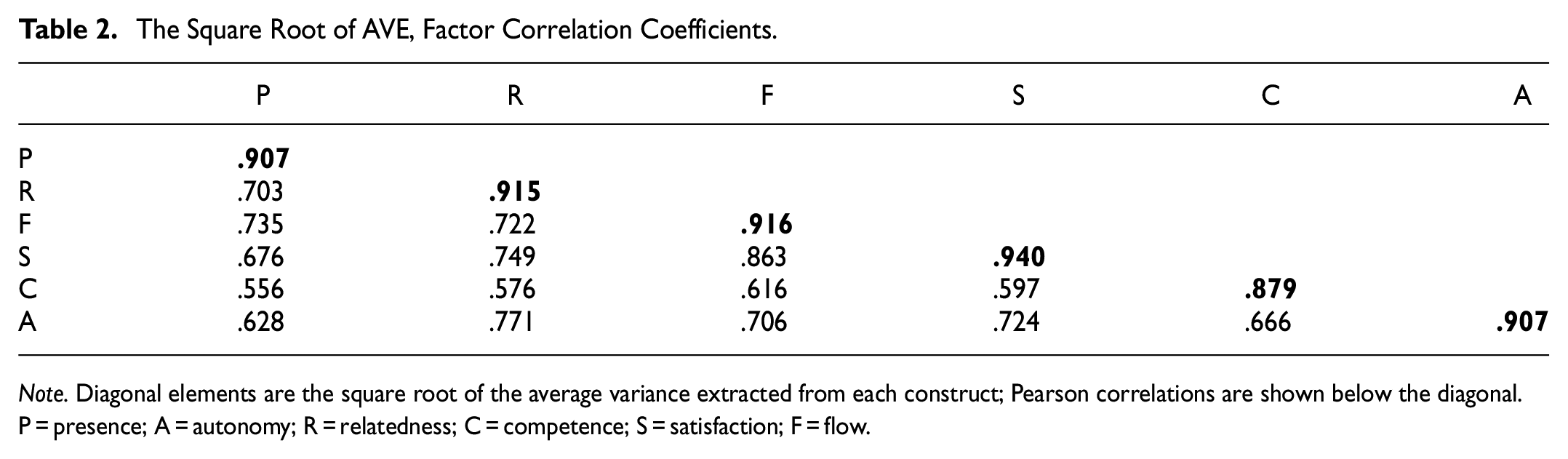
Note. Diagonal elements are the square root of the average variance extracted from each construct; Pearson correlations are shown below the diagonal.
P = presence; A = autonomy; R = relatedness; C = competence; S = satisfaction; F = flow.
Multicollinearity Diagnosis
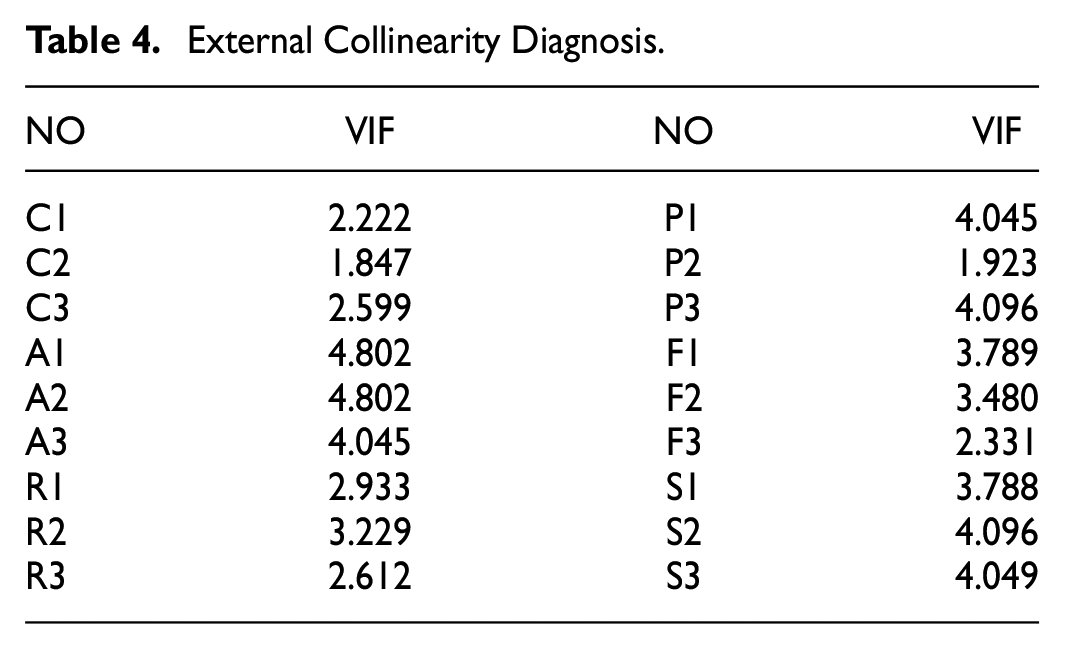
If there is collinearity between factors, it is very easy to cause deviation in path coefficients, so a collinearity diagnosis is required. The variable inflation factor (VIF) is often used to judge in research. When the VIF value is between 0 and 10, there is no collinearity. If the VIF value is between 10 and 100, there is a multicollinearity. When the VIF value is greater than 100, there is a serious multicollinearity (Diamantopoulos & Siguaw, 2006). Hair et al. (2014) believed that the VIF must be lower than 5 before there is no collinearity. This paper uses the PLS Algorithm of Smart PLS 3.0 to calculate the internal and external variance expansion factors, as shown in Tables 3 and 4. It can be seen from the table that VIF is less than 5, and there is no multicollinearity between variables.
Internal Collinearity Diagnosis.

Note. P = presence; A = autonomy; R = relatedness; C = competence; S = satisfaction; F = flow.
External Collinearity Diagnosis.
Results
Based on the integrated model of mind flow theory and satisfaction theory, this paper explores the factors influencing college students’ satisfaction with gamified courses from the perspective of SDT. The results of the study prove that competence needs, autonomy needs, related needs, and presence have direct or indirect positive effects on satisfaction with gamified courses. This study enriches and extends the theoretical basis of gamified course satisfaction research, and the specific findings of the study are as follows. The investigation results of the structural model are shown in Table 3 and illustrated in Figure 1. It provided the integrated explanatory power, assessed path coefficients (all significant paths are indicated with asterisks), f2, and associated T-values of each path in this model. The bootstrapping re-sampling procedure ware employed to test path significance. All hypotheses are supported. The related explanations of these outcomes are further stated in a later discussion section (Figure 2).

Results of the research model tests.
Table 5 shows the results of the hypothesis test. Competence (β = .146, p < .05) and Autonomy (β = .211, p < .001) positively affect the production of a cardiac flow, so hypothesis H1 and hypothesis H2 are supported. Relatedness (β = .215, p < .05) and Presence (β = .370, p < .001) have a significant positive effect on cardiac flow respectively, so hypothesis H3 and hypothesis H4 are supported. Cardiac flow (β = .863, p < .001) finally has a positive impact on satisfaction, so it is assumed that H5 is supported.
Results of Hypotheses Testing.

Note. P = presence; A = autonomy; R = relatedness; C = competence; S = satisfaction; F = flow.
The model illustrates that 11.0% of the variance exists in presence, 44.5% of the variance exists in autonomy, 25.1% of the variance exists in relatedness, 30.2% of the variance exists in flow, and 57.8% of the variance is related to competence. This result indicates that proposed conceptual model has adequate explanatory significance (Farooq et al., 2018). This result shows that the endogenous construct (i.e., perceived green value, customer satisfaction, perceived pleasure, and customer loyalty) involved in this study have strong predictive relevance (Chin, 2010). The standardized root means square residual (SRMR) value of this model is 0.07 (less than 0.08) and the Goodness of Fit (GOF) value is 0.512 (more than 0.36), which indicates a very good model fit (Hu & Bentler, 1998; Wetzels et al., 2009).
On the base of the above analysis, it is concluded that both the measurement model and structural model are validated. Moreover, these results show that proposed theoretical model of this study has significant predictive relevance and explanatory power.
Discussion
The purpose of learning gamification entrepreneurship courses is to better optimize the school curriculum, enhance students’ interest in learning, and allow students to better understand the content of business management after entering society. Combining existing theories and past research, this paper extracts five concepts and discusses the relationship between these five concepts and students’ course satisfaction. It is concluded that the generation of flow has a strong correlation with the four independent factors of competence, autonomy, relatedness and presence, and the flow state has a strong correlation with the satisfaction of the Gamification Entrepreneurship Course. This has a similar view to the research on traditional curriculum (Denson et al., 2010).
First of all, taking competence as an example, when completing tasks that are in line with one’s own ability can enhance self-confidence at work. According to Ryan et al. (2006) and Schuler and Brandstatter’s (2013) research, satisfaction with one’s own ability at work can indeed predict whether to enter flow. Especially in education (Luarn et al., 2023; Putz et al., 2020), Competence plays a more important role. That is to say, by formulating appropriate task difficulty, students can effectively improve their concentration and self-confidence while cultivating their problem-solving ability. The data in this paper can also find that high levels of ability performance are highly correlated with whether students enter a state of flow.
In SDT (Luarn et al., 2023; Reeve & Tseng, 2011; Ryan et al., 2006), Autonomy is described as a voluntary behavior. Taking the learning state as an example, in Hofferber et al.’s (2016) and Johansen et al.’s (2023) study, Autonomy learning behaviors make a huge difference between the intrinsic motivation and the timing of the flow state between students and passive learning students. This result indicates that autonomy needs play a huge role in flow.
Relatedness refers to an emotion acquired through a sense of belonging and social connection, which can be achieved by connecting with others, functioning in social groups, enhancing collective cohesion and belonging, etc.(Deci & Ryan 2000; Nysveen et al., 2022). Taking teenagers surfing the Internet as an example (L. Zhao et al., 2011), the intrinsic motivation of relatedness is far superior to other attributes when using the Internet, which can be explained as an important condition for maintaining focus and entering the state of flow.
Finally, presence can be understood as a sense of presence or participation (Caroux, 2022; Marto & Gonçalves, 2022; Ryan et al., 2006), which makes people willing to put themselves into the designed rules of the game to complete their corresponding tasks. Joo et al.’s (2013) research on e-learning also confirms that flow has a significant effect as an intermediate measure between instructional presence, cognitive presence, and satisfaction. This is consistent with the gamification curriculum we have studied, and the purpose of enhancing students’ presence through games to improve student satisfaction.
Compared with similar literature in recent years, we believe that research on entrepreneurship courses should not be limited to the research on students’ entrepreneurial intentions. Take Zelin et al.’s (2021) study as an example, in its survey of about 1,200 students receiving innovation and entrepreneurship education, the research focuses on students’ entrepreneurial intentions after completing the course. Zelin et al.’s (2021) research also shows that entrepreneurial intention is greatly influenced by students’ families and environment. And we believe that the curriculum should focus on the improvement of students’ content and ability, so we put more energy into the students’ curriculum status, hoping to find out the key to improving the efficiency of the curriculum.
Conclusion
Implications for Researchers
Overall, this study enriches the existing literature on research on undergraduate Gamified Entrepreneurship Courses satisfaction from multiple perspectives. First, this study constructs a new model to explore the satisfaction mechanism of Gamified Entrepreneurship Courses. Entrepreneurship courses, as an important link for college students to participate in the classroom and go to society, are also essential for the satisfaction research of such courses. At present, most of the related research studies on satisfaction from the relationship between classroom participants or other perspectives. This paper selects competence needs, autonomy needs, related needs, and presence as independent variables of the model from the perspective of SDT, and uses flow as a mediating variable to study the influencing mechanism of classroom satisfaction. Secondly, this paper explores the mechanism of the four elements of the game on flow. Based on the above research results, this paper analyzes the mechanism and influence of the four elements to guide the flow through the questionnaire survey data. Finally, this study confirms and explains how SDT and presence are used as antecedents of flow to guide satisfaction when participants generate curriculum competence needs, autonomy needs, related needs, and presence, participants will generate course satisfaction by instructing these needs to develop a flow state. That is, flow can convey various states of participants to satisfaction assessment. The results also showed that the flow-mediated pathway significantly outperformed the other pathways. Therefore, this study enriches the literature on the satisfaction research of college students’ Gamified Entrepreneurship Courses.
Implications for Practitioners
This study confirms that course satisfaction is most directly affected by flow, while competence needs, autonomy needs, related needs, and presence directly affect the formation of flow states. From the results of this study, several practical conclusions can be drawn. First, presence has the greatest positive effect on flow. This means that course designers and course instructors pay special attention to the students’ course experience when designing a course, which is enhancing the students’ sense of presence and making students feel like they are in a real company, able to manage a company, or act as a manager to make decisions. On the one hand, the simulation courses created by gamification can greatly stimulate students’ interest and enhance the sense of experience, as if they are really “immersed in the scene”; on the other hand, the improvement of the sense of presence can help students to enter a stable mind faster stream status, thereby increasing student satisfaction with the course. Second, autonomy needs to have a greater positive impact on flow. That is, teachers should respect and retain students’ autonomy in Gamified Entrepreneurship Courses, and ensure that students can express or propose their own ideas and solve problems in their own way. Higher autonomy ensures students’ personal experience and opportunities in Gamified Entrepreneurship Courses, helping students to integrate into the course more quickly and enter a state of flow more easily, which can lead to higher course satisfaction production. Third, the positive effect of relatedness on flow is second only to autonomy needs. Students usually need to establish effective connections with others in the course, it is easier to experience a sense of inclusion and belonging in the course, and to be able to get help from others or take the initiative to help others complete the work content. A better course experience and a sense of belonging to the course help students to engage in the course, thereby helping the flow state and the emergence of higher course satisfaction. Finally, competence needs also have a positive effect on flow. Teachers should pay more attention to the relationship between students’ overall level and comprehensive ability and problem design in curriculum design, not only to enable students to have the ability and confidence to complete the tasks arranged in the curriculum but also to allow students to achieve certain achievements in completing the tasks. This allows students to be personally affirmed in the course and thus more enjoyable and larger to study effectively into a state of flow, forget about the noisy environment, and focus on the things to be solved. This not only helps to improve the quality of the course but also helps students to have higher satisfaction with the Gamified Entrepreneurship Courses.
Limitations and Future Research Directions
There are inevitably some limitations to this study. Firstly, we only selected some colleges and universities for the questionnaire survey. The coverage and representativeness of colleges and universities are not high, and the sample has certain limitations. Secondly, the age, education and other attributes of the research samples are not very different, so the sample characteristics have little effect on the dependent variables of this study. However, it is unclear whether the findings still hold across age groups and levels of education. Third, this study takes the satisfaction of Gamified Entrepreneurship Courses as the research object and examines the generation of flow state and the satisfaction of the courses of college students from four dimensions: competence needs, autonomy needs, related needs, and presence. The effect of each dimension remains to be seen and further validated. Despite the above limitations of this study, we firmly believe that the contribution of this study cannot be ignored. From the above research results, it is not difficult to find that the effects of the four elements of SDT on flow vary to varying degrees, and the mediating effect of flow has not been widely promoted in the study of course satisfaction. Therefore, the authors suggest that the role of presence and flow should be emphasized in future research on course satisfaction, and the mechanism of college students’ willingness to continue learning in the course should be explored in follow-up research, to provide longitudinal tracking for the study of course satisfaction. We believe that the research provides a better understanding of satisfaction with Gamified Entrepreneurship Courses and will also provide related practitioners with effective advice. In addition, previous studies have also shown that flow and SDT theory can be used as entry points for research in various fields, this study also provides research basis for other studies (such as consumer satisfaction, music learning, and virtual experience) to adopt flow and SDT as research variables.
Footnotes
Declaration of Conflicting Interests
The author(s) declared no potential conflicts of interest with respect to the research, authorship, and/or publication of this article.
Funding
The author(s) disclosed receipt of the following financial support for the research, authorship, and/or publication of this article: This work was supported by Chengdu University of Technology “Double First-Class” initiative Construction Philosophy and Social Sciences Key Construction Project [ZDJS202304]; Sichuan Province higher Education Personnel Training quality and teaching reform project[JG2021-739]; Philosophy and Social Science Research Foundation Project of Chengdu University of Technology [YJ2022-ZD013]; Sichuan Network Literature Development Research Center [WLWX-2022003]; Research Center for Systems Science and Enterprise Development[Xq22C05]; National college student innovation and entrepreneurship project training program[202110616015].
