




Abstract
In recent years, there has been an increasing interest in the efficiency of the lecture and flipped classroom instruction method (FCIM) on EFL students’ academic passion (AP) and responsibility. Although these variables have been studied before, more studies still need to be conducted in this field. The statistical population of this study includes all language students at the University of Tabriz in the academic year 2022–2023. In the current study, 72 of 552 persons were selected using a one-stage cluster sampling method from students in term two and randomly assigned to two groups (36 persons for each group). This research is a quasi-experimental method based on the objectives and method of data collection. Two questionnaires were used in this study: AP and responsibility questionnaire. The content validity index (CVI) and content validity ratio (CVR)methods examined the content validity of the textbook course. The results showed that students’ AP and responsibility in flipped classroom instruction (FCI) are significantly higher than in the lecture method. Thus, by activating learners, they can direct their thoughts and actions in a way that has a more significant impact on their motivation, AP, responsibility, and ultimately on their learning. It can be concluded that FCI is more efficient than the lecture method.
Introduction
Different methodologies have been used at different times to teach English. The lecture is among them, despite all its shortcomings, some advantages have made it still used as one of the most common methods in schools and institutions. According to Kaur (2011), lectures are considered easier, more efficient, and more flexible than any other teaching strategy. However, they are teacher-centered rather than student-centered that is, the students are inactive participants in the learning process, they just listen and receive the instructions.
On the other hand, contrary to the traditional method such as lecturing, FCI is more student-centered that is, students are responsible for their learning process according to their individual needs (Bergmann & Sams, 2012). In FCs, the teacher is considered a facilitator of learning, and students are supposed to come to the class prepared and actively collaborate during class activities (Gillette et al., 2018; Kay et al., 2019; Veres & Muntean, 2021). The need to pay attention to educational methods is one of the requirements of educational systems because using new teaching methods can increase the effectiveness of continuing education (Kazeminia et al., 2022). Many new teaching methods have been formed based on different goals with specific learning and training outcomes that can be applied contingently (Teo et al., 2022). One of the new methods that is very popular today is flipped classroom instruction (FCI) (Burke & Fedorek, 2017; Ng et al., 2022; Shen et al., 2022).
Paying attention to the psychological factors of students is another factor affecting learning. Passion and responsibility are among such factors. Passion is a motivating and learning facilitator factor (Altun, 2017). It positively affects the teaching and learning process and is associated with the student’s achievement (Serin, 2017). Moreover, to become autonomous learners, students must take responsibility for their learning. This taking personal responsibility depends on both teaching methodologies and metacognitive input which consists of two related components: students’ cognitive strategies and planning and implementing them in appropriate activities related to learning (Devlin, 2002).
Responsibility is a social skill that has been considered by psychologists (Bayati et al., 2022). Meanwhile, Tabai et al. (2022) emphasized social responsibility, considered the human species as a social being, and stated that human beings are constantly in contact with people in society. These contacts cultivate a sense of community and force people to build relationships and take full responsibility for their own lives (Tabai et al., 2022). Due to the increasing development of technology and public access, especially to young people and students, to new information and communication technologies, education can be based on these technologies and use their capabilities in education.
Todays, we are observing the expansion of communication tools such as Tablets and Smartphones, through which reading and accessing information is not limited to a specific time and place, and the required information can be accessed at any time and anywhere. These facilities can be used in learning and teaching. In FCL, by using different technologies in critical situations such as war, disease outbreak, or in case of interference of courses and other instances in which it is not possible to form classrooms in schools and universities, it is possible to help educate and save it from closure. Therefore, it can be said that new technologies and teaching methods are also used in the service of education.
Various research has been done to evaluate the effectiveness of the FC, including Ainulluluah et al. (2022), Galindo-Dominguez (2021), Hew et al. (2021), Huang et al. (2022), Özbay and Çınar (2021), and Polat and Karabatak (2022). The results showed a statistically significant difference in comparison between the mean, the highest score, and the acceptance percentage. The students agreed that the FC method allowed them to work independently at home and see the training materials again. According to the research background, the FC instruction method has shown its effect during its short life. This method can be one of the most effective methods due to its features such as supporting constructive educational processes, providing opportunities for learning, flexible educational support for learners’ activities, balancing direct self-learning education, and using real-life contexts that have personal meanings for learners.
This study aimed to compare the effectiveness of the FCI and lecture method on AP and responsibility. To the best of researchers’ knowledge, few studies have been conducted in this field, at least in Iran, and more research needs to be done.
Hypotheses
Students’ AP with FCIM is significantly higher than the lecture method.
Students’ responsibility with the FCIM is significantly higher than with the lecture method.
Review of Literature
Flipped Classroom Instruction
FCI is one of the teaching and learning methods that use technologies to transfer education and facilitate learning (Gonzalez-Gomez et al., 2022). The concept of an FC was introduced by two high school teachers in Colorado named Bergmann and Sams. In this method, the teacher already provides the content that is to be taught to the learners in a session (Ruiz-Jiménez et al., 2022). They should learn the instructional content individually at home or outside the classroom by watching videos or experiments, audio or text files, or whatever the teacher provides to better understand the subject of the class session. A classroom is a place for conversation on problem-solving, questions and answers, and practice solving are some of the things that happen in the classroom (Torres-Martín et al., 2022). Activities that are supposed to take place at home replace teaching in the classroom. In other words, it means replacing traditional interactive and participatory activities with conventional teaching methods (Khodaei et al., 2022). The theory behind of FCs and their conceptual foundations are based on student-centered learning theories (Piaget, 1968; Vygotsky & Cole, 1978).
The most issues of utilizing the flipped classroom approach incorporate the high workload of instructors to make flipped instructing materials and the need for cooperation of learners in learning exterior the classroom (Laura-De La Cruz et al., 2022; Li et al., 2022; Pratiwi et al., 2022). Flipped classrooms have preferences and drawbacks. On the one hand, they offer assistance to teachers to save valuable lesson time while expanding student engagement. On the other hand, they can improve the arrangement time of teachers and make challenges for learners. Flipped classes typically depend intensely on innovation and frequently require high-speed Web get for off-campus. On the other hand, a few classrooms utilize video-based course content for students (Cevikbas & Kaiser, 2022).
Academic Passion
The theoretical background of AP is related to Walberg’s theory which suggests that the psychological features of individual students and their immediate psychological environments impact educational outcomes (cognitive, behavioral, and attitudinal) (Reynolds & Walberg, 1992). AP means having a desire for something or a great interest in the affairs and aspects of work. AP is a sense of belonging and inclination to participate in-class activities as one of the important results of school along with school success (Williams, 2013). AP can include participation in extracurricular activities such as sports, music, theater, and teamwork organized by the school. It is also about participating in learning schoolwork (Fredericks et al., 2004). AP is a measure that was first proposed to understand and explain academic failure and was considered a basis for reform efforts in the field of education (Fredericks et al., 2004). Research shows that the more students can be involved in learning and homework, the more they can hope for academic success. Conceptually, AP includes both the behavior of students at the university and their emotional or psychological attachments to the university. AP can refer to students’ behavior or feelings about classroom topics, university regulations, teachers, and peers (Sverdlik et al., 2022). The concept of AP refers to the quality of the effort that students make in purposeful educational activities to achieve the desired results directly; in other words, AP is a kind of psychological investment and direct effort to learn, understand and master the knowledge, skills, and arts that promote academic activities (Ergezen et al., 2022). The concept of AP has attracted increasing research attention in the last two decades ( Ergezen et al., 2022; Fredericks et al., 2004; Hussein, 2023; Polat & Yilmaz., 2022).
Four models have been proposed for AP. One of these models is the model of Blumenfeld and Paris (2004). AP has three behavioral dimensions (positive behaviors, homework, participation in extracurricular activities that are useful for psychosocial adjustment and student progress), emotional (student’s feelings, interests, perceptions, and attitudes toward school), and cognitive (psychological empowerment of students in learning and application of self-regulatory strategies).
The second model is the model of Rumberger and Larson (1998). In this model, AP is characterized by two components of AP and social motivation which play a role in academic adjustment. Social motivation is defined by behaviorists as attending classes, accepting regulations, and actively participating in class-related matters. AP also includes student attitudes toward school and the ability to meet performance expectations.
The third model is the model of Newmann et al. (1992). In this model, AP is defined as students’ psychological capital and their direct efforts to learn and acquire skills, and the desire to improve their level of success, which can lead to effective participation in school activities, participation in-class activities, adaptation to school culture (quoted from Shaaria et al., 2014).
The fourth model expresses AP through persistence and a positive emotional-motivational state about schoolwork. It includes three aspects: enthusiasm, enchantment, and absorption. Enthusiastic students cognitively use metacognitive strategies to practice, plan, and evaluate their progress and efforts.
Based on the Bloomfield and Paris model, educational passion has three components: Cognitive desire for flexibility in problem-solving, preference for hard work, and positive confrontation against failure (Burrows, 2010; Polat & Yilmaz, 2022; Wang et al., 2011). Learners improve strategies such as summarizing, pre-reading, organizing and reviewing contents, and academic achievement (Ergezen et al., 2022). Many learners may show behavioral cues to pay attention to the teacher, such as looking, but their mind wanders elsewhere. Wang and Holcombe (2010) urge learners to think deeply about learning content, use different learning strategies that increase their understanding of the curriculum, and think critically and creatively about learning. Cognitive enthusiasm involves deep thinking about the disciplines that have been learned and using metacognitive strategies to learn the disciplines and practice, plan, and evaluate their progress and efforts (Pintrich & De Groot, 1990). Students repeat, summarize, and elaborate on what they are learning to organize and learn well in their minds (Michos et al., 2022).
Behavioral enthusiasm includes learners’ observable behaviors in dealing with homework that the instructor can easily see during the lesson (effort, perseverance, accuracy and attention, positive attitude, attendance at school, and seeking help) when face with a problem while performing homework and asking for help from the teacher or peers to learn and understand the material (Kaur et al., 2023; Love et al., 2014).
The emotional dimension of passion refers to the student’s emotional reactions in class, and at school, and effective attitudes to recognize a sense of belonging to the education place. Researchers interested in motivation have conceptualized emotional passion as observable emotional states created by specific scientific activities. In this sense, emotional passion refers to the quality of emotion such as enthusiasm, interest, and feeling of pleasure during scientific activities. Emotional passion is also defined as the student’s feeling of emotional connection with the school and school staff. An emotional desire for interest or disinterest in school, teachers, and homework refers to positive and negative emotions such as pleasure, curiosity, anxiety, anger, or boredom (Chang et al., 2022). Some studies show that students who are cognitively and emotionally enthusiastic about learning, show more willingness to spend time and enough effort on homework than students who have lower levels of cognitive and emotional passion (Abbasi & Dargahi, 2014).
Research results emphasize that a lack of enthusiasm for school can increase serious consequences such as a lack of academic achievement, a tendency to deviant behaviors, and the risk of dropping out of school (Douglas, 2022; Sverdlik et al., 2022). Coordination and alignment of inclusive behaviors (study habits, interests, time management, motivation) and environmental conditions (university environment, peers, educational approaches and family atmosphere, academic support, and other factors) cause enthusiasm and success in the individual. There are several factors in creating AP, and the teacher and teaching method are the most effective. Traditional methods, especially lecturing, are generally compared to the most common method of teaching university courses.
Responsibility
The theoretical background of social responsibility is an ethical theory in which persons are responsible for doing their public obligation, and the actions of an individual must profit the whole of society. Responsibility is one of the basic and necessary skills for every person. It is a social skill whose role has been considered by scientists. Human beings are social beings and to maintain their survival, it is necessary to interact with people in society. Communicating with others requires the acquisition of social skills to provide how to satisfy the needs of themselves and others. On the other hand, to live for a long time, man has to cooperate with his fellows accepting responsibility because his needs have been met with the help and assistance of others. In the meantime, having some skills provides the ground for giving appropriate answers so that one can live, learn and work effectively. Responsibility is a social skill that has been considered by psychologists (Genschow & Lange, 2022). In the meantime, Bondar (2022) has emphasized social responsibility, considered the human species as a social being, and stated that humans are constantly in contact with people in society. All of these contacts cultivate a sense of community and force people to build relationships and take full responsibility for their own lives.
Sereda and Jaskolka (2022), on the other hand, introduce a responsible human being as a right human being and criticizes the psychoanalytic approach, stating that this approach, with the past focus on individuals, takes responsibility for life and choice from a human being. On the other hand, they state that the problem of human beings and their anomalies has been the lack of responsibility because this state causes the person to be unable to satisfy their basic needs based on a proper and humane situation.
In this regard, Sereda and Jaskolka (2022) consider responsibility as the ability to meet one’s own needs and accept the consequences of behaviors in a way that is not an obstacle to meeting the needs of people in society.
According to Sripada’s (2022) theory of choice, human control over one’s behavior is a conscious control, so one chooses one’s general behavior and is responsible for one’s own choices. On the other hand, Sripada believes in his theory that the theory of choice is about better choice, but before that, each person must understand the reason for their choices.
Therefore, according to this theory, human beings are responsible for all the consequences of their choices. An important part of choice theory is based on the premise that individuals are ultimately the decision-makers and responsible for their own lives; among these, two components of performance and thinking play an essential role. On the other hand, according to this theory, focusing on internal forces provides the conditions for responsibility and prepares the individual to create a suitable environment for a useful life (Genschow & Lange, 2022).
In the last few decades, various theories have emerged due to the importance of responsibility and its relationship with the category of education. The idea of existentialism is one of the important theories in this field. According to this theory, responsibility is an existential thing that flourishes through education (Bondar, 2022). Due to the importance of responsibility to cultivate this trait in people, special attention is paid to educational methods. In this regard, it is stated that if children and students of a country become responsible and have a broad vision, they will be able to solve many problems in the future to overcome life problems. Therefore, it is necessary to create interventions that can increase the responsibility of individuals. In education, one of the interventions that can effectively improve learners’ responsibility is educational methods, during which the person takes responsibility for learning and strives to achieve it.
The methods used in education systems to create responsibility in learners have been direct for a long time, especially lecturing methods. The lecture method is one of the old and most common teaching methods in educational systems today. This method is one of the direct or teacher-centered methods in classifying teaching methods because of its simplicity of implementation and low cost in terms of economics and time; many teachers use it at most levels of education. Presenting concepts orally by the teacher and learning them through listening and taking notes on the student is the basis of this method. In this method, one-way communication, and inactivity of learners during education lead to fatigue and boredom and can be a barrier to a sense of pervasive responsibility for learning and its consequences.
FCI, which promotes the development of students’ thinking, reasoning, and communication skills, has a special place. This method has effectiveness in influencing educational variables during its short life. Today, society needs new and creative educational models to prepare students to face life crises and take advantage of their opportunities, abilities, and creativity. Therefore, instead of remembering, students should learn how to learn scientifically through thinking and dealing with problems regularly (Huang et al., 2022). The FC is a new method that has been considered by educators, especially teachers, since 2004. The idea of an FC is a relatively new concept in education. The FC is a new model of education in which education is done at home and homework is done in class. Students watch instructional videos at home before class and spend time in class solving exercises, doing projects, and discussing what they have learned. Instructional videos, which are the main and key structure of flipped teaching, are usually prepared by the instructor or selected from online instructional resources.
Bergman and Sams (2004) are pioneers of flipped education. They believe that every education is based on three elements: content, communication, and curiosity. From their point of view, the element of curiosity is more important, which means that the teacher should be able to arouse curiosity in students, so they are prepared to learn the content. One of the most important ways to arouse curiosity in students is to change the way of lecturing. It is done in a way that learners search to answer their questions. In the FC, the time and place of the class are devoted to the exploration, depth, and enrichment of learning (Ainulluluah et al., 2022).
Another type of inequality that can be addressed using the FC model is parental involvement and their level of education. Students completing homework have different levels of parental assistance that they may have enough time or knowledge to support their children. Still, students who do homework in FCs are allowed to receive direct and face-to-face help from their instructors (Polat & Karabatak, 2022). The value of flipped instruction is turning class time into a workshop where learners can comment on educational content, evaluate their learning, and interact with other students through hands-on and group activities. The teacher acts as a mentor or advisor during the FC session, encouraging students to do more practice and group activities.
In recent decades, there has been a fundamental change in new approaches to knowledge transfer with the transition from a behavioral perspective to a constructivist perspective. In this approach, the emphasis of experts is on using new methods of student-centered (Polat & Karabatak, 2022). Student-centered education refers to learning in which learners, with the help of the teacher, take responsibility for understanding and comprehending the material (Ainulluluah et al., 2022). According to the constructivist view, one of the most effective models that have received a lot of attention recently and is closely related to the philosophy of constructivism is the flipped class model, which can be used as a solution to problems. In this modified paradigm, learners observe the educational content before the class, attend the lesson with readiness, and participate in the learning activities provided by the teacher. In an attempt to restructure the traditional classroom, this method leads the learner to better learning.
Method
Design of Study
The present study is quasi-experimental according to the objectives and method of data collection. In this regard, the research design is a type of experimental design, part of which is between groups and another part is within groups with pre-test and post-test in which there are independent variables with two levels of FCI and lecture method.
Statistical Population
The statistical population of this study includes all language students at the University of Tabriz in the academic year 2022 (552 people). In the present study, 72 people were selected from second-semester students using a one-stage cluster sampling method and randomly assigned to two experimental and control groups (36 people) for each group. The criterion for entering the research is the selection of English language students who were willing to attend classes and entered the university before 2023. In the explanation that in estimating the sample size, Kerlinger’s (1967) recommendations were used. For experimental designs, a random selection of samples over 30 people can guarantee the validity of the external validity of research findings.
Academic Passion
This scale has 15 items, which are: Measures of behavioral, emotional, and cognitive analogy among students. The answer to each item has a score of 1 to 5, which includes (never = 1 to always = 5). Fredericks et al. (2004) reported a reliability coefficient of 0.86. Abbasi et al. (2015) obtained the reliability of this questionnaire using Cronbach’s alpha of .66. The present study’s reliability coefficient based on Cronbach’s alpha index was .78. The results of this test showed that the questions of this questionnaire have a good internal consistency.
Responsibility
The tool used to measure responsibility was the Nemati Responsibility Questionnaire (2009), which has 50 items. This questionnaire has one component. In Mohseni’s (2013) research, factor analysis methods, and group differences have been used to check the validity (content) of the questionnaire. The results show that the test consists of seven factors and the commonalities of the questions (correlation of each question with the general concept of the test, that is, responsibility is between 48% and 78%) and it is often high. The validity of the structure through group differences was also performed on two groups with high and low responsibility using a t-test for independent groups, which showed the results of significant differences in all seven factors, Nemati Responsibility Test (2009) separated these two groups from each other and had a high structural validity. The questionnaire is scored in such a way that each phrase has five options: strongly agree, agree, disagree, disagree, and strongly disagree. Scoring follows methods 1 to 5. In the questions that are scored directly, if the participants choose the opposite option, the score is 1, and if they choose the opposite option, they score 2. If they choose the blank option, the score is 3. If they choose the agreeing option, they get a score of 4, and if they choose the completely agreeing option, they get a score of 5. The reliability of this questionnaire was also obtained with Cronbach’s alpha coefficient of .94 (Nemati, 2009).
Questionnaire Reliability
Regarding the reliability of the questionnaires, Cronbach’s alpha index obtained for the academic passion questionnaires is .731. The responsibility is .810 and higher than .7, and the questionnaires have the necessary reliability.
Results
Data Analysis
After collecting research data, SPSS 25 software and univariate analysis of covariance were used to analyze it.
Validity of Taught Lessons
The content validity of the textbook sections was examined by CVI (content validity of index) and CVR (content validity of ratio) methods using the opinions of 20 experts. The results are as follows: Note that the CVR index for 20 people should be higher than 0.42, and the CVI 0.79 (Table 1).
CVI and CVR Results of Professors’ Self-Assessment Questionnaire.

Descriptive Findings
The results of demographic information are presented in Table 2
Comparison of Students’ Gender in the Two Groups of FCI and Lecture-Based Teaching.
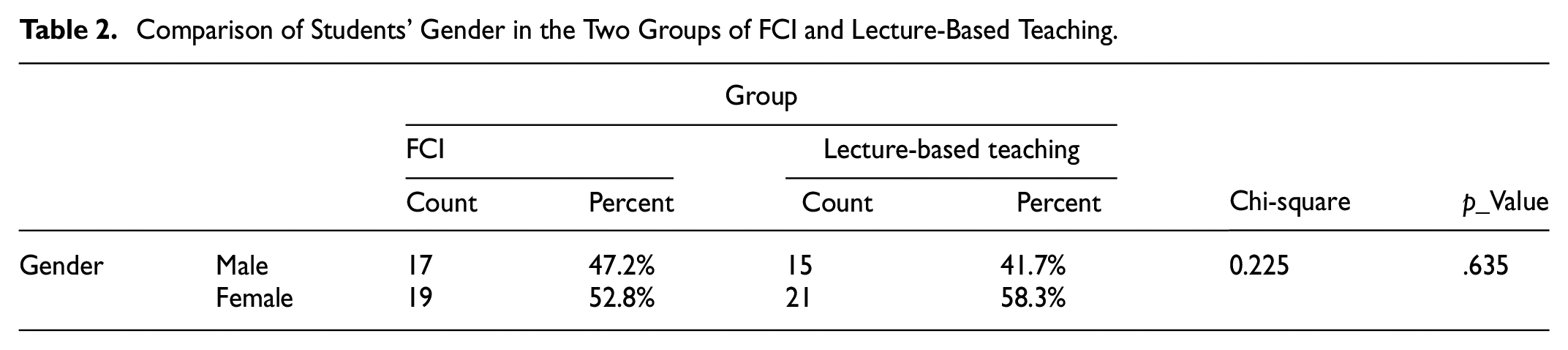
Table 2 shows that from the FCI group, 47.2 were male and 52.8% were female, and from the lecture-based teaching group, 41.7% were male and 58.3% were female.
The results of Table 3 showed that the mean age of students in the FCI group was 21.88 ± 3.85 and in the lecture-based teaching group was 21.38 ± 3.92, that no significant difference was observed between the two groups through independent t-test (p_value = .587). Therefore, none of these variables play a covariate role in testing the hypothesis.
Comparison of Students’ Age in FCI and Lecture-Based Teaching.

In this section, the researcher first examines the central indicators (mean) and scatter (standard deviation) of research variables:
The results of Table 4 showed the mean of the pretest in the AP variable is 40.97 ± 5.31 in the experimental group, and the control group is equal to 39.38 ± 5.05. The mean of this variable in the experimental group’s post-test is 44.05 ± 3.56 and in the control group is 39.58 ± 5.50. Academic passion increased in the experimental group after the intervention.
Central Indicators and Dispersion of Pre-Test and Post-Test in Control and Experimental Groups.

The independent t-test shows a significant difference between the mean of passion and responsibility variables after the intervention in FLI. The independent t-test showed that the mean of academic motivation between the two groups in the pre-test was not significantly different (p_value = .129). But in the post-test, a significant difference was observed between the two groups (p_value = .001).
The mean of the pre-test in the responsibility variable in the experimental group is 144.19 ± 13.36 and in the control group is equal to 147.05 ± 13.75. The mean of this variable in the experimental group’s post-test is 170.21 ± 9.35 and in the control group is equal to 154.22 ± 12.01. Responsibility in the experimental group increased after the intervention.
The independent t-test showed that the mean of responsibility between the two groups in the pretest did not differ significantly (p_value = .129). But in the post-test, a significant difference was observed between the two groups (p_value = .001).
Inferential Analysis
Analysis of covariance was used to test the research hypotheses. Covariance analysis is a comprehensive type of analysis of variance. While comparing the means of one or more groups and estimating one or more independent variables, the effect of intervening variables, or covariates, is excluded from the equation.
Assumptions of Analysis of Covariance
Before analyzing the research data, the assumptions of the ANCOVA test, that is, data normality, variance homogeneity, regression homogeneity, and linearity of the scattering variable and the independent variable are examined. The results are presented in the following tables:
According to the results of the Kolmogorov-Smirnov test in Table 5, the hypothesis of normality of research variables by control and experimental groups was confirmed (p value >.05).
Kolmogorov-Smirnov Test (K-S) for Pre-Test and Post-Test of Control and Experimental Groups.

Significant level at .05.
Defaults 4 and 5 Regression Slope Homogeneity and Confirmation
The results of this was done through an analysis of covariance, which is presented in Table 6.
Regression Slope Homogeneity Test and Confirmation of the Effect of the Auxiliary Variable.

Significant level at .05.
According to Table 6, the assumption of homogeneity of regression slope was accepted by analysis of covariance (p value >.05). Based on the results of Table 6, the choice of an auxiliary variable (pre-test) as a covariate is confirmed in this study (p value <.05).
Investigation of Research Hypotheses
The first hypothesis of the research: Students’ AP for the FCI method is significantly higher than the lecture method.
Analysis of covariance was used to test the above hypothesis. As observed, the necessary assumptions for the analysis of covariance have been examined, and these assumptions are valid. The results of the analysis of covariance are recorded in the following tables:
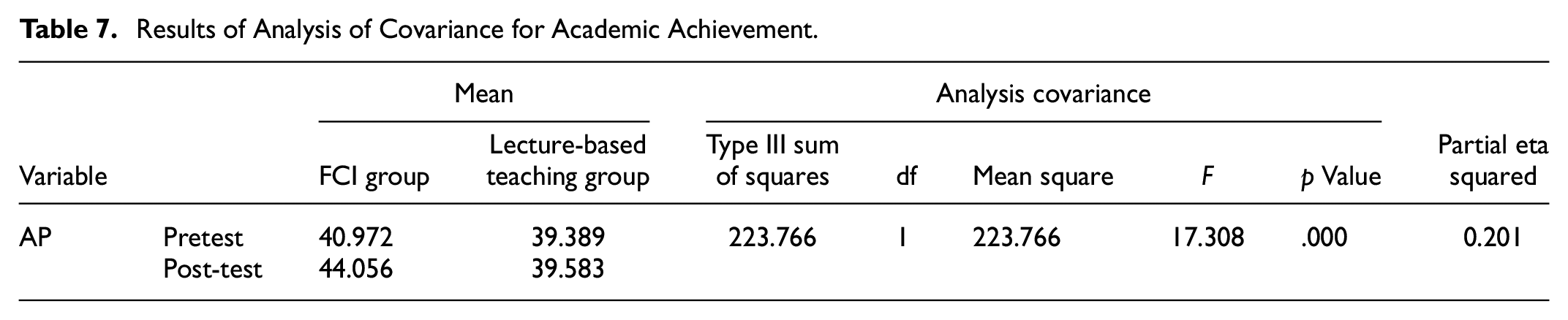
As can be seen in Table 7, teaching in FC compared to the lecture method has a significant effect on AP (p value = .001, F = 17.308), and it was concluded that the mean of the two groups in the post-test after adjusting the pre-test scores, there was a significant difference with each other. As can be seen in the table, the mean scores of AP in the group by lecture method in the pre-test was 39.389 and in the post-test was 39.583, while the mean of this variable in the group with the FCI method was 40.972 in the pre-test and 44.056 in the post-test. Due to the significant difference between the scores in the post-test in the two groups, it was concluded that by eliminating the pre-test factor (covariate), FCI increases AP. Due to the size of the effect of the second power factor, up to 20% of the variability of AP in the first group is related to FCI.
Results of Analysis of Covariance for Academic Achievement.
The Research’s Second Hypothesis: Students’ Responsibility for the FCI Method is Significantly Higher Than for the Lecture Method
Analysis of covariance was used to test the above hypothesis. As observed, the necessary assumptions for the analysis of covariance have been examined and these assumptions are valid. The results of the study of covariance are recorded in the following tables:
As can be seen in Table 8, flipped class instruction compared to the lecture method has a significant effect on responsibility (p value = .001, F = 55.35), and it was concluded that the mean of the two groups in the post-test after adjusting the pre-test scores, there was a significant difference with each other. As can be seen in the table, the mean score of responsibility in the group by lecture method in the pre-test was 147.056 and in the post-test was 154.222, while the mean of this variable in the group by FCI method was 144.194 in the pre-test and post-test was 170.213. Due to the significant difference between the scores in the post-test in the two groups, it was concluded that eliminating the pre-test factor (covariate) training in the FCI increases responsibility. Due to the size of the effect of the second power factor ETA, 44% of the change in responsibility in the first group is due to FCI. To evaluate the effect of the FCI method, the researchers used the paired t-test in the intervention group. This test for the pre-test and post-test of AP is presented in Table 9.
Results of Analysis of Covariance for Responsibility.

Paired T-Test of Variables in the Intervention Group.

The results of paired t-test in Table 9 showed:
FCI has a significant effect on improving AP and responsibility (p = .001). In other words, it can be inferred that the FC method effectively affects students’ AP and responsibility.
Discussion
This study aimed to investigate 1-Students’ AP with FCIM is significantly higher than the lecture method 2. Students’ responsibility with the FCIM is significantly higher than with the lecture method.
Regarding the first hypothesis, students’ AP with FCIM is significantly higher than the lecture method: Teaching in the flipped class is one of the new teaching models. It was studied in the present study and was found that the student’s grade in the flipped class is higher than in the lecture method. In the study, Harrington et al. (2015) compared two methods of traditional teaching and learning based on flipped classrooms in nursing students. The flipped classroom teaching method has been found to be a very effective strategy in facilitating learning, which is also consistent with the present study. Using the flipped classroom method not only leads to the active and creative participation of students but also is effective in the production of educational content by students.
The findings of this study show that FCI effectively improves students’ AP. This finding is consistent with the findings of (Bouwmeester et al., 2019; Burrows, 2010; Chang et al., 2022; Chen et al., 2018; Douglas, 2022; Fannakhosrow et al., 2022; McLean et al., 2016; Polat & Yilmaz, 2022; Wang & Holcombe, 2010; Wang et al., 2011) and inconsistent with Laura-De La Cruz et al. (2022), Li et al. (2022), Pratiwi et al. (2022) findings. In explaining this finding, AP can be considered an activity that motivates active learning. People who increasingly integrate them cause to increase in their desire to learn. In other words, when active motivation and learning are combined, they promote learners’ passion for learning because passion works stronger with more overlap between these two factors. Also, due to its high flexibility, the FC does not have a completely fixed framework, so the learner learns according to their passion and interest whenever they want. The program is corrected based on interests and comprehensive facilities, increasing the passion for studying. Polat & Yilmaz (2022) and Wang et al. (2011) believe that people who attend classes regularly focus on learning topics, adhere to school rules, get high grades overall, and perform better on standardized academic achievement tests. Lack of passion for school can lead to serious consequences such as lack of progress in school, a tendency to deviant behaviors, and the risk of dropping out of school. As another explanation for the present research finding, researchers can refer to the view (Bouwmeester et al., 2019; Chen et al., 2018; McLean et al., 2016) that believe that the FC is a method of teaching to change the traditional teaching method.
In the traditional method, the lesson is dedicated to the educational content, and in this regard, assignments are considered for learners to use outside the lesson. The FC is a strategy that records instructional lectures through videotape and transmits it out of the classroom (Fannakhosrow et al., 2022). On the other hand, the FC includes spending class time on individual learning and using the types of teaching and learning materials, encouraging learners to take responsibility for their learning, and authorizing them to achieve content-based learning (Douglas, 2022; Sverdlik et al., 2022). In the FC, the learner reads the lesson’s content beforehand and repeatedly watches the teacher’s teaching—focusing on a specific section. They can also ask questions and delve deeper into the topics in the classroom, cause to more effective and deeper learning.
This approach can improve teacher-student interaction—facilitate deep learning through classroom learning activities—class dynamism, increase learners’ motivation and desire for deeper learning; help learners understand their learning styles and practices, and foster learners’ engagement (Kaur et al., 2023; Michos et al., 2022). In this approach, content delivery in the classroom is also left out. Instructors can provide classroom activities by teaching learners how to access problems and apply real-life information. Implementing FCI increases learners’ understanding of the importance of pre-classroom activities and strengthens them within the classroom (Wang & Holcombe, 2010). Various studies also show that learners’ perceptions of flipped learning teaching activities have been positive. They prefer to have lectures in visual form but are more inclined to have more class interactive activities (Wang & Holcombe, 2010).
On the other hand, according to the findings (Chang et al., 2022), many learning problems in undergraduate students arise from the fact that they have a passive role in the traditional lecturing method. Research findings recommend teachers develop environments that facilitate AP. The studies (Douglas, 2022; Sverdlik et al., 2022) show that FCs motivate learners more than traditional classes. Passion for school is also an essential element in academic success and achievement and is the focal point of most theories related to academic failure.
In general, the core of all existing theories in the flipped classroom revolves around the active engagement of learners with educational materials and learning tasks; therefore, by actively engaging students in learning tasks, they can direct their thoughts and actions in a way that has a positive effect on their academic motivation, passion and ultimately their learning. Individualization of each student’s learning; more interaction between students and teachers; more opportunities for teachers to help students who need more effort; more time for the teacher to challenge gifted students. Parents’ participation in their children’s learning, replacing educational videos instead of the screens that are used, is one of the positive consequences of the flipped classroom method. One of its important results is the increase in students’ academic passion.
Regarding the second hypothesis students’ responsibility with the FCIM is significantly higher than with the lecture method.
One of the important and necessary steps in educational design is choosing the teaching method. In the lecture, the teacher can be considered as the sender and the audience as the receiver. In this sense, speech is a one-way way of transmitting information in which the speaker usually plays a passive role (Martos-Pedrero et al., 2023). Many teachers are trying to take the education process out of the passive mode and encourage learners to actively participate in learning the subject matter. Therefore, choosing the appropriate teaching method, in addition to more effective learning, provides a greater sense of satisfaction in the learner and is of great importance.
The findings of this study show that FCI effectively improves students’ responsibility. Since no research has been done on the effect of flipped learning on responsibility, the researchers try to achieve this by examining studies with a conceptual and indirect relationship with the subject. For example, Murillo-Zamorano et al. (2019) in their research concluded that FCI affects knowledge, skills, and participation in higher education students. The results of Rodríguez et al. (2019) research show the effectiveness of FCI on the essential skills required by elementary school students and teachers. They showed that FCI is more effective in developing students’ creativity skills. Research results (Sereda & Jaskolka, 2022; Shen et al., 2022) showed that the application of the FC leads to the realization of motivations that are primarily related to the individual and the student in the FC while accepting the responsibility of learning, moves forward based on his learning speed and habits.
Another factor that was effective in getting the FC was external motivations or motivations that were realized in learning groups. These factors included group interactions, receiving feedback, and participation in the learning process. According to students, these factors greatly impact their learning and have led to the formation of desirable individual and academic outcomes for them. Students who learn through active learning learn better and enjoy learning more because they are actively involved in learning instead of just listening and taking responsibility for their learning (Kwon & Woo, 2018).
As a result of these findings, it can be said that the flipped class is a model that is an active, comprehensive, and cooperative learning model. It covers most of the learning patterns, and on the other hand, activities such as summarizing and note-taking, question and answer, timely feedback (group and individual), online discussion, online communication, and group discussion are activities that take place during the flipped class. It is common and each of these activities are among the activities that somehow cover a variety of responsibility.
In another explanation, researchers can refer to the view of Sereda and Jaskolka (2022), who consider responsibility as the ability to meet their needs and accept the consequences of behaviors. One of the salient features of the FC is that it does not only involve spending class time on individual learning, but also uses a variety of teaching instructions, encourages learners to take responsibility for their learning, and empowers them to achieve content-based learning (Bondar, 2022; Genschow & Lange, 2022).
The results of the present study showed that the lecture-based teaching method is also effective in improving students’ responsibility, although it was less effective than the FCI. Researchers can explain this finding to Bayati et al. (2022) view that homework is considered an extended learning time. In the method of lecturing, he knows that his task is to learn what the teacher says in class and do the tasks that he assigns. This model is the duty model of the circuit, in such a model, curriculum, educational content, academic assignments, and assignments are pre-defined. The learner feels responsible for the duties of the school, although such a feeling is not based on the individual’s preferences. In such circumstances, the student knows that she or he will be expelled from the educational system if she or he does not do her or his homework, acting according to the teacher’s opinion and homework. One of the important applications of the FCI is used in situations where it is impossible to form courses for any reason, so we have recently seen a practical example of it during the outbreak of Covid19 disease.
Conclusion
The purpose of this study was to compare the efficiency of the lecture and flipped classroom instruction methods on EFL students’ academic passion and responsibility. Our findings suggest that using FCI compared to the lecturing method creates AP and responsibility effectively. The first major finding was that students’ academic passion is significantly higher with the flipped class teaching method than with the lecture method. The second major finding was that students’ responsibility is significantly higher with the flipped class teaching method than with the lecture method. Therefore, planning and organizing training courses for teachers to implement this educational method can increase learners’ responsibility and AP. It should be noted that using the FCI, with special benefits, requires careful planning and educational design. So, teachers should be conscientious in using these methods. Holding in-service classes and training workshops in this field can help properly use the field.
The core of all existing theories in the FCI revolves around the active involvement of learners with learning materials, and learning assignments are remote; thus, by actively engaging learners with learning tasks, they can direct their thoughts and actions in a way that has a positive effect on their motivation and AP and ultimately on their learning. In FCI, individualize each student’s learning; more interaction between student and teacher; more teacher opportunities to help students who need more effort; more opportunities for the teacher to challenge gifted students. Parents’ participation in their children’s learning, replacing the educational videos with the screens used, is one of the positive consequences of FCI, which has the important result of increasing the students’ AP.
Limitations
The present study had some limitations, including the sample used, including English language students of Tabriz University. Therefore, caution is associated with generalizing the current study’s findings to other students. This study was conducted on students in Tabriz, and consequently, the results obtained are applicable to the same community, and its generalization to other communities is difficult and should be done carefully.
Suggestions and Implications
FCI can have a constructive effect on learners under the influence of psychological constructs, especially if this effect is greater than the lecture method. In that case, teachers can be promised to find effective and practical ways to influence academic passion and responsibility. Therefore, the knowledge gained from this study will help educational institutions to find efficient methods for inclusive education. The findings of this study can generate some implications for future research, classroom practice, and curriculum design. Moreover, the results of this investigation may also guide EFL task designers and instructors to develop appropriate tasks and teaching procedures which use FCI so that students learn more effectively and boost their AP and responsibility. This study may inspire educators to focus on EFL learners’ AP and responsibility to increase the efficiency of FCI. This study recommends that researchers investigate the relationship between other essential psychological factors with FCI.
Footnotes
Acknowledgements
Not applicable.
Author Contributions
The authors read and approved the final manuscript.
Declaration of Conflicting Interests
The author(s) declared no potential conflicts of interest with respect to the research, authorship, and/or publication of this article.
Funding
The author(s) received no financial support for the research, authorship, and/or publication of this article.
Compliance With Ethical Standards
The datasets used and/or analyzed during the current study are available from the corresponding author on reasonable request. “Please contact the author for data requests.”
Availability of Data and Materials
The data will be available upon request from the corresponding
Informed Consent
Written informed consent was obtained from all subjects before the study. There is no ethical or conflict of interest in this research. All the participants filled out consent forms.
Ethics Approval
Our intervention was educational and do not have clinical manipulation on humans.
