




Abstract
Although the flipped pedagogical approach has been exhaustively explored, the effect of video length remains sparsely studied. Through a mixed design, videos, and three ratio scales, this study determined the effect of video length on English proficiency, student engagement, and satisfaction in a flipped English classroom in China. We concluded that: (1) The short video (shorter than 5 minutes)-assisted English flipped classroom could lead to significantly higher English proficiency, student engagement, and satisfaction than the flipped classroom assisted with medium videos (10–20 minutes); and (2) The medium video-assisted English flipped classroom could lead to significantly higher English proficiency, student engagement, and satisfaction than the flipped classroom assisted with long videos (longer than 30 minutes). Designers of videos could make every effort to provide short videos to improve English proficiency, engagement, and satisfaction. They could also seriously consider a scale, a mobile platform, quizzes, pictures, and multimedia in the future design and innovation of videos.
Highlights
• Short video-aided flipped classroom could cause better outcomes than the medium;
• Medium video-aided flipped classroom could cause better outcomes than the long;
• Designers of videos could consider quizzes, pictures, and multimedia.
Introduction
The flipped classroom is a pedagogical approach where students previewed the learning contents before class mainly via videos designed by the teacher or other learning materials provided through the Internet, while the in-class lecturing is made of student-centered learning activities. The flipped classroom combines the asynchronous video-assisted learning with practical learning activities such as homework, interactions, and discussion based on constructivist theories and behaviorist principles (Bishop & Verleger, 2013). The in-class lecturing activities and homework were reversed (Sutia, 2018). The teacher acted as a facilitator, helping students in need and providing necessary explanations when necessary (Lopes & Soares, 2016). After class, the teacher and students could interact to solve difficult problems through the Internet or any communication technology.
A flipped classroom integrates video-based teaching out of class into problem-solving learning activities in class. The success of the flipped instruction depends heavily on the preview of contents via watching videos. Nevertheless, sparse studies have been committed to the assessment of students’ eagerness to learn via video-based flipped classroom (Kissi et al., 2018), let alone the effects of the length of videos on a flipped classroom (Slemmons et al., 2018). The length of videos might also exert an indispensable influence on the effectiveness of the flipped English classroom. It is thus necessary to explore the effect of video length on the flipped pedagogical approach.
Literature Review
Effects of Video-Assisted Flipped Instruction
Videos used in teaching were demonstrated effective in most flipped classrooms (Robinson et al., 2020). The online videos integrated with face-to-face interaction are an effective educational model for teaching core pediatric emergency medicine via a flipped approach (Rose et al., 2016). The flipped classroom requires learners to review the contents outside the classroom beforehand, which provides more time for them to apply the newly acquired knowledge to workshops. Instructional videos in libraries could facilitate the effectiveness of the flipped classroom (Obradovich et al., 2015). In the flipped classroom, videos, which could be used as homework for students to watch, were considered curriculum materials instead of merely instructional representations (de Araujo et al., 2017). Combined with the flipped classroom, videos could be a beneficial teaching tool to improve the competence in both general and musical skills (Gértrudix & Rivas Rebaque, 2015).
Students who completed model-eliciting activities inside the classroom and video lectures and homework outside the classroom outperformed those who completed homework outside the classroom and group lectures inside the classroom (Bishop & Verleger, 2013). In mathematics flipped class, videos could draw students’ attention, and enhance their interest because students tended to be visual and fewer readers. Videos could also expand the class by providing students with more opportunities of learning and reviewing what they learned.
In the flipped classroom, the video could influence students’ expectations, and improve students’ comfortableness, and an introductory video could be used to mediate students’ conceptualization of language pedagogy (Moranski & Henery, 2017). Pausing and restarting the video in the process of learning significantly influenced perception of learning contents. Students tended to be more active in learning when assisted with embedded prompts in videos, which could enhance instructional efficiency and improve learning outcomes (Moos & Bonde, 2016).
The majority of students positively commented on the video-assisted flipped classroom, which could solve in-class problems better than traditional instruction, and improve interactions between students and teachers (Cristina Blasco et al., 2016). The interactions between the teacher and students could exert a significant influence on learning outcomes (Zhang & Wu, 2015). Videos, improving student in-depth understanding, could be used in flipped instruction, MOOCs, and other lecture screen-casts or training (Stelovska et al., 2016). Numerous studies have identified the disparities of technology use between urban and rural areas. Some studies argued that users in urban areas preferred use of technology to those in rural areas (e.g., Asfar & Zainuddin, 2015; Sarfo et al., 2011), while others reported no significant difference in technology preference between urban and rural areas (e.g., Menachemi et al., 2007).
Most students held positive attitudes toward the flipped instruction model, would like to introduce this model to peers, and felt interested in video watching (Yu, 2019a). They also argued that the flipped class assisted with videos was more engaging and effective than traditional class in terms of learning outcomes (Yu, 2019b). In the flipped classroom, students could accelerate the speed of watching videos and maintain the same comprehension level as the normal speed (Tse et al., 2019). However, too fast watching speed could weaken comprehension despite speedy practice (Jacobson et al., 2018). In the flipped teaching in laboratory sessions, students preferred videos to written materials before and during class (Gomez-Tejedor et al., 2017).
In addition, although students preferred watching short videos at home to attending distance education, they were still in need of teachers’ instruction and explanation. A combination of videos and flipped pedagogical approach was more appropriate for them than video watching alone (Engin & Donanci, 2016). It is thus necessary to further explore the effect of videos on the flipped pedagogical approach. Few studies have been committed to the effect of length of videos on flipped learning outcomes. This study, aiming to compare the effects of short, medium, and long videos, is meaningful. We will determine the effect of videos of different lengths on English proficiency, student engagement, and satisfaction.
English Proficiency in the Video-Assisted Flipped Approach
Video-flipped assisted instruction has shown for the most part to positively impact English proficiency. English proficiency was operationally defined as the knowledge obtained through a certain period of academic activities. Numerous studies have explored the English proficiency of the video-assisted flipped pedagogical approach. The flipped classroom was a pedagogical approach where the teacher moved much of the “transmission of knowledge” out of the classroom assisted with videos, which could improve English proficiency (Caviglia-Harris, 2016, pp. 321). The flipped pedagogical approach assisted with videos was positively evaluated by most students majoring in pharmaceutical calculations, who produced significantly higher English proficiency than those via a traditional approach (Gloudeman et al., 2018). The video-assisted flipped pedagogical approach could improve students’ English proficiency, save time, promote practice, enhance accessibility, and facilitate video-aided distance education (Özkurkudis & Bümen, 2019). It could also lead to better English proficiency in Financial Mathematics (Lopes & Soares, 2016).
Educational technologies such as videos could improve the self-regulated learning of health students and better English proficiency (Ferrer-Torregrosa et al., 2016). Lightboard, a new method of recording videos used in a flipped classroom, could avoid the disadvantages in traditional recording methods, which achieved academic success in a flipped classroom through visual connection with the teacher (Fung, 2017). Digital game mechanics and various video lecture formats, for example, Badges and Leaderboard, were helpful to the improvement of learning effect through the flipped model (Wong et al., 2017). While there have been many studies exploring the effect of videos, insufficient studies have focused on the length of videos in the flipped classroom. Therefore, it is necessary to explore the effect of length of videos on English proficiency in the flipped pedagogical approach.
Student Engagement and Satisfaction in the Video-Assisted Flipped Approach
Student engagement and satisfaction have been positively evaluated in video-based flipped learning. Student engagement was operationally defined as the academic activity where students participate as learners or members. Student satisfaction was operationally defined as the pleasure that students feel when they engage in English language learning. The majority of studies supported video-assisted pedagogical approaches in terms of engagement and satisfaction. Video lectures and online activities were able to promote student engagement in a flipped classroom, where students preferred video watching and online exercises to textbook reading. The flipped classroom assisted with videos could improve students’ engagement and enhance their satisfaction to focus on the flipped learning via videos (Sutia, 2018).
Videos in flipped instruction could immerse students in learning, explain the teaching process, provide a good platform for peer discussions and critical thinking cultivation, engage students by opinion sharing, and help students memorize key knowledge and conceptions (Mora, 2016). Students felt satisfied with and were thus engaged in video watching due to facilitation of understanding and the convenience of time and venue. A flipped instruction with integrated videos could enhance learning effectiveness (Gastardo, 2016).
The flipped pedagogical approach could improve student engagement and prolong learner retention on the online platform named Zaption. Videos have been widely used in classroom teaching due to the affordability and user-friendliness of the advanced innovative technology, which has given rise to popularity of the flipped classroom (Slemmons et al., 2018). However, scanty studies have been committed to the effect of video length on student engagement and satisfaction especially in the flipped English language classroom. It is thus meaningful to conduct this study.
The Effect of Video Length on the Flipped Approach
Some studies have discussed the effect of videos in terms of their length. The flipped classroom assisted with micro videos, characteristic of flexibility and convenience, activated in-class interactions, and improved teaching effectiveness (Yang, 2017). Students positively evaluated use of videos, especially short and engaging ones, before class (Long et al., 2016). Short videos also played an important role in problem-solving in teaching and learning by facilitating self-directed and collaborative learning (Chang et al., 2015).
Short videos combined with the flipped model could strengthen students’ self-regulated learning abilities, promote the engagement in classroom learning activities, enhance the knowledge acquisition, and finally improve instructional effectiveness (Yin & Liu, 2017). Short videos could enhance translation teaching and learning in a flipped class (Li & Zhou, 2016). Use of a multimodal video driver in Flipping Classroom could improve students’ audio-visual-oral ability and self-regulated learning ability, where subject consciousness, language comprehension ability, and culture exerted a great influence (Yao, 2015).
However, contradictory findings were also revealed. Evaluation of short videos was slightly and insignificantly higher than long videos. Video length did not exert significant influence on short-term retention of knowledge, while the influence was significant on longer-term retention for disabled male students. Students were more interested in, highlighted, and better perceived learning contents through watching short videos (Slemmons et al., 2018). Based on the literature reviewed, we raised a research question, that is, does the length of videos influence English proficiency, student engagement, and satisfaction in the flipped English language classroom? Accordingly, we proposed two research hypotheses as follows:
The distinction of long, medium, and short videos was defined based on previous findings. The results of data analysis and questionnaires revealed that the best length of a video in MOOCs was less than 6 minutes and students tended to watch less than a half when the video was longer than 9 minutes (Guo et al., 2014). We, therefore, design videos shorter than 5 minutes, as well as those between 10 and 20 minutes. The COVID-19 pandemic has led students to learn by staring at a computer screen for around 30 minutes, which may cause eyestrain and indicate that 30-minute or longer videos may negatively influence learning outcomes (Li et al., 2021). We thus design videos longer than 30 minutes with an aim to comparing their effects with medium and short videos.
Research Methods
Sampling
This study adopted a mixed design and collected data through three scales. This section will detail the sampling, research instruments, and procedure in this study. A total of 97 participants (Female N = 75; Male N = 22) were randomly selected from a distinguished university in China. Total population (N = 593) of those who experienced the flipped classroom were recruited to participate in the sampling. We numbered the students before we determined the sample size through the program “random number generators” in SPSS. The University focuses on the female-dominant disciplines such as foreign languages, Chinese language, economics, art, and psychology. Female students are significantly more than males, which is the reason why the female participants greatly outnumber males in this study.
The sampled sophomores, aging from 16 to 19 years old (M = 17.49; SD = .98), were both physically and psychologically normal and received English education for around 10 years. They were all familiar with and experienced the flipped learning assisted with videos, whether long, medium, or short. They were randomly assigned to three groups, that is, Groups A, B, and C. Group A (N = 32) received The short video (shorter than 5 minutes for each)-assisted flipped English education; Group B (N = 33) received medium video (longer than 10 minutes and shorter than 20 minutes for each)-assisted flipped English education, while Group C (N = 32) received long video (longer than 30 minutes for each)-assisted flipped English education.
Research Instruments
The videos
Three scales were used in this study to identify engagement, satisfaction, and English proficiency. We designed and produced in total 139 videos. Short (N = 46), medium (N = 46), and long videos (N = 47) all consist of fundamental English knowledge delivery such as English vocabulary, grammar, text organization, pronunciation, listening, speaking, reading, and writing skills. The short videos present the knowledge concisely, while long ones in detail. The medium videos deliver the English knowledge moderately, neither concise nor in detail. The short ones also delete some particulars such as English grammar for beginners, easy words, and simple pronunciation. The long ones detail nearly all of these. The medium videos touch on some of them (See Table 1).
Differences in Three Types of Videos.

A scale to measure English proficiency
English proficiency was operationally defined as English proficiency, which was determined through TOEFL Internet-Based Test (iBT) (Appendix A). The TOEFL test, a real test, is an academic English language test developed by the Educational Testing Service (ETS). It measures listening, speaking, reading, and writing skills to demonstrate participants’ real academic language ability in an academic language task environment. The TOEFL iBT is an Internet-based Test that replaces the computer-based TOEFL (CBT) and paper-based test (TOEFL PBT). The online test was first used in the United States, Canada, France, Germany, and Italy. The TOEFL iBT began in late 2005 and became widely available worldwide in 2006. TOEFL iBT consists of four parts: reading, listening, speaking, and writing. The testing items could provide real English proficiency only when combined. We, therefore, adopted the reading, writing, listening, and speaking as a whole measurement rather than separate them into individual items. Each part accounts for 30 points, with a total of 120 points for the whole test. We used the same testing items for both pre and post tests, but the contents are different to avoid memory bias. The difficulty level is the same for both pre and post tests, which has been validated by perceived task difficulty (Cho et al., 2013).
A scale to measure student engagement
The scale to measure student engagement (Wang et al., 2016) contains four dimensions: cognitive engagement (8 questions), behavioral engagement (8 questions), emotional engagement (10 questions), and social engagement (7 questions), each of which is followed by a 5-point Likert scale: A. strongly agree, B. agree, C. neutral, D. disagree, and E. strongly disagree. The item-total internal consistency has reached a satisfactory level (α = .706). The reliability of specific items has also reached satisfactory levels (Appendix B). A sample item to identify cognitive engagement is “I go through the work for English class and make sure that it’s right.” A sample item to identify behavioral engagement is “I talk about English outside of class.” A sample item to identify emotional engagement is “I think that English class is boring (reverse).” A sample item to identify social engagement is “I try to work with others who can help me in English.”
A scale to measure student satisfaction
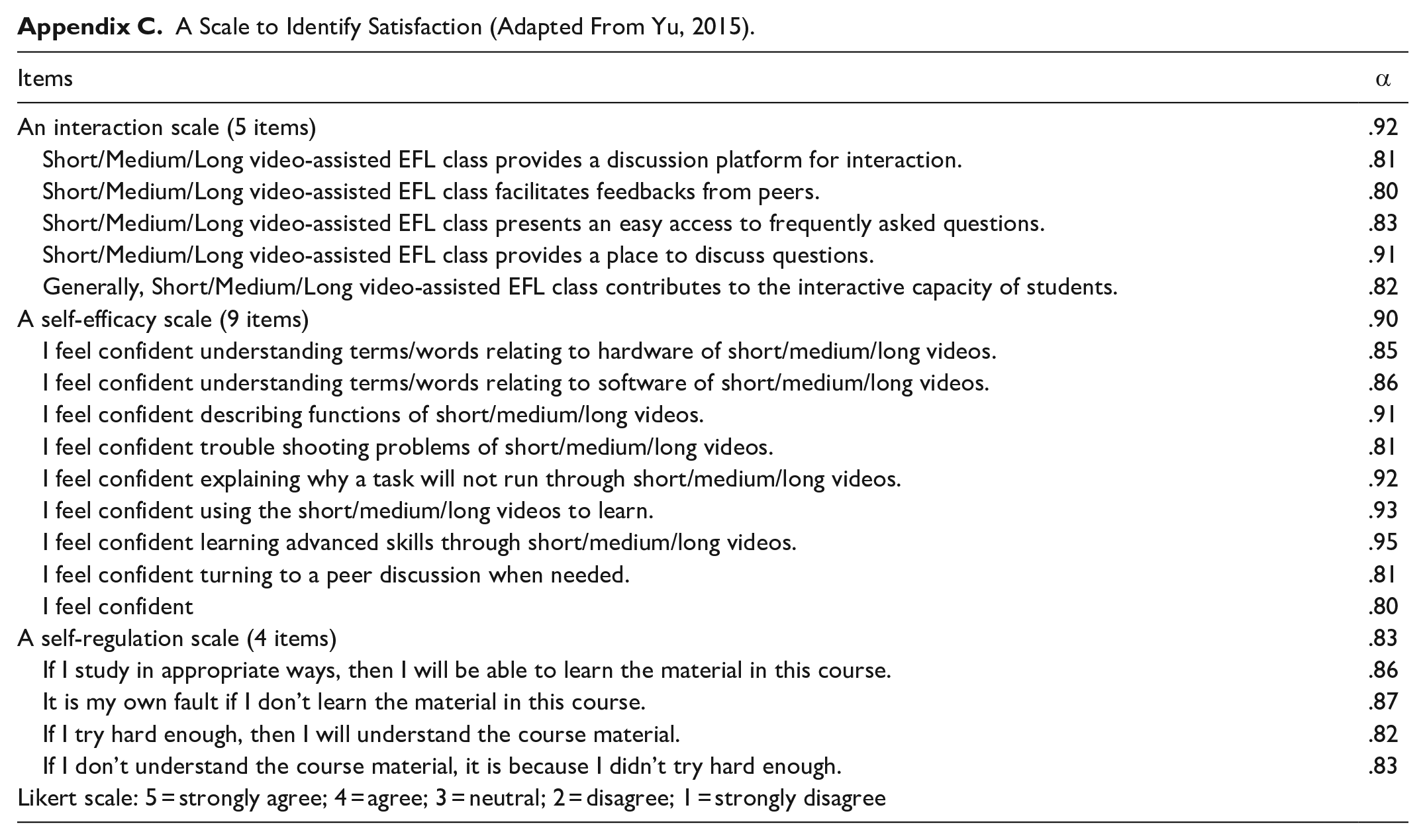
The student satisfaction includes three sub-scales, that is, interaction, self-efficacy, and self-regulation (Yu, 2015). Interaction involves learner-content interaction, peer interaction, and learner-instructor interaction (Kuo et al., 2014). Self-efficacy, as well as self-regulation (Bembenutty & White, 2013; Deci et al., 1996), was an important indicator of satisfaction (Artino, 2007; Liang & Tsai, 2008). The item-total internal consistency has reached an excellent level (α = .965). The reliability of specific items has also reached satisfactory levels (Appendix C). A sample item to measure self-efficacy is “I feel confident learning advanced skills through short/medium/long videos.” A sample item to measure interaction is “Short/Medium/Long video-assisted EFL class facilitates feedbacks from peers.” A sample item to measure self-regulation is “If I try hard enough, then I will understand the course material.”
Research Procedure
All the participants received flipped college English education conducted by an experienced professor for one semester. The professor designed three kinds of videos, that is, short videos (shorter than 5 minutes), medium videos (longer than 10 minutes and shorter than 20 minutes), and long videos (longer than 30 minutes). The videos share items in common but differ in the length. Three groups of participants received flipped English education assisted with different lengths of videos for one semester. They received this education twice a week for a total of 16 weeks. The findings would therefore be merely due to different lengths of videos. This could help us determine the effect of short, long, and medium videos on the flipped English classroom. At the beginning and end of the semester, we measured participants’ engagement, satisfaction, and English proficiency for comparative analysis (See Figure 1).
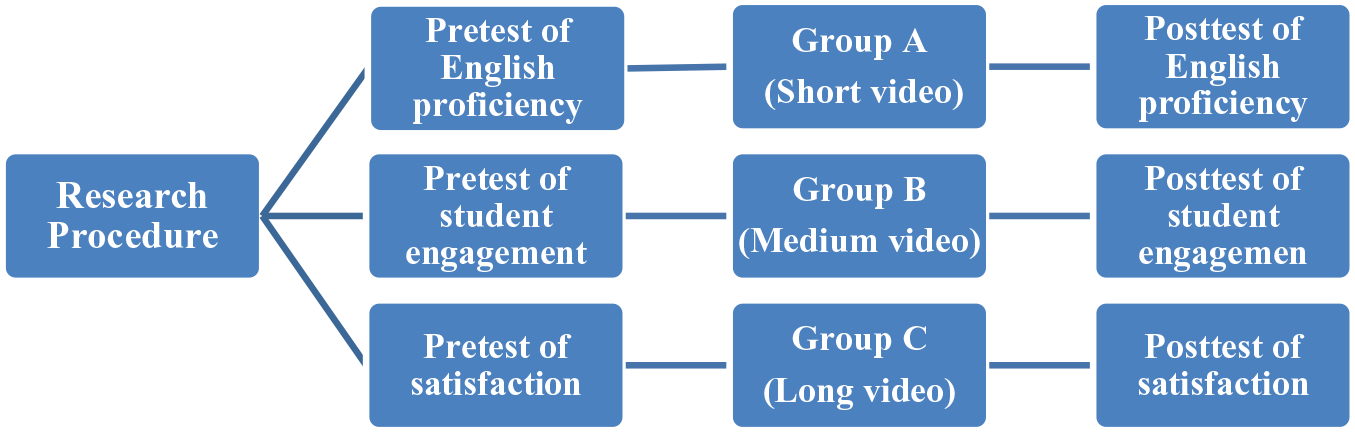
Research procedure.
All the participants were required to preview and understand the contents before class. They were required to watch videos twice a week. They can watch videos independently or communicate mutually through the China University MOOC platform. The platform can monitor all the students who watch videos by reporting their watching progress and the assignment they have completed. In case that they met up with difficulties, they were encouraged to solve problems via interactions with peers or teachers through communicative technologies. In class, the teacher, acting as an organizer and facilitator, organized many learning activities for students to participate in. The teacher made every effort to urge each student to join academic activities. The main task of the teacher was to encourage students to be engaged in activities, to solve problems through peer discussion, and to resort to the teacher if they failed.
After class, they were expected to review the acquired knowledge independently to enhance their self-directed learning abilities and improve their creativeness. They were free to choose to watch videos or learn printed English knowledge. They were also required to complete the homework assigned by the teacher. They could communicate with teachers or peers in case they came across any difficulty in the homework.
Results
To provide a baseline for comparative analysis, we compared both pre-test and post-test scores in terms of English proficiency, engagement, and satisfaction (Table 2). As shown in Table 2, scores of pre-English proficiency, pre-engagement, and pre-satisfaction are not significantly (p > .05) different among three groups at the .05 level. This establishes baseline equivalence for the following comparative analysis. The post-test scores of English proficiency, engagement, and satisfaction also provide a reference for the comparative analysis.
Descriptive Data of Pre- and Post-Test Scores.

The results were obtained from both pre- and post-tests to determine the effect of the length of videos on English proficiency, student engagement, and satisfaction. Analysis of Variance (ANOVA) aims to carry out the significance test of the differences between the means of two or more samples. Normal distribution of data is unrealistic in social sciences such as psychology (Delacre et al., 2019). A deviation from the normal distribution does not exert a significant influence on both the Type I error (Glass et al., 1972; Harwell et al., 1992; Tiku, 1971) and the F-test power (David & Johnson, 1951; Harwell et al., 1992; Srivastava, 1959; Tiku, 1971), but unequal variances can significantly influence the Type I error (David & Johnson, 1951; Harwell et al., 1992) and the F-test power (Nimon, 2012; Overall et al., 1995). We, therefore, carried out a test of homogeneity of variances rather than normality of distribution before we conducted the ANOVA test (See Table 3). To analyze the data through ANOVA tests, the homogeneity of variances needs to be examined (See Table 3).
Test of Homogeneity of Variances.

The ANOVA test requires that the variances of each comparison group be equal. Using the Levene statistic, it is concluded that this requirement has been met at the level .05 since the significance values are all larger than .05. Therefore, a one-way ANOVA test, which requires homogeneity of variances, was used to determine whether there was a significant effect of the length of videos on English proficiency, student engagement, and satisfaction in the flipped classroom. We also reported the effect sizes using standard mean differences (d) (Table 4).
Effects of the Length of Videos in the Flipped Classroom.

As shown in Table 4, there were statistically significant differences (post-pretests) in English proficiency between three groups as demonstrated by one-way ANOVA at the level .05 (F [32] = 29.43, p < .01 for Group A, d = 0.88 (large); F [33] = 56.80, p < .01, d = 0.43 (medium) for Group B; F [32] = 56.80, p < .01, d = 0.21 (medium) for Group C). There were statistically significant differences (post-pretests) in student engagement between three groups as demonstrated by one-way ANOVA at the level .05 (F [32] = 13.81, p < .01, d = 1.67 [very large] for Group A; F [33] = 27.56, p < .01, d = 1.02 [large] for Group B; F [32] = 27.56, p < .01, d = 0.5 (medium) for Group C). There were statistically significant differences (post-pretests) in student satisfaction between three groups as demonstrated by one-way ANOVA at the level .05 (F [32] = 15.04, p < .01, d = 1.06 [large] for Group A; F [33] = 30.06, p < .01, d = 0.74 [medium] for Group B; F [32] = 30.06, p < .01, d = 0.45 [medium] for Group C). The effect size is considered very small if d < 0.1, small if 0.1 < d < 0.2, medium if 0.2 < d < 0.5, large if 0.7 < d < 1.2, very large if 1.2 < d < 2.0 and huge if d > 2.0 (Sawilowsky, 2009).
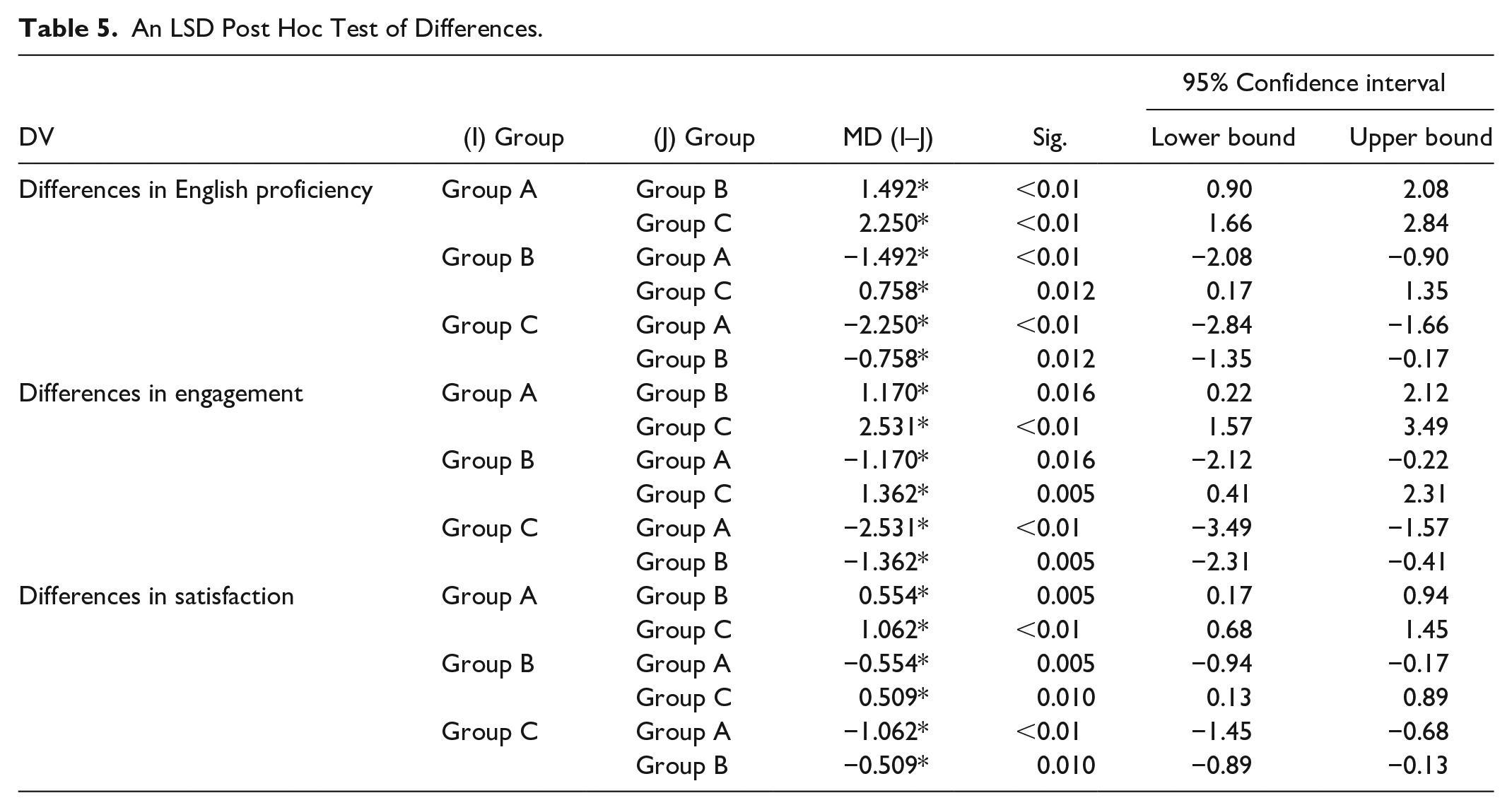
As shown in Table 5, An LSD post hoc test of differences of post-pretests demonstrated that short videos (Group A) could lead to statistically significantly higher English proficiency, student engagement, and satisfaction than medium and long videos (Groups B and C) (p < .05), and that medium videos (Group B) could lead to statistically significantly higher English proficiency, student engagement, and satisfaction than long videos (Group C) (p < .05). Therefore, we accepted both research hypotheses proposed.
An LSD Post Hoc Test of Differences.
Discussion
Factors Influencing Use of Videos
Facilitation condition, task-fit technology, perceived control over time, performance expectancy, and learning-family conflicts also exerted a positive influence on learners’ behavioral intention to use videos in a flipped classroom. Learners in rural schools showed less learning-family conflicts than those in urban schools. The former had significantly higher control over time, and higher intention to use videos than the latter (Kissi et al., 2018). Characteristic of flexibility and less time-consumption, shorter videos in Group A are more available to those in urban areas (e.g., participants in this study) than longer ones in Groups B and C. The shorter videos may have provided significantly more freedom for learners to interact with peers and teachers. They could also expect more positive learning outcomes because shorter videos could be understood more easily and quickly than longer ones through the interactive activities. Learners could solve difficult problems and share their opinions with peers and teachers through the interactions. It is thus reasonable to find that shorter videos could lead to significantly higher English proficiency, student engagement, and satisfaction than longer ones.
Advantages of Short Videos
Effectiveness of videos in a flipped classroom was influenced by various factors, for example, video segments addressing a course topic, time of video view, and the length of video view (Beatty et al., 2019). Shorter videos, for example, those less than 5 minutes, might focus on specific topics consuming a short time span to view, which might be easier to draw learners’ attention and arouse their interest. Shorter videos may allow teachers and students to convey information or interact with each other flexibly via different communication styles such as eye movement (Strupp et al., 2021), special effects, and closed captions (Fresno, 2021; Pantula & Kuppusamy, 2020), etc. Through shorter videos, teachers can tell a short and funny story, make short and animated lists, and present eye-catching graphics and illustrations to attract students before they are fed up. Through dynamic, interesting and, effective presentation, shorter videos may extend the attention span of students by providing concise and entertaining contents. Shorter videos may also be able to catch the limited attention of learners with interesting contents. With a minimal amount of conveyed information, the short presentation may be interesting and alive. This may finally improve students’ English proficiency, engagement, and satisfaction. However, it was also reported that shorter videos could not lead to significantly different results compared with longer ones (Slemmons et al., 2018). The appropriate length of videos may depend on specific knowledge delivered and different pedagogical approaches adopted.
Disadvantages of Long Videos
However, if the contents of videos are not tailored appropriately to target students, for example, irrelevant, uninteresting, or redundant, they may exert a negative impact on students, who may then be distracted from the videos and the fundamental purpose of the video may fail. One frequent mistake teachers make is to produce long and detailed videos. Based on the findings, they should keep videos short, dynamic, attractive, interactive, and sweet. The average viewer will stop watching the video after a certain short period for other purposes such as interactions, communication, discussion or problem solving. It is thus necessary to limit the length of videos to approximately 5 minutes. Those over 5 minutes may risk being ignored. The frequency of videos could also be limited within a given period to avoid the possible negative impact on learners’ attention.
English Proficiency
It is reasonable to find that shorter videos can lead to significantly better English proficiency than long ones. Shorter videos include various contents ranging from a variety of British and American cultural backgrounds, the way of English pronunciation, and vocabulary learning, to all kinds of famous speeches, interviews, and even Chinese traditional festivals in English. With rich contents, such short videos can enrich English knowledge and improve learners’ interest. Rich and colorful video materials can also expand the learners’ English vocabulary, which is also of great benefit to their listening and speaking skills (Yao, 2015). Problem-based active learning model (Akınoğlu & Tandoğan, 2007) and regular videos could also improve English proficiency in science and social studies (Boster et al., 2006). Teachers could increase the frequency that learners watch short videos and condense more contents into them. In this way, there will be no worry that learners acquire significantly less knowledge through watching the shorter videos than the longer ones.
Engagement
Shorter videos can also enhance learning engagement (Guo et al., 2014) due to their features. They, brief and concise, do not occupy much time and space of learners. Learners can pick them up easily whenever they are ready. Characteristic of portability and flexibility, short videos can also easily draw learners’ attention and enhance their engagement in learning since they never limit them to a certain space. Short videos can carry information of diversity and integration such as texts, pictures, and sounds. The variety of information can possibly engage learners with various needs (Wang et al., 2016). Shorter videos could also leave much freedom for learners to join social, academic, or other interpersonal interactions, which could enhance their engagement in learning activities.
Satisfaction
Shorter videos can also improve users or learners’ satisfaction due to their powerful functions. Social media such as Facebook, Twitter, and WeChat make everyone become a publisher of information, who can express their own opinions individually, spread information they care about, and share information they feel interested in. The content and form of communication is completely individualized and able to cater for different requirements. The personalized way of communication allows people to experience the pleasure of releasing information and influencing others. This will definitely improve users’ satisfaction with shorter videos (Bembenutty & White, 2013). The flipped class requires students to be familiar with the knowledge in advance with an aim to participating academic activities in class with strong self-efficacy and interactions. Learners actively joining the in-class activities tend to feel satisfied especially when they feel valued by their peers and teachers.
Conclusion
The Major Findings
This study is mainly concerned with effects of different lengths of videos on learning outcomes in a flipped English class. The major findings in this study are that shorter videos in Group A are more effective than longer ones in Groups B and C in terms of English proficiency, student engagement, and satisfaction in a flipped English classroom. This is in general consistent with previous studies (e.g., Chang et al., 2015; Long et al., 2016).
Limitations of This Study
Although the study is rigidly designed, the context is mainly limited to English classes. Other classes, in the future, could be included to explore the effect of the length of videos in a flipped pedagogical approach. The findings, associated with the flipped classroom, may not be generalizable to other contexts. The content is a confounding variable that might jeopardize the causal effect. While three types of videos all deliver fundamental English knowledge, the contents of different length of videos are not identical. It is thus hard to determine whether length or content (complexity of the content) works. The study is also limited to the analysis method.
It is confusing to run ANOVA for baseline equivalence, and then to run ANOVA on the mean difference between pre and post among each group. Since there is no significant difference in the baseline on all variables, conducting ANOVA on outcome variables only can be treated as the final results. There is controversy on the use of gained score, in which case pre-test normally needs to be included as a covariate, even if there is no significant difference among the groups for comparison (as pre-test is a strong predictor of the gain).
Future Research Directions
In the future, a scale to measure learning activities is also necessary to improve the video-assisted learning, based on which designers and teachers may innovate videos. For example, a rating system referred to as Classroom Assessment Scoring System was developed to analyze classroom observations and classroom videos (Greve et al., 2020), which plays an important role in improvements on video-assisted learning and teaching. Data retrieved from learning analytics may be solid references for video design and innovation.
To enhance the effect of videos on the flipped pedagogical approach, it is necessary to develop an effective platform, through which learners may have convenient access to learning resources and interaction with peers and teachers. Perceived usefulness, ease of use, enjoyment, continuance intention, peer, and superior influence could be seriously considered when the platform was developed (Yu, 2019a). Mobile learning could improve learner attitudes, interest, and intrinsic motivation (Yu, 2019b). If the platform could be integrated with a mobile device, the learning effect could possibly be enhanced. Through a well-designed platform, videos could exert a positive effect on flipped learning outcomes. Video lectures through the platform of Tangible User Interfaces could significantly improve learning effects more than Combinatorix, where students watched a lecture, followed by a hands-on activity (Schneider & Blikstein, 2016). Dental students reported that they could conveniently watch videos at home in a flipped instruction via a YouTube platform, that video lectures were easier to perceive compared with traditional media, and that they would review the videos once more after graduation. Therefore, platforms such as YouTube proved effective to deliver video-assisted lectures and could provide more opportunities for students and teachers (Seo et al., 2018).
Effectiveness of videos was also subject to learners’ simultaneous pictorial and the verbal cognitive channel, which was referred to as the multimedia principle. However, the majority of videos were limited to words and texts, ignoring use of multimedia tools, which implied that the flipped instructional videos remained at an early stage (Afonso & Garcia-Barrera, 2014). Quizzes could also significantly increase video view time, which was positively correlated with English proficiency (Patanwala et al., 2017). Besides the length of videos, designers of videos could thus seriously take quizzes, pictures, and multimedia into consideration in the future development of videos. Other influencing factors could also be included in the future.
Future research could also attach importance to other factors that may influence video-assisted distance learning, for example, teacher presence (Yu, 2021a), gender, educational level, and personality (Yu, 2021b), as well as challenges that may confront the flipped approach such as technological costs, video suspense, absence, and poor interactions (Taşpolat et al., 2021).
Research Data
sj-rar-1-sgo-10.1177_21582440211068474 – for Effects of Video Length on a Flipped English Classroom
sj-rar-1-sgo-10.1177_21582440211068474 for Effects of Video Length on a Flipped English Classroom by Zhonggen Yu and Mingle Gao in SAGE Open
Footnotes
Appendix
A Scale to Identify Satisfaction (Adapted From Yu, 2015).
| Items | α |
|---|---|
| An interaction scale (5 items) | .92 |
| Short/Medium/Long video-assisted EFL class provides a discussion platform for interaction. | .81 |
| Short/Medium/Long video-assisted EFL class facilitates feedbacks from peers. | .80 |
| Short/Medium/Long video-assisted EFL class presents an easy access to frequently asked questions. | .83 |
| Short/Medium/Long video-assisted EFL class provides a place to discuss questions. | .91 |
| Generally, Short/Medium/Long video-assisted EFL class contributes to the interactive capacity of students. | .82 |
| A self-efficacy scale (9 items) | .90 |
| I feel confident understanding terms/words relating to hardware of short/medium/long videos. | .85 |
| I feel confident understanding terms/words relating to software of short/medium/long videos. | .86 |
| I feel confident describing functions of short/medium/long videos. | .91 |
| I feel confident trouble shooting problems of short/medium/long videos. | .81 |
| I feel confident explaining why a task will not run through short/medium/long videos. | .92 |
| I feel confident using the short/medium/long videos to learn. | .93 |
| I feel confident learning advanced skills through short/medium/long videos. | .95 |
| I feel confident turning to a peer discussion when needed. | .81 |
| I feel confident | .80 |
| A self-regulation scale (4 items) | .83 |
| If I study in appropriate ways, then I will be able to learn the material in this course. | .86 |
| It is my own fault if I don’t learn the material in this course. | .87 |
| If I try hard enough, then I will understand the course material. | .82 |
| If I don’t understand the course material, it is because I didn’t try hard enough. | .83 |
| Likert scale: 5 = strongly agree; 4 = agree; 3 = neutral; 2 = disagree; 1 = strongly disagree | |
Author’s Contributions
Zhonggen Yu: Conceptualization, Methodology, Investigation, Writing-Original Draft, Writing-Review & Editing, and Funding acquisition.
Availability of Data and Material
We make sure that all data and materials support our published claims and comply with field standards.
Declaration of Conflicting Interests
The author declared no potential conflicts of interest with respect to the research, authorship, and/or publication of this article.
Funding
The author disclosed receipt of the following financial support for the research, authorship, and/or publication of this article: This work is supported by 2019 MOOC of Beijing Language and Culture University (MOOC201902) (Important) “Introduction to Linguistics”; “Introduction to Linguistics” of online and offline mixed courses in Beijing Language and Culture University in 2020; Special fund of Beijing Co-construction Project-Research and reform of the “Undergraduate Teaching Reform and Innovation Project” of Beijing higher education in 2020-innovative “multilingual +” excellent talent training system (202010032003); The research project of Graduate Students of Beijing Language and Culture University “Xi Jinping: The Governance of China” (SJTS202108).

References
Supplementary Material
Please find the following supplemental material available below.
For Open Access articles published under a Creative Commons License, all supplemental material carries the same license as the article it is associated with.
For non-Open Access articles published, all supplemental material carries a non-exclusive license, and permission requests for re-use of supplemental material or any part of supplemental material shall be sent directly to the copyright owner as specified in the copyright notice associated with the article.
