



Abstract
Although multiple studies have suggested a negative relationship between psychopathic traits and cognitive abilities, a few identified positive associations between psychopathic traits and specific executive functions. This study examined the relationship between a set of cognitive functions and the adaptive traits associated with psychopathic personality. Participants (N = 107) completed measures of psychopathic traits and adaptive personality traits, as well as a series of cognitive-ability-based tasks (measures of working memory, response inhibition, cognitive discrimination, and long-term memory). Results showed that adaptive psychopathic traits were associated with faster response times on measures of working memory, cognitive discrimination, and long-term recall. In contrast, psychopathic traits related to impulsivity were associated with slower response times in incongruent trials of measures of cognitive discrimination and short-term recall. Higher levels of adaptive and psychopathic traits related to fearlessness and dominance were associated with better performance in a working memory task without sacrificing accuracy for speed. These findings further support the multidimensionality of psychopathy; whereas its maladaptive traits are related to cognitive impairments, its adaptive traits seem to be related to cognitive superiority.
Introduction
Psychopathy
Psychopathy is commonly defined by ruthlessness, callousness, lack of guilt and remorse, impulsivity, emotional detachment, social deviance, and poor behavioral control (Berg et al., 2013; Lynam & Miller, 2012). Although there is a consensus regarding the importance of the aforementioned traits, the inclusion of other traits, which could be considered adaptive, is highly debated (Lilienfeld et al., 2012; Lynam & Miller, 2012; Maples et al., 2014). Early conceptualizations of psychopathy by Cleckley (1941) included numerous non-maladaptive traits in the set of characteristics observed in psychopaths, such as superficial charm, absence of delusion or irrational thinking, absence of nervousness, and low suicide rate (Cleckley, 1988, pp. 338–339). Multiple additional studies have confirmed that several psychopathic traits are commonly associated with adaptive traits such as social charm, low neuroticism, and high resilience to stress and anxiety (see Durand, 2019b) for a complete review).
Cognitive Abilities and Psychopathy
Although multiple studies suggest that highly psychopathic individuals have a deficit in executive functions (EF) and cognitive abilities, findings and conclusions are very inconsistent (Morgan & Lilienfeld, 2000). Cognitive abilities include functions such as planning abilities, behavioral inhibition, working memory, and cognitive flexibility (Zeier et al., 2012). Previous findings indicate that people classified as highly psychopathic often have poor impulse control and difficulty adapting their behavior. For instance, when asked to complete a flanker task (i.e., a task where a centrally presented target stimulus is flanked on both sides by distracter stimuli, which can be either the same as or different from the target stimulus), incarcerated offenders diagnosed with psychopathy were significantly less accurate in incongruent trials than non-psychopathic participants. This supports the definition of psychopathy as characterized by interference from poorer cognitive control, as well as by increased impulsivity when making decisions (Zeier et al., 2012). These results are consistent with the findings of Roussy and Toupin (2000). They concluded that institutionalized juvenile delinquents with psychopathy doing a go/no-go task (i.e., responding when a specific stimulus is on screen and not responding when any other stimulus is presented) and a stopping task (i.e., inhibiting the expected response to a stimulus when hearing a signal tone) made more errors than juvenile delinquents not diagnosed with psychopathy. Similar trends were observed in undergraduate students who completed a self-report measure of psychopathic traits (Wilkowski & Robinson, 2008). Specifically, individuals displaying high levels of psychopathic traits related to impulsivity (but not to emotional deficits) had difficulties adjusting their behavior after an incorrect response, and therefore made more errors in cognitive tasks. The authors suggest that the impulsivity trait may prevent individuals from pausing after an error for long enough to evaluate their strategy and readjust.
Cognitive Abilities and Adaptive Psychopathic Traits
None of the studies discussed in the previous section used an instrument that included adaptive features. However, multiple studies on cognitive abilities and psychopathy were performed using a common measure of self-reported psychopathic traits that notably includes an adaptive component: the Psychopathic Personality Inventory (PPI; Lilienfeld & Andrews, 1996). The PPI is divided into two factors: PPI-I (Fearless Dominance, which includes several of the potentially more adaptive features of psychopathy) and PPI-II (Impulsive Antisociality, which focuses on several maladaptive features of psychopathy).
A study by Snowden et al. (2013) on college students identified a negative relationship between self-reported levels of PPI and executive functions. Indeed, higher levels of psychopathic traits were associated with more errors on the Porteus Maze test used to assess impulsivity. This relationship was observed for both PPI-I and PPI-II. Contradictory results came from another study using the PPI on a sample of undergraduates (Carlson et al., 2009), where self-reported psychopathic traits were linked to executive functioning measured with the rotated heads task. A negative relationship was found between reaction time on the cognitive task and PPI-I, but there was no association between reaction time and PPI-II. Similar results were obtained for the relationship between the PPI and a battery of test assessing general executive functions (i.e., working memory, attention, planning, cognitive flexibility, sustained attention, and behavioral disinhibition) in undergraduate students (Sellbom & Verona, 2007). There was a positive association between cognitive functioning and PPI-I, as well as a negative association between the former and PPI-II. The negative association between PPI-II and reduced executive functions was also identified by Michałowski et al. (2015). Their findings suggested a negative association between PPI-II and executive control (e.g., slower response time).
Contradictory results were also obtained in studies examining psychopathic traits categorically rather than on a continuum in the general population using the PPI. For instance, one study supported the positive association between high levels of PPI and cognitive abilities. Salnaitis et al. (2011) divided their sample of undergraduate students into three groups based on their level of psychopathic traits (low, medium, or high), and had them solve the tower of Hanoi (a cognitive measure of planning, working memory, and problem solving). Highly psychopathic individuals were predominantly fast and accurate in their responses, while individuals with low levels of psychopathic traits were slow and accurate, and suggested that executive functioning deficiencies may not be present in subclinical psychopathic individuals from the general population. Similar results were observed in a study comparing undergraduate students based on PPI levels (low and high) on cognitive measures of risk-taking and decision-making, and response inhibition (Zimak et al., 2014). While individuals with high levels of psychopathic traits displayed more inaccuracy and behavioral inhibition, their response time was significantly faster, and they exhibited better decision-making skills.
The highly variable results from studies comparing PPI levels and cognitive abilities in the general population could be due to the traits assessed by PPI-I. It includes only three traits thought to be related to the psychopathic personality—social potency, fearlessness, and stress immunity—and does not consider maladaptive traits (coldheartedness, Machiavellian egocentricity, impulsive nonconformity, blame externalization, and carefree nonplanfulness). There is a newer self-reported instrument, which covers a wider range of adaptive features believed to be associated with high levels of psychopathic traits (Durand, 2019b). The Durand Adaptive Psychopathic Traits Questionnaire (DAPTQ) is a 38-item questionnaire assessing eight adaptive traits known to correlate with psychopathic personality traits. The first step in its development was to identify the constructs considered adaptive that are strongly associated with the diagnosis of psychopathy or psychopathic traits as measured through self-report. Adaptive traits are defined as those that facilitate and improve the individual’s chances of survival in their environment (Durand, 2019b). Factor analysis suggested an 8-factor solution (Leadership, Logical Thinking, Composure, Creativity, Fearlessness, Focus, Extroversion, and Management; Durand, 2019a). The DAPTQ is not a measure of psychopathy, nor is it a measure of psychopathic traits.
Present Study
The purpose of this study is threefold. First, due to the high variability of cognitive tasks across the studies in the field of psychopathy, a pilot study examining the validity of different versions of cognitive tasks is necessary. Second, while the DAPTQ was intended to expand on the PPI-I, it has not yet been compared to any behavioral executive function measure. Therefore, a correlational analysis will be performed to identify the relationship between the DAPTQ, PPI-I, and EF. Lastly, we will examine how efficiently the DAPTQ and PPI-I predict EF. We hypothesize that the DAPTQ and PPI-I will predict the variance of response time in cognitive tasks, whereas higher levels on the DAPTQ and PPI-I will be associated with lower response time.
Methods
Participants
A total of N = 107 participants (44 males, 63 females) were recruited on social media and websites dedicated to psychology research (e.g., callforparticipants.com, onlinepsychresearch.co.uk, and facebook.com). The age of the participants ranged between 18 and 64 years old (M = 28.78, SD = 10.52). Over a third of the participants were university students (38%). Participants were located mostly in North America (51%) and Europe (39%). In terms of the latest diploma obtained, the largest group of participants reported holding a high school diploma (41%), followed by a bachelor’s degree (31%), a master’s degree (13%), and other (15%). The current study was approved and given the “exempt” status by the IntegReview Ethical Review Board (Austin, TX, USA), under protocol number 11022016. No names or other protected health information, as defined by the Health Insurance Portability and Accountability Act (HIPAA), were recorded. All participants filled out an informed consent form with detailed information about the nature, goal, and procedure of the study before the experiment started. Participants remained anonymous throughout the study and were not compensated for their time.
Instruments
Durand Adaptive Psychopathic Traits Questionnaire (DAPTQ)
The DAPTQ is a 38-item self-report instrument assessing adaptive traits known to correlate with psychopathic personality traits (Durand, 2019b). The DAPTQ uses a 6-point Likert scale, ranging from 1 (Strongly Disagree) to 6 (Strongly Agree). A validation study of the DAPTQ confirmed its incremental validity over the PPI-short form in measures related to successful psychopathy, such as conscientiousness, stress and anxiety immunity, and communication adaptability (Durand, 2019a). Subsequent studies supported the reliability and validity of the DAPTQ as a measure of adaptive traits (Bronchain et al., 2020, 2021). In the present study, the internal consistency reliability of the DAPTQ total was α = .92, and that of its subscales ranged from α = .76 to .92.
Psychopathic Personality Inventory-Short Form (PPI-SF)
The PPI-SF is a 56-item self-report instrument assessing psychopathic traits on a 4-point Likert scale (1 = false, 4 = true; Lilienfeld & Widows, 2005). Factor analytic research showed that the subscales load on two different factors. The Fearless Dominance (PPI-I) factor includes Stress Immunity, Social Potency, and Fearlessness subscales, and the Impulsive Antisociality (PPI-II) factor includes Blame Externalization, Machiavellian Egocentricity, Carefree Nonplanfulness, and Impulsive Nonconformity subscales. The Coldheartedness subscale does not load on either of the two factors (Benning et al., 2003). The DAPTQ total score was shown to correlate positively with PPI-I (r = .66) and PPI-SF total (r = .46), but is not significantly associated with PPI-II (r = −.04; Durand, 2019b). In the present study, the total PPI score had a Cronbach’s alpha of α = .76; PPI-I, of α = .83; and PPI-II, of α = .76.
The n-Back Task
The n-back task is a measure of attention and working memory based on the design of Schoofs et al. (2008). Participants were asked to monitor a series of one-digit numbers from 0 to 9, presented in a random sequence. Participants had to choose between two arrows on the keyboard (e.g., left arrow if seen n steps before; right arrow if not seen n steps before). Participants completed a practice trial of 15 stimuli, followed by two blocks of 50 trials presented in random order, where the working memory load was varied by switching the difficulty between a 2-back and a 3-back condition. A fixation cross was presented for 500 ms, followed by a stimulus with auto-advance for 3,000 ms and an inter-stimulus interval of 1200 ms. Target stimuli (same as in the n-trials before) were presented randomly with a probability of 33%. The first three trials of both conditions were removed for all participants.
The Go/No-Go Task
The go/no-go task is designed to assess cognitive attention and response inhibition. On-screen instructions told the participant to press the space bar of the keyboard every time the letter X appeared, and to refrain from pressing any key when the screen displayed any other letter (A, D, Y, W). The task was composed of 48 consecutive trials, divided equally between presentations of the target cue and distracters. During each trial, a blank screen was presented for 500 ms, followed by a fixation cross for 1000 ms and a target letter for 2500 ms. The go/no-go paradigm has been used in several other laboratory studies in the field of psychopathy (Zimak et al., 2014) and is a valuable tool for assessing response discrimination. Scoring was performed by calculating the mean reaction time before responding to the go stimulus (the X) and by calculating the average number of errors (i.e., pressing the space bar on Y or inhibit pressing).
The Flanker Task
The flanker task is a common measure of cognitive control and perceptual discrimination (Eriksen & Eriksen, 1974). A row of five characters was presented to the participant. The target stimulus was in the middle of the row, flanked by two distracters on either side. The distracters were either very similar to (congruent) or very different (incongruent) from the target stimulus. When distracter stimuli are incongruent, participants generally answer more slowly and less accurately than when answering congruent trials.
There are many versions of the flanker task. We used one version with control trials and another without, with participants completing either one or the other. The first version was based on the numbers/letters version used by Zeier et al. (2012). Our participants completed 100 trials divided into two blocks. For each trial, a fixation cross appeared on screen for 500 ms, followed by the target and the flankers, which were set to auto-advance after 2500 ms. The target appeared at fixation, and the distracters appeared to the left and right, equidistant from the target (at approximately one degree of visual angle). As in Zeier et al.’s (2012) study, the target stimulus was always a 5, 8, G, or M, and the distracters were either another one of these characters or a pound sign (#). Participants were asked whether the target was a letter or a number and responded using a two-alternative forced choice answer. This was followed by a 1000–1500 ms variable intertrial interval. In congruent trials, the target and distracters were from the same category (e.g., 8 5 8); in incongruent trials, they were different (e.g., G 5 G). In control trials, the distracters were pound signs (e.g., # 5 #).
The second flanker task version we used was the arrows version. The settings were the same, but the letters and numbers were replaced with arrows (e.g., < < < < <). Participants were asked to chose the keyboard arrow key corresponding to the middle arrow (left arrow key for < < < < <; right arrow key for < < > < <). The arrows version did not include control trials. The dependent measures were response time (RT) and the number of errors for congruent trials, incongruent trials, and control trials (for version 1). Although Zeier et al.’s (2012) task version appears to be an improvement over the regular flanker task, the version without control trials has been used in more studies (Racer et al., 2011; Sellbom & Verona, 2007).
The Penn Word Memory Test (PWMT)
The PWMT is a measure of short- and long-term episodic memory. Participants were presented with 20 target words (1500 ms for target cue; 1500 ms for target word) and were asked to try to memorize them (Gur et al., 1993). Immediately after, participants were instructed to identify all the previously seen words from a list comprising 40 words (20 words from the first list and 20 distracters). Participants were asked to answer using a two-alternative forced choice response (left arrow if seen before; right arrow if not seen before). The target cue during the trial remained at 1,500 ms, and the trial auto-advanced to the next trial after 3,000 ms. About 15 minutes later, at the very end of the study, participants were shown a second list (20 words from the first list, 20 new distracters), and were asked to answer, once again using the two-alternative forced choice response. Distracters and target words were equated for frequency, length, concreteness, and imageability using Paivio’s norms (i.e., moral, figment, event, prestige, hint, and origin; Paivio et al., 1968). The response time and number of errors were selected as performance measures. For analyses, PWMT1 refers to the first series of trials, measuring short-term recognition, and PWMT2 refers to the second and last series of trials, measuring long-term recognition. Across all cognitive tasks, participants with an error rate of over 75% were automatically excluded from the data set.
Experimental Procedure
All participants first completed the PWMT1. Then, in random order, they did the go/no-go, the n-back task, and one of the two flanker tasks. The last task for all participants was the PWMT2, which concerns long-term memory. Participants completed the cognitive tasks using the Gorilla platform (www.gorilla.sc). Although laboratory studies in the presence of an experimenter are often thought to be more reliable, recent evidence suggests that online behavioral experiments do not differ from laboratory studies and provide equally valid results (Hilbig, 2016; Semmelmann & Weigelt, 2017). In order to exclude participants who stopped completing the tasks without closing the study page, we added various checkpoints in the experimental setup of the Gorilla platform. Participants missing more than 75% of the data were automatically removed. There was no missing data in either of the two questionnaires. For the analyses, we excluded response time trials answered in less than 150 ms or more than 1,500 ms (2,000 ms for PWMT1 and PWMT2). Errors rates for all cognitive tasks were recoded as z-scores.
Statistical Analyses
We first computed the means and standard deviations for the questionnaires and cognitive tasks to ensure similarity with other studies using the same instruments. T-test analyses were used to compare cognitive tasks’ version efficacy for the n-back task, the flanker task, and the PWMT. A Pearson correlation was then used to determine the strength of the association between the questionnaires and the cognitive tasks. Lastly, we performed a series of linear stepwise regression analyses on all response time variables using the DAPTQ and PPI-I as predictors.
Results
Descriptive Data
Tables 1 and 2 show the descriptive data of the questionnaires and all the cognitive tasks. The DAPTQ and the PPI-SF had similar means and standard deviations as in other studies using those instruments (Bronchain et al., 2020; Durand, 2018a, 2018b; Lee & Salekin, 2010). The DAPTQ total score again correlated positively with PPI-I (r = .81) and PPI-SF total (r = .59), but was not significantly associated with PPI-II (r = −.20). The n-back task yielded results similar to those obtained by Schoofs et al. (2008). In their study, the mean response time for 2-back was 715 ms for control and 879 ms for the stress group (compared to 809 ms in the present study), and their mean response time for 3-back was 811 ms for control and 943 ms for the stress group (compared to 881 ms in the present study). Our go/no-go response time was similar to the results obtained by Harper et al. (2014), who reported mean reaction times between 445 and 451 ms (compared to 436 ms in the present study). Our results for both versions of the flanker task were also similar to previous results. Zeier et al. (2012) reported mean response times between 579 and 610 ms for the letters/numbers version (compared to 589–603 ms in the present study), while Sellbom and Verona (2007) reported a mean of 499 ms for the arrows version (compared to 478–530 ms in the current study).
Descriptive Data From the Durand Adaptive Psychopathic Traits Questionnaire and the Psychopathic Personality Inventory Short Form (N = 107).

Descriptive Data From the n-Back, Go/No-Go, and Flanker Tasks and the Pennsylvania Word Memory Test.

Note. Each participant was asked to complete only one of the two flanker task versions. RT = reaction time.
On the other hand, our mean response times for the PWMT were significantly faster than in other studies—around 800 ms, compared to previous results of around 1,400 ms (Gur et al., 2012; Moore et al., 2015). This difference may be due to the sample’s characteristics, whereas the aforementioned authors investigated the EF of a young sample with a mean age of 15 years.
Regarding the relationship between demographics and levels of the DAPTQ and PPI, an ANOVA identified a sex-based difference for the PPI, where males scored higher than females (F(1, 105) = 6.122, p = .015, d = 0.47). This was not the case on the DAPTQ (F(1, 105) = 3.431, p = .067, d = 0.35). No other analyses of mean differences based on demographics could be carried out due to the small sample size.
Comparability of Alternative Cognitive Tasks
To assess the reliability of cognitive tasks with multiple paradigms, we first examined the mean differences between the two versions of the n-back task, the flanker tasks, and the PWMT. As expected, participants were significantly faster when answering the 2-back task compared to the 3-back task (t(89) = 6.382, p < .001, d = 0.54). Within answered trials, participants also made fewer mistakes on the 2-back task than on the 3-back task (t(89) = 6.65, p < .001, d = 0.72), most likely because the 2-back version was simpler than the 3-back.
As with the n-back task, a few differences were observed between the two versions of the flanker task. In the letters/numbers version, control trials yielded the same reaction time as the congruent trials (t(46) = 0.67, p = .504, d = 0.05). As expected, a small significant difference was nonetheless observed between response time (RTs) of congruent and incongruent trials, where congruent trials were answered faster (t(46) = 2.14, p = .038, d = 0.15). Interestingly, differences between congruent and incongruent trials for the arrows flanker task were larger. In this version, congruent trials were significantly faster than incongruent trials (t(53) = 13.39, p < .001, d = 0.67). Similarly, congruent trials elicited fewer mistakes (t(53) = 5.70, p < .001, d = 1.10). When controlled for multiple testing (p = .05/3 = .016), three ANOVAs detected no difference between the two flanker groups for the DAPTQ (F(1, 105) = 0.180, p = .672, d = 0.08), the PPI-SF (F(1, 105) = 3.995, p = .048, d = 0.40), and age (F(1, 105) = 0.541, p = .464, d = 0.14). The flanker groups also did not differ by sex (χ2 (1, N = 107) = 0.718, p = .397).
A significant mean difference was observed between response times for PWMT1 and PWMT2 (t(99) = 2.08, p = .040, d = 0.16). There were no significant differences in the number of errors between PWMT1 and PWMT2 (t(98) = 1.22, p = .222, d = 0.11).
Associations Between the DAPTQ, the PPI-SF, and Executive Functions
As shown in Table 3, Pearson correlations between the DAPTQ, the PPI-SF, and executive functions revealed multiple significant results. As in Durand (2019a, 2019b), the DAPTQ was positively associated with PPI-SF and PPI-I, and significantly negatively associated with PPI-II. Higher scores on the DAPTQ were associated with faster response times on the 2-back and 3-back task; on the control, congruent, and incongruent trials of the letters/numbers flanker task; on the congruent trials of the arrows flanker task; and on the long-term recall PWMT2. Unexpectedly, the DAPTQ was also associated with higher error rates on the long-term recall PWMT2, although the results were barely within the significance threshold (p = .040). The PPI-SF total score was not associated with any variables related to executive functions. Higher scores on the PPI-I were associated with faster RTs on the 2-back task; on the control, congruent, and incongruent trials of the letters/numbers flanker task; and on congruent trials of the arrows flanker task. Lastly, PPI-II was associated with slower response times in incongruent trials for both the letters/numbers and arrows flanker task, as well as slower response times on short-term recall PWMT1.
Correlations Between the Durand Adaptive Psychopathic Traits Questionnaire, the Psychopathic Personality Inventory Short Form, and Executive Functions.

Note. *p ≦ .05. **p ≦ .01. ***p ≦ .001.
Regression Analyses to Predict Executive Functions
As shown in Table 4, a series of stepwise regression analyses was performed on all response time variables using the DAPTQ total and PPI-I as predictors. The results are as follows. A significant regression was observed for 2-back response time (adjusted R2 = .11, F(1,94) = 12.731, p < .001); 3-back response time (adjusted R2 = .09, F(1,91) = 10.160, p = .002); flanker letters/numbers control response time (adjusted R2 = .15, F(1,45) = 8.913, p = .005); flanker letters/numbers congruent response time (adjusted R2 = .15, F(1,45) = 8.909, p = .005); flanker letters/numbers incongruent response time (adjusted R2 = .18, F(1,45) = 11.002, p = .002); flanker arrows congruent (adjusted R2 = .09, F(1,52) = 6.284, p = .015); and PWMT2 response time (adjusted R2 = .03, F(1,102) = 4.426, p = .038). For all analyses, the DAPTQ was the sole predictor, and higher levels on the DAPTQ predicted faster response times. No significant regression was found for the go/no-go response time, flanker arrows incongruent response time, or PWMT1 response time.
Regression Analyses of DAPTQ and PPI-I on Response Time.
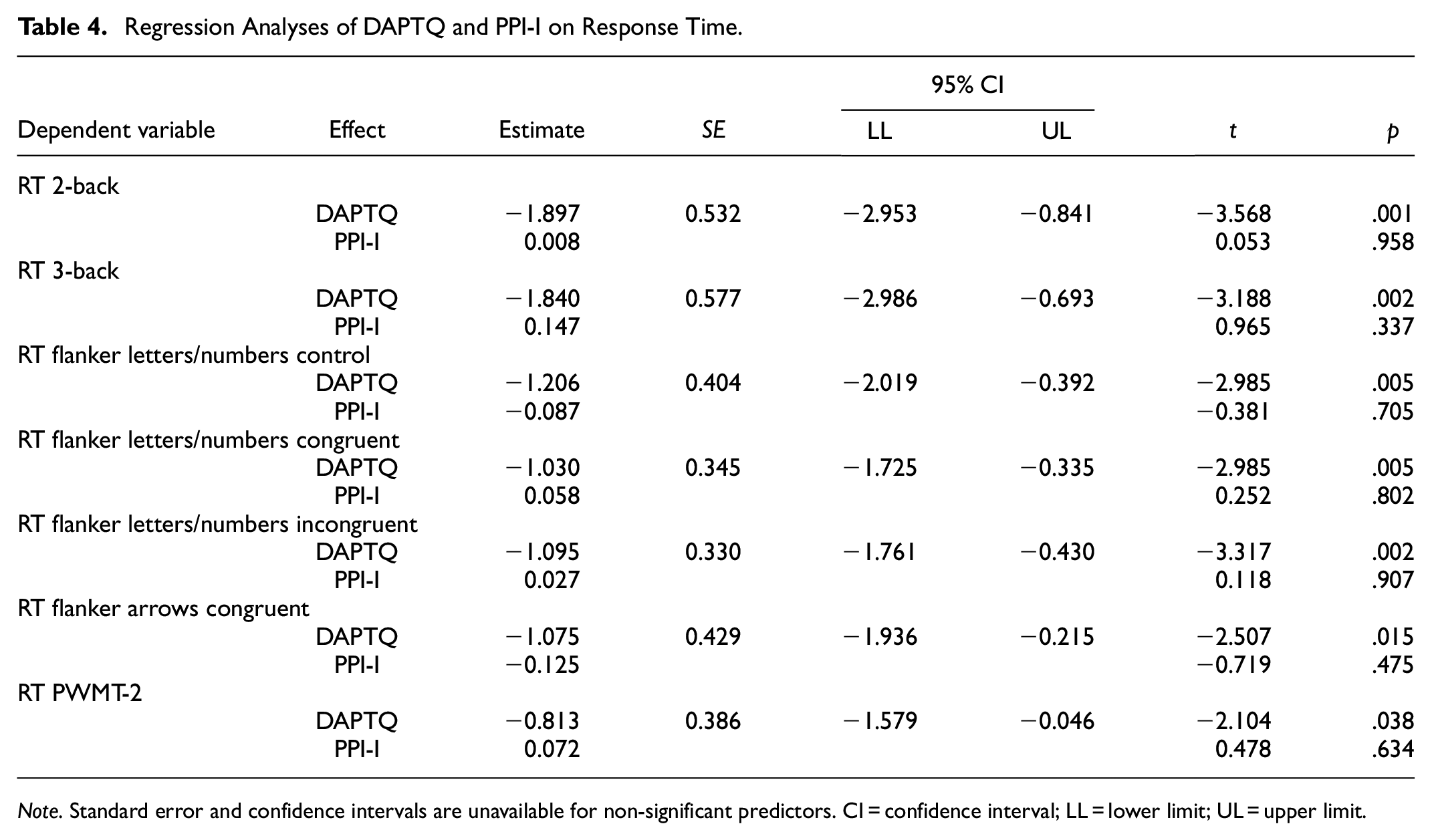
Note. Standard error and confidence intervals are unavailable for non-significant predictors. CI = confidence interval; LL = lower limit; UL = upper limit.
Discussion
The purpose of the present study was (i) to compare the validity of different measures of cognitive abilities in the field of psychopathic traits; (ii) to examine the relationship between EF and adaptive personality traits related to the psychopathic personality; and (iii) to assess the predictive value of the DAPTQ and PPI-I for EF.
Comparing versions of cognitive tasks yielded interesting findings. The slower response time and higher number of errors in the 3-back task compared to the 2-back task is similar to the results obtained by Schoofs et al. (2008). These results suggest that the 3-back task may yield more variable results for group differences in working memory performance. This is likely because the 3-back task is more challenging than the 2-back task, which may be too easy for high performers.
Similarly, a few differences emerged between the two versions of the flanker task. Participants were significantly slower in the letters/numbers version and were making more mistakes, especially in incongruent trials. These results mirror those obtained by Zeier et al. (2012), who reported an effect size of d = 0.34 when comparing response time between congruent and incongruent trials. Another study using the arrows version obtained an effect size between congruent and incongruent trials three times larger (d = 0.99, Racer et al., 2011). These results suggest that using an arrow paradigm for the flanker task provides better results in discriminating between congruent trials and interfering stimuli.
Lastly, differences were also identified in the PWMT. A previous study investigating the psychometric properties of a cognitive battery that included the PWMT reported no difference in response time (d = 0.01) or accuracy (d = 0.14) between immediate and delayed word memory (Gur et al., 2010). Our participants, in contrast, were faster at the second time point, which may be due to a habituation effect. Repeating other tasks besides the PWMT at different times could help determine whether participants were only faster the second time because they already did the PWMT once, and whether this is observed when repeating any other task, such as the n-back and flanker tasks.
Higher levels of adaptive and psychopathic traits were associated with faster response time for working memory with high load (the 2-back task), but only adaptive traits were associated with the more complex working memory task (the 3-back task). Interestingly, no significant results were observed regarding accuracy on the n-back task. These findings suggest that individuals with higher levels of adaptive traits did not lose accuracy while they gained speed. Similar results were obtained in previous studies. For instance, a study on incarcerated inmates suggested that individuals with a higher deficit in interpersonal features (e.g., arrogance and a deceitful interpersonal style, as identified on a psychopathy diagnosis measure) made fewer errors in tasks related to working memory (Hansen et al., 2007). These results are also in line with the work of Carlsonet al. (2009). Overall, these results suggest that higher levels of adaptive and PPI-I traits are associated with better performance in working memory tasks, without sacrificing accuracy for speed.
Unexpectedly, no effects were found for the go/no-go task. An early study in the field of cognitive abilities and psychopathic traits in undergraduate students has reported that individuals with higher levels of psychopathic traits presented more difficulties inhibiting their responses when facing a competing reward in a go/no-go paradigm (Lynam et al., 1999). These results mirror those previously reported, supporting an increase in error on a go/no-go task in diagnosed juvenile psychopaths (Roussy & Toupin, 2000). Although only the second study was categorical, it is possible that inhibition difficulties in a go/no-go paradigm are present mainly in highly psychopathic individuals. An experiment focusing on groups of psychopathic individuals (low scorers and high scorers on the PPI-SF) would provide more clarity regarding the relationship between the go/no-go task and psychopathy.
The results obtained for both versions of the flanker task further support previous findings regarding the opposite associations observed with PPI-I and PPI-II. Higher levels of adaptive traits and PPI-I were associated with faster RTs on all trials in the letters/numbers version, and only with congruent trials in the arrows version. In contrast, PPI-II was associated with slower incongruent trials on both flanker task versions. Impairment in response inhibition is one of the most recurrent reported problems among psychopathic individuals (Roussy & Toupin, 2000; Wilkowski & Robinson, 2008; Zeier et al., 2012). However, inhibitory control has often been negatively associated with psychopathic traits when viewing them as a whole. Studies differentiating the various aspects of psychopathic traits, for instance the behavioral aspects (e.g., social deviance and violent behavior) from the psychological aspects (e.g., callousness and low anxiety) find that inhibitory control may be impaired in individuals showing high levels of the former, but not in individuals displaying the latter. In fact, individuals showing callousness and low anxiety may even outperform typically developing individuals in tasks requiring inhibitory control (Ross et al., 2007).
The results related to the PWMT1 and PWMT2 were in line with our expectations for the PPI-II, but not for the DAPTQ. As with both flanker tasks, PPI-II was associated with slower RTs on the PWMT1, but not on the PWMT2. It is possible that higher levels of PPI-II are related to higher levels of doubt in one’s answers and lower levels of motivation when completing the first task of the study. Many studies have associated high levels of psychopathic traits, particularly those related to the PPI-II, with lower self-esteem (Durand, 2016; Falkenbach et al., 2013). Alternatively, low self-esteem has been associated with high neuroticism, which includes a host of factors, such as self-doubt and worry (Scheier et al., 1994). In addition, adaptive traits were associated with faster RTs but a higher error rate on the PWMT2, though the DAPTQ has not been associated with error rates in any other task. It is possible that higher levels of adaptive traits are associated with a reduced attention span toward the end of the experiment, causing more errors on the last task. However, the lack of significant association between adaptive traits and error rates in all other tasks indicates a potential type I error due to limited power, especially given the weak p-value (p = .040).
In addition to the correlation analysis, we performed a regression analysis to assess the predictive power of the DAPTQ and PPI-I on the response time of cognitive abilities. For all significant regression analyses, the DAPTQ was the sole predictor of the regression, with explained variance varying between 3% and 18%. It is important to note that these results should be considered highly preliminary due to the small sample size, particularly on the flanker task. Indeed, the sample size does not allow a thorough examination of the incremental validity of the DAPTQ over the PPI-I. Nevertheless, these preliminary findings are sufficiently encouraging to justify a larger study focusing on the same variables to examine the incremental validity of the DAPTQ over the PPI-I to predict EF.
Limitations
There are several limitations to this study. First, our sample size was modest, which further tampers the results obtained on the flanker tasks. Only half the participants performed each of the two versions, and our results need to be verified in a larger study focusing on the arrows version of the flanker task. Second, the assessment of psychopathic traits was performed using a brief self-reported questionnaire—the PPI-SF. A future study could benefit from the paradigm developed by Bronchain et al. (2020), in which a large sample of individuals are divided into four groups based on an extensive measure of psychopathic and adaptive traits. Third, our sample was not only small but also very heterogeneous, which may further temper the results. The standard deviation for the age of the sample was particularly large, which may influence cognitive performance. A future study with a more homogeneous group of participants (e.g., students from one university) may yield different results. Lastly, while experiments using cognitive tasks often include hundreds of trials, each of our tasks used between 48 and 100 trials. While the study gives a general idea of the relationship between the DAPTQ and EF, future studies will need to increase the number of trials (and most likely decrease the number of EF tasks to remain time-efficient).
Conclusion
This study extends the research on psychopathic traits and EF and tentatively supports the association between the DAPTQ and EF. Specifically, adaptive traits and PPI-I are associated with better performance on cognitive tasks, as observed through a faster response times with similar accuracy. While encouraging, these results remain highly preliminary due to the small number of participants, who were recruited on social media. Our findings confirm that psychopathic traits need to be studied as a heterogeneous construct by exploring its various individual facets, both adaptive and maladaptive, such as the ones assessed by the DAPTQ.
Footnotes
Acknowledgements
This work is published thanks to an aid to publishing grant from Saint Paul University.
Declaration of Conflicting Interests
The author(s) declared the following potential conflicts of interest with respect to the research, authorship, and/or publication of this article: Dr. Guillaume Durand receives royalties from the sale of the Durand Adaptive Psychopathic Traits Questionnaire. Dr. Bart P.F. Rutten, and Dr. Jill Lobbestael declare that they have no conflict of interest.
Funding
The author(s) received no financial support for the research, authorship, and/or publication of this article.
Ethical Approval
The current study was approved and given ‘exempt’ status by the IntegReview Ethical Review Board (Austin, TX, USA), under protocol number 11022016.
