




Abstract
Arts integration in school-based curriculum has been an area of interest in the United States since formal schooling began in the 1800s. Arts integration uses art forms such as, visual arts, music, drama, or dance with a language arts, math, science, and/or social studies curriculum. This article examines nine studies that assessed the effects of school-based arts integration on urban students’ academic achievement. Findings suggest that an arts-integrated curriculum has positive effects on urban student academic achievement. Despite the positive impact of arts integration, the cumulative understanding of current research does not definitively offer an explanation for why arts integration successfully impacts student achievement. The analysis of findings suggests that improvements in core content knowledge may be a minor outcome when compared with possible developmental gains in executive function (representational knowledge, operational processes, and self-regulation) from an arts integration program. Opportunities to focus future research in arts integration programs around the construct of executive function are suggested and justified based on analysis of findings.
The idea of integrating art disciplines into a general education subject area to enhance learning and gain knowledge has been of interest to many educators and educational reformers. The John F. Kennedy Center for the Performing Arts defines art integration “as an approach to teaching in which students construct and demonstrate understanding through an art form. Students engage in a creative process which connects an art form and another subject area and meets evolving objectives in both” (Silverstein & Layne, 2010, p.1). Horace Mann in the 19th century was one of the first educational reformers to demand that visual arts and music should be taught in the common schools in Massachusetts as an aid to the curriculum and an enhancement to learning (Gullatt, 2008). Another prominent educational reformer in the early 20th century, John Dewey, also supported arts education and curriculum integration in an effort to aid student learning (Gullatt, 2008). In the early 21st century reform documents such as Common Core State Standards (National Governors Association Center for Best Practices, Council of Chief State School Officers, 2010) state, “the Standards insist that instruction in reading, writing, speaking, listening, and language be a shared responsibility within the school.” Current research has flourished in the past 20 years toward furthering our understanding of arts integration and its effects on students. Evidence is now emerging that shows the arts have some effect on student achievement. Moreover, these effects may be most profound for struggling students (Rabkin & Redmond, 2006). Catterall, Chapleau, and Iwanaga (1999) found that intensive arts participation was associated with achievement for students in the lowest socioeconomic status (SES) quartile, those most at risk of academic failure.
The purpose of this article is to examine existing literature to determine how arts-integrated classrooms effect an urban student’s academic performance, and what the findings mean for future research. Art forms or disciplines in this review include: visual arts, music, drama, and dance. Academic subjects include language arts, math, science, and social studies. The instruction in the studies citied in this article took place in the core academic subject’s classroom. An art teacher or teaching artist (an artist who is fluent in arts integration) in these studies collaborated with the core academic subject teacher to foster an integrated curriculum. Nine studies that met these criteria were analyzed to understand how arts integration affects academic achievement in urban students. Academic achievement was found using quantitative measures such as standardized test scores and questionnaires. Qualitative measures included observations, interviews, writing samples, and student engagement surveys. All of these measures, when implemented in a particular study, were used with a control classroom and the integrated classroom.
Methods of Choosing Studies
Research articles were identified that included urban learning environments, some form of arts integration, and some type of longitudinal (lasting a semester or more) academic performance data. Articles meeting this criteria were identified from the following databases: Google Scholar, EBSCO, Academic Search Premier, ERIC, Professional Development Collection, PsycARTICLES, the Education Research Complete databases, and cross-checking of references in related and relevant articles. Our search looked for any relevant article over the last 20 years (1995-2015). This time frame captures both recent publications and studies with larger-scale academic performance data. We did not restrict the search to any specific participant age group because longitudinal data were a desirable criterion. Of the longitudinal studies we identified, some started in middle school and continued tracking through high school or elementary school through middle school. To ensure a well-rounded interpretation of this topic quantitative, qualitative, and mixed methods studies were considered. The majority of the studies that fit our criteria were quantitative studies and included some type of standardized achievement test. All studies included participants from urban areas. Some studies also included participants from suburban and rural areas as well. All the studies looked specifically at school-based arts integration. Any study not connected to a school (e.g., community center or home) was not included. If a study did not have a control group that was assessed alongside the arts-integrated group, it was not included.
Quality Indicators
In the process of examining the strength of the relationships between arts integration and achievement in urban settings, we adopted the approach of Chard, Ketterlin-Geller, Baker, Doabler, and Apichatabutra (2009) and modified and added indicators specifically for this article, but also used some indicators from Chard’s et al. quality indicators. This approach helps our readers to understand the perceived strength of the articles to inform our evidence-based discussion on the effects of arts integration on urban student achievement. Table 1 is the quality indicator rubric that we used to assess the intellectual merit of the nine studies identified for this article. The possible scores range from one to three. A score of three indicates all aspects of the indicator were met at a high level. One is the lowest score for any given category and indicates little or no evidence of meeting the requirement.
Quality Indicator Rubric.
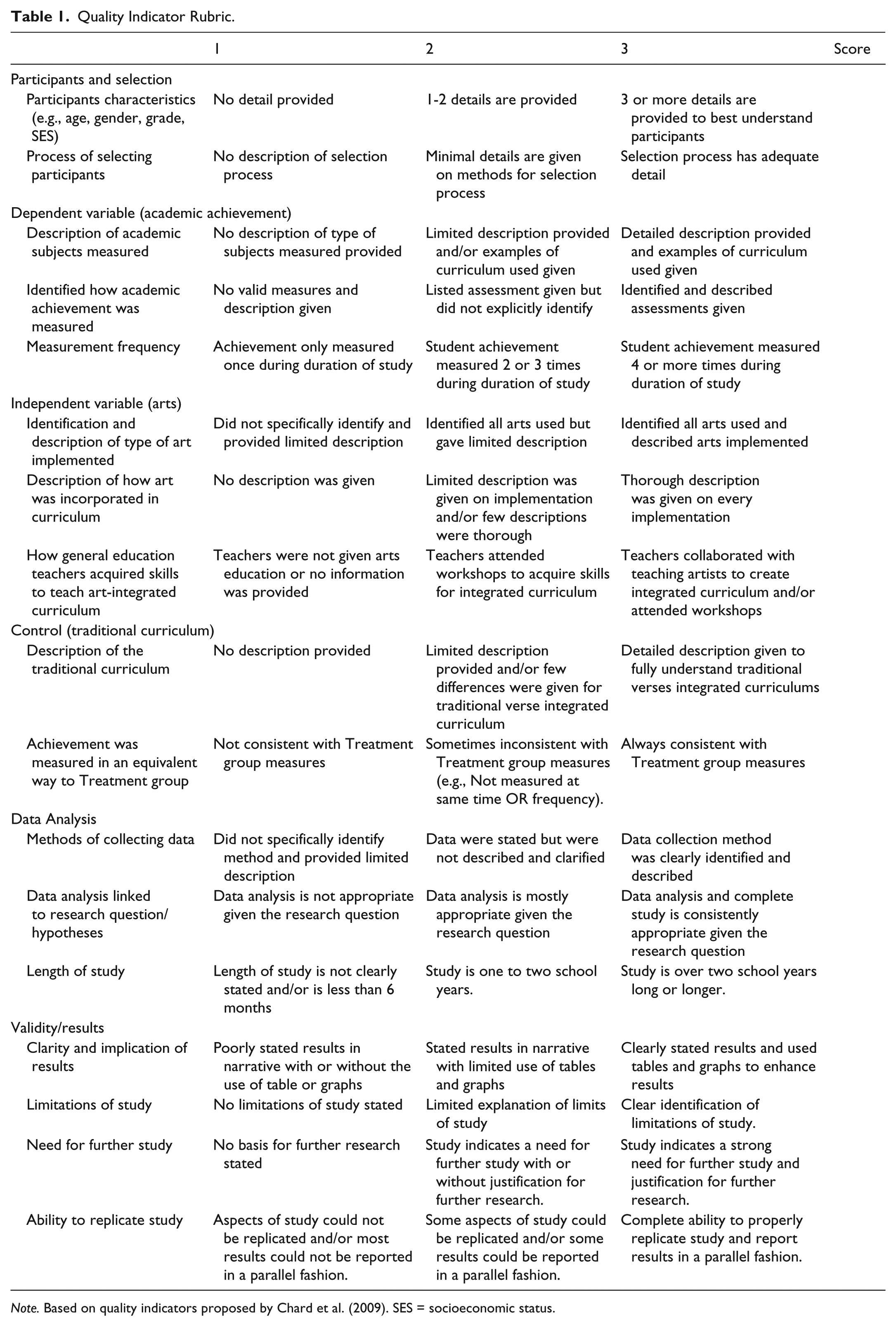
Note. Based on quality indicators proposed by Chard et al. (2009). SES = socioeconomic status.
The first set of indicators assesses participants and the selection process. It was important for each study to describe the participants adequately to understand who they were in terms of age, grade, gender, location, and SES. The process in which participants were selected insured that some participants in each study were from urban communities and their selection process was well understood.
The second set of indicators assesses the quality of the dependent variable, academic achievement in each study. A detailed description of academic subjects helped to determine what academic subjects may have been affected by arts integration. Studies that clearly identified how academic achievement was measured aids in interpreting the qualitative and/or quantitative results. The inclusion of this indicator was also important because it rated the ways in which achievement data were used to support each study. Finally, measurement frequency was used as a quality indicator because frequency and repeated measurements tend to strengthen understanding and plausibility of findings.
The third set of indicators measures how coherently each art type was integrated. Studies that articulate the type of integrated art aid in understanding the possible effects of one type of integration over other types when incorporated into core academic areas. Studies with no explanation, or a limited explanation, make it difficult to interpret the extent of curriculum integration. The final indicator in this section addresses the extent to which the core academic subject teacher acquired skills or received guidance to integrate art into the curriculum. The quality of explanation aids in understanding the role professional development may have had in interpreting the impacts of each study’s findings.
The fourth set of indicators measured the setting for each control group. Each study was rated for the quality of their description of the traditional curriculum. The dependent variable and the control group’s achievement measurement needed to be closely aligned. It was important each study assessed the similarities and differences between the integrated and control classrooms.
Data analysis was the fifth set of indicators and was used to ensure the data collected and conclusion offered helped to answer the questions or hypotheses in each study. Similar to measurement frequency, the length of the study helps in supporting quality findings. A study that was conducted for less than a year was not necessarily an insufficient study. However, a study that lasted more than a year had the opportunity to study the participants over time and see the extent to which arts integration affected participants over a longer period of time. Thus, a longer study was assigned a higher score on the quality indicators assessment tool.
Finally, the sixth set of indicators assessed the clarity and succinctness of results. Studies that stated the limitations and type of further research needed were also regarded as a strength for the study. After the study was completed, it was important that the researcher made it clear what he or she was not able to do during the study and how the study can be expanded/refined into other areas of research. Finally, the ability to replicate the study was an important factor because it pointed out that the given study provided a clear explanation in every aspect, so it could be easily replicated. This indicator addressed the organization and precision of the study’s intentions, setting, participants, and assessments.
Quality of Studies Identified for This Article
Table 2 summarizes the average score each study received in each category as a result of the quality indicator. “3” is the highest overall average score a study could receive and indicates that the study met all requirements to the fullest extent possible. An average score of “2” indicates that the study met some of the requirements. An average score of “1” indicates that the study met few if any of the requirements. All the studies have varying scores in different categories. Most of the studies have overall average scores between 2.18 and 2.51. Eight of the nine studies scored above two. This suggests that the studies identified for this article are of sufficient quality based on our indicators and their results merit our attention.
Summary of Analytic Tool Results.

Overall Insights From Research Studies
Table 3 shows the breakdown of information concerning the participants included in each study. This analysis focused specifically on urban students identified in each study. Students ranged in grade from Kindergarten through 12th grade. The ranges of size, grade-spans, duration, and ethnicity from all nine studies provide a fairly comprehensive array of implementation.
Participant Specific Information.

The type of art form and subject area each study focused on is shown in Table 4. Most of the studies included in this article explained in detail how each art form and subject area were integrated. At least five of the nine studies specifically identified visual art, music, drama, and dance as being integrated into math, language arts, social studies, and/or science subjects. However, language arts, specifically literature and writing, were the subjects most often selected for integration.
Type of Art Form Integrated and Subject Assessed.

In Table 5, all assessments used in each study have been identified. The SAT was the most often used measure. In nearly all of the studies, both qualitative and quantitative measures showed a positive increase for students in integrated classrooms compared with those in control classrooms. In addition, the longitudinal studies, for example, 1 year or more, found a positive correlation between students who were once in an integrated classroom, and his or her continued success on achievement tests in the following years. The array of assessment measures across all types of arts programs further supported the positive effects of arts integration on student achievement.
Type of Achievement Assessment Used and Results Found.

Connecting Arts Integration and Academic Achievement
Cognitive processes in growing children and the ways in which these functions are influenced by behavior are not well-established in the research literature. This article has identified the ways in which existing research has demonstrated that arts integration positively impacts academic achievement, but it is particularly concerning that none of the studies cited are able to make a strong claim as to why this is effective. In Winner and Hetland’s (2000) exhaustive search for studies related to arts integration published in English from 1950 to 1998, they found no experimental studies that tried to explain what changes in thought processing occurred to explain a change in academic improvement. In our review (1995-2015), we also found no explanations. Researchers in this area seem to agree that there is some relationship between increasing arts study and academic achievement. However, what aspects of that increased study in art may contribute to academic achievement is not clear and still remains speculative at this time. To further complicate the lack of direct cause, Luftig wrote in 2000, “There is little agreement in the professional literature as to the behaviors that children who have studied the arts in schools should demonstrate” (p. 209). This lack of clarity on what is being developed and/or refined in the learner and what integrated art experiences aid in that development to support academic achievement on tests creates a murky field for justifying what exactly constitutes impactful arts integration.
Attempts at explaining the mechanism for arts integrations effectiveness are varied and often devoid of any statistical evidence. Brouillette, Fitzgerald, Burge, and Walker (2008) suggest that arts integration is effective because students learn how to problem solve through writing while Lorimer (2011) contributes the effect to positive student engagement in the classroom and Walker, Tabone, and Weltsek (2011) neglect to give a reason. Not only are the expected behaviors students develop from art unclear, but the type of art activity that is most effective is also unclear. Catterall et al. (1999) explains that a wide variety of art activities seems to matter and says, “In general the argument is that different art forms involve different skills and different sorts of human interaction—in short, they impact cognitive processes differently and should be expected to result in different outcomes” (p. 9). The combined effect of varied art forms, expectations of public and private interaction, and practice in one or more art forms, approaches to instruction, and intrinsic and extrinsic student motivation(s) create an array of variables for measuring what aspects or groupings of aspects most likely contribute to how academic achievement is measured.
A Framework for Understanding Arts Integration and Academic Achievement
Existing literature cited in this article does offer some possible insights as to the ways in which arts integration impacts student achievement. In some cases, no reason was given or presented. Many of the articles cited seemingly ill-defined concepts such as perceived higher levels of engagement or more positive levels of confidence and self-esteem without any actual measurement process. In our analysis of how arts integration may impact student achievement, we determined that the collective grouping of these studies align to the three general concepts of Executive Function (Barrasso-Catanzaro & Eslinger, 2016; Eslinger, 1996).
Executive Function is defined in the American Heritage Medical Dictionary (Executive Function, n.d.) as “the cognitive process that encompasses an individual’s ability to organize thoughts and activities, prioritize tasks, manage time efficiently, and make decisions.” Barrasso-Catanzaro and Eslinger (2016) propose that Eslinger’s (1996) model consisting of “representational knowledge, operational processes, and self-regulation” be used when discussing Executive Function. The underlying concepts related to executive function help to sort out the findings from these studies and helps in understanding the role that arts integration may have in supporting cognitive development and ultimately student achievement.
When representational knowledge is developed, rules, conventions, and cultural norms of practice are being engaged (Barrasso-Catanzaro & Eslinger, 2016). In the arts, for example, choice of art materials, the color used, and how colors can be mixed for a visual representation have universal and specific cultural components. Learning and expressing these norms and practices work to help a learner see that representation of information has underlying norms that are attended to in representations of knowledge.
Operational processes are involved with planning, organization, sequencing, and using working memory to connect goals and actions over time and space (Barrasso-Catanzaro & Eslinger, 2016). In the arts, for example, creating and conceptualizing a dance routine, sequencing its components, memorizing the motions in relation to a song, and performing it over time in varying locations and spaces require extensive practice and engagement with operational processes.
Self-regulation includes an awareness of self in a particular setting to act in such a way that can initiate, sustain, inhibit, and shift an action. In the arts, for example, a reenactment of an historical character requires the learner to be aware of who they are reenacting and consider the actions and characteristics of the historical character. Students might critically read a text, talk with others, view videos, and so forth, to learn about their character. Having awareness of what words, gestures, and feelings to initiate, sustain, develop, refine, and suppress will help to ensure a historical accuracy and acute awareness of self in that role. Perhaps this awareness may help to self-regulate one’s actions when performing other academic tasks.
Connecting Arts Integration to Executive Function
Barrasso-Catanzaro and Eslinger (2016) state
rather than the modular packaging of functions that theorists sometimes associate with a type of intelligence or cognitive ability, executive functions are thought to access multiple streams of information processing and experience and potentially interact with all available mental resources in choosing responses and attaining goals (p. 109).
In Table 6, we have taken the major findings from each study and mapped it to the three aspects of executive function. While we are not claiming in this article that one or more aspects of the learner’s executive function was developed as a result of a particular approach, we are suggesting future researchers design studies that will explicitly measure pre and post aspects of executive function from an arts integration program to see if an effect is explicitly evident.
Aspects of Executive Function From Arts Integration That May Support Student Achievement.

Overall research literature lacks a coherent understanding of the complex behavioral and cognitive processes involved in an integrated classroom. Gullatt (2008) states
Recent developments in cognitive science and neuroscience help explain the power of the arts as enhancing teaching and learning in numerous ways. These developments have shown that the mind is embodied and that the brain and body make up a single, fully integrated cognitive system. Scientists have found that most thought occurs on a level well below conscious control and awareness and that it involves the processing of a continual stream of sensory information (p. 14).
If this continuous stream of information impacts a student’s thought process on a below-conscious level, then it is important to understand how these various streams of information could be/are developed through an arts integration program. Trainin, Andrzejczak, and Poldberg (2005) elaborate on these multiple information streams through explaining the connection between symbols and text, “We hypothesize, based on the interwoven symbols systems described by Dyson (1988), that the concrete cognitive connections made between image and text facilitated the students’ writing process” (p. 147). If thought processing occurs on a below-conscious level continuously processing input, then it could be easily understood that the symbolic relationship of pictures and texts create complex meaning in a way that text alone might not convey, thus contributing to student understanding. If the cognitive system learns best through processing information on a below-conscious level, then arts integration potentially increases academic achievement through providing multiple sensory streams of information.
This idea is strengthened further when student engagement is taken into account. Posner, Rothbart, Sheese, and Kieras (2008) pursued a deeper understanding of how engagement and enthusiasm affect learning. They hypothesize that
the enthusiasm that many young people have for music, art, and performance could provide a context for paying close attention. This motivation could, in turn, lead to improvement in the attention network, which would then generalize to a range of cognitive skills.
Schubert and Melnick (1997) also agree and attribute increased academic achievement from an arts-integrated curriculum to better attitudes and increased engagement. Melnick, Witmer, and Strickland (2011) also recognize the complexity of relating arts integration with changes in cognitive function. They note that the plethora of definitions of cognition, varying approaches to arts integration, high-stakes testing, policymaking, and funding all influence what and how art is integrated and what aspects of cognitive function is measured.
Linking Academic Achievement, Executive Function, and Standardized Testing
The existing literature supports that academic achievement—as measured by some standardized test—is improved when urban students are in an arts integration program. During this analysis, we examined the findings from nine studies that included urban students, integration of an art form and academic subject(s), and measurements of academic achievement. However, we hesitate to claim the cause and reason for that improvement is due to improvements in content knowledge.
We perceive that the important difference coming from these studies is that the important and critical processes, skills, development, and regulations of experiencing art as an integrated process work to refine students’ executive function through the processing of multiple streams of information. It seems reasonable to us that experiences which aid in the development of one’s executive function should help an individual to recognize rules or conventions of practice, cultural norms, and contextual clues in a written exam. Individuals taking an exam, who have a higher degree of executive function, should be better equipped to keep details of exam questions in working memory and recognize patterns or sequences of operation in more proficient ways as well as persevere when passages of text get tricky, boring, or complex.
Research Opportunities
Opportunities to further research the underlying implications of practicing arts integration are plentiful. Receptive school districts already implementing arts integration should be carefully studied to identify the extent to which teachers and students engage in practices aligned to strengthen executive function. Professional development programs that significantly involve the teaching artist in curriculum planning should be studied. Specifically, researchers should take a closer look to what and how their collaborative efforts create a curriculum that is aligned to the developmental and cognitive level of the learner consistent with aspects of executive function.
Future studies must include the ways in which students work to develop conceptual understanding and content knowledge of the links between art and integrated subject(s) to further understand how art integration happens. To explain what may account for reported gains in academic achievement, research instruments related to executive function should be utilized to explicitly examine how each aspect or the interplay of each aspect of executive function may develop or mature over the course of an arts integration experience.
Researchers should be encouraged to continue studying arts programming in an array of contexts. The existing research does not claim one type of arts integration is better suited than another. However, close examination of one particular artistic form with one or more core subject areas may provide more transparent findings related to what aspects of executive function may be developed. Arts integration programs that show significant gains from pre/post measures should also be studied to understand what types and to what extent knowledge, processes, and/or skills seem to be most likely retained and used in new but familiar settings.
Exemplary learning experiences happen when representational knowledge, operational processes, and self-regulation skills are transferred to similar or related tasks in another space and time. By refining our understanding of the ways in which knowledge, skills, and/or dispositions are developed by means of arts integration programs, we can further strengthen and justify why these programs are deserving of our attention.
Footnotes
Declaration of Conflicting Interests
The author(s) declared no potential conflicts of interest with respect to the research, authorship, and/or publication of this article.
Funding
The author(s) received no financial support for the research, authorship, and/or publication of this article.