




Abstract
The contribution of micro and small enterprises is limited as the majority are financially constrained and half of them exit from business in 2014/15, Amhara Region. Therefore, this study aimed to analyze the profitability of agricultural micro and small-scale enterprises in North Wollo Zone, Amhara Regional State, Ethiopia. Primary data was collected from 271 sample enterprises. The study employed descriptive and econometrics models for the data analysis. The financial ratio result shows that the return on asset, return on owner equity and net profit margin were 0.1601, 0.2768, and 0.1520 birr, respectively. The result of the probit model estimation shows that six variables, namely enterprise age, manager education level, credit use, input availability, owners’ aspiration, and frequency of extension contact significantly and positively influenced the probability of Micro and Small Enterprises (MSEs) being profitable. The second hurdle model, the truncation model showed that enterprise age, manager education level, record keeping, access to input, and frequency of extension contact significantly affected the extent of agricultural MSEs’ profitability. Therefore, enhancing the knowledge, skill, and aspirations of enterprise owners, improving financial access and outreach, providing financial bookkeeping training and practice, creating reliable integration with input producers, and frequent extension support to enhance the profitability and sustainability of enterprises.
Introduction
Small and Medium Enterprises (SMEs) contribute more than 50% of most African GDP (Muiruri, 2017 ) and 80% of jobs across the continent (Runde et al., 2021). Even though the sector is thought to be marginal and unproductive, its importance in terms of job creation and income is massive (GB news, 2020). It plays a key role in improving nutrition not only by bringing nutritious foods to markets but also through job creation and income generation (FAO, 2018). Agricultural SMEs across sub-Saharan Africa (SSA) bring food to households (CSIS, 2021). Transformational leadership with important knowledge of agribusiness sustainability improves the performance of the sector (Jankelová et al., 2020). The establishment of effective government policies and support in Ethiopia helps youths to engage in productive employment and could discard the stigma of unemployment (Melese, 2018).
The integration of classical firm growth literature into the inclusive finance—enterprise growth discourse improved insight into the trajectories of small enterprise growth in SSA (Eton et al., 2021; Kuada, 2021). Micro Finance Institutions (MFIs) help Micro and Small Enterprises (MSEs) to increase profits, total asset and employment through the expansion and diversification of their operation (Semegn & Bishnoi, 2021). The financing structure affects the profitability of micro and small enterprises. Thus, enterprises financed through retained earnings and personal savings increase their profitability while debt capital significantly reduces profitability (Achola, 2021). Access to credits from MFIs enhances profitability while interest rate and size of business hinder the profitability of SMEs. The positive contributions of microfinance banks via improved access to credit, managerial training, advisory service and growth in the size of business lead to SMEs’ profitability (Babarinde et al., 2019). In addition, informal microfinance sources significantly boost the profitability of enterprise clusters which suggests that informal credit sources support MSEs much more than formal sources (Amakom & Amagwu, 2020).
The financial management practice improves the profitability and growth of SME firms (Musah et al., 2018). The ability of the firm to operate for a longer time depends on a proper tradeoff between the management of investment in long-term and short-term funds (Dinku, 2013). The efficiency of working capital management and internal control (Basir et al., 2021; Benard & Ainomugisha, 2019) like shortening of the cash conversion cycle significantly contributes to the profitability of MSEs (Dinku, 2013). The firms maintain the cash holding level up to a maximum profitability or growth where beyond these levels adding cash would hurt sales growth and profitability (Prijadi & Desiana, 2017). In addition, good financial behaviour such as budgeting, debt management, savings, record keeping and retirement planning contributes to the profitability of MSEs (Ibrahim, 2017).
In a country like Ethiopia with a fast-growing population, proper management and efficient utilization of its workforce is a critical concern (CSA, 2018). Micro and small enterprise has generated a large share of economic growth and employment in Ethiopia. It has a great contribution in reducing unemployment and providing income to those owners and employees of MSEs (Mahmud et al., 2020), and improving the livelihood conditions of target beneficiaries (Bekele, 2017). During 2019/20 alone, 111,547 new MSEs employed about 1.6 million people and received more than Birr 7.7 billion in loans for their operations (NBE, 2020). The annual progress report of GTPII in 2012/13 indicates that over the first 3 years of GTPI implementation, 3.96 million jobs were created over the 3 years (Dom & Vaughan, 2018).
Statement of the Problem
The long-term sustainability of Ethiopian SMEs is substantially hindered by political instability, corruption, and COVID-19 (Abdissa et al., 2022). Ethiopian political uncertainty has a negative and considerable influence on the survival of SMEs (Abdissa et al., 2022). Access to finance remains the leading barrier to the development of MSEs in Ethiopia due to the existence of inadequate loan size, borrowing cost and collateral requirement. In addition, poor infrastructures leads to high worktime loss, reduce productivity, and increased cost of enterprise production (Endris & Kassegn, 2022). Financial constraints reduced the start-up of new businesses, which leads youths to face high cost of financial services (Eton et al., 2021) and struggle with unfair competition and corruptive actions (Mehari & Belay, 2017). Lending to agricultural SMEs is twice as risky as lending to other sectors, and operates at a scale that is too small and yields lower returns, which is the greatest challenge for agricultural SMEs (CSIS, 2021)
The adverse attitude toward MSEs is the main challenge due to lack of knowledge on the potential of MSEs and a preference for paid employment (FMSEDA, 2011). Most graduates of vocational agriculture are less likely to establish a farm/enterprise of their own and the majority want to obtain certificates required for securing employment in paying jobs (M. Francis et al., 2019). According to (Central Statistical Agency (CSA), 2018), 53.8% of unemployed desire to work constrained by the shortage of capital and the other accounting 10.9% did not work due to lack of working place. The politicization of entrepreneurship; weak institutional systems, weak business development services, poor infrastructure, and youth negligence are critical barriers to youth entrepreneurship programs in Ethiopia (Ahmed & Ahmed, 2021; Kebede, 2022). Moreover, Wolday (2015) found that limited access to finance, lack of production and marketing premises, and inadequate market development are the main challenges in expanding and establishing MSEs in Ethiopia.
Firms with a high level of profitability and a low level of growth have a greater chance of subsequently achieving high growth and high profitability than a firm with a high level of growth and a low level of profitability (Rivard, 2014). With this, profitability has a significant effect on the growth of SMEs (Raharja & Kostini, 2019) and lack of enterprise profit appears to be a binding constraint to their growth (Shitaye & Elgammal, 2022). Most Micro, Small and Medium Enterprises (MSMEs) are not profitable and poor utilization of assets, poor cash management practices and difficulty to produce equity returns are the major problems (Mayanja, 2020; Pandey, 2020). MSEs profitability is decreasing as they failed to apply financial statement analysis, made unplanned withdrawals of money for personal use, manage their working capital poorly and faced shortage of finance (Abera et al., 2020).
Micro and small manufacturing enterprises accounting for 60.5% are financially constrained in the Amhara region (Melesse, 2019), and half of them dropout from the business in 2014/15 (Zegeye et al., 2016). Urban agriculture MSEs have registered the lowest mean efficiency (B. A. Abebe & Zemenu, 2021; Ayele, 2021) and created the least employment (10.5%) in Amhara region, while other sectors independently contribute beyond 20% of MSEs employment (EMUDH, 2016). In 2018/19, agricultural MSEs accounted for the lowest number of enterprises (9.12%) in the study area (NWZVEDDO, 2019). Even though agricultural MSEs have played an enormous role in supplying foods and raw materials to agro-processing industries (Daniel & Getaneh, 2016), their contribution to employment and the economy is limited. Thus producing questions on the profitability and growth potential of agricultural MSEs. Empirical evidence revealed that the profitability of MSEs is key to their growth and sustainability (Raharja & Kostini, 2019; Rivard, 2014; Shitaye & Elgammal, 2022). Nevertheless, there are no adequate studies conducted on the profitability of MSEs, particularly in the agriculture sector. Most empirical evidence (Fufa, 2015; Molla, 2016) mainly focused on investigating MSEs’ performance using capital growth and employment size. As a result, this study intends to fill the existing research gap through investigating the profitability of agricultural MSEs in North Wollo Zone, Amhara Regional State, Ethiopia. Understanding the profitability of enterprises helps to evaluate the growth and sustainability of the existing enterprises, and boosts youth aspiration to startup of new ventures. The findings of this study have significant ramifications for scientific knowledge, the academic community, researchers and policy-makers to develop effective policies.
The objective of the study is to analyze the profitability of agricultural micro and small-scale enterprise in North Wollo Zone, Amhara Regional State of Ethiopia.
The study aimed to provide evidence for the following research questions
(1) What are the determinants of agricultural MSEs profitability in the study area?
(2) Does the profitability ratio of the enterprise indicate MSEs’ financial health?
Basic Definitions of Terms Used in the Study
Small and medium enterprises are defined according to size (number of employees), turnover, activity, ownership and legal status (Hussain, 2000). In Ethiopia, FDRE (2016; FMSEDA (2011) define micro and small enterprises.
Research Methodology
Description of Study Area
This research was carried out in Ethiopia’s North Wollo Zone (Figure 1). The capital city of the zone is located 521 km north of Addis Ababa, the country’s capital. The zone is divided into 14 districts and 5 town administrations and covers a total area of 12,172.5 km2. The study area is bounded on the south by the South Wollo Zone, on the west by the South Gonder Zone, on the north by the Wag Hemra Zone, on the northeast by the Tigray Region, and on the east by the Mille River. In 2017, the zone’s total population is expected to be 1,824,361, with 913,572 men and 910,789 women. There are 270,686 of these people live in cities, and 1,553,674 live in rural areas (CSA, 2013).

Study area map.
Types, Sources and Methods of Data Collection
In this study, both qualitative and quantitative data were collected from primary and secondary sources. Primary data was collected from selected agricultural MSEs using semi-structured questionnaires. The study collected relevant information about the enterprise from managers of the enterprise who represent the enterprise as a business entity. The questionnaire was pretested by experts and enterprises outside the study area and necessary modification has been made for final data collection. Finally, the questionnaire designed for the enterprise was translated into the regional language Amharic to make it clear and collect real data from respondents. Furthermore, secondary data was collected from enterprises’ annual financial statements, reports, and business plans and different published and unpublished sources, such as North Wollo Zone enterprise directive office, woreda enterprise development office, NBE, CSA, EEA, reports, and bulletins.
Sampling Procedure and Sample Size
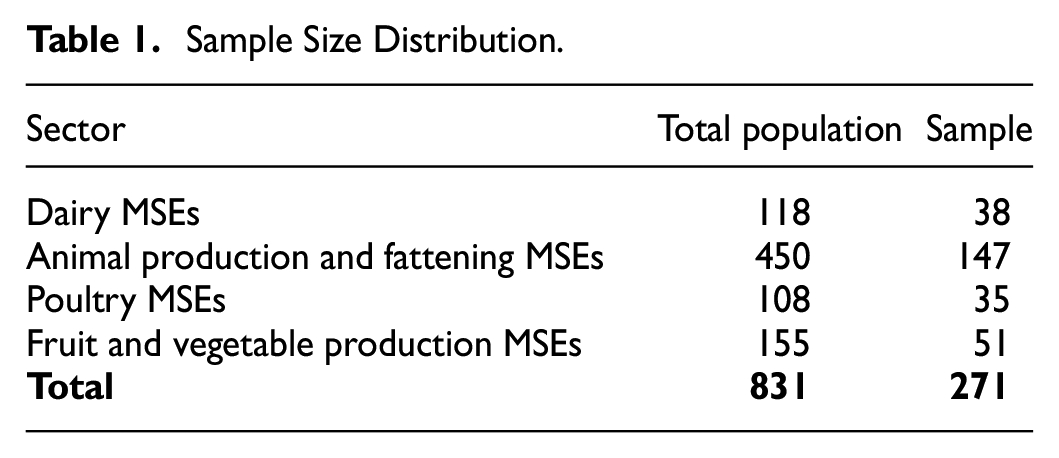
This study solely focused on agricultural MSEs due to the number of enterprises in the sector and the employment opportunity created with them are limited. The desired sample size was selected proportionally from different agricultural MSEs (dairy MSEs, animal production and fattening MSEs, poultry MSEs, fruit and vegetable production MSEs) using a simple random sampling technique. Enterprises established during the survey year were excluded from the sample as those enterprises are startups and may not produce output. The enterprises were stratified into four subsectors and the sample of each subsector was determined by proportional sampling methods, as provided in Table 1.
Sample Size Distribution.
The researchers used (Yamane, 1967) sample determination formula to determine the desired number of samples from the total population


Where, n = sample size, N = the total number of agricultural MSEs in North Wollo Zone, and e is the level of precision (i.e., 5%.). Accordingly, out of 831 agricultural MSEs registered in North Wollo Zone, 271 samples were selected.
Methods of Data Analysis
Business performance evaluation methods can be grouped into two categories: traditional methods that are justified only by the analysis of financial indicators and modern ones that combine the company’s financial and non-financial performance information that enables the evaluation of its activity both quantitatively and qualitatively (Narkunienė et al., 2018). Two different indexes of profitability are operating profit ratio and return on total assets (Cozza et al., 2012). Profit and job creation are fundamental outcomes for measuring entrepreneurial performance, especially in the context of developing countries. While profit captures the main monetary outcome of business performance, employment creation is all more socially valuable, in particular, when job opportunities are offered to external workers and not only to family members (OECD, 2017). Financial performance measures such as profitability, liquidity, and solvency ratios are expressed in monetary terms to ensure the business’s financial health and sustainability. Profitability ratios are viewed as a way to identify and measure the ability MSEs to generate a profit (Scarborough, 2012; Warren et al., 2013). Profitability is simply the capacity to make a profit, and a business needs to make a profit to provide a return to the investors and to grow the business. Hence, this study used Return on Assets (ROA), Return on Equity (ROE), and Net Profit Margin (NPM) ratios to examine the profitability performance of MSEs in the study area.
The econometrics model used to analyze the determinants of agricultural MSEs profitability depends on whether the dependent variables are dummy, continuous, or censored at a certain level. Ordinary Least Squares (OLS) is applicable when all enterprises are profitable (have positive returns on assets). However, in reality, SMEs may incur a loss. The double-hurdle model is a more flexible alternative than Tobit and Hickman models assuming a two-step decision is independent. Unlike in the Tobit model, there are no restrictions regarding the elements of explanatory variables in each stage of the double hurdle model. The model estimation involves a probit regression and the truncated regression model to identify factors affecting profitability and the extent of profitability, respectively. The two decisions also have been modelled as sequential, but most studies treat the decisions as separate (Cramer et al., 1995).
A double hurdle model was used to estimate the probability and intensity of agricultural MSEs’ profitability. The dependent variable profitability is measured by return on asset (ROA), which is a limited dependent variable, that is, some observations do not have positive returns on the asset during the survey year. As the likelihood of enterprises’ profitability and extent of profitability are not necessarily made jointly and no selection bias, the Double-hurdle model was chosen over Tobit and Heckman model. The model postulates that households must pass two separate hurdles before they are observed with a positive return on assets (profitable). The first hurdle (probit model) is whether to achieve a positive return on an asset or not, and the second hurdle (truncated regression model) is deciding the level of profitability conditional on the probability of being profitable. The double-hurdle model can be specified as follows:
The first hurdle is the probability of being a profitable equation with a probit model. The model is specified as follows:


When
X is a vector of enterprise characteristics and
In the second hurdle, the truncated regression model was used to analyze factors affecting the level (extent) of MSEs’ profitability. Truncated regression excludes part of the sample observation based on the value of the dependent variable (Wooldridge, 2010). That is, the truncated regression uses observations of enterprises that have a positive return on asset. The level of enterprise profitability is modeled in a truncated regression at zero as follows:


Where
The log-likelihood functions as the double-hurdle model that nests a univariate probit model and a truncated regression model estimated by(Cragg, 1971):

Where, Ф and φ refer to the standard normal probability and density functions, respectively, Xi′ represent independent variables for the Probit model and the Truncated model, α′ and β′ are the estimated coefficients of the explanatory variables for the probit and the truncated regression models, respectively.
Definitions and Hypotheses of Variables
Dependent Variables
Independent Variables
The independent variables are those factors affecting the profitability of agricultural SMEs.
Description and Hypothesis of Explanatory Variables.

Source. Own summary.
Result and Discussion
Socio-Economic Characteristics of Enterprises
The government of Ethiopia has given priority to the development and employment creation in the manufacturing sector including agriculture, which is a key in solving long-standing food insecurity challenges in the country and the foundation for agro-processing industries. The age of the agricultural MSEs in the study area ranges from 1 to 9 years. From the sample respondents, 8.12% of enterprises startup a year ago during the survey, while the majority of enterprises accounting for 83.76% were aged from 2 to 5 and the other 8.12% were aged more than 5 years old (Table 3). This shows that more than 91.88% of agricultural MSEs are young and less than five years old as there were large government interventions in youth employment creation through MSEs and youth revolving funds released recently.
Financial Ratio of Agricultural MSEs.

Source. Own survey (2021).
The mean education level of enterprise managers was 7.5 years of schooling, ranging from 1 to 17 years. About 66.79% of the MSEs managers attained elementary education (from grade 1 to 8), 19.56% attained high school education (grade 11–12), 4.8% attained preparatory and the other 8.86% had a diploma and above certificate level of education. This shows that the majority of entrepreneurs in the agriculture sector are at the elementary education level who are school dropouts and returnees from Arab counties. The number of employees of sampled agricultural MSEs ranges from one to 20 with a mean of 4 employees. The results of the study indicated that most enterprises employed members of the business and extra employment creation for non-members were few as the small size of the enterprise restricted the capacity of enterprises for more employment creation. The result showed shows that a considerable number of enterprises accounting for 40.22% do not obtain a loan from micro-financial institutions. The mean start-up and current capital of agricultural MSEs in the study area were67,319 to 118,127, respectively.
The financial ratios for each agriculture subsector enterprise were computed in Table 4 Below. The result showed that the mean return on asset, return on equity, and net profit margin of agricultural enterprises in the study was 0.1601, 0.2768, and 0.1520 birr per each birr of investment and sales respectively. The minimum ratios, which are indicated by a negative value, represent the financial ratio of non-profitable agricultural enterprises during the survey year.
Socio-Economic Characteristics of Agricultural MSEs.

Source. Own survey (2021).
Econometrics Result
The study evaluated the performance of agricultural MSEs in North Wollo Zone, Amhara Regional State, Ethiopia. The financial performance of agricultural MSEs is evaluated through profitability, which is measured by the return on assets.
Factors Affecting Enterprise Profitability
In this section, the factors affecting profitability and the extent of profitability estimates are presented with the application of the double hurdle regression model. Model appropriateness tests were performed using the log-likelihood ratio test, Akaike’s Information Criteria (AIC) and Bayesian information criterion (BIC). The result indicates that double hurdle regression is the right model over Tobit regression, with log-likelihood (Γ = 553.92823) higher than the chi-square value (24.99) at 15 degrees of freedom and at 1% significance level. The dependent variable return on asset (ROA) which is used to measure profitability which is limited as some enterprises are profitable while some are not during the survey year 2020/2021. Hence, the first stage of the hurdle model uses the probit model to analyze the probability of enterprises being profitable (positive returns on assets) and the second stage of the hurdle model uses truncated regression to estimate factors affecting the extent of profitability (amount of return on assets) by truncating enterprises that are not profitable during the survey year.
The probit regression model chi-square test indicates that the overall goodness-of-fit of the probit model was statistically significant at 1% probability level. The result of the probit model estimation shows that 6 variables (enterprise age, manager education level, credit use, access to input, owners’ aspiration, and frequency of extension contact) significantly and positively influenced the probability of MSEs being profitable (Table 5). The second hurdle model, the truncation model, was statistically significant at 1% significance level that shows the goodness of fit of the model to explain the effects of the hypothesized variables on the dependent variable (extent of profitability). The truncated regression results revealed that enterprise age, manager education level, record keeping, input access, and frequency of extension contact significantly affect the extent of agricultural MSEs’ profitability.
Double-Hurdle Estimates of Profitability and Level of Profit of Agricultural MSEs.

and ** indicates statistically significance at 1%, and 5% level respectively.
Source. Survey (2021).
The result of the study reveals that ownership structure enhances the growth of micro and small enterprises (Shitaye & Elgammal, 2022). Private ownership enables MSEs to develop sustainably (Chen et al., 2022)
Conclusion and Recommendation
With a fast-growing population in Ethiopia, MSE development has given extensive attention to creating jobs and fostering the economic development of the country. However, the pursuit of entrepreneurship often comes with high stress, multiple obstacles, and high levels of uncertainty regarding outcomes, which limit their contribution to national income, employment, and export performance. The performance of agricultural MSEs in terms of job creation, efficiency and growth is very restrictive compared to other sectors. Despite North Wollo Zone having a high potential for agriculture, the contribution of agricultural MSEs to employment and the economy is limited, which needs empirical evidence to evaluate the profitability factors that hinder the development of MSEs in the agriculture sector. Therefore, this study aimed to investigate the profitability of agricultural MSEs in North Wollo Zone, Amhara Regional State, Ethiopia.
The descriptive results showed that the mean return on asset, return on equity, and net profit margin of agricultural enterprises in the study were 0.1601, 0.2768, and 0.1520 birr per each birr of investment and sales respectively. The result of the probit model estimation shows that age of the enterprise, manager education level, credit use, access to input, owners’ aspiration, and frequency of extension contact significantly and positively influenced the probability of MSEs being profitable. The second hurdle model, the truncation model showed that age of the enterprise, enterprise manager education, record keeping, access to input, and frequency of extension contact significantly influenced the extent of agricultural MSEs’ profitability.
Based on the findings of this study, the following recommendation is provided for the respective concerned body to enhance the profitability and financial performance of agricultural MSEs in the study area as well as national sector development.
Enhancing enterprise knowledge and skills, and owners’ aspirations through skill development training and youth education program are vital for the profitability of the enterprise, thereby developing the sector.
Financial sectors and government should consider unlocking the financial challenges through MSEs targeting loans and improving financial outreach.
Enterprise development offices and lending institutions should provide basic financial skill training and monitor the financial bookkeeping practice of the enterprises.
Creating a reliable input linkage for agricultural MSEs for which their products are perishable and have seasonal production schedules is critical to the development of the sector.
Frequent extension monitoring and advice to enterprises should be intensified.
Research Limitations/Implications
The key limitation of the study is it depends on cross-sectional data obtained from agricultural MSEs. The study was conducted on only MSEs engaged in the agriculture sector which didn’t include firms in the other sector. The finding would not be applicable for generalization at a broader level and to the non-agriculture economic sector. Hence, more evidence is needed through a further comprehensive study using a longitudinal study design, employing both qualitative and quantitative research approaches on MSEs is desirable. More importantly, a study that focuses on dropout enterprises is critical to investigate the problems of MSEs.
Footnotes
Authors’ Contributions
All authors participated in the entire process of the research and write-up. All authors read and approved the final manuscript.
Declaration of Conflicting Interests
The author(s) declared no potential conflicts of interest with respect to the research, authorship, and/or publication of this article.
Funding
The author(s) disclosed receipt of the following financial support for the research, authorship, and/or publication of this article: This paper received funding from Woldia University
Availability of Data and Materials
The datasets used and/or analyzed during the current study are available from the corresponding author on reasonable request.
Code Availability
Not applicable
