



Abstract
Micro, small and medium-sized enterprises (MSMEs) play a large role in different economies; hence the relevance of research on the factors that may leverage MSMEs competitiveness such as innovation and management. This research aims to review highly cited articles in the Web of Science database regarding management and/or innovation in the context of MSMEs. Besides showing MSMEs classifications across regions, this review also showed that variables employed in the highly cited papers have correspondences with excellence/quality management factors and traditional innovation types, which hence still serve as theoretical frameworks for research on MSMEs competitiveness. Moreover, theoretical relations were identified among all variables, being the strongest among networks-open innovation, information-knowledge, and product and process innovations. The results indicated that MSMEs competitiveness is related to sustainability, information-knowledge, and networks-open innovation; hence MSMEs managers and owners should pay attention to these factors. Finally, future research directions were also gathered and discussed.
Keywords
Introduction
The definitions of micro, small, and medium-sized enterprises (MSMEs) are not constant around the world. In fact, the categories themselves differ between countries and regions (Table 1). For instance, Europe and Brazil have definitions for micro, small, medium and large companies (i.e., four categories); China has definitions for small, medium and large enterprises (i.e., three categories); and the United States has definitions for small and large businesses (i.e., twos categories) (BRASIL, 2006; EU-Commission, 2003; Small Business Administration [SBA], 2017, 2018; Xiangfeng, 2008).
Summary of Companies’ Size Classification by Region Based on the Number of Employees.

Note. Companies size classification was limited to the number of employees, but other factors such as annual revenues may also influence companies’ size classification in all regions. China and USA classifications were general as both countries have additional special classifications by sector. N.A = not applicable.
In Europe (EU-Commission, 2003), a medium-sized enterprise is defined as a company that employs less than 250 people and has annual revenues of up to 50 million euros and an annual payroll of up to 43 million euros. A small enterprise is defined as a company that employs less than 50 people and has annual revenues or payroll of up to 10 million euros. Finally, a micro enterprise is defined as a company that employs less than 10 people and has revenues or payrolls of up to 2 million euros. Several articles in the European context use this definition of the European Commission, especially regarding the number of employees (Calvo-Mora et al., 2013; Cerchione & Esposito, 2017; Villar et al., 2014).
In Brazil, the Small Business General Law (BRASIL, 2006) establishes the definition of company size for tax purposes as a function of the company’s annual revenues. Since 2018, the revenue limits are BRL 81,000 (approximately $20,250) for the individual micro-entrepreneur (MEI), BRL 360,000 (approximately $90,000) for the microenterprise, and BRL 4,800,000 (approximately $1,200,000) for the small business. Although the medium and large-sized enterprise definitions are not established by law, the Brazilian Development Bank (Banco Nacional de Desenvolvimento Econômico e Social – BNDES) applies the annual revenue limit of BRL 300,000,000 (approximately $ 75,000,000) to differentiate between medium-sized and large enterprises. Nevertheless, the Brazilian Micro and Small Business Support Service (Serviço Brasileiro de Apoio às Micro e Pequenas Empresas – SEBRAE) uses the number of employees to determine company size in different surveys and derived publications, especially when billing data is not available. The number of employees differs between two main sector groups, namely (1) extraction, manufacturing, and construction, and (2) agriculture, trade, and services. In each size category, the limit number of employees for each sector group is respectively: 19 and 9 for the micro enterprise; 99 and 49 for the small enterprise; 499 and 99 for the medium-sized enterprises (SEBRAE, 2017, 2019).
In China, the definition uses the number of employees, annual revenue, and financial assets as criteria, but it is specific to different economic sectors (i.e., industries). For instance, the limit of employees for a medium-sized enterprise in manufacturing is 2000, in construction 3000, in retail 500, and tourism 800. The limit of employees for a small company in these same sectors is, respectively, 300, 600, 100, and 400 (Xiangfeng, 2008). It is interesting to note that a manufacturing company with 290 employees would be considered small in China while it would be considered large in Europe.
In the United States, the Small Business Administration (2018) agency generally defines a small business as an independent business that has fewer than 500 employees. However, the agency itself indicates that the definition of small business for participation in US federal government programs may vary for each economic sector, so it also provides a table of size standards in correspondence with the US industry classification code system, where size is determined by annual revenue limits and/or the number of employees (SBA, 2017). For instance, the maximum limit for employees in the paint and coating manufacturing sector is 1,000, while in the semiconductor machine manufacturing sector it is 1,500. Still, the most commonly used definition in the literature is the limitation of 500 employees (Rosenbusch et al., 2011). In fact, Zeng et al. (2010) used the US definition of 500 employees even though they investigated Chinese companies.
Despite different definitions, micro, small and medium-sized enterprises have been recognized for their importance to the economy in different countries and regions (Salgado et al., 2018; Salimi & Rezaei, 2018; Scuotto, Santoro et al., 2017; Soto-Acosta et al., 2015, 2017). In the European Union, nine out of ten companies are micro, small, or medium, which also generate two out of three jobs (EU-Commission, 2015). In Brazil, they account for 27% of Brazil’s GDP and 54% of all formal employment and represent 98.5% of all private companies (SEBRAE, 2017). In China, they account for 99% of all businesses and at least 60% of GDP (Xiangfeng, 2008). In the United States, the numbers are similar, where they account for 99.9% of all companies, 47.5% of total private-sector employees, and the generation of two out of every three new jobs (SBA, 2018).
On the one hand, an advantage of MSMEs over large companies is their ability to adapt faster, as there are fewer tightly established processes and hierarchies. On the other hand, MSMEs still face different difficulties and are therefore targets of government support and incentive programs (Carvalho et al., 2018; Inoue & Yamaguchi, 2017; Radicic et al., 2016). The main difficulties of MSMEs highlighted in the literature encompass the lack of resources such as financing, qualified professionals, knowledge, and technologies. These factors are relevant as they may leverage MSMEs management and innovation capabilities and, in turn, MSMEs competitiveness (Gonçalves et al., 2017; Grimsdottir & Edvardsson, 2018; Vasconcelos & Oliveria, 2018a).
Recent literature reviews on MSMEs focused on different topics related to their competitiveness such as open innovation (Torchia & Calabrò, 2019), collaboration (Zahoor & Al-Tabbaa, 2020), performance measurement (Rojas-Lema et al., 2020), sustainable management (Barbosa et al., 2020), among others. Nevertheless, broad literature reviews covering both innovation and management in MSMEs remain as a research gap. An additional motivation involved the identification of the most relevant papers, and hence potential hot subtopics for research, on MSMEs innovation and management. Different approaches have been employed by the literature to identify relevant papers, in which the most common approaches are quantitative-based on top-cited papers, percentiles, citation counts, and databases definitions such as the highly cited papers from Essential Science Indicators in Web of Science (Bornmann, 2014).
In this sense, this paper aims to review the highly cited papers on MSMEs innovation and management. The reviewed papers were specially analyzed by the lens of seminal models, namely, the quality-excellence management models (ABNT, 2015; European Foundation for Quality Management [EFQM], 2013; FNQ, 2011; NIST, 2013) as well as the innovation types used in the third edition of the Oslo Manual (OECD & Eurostat, 2005). Further theoretical contributions include the identification and discussion of current research topics as well as incipient topics, besides indicating future research directions.
The paper is organized as follows. Besides this introduction, section 2 presents the quality-excellence and innovation frameworks that supported the analysis. Section 3 presents the method. Section 4 presents the results while section 5 presents the literature analysis/review. Finally, section 6 presents the discussion, future research directions, and conclusion.
Frameworks-Quality-Excellence Management and Innovation
Quality-excellence management models are general reference frameworks to improve overall business management and outcomes (Bou-Llusar et al., 2009; Calvo-Mora et al., 2016). In addition to ISO 9001(ABNT, 2015), the most widespread models include the American Malcolm Baldrige National Quality Award (MBNQA) and the European Foundation for Quality Management (2013; Eriksson et al., 2016; Suárez et al., 2017). Still, other countries also have national quality awards and excellence models such as the Excellence Management Model – EMM (Modelo de Excelência em Gestão – MEG) in Brazil, which is mainly based on both the MBNQA and EFQM (Cardoso et al., 2020; Machado et al., 2020; Melo & Medeiros, 2021).
As Table 2 shows, the excellence and quality management models comprise by and large common enabling and resulting management dimensions such as leadership, people, clients, strategy, relationships, information-knowledge, processes, society-environment, and results.
Management Factors of Excellence/Quality Models.

Source. Elaborated by the authors based on ABNT (2015), EFQM (2013), FNQ (2011), and NIST (2013).
Note. EFQM = European Foundation for Quality Management; MBNQA = Malcolm Baldrige National Quality Award; EMM = Excellence Management Model (Modelo de Excelência em Gestão – MEG).
Indirect aspects.
Leadership is a primary dimension in the models as it usually drives other management factors (Kim et al., 2012; Naqshbandi & Tabche, 2018). The strategy dimension is also able to influence other management dimensions, but it is influenced by leadership (EFQM, 2013; NIST, 2013). Other dimensions such as people management, client orientation, and processes management are also reckoned in the literature as general and relevant management capabilities for business success (Vasconcelos & Oliveira, 2018b).
Other specific management dimensions include relationships-networks management (Resende et al., 2018; Zahoor & Al-Tabbaa, 2020) and information-knowledge management (Calvo-Mora et al., 2016; Naqshbandi & Jasimuddin, 2018), which also have been shown in the literature as catalysts of business results, especially innovation. In this sense, it is worth noting the close association between relationship management and the open innovation concept, which is broad and encompasses different types of activities businesses engage with clients, customers, suppliers, universities, competitors, etc. specifically in order to pursue innovation (Brunswicker & Vanhaverbeke, 2015; Chesbrough, 2003a, 2003b). Complementarily, while the Society-Environment is a specific enabling dimension of the Brazilian Excellence Management Model, ‘results toward society’ is included within the EFQM model (Cardoso et al., 2020; Santos et al., 2018). Moreover, all quality management models include to some extent social and sustainability aspects in their dimensions since they encompass management principles (NIST, 2013) and fundamental concepts (EFQM, 2013). Finally, all quality management models include either one general or several specific dimensions related to business results.
Regarding innovation, the Oslo Manual (OECD & Eurostat, 2005, 2018) stands as a seminal reference that bases different innovation and innovativeness measures applied in the literature, besides regional and national innovation surveys (Alves & Galina, 2020; Melo et al., 2017). The innovativeness concept is related to companies’ innovation capability and comprises innovation inputs, activities/capabilities, and outputs, wherein innovation outputs are innovations per se (Carvalho, Cruz et al., 2020; Quandt & Castilho, 2017). In this sense, the business innovation concept was recently updated in the fourth edition of the Oslo Manual as “[. . .] a new or improved product or business process (or combination thereof) that differs significantly from the firm’s previous products or business processes and that has been introduced on the market or brought into use by the firm” (OECD & Eurostat, 2018, p. 20).
Although the fourth edition of the Oslo Manual published in October 2018 is the most recent version of the manual (OECD & Eurostat, 2018), the third edition from 2005 (OECD & Eurostat, 2005) was contemporary to the highly cited papers identified in this review, which were published between 2008 and 2018. Within the third edition of Oslo Manual’s innovation measurement framework (OECD & Eurostat, 2005, p. 34), firm innovation is mainly characterized by the product, process, marketing, and organizational innovation types. On the other hand, business innovation is characterized by only product and process innovations in the fourth edition, wherein marketing and organizational innovations were reclassified as subtypes of process innovations (OECD & Eurostat, 2018). Thus, considering the contemporaneousness of Oslo Manual’s third edition to the highly cited papers, its broader coverage of innovation types, and its comparability to the fourth edition, this review adopted its firm innovation framework encompassing product, process, marketing, and organizational innovation types. Finally, it is worth noting that all the frameworks adopted in this review may be applied to organizations of any size, and hence are adequate to MSMEs.
Method
Bibliographic Search
The Web of Science is considered one of the main prestigious databases in different fields of research and currently covers 24,960 journals. Even though its main measurement of journal impact factor (journal citation reports – JCR) is a subject of debate in the literature, Web of Science has been used as a data source for diverse bibliometric studies (Archambault & Larivière, 2009; Bensman, 2012; Buela-Casal & Zych, 2012; Carvalho et al., 2017; Carvalho, Sokulski et al., 2020; Garfield, 2006; Li et al., 2018; Vanclay, 2012). Along with Scopus, Web of Science bibliometric indicators have been used to support diverse hybrid journal classification lists (Docampo & Safón, 2021), especially in business management, such as the Australian Business Deans Council (ABDC, 2019), and the Academic Journal Guide (AJG) by the Chartered Association of Business Schools (ABS, 2021), besides national classifications lists for all subject areas such as the updated Brazilian Qualis, which employs mainly percentiles (CAPES, 2019; Costa et al., 2020). Particularly on Business Management and the AJG-2021 list (ABS, 2021), it is worth noting that 1,423 out of all 1,698 listed journals (83.8%) are indexed in the Web of Science database, in which the majority of top classified journals are also indexed (100% of categories 4* and 4, and 97.4% of category 3). Table 3 presents the query conducted in the Web of Science database regarding management and/or innovation in micro, small, and medium-sized enterprises, which was performed in February 2019.
Query and Selection of Papers on Management and/or Innovation in MSMEs.

Since this paper aimed to review the highly cited papers on MSMEs innovation and management, these three terms supported the choice of the keywords. By means of the advanced search, different keywords related to micro, small and medium-sized enterprises were used, even though there is no universal definition for MSMEs, as already presented in the introduction (section 1). The query also used part of the word management with the asterisk wildcard symbol (manag*), which then encompasses different variations such as management, managing, manage, managed, among others. Similarly, part of the word innovation with the asterisk wildcard symbol (innovat*) encompasses different variations such as innovation, innovations, innovative, innovativeness, innovators, among others. The query also limited results to the English language and to articles or revisions regarding document types, which resulted in 8,418 papers.
Subsequently, the query was refined by selecting Web of Science top papers, i.e., the highly cited papers in a field or hot papers in a field. The former refers to 1% of the most cited papers by research field each year, considering the papers published in the last ten years. The latter refers to 0.1% of the most cited papers per bimester, considering the papers published in the last 2 years (Clarivate, 2019; Zhang et al., 2018). The percentile classification approach of highly cited papers is aligned with DORA principles (Pulverer, 2015) and the view of Bornmann and Marx (2016), who contended that citation impact measures should shift from journal impact factors to the level of individual papers controlled by research field. Still, it is worth noting that all citations within the Web of Science database are counted, irrespective of the citing paper research field. In this vein, Chen et al. (2021) have shown interdisciplinarity as an important characteristic of highly cited papers.
This review included all Web of Science research field categories, even though Business and Management would be the central categories, as interdisciplinary highly cited papers could have been classified into other categories. The refinement by Web of Science top papers criteria resulted in 52 papers.
Finally, the papers were selected by theme alignment in which the title, abstract, and full text were analyzed. The selection by theme alignment resulted in 31 papers in the final portfolio.
In sum, the selection of papers was as follows: 8,418 papers were found in the initial query; 52 papers were selected as top papers; and 31 papers were selected as to theme alignment (Table 3).
Analysis
Besides depicting the distribution of publications per year, the 31 papers were reviewed in terms of focused topics, methodological approaches (quantitative, qualitative, mixed, and review), variables, main results, and future research directions. Thus, this review was predominantly aligned with general systematic review methods (Carvalho, Sokulski et al., 2020; Ensslin et al., 2015; Moher et al., 2016). Particularly, the variables/constructs employed in these studies were identified considering Oslo Manual’s innovation types (product, process, marketing and organizational) (OECD & Eurostat, 2005) and nine management factors employed by excellence/quality models such as the EFQM (2013), the MBNQA (NIST, 2013), the ISO 9001 (ABNT, 2015), and the Brazilian Excellence Management Model (EMM) (FNQ, 2011), namely, leadership, strategy, clients, society-sustainability, information-knowledge, people, process, results, and networks. (Table 2). In sum, innovation types and quality-excellence management factors were employed as theoretical frameworks in the analysis.
Complementarily, a bibliometric network analysis was applied in the VosViewer software (van Eck & Waltman, 2010, 2017) in order to illustrate the management factors and innovation types that were concurrently investigated by the portfolio of 31 highly cited papers. A dyad relationship was identified when a pair of variables were investigated in the same paper. The link strength of each dyad relationship was calculated as the number of papers that investigated concomitantly both variables. For instance, three papers investigated concomitantly the leadership and strategy variables and hence the link strength between them was equal to three. Besides, within the resulting network chart, the circle size represented the variable total links strength while the circle colors represented the variable theoretical frameworks.
Finally, the literature analysis/review was mainly organized based on the management factors that stood out considering the portfolio of the 31 highly cited papers, namely, society-sustainability, information-knowledge, and open-innovation/networks.
Results
Figure 1 shows the distributions of papers per year. Regarding all the 8,418 papers found in the first research query (trendline), one may observe that the number of publications per year goes from virtually zero before 1990 up to 200 in 2006 to more than 400 publications per year in 2013. The trend had grown exponentially since 2014 and reached a peak of approximately 1,200 publications in 2018. Regarding the highly cited papers and those aligned with this review topic, by and large, it is worth noting a low number of papers between 2008 and 2012 and a moderate number of publications between 2013 and 2018, except for 2017 which was atypical and reached a peak of highly cited papers.

Distribution of papers published per year.
Table 4 presents a list of the selected portfolio, that is, 31 highly cited papers on management and/or innovation in MSMEs as well as the methodological approach and the topic focused on each paper. Particularly regarding the method approach, most papers were quantitative (21) in comparison to qualitative (3), mixed-method (4), and reviews (3).
Focused Topics of the 31 Highly Cited Papers on Management or Innovation in MSMEs.

Note. Quant = quantitative; Qual = qualitative.
Table 5 lists the 31 revised articles on management and/or innovation in MSMEs and presents by paper the use of variables closely derived or even directly associated with the management dimensions present in the excellence models, as well as the innovation types of the third edition of the Oslo Manual (product, process, marketing and organizational).
Highly Cited Papers and Excellence Models and Innovation Types as Theoretical Frameworks.

Note. Lead = leadership; Str = strategy; Cus = customer; Soc = society-environment; Ppl = people; Proc = process; Res = results; Net = networking; Prod = product; Mkt = marketing; Org = organizational.
Indirect coverage.
Complementing Table 4, Figure 2 shows the relationships between management and innovation variables investigated in the portfolio of 31 highly cited papers. Overall, it is noticeable that all variables, but marketing innovation, were interrelated to some extent with each other, wherein the strongest relationships were among product, process, and organizational innovation types and information-knowledge and networks-open innovation. Particularly regarding innovation types, product innovation stood out as the most investigated in the portfolio of highly cited papers, followed by process and organizational innovations, whereas marketing innovation was the least investigated. Regarding excellence-quality management factors, three variables stood out in terms of total link strength, namely, networks-open innovation, information-knowledge, and society-sustainability, which then based the organization of the literature analysis/review.
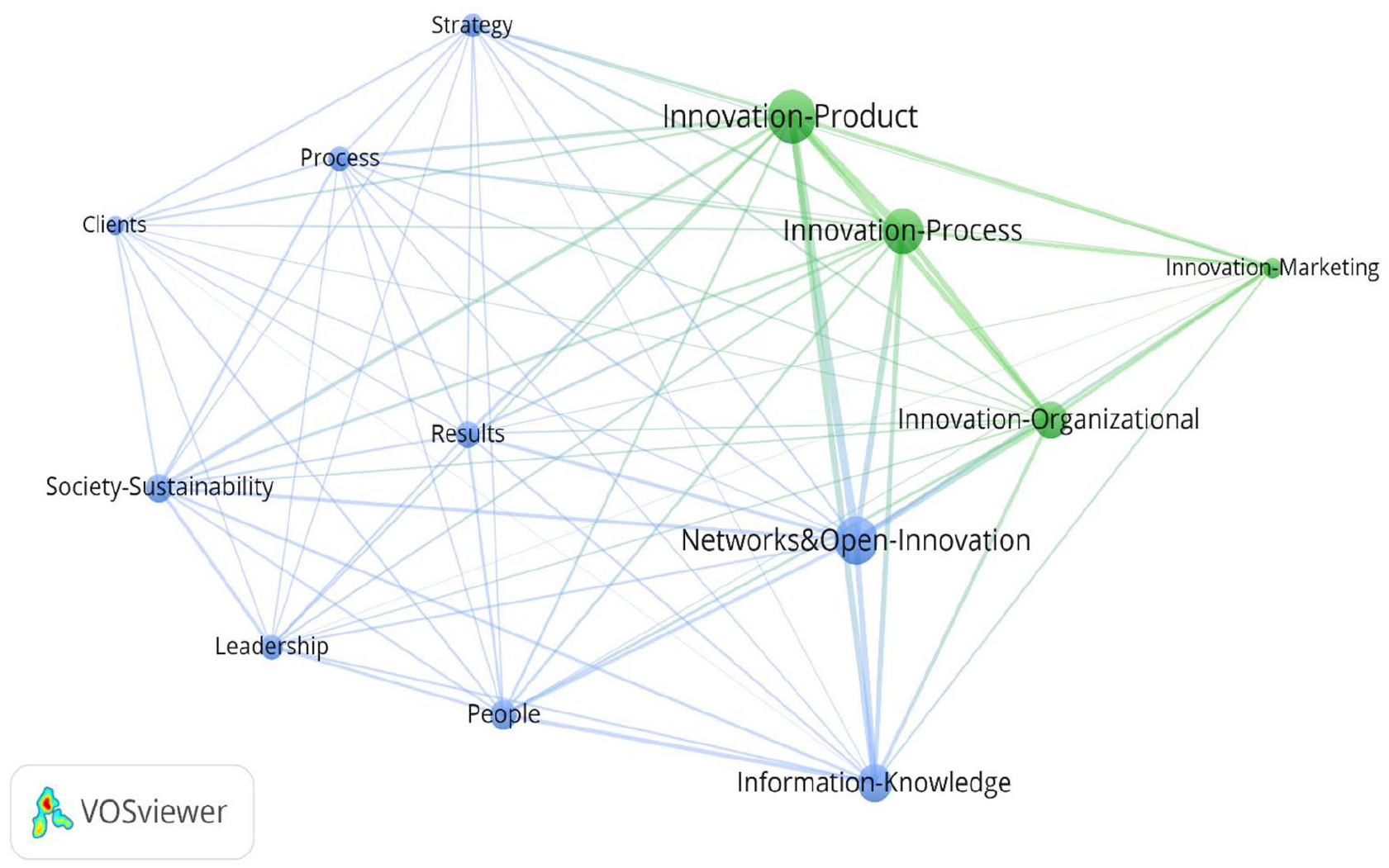
Frameworks variables relationships.
Literature Analysis/Review
Approximately one-third of the articles addressed aspects of sustainability, while another third addressed aspects of information-knowledge management. Additionally, about half addressed direct or indirect aspects of networks and open innovation, which mainly covered the importance of relationships/networks for innovation. Regarding innovation, most papers analyzed the technological product and process innovations, while marketing and organizational innovations were analyzed in smaller numbers. Overall, besides a few divergent topics, the portfolio of highly cited papers has shown that MSMEs’ competitiveness is strongly related to sustainability, information-knowledge, and networks-open innovation aspects.
Sustainability
Regarding the first emerging theme, sustainability, the following papers were included: Cuerva et al. (2014), Lee and Klassen (2008), Singh et al. (2018), Klewitz and Hansen (2014), Jansson et al. (2017), Hamann et al. (2017), Gupta and Barua (2017), Triguero et al. (2013), and Albort-Morant et al. (2016). It is noteworthy that the variables in these studies included both management dimensions covered by the excellence models and the traditional types of innovation in the Oslo Manual (especially product, process, and organizational), but they were particularized by the incorporation of environmental, green, or sustainable aspects. In sum, sustainability was mainly covered in terms of management capabilities or innovation features.
Sustainable-green management capabilities
Lee and Klassen (2008) analyzed in a case study approach the factors that influence environmental management capabilities (EMC) of Korean SMEs in the automobile industry, which were suppliers of large organizations (buyers). The environmental management capabilities were subdivided into internal and external. The former included product, process, and organization, whereas the latter included supply chain and relationship (with society). The factors included the buyer’s green supply chain management (GSCM) strategy, whether monitoring-based or support based, external resources (especially knowledge) and environmental championing, which is related to top-management leadership toward environmental issues. Regarding the main results, Lee and Klassen (2008) found that leadership (championing) and external knowledge resources were critical factors to develop environmental management capabilities and that internal-oriented capabilities developed ahead of external-oriented capabilities. Despite the high focus on environmental aspects, the management capabilities and the factors covered by Lee and Klassen (2008) resemble the dimensions covered by the excellence management model. For instance, the improvement of products and processes as well as organizational practices are covered in the information and knowledge dimension. Another aspect included in the environmental management capabilities was people management, which is an excellence quality-management factor. Other examples included supply chain assessment, external knowledge resources, the relationship with society and leadership, which are also dimensions of management excellence.
Singh et al. (2018) adapted the Balanced Scorecard (BSC) approach to the context of sustainability. The four aspects of BSC were maintained (finance, customer, internal process, and learning & growth) and applied in a case company, specifically, a manufacturing Indian SME. The methodology consisted of applying a combined-method of the analytical hierarchical process (AHP) and the fuzzy inference system (FIS) to determine the relevance (weights) of BSC indicators. Among the nine indicators identified by decision-makers as suitable, manufacturing cost (financial aspect) and hazardous material ratio (process aspect) already met a high sustainable performance in the case company and hence were left out the set of important indicators for sustainability improvement. Moreover, the most important indicators identified were customer satisfaction (customer aspect), training hours per employee (learning aspect), and debt ratio (financial aspect). It is interesting to note the resemblance of the four BSC aspects to the dimensions of the excellence modes. Finance is related to results, customer to clients, internal process to process, and learning & growth to information-knowledge. Nevertheless, particularly in this adaptation of BSC to the sustainability of manufacturing SMEs, the learning & growth aspect included people and leadership dimensions, since the indicators were training hours per employee (people) and management commitment (leadership).
Jansson et al. (2017) analyzed the factors that influence the commitment to sustainability in Swedish SMEs, which included market orientation (MO), entrepreneurial orientation (EO) (which encompassed proactiveness/innovativeness), Management values concerning sustainability and sustainability practices. The sample comprised 450 Swedish SMEs and the analyses included exploratory factor analysis (EFA), reliability analysis (Cronbach’s alpha), and regression. The results showed significant effects on SME’s commitment to the sustainability of both orientations, as well as of sustainability practices (sustainable products and recycling in operations), but the insignificant effect of management values.
Hamann et al. (2017) analyzed both quantitatively and qualitatively the drivers of South African wine SMEs’ pro-environmental/green behavior, also named by the authors as ecological responsiveness. The quantitative sample comprised 55 SMEs whereas the qualitative sample comprised seven. The three drivers (managerial attitudes, legitimacy-seeking, and competitiveness) were based on the literature and were confirmed by exploratory factor analysis (EFA) and reliability analysis (Cronbach’s alpha). By also applying EFA and reliability analysis, the ecological responsiveness was subdivided into three main factors, namely, conservation, environmental monitoring, and recycling). The quantitative results showed that only managerial attitudes had a positive significant influence on the three factors of ecological responsiveness. On the one hand, the qualitative results confirm the relevance of managerial attitudes, but on the other hand, suggest that competitiveness also enhances SME’s ecological responsiveness.
Sustainable-green innovations
Cuerva et al. (2014) analyzed the driver factors of both conventional and green product and process innovations, in which green refers to environmental sustainability aspects. Based on a sample of 301 Spanish SMEs in the food and beverage industries and through bivariate probit regression, the authors found that R&D (Research and Development) and human capital had a positive effect on both green and conventional innovation; financial constraints had a negative effect while product differentiation and quality management systems (such as ISO 9000) had a positive effect on green innovation; and corporate social responsibility and public subsidies had a positive effect on conventional innovation. Besides the identification of several different drivers for each innovation type, Cuerva et al. (2014) stress as striking results the strong effect of quality management as well as the absence of effect of public support on green innovation. As quality management (ISO 9000) has many features in common with models of excellence, this research confirms the relevance of management for innovation, especially when the effects of the driver factors are considered such as R&D (especially information and knowledge), human capital (people) and social responsibility (society).
Klewitz and Hansen (2014) reviewed systematically the sustainability-oriented innovation (SOI) of SMEs focusing especially on the practices at the product, process, and organizational level. The authors identified the main practices, subtopics, drivers, and barriers of SOIs to SMEs, as well as five strategic sustainability behaviors (resistant, reactive, anticipatory, innovation-based, and sustainability-rooted). They also propose an integrated framework for SOI practices gathering all these elements and stress the interaction between innovation types, that is, the innovation development at one innovation type generally leads to the development of other innovation types (e.g., product SOI may trigger process and even organizational SOIs). It is worth noting that, besides the three types of sustainability-oriented innovation (SOI) (product, process, and organizational), other aspects of management excellence are noted along with the review paper, especially regarding drivers and barriers of SOIs. Particularly, the society and people management dimensions are observed when the authors contend that the sample articles also covered SMEs’ social innovations aspects such as employee development, corporate mission engagement with society, and consideration of community needs. Besides, the integrated framework also stressed the role of strategy in developing SOIs, and some drivers and barriers included values of the owner-manager (i.e., leadership), new customer needs (i.e. clients), and collaboration (i.e. relationships).
Gupta and Barua (2017) applied the Best Worst (Multicriteria) Method along with fuzzy TOPSIS (Technique for Order of Preference by Similarity to Ideal Solution) in the selection of SME suppliers of an Indian automobile large company based on SMEs green innovation ability. The criteria were identified by literature review and then four experts decided conjointly in a panel the green innovation criteria weights. In total, seven main criteria were ranked as follows: (1) resource availability and green competencies, (2), regulatory obligations, pressures, and market demands, (3) environmental investments and economic benefits, (4) research and design activities, (5) green purchasing capabilities, (6) collaborations, and (7) environmental management initiatives. As one can note, the criteria were ordered as the most valuable to the buyer (large company) standpoint. For instance, suppliers’ collaborations and internal management initiatives were not relevant to the buyer when deciding on supplier selection, but could be indeed important to SME’s green innovation ability. Furthermore, the multicriteria weight results are strongly embedded in the focal company decision making, that is, they change from one context to another.
Triguero et al. (2013) investigated the factors that drive three types of eco-innovation, namely, product, process, and organizational (eco-innovation). The factors were subdivided into three: supply-side factors, which included technological and management capabilities within the company, collaboration with research institutes and universities, access to external information, knowledge, material prices, and energy prices; demand-side factors such as market share and market demand for green products; and environmental policy influences such as existing regulations, expected future regulations, and access to subsidies/fiscal incentives. It is worth noting the influence of traditional innovation literature in the paper construction as the authors adopted Oslo Manual’s types of innovation as well as subdivided the driver factors in science/technological push (supply-side) and demand-pull (demand side). Regarding supply-side factors results, these influenced most eco-process innovations and less eco-product innovations. Still, network (collaboration with research institutes) influenced significantly all types of eco-innovation, but technological capabilities and access to external information/knowledge only influenced significantly process and organizational eco-innovations. Regarding demand-side drivers results, market demand for green products influenced all types of eco-innovation whereas market share influenced eco-product and eco-organizational innovations, but not eco-process innovations. Regarding environmental policy results, existing regulation was the only factor with significant influence on eco-innovation (eco-product and eco-organizational) whereas expected future regulations and access to subsidies/fiscal incentives were not significant. Finally, the authors also found that when firms eco-innovate in one dimension they also tend to innovate in all dimensions and that size is related to all dimensions of eco-innovation.
Albort-Morant et al. (2016) verified by PLS-SEM in a sample of 112 automotive components manufacturing SMEs the direct effect of dynamic capabilities (DC) on green innovation performance (GIP) and its indirect effect through an ordinary capability, namely, the relationship learning capability (with customers/suppliers). It is worth noting that the GIP measure encompassed product and process innovations that reduced environmental impact; the relationship learning capability encompassed information, knowledge, and network aspects; and the dynamic capabilities encompassed sensing/scanning, learning, integration, and coordination/implementation aspects. It is possible to consider that excellence/quality models explicitly comprise ordinal capabilities but dynamic capabilities are also implicitly considered when organizations excel in some aspect as the quality model embraces the idea of continuous improvements, thus related to some extent to the concept of dynamic capabilities.
Information and Knowledge
Regarding the second emerging topic, information-knowledge management, the following highly cited papers were included: Gupta and Barua (2016), Lee et al. (2010), Cerchione and Esposito (2017), Scuotto, Santoro et al. (2017), Scuotto, Del Giudice, and Carayannis (2017), Scuotto, Del Giudice, Peruta, et al. (2017), Scuotto, Del Giudice, Bresciani, et al. (2017), Palacios-Marqués et al. (2015), Soto-Acosta et al. (2017, 2015), Martinez-Conesa et al. (2017), and Popa et al. (2017). Three subgroups were identified in these works: a group of unique authors, a group in which Scuotto stands out with 4 articles, and a group of Spanish authors with 5 related articles.
Information and knowledge – Unique authors
By applying the Best-Worst Multicriteria method with 16 experts from both industry and academia, Gupta and Barua (2016) identified the most important enablers of technological innovation in Indian micro, small and medium-sized (MSM) enterprises. The definition of MSM enterprises in India depends on investment in plant and machinery/equipment. The authors identified four main criteria/enablers on the literature, namely, entrepreneur role, linkage capability (networks), technological infrastructure (especially concerning information and communication), and government support, among which technological infrastructure was considered by experts as the best enabler whereas linkage capability as the worst. Nevertheless, when considering the overall weight of the 13 sub-criteria identified, project resources and capabilities were identified as the most important sub-criteria/enablers of technological innovation in Indian MSMEs, followed by the technical know-how and training of entrepreneurs and government policies and programs.
Lee et al. (2010) discussed the open innovation model in SMEs’ context and focus on different types of collaboration networks that SMEs could use to explore (R&D) and exploit (commercialize) innovation. Particularly, the authors bring up a successful Korean experience in which an intermediate agency (KICMS) established cross-functional consortium families (CF²), wherein SMEs collaborate temporarily in an innovation project as a consortium to be competitive. Lee et al. (2010) also examined some data from the 2005 Korean Technology Innovation Survey, which covered 329 large firms and 2,414 SMEs, totalizing 2,743 companies. Overall, descriptive results showed that large firms were more involved in innovation activities than SMEs, though statistical differences were not performed. Besides, the largest barriers to SMEs innovation included the lack of manpower in the labor market, information, infrastructure, and financial resources. A noteworthy analysis was the correlations between SMEs’ external information usage breadth/depth and innovation performance, which consisted of major product innovation, minor product innovation, service innovation, and process innovation. Both major and minor product innovation and service innovations correlated with external information usage breadth and depth at the 0.01 significance level, whereas process innovation correlated only to breadth at the 0.05 significance level. Thus, the authors verified the importance of external information for innovation.
Cerchione and Esposito (2017) proposed a taxonomy for strategies adopted by SMEs regarding knowledge management systems use, particularly based on the degree of diffusion and intensity of use of knowledge management (KM) tools and practices, which were identified by the authors in a systematic review and full analysis of 49 papers. The authors also investigated empirically 61 Italian SMEs through semi-structured interviews with two managers from each organization. The authors calculated some indexes such as the index of differentiation (proportional number of KM tools/practices adopted), index of intensity of use of KM tools/practices (defuzzified value in a 5 point scale), the indexes of global differentiation, and global intensity of use (which include both KM tools and practices). Regarding results, Cerchione and Esposito (2017) found positive significant correlations between the differentiation of KM-tools and KM-practices, as well as between the intensity of use of KM-tools and KM-practices. Nevertheless, a negative significant correlation was found between the index of global differentiation and the index of global intensity of use, revealing that the larger the number of tools and practices adopted, the less intense is their use. Based on the global indexes of differentiation and intensity of use, and hence two axes (differentiation, intensity), the proposed taxonomy encompasses four groups: guideposts (high, high), explorers (high, low), exploiters (low, high), and latecomers (low, low).
Information and knowledge – Scuotto et al
Scuotto was an author of prominence in the selected set of highly cited articles with four publications related to the impact of information and communication technologies (ICTs) and knowledge in open innovation, innovation in the financial performance of MSMEs. It is worth noting the quantitative approach of these highly cited works, in which large samples were used with advanced statistical techniques such as structural equation modeling (Scuotto, Del Giudice, Bresciani, et al., 2017; Scuotto, Del Giudice, & Carayannis, 2017; Scuotto, Del Giudice, Peruta, et al., 2017; Scuotto, Santoro et al., 2017).
Based on a sample of 239 Italian SMEs in knowledge-intensive industries (software, healthcare, tourism, leisure), Scuotto, Santoro et al. (2017) analyzed by CB-SEM the influence of ICT use in in-house R&D and open innovation activities and then of these three in SMEs’ innovation performance. Notwithstanding the weak confirmation of the measurement model, which included only Cronbach’s alpha internal reliability indicator, the results confirmed all the predicted influences, with special regard to the high effect of ICT use on open innovation. It is also noteworthy that the measures employed in the paper are to some extent related to the information and knowledge dimension of excellence models, besides including network aspects (open innovation) as well as product and marketing innovations. Particularly, ICT use included orientation to information, communication (internal and external) and workflow (processes); in-house R&D included investment and knowledge development and storage; open innovation involved external sources of knowledge; and innovation performance encompassed the ability of the firm to develop incremental and radical product/service innovations and opening new markets (thus a marketing innovation).
Based on a sample of 215 SMEs from knowledge-intensive and labor-intensive industries, Scuotto, Del Giudice, and Carayannis (2017) verified by PLS-PM the positive effects of social networking sites (SNSs) on absorptive capacity and, in turn, of both on innovation performance. Regarding the constructs: SNSs encompassed social media communities, platforms, and capabilities; absorptive capacity involved external knowledge (acquisition), internal knowledge (combination), and R&D activities; innovation performance encompassed product/service innovation aspects such as faster time to market, faster product adoption, and product lifecycle management. It is possible to contend that the SNSs construct is close to the network dimension of the innovation radar, which deals with the use of network technologies to connect with the customers. Besides, as absorptive capacity encompasses mainly knowledge aspects, it is to some extent related to information and knowledge dimensions of excellence models. Finally, the construct innovation performance involved mainly product innovation aspects.
Based upon the premise that social media networks (SMNs) leverage companies’ innovativeness, especially by customer involvement, Scuotto, Del Giudice, Peruta, et al. (2017) analyzed the effect of five SMNs key dimensions on SMEs’ return on investment (ROI). All measures employed were dichotomized. Particularly, the structural dimension encompassed information and communication technologies and infrastructure, the relational dimension encompassed the use of and interaction on digital platforms, the cognitive dimension encompassed multiple knowledge sources from users, the knowledge transfer dimension encompassed both inflow and outflow of knowledge, and legitimation encompassed the number of innovations based on user ideas. The sample comprised 2,548 SMEs of the fashion industry located in Italy and the United Kingdom and the analysis was performed through the classification and regression tree (CART) method. Overall, the structural, relational, knowledge transfer, and legitimation dimensions had positive effects on SMEs’ ROI, whereas the cognitive dimensions had a negative effect. It is noteworthy that the innovation measure included within the legitimation dimension is loosely defined and could embrace any type of innovation. Besides, the SMNs dimensions embrace mainly information and knowledge aspects in addition to mainly networking with customers.
Despite discussing both formal and informal inbound open innovation modes, Scuotto, Del Giudice, Bresciani, et al. (2017) analyzed the impact of cognitive dimensions, knowledge-driven approach, and absorptive capacity only on informal inbound open innovation modes adopted by ICT SMEs located in the United Kingdom. Besides, even though PLS-SEM was employed to analyze data, only Cronbach’s alpha was employed as a confirmatory/reliability analysis, thus neglecting established confirmatory analysis in SEM such as convergent and discriminant analysis. Still, the paper has an interesting literature review as it links to theory streams, namely, open innovation and the knowledge-based view (KBV). Regarding the results, cognitive dimensions and absorptive capacity had significant positive effects on the informal mode of open innovation, while the effect of the knowledge-driven approach was insignificant.
Information and knowledge – Spanish scholars
Another set that stood out was the Spanish authors Palacios-Marqués, Soto-Acosta, Martinez-Conesa, and Popa, with five publications mainly related to the factors determining the use of information and knowledge, as well as their impact on the innovation environment, open innovation, innovation performance, and financial performance of MSMEs. In general, the works of these authors presented a common theoretical basis, especially the model with determinants of technological, organizational, and environmental (TOE) context. Similar to Scuotto, Del Giudice, Bresciani, et al.(2017; Scuotto, Del Giudice, & Carayannis, 2017; Scuotto, Del Giudice, Peruta, et al., 2017; Scuotto, Santoro et al., 2017), the works of this set of authors also presented a quantitative approach by employing large samples and the modeling of structural equations (Martinez-Conesa et al., 2017; Palacios-Marqués et al., 2015; Popa et al., 2017; Soto-Acosta et al., 2015, 2017).
Palacios-Marqués et al. (2015) analyzed the technological, organizational, and competitive environment (TOC) context factors that impact knowledge exchange with employees, customers, or business partners through web technologies. Technology factors included technology integration and IT expertise (number of IT employees), organizational factors included HR practices, and competitive environment factors included the degree of negotiation pressures of clients and suppliers. Although innovation was not considered in the model, Palacios-Marqués et al. (2015) contend that knowledge exchange is relevant to innovation, which in turn leverages SMEs’ competitiveness, especially concerning survival and success. Besides, management aspects are covered along with the paper such as technological capacity (technology integration and IT personnel), HR practices (people management), and knowledge exchange within and out of the company.
Similar to a previous model, Soto-Acosta et al. (2017) analyzed the effect of TOE (technological, organizational, and environmental) aspects on social web knowledge sharing and of the latter on innovation performance. The technological aspect comprised information systems (IS) integration while the organizational aspect comprised HR commitment-based practices and the environmental aspect comprised the environment competition. Innovation performance followed Oslo Manual’s innovation types (product, process, organizational (management practices), and marketing) (OECD & Eurostat, 2005). The results from the PLS-SEM analysis in a sample of 175 manufacturing Spanish SMEs were also similar to the previous study as HR-practices and IS integration impacted social web knowledge sharing and the latter also impacted innovation performance. Besides, social web knowledge sharing was also confirmed as a partial-mediator between HR commitment-based practices and innovation performance.
Furthering previous studies, Soto-Acosta et al. (2015) analyzed by PLS-SEM based on a sample of 175 Spanish SMEs the impact of TOE aspects on e-business use, of e-business on innovation and firm performance, and finally of innovation on firm performance. It is noteworthy that, although the authors employ the term “organizational innovation,” the construct comprises the implementation of process and especially product innovations. Firm performance construct comprises financial (earnings, ROI, market share) and customer (satisfaction, perceived quality) measures. Results showed: significant effects of IS integration and commitment-based HR practices and a no-significant effect of competitive environment on e-business use; a significant effect of e-business use on innovation but an insignificant direct effect on firm performance; and significant effect of innovation on firm performance, thus corroborating a mediation effect of innovation on performance.
Based on a sample of 429 Spanish manufacturing SMEs, Martinez-Conesa et al. (2017) analyzed by CB-SEM the impact of ICT-supported operations, interdepartmental connectiveness, and commitment-based human resources (HR) on knowledge management (KM) capability, and then the impact of KM capability and environmental dynamism on SMEs’ open innovation, also considering a moderation effect of environmental dynamism in the relationship between KM capability and open innovation. The results showed positive significant impacts of ICT and HR on KM capability, as well as significant positive impacts of KM and environmental dynamism on open innovation. Nevertheless, neither the effect of interdepartmental connectiveness was significant nor the moderation effect of environmental dynamism. Finally, it is worth noting that the variance explained by the open innovation endogenous construct was moderate (R² = .47). In short and parallel to excellence models, the results showed that aspects related to the dimensions of information and knowledge, and people management influence open innovation in SMEs.
By applying CB-SEM in a sample of 429 manufacturing Spanish SMEs, Popa et al. (2017) analyzed the antecedents of innovation climate, namely, commitment-based HR, interdepartmental connectedness, and decision-making centralization, as well as, the influence of innovation climate in both inbound and outbound open innovation, also moderated by both environmental dynamism and competitiveness, and finally the influence of open innovation in SMEs’ performance. Regarding results, only commitment-based HR practices were a significant antecedent of innovation climate, which in turn influenced both inbound and outbound open innovation, which successively influenced firm performance (albeit low as R² = .11). Moreover, only one moderation effect was confirmed: environmental dynamism moderated the influence of innovation climate on outbound open innovation. Interestingly, the authors suggest future research including relevant organizational factors such as organizational strategy and leadership. Committed HR (People), innovation climate (culture/capability), open innovation (networks), firm performance.
Networks and Open Innovation
The third emerging topic, networks-open innovation, is a complementary and cross-cutting topic to others already addressed. In particular, some sustainability studies such as those by Triguero et al. (2013) and Gupta and Barua (2017) have simultaneously addressed open innovation as a facilitating factor as partnerships, especially through networks, leverage sustainability. The same holds for information-knowledge studies, where open innovation has been approached as a facilitator for the input and output of information and knowledge in MSMEs (Lee et al., 2010; Scuotto, Del Giudice, Bresciani, et al., 2017; Scuotto, Del Giudice, Peruta, et al., 2017; Scuotto, Santoro et al., 2017).
In addition to these papers reviewed in the previous sections, six studies looked at networks and open innovation in the traditional context of impact for conventional innovation and/or organizational performance. Although both concepts are closely related, some of these studies focused on networks (Badi et al., 2017; Rosenbusch et al., 2011; Zeng et al., 2010) while others focused on open innovation (Brunswicker & Vanhaverbeke, 2015; Parida et al., 2012; Van de Vrande et al., 2009).
Networks focused papers
Badi et al. (2017) analyzed qualitatively and quantitively by social network analysis with UCINET software, the guanxi networks concerning relationship marketing of four Chinese Construction SMEs. The relationship marketing approach was based on a six market stakeholder model, which included customers, employees, suppliers, referrals, influencers, and recruiters. Overall, the results of the multiple case study show that Guanxi rather than transactional relationships still dominate in the six markets of relationship marketing, thus corroborating Guanxi relevance within the Chinese context. In this sense, as a possible further development, the Chinese context of guanxi could influence different dimensions covered by both open innovation and management excellence models, such as people, customers, suppliers (processes), and even society.
Rosenbusch et al. (2011) performed a meta-analysis on the relationship between innovation and performance in SMEs. The 42 independent samples from 46 studies covered 21,270 SMEs in total and were analyzed by meta bivariate and meta-regression analyses. The authors applied the American definition of SMEs, that is, firms with less than 500 employees. Performance measurements included firm return, growth, market-based indicators. Innovation was measured by different indicators such as innovation orientation (e.g., innovation strategy), internal and external innovation inputs (e.g. R&D intensity-expenditure, R&D collaboration, respectively), and output indicators (e.g., number of new products, the share of sales derived from new products). SMEs were also classified in terms of age, in which young firms were those with 12 years or less. Countries’ cultures were also included in the analysis in terms of societal individualism, in which Asian countries had low levels of individualism, European medium, and American high levels. Overall, Rosenbusch et al. (2011) found that innovation has a positive effect on SMEs’ performance. Still, innovation orientation had the highest impact on performance, followed closely by innovation outputs and by far by innovation inputs. Particularly concerning innovation inputs, the authors found that internal inputs presented a significant impact on performance whereas external inputs did not, and hence challenged the network and social capital literature on their benefits to SMEs, especially in the innovation context. The authors also found that innovation had a stronger impact on performance in younger firms and less individualistic cultures (i.e., Asian countries).
Based on a sample of 137 Chinese SMEs, Zeng et al. (2010) analyzed by structural equation modeling (SEM) the influence of different types of cooperation networks on innovation performance. Particularly, the authors analyzed the influence of cooperation with government agencies on other cooperation networks such as with other firms, intermediary institutions, and research organizations. The authors also analyzed the influence of these four types of cooperation networks on (product) innovation performance, which was measured as the proportion of annual turnover-sales of product innovations to total turnover-sales in the preceding 3 years. Results showed that cooperation with government agencies have significant effects on the three other types of cooperation networks, but no direct effect on innovation performance. Nevertheless, the other types of cooperation (with other firms, intermediary agencies, and research organizations) impacted positively the innovation performance of Chinese SMEs, in which inter-firm cooperation had the greatest impact, followed by intermediary organizations and finally by research organizations such as universities.
Open innovation-focused papers
In the context of open innovation, Brunswicker and Vanhaverbeke (2015) analyzed European SMEs’ main strategies concerning external knowledge sourcing, besides their relationships with innovation performance and (four) internal organizational practices for innovation. Based on six external knowledge sources (direct customers, indirect customers, suppliers, universities/research organizations, intellectual property experts, and network partners), 1,411 sampled SMEs were categorized by cluster analysis into five groups: minimal searcher (low levels of interaction), supply-chain searcher (high interaction with customers and suppliers), technology-oriented searcher (high interaction with universities, IP experts and network partners), application-oriented searcher (high interaction with indirect customers, regular interaction with supply-chain, and low interaction with universities), and full-scope searcher (high interaction with all). The authors also verified by Tobit regression the effect of the full-scope searcher cluster on innovation performance and the effect of both full scope and application-oriented clusters on innovation launching success. Regarding the four internal organizational practices for innovation (long-term investment, strategy, development, and project control), strategy and project control had a significant positive influence on innovation income whereas strategy and development had on innovation launching success. It is worth noting that innovation development was a five-indicator composite measure related to traditional Oslo Manual innovation types (OECD & Eurostat, 2005), since it encompassed the existence of formal processes for developing product, service, process, organizational, and business model innovation. Besides, the internal organizational practices of strategy and project control are to a certain extent related to the strategy and plans dimensions of the excellence management model. Similarly, innovation development processes could be deemed as a particular subset of processes, thus resembling some extent the process dimensions of excellence models.
Parida et al. (2012) analyzed the impact of four inbound open innovation activities on radical and incremental product innovation performance, namely, technology scouting (scanning), technology (in)sourcing, vertical technology collaboration, and horizontal technology collaboration. On the one hand, technology scouting (scanning) and technology (in)sourcing impacted positively and significantly both radical and incremental product innovation. On the other hand, each type of collaboration impacted positively and significantly only one type of innovation: horizontal collaboration impacted incremental innovation whereas vertical collaboration impacted radical innovation. It is also worth noting some control variables results as size and age. The former had a positive and significant impact on both innovation types whereas the latter did not.
Van de Vrande et al. (2009) analyzed the adoption of open innovation practices by innovative small and medium-sized enterprises from the Netherlands. The Oslo Manual (OECD & Eurostat, 2005) definition was followed in which innovative SMEs were those that had introduced at least one (product, process, marketing or organizational) innovation in the past 3 years. The open innovation practices were subdivided into two categories: technology exploitation and technology exploration. The former involves outflows of knowledge such as venturing, outward intellectual property (IP) licensing, and involvement of non-R&D workers in innovation activities, whereas the latter involves inflows of knowledge such as customer involvement, external networking, external participation, outsourcing R&D, and inward licensing of IP. Results revealed the most employed open innovation practices as customer involvement, external networking, and employee involvement, whereas both inward and outward IP licensing as the least employed by SMEs. The authors found a few industry differences as manufacturing had a significantly higher incidence than services in only two open innovation practices: outsourcing R&D and inward IP licensing. On the other hand, differences regarding company size were more evident. Medium enterprises had a significantly higher incidence than small enterprises in four open innovation practices: outward IP licensing, participation (equities) in external companies, outsourcing R&D, and inward IP licensing. In sum, Van de Vrande et al. (2009) found few differences between manufacturing and service industries regarding open innovation practices adoption, but some differences between small and medium-sized enterprises. Nevertheless, the three most adopted practices were similar both in terms of industry and size.
Divergent Topics
Finally, a remaining group of four highly cited articles did not converge on the previous major topics. However, these articles addressed other topics such as: international entrepreneurship (Terjesen et al., 2016); R&D performance of high-tech MSMEs (Salimi & Rezaei, 2018); industry 4.0 and innovation in business models (Müller et al., 2018); and the relationship between innovation, exports, and growth of MSMEs (Love & Roper, 2015).
International entrepreneurship
Terjesen et al. (2016) reviewed systematically the literature on comparative international entrepreneurship (CIE). The studies were analyzed in terms of the level of analysis (individual, firm, industry, country), characteristics, antecedents, outcomes, methods, and even most employed underlying theories (institutional, culture, transaction cost economics, resource-based view, and economic growth). The authors stressed that even though innovation and SMEs were not searched deliberately, a large portion of international entrepreneurship research includes these topics, especially when studying firm-level performance, such as financial and innovation performance, and country-level performance, such as economic growth and innovation.
R&D performance
Salimi and Rezaei (2018) applied the Best-Worst-Multicriteria method with 8 experts to determine the weights of R&D performance criteria, which consists of four main perspectives: innovation and learning, customer perspective, financial perspective, and internal business perspective. Furthermore, the authors utilized these weights to analyze the R&D performance of 50 high-tech SMEs in the Netherlands, which ranking position varied according to the criteria and weights considered. The perspectives composing the R&D performance measure resemble some aspects of the excellence models. For instance, the customer perspective is similar to the clients’ dimension, the internal business perspective cover aspects of planning and processes, and the financial perspective encompasses performance results. Complementarily, the innovation and learning perspective included the number of patents, number of ideas, creativity/innovation level, and network building activities of the firm, thus loosely related to product and organizational innovation types.
Industry 4.0 and business models
By interviewing a sample of 68 German manufacturing SMEs, Müller et al. (2018) analyzed qualitatively how industry 4.0 may affect SMEs’ business model innovations, which comprises three main elements, namely, value creation, value capture, and value offer. Results revealed that the understanding of Industry 4.0 by German manufacturing SMEs consists of three main dimensions: digitization of processes, smart manufacturing, and inter-company connectivity. Besides identifying and listing the effects of industry 4.0 on business model innovations, the authors also analyzed SMEs in terms of the role as user or provider and in terms of internal or external motivation, which supported a proposal of four SME categories regarding Industry 4.0 and business model innovation: craft manufacturers, preliminary stage planners, industry 4.0 users, and full-scale adopters. Overall, Müller et al. (2018) show that industry 4.0, which primarily involves ICT and process aspects, can leverage all types of innovation, as innovations in business models can significantly modify products, operations processes, or processes, distribution methods, marketing methods, management methods as well as all types concurrently.
Innovation, exports, and growth
Finally, Love and Roper (2015) conducted a literature review on the internal and external enabling factors of innovation, exportation, and growth of small and medium-sized enterprises. The authors highlighted the use of a broad definition of innovation that encompasses both technological (product and process) and non-technological (marketing and organizational) innovations. The enabling factors comprised: technical skills; leadership and strategy; people management; financing; R&D, which is intrinsically related to absorptive capacity and the ability to generate new knowledge. External enabling factors included external knowledge and external resources, usually obtained through open innovation, that is, through networks or partnerships. Generally, MSMEs seek to obtain external resources and knowledge to overcome resource constraints they face. At the end of the literature review, Love and Roper (2015) highlight some areas of agreement and controversy regarding enabling factors for innovation in MSMEs. In particular, the authors indicated that evidence is not yet robust as to the positive impacts of people management, strategy, and planning on innovation; and therefore, more research is needed in these areas.
Discussion, Future Research Directions, and Conclusion
Discussion
Although sustainability has emerged as a strong emerging topic, it is possible to observe that the dimensions related to sustainability management derive strongly from the dimensions present in the excellence models. Overall, some dimensions such as leadership, processes, and people are particularized to the context of sustainability. The same is true for innovation types, where mainly product and process innovations are adapted to sustainable (e.g., green, environmental, social, etc.) innovations.
Regarding the other emerging topics, information- knowledge, and open innovation, it can be stated that in general they are also included in the excellence models and types of innovation. Particularly, although network/relationship is not an individual factor in all excellence models, aspects of networks are included within other factors such as processes, information-knowledge, and even strategy. Furthermore, engaging in novel open innovation initiatives may be considered an organizational innovation.
In sum, it can be concluded that the excellence management model factors, as well as the types of innovation, are aligned with and serve as a theoretical foundation to the international literature on management and/or innovation in small businesses. Still, the theoretical breadth of excellence models’ factors and types of innovation is noteworthy, as most of the highly cited papers focused only on some management factors and innovation types. For instance, several papers focused on information and knowledge factors while other management factors were disregarded.
Future Research Directions
Future research directions suggested by the highly cited papers were identified and are presented in Appendix A in Tables A1 to A4. Regarding the first emerging topic, sustainability, future research venues include investigating further the driving factors that affect green innovation adoption/implementation by MSMEs such as management capabilities, environmental orientation as well as other moderating factors such as industrial and regional/country contexts. Some papers stress the necessity to validate and extend the generalizability of models by collecting larger samples or even longitudinal data. A noteworthy future research direction comprises the longitudinal analysis of SMEs that adopt an eco-innovation strategy versus those that innovate conventionally.
Regarding the second emerging topic, information and knowledge, most future research directions comprise extending and validating the models with larger samples, longitudinal data, or cross-country comparisons. Investigating further specific information technologies and specific types of knowledge also comprise future research venues.
Regarding the third emerging topic, open innovation, as it is interrelated with information and knowledge, the second emerging topic, research also suggested as future research investigating information and knowledge flows in different open innovation contexts. Moreover, open innovation in the context of SMEs was still deemed underexplored and hence more research on this topic is necessary, especially concerning outflows of technology exploitation.
Finally, besides suggesting longitudinal and large sample studies, the papers classified as divergent suggested as future research: utilizing multiple levels of analysis to investigate determinants and outcomes of entrepreneurship, including sustainability perspectives to analyze R&D performance; exploring industry 4.0 in manufacturing SMEs; and verifying robustly the effects of people management, intellectual property management, strategy, etc. on SMEs performance.
Conclusion, Limitations, and Implications
The aim of this research was achieved as it reviewed the most highly cited articles in the Web of Science database regarding management and/or innovation in the context of MSMEs. Although limited in terms of the number of papers and databases, this review comprised 31 top papers in the Web of Science database, which is a prestigious database in different fields of research, including Business Management. Particularly, 100% of top classified journals (categories 4* and 4) in the 2021 Academic Journal Guide (AJG) by the Chartered Association of Business Schools (ABS, 2021) are also indexed in the Web of Science database.
Therefore, this review contributed to the literature on innovation and management of micro, small, and medium-sized enterprises by gathering and analyzing relevant papers on the topic.
As theoretical implications, the results revealed that most variables employed in these studies have a direct or indirect correspondence with the quality-excellence management factors and the innovation types of the third edition of the Oslo Manual, and hence these frameworks could be deemed as foundational for MSMEs competitiveness research. Particularly, theoretical relations were identified among all variables, wherein the strongest linkages encompassed networks-open innovation, information-knowledge, and product and process innovations. A moderate theoretical linkage between sustainability and product innovation was also identified.
In this sense, three emerging topics were identified, namely, sustainability, information-knowledge, and networks-open innovation. Overall, reviewed research indicated that MSMEs’ current and future competitiveness is strongly related to sustainability, information-knowledge, and networks-open innovation aspects. As practical implications, MSMEs owners or managers should focus on these three management aspects to improve MSMEs innovation and, in turn, competitiveness. Finally, this review also contributed to the theory by gathering and discussing the future research directions indicated by the top papers on MSMEs innovation and management.
Supplemental Material
sj-docx-1-sgo-10.1177_21582440211052555 – Supplemental material for Innovation and Management in MSMEs: A Literature Review of Highly Cited Papers
Supplemental material, sj-docx-1-sgo-10.1177_21582440211052555 for Innovation and Management in MSMEs: A Literature Review of Highly Cited Papers by Gustavo Dambiski Gomes de Carvalho, Luis Mauricio Martins de Resende, Joseane Pontes, Hélio Gomes de Carvalho and Leozenir Mendes Betim in SAGE Open
Footnotes
Appendix A
Future Research Directions on Divergent Topics.

| Paper | Future research directions |
|---|---|
| Terjesen et al. (2016) | Investigate multiple levels of determinants and outcomes of different types of entrepreneurship. Explore the cross-country phenomenon by testing competing theories. Include unexplored countries, especially from the developing world. Utilize publicly available longitudinal data in cooperation with supranational and government agencies. Apply sophisticated analytical techniques. |
| Salimi and Rezaei (2018) | Include environmental, social, and networking perspectives as well as additional influential factors to analyze R&D performance |
| Müller et al. (2018) | Investigate longitudinally how Industry 4.0 transforms business models and affects cooperation between companies from different sectors. Investigate quantitatively and qualitatively the implementation of Industry 4.0 in manufacturing SMEs. |
| Love Roper | Investigate robustly the effects of people management, employee engagement, intellectual property management, family ownership, business strategy, eco-systems, and purposive linkages in SMEs innovation and exports. Investigate further different types of innovation and their effects on SMEs’ performance. |
Acknowledgements
Not applicable.
Declaration of Conflicting Interests
The author(s) declared no potential conflicts of interest with respect to the research, authorship, and/or publication of this article.
Funding
The author(s) disclosed receipt of the following financial support for the research, authorship, and/or publication of this article: This research was funded by Coordenação de Aperfeiçoamento de Pessoal de Nível Superior - Brasil (CAPES), grant number 001”

Supplemental material
Supplemental material for this article is available online.
References
Supplementary Material
Please find the following supplemental material available below.
For Open Access articles published under a Creative Commons License, all supplemental material carries the same license as the article it is associated with.
For non-Open Access articles published, all supplemental material carries a non-exclusive license, and permission requests for re-use of supplemental material or any part of supplemental material shall be sent directly to the copyright owner as specified in the copyright notice associated with the article.
