




Abstract
Based on the DEA model, this paper evaluates the efficiency of poverty alleviation through tourism in Jiangxi Province based on three aspects: comprehensive efficiency, technical efficiency, and scale efficiency. The results show that the overall efficiency of poverty alleviation through tourism in Jiangxi Province is gradually progressing toward a high level, with the average value in recent years reaching 0.765. Compared to other cities in the Province, Ganzhou and Fuzhou have the highest ranking by level of tourism poverty alleviation. However, the tourism development at present is not truly just or even, resulting in a gap between the efficiency levels of regions. There are some areas that have been in the effective state for a long time, while others are far lower than the average efficiency due to low technical efficiency in these areas. The spatial differentiation of tourism poverty alleviation efficiency across regions shows that the tourism poverty alleviation efficiency in the eastern region of Jiangxi Province is low compared to other parts. Although the overall efficiency of tourism poverty alleviation in Jiangxi Province does not fluctuate much, there are still some areas where the efficiency of tourism poverty alleviation continues to show a downward trend, indicating that the allocation of tourism resources in Jiangxi Province needs to be optimized and leaving much room for improvement in the efficiency of poverty alleviation.
Keywords
Introduction
The tourism industry plays a vital role in a country’s economic prosperity. Some estimates suggest that tourism contributed slightly less than USD 9 trillion to the global gross domestic product (GDP), creating job opportunities for more than 300 million people (10% of total jobs) (UNWTO, 2019). Among other regions across the globe, tourism has grown rapidly in Southeast Asian regions, particularly in China, ranking first in terms of GDP and employment scale. In China, the overall contribution of the tourism industry to GDP is 10.94 trillion Yuan (11% of the GDP), providing job opportunities for approximately 800 million people (10.31% of the total employed population) (Liu et al., 2021). Some estimates suggest that tourism in China is growing at a 10% overall rate (Hu, 2020; Li & Wang, 2019). It is commonly understood that tourism is a highly comprehensive industry involving the development of multiple industries, such as food, shelter, and travel, and has positive effects on a county’s overall economic situation, such as attracting foreign investment, increasing employment, improving the quality of life, and optimizing the ecological environment (Medina-Munoz & Gutierrez-Perez, 2016; Qin et al., 2020; Shaohua, 2019; Shiyong et al., 2017; Yanan, 2020).
Given that the development of tourism in China is in the new normal (Banker et al., 1984), it is becoming the key to promoting economic growth (Li & Wang, 2019). Since tourism development can bring positive economic benefits, the rapid development of tourism can help reduce poverty (Wang et al., 2020). For the purpose of this paper, we define poverty in terms of a multidimensional perspective, that is, a lack of access to health, education, clean water, electricity, dignified jobs, and other basic infrastructure along with the monetary headcount (Zhao & Xia, 2020). As a thriving tertiary industry, tourism has gradually become a powerful weapon for poverty eradication. However, the goal of poverty alleviation work is to maintain economic stability at both macro and microeconomic levels and to pay more attention to quality rather than quantity. Therefore, research on poverty alleviation through tourism should focus more on the quality of poverty alleviation through tourism.
Since the reform and opening up, China has made significant progress in advancing inclusive and sustainable development, and it has made unprecedented achievements in poverty reduction (Shun, 2015). Among the many poverty reduction methods tried, tourism has shown the most significant effect on poverty reduction. Although the achievements are undeniable, there are still some problems. In the face of new economic development trends and poverty reduction needs, the early crude model of poverty reduction focused only on its overall benefits. Due to insufficient poverty reduction precision and low poverty reduction efficiency issues, the expected poverty reduction effect has not yet been fully achieved. From the perspective of resource allocation, these problems will lead to a low resource utilization rate and will also affect the normal living environment of residents. Most poverty-stricken areas are located in remote rural or mountainous areas, that is, regions with beautiful natural environments, unique local customs, and other excellent tourism resources that have tourism development potential (Nieto & Ríos, 2021). The tourism industry can drive the development of catering, hotels, transportation, and other industries (Zhao & Xia, 2020), and it is bound to drive the growth of the local economy and make a huge contribution to poverty reduction (Zhou, 2002). As an important method of entertainment consumption for people today, tourism can actively promote economic development. Tourism poverty alleviation has become the backbone of poverty alleviation because it combines the excellent tourism resource endowment of poor areas and meets people’s consumption needs (Feng et al., 2020; Hu, 2020; Liu et al., 2021).
Theoretical studies have different views regarding the effect of tourism on poverty alleviation. Some scholars believe that tourism contributes to the development of poverty alleviation, which has a significant positive effect on poverty reduction. Investigating the relationship between international tourism and the magnitude of poverty, Garza-Rodriguez (2019) found that an increase in international tourism will lead to an increase in per capita household consumption and ultimately reduce poverty. Studying the multiple Granger causality between tourism, poverty, and economic growth, Rakotondramaro and Andriamasy (2016) came to the same conclusion that tourism development can promote economic development and reduce poverty. Tourism economic development has been a momentous contributor to alleviating multidimensional poverty to a certain extent (Wang et al., 2020). Considering the plural and relative nature of poverty and well-being, Winter and Kim (2021) found that opportunities related to tourism resources help participants achieve diverse aspects of well-being. However, others believe that the development of the tourism industry may not necessarily reduce poverty (Hubert & Ferdinand, 2013). Oviedo-Garcia et al. (2019) argued that tourism income has not alleviated poverty and has failed to reduce inequality in the distribution of wealth. Taking the poor villages in a scenic spot as their research object and analyzing the phenomenon of poor villages in the core scenic spot, He and Li (2019) found that the imbalance of the power structure led to poverty in the scenic spot. It has also been empirically revealed that tourism development has significant negative effects on absolute and relative poverty in both the short run and the long run, albeit at varying magnitudes of effect and levels of significance (Zhao, 2021). In addition, the recognition of the poverty alleviation benefits that tourism development brings is generally not high (Qin et al., 2020). Only by fully mobilizing the enthusiasm of participating subjects can better effects of tourism poverty alleviation be realized (Li & Wang, 2019).
Regarding the relationship between tourism and economic growth, many studies agree that there is an inseparable connection between them (Fang et al., 2013; Shaohua, 2019; Shiyong et al., 2017; Spenceley & Meyer, 2012; Zhao & Xia, 2020). Some scholars, such as Li et al. (2016), Seetanah (2011), Kreishan (2011), and Balaguer and Cantavella-Jorda (2002), believe that tourism development greatly contributes to the economic growth of a country and that regions with less developed economies are more likely to experience tourism-led growth, which plays a key role in national economic growth. The reason is that the development of tourism can drive the development of other industries, such as services and agriculture, promoting GDP growth (Scarlett, 2021). After examining the impact of tourism development on economic growth based on a threshold model, Tu and Zhang (2020) argued that tourism has a significant nonlinear effect on economic growth. Additionally, there is a positive correlation between tourism development and economic growth indicators, and the prosperity of the tourism economy can promote the development of related industries and the regional economy. He et al. (2018) argued that economic growth is a one-way Granger reason for tourism revenue. Li and Wang (2019) showed that tourism development has a positive impact on economic growth and that there are obvious short-term effects. In addition to promoting economic development, some scholars agree that tourism development will also have some negative effects. For example, although total household income is increased, the relatively low labor intensity of the tourism industry may worsen the income distribution (Wattanakuljarus & Coxhead, 2008). From the perspective of tourism technology innovation and industrial upgrading, Yang et al. (2020) found that there is a reverse interaction mechanism between tourism technology innovation and industrial upgrading that will restrict economic development to a certain extent (Chen & Wang, 2020). Xie and Wang (2018) found that the scale of tourism agglomeration has an inhibitory effect on economic development. In addition, it has been found that there is a significant lag in the positive impact of tourism on economic growth (Wang et al., 2018).
Multiple factors affect the efficiency of tourism poverty alleviation. Some scholars agree that technical efficiency is the key factor and that fluctuations in technical efficiency have a significant impact on the index of total factor productivity (Lin et al., 2019; Liu et al., 2013). Others believe that scale efficiency plays a key role as well and that the low scale efficiency surface may lead to the ineffectiveness of the comprehensive efficiency of tourism poverty alleviation (Yan et al., 2018). At the same time, input factors, such as financial support, infrastructure construction, and poverty alleviation through industrialization, have an important impact on the efficiency of tourism poverty alleviation (Chen & Wang, 2020). In addition, individual participation dimensions combined with resource advantages and local conditions can effectively promote regional poverty alleviation, while the investment dimension of tourism poverty alleviation has a certain degree of investment redundancy, which delays the power output of tourism poverty alleviation to poverty alleviation (Tian & Zhou, 2019).
Due to the close relationship between tourism and national economic growth, tourism development has become an important driver of economic growth. As a research topic that has only recently attracted the attention of scholars, the efficiency of tourism poverty alleviation holds important practical significance for promoting the implementation of tourism poverty alleviation. Through research and the collation of recent literature, the summary is as follows. First, in the process of studying the efficiency of tourism poverty alleviation, scholars generally use DEA to measure the efficiency of tourism poverty alleviation. Through data analysis, it is possible to draw conclusions on whether tourism poverty alleviation work is efficient and to analyze which aspects can be improved. In addition, regarding the factors that affect the efficiency of tourism poverty alleviation, many scholars have concluded that technical efficiency and scale efficiency are the key to the overall efficiency of tourism poverty alleviation. Redundant or insufficient factors will affect the efficiency of tourism poverty alleviation. Accordingly, this study takes Jiangxi Province, China, as its research object and studies the efficiency of tourism poverty alleviation in this province. First, DEA is used to measure efficiency. Second, by constructing an empirical test of the measurement model, the factors that affect the value of efficiency are further explored, and relevant countermeasures and suggestions are proposed based on the conclusions obtained.
Study Area and Methodology
Study Area
As shown in Figure 1, Jiangxi Province is located in southeastern China on the south bank of the middle and lower reaches of the Yangtze River, and it is part of the region of Eastern China. For historical reasons, Jiangxi Province lags behind in economic development. As of 2020, there are 21 national-level poverty-stricken counties within the jurisdiction of Jiangxi Province. The tourism resources of Jiangxi Province are characterized by complete types, large numbers, and high grades. There are 153 out of 155 species across eight categories classified by the national tourism resource standard classification, the four major landscapes of mountains, lakes, cities, and villages, and the three tourism features of red, green, and ancient areas (Zhu, 2014). Although the province has abundant tourism resources, there are only a handful of well-known tourist attractions in the province, and there are some problems in the development of tourism resources. Tourism poverty alleviation is at the height of activity in various parts of Jiangxi Province. For example, Gexian Village, a small village in Qianshan County, Shangrao City, which was rated as a “Typical Case of Tourism Poverty Alleviation in 2020,” not only provides a large number of jobs for local people but also promotes regional economic development, having become another successful case of tourism poverty alleviation. However, many tourist attractions developed for poverty alleviation have failed to achieve the expected poverty reduction effect, and there is inefficiency. For poverty-stricken areas in Jiangxi Province to be transformed, tourism poverty alleviation will need to make an important breakthrough. The key to the success of tourism poverty alleviation lies in whether its efficiency can be improved.

The location of Jiangxi province and its 11 cities.
Data Envelopment Analysis
As a nonparametric estimation method, DEA can evaluate the efficiency of decision-making in a fair and objective manner. Thus, it has been widely applied in social and economic fields (Wang et al., 2017; Zhou & Zhang, 2020). On the basis of “relative efficiency evaluation,” DEA is essentially based on a mathematical programming model. In the process of using DEA to evaluate the relative efficiency of a decision-making unit (DMU), first, linear programming is used to find the efficiency frontier envelope corresponding to the collected data, reflecting the input-out relationship. Then, the difference between the DMU and the frontier envelope input and output is evaluated to measure the efficiency of the evaluated DMU. Under normal circumstances, a DMU that falls on the front envelope is defined as DEA effective. Its efficiency value is 1, and this input–output combination is efficient. A DMU that is not on the boundary is defined as non-DEA effective, and its efficiency value is between 0 and 1, which shows that this resource allocation relationship is not optimal.
At present, the most representative DEA methods are the Charnes-Cooper-Rhodes (CCR) model (Charnes et al., 1978) and the Banker-Charnes-Cooper (BCC) model (Banker et al., 1984). The CCR model is based on the assumption of constant returns to scale (CRS). However, in the actual production process, some DMUs cannot be produced at the optimal scale and may be in the stage of variable returns to scale (VRS), with increasing returns to scale or diminishing returns to scale. Therefore, VRS need to be considered as a factor in the process of analysis. Therefore, the CCR model was expanded to develop the BCC model, which removes the basic assumption of fixed returns to scale in the CCR model and is able to measure efficiency estimates under different returns to scale. The BCC model decomposes overall efficiency (TE) into pure technical efficiency (PTE) and scale efficiency (SE). The efficiency calculated by the CCR model is the overall efficiency, and the efficiency calculated by the BCC model is the pure technical efficiency. Scale efficiency cannot be directly calculated by the model. It is necessary to combine the results of the two models and to calculate them based on the following formula: TE = PTE × SE.
The CCR model is constructed as equation (1):

In the formula,
Compared with the CCR model, the BBC model has one more restriction:

Malmquist Index
The Malmquist index can be used to evaluate the changes in productivity of each DMU over the years and to further subdivide the reasons for the productivity changes. This subdivision is mainly used to compare DMUs in different periods. The model of the Malmquist productivity change index is as follows:

In the formula,
Indicator Selection and Data Sources
Since measuring the impact of tourism industry development on economic growth is complicated, it is necessary to use available alternative indicators to measure the relevant effects, making the research more feasible.
In the selection of output indicators for the efficiency of tourism poverty alleviation, the economic level in the region must be reflected, and it can be divided into the economic situation of the population and the overall economic level. The regional population can be divided into urban residents and rural residents. The per capita disposable income of urban residents can be used to measure the economic situation of the urban population, while the economic situation of the rural population can be measured by the per capita disposable income of rural residents. Regarding the poverty level of the entire region, GDP is generally used to measure the economic development status of the region. Considering the standardization of output index data, it is necessary to convert GDP into per capita GDP to meet the research requirements. Therefore, there are three main output indicators for the efficiency of tourism poverty alleviation: the per capita disposable income of urban residents, the per capita disposable income of rural residents, and per capita GDP.
Since the purpose of tourism poverty alleviation is essentially to promote economic growth through tourism development, thereby reducing poverty, the selected input indicators must reflect the current development of the tourism industry. The most direct manifestation of the development of the tourism industry is comprehensive tourism income because tourism is a profitable industry, and a large part of its development can be reflected by related income. Due to the relevance and complexity of the tourism industry, its development is closely related to the development of other industries. During the operation of the economic system, the number of tourists can well reflect the driving effect of tourism on other industries. The reason is that tourists attracted by the tourism industry will consume, which will promote production and ultimately drive the growth of the regional economy. To form a unified correspondence with the output indicator system, it is necessary to appropriately convert comprehensive tourism income and the number of tourists. Therefore, there are two main input indicators for the efficiency of tourism poverty alleviation: per capita, comprehensive tourism income, and the number of tourists received per capita (Table 1).
Tourism Poverty Alleviation Efficiency Index System.

All the data involved in the input-output indicator system of tourism poverty alleviation efficiency in this article come from the publicly released Jiangxi Provincial Statistical Yearbook (2014–2020). Since the data in this yearbook are up to date through 2019, this study selects data from the 7-year (inclusive) period from 2013 to 2019 for calculation and analysis.
Results
Comprehensive Efficiency of Poverty Alleviation through Tourism and Its Spatiotemporal Differentiation
Taking the 11 prefecture-level cities in Jiangxi Province as the research object, this study runs DEAP 2.1 software based on DEA to calculate the comprehensive efficiency (TE) of tourism poverty alleviation from 2009 to 2013. The results are shown in Table 2.
Comprehensive Efficiency of Poverty Alleviation Through Tourism in Prefecture-level Cities in Jiangxi Province (2013–2019).

As depicted in Table 2, comprehensive tourism efficiency gradually increased from 2013 to 2019 in the 11 prefecture-level cities. For instance, in the case of Nanchang, the capital of Jiangxi, comprehensive efficiency increased from 0.834 in 2013 to 1 in 2019, with a mean of 0.934 in the time period selected for this analysis. Similarly, Ganzhou and Fuzhou are other attractive tourist destinations in the province where tourism efficiency has constantly improved because the government is constantly paying and investing in the tourism sector in the city. Furthermore, in addition to Ganzhou and Fuzhou cities, the tourism efficiency in all remaining cities shown in Table 2 gradually increased between 2013 and 2019.
The comprehensive efficiency of tourism poverty alleviation reflects the relationship between the input and output of the tourism industry in poverty alleviation work, which can also measure the effective allocation of input resources. In the comprehensive efficiency of tourism poverty alleviation in various cities of Jiangxi Province, the average tourism poverty alleviation efficiency of the province is 0.765, which is at the upper-middle level. From the temporal perspective, the efficiency of tourism poverty alleviation in most prefecture-level cities was initially at a relatively good level, indicating that the tourism industry has had a positive effect on the economy. With the passage of time, the overall efficiency of tourism poverty alleviation in Jiangxi Province showed an upward trend from 2013 to 2016, but it declined after 2016 and did not rebound until 2019. Based on the ranking of the average overall efficiency of tourism poverty alleviation in each year, 2016 is the year with the highest level of overall efficiency, with an average value of 0.794; 2013 is the year with the lowest level, with an average value of 0.711. Among the prefecture-level cities in the province, the average comprehensive efficiency of Jingdezhen, Pingxiang, Xinyu, Yingtan, Ji’an, and Shangrao is lower than the effective average value of 0.765 in the province. In addition, the overall efficiency of these lower-than-average prefecture-level cities has always been at a low level in the years under study, indicating that the allocation of tourism poverty alleviation resources in these regions has not reached the optimal allocation, which must be addressed in the future development process. In contrast, the tourism poverty alleviation efficiency of Ganzhou and Fuzhou has always been at 1, where obvious results have been achieved in practice (Figure 2).

Spatial differentiation of the comprehensive efficiency of tourism poverty alleviation in Jiangxi Province from 2013 to 2019: (a) 2013, (b) 2016, and (c) 2019.
The economic efficiency of tourism poverty alleviation in Nanchang also fluctuates approximately 1, which is relatively efficient. Based on the overall effective average, the reason the province’s average tourism poverty alleviation efficiency is at a relatively high level is that it is driven by a small number of regions with effective tourism poverty alleviation; however, the average level of tourism poverty alleviation efficiency in most other regions is still relatively low. This result shows that there are significant differences in the overall efficiency of cities at various levels and that there is room for improvement in regions with low levels of overall efficiency. Although the efficiency of tourism poverty alleviation in various regions of Jiangxi Province is generally on the rise, the overall efficiency of a few prefecture-level cities is still on the decline. For example, the overall efficiency of Xinyu and Pingxiang first increased and then decreased during the years under study and was at a lower level. According to the spatial distribution analysis, the reason may be that the tourism industry of adjacent cities, that is, Yichun and Ji’an, has developed rapidly in recent years, restricting the development of tourism in Xinyu. Tourism development in the city will ultimately lead to a reduction in the overall efficiency of tourism poverty alleviation. The efficiency fluctuations of Jingdezhen and Yingtan are relatively small, but they are always at a low level. To a large extent, the reason is the slow development of the tourism industry in these cities.
Technical Efficiency of Poverty Alleviation through Tourism and Its Spatiotemporal Differentiation
Technical efficiency mainly reflects the impact of technological progress or management innovation on production efficiency. In DEA theory, overall efficiency can be decomposed into technical efficiency and scale efficiency. By using DEAP 2.1 software to analyze the relationship between the comprehensive efficiency, technical efficiency, and scale efficiency of tourism poverty alleviation, the technical efficiency of tourism poverty alleviation in Jiangxi Province from 2013 to 2019 can be obtained, as shown in Table 3. GIS 10.6 was used to obtain the spatial distribution map of the technical efficiency of tourism poverty alleviation in Jiangxi Province in 2013, 2016, and 2019, as shown in Figure 3.
Technical Efficiency of Poverty Alleviation Through Tourism in Prefecture-level Cities in Jiangxi Province (2013–2019).


Spatial differentiation of the technical efficiency of tourism poverty alleviation in Jiangxi Province from 2013 to 2019: (a) 2013, (b) 2016, and (c) 2019.
By analyzing the technical efficiency of tourism poverty alleviation in various regions of Jiangxi Province from 2013 to 2019, this study finds that the technical efficiency of tourism poverty alleviation in each region shows an upward trend. However, in 2019, many regions experienced a decline in efficiency. In general, the technical efficiency of most regions is at a relatively high level. Among them, Nanchang, Ganzhou, and Fuzhou have always been effective, and Pingxiang and Yichun are also basically effective. This result shows that these regions have always maintained a state of innovation in the technology and management of tourism poverty alleviation. In Jiujiang and Xinyu, the technical efficiency of tourism poverty alleviation has been effective throughout the years under study, but it dropped sharply in 2019. The main reason is that the technology used in tourism poverty alleviation in the region has not been updated in a timely manner or the policy has not been innovative, leading to an inability to adapt to the development of the tourism industry. Although the technical efficiency of tourism poverty alleviation in Jingdezhen has relatively small fluctuations during the period under study, it has always been at a low level. The spatial distribution shows that the regions with low technical efficiency of tourism poverty alleviation are mainly located in northeastern Jiangxi Province. The introduction of talent and technology in these regions is not as good as that in other regions, and policy innovation is relatively low, which limits the improvement in the technical efficiency of tourism poverty alleviation.
Scale Efficiency of Poverty Alleviation through Tourism and Its Spatiotemporal Differentiation
The scale efficiency of tourism poverty alleviation refers to the efficiency affected by the scale of the tourism industry provided that the technology and management conditions remain unchanged. It reflects the degree of difference between the current industrial scale and the optimal scale. The larger the scale efficiency of tourism poverty alleviation is, the closer the industrial scale is to the optimal level. When the scale efficiency is equal to 1, it means that it is already in the optimal scale state, and the overall efficiency can be improved only by improving technological innovation, introducing talent, and using other ways to improve technical efficiency. In the DEA model, the efficiency value satisfies “comprehensive efficiency = technical efficiency × scale efficiency,” and the scale efficiency of tourism poverty alleviation can be calculated by this formula, as shown in Table 4.
Scale Efficiency of Poverty Alleviation Through Tourism in Prefecture-level Cities in Jiangxi Province (2013–2019).
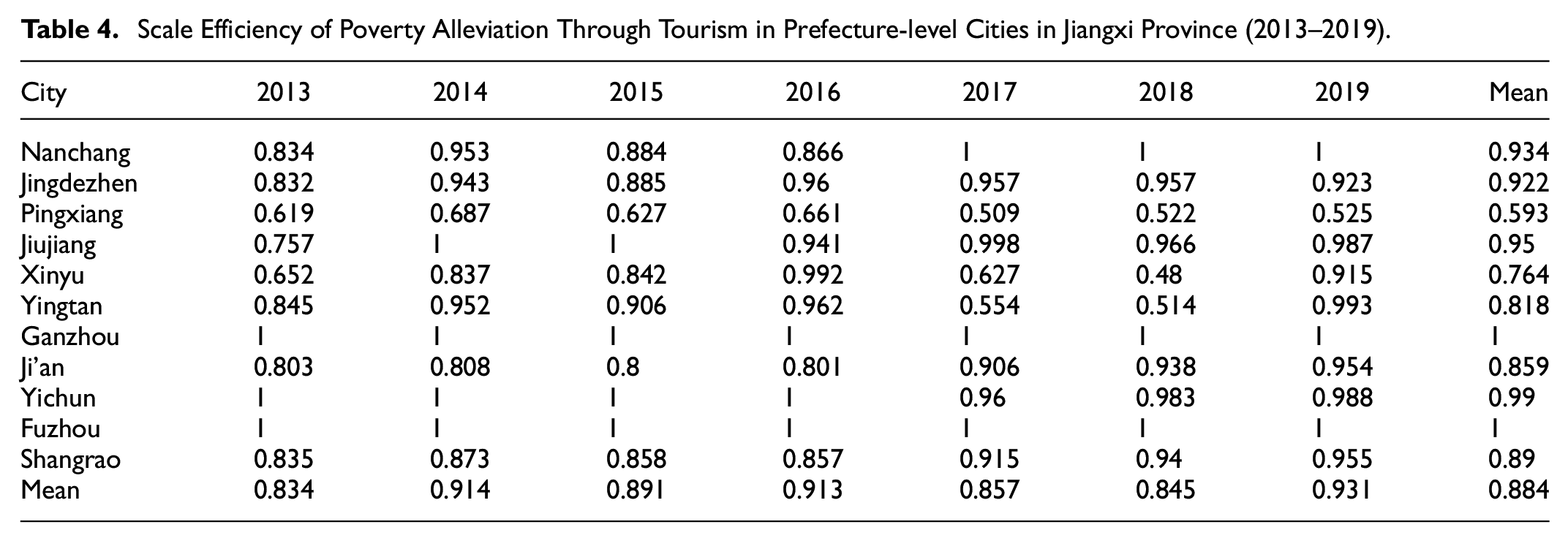
By analyzing the scale efficiency of tourism poverty alleviation in Jiangxi Province from 2013 to 2019, this study finds that the scale efficiency of tourism poverty alleviation in Jiangxi Province is generally at a relatively high level. Among the prefecture-level cities in the province, the average technical efficiency of seven cities exceeds the average efficiency of the province (0.884). From 2013 to 2019, three or four regions were in an effective state every year, the scale efficiency of tourism poverty alleviation has been increasing year by year, and it is constantly approaching the optimal scale state. This result shows that the scale of resource investment in many regions of Jiangxi Province is relatively appropriate. If it is necessary to improve the overall efficiency of tourism poverty alleviation, we should consider improving its technical efficiency and start work on technological innovation, talent introduction, management improvement, etc. From the spatial distribution perspective, the scale efficiency of all regions in the province has been continuously optimized over time. Only the western region has been lower than the average value of the province. This result shows that investment in the scale of resources in Pingxiang needs to be optimized. Hence, it is concluded that there is a huge potential for further improvement in scale efficiency across all study sites except Ganzhou and Fuzhou (Figure 4).
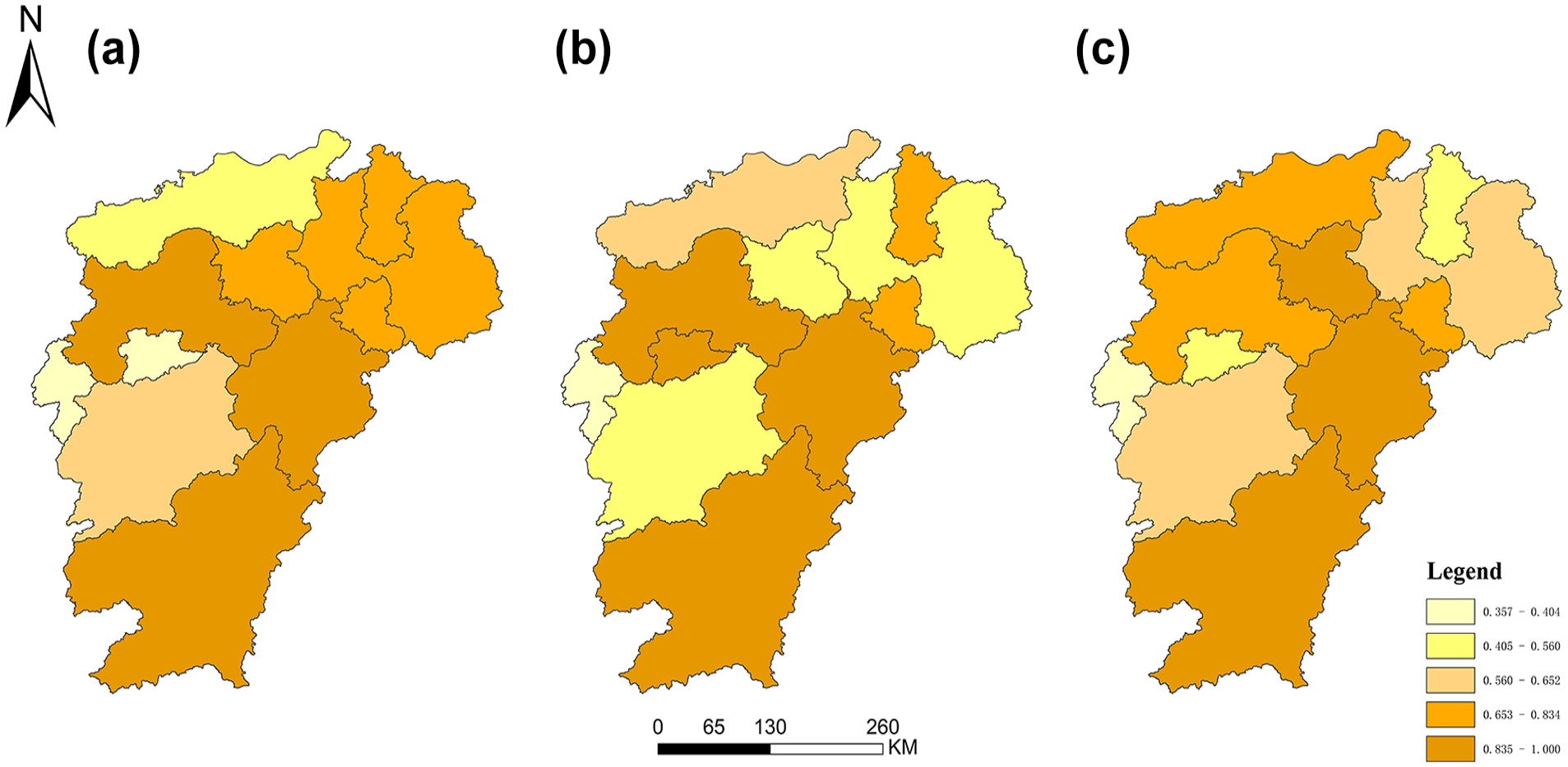
Spatial differentiation of the scale efficiency of tourism poverty alleviation in Jiangxi Province from 2013 to 2019: (a) 2013, (b) 2016, and (c) 2019.
Malmquist Index Analysis
By combining DEA theory and DEAP 2.1 software, we can calculate the Malmquist index of the comprehensive efficiency of tourism poverty alleviation in Jiangxi Province from 2013 to 2019, as shown in Table 5.
Malmquist Index in Prefecture-level Cities in Jiangxi Province.

In general, the average value of the Malmquist index in each region of Jiangxi Province reached the highest value of 1.137 in 2014. In the subsequent years under study, only 2016 had a value greater than 1, and all other time periods had values less than 1. This result shows that the overall efficiency of tourism poverty alleviation in Jiangxi Province has been on a downward trend for a long period of time. Among all regions, only Ji’an has an index greater than 1 during 2013 to 2019, which shows that Ji’an’s tourism industry resource allocation has been continuously optimized. Ganzhou and Fuzhou have always been effective in poverty alleviation through tourism; thus, their Malmquist index has always been 1. Index fluctuations in other regions are relatively large, and overall efficiency first increased and then decreased. This result indicates that the resource utilization rate has been declining in recent years and that there is much room for improvement. To improve technical efficiency or adjust the industrial scale to improve scale efficiency, we should focus on technological innovation, talent introduction, policy innovation, etc.
Research Limitations and Prospects
This article attempts to study the efficiency of tourism poverty alleviation to provide a reference for the effective development of tourism poverty alleviation in Jiangxi Province. However, there are several limitations to this approach. First, the study uses a limited data set for only 7 years (2013–2019) and selects only one province in China. Moreover, the data were mainly obtained from a statistical yearbook published by the government, and it was not possible to obtain more complete data through field investigations due to COVID-19 travel restrictions and financial constraints in case of buying a large data set, which would definitely have improved the quality of the analysis to make better generalizations about the usage of the DEA model in tourism efficiency. If we obtain data through field research, we will be able to obtain more complete data, and therefore, the research will be more scientific and persuasive. Second, for the selection of input–output indicators for tourism poverty alleviation efficiency, this study mainly selected by reviewing existing research and combining the available data. It was unable to take into account all the factors that affect the efficiency of tourism poverty alleviation. To improve the rigor of research, the selection of input–output indicators should be more specific and detailed. Finally, research on the efficiency of tourism poverty alleviation is a process of continuous innovation, and bolder and innovative research is needed to enrich the research in this field to better guide the practice of tourism poverty alleviation. Future research on efficiency can adopt a more rigorous indicator system based on the theoretical foundations and research methods in many fields, such as sociology, psychology, and statistics, to obtain more scientific research results.
Conclusions and Discussion
Research Conclusions
Through the DEA model, this paper measures tourism poverty alleviation efficiency in 11 prefecture-level cities in Jiangxi Province, China, by analyzing its spatiotemporal differentiation and dynamic changes. The results show that the efficiency of tourism poverty alleviation in most regions is on an upward trend in all cities except in a few cities where tourism poverty alleviation efficiency continued to decline. This is because these regions have been in a state of inefficiency for a long period of time. By analyzing the spatial differentiation of the three types of efficiency, this study finds that the regions with a low level of tourism poverty alleviation efficiency are Jingdezhen and Yingtan, which are cities adjacent to Shangrao. The development of the tourism industry in Jingdezhen and Yingtan may be affected by that in Shangrao to a certain extent, which means that the rapid development of the tourism industry in Shangrao limits the development of tourism in its surrounding urban areas. Technical efficiency is an important factor leading to the low efficiency of tourism poverty alleviation. Compared with other regions across the country, these regions located in Jiangxi Province still need to improve in terms of technological innovation, talent introduction, and policy innovation. To improve the overall efficiency of tourism poverty alleviation in Jiangxi Province, we must attach importance to the development of these few tourism industries and realize more effective resource allocation.
Practical Implications
The improvement of tourist efficiency is a challenge that is shared by all counties, particularly those with fast-growing tourism businesses. The proposed technical approach and related policy recommendations in this study can serve as incisive benchmarks for helping decision-makers ascertain tourism efficiency quite precisely and support the more rapid growth of the domestic tourism industry in their respective localities. To accelerate tourism development in Jiangxi Province, several factors, including the duplication input of many factors, resources, capital, and labor, should be effectively addressed. First, the funding for tourism attributes should be decently expanded; second, the management level of the officials should be changed for the better; third, the allocation of resource factors should be improved. Bureaucratic obstacles and stimulating managerial and technical experience sharing need to be improved for tourism development among counties. Furthermore, we should underscore the development of tourism transport networks and fully exploit the role of traffic in enabling links in tourism destinations while also nurturing the sectoral amalgam of the local tourism sector. As the final measure, we must vehemently support the development, growth, and conservation of the local environment and resources along with the economic expansion of the tourism industry’s cutting-edge infrastructure.
To improve the poverty alleviation efficiency of tourism in Jiangxi Province, this paper proposes three suggestions for tourism development as follows: (1) As a major tourism province, Jiangxi Province has excellent tourism resources in all regions. However, the level of development of the tourism industry in various regions is uneven. The main reason is that tourism resources have not been effectively developed and utilized. Tourism should be developed in accordance with its own resource endowments, which will not only bring positive economic benefits but also win high visibility and an excellent reputation. Therefore, all regions of Jiangxi Province, especially those with low efficiency in poverty alleviation by tourism, must develop tourism based on their own characteristics. Only in this way can the tourism industry have a good driving effect on the regional economy, thereby promoting the progress of tourism poverty alleviation. (2) Technical efficiency is an important factor affecting the overall efficiency of tourism poverty alleviation, but it is at a relatively low level. To improve the efficiency of tourism poverty alleviation technology, we must pay attention to the introduction of high-end technology and talent. In the work of poverty alleviation through tourism, we should pay attention not only to the introduction of high-end foreign talent but also to the training of grassroots tourism personnel, especially the training of poor individuals who participate in tourism development. The reason is that it is mainly through their participation in the tourism industry that poor individuals can obtain jobs and economic benefits, which ultimately improves economic capacity and eliminates absolute poverty. Therefore, to improve the efficiency of tourism poverty alleviation, we must attach importance to cultivating the professional abilities and professional qualities of poor individuals, enriching their corresponding knowledge reserves, and ultimately realizing the active participation of poor individuals in tourism poverty alleviation. (3) By comparing and analyzing tourism poverty alleviation efficiency in various regions of Jiangxi Province, this study finds that some regions have been at an effective level for a long period of time, while other regions are far below the average efficiency level of the province. Hence, to improve the efficiency of tourism poverty alleviation in the whole province, regions can cooperate in the development of the tourism industry to achieve development in a sustainable manner. This can be done through interregional cooperation in the tourism industry, which will certainly pave the way to promote tourism in regions with low efficiency in poverty alleviation and to realize the further development of tourism poverty alleviation. Additionally, the tourism industry of Jiangxi Province as a whole can be developed rapidly, realizing the transformation from a major tourism province to a strong tourism province.
Footnotes
Declaration of Conflicting Interests
The author(s) declared no potential conflicts of interest with respect to the research, authorship, and/or publication of this article.
Funding
The author(s) disclosed receipt of the following financial support for the research, authorship, and/or publication of this article: This research was funded by the Humanities and Social Sciences Project of Jiangxi Education Department (No. JC20228).
