




Abstract
This study posits that there are divergent positions among scholars regarding the roles of experiential and linguistic factors in reading incompetence among Second Language (L2) readers. This study was conducted with a view to determining the exact sources of reading errors among selected second language learners. The goal was to suggest strategies of reading improvement, using the context of the research as a microcosm of Nigeria and, by extension, other second language contexts. It emerged that reading competence was typically low. However, it is significant that linguistic inadequacies accounted for the bulk of the reading errors identified. This study advocates an approach to reading instruction which emphasizes wide reading, that is, extensive reading. This approach not only generates interest in reading but also creates the opportunity for the learners to gain exposure to data of the target language thereby improving their linguistic skills and subsequently improving their L2 reading.
Keywords
Introduction
Reading competence in a second language (L2) has been a matter of concern among scholars because of the observed tendency among L2 and foreign language (FL) readers across the globe to manifest profound reading difficulties. Wuit (2012) explains the situation by pointing out that second language reading may place additional demands on the reader due to second language and cultural proficiency as well as previous literacy experience and belief. Unoh (2012), writing about the Nigerian L2 reading situation, points out the existence of reading problems such as slow reading, low comprehension, inability to distinguish between main idea from subordinate details, ineffective recall, difficulty in creative reading, and many others. Some scholars like Onochie (2012) and Tswanya (2005) have emphasized the experiential factor which they argue deprives an L2 reader of schemata required for comprehending texts written in a second language. This view, which is hinged on the schema theory, is viewed by Landry (2002) as an untenable explanation of poor L2 reading. Wallace (2014), in his own submission, observes that readers in second language situations often do not have the minimum threshold of general L2 ability required to read well. Obviously, there are divergent positions regarding the source of reading difficulties among L2 readers. Yet, appropriate pedagogical responses would depend on a clear picture of the causes of reading problems. In view of this, this researcher embarked on this study to contribute to the establishment of a clear position regarding the issue and to recommend solutions to reading problems. The study was conducted in Nigeria within the Lokoja metropolis among two groups of school pupils. One group had completed primary education while the other group had completed secondary education. The goal of the research was to find out their level of competence in reading materials that are deemed (based on appropriate readability tests) to be suitable for their level of literacy training. The objective was to establish the nature of the reading errors with a view to recommending an appropriate remedy to reading deficiencies.
Lokoja is a cosmopolitan town in the central part of Nigeria with people of diverse ethnic background. Its cosmopolitan nature is further enhanced by the fact that it is a state capital which is host to many Federal Government establishments. The town also is host to two tertiary educational institutions (a university and a polytechnic). Within a 30-km radius around the town are two of the biggest factories in Africa (the huge cement factory in Obajana and the large but struggling steel plant at Ajaokuta). The town is less than 2 hr drive from Abuja, the capital city of Nigeria. These features create a population that is sufficiently cosmopolitan for the extraction of a group to be used as a microcosm for the entire country and, to a reasonable extent, for most former colonial L2 contexts. The study, however, begins with an overview of essential issues related to reading competence, reading assessment, and second language reading. Subsequently, the method of research used is presented. Thereafter, the results are presented and analyzed. Discussions of emerging issues are then made with conclusions and recommendations drawn.
Theoretical Framework
The centrality of the concept of competence to this study necessitates an overview of existing scholarly positions with a view to putting this research in proper perspective. Definitions of reading competence usually depend on the theoretical perspective from where one is viewing the issues involved in reading, and there are indeed different theoretical perspectives of reading which may be classified as the traditional view, the cognitive view, and the metacognitive view (Vaezi, 2006). According to this scholar, the traditional perspective views readers as passive recipients of information in texts. That is, meaning is assumed to reside in the text; readers simply reproduce it. Emphasis is laid on the decoding of a set of written symbols into their speech equivalents. The process is often referred to as the bottom-up view of reading (Vaezi, 2006). This process has also been referred to as the outside-in approach because of its emphasis on meaning as a component of the printed page which is usually subsequently taken in by the reader. Vaezi (2006) further explains that the traditional approach emphasizes the discrete skills that readers employ in reading, such as those that involve the understanding of formal features of writing like letters, words, and structure. These were the earliest views of reading. Indeed, reading research started on this kind of view. Vaezi (2006) observes that the cognitive view of reading, which has been described as the top-down model, emerged in opposition to the bottom-up approach of the traditional school. The cognitive view, the scholar argues, comprises of a number of relatively more modern views. These views were put forward in the form of theories such as the substrata-factor theories, psycholinguistic theories, and the schema theories. These views, in varying ways, lay emphasis on the reader and on how texts are processed in the reader’s mind to arrive at meanings.
As scholarly perspectives on reading continue to evolve, scholars are beginning to arrive at a position where, in the words of Vaezi (2006), “there is now no more debates on whether reading is a bottom-up language-based process or a top-down knowledge based process.” Also, it is “no more problematic to accept the influence of background knowledge on both L1 and L2 reading.” According to the scholar, research has gone beyond this and is now beginning to focus on the control which readers execute on their ability to understand a text through their own thought processes. This control is what is referred to as metacognition which is now the current fad.
The perspective of Koda (2005) on reading competence is slightly different. The scholar discusses all the modern views and theories of competence by classifying them into three broad categories: the cognitive view, the developmental view, and the functional view. The term “cognitive view” is used by Koda (2005) to classify those views which uphold that before information extraction can take place, readers must adequately complete three processing clusters. These clusters are decoding, information building, and situation model construction. Decoding involves the extraction of linguistic information from the text, while information building involves the integration of extracted ideas to uncover text meaning. The situation model construction involves the amalgamation of text information with prior knowledge. The second perspective is the developmental school of thought. This school of thought agrees that learning to read involves the mastery of two basic operations (decoding and comprehension) and they do not develop in parallel. Both reading and listening share similar processing requirements, and children acquire comprehension skills in the course of oral language development. By the time they are learning to read, listening comprehension skills are already well developed. In principle, children should be able to transfer listening comprehension ability to reading (Koda, 2005). Koda (2005) points out that there is yet another view of reading competence called the functional perspective. This is a modern view that has been variously proposed by different scholars over the years. According to this view, the purposes for which texts are read determine the manner in which the information is processed. Therefore, the indices of comprehension success vary in accordance with reading purpose. For the purpose of explaining the practical relevance of this view, different reading gears are identified which serve different purposes on a continuum of cognitive complexity. This means that reading test must bear in mind the competence level required for the purpose for which reading is done.
Farrar and Al-Qatawneh (2010) provide more comprehensive approaches to the study of reading. They share five theoretical perspectives: the linguistic theories, the psycholinguistic theories, the cognitive theories, the sociolinguistic theories, and the critical theories. According to the scholars, linguistic theories emphasize the role that knowledge of features of language play in all aspects of reading. This inevitably leads to emphasis on discrete measurable skills of language. This appears to be quite similar to what Vaezi (2006) refers to as the traditional perspective. The psycholinguistic theories, according to Farrar and Al-Qatawneh (2010), emphasize the use of cognitive functions, especially the integration of prior or old knowledge into reading, which the schema theory also emphasizes. These scholars further point out the features of the sociolinguistic theories which discuss how instructional and noninstructional social situations impinge upon all aspects of reading. They explain the critical theories which emphasize the ability of readers to analyze their own reading by thinking, solving problems, and carrying out interpretive tasks beyond the literal level. Singer (2012), like other scholars cited above, traces the development of views of reading from the early days of emphasis on discrete measurable skills to the time when cognition became recognized in the form of such theories as the substrata-factor theory, and the current perspectives of focusing on interaction between the reader and the text in such a way that the reader goes back and forth from his knowledge to the database of the text (Cook, 2011).
In view of the fact that each of these theories simply emphasizes certain things which other theories may not emphasize so much, and the fact that all the different components they emphasize have their relevance, Farrar and Al-Qatawneh (2010) advocate for an eclectic approach. They describe it as an interdisciplinary approach that involves linguistics, psychology, sociolinguistics, and critical thinking. They point out that “a conscious, purposeful and systematic integration of these theories results in a careful balance of numerous teaching and learning experiences” (Farrar & Al-Qatawneh, 2010, p. 19). It would, therefore, be necessary to extract and itemize relevant concepts from all the above to clearly outline the reading comprehension construct that would govern this research. These are as follows:
i. There are a number of linguistic inputs to reading. These involve knowledge of graphology, syntax, lexico-semantic elements, and other miscellaneous requirements for decoding.
ii. A reader’s application of the above will depend on the extent or level of his literacy training.
iii. The application of all the skills mentioned in (i) above will yield, for the reader, textual information or derived texual information.
iv. Full text comprehension, however, depends on the integration of textual information with preexisting reader knowledge, which depends on the readers’ experiential background.
In view of the above, it is clear that reading competence is the ability to carry out (within the limits of literacy training) the task of integrating derived text information and preexisting reader knowledge such that the reader is ultimately able to extract from the text the thought which the writer is trying to express. Reading competence is a crucial issue because of the role of reading in modern society. It is the core issue in scholastic achievement in all academic pursuits. Therefore, it deserves all the scholarly attention it can get. In view of the fact that this research is centered to a large extent on competence assessment, it would be necessary to provide a background for the intended tests.
Reading Competence Assessment
It has to be said that there are myriads of approaches to testing reading. It is possible to look at the issue from the perspective of the purpose for which the assessment is to be done, the model to be employed, and the nature of the instrument to be used. According to Koda (2005), there are administrative objectives usually requiring large scale testing and diagnostic objectives usually meant for finding out sources of reading difficulties. Also, there are tests meant for classification purposes, to create a basis for comparing and differentiating examinees. These can be carried out by using either the standard model or the informal model. The former involves the use of objective testing of acquired skills and is amenable to mathematical accuracy. The latter emphasizes practical use of such skills, and it is dynamic, flexible, and sensitive to learners’ variable capabilities. Measurement instruments may include free recall tests, cued recall tests, multiple choice questions, cloze tests, to mention but a few. All the testing instruments have their advantages and disadvantages. These are also clearly spelt out in Koda (2005). The scholar observes that free recall has the advantage of being the most straightforward and easy to construct of the tests. However, it is usually very difficult to score objectively and the option of formulating scoring templates often proves very difficult. Moreover, it often turns out to be a test of memory and preexisting reader knowledge than a test of reading proficiency.
The cued recall system offers the tester the opportunity of going beyond general memory. It enables the tester to ask specific task based questions but limits opportunity to recall some things that the reader may actually understand because only questions asked are responded to. The multiple choice objective test, which is the most popular test, is valued for its simplicity of scoring and its objectiveness. However, it is often criticized for sometimes confusing testees with distractors and for the tendency of test results to reflect test taking skills and not reading skills. Koda (2005) also raises serious reservations about the cloze test which she believes tests only surface elements like word recognition and grammar while leaving out fundamental aspects of mental processing. The cloze procedure also yields radically different results from the same test passages when the deletions are varied. One must stress that the view that the cloze procedure is inappropriate for testing beyond surface elements is very untrue. Cloze tests are able to test inference ability and the integration of experiential background into the understanding of texts. Moreover, when a lenient criterion is used for scoring, the credibility of the test is enhanced. Indeed Koda (2005) himself affirms this. None of these approaches to testing is 100% perfect. Each tester must determine his focus and apply informed discretion to determine which one best suits his objectives. It is believed that the cloze test is able to isolate the causes of reading errors very well. As the identification of such errors is crucial in this study, the cloze procedure is the preferred option.
The cloze test, which Roe, Stoodt, and Bums (2012) describe as “easy to construct, administer and score,” takes less time than the testing formats usually employed in the Informal Reading Inventory (IRI). The cloze procedure has an interesting theoretical foundation which may be relevant at this stage. Onochie (2012) provides some insight into the cloze procedure. He points out that the word “cloze” is derived from the concept of “closure” in Gestalt psychology. This concept of closure refers to the tendency to “complete otherwise incomplete experiences in order to make them meaningful wholes” (Onochie, 2012, p. 96). According to the scholar, “Gestalt” is a German word for configuration or organization. Psychologists of the Gestalt school of thought believe that the world is experienced in meaningful wholes made up of patterns or configurations. A person uses the concept of closure while perceiving reality thereby seeing things in whole regardless of “gaps or exceptions here and there” (Onochie, 2012, p. 97). In the cloze test, these gaps are in the form of deletion of words in passages such that the testees will be asked to fill in the appropriate words. The deletion system often varies according to testers’ preferences. Onochie (2012) recommends a deletion system that involves the deletion of every fifth word (for adults) and 10th word (for children). This approach is adopted for this research. By and large, the most ideal test procedures usually involve a combination of two or more types of tests to enhance validity of results. In this research, however, only one test type is employed due to reasons that will be explained later.
Reading in Nigeria
Reading is germane and crucial to effective academic functioning, and it is the determining factor in the achievement of the aim and objective of teaching and learning. Consequently, a learner at whatever level or age, who is deficient in this all-important skill, is already limited in exploiting available opportunities for a successful academic excellence. Sadly, however, as decisive and important as reading is to teaching and learning, researchers have found that underachievement in reading is the bane of effective academic functioning among learners all over the globe (Alika, 2012). African countries, particularly Nigeria, are confronted with more biting effects of underachievement in reading. For instance, it has been established to be a national crisis in Nigeria (Lawal, 1987), while in Botswana, it is estimated that many students are yet to master literacy and language competencies by the time they enter secondary school. Many efforts have been made to address this problem. Some interventionists have viewed it from the angle of socio-psychological factors related to the learner’s background (Alika, 2012) and others have focused on readability of a text as a prime factor that determines reading efficiency or inefficiency (Lawal, 1987). Yet some others have considered the students’ attitude to reading as a factor in reading comprehension (Hall, 2006). More specifically, Hall (2006) in the study of reading comprehension among the San students of Botswana revealed that underachievement in reading comprehension at the junior secondary school is very high and traced the problem to environmental factors of the home background and the neglect of the San people by the government. The scholar reiterated the fact that the scourge of poverty among this community of people coupled with lack of attention from the government’s end has rendered literacy and, ultimately, teaching and learning ineffective. Unoh (2012) opined that the methodology used by teachers for the teaching of reading, coupled with poor learning environment in most of Nigeria’s secondary schools, had hitherto yielded nothing to enhance the needed reading requirements of today’s academic demands. This has resulted in the major crisis being witnessed in the school certificate results on English Language examinations of any form according to the scholar.
Akindele and Adegbite (1999) highlighted the factors that brought about the incursion of the English Language into the African continent to include colonialism, clothed in missionary activities, trade, and commerce. Soon after the language had gained prominence in the African soil, it became the “de facto” language. In fact, some foremost educated elites of the period, notably in Nigeria, clamored for the preservation of the “Queen’s” or the “King’s” English. According to Akere (2006), The expectation was that the British variety of the language was the model to which all learners must aspire . . ., a variety whose phonological, lexical and grammatical features and rules must be acquired and used. (p. 50)
The influx of missionaries into Nigeria to spread Christianity aided the spread of the teaching and assimilation of English Language as a medium of communication. The missionaries did not only build churches, but they also established schools, and the curricula were practically dominated by the English Language (Akere, 2006), and soon, the language assumed the status of a language of commerce, civilization, and Christianity (Fafunwa, 1974). In fact, the teaching and learning of reading dominated the curriculum because the then heathen had to be taught how to read the Bible for the purpose of propagating the gospel and winning them for Christ. Incidentally, the Nigerian children had to be taught the elementary and the advanced forms of reading in a language that is foreign or alien to them. This has been attributed to be one of the problems posing a very serious challenge to the teaching and learning of reading (Afolayan, 1987).
The language planning and policy in Nigeria also has its effect on reading deficiency. It is generally accepted that any child without any form of pathological defect such as hearing or speaking difficulty should be capable of making use of his or her language of immediate community. He or her has this opportunity for at least 6 years before the beginning of the official primary school career. As Chomsky (1957) stated, the child is linguistically competent to effortlessly produce novel sentences of his environment. This child should be able to make good sentences and also internalize virtually all the linguistic features of his or her mother tongue (L1), quite aware of the morphosyntactic features of the language of his or her first contact. Introducing the child to early education in this language will therefore not pose any serious problem to him simply because he is already immersed in that language. Thus, whatever the child encounters in a bid to acquire knowledge is not new. The early language encountered at home should therefore provide a suitable ambience toward linguistic competence in the second language. The second language here in the case of Nigeria is English. Afolayan (1987) expressed this tersely thus, “for foreign language learners to read, they have to be prepared to use various abilities and strategies they already possess from their reading experiences in their native language” (p. 34). This view is further established in the remark of Eurydice (2010), which affirmed that many migrant students perform below standard in reading compared with their L1 standard because of the change in the language of instruction. In Nigeria, an accomplished educationist, Professor Babs Fafunwa, expressed this view tersely: If a Nigerian child is to be encouraged from the start to develop curiosity, manipulative ability, spontaneous flexibility, initiative, industry, manual dexterity, mechanical comprehension and coordination of hands and eye, he should acquire those skills and attitudes through the mother tongue as the medium of education, which after all is the most natural way of learning. (Fafunwa, Macauley, & Sokoya, 1989, p. 10)
It should be noted here that Fafunwa’s remark was referring to the cognitive, affective, and psychomotor domains of the child. The question that readily comes to mind is “How many Nigerian children are grounded in reading in their native languages before they are introduced to foreign language?” Afolayan (1987) also established that “Children who develop proficiency in using their native language to communicate, to gain information, to solve problems and to think can easily learn to use a second language in similar ways.” He maintained that “Even young children who are learning a second language bring all of the knowledge about language learning they have acquired through developing their first language” (p. 183). This suggests that the place of the first language in latent formal acquisition of the second language cannot be underestimated. But a problem arises if the policy on education and the planning of language are unstable with regard to the status accorded to the English language as the official language and the language of the immediate background of the child.
Second Language Reading
It may be necessary to establish a clear perspective of the concept of second language (L2) that governs this research before discussing second language reading. This is because there are diverse perspectives of what the term means. Also, the type of L2 readers in question is important in a discussion of influences on reading. For example, Landry (2002) stresses the importance of first language (L1) influence as a factor in second language (L2) reading. This, however, may be irrelevant to many of the respondents in this research as they are not deemed L2 learners on the basis of prior acquisition of an L1. The study views the concept of L2 in line with the perspectives of Afolayan (1987) and Akindele and Adegbite (1999) and posits that a second language is a variety of a language which is used in a given socio-cultural context that is nonnative and which creates a situation of bilingualism as is the case in ex-colonial countries where the languages of former colonial masters are still in use. One must stress the fact that the speakers’ sequence of acquisition is irrelevant to this perspective. This is radically different from the positions of Cook (2011) and Yule (1996) who emphasize the sequence of acquisition in their views of L2. Cook (2011), for example, opines that L2 refers to “languages other than the first in whatever situations or for whatever purpose” (p. 5). In places like Nigeria, however, we now have millions who acquire both a local language and the local variety of English simultaneously. Indeed, there are those who actually acquire English first and either never acquire a local language or go on to acquire one later in life. Such people are still viewed as L2 speakers of English because most of the features of L2 English speakers which have pedagogical and communicative significance remain relevant to them. These features are also important for L2 reading. They include the following:
i. Exposure to inadequate or inappropriate data of the target language,
ii. Tendency to depend on written texts for appropriate and adequate data of the target language, and
iii. Inability, on the part of many, to become fully functional readers in target language texts.
These are some of the generic features that characterize the typical L2 learner in a typical urban area in Nigeria regardless of individual differences in L2 status which are believed to have pedagogical implications. They thus require learner specific approaches to teaching at the early stages (Avalos, 2003). By and large, though there are parallels in L1 and L2 reading, there are peculiarities in L2 situations that may breed some reading difficulties. These as earlier stated are viewed differently by different scholars. Wallace (2014) believes that the reading difficulties of the typical L2 reader exist because they often do not have the “minimum threshold” of competence in the language. While this is a fairly well accepted view, other scholars like Onochie (2012) have stressed experiential difficulties based on a comparison of performance in reading indigenous texts and nonindigenous texts which revealed better performance in the local texts. It is important to point out that this is hardly surprising and significant. Experiential problems inevitably affect the comprehension of nonindigenous texts and as such should not be overemphasized when nonindigenous texts are involved.
Although this study is of the view that the ability to read nonindigenous texts must form part of a broader reading comprehension construct in view of globalization, the current research is based on texts that do not contain concepts that are completely alien to the culture of the respondents. This study believes that this is really the best thing to do to objectively measure the intrinsic value of experiential problems as a factor in L2 reading. On a general note, it must be said that the situation of L2 readers does not always have to be marked by disadvantages. Biliterate L2 readers are known to be considerably more flexible readers in the sense that they usually possess the knowledge and skills required to navigate from one language situation to another or even from one rhetorical style to another. They often develop strategies and schema for dealing with different languages and texts (Singhal, 2009). Most of the respondents in this research are not biliterates and may not have this advantage.
Method
This study involved administering silent reading tests to selected respondents. Although the objective of the survey was to obtain information that would be relevant to Nigeria, it was obviously not possible to obtain samples from the entire country. The research is deemed appropriate to be focused on the area most accessible to it (the Lokoja metropolis) which is, as earlier explained, metropolitan enough to yield results that can give a reasonable picture of Nigerian L2 reading. The respondents used in this research were selected from among pupils in the first year of secondary education and the first year of tertiary education. These were, in effect, people who had completed primary and secondary education, respectively. Limiting the study to pupils in schools was a result of the fact that this research was primarily focused on pedagogical objectives. This study involved a total of 300 respondents (150 with primary education, 150 with secondary education). The schools involved were selected purposively to yield responses from both government owned and private schools with a ratio of about 7 to 3. Also attempt was made to achieve a reasonable balance of male and female respondents. In all, 160 males and 140 females were involved as respondents.
Based on the theoretical perspective on reading competence assessment discussed earlier, the researcher decided to use the cloze procedure for the reading tests because it is an option for testing the linguistic and cognitive processes involved in reading. The respondents strive to “guess” the options to fill the spaces created in the passages, thereby integrating text information and existing reader knowledge. It would have been better to combine the cloze test with at least one other test format to make the conclusions more valid. This could actually have resulted into significant changes in individual scores even if the final overall picture remains. However, obtaining the whole-hearted cooperation of respondents while carrying out research is often problematic in Nigeria. It is often wise to minimize the tasks that respondents are expected to perform. The idea behind this is to get the best from little rather than take the risk of obtaining unreliable data from the inclusion of more tasks. Also, the option of including informal activity based assessment may amount to subtle instructional guidance, which may contradict the objective of the test being to assess the ability to do independent reading. Indeed, one of the competence levels identified after the test is the instructional level, which involves those who require instructional guidance to read well. Any procedure that resembles instructional guidance will obviously compromise this approach, as one would have no basis for differentiating those who can read independently from those who require instructional guidance. Moreover, prior knowledge of text, which may be inherent in informal procedures such as prior discussion of material, is not quite suitable for the objective of scrutinizing readers’ “guessing” process to test the impact hitherto acquired through experiential knowledge.
The researcher administered two separate tests. One was for respondents with primary education while the other was for respondents with secondary education (i.e., 6 years of schooling and 12 years of schooling, respectively, in the Nigerian context). The tests were subjected to the Fry readability test to confirm their suitability for the selected category of readers. The Fry readability formula is a readability metric for English texts, developed by Edward Fry. The formula and graph are often used to provide a common standard by which the readability of documents can be measured. The Fry test is generally acceptable for second language situations (Appelt, 2006). It is important to point out again that it was ensured that the texts were largely devoid of concepts that were completely unknown in the respondents’ culture. It seems obvious that a fair assessment would require this. Also, one must point out that the scoring system was lenient, such that any words that could grammatically and semantically fit into the cloze test blanks were accepted. The exact words in the original passage were not necessarily required. Subsequently, the results were scored and aggregated according to three categories: independent level (60 and above), instructional level (40-59), and frustration level (0-39).
A total of 11 samples (the only available one for independent level of secondary education and two each for the other reading levels of the two categories of respondents) were analyzed for reading errors. The number of errors was tabulated according to the following categories developed by Onochie (2012).
IC—In Context PC—Partially in Context OC—Out of Context GE—Grammatical Errors SE—Semantic Errors EE—Experiential Errors
Subsequently, the test passages were rearranged in such a way that the deletions appeared vertically in serial order. Six columns were created in front of each deletion, one each for the identified category of errors. The column represented the nature of the testee’s response for each deletion and was marked as demonstrated in Table 1.
Reading Expectancy Table for Respondents With Primary Education.

Please note that Table 1 is merely a demonstration of what was done in the study. It contains 10 out of the 50 blanks from the test passage completed by one of the respondents. Not all the analyzed responses of 50 items each could be reflected in this write up.
Results and Discussion
The results of the analyses for both categories of respondents are presented below.
a. Reading Expectancy
Table 2 shows an overwhelming proportions of the respondents reading out at frustration level for simple prose passages (70.6% for primary education and 81.05% for respondents with secondary education), it is clear that reading competence levels are tragically low.
b. Frequency Distribution of Reading Errors
Reading Expectancy Table for Respondents With Secondary Education.

Below are Tables 3 and 4 illustrating the distribution of reading errors in accordance with the identified categories and the analyses procedures stated earlier.
Summary of Reading Errors (Primary Education).

Note. IC = in context; PC = partially in context; OC = out of context; GE = grammatical errors; SE = semantic errors; EE = experiential errors.
Summary of Reading Errors (Secondary Education).
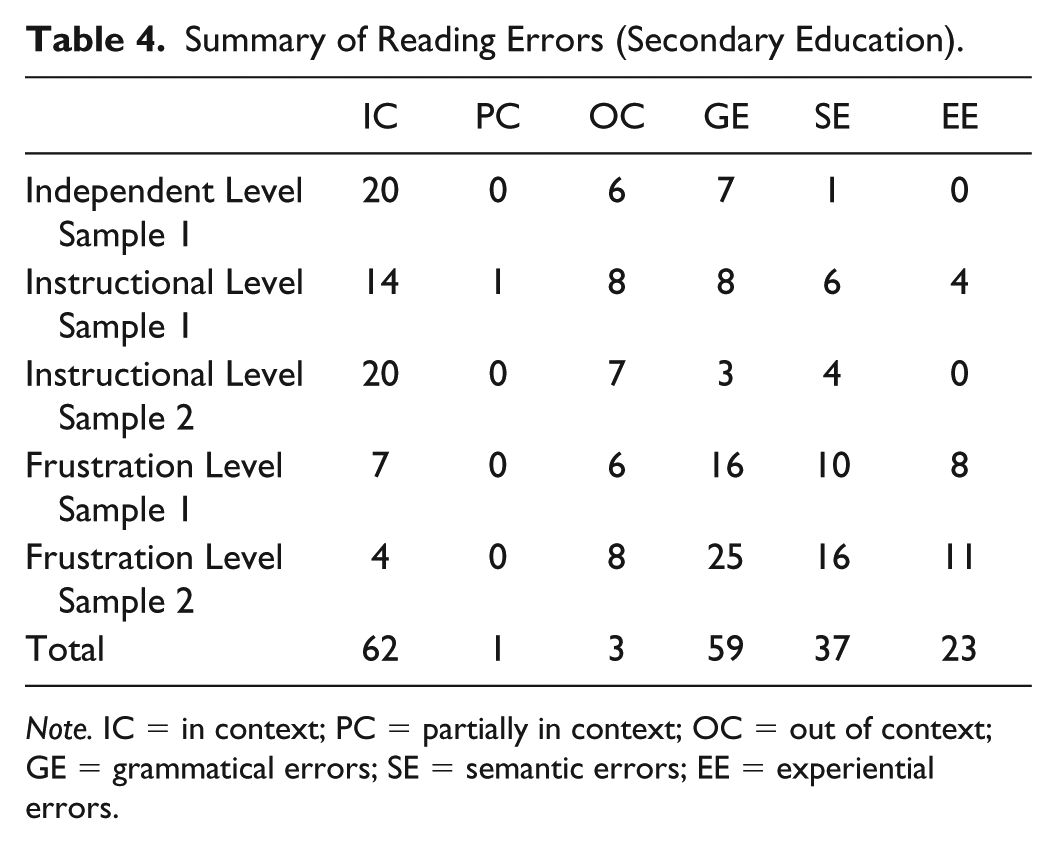
Note. IC = in context; PC = partially in context; OC = out of context; GE = grammatical errors; SE = semantic errors; EE = experiential errors.
The summary of reading errors reveals quite clearly that the bulk of errors occur in the area of in context (98, 62), grammar (76, 59), and semantics (47, 37) for the two categories of respondents. These far outweigh the other error categories that have 14, 1; 26, 3; and 13, 23, for partially in context, out of context, and experiential errors, respectively.
Analysis of Reading Errors
Table 5 illustrates how the source of the reading difficulties are identified in accordance with earlier identified procedure. However, the original passage from where the cloze test is constructed is presented below with the deleted words underlined. This particular test was administered to respondents with primary education. It involved the deletion of every eight word. Note that the lenient criterion was used for scoring.
Sample of Analysis of Reading Errors.
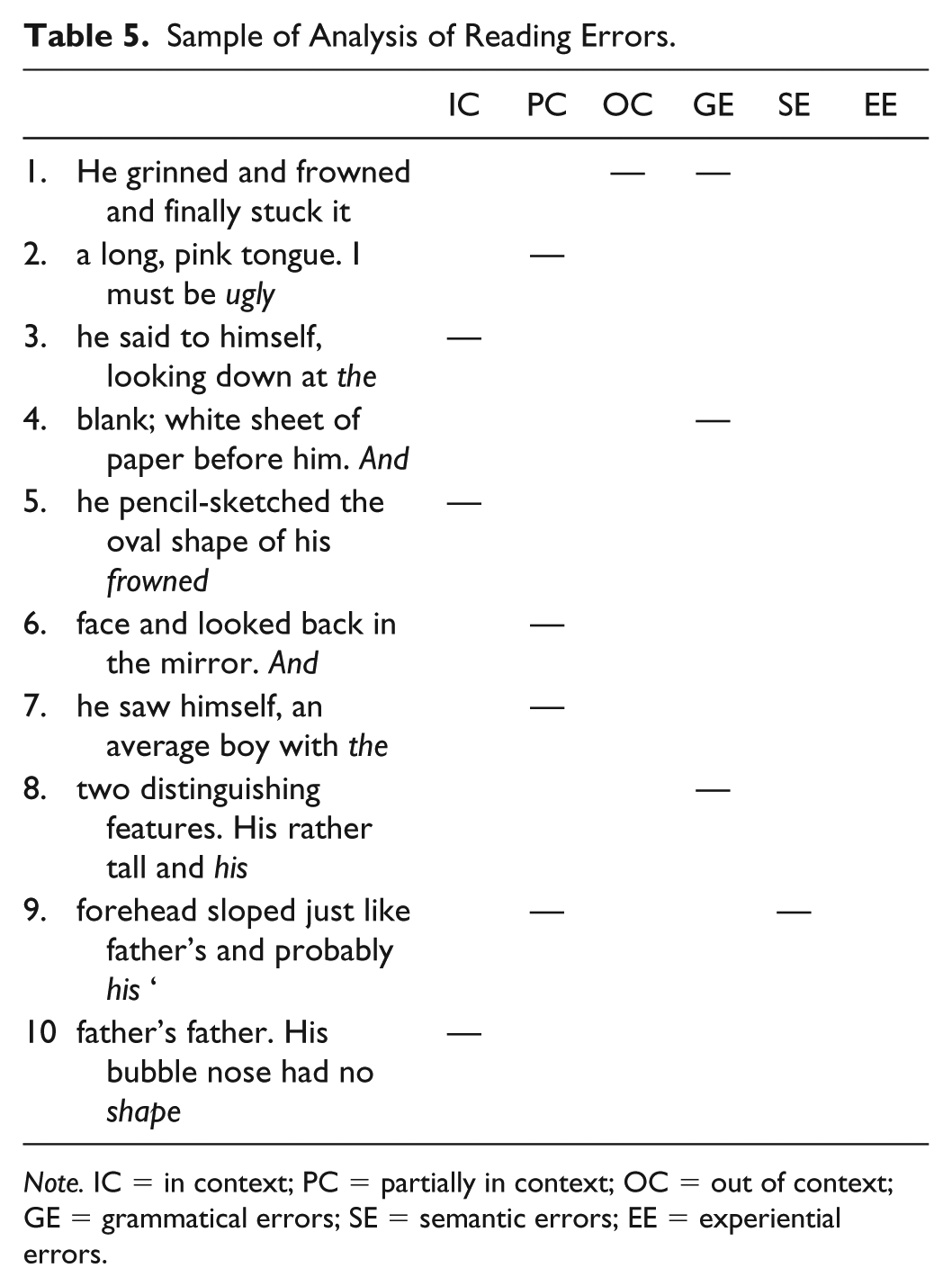
Note. IC = in context; PC = partially in context; OC = out of context; GE = grammatical errors; SE = semantic errors; EE = experiential errors.
He grinned and frowned and finally stuck out a long, pink tongue. I must be serious, he said to himself looking down at the blank, white sheet of paper before him. Swiftly, he pencil-sketched the oval shape of his own face and looked back at the mirror. Again he saw himself, an average boy with only two distinguishing features. His rather tall and receding forehead sloped just like father’s and probably like father’s father. His bubble nose had no shape at all. (The test passage was extracted from C.A. Gbele’s Stepping Out.)
Conclusion
It has emerged from the study that an overwhelming majority of the selected educated Nigerians who participated in the study appear to be unable to read up to the level of their perceived literacy training. This conclusion is drawn from the fact that the results of the reading tests administered indicated that about 70% of those with primary education read at frustration level while about 81% of those with secondary education fall into the same category. One must again emphasize that the respondents were given a wide berth with a scoring system that allowed for any words as long as such words would fit the context of the passage. The failure rate was high in spite of this dispensation. A close look at the reading errors (in percentage terms) reveals that most of them are errors of language incompetence which often translates invariably to reading incompetence. For instance, 68.26% of errors committed by respondents with primary education are grammatical and semantic errors. Also, 69.94% of such errors are grammatical and semantic for respondents with secondary education. The implication of reading at frustrations level, according to Ekwall (2013), is that comprehension is less than 50% and word recognition is below the required 90%. Also, the readers cannot really understand the text and will show signs of tension and discomfort. It is also likely that the readers concerned will engage in vocalization. Only 20% and 18.30% for primary level and secondary level, respectively, could read at instructional level, that is, at comprehension level of about 75% and word recognition level above 90%. The reader in this category requires instructional guidance to understand an appropriate text. Only 9.33% and 0.65%, respectively, could read appropriate level text without help. The overall implication of all these is that as far as capacity to read is concerned, something is desperately wrong in the system operational in Nigeria. Although many reasons have been given for this situation, this researcher is of the opinion that among all these reasons, the factor of teaching is probably the crucial factor. Scholars have observed that reading is usually not properly taught in Nigeria (Oyetunde & Umolu, 2012; Unoh, 2012). However, this researcher is of the opinion that reading is usually not taught at all! What we often consider to be the teaching of reading is actually the teaching of language using reading. This view will be expounded under the section on recommendations.
The implication of the above is that the respondents have not mastered the meaning and the grammatical structures of the text. It is obviously clear that for the respondents, English language is functionally a second language in which they have profound problems, especially in the context of inadequate teaching. Korppi (2003) observes that there is indeed a problem with competence in reading in a second language, such that an understanding of the relationship between second language acquisition and reading development has to be properly grasped. It is the view of the researcher that this relationship operates in such a way that language problems negatively affect reading which leads to reading incompetence. This generates a low interest in reading. This in turn negatively impinges upon language development. This becomes cyclical because reading is a crucial factor in second language development.
Recommendations
Having obtained the relevant data and analyzed the same, it is clear that the reading competence level of the respondents in this study is abysmally low. It has also emerged that the respondents have significant problems with grammatical structure and semantic relationships requiring teaching attention because low linguistic competence leads to reading incompetence. This leads to low involvement in reading, which in turn leads to limited exposure to linguistic data of the target language. This problem operates in a cyclical way. An approach to the teaching of reading which would enhance language development and boost interest in reading will therefore be very relevant to the situation. Extensive reading programs have in recent times been found to be the most effective in this regard (Susser & Robb, 1990; Yamashita, 2004). This researcher, therefore, recommends this approach to reading for the Nigerian situation. One way to properly understand the relevance of extensive reading is to view it against the background of the kind of teaching that currently goes on in our schools. The current approach which is based on intensive reading involves a close study of short passages, including syntactic, semantic, and lexical analysis (Susser & Robb, 1990). This approach has been the preferred choice in second language situation over the years. People have assumed, in error, that spending time on scrutinizing linguistic elements of texts is a way of boosting language proficiency in view of the L2 learner’s limited contact with the target language. It is erroneously assumed that the exclusive use of extensive reading is more of an L1 strategy, as L1 learners already have oral competence in the language and do not need the linguistic drills. In L2 situations, the teaching of reading is naturally subsumed under the teaching of language with reading texts treated as language teaching aid. The huge disadvantage in this, as scholars like Susser and Robb (1990) have pointed out, is that it tends to become a tedious drudgery because of the grueling linguistic exercises. Intensive reading does not amount to any form of reading but rather a language lesson. There may actually be a transfer of negative feelings toward reading generally. The point here is that intensive reading can be counterproductive as it deprives the learner of the benefit of language improvement from wide reading. It “programs” the learner toward dislike for reading.
On the contrary, recent studies in both foreign and second language situations have identified the enormous benefits of extensive reading for increasing the tendency to read and consequently help the reader to improve in reading. Their works are based on the results of practical implementation of extensive reading for learners of English in nonnative contexts. Pang, Muaka, Bernhardt, and Kamil (2003) point out that “the more children read, the more vocabulary and knowledge they acquire and the more fluent they become” (p. 105). Extensive reading is a system capable of achieving this as it involves making children read, as much as possible, materials that fit into the simple formula. Although extensive reading is often beset with many problems of practical implementation such as availability of books, library facilities, and the problem of defining the quantity of materials to be read by the different categories of learners, it emerged from the study that these problems can be overcome with enough will and commitment. English language teachers should be exposed to more in-service trainings and be given the opportunity to attend seminars and conferences. Teacher training institutions in Nigeria should, as a matter of urgency, re-design their curriculum to emphasize the acquisition of reading skills to assist the intending teachers on training. The Ministries of Education all over the nation should be compelled to set up standard postliteracy programs for Nigerian teachers with a bid to enhancing their teaching and reading strategies. Needed books and all library facilities should be made available in school libraries. These efforts would invariably improve the teaching of reading in second language learners in Nigeria. Nigeria as a nation should not make the mistake about the critical location of reading in our national life because even the survival of our fledgling democracy depends on it. It is equally important to begin further studies on reading in other parts of Nigeria.
Footnotes
Declaration of Conflicting Interests
The author(s) declared no potential conflicts of interest with respect to the research, authorship, and/or publication of this article.
Funding
The author(s) received no financial support for the research, authorship, and/or publication of this article.