



Abstract
Given the global importance of English, this study examined the impact of necessity of learning English on English learning engagement, with learners’ motivation and learner agency playing mediation roles. The study collected responses from 351 non-English majored EFL (English as a foreign language) learners across three universities in southern Vietnam using a self-report survey. The study examined 10 hypotheses by using partial least squares structural equation modelling (PLS-SEM). The results show that the model proposed in the study was a strong predictor for engaging learners in learning English. While the necessity of learning English does not directly correlate with English learning engagement or learners’ motivation, it has a positive influence on learner agency alone. While learners’ motivation only affects English learning engagement, learner agency fully mediates the relationship between the necessity of learning English and English learning engagement. As learner agency positively affects learners’ motivation and learners’ motivation predicts English learning engagement, it has created a chain mediation from necessity of learning English to learner agency, to learners’ motivation, and ultimately to English learning engagement. These results suggest that educational policymakers should employ teaching strategies that focus on enhancing learner agency and learners’ motivation to foster English learning engagement.
Plain Language Summary
Introduction: This study proposed a framework to boost EFL students’ engagement in learning English as a foreign language, with learning agency and students’ motivation playing mediating roles. Method: 351 students were recruited for the study. Structural Equation Modelling approach - PLS was employed to explore the relationships of the necessity of learning English with learning engagement, learning agency, and students’ motivations. The analysis also involved exploring the relationship between learning agency and students’ motivation with learning engagement. Findings: While the necessity of learning English does not directly correlate with English learning engagement or learners’ motivation, it has a positive influence on learner agency alone. While learners’ motivation only affects English learning engagement, learner agency fully mediates the relationship between the necessity of learning English and learners’ engagement. Learner agency also positively affects learners’ motivation, highlighting its critical role in fostering deeper student engagement. Learners’ motivation was also found to predict engagement. Recommendations: Educational policymakers should employ teaching strategies that focus on enhancing learner agency to foster EFL learning engagement.
Keywords
Introduction
English has become a global lingua franca, essential in international trade, finance, tourism, and research, and is incorporated into educational curricula worldwide, including in Vietnam (van Hout & van der Slik, 2025). In Vietnam, English is a compulsory subject from grade 3 to grade 12, as mandated by the Ministry of Education and Training (MOET), to enhance communication skills and foster global citizenship (Ngo & Tran, 2024). Under the current policy, university students in Vietnam must attain level three on the CEFR (Common European Framework of Reference, consisting of six levels of proficiency ranging from A1 to C2) to be eligible for graduation (L. D. Nguyen, 2023). Despite this, non-English major students often show lower engagement in learning English compared to their English-major peers (Huong, 2022). Since most students in Vietnam are not yet specialising in English but still require functional proficiency (Nguyen et al., 2020), it is integral to examine the factors affecting learning engagement among this group (L. Nguyen et al., 2021). While numerous factors may influence English learning engagement, three primary elements—perceived necessity, learner motivation, and learner agency—exert a particularly significant impact on English learning engagement (Almusharraf & Bailey, 2021; Anghel et al., 2023; Ferrer et al., 2022; Jang, 2022; N. H. Phan & Trinh, 2024). These factors are particularly important for non-English majors, who often view English as a compulsory subject rather than one of personal interest and are often taught in traditional, exam-focussed environments (T. K. D. Nguyen et al., 2023; S. V. Nguyen & Habók, 2021; Van Nguyen, 2022).
The perceived necessity of learning English is influenced by contextual factors. In Vietnam, which is classified as part of the Expanding Circle (Ozaki, 2023) where English is not widely spoken, Dauzón-Ledesma and Izquierdo (2023) argue that the necessity to learn English is often linked to personal or professional interests, such as obtaining a scholarship, studying abroad, or securing a well-paid job. However, this necessity is not uniform and varies according to individual differences, including learners’ linguistic and sociocultural backgrounds and their expectations regarding the outcomes and personal benefits of acquiring English as a foreign language (Ali, 2021).
Second, motivation has been seen as a significant predictor of success in language learning (Dörnyei & Ushioda, 2009). Studies show that intrinsic motivation was driven by personal interest while extrinsic motivation was driven by external rewards, and both affect learners’ learning engagement (Gardner & MacIntyre, 1991; Lăpădat & Lăpădat, 2023). However, many non-English majors in Vietnam struggle with low intrinsic motivation due to limited opportunities to use English outside the classroom (L. H. N. Tran, 2019). On the other hand, external pressures such as exams or parental expectations may initiate engagement, but they are insufficient to sustain long-term involvement (S. V. Nguyen & Habók, 2021). Additionally, Vietnamese students may have a feeling of just learning it and passing it without much care about their communication ability outside the classroom. To mitigate English proficiency challenges, the Vietnamese government has employed many strategies. For example, the government issued Decision No. 1400/QD-TTg. on September 30, 2008, on the Scheme for Teaching and Learning Foreign Languages in the National Education System for the period from 2008 to 2020 or another name, “Đề án Ngoại ngữ Quốc gia 2020” (National Foreign Language Project 2020 or NFLP; MOET, 2008). The goal of the project is to reform foreign language teaching and learning across the national education system, introducing new programmes at all levels and training human resources to use foreign languages confidently by 2020. This project mandates the teaching of English at all levels of education (Chinhphu.vn [Vietnam Government Portal], 2024). However, the project can either enhance the teaching and learning of English or compel several learners to study it because they have no alternative. Ho (2024) found that although the government promotes this project, it has not significantly boosted foreign language learning outcomes overall.
Third, learner agency is another factor that is likely to affect learning engagement. Learner agency is the ability of students to take control of their learning process for fostering learning engagement demonstrated through will, but through determination and perseverance they exhibit to achieve goals and produce successful outcomes (Harrison et al., 2013). Past experiences shape students’ agency, their perceived linguistic competence, and the importance they attribute to English in their present and future lives, including their interests, aspirations, and expectations related to their identity (Avila Pardo, 2019). Agency is also conceptualised in a wider emotional pathway that integrates perceived control or autonomy and self-efficacy (N. Lo, 2023), and learning enjoyment (N. P. K. Lo, 2022). Learner agency extends beyond the mere act of making choices; it functions as a bridge that transforms external demands, such as the necessity of learning English, into internally driven motivation. In Vietnam, traditional methods and exam-oriented focus teaching can also discourage learners from exercising their agency to put more effort into developing their English ability (S. V. Nguyen & Habók, 2021; Van Nguyen, 2022). The teaching ideology should aim to cultivate independent learners who are actively seeking knowledge. Tang et al. (2024) found that only a few Vietnamese and Indonesian learners adopted independent approaches to their learning, while others relied more heavily on external guidance, indicating that their past experiences and socialisations could influence their exercise of agency. Hence, a shift to student-centred approaches, such as project-based learning and peer collaboration, can empower learners and improve engagement (T. Q. Tran & Nguyen, 2023). In response to Vietnam’s expectations to boost English proficiency among students, this study aims to gain a deeper understanding of how students engage in learning English by investigating various hypotheses that may predict learners’ English learning engagement. The study will use the following questions: (1) To what extent does the necessity of learning English affect English learning engagement? (2) To what extent does learners’ motivation mediate the effect of the necessity of learning English on English learning engagement? (3) To what extent does learner agency mediate the relationship between learners’ motivation and English learning engagement? And (4) To what extent does learners’ motivation mediate the relationship between learner agency and English learning engagement?
Literature Review
Research Context
The study will present several documents that are seen as mandating and promoting English as a foreign language in Vietnam. First, Vietnam adopted a socialist political system in 1945 and retains many Soviet-era characteristics in its education ministry, marked by bureaucratic control (Hallinger & Truong, 2016). In response to globalisation, Vietnam introduced the Đổi Mới (Renovation) and Mở cửa (Open Door) policies in 1986, incorporating Western models to align education with labour market needs while preserving socialist ideology (Duggan, 2001). In an era of global integration, a workforce fluent in English is essential for social and economic development. As such, English language education is given significant attention in Vietnam (Le, 2012). In 2008, the Prime Minister signed Decision No. 1400/QĐ-TTg on September 30, 2008, officially approving the NFLP 2020. This initiative aimed to enhance foreign language proficiency, particularly English, across Vietnam’s education system from 2008 to 2020 (MOET, 2008). Despite the support for English learning provided by this project, challenges remain, including limited teaching time, insufficient materials, low proficiency, and a lack of practice environments (T. Nguyen, 2017; T. T. H. Nguyen & Nguyen, 2018). On December 22, 2017, the Prime Minister of Vietnam issued Decision No. 2080/QĐ-TTg., which adjusted and supplemented the NFLP 2020 for the period from 2017 to 2025. This second decision aims to address the difficulties met in the initial phases of the project. Despite those efforts, many students have not reached the expected outcome, for example, those not majoring in English are expected to gain CEFR proficiency level (Level 3). There was also a disconnect between the curriculum and the practical demands of the labour market, which presents a challenge to the effectiveness of NFLP 2020 (Tran–Thanh, 2025; Trinh & Mai, 2018).
Research Framework and Hypotheses
Conceptual Framework
Hiver et al. (2024) defined engagement as encompassing both the extent and the qualitative nature of learners’ active participation in language learning tasks or activities. Engagement can be classified as behavioural, cognitive, and emotional (Fredricks et al., 2004). L. K. H. Tran (2022) reported that Vietnamese students demonstrated higher engagement in the cognitive domain during their English course, with emotional and behavioural domains following, while agentic engagement was the weakest. These findings indicate that students prioritised content processing rather than proactive involvement in their learning.
To explain how engagement in learning English, a foreign language in Vietnam, can be enhanced, the study employed the L2 Motivational Self System (L2MSS) theory. According to Dörnyei (2014), the term “ought-to L2 self” refers to the version of oneself that an individual feels compelled to become, driven by external expectations, duties, or responsibilities. This theory suggests that engagement often functions as a compliance driver; it can motivate students to study, but it rarely sustains deep engagement. In contrast, the “ideal L2 self” emphasises inner desires, values, and personal vision, which motivate learners to engage more fully in English as EFL learning. Derakhshan and Fathi (2024a) stated that a strong ideal L2 self (representing learners’ vision of themselves as proficient users of a second language) is associated with engagement.
In this study, necessity is closely associated with the ought-to L2 self, as learners perceive learning English as essential for their future success. Dauzón-Ledesma and Izquierdo (2023) define necessity as personal needs, whereas Maslow (1943) characterises it as the need for something. Students who perceive English as essential for academic achievement, career advancement, or social mobility are therefore more likely to remain committed to learning (Gardner & Lambert, 1959). Norton et al. (2020) argue that personal interests or needs can enhance active engagement in learning.
Furthermore, learners’ motivation and agency may serve as mediating factors that connect the perceived necessity of learning English to their engagement in language learning. Social Determination Theory (SDT; Deci & Ryan, 1985) helps explain learners’ motivation. People are more likely to engage deeply and persist when their motivation is self-determined rather than driven by external pressures. However, there are two types of motivation: intrinsic motivation and extrinsic motivation. Generally, people with intrinsic motivation engage in activities for their inherent satisfaction, enjoyment, or interest, while those with extrinsic motivation participate in an activity to attain an external reward or avoid a negative consequence. Hence, the need to learn EFL in Vietnam can stem from personal needs or from external motivators (extrinsic motivation). This external regulation can become more internalised over time if learners integrate the perceived necessity into their self-concept and recognise its value (i.e., a shift towards integrated regulation, having intrinsic motivation; Dörnyei & Ushioda, 2009).
Learner agency enables individuals to define their own learning pathways, which can enhance engagement. Agency is demonstrated not only through learners’ intentions but, more significantly, through their determination and perseverance in pursuing goals that yield positive learning outcomes (Harrison et al., 2013). Learners with agency initiate decisions regarding their approach to the learning process and regulate their progress by autonomously selecting learning activities and managing their time effectively (Little, 2020). Bandura (2001) emphasised that agency is fundamentally linked to self-efficacy and the motivation to exert control over learning processes. Students exercise agency by self-regulating cognitive, emotional, and behavioural processes in interaction with environmental factors (Code, 2020). Collectively, these perspectives suggest that agency is expected to enhance both learners’ motivation and engagement.
Figure 1 illustrates the conceptual framework for this study, outlining the research variables and their proposed relationships. These include the connections between the necessity of learning English and English learning engagement, the necessity of learning English and learners’ motivation, the necessity of learning English and learner agency, learners’ motivation and English learning engagement, and learner agency and English learning engagement.

Research framework.
Relationship Between Necessity of Learning and Learning Engagement
There should be a relationship between the perceived necessity of learning English and English learning engagement. In Vietnam, English is considered a valuable and essential tool for achieving academic, professional, and social goals and is therefore a compulsory subject at all levels of state schools. Learners’ expectations from the course of study are important as it helps clarify learners’ needs (Anghel et al., 2023). According to Zhou et al. (2022), individuals’ psychological needs could affect the perceived necessity of learning. If students view English as essential for achieving academic and career goals, they will be likely to sustain their learning. Luan et al. (2025) found that learners with a strong sense of the necessity to improve their English for career success or personal development exhibit higher levels of engagement. This is particularly true when external factors, such as societal expectations or career opportunities, emphasise the need for English proficiency. Tran–Thanh (2025) found that the reinforcement of the state policy on English requirements reinforced the importance of learning English, leading to increased engagement among students who recognise the language’s significance for future career prospects. With these views, the study proposes the following hypothesis:
Relationship Between Necessity of Learning and Learner Agency
Regarding the relationship between learning necessity and learner agency, Gupta et al. (2024) found that recognising the necessity of learning tasks enhances students’ sense of ownership and responsibility, thereby increasing their learner agency. The perceived responsibility motivates learners to become more engaged in their learning activities and develop effective learning strategies that promote success. When students perceive learning as meaningful and relevant to their lives, they are more likely to take the initiative and engage deeply in their education, thereby exercising greater agency (Cook-Sather, 2020). When students recognise the significance of their learning tasks—whether for academic success, personal development, or future career goals, they are more likely to engage in self-regulated learning behaviours, thereby enhancing their learner agency (Stenalt & Lassesen, 2022). This relationship can be well explained by SDT, meaning that when learners perceive learning tasks as necessary or meaningful, their intrinsic motivation increases as they find learning more personally relevant. Hence, if students see learning as essential for achieving personal or academic goals, they are more likely to engage autonomously and proactively in the learning process. The context of learning is crucial in driving learner agency (Avila Pardo, 2019), and in Vietnam, English is a mandatory subject in higher education. With these views, the study proposes the following hypothesis:
Relationship Between Necessity of Learning and Learners’ Motivation
The relationship between the necessity of learning English and learners’ motivation can be explained as follows: Instrumental motivation, which is closely tied to external rewards and necessities (like career advancement or education), can be a strong driving force in language learning (Gardner & Lambert, 1959). As needs originate from learners’ needs or the needs for doing things (Dauzón-Ledesma & Izquierdo, 2023; Maslow, 1943), motivation can be easily enhanced. According to Deci and Ryan (1985), when the necessity of learning English is perceived as an external pressure (e.g., a job requirement or exam requirement), it may reduce intrinsic motivation. However, if learners can align this necessity with their personal goals (e.g., using English to travel or communicate with others), their motivation can remain high. Cook-Sather (2020) stated that students’ motivation can increase when learners’ roles are defined, which is one of the necessities that defines their learning goals. Avila Pardo (2019) found that, in a case, the need for students in Cancun to invest in language learning for both professional and personal reasons can enhance the agency of learners, making them more motivated to engage with the language, even if the necessity is external. The necessity of learning English can coexist with high motivation if learners are provided with the tools to regulate their own learning (Gupta et al., 2024). With these views, the study proposes the following hypothesis:
Relationship Between Learners’ Motivation and Learning Engagement
There should be a relationship between motivation and engagement in English learning. C. Wang et al. (2022) emphasised the role of motivational intensity in language learning and found that learners with higher motivation put greater effort and persistence in their learning. H. Liu et al. (2025) built on this view, considering that learners’ motivation can help link their psychological needs to their engagement. Such perspectives align with the SDT, which posits that intrinsic motivation is fostered by the fulfilment of basic psychological needs: autonomy, competence, and relatedness. Prior studies also showed the role of motivation in learning intensity. Gao et al. (2024) stated that both motivation and engagement can be promoted by teacher support. X. Zhang et al. (2023) and Y. Zhang et al. (2024) argued that enjoyment and reduced boredom play a substantial role in maintaining motivation and sustaining engagement in language learning. Furthermore, N. P. K. Lo (2022) and N. Lo (2023) stated that all students’ emotional states, such as enjoyment, confidence, and autonomy, can lead to engagement in tasks, so how well a learner regulates their emotions may affect learning engagement, too. Mohammad Hosseini et al. (2022) found that foreign language enjoyment, the positive emotions students feel while learning a foreign language, is associated with motivation and EFL engagement. Q. Liu and Zhou (2024) suggested that teachers should focus on promoting enjoyment in their students’ learning experiences in EFL classes and aim to reduce boredom. By doing so, teachers can strengthen the impact of emotional support on learning engagement. Based on these positive aspects of motivation, the study proposes the following hypotheses:
Relationship Between Learner Agency and Learning Engagement
Learner agency, or learners’ ability to control their learning process, can be linked to English learning engagement. Learner agency allows individuals to exercise control over their learning processes, which enhances engagement. This agency is evident not only in learners’ intentions but also in their determination and perseverance in achieving learning goals (Harrison et al., 2013). Individuals demonstrating strong agency actively regulate their learning by making decisions regarding strategies, activities, and time management (Little, 2020). In a systematic review, Stenalt and Lassesen (2022) found that agency influences student learning outcomes. Xu and Feng (2024) suggested that when students perceive themselves as learning agents, they can effectively regulate their learning strategies to achieve successful engagement. G. Yang et al. (2025) identified that AI-supported interventions can enhance learners’ agency by promoting self-regulation and improving engagement, particularly in tasks such as impromptu speaking. When students feature strong agency, they should adopt proactive learning strategies and persist in their studies (Derakhshan & Fathi, 2024a). Q. Liu et al. (2023) found that teacher support enhances students’ agency, enabling them to regulate their learning strategies and stay engaged. They argued that when teachers provide emotional and instructional support, learners feel more confident in taking control of their own learning, which in turn boosts engagement. Y. Yang and Liang (2025) found that with agency, students remain engaged in EFL learning over time, overcome challenges, and persist in their studies. Xiao (2014) found that learner agency helps improve self-efficacy, maintain motivation, and develop metacognitive skills, ultimately leading to deeper engagement in EFL learning. With these views, the study proposes the following hypothesis.
Relationship Between Learner Agency and Learners’ Motivation
The relationship between learner agency and learners’ motivation can also be explained. Based on SDT, autonomy is a basic psychological need; when fulfilled, it fosters intrinsic motivation. It added that when learners have more agency—the ability to make decisions about their learning—they are often more motivated to engage with the material. Self-determined learners are typically more intrinsically motivated because they feel a greater sense of ownership and control over their learning process. Learner autonomy and agency are important to motivation retention in language learning (Dörnyei & Ushioda, 2009). However, autonomy was found to have different effects on different types of engagement. In a study examining EFL learning engagement among Chinese EFL learners, X. Wang and Wang (2024) found that perceived autonomy was not related to behavioural engagement, and perceived competence was not associated with either behavioural or cognitive engagement. Gupta et al. (2024) discussed how self-regulated and self-directed learners—who have greater agency—tend to be more intrinsically motivated due to their sense of ownership over the learning process. Cook-Sather (2020) discussed how student agency—enabling students to have a voice and take an active role in shaping their learning experiences—can significantly increase motivation. In their systematic review of research on student agency in higher education, Stenalt and Lassesen (2022) found that students who have agency over their learning are often more motivated. Students with greater agency are more likely to feel motivated to participate in collaborative learning activities (Almusharraf & Bailey, 2021). N. Lo (2023) found that when learners have control over their learning, they can develop their self-efficacy, which in turn positively influences their motivation. Li et al. (2021) found that monitoring, including students’ ability to track their progress and adjust their learning time, task understanding, and students’ ability to grasp the task requirements and objectives clearly, can predict students’ engagement in EFL learning. With these perspectives, the study proposes the following hypothesis:
Mediators
Based on these hypothesised direct relationships, the study posits that learners’ motivation and learner agency are expected to mediate the association between the necessity of learning English and English learning engagement and that there should be a chain mediation between learner agency, motivation, and English learning engagement. Therefore, the study proposes the following hypotheses of these mediation roles:
From these reviews, learners’ motivation, necessity of learning English, and learner agency can interact together to shape EFL learning engagement. Gao et al. (2024) found that teachers’ support and grit mediate the relationship between motivation and engagement, with agency playing a central role in allowing learners to regulate their engagement. When learners are empowered to manage their own learning, they are more likely to stay engaged, especially when they feel supported by both peers and instructors (Luan et al., 2023).
Methodology
Participants and Sampling
This study employed convenience sampling; a method also used in previous studies (e.g., Dauzón-Ledesma & Izquierdo, 2023). A total of 351 non-English-majored students from 3 universities in southern Vietnam participated. The three universities involved in this study are public institutions, with one located in southwestern Vietnam and the others based in Ho Chi Minh City. The participating students study English as a general subject, not as English for specific purposes or a major. These universities have their own English curricula, and students must pass all the compulsory credits of general English subjects to meet graduation requirements. As the purpose of the survey was not to differentiate groups, it used the same link for all students, and their names were not required on the form.
After explaining the purpose and procedure of the survey, the classroom teachers took their seats at their desks, in case they needed to maintain class order without influencing their responses. This survey took place during break time, and all students voluntarily participated by clicking on the survey link provided and answering the questions. The survey clearly stated at the top of the form that their private information would be kept anonymous, and the researcher sought to understand their perceptions of English learning engagement only, so that more measures could be proposed to enhance English learning engagement in higher education. Additionally, there were no threats or rewards for participation, so their relationship with the researcher and classroom teachers was not negatively affected. Moreover, students could skip any questions they were unsure of or withdraw at any time without consequences. Survey responses were stored securely through Google Forms, which provides built-in encryption and secure storage. Access to the data was restricted to the authorised researcher only. Responses were then synthesised into an Excel file without student identifiers before being transferred to SPSS (Statistical Package for the Social Sciences).
The sample consisted of 30.2% males and 69.5% females, with ages primarily ranging from 18 to 22. Most of the participants were first-year students (78.1%), followed by second-year students (17.7%) and third-year students (4.3%). At the top of the questionnaire, ethical statements were provided to inform participants about the future use of their responses.
Research Materials and Procedure
The author obtained ethics approval for this research from the Department of Research-Development and Global Engagement dated August 25, 2025. The study adopted the English version of the questionnaire by Dauzón-Ledesma and Izquierdo (2023) and examined the 4 dimensions: the necessity of learning English (11 items), learners’ motivation (9 items), learner agency (20 items), and engagement in learning English (11 items), totalising 51 items. The author employed Brislin’s (1980) back-translation method for the translation task into Vietnamese to ensure accuracy between the English and Vietnamese versions. The translation was reviewed for meaning and clarity by multiple experts with diverse backgrounds, including English Education and Educational Psychology. A pilot test was conducted to assess the clarity of the questionnaire items and the time required for the survey. An invited classroom teacher helped organise the survey with participants, inviting them to complete it during their break. Feedback from 40 participants indicated satisfaction with the questionnaire, estimating the survey duration of 5 to 7 min. SPSS version 25.0 (IBM, 2017) was used for data analysis, with internal consistency reaching a Cronbach’s alpha (α) = .97. After analysing the pilot test results, the final version of the questionnaire was distributed to non-English majored students at three universities with the help of classroom English teachers, who utilised their media network, for example, the Zalo platform, to distribute the Google form containing the survey. All the surveys were collected after 2 days in May 2025.
Analysis
The data were analysed using two software sources: For testing mean scores and standard deviations, the study utilised SPSS version 25.0 (IBM, 2017). The data was cleaned to ensure there was no missing value, using Missing Value Analysis- EM with the SPSS. After obtaining the qualified data, the study employed SmartPLS (Ringle et al., 2024) to conduct a Confirmatory Composite Analysis (CCA), a newer alternative to confirmatory factor analysis (CFA), for validating measurement models in partial least squares structural equation modelling (PLS-SEM; Hair et al., 2020). Finally, when these indices were accepted, the study examined the path analysis of the hypothesised statements.
Results
Descriptive Analysis
The study first presents the descriptive analysis of the studied variables to have an initial look of the fit of the data prior to SEM analysis.
Table 1 presents descriptive statistics for the four variables: learners’ motivation, the necessity of learning English, English learning engagement, and learner agency. Each variable was measured using a sample of 351 participants. The mean for learners’ motivation is 3.12, with a SD = 0.446. The necessity of learning English has a higher mean of 3.52 (SD = 0.430), while English learning engagement and learner agency have means of 3.27 (SD = 0.481) and 3.38 (SD = 0.495), respectively. Based on a four-point Likert scale from 1: strongly disagree to 4: strongly agree, it means that the participants significantly agree with the statements.
Mean (M), Standard deviation (SD) and Correlation Matrix.

Next, this study employs analysis of the Reflective Measurement Models, which are composite latent constructs in which the indicators (observed variables) are viewed as being influenced or caused by the underlying latent variable (Sarstedt et al., 2016). Hence, the study took the advice of Hair et al. (2020) to report on the following indices: The internal consistency/reliability (α), Composite reliability (rho_c) or CR, Average Variance Extracted (AVE), and model fit.
Regarding assessment of the reliability and validity of the data, the study has the indexes for the learner agency construct (α = .79, CR = 0.86, AVE = 0.61), English learning engagement (α = .90, CR = 0.92, AVE = 0.59), learners’ motivation (0.84, CR = 0.89, AVE = 0.62), necessity for learning English (α = .70, CR = 0.83, AVE = 0.63). These indices ensure adequate validity and reliability (Fornell & Larcker, 1981; Hair et al., 2011).
Discriminant validity—Heterotrait—Monotrait ratio (HTMT)—matrix is used to evaluate whether constructs in a model are distinct from each other. HTMT values ranged from 0.496 to 0.834, all below the 0.90 threshold, confirming acceptable discriminant validity (Henseler et al., 2015). To mitigate the risk of common method variance (CMV), the study examined the variance inflation factors (VIFs) for full collinearity, which assesses multicollinearity in the structural model. It shows how much variance of one predictor is inflated by its correlation with other predictors. The study’s VIF values of the constructs range from 1.000 to 1.948, well below the threshold of 3.3, indicating acceptable levels of multicollinearity (Thompson et al., 2017).
A loading below 0.7 suggests a weak correlation between the item and the factor. This means the item is not making a significant contribution to the measurement of the underlying construct. Hence, the study used the standard cut-off score of 0.70 for item loadings (Bryne, 2010; Kline, 2023). As a result, 6 items in the motivation construct, 6 items in the necessity construct, 12 items in the engagement construct, and 7 items in the agency construct were removed. This removal strictly adheres to the rule following Costello and Osborne’s (2005) suggestion that a construct or factor should have no fewer than three items. After removing the items, the author analysed the rest for the second time with the following items and loadings. However, this time the loading values of the remaining items were even greater than they were integrated with the whole data at initial check.
The items left for analysis after removal (Shown in Figure 2 below) are as follows: Necessity (N1: “I need English to communicate with other people – loading: 0.805,” N2: “I need English to interact with people from other cultures – loading: 0.805,” and N5: “I need English to have access to updated information – loading: 0.765.), Agency (A1: “I search for videos on the Internet to improve my English – loading: 0.817,” A2: “I look for readings in English (internet, magazines or books) to complement what I see in English class – loading: 0.809,” A5: “In my free time, I listen to English songs to improve my English – loading: 0.721,” and A9: “If I take an active role in my learning, I will improve my proficiency – loading: 0.773.”), Motivation (M2: “I am very perseverant in completing my English class activities – loading: 0.754,” M3: “I enjoy the time I spend on my English activities – loading: 0.787,” M4: “I enjoy doing the English exercises that my teachers assign to us – loading: 0.756,” M7: “I am very enthusiastic about learning English – loading: 0.861,” and M8: “I enjoy doing English activities – loading: 0.759”), and Engagement (E2: “Having all the materials I need for class is a priority for me – loading: 0.729,” E3: “Doing well on assigned tasks in English class is a worthwhile effort – loading: 0.767,” E4: “Doing homework helps me review what I have learned in class – loading: 0.802,” E5: “Paying attention to the teacher’s explanations is essential for me – loading: 0.800,” E6: “Doing the writing assignments given by the teacher is helpful for me – loading: 0.803,” E7: “Participating in speaking activities assigned by the teacher helps me build confidence in speaking – loading: 0.720,” E8: “Taking notes in class helps me feel confident – loading: 0.739,” and E9: “Listening to my classmates during classroom activities is important to me” – loading: 0.774).

CCA with loading values of 0.70 or above and coefficient of determination.
The study also examined the model fit, with an NFI = 0.81. While it was suggested to be ≥0.90 for goodness of fit, some scholars even considered 0.80 (Hu & Bentler, 1999). However, it should not be interpreted in isolation (Dash & Paul, 2021). Therefore, the study sought additional indices to assess the model’s goodness of fit. The study has a Standardised Root Mean Square Residual (SRMR) of 0.07. Traditionally, 0.05 was used as a cut-off score. However, recent research suggests that an SRMR value of 0.06 and higher (Hu & Bentler, 1999) is more suitable for PLS path modelling. Additionally, to compensate for NFI, other researchers, such as Fornell and Larcker (1981) and Hsieh et al. (2024), use a CR of 0.60 or higher. In addition, all the indexes of α, AVE, HTMT and VIF obtained the required standards.
Figure 2 below describes the R2 values—the explanatory power of the study’s model for the endogenous (dependent) variables, while Figure 3 shows Stone–Geisser’s Q2—the predictive relevance of a model in PLS-SEM.

Stone–Geisser’s Q2.
The structural model shown in Figure 2 explains 58.5% of the variance in the engagement construct, indicating a moderate level of explanatory power for the framework, which is considered typical for R2 values in PLS-SEM (Hair et al., 2011). As suggested by Hair et al. (2017), besides R2, researchers should assess Stone–Geisser’s Q2, whose value should be greater than zero to demonstrate predictive relevance for the corresponding endogenous construct in the PLS path model. Q2 values of 0.02, 0.15, and 0.35 are interpreted as reflecting small, medium, and large predictive relevance of an exogenous construct for an endogenous construct, respectively (Hair et al., 2017). The blindfolding procedure yields a Q2 value of .33 for the learning engagement construct, indicating substantial relevance as shown in Figure 3 above.
Hypothesis Testing
Consistent PLS-SEM bootstrapping was employed to identify outer loadings and assess significant path coefficients, utilising 5,000 bootstrap samples. The analysis speeds up computations with parallel processing. The percentile bootstrap method was used to calculate the confidence intervals (choosing confidence intervals bias corrected). In addition, for directional hypothesis, a one-tailed test evaluates the significance of the estimates with a significance level of .05, which means a path coefficient with a p-value below this threshold is considered statistically significant. A fixed seed for the random number generator was employed to ensure the reproducibility of the results. Table 2 below presents the results of SEM analysis.
Results of Hypothesis Testing Direct Effects.
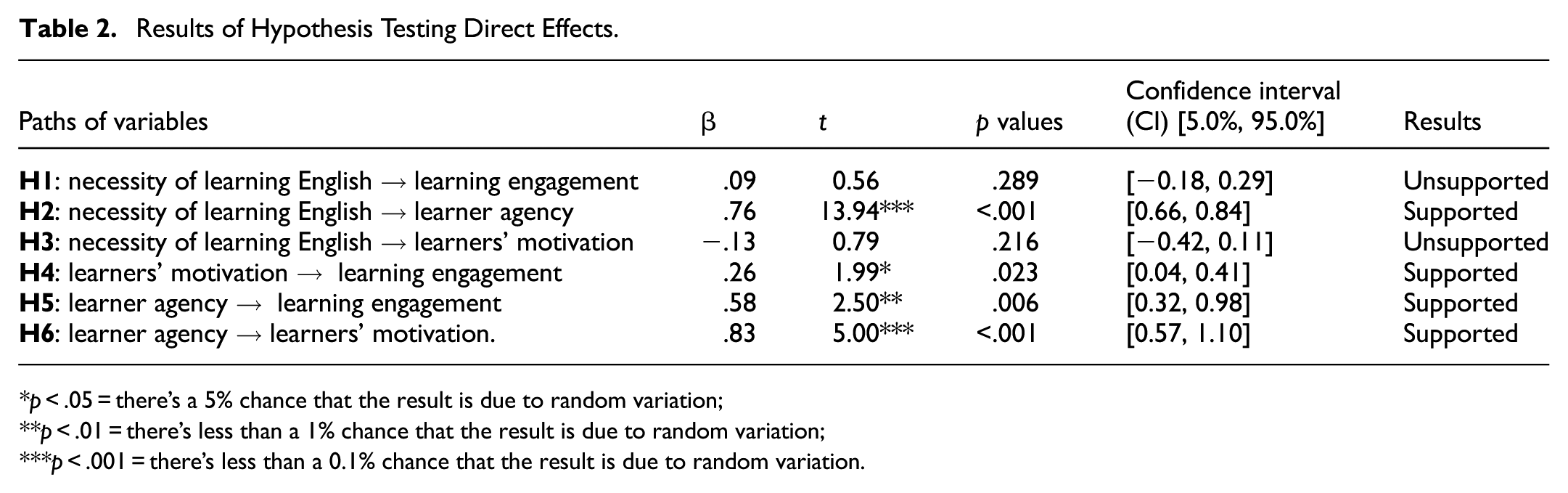
p < .05 = there’s a 5% chance that the result is due to random variation; **p < .01 = there’s less than a 1% chance that the result is due to random variation; ***p < .001 = there’s less than a 0.1% chance that the result is due to random variation.
As seen in Table 2, the path between the necessity of learning English and English learning engagement obtained coefficient (β) of .09, indicating a weak positive relationship; the p-value of .289 suggests an insignificant relationship. The confidence interval (CI), ranging from −0.18 to 0.29, further confirms that the effect is not statistically significant, as the interval includes zero, leaving
Results of Hypothesis Testing Indirect Effects.

p < .05; ***p < .001.
As shown in Table 3,
In contrast,
Figure 4 below illustrates a model featuring the investigated variables and their interrelationships after consistent PLS-SEM bootstrapping. With coefficient of determination (R2 = 0.732) for English learning engagement, the model represents the predictive relationship between the variables that lead to significantly enhanced English learning engagement. This means that the necessity of learning English, learners’ motivation, and learner agency explain 73.2% of the variance in English learning engagement. The higher the coefficient value, the stronger the predictive effect of the outcome variable (ranging from −1 to +1; Cohen, 1988).

Model diagram with parameter estimates.
Discussion and Conclusion
Other explanations also need to be considered regarding learning engagement. There are three types of engagement: behavioural (e.g., classroom participation and regular obedience), emotional (e.g., interest and motivation), and cognitive (e.g., making mental effort and employing strategic learning methods (Fredricks et al., 2004). This study includes all these types of engagement, such as “having the necessary material for the class is a priority for me” (Behavioural Engagement); “completing the assigned work during class is a worthwhile endeavour” (Cognitive Engagement); and “Participating in the assigned speaking activities increases my speaking confidence” (Emotional Engagement). However, the three were not classified into subdimensions, so levels of engagement in each type are not a focus. Future work could examine these subdimensions of engagement. In addition, to increase students’ learning engagement, Hiver et al. (2020) stressed the role of contextual factors. For instance, teacher support and task characteristics can also promote learning engagement.
In summary, this study aims to examine the association between the necessity of learning English and English learning engagement. The result shows no link between them. For the necessity of learning to have an impact on learning engagement, the necessity of learning needs to go through learner agency (fully mediated). Another point is that the necessity of learning is not directly related to motivation. However, it needs to go through learner agency first to have an association. As a result, there is a chain mediation, starting from the necessity of learning to learner agency, from learner agency to learners’ motivation, and from learners’ motivation to learning engagement.
Implications
First, the study also implies that the current exam-driven system in Vietnam may limit students’ intrinsic motivation. Because exams may only serve as a short-term motivator, they may not help learners sustain long-term engagement unless students internalise the relevance of learning. Teachers should have problem-solving questions in their teaching practices to foster the application of English in diverse contexts. Furthermore, to enhance student engagement and motivation, the classroom teacher may consider adopting hybrid or flipped course structures that incorporate low-stakes, iterative tasks supported by checklists and self-monitoring tools. Additionally, the teacher may want to use authentic, discipline-linked EAP tasks with constructive formative feedback to increase enjoyment and perceived value. Next, classroom climates like enjoyment can also help improve learners’ motivation and learning engagement. In addition, professional development for teachers should focus on enhancing their understanding and application of learner-centred pedagogy. Hence, teachers need to be equipped with strategies that promote student agency and responsibility in the learning process. Furthermore, educators should be encouraged to create a supportive classroom environment for learners that fosters sharing and helps them have a sense of mistake-free to increase engagement. Finally, policymakers should reduce the reliance on high-stakes exams to interpret learning outcomes, as doing so can mitigate external pressures that inhibit intrinsic motivation while encouraging more creative and self-directed forms of assessment. These strategic actions can help the learning of English align with the expectations of NFLP 2020, extending its effect to 2025 in Vietnam, and regions that view English as EFL. As the current framework is seen to work relatively well in this context, future work can try this model in their contexts.
Limitations
Although the study has gained many insightful findings, it also has several limitations. First, self-reported data may generate response bias, as students might overestimate their level of motivation or agency, a limitation highlighted by A. N. Q. Phan (2021). Second, to further reduce the impact of method variance, future research should consider using time-separated measures or multi-informant data, such as teacher-rated engagement or behavioural logs, to capture a more comprehensive view of the constructs, thereby helping mitigate common method bias and enhance the robustness of the results. Third, low item loadings could be due to the psychometric fit and model specification, which means that the factor structure assumed in the original version may not accurately reflect how Vietnamese undergraduates perceive learning engagement (Boateng et al., 2018; Costello & Osborne, 2005). Fourth, future studies may want to incorporate validated, brief measures such as a domain-specific self-efficacy scale for English learning and short enjoyment subscales from achievement emotions measures. While this study examined learner agency and learners’ motivation as mediators, other affective constructs, such as English learning self-efficacy and enjoyment, were not directly measured which are central in the achievement emotions framework (Pekrun, 2006) and in research on hybrid engagement (N. P. K. Lo, 2022; N. Lo, 2023), where enjoyment and self-efficacy function as key emotional and cognitive bridges that sustain motivation. Fifth, the study acknowledges that age, year, gender, or school location may also moderate the relationships between the independent variables and the dependent ones within the framework. However, as the primary focus is examining the relationships of the studied constructs and avoiding exhausting data, the study ignored these possible effects. Future similar studies may want to examine these aspects by conducting multi-group analysis to provide a more comprehensive understanding of more specific factors influencing learner engagement. Sixth, A limitation of the present study is that it did not directly measure the affective mechanisms that may explain how necessity translates into engagement—specifically, self-efficacy and enjoyment. As a result, while the findings highlight the pivotal role of learner agency, the study was unable to thoroughly test the proposed mediation pathway in which learning necessity and perceived value operate through learner agency and control, which in turn foster self-efficacy and enjoyment before driving motivation and engagement. Seventh, a longitudinal study can help better understand how learner agency and motivation evolve and interact throughout students’ academic careers, which can influence the effect of the necessity of learning English on English learning engagement. Eighth, while the study focussed on the Vietnamese context, the unique cultural and educational factors may limit the applicability of the findings to other countries. Future research could investigate the same variables in different cultural contexts to determine whether similar patterns emerge globally, as emphasised by T. Q. Tran and Nguyen (2023). Finally, other studies may need to use the same adopted questionnaire written in either English or learners’ mother tongue to continue seeing how the questionnaire works in their context.
Supplemental Material
sj-docx-1-sgo-10.1177_21582440261423257 – Supplemental material for Agency and Motivation Mediation in Necessity-Engagement in EFL Learning Among Vietnamese Undergraduates
Supplemental material, sj-docx-1-sgo-10.1177_21582440261423257 for Agency and Motivation Mediation in Necessity-Engagement in EFL Learning Among Vietnamese Undergraduates by Nguyen Huynh Trang in SAGE Open
Footnotes

Ethical Considerations
Limiting Risk of Harm: The study was designed to prevent any unnecessary stress or harm to participants by highlighting the voluntary nature of participation and ensuring the confidentiality of all responses. The surveys were anonymous to safeguard participants’ identities, ensuring adherence to ethical research standards. In addition, participants were assured of their right to withdraw without negative consequences during and after the survey.
Weighing Benefits and Risks: There are several potential benefits of this research. This research involved a large sample of 351 non-English majored EFL in the south of Vietnam. Moreover, EFL learning in Vietnam like many other Expanding circle countries have struggled a lot because English is treated as a foreign language, which is not used the main source of communication. Therefore, exploring EFL learning engagement can be one of the prioritised tasks. The results reflect reality, so they help educators and schools of interest consider motivational strategies to help EFL students pursuing their bachelor’s degree to study English better, ultimately enhancing their overall academic performance and world integration. This research can be seen as part of the Ministry of Education and Training’s efforts, as outlined in Decision No. 1400/QĐ-TTg, dated September 30, 2008, which officially approved the National Foreign Language Project (NFLP) 2020, which aims to enhance foreign language proficiency across Vietnam’s education system from 2008 to 2020 and then updated to 2025 (MOET, 2008). Hence, I considered that the benefits of this research far outweigh any minimal risks.
Informed Consent Statements
All students were given detailed information about the study’s purpose, procedures, potential risks, and benefits. The author also obtained the Ethics approval for this research from the Department of Research-Development and Global Engagement dated August 25, 2025 (Approval No. 3742/NCPTGKTC). The survey was an informal investigation, which means both the researchers and participants agreed not to include their signatures or names.
Author Contributions
The author conducted this research on her own.
Funding
The author disclosed receipt of the following financial support for the research, authorship, and/or publication of this article: This research is funded by University of Economics Ho Chi Minh City (UEH).
Declaration of Conflicting Interests
The author declared no potential conflicts of interest with respect to the research, authorship, and/or publication of this article.
Data Availability Statement
The data generated and analyzed in this study are available from the corresponding author upon reasonable request.
Supplemental Material
Supplemental material for this article is available online.
References
Supplementary Material
Please find the following supplemental material available below.
For Open Access articles published under a Creative Commons License, all supplemental material carries the same license as the article it is associated with.
For non-Open Access articles published, all supplemental material carries a non-exclusive license, and permission requests for re-use of supplemental material or any part of supplemental material shall be sent directly to the copyright owner as specified in the copyright notice associated with the article.
