




Abstract
Technological innovation relies on creating new knowledge and technologies, and the talents who create and share the knowledge are influenced by interpersonal relationships. Therefore, how to use the company’s existing internal resources to solve the issue of interpersonal workplace exclusion and encourage the knowledge-sharing between employees to form a specific cultural dynamism in terms of knowledge sharing, which leads to technological innovations, has become a challenge for enterprises. Through an investigation of the survey conducted in China, this paper aimed to explore the influence mechanism of workplace exclusion on knowledge sharing from resource conservation theory and social exchange theory perspectives. The dual moderation model of this study contained digital media and the dynamics of organizational culture. The research results of this study found that workplace exclusion has a significant negative impact on knowledge sharing while digital media negatively moderates the relationship between workplace exclusion on knowledge sharing. On the other hand, organizational culture dynamics help enhance digital media’s moderating effect on the negative relationship between workplace exclusion and knowledge sharing. This research result indicates that when promoting employees’ knowledge-sharing behavior, the influence of the organizational cultural environment cannot be ignored. With the vibrant dynamics of organizational culture design, the company can promote a free, relaxed and innovative cultural atmosphere, encouraging employees to express their ideas and suggestions freely. That is to say, when employees feel excluded from others and cannot express their views because of being ignored and excluded, the visibility of digital media helps them better express their views and knowledge.
Introduction
With the continuous economic development and times, enterprises shall constantly break through themselves and realize technological innovations if they aim to be stronger and bigger in the market. However, technological innovation cannot simply depend on material resources; knowledge resources are the most important technological innovation (Luo & Zhang, 2016). Many studies have shown that two-thirds of new knowledge required by technological innovation comes from within the enterprise (Jian et al., 2010). Knowledge resources have been absorbed, interacted with, influenced and transformed, which are conducive to the technological innovation of enterprises. Existing studies have confirmed that the formation of technological innovation requires the joint action of internal and external knowledge (Laursen & Salter, 2006). Hence, the maximum use and effective transformation of knowledge resources owned by employees can help accelerate technological innovations for the long-term development of enterprises.
The so-called knowledge governance refers to the use, sharing, integration and creation of knowledge through the design of organizational structure or mechanism. Among them, knowledge sharing is a common and important issue to discuss; that is because knowledge sharing is an important antecedent of knowledge creation (Foss et al., 2010). However, in the workplace, how to design an organizational mechanism such as rewards (Hau et al., 2013), job design (Foss et al., 2009), or informal organizations (e.g., guanxi networks, cultures, communities) that encourage employees to share their knowledge actively remains a big issue for managers. Basically, the organization itself does not directly affect the overall performance of the organization; it is the actions and reactions of the members of the organization, mental state, etc. That affect the intention and behavior of knowledge sharing, and then the organizational performance.
Several studies have proven that personal and organizational factors are the two main elements that influence knowledge sharing in organizations. In terms of personal factors, knowledge sharing may be influenced by employee personality, psychological capital, and trust. Mao and Wang (2014) discussed that employees’ psychological capital positively influences knowledge-sharing willingness. In terms of organizational factors, leadership style, the dynamics of organizational culture and organizational climate, all factors influence knowledge sharing willingness and behavior. H. Wang (2019) argued that inter-organizational trust and communication climate positively relate to tacit knowledge sharing behavior. Therefore, focusing on boundary conditions of knowledge sharing behaviors, this paper hopes to provide some references for enterprise managers to stimulate employees’ willingness to share knowledge and further realize technological innovations.
With the development of the times, people’s lives and personal pursuits have also changed significantly, with more attention given to the satisfaction of their spiritual needs. In the existing research, an increasing number of scholars have begun to focus on negative relational capital. It has a stronger impact on employees and organizations than positive relational capital and thus needs to be prevented and avoided on time. In all types of organizations, workplace exclusion is the most prevalent negative relationship, which is a common workplace stressor. Workplace exclusion is the extent to which employees perceive themselves to be ignored and excluded by others in the organization (Wu et al., 2010); Most people feel excluded by others which results in negative interpersonal experiences for employees; When individuals who suffer from workplace exclusion perceive isolation and neglect from others, their sense of organizational identity and belongingness is threatened. Exclusion in the workplace could affect employees’ emotions (such as sadness, shame, etc.), attitudes (such as self-appraisal, job satisfaction, etc.), behaviors (including in-role and out-of-role behavior), and personal performance. They reduce the frequency of interaction and communication among members, thus reducing their contributions to the organization beyond their work, like reducing their knowledge-sharing behavior, or even lead to the hiding-knowledge behavior (Zhao et al, 2016).
Currently, research on workplace exclusion behavior focuses on its negative effects on organizations and their members. Wu et al. (2010) showed that workplace exclusion exacerbates employees’ sense of psychological distress, with emotional states such as work tension, psychological depression, and emotional exhaustion. At the level of employee behavior, workplace exclusion can greatly impact employee performance, constructive behavior, counterproductive behavior, and knowledge sharing behavior. Leung et al. (2011) found that workplace exclusion was significantly and negatively related to job performance. X. Li et al. (2014) demonstrated that employees significantly reduce knowledge-sharing behavior when receiving exclusionary treatment from others. Thus, it is evident that there is a paucity of research that treats workplace exclusion as the main effect on knowledge sharing and the boundary of action. In the era of information technology and knowledge economy, knowledge resources are important sources for enterprises to maintain a sustainable and competitive advantage. Therefore, workplace exclusion and knowledge-sharing behavior have received increasingly widespread attention from scholars. This paper will explore whether there are significant negative effects of workplace exclusion on knowledge sharing and whether or not there is a moderating mechanism between them.
With the rise of the digital economy, the intake of digital media tools has gradually become a focal point of current scholarly attention. New technologies bring new capabilities to organizations. Social media enables organizations to realize innovative new business and marketing models, and also changes management practices and learning patterns (Ali-Hassan et al., 2015). In addition, many businesses have successfully used internal social media (so-called enterprise social media, ESM) to reduce costs, increase revenue, and gain a competitive advantage (Huy & Shipilov, 2012). Social media also reshapes the concept of knowledge management in organizations. In short, organizations offer new knowledge-sharing opportunities through collaboration platforms (Nielsen & Razmerita, 2014). Digital media visibility refers to the interrelationship between the intentions of behavioral participants and the technological capabilities that offer the potential for particular actions in the form of persistent, triggered and tailored engagement (Majchrzak et al., 2013). Digital media tools help knowledge sharing move from centralized to decentralized, from intermittent to continuous, and from repositories to emergency knowledge sharing (i.e., from online knowledge sharing to a continuous online public knowledge dialog) (Richard, 2002). Thus, digital media visibility provides a good theoretical tool for companies to explore the impact of digital media tools on knowledge sharing.
Using social media can reduce depression symptoms (Thorsteinsson & Davey, 2014). Using image-based social media such as Instagram increases users’ perceived well-being and life satisfaction (Pittman & Reich, 2016). Uses and Gratification Theory (Katz et al., 1974) asserts that media use is selective, and the motivation for use is influenced by individuals’ rational self-awareness of their own needs. There may be different motivations for participation due to individual differences. Within an organization, the use of social media under different motivations has a positive impact on job performance through the mediating effect of social capital (Ali-Hassan et al., 2015). Increasingly, social media within organizations start to serve multiple purposes for employees—not only for work but also for social and entertainment functions. Online communication through social media reduces face-to-face stress. The enhanced social connection helps support and regulate the negative emotions of some employees who are confronted with the issues of exclusion.
The dynamics of organizational culture reflect the organizational environment, and it is the values with the characteristics of the enterprise that are gradually formed for all employees to agree and abide by in the process of long-term operation. More scholars have focused on the influence of the dynamics of organizational culture in terms of knowledge sharing (or tacit knowledge sharing), organizational innovation, and organizational performance, and most of them have covered one of the subdivisions of organizational culture, namely, the dynamics of organizational culture. Al-Alawi et al. (2007) confirmed that the dynamics of organizational culture with appropriate incentives promote knowledge-sharing behavior. Leaders of dynamic organizations are better at motivating employees to think outside of the box and encourage innovation, conducive to stimulating knowledge-sharing behaviors amongst members (Xi, 2015). Cameron and Quinn (1999) proposed four types of organizational culture based on the CVF model, while Zeb et al. (2021) used this model to explore the relationship between culture, innovation and performance. Zeb et al. (2021) found that adhocracy cultures had the most significant positive impact on performance. That is to say, adhocracy cultures are extroverted and dynamic, and thus employees are motivated to be highly committed to innovation. Few studies have confirmed that digital media can mediate between workplace exclusion and knowledge sharing. Most scholars have studied the dynamics of organizational culture as a broad category, and only a few studies have examined only the dynamics of organizational cultures. There is also no research to confirm whether the dynamics of organizational cultures can be combined with digital media to play a dual role in moderating the workplace exclusion and knowledge sharing gap. To fill this research gap, this paper will construct a dual regulation model. First, it will try to verify whether digital media can weaken the negative effects of workplace exclusion on knowledge sharing. And second, investigate whether the dynamics of organizational culture can enhance the weakening effect of digital media to enrich the research perspective of digital media and the dynamics of organizational culture.
In summary, this paper aims to decipher the mechanisms of the effect of workplace exclusion on knowledge sharing and its boundary conditions. Based on the dual regulation mechanism under resource conservation theory and social exchange theory, the regulation mechanism of digital media and the dynamics of organizational culture is explored. Data are collected through snowballing in channels such as WeChat, and empirical research is conducted to analyze and study the influence paths between the four under the dual role of theory and data. Theoretical contributions to be achieved in this paper are: (1) Enriching the study of knowledge sharing factors. The Chinese world is a special social pattern (Y. Li & Huang, 2014), which attaches great importance to interpersonal relationships (guanxi). Workplace exclusion may occur if employees are not insiders in the Chinese world or are not good at building interpersonal relationships. Therefore, Guanxi has become an important human resource issue to explore for the Chinese society. The research on the antecedent variables and influencing factors of knowledge sharing is enriched by studying the negative influencing mechanism of workplace exclusion on employee knowledge sharing and the moderating role of digital media and the dynamics of organizational culture. (2) There are relatively few existing studies on the moderating mechanisms of workplace exclusion on knowledge sharing. They mostly focus on mediating or moderating mediating mechanisms and rarely involve the dual moderating mechanism. The results of this study can enrich the research perspective of workplace exclusion on knowledge sharing and fill the gaps in research related to digital media on knowledge sharing. (3) By studying the moderating role of digital media and the dynamics of organizational culture, the research perspective of digital media and the dynamics of organizational culture is expanded by explaining the boundary of the influence of workplace exclusion on knowledge sharing from a new perspective. Foss et al. (2010) suggested that when discussing the influence of organizational factors on knowledge-sharing behavior, the employees’ perception and interpretation toward organizational factors should not be ignored. The framing effect may influence organizations to make different choices regarding the action plans for the knowledge-sharing mode. This study explores the relationship between individual workplace exclusion and knowledge-sharing behavior from a micro perspective and verifies the moderating effect of media use simultaneously. In addition, taking into account the macro-organizational factors and the possible moderating effects of the dynamics of organizational culture in which the individual is located is the features and contribution of this research. That is because organizational culture is considered one of the significant factors hindering knowledge sharing in organizations (Soyadı et al., 2014). Based on the conclusions drawn above, the corresponding management strategies are proposed to enhance competitiveness and achieve long-term corporate development.
Literature Review
Workplace Exclusion and Knowledge Sharing
According to Ferris et al. (2008), workplace exclusion is the neglect and exclusionary treatment behavior perceived by employees by others in the workplace. Antecedents of workplace exclusion include individual and organizational level factors. Individual factors include gender, personality traits, and capabilities (such as political skills, psychological capital), etc. Organizational factors include leadership, task dependencies, and performance appraisal methods (Lin, 2017). And leadership traits seem to be one of the most significant antecedents (Howard et al., 2020). Workplace exclusion may reduce positive behaviors (such as organizational citizenship behavior) or increase the display of negative behaviors, thereby affecting individuals’ emotions, personal performance, sense of belonging (O’Reilly & Robbinson, 2009), and even turnover of employees. Zhao et al. (2016) found that workplace exclusion may lead to knowledge-hiding behaviors. Workplace exclusion has a negative relationship with turnover intention, and psychological capital moderates the relationship between exclusion, emotional commitment, and turnover intention (Zheng et al., 2016). These three factors, including individuals, organizations and information technology, affect knowledge-sharing behaviors—while organizational culture is considered one of the most important factors hindering knowledge sharing in organizations (Soyadı et al., 2014). Organizational rewards have a negative effect on employees’ tacit knowledge-sharing intentions, but have a positive effect on their explicit knowledge-sharing intentions. Reciprocity, enjoyment, and social capital significantly contribute to enhancing employees’ willingness to share tacit and explicit knowledge (Hau et al., 2013). Self-efficacy directly affects the knowledge-sharing behaviors of online community members, and personal outcome expectations (such as social status, image, and appreciation) are also significantly related to knowledge-sharing behaviors. When individuals believe that providing knowledge improves relationships with others, they have a more positive attitude toward knowledge sharing. The higher the expected reciprocity, the more positive the attitude (Hsu et al., 2007).
According to scholars, knowledge sharing refers to the willingness and behavior of individuals in an organization to exchange the unique experiences and knowledge resources they possess with others. This paper argues that workplace exclusion reduces the occurrence of knowledge-sharing behaviors among members of an organization. On the one hand, when combined with social exchange theory, the knowledge-sharing behavior between members can be regarded as a voluntary exchange behavior based on the mutual trust and reciprocity between the two parties. Individuals will have greater autonomy in deciding whether to share the knowledge they possess and how much knowledge to share. Sun and Liu (2006) found that in the dynamics of Chinese organizational culture, the proximity of inter-individual relationships affects employees’ willingness to share knowledge since it shows strong relational motivation. When workplace exclusion occurs, the excluded person will feel unappreciated, less present in the organization and, isolated from the group or the individual. The individual perceives this as a negative interpersonal experience. Over time, this will reduce the employee’s trust in the organization and others. This will weaken their interactions with others, weaken their relationships with others, and eventually gradually reduce their inputs and contributions to the organization and others. This will also lead to employees reducing or even not sharing their knowledge with others.
On the other hand, in resource preservation theory, resources include four types: material, conditional, energetic, and personal traits. According to the needs-threat model proposed by Williams (2009), individuals who suffer from workplace exclusion will have four basic psychological needs: sense of belonging, a sense of control, a sense of confidence, and a sense of existential significance. The four basic psychological needs of individuals who experience workplace exclusion are significantly disrupted (Riaz et al., 2019). In the case of workplace exclusion, when employees perceive that their resources and needs have been damaged and depleted, they are likely to be caught in a spiral of resource loss and will take various measures to protect their remaining resources that have not been damaged and reduce their resource input to the organization. As an energetic resource possessed by individuals, knowledge is also protected by those who are excluded from communicating and sharing it with others. Based on the above-mentioned derivation and analysis, the following hypotheses are proposed in this paper:
H1: Workplace exclusion has a significant negative effect on knowledge sharing.
The Moderating Role of Digital Media
Social media utilizes a set of technical tools for social networking. The popularity of social media has significantly impacted the lifestyle of human beings, as well as the way that organizations and societies operate. Enterprises advertise and market through online social platforms; politicians build their reputation through online voices; celebrities and stars also operate online to maintain high popularity.
The research focus on the rise of social media, at the individual level, mainly on the motivational needs of using social media, as well as the impact and satisfaction on users. People use the Internet for purposes such as interpersonal relationship interaction, spending boring hours, searching for information or entertainment (Papacharissi & Rubin, 2000)—satisfaction includes content satisfaction obtained from content of the internet, process satisfaction of using the Internet, and social satisfaction as a social environment that is established (Lu & Lin, 2022). With the high competition of the industrial and commercial society, interpersonal alienation and feeling of indifference between people are increasing—that is to say, modern people are lonely. Olds and Schwartz (2009) argued that Americans are lonelier in the 21st century than in previous years. With the popularity of digital media and social platforms, people are more connected than ever before, especially young people. The impact of social media on human beings’ emotions depends on the activities that users of social media users participate in (Frison & Eggermont, 2016). Pittman & Reich (2016) found that image-based platforms such as Instagram have the potential to improve loneliness. Happiness and life satisfaction are also increased owing to the increased utilization of social media: Users’ engagement in Instagram is positively related to the psychological dependency of users on media, which is mediated by positive emotions and negative emotions. However, the positive emotion’s level of users is higher than negative emotions (Lu & Lin, 2022).
In addition to personal use, social media is increasingly being used for organizational purposes, so-called enterprise social media (ESM). Corporate social media may be used to facilitate the flow of information and knowledge within the organization, in order to enhance the company’s interaction with customers. Lam et al. (2016) argued that corporate social media can be viewed as a strategic resource to enhance dynamic knowledge-sharing programs, thereby improving operational efficiency and innovation performance. X. Chen et al. (2019) explored the relationship between ESM, social network connections and job performance. The involvement of social media has transformed knowledge sharing from a centralized pattern to become a decentralized process. Individuals can publish information either informally or formally at any time, allowing the knowledge-sharing process to change from intermittent to continuous format. Individuals can have ongoing conversations in different ways (Majchrzak et al., 2013). Nonetheless, corporate management has increasingly aware of the influence of social media and the existence of the virtual world in order to prevent the manipulation of social media from invading employees’ privacy, which may also increase employees’ mental stress and thus cause work-family conflict (Ollier-Malaterre & Foucreault, 2021).
Online communities can provide connections of friendship, emotional and social support. The powerful search engine and management functions of certain media tools allow users to connect with others, and thus the number of instrumental connections in the network keeps increasing. Ali-Hassan et al. (2015) adopted the Uses and Gratification Theory to classify media use motivations into three categories, including hedonic, social and cognitive: with social capital as the mediating variable, Ali-Hassan et al. (2015) explored the relationship between media use and job performance within an organization, and found that social and cognitive use has a positive impact on employees’ day-to-day and innovative job performance. Finally, Ali-Hassan et al. (2015) suggested that although hedonic use has a direct negative impact on daily performance, it also positively contributes to developing social relationships.
Digital media visibility was formally introduced by scholars Faraj and Azad in 2012 as the interrelationship between behavioral participants’ intentions and technological capabilities. Cabiddu et al. (2014) found that digital media visibility functions have different ways of engaging in public knowledge conversations in different contexts, including meta-linguistic engagement, triggered engagement, network-informed association, and generative role acquisition. Meta-linguistic engagement refers to the way participants follow, comment and retweet messages about specific companies or products. It also refers to how participants actively participate in polling activities on specific topics or in specific knowledge-sharing activities. Triggered engagement refers to the way participants use social media features such as automatic alerts to continuously manage information changes on social media and selectively participate in specific digital media conversations. Network informed association refers to organizational members engaging in relationship-based online knowledge conversations in virtual spaces. Generative role acquisition refers to how participants engage in online knowledge conversations through the development of action patterns and support roles to maintain productive conversations among participants. Social media reshapes the concept of knowledge management in organizations. Businesses offer new opportunities for knowledge sharing through collaborative platforms that make it easier for employees to share knowledge across sub-units in different regions (Nielsen & Razmerita, 2014). Social networking platforms can improve the quality of communication and facilitate knowledge sharing. The use of team social media improves individual job performance by enhancing in-role and out-role knowledge sharing behaviors of team members (Cui et al., 2019).
Established digital media research has found that many organizations have engaged employees in internal professional and managerial knowledge sharing by introducing digital media tools. In doing so, organization-wide knowledge sharing has shifted from an intermittent, centralized knowledge management process to a continuous online dialog between strangers, an unexpected process of interpretation and reuse (Cabiddu et al., 2014). In conclusion, companies that have introduced digital media can increase the frequency of mutual communication among members, facilitating knowledge-sharing behavior. In short, digital media can facilitate knowledge sharing.
Through the network or community, participants of the network can complete knowledge sharing behaviors without meeting in real. Technology has replaced face-to-face interaction. Based on Social Cognitive Theory (SCT), self-efficacy directly affects the knowledge sharing behavior of online community members. Expectations of personal outcomes (e.g., social status, image, and respect) were also significantly associated with knowledge-sharing behaviors. Individuals have more positive attitudes toward knowledge sharing when they believe providing knowledge can improve relationships with others (Hsu et al., 2007). When employees are neglected or ostracized by others, they tend to reduce altruistic behaviors toward the organization, such as knowledge sharing. According to the resource conservation theory. When employees face workplace exclusion, they need to share their feelings through social interaction to increase emotional resources and maintain physical and mental health. When employees use social media more or have more channels, the negative effects of workplace exclusion can be reduced. When digital media are introduced, multiple ways of participation in the dialog between members are increased. The knowledge resources absorbed in digital media are also increased to a certain extent. It also compensates for the loss of resources brought by workplace exclusion to the excluded. In this case, when faced with requests for knowledge from others, the excluded will also increase the sharing of their knowledge resources based on reciprocity. Therefore, following the sayings of Ali-Hassan et al. (2015) in the aspects of the degree of diversity and frequency of individual media use, this study suggests: in addition to reducing face-to-face pressure, the increased social connection and support through the Internet have a positive impact on knowledge sharing, and also reduce the negative impact on knowledge sharing caused by exclusion. Therefore, this study proposes the following hypotheses.
H2: Digital media has a positive relationship and a positive impact on knowledge sharing.
H3: Digital media play a moderating role in the influence of workplace exclusion and knowledge sharing. In short, digital media can significantly weaken the negative influence of workplace exclusion on knowledge sharing.
The Dual Regulatory Role of the Dynamics of Organizational Culture
Organizational culture is a critical factor affecting knowledge sharing (Soyadı et al., 2014). Because organizational behavior is primarily determined by its culture rather than instructions from top management team (Jarnagin & Slocum, 2007); organizational culture is the biggest obstacle to the creation and utilization of knowledge assets (De Long & Fahey, 2000). The right organizational culture is important for encouraging knowledge sharing behavior in the organization. The Competing Values Framework (CVF) of Cameron and Quinn (1999) is widely used in the study of organizational culture, using dimensions such as “external focus versus internal focus” and “flexibility and discretion versus stability and control”—four types of organizational culture are proposed: spontaneity, authoritarian, adhocracy, hierarchy, clan, and market culture. The basic premise of CVF is that organizations can often be diagnosed as having any one or a combination of four cultural types.
Zeb et al. (2021) used the CVF model to explore the relationship between culture, innovation and performance, and found that organizational culture affects innovation, which in turn affects company performance; among them, adhocracy culture has the greatest positive impact on performance, while authoritarian culture has a negative impact on performance. Adhocracy cultures are extroverted, dynamic, responsive to change and resilient, with high levels of risk-taking and creativity. With an adhocracy culture, employees are motivated to be highly committed to innovation and experimentation. However, when Suppiah and Sandhu (2011) explored the correlation between organizational culture and tacit knowledge sharing behavior, they found that clan culture had a positive impact on tacit knowledge sharing behavior, and market culture and hierarchy culture had a negative impact, but the adhocracy culture has not been validated.
L. Wang and Li (2014) found that companies with the dynamics of organizational culture value the acquisition of new knowledge and resources and motivate employees to explore new information to innovate. The organizations encourage them to explore, innovate, and emphasize an energetic and adventurous work environment, making employees actively seek advice from those more experienced than themselves, thus increasing knowledge-sharing behaviors. Therefore, dynamic companies with tacit knowledge can further promote knowledge sharing through identified, respected individuals (Korstanje, 2012). This result fully confirms that digital media and the dynamics of organizational culture influence employees’ knowledge-sharing behavior.
There are few empirical studies on the relationship between the dynamics of organizational culture and workplace exclusion and knowledge sharing. With the moderating role of digital media, there is even less literature with definitive theoretical support for the dual moderating role of the dynamics of organizational culture. The research on the relationship between the dynamics of organizational culture and variables can provide theoretical basis for this paper’s research hypothesis.
In summary, this paper argues that while the dynamics of organizational culture is a factor that cannot be ignored in studying the impact of workplace exclusion on knowledge sharing, the dynamics of organizational culture, it also plays a role in this process. Although research has confirmed that the dynamics of organizational culture have a significant positive effect on knowledge sharing, it is worth exploring its role when combined with digital media variables. Therefore, in the mentioned above analysis, H4 is proposed, which discloses that the dynamics of organizational culture moderates the relationship between digital media on the relationship between workplace exclusion and knowledge sharing; specifically, the stronger the dynamics of organizational culture, the more significant the moderating effect of digital media on workplace exclusion and knowledge sharing.
H4: The dynamics of organizational culture plays a double moderating role on digital media.
Based on the resource preservation theory and social exchange theory, it can be found that workplace exclusion makes individuals perceive that they are in a vicious exchange relationship with the organization. They can also intuitively perceive the depletion and threat to their traits and resources, leading to an increase in pressure. When faced with requests for knowledge from other people in the organization, individuals are more inclined to hide their unique knowledge resources and not share them with others. In summarizing the relationship between the relevant variables, we conclude that with the visibility function of digital media, the intake of digital media can strengthen the communication and interaction between members, which promotes knowledge sharing in the organization. Also, the dynamics of organizational culture, characterized by openness, freedom, innovation, and inclusiveness, strongly influence the organization’s knowledge sharing. At the same time, the dynamics of an organizational culture characterized by openness, freedom, innovation, and inclusiveness, supported by digital media tools, can inspire employees to be more proactive in the organization, to face challenges and difficulties with a more proactive mindset. It can also reduce the negative impact of workplace exclusion on themselves, which may not significantly reduce knowledge-sharing behavior in the organization. Therefore, this paper constructs theoretical model of the relationship between workplace exclusion, digital media, the dynamics of organizational culture, and knowledge sharing, as shown in Figure 1.
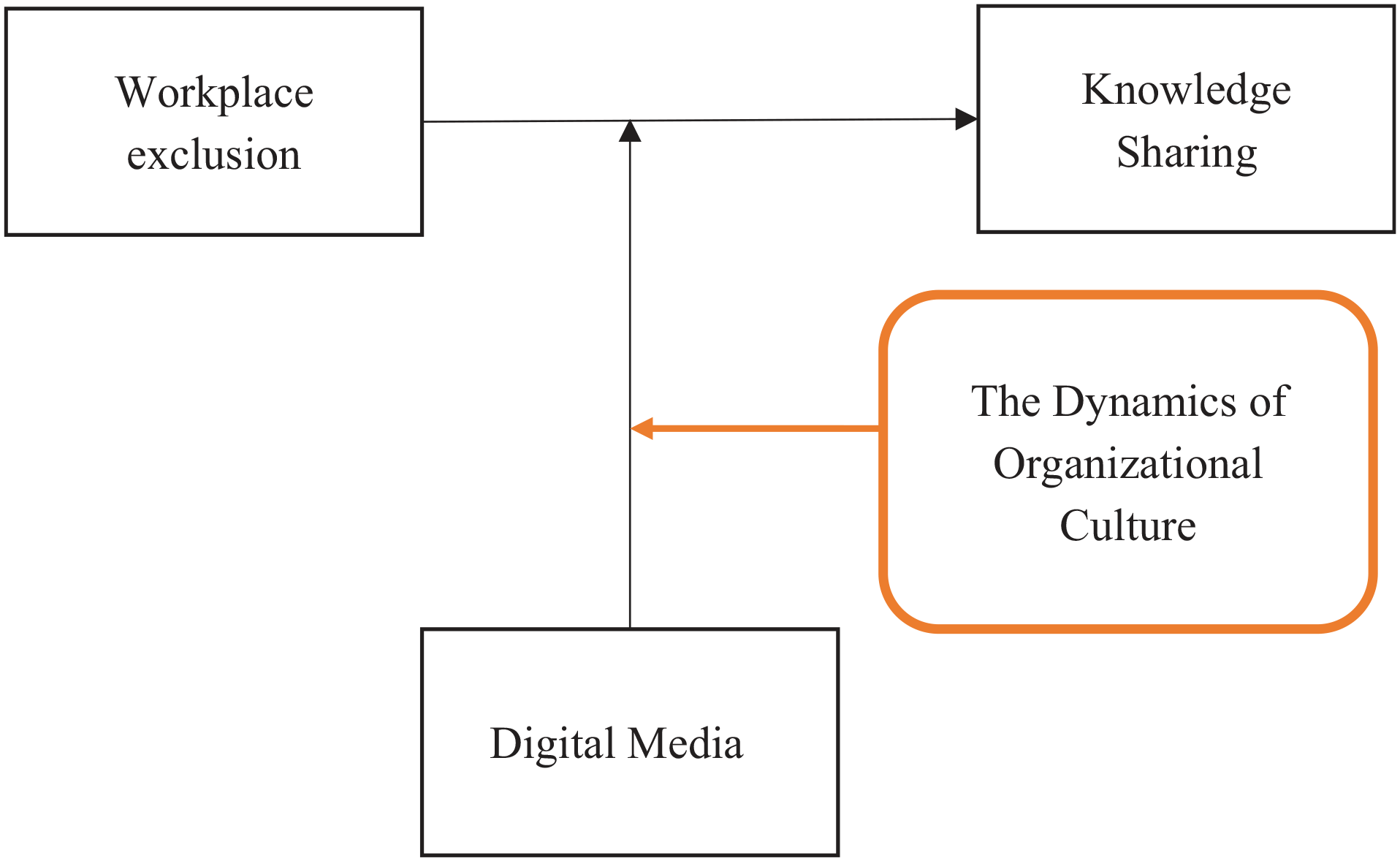
Conceptual framework of this research.
Research Method
Questionnaire Design and Data Collection
This paper uses a questionnaire to collect data to test the validity of the proposed research hypothesis and model. After screening and referring to the previous literature, the questionnaire was adapted to the actual situation in China and the issues to be studied. Measurement instruments on workplace exclusion, knowledge sharing, digital media and the dynamics of organizational culture were selected to design the questionnaire required for this study. The questionnaire was designed using a Likert’s 5-point rating scale, which divides each question into five levels. It asks respondents to choose how much they agree with each statement based on their true perceptions. The questionnaire contains two types of content. The first is collecting basic information from the respondents by setting up single-choice questions, including five questions on gender, age, education, job level, and years of experience. The second is the core content of the questionnaire, which contains 10 single-choice questions measuring workplace exclusion, 6 single-choice questions measuring the dynamics of organizational culture, 9 single-choice questions measuring knowledge sharing, and 13 single-choice questions measuring digital media. There are 38 questions in total. The online questionnaire was created using Questionnaire Star and distributed to the respondents in a snowballing manner thru the internet using social media platforms such as WeChat and QQ. Four hundred thirty-five questionnaires were collected after 3 weeks of data collection. After the questionnaires were collected, they were eliminated according to the following principles: (1) apparent random answers and (2) answers that were contradictory. A total of 57 invalid questionnaires were eliminated, leaving 378 questionnaires, with a valid return rate of 86.9%.
Gauging Tools
The scales used in this study are well-established scales developed and commonly used by national and international scholars. The questionnaires involve a 5-point Likert scale ranging from 1 (totally disagree) to 5 (totally agree) (Table 1).
Status of the Scales.

Among these scales, the wording of the reference scales was partially modified to fit this paper’s study better. After selection and modification, the questionnaire was integrated and completed.
Data Analysis and Results
Questionnaire Reliability Test
In order to ensure the accuracy of the data collected, the reliability of the questionnaire needed to be explored. The intrinsic reliability of each questionnaire scale was measured by SPSS software, and the important indicator examined was Cronbach’s alpha coefficient. Alpha coefficients range from [0, 1], and the more the reliability coefficient converges to 1, the better. When the alpha is greater than 0.7, it indicates that the scale has a good internal consistency and high reliability, while when the alpha is less than 0.65, the scale has poor internal stability and reliability and thus cannot be used. The reliability analysis of the scales used in this questionnaire yielded the results below.
As seen in Table 2, the reliability coefficients of the four scales of workplace exclusion, the dynamics of organizational culture, knowledge sharing and digital media are all higher than 0.7, and the overall reliability coefficient of the four scales is .887, which is also higher than .7. This indicates that the scale reliability of this questionnaire is high, has strong stability and consistency, and meets the basic requirements of the hypothesis for the study.
Analysis of the Scales and Overall Reliability.

This paper uses AMOS to conduct a validation factor analysis on the sample data to test whether the scale can accurately and validly measure the study variables and whether the structural validity of this questionnaire is satisfactory. The main focus was on the CFI, CMIN/DF, RMR, TLI, and RMSEA indicators during the test. The results are shown in the Table 3.
Validity Test Results.

The validation factor analysis of the questionnaire scales showed that the CFI, CMIN/DF, RMR, TLI and RMSEA indicators were all within the range of standard levels, and the overall fit of the variable structure to the theoretical model was good. The test results indicated that the structural validity of the research questionnaire in this paper was relatively good.
Relevance Analysis
Pearson correlation analysis in SPSS was used to examine the correlation and degree of correlation between the variables of workplace exclusion, the dynamics of organizational culture, knowledge sharing, and digital media. The correlation coefficients range from 0 to 1, with the stronger correlation closer to 1. The sign “*” after the correlation coefficient reflects the significance. The results of the analysis are shown in the Table 4.
Results of Correlation Analysis.

p < .05. **p < .01.
The correlation analysis results show a significant linear correlation between workplace exclusion and knowledge sharing, digital media and the dynamics of organizational culture, knowledge sharing, and the dynamics of organizational culture and knowledge sharing. Workplace exclusion hurts knowledge sharing with a correlation coefficient of −.335, while digital media has a positive effect on knowledge sharing with a correlation coefficient of .393.
However, Pearson correlation analysis is relatively simple. It has certain limitations and shortcomings and cannot accurately and comprehensively measure the relationship among variables. For an in-depth analysis, further regression analysis is required.
Hypothesis Testing
The results of the hierarchical regressions are shown in Table 5 Workplace exclusion had a significant negative effect on knowledge sharing (model 2, β = −.189, p < .01) and explained 10.8% of the variance (ΔR2 = .108, p < .01), which means hypothesis 1 was supported. Hypothesis 2 was supported by the significant positive effect of digital media on knowledge sharing (model 3, β = .320, p < .01) and explained an additional 16.5% of knowledge sharing (ΔR2 = .165, p < .01).
Analysis of Hierarchical Regression Results.

We further examined the moderating effect of digital media on workplace exclusion and knowledge sharing by normalizing them and constructing interaction terms to eliminate the negative effect of multicollinearity on the data analysis results. The results of the cascade regression showed that digital media significantly weakened the negative effect of workplace exclusion on knowledge sharing. We were acting as a moderator (model 4, coefficient of workplace exclusion −0.494, coefficient of interaction term 0.074, p < .05) it indicated that the negative effect of workplace exclusion on knowledge sharing was significantly weakened with the increase in digital media intake, which means hypothesis 3 was supported. In order to visualize the moderating effect of digital media, the corresponding moderating effect graphs were drawn. As shown in Figure 2: the slope of high digital media was significantly smaller than that of low digital media, and both were in the same direction. It shows that digital media significantly weakened the negative effect of workplace exclusion on knowledge sharing, further verifying hypothesis 3. This means that digital media play a moderating role in the influence of workplace exclusion and knowledge sharing and can significantly reduce the negative influence of workplace exclusion on knowledge sharing.

High digital media and low digital media.
Further testing of the moderating effect of the dynamics of organizational culture, the results of model 5 show that the coefficient of the third-order interaction term ‘workplace exclusion × digital media × the dynamics of organizational culture is significant (β = −.017, p < .01), with an increase in R2 of .386 and an improvement in model 5 relative to model 4 (ΔF = 222.006, p < .01). It can be concluded that the dynamics of organizational culture play a moderating role in the relationship between digital media and workplace exclusion in the relationship between knowledge sharing. Hypothesis 4 is supported by the validation. Second, the coefficient of the independent variable −0.535 and the coefficient of the third-order interaction term −0.017, both with negative signs, suggest that the dynamics of organizational culture significantly enhance the weakening effect of digital media on the relationship between workplace exclusion and knowledge sharing. In summary, hypothesis 4 proposed in this paper holds true and the dynamics of organizational culture play a dual moderating role in the regulation of digital media.
Discussion and Conclusion
The contribution and characteristics of this study is to indicate and suggest (1) workplace exclusion is an important issue in a Chinese society that values the “guanxi” network, which is like a center of dialog for Chinese people—as well as the relevant investigation on the fact that: Does negative guanxi capital affect knowledge sharing behavior. (2) The contributive features of this study are that the authors tried to explore the relationship between personal factors and knowledge-sharing behaviors from a macro- and the micro-organizational behaviors at the same time. In short, this study tries to investigate the impact of individuals’ interpretation and perception of the influential factors from the organization.
Theoretical Implications
This study found that workplace exclusion has a significant negative impact on knowledge sharing. Workplace exclusion refers to the level of neglect and exclusion that employees perceive, such as deliberately not answering questions, not being informed of gatherings, or not greeting people when they approach them. As time goes by, people are increasingly looking for a harmonious work environment to be treated with the respect they deserve. When encountering rejection from others or groups in the workplace, the excluded are often prone to self-doubt, anxiety, disappointment, and other emotions, which can easily hurt the employee’s self-confidence in the organization’s survival and development. It can reduce the sense of identity and belongingness in the organization, and to a certain extent, discourage the excluded from contributing to the organization. Under such circumstances, employees will largely reduce their commitment to the organization, for example, by reducing the sharing of their unique knowledge and experience. As a result, employees are less willing to share their knowledge and behavior when they experience workplace exclusion from others in the organization. Digital media is positively related to knowledge sharing and has a positive impact on knowledge sharing. Digital media also plays a moderating role in the mechanism of workplace exclusion and knowledge sharing. Firstly, digital media is positively correlated with knowledge sharing, which is consistent with the findings of domestic and international scholars. It suggests that the intake of digital media in an organization is conducive to deepening communication and interaction amongst members, promoting knowledge-sharing behavior among them. Through the visibility of digital media, members can participate in multiple channels of communication through various dialogs, such as meta-linguistic participation, triggered participation, network-informed association, and generative role-playing. In the process of communication and interaction, knowledge and experience are implicitly shared. According to the social exchange theory, when one party shares knowledge, most people will exchange knowledge and information based on reciprocity and trust. This suggests that digital media and knowledge sharing are positively correlated.
In terms of the moderating effect of digital media, the intake and full use of digital media can mitigate the negative effects of workplace exclusion on knowledge sharing. Digital media provides a variety of ways and means to facilitate interactions between employees. With the visibility of digital media, there is a significant increase in the frequency of communication between employees, and records of other members’ interactions are kept. It helps improve stereotypes to a certain extent as the interaction between members deepens. Under workplace exclusion, despite being ignored, ostracized, and treated indifferently by others, when others have a request to share their knowledge, they will also want to share their knowledge through the visibility function of digital media in order to improve their colleagues’ perception of them and reduce their future rejection by colleagues. From another point of view, in conjunction with the resource preservation theory, the excluded can draw on the knowledge shared by others on digital media. To a certain extent, it can compensate for the loss of personal traits brought about by exclusion and gain more access to knowledge resources to realize the value-added spiral of resources. The excluded will also choose to share their knowledge for investment. Therefore, we can conclude that digital media has a significant inverse moderating effect on workplace exclusion and knowledge sharing.
The moderating effect of the dynamics of organizational culture on the relationship between workplace exclusion and knowledge sharing is mediated by digital media. Specifically, the dynamics of organizational culture positively moderate the moderation of digital media as described above, that is, the moderating effect of digital media on the relationship between workplace exclusion and knowledge sharing is enhanced when the dynamics of organizational culture are in place. This strongly suggests that the organizational influences of the organizational culture environment cannot be ignored when promoting employees’ knowledge-sharing behaviors. In organizations with a dynamic culture, companies advocate a free, relaxed, and innovative cultural climate where employees are encouraged to express their thoughts and suggestions freely. In this cultural context that is influenced by a free and open atmosphere of inclusion, when employees perceive exclusion from others and are unable to express their views because they are ignored, the visibility of digital media helps them to express their views and knowledge better. For example, by participating in dialog and sharing, employees make their presence felt through knowledge sharing and, hopefully, improve the perceptions of those who exclude them. In this way, the dynamics of organizational culture can act as a dual moderator between workplace exclusion and knowledge sharing.
With the dual-adjustment model of “workplace exclusion, digital media, the dynamics of organizational culture and knowledge sharing,” this paper aims to reveal how the managers can stimulate staff’s enthusiasm to share knowledge and promote enterprises to realize technological innovation in the context of workplace exclusion. The technological innovation of enterprises is inseparable from knowledge resources. According to the conclusions of this paper, enterprises can transform knowledge resources owned by employees to the maximum extent through the media and culture. When knowledge resources can be effectively transformed and utilized, enterprises speed up technological innovation to stand firmly in the market competition with long-term development.
Practical Implications
Workplace exclusion can cause employees to feel negative emotions and experience an increase in their psychological stress.
Organizations must establish a psychological counseling center (Tao, 2019). A psychological counseling center can give employees relief from their inner distresses and an opportunity to release negative emotions. After psychological counseling by professionals, employees can be prescribed the right medicine and take targeted measures to help them get rid of the distress caused by workplace exclusion. Therefore, employees can deal with interpersonal relationships more rationally and thus do not suffer from rejection and reduce altruistic behaviors such as knowledge sharing with the organization. In addition, enterprises can organize more group activities, such as mountain climbing, dinners, and fun games, to increase communication and interaction between employees, increase opportunities for employees to understand each other and reduce stereotypes or misunderstandings caused by not getting along with each other. This can lead to the reduction of the possibility of workplace exclusion.
Organizations must build a harmonious, open and inclusive the dynamics of organizational culture to provide a good atmosphere for knowledge sharing. Research has found that the dynamics of organizational culture can affect employees’ psychology and behavior. Therefore, reducing the negative impact of workplace exclusion can start with building a harmonious, inclusive, free, open and vibrant organizational culture. When an organization encourages employees to express their opinions freely and has a generous and harmonious atmosphere, employees will have more opportunities to express themselves. When conflicts and rejection arise between employees, they can be resolved promptly, reducing misunderstandings, and deepening interaction and understanding. This all leads to reducing the occurrence of rejection and promoting the sharing of knowledge resources between employees.
Organizations must construct a good knowledge-sharing platform with the help of digital media and other tools. In the era of the knowledge economy, knowledge resources are important strategic resources for enterprises and an important basis for enterprises to improve their independent innovation and competitiveness. It is also a major challenge for enterprises to maximize the effectiveness of employee knowledge resources. Enterprises can introduce digital media tools, use meta-linguistic participation, triggered participation, generative role-playing, network-informed association, and other means of digital media, and set interesting topics to attract employees to participate in communication and interaction. Consequently, fragmented knowledge can be shared, effectively integrated and utilized, which helps to share resources among employees and, to a certain extent, reduce the negative impact of knowledge sharing brought about by workplace exclusion. The negative effects of sharing can be reduced to a certain extent.
Organizations must adopt an incentive mechanism to encourage employees to engage in knowledge sharing. Enterprise managers can establish a corresponding reward system to stimulate employees’ enthusiasm for knowledge sharing. Combined with the social interaction theory, when sharing one’s knowledge resources can obtain corresponding rewards, employees will not reduce their willingness to share even if other organization members reject them due to rejection. It can be seen that this move can also reduce the negative effects of workplace exclusion and maximize the behavior of employees in sharing resources while stimulating the enthusiasm of employees to sharing knowledge.
Research Limitations and Prospects for Future Studies
The influence process of workplace exclusion on knowledge sharing should have a delayed effect. Using a cross-sectional data research design, it is more difficult to examine the dynamic process of the relationship between workplace exclusion and knowledge sharing behavior.
This paper adopted across-sectional data research. Therefore, a longitudinal research design, such as a time series design, can be used in the future to study the mechanism of workplace exclusion on employees’ knowledge sharing behavior more thoroughly and make the findings more convincing.
Although the questionnaire in this paper was distributed anonymously, the results of the study may be affected to a certain extent because workplace exclusion involves employees’ negative interpersonal interaction behavior in the workplace. It is more sensitive, and some subjects may be reluctant to admit that they have reduced their knowledge-sharing behavior after being rejected in the workplace. Therefore, in the future, a combination of self-assessment and other assessments can be used, such as adding a few lie detector questions to the questionnaire to obtain more realistic and valid data.
This paper has not yet distinguished different sources of workplace exclusion; for example, leadership rejection and colleague rejection may have different behavioral effects on the excluded. Future research can further divide rejection according to different sources of rejection and conduct research from two dimensions. Namely, the leader rejection and colleague rejection. This is to increase the intrinsic mechanism and research boundary of workplace exclusion affecting employee knowledge sharing.
Different types and levels of knowledge (e.g., individual-level vs. group and organizational level) may lead to differential effects impacting the relationship among the variables of this study. This study did not specifically make distinctions when collecting data at the initial stage, which will limit the inference of this study’s results.
Also, the pandemic situation may force the effectiveness and efficiency of sharing knowledge behavior. However, this study was developed during 2019 to 2021; therefore, the authors suggest that the influence from the pandemic situation should also be taken into account in future studies.
Finally, the dynamics of organizational culture may also be one of the antecedents causing workplace exclusion. That is to say, the dynamics of organizational culture may also affect knowledge-sharing behavior. However, the focus of this study is on the possible negative effects of workplace exclusion and the moderating effect of individuals’ perceptions of the dynamics of organizational culture turning out to be the individuals’ knowledge-sharing behaviors. Therefore, it is encouraged that future studies can also further explore whether the dynamics of organizational culture is an antecedent of workplace exclusion.
Footnotes
Declaration of Conflicting Interests
The author(s) declared no potential conflicts of interest with respect to the research, authorship, and/or publication of this article.
Funding
The author(s) disclosed receipt of the following financial support for the research, authorship, and/or publication of this article: Dr. Shunjun Luo was supported by Guangdong Natural Science Foundation of General project [2019A151].
