




Abstract
The transition from primary to secondary school is a highly stressful period for vocational school students because they need to adjust both to the school and their future vocation at the same time. The current study examines the relationship between the school climate, teacher support, school engagement and subsequent students’ school adjustment by testing a two-wave moderated mediation model. The study included 251 vocational secondary school first-year students from Serbia. A significant indirect effect of the perceived school climate on school adjustment through school engagement was determined. Teacher support had a moderating role on the relationship between school climate and school engagement. Students from Serbia reported lower school engagement and teacher support than their peers from other countries. The findings indicate that school engagement is a mechanism of adjusting to a new school environment and that teachers have a role as catalysts of that adjustment.
Introduction
Identifying the means to improve student learning and psychosocial outcomes has been one of the most relevant subjects of continuous academic inquiry and a key objective of decision makers in education. Although an immense body of work has addressed system-, school-, and teacher-related factors that can positively impact students’ achievement and wellbeing in general (e.g., Hattie, 2009; Schleicher, 2018), understanding how these factors function within specific, potentially vulnerable groups of students is still under investigation. Vocational students “struggle” with school-to-work transition (Hlad′o et al., 2020), because their adjustment to a new learning environment is accompanied by an adjustment to their future career and a complex process of construing professional identity. Moreover, these students usually come from families with lower socioeconomic and educational status and have lower academic achievement (Videnović & Čaprić, 2020); they are also at high risk of dropping out and many other negative outcomes (Simić et al., 2018). Nevertheless, transition period from primary to secondary education has still not been sufficiently studied, especially in the countries that face challenges such as students’ low functional literacy, high rates of unemployment, low economic growth and socio-political instability, Serbia being one of them (Government of the Republic of Serbia, 2018; Petrović et al., 2019; Videnović & Čaprić, 2020).
Seeking to fill this gap, we conducted a two-wave study that addressed the students’ perception of school climate, teacher support, school engagement, and school adjustment in the first year of vocational secondary school. This study partially relies on some already known research models and ideas (e.g., Darling-Hammond & DePaoli, 2020; Storlie & Toomey, 2020) in claiming and investigating school climate as a precursor of school engagement and consequently school adjustment. It introduces a novel approach by arguing that teacher support has a significant role in developing school engagement over time and in taking advantage of positive school climate and, to some extent, in enabling better adjustment to school. Within this study, we aim to understand not only certain variables as predictors of vocational students’ adjustment to new school, but also to investigate the underlying mechanisms as mediators and moderators of vocational school adjustment that could bring about recommendations for practice improvement.
Theoretical Framework
School Climate and Its Relation to Students’ Engagement and Adjustment
School climate is a complex and multidimensional construct that involves many aspects of students’ educational experience, including school safety and organizational structures, values and norms, relationships with other students and teachers, and perceptions of teaching and learning (Kutsyuruba et al., 2015). Although there is a lack of definitional consensus, most scholars agree that interpersonal relationships within school and school values and norms represent the “core” of the school climate (Moos & Moos, 1978; Thapa et al., 2013). Therefore, we included relationships with peers, the teachers’ orientation toward learning and academic growth and the overall feeling of safety and acceptance in our definition and measure of school climate. Given that school climate is a perception-based concept grounded in students’, teachers’, and administrative staff’s experience of school life and that some authors stress that students’ perceptions should be central to school reform efforts (Gase et al., 2017), we focused on students’ perceptions of the school climate.
Positive school climate—where students feel safe, accepted and supported—is associated with increase in student engagement and achievement (Konold et al., 2018; Thapa et al., 2013), less violence and student suspension (Bradshaw et al., 2014; Cornell et al., 2016; Daily et al., 2020; Gregory et al., 2011; Maxwell et al., 2017), higher levels of overall life satisfaction, happiness and self-esteem (Coelho et al., 2020; Natvig et al., 2003), and, hence, more successful school adjustment (Finn, 1989; Osterman, 2000). School climate is positively associated with achievement even after controlling for SES (Hoy & Hannum, 1997; Tschannen-Moran et al., 2006), across different school grades, backgrounds, and cultures (Gregory et al., 2007; Jia et al., 2009); it even helps reduce the negative effects of poverty on academic achievement (Darling-Hammond & DePaoli, 2020). Longitudinal studies show that these influences are robust and long-lasting (e.g., Brand et al., 2008).
In this study, we opted for school adjustment as a relevant outcome since it refers to a more general construct than, for example, GPA (Libbey, 2004; Perry & Weinstein, 1998). Several definitions of school adjustment are offered in the literature (Reich & Flanagan, 2010), but there is no widely accepted theory or approach to describe this concept. Unlike other studies, which defined school adjustment as a composite of several constructs, such as school achievement, peer acceptance or students’ school-related attitudes (see e.g., Chen et al., 2018), our study focuses on students’ perception of overall school adjustment, encompassing psychosocial (and specifically—transition-related) aspects of student experience.
Based on the previous studies’ results (e.g., Finn, 1989; Osterman, 2000), we hypothesized that the students’ perception of the school climate at the beginning of the first year of vocational secondary school would be associated with subsequent positively assessed school adjustment 6 months later, near the end of the first year (Hypothesis 1, see Figure 1). However, we assumed that the relationship between the perceived school climate and subsequent school adjustment would not be direct, so we enriched our model by introducing the construct of school engagement, already proven to be positively related to both academic and psychosocial students’ outcomes, regardless of student socioeconomic status (Eccles, 2004; King et al., 2015; Lewis et al., 2011; Li & Lerner, 2011). As suggested by the participation identification perspective (Finn, 1989), not only does engagement lead toward better achievement directly, but it also results in greater school identification and internalization of the school goals and values, thus contributing toward academic perseverance and school adjustment. Given the potential long-lasting effects of successful school adjustment in the transition from primary to vocational secondary school, we explored the relationship between certain aspects of school engagement and school adjustment, and hypothesized that the association between the students’ perception of school climate and later school adjustment would be mediated by their school engagement (Hypothesis 2, see Figure 1).

The anticipated model of the time-bound relationship between all the variables in the study with hypotheses.
Teacher Support and Its Relation to School Engagement and School Adjustment
Teacher support is a multidimensional concept that encompasses several domains. Some authors stress the emotional component, such as the quality of the relationship (to what extent it is warm, close, and conflictless, e.g., Y. Wang & Wang, 2002) or treating students with respect and fairness (e.g., Brewster & Bowen, 2004; Patrick et al., 2003), while others focus on the instructional component, such as making an effort to aid comprehension or higher-order thinking (e.g., Hamre & Pianta, 2005; Patrick et al., 2007). In this study, we opted for students’ perceptions of both emotional and instructional support. We asked students about their perceptions of teacher support because studies showed that the perceived support may be as important (or even more important) to students’ adjustment as enacted support (McElhaney et al., 2008; Murray et al., 2008).
Theories and empirical findings argue that the warm and supportive relationship with teachers results in greater student engagement and learning (see e.g., Furrer & Skinner, 2003 or Noddings, 1992), as well as in many positive psychosocial outcomes (Hattie, 2009; McGrath & Van Bergen, 2015; Reddy et al., 2003; Tschannen-Moran et al., 2006). Teachers are the most relevant school actors who mediate between the overall school climate and students’ perceptions, feelings and achievement. Student-teacher relationships represent a protective factor for school adjustment (Baker, 2006; Wentzel, 2009), especially for adolescents transitioning from middle school to high school (e.g., Longobardi et al., 2016) and for secondary school students (Roorda et al., 2014). Teacher morale and school identification moderate the influence of students’ climate perception on students’ achievement (Maxwell et al., 2017).
Many studies have shown that the relationship between teacher support and student academic achievement is not direct but is instead mediated by student engagement (Bryce et al., 2019; Fredricks et al., 2004; Furrer & Skinner, 2003; Hughes et al., 2008). Different studies have relied on different aspects of engagement and teacher support, and they have applied different psychological instruments. However, the majority of findings converge toward the conclusion that, regardless of student age, warm and supportive teachers tend to motivate students and engage them more in classroom (and out-of-classroom) learning activities, which, in turn, results in greater academic achievement (Bryce et al., 2019; Fredricks et al., 2004; Furrer & Skinner, 2003; Hughes et al., 2008) and better school adjustment (Baker, 2006; Murray et al., 2008).
Therefore, we hypothesized that the relationship between the perceived school climate and school engagement would be dependent on the degree of the perceived teacher support (Hypothesis 3, see Figure 1). Finally, we hypothesized that the indirect association between school climate and later school adjustment through school engagement was conditionally dependent upon the levels of teacher support (Hypothesis 4, see Figure 1).
Characteristics of School and Transition Environments in Serbia
In Serbia, children start compulsory and free-of-charge primary school at the age of seven. In the first four grades, students have one class teacher and six obligatory subjects, while, in the following four grades, they have subject teachers for over 10 obligatory subjects. Although this transition from class to subject teaching represents a stressful event for students, it is not as challenging as in some other countries like the UK or USA (see e.g., Rice et al., 2011; Zeedyk et al., 2003).
Secondary education in Serbia consists of vocational schools and high schools (gymnasiums) (Eurydice, 2019). Vocational school curricula are mostly focused on acquiring skills through many hours of vocational practice and are organized around specific areas of focus that are firmly embedded within the industry sector or within a specific occupation. At the end of the eighth grade of primary school, mostly at the age of 15, all students in Serbia take a final exam in Serbian, Mathematics and Science. Based on their performance on this exam, the GPA from the final three primary school years and their preferences regarding a certain type of school, students get enrolled into the school from their wish list for which they had enough points. Most gymnasiums and some vocational schools are very competitive, while low-achieving students tend to get enrolled in lower quality vocational schools, which are not necessarily aligned with their professional interests (Videnović & Čaprić, 2020). Even though students from vocational schools could have access to further education (further secondary education or post-secondary vocational schools/colleges or universities), they easily find themselves in “dead-end tracks” (Boyadjieva & Ilieva-Trichkova, 2019).
While almost all children (99.8%) who entered the first grade of primary school eventually finish their compulsory education, and while the transition rate to secondary school is 96%, the number of those who continue their secondary education and those who complete it is much lower (90% and 83.6% respectively) (Statistical Office of the Republic of Serbia and UNICEF, 2014). Statistics shows that dropout rates in secondary education are higher for vocational school students than for gymnasium students (Statistical Office of the Republic of Serbia, 2015).
Additional challenge in vocational schools is related to teachers’ teaching competencies, which may be insufficiently developed due to their previous educational trajectories that were characterized by lack of courses in psychology or didactics (Simić, 2019). Together with the outdated curricula, and a lack of teaching aids and resources, teachers’ inadequate competencies may be responsible for a mismatch between what students learn at school and what is needed at work, which, in turn, may explain high unemployment rates among youth with completed secondary vocational education (European Training Foundation [ETF], 2019; OECD, 2016; Statistical Office of the Republic of Serbia, 2020).
Current Study
Given that there is a gap in the literature on the vocational secondary school students’ transition experience and school-related factors that can promote a more positive transition and school adjustment, the primary purpose of this study is to investigate the relationship between the perceived school climate, teacher support, school engagement and subsequent student school adjustment, as well as to test a two-wave moderated mediation model. Although the study relies on the already known relationship between school climate, engagement and adjustment (e.g., Astor & Benbenishty, 2018; Storlie & Toomey, 2020), it introduces teacher support as a factor, and explores its significant role within the interplay between school climate, engagement over time and better school adjustment as an outcome (Figure 1). Moreover, its two-wave design (with two waves, T1, being at the beginning of the school year and T2, being at the end of the same school year), still underrepresented in the studies addressing the relationships between school-level factors and students’ outcomes (Hughes et al., 2008), enabled us to draw more reliable conclusions about the links and hypothesized mediating and moderating processes (Figure 1).
Although this is not the main focus of the study, we also addressed the level of school engagement and adjustment of Serbian secondary vocational students, and their perceptions of teacher support and school climate in light of the findings from other countries. Based on our results, we aimed to define implications for policy and practice in Serbia, as well as in other countries facing similar challenges.
Method
Sample and Procedure
A total of 251 vocational secondary school first-year students (49.8% female) participated in the study (both in T1 and T2). Schools were selected based on a previous analysis of data from the final exam—attractiveness of the particular school, the field of school specialization and its location. We selected five schools which typically attract neither excellent nor extremely academically unsuccessful students, which train students in different future fields of specialization (traffic, hospitality and tourism, agriculture, food production and processing, personal services and chemistry) and which were located in diverse parts of the capital city (central and suburban).
The research was conducted after permissions had been collected from the selected schools’ administrations and boards. Students’ written consents were collected. Their participation was strictly voluntary and confidential, and they could opt out of the research at any time. The first wave of data collection (T1) was performed at the beginning of the school year (in October), while the second wave (T2) was conducted at the end of the school year (in May). In this way, we were able to collect students’ first impressions of the school, as well as more stable perceptions after more than 6 months spent in that particular school. In both waves, we used the guided filling out approach, which lasted for an entire class period (45 min). Due to the time constraints, we measured one set of variables in the first wave and another set of variables in the second, with overlaps in only a few measures. Seven students chose not to participate (four in wave 1, three in wave 2), while eight questionnaires (six in wave 1 and two in wave 2) had to be removed prior to analysis due to inadequate, random filling out, which was detected during the survey administration.
Out of 490 students who filled in the questionnaire properly in the first wave, 251 participated in the second wave of the research. Although the attrition rate was high, it was considered expected given that absenteeism rates (especially among low achieving students from vocational schools) are much higher in Serbia than in OECD countries (Videnović & Čaprić, 2020).
Despite this, attrition analysis with data on teacher support and gender (for these variables, data were available for both waves) was performed. The differences in teacher support could point to the fact that students who lacked teacher support were more likely to skip classes and leave school, thus creating a restriction of range in our sample. The analysis showed that there was no significant difference between the students who participated only in the first phase, and those who participated in both phases regarding the perceived teacher support—F(1,486) = 0.681, p = .410. Moreover, there were no significant differences between the participants in the first wave and the participants of both waves regarding gender—χ2 (2, N = 389) = 0.340, p = .315. These results indicate that, even though attrition was relatively high, it was random, and that the sample used in this analysis was representative for the overall sample.
Measures
This research formed a part of a larger study encompassing vocational school freshmen. For the purposes of the current paper, we will only use the data collected via the scales assessing the perceived school climate, perceived teacher support (in T1), school engagement and school adjustment (in T2). The Cronbach alpha coefficients for each scale are given in Table 1.
Mean, Standard Deviation, Skewness, Kurtosis, Cronbach’s Alpha, Pearson’s Product-Moment Correlations for all the Variables in the Study .

p < .01.
For the perceived school climate, we designed a three-item scale that included three relevant aspects of school climate according to Thapa et al. (2013): perception of overall atmosphere of safety (“I feel safe and agreeable in this school”), relationship with peers (“Peers in this school are friendly”), and general school value orientation toward providing a supporting learning environment to students (“In this school students get supported in their learning endeavours”). Each item was followed by a 5-point Likert scale (1—strongly disagree to 5—strongly agree).
We applied the Teacher and Classmate Support Scale (TCMS; Torsheim et al., 2000) that aligns with Cobb’s (1976) definition of the perceived support as information that leads a person to believe he/she is cared for, esteemed and valued, or belongs to a network of communication and mutual obligation. The TCMS consists of two subscales, only the first one being relevant for this research. The teacher subscale encompasses both socioemotional and instructional aspects of support and includes four items that are assessed on a 5-point Likert scale (from 1—“strongly disagree” to 5—“strongly agree,” e.g., “Our teachers are nice and friendly” and “When I struggle with learning, my teachers help me”). In previous studies, the entire scale and the teacher subscale showed good psychometric characteristics in diverse cultural contexts, with Cronbach alpha coefficients ranging from .78 to .85 (Torsheim et al., 2000, 2012).
As a measure of student engagement, we applied the shortened version of The School Engagement Scale (Fredricks et al., 2004) that initially consisted of 15 items measuring behavioral, emotional and cognitive engagement and showed good reliability (with Cronbach alpha ranging from .72 to .86) (Fredricks et al., 2005). For this research, we intentionally omitted the items that referred to academic and cognitive engagement, which are more applicable to students attending high schools whose curricula are designed to be mostly oriented toward gaining knowledge suitable for further university education. Our final version consisted of 9 items (e.g., “I like being at school,” “I follow the rules at school,” “I am interested in work at school”).
School adjustment was assessed through a 3-item scale. These items addressed the transition itself (“I feel my transition from primary school to this school was successful”), the perception of adaptation to the new environment (“I feel I have successfully adjusted to this school”) and the feeling of belonging (“I feel I belong at this school”), the most important aspect of school adjustment according to previous studies (Henry et al., 2009; Libbey, 2004; Perry & Weinstein, 1998).
Analytic Plan
All statistical analyses were performed using the IBM SPSS Statistics V21 and PROCESS SPSS macro by Hayes (2013). We first analyzed descriptive statistics and correlations. The hypothesized moderated mediation model was tested using Model 7 within the PROCESS SPSS supplement. The analysis was performed using mean centered variables, heteroscedasticity-consistent SEs and 5,000 bootstrap samples, bias-corrected, with 95% confidence levels for the indirect effect of different levels of moderator. Gender was not included in the analysis since it had not been shown that it had a significant relation to transition and engagement, which were taken as the criterion variables during mediation, moderation and moderated mediation analysis.
Results
Descriptive Statistics and Intercorrelations
Firstly, we tested whether a single factor entailed the majority of covariance among four constructs used in this study (expectations, teacher support, school engagement and transition). Harman’s single factor test was performed (one factor un-rotated factor analysis). The results showed 30.12% of total explained variance, which points to the conclusion that the common method variance did not explain the majority of the covariance between items. In addition, we performed the confirmatory factor analysis in order to test the structure of the entire questionnaire used in this study, and we found that a four-factor solution (school climate, perceived teacher support, school engagement and adjustment) with error covariances allowed within school engagement (items 1 and 3; items 5 and 8) and expectations (items 3 and 4) gave good fit χ2 = 245.299, p = .00, RMSEA = .057 [0.044, 0.069], CFI = .932, SRMR = .071; PClose = .178.
The perceived school climate, teacher support, school engagement and adjustment were relatively positively evaluated (see Table 1). All correlations were positive and rather moderate. Both the school climate and teacher support from T1 were more strongly correlated with school engagement than with school adjustment. Nevertheless, Hypothesis 1, related to the perceived school climate at the beginning of the first year of vocational secondary school being positively associated with subsequent school adjustment, was confirmed.
Moderated Mediation Analyses
In order to test Hypothesis 2, we conducted a simple mediation analysis, which showed that there was a significant indirect effect of the perceived school climate on school adjustment through school engagement b = 0.136, BCa CI [0.244, 0.058], p = .002. There was a significant positive relationship between the perceived school climate (T1) and school adjustment (Hypothesis 1), b = 0.245, p = .010, BCa CI [0.057, 0.433], and a significant positive relationship between the perceived school climate and engagement, b = 0.294, p < .000, BCa CI [0.200, 0.389]. We also found a significant positive relationship between engagement and school adjustment b = 0.462, p < .000, BCa CI [0.205, 0.718]. Further, we analyzed the moderation role of teacher support in relation to school climate and school engagement (Hypothesis 3). A hierarchical regression analysis revealed that teacher support moderated the relationship between the perceived school climate and engagement (ΔR2 = .02, F(1, 224) = 5.87, p = .016). The results of the hierarchical regression indicated that the entire model, taken as a whole, explained 27.40% of the variance F(3,224) = 34.21, p < .000. The resulting graph from the moderation analysis is shown in Figure 2.

The interaction between the perceived school climate and teacher support with regard to school engagement.
When teacher support is the strongest, the relationship between school climate and engagement is higher, b = 0.335, t = 5.25, p = .000, BCa CI [0.209, 0.460], but when teacher support is weak, the relationship between school climate and engagement is not significant b = 0.116, t = 1.65, p = .098, BCa CI [−0.021, 0.255]. For medium teacher support, b = 0.226, t = 4.55, p < .000, BCa CI [0.128, 0.323].
In order to test Hypothesis 4 that involves all the relations from the theoretical model (Figure 1), we performed a moderated mediation analysis (Table 2). The output produced two models, one where school engagement was an outcome variable, and the other where school adjustment was an outcome variable, with the information about the conditional indirect effect at different values of teacher support as the moderator given. Based on the value of the index of moderated mediation, Hypothesis 4 was rejected.
Conditional Indirect Effect of the Perceived School Climate on School Adjustment Through School Engagement and Teacher Support as a Moderator.
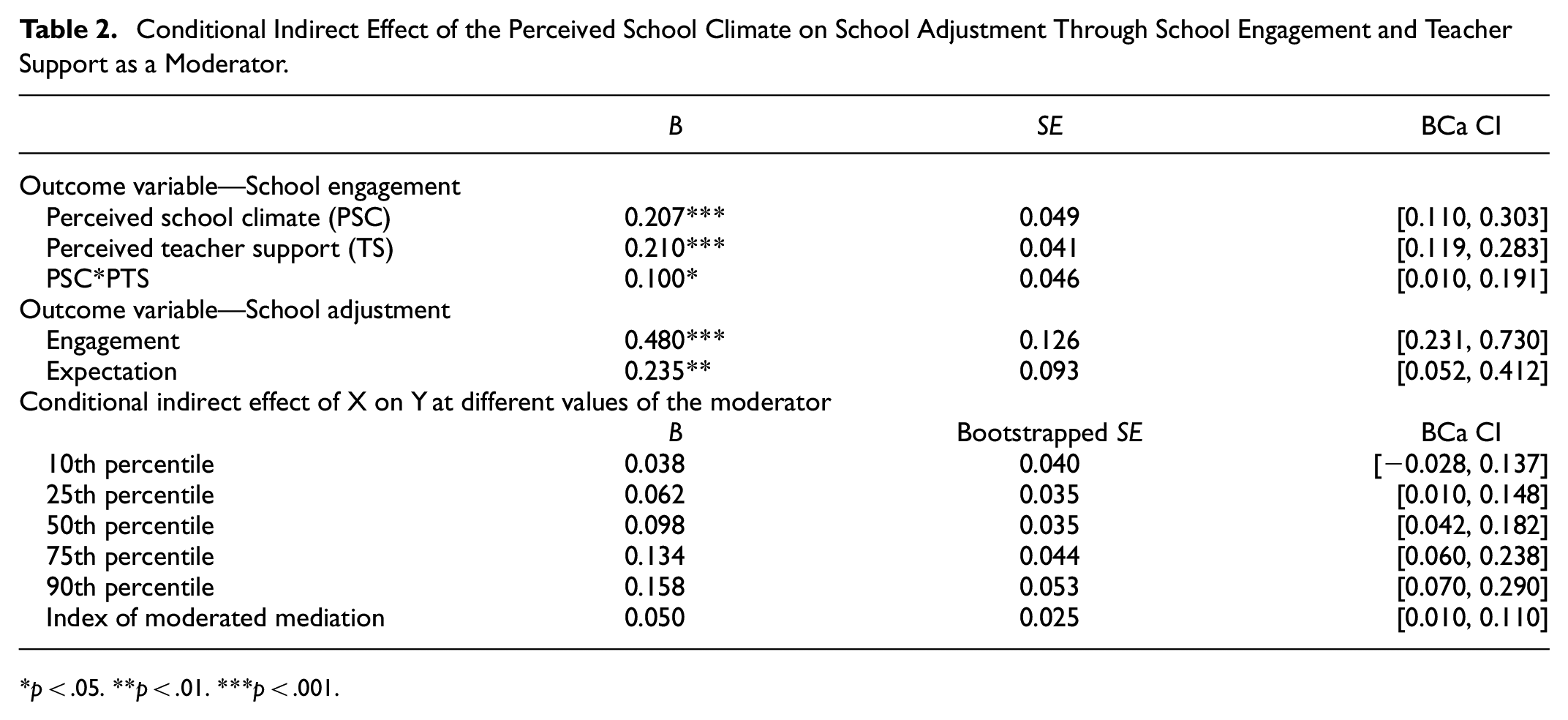
p < .05. **p < .01. ***p < .001.
Discussion
In this study, we strove to investigate the relationship between school climate, perceived teacher support, school engagement and subsequent student school adjustment through a two-wave moderated mediation model. We hypothesized that the students’ perception of the school climate (T1) would be associated with a positively assessed school adjustment 6 months later (T2) and that this association would be mediated by student school engagement (T2). We also hypothesized that the association between perceived school climate and school engagement would be moderated by the perceived teacher support (T1), and that the indirect association between school climate and subsequent school adjustment through school engagement would conditionally depend upon the levels of teacher support. All hypotheses were confirmed, except the last one regarding the moderated mediation analysis.
The correlations between the constructs confirm the finding from previous studies that perceived teacher support, students’ school engagement, perceived school climate and school adjustment are all positively related (Bradshaw et al., 2014; Cornell et al., 2016; Gregory et al., 2011; Torsheim et al., 2012; Tschannen-Moran et al., 2006). Moreover, as hypothesized, students’ first impressions of the overall atmosphere, peer relationships and school learning-related practices have an important role in shaping later engagement and sense of adjustment, which represent important prerequisites for high school achievements, low intention of leaving school and overall wellbeing (Finn, 1989; Hughes, 2011; Osterman, 2000; Suldo & Huebner, 2005).
After testing the hypothesized two-wave moderated mediation model, it was determined that there was a significant indirect effect of the perceived school climate on school adjustment through school engagement, suggesting that, through school engagement, students gradually adjust to what they experience. Therefore, if students like what they see in terms of school climate, they will engage in learning, which will further bring about the sense of a successful transition and sense of belonging. Analysis of the moderation role of teacher support on the relationship between school climate and school engagement has shown that when teacher support is strong, the relationship between school climate and engagement is significant and moderate, but when teacher support is weak, the relationship between school climate and engagement becomes insignificant. This suggest that without teachers’ positive attitude toward students and willingness to help them learn, the effects of positive school climate on subsequent engagement would be lower. Besides being “mediators” of knowledge, different goals, and actors, teachers can be considered “moderators” of school values, norms and practices and catalysts of successful adjustment.
Contrary to what had been hypothesized, the results did not show that the indirect association between school climate and school adjustment through school engagement conditionally depended upon the levels of teacher support. This can be explained by the fact that school adjustment is dependent upon various factors beyond the teacher-student relationship and support, such as peer relationships, discrepancy between expectations of the school and what has been experienced, a match between the student’s competencies and needs and the demands of the school environment, and differences in the student’s values and values promoted among school staff, parents and/or peers (Reich & Flanagan, 2010).
These findings are particularly relevant for “multiply-disadvantaged” students, such as vocational secondary school students. In addition to the challenges that are typical for the transition from primary to secondary school per se (e.g., Authors, 2018; Ross, 2009), previous studies showed that vocational secondary school students came from families with lower socioeconomic status and that their dropout rates were higher than for high school students (Statistical Office of the Republic of Serbia, 2015; Videnović & Čaprić, 2020). Additionally, the skills they gain in Serbian schools are not attuned to labor market needs, which hampers their employment chances after schooling (ETF, 2019; OECD, 2016; Statistical Office of the Republic of Serbia, 2020). Our study confirmed the “risk potential” of this group of students by pointing to the lower scores for school engagement and teacher support in comparison to their peers from other contexts. The scores for school engagement, which are at the level of average for the scale, are much lower than those determined in the studies from other countries (e.g., for the American sample, see Fredricks et al., 2019; for the Turkish sample, see Demirci, 2020), suggesting that Serbian vocational secondary school students are not that enthusiastic about active participation in learning-related activities at school.
In order to test if differences in mean values were statistically significant, we performed t-test analysis with the data reported in the paper of Fredricks and associates (Fredricks et al., 2019) and data from this study. It was determined that t = 10.820, p < .000. As for the data reported in the study of Demirci (2020), conducted with students from Turkey, it was determined that t = 13.956, p < .000. Both results indicate that Serbian students’ scores were significantly lower.
It is possible that engaged students are seen as academically oriented (even as “nerds,”Bodroža & Jakšić, 2014), which might not be popular among vocational school students. The mean score for the perceived teacher support was above average for the scale, but lower than in other countries that applied the same scale with the students of the same age (for samples from seven countries, see Torsheim et al., 2012). T-test, performed on the basis of data reported in the paper of Torsheim et al. (2012), showed that all the differences were statistically significant—for example, for Serbian versus Canadian sample t = 20.104, p < .000; for Serbian versus Polish sample t = 8.502, p < .000; for Serbian versus Slovenian sample t = 7.488, p < .000.
Limitations and Further Research Implications
Although this study confirmed the relevance of exploring students’ perceptions (see Gase et al., 2017), more reliable results could be obtained from the future study that would involve the perspective of other actors (e.g., parents, peers) as well. Obtaining students’ adjustment estimates from teachers, as well as parents and peers, would also contribute a broader perspective to this model.
Another limitation of this study is related to the sample size. Although we covered five schools that educate students in different professions, the final sample size turned out to be rather modest due to the high rates of attrition. This could be considered expected for this type of Serbian schools (Videnović & Čaprić, 2020), especially because students have the right to request a change of the school they are assigned to from a specialized committee that receives student complaints during the first semester. Therefore, for future studies we suggest including a larger group of students and, preferably, tracking the vocational school freshmen for a longer period and checking if the associations found in this study remain stable across time. As Ployhart and Ward (2011) noted, with two waves study design, it is difficult to resolve whether we tracked some true change or measurement error. Thus, more waves would enable deeper insights into causal processes and change.
Implications
Relying on our results about secondary vocational school students’ engagement and perceived teacher support, and the findings from previous studies and statistical data (ETF, 2019; Statistical Office of the Republic of Serbia, 2015, 2020; Videnović & Čaprić, 2020), we can consider this group of students multiply-disadvantaged and in need of particular attention from policy makers, teachers and other school staff. The transition period and the first year of schooling is a key period when certain interventions can be made in order to prevent low academic achievement, school adjustment and overall wellbeing.
At the policy level, the vocational school profiles have to be modernized and attuned to labor market needs. Given the relevance of positive school climate, at the school level it is important for school principals to promote positive school climate and encourage teachers to “transmit” shared values to students. As proposed by M. T. Wang and Eccles (2013), schools should be structured with clear expectations for student behavior and provide an emotionally supportive and caring school environment. Relying on our findings that the first impressions on the school climate matter, we believe that schools should exert an effort in welcoming freshmen through school and local community-based activities and provision of peer-mentoring.
School engagement, as a prerequisite for positive school adjustment in the transition period and potentially better academic and career achievements, holds a tremendous potential as a locus for interventions (Appleton et al., 2006). Teachers should constantly work on the improvement of their competences to engage students and use the potentials of project-based, collaborative and hands-on learning and cooperation with the business sector, as the potential future students’ employers. The well-structured and relevant apprenticeship has a potential to boost students’ dedication and engagement through transforming their perceptions of work from just a job to a calling (Chan, 2019). In line with our findings that teacher support moderates the relationship between the perceived school climate and engagement, we propose they should also improve their competences in providing psychosocial support to students, as well as communication and conflict resolution skills. Besides focused in-service training and coaching, these skills should be practiced even during teachers’ pre-service education (particularly vocational teachers’ education). We also recommend including more courses in psychology and pedagogy in the pre-service teachers’ (particularly, vocational teachers’) curricula.
Footnotes
Declaration of Conflicting Interests
The author(s) declared no potential conflicts of interest with respect to the research, authorship, and/or publication of this article.
Funding
The author(s) disclosed receipt of the following financial support for the research, authorship, and/or publication of this article: Data used in this study are archival data from the study that was part of the Project “Education in Focus,” supported by UNICEF Serbia (Belgrade office), Institute of Psychology (Belgrade, Serbia) and Ministry of Science, Education and Technological Development of the Republic of Serbia. Prepation of the paper was supported by the Ministry of Science, Technological Development and Innovations of the Republic of Serbia (contract number: 451-03-47/2023-01/ 200163). The study was carried out in accordance with the Ethical Code required by the Project and Code of Ethics of the Serbian Psychological Society.
