




Abstract
Prior studies regard psychological ownership as a positive thing, but this study suggested two faces of psychological ownership. Specifically, we focused on the psychological process wherein two different routes via disparate mediators led to two seemingly contradictory outcomes: organizational citizenship behavior (OCB) and workplace aggressive behavior (WAB). In addition, we also examined the moderating role of a structural factor (i.e., network position) in the mediation process. Drawing on the social exchange theory, we proposed that psychological ownership would produce both OCB and WAB through organization-based self-esteem and psychological entitlement respectively, and an individual’s network position would moderate the effects of this process. Data from 189 nurses from a general hospital in Korea revealed that psychological ownership was positively related to two ambivalent outcomes, OCB and WAB. Further, a central position in a friendship network among nurses strengthened the positive relationship between psychological ownership and OCB. Overall, this study showed that psychological ownership was like a double-edged sword. We discussed the theoretical and practical implications of this finding.
Keywords
Introduction
In a complex and uncertain organizational environment, employee proactivity and a sense of ownership are more required than ever. Psychological ownership, a state in which individuals feel as though the target of ownership is theirs (Pierce et al., 2001), can play a pivotal role in determining employee work-related behaviors. Considering that organizations try to figure out how to encourage employees to conduct organizational citizenship behavior, psychological ownership could be an important predictor. A considerable number of studies have found that employee performance, satisfaction, and prosocial behaviors are associated with psychological ownership (Han et al., 2010; Pierce et al., 2003; Vandewalle et al., 1995; Van Dyne & Pierce, 2004). Because psychological ownership, in itself, is regarded as a positive factor, most previous studies have paid attention to its positive outcome. However, despite the positive nature of psychological ownership, organizations did not consider that it may induce employees to behave in aggressive way. This study helps to find the mechanism behind how the same feeling of ownership can be developed into not only positive but negative consequences.
Considering that psychological ownership is the feeling toward an object (Pierce et al., 2001), a sense of ownership toward an organization could be formed through the interaction between an individual and an organization. If an individual believes that they received benefits from the organization for their input, they will shape psychological ownership in a positive way. However, when individuals feel they are not appreciated in the exchange with the organization, they will consider it as unfair and feel ownership toward the organization in a negative way. Depending on the result of social exchange with an organization, employees’ responses would be different.
However, the negative aspect of psychological ownership has rarely been studied (Dawkins et al., 2017; L. Wang et al., 2019). As an exception, researchers have focused on territoriality as the dark side of psychological ownership. Territoriality is a component of psychological ownership and people may feel that they have an exclusive right or control over the target. Accordingly, when people psychologically own their organizations, they are prone to limit others’ access to their possessions and protect them from others (Brown et al., 2005). A sense of exclusive control over the object impedes cooperation with others and induces destructive behavior. Except for research on territoriality, the negative effects of psychological ownership are understudied (Y. Zhang et al., 2021).
Meanwhile, we can find a similar stream of research about the negative outcomes of psychological ownership in entrepreneurship studies. For instance, founder CEOs who have a high degree of organizational identification are unwilling to make a voluntary succession (J. M. Lee et al., 2020; O’Reilly & Chatman, 1986; Riketta, 2005). In this sense, founder CEOs can be described as the overly possessive parents of their organizations. They try to engage in every decision so that the necessary delegation of decision-making tends to fail more often than not. As such, it should be noted that psychological ownership may produce negative outcomes as well as positive ones.
Furthermore, although studies on psychological ownership are abundant, few studies pay sufficient attention to the intervening mechanism of psychological ownership (Dawkins et al., 2017). Psychological ownership is an abstract inner feeling far from specific employee behaviors in the workplace. There must exist certain intervening variables between psychological ownership and behavioral outcomes. Psychological ownership has diverse dimensions such as self-efficacy, belongingness, and self-identity (Avey et al., 2009). Individuals who get reciprocated back for their efforts develop positive attitudes toward an organization (Cropanzano et al., 2017). Employees with positive psychological ownership would feel the organization appreciates one’s work. In turn, the employees would consider themselves worthy and capable in an organization. It leads one to develop organization-based self-esteem. Feeling important and competent induces an employee to behave proactively toward an organization. On the other hand, the negative dimensions of psychological ownership can prevail when an individual thinks that an organization does not give credit to its efforts. Employees who failed to get reciprocation may experience territorial psychological ownership. It induces them to feel they deserve better. Psychologically entitled individuals are prone to act in a negative way in the workplace. Likewise, we need to fill this gap by considering the mediating and moderating factors to better understand the effects of psychological ownership.
In addition, psychological ownership is a product of the social context in an organization (J. Liu et al., 2012). Because social context is comprised of the relationships among individuals, psychological ownership is also affected by social relationships. Also, the manifestation of an attitude depends on one’s social status. Only if an individual has enough power and resource, one can behave based on their underlying feelings. At this point, the position one takes in interpersonal relationships determines how much influence and leverage one can have. However, previous studies have given primary attention to intrapersonal aspects and rarely shed light on the importance of one’s position in a social network when examining the effects of psychological ownership. Thus, for a richer understanding of the role of structural factors, researchers need to explore how interpersonal relationships affect psychological ownership.
In this study, first of all, we aim to discover the two psychological routes whereby psychological ownership results in two ambivalent behavioral outcomes: organizational citizenship behavior (OCB) and workplace aggressive behavior (WAB). These behaviors are independent of each other rather than the opposites on the same continuum (Cropanzano et al., 2017; Spector et al., 2010). In this study, we suggest that OCB will be closely related to self-esteem based on the organization which an employee belongs. In contrast, aggressive behavior in the workplace originates from the cognition that one deserves better than others (Campbell et al., 2004). Taken together, we examine the mediating role of organization-based self-esteem (OBSE) and psychological entitlement in the process of how psychological ownership induces two seemingly contradictory (i.e., positive and negative) employee behaviors.
Second, this study tries to expand the prior research by introducing a structural factor engaged in the process of psychological ownership and employee behaviors. So far, most research on psychological ownership has paid much attention to the micro-side or perceptional aspect of employees (Avey et al., 2009; J. Liu et al., 2012; Van Dyne & Pierce, 2004). However, employee behavior is embedded in the social context (M. Granovetter, 1985). Social positions where employees are located significantly affect their actions because the social position can represent one’s power in the workplace (Freeman, 1978). Central employees can reach more people and therefore have plenty of information and resources than peripheral ones (Brass, 1984; Burkhardt & Brass, 1990; Fombrun, 1983; Krackhardt, 1990; Tushman & Romanelli, 1983). Since central employees are less dependent on others, they are able to express their underlying feelings and implement actions. Accordingly, employees with social power can behave based on their perceptions and motivations. In this vein, when employees with OBSE also occupy a central position in the workplace, they will display OCB in order to realize their prosocial motivation. On the contrary, employees who feel psychological entitlement are more prone to show WAB if they have the social power to wield it.
In sum, this study is an effort to broaden prior studies by revealing two faces of psychological ownership and discovering the mechanism of its functioning like a double-edged sword. In doing so, we try to answer the question of how psychological ownership results in positive and negative consequences simultaneously, which the routes it takes to different destinations via disparate mediators, and the boundary conditions of increasing or decreasing the outcome behaviors.
Theory and Hypotheses
Overarching Framework
Prior to delving into the psychological mechanism of psychological ownership, it is pivotal to define the relationship between employees and an organization. This is because psychological ownership is feeling about the organization. It can be said that the theoretical basis for their relationship is social exchange theory. When an individual thinks that they are giving more benefit to the organization than receiving some, they would behave in a negative way. On the contrary, when someone thinks that the organization gives benefit them then they would reciprocate with prosocial organizational behavior (Cropanzano et al., 2017). In other words, resources are exchanged based on the norm of reciprocity, in which an individual pays back the good or bad deeds of the counterpart (Gergen, 1969; Gouldner, 1960).
Social exchange theory regards social life as being comprised of an array of subsequent transactions between parties (Mitchell et al., 2012). Most of the organizational behavior studies share common features regarding social exchange theory. An actor and a target form a relationship when a target individual shows a reciprocal response to an actor’s initiating action by showing a particular attitude and behavior (Cropanzano et al., 2017). To be specific, the target responds with good or bad behavior in order to reciprocate the initial treatment (Eisenberger et al., 1987; Gergen, 1969). If individuals feel that the organization is treating them not properly even though they give benefit the organization, then they would show negative behavior in the workplace. In a nutshell, individuals form attitudes by comparing their inputs and returns. It means a social exchange between an individual and an employee determines the formation of attitudes and sequential behaviors. Likewise, the social exchange between the organization and individuals could lay ambivalent results. To figure out whether psychological ownership or proactivity of employees is always good for the organization, not only the different aspects of it but also the mechanism through which it is produced need to be investigated. Among various behavioral outcomes, this paper focuses on organizational citizenship behavior and workplace aggressive behavior. This is because those two behaviors are the most commonly studied behavioral variables as psychological outcomes.
Psychological Ownership and Extra-Role Performance
Psychological Ownership and Organizational Citizenship Behavior via Organization-Based Self-Esteem
An organization can be a positive expression of oneself when an employee feels a sense of ownership toward it (Dipboye, 1977). According to the extended-self theory, possession can symbolize the core value of self (Abelson & Prentice, 1989; Dittmar, 1992; Furby, 1978; J. Liu et al., 2012; Porteous, 1976). Employees would evaluate themselves as a member of an organization in a positive way if they believe that the organization is their psychological property (Van Dyne & Pierce, 2004). Also, employees with psychological ownership regard themselves as competent and worthy organization member (Liang et al., 2012). Because psychological ownership is originated from the knowledge about the target, employees assume themselves as the master of the organization having important information. Consequently, people who feel psychological ownership think that they are a valuable member of an organization (J. Liu et al., 2012; Pan et al., 2014). When employees perceive themselves as a member of an organization and regard themselves adequate in the context of an organization, they get organization-based self-esteem (Van Dyne & Pierce, 2004). Self-esteem reflects the belief in self (Pierce et al., 1989) and a self-perception of personal adequacy (J. Liu et al., 2012). With a belief that oneself is a pivotal factor in the organization (Pan et al., 2014), psychological ownership induces employees to have organization-based self-esteem (Y. Zhang et al., 2021).
In addition, individuals can produce a positive attitude toward an organization because feelings of ownership satisfy the human basic needs: self-identity, self-efficacy, and belongingness (Pierce et al., 2001). At this point, organization-based self-esteem refers to a belief that an individual can meet their needs by being an organization member (Pierce et al., 1989). Accordingly, individuals who feel psychological ownership can fulfill their needs, in turn, they would form a sense of self-esteem based on the organization.
Employees with organization-based self-esteem have a positive attitude toward not only themselves as a member of an organization but also the organization (Liang et al., 2012; Pan et al., 2014; Pierce et al., 1989; Y. Zhang et al., 2021). In order to protect a positive self-image and self-esteem, they would act prosocially. Through proactive behavior, people can keep cognitive consistency because positive behaviors amplify the positive sense of self (Kouchaki et al., 2017). Likewise, by helping others and an organization, high self-esteem individuals are able to maintain a positive image of themselves. Accordingly, organization-based self-esteem would be associated with self-identity and self-efficacy, which is related to performance (Bandura, 1997; Judge & Bono, 2001) and organizational citizenship behavior. Thus, we expect that psychological ownership enhances state self-worth based on the organization, which in turn increases subsequent citizenship behavior (Kouchaki et al., 2017).
Taking the above arguments together, the extended-self framework suggests that psychological ownership promotes OBSE and that a heightened sense of self-worth within the organization in turn contributes to extra-role work behavior represented with OCBs.
H1: Organization-based self-esteem will mediate the relationship between psychological ownership and OCB.
Psychological Ownership and Workplace Aggressive Behavior via Psychological Entitlement
This study predicts that psychological ownership would be related to an employee’s aggressive behavior in the workplace through a feeling of entitlement. Psychological ownership toward an organization could manifest that one has committed oneself to the organization. As psychological ownership comes from three routes: knowledge about the target, control over the object, and the investment one pours into it (Pierce et al., 2001), a great number of the individuals’ efforts and resources are involved in the process of gaining the sense of ownership. Accordingly, employees may expect rewards for their efforts and regard themselves to deserve more. Because the expectation for reciprocation has not been met, unsatisfied individuals behave in a selfish way. Also, feeling of entitlement induces individuals to acquire power in reality. To express their psychological power over others, employees engage in aggressive behavior in the workplace.
To elaborate, entitlement perceptions are based on perceptions of reciprocity (Naumann et al., 2002). To be specific, psychological entitlement occurs when individuals believe that their input is worth more than what they received in return (Yam et al., 2017). People who feel entitlement expects rewards from an organization regardless of whether they actually earned them or not. Likewise, individuals with psychological entitlement expect special treatment relative to peers (Snow et al., 2001). Thus, individuals who feel ownership think that they put effort a lot and benefit the organization, accordingly, they may feel psychological entitlement.
In addition, control and knowledge about the organization are the fundamentals for having influence over others in the organization. Power is more than having control over resources or occupying a good social position (Anderson et al., 2012). An individual’s belief about the capability of influencing others can be power (Bugental et al., 1989; Galinsky et al., 2003). Consequently, individuals with psychological ownership may experience psychological power. Because individuals of high power are aware that they are able to satisfy their low power counterparts’ needs (Magee & Smith, 2013), they assume they have to be well-treated. Accordingly, a sense of entitlement to the experience of being deserved emerges (Campbell et al., 2004; Foulk et al., 2018).
Workplace aggressive behavior can fulfill the desire for status which is a basic human motive (Anderson et al., 2015). People with psychological entitlement are eager to obtain status in order to fulfill their entitled desires. (Lange et al., 2019). In dominance-based routes, status can be acquired through intimidation and coercion over others. Also, in order to increase their actual power, individuals who believe they are powerful behave in more effective ways (Bandura, 1999; Bugental & Lewis, 1999). Because aggressive behavior conveys an authoritative image while influencing subordinates (Ferris et al., 2007; Harms et al., 2007; Tepper et al., 2012), individuals abuse others as a tactic (L. Hu & Liu, 2017). For this reason, individuals who feel psychological entitlement behave in a more aggressive way while having interactions with others (e.g., Campbell et al., 2004; Reidy et al., 2008).
With that, entitled individuals prioritize their needs over others in an organization and behave in a self-serving way (Harvey & Martinko, 2009) This is because entitlement distorts one’s perception of the world (Levine, 2005) so that entitled people overestimate their attributions and underestimate those of others (Robinson et al., 1994; D. Rousseau, 1995). Accordingly, the entitled desire will not be satisfied (Harvey & Martinko, 2009) and for defending themselves and maintaining their grandiose self-image, the entitled are more likely to respond by engaging in aggressive acts.
Following the arguments mentioned above, psychological ownership leads to psychological entitlement, and in turn, psychological entitlement results in aggressive behavior toward others in the workplace based on entitlement theory.
H2: Psychological entitlement will mediate the relationship between psychological ownership and workplace aggressive behavior.
The Moderating Role of Employee’s Structural Position
Most studies regarding psychological ownership focus on the individual aspect (Avey et al., 2009; Kouchaki et al., 2017; J. Liu et al., 2012; Van Dyne & Pierce, 2004; L. Wang et al., 2019). We consider a structural factor because it affects an individual’s behavior (M. S. Granovetter, 1973). Also, people never feel and behave in a vacuum. Social context, especially the social positions they occupy, probably plays a pivotal role in shaping their work-related behaviors. Individuals charging a central position in a network are more accessible to relevant resources (Ibarra, 1993). People with control over resources that is not mediated by others acquire the position with power. This is because they are less dependent on others but others’ dependence on them increases (Brass & Burkhardt, 1993). In addition, an individual of high centrality in an intra-organizational network has power (Brass, 1984, 1985; Burkhardt & Brass, 1990; Krackhardt, 1990) since power is a social-relational construct that reflects relationships among members in a group (Anderson et al., 2012; Emerson, 1962). Thus, behaviors conducted based on psychological ownership can be differentiated depending on how central one is in the workplace network.
A central individual’s behavior is more prone to represent underlying feelings and personality than the peripheral (Hecht & LaFrance, 1998). This is because the powerful are independent when they acquire and maintain important social resources. Also, opportunities for action increase since people in power are not restricted by social constraints. Consequently, power activates individuals’ behavioral approach systems (Galinsky et al., 2003; Keltner et al., 2003). To be specific, social power enhances the self-serving behavior of exchange-oriented individuals and the altruistic behavior of communally-oriented individuals (Chen et al., 2001). The underlying motivation of an employee can be realized in action when one has the power to handle it. Thus, prosocial motivation from organization-based self-esteem and exchange-oriented motivation from psychological entitlement come to behavior in a different ways.
Especially, a central position in a friendship network signals one’s influence over others. Friendship network has consisted of stronger and more intimate ties than task networks. This is because friendship ties connect people of similar characteristics (Ibarra, 1992; Marsden, 1988) so that they have frequent interactions (M. S. Granovetter, 1973; Krackhardt, 1990; Krackhardt & Porter, 1986; Krackhardt & Stern, 1988). As a result, a denser network is formed in organizational units through friendship network than task networks (Krackhardt & Stern, 1988). In this vein, friendship network centrality carries greater power to influence others (Granovetter, 1985; Krackhardt, 1990; Rogers & Kincaid, 1981).
Our study suggests that if employees with organization-based self-esteem are central in the friendship network, they are more likely to behave prosocially. Central individuals have an increased number of ties and define their job broadly. Also, since they receive requests regarding citizenship behavior from others (Bowler et al., 2009) and normative expectation to act responsibly (Chung et al., 2011), they have more chances to engage in organizational citizenship behavior. In effect, employees with centrality perform citizenship behavior performance (Settoon & Mossholder, 2002; Sparrowe et al., 2001). At this moment, individuals with high self-esteem regard themselves as competent (Korman, 1976; Wells & Marwell, 1976) and have a positive attitude to the self who has a membership in an organization. For consistently maintaining a positive self-image (Korman, 1976), they are prone to conduct citizenship behavior. When individuals have the power to help others and are demanded to do positive behavior for the organization, they would perform organizational citizenship behavior. In addition, people with organization-based self-esteem feel responsibility for the organization since it helps to fulfill their fundamental desires (Pierce et al., 2001). When employees with organization-based self-esteem have the power to help the organization, they would do so in order to reciprocate what they received from it. In this vein, individuals who have organization-based self-esteem and occupy a central position in a network would show more citizenship behavior.
On the other hand, psychologically entitled individuals may show more negative behavior when they have social power. Power is associated with interpersonal negative behaviors, such as unethical behavior (Hirsh et al., 2011), and norm violation (Galinsky et al., 2008). Several studies revealed the relationship between central position and higher social and physical aggression (Neal & Cappella, 2012, 2014; H. Xie et al., 2002). Also, Central individuals may perceive the efficacy to enforce aggressive behavior to their colleagues since they are more prestigious and powerful than the peripheral (Brass & Burkhardt, 1993; Chung et al., 2011). In this light, when entitled people who assume that they give more than what they gain in return have enough power to negative respond to the organization, they would show more of aggression.
Along these lines, a distinct psychological state as a result of psychological entitlement would result in opposite consequences in a more extreme way when employees have the power to wield.
H3: Employee’s centrality will moderate the indirect relationship between psychological ownership and OCB via OBSE such that the mediated relationship will be stronger when one’s centrality is high compared to when it is low.
H4: Employee’s centrality will moderate the indirect relationship between psychological ownership and workplace aggressive behavior via psychological entitlement such that the mediated relationship will be stronger when one’s centrality is high compared to when it is low.
The overall research model of this study is shown in Figure 1.

Research model.
Method
Sample Characteristics and Procedure
We collected data from a general hospital in South Korea. This study used a random sampling model. We used this sampling model because each survey subject is selected independently from the other members of the population so it allows all the units in the population to have an equal chance of being selected. In this hospital, coordination among specialized divisions (e.g., pediatrics, surgery, etc.) occurs actively so interpersonal relationships are important. The questionnaire includes measures of employee psychological ownership, OBSE, OCB, psychological entitlement, WAB, and so on. To avoid common method bias, we used different sources of responses; variables related to personal perceptions such as psychological ownership, OBSE, and psychological entitlement was self-reported, employee’s centrality was calculated from the friendship network in a team, and formal leader rated OCB and WAB.
Based on the guidance of IRB, we designed the study. We provided the study description to subjects that includes the purpose of the study, risks and benefits of participating in the survey, and the confidentiality of the data. In addition, we talked to leaders while explaining the study and got approval for conducting the survey. Individuals who agreed to participate are only included.
One hundred ninety-two team members out of 215 individuals replied to the survey so the a response rate was 89.3%. For the inclusion and exclusion criteria, following previous social network studies (e.g., Oh et al., 2004; Sparrowe et al., 2001), we excluded teams with less than 80% response rate or teams with less than three members. This is because network data requires a high response rate (Sparrowe et al., 2001). Also, since the target population is the nurses, we exclude administrative employees and doctors in the hospital. The final sample of this study was 189 respondents in 33 work teams. The average team size was 5.82. The respondents were all females and the average team tenure was 39.16 months (s.d. = 39.49). The rank was as follows: nurse (58.9%), junior nurse (25%), and senior nurse (16.1%). Partner nurses are formal leaders of groups. All 33 teams belonged to 10 floors which represent different medical divisions (e.g., Floor 1 represents the pediatrics department).
Measures
Independent Variable
Psychological Ownership
We measure psychological ownership using perception from Van Dyne and Pierce (2004)’s modified three items (e.g., “This is MY organization,”“I sense that this organization is OUR company”) on a 5-point Likert scales (1 = strongly disagree, 5 = strongly agree). (Cronbach’α = .815, AVE = 0.60, CR = 0.82)
Mediating Variables
Organization-Based Self-Esteem
Organization-based self-esteem was measured with four items (e.g., “I am important,”“There is faith in me”) developed by Pierce et al. (1989) on 5-point Likert scale (1 = strongly disagree, 5 = strongly agree). (Cronbach’α = .793, AVE = 0.58, CR = 0.80)
Psychological Entitlement
The measure for psychological entitlement was four items (e.g., “I honestly feel I’m just more deserving than others,”“Great things should come to me”) from Campbell et al. (2004) on a 5-point Likert scale (1 = strongly disagree, 5 = strongly agree) (Cronbach’α = .671, AVE = 0.35, CR = 0.67).
Moderating Variable
Employee’s Friendship Network Centrality
We measure an individual’s centrality in a friendship network assessed by team members. Social network analysis with roster methods is used to measure members’ friendship network centrality (Wasserman & Faust, 1994). We asked respondents on a team member list and the questionnaire was “people with whom you like to spend your free time, people you have been with most often for informal social activities, such as visiting each other’s homes, having dinner or other public performances” (Oh et al., 2004). The rating was on a 5-point scale from 1 (never) to 5 (very frequently). Based on this, we create N*N peer-rated matrix. By using this matrix, we calculated the individual’s indegree centrality with UCINET 8.0. Indegree centrality is defined as follows:

*d(ni) = the count of the number of direct ties that the focal employee has, (g−1) = maximum possible degree.
It measures the employee’s central position based on the score in the friendship matrix rated by peers. This indegree centrality index of the friendship network is normalized, ranging from 0 (focal employee has isolated) to 1 (focal employee was central among team members).
Dependent Variables
Organizational Citizenship Behavior
We measure organizational citizenship behavior assessed by a formal leader. Citizenship behavior rated by a formal leader may prevent distortion to the actual extent if assessed on their own. Four items were used from Williams and Anderson (1991) measure of organizational citizenship behavior. The sample items of citizenship behavior were, “Helps others who have been absent,”“Take time to listen to co-workers’ problems and worries,” and “Conserves and protects organizational property.” All ratings were on a 5-point scale from 1 (never) to 5 (very frequently). (Cronbach’α = .764, AVE = 0.47, CR = 0.78).
Workplace Aggressive Behavior
Employees’ aggressive behavior was rated by a formal leader. Three items of Douglas and Martinko (2001) aggression measures were used. The sample items of workplace aggressive behavior are “Did work badly, incorrectly or slowly on purpose,”“Griped with coworkers,” and “Saying nasty things about the organization while at work.” All ratings were on a 5-point scale from 1 (never) to 5 (very frequently) (Cronbach’α = .758, AVE = 0.53, CR = 0.77)
Control Variables
First, we controlled for demographic characteristics such as age, team tenure, and rank (nurse = 1, junior nurse = 2, senior nurse = 3). Second, we controlled for neuroticism because, among big five personality factors, it is closely related to conducting aggressive behavior toward others in the workplace (S. G. Taylor & Kluemper, 2012). Because an employee’s level of neuroticism affects how they react to workplace stress, it induces more of workplace aggression. It was measured by three items (e.g., “get angry easily,”“not easily annoyed(R),”“rarely lose my composure”) by Goldberg (1993) using 5-point Likert scale (1 = strongly disagree, 5 = strongly agree) (Cronbach’α = .738, AVE = 0.49, CR = 0.74). In addition, we also controlled for job stress because it has a negative relationship with citizenship behavior (Kasraie & Parsa, 2014) and a positive relationship with aggression (Sprague et al., 2011) (Cronbach’α = .723, AVE = 0.54, CR = 0.76). This is because the psychological response to a stressor determines the consequent functioning of an individual (Schat & Kelloway, 2005). In addition, we controlled mostly the dependent variable. In OCB literature, the most controlled variables are personality and in WAB literature, it is job stress. Given that our target dependent variables are positive and negative, the most typical control variables are personality and job stress. Thus, we followed the previous studies’ conventionally controlled variables on employee behaviors. Lastly, because each floor (medical division) has its own unique atmosphere, culture, and norm which affect the employees’ behavior, we generated dummy variables of floors (Floor 1 = pediatrics, Floor 2 = surgery, Floor 3 = urology, Floor 4 = plastic surgery, psychiatry, Floor 5 = hospice, Floor 6 = orthopedics, Floor 7 = internal medicine, Floor 8 = rehabilitation medicine, Floor 9 = neurosurgery). For the AVE value, the level of 0.5 is acceptable. For CR, the acceptable value of CR is 0.7 and above. Even though Psychological entitlement has slightly lower values than the standard, it could be still acceptable. Other than that, all the variables have above-standard values for AVE and CR, we could say constructs have enough discriminant validity.
Results
Table 1 shows the descriptive statistics and correlations among all variables. As shown, psychological ownership is not significantly correlated with OCB, nor with WAB (r = .00, ns/r = −.06, ns).
Means, Standard Deviations, and Correlations.

Note. N = 189. Rank (nurse = 1, junior nurse = 2, senior nurse = 3); Floor (Floor 1 = pediatrics, Floor 2 = surgery, Floor 3 = urology, Floor 4 = plastic surgery, psychiatry, Floor 5 = hospice, Floor 6 = orthopedics, Floor 7 = internal medicine, Floor 8 = rehabilitation medicine, Floor 9 = neurosurgery).; Cronbach’α in parentheses. *p < .05. **p < .01. (two-tailed).
To test hypothesis 1 and hypothesis 2, this study runs the mediation model for examining the direct and indirect effect of mediation analysis using SPSS macro, PROCESS model 4 (Hayes, 2012). With a bootstrapping method of 5,000 resamples developed by Preacher and Hayes (2004), this test generates 95% confidence intervals (Cis). Through the test, the significance of the indirect effect of psychological ownership on organizational citizenship behavior through organization-based self-esteem (Hypothesis 1) and workplace aggression through psychological entitlement (Hypothesis 2) was examined. The bootstrap test is more robust than the Sobel test because it could offer a biased p-value due to the non-normal distribution of standard error estimate (MacKinnon et al., 2002).
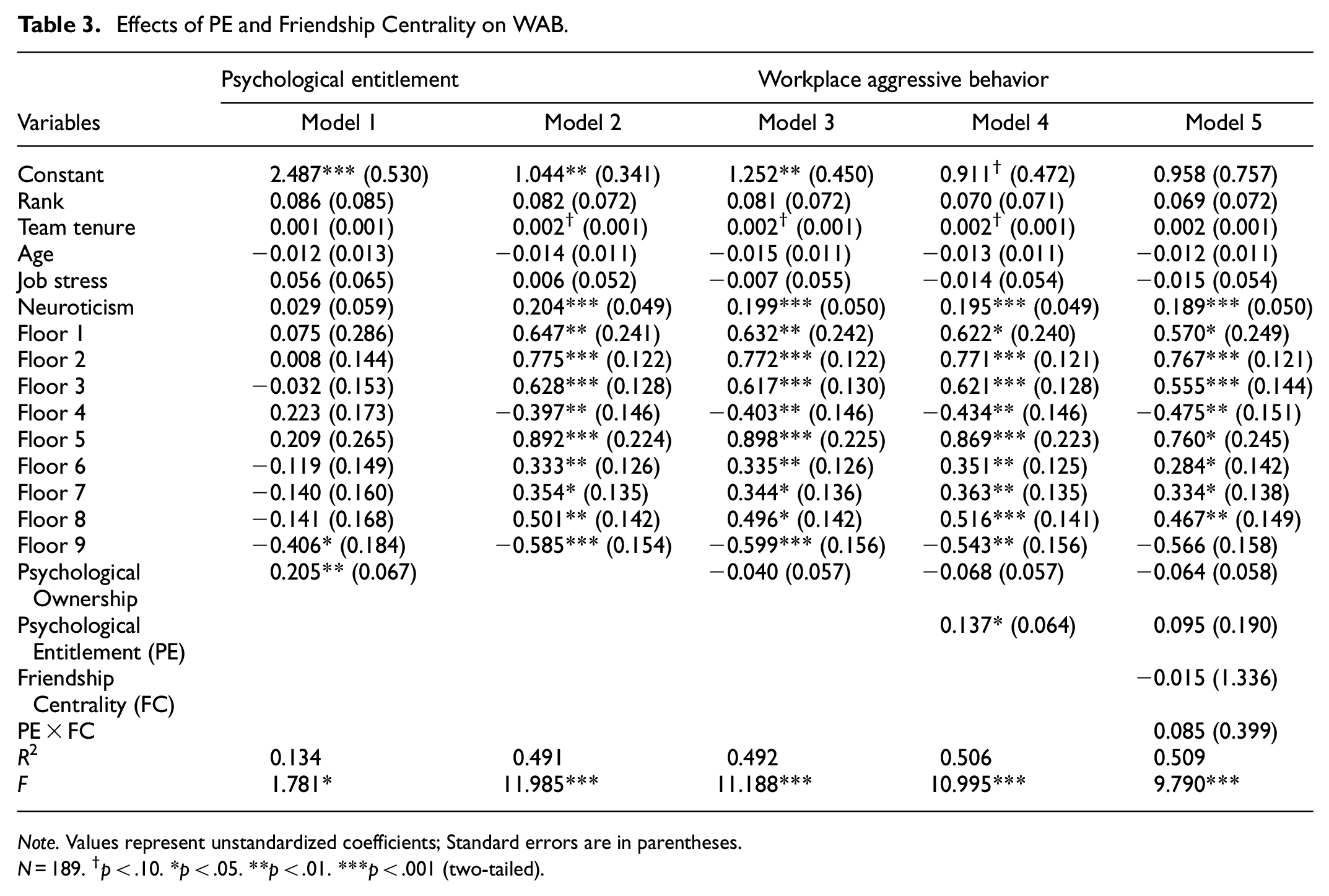
Although this study pays attention to the mediating effects, we investigated the direct relationship between psychological ownership and extra-role behaviors for further understanding. Model 3 in Table 2 and model 3 in Table 3 respectively psychological ownership and organizational citizenship behavior (b = 0.019, ns) as well as workplace aggressive behavior (b = −0.040, ns) have no significant relationships. However, the direct relationship is not a prerequisite for analyzing the mediation effects (Hayes, 2009; MacKinnon et al., 2002; Zhao et al., 2010).
Effects of OBSE and Friendship Centrality on OCB.

Note. Values represent unstandardized coefficients; Standard errors are in parentheses.
N = 189. †p < .10, *p < .05, **p < .01, ***p < .001 (two-tailed).
Effects of PE and Friendship Centrality on WAB.
Note. Values represent unstandardized coefficients; Standard errors are in parentheses.
N = 189. †p < .10. *p < .05. **p < .01. ***p < .001 (two-tailed).
To begin with, as model 1 in Table 2 illustrates, psychological ownership was significantly related to organization-based self-esteem (b = 0.208, p < .001). Also, model 4 in Table 2 showed that organization-based self-esteem is positively related to organizational citizenship behavior (b = 0.359, p < .001). Along with hypothesis 1 and hypothesis 2, this study found that psychological ownership is positively associated with organization-based self-esteem, which in turn impacted to organizational citizenship behavior. Moreover, as shown in Table 4, the indirect effect through organization-based self-esteem was statistically significant (b = 0.0748) with the 99% bias-corrected CIs did not include zero ([0.0189, 0.1572]). Thus, these results supported hypothesis 1.
Results for Mediation Effects.

Note. N = 189. Bootstrap sample size = 5,000. 99% CI = Bias-Corrected Bootstrap 99% Confidence Interval. LLCI = 99% Lower Level Confidence Interval. ULCI = 99% Upper Level Confidence Interval; 95% CI = Bias-Corrected Bootstrap 95% Confidence Interval. LLCI = 95% Lower Level Confidence Interval. ULCI = 95% Upper Level Confidence Interval.
Next, hypothesis 2 predicts the relationship between psychological ownership and workplace aggression with psychological entitlement as a mediator. As shown in model 1 in Table 3, psychological ownership was positively related to psychological entitlement (b = 0.205, p < .01) in a significant way. In turn, psychological entitlement showed a significant correlation with workplace aggressive behavior (b = 0.137, p < .05). In addition, in the bootstrap testing as shown in Table 4, the indirect effect through psychological entitlement was statistically significant (b = 0.0280) as the 95% CIs did not include zero ([0.0014, 0.0647]). Therefore, hypothesis 2 was also supported.
Lastly, this research suggests that the indirect effect between organization-based self-esteem and organizational citizenship behavior is moderated by the level of an employee’s friendship network centrality. Also, the level of an employee’s central position in a friendship network moderates the indirect effect between psychological entitlement and workplace aggressive behavior. In order to test conditional indirect effects (hypothesis 3 and hypothesis 4), this study conducted the full moderated mediation model through PROCESS model 14. Previous studies believe that centering predictors are necessary for moderation analysis due to multicollinearity between the predictor and moderator (Cohen et al., 2013). However, according to Hayes (2012, 2017), mean centering is not pivotal because multicollinearity does not induce a problem in the test for interaction. Since mean centering does not change the value of the interaction term, it is not an essential part of the moderation test. For this reason, this study did not center on predictors.
As shown in Model 5 in Table 2, results revealed a positive and significant interaction between friendship network centrality and organization-based self-esteem in organizational citizenship behavior (b = 1.254, p < .05). On the other hand, Model 5 in Table 3 illustrates friendship network centrality and psychological entitlement do not show significant interaction onto workplace aggressive behavior (b = 0.085, ns). Following recommendations from Cohen et al. (2013), the simple slopes were plotted at two levels of moderator for each interaction effect: the mean of employee friendship network centrality plus and minus one standard deviation. Along with the prediction, the slopes were significantly different only for organizational citizenship. The slopes for workplace aggressive behavior with friendship centrality’s moderating effect were not significant (see Figures 2 and 3). Figure 2 illustrates the effect of organization-based self-esteem on organizational citizenship behavior was strengthened with a higher level of friendship network centrality. Figure 3 shows that the level of friendship network centrality does not moderate the effect of psychological entitlement on workplace aggressive behavior.

Moderating effect of friendship centrality on OCB.

Moderating effect of friendship centrality on WAB.
Moreover, hypothesis 3 proposed that friendship centrality moderates the indirect relation of psychological entitlement and organizational citizenship behavior and hypothesis 4 suggested that friendship centrality moderates the indirect relation between a sense of entitlement and workplace aggressive behavior. Therefore, this research conducted the conditional indirect effect test between psychological ownership and organizational citizenship behavior through organization-based self-esteem at two levels of friendship centrality: high and low (the mean plus and minus one standard deviation respectively). In Table 5, the results implied that the indirect relation of a sense of ownership and organizational citizenship behavior through organization-based self-esteem was significant regardless of friendship centrality level (high: b = 0.0238, 95% CI [0.0035, 0.0975], low: b = 0.0509, 95% CI [0.0598, 0.2579]). Thus, hypothesis 3 was supported. However, the significant conditional indirect effect of psychological ownership and workplace aggressive behavior through psychological entitlement at two levels of friendship centrality (high: b = 0.0171, 95% CI [−0.0051, 0.0615], low: b = 0.0282, 95% CI [−0.0187, 0.0940]) was not found as shown in Table 5. Therefore, hypothesis 4 was not supported.
Results for Moderated Mediation Effects.

Note. N = 189. Bootstrap sample size = 5,000. 95% CI = Bias-Corrected Bootstrap 95% Confidence Interval. LLCI = 95% Lower Level Confidence Interval. ULCI = 95% Upper Level Confidence Interval.
Post-hoc Analysis
This study paid attention to the two routes which lead psychological ownership to different workplace behaviors. Through the analysis, this research investigated that psychological ownership can lay two different extra-role performances whether its level is high or low. However, previous studies argued that a sense of ownership’s degree matters (Baer, 2012; Pierce et al., 2001). For example, when a perception of ownership is too high or too low, it may result in negative consequences. Accordingly, in order to explain the alternative possibility, this research conducted post hoc analysis which examines not only whether psychological ownership is directly associated with organizational citizenship behavior and workplace aggressive behavior but also the squared term of psychological ownership is related to workplace aggression. As shown in Models 2 and 4 in Table 6, the direct relation between psychological ownership and organizational citizenship (b = 0.019, ns) and workplace aggressive behavior (b = −0.040, ns) were not significant. Of interest, the squared term of psychological ownership and workplace aggressive behavior showed a significant positive relationship (b = 0.149, p < .01). In sum, in organizational citizenship behavior perspective, the result was differentiated from previous studies which suggests the direct relationship between psychological ownership (Pierce & Gardner, 2004; Van Dyne & Pierce, 2004; Y. Zhang et al., 2021). From the workplace aggressive behavior perspective, the result showed a curvilinear relationship between psychological ownership rather than a linear relationship.
Effects of Psychological Ownership on OCB and WAB.

Note. Values represent unstandardized coefficients; Standard errors are in parentheses.
N = 189. †p < .10. *p < .05. **p < .01. ***p < .001 (two-tailed).
In addition, since our data is nested in individual groups, we know it is two-level data. In order to check if there is an effect of the two-level nested data (i.e., individuals in groups), we calculated Rwg, ICC1, ICC2 values. Based on the standard, there may be some group-level effects on the results of our study. For the interpretation, we elaborate in the limitation session.
Discussion
Major Findings
This study’s objective is to examine the different routes where psychological ownership links to extra-role performance. This study found that psychological ownership has effects on organizational citizenship behavior and workplace aggression evaluated with distinctive routes. To be specific, a sense of ownership is positively related to organizational citizenship behavior and workplace aggressive behavior, but it is not directly related to extra-role performances. This study finds that organization-based self-esteem mediated the relationship between psychological ownership and organizational citizenship behavior. Organization-based self-esteem is important because organizational citizenship behavior is originated from a desire to keep an organizational membership (Van Dyne & Pierce, 2004) Since a sense of possession is not necessarily positive so organization-based self-esteem which confers employees with a positive attitude toward an organization is pivotal. Also, individuals with organization-based self-esteem perceive themselves as a member of an organization in a positive way (Liang et al., 2012; Pan et al., 2014; Pierce et al., 1989; Y. Zhang et al., 2021). Accordingly, in order to maintain a positive self-image, employees conduct citizenship behavior (Kouchaki et al., 2017). Next, this research revealed that psychological entitlement mediated the positive relationship between a sense of ownership and workplace aggression. Without psychological entitlement, psychological ownership and workplace aggressive behavior cannot be related since psychological entitlement induces individuals to pursue their own goods and overestimate their contribution to the organization (Naumann et al., 2002; Snow et al., 2001). This result reconfirms the notion that an unbalanced assessment of reciprocity which is the basis of entitlement plays an important role in causing unethical workplace behavior (Hamilton, 2003; Harvey & Harris, 2010).
Moreover, this research examines whether friendship centrality acts as a moderator on the Mediation route. Employees’ friendship network centrality facilitates the positive relationship between organization-based self-esteem and organizational citizenship behavior. The result reveals that having the power to behave based on an underlying psychological state through occupying a central position in a network influences the indirect relationship between psychological ownership and organizational citizenship behavior by organization-based self-esteem. However, the relationship between a sense of ownership and workplace aggression through psychological entitlement was not moderated by friendship centrality. Friendship network consisted of ties of affection and camaraderie among individuals (Baldwin et al., 1997). Support, companionship, and comfort are expected in the friendship network (Fehr, 2004). Accordingly, even if an individual feels a sense of entitlement, he or she would less likely to behave in an aggressive way when one occupies a central position in a friendship network. Since a friendship network assumes emotional support among members, a high degree of friendship centrality would not strengthen the workplace aggressive behavior of an individual with psychological entitlement.
Lastly, this study conducted post hoc analysis for checking the research model’s robustness. As a result, psychological ownership and organizational citizenship showed no direct relationship. This result deviates from previous studies’ outcomes which illustrate the direct relationship between them (O’Driscoll et al., 2006; Y. Zhang et al., 2021). However, this research revealed that psychological ownership must get through another stage in order to be associated with citizenship behavior. This is because psychological ownership does not necessarily associate with employees’ positive psychological state and behavior. Rather, psychological ownership can evolve into territoriality, a sense of obsession (Avey et al., 2009; Brown et al., 2005), or entitlement. Thus, the result reveals that intervening effects and a distinctive path where psychological ownership links to organizational citizenship behavior exist. In addition, psychological ownership and workplace citizenship behavior did not directly relate to each other. A positive relationship was found between the squared term of psychological ownership and workplace aggression, which means a curvilinear relationship between them. This study established hypothesis 2 based on the curvilinear correlation possibility. It can be interpreted that if psychological ownership is too low or too high, the level of workplace aggressive behavior is higher than when psychological ownership is moderate. Through the additional analysis, it can be inferred that organizational citizenship behavior and workplace aggressive behavior is a distinctive and independent behavior rather than opposite constructs on a continuum.
This study extends prior literature on psychological ownership in that it highlights the negative consequences of psychological ownership. Even though most research on psychological ownership see it as a positive thing that makes employees involved more in the workplace, we suggest that it can be expressed as an obsession. Also, we refute the psychological ownership study that says it would be directly related to the behavior by introducing the psychological mediating mechanism between the feeling of ownership and the actual workplace behavior.
Theoretical Implications
This study results have several theoretical contributions. First of all, current research theoretically complements the extant research on psychological ownership by suggesting different psychological processes which relate psychological ownership to two different behaviors. With the reciprocity norm based on the social exchange theory, this study examines how organization-based self-esteem and psychological entitlement would distinctively affect organizational citizenship behavior and workplace aggressive behavior respectively. Prior studies rarely examine the psychological mechanism of psychological ownership. Also, research suggesting the distinctive psychological process of the relation between a sense of ownership and employees’ extra-role performance simultaneously had not been conducted. This study develops psychological ownership literature by expanding the understanding of the intervening mechanism of psychological ownership with concerning positive and negative consequences.
In addition, this study extends the study on psychological ownership by considering a structural factor at the same time. Previous studies mostly paid attention to the personal factor of psychological ownership. However, a structural factor such as social relationship among members is important (Burt, 2005; Cross et al., 2004; Gittell & Douglass, 2012; Groysberg & Abrahams, 2006) nowadays since organizations are getting flatter in order to respond to rapidly changing business environment. This study approached the social relationship with a social network perspective. With a focus on the network positions of an employee, the current research investigates how potential power over others originated by occupying a core position in a friendship network influences employees’ behavior. Therefore, this study develops the psychological ownership literature by introducing the social network perspective.
Lastly, this study extends the study on psychological ownership by suggesting the understudied possible outcome: workplace aggressive behavior. As interpersonal interaction among members gets intense, attentions on workplace aggression and unethical behavior get higher. The result of this research highlights the positive relationship between psychological ownership workplace aggressive behavior through psychological entitlement. Therefore, this study has a theoretical contribution in that empirically tests the dark as well as the bright side of psychological ownership in the workplace.
Practical Implications
On a practical aspect, the results of the study propose that managers have to pay attention to which state psychological ownership is related. As aforementioned, a sense of ownership is associated with seemingly contradictory outcomes-organizational citizenship behavior and workplace aggressive behavior- through distinctive mediators: organization-based self-esteem and psychological entitlement. As such, since psychological ownership has both positive and negative aspects, it can induce different consequences. Given that organizations try to encourage employees to conduct organizational citizenship behavior and discourage them to behave in an aggressive way in the workplace, managers have to recognize that intervening in psychological state is a key factor for different outcomes. Especially, leadership is closely related to how psychological ownership is evolved into a unique psychological state. Therefore, leaders should manage the path of psychological ownership which correlates to employee extra-role performances. In addition, our results suggest that managers should support central employees in friendship network because core individuals are more prone to conduct citizenship behavior if he or she has organization-based self-esteem. Managers should encourage social gatherings among employees so that making camaraderie and emotional support in the workplace.
Limitations and Future Research
Despite theoretical and practical contributions, limitations can be found in the study. First, future research can investigate the intervening effect of the squared term of psychological ownership. Although this study investigated the relationship between a sense of ownership squared and workplace aggression, the result does not tell whether the relationship is mediated by other factors such as psychological entitlement. Thus, in addition to exploring the effects of different levels of psychological ownership on extra-role behavior, the future study can figure out the mediator and moderators of the curvilinear relationship.
Second, this study chose a friendship network while estimating the centrality of an individual. However, there are diverse network types other than friendship such as advice, and helping networks. Since each type of network has its own characteristics, they may have different moderating effects on the mediation model. For example, instrumental network ties involve the exchange of resources on the job. Also, task network centrality showed a higher correlation with status attributes than friendship network centrality (Ibarra, 1993). Therefore, prospective studies can explore the conditional indirect effect of different kinds of network centrality which may affect the relationship between a sense of ownership and workplace aggression.
Third, the study has a limitation in that it used cross-sectional data while empirically testing the connection between psychological ownership and extra-role performance. In order to clarify the causal relationship between variables, future research can conduct a longitudinal study. Through longitudinal research, the study can obtain the validity of test outcomes and increase generalizability.
Fourth, this study owns limitations because the data were collected in only one institution with the healthcare context. It may restrict the generalizability of this study to other contexts. Even though our data is valuable in that it contains three different sources of measurement, researchers have to conduct the study of similar designs in diverse contexts such as companies or public organizations.
Fifth, in the current study, workplace aggressive behavior was rated by supervisors for eliminating the common method bias. Since the factor did not measure the direct perception of an individual, it may fail to estimate the low degree of aggression such as incivility. Accordingly, this study has a limitation in that workplace aggressive behavior might have a measurement problem. However, there is a negative asymmetry that negative events are more memorable and powerful than positive events so people exaggerate the report of negative behaviors. Also, as the supervisor is able to observe the overall life of subordinates, employees’ workplace aggression could be evaluated by them. In the future research, workplace aggressive behavior could be measured by self-reports.
Lastly, as we mentioned in post hoc analysis, the result values imply the group effect. In order to get a large number of samples, we collected data from over 30 teams. Thus, there could be the effect of group. However, all of our samples is from one hospital. Also, the hospital is known for its standardized procedure and norm in task work. In addition, the dependent variable of the study is psychological ownership toward the organization, not their teams. There is the possibility of psychological ownership developed through experiences in teams, but it is not bounded only by the group so our findings are not nullified. Since we are interested in individual-level psychological ownership’s divergent outcome, the group effect is not our major concern. However, the results should be cautiously interpreted because it is two-level data, and the group-level effect may be included.
Conclusion
As competitions and uncertainty in business environments increase, employee proactivity and a sense of ownership are emphasized in order to promote positive extra-role behavior. Although extant research on psychological ownership focuses on the positive consequences, it may induce positive as well as negative outcomes: organizational citizenship behavior and workplace aggressive behavior. Also, prior studies on psychological ownership paid attention to the direct effects of it, however, employees’ extra-role performance may vary depending on the psychological process one experiences. The current research argues that the different consequences of extra-role behaviors are attributable to mediators: organization-based self-esteem and psychological entitlement. Moreover, this study highlights friendship network centrality’s role as a moderator in the indirect relation of psychological ownership to citizenship behavior through organization-based self-esteem. Therefore, the current research is an effort to examine the two routes of psychological ownership to extra-role performances and elucidate the structural factor’s role in psychological mechanisms.
Footnotes
Authors’ Note
This paper was developed from the first author’s Master’s Thesis, Ewha Womans University. An earlier version of this paper was presented at the Annual Meeting of Academy of Management (AOM), 2021. We appreciate the valuable feedback of the KONS seminar group, prof. Sang Joon Kim, Dong Won Choi, and Dr. Jeeyoung Kim for their advice.
Declaration of Conflicting Interests
The author(s) declared no potential conflicts of interest with respect to the research, authorship, and/or publication of this article.
Funding
The author(s) received no financial support for the research, authorship, and/or publication of this article.
An Ethics Statement
All participants provided written informed consent prior to enrollment in the study.
The Review Committee
Ewha Institutional Review Board (IRB)
