



Abstract
It is challenging to be a nurse because you have to deal with patients’ unstable states on the spot, especially during pandemics. There has been an escalation in the situation as a result of the spread of a novel Coronavirus, COVID-19, across the globe. The mental health and personal lives of nursing staff suffered as a result of overload and stress during this contagion. In this context, the current study aims to hinge on improving the family satisfaction and family life quality of frontline soldiers by mentoring quality through the mediating role of organization-based self-esteem. Against this backdrop, a sample of 450 nurse-family dyads was collected in a three-wave field survey to investigate the hypotheses concerning the subjects working in hospitals in Lahore, Pakistan. Data were analyzed through structural equation modeling using AMOS 26. The study results indicate that high mentoring quality positively impacts family satisfaction and family life quality. In light of the study findings, hospital administration has practical implications for improving the quality of mentoring in order to enhance the personal and professional lives of nurses.
Keywords
Introduction
Nursing is a noble profession that requires physical and mental endurance, patience, and empathy toward patients. However, a nursing job is challenging because it generally confronts immediate uncertain conditions of patients, especially during pandemics. At the moment, a contagious disease named coronavirus (COVID-19), while spreading all over the world, is giving a hard time to paramedical and nursing staff. It was first reported in November 2019 in Wuhan city of China, in the wet market (M. Chan et al., 2021). It then transmitted rapidly throughout China and around the world. It is a highly contagious disease that spreads through social contact, thereby putting the life of people and health professionals in danger. Doctors and nurses face enormous workloads and a high risk of infection with the surge in the number of patients, which impinges on their mental health, such as depression and anxiety (W. Liu et al., 2020). These cognitive problems are causing predicaments in terms of their family relations. In particular, nurses are becoming less able to manage their jobs and family sphere dexterously. In battling with COVID-19, psychological distress appears among nursing staff due to a shortage of protective equipment and unprecedented health crises (Jackson, 2020; Mahmood & Sahar, 2017). Newly graduated nurses often feel insecurity, apprehension and fear due to stressful environments (Jewell, 2013). Therefore, necessary action should be taken to reduce and control depression and anxiety to reduce workload and offer training guidance and counseling like the Chinese government (Kang et al., 2020).
In this frame of reference, mentorship is a powerful tool for training and counseling. It has become a critical component, and is widely recognized and considered an essential element in the domain of human resource management (Allen et al., 2017). Research on mentorship has been done for decades and has expanded the research due to its importance (Allen et al., 2017). An interpersonal relationship between two people, one more talented and experienced than the other, is called mentoring. Less experienced is called protégé and the veteran is called mentor (Kram, 1985). The mentoring function benefits protégés regarding professional growth and personal development (Ghosh, 2014). Mentors (experienced colleagues) can play an essential role in the life of protégés (nurses), especially during the pandemic. The seasoned colleague becomes a role model for their protégés because of imparting a positive effect on their professional as well as personal lives. Therefore, mentorship is provided explicitly to the protégés to increase professional or personal outcomes. Thus, the mentor-protégé relationship is very healthy and beneficial for protégés’ social and emotional well-being as well as for their careers.
Similarly, factors such as Work-Family Conflicts (WFC) and Work-Family Enrichment (WFE) are related to professional and social relations and mentoring quality. These aspects are markedly connected with the field of nursing (Cortese et al., 2010; Ghislieri et al., 2011). Hamilton et al. (1989) defined mentoring quality as providing social influence, guidance, support, and role modeling. Mentoring can also involve providing research experience and opportunities for professional growth. Mentors should be committed to the mentee’s professional and personal growth and development, and provide regular feedback and constructive criticism. According to Cortese et al. (2010), WFC reduces family satisfaction (FS) and increases turnover, whereas WFE soars professional and personal commitments, and reduces quit intentions (Ghislieri et al., 2015; Tummers & Den Dulk, 2013). To describe family satisfaction, it is important to consider various factors such as the quality of relationships, communication, emotional support, and caregiving. For example, a study by L. S. Greenberg and Nayak (2015) highlights the importance of effective communication and mutual understanding in promoting family satisfaction. The increasing research interest in the field of work-family well-being has been witnessed over the past decades (Ghislieri et al., 2015). Empirical research indicates that positive work experience in organizations can encourage a positive attitude toward the well-being of the family domain (Liao et al., 2015). Anyhow, the well-being of family members is required to study further mentoring quality (Wu et al., 2019). With respect to the conflict perspective, most research work has been dominated during the 1980s and 1990s; however, enrichment has been increasingly important for the past two decades (Ghislieri et al., 2011; Russo & Buonocore, 2012). Enrichment can be defined as the process in which one person (junior) learns from some other individual (senior) to enhance their skills and capabilities. It has two aspects: One is the WFE, in which a positive environment of the workplace better the quality of FLQ and FS. The other is Family-Work Enrichment (FWE), in which a positive home environment better the quality of work in the organization (Greenhaus & Powell, 2006). According to a study by Siahpush et al. (2007), factors that contribute to family life quality include positive family relationships, effective communication, and social support. However, Work-Family conflict has been studied more than WFE in the nursing profession (Cortese et al., 2010).
Moreover, as stated by WFE theory, self-esteem is itself a psychological resource to illustrate the relationship of WFE (Greenhaus & Powell, 2006). Empirical research shows that a positive or favorable workplace is an essential predictor of organization-based self-esteem (OBSE) (Bowling et al., 2010). OBSE is described as an individual’s self-perceived value that the employee receives from the organization and its members (Pierce et al., 1989). OBSE is essential for individuals because they perceive themselves as respected and valuable in the workplace. They become vital members of the organization because they complete their assignments efficiently and effectively (Bowling et al., 2010). On the contrary, individuals who do not take interest in the work, and lack the confidence to handle their work pressure, are the upshots of low OBSE (Wu et al., 2019).
Considering the preceding illustration, the current research has analyzed the relationship between family well-being and mentoring quality under the mediating effect of OBSE. First, the study has investigated whether mentoring quality positively influences family life quality and family satisfaction. The study has then assessed whether OBSE mediates positively between mentoring quality (MQ), family satisfaction (FS), and family life quality (FLQ). This research-based investigation would contribute to the literature on mentoring and work-family enrichment (WFE) by examining the unique relationships between the aforesaid variables. The findings of the study will provide valuable insights into the impact of mentoring quality and organization-based self-esteem on family satisfaction and family life quality, specifically for nurses working in hospitals in Lahore, Pakistan, during the COVID-19 pandemic. These findings will have practical implications for hospital administration, as they can utilize them to improve the quality of mentoring, and enhance the personal and professional lives of nurses, thereby ensuring high-quality patient care.
Literature Review and Hypotheses Development
Mentorship Quality (MQ) and Organizational Based Self Esteem (OBSE)
According to self-consistency theory, individuals are able to assess their social experience and importance in the workplace (Korman, 1970). The development and growth of both persons (mentor-protégé) depend on the mentoring quality (MQ) (Fletcher & Ragins, 2007). A high-quality mentorship contains mutual benefits and nurturing relations between mentor and protégé. It gives mutual benefits to both persons with respect to personal growth and professional development (Allen & Eby, 2003). In a mentors-protégés relationship, protégés learn how to tackle uncertain situations, either at the individual level or organizational level (J. Liu et al., 2012). Therefore, excellent-quality mentorship assists the protégés in a better understanding of their work and better performance in the organization, and helps improve personal life based on mutual benefits (Allen & Eby, 2003).
As such, when protégés receive positive gestures from others in the organization, they perceive themselves as valuable and confident to play their role beneficial to the organization. One source that positively affects OBSE and improves the skills and abilities of the protégés is high-quality mentoring, which also benefits the organization (Wu et al., 2019). In contrast, protégés who do not receive positive messages are less confident and not worthwhile for the organization, thus ebbing away OBSE. This is because of the following two reasons. First, protégés improve personal and career skills with high-quality mentorship (Pierce & Gardner, 2004), counseling the protégés in their personal and professional matters (Donaldson et al., 2000; Kwan et al., 2011). The skills and competencies of protégés can be increased with such kind of mentorship quality, making them more capable and confident of overcoming workplace issues and may build high OBSE in the organization (Wu et al., 2019). Second, further attention has been given to protégés, which signals that they are more critical for the organization (Singh et al., 2009). Having said that, not all the protégés have this ability to sustain relations with seniors (mentors) (Eby et al., 2008). Nevertheless, if protégés can keep good ties with mentors, it could increase their sense of worth and reliability developed at the workplace (Ghosh et al., 2012). Individuals’ perception of self-worth may be strengthened at the workplace with this perception that he/she has latent abilities (Wu et al., 2019). In other words, when the protégés receive support from mentors, they perceive high self-esteem at the place of business. Based on these arguments, we put forward the following hypothesis.
H1: Protégés perception of mentoring quality is positively related to OBSE
Family Life Quality (FLQ), OBSE, and Family Satisfaction (FS)
Work demands and resources from the work or family domain influence an individual’s performance through the work-family interaction process (Bakker et al., 2011). According to the WFE theory, positive workplace experience affects the individual professional and personal life. It enhances work performance as well as life quality in the family context (Greenhaus & Powell, 2006). Research studies indicated that WFE is essential for the workplace and its staff (Molino et al., 2013). Its relationship showed a positive link with the workplace (Boyar & Mosley, 2007; Shockley & Singla, 2011), family members (van Steenbergen et al., 2007), and well-being consequences (van Steenbergen & Ellemers, 2009). The broaden-and-build theory of positive emotions by Fredrickson (1998, 2001) also elaborates on how positive workplace experience strengthens positive emotions. It increases the stock of skills and positive attitude while decreasing negative emotions, which tend to limit the thought-action repertoire (Carlson et al., 2014). People could improve their flexibility and creativity with the help of a broadened thought-action repertoire and drag it into the family domain (Fredrickson & Branigan, 2005). Individuals who perceive positive self-images and self-worth are involved in positive activities, and have a high OBSE (Pierce & Gardner, 2004). Individuals with high OBSE, protégés perceive themselves as important, valuable, capable, and confident to perform work in the organization (Jian et al., 2012; Pierce & Gardner, 2004). Therefore, they may devote time, effort, and attention to family members and remain relaxed at home while offering care and love to their families. Furthermore, with a high OBSE, employees feel worthy and skilled in the workplace. With this growing strong OBSE in the organization, employees are well competent to tackle family matters and strengthen family relations and prosperity (Yang et al., 2018). Individuals with high self-esteem perform their job confidently and take less stress in both the family sphere as well as at the place of work (Greenhaus & Powell, 2006). These workers with high OBSE also avoid reacting negatively to pressure and bad situations (Hui & Lee, 2000). Hence they do not bring stress and negative information at home, and do not react with family members, and, therefore, less anxiety, trouble and disturbance occur in the family domains (Yang et al., 2018). In the long run, high OBSE results in positive behavior with family members, consequently leading to positive feelings and emotions in family members and mutually beneficial attitudes (Carlson et al., 2011). Furthermore, people think the family environment is a sincere and earnest place where positive attitudes are facilitated (Yang et al., 2018). Considering the preceding discussion, the following hypothesis has been proposed.
H2: OBSE is positively associated with: (i) family satisfaction and (ii) family life quality
Organization-Based Self-Esteem OBSE as a Mediator
A positive workplace experience affects an employee’s professional and personal life. It raises work performance and quality of life because positive work wields congenial influence on employee’s psychological resources, which leads to family well-being in consonance with the WFE theory (Carlson et al., 2006; Greenhaus & Powell, 2006) and Broaden-and-Build theory (Carlson et al., 2014; Fredrickson & Branigan, 2005). According to the work-family enrichment theory, individuals learn useful information, skills, and superior attributes from workplace experiences, which they have acquired and applied in different environments like family domains and social networks (Greenhaus & Powell, 2006). Therefore, a social network (social capital) introduces social relations to stimulate behavior (Adler & Kwon, 2002). This social capital is an example of informal mentoring relationships (Higgins & Kram, 2001). Since formal mentoring does not mean that it gives high-quality results (Eby et al., 2008), the quality of social capital relationships is considered necessary in the mentor-protégé relationship (Hu et al., 2021). High-quality mentorship is vital to attain trust, commitment, and assistance, which are the fundamentals associated with social capital (Lankau & Scandura, 2007). It is because high-quality mentorship holds valued resources (Higgins & Kram, 2001), and these resources are essential to get and enhance WFE (Greenhaus & Powell, 2006). The benefits of family life are associated with resources, which can be attained with high-quality mentorship. These assets could solve ill and elderly family problems (Hu et al., 2021). Self-esteem is also a psychological resource and a critical element in improving family life quality (Greenhaus & Powell, 2006). Therefore, mentoring quality is essential in reducing stress in professional and personal life. Based on the arguments mentioned above, we hypothesize that family happiness and the quality of family life are positively impacted by mentoring quality through OBSE.
H3: OBSE mediates the positive effect of mentorship quality (MQ) between family satisfaction (FS) and family life quality (FLQ)
All the relationships described above have been sketched into a graphical model in Figure 1.

Hypothesized model of research.
Research Methodology
This research study examines whether mentoring quality positively impacts family satisfaction (FS) and family life quality (FLQ), and whether organized-based self-esteem (OBSE) mediates the effect of mentoring quality between FS and FLQ. The participants in this study were nursing staff and their family members who were working in hospitals in Lahore, Pakistan, during the COVID-19 pandemic. A convenience sampling technique was used to recruit 450 nurse-family dyads for the study. Participants were required to be aged 18 years or older, able to read and write in Urdu or English, and have worked in a hospital setting during the COVID-19 pandemic. We examined the quantitative survey through structural equation modeling (SEM) using AMOS 26.
Sampling and Procedure
A survey questionnaire was used to gather data from the hospitals for hypothesis testing. The population comprised all nursing staff working in private hospitals located in Lahore, Pakistan. According to Kline (2011), a 200 or larger sample is suitable for complicated path models. We collected 450 filled questionnaires separately for the nurses and their families at three time points over 8 weeks. The data were collected in multiple waves in order to test the true causal effect in a mediation model (Cole & Maxwell, 2003). We visited hospitals one by one, and gave them a questionnaire in an unsealed envelope describing the survey intention and procedure briefly. We assured them that the information collected would be used for educational purposes and kept confidential. Furthermore, they provided their informed consent before completing the questionnaire. A screening question was asked, “I am/have been engaged in treating patients during COVID-19,” as the inclusion criteria. If the answer was yes, only then the remaining part was asked to fill.
In the initial-wave survey, we distributed 630 questionnaires in order to compile information from staff nurses about mentoring quality; mentoring features (meeting frequency, relationship length), including control variables (age, education, and work experience). In the survey’s second wave (4 weeks later), data were collected from the nurses to evaluate their OBSE over the preceding 4 weeks. The usable questionnaires received were 509. Third wave survey result (4 weeks later after the second wave), we collected information about family life quality and family satisfaction from the family members of the staff nurses through survey questionnaires over the preceding 4 weeks. We received questionnaires from all three phases, nurses-family dyad, with a response rate of 71.43%. After deleting all unanswered and unusable questionnaires, a final sample of 450 nurse-family dyads was retained. The overall attrition rate was 28.71%. The attrition rate was less due to following the guidelines provided by Given et al. (1990).
The demographic results from Table 1 show that all the nurses were female. The ages of largest portion, 37.8%, falls between 31 and 40 years old. The largest portion has experience between 11 and 20 years. All the nurses were doing a full-time job 8 hr per day.
Mean and Standard Deviation of Demographics of the Respondents.

Measures
Albeit, all of the key metrics were first created in western corporations, they were tested in the Chinese setting, and now they have been examined in a Pakistani setting. A 5-point Likert scale, from strongly disagree (1) to strongly agree (5), was used to measure the responses in this study. We utilized a five-item scale to assess the quality of the mentoring relationship, created by Allen and Eby (2003), and later applied by J. Liu et al. (2012). The sample item included, “Both my mentor and I benefited from the mentoring relationship.” Cronbach’s alpha for this scale was .84. We used a 10-items scale to measure OBSE, developed by Pierce et al. (1989), and validated by Hui et al. (2010). The sample item included “I am an important part of this place.” Cronbach’s alpha was .94.
Similarly, we used a three-items scale to measure family satisfaction, developed initially by Kopelman and Connolly (1983), and later applied and validated by J. Liu et al. (2013). The sample statement included, “Generally speaking, I am very satisfied with my family.” Cronbach’s alpha was .80. We used a six-items scale to measure family life quality, developed initially by Summers et al. (2005), and subsequently validated by Yi (2014). The sample item included, “My family members show that they love and care for each other.” Cronbach alpha was .91.
Data Analysis
Since structural equation modeling (SEM) allows decisions simultaneously for measurement and structural elements, and, therefore, is considered a robust quantitative analysis method (Kline, 2011). We used AMOS 26 to test both measurement and structural models. We performed confirmatory factor analysis (CFA) to test relationships between observed and latent variables in the measurement model. Whereas, in the structural model, we conducted path analysis and hypotheses testing, analyzing the relationships among latent variables (Byrne, 2001; Hair et al., 2010).
Results
Measurement Model
First, in order to evaluate the convergent and discriminant validity of the important constructs, we performed a confirmatory factor analysis. The final model was employed for the analysis after deleting one item from each of the mentoring quality and OBSE scales due to low factor loadings. With a view to establishing convergent validity, we computed average variance (AVE) using AMOS 26. The scale validity is considered very high if the value of AVE is greater than 0.5, the standard loading is more than 0.5, and the composite reliability (CR) is more than 0.7 (Byrne, 2001; Hair et al., 2010). Since all the parameters were above the threshold values, convergent validity was confirmed. While, the square root of AVE for each construct was larger than the correlation coefficients with all other constructs to show discriminant validity. The measurement model fit indicators ascertained the model fit. Chi-square χ2 (196) = 428.97, p < .01; (Goodness of fit index) GFI = 0.924; (Comparative Fit Index) CFI = 0.97; (Tucker Lewis Index) TLI = 0.96; (Root Mean Square Error of Approximation) RMSEA = 0.05, these values indicated a positive adaptation. Using Cronbach’s alpha values, the reliability of the constructs was calculated, as exhibited in Table 2. All of the constructs had Cronbach’s alpha values better than .7 (ranging from .85 to .90), which is generally an accepted rule to demonstrate good reliability for further analysis.
Mean, Standard Deviation, Cronbach Alpha and Correlation Between Constructs.

Note. N = 450.
p < .01.
Hypothesized Model
We estimated the hypothesized paths of the proposed model with the application of SEM controlling the effects of age, education, and tenure. Additionally, it allows a simultaneous test of the complete system and covers all the variables in the suggested model. We analyzed the data on a full-item scale. Figure 2 shows the hypothesized structural model transformed from the measurement model. Results indicate that the structural model fit the data well with χ2 (197) = 429.19, p < .001; GFI = 0.92; CFI = 0.97; TLI = 0.96; and RMSEA = 0.05.
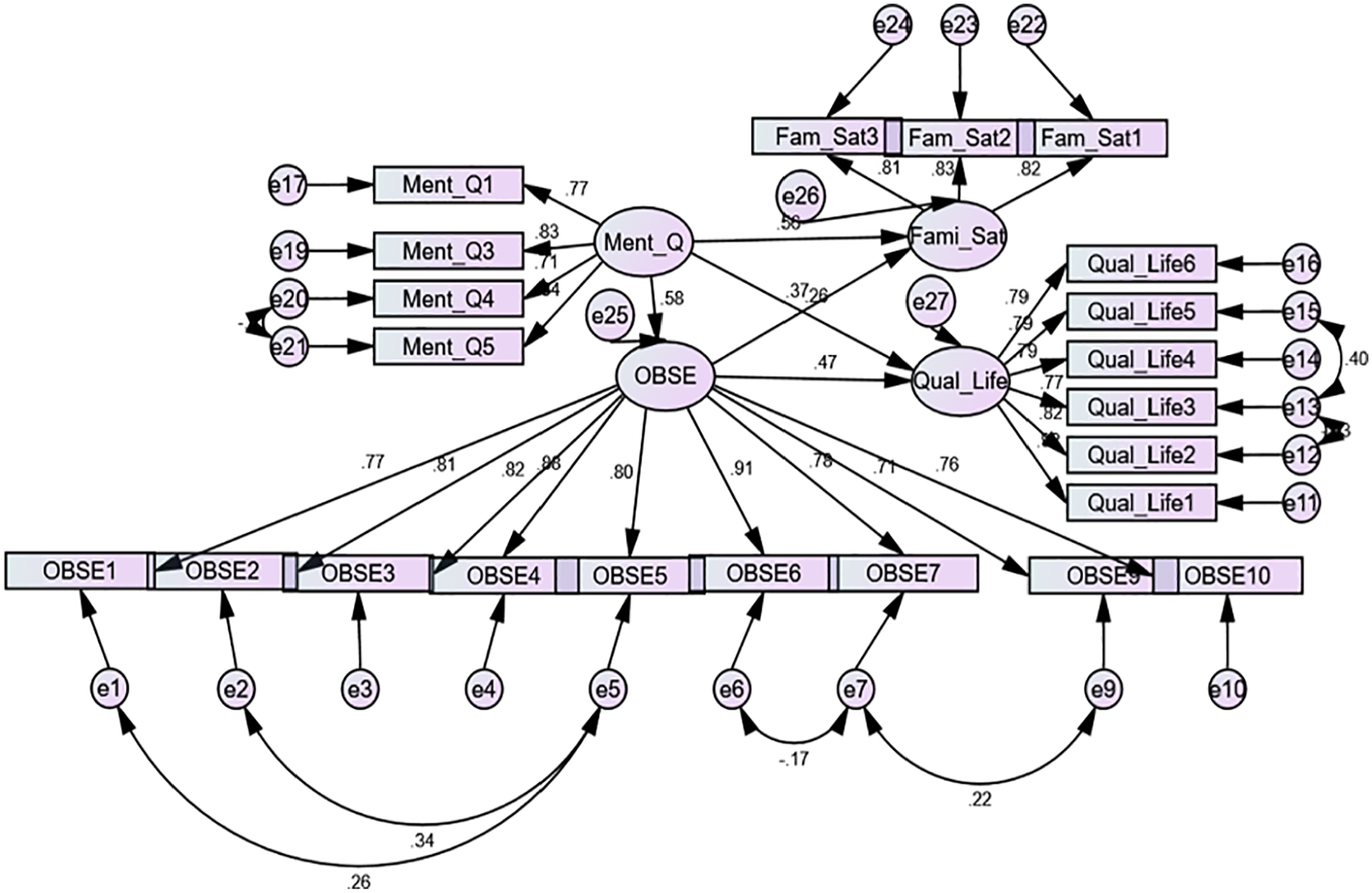
Path analysis.
Table 2 demonstrates a significant correlation between mentorship quality and OBSE (r = .63, p < .01) and a positive correlation between OBSE and family satisfaction (r = .67, p < .01) and family life quality (r = .69, p < .01). As a result, our preliminary analysis results were supportive of our hypotheses.
The values of critical ratios for all the constructs indicated that relationships between them were approved, as displayed in Table 3. As hypothesized, mentoring quality had a significant relationship with OBSE (parameter estimate = 0.578, t-value = 10.759); family satisfaction (parameter estimate = 0.559, t-value = 10.374); family life quality (parameter estimate = 0.264, t-value = 4.989); and OBSE had a significant relationship with family satisfaction (parameter estimate = 0.368, t-value = 7.574) and family life quality (parameter estimate = 0.466, t-value = 8.635). Furthermore, since the direct as well as indirect effects were significant, it reveals that OBSE partially mediates the relationships of mentoring quality with family life quality and family satisfaction (indirect effects: parameter estimates = 0.358; 0.229, ∀p < .001, respectively). Moreover, we computed the effect sizes (Cohen’s f2) and the power of the hypotheses’ tests. The effect sizes were large enough, namely, 0.502, 2.175, and 0.751 for OBSE, Family Satisfaction, and Quality of Life, respectively, and the power of the hypotheses tests was 1 for all the relationships, supporting the acceptance of alternative hypotheses. Thus, we conclude that the results have fully supported our proposed hypotheses.
Regression Weights of Hypothesized Relations.

p < .01.
Discussion
This study aimed to investigate the impact of mentoring quality on family satisfaction and the family life quality of nursing staff during the COVID-19 pandemic, with organization-based self-esteem as the mediator. The results of the study support the hypothesis that mentoring quality has a positive impact on family satisfaction and family life quality of nursing staff, and this effect is mediated by organization-based self-esteem.
The finding that mentoring quality has a positive impact on family satisfaction and family life quality of nursing staff during the COVID-19 pandemic is consistent with previous research (Z. C. Chan et al., 2013; N. Greenberg et al., 2020). The COVID-19 pandemic has created a highly stressful and demanding work environment for nursing staff, and mentoring relationships can provide the support and guidance needed to cope with these challenges. The findings suggest that hospitals and healthcare organizations should invest in mentoring programs for nursing staff to enhance their well-being and satisfaction, both at work and in their personal lives.
The study’s findings also suggest that organization-based self-esteem plays a significant role in mediating the relationship between mentoring quality and family satisfaction and the family life quality of nursing staff during the COVID-19 pandemic. This finding is consistent with previous research that has highlighted the importance of self-esteem in the workplace (Harris et al., 2017; Orth et al., 2016). Nursing staff who feel valued and appreciated by their organization are more likely to experience a positive impact on their family satisfaction and quality of family life quality. Therefore, healthcare organizations should prioritize efforts to enhance nurses’ self-esteem and create a positive work environment.
The study’s findings have practical implications for hospital administrators and healthcare organizations. The findings suggest that mentoring programs can improve the well-being of nursing staff during the COVID-19 pandemic. Therefore, hospital administrators should prioritize the development of mentoring programs to support nursing staff during the pandemic. Additionally, healthcare organizations should invest in initiatives that enhance nursing staff’s organization-based self-esteem to improve their well-being and job satisfaction.
The study has several limitations that should be considered when interpreting the results. Firstly, the study was conducted in a specific context of hospitals in Lahore, Pakistan, during the COVID-19 pandemic, and the findings may not be generalizable to other contexts. Secondly, the study used a convenience sample, which may limit the representativeness of the results. Finally, the study used self-report measures, which may be subject to response biases.
In conclusion, the study’s findings suggest that mentoring quality has a positive impact on family satisfaction and family life quality of nursing staff during the COVID-19 pandemic, and this effect is mediated by organization-based self-esteem. The findings have practical implications for healthcare organizations to prioritize the development of mentoring programs and initiatives that enhance nursing staff’s organization-based self-esteem to support their well-being during the pandemic. Future research should investigate the effectiveness of mentoring programs in different contexts and populations and explore other factors that contribute to the well-being of nursing staff during pandemics.
Conclusion
At the moment, the novel coronavirus (COVID-19) is spreading worldwide, resulting in emergencies, and symptoms of fear, stress, depression and tension. We noted that mainly nurses’ job is very difficult to handle uncertain immediate conditions of the patients in hospitals. This situation has created a disturbance in family life as well as in work life, lowering the quality of family satisfaction and family life.
This research contributes in several ways. First, this research helps nurses better their professional and personal lives by applying high mentoring quality with OBSE acting as a mediator. Mentoring quality exerts a positive effect on OBSE, then OBSE, in response, facilitates the effect of mentoring quality (MQ) on family satisfaction (FS) and family life quality (FLQ). We hope our study will contribute to and increase family well-being in nursing jobs. This research is exclusively useful for developing countries where the data have provided empirical evidence to improve family well-being. The outcomes of this investigation are in line with the researchers’ earlier conclusions, as detailed in the “Discussion” section.
Limitations and Future Directions
This research study has indispensable limitations. First, we collected data through a paper-based questionnaire (quantitative survey), while there are some other techniques available to collect data, such as observation, interviews, peer reviews, etc. The other limitation is that we collected data in a three-wave survey in a short point time (i.e., 8 weeks), which is less to examine the more generalizable results of this research. In future research, this time point can be broadened to improve the collection of data. Third, the research is based on a longitudinal study, and future research can be conducted by framing experimental designs. Moreover, additional relevant variables such as social support, empowerment, organizational trust, and work engagement should be incorporated into the model to enrich the level of family satisfaction and family life quality. We collected data from nursing staff working in hospitals located in Lahore, Pakistan. Prospective research can be replicated in other countries because the culture and nature of people contrast in different regions. Finally, analysis through multilevel modeling can be performed to better understand the individual and organizational level attributes.
Footnotes
Declaration of Conflicting Interests
The author(s) declared no potential conflicts of interest with respect to the research, authorship, and/or publication of this article.
Funding
The author(s) received no financial support for the research, authorship, and/or publication of this article.
Ethics Statement
The Ethical Evaluation Committee of the Institution granted ethical review and clearance for this study using human subjects (NML-ERC/2020-021). In addition, each subject gave written informed consent to take part in this study.
Data Availability
The data used to support the findings of this study are available from the corresponding author upon request.
