




Abstract
In the transition of China’s economy toward high-quality development, it will be increasingly important to coordinate the relationship between local government competition, environmental regulation, and the transformation of the economic growth mode. To explore the impact of local government competition and environmental regulation on total factor productivity (TFP), in this study empirical analysis models were established using panel data of 30 provinces in China from 2001 to 2017. Local government competition was measured from the perspectives of foreign direct investment (FDI), fiscal expenditure, and tax. The results show that local government competition has a positive impact on the improvement in TFP. Taking environmental regulation into consideration, the impact of local government competition on TFP is weakened. Furthermore, under the current intensity of environmental regulation, local government fiscal expenditure competition and tax competition both lead to improvement in TFP, while FDI competition has the opposite effect. This paper explores the heterogeneity of the impact of local government competition and environmental regulation on TFP under different local government competition levels. Under the influence of environmental regulations, local government FDI competition has a negative impact on the improvement in TFP, particularly in “low” FDI competition areas. Local government fiscal expenditure competition has a positive impact on the improvement in TFP, particularly in “low” fiscal expenditure competition areas. The current level of local government tax competition has a negative impact on the improvement in TFP in “high” tax competition areas, whereas it has a positive impact on the improvement in TFP in “low” tax competition areas.
Keywords
Introduction
In recent years, China’s economy has shifted from the high-speed growth stage to the high-quality development stage (Liu & Ling, 2020). To promote high-quality development of China’s economy, it will be increasingly important to improve total factor productivity (TFP) in this critical period of China’s economic transformation. High-quality development requires forgoing the original model of extensive economic growth at the expense of the environment, and turning to an intensive economic growth model with high output and low consumption. It is essential to implement effective environmental regulation policy tools in this process of transformation. The central government sets environmental regulatory policies, whereas local governments implement those policies. If local governments are unable to implement the environmental intentions of the central government effectively due to their political performance and competition, the effect of environmental regulatory policies will be greatly weakened. Since the tax-sharing system reform in 1994, China has gradually formed its fiscal decentralization system. Under this system, the income decentralization of local governments has consistently lagged behind the expenditures decentralization, causing an expanding gap between the fiscal revenue and expenditure of local governments (Y. Fu, 2010). Under the dual pressures of regional economic development and political promotion, local governments launched fierce competition for limited resources (Q. Wu & Li, 2010).Thus, local governments play important roles in environmental regulation (Lu & Yang, 2019) and have an important impact on TFP through environmental regulations. There is no doubt that many factors including local government competition and environmental regulation will affect total factor productivity. Does local government competition in different fields have different effects on TFP? Do different types of environmental regulation policies have different effects on TFP? After considering the interaction of local government competition and environmental regulations, how will the impact of the two factors on TFP change? These issues are exactly what this paper needs to study.
In this study, local government competition was measured from the perspectives of foreign direct investment, fiscal expenditure, and tax. Empirical analysis models were established to explore the impact of local government competition and environmental regulation on TFP. The result shows that local government competition is conducive to the promotion of TFP, but the effect will be weakened under the influence of environmental regulation. Furthermore, from the perspective of the current intensity of environmental regulation, local government fiscal expenditure competition and tax competition are both conducive to the improvement in TFP, whereas foreign direct investment competition is not conducive to the improvement in TFP. We also find that the impact of local government competition and environmental regulation on TFP is regionally heterogeneous at different levels of local government competition.
The contributions of this paper are as follows. Firstly, through the application of the interactive terms of environmental regulation and local government competition, this paper introduces environmental regulation factors into the analysis framework of the impact of local government competition on TFP, which expands previous theories on TFP. Secondly, this paper investigates local government competition from the three perspectives of foreign direct investment, fiscal expenditure, and tax, thus reflecting the impact of local government competition more comprehensively. Thirdly, this paper explores the heterogeneity of the impact of local government competition and environmental regulation on TFP under different local government competition levels.
The rest of the study is organized as follows. Section 2 provides a review of relevant research on local government competition, environmental regulation, and TFP. Section 3 introduces the empirical analysis models, variable definitions, and data description. Section 4 provides the empirical results and discussion. The conclusions and implications are presented in Section 5.
Literature Review
Regarding the roles of environmental regulation in the improvement of TFP, the literature is rich. However, the impacts of local government competition on TFP are largely overlooked in the literature. Based on variables of interest, we divide this section into four parts. The first and second parts discuss the literature on the impacts of environmental regulation and local government competition on TFP respectively. The third part discusses the literature on the impacts of local government competition on environmental regulation. Lastly, the gaps in the literature this current study aims to address are outlined.
The Literature on Environmental Regulation and TFP
The public nature of environmental resources and the negative externalities of environmental pollution promote the emergence of government environmental regulations (Tong et al., 2016). The previous literature has not reached an agreement on the impact of environmental regulation on TFP. Firstly, Christainsen and Haveman (1981), Gollop and Roberts (1983), Gray (1987), and Jorgenson and Wilcoxen (1990) believed that environmental regulations might increase enterprises’ costs and lead to a decrease in TFP. So, environmental regulations generated new constraints on enterprises’ production decisions, resulting in increased challenges for management, production, and sales. J. Wang and Liu (2014) and Y. Wang et al. (2019) found that the improvement of TFP was suppressed due to the increase in costs caused by environmental regulations. Second, Porter and Linde (1995), Ambec et al. (2013), Greenstone et al. (2012), and S. Li and Chen (2013) considered that appropriate environmental regulations could stimulate enterprises to carry out technological innovation, and promote the improvement of TFP through the “innovation compensation effect” and “learning effect.”Berman and Bui (2001), Hamamoto (2006), and C. Zhang et al. (2011) concluded that the “innovation compensation effect” exceeded the “cost effect” caused by environmental regulations, so environmental regulation could promote the improvement of TFP.
The main cause of disagreement may be the different samples used in the studies; for example, different regions have varying intensities of environmental regulations, or the same intensity of environmental regulation might lead to different impacts in different industries. However, there is a consensus that environmental regulations will have a significant impact on TFP.
The Literature on Local Government Competition and TFP
As the leader of economic growth, the competitive behavior of local governments has a significant impact on regional economic growth, which has been studied by scholars. The most intuitive reflection of local government competition was the focus on regional economic growth. Driven by political performances and economic interests, local governments continued to use preferential policies to attract resource inflows. They adjusted the regional industrial structure through support, guidance, and other methods, which improved resource allocation efficiency and achieved economic growth (Y. Deng & Xu, 2013).
Some scholars believe that local government competition inhabits TFP. Local government competition harms economic growth by distorting tax burdens, reducing the efficiency of resource allocation, and widening regional economic disparities (Aaberge et al., 2019; Cai & Treisman, 2004). Q. Fu and Qiao (2011) concluded that market segmentation generated by local government competition seriously inhabits TFP. Moreover, these negative effects were found to be gradually amplified, eventually hindering high-quality economic growth. J. Wu et al. (2017) found that the impact of fiscal competition on TFP presented an inverted U shape, and excessive competition would be harmful. Under the highly competitive promotion system, local officials have a strong urge to invest and ignore their comparative advantages. This irrational investment impulse leads to inefficient investment of state-owned enterprises, resulting in their overcapacity and a suboptimal scale of investment from the perspective of society. Local governments use direct financial subsidies or indirect loan discounts to enable state-owned enterprises that would otherwise have withdrawn from the market to maintain daily business activities, which lowers the overall efficiency of the Chinese economy (X. Deng et al., 2019).As environmental regulation intensity increases, the enthusiasm of enterprises to migrate to the area gradually declines, which will not be conducive to the diversified development of industries in the region (Dong & Zhang, 2020). In addition, as environmental regulation intensity increases, enterprises with high energy consumption and high pollution are forced to move to regions with lower environmental regulation intensity, thus forming a “pollution refuge.” Although these enterprises can increase local output to some extent, they do not improve the local production technology and operating environment. And these enterprises will promote production with high energy consumption and high pollution, which will eventually hinder regional TFP (S. Li & Chen, 2013; J. Wang & Liu, 2014). Some recent studies of Pan et al. (2020), Thanh Dinh and Nguyen (2021), Tang and Qin (2021) also supported this view. Su et al. (2021) hold that local governments’ competitive behaviors would eventually inhibit regional economic growth such as local protectionism, industrial isomorphism, over-investment.
Other scholars consider that local government competition can significantly promote regional economic growth (Keen & Marchand, 1997; Oates, 1999). Under China’s special political system, local governments generally use public expenditure and tax policy adjustments to compete for liquidity resources, which inevitably lead to strategic competition. Y. Zhou and Song (2009) believed that local government competition can promote regional economic growth and TFP through three types of spillover effects, fiscal imitation, and yardstick competition. Yan et al. (2013) found that local governments can encourage investment and accelerate economic growth through land price competition and land revenue expenditure competition. Z. Wu and Wang (2013) hold that local government competition can improve TFP through efficiency and technological progress. Canavire-Bacarreza et al. (2020) and Ding et al. (2019) found that local governments had positive effects on economic growth through financial resource, fiscal expenditure, and infrastructure competition. Luo and Luo (2019) believed that the reference learning effect generated by local government competition, to a certain extent, promoted the convergence of public policies between regions, which was conducive to narrowing regional development gaps and promoting regional coordinated development. The construction of the regional ecological civilization has become another focus of local government competition due to the aggravation of environmental pollution in recent years. J. Li (2020) highlighted that the focus of local government competition shifted from “competing for growth” to “competing for quality improvement,” which would promote the industrial transformation and technological innovation of enterprises to improve local TFP.
The Literature on Local Government Competition and Environmental Regulation
As the executor of environmental protection policies, local governments’ competitive behaviors have a significant impact on environmental policies. Local governments have differences in environmental regulation policies and implementation methods, which also lead to the existence of competitive behaviors in environmental regulation (Woods, 2006). Konisky (2007) verified the existence of a “race to the bottom” and “yardstick competition” in the environmental regulation of the US state government using data from 1985 to 2000. Fredriksson et al. (2003) believed that these competitive behaviors are more prominent in local governments at or below the county level. Wen (2013) pointed out that local government competition would lead to a “race to the bottom” in environmental policies. These results are consistent with the conclusion of Shen and Zhou (2020) that local government competition will lead to the “pollution backflow effect.” It can be seen from the above studies that local government competition has an important impact on environmental regulation. As environmental regulation is the main means for governments to govern the environment and affect company’s decisions, it will also influence TFP.
In the process of competition among local governments, environmental policy is often regarded as an important means to make profits, and environmental regulation is an inevitable problem. Cui and Liu (2010) found that tax competition affects the intensity of local governments’ environmental policies, which leads local governments to adopt more relaxed environmental policies. Environmental regulation is a means for the government to control enterprises’ behaviors and decision. This will lead to environmental degradation and form the “bottom-to-bottom competition” effect of environmental pollution (Banzhaf & Chupp, 2012; Kuai et al., 2019; Oates & Portney, 2003; van der Kamp et al., 2017). Under environmental regulations enterprises’ positioning, goals, and cultures will also be distorted to a certain degree, which may lead to a decline in the efficiency of market resource allocation (Kuang & Lu, 2019). However, in the process of competition among local governments, they will imitate each other in environmental regulation. H. Y. S. C. Y Zhou (2008) believed that local government competition could also lead to incomplete enforcement of environmental regulations. The intensity of environmental regulation is closely related to the entry and transfer of enterprises, scale distribution, and business performance, and ultimately affects the improvement level of regional TFP.
The results of previous studies indicate that environmental regulation represents a capital and technical barrier for enterprises, and weakens the promotion effect of local government competition on TFP. The environmental regulation intensity and requirements for pollutant discharging equipment vary in different industries, leading to a high capital and technology threshold for an enterprise when entering a certain industry. Under the role of local protectionism, some local governments may restrict enterprises’ entry by raising the intensity of environmental regulation, which leads to high environmental regulation barriers for enterprises to enter a certain region.
Literature Gaps
Several gaps can be identified from the literature reviewed in the preceding sub-sections. First, it is clear that the existing literature has overwhelmingly emphasized the effects of environmental regulation on TFP while only a handful of the recently published studies have shed some light on the local government competition-TFP. Secondly, the existing studies did not focus on the difference in the role of local government competition in different fields on TFP. Lastly, the existing studies have empirically analyzed the effects of environmental regulation, local government competition on TFP, while the effect of the interaction between the factors on TFP has been ignored. This current study aims to bridge these literature gaps using relevant panel data and econometric methods for the case of China.
Measurement Model, Variable Definition and Data Description
Basic Model and Estimation Methods
Based on the above theoretical analysis, this study first conducted a comprehensive investigation of the impact of local government competition on TFP. The benchmark regression model was constructed as follows:

where
In this study, we measure local government competition from three perspectives: foreign direct investment, fiscal expenditure, and tax. Based on this, the following hypotheses are proposed:
To further study the impact of local government competition on TFP under the role of environmental regulation, the following regression model was constructed:

where
From the perspective of the process of environmental regulation, the cost effect may weaken the role of local government competition in promoting TFP. The cost effect increases enterprises’ production costs, leading to a decrease in production investment. Under the condition of keeping the original profit unchanged, enterprises’ output capacity and production efficiency will decrease. To compensate for the loss of profits caused by environmental regulations, enterprises may reduce production costs by cutting corners, reducing product quality, etc., resulting in a low-quality production chain. In addition, stimulated by local government competition, local governments pay more attention to the increase of product supply scale and the “boom” of enterprises under strong environmental regulations, which leads to a further reduction of market resource allocation efficiency. Based on this, the following hypotheses are proposed:
Variable Definition
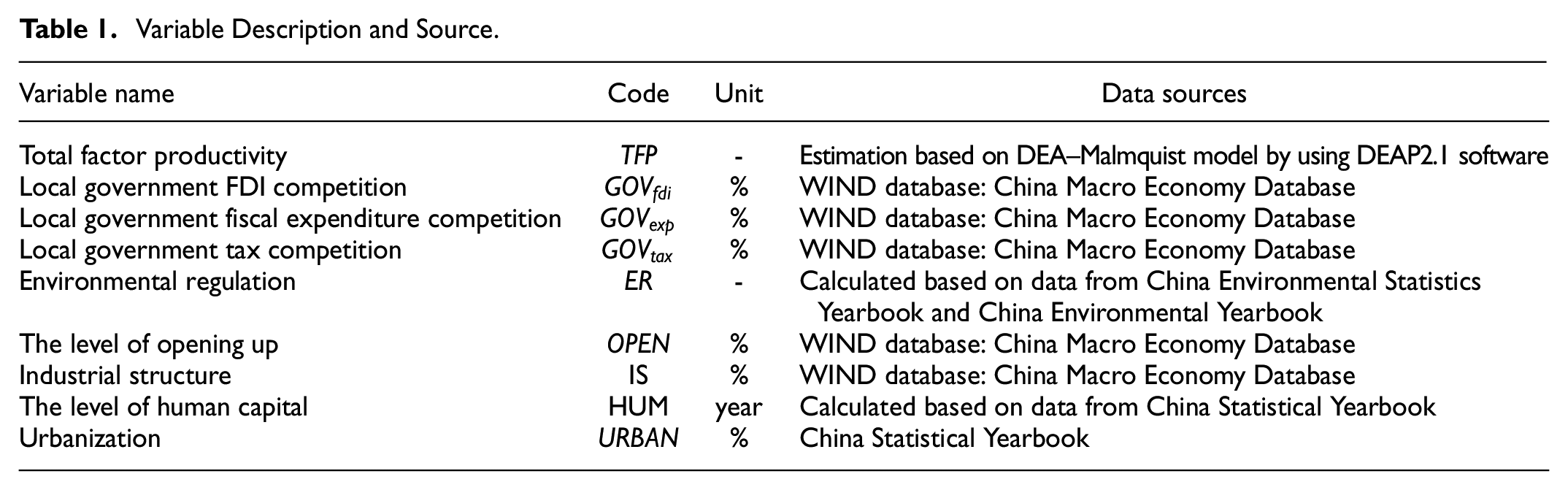
To calculate TFP, the following methods are commonly used: Solow residual method (Guo & Jia, 2005), stochastic frontier function (Z. Wang et al., 2006), SBM directional distance function (B. Wang et al., 2010), and data envelopment analysis (DEA) (Q. Li et al., 2020; Mao & Sheng, 2012). Because DEA is a non-parametric method, the form of the production function is not required to be known in advance and complex assumptions are also not required. Thus, this approach effectively avoids errors caused by deviation in the selection of a production function and is robust. As a result, this study adopted the DEA–Malmquist index method to measure total factor productivity. The input indicators include material capital, labor, and energy (Xie, 2017). Material capital input is measured by capital stock, and its calculation method is based on J. Zhang et al. (2004). Labor input is measured by the number of employees in each region. Energy input is measured by total energy consumption in each region. The output indicator is expressed as real GDP. Figure 1 shows the annual total factor productivity of China from 2001 to 2017.

(a) TFP of China, (b) TFP of Eastern China, (c) TFP of Central China, and (d) TFP of Western China.
Local government competition (GOV) and environmental regulation (ER) are the core explanatory variables of TFP.
Local government competition mainly refers to the economic behavior of local governments to attract liquid factors into their jurisdictions through taxation, environmental policies, and welfare, and to serve their jurisdictions. Because it is limited by the household registration system and the financial system, the mobility of labor and material capital is often insufficient. As a liquid factor with significant economic benefits and spillover effects, foreign direct investment (FDI) is often favored by local governments (Q. Deng & Li, 2018). Therefore, this study adopted the proportion of the actual use of foreign capital and GDP in each province to measure the competition of local governments for FDI, which is expressed by
Some scholars use pollutant discharge fees to measure the intensity of environmental regulation (Levinson, 1996), whereas others use environmental treatment investment (Berman & Bui, 2001; Lanoie et al., 2008). The authors of this article believe that environmental regulations should be a comprehensive indicator. The above indicators for measuring environmental regulation do not take into account the spatial distribution of elements in a certain area, which might cause bias in the measurement of environmental regulation. In this study, location entropy was derived to measure environmental regulation using the two indicators as follows:

where
Regional total factor productivity is also closely related to the levels of opening up, industrial structure, human capital, and urbanization, etc. (Lin & Sun, 2019). This study used the proportion of total import and export in each region to GDP to measure the degree of opening up, which is expressed by OPEN. The industrial structure is measured by the proportion of the added value of the tertiary industry in each region to the added value of the secondary industry in each region, which is expressed by IS. The regional number of average education years is used to measure the level of regional human capital, which is expressed by HUM. The proportion of urban population in the total population of each region is adopted to measure regional urbanization, which is expressed by URBAN.
Data Source
All variable descriptions and data sources are as shown in Table 1. The time interval of the data in this paper is 2001 to 2017.
Variable Description and Source.
Empirical Test and Result and Discussion
Model Estimation and Results Analysis
To reveal the influence of local government competition on TFP, the system generalized method of moments (GMM) were used in the panel data models. All of the regressions were performed in Stata14.0. The estimated results are shown in Table 2.
Regression Results of the Impact of Local Government Competition on TFP.
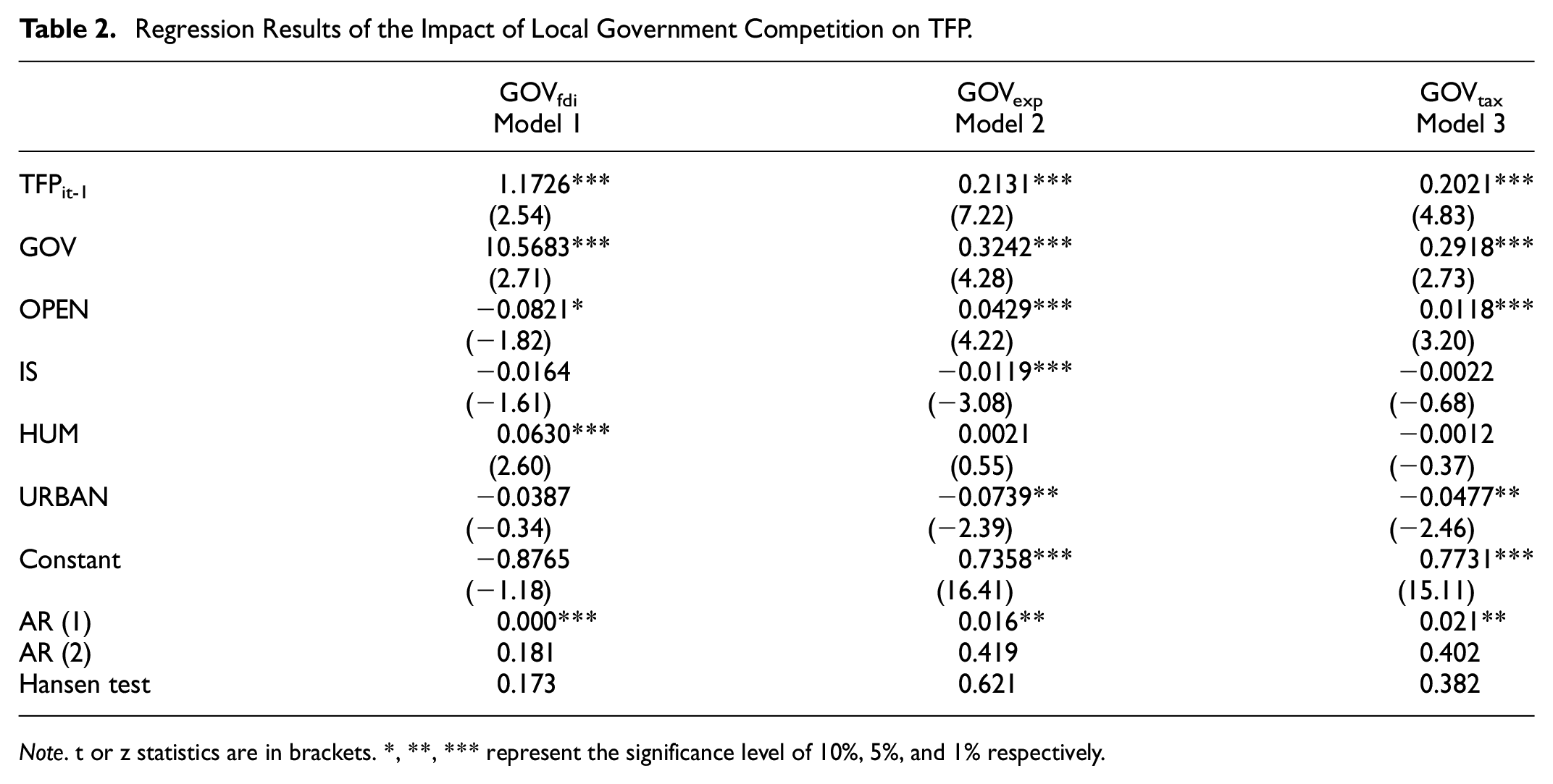
Note. t or z statistics are in brackets. *, **, *** represent the significance level of 10%, 5%, and 1% respectively.
Models 1 to 3 are the regression results of local government foreign direct investment competition, fiscal expenditure competition, and tax competition on TFP. The p-values of the first-order autocorrelation test for the three models are significant at the 1% or 5% statistical level, whereas the p-values of second-order autocorrelation test are not. Therefore, the method of system GMM estimation is applicable, and the model setting is reasonable. The p-values of the Hansen test for the three models are not significant, which means that the selections of instrumental variables are effective, and the overall moment conditions of the three models are valid.
In Model 1, the regression coefficient between local government FDI competition and TFP is 10.5683, and is significant at the 1% statistical level. This indicates that local government competition for FDI has a positive effect on the improvement of TFP, which verifies Hypothesis 1. In Model 2, the regression coefficient between local government fiscal expenditure competition and TFP is 0.3242, and is significant at the 1% statistical level. This indicates that local government competition for fiscal expenditure has a positive effect on the improvement of TFP, which verifies Hypothesis 2. In Model 3 the regression coefficient between local government tax competition and TFP is 0.2918, and is significant at the 1% statistical level. This indicates that local government competition for tax has a positive effect on the improvement of TFP, which verifies Hypothesis 3. Therefore, local government competition for the three perspectives each have a positive effect on the improvement of TFP.
The positive effect of local government competition on TFP has also been found in other literature (J. Li, 2020; Z. Wu & Wang, 2013; Y. Zhou & Song, 2009). In terms of the improvement effect, local government competition for FDI is the most obvious, which also explains why local governments have such a significant focus on attracting FDI. In addition, it also reflects the fact that FDI can bring capital, technology, and advanced management experience, which can quickly change the economic development environment, and thus effectively improve regional TFP. Competition between local governments is considered to be a reasonable explanation for the puzzle of China’s economic growth. The mechanism of competition for growth has transformed into competition for high-quality development. Local governments make use of their information advantages and decision-making efficiency to constantly compete for factors and resources. Furthermore, they can achieve Pareto optimality of factor and resource allocation by improving the factor combination within their jurisdiction, and thus promote the improvement of TFP.
We also used system GMM to analyze the influence of local government competition on TFP while taking environmental regulation into consideration. The regression results are shown in Table 3.
Regression Results of the Impact of Local Government Competition and Environmental Regulation on TFP.

Note. t or z statistics are in brackets. **, *** represent the significance level of 5%, and 1% respectively.
In Model 4 to 6, the regression coefficients between ER and TFP are all significantly positive, which means that the current environmental regulation policies can promote the improvement of TFP in China. The positive effect of environmental regulation on TFP has also been found in Porter and Linde (1995), Berman and Bui (2001), K. Zhang et al. (2011), Ambec et al. (2013), Greenstone et al. (2012), S. Li and Chen (2013).
In Model 4, the regression coefficient between local government FDI competition and TFP is 3.6549, and is significant at the 5% statistical level, and the regression coefficient of interaction between local government FDI competition and environmental regulation is −4.1284, and is significant at the 1% statistical level. This indicates that local government FDI competition has a significantly positive impact on TFP, but the positive effect will be weakened when environmental regulation is considered. The greater the intensity of environmental regulation, the more unfavorable it is for local governments to use FDI competition to improve TFP, which verifies Hypothesis 4. This may be because the relaxation of the intensity of environmental regulations is an important policy tool that local governments rely on for FDI competition. Increasing the intensity of environmental regulations has a significant negative effect on polluting foreign investment. As the intensity of environmental regulations in a certain area increases, polluting foreign direct investment will transfer funds to areas with relatively weak environmental regulations, thereby forming a “pollution refuge.” The transfer of FDI will subtly affect the regional economic structure and ecological environment, cause an imbalance of regional economic structure and prominent environmental pollution problems, and ultimately lead to a decline in TFP. After calculation, the current average value of environmental regulations is 1.1318, and the regression coefficient of local government FDI competition on TFP becomes −1.0176 after substitution (as shown in Figure 2a). This shows that under the influence of environmental regulations, local government FDI competition will not boost TFP.

(a) Regression coefficients of GOVfdi before and after considering ER, (b) regression coefficients of GOVexp before and after considering ER, and (c) regression coefficients of GOVtax before and after considering ER.
In Model 5, the regression coefficient between local government fiscal expenditure competition and TFP is 0.6642, and is significant at the 5% statistical level, and the regression coefficient of interaction between local government fiscal expenditure competition and environmental regulation is −0.5638, and is significant at the 1% statistical level. This indicates that local government competition for fiscal expenditure has a significantly positive impact on the improvement of TFP, but the positive effect will also be weakened when environmental regulation is considered. The greater the intensity of environmental regulation, the more unfavorable it is for local governments to use fiscal expenditure competition to improve TFP, which verifies Hypothesis 5. A possible reason is as follows. The productive fiscal expenditure of local governments is conducive to promoting economic growth and structural transformation through infrastructure construction channels, but the increase in the intensity of environmental regulation will lead to an increase in the investment of local governments in environmental governance, which compresses the space of the local government’s productive fiscal expenditure. Hence, the positive effect is weakened. After calculation, the current average value of environmental regulations is 1.1318, and the impact of local government fiscal expenditure competition on TFP becomes 0.0261 after substitution (as shown in Figure 2b). This shows that under the influence of environmental regulations, the current competition for fiscal expenditure by local governments still has a positive impact on the improvement of TFP. This shows that under the influence of environmental regulations, local government fiscal expenditure competition still has a positive impact on TFP.
In Model 6, the regression coefficient between local government tax competition and TFP is 0.4933, and is significant at the 1% statistical level, and the regression coefficient of interaction between local government fiscal expenditure competition and environmental regulation is −0.4022, and is significant at the 1% statistical level. This indicates that local government competition for tax has a significantly positive impact on the improvement of TFP, but the positive effect will also be weakened when environmental regulation is considered. The greater the intensity of environmental regulation, the more unfavorable it is for local governments to use tax competition to improve TFP, which verifies Hypothesis 6. A possible reason is as follows. The tax competition of local governments mainly attracts the inflow of enterprises through tax reductions, preferential tax rates, and tax refunds, which may reduce the cost of enterprises in the region and increase production enthusiasm. In the short term, the increase of environmental regulation intensity increases polluting enterprises’ costs, compressing their productive investment space and resulting in the decline of the production efficiency of enterprises, and thereby weakening the promotion effect of tax competition on total factor productivity. After calculation, the current average value of environmental regulations is 1.1318, and the impact of local government fiscal expenditure competition on TFP becomes 0.0381 after substitution (as shown in Figure 2c). This shows that under the influence of environmental regulations, local government tax competition still has a positive effect on the improvement of TFP.
Therefore, under the influence of environmental regulation, the current fiscal expenditure competition and tax competition are conducive to the improvement of TFP, while FDI competition is not. The results show that when introducing foreign capital, local governments should change their approaches and preferences by reducing the introduction of polluting and energy-consuming enterprises, regulating the behavior of attracting foreign capital and improving the quality of foreign direct investment.
Analysis of Regional Estimation Results
At different levels of local government competition, local governments take differentiated measures to compete for resources. Generally speaking, when the level of local government competition is low, it is relatively easy for the government to obtain resources. For example, local governments can provide preferential tax policies or certain financial compensation to local environmental protection companies or companies that introduce advanced environmental protection equipment to stimulate local companies to carry out green production and innovation, thus improving the competitiveness of local companies. To attract foreign investment, local governments may appropriately relax environmental barriers and provide foreign-funded enterprises with loose environmental regulations, and then stimulate the regional economy using the economic effects, spillover effects, and learning effects brought about by foreign investment.
When the level of local government competition is high, resource competition is fierce. Local governments may engage in rent-seeking, information concealment, and a “race to the bottom,” which will have a negative impact on economic development. To protect the development of local enterprises, local governments may raise environmental regulatory barriers to restrict or even hinder the entry of enterprises from other areas, thus forming local protectionism. This kind of local protection sets a higher cost of compliance, reduces the competitiveness of enterprises, and may weaken local enterprises and even entire industries. Local governments may also sacrifice certain aspects of the environment to attract foreign capital. When governments in other regions introduce foreign investment at the expense of the environment, local governments may imitate and adopt the same behavior, which will accelerate resource consumption and environmental degradation, and result in the “race to the bottom” in environmental regulation.
Based on this, this study further investigated the impact of local government competition and environmental regulation on TFP in the context of different levels of local government competition. The samples were divided into two groups based on the median of the mean of the local government competition indicators in each region. Areas with a local government competition index greater than the median were defined as “high” areas, while the remaining areas were defined as “low” areas. The regression results are shown in Table 4.
Regression Results of the “High” and “Low” Areas.

Note. t or z statistics are in brackets. *, **, *** represent the significance level of 10%, 5%, and 1% respectively.
The regression coefficients of local government FDI competition are significantly positive in both “high” and “low” areas, and the regression coefficients of the interaction between local government FDI competition and environmental regulation are both significantly negative. The results imply that under the consideration of environmental regulations, the promotion effect of local government FDI competition on TFP is weakened in both “high” and “low” areas. The higher the level of environmental regulation, the less conducive it is for local governments to use FDI competition to increase TFP. The current average values of environmental regulations in “high” and “low” FDI competition areas are 0.8945 and 1.3691, respectively. Substituting the current average values into the model, the regression coefficients of local government FDI competition on TFP in “high” and “low” areas become −5.1898 and −12.7178, respectively (as shown in Figure 3a). The results show that under the influence of environmental regulations, the current level of local government FDI competition has a negative impact on the improvement of TFP, especially in “low” areas. This may be because there is an interactive mechanism between FDI and the level of environmental regulations, and the negative effects of this interactive mechanism hinder the improvement of total factor productivity. The enhancement of local government FDI competition increases the level of environmental regulation. The increase in the environmental regulation level will reduce the motivation of FDI and stimulate the enterprises with high pollution and high energy consumption to transfer to regions with a low environmental regulation level. Moreover, the level of FDI competition in regions with low environmental regulation levels is generally low. These regions have stronger incentives to introduce polluting enterprises, which will eventually form a “polluting paradise” and obstruct the improvement of TFP.
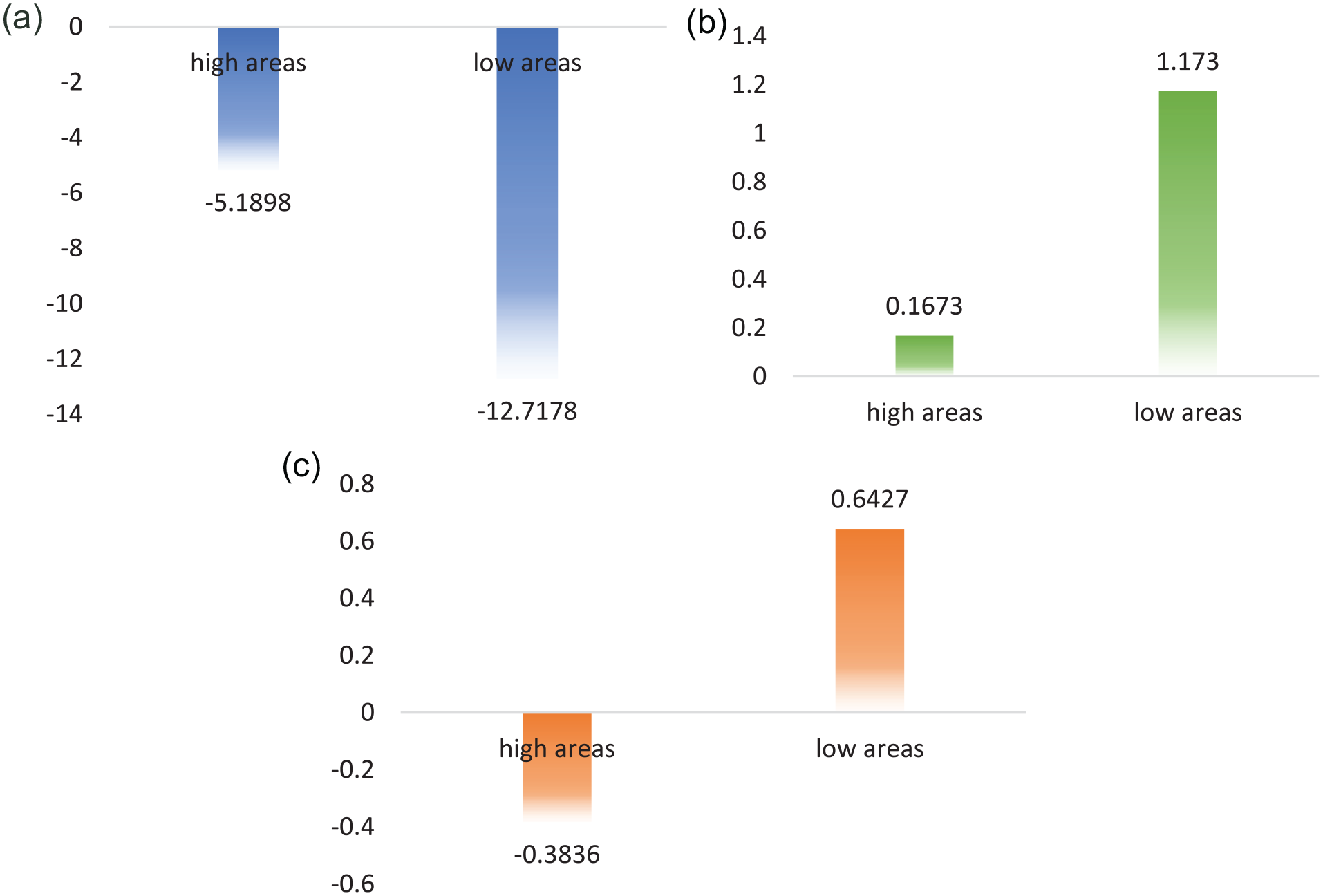
(a) Regression coefficients of GOVfdi after considering ER in “high” and “low” areas, (b) regression coefficients of GOVexp after considering ER in “high” and “low” areas, and (c) regression coefficients of GOVtax after considering ER in “high” and “low” areas.
From the perspective of local government fiscal expenditure competition, the regression coefficients of local government fiscal expenditure competition are significantly positive in both “high” and “low” areas, and the regression coefficients of the interaction between local government fiscal expenditure competition and environmental regulation are both significantly negative. The results imply that under the consideration of environmental regulations, the promotion effect of local government fiscal expenditure competition on TFP is weakened in both “high” and “low” areas. The higher the level of environmental regulation, the less conducive it is for local governments to use fiscal expenditure competition to increase TFP. The current average values of environmental regulations in “high” and “low” fiscal expenditure competition areas are 1.2927 and 0.9709, respectively. Substituting the current average values into the model, the regression coefficients of local government fiscal expenditure competition on TFP in “high” and “low” areas become 0.1673 and 1.1730, respectively (as shown in Figure 3b). This shows that under the influence of environmental regulations, the growth effects caused by local government fiscal expenditure competition at this stage can offset the cost effects due to environmental regulations. Local government fiscal expenditure competition has a positive effect on the improvement of TFP, especially in “low” fiscal expenditure competition areas. This may be because the marginal contribution of fiscal expenditure competition in “low” areas is relatively high, and local governments can effectively use fiscal expenditures to improve the “quantity” and “quality” of the economy, which in turn promotes the TFP of these areas.
From the perspective of local government tax competition, the regression coefficients of local government tax competition are significantly positive in both “high” and “low” areas, and the regression coefficients of the interaction between local government tax competition and environmental regulation are both significantly negative. The results imply that under the consideration of environmental regulations, the promotion effect of local government tax competition on TFP is weakened in both “high” and “low” areas. The higher the level of environmental regulation, the less conducive it is for local governments to use tax competition to increase TFP. The current average values of environmental regulations in “high” and “low” tax competition areas are 1.2317 and 0.9319, respectively. Substituting the current average values into the model, the regression coefficients of local government tax competition on TFP in “high” and “low” areas become ÿÙ0.3836 and 0.6427, respectively (as shown in Figure 3c). This shows that under the influence of environmental regulations, the current level of local government tax competition has a negative effect on the improvement of TFP in “high” tax competition areas, whereas it has a positive effect on the improvement of TFP in “low” tax competition areas. This may be because tax competition has a significant negative impact on environmental quality. The higher the level of tax competition, the worse the regional environmental quality. To transform regional economic growth to “qualitative” development, it is necessary to increase the level of environmental regulations. The increase in the level of environmental regulations will increase the production costs of enterprises and reduce their enthusiasm for production, which in turn will lead to a reduction in taxes in the area and relatively slow economic development. Furthermore, to stimulate regional economic development, local governments will increase tax competition by further reducing tax rates and providing tax incentives, and then embark on a “race to the bottom” on tax competition and environmental quality which will obstruct the improvement of TFP.
Conclusions and Implications
Conclusions
This study used panel data of 30 provinces in China from 2001 to 2017, measured local government competition from three perspectives (foreign direct investment, fiscal expenditure, and taxation), and then analyzed the impact of local government competition and environmental regulation on TFP. The results show that local government competition is conducive to the improvement of TFP, which means that the competitive behavior of local governments using various preferential policies will eventually promote TFP, and is also consistent with Hypothesis 1 to 3. Taking environmental regulation into consideration, the positive effect of local government competition on TFP is weakened, which means that environmental regulation will force local governments to balance the efficiency of economic growth and the ecological environment, and is also consistent with Hypothesis 4 to 6. Furthermore, under the current level of environmental regulation in China, local government fiscal expenditure competition and tax competition both have a positive effect on the improvement of TFP, whereas foreign direct investment competition has the opposite effect as shown in Figure 2.
The impact of local government competition and environmental regulation on TFP is regionally heterogeneous at different levels of local government competition in China as shown in Figure 3. Under the influence of environmental regulations, the current level of local government FDI competition in China has a negative effect on the improvement of TFP, which means that excessive local government FDI competition is harmful to TFP especially in “low” FDI competition areas. Local government fiscal expenditure competition has a positive impact on the improvement of TFP, which means that it is beneficial for local governments to strengthen fiscal expenditure competition in order to increase TFP especially in “low” fiscal expenditure competition areas. The current level of local government tax competition has a negative impact on the improvement of TFP in “high” tax competition areas, whereas it has a positive effect on the improvement of TFP in “low” tax competition areas.
Implications
The implications of this paper are as follows:
Local government competition can effectively promote the improvement of total factor productivity, so central government should further guide local governments to engage in healthy competition and orderly interaction, and establish an evaluation mechanism for healthy competition and interaction. Through the vertical and horizontal multi-directional supervision among higher, same-level, and lower governments, it is possible to avoid “vicious competition” and a “race to the bottom.”
Environmental regulations have weakened the role of local government competition in promoting total factor productivity to a certain extent, but environmental regulations are effective measures to ensure sustainable environmental development. Therefore, a coordination mechanism between local government competition and environmental regulation should be established. Local governments should pay attention to environmental quality, sustainable resource development, and ecological civilization construction in the process of competition, and achieve coordination between economic development and the environment.
At the current stage, under the influence of environmental regulations, fiscal expenditure competition and tax competition of local governments can effectively promote the increase of total factor productivity, whereas FDI has a negative effect on total factor productivity. Therefore, it is necessary to further promote the shift of local government competition to fiscal expenditure competition and tax competition, and weaken the motivation of local governments to adopt FDI competition. Local governments should focus on the quality of foreign direct investment; standardize the behavior of attracting foreign investment; and establish evaluation, assessment, and exit mechanisms, and risk prevention and control mechanisms, for inviting foreign investment.
Different regions should implement different means of competition and environmental regulation policies. For example, in “high” tax competition areas, differentiated fiscal and tax policies can be used to appropriately reduce the level of competition, which can provide a good foundation for the implementation of environmental regulations, and promote the internalization of environmental costs. In “low” tax competition areas, local governments may appropriately increase the level of competition by providing tax subsidies and preferential tax rates for environmental protection enterprises, which can also promote enterprise production and attract the inflow of factors.
Footnotes
Acknowledgements
Thank Xu Miao for his work in review and editing.
Author Contributions
Conceptualization, L.Q. and S.L.2; methodology, S.L.1 and C.Z.; software, X.D. and S.L.2; Resources, L.Q. and Y.H.; data curation, S.L.2 and Y.H.; writing—original draft preparation, L.Q., C.Z., and S.L.2; writing—review and editing, X. M.(Xu Miao); visualization, X.D.; supervision, L.Q. All authors have read and agreed to the published version of the manuscript.
Declaration of Conflicting Interests
The author(s) declared no potential conflicts of interest with respect to the research, authorship, and/or publication of this article.
Funding
The author(s) disclosed receipt of the following financial support for the research, authorship, and/or publication of this article: This paper was funded by National Social Science Foundation (21CJY026): Research on the Mechanism and Realization Path of Green Finance Promoting China’s Green Total Factor Productivity.
