




Abstract
Massive advances in information and communication technology have intensified the usage of digital technologies by organizations in the 21st century. This research aims to determine if ICT tools inhibit successful e-governance implementation and service delivery in the Cross River State Civil Service. The study’s theoretical basis was the Unified Theory of Acceptance and Use of Technology (UTAUT). To achieve its goal, the study used a mixed-methods research design. A total of 374 samples were drawn from a population of 1,123. The study’s questionnaire was administered using proportionate and random sampling approaches. An interview with thirteen (13) permanent secretaries of the ministries chosen for the study was also done. A one-way ANOVA was used to examine the quantitative data, while a descriptive evaluation was used to analyze the qualitative data. According to the investigation findings, the insufficiency of ICT tools hampers efficient service delivery in the Cross River State Civil Service. The findings also revealed that the problem of the insufficiency of digital tools is driven by insufficient budgetary availability for ICT financing. The study recommends adequate financing, digital literacy training, and the acquisition of ICT tools to promote successful e-governance implementation and service delivery.
Plain Language Summary
The study investigates and highlights the relevance of adequate e-governance financing to successful public sector digitalization programs. The study argues that while e-governance within the new paradigm of digital transformation has emerged as a tool for public sector reformation globally, the successful adoption and implementation of digital reforms is contingent upon adequate financing.
Keywords
Introduction
The performance or non-performance, success or failure, of any government around the world hinges on the quality of its workforce and, essentially, of its bureaucracy. This has informed the basis for most reform agendas on making the bureaucracy more efficient and effective in terms of service delivery to the public (citizenry). E-governance is fast becoming the currency in global practices adopted by countries to improve service delivery at the international, national, and sub-national levels. The importance of digital transformation initiatives for contemporary organizations has been demonstrated in research and practice (Agbeko et al., 2021). Digitalization is the complex sociotechnical phenomena and procedures of adopting and utilizing digital innovations by individuals, organizations, and the broader society (Gimpel et al., 2018). With the inventions of computers, internet facilities, and all sorts of electronic gadgets, e-governance has become a reform tool that modern states have attempted to use to shape the operation(s) of the public sector to function optimally and accountably. Consequently, modern organizations (not ignoring the private ones) have seen the need to invest in information and communication technology (ICT) to improve administrative processes and service delivery. The drive toward e-governance can aptly be considered, among other things, as dynamic governance—a “key to success in a world undergoing accelerated globalization and unrelenting technological advancement” (Neo & Chen, 2007). With the benefits that ICT offers, many countries have accepted the capacity of ICT to transform the system of governance as the preferred channel of delivering services to citizens, decreasing the administrative size and cost and increasing the functionality of government bodies in democratic societies around the world, a key tenet of good governance. One such indicator of good governance is the drive to uphold or improve openness, transparency, and accountability in government services (see Kaufman et al., 2010). E-governance, through the use of information technologies and digital communication, provides the variables or tools for simplifying government operations and service delivery to citizens, as well as the private sector.
A cross-country analysis of ICT usage and digital penetration among developed and developing countries around the globe reveals contrasting progress in the quality and quantity of services. While the developed countries witnessed much advancement in the use and penetration of ICT, building digital public services and infrastructures (Lember et al., 2022), the experiences of the developing countries, especially Africa, have been marked with skepticism and marginal progress (see Basu, 2004; World Bank, 2005; World Bank Report, 2002, 2022), leading to the exponential drive to improve e-governance in the developing world. Besides, the drive toward e-governance around the world makes imperative the need to mainstream its operability, not just at the national but also at the sub-national levels. This process is epochal, as in many countries it has marked the transition from the traditional/monolog administration to e-administration, where the gains of e-governance are to be realized.
In Nigeria, the road map to e-governance and administration started in 2001 with the enactment of the National Information Technology Policy, the National Information Technology Development Agency (NITDA), and, subsequently, the Nigeria Communication Commission in 2003, all in a bid to put the country (Nigeria) on the forefront of ICT development and use. Prior to this time, citizen perceptions of government efficiency and effectiveness were low. Electronic governance in Nigeria has improved several aspects of service delivery in education, justice administration, health, commerce, and trade, which include telemedicine, video conferencing, online justice administration, electronic filing of cases in the justice system, online registration and payment of school fees by students in tertiary institutions, the adoption of drill and practice software and computer-assisted instruction for the presentation of lectures, electronic payment of taxes and revenues from clients, and the adoption of emails for interdepartmental networking and communication. Nigeria is also the largest market for mobile and internet use in Africa, with about 82% of subscribers and 29% of internet users. It is projected that in the next 5 years, from 2023 to 2028, the country is expected to account for a little over 55% of penetration in sub-Saharan Africa (United States of America Department of Commerce, 2023).
In acknowledging the vital role of e-governance in enhancing the administrative machinery at the national level, we shall turn our attention to the sub-national levels in the Cross River State of Nigeria, where present and past political leaderships in the state have made concerted efforts to invest in e-governance to achieve efficiency and effectiveness in service delivery in the Cross River State civil service. However, it is reported that the problem of transitioning from traditional administrative processes by the Cross River State Civil Service, which relied heavily on the manual discharge of administrative duties and functions, to digital administration, where ICT plays a vital role, has encountered some setbacks. Public opinion on why e-governance policies in the state have not yielded the desired results in terms of service delivery is attributed to the paucity of e-governance resources. This study was therefore conducted to investigate the controversy and clear the air. This is investigated by posing the following research question:
RQ: How have digital resources (office computers, internet broadband, and GSM communication) undermined e-governance reform implementation and service delivery in Cross River State Civil Service, 2010–2020?
Addressing this research question will effectively and positively deliver organizational and managerial directions with the rising use and management of electronic and digital technologies in organizations. More so, it will further e-governance through the new paradigm of digital transformation and institutional change. The research covers aspects of e-governance, such as financing (budgetary provision and procurement), office requirements to aid service delivery (office computers and internet broadband and GSM communication), and government-citizen interaction. The study also investigates the relationship between ICT infrastructure and government financing.
Organizational researchers (e.g., Kallinikos, 2006; Orlikowski, 2007) have revitalized the concept of technology in their studies, but except with a few notable exceptions (Harris, 2006, 2008; Hossan et al., 2013; Introna et al., 2009; Pors, 2015), the digitization of the public sector remains largely unexplored (Plesner et al., 2018). Existing studies have focused on various aspects of e-governance and service delivery, such as evaluating bureaucrats’ cognitive disposition toward e-governance reforms (Inakefe et al., 2023), predicting digital system acceptance and adoption (Al-Haddad et al., 2023; Alomar, 2023), establishing a relationship between e-governance and corruption reduction (Aftab et al., 2022; Alam et al., 2023; Lindquist & Huse, 2017; Matheus et al., 2021; Sharma et al., 2021), applying machine learning and deep learning in smart city management (Heidari et al., 2022), assessed the role of IT-based technologies in human resources management (Vahdat, 2022), proposed new intelligence algorithms for better cloud services (Darbandi, 2017a, 2017b), and assessed vulnerabilities and attacks associated with the Internet of Things (IoT; Tariq et al., 2023). However, despite the availability of digital revolutions improving service delivery, there is a lack of research on the relationship between digital tools, digitalization (e-governance), and service delivery. This highlights the need for further research to understand the impact of digital tools on service delivery.
Despite substantial studies on e-governance in advanced countries, research on institutional changes as a result of digital transformation is lacking in Sub-Saharan Africa (SSA). The study focuses on the demand side of e-governance in SSA, including previously understudied limitations such as a lack of digital tools. Despite previous research (e.g., Aimuan & Endurance, 2019; Edward & Charles, 2014; Ewuim et al., 2016; OECD, 2003) identifying the inadequacy of e-governance tools, such as computers, weak internet, and lack of government confidence, as barriers to digitalization, there is a lack of research on the manifestation of the paucity of digital resources in e-governance reform implementation and service delivery. The case study combines networks, software, and hardware solutions. The combination of this mix of domains is an innovative approach in the field. The research provides academic, organizational, and managerial directions on the relationship between digital tools, e-governance, and service delivery in the digital era, where e-governance has become the most-invoked tool for public sector reformation globally.
Adhikari (2020) asserts that the least developed countries (LDCs) have failed to leverage previous revolutions, and the Fourth Industrial Revolution (4IR) offers opportunities for their development. This study seeks to investigate some factors that could inhibit LDCs from leveraging on the gains of the 41 R. The results of this study and the recommendations therefrom will not only offer pathways for LDCs to be key beneficiaries of the digital economy but will also propel them toward the realization of goals 8 (decent work and economic growth), 9 (industry, innovation, and infrastructure), and 16 (peace, justice, and strong institutions) of the Sustainable Development Goals (SDGs).
To achieve the objectives of this study, the paper is divided into five (5) themes. The section that follows is the literature review, which reviews vital variables in the field related to the study, related studies, and the theoretical framework of the study. This is followed by the methodology section, which discusses the research design, data collection approaches, and method of data analysis. The section that follows is the results and discussion section, which presents and discusses the research findings. This is followed by the study’s conclusion and recommendations, as well as the theoretical and managerial implications of the study and the direction for future studies.
Literature Review and Theoretical Foundation
This section provides a review of key variables. A review of related studies and the theoretical framework of the study, which is based on Venkatesh et al.’s (2003) Unified Theory of Acceptance and Use of Technology (UTAUT), are also presented.
Digitalization, E-Governance Services, and Organizational Change
The term “digitalization” has been used generally in the literature to denote the integration of new technologies into work processes or products (Mertens & Wiener, 2018; Mina-Raiu & Melenciuc, 2022; Wolf & Strohschen, 2018). Digitalization is the use of information and communication technologies (ICTs) by government organizations to conduct business, manage governance, and promote democratic participation (Sharma et al., 2021). This process is driven by regulatory support, government incentives, citizen pressure, and perceived benefits (Mikalef et al., 2022; Schaefer et al., 2021). Public administration is rapidly deploying technology to improve services and living standards (Urs & Spoaller, 2022). The current phase of digitalization is driven by complex data and platforms like robotics, cloud computing, and the Internet of Things (IoT; Lévesque et al., 2020). Digitally-enabled machines with artificial intelligence, digitalized processes, and digital networks are changing work, affecting labor markets, workplace interactions, and employment in the service sector (OECD, 2019a, 2019b; Warhurst & Hunt, 2019; West, 2018).
To understand the implications of digitalization on jobs, personnel, and processes, three variables must be distinguished: individual, technological, and environmental (Peiffer et al., 2020). Individual-level factors describe an individual’s objective and subjective competencies, experiences, or characteristics that impact their adaptation and reaction to digitalization (Peiffer et al., 2020). Technological considerations include system features and environment-related elements such as job type and team cooperation (Endsley, 2017). Technological and environmental aspects are more easily modifiable than individual-related aspects (Peiffer et al., 2020). Individual-related factors (objective capacities and competence perception) can affect users’ use of digital systems (Goddard et al., 2012). According to studies like Anas and Cahyawati (2023) and Inakefe et al. (2023), in-service training as a component of individual-related variables boosts workers’ digital literacy level, hence making them effective users of digital systems. This research, however, focuses on technological and environmental aspects such as digital resources as a facilitator or detractor of digitalization, which are yet to be sufficiently explored in the field.
Digitalization merges technological advancements with physical components and brings changes to organizational culture, processes, and value-generation channels, necessitating organizations to innovate and adapt to digital transformation (Dremel et al., 2017; Vial, 2019). This involves incorporating advanced digital technology, applications, and state-led digitization, enhancing citizen-government engagement and interdependence (Aben et al., 2021; Vial, 2019). The transformation relies on artificial intelligence, social media, mobile, business analytics, cloud computing, and the Internet of Things (Aben et al., 2021; Vial, 2019). Digitalization influences departmental interconnectivity, transparency, and decentralization, while accountability approaches incorporate professional ethics for equitable connections between professionals and citizens (Pors, 2015). Public sector digitization is crucial for fiscal and political responsibility, with Web 2.0 tools enabling citizen monitoring of governmental spending (Lindquist & Huse, 2017; Matheus et al., 2021). Digital transparency challenges include data quality issues and usage restrictions (Matheus et al., 2021). To overcome these challenges, principles such as separating privacy-sensitive and non-sensitive data can be implemented (Matheus et al., 2021).
Public sector transformation, such as libraries and government websites, has led to increased e-research, e-commerce, and e-participation (Sharma et al., 2021). Government services are transitioning to electronic platforms at three organizational levels: formal bureaucratic structures, accountability, and professionals (Plesner et al., 2018). Digitalization has led to structural changes, redesigning structures, creating tasks, and facilitating horizontal communication (Plesner et al., 2018). This has blurred the barrier between hierarchical management and flexible communication, making communication simpler and closing the gap between employees and decision-makers (Plesner et al., 2018).
Digitalization and Sustainable Development
Digitalization has spawned a new paradigm of sustainable technology centered on using digital resources to accomplish the 17 United Nations Sustainable Development Goals (SDGs). Information and communication technology (ICTs) have the potential to accelerate all of the SDGs (International Telecommunication Union [ITU], 2021). The United Nations Sustainable Development indicators 4.4.1 (proportion of youth and adults with ICT skills), 5.b.1 (proportion of people who own a mobile phone), 9.c.1 (proportion of the population covered by a mobile network), 17.6.2 (fixed internet broadband subscriptions per 100 inhabitants), and 17.8.1 (proportion of people who use the internet) have become the gold standard for assessing a country’s digital transformation impact. The ITU collaborates with governments in a variety of fields, including digital banking, e-health, e-education, and teleworking, to further the SDG indicators (International Telecommunication Union, 2021).
In 2021, the International Telecommunication Union forecasted that most of the world’s 42 least developed countries are making progress toward SDG 9 by building resilient infrastructure, fostering innovation, and reducing poverty. However, in 2023, the Union’s assessment in Figures 1 to 3 shows contrasting progress between developed and developing worlds in ICT infrastructural availability, particularly in broadband subscription, internet penetration, and internet accessibility for Sub-Saharan Africa and the LDCs, highlighting a need for further progress in these areas.

Fixed Internet broadband subscriptions per 100 inhabitants, 2022.

Proportion of population covered by a mobile network, 2022 (%).

Proportion of individuals using the internet, 2022 (%).
Figure 1 above is the international rating of broadband connections across the regions of the world. The figure shows the least developed region in terms of internet broadband connections for 100 inhabitants in urban and rural areas, as represented by 1%. Despite mobile subscriptions, fixed broadband connections remain low in both urban and rural areas, with rural areas being the worst affected (International Telecommunication Union, 2023b). Internet affordability is also low in developing countries, with Sub-Saharan Africa having one of the most expensive internet purchases, leading to low patronage of internet and ICT facilities (ITU and A4AI, 2021). Nigeria ranks 109th out of the 132 featured economies (Buchholz, 2023). However, the European Investment Bank (2021) predicts that a 10% increase in mobile broadband adoption could result in a 2.5% GDP rise in SSA “due to cross-border e-commerce platforms and entrepreneurs leveraging technology to expand” (Beschorner, 2021). New technologies like blockchain, artificial intelligence, and the Internet of Things are altering industries like manufacturing, agriculture, and urban development (European Investment Bank, 2021). Figures 2 and 3 also show continental and region-wide ratings of the proportion of the population covered by a mobile network and the proportion of individuals using the internet.
The top end of Figure 2 shows that in Sub-Saharan Africa between 2015 and 2022, 91% of the population had a 2G network, represented in a light-blue color. Eighty-two percent had 3G represented in the light-brown color, and 49% of the population could only upgrade to 4G, which is undoubtedly below the SDG target 9 for providing universal access to the internet in the least developed countries. The ITU survey reports that 4G technology is now available to more than 90% of the population in most of the regions, except Latin America and the Caribbean (88% of the population), Northern Africa and Western Asia (83%), Oceania (excluding Australia and New Zealand (59%), and Sub-Saharan Africa (49%) (International Telecommunication Union, 2023a).
Figure 3 further shows that only Australia and New Zealand have reached universal use (benchmarked by the ITU’s at least 95% internet penetration rate). Other regions and continents—Sub-Saharan Africa (39%), Oceania (excluding New Zealand), and Australia (48%)—ranked lowest. Also, the figure shows that universal connectivity also remains a distant prospect in the least developed countries (LDCs) and landlocked developing countries (LLDCs), where only 36% of the population is currently online.
Although much of the world has not achieved the SDG indicator on internet connectivity due to their low digital development, digitalization is contributing to the Paris Agreement’s global climate targets by introducing fintech for the unbanked, green financial goods, and new technology for SDG initiatives (Arner et al., 2020; Foster & Nassiry, 2021). Sustainable technology includes big data systems and computationally networked municipal administration (Robinson, 2020). Digital technologies are helping the Middle East and North Africa create 300 million jobs by 2050 to meet the demands of their young populations (Langendorf, 2020). Digital technologies can disrupt traditional power relations, save money, increase efficiency, and deliver climate funds directly to people in need of humanitarian aid (Foster & Nassiry, 2021). These technologies are essential for a new economic future and increased civic involvement (Robinson, 2020).
The Hazardous Impact of Digitalization: The Dark Side
Thomas Khun contends that every development in human civilization is followed by an attendant loss. Khun’s observations apply to the digitalization phenomenon, which has simplified organizational tasks but also caused “disruption for employees as they must learn new skills to adapt to new ways of working, job losses, harm to society by increasing the digital divide, and increased risks of data breaches and cyberattacks” (Digital Transformation, 2024; Veit & Thatcher, 2023).
Cybercrime, a threat exacerbated by technological advancements, has significantly impacted government operations and also caused significant damage to businesses. Cybercrimes are committed using technology like smartphones, computers, or tablets (Perwej et al., 2021). Advanced malware has exacerbated cybercrimes over the past three decades, with a single attack potentially disrupting millions and costing billions of dollars (Riggs et al., 2023). The NotPetya hack caused over $10 billion in damage, while China’s fintech ventures face challenges due to poor security and privacy protocols (Natile, 2020). Cyberattacks in Sub-Saharan Africa, Asia, and Latin America cost the banking industry $246 annually, while malicious cyber activities are expected to cost the US economy between $57 billion and $109 billion annually (Maurern & Nelson, 2020; United States White House Economic Advisers, 2018). Criminals often use the “business email compromise” tactic to steal data, conduct fraud, deploy ransomware, and engage in criminal acts (United States Department of Justice, Office of Legal Education, 2015).
The global banking industry has seen a surge in cybercrimes due to insecure communication protocols like short message service and unstructured supplementary service data (Maurern & Nelson, 2020). Hackers exploited the COVID-19 pandemic, which heightened digital infrastructural use, increasing cybercrime by 238% between February and April 2020. Sixty-one percent of US organizations have experienced a 25% increase in cyber threats since the pandemic began (Cisco Umbrella, 2023; Tom & Murphy, 2020). The FBI and Internet Crime Complaint Center have received over 4,000 daily reports of cybercrime since the pandemic began (Garcia & Hindocha, 2020).
Furthermore, digital technologies are transforming organizations and potentially replacing incumbent businesses through new models (Trittin-Ulbrich et al., 2020). The 1990s saw the end of record labels’ monopoly with Napster, while the internet is driving newspapers out of business and transforming television services like Netflix (Cho et al., 2016; Hensmans, 2003). These advancements are transforming and undermining traditional service providers, such as broadcast, cable, and satellite (Lotz et al., 2018; Park, 2017). Digital advances have had significant impacts on various industries, including media companies, taxi businesses, and the environment (Trittin-Ulbrich et al., 2020). UberX drivers have a 38% higher capacity utilization rate than taxi drivers, posing a challenge for the taxi industry (Cramer & Krueger, 2016). The debate on green IT and sustainability suggests that technology can both be a problem and a solution (Berthon & Donnellan, 2011; Dedrick, 2010; Fuchs, 2008; Wang et al., 2015). Digitalization has led to increased energy consumption and toxic waste (Veit & Thatcher, 2023).
Digitalization has led to challenges in cybercrime, necessitating policy measures to protect critical infrastructure. The increasing use of digital apps and unprotected devices underscores the need for securing information technology systems to protect data integrity, confidentiality, and system availability. Research suggests three layers of reform: domestic enforcement, international cooperation, and structural and process reform (Third Way, 2020). The Paris Call for Trust and Security in Cyberspace recommends non-proliferation of malicious software, digital lifecycle security, and cyber hygiene (Lété, 2021). The 2014 Cyber Security and Personal Data Convention mandates legal, legislative, and regulatory measures to improve cybersecurity governance (Turianskyi, 2020).
A comprehensive cyber security approach should cover various areas like cloud, critical infrastructure, data loss prevention, information security, network security, end-user education, IoT security, endpoint security, website security, and blockchain security (Perwej et al., 2021). Inclusive cyber governance requires educational initiatives, digital literacy, targeted law enforcement, diplomatic pressure, and penalties (Wiggen, 2020). Coordination between the public and private sectors is crucial for ongoing cyberspace governance (Chen, 2020).
Public sector digitalization faces issues like inadequate ICT infrastructure, power outages, low literacy levels, weak internet, and poor internet connections (Adepetu, 2012; Anyaoku, 2012; Chigbu & Idoko, 2013; Israel & Edesiri, 2014; Lallmahomed et al., 2017; Rehman et al., 2016; Renz, 2022; Savoldelli et al., 2014). Additionally, there is a clear ICT skills gap in citizen behavior when using e-government services (Chohan & Hu, 2022). Research (e.g., Adepetu, 2012; Anyaoku, 2012; Chigbu & Idoko, 2013; Israel & Edesiri, 2014) recommends examining the effects of these challenges. This study analyzes the researchers’ identification of inadequate digital tools as a barrier to digital transformation and service delivery through the conceptual model in Figure 4.

The conceptual framework.
Digitalization necessitates that workers rely on digital tools to address complex organizational issues. Access to digital resources, such as teleconferencing systems, internet connections, and digital platforms, is crucial for job performance (Kodama, 2020). Digital technologies enhance government-citizen ties by simplifying procedures and fostering social and economic resilience (Asian Productivity Organization, 2022; Daub et al., 2020). They can revolutionize various sectors, including logistics, finance, and services while ensuring trust and customer satisfaction (Beschorner, 2021; Renz, 2022). Digital technologies can also create public services that make citizen interactions with the public bureaucracy quick, safe, simple, and corruption-free (Mina-Raiu & Melenciuc, 2022).
Review of Related Studies
Salam’s (2013) study aimed to evaluate the effectiveness of District E-Service Centers (DESC) in service delivery in the public sector, assess the impact of e-service on citizens, and determine if e-governance schemes promote good governance. The results of the study confirmed the hypotheses formulated for the study, indicating that e-governance schemes can contribute to good governance. The study’s findings provide valuable insights into the role of e-governance in improving public services and enhancing citizen satisfaction. However, it did not highlight the role digital tools played in accentuating or reducing e-governance services or the impact of the experience on public servants.
Alhassan (2020) researched issues and prospects in the use of e-governance for development. The study employed a mixed-methods research design to achieve its objectives. Per the research findings, there is a strong relationship between e-governance and sustainable development. The study further established that the deployment of e-government projects has a direct impact on the three pillars of sustainable development: economic, social, and environmental. According to the study, e-governance ensures the delivery of services remotely, thereby reducing the economic, social, and environmental costs associated with service delivery to the public. It cuts down on the use of resources and empowers consumers to seek and receive services around the clock. However, the study did not x-ray the significant role played by public administration in the drive toward socioeconomic development using digital technology.
Sigwejo’s (2015) study aimed to evaluate e-governance services in third-world countries using a citizen-centric framework. The research aimed to identify existing models, understand citizens’ perspectives on e-governance effectiveness, and determine their applicability and workability. The results showed that the low effectiveness of e-governance services reduced citizens’ adoption rates, influenced by low service quality and delayed government information relay. The study concluded that the quality of services and the effectiveness of e-governance services were crucial factors in determining their applicability and effectiveness in third-world countries. The paper did not take cognizance of the tech-infrastructural challenges facing government bureaucracies and how they implement e-governance services, nor did it x-ray the funding and procurement for ICT enroute to service delivery.
Iong and Phillips (2023) conducted a study on government employees’ attitudes toward e-government services. They conducted ten in-depth interviews in Macao SAR, focusing on the Theory of Planned Behavior (TPB) and e-government studies. The results showed positive attitudes toward e-government services, as they were seen as necessary for daily work and macro-government policies. However, the frequency of usage was low in personal life. The main motivation for using e-services was from superiors, and the study found low risk in using government digital services compared to banking services. However, the study did not specify if government ICT was easier or not to attract more preference from the employees. For instance, if less tech savvy was required for government operations compared to those of the private sector.
Ganguly and Acharyya’s (2021) work centers on production lines and tries to draw a link between the infrastructural development of ICT services and the quality of goods and services exported by a country. They found that an upscaling of ICT facilities in production brought both benefits and costs. The benefit was that it improved the quality of products for export with a greater cotton edge, but also had cost implications, which required some competition for scarce resources and the prioritization of funding resources for ICT upgrades of equipment and skills of the workforce. While their findings are focused on production lines for export of goods and services for countries hoping to use high-tech manufacturing to boost economic growth, our paper leverages this to situate the context within the public sector e-governance services to show the link between ICTS infrastructures and the performance of public sector e-governance services.
Akintunde (2007) draws a nexus between provisions for ICT facilities and effective service delivery in the management of library services in Nigeria. For him, if ICT services are to meet the demands of the public, improved budgeting for ICT tools and personnel technical training must be met. While the Akintunde assessment is based on Nigerian public library services, we find it a bit narrow and therefore need a much wider context aside from the monolith department silo assessment. Hence, our recourse is to espouse the analysis within the context of government bureaucracies having ministries, departments, and agencies to give much-needed assessments.
Gap in Literature
Against the backdrop of the foregoing review, research on e-governance and ICT use and development in the public space revolves around three thematic pillars: ICT infrastructures, citizen-centric e-governance, and agency-centric e-governance. The papers examined highlighted one or more aspects of the research. For a more balanced approach, apart from the almost one-sided, citizen-centric ICT and e-governance views that dominate the research, efforts should also be made to look at the demand side of the supply, which is: ICT infrastructures, their provision, and the implementing institutions or bureaucracies, to which this study seeks to address or fill in the gap, either wholly or partially. This study was therefore undertaken to fill this gap by posing the following hypothesis:
In terms of methodology, other research has adopted either qualitative or quantitative approaches to investigate e-governance-related issues. It could be observed that there is a dearth of research that combines two research methods. Researchers have contested studies because they have consistently overemphasized confirmatory statistical methods (Schwarz & Chin, 2007; Silva, 2007). According to Silva (2007), most quantitative research is unarguable except for possible issues relating to sample size. Another option that produces rich and thorough data is the qualitative technique (Elliot & Loebbecke, 2000; Lee et al., 2003). Combining the two approaches, therefore, promises optimal results. According to Silva (2007), information technology research requires both methodologies to aid in the comprehensive investigation of issues under consideration. To develop new ideas, prevent misleading findings, or fill a methodological gap, research methodologies must be varied (Jacobs, 2011; Miles, 2017; Müller-Bloch & Kranz, 2014). Therefore, this study adopted a mixed-methods research design to bridge the gap, generate new insights, and avoid distorted findings.
Theoretical Framework
The Unified Theory of Acceptance and Use of Technology (UTAUT) is used as the theoretical framework of the study. UTAUT was developed by Venkatesh et al. (2003). The originators of the theory deconstructed and synthesized the tenets and assumptions of eight (8) existing Information Communication Technologies theories (the Technology Acceptance Model, Innovation Diffusion Theory, Motivational Model, etc.). The UTAUT provides managers with a guide to evaluate the prospects of a technology being accepted by the staff of an organization. The core factors that ultimately determine users’ use of technology, gleaned from the theory, are discernible:
Applicability of the Theory to the Study
The study argues that the availability or otherwise of digital infrastructure enhances or undermines the workability of e-governance or digital transformation in the public sector. UTAUT’s fourth tenet espouses that facilitating conditions (supporting infrastructure) are relevant for high organizational performance. Thus, the study contributes to the theory of the relevance of supporting infrastructure (digital tools) in digitalization and service delivery. The study also argues that the availability or otherwise of digital resources is contingent upon adequate e-governance financing. Consequently, the study expands the theory by identifying e-governance funding as an enabler of digitalization, thereby adding to UTAUT’s fourth construct: facilitating conditions.
Methodology
Research Design
The study adopted a mixed-methods research design. Mixed-methods research was used by Inakefe (2021) in his master’s thesis. The results of the first construct on digital literacy have been published by Inakefe et al. (2023). This paper is based on the second construct with the same method but different results. Bassey (2021) and Ike et al. (2023) have also adopted the mixed-methods research design to research issues relating to the implementation of the National Health Insurance Scheme (NHIS) and the Integrated Personnel and Payroll Information System (IPPIS) in Nigeria. The mixed-methods research design was deployed to answer the question as to why the Cross River State Civil Service performed below expectations despite the adoption of e-governance for service delivery. Hence, both quantitative and qualitative techniques were used to gather data, which was collated, synchronized, and analyzed.
The study used a closed-ended questionnaire and an interview checklist to collect data on civil servants’ satisfaction with digital service delivery, client accessibility, and the availability of digital resources. The questionnaire was structured using a 5-point Likert scale. The questionnaire assessed five statement items, while the interview checklist had three topical probing questions to identify the aspects of service delivery affected by inadequate digital resources and the implications of the lack of ICT tools for public clients.
Thirteen (13) out of the thirty-nine (39) ministries in the Cross River State Civil Service represent one-third of the ministries as the target population for the study, which allows for a fair generalization of the results. This was a result of resource constraints and the fact that we selected only ministries that have fully implemented the e-governance project. The ministries were selected to reflect the various sectors of the economy and civil service operations such as finance, education, environment, health, culture, justice, ICT, and tourism. Senior officials of the 13 ministries, including the permanent secretaries (administrative heads) of the ministries, were interviewed to collect qualitative data. Table 1 below shows the population of each of the thirteen ministries and the corresponding proportionate sample selected for the study.
Numerical Value of the Selected Ministries for the Study.

Source. Adapted from Inakefe (2021) and Inakefe et al. (2023) with modifications.
Secondary data for the study were gathered through a review of relevant literature on the issue under consideration. Priority was given to studies published in the last 5 to 10 years for the study to be impactful.
Sampling Procedure
Given that the study is a large-scale population study, and to ensure the reliability and generalizability of the study’s findings, one-third of the population (1,123), representing 374, was used as the sample for the study. A sample of 374 is a fairer representation of the population than the sample of 295 obtained through the Taro Yamane formula.
374 copies of the questionnaire were self-administered to randomly selected individuals from the thirteen (13) ministries based on proportionate sample size (see Table 1 above). At the ministries, respondents were drawn predominantly from the administrative cadre because of their perceived understanding of the subject area. The research instrument was explained to respondents who needed help, and the instrument was easily retrievable. Permanent secretaries were briefed about the research essence before structured interviews with thirteen of them. These secretaries were chosen because they oversee ministries and e-governance initiatives and possess the necessary knowledge to meet the research objectives. The structured questions in the interviews were repeated throughout the interviews, lasting 30 to 45 min, and recorded to avoid distorted transcription and analysis.
Instrument Validation
The study instruments (questionnaire and interview checklist) were evaluated for face validity and predictive validity by a team of experts from the University of Nigeria, Nsukka, comprising two lecturers and a statistical analyst (statistician) using the SPSS software package. The research tools were subjected to critical testing for errors before their eventual adoption for use. The validity of the qualitative data was ensured by using a tape recorder and ethical recruitment.
Reliability of the Instruments
The instruments were developed based on the Likert 5-point scale. Carefully designed test items (structured scales) to measure both declarative and procedural knowledge. The reliability of the instruments was assessed using the Cronbach Alpha techniques with a correlation of .83, which is near perfect. Other findings reveal a group of items evaluated across several construct categories, namely, cluster 1 at 0.96 levels of correlation, cluster 2 at .76 levels of correlation, and cluster 3 at .75 levels of correlation. Thereby authenticating the reliability of the instrument to provide reliable and accurate data for the study.
Method of Data Analysis
For the qualitative method, results from survey questionnaires of 374 respondents were inputted into version 28 of the SPSS software package and analyzed using the one-way analysis of variance (ANOVA), since it examines the association between two variables and sets 0.05 as the level of significance for testing a hypothesis. To address the qualitative aspect of the study, interviews were conducted to elicit information from the interviewees, lasting about 30 to 45 min, then transcribed and analyzed using descriptive evaluation. The descriptive evaluation was done based on a thematic analysis and presentation of the results based on the dominant themes in the interviewees’ responses. The results thereof were arranged in a set of themes to reflect the various responses, which were then analyzed based on the hypothesis. Based on this, conclusions and recommendations were reached.
Results and Discussion of Findings
Data for the analysis arose from the 374 issued and retrieved for the study and the interviews held with the thirteen permanent secretaries covered by the study. The results are presented in Table 2 and discussed.
ANOVA Analysis of the Effect of Digital Tools on E-Governance and Service Delivery.
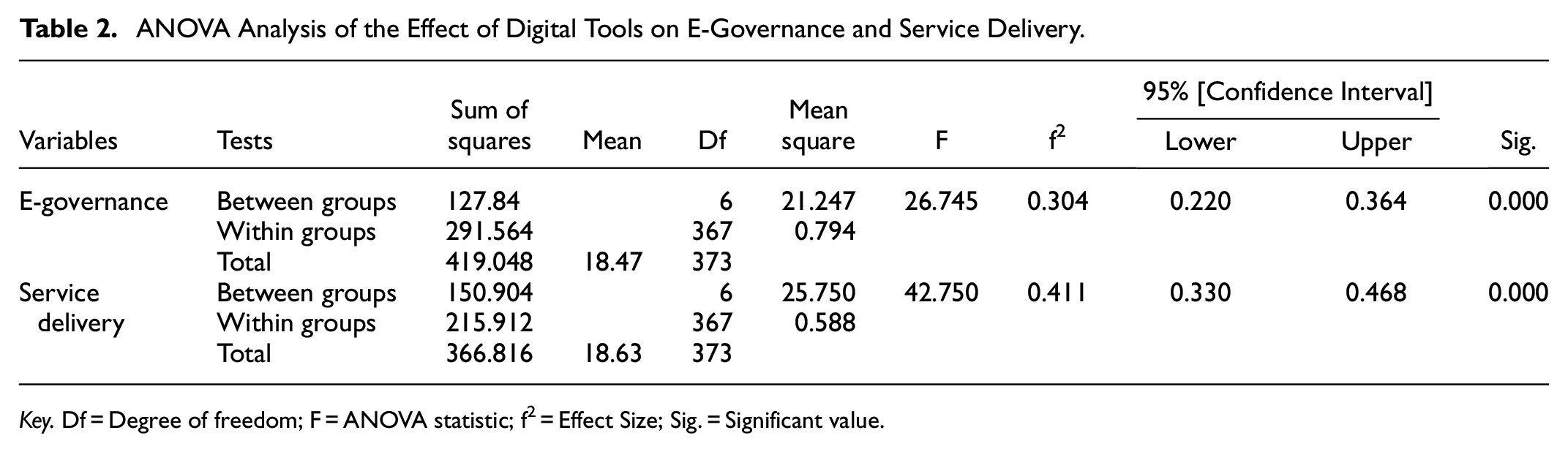
Key. Df = Degree of freedom; F = ANOVA statistic; f2 = Effect Size; Sig. = Significant value.
The research evaluated the significance of digital tools on e-governance and service delivery using two research approaches:
• Knowledge-based assessment, where civil servants are asked to respond to carefully crafted questions that range from structured scales and free-from questions that measure the effect of digital tools on e-governance and service delivery; and
• Self-assessment, where the researchers review literature and government publications to make meaning to underscore the prevalence of the theme(s).
The results show that digital resources have undermined the implementation of e-governance reforms for effective service delivery. The results further show that inadequate financing of e-governance is the cause of inadequate digital resources in the Cross River State civil service.
The ANOVA results in Table 2 above showed the effect of digital tools on e-governance and service delivery. The result reveals that there is a significant effect of digital tools on e-governance and service delivery: e-governance F(6, 367) = 26.745, p = .000 and service delivery F(6, 367) = 26.745, p = .000. Since the probability level of e-governance and service delivery is less than 0.05 for testing the hypothesis, the hypothesis is accepted. Therefore, digital tools (office computers, internet broadband, and GSM communication) undermined e-governance reform implementation and service delivery in Cross River State Civil Service 2010–2020. The effect size of 0.304 indicates that 30.4% of the variance in the mean of e-governance reform implementation is accounted for by digital tools within a confidence interval range of 0.220 and 0.364. The effect size of 0.411 indicates that 41.1% of the variance in the mean of service delivery is accounted for by digital tools within a confidence interval range of 0.330 and 0.468.
This result is buttressed by the findings of the interviews, which identified the inadequacy of e-governance tools as responsible for why effective service has not been realized in the Cross River State Civil Service.
Inadequacy of E-Governance Infrastructure
E. Ebeku notes that poor network facilities, obsolete hardware, and the unavailability of important software undermined e-governance initiatives and the realization of service expectations (Personal Communication, February 4, 2021). The problem of inadequacy of e-governance resources is in three aspects: networking, hardware, and the unavailability of the necessary software (E. Ebeku, Personal Communication, February 4, 2021). T. Takong identified poor funding of ICT as undermining e-governance implementation (Personal Communication, January 21, 2021). Poor funding resulted in the inability of the government to renew software licenses such as Oracle Accounting Base upon expiration, thereby limiting the workability of most e-governance platforms and services (T. Takong, Personal Communication, February 21, 2021). Fiber optics failed because of the government’s inability to procure bandwidth, provide power supplies, and maintain hardware (M. Ikpi, Personal Communication, February 1, 2021). J. Ikpi attributes the problem of funding E-governance to the cessation of Cross River State oil wells to Cameroon and Akwa-Ibom State, which has reduced the revenue base of the state, thereby reducing the capacity of the state to sustain or increase the budgetary allocation for E-governance (Personal Communication, February 1, 2021). M. Mgbekem also explained that part of the problem of poor funding for e-governance resulted from the lack of continuity in ICT funding after the withdrawal of donor agencies to sponsor e-governance initiatives (Personal Communication, January 28, 2021). Ensuring the Ability of Frontline Workers failed because the government could not continue its funding after its sponsor, the World Health Organization (WHO), withdrew (M. Mgbekem, Personal Communication, January 28, 2021). E-governance policies such as Supporting Institution Reform, Budget Accounting Treasury Management Information System (BATMIS) sponsored by the World Bank and European Union designed to aid the preparation of financial reports, budgeting and auditing and to bridge the gap between human resource and payroll that is, linking the human resource database at the office of the Head of Service and payroll at the office of the Accountant General through electronic medium; the Local Government Reform Program assisted by the World Bank, and State Integrated Financial Management Information Systems (SIFMIS) also sponsored by the World Bank to integrate all MDA’s to aid financial accounting, digital preparation of voucher, and posting to reflect in the consolidated accounts in the Accountant General Office have not brought about significant improvement in service delivery due to lack of continuity in ICT funding after withdrawal of their sponsors (T. Takong, Personal Communication, January 21, 2021). M. Eko associates the problem of lack of proper funding for e-governance and its resultant creation of paucity of digital resources and consequently poor service delivery with laxity among the political class to sustain and fund e-governance programs (Personal Communication, February 1, 2021). Data from the Cross River State Budget Office reveal statistics on budgetary allocations for E-governance from 2010 to 2020. Table 3 displays derived data on the budgetary provisions for e-governance alongside the total budget for the years under discussion.
Overview of Budget Trend for ICT Against the Total Budget Estimates in Cross River State, 2010–2020.

Source. Authors’ Compilation.
Table 3 indicates that the year 2020 had the highest budgetary provision for e-governance, with a sum of ₦3,047,700,175, followed by 2018 with ₦1,257,112,359.36, and 2019 with ₦871,160,370.32. Table 4, derived from data in Table 3, based on Benchmark 1 of the Carnegie Classification of Budget Impact for ICT, shows a smackingly low budgetary provision for ICT from 2010 to 2020.
Percentage Distribution of Budgetary Provisions for E-governance in Cross River State, 2010-2020.

Source. Authors’ Compilation.
Based on the budget impact assessment, Table 3 highlights the government’s lack of priority for E-governance in the years under review. According to the data, ICT financing accounted for 0.37% of the budget in 2010, 0.43% in 2012, 0.42% in 2013, 0.40% in 2014, 0.39% in 2015, 0.31% in 2016, 0.18% in 2017, 0.09% in 2018, 0.08% in 2019, and 2.07% in 2020. Although the Carnegie Classification of Budget Impact for ICT does not specify a benchmark for determining how much institutions should invest in information and communication, it is clear that inadequate budgetary provisions are the cause of insufficient digital resources and, as a result, poor service delivery. R. Ovat explains that much of the budget spending does follow the budget plan and budget priorities (Personal Communication, January 28, 2021) This exacerbates the problem of poor E-governance funding and procurement of digital resources (R. Ovat, Personal Communication, January 28, 2021). M. Ekanem explains that insufficient ICT tools (laptops, computers, internet, etc.) and a lack of electricity supply are hindering the Cross River State Civil Service from meeting service expectations and deadlines (Personal Communication, January 28, 2021). Explaining further, T. Takong stated that:
“Inadequacy of ICT tools hinder the realization of service goals and deadlines as a result of the inability of staff to meet the timeline of services because government information is time-bound. The information civil servants are expected to provide within a specific period is not met because of the barriers. An example is the publication of government accounts. It is mandatory by law that accounts be published on or before the 31
st
day of March every year. The commissioner of the ministry is also expected to present the ministry’s budget to the House of Assembly on or before the last working day of October every year. The House of Assembly is expected to send the budget back to the Governor on or before the last working day of the year. And because of the lack of the aforementioned facilities, civil servants are not able to meet such deadlines. This affects the deadlines. Permanent secretaries are expected to publish information, thereby contravening the financial laws. It also affects service delivery because the services civil servants are expected to render to clients are not rendered adequately, thereby causing dissatisfaction among clients. It also brings additional costs to the government and irregularities in budget cycles, which affect the proper rendering of accounts” (Personal Communication, January 21, 2021).
T. Takong explained that a dearth of e-governance-supporting infrastructure hinders service delivery in Cross River State Civil Service, not only in the preparation of annual estimates but in other areas as a factor militating against the realization of other services in Cross River State Civil Service (Personal Communication, January 21, 2021). In this way, E. Effiong revealed that:
“The non-existence of a database to capture payment for water bills and a lack of a database to capture clients leads to loss of revenues through manual payment; the non-passage of the water bill by the Cross River State Assembly hinders the implementation of digital payment for water resources, thereby introducing corruption in the process; and the non-inclusion of some ministries among the pilot ministries that have benefited from e-governance initiatives hinders effective service delivery in the ministry (Personal Communication, February 3, 2021).”
E. Effiong links the problem of the dearth of e-governance infrastructure to political corruption, which creates a lack of ICT facilities due to embezzlement of funds meant for the procurement of ICT facilities and training of staff (Personal Communication, February 3, 2021). This, in turn, engenders inefficiency in service delivery and hence limits the civil service from meeting service expectations through the delay in policy decision-making, loss of government revenues, delay in the proceedings of government meetings, and hinders access to data and information (E. Effiong, Personal Communication, February 3, 2021). M. Nyajor provided that: “A barrier such as poor power supply that hinders the use of e-governance tools generates inefficiency in service delivery and limits the attainment of service targets by delaying prompt response to citizens’ demands, resulting in the loss of valuable resources and manpower hours and the creation of dissatisfaction among members of the public in service delivery and government operations” (Personal Communication, March 17, 2021).
T. Takong stated that:
“The existence of the problem of inadequacy of ICT tools impedes the speed of justice delivery in terms of meeting deadlines for filling cases, leak of confidential government information due to staff having to process official documents outside the establishment, waste of resources of governments, delay in justice delivery, and lack of satisfaction for clients” (Personal Communication, January 21, 2021).
T. Takong also identified a lack of substantial spread of E-governance facilities among the civil servants who are the operators of E-governance and bureaucratic opposition to E-governance initiatives and the attitude of always trying to do things in the old ways as part of the factors hindering E-governance and service delivery in Cross River State Civil Service (Personal Communication, January 21, 21021). Low internet penetration, slowness in internet speed, limited internet bandwidth, and low-quality internet services hinder citizens’ access to government information (T. Takong, Personal Communication, January 21, 2021). M. Mgbekem offered that: “Unavailability of internet facilities in most rural areas of the 18 local government areas of the state to capture data into the District Health Management Information System (DHMIS) to be relayed into the National Health Management Information System (NHMIS) managed by the federal government and lack of power supply hinders the timely entry of data, resulting in an inability to meet deadlines for data entry” (Personal Communication, January 28, 2021).
E. Eko further explained that: “The dearth of supporting infrastructure affects administrative services such as digital imputation of data and delays data processing in areas such as the processing of examination results from various schools in the state and the digital compilation of biodata of staff under the supervision of the ministry” (Personal Communication, February 1, 2021).
Discussion of the Findings
The study reveals that insufficient e-governance infrastructure in the Cross River State Civil Service hinders e-governance and service delivery. This aligns with Venkatesh et al.’s (2003) Unified Theory of Use and Acceptance of Technology, which suggests that facilitating conditions, such as digital infrastructure, are necessary to ensure performance expectancy in technological adoption and use. Other constructs of the theory include performance expectancy, effort expectancy, and social influence, which measure individuals” belief in the effectiveness of technology in their jobs, the ease they feel in using technology, and the impact they have on their use of technology from those around them (Venkatesh et al., 2003: 453). The study’s results indicate that the first two constructs are affected by the inadequacy of digital tools. The study also highlights the impact of digital resources on performance expectancy and the effort bureaucrats require to execute assigned tasks, ultimately determining the outcomes of actual services delivered.
Previous studies (e.g., Abdelazyz, 2020; Aneke et al., 2019; Osamwonyi, 2016) have highlighted the challenges faced by organizations in digital transformation, including a lack of skilled ICT-savvy staff, inadequate planning, lack of digital literacy training, job loss fear, poor management, and coordination. The importance of digital resources and proper funding for e-governance implementation has not been adequately addressed. This study highlights the need for adequate ICT financing and infrastructural tools. The findings of this study indicate that the lack of digital infrastructure is due to inadequate financial resources for ICT, with 0.37% of the budget committed to ICT financing in 2010, 0.43% in 2012, 0.42% in 2013, 0.40% in 2014, 0.39% in 2015, 0.31% in 2016, 0.18% in 2017, 0.09% in 2018, 0.08% in 2019, and 2.07% in 2020.
At the current stage of the development of the e-governance literature, there is currently no benchmark for deciding how much investment in ICT is sufficient. According to Smallen and Leach (2004), establishing sufficient investment in ICT depends on the institution’s mission and competitive advantage. However, the pittance of ICT investments, which is less than 3% in all years considered, would scarcely support any organization’s institutional purpose and competitive advantage in today’s digital era, where ICT plays a key role in institutional change.
While the Technology-Organization-Environment (TOE) framework proves to be useful for studying the adoption and assimilation of different types of information technology innovation (Oliveira & Martins, 2010), this study draws a nexus between the first, second, and third tripods of Tornatzky and Fleischer’s (1990) TOE framework, where e-governance financing is a predictor of technology resource availability, affecting organizations' areas such as internal structures and processes, hindering organizations from meeting external influences from the environment such as pressure or competition. This also corroborates the summary report of the International Telecommunication Union (2023b), which points to the synergy between digitalization and economic growth by insisting that an upscaling of the ICT inputs into the production processes by way of increased funding will lead to better quality of products and services.
This study highlights the inadequacy of digital resources in e-governance, which contributes to technical and environmental issues. This is a remarkable contribution to the area, which deviates from Al-Haddad et al. (2023), Alomar (2023), and Inakefe et al. (2023), who focused on individual-related factors by predicting digital system adoption and acceptance predators such as digital competence, perceived ease of use, perceived utility, and customers’ attitudes. The lack of digital tools, low internet penetration, lack of databases, and poor power supply due to a lack of proper funding hinder digital transformation and service delivery. The study also highlights the impact on citizen satisfaction, highlighting the need for improved digital tools and infrastructure. The inadequacy of digital tools, low internet penetration, and poor power supply result in a difference between the e-governance reform agenda and the public sector digital transformation outcomes, leading to poor service delivery.
The policy implication is that funding ICT development and use determines the success rate of e-governance, as ICT tools play a significant role in service delivery. The availability and use of computer facilities, internet broadband, and telecommunications drive the government’s agenda of mainstreaming e-governance and service delivery. But rarely can this be achieved without adequate budgetary provision for ICT development and skill improvement in the workforce. Therefore, the central contribution of this research is that the availability of ICT tools is contingent upon good budgetary provisions and skill development to improve service delivery. Wherefore technology tools are used without a corresponding uptick of resources tailored toward ICT development and training of public officials whose skills are needed to mainstream e-governance, the drive toward digitalization will remain hampered.
Carter and Belanger (2004), Alam et al. (2023), and Aftab et al.’s (2022) studies have established a correlation between e-governance and corruption reduction in the public sector. Part of the study’s results reveals that the problem of inadequacy of digital resources was caused by the embezzlement of public funds (corruption), hinting that corruption, which E-governance reform in most contexts is designed to fight, can be an inhibitor of digitalization, thereby giving organizational and managerial attention to the need to fight corruption and resistance to E-governance implementation as the same sequence in public sector digital transformation.
Conclusion and Recommendations
The optimal realization of effective service delivery through e-governance is heavily dependent on the availability of adequate e-governance tools. Inadequate digital resources hinder the realization of the gains that e-governance promises. Our study indicates that the availability of e-governance resources such as strong internet facilities, computers, electricity, laptops, etc. are inescapable concerns for states and organizations in the digital age, as government service provision and citizens’ satisfaction are undermined by their inexistence. The Cross River State civil service’s use of ICT tools for e-governance demonstrates that inadequate digital tools hinder service delivery and have negative economic effects. Poor budgetary provision and political will are identified as a clog in the progress toward e-governance. Poor financial and technical provisions for procurement and use of ICT facilities like internet broadband connectivity, office computers, telecommunication servers, and GSM communication facilities are also a reflection of the lack of political will. The availability of ICT infrastructure and required skills depends on the policy thrust and determination of the government, either at national or subnational levels. This case highlights the importance of government policy in ensuring the successful implementation of ICT tools for public administration.
For modern governments and organizations to thrive and remain viable and competitive, adequate e-governance resources are vital. Consequently, policymakers and administrators should consider:
Assessing the digital resource demands and needs of their organizations, they should strongly consider the option of investing adequately in procuring relevant e-governance resources. This can be done by taking stock of the general as well as unique ICT needs of each department and tailoring the training modules to meet the demands of each government department. ICT equipment must be distributed to all departments in the organization, starting with the staff offices—the planning department, human resources, personnel, customer relations, and public relations departments. Then, this should be extended to line departments like the public works department, supervisory department, etc. to accommodate all trainable staff. Adequate budgetary allocations should also be made to support e-governance procurement plans. There is a need to shore up revenue and fiscal grants for subnational governments and, by extension, their bureaucracies to meet digital infrastructural challenges, including, essentially, the drive toward digitalization for service delivery. Investment in digital resources can also be accompanied by digital literacy training programmes to upskill the workforce to be attuned to the demands and realities of the digitalization program. This agrees with the Nigerian government’s national policy on improving ICT usage in the public service and propagating e-governance.
There is a need for an institutional policy that insists on ICT training for recruits before they are deployed to designated jobs. General training on ICT proficiency for all new staff on office software packages and interfaces with digital tools like telecommunications. Such that all staff concerned with service delivery can receive calls and e-mails from the public and input complaints into the computer for solution purposes. They are also to be trained to input biometric data of customers or citizens with needs in social services sectors like health, education, the environment, and the humanitarian sector. Also, there is a need for departmental ICT skill training to acquaint the personnel with the operational demands of the department geared toward service delivery. By this, we mean office software, mail correspondences, use of the internet broadband connection, and office telecommunications facilities in such a manner that they can coordinate their tasks, synergize, and respond to public needs or problems. This is one of the expectations of the citizens: that e-governance leads to a much easier and faster way of responding to public problems.
An ICT curriculum for the public service is needed. It should start with the training of recruits before deployment, then in-service training modules on simple software to aid government business or service delivery, and ICT promotional exams for progression to the next level, both for intermediate and management staff. The policy implications are that ICT development and use will help propel a country toward economic growth and development. While poor commitment to ICT infrastructure development and use will cripple the workforce, it will compound public problems, especially in the service sectors (health, education, public utilities, environment, and humanitarian sectors). Therefore, there should be a conscious and deliberate effort by the government to match words with action and improve the budgetary provisions for ICT by allocating more revenue to the sector, because ICT services are the pivot that drives national and subnational economies.
Theoretical and Managerial Implications
This study contributes to theoretical and practical research on e-government technological innovations for information societies. The contribution to the general body of knowledge on the use of e-governance for service delivery by public bureaucracies in developing countries hinges on the nexus between ICT infrastructure and funding availability. The unified theory of use and acceptance of technologies made a case for facilitating conditions to aid the use of ICT tools for service delivery. We are bold to underpin funding as part of the enablers of the digital drive. This also brings to the fore the importance of furthering research on the nexus between the internal dynamics of operations of the bureaucracy and the broader context around revenue sources—the policy and politics revenue allocation and grants at the intergovernmental levels—because the experience of the developing countries shows a fiscal imbalance between the center and the subnationals, leaving them with limited resources for infrastructural projects and services, including e-governance services, as the experience of the Cross River State civil service revealed. Significantly, the availability of ICT infrastructure and use in the public sector is contingent upon funding made available and prioritized for ICT-related public service engagements and service delivery. Put differently, the broader context of power arrangement and revenue allocation are conditioning factors that affect the availability of digital tools in the public sector. It, therefore, means that the characteristically centralized or skewed nature of revenue or fiscal allocations in developing countries may affect the provision of services (see UN-HABITAT, 2015), essentially also e-governance services at the sub-national levels, which in turn may have ripple effects on the performance of their public bureaucracies.
In the main, through the experiences of the Cross River State civil servants’ use of ICT tools in the business of service delivery, insights have been gleaned on the empirical factors that can influence the progress, or otherwise, of the use of digital technologies to render services. This has implications for organizational theories and the modern use of information systems. The study establishes a relationship between digital tools, e-governance, and service delivery.
Resources, tools, and communications are the lifeblood of any organization’s operation. Therefore, it is necessary to earmark adequate resources for the acquisition of digital equipment, without which the operations of the government can be hampered. In light of this, adequate provision must be made in the budget for government departments to equip themselves with ICT tools and equipment. Next in the pecking order is the training of personnel in the know-how and use of digital tools for efficient and effective service delivery. These are necessary measures that put a country on the path to achieving technological achievement.
Technology, tools, and humans are key drivers of organizational or institutional operations and the reason why organizational goals are accomplished. Therefore, managers and policymakers should make efforts to provide digital tools and an adept workforce if the goals of e-governance and service delivery are to be realized. In the main, although the influence of organizational context matters (sociology, politics, and economic determinants), adequate and effective use of digital tools and technologies reduces sociological pathologies like corruption. It also introduces transparency and efficiency in government operations and reporting, thereby increasing citizens’ trust in government—the gains of e-governance. Also, in contribution to the practice of administration, the study’s results highlight the significance of funding for organizational change through digitalization, given that every technological resource required for deployment comes with an attendant financial cost requiring budgetary provision. While the core emphasis is on ICT infrastructural provision, the contingent factor is resource availability.
Future Recommendations
The uniqueness of this study is its case study approach. However, this poses a challenge to the generalizability of the research findings. Future research could be geographically expanded. While this study suggests that the problem of insufficient digital tools is driven by insufficient e-governance financing, future research might focus on the human and institutional problems that produce disparities between budget plans, budget utilization, and budget priorities, as well as the association between bureaucratic characteristics (e.g., formalistic impersonality, formal rules, and standardized operating procedures) and e-governance budget execution to proffer efficient budget implementation monitoring systems.
Footnotes
Acknowledgements
This work is based on a master’s thesis by the first author submitted to the University of Nigeria’s Department of Public Administration and Local Government under the supervision of Assoc. Prof. Edwin Izueke Madu. The thesis’s title was “E-Governance and Effective Service Delivery in the Cross River State Civil Service, Nigeria, 2010-2020.” The authors are grateful to the thesis advisory committee, which includes academics such as Prof. Ngozi Christiana Ewuim, Prof. Nnadozie Onyema Uchechukwu, Prof. Okey Marcellus Ikeanyibe, Assoc. Prof. Benjamin Amujiri, Dr. Nwosu Okwudili Odiye, and the journal’s reviewers.
Declaration of Conflicting Interests
The author(s) declared no potential conflicts of interest with respect to the research, authorship, and/or publication of this article.
Funding
The author(s) received no financial support for the research, authorship, and/or publication of this article.

Data Availability Statement
Raw data were generated at the thirteen ministries covered by the study. Derived data supporting the results of this study are available from the corresponding author (Gabriel Inakefe Inakefe) upon reasonable request.