




Abstract
The involvement of green marketing in sustainable consumption is becoming a hot topic in recent decades. However, the co-themed studies of these two terms are relatively less sufficient, and more detailed integrated research should be processed. This study uses CiteSpace to do bibliometric analysis regarding the knowledge structure and evolution of green marketing in sustainable consumption with visualization. Results show that green marketing in sustainable consumption is a prosperous topic with increasing annual publications. Besides, there are relatively complicated collaboration networks among institutions and strong extensive cross-regional collaborations, and the most productive authors may not be highly cited, which contradicts with former results of other studies. Furthermore, “green,” “consumption,” “sustainability,” and “consumer” are more welcomed in this research domain and are at the dominating status in the recent studies; some new research directions have emerged, and research focuses are more diversified, implying the multidisciplinary and comprehensiveness nature of this research domain. This study enjoys novelties by combining green marketing and sustainable consumption, constructing a knowledge framework of this domain, revealing current gaps, and proposing key research directions in the future, which cover the deficiencies of former studies and enrich the knowledge system, and are significant references for scholars to explore the research of this domain in the future more effectively and efficiently.
Introduction
The changing consumption behaviors have drawn much interest from both scholars and professionals. Traditional consumption pattern heavily relies on the ecological environment and non-renewable resources, thus is damaging the sustainability of the environment and society. Sustainable consumption, which is defined as the consumption behaviors and patterns that meet ecological needs, protect the environment, and contribute to social development, has become a hot topic and has been regarded as a practical approach to solving the problems caused by traditional consumption patterns (Glavič, 2021). The United Nations proposed sustainable development goals, including the plans in the aspect of sustainable consumption, requiring us to enhance resource-use efficiency, promote sustainable lifestyles, and gradually achieve a green and low carbon economy (Geng & Zhang, 2021; Geng et al., 2022; Ye et al., 2020).
Green marketing is defined as an integration of marketing that promotes sustainable marketing-related activities and satisfies human needs while minimizing the adverse effects on the environment (Amoako et al., 2022; Dangelico & Vocalelli, 2017). Green marketing has become a practical approach to decrease energy consumption and to increase environmentally friendly consumption activities; besides, the changes in product designs, manufacturing materials selections, packaging, promotion approaches, advertising tools, and other activities of green marketing reflect both customers’ needs and goals of sustainability (Cetin, 2018; Glomsrød & Wei, 2018; Shabbir et al., 2020). Green marketing is one of the trends in sustainable marketing; carrying out green marketing activities in sustainable consumption effectively and efficiently and utilizing influencing factors to solve problems during green marketing in sustainable consumption have become everyday concerns and significant interests for both researchers and marketing professionals. We can find that green marketing is consistent with the goals of sustainable consumption (Ali, 2021).
There is an apparent increasing trend in the research domain of green marketing in sustainable consumption. Former studies explored the reasons for the development of green marketing, which were the outcomes of ecological pressures and the proposal of the idea of sustainable consumption; besides, studies also explored the significance of green marketing in sustainable consumption (Chen, 2016). From the consumers’ perspective, green marketing can balance limited resources and unlimited consumer demands or needs, and it is beneficial to enhance consumers’ sustainable consumption conscience (Duong, 2022; Yu et al., 2019). From the enterprises’ perspective, green marketing is helpful to help firms change organizational behaviors to be more environmentally friendly and more sustainable; for instance, companies may reduce waste disposals, improve recycling efficiency, develop new technologies and use more environmentally friendly materials, thus producing sustainable products for consumption (Ball & Kittler, 2019). Besides, green marketing helps companies achieve social responsibility, sustainable strategic goals, and visions, which are also regarded as sustainable development goals (Dalmoro et al., 2009; Huang et al., 2021). From society’s perspective, green marketing in sustainable consumption reduces environmental pressures and solves environmental problems; after all, green marketing in sustainable consumption integrates the concepts and practices of the ecological environment and social activities (Geng et al., 2021; Geng, Maimaituerxun et al., 2020; Sharma, 2021). These studies proved the effectiveness of green marketing in cleaner productions and consumptions with sustainability.
Besides, it is needed to have more detailed and comprehensive explorations regarding green marketing in sustainable consumption. For instance, in order to better explore the contributions of green marketing to sustainable consumption and to better understand the synopsis and time flow of this research domain, it is essential to know how the knowledge structure of this domain is formed, how the knowledge focuses are evolved, and what the hotspots and emerging directions are. However, current publications seem to ignore answering these questions, not to mention visualizing the results. Former scholars have summarized and reviewed green marketing in sustainable consumption from different perspectives, such as stakeholder, market, energy consumption, policy-making, consumer’s purchase behaviors, strategies, and approaches (Ali et al., 2012; Dangelico & Vocalelli, 2017; Farias et al., 2021; Frei et al., 2018; MacAskill et al., 2021; Sharma, 2021; Wȩdzik et al., 2017). However, they reviewed green marketing in sustainable consumption from a single perspective rather than a more comprehensive and integrated perspective, which means they did not provide a panorama or depict how this research domain’s integral development tendency is. To some degree, this limited future scholars or entrepreneurs to integrate various insights into green marketing in sustainable consumption academically and systematically. Thus, it is necessary to summarize the research outcomes and to explore the apparent tendency of green marketing in sustainable consumption research with visualized results in order to know the current frontiers and hot spots of this field, to expand new insights and perspectives, and to enhance research effectiveness and efficiency of green marketing and sustainable consumption, to provide important references for entrepreneurs in the future management and marketing.
In order to answer these questions and cover the research gaps, this paper aims to use the bibliometric approach to summarize the research status of green marketing in sustainable consumption in recent decades and provide a more comprehensive view of green marketing in sustainable consumption from different detailed perspectives. This paper is meaningful mainly because it covers the gaps of former studies which fail to review green marketing and sustainable consumption simultaneously, to demonstrate how the research of green marketing in sustainable consumption is evolving, to depict the characteristics and insights of this domain, and to explore what the trend is in the future with visualized results. In this study, CiteSpace bibliometrics software is utilized, which is helpful in directly exhibiting the distribution or evolution networks of involved authors, institutions, regions, journals, hot topics, and tendencies of research topics with visualized results (Chen & Song, 2019; Chen et al., 2020), which is also rare to see in former studies in this research domain. This article also proposed a knowledge framework and prospects, which are valuable references both theoretically and practically for persons in both academia and industry business.
The paper provides overviews of the evolution status and hotspots of green marketing in sustainable consumption rather than providing contracts or comparisons of single articles, mainly aiming to provide overview references for future research. In this paper, Section 2 mainly discusses the details of data source, software selection, and research processes in methodology. Section 3 mainly reviews the primary characters of the literature (such as publication numbers with years, research subjects, categories), analyzes the collaboration networks (institution, region, and author collaboration), the co-citation networks (journal, reference, and author co-citation), the co-occurrence networks (category, and keywords co-occurrence), and the hotspots evolutions of the research domain. In Section 4, we construct a knowledge framework and point out key research directions in the future. The final section summarizes our conclusions, limitations, and recommendations for future research.
Methods
Data Sources and Selection Process
This paper selects article data from Web of Science Core Collection with indexing Science Citation Index Expanded and Social Sciences Citation Index (WoS). The source is chosen mainly because of the following reasons: (1) WoS covers great highly-recognized peer-reviewed articles with wide ranges of research fields, making the research results more convincing; (2) article details such as authors, institutions, countries, journals, and citations, are included in the database, making more detailed analysis possible; (3) the database is easily accessible by most scholars around the world, making the research results more representative (Yang et al., 2021).
During the data collection procedure (data were collected on 1st September 2021), this paper used “topic” to search relative terms; the topic in the search field included title, abstract, and keyword. In detail, topic = {[green sale*] or [green market*] or [green business*]} and {[sustain* consumption] or [sustainable consum*]}; the search was limited by language (English) and document type (article and review); as we would like to provide a more integrated perspective of green marketing in sustainable consumption, we did not refine categories (categories of environmental sciences, environmental studies, energy fuels, food science technology, urban studies, management, law, business, economics, development studies, and so on, were included). After screening the title of the publications and sorting out irrelevant papers, 1,456 articles were selected as the database. The database meets the following criteria: (1) the data wholly or partly reflect the idea or concept of green marketing in sustainable consumption by explaining the correlations between green marketing in sustainable consumption and other factors; (2) the data contribute to the research of green marketing in sustainable consumption (Wang et al., 2021).
Analysis Methods Selection
Several software or methods can process bibliometric analysis with abundant publications quantitatively, such as RefViz, HistCite, SATI, and CiteSpace. They enjoy advantages and disadvantages. For instance, RefViz enjoys the advantage of the simplicity of operation, whereas it is mainly applicable to group and keywords analyses only, and comprehensive analyses from various aspects are less likely. HistCite is also easy to operate, whereas it is mainly used to analyze word frequencies, and it is impossible to analyze the co-citation or co-occurrence status of publications and to depict the correlations among factors. SATI compensates for the disadvantages of HistCite, while it is impossible to depict the timeline graph and help us discover the evolutionary tendencies of the research domain.
CiteSpace is easy to operate and solves the problems of those methods: it provides visualized interpretations to help us explore the knowledge structure and depicts the correlations among factors and the evolutions of the research domain (Liu, Ma et al., 2021; Liu, Luo et al., 2021; Wang et al., 2021). In detail, there are some other advantages of CiteSpace: (1) by classifying clusters of the data, it can point out knowledge bases, networks, hotspots, tendencies of research fields visually, providing insights for future research; (2) it can analyze the correlations of networks from various perspectives such as authors, countries, cited journals, and cited authors; (3) it analyzes results quantitatively, which is more suitable to analyze a large number of publications in a limited time with convincing results compared with qualitative analysis methods; (4) it is easy to download and free to use, and the time to process data is comparatively tiny, enhancing the research efficiency greatly (Wu et al., 2020; Zhang et al., 2021). This paper used version 5.8.R2.
Methodology
There are five steps in this study, which are as follows.
(1) Demonstrate the statistical characteristics of the research domain, including the number of publications per year, the leading journals, and the main categories publishing papers with the topic of green marketing in sustainable consumption. The statistical characteristics research helps us understand whether the domain is popular and what journals and categories welcome this domain more.
(2) Process the collaboration network analyses of institutions, regions, and authors respectively to evaluate current cooperation networks.
(3) Process the co-citation network analyses from the journal, reference, and author perspectives, respectively; such analyses help us understand the current research themes and status of the domain.
(4) Process the co-occurrence analysis to evaluate the evolution of green marketing in sustainable consumption and predict the potential hotspots in future research.
(5) Construct the knowledge framework and suggest future key research directions based on the former analysis results, which stimulate ideas of other scholars.
Figure 1 shows the process of the research.

Research process.
Results
Publication Statistical Analysis
Number of publications by years
Figure 2 exhibits the development trend of the number of publications in green marketing in sustainable consumption. We can find that there are apparent increases in the publications in the recent two decades, proving that this topic is gradually obtaining more attention from the academic community. Besides, we can also find that 1,121 papers are published in the recent decade (2011–2020, accounting for 76.99% in the dataset), among which 850 papers are published in the recent 5 years (2016–2020, accounting for 58.38%), proving the timeliness, novelty, and significance of green marketing in sustainable consumption research. It is noticeable that there are relatively fewer publications in 2021 than in the previous year mainly because the data of this study are collected in September 2021, meaning some papers published in the later months could not be collected; therefore, we at this moment ignore analyzing the numbers of publication of 2021. These findings demonstrate that green marketing in sustainable consumption is an emerging and hot topic, and we suggest that researchers devote more resources to this research domain.

Number of publications by years.
Number of publications by journals
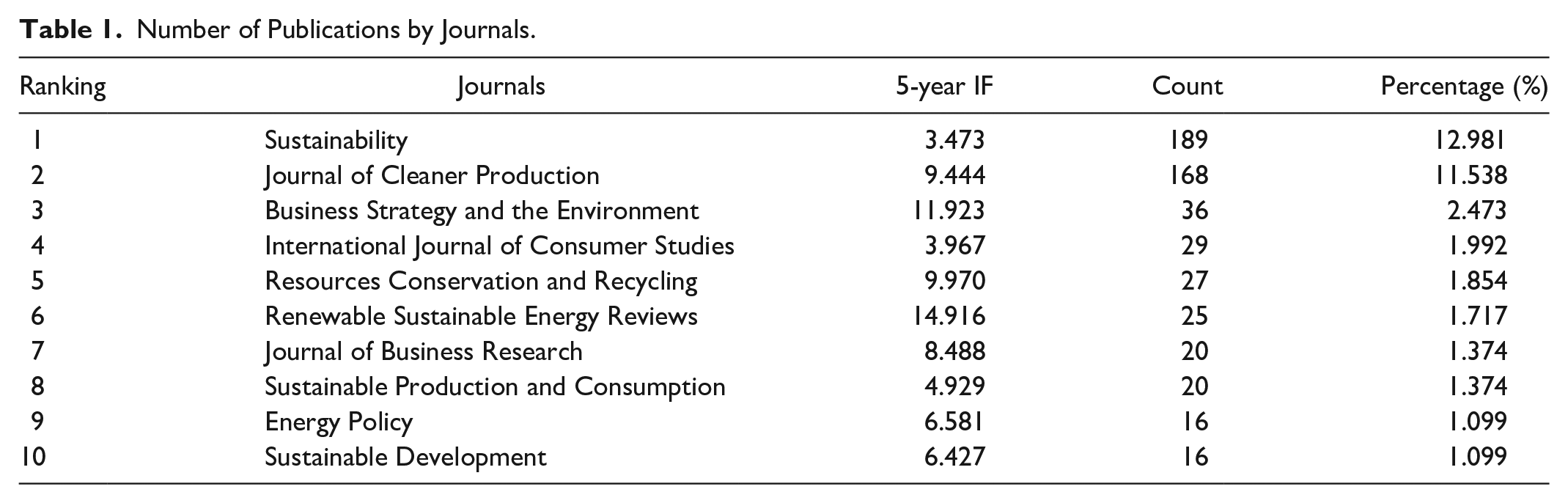
We can find that 443 journals have published articles relating to green marketing in sustainable consumption in the recent two decades. Table 1 illustrates the top journals publishing papers regarding green marketing in sustainable consumption. We can see that the most productive journals in this field are Sustainability, Journal of Cleaner Production, Business Strategy and the Environment, International Journal of Consumer Studies, and Resources Conservation and Recycling (accounting for 12.981%, 11.538%, 2.473%, 1.992%, and 1.854% respectively). Besides, the top 10 journals publish 37.501% of the total publications in the field, and these journals enjoy relatively high impact factors (IF), proving that though there are many journals publishing articles about this field, most articles are centered in the limited numbers of highly-ranked journals. These findings provide valuable references for researchers to find target journals in this domain more precisely.
Number of Publications by Journals.
Number of publications by categories
Table 2 illustrates the top 10 categories of green marketing in sustainable consumption. We can find that 533 papers come from environmental sciences, 481 from green & sustainable science & technology, 362 from environmental studies, 294 from business, and 213 from engineering environment (accounting for 33.607%, 33.036%, 24.863%, 20.192%, and 14.629% respectively); management, energy fuels, economics, operations research management science, and food science technology are also essential categories in green marketing in sustainable consumption research. These categories contain different disciplines (such as science, engineering, and business), proving the comprehensiveness and intersectionality of this domain and also indicating the currently focused aspects regarding green marketing in sustainable consumption research.
Number of Publications by Categories.

Collaboration Analysis
Institution collaboration network
Table 3 exhibits the cooperation status among institutions globally. Most of the top 10 institutions are in Europe (6 out of 10), China, and Australia (two institutions respectively), implying green marketing in sustainable consumption is the highly focused topic in the institutions of these regions. Besides, the University of Sheffield in the UK ranks in the top tier in publication numbers (17), year of the first paper (2009), and centrality (0.08; higher centrality means there are stronger collaborations or connections between the observed node and other nodes) (Azam et al., 2021; Ye et al., 2020), demonstrating its quantitative and qualitative contributions to green marketing in sustainable consumption. Besides, the centrality scores reached 0.05 for both the University of Southern Denmark and Hong Kong Polytechnic University, demonstrating their publications are well cooperated and can be well-referred in the research.
Institution Collaboration Network.

The visualization of the institution’s collaboration network is shown in Figure 3. It can be found that there are relatively complicated collaboration networks among institutions globally, and the collaboration networks can be summarized as “more collaborations within institution clusters, while fewer collaborations among different institution clusters.” For instance, there is a prominent self-isolated cooperative cluster led by the University of Exeter, indicating that the institutions within this cluster have close cooperation with each other. In contrast, they are less cooperative with other institutions in other clusters. This situation is mainly because different institution clusters have different research focus or emphases, making collaborations among institution clusters less sufficient. In the future, researchers can try to expand collaborations among institutions.

Visualization of institution collaboration network (Nodes = 1,291, Links = 1,951).
Region collaboration network
Table 4 exhibits the collaboration status among regions. There are several findings. First, the USA leads the research of green marketing in sustainable consumption in many aspects: the number of publications is the first (257), the centrality is the highest (0.28, meaning it has more relations and cooperation with other regions in this research domain), and the year to start the research is the earliest among the top 10 regions (1997); this proves that the USA acts as a global leader in this research domain. The second finding is that regions with more collaborations are mostly rich or developed. In detail, 8 out of 10 are the developed regions; China and India are the only two recognized developing regions in the top 10 list. That may be because there are usually large research budgets, outstanding research staffs, convenient transportation facilities, and communication infrastructures in developed regions, so there are more opportunities and possibilities for the staff to participate in international conferences and initiate international cooperation research programs (Geng & Yan, 2021; Geng & Zhao, 2020; Geng, Zhu et al., 2020). Besides, China and India are on the list mainly because of their vast population and fast-growing economy, so that they can enjoy scale effects brought by demographic dividends and devote increasing resources in collaboration research (Geng & Zhang, 2020; Golley & Tyers, 2012; Joe et al., 2018).
Region Collaboration Network.

Figure 4 is the cluster view of the region collaboration network. We can see extensive solid cross-regional collaborations; take the top four regions with regional collaborations as examples, they all enjoy cooperation with each other and with other regions, which proves that the research of green marketing in sustainable consumption has achieved extensive regional cooperation. Besides, we can also find that the start dates of cooperation among regions vary. In the top four regions with regional collaborations, the USA and England initiated regional cooperation early. In contrast, PR China and Italy started cooperation in later stages, proving the potential and synergy of both China and Italy in this research field. Furthermore, the regional collaborations can be divided into five clusters: American and Romanian researchers mainly focus on green marketing for university students; those in Europe (Sweden, Greece, Germany, Netherlands, and Spain) mainly focus on good practices of green marketing in sustainable consumption; some regions (Canada, Denmark, and France) initiate research regarding decision-making techniques; some (Brazil and Italy) concern orphan crops together with their green marketing; some researchers in Asian regions (Malaysia, India, Taiwan China, PR China, and South Korea) are more likely to focus on green innovation of green marketing in sustainable consumption.
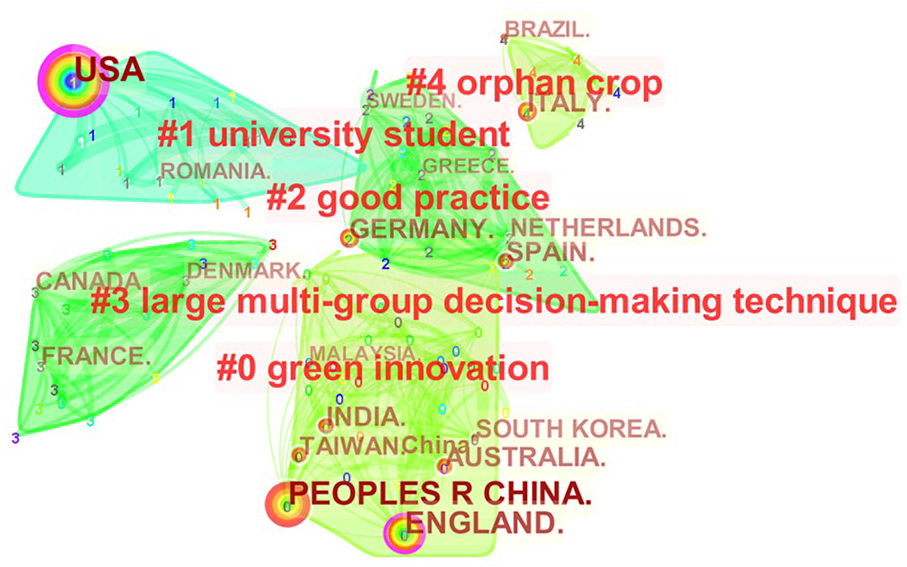
Visualization of region collaboration network (Nodes = 127, Links = 596).
Author collaboration network
Table 5 exhibits the global collaboration networks among authors in the research field. Generally, the collaborations among authors are not as common as collaborations among institutions or regions: only 14 out of the 554 counted authors share more than three times’ collaborations; besides, the top two authors with most collaborations in this research field are Kannan Govindan and Joseph Sarkis, proving these two researchers have comparatively more robust co-authorship relations with others. Indeed, these authors’ centralities (0.00) imply weak collaborations with others.
Author Collaboration Network.

Figure 5 shows the cluster view of the author collaboration network. Although there are collaborations among authors, such collaborations are relatively isolated; in other words, research teams operate in this domain, but different teams lack enough communication. In detail, there are two outstanding research teams whose influential leaders are Seonaidh Mcdonald and Kannan Govindan, respectively (both are also top collaborated authors). As a result of this, we suggest scholars increase cooperation regarding this topic with others, which is proved useful to enhance research effectiveness and efficiency (Li et al., 2021; Sun et al., 2021).

Visualization of author collaboration network (Nodes = 4,364, Links = 8,739).
Co-citation Analysis
Journal co-citation network
Table 6 illustrates the top journals where the papers on green marketing in sustainable consumption are the most cited. There are several new findings. Firstly, journals with high impact factors are more likely to be cited. In detail, 7 out of the top 10 journals are in Quarter 1 of WoS with IF higher than six, indicating these journals are the core ones in the research domain of green marketing in sustainable consumption. Also, the top journal (Journal of Cleaner Production) enjoys high centrality (0.07), indicating it plays a vital role in connecting other journals in the co-citation network. Besides, these journals have been cited in the early stages; for instance, papers published in Journal of Business Research and Journal of Business Ethics have been cited since the last century (1998). Furthermore, there is a journal in the emerging science citation index edition (Journal of Consumption Marketing) with a high centrality (0.11), indicating its potential influential impacts on the research in this field. These highly co-cited journals provide valuable references for future studies in green marketing in sustainable consumption; researchers may understand which journals to submit to if they want their papers to be highly cited.
Journal Co-citation Network.

Figure 6 shows the visualized clusters of the journal co-citation network. It is found that there are wide ranges of categories of the co-cited journals. For instance, the top 10 categories (operations research & management science, geography, medicine, business, nutrition & dietetics, chemistry, environmental engineering, development studies, management, energy & fuels) can be observed in the journal co-citation clusters, indicating that the research and the journals cited about the topic of green marketing in sustainable consumption is multidisciplinary. That is mainly because green marketing in sustainable consumption interacts with other factors or systems such as ecosystem, agricultural science & technology, social activities, and psychology, leading to multidisciplinary studies in different fields (Melović et al., 2020; Petcharat et al., 2020; Ramos-Hidalgo et al., 2022; Sun & Wang, 2019). That also provides a meaningful insight that researchers can expand their views from a specific discipline to broader disciplines when researching both theories or applications of green marketing in sustainable consumption.

Visualization of journal co-citation network (Nodes = 2,223, Links = 8,544).
Reference co-citation network
Table 7 exhibits the 10 most cited documents in green marketing in sustainable consumption research. Generally, the most cited documents are about consumer intentions and behaviors. In detail, four cited articles validate the theory of planned behavior and its application to predicting consumers’ green consumption intention (Moser, 2015; Paul et al., 2016; Yadav & Pathak, 2016, 2017); another three discuss the affecting mechanism of purchasing eco-friendly products’ intentions or behaviors of consumers (Barbarossa & De Pelsmacker, 2016; Chekima et al., 2016; Gleim et al., 2013). Besides, there is an article discussing the interactions between circular economy, green marketing, and green consumptions (Ghisellini et al., 2016), a review looking back empirical publications on green purchase behaviors and examining attitude-behavior inconsistencies in the field of green purchasing (Joshi & Rahman, 2015), and a book introducing various statistical methods which are applicable to analyze problems in green marketing in sustainable consumption (Hair, 2011). The top-cited documents imply that consumer intention or behavior is a highly focused topic in the research of green marketing in sustainable consumption.
Reference Co-citation Network.

The cluster view of the co-cited references is shown in Figure 7, demonstrating the main categories of the cited documents. The top 10 categories of the co-cited references are filtered, and these categories can be classified into four aspects: energy, enterprise, consumer, and methodology. The energy aspect includes the following categories: electric utility restructuring and designing renewable electricity support, which imply that clean energy is contributive to green marketing and sustainable consumption; the enterprise aspect include the categories of B2B firm and enterprises policies, which indicate enterprise activities are closely related to green marketing in sustainable consumption; the aspect of the customer includes the categories of planned behavior, gentrification, customer-centric approach, and environmental product, implying consumers’ behaviors are closely related to green marketing; the methodology aspect include empirical research and information technology, which emphasize the research patterns of green marketing in sustainable consumption. When looking up the most co-cited documents and reviewing the clusters of the co-citation network, scholars may find new insights and ideas in green marketing in sustainable consumption research.

Visualization of reference co-citation network (Nodes = 3,601, Links = 11,740).
Author co-citation network
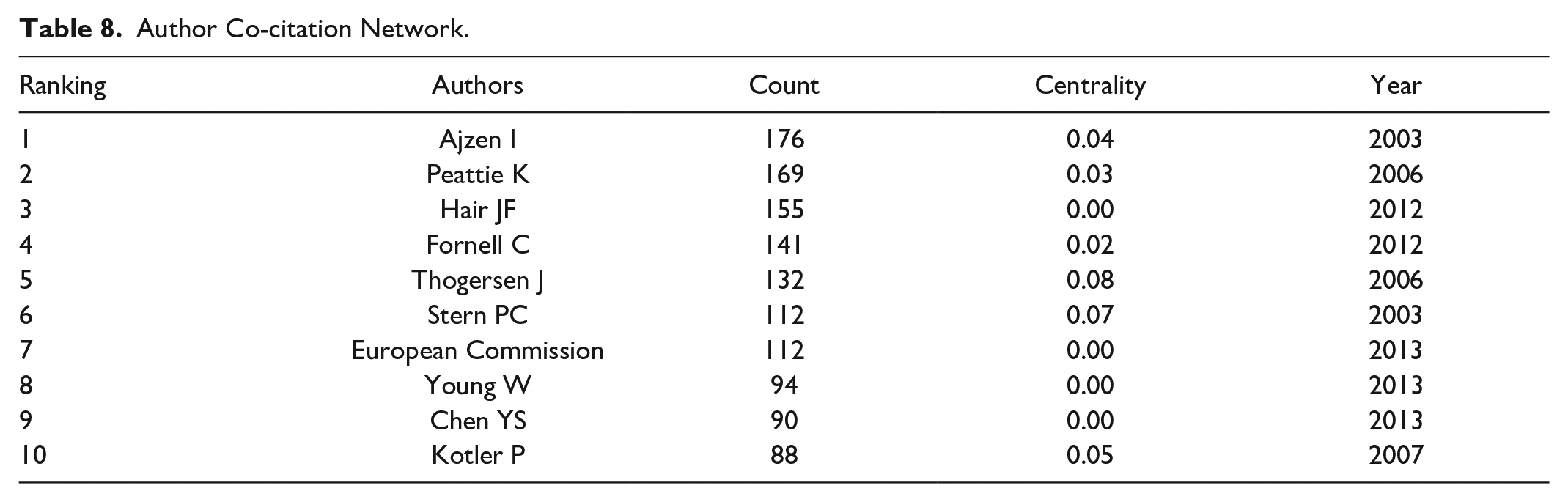
Table 8 shows the top 10 cited authors. Generally, the top 10 authors have higher cited counts: the top seven cited authors are cited more than 100 times. Specifically, the top-cited author is Ajzen I, whose cited count is 176, followed by Peattie K and Hair JF, whose counts are 169 and 155, respectively. Thogersen J enjoys the highest centrality in the top 10 co-cited list (0.08), indicating that this author’s transformative potential to contribute to the study of this domain is significant (Fang et al., 2018). Besides, there is a finding that publications by professional institutions can also be cited: European Commission as the author is cited 112 times.
Author Co-citation Network.
Furthermore, if we compare author collaboration networks and author co-citation networks, we may find inconsistency of authors: the most productive authors may not be highly cited, which contradicts former results of other studies (Fang et al., 2018). That is mainly because the research domain of green marketing in sustainable consumption is much more integrated and combines various aspects and domains so that the citing references can be varied. This result again proves the integration and comprehensiveness of the research of green marketing in sustainable consumption.
The timeline visualization of the author’s co-citation network is shown in Figure 8. We can find that the clusters were formed in 1995, whose main focuses were “emerging market” and “planned behavior.” The former cluster mainly focuses on how green marketing is shaped and how it satisfies new market opportunities, and the latter mainly focuses on how the planned behavior theory affects consumers’ expectations, intentions, and behaviors in green marketing activities. “Planned behavior” forms the most prominent cluster with the most prolonged duration and with the most co-cited authors researching in this field, which provides abundant cases and references for future scholars, and which reflects the significant focus on this field from the academics. At the same time, co-cited authors are also clustered into different categories such as “environmental profile,” “life circle assessment-based information,” “polar lipidome,” “sustainable development,” “full-scale transition,” “gentrification,” and “recent development”; these clusters provide insights or ideas of scientific studies in green marketing in sustainable consumption. However, some of these clusters experience relatively limited duration periods, possibly mainly because the orientation and prevalence of the customer-oriented behavior research leads to the decrease of environment or product-oriented productive process research.
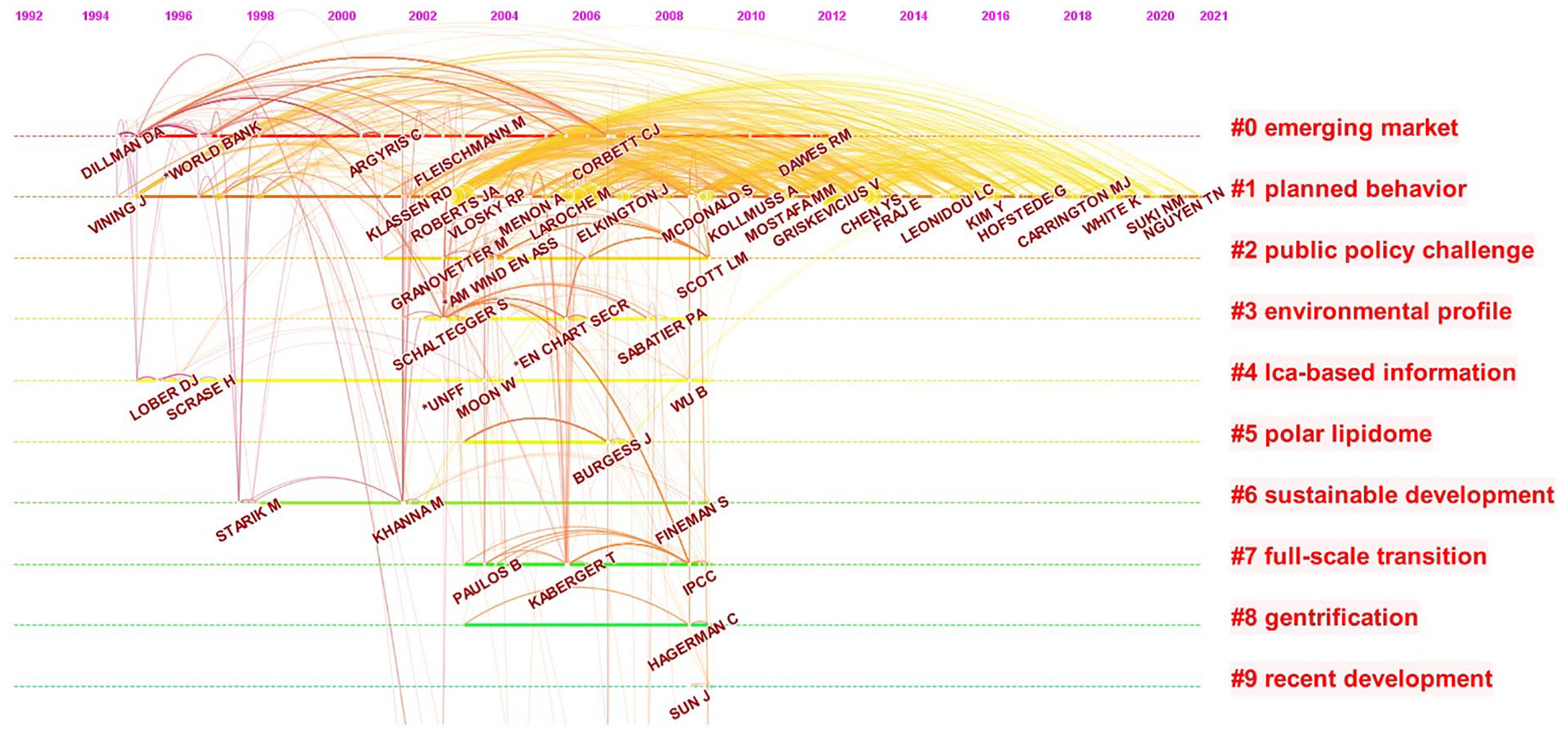
Cluster visualization of author co-citation network (Nodes = 2,921, Links = 10,867).
Co-occurrence Analysis
Category co-occurrence
Table 9 exhibits the top 10 co-occurrence of categories in the research of green marketing in sustainable consumption. The top categories are mainly related to the environment and business. In detail, among the top 10 co-occurrence categories, four categories are related to the environment (environmental sciences & ecology, environmental sciences, environmental studies, and environmental engineering, with the counts of 680, 531, 358, and 212), demonstrating the field of environment is highly concerned in this research domain. Besides, the environmental sciences & ecology category has a high centrality of 0.42, demonstrating its vital position in the research of green marketing in sustainable consumption. Furthermore, three categories are related to business (business & economics, business, and management, with the counts of 404, 275, and 154), illustrating that business categories are also the hotspots and frontier domains in this research field. Comparing Table 2 (number of publications by categories) and Table 9 (category co-occurrence), we may find that 7 of the top 10 categories are the same, demonstrating similarities in categories in this research domain between the publication and co-occurrence categories.
Category Co-occurrence.

Figure 9 exhibits the cluster view of the main categories co-occurrence in the research of green marketing in sustainable consumption, which helps us explore the subject distributions of this research domain. Generally, there are six main category clusters: multidisciplinary materials science, environmental studies, industrial engineering, ethics, food science & technology, and environmental engineering. The cluster of multidisciplinary materials science mainly consists of categories of materials and chemistry (science or engineering); the cluster of environmental studies mainly refers to business behaviors of green marketing in sustainable consumption, such as green & sustainable science & technology, business & economics, environmental science, ecology, and related studies, etc.; the cluster of industrial engineering mainly explores the supportive engineering activities or programs of green marketing and sustainable consumption, such as manufacturing engineering, industrial engineering, operations research, management science, computer science, etc.; the cluster of ethics mainly discusses the business issues from social perspectives, such as interdisciplinary social sciences, psychology, ethics, etc.; the cluster of food science & technology mainly discusses the interactions between human health and green marketing in sustainable consumption, such as public & occupational health, agriculture, food science & technology, agricultural economics & policy, etc.; the cluster of environmental engineering studies energy-related issues in green marketing and sustainable consumption, such as biotechnology & applied microbiology, energy & fuels, science & technology, etc. The results provide valuable hints that the categories of this research domain are multidisciplinary, meaning it is needed for researchers to expand their research focuses and interests in different categories in addition to environment and business categories. It is also possible for researchers to submit research manuscripts of this domain to journals in different disciplines.

Cluster visualization of category co-occurrence (Nodes = 142, Links = 700).
Keywords co-occurrence
Table 10 depicts the keywords co-occurrence situations of green marketing in sustainable consumption; the frequently counted keywords reflect the most focused contents and the latest development hotspots of the domain (Zhang et al., 2020). The keywords are closely related to green marketing and sustainable consumption. Specifically, among the top 10 co-occurrence keywords, “green,” “consumption,” “sustainability,” and “consumer” are the exact words of the domain of green marketing in sustainable consumption (with counts of 302, 245, 134, and 122, respectively). Besides, “green,” “consumption,” “behavior,” “impact,” and “attitude” are the high-frequency keywords among the top 10, meaning these keywords are more welcomed and valued by scholars in this research domain and are at the dominating status in the recent studies.
Keyword Co-occurrence.

Figure 10 shows the cluster timeline map of keywords co-occurrence. The keyword co-occurrence timeline map with clusters is significant due to the following two reasons: first, publications with relatively strong internal relations are grouped together and thus form a cluster, which illustrates a research focus aspect and hotspot; second, keywords to some degree represent and generalize the core idea and research contents of publications; those with high frequencies are proper to track the latest research hotspots at various research periods. We can see that there are 10 clusters for the keywords co-occurrence of this research domain. The cluster with the most prolonged duration is cluster #2 “economy” (from 1994 to 2019), mainly focusing on the related economic issues of green marketing in sustainable consumption. At the beginning stage (1994–1995), economy and commitment are the main focuses (King & Borchardt, 1994; Oskamp, 1995). In the middle age (2002–2011), policy, technology, innovation, and consumption choices become the main hotspots in the cluster of the economy (Arkesteijn & Oerlemans, 2005; Jim & Chen, 2007; Press & Arnould, 2009; Rivera, 2002), proving the discussions of the economic aspect of green marketing in sustainable consumption have shifted from pure economic theories to various complex factors affecting the economy. Recently (2012–2019), the implementation and business model of the economy in this research domain has become the hotspot (Bastas & Liyanage, 2019; Nilsson & Nykvist, 2016). The cluster with the latest duration is “organic food” (cluster #0). In 2003, green, consumption, and product model were the main hotspots (Kalmykova et al., 2018; Montalvo Corral, 2003; Rios et al., 2003); then the hotspots witnessed changes to trade, consumer, price, attitude, willingness to pay, environmental concern, information, intention, perceived value, purchase, and service quality in the later years (2004–2017) (Dangelico & Vocalelli, 2017; Liobikienė et al., 2016; Nguyen et al., 2017; Ozaki & Sevastyanova, 2011; Paul et al., 2016; Peloza & Shang, 2011; Sheth et al., 2011). The recent hotspots are green products and young consumers, demonstrating that studies in the cluster of organic food in green marketing in sustainable consumption are dynamic and comprehensive (Dhir et al., 2021; Sultan et al., 2020). The rest clusters are barriers (including topics such as barriers in management, firms, performance, strategy, supply chains, competition, industry, online, and optimization), sustainable lifestyle (including topics of environmental attitude, fair trade, climate change, energy consumption, and green consumer), social issues (including social impact, electricity power, efficiency, renewable energy, and emission), life cycle assessment (including decision making, eco-design, and input-out analysis), conservation (product certification, public health, and fishery), pathfinding robot simulation (including the orientation, selection, scale, and recovery of the robot simulation), sustainable practice (addressing the adoption of it, corporate social responsibility, and green electricity), and small business (addressing the role of companies in green marketing in sustainable consumption, including corporate environmentalism, response, and small & middle enterprise).
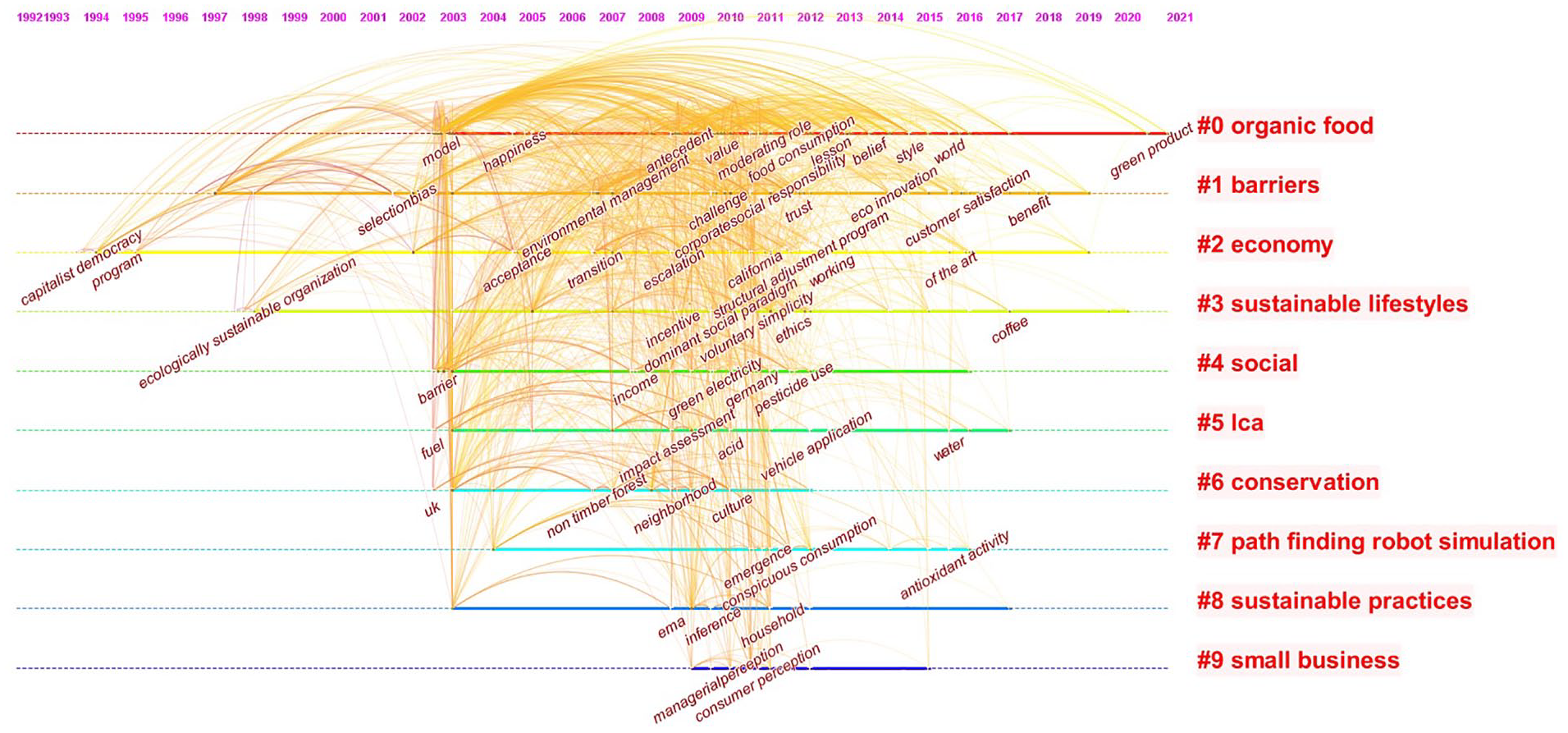
Cluster visualization of keyword co-occurrence (Nodes = 457, Links = 2,924).
Keyword bursts
Keywords bursts illustrate the hotspots and emerging trends of the research domain, proving these keywords are mainly focused on academia. Figure 11 demonstrates the top 20 keywords with the strongest citation bursts from 1992 to 2021. The results prove that the top five keywords with the strongest bursts are “perception” (with the strength of 6.49), “empirical evidence” (5.26), “driver” (4.43), “innovation” (4.38), and “preference” (4.00), meaning that they are the specially focused keywords and are likely to be the turning points in the research domain of green marketing in sustainable consumption. The top five keywords with the most prolonged bursts are “conservation” (10 years), “power” (8 years), “business” (7 years), “demand” (5 years), and “economy” (4 years), meaning that the scholars have long focused them. The latest five keywords among the top 20 are “health,” “preference,” “innovation,” “driver,” and “perception,” meaning that they are the latest research frontier of this domain. The top five with the earliest bursts are “business,” “conservation,” “demand” (2007), “power” (2009), and “market orientation” (2012). We can find that the keywords with the strongest, the longest, the latest, and the earliest bursts are not the same, proving that the contents of everyone’s concern in this research domain are comprehensive and extensive. Such results also provide insights that scholars can focus on different aspects of green marketing in sustainable consumption and contribute to academic outcomes in various aspects of this domain in the future.

Top 20 keywords with the strongest citation bursts.
Theoretical Summaries
Knowledge Framework of the Domain
It is necessary to systematically analyze and review previous studies and construct the knowledge mechanism that contributes to the overall progress and understanding of the research domain (Li et al., 2017; Zhong et al., 2021). This study analyzes the knowledge base, correlation, status quo, and evolution of green marketing in sustainable consumption. It thus constructs the knowledge framework of this domain to comprehensively understand this research domain and provide valuable references for future explorations (Figure 12). The knowledge base is composed of statistical foundations of the domain, which clarifies the popularity and significance of this domain, and which depicts the welcomed journals and research categories in this domain; the results are encouragement for scholars to continue further research in this domain and are practical guidance when scholars want to publish papers. The knowledge correlation demonstrates the interactions among scholars with their institutions and countries, answering how academic stakeholders interact and cooperate; the results are valuable suggestions for finding proper collaborators in this research domain. The knowledge status quo illustrates the current situations of the research domain from the journal, reference, and author perspectives. By identifying the highly counted terms and clustering knowledge, the results outline the current research focus and temporal frameworks, which is conducive to understanding this domain’s current research processes and themes. The knowledge evolution path depicts the tendency of the domain; the clusters of research categories, time-line maps of keyword clusters, and keyword strong bursts exhibit the future hotspots of the categories and aspects and provide helpful guidance for scholars on which aspects can be focused in the future.

Knowledge framework of the domain.
When deeply exploring the knowledge base of the framework, we may find that the domain is popular with increasing focus per year. In detail, journals such as “Sustainability,” “Journal of Cleaner Production,” “Business Strategy and the Environment” are the top journals welcoming submissions of this domain with most focused categories in environmental sciences, green sustainable science & technology, and environmental studies. When looking at the knowledge correlation, we may find that the cooperation among institutions, regions, and authors is dynamic: we may find that the more active cooperation institutions are the University of Sheffield, Bucharest University of Economic Studies, and the University of Southern Denmark; the more active cooperation regions are the USA, the PR China, and England of the UK; the more active cooperation authors are Achim Spiller, Kannan Govindan, and A. Toppinen. When further looking at the knowledge status quo, we may find that the themes of this domain vary slightly. From the co-cited journal perspective, the themes mainly fall into operation research and management science, geography, and medicine; from the perspective of the co-cited reference, the themes are mainly regarding B2B firm, planned behavior, and empirical research of green marketing in sustainable consumption; from the co-cited authors perspective, the themes are mainly about the emerging market, planned behavior, and public policy challenge of the research domain. Looking deeper at the knowledge evolution, we may have a clearer sight of future trends. Categories of materials science, environmental studies, and industrial engineering of this domain will be more popular, and the domain’s economic growth, perception, and innovation will be the coming hot topics.
Key Research Directions
In recent years, the research of green marketing in sustainable consumption has increased, and some new and critical research directions have emerged; research focuses are getting more diversified. Therefore, it is needed for future studies to pay more attention to the following changing research directions. (1) The research domain will be more integrated with multiple disciplines; theories in various non-traditional categories such as food science, ethics, materials engineering, and environmental studies will be included in this research domain. The alternative topics for future research may be the organic food growing and marketing, the ethical issues in green marketing in sustainable consumption, the application of new materials to achieve green marketing in sustainable consumption, and the coordination among environment, society, economy, and green marketing in sustainable consumption. (2) The research topics will be more complex and comprehensive; “customer perception and behavior” will not be the dominating topic in this research domain anymore; the topics will cover different areas in the future. The alternative emerging hotspots of the domain cover the areas of health, technology, society, economy, and consumer. Specifically, customers’ health, relevant green marketing technology, green marketing innovation, supporting infrastructures for sustainable consumption, policy making procedures of green marketing in sustainable consumption, economic growth from green marketing, and the sustainable lifestyle of consumers will be the hotspots in the domain. (3) Studies regarding the theories and methodologies to solve the problems in this domain will be an emerging trend. Specifically, empirical research will be gradually more significant in future research, which should be paid special attention to; in other words, papers discussing the topics mentioned above with new empirical research methods are more likely to be published and focused in this domain. (4) Studies regarding the practice of green marketing in sustainable consumption will also be an emerging trend. How theories can be applied to direct effective green marketing practice will be more significant; especially, customer-oriented approaches will be more critical: alternative topics include what barriers are in increasing green marketing in sustainable consumption, how to enhance consumers’ perceptions of green marketing in sustainable consumption, how to improve consumers’ preferences to consume sustainably, how to encourage consumers to have sustainable lifestyles via green marketing, and how to improve the health status of consumers by green marketing in sustainable consumption. In general, we suggest that researchers expand knowledge structures and absorb new ideas in different categories and topics.
Conclusions
This study analyzes the bibliometric evolutions of green marketing in sustainable consumption with CiteSpace, which provides a new perspective to evaluate the research process of this domain. We can conclude several findings in this study. (1) In the latest decade, the publications have witnessed an apparent increase; the publication distributions of journals and categories prove that research of green marketing in sustainable consumption is comprehensive and intersectional. (2) For the collaboration network of this research domain, though authors seem to be more likely to do research independently in this field, there are still relatively complicated collaboration networks among institutions and strong extensive cross-regional collaborations. (3) For the current knowledge situations of this domain, journals publishing related articles, mostly cited references, mostly cited authors cover wide ranges of categories, implying the multidisciplinary nature of this research domain; besides, the most productive authors may not be highly cited, which is contradict with former results of other studies. (4) For the co-occurrence and knowledge evolutions of this domain, “green,” “consumption,” “sustainability,” and “consumer” are more welcomed and valued in this research domain and are at the dominating status in the recent studies; besides. the categories of the domain will keep multidisciplinary; furthermore, the keywords with the strongest, the longest, the latest, and the earliest bursts vary, proving that the contents of everyone’s concern in this research domain are comprehensive and extensive. (5) The research of green marketing in sustainable consumption has significantly increased in recent years, and some new and critical research directions have emerged; research focuses are much more diversified. Therefore, it is needed for future studies to pay more attention to the changing research directions.
There are several innovations of this study. (1) This study combines green marketing and sustainable consumption and comprehensively analyzes the research development path of green marketing in sustainable consumption, covering the deficiencies of former studies that lack comprehensive and integrated analysis of this research domain. (2) This study constructs and precisely elaborates the research framework of this domain, which is conducive to helping readers and scholars to understand the knowledge structure and evolution better comprehensively and dynamically. (3) This study reveals the research gaps and main focused aspects and proposes vital research directions in the future, which further enrich the knowledge system and are significant references for scholars to explore the research of this domain in the future more effectively and efficiently.
Also, there are some limitations of this study. (1) This study selects publications in English only and ignores some papers in other languages. (2) The latest literature during the writing period is ignored, though we must admit that the update of this domain is fast. Therefore, future studies may select publications in other languages and compare differences of the results; besides, the latest publications will be selected, and the evolution trends should be further discussed.
Footnotes
Author Contributions
Conceptualization, Y.G.; methodology, Y.G.; software, Y.G.; validation, Y.G.; formal analysis, M.M.; investigation, Y.G.; resources, Y.G.; data curation, Y.G.; writing—original draft preparation, Y.G.; writing—review and editing, Y.G.; visualization, M.M.; supervision, Y.G.; project administration, Y.G.; funding acquisition, Y.G.
Data Availability Statement
Data are available if requested to the author.
Declaration of Conflicting Interests
The author(s) declared no potential conflicts of interest with respect to the research, authorship, and/or publication of this article.
Funding
The author(s) disclosed receipt of the following financial support for the research, authorship, and/or publication of this article: This research was funded by Shanghai Education Science Project, grant number C2-2020097.
