



Abstract
Covid-19 pandemic has brought drastic and unprecedented challenges to the medical education and medical students, affecting them physically, mentally and emotionally. While progressing through the post-pandemic recovery phase, it is crucial to comprehensively evaluate the pandemic’s consequences and tackle the underlying problems. To investigate the impact of Covid-19 pandemic on medical students’ mental health, social well-being, and academic progression. A cross-sectional study was carried out with voluntary sampling of students from both government and private medical schools in Malaysia. A self-administered online survey form containing three validated psychological tools was distributed (Hospital Anxiety and Depression Scale HADS, Rosenberg Self-esteem Scale, NIH Toolbox Social Relationship Scales). There were also questions regarding the challenges faced by medical students and their academic performance during Covid-19 pandemic. Scores of each questionnaire were tabulated, analyzed and interpreted according to their specific cut-points. Two hundred and thirteen responses were received. 89.2% (n = 190) were domestic students while 10.8% (n = 23) were international students. Out of 32 medical universities in Malaysia, the participants were from 19 of them (9 public and 10 private universities). About half of the participants had contracted Covid-19 infection during the study period (n = 124, 58.2%). Majority had chosen “Lack of on-campus learning and training session causing incompetency” as the most relevant impact of Covid-19 on their academic progression (n = 85, 39.9%). Above 90% of participants passed their Final Academic Assessment in 2020 (91.5%) and 2021 (93.9%). About half of them (n = 86, 40.4%) were having symptoms considerable of anxiety while only 19.2% (n = 41) were having symptoms considerable of depression. Majority had normal self-esteem (n = 177, 83.1%). For social relationship, around two-third of them had great social support and companionship. However, more than half had social distress. The median for the period of time having absolute online classes, absolute physical classes and hybrid classes were 18, 4, and 9 months, respectively. Having absolute online classes of >18 months was associated significantly with higher perceived hostility (16.49vs. 14.47, p = .012). In addition, being infected with Covid-19 was associated significantly with higher self-esteem (26.88vs. 25.85, p = .009). Large proportion of students were affected by Covid-19 pandemic. Absolute online classes has huge impact on emotions of medical students especially from the aspect of perceived hostility. Hence, implementation of online medical education during Covid-19 era requires modifications and improvements.
Plain language summary
Purpose: To investigate the impact of Covid-19 pandemic on medical students’ mental health, social well-being, and academic progression. Methods: A cross-sectional study was carried out with voluntary sampling of students from both government and private medical schools in Malaysia. A self-administered online survey form containing three validated psychological tools was distributed. Scores of each questionnaire were analyzed and interpreted according to their specific cut-points. Conclusions: Large proportion of students were affected by Covid-19 pandemic. Absolute online classes has huge impact on emotions of medical students especially from the aspect of perceived hostility. Implications: Challenges and difficulties faced by medical students are addressed. Raise the public concern regarding the importance of the transformations and improvements in delivering online education to promote a better learning environment. Limitations: The sample size of this study is inadequate as the 213 valid responses only achieved 85% confidence interval with 0.05 margin of error. Non-normal distribution of data is another limitation of this study. Selection bias may be present in this study due to convenient sampling as participants were only recruited via online platform such as emails, WhatsApp, and social media. The temporal link between the Covid-19 pandemic and the current mental and social well-being of medical students cannot be determined. There is possibility that students who have traits of anxiety and depression are having mild symptoms before pandemic or having other sources of stress.
Background
The WHO has declared COVID-19 outbreak a global pandemic in March 2020 (Cucinotta & Vanelli, 2020). This has brought drastic and unprecedented challenges to the medical education and medical students. In Malaysia, to mitigate the spread of infection, Movement Control Order (MCO) was imposed and took effective on 18th March 2020 (Okwonu et al., 2020). Under MCO, only providers of essential services (e.g., food, health, telecommunication) were allowed to operate while all government and private premises were closed, including educational institutions. This obliged the transformation of face-to-face medical education program to virtual platform. Preclinical students were prohibited from on-campus learning sessions (clinical skills, patient simulation sessions, anatomy and laboratory classes) while clinical students were restrained from clinical attachments and bedside teaching classes.
To date, there are 32 accredited medical schools in Malaysia, including 11 public and 21 private institutions. Each medical school has different curriculum and methods of delivery (e.g., block scheduling, system-based, problem-based learning). The rapid transformation of curriculum delivery imposes uncertainty in the educational efficiency, effectiveness, and generate impact on academic progression.
On the other hand, the mental and social well-being of medical students are being concerned. Medical students are vulnerable to developing burnout, psychological illness and distress due to stressful and challenging medical education (Yogeswaran & Morr, 2022). Covid-19 pandemic may exacerbate the stress, anxiety and depression in medical students as it introduces new changes to the system and students are forced to comply and cope promptly (Kalok et al., 2020). In addition, due to restrictions, social interactions and peer support may be minimal and may negatively impact the overall well-being of medical students.
A cross-sectional psychological study on young people revealed that Covid-19 pandemic had profound disruptions on them, causing the high and concerning levels of clinical depression, anxiety and loneliness (Bell et al., 2023). A US study found that university students who attended classes during pandemic were experiencing negative psychological impacts (Ding et al., 2023). Whilst surveys have targeted young people and university students, little is known about the nature of this impact on medical students particularly.
A systematic review comparing the mental health symptoms of cohorts before and during Covid-19 pandemic, found no significant changes in the majority of the symptom change estimates for general mental health, anxiety and depression. There is, however, a knowledge gap regarding the long-term psychological impact of Covid-19 pandemic (i.e., post-pandemic era). Majority of the studies focused on the early phase and peak of the pandemic, that is, their data collection were done in 2020 and 2021 (Bolatov et al., 2021; Cockburn et al., 2022; Y. R. Kim et al., 2022; Meo et al., 2020; Turana et al., 2022). There were studies showing that Coronaviruses (e.g., SARS outbreak in 2003 and MERS in 2012) cause long-term mental health problems such as post-traumatic stress disorder and increased suicidal rate (Park et al., 2020; Tzeng et al., 2020). This raise the concern of whether this novel Coronavirus (SARS-CoV-2) causes similar consequences on mental health. Hence, evaluation of the impact of Covid -19 pandemic during post-pandemic recovery phase becomes the focus of this research.
This study aims to investigate the impact of Covid-19 pandemic on medical students’ mental health, social well-being, and academic progression.
Materials and Methods
Study Design and Population
This was a cross-sectional study with voluntary sampling of students from all government and private medical schools in Malaysia. Ethical approval was granted by Monash University Human Research Ethics Committee MUHREC (Project ID: 34909).
In December 2022 (approximately 3 years after MCO being lifted), a self-administered online survey form was distributed through Malaysia Medical Association (MMA), Society of MMA Medical Students (SMMAMS), Asian Medical Students Association Malaysia (AMSA) and student WhatsApp groups in the form of emails, social media posts and messages.
All medical students who are currently studying in or just graduated (i.e., 2020, 2021, or 2022) from accredited medical schools in Malaysia, ≥18-year-old, able to understand English were eligible to participate. Moreover, the participants were not pregnant, not diagnosed with psychological disorders, not absent from school for >1 week due to non-Covid illness and not dropped-out of school for more than twice within period of March 2020 to December 2022. Based on the estimated student population of 18,000 in all years, power estimates required a minimal of 377 responses to achieve a representative sample of 95% confidence level and 0.05 margin of error (Wong & Abdul Kadir, 2017).
Instrument Design
The survey form included a consent section and was written in English. Data collected included: socio-demographic data (age, nationality, gender), university, year of study, period of time having absolute online classes, absolute physical classes and hybrid classes, results of the academic year (pass or fail), personal opinion regarding the most relevant impact of Covid-19 on the academic progression. In addition, questions regarding experience of being diagnosed and losing first degree family members with Covid-19 infections were included. Self-evaluation on mental health and self-esteem were assessed through three validated psychological tools:
Hospital Anxiety and Depression Scale (HADS)
HADS assesses both anxiety and depression. It comprises seven questions for anxiety and seven questions for depression which are scored independently (HADS; Stern, 2014; Zigmond & Snaith, 1983).
The specific cut-off scores are as follow (Table 1):
The Specific Cut-off Scores for HADS.
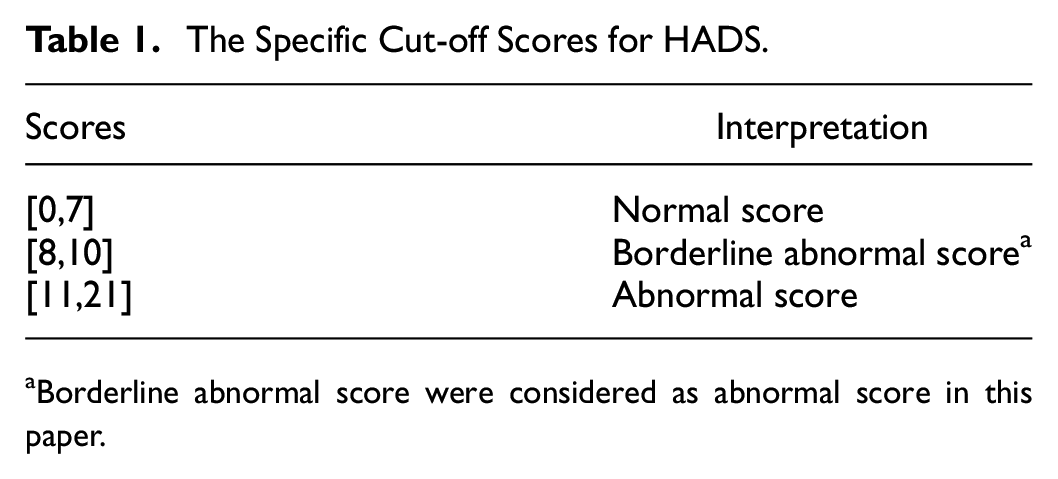
Borderline abnormal score were considered as abnormal score in this paper.
Rosenberg Self-Esteem Scale (RSES; Rosenberg, 2015)
RSES is a 10-item scale measuring global self-worth (including positive and negative feelings toward self). A 4-point Agreement Likert scale, ranging from strongly agree to strongly disagree is used.
The specific cut-off scores are as follow (Table 2):
The Specific Cut-off of Rosenberg Self-Esteem Scale (RSES).

High score was considered as normal score in this paper.
NIH Toolbox Adult Social Relationship Scales (Cyranowski et al., 2013)
NIH Toolbox assesses social relationship from 3 aspects, including:
Social Support (emotional and instrumental support)
Social Companionship (Friendship and Loneliness)
Social Distress (perceived rejection and perceived hostility)
For emotional support, instrumental support and friendship, higher score indicates positive effect which is greater support. For loneliness, perceived rejection and perceived hostility, higher score indicates negative effect, which are greater loneliness, more rejection and hostility.
A five-point Frequency Likert Scale is used to assess each domain.
Statistical Analysis
Data were sorted and tabulated for analysis with the removal of incomplete and repetitive surveys. IBM SPSS Statistics (Version 26) was use for data analysis. Continuous variables were presented as mean (standard deviation, SD) while categorical variables were presented as frequency (percentage).
The data were normally distributed. The skewness of all included data was excellent (i.e., all within ±1) while the kurtosis was not substantial (i.e., absolute kurtosis value <7; H. Y. Kim, 2013).
Internal validity of the survey was assessed with Cronbach’s Alpha and an output of α≥ .70 indicates sufficient consistency (Taber, 2018). This was fulfilled by the all the tested domains including depression and anxiety in HADS, RSES, Emotional and Instrumental Support, Friendship, Loneliness, Perceived Rejection and Hostility in the NIH Toolbox Adult Social Relationship Scales.
The median for the period of time having absolute online classes, absolute physical classes and hybrid classes were used to classify the participants into two groups (>median and ≤median).
Independent T-tests were used to determine the mean differences, including mean differences:
-Among groups of different period of time spend for different mode of curriculum delivery with component scores of the three psychological tools
-Between the experiences of contracting Covid-19 pandemic with components scores of the three psychological tools
All significant results were based on p < .05 and 95% confidence interval.
Descriptive statistics were calculated for demographic variables and questions regarding participants opinion on the most relevant impact of Covid-19 pandemic on their academic progression.
Results
Survey Collection
From 18th December 2022 to 31st January 2023, 215 responses were received. Two responses were removed as consent were not given. 89.20% (n = 190) were domestic students while 10.80% (n = 23) were international students. Out of 32 medical universities in Malaysia, the participants were from 19 of them (9 public and 10 private universities).
Demographics
The demographic variables were displayed in Table 3. The mean age of the participants was 22-year-old. Majority of the participants was females (62.91%) and currently in preclinical year (81.69%). Among 190 domestic students, the majority was Chinese (68.54%), followed by Indian (13.15%), Malays (4.69%) and others (2.82%). 38.50% (n-82) of students were self-funded.
Demographic Variables.

Mean (standard deviation).
Experience of Contracting Covid-19 Infection
About half of the participants had contracted Covid-19 infection during the study period (n = 124, 58.2%). The incidence of Covid-19 infection among clinical students (58.2%) was only slightly higher than preclinical students (57.9%).


The Most Relevant Impact of Covid-19 Pandemic on Academic Progression
Majority had chosen “Lack of on-campus learning and training session causing incompetency” as the most relevant impact of Covid-19 on their academic progression (n = 85, 39.9%). (Table 4 & Figure 1).
Impact of Covid-19 Pandemic on Academic Progression Based on Personal Experiences.


Impact of Covid-19 pandemic on academic progression based on personal experiences.
Status of Final Academic Assessment in Medical School
Above 90% of participants passed their Final Academic Assessment in 2020 (91.55%) and 2021 (93.9%). (Table 5).
Status of Final Academic Assessment in Medical School.

Hospital Anxiety and Depression Scale
About half of them (n = 86, 40.38%) were having symptoms considerable of anxiety while only 19.25% (n = 41) were having symptoms considerable of depression. (Table 6).
Hospital Anxiety and Depression Scale (HADS) Scores.

Rosenberg Self-Esteem Scale (RSES)
Majority had normal self-esteem (n = 177, 83.1%) (Table 7).
Rosenberg Self-Esteem Scale (RSES) Scores.

NIH Toolbox Social Relationship Scales
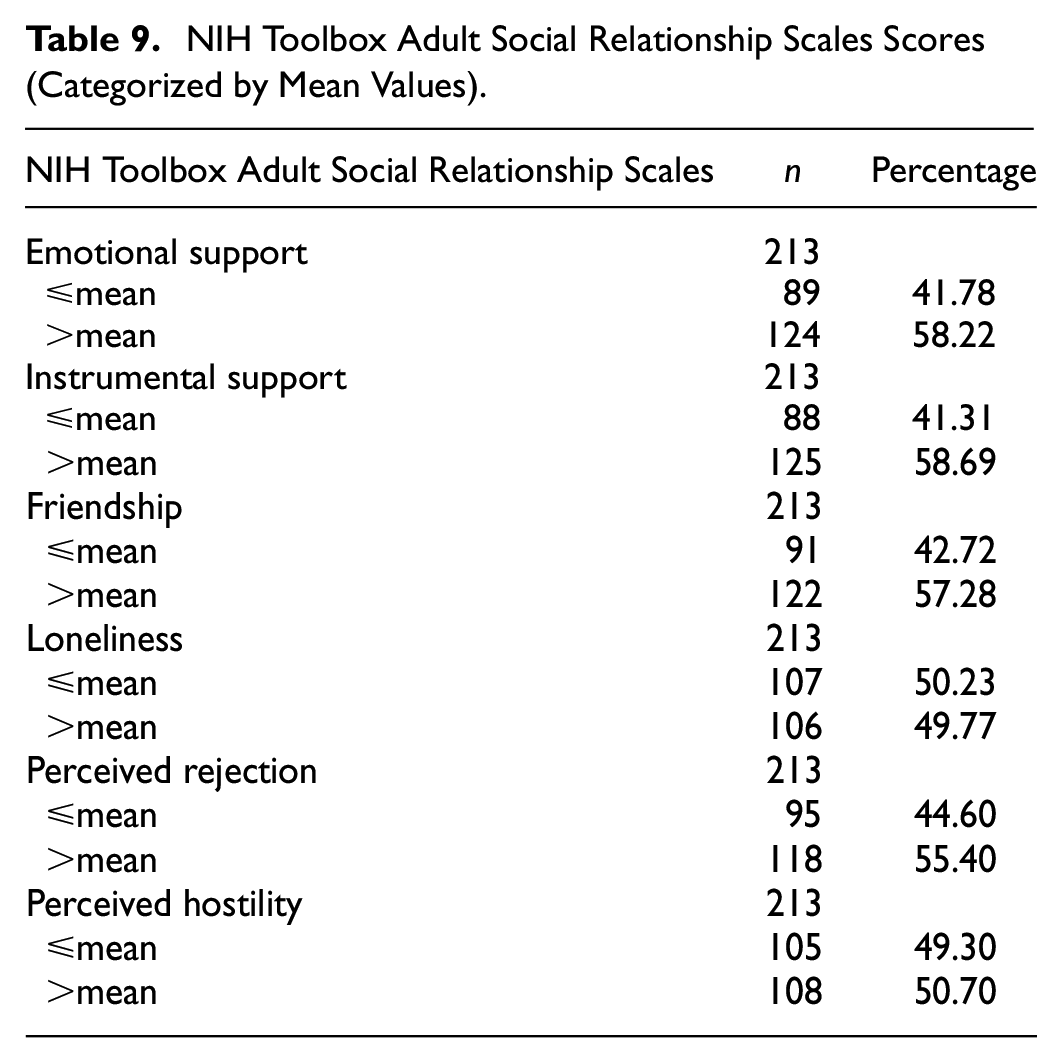
For social relationship, around two-third of them had great social support and companionship. However, more than half had social distress. (Tables 8 & 9).
Mean Values of All Domains Assessed by NIH Toolbox Adult Social Relationship Scales.

NIH Toolbox Adult Social Relationship Scales Scores (Categorized by Mean Values).
Different Period of Time Spend for Different Mode of Curriculum Delivery (Months)
The median for the period of time having absolute online classes, absolute physical classes and hybrid classes were 18, 4, and 9 months, respectively. (Table 10).
Period of Time Spent for Different Mode of Curriculum Delivery (Months).

Significant Mean Difference
Having absolute online classes of >18 months was associated significantly with higher perceived hostility (16.49vs. 14.47, p = .012). (Table 11) In addition, being infected with Covid-19 was associated significantly with higher self-esteem (26.88vs. 25.85, p = .009). (Table 12).
T-Test for Mean Difference Between The Period of Time Having Absolute Online Classes (>18 months and ≤18 months) with Scores of Each Psychological Tools.

CI = confidence interval.
p < .05.
T-test for Experience of Contracting Covid-19 Infection with Score of Each Psychological Tools.

CI = confidence interval
p < .05.
Logistic Regression
Logistic regression was performed for the anxiety and depression.
Participants with Loneliness score >mean had 4 times the odd of anxiety than participants with score ≤ mean (p < .001) (Table 13).
Linear Regression for Anxiety.

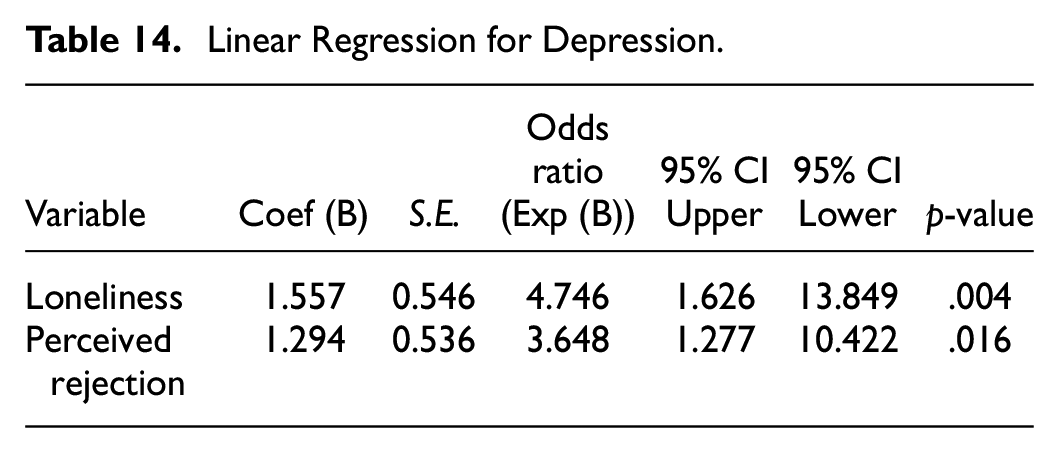
Participants with Loneliness score >mean had four times the odd of depression than participants with score ≤ mean (p = .004). Participants with Perceived rejection score > mean had three times the odds of depression than participants with score ≤ mean (p = .016) (Table 14).
Linear Regression for Depression.
Discussions
This research tackles the knowledge gap in the long-term impact of Covid-19 on medical students mental health, self-esteem, social well-being and academic progression. In this study, more than half of the participants had contracted Covid-19 infection during the study period (March 2020 to December 2022; n = 124, 58.2%), which is higher than the 7-day incidence rate of 26.6 per 100,000 population in Malaysia (for 16th March 2020 to 31st May 2021; Jayaraj et al., 2021). However, there is only a slight difference in incidence between preclinical and clinical students, which is inconsistent with the finding reported in a cross-sectional study done in University of Jordan (Bani Hani et al., 2021).
About half of the participants (n = 86, 40.4%) were having symptoms considerable of anxiety while only 19.2% (n = 41) were having symptoms considerable of depression. This may be due to the fact that anxiety disorders are the most prevalent mental disorders and they are often under-recognized and undertreated (Bandelow & Michaelis, 2015). For depression, it is common among medical undergraduates with the overall frequency ranging from 1.4% to 73.5% (Mirza et al., 2021). In this study, there is no significant association found between anxiety and depression score with demographic factors (age, genders, nationality, ethnicity and current year of study). Based on a brief overview regarding anxiety and depression among medical students published in April 2021, female gender, economic and academic pressures are found to be associated with higher rate of anxiety and depression (Mirza et al., 2021).
Participants with Loneliness score >mean had four times the odds of anxiety (p < .001) and depression (p = .004) than participants with score ≤mean. This is consistent with an India study which revealed the negative impacts of loneliness on both mental and physical health (Mushtaq et al., 2014). In addition, having Perceived Rejection score >mean had three times the odds of depression than participants with score ≤mean (p = .016). This is in line with the finding that, rejection sensitivity confer a risk for depression and more attention should be given to rejection-sensitive individuals to better manage their maladaptive behaviors (Liu et al., 2014).
From the interpretation of the Rosenberg Self-Esteem Scale, >80% of the participants had normal and high self-esteem (n = 177, 83.1%).Interestingly, being infected with Covid-19 was associated with significantly higher self-esteem (26.88vs. 25.85, p = .009). Based on a study in Taiwan, factors associated with the higher level of confidence in coping with COVID-19 included individual factors (younger, male or transgender, healthcare workers, better self-reported mental and physical well-being before pandemic), Covid-19-specified factors (sufficient personal protective equipment, disease knowledge, financial and medical support, lower risk perception) and social factor (higher perceived support; D. J. Li et al., 2020). The increased confidence level after Covid-19 infection amongst our cohort could be explained by the positive experiences of self-managing, receiving treatment, and recovering from the infection.
Majority had chosen “Lack of on-campus learning and training session causing incompetency” as the most relevant impact of Covid-19 on their academic progression (n = 85, 39.9%). This reflects the importance of hands-on experiences, direct supervision, role-modeling and patient simulation in the medical education (Rose, 2020). In addition, this may indicate that social distancing and lockdowns during Covid-19 pandemic have further abolished the opportunities for medical students to practice their skills, get involved in patient care and actively engage with the curriculum.
For social relationship, unexpectedly, around two-third of them reported great social support (emotional and instrumental) and companionship (friendship and loneliness). However, more than half had social distress (perceived rejection and hostility). Social distress may be due to isolation, difficult interpersonal relationships, significant changes in life, socioeconomic disadvantages and other demographic factors (Crow & Colabianchi, 2008). In the context of lockdowns, social distancing and online education, the social cycle of an individual becomes smaller and interactions are limited.(Y. Li et al., 2023) Students tend to spend more time in front of the computer screen, facing problems such as poor internet connections, lagging time and frozen screens, thus worsening their abilities in interpretating facial expressions, non- verbal cues and the appropriate timing for them to speak.(Dragomir et al., 2021)
The median for the period of time having absolute online classes, absolute physical classes and hybrid classes were 18, 4, and 9 months respectively. Having absolute online classes of >18 months was associated significantly with higher perceived hostility (16.49vs. 14.47, p = .012). This may due to the lacking of non-verbal communications and cues during online social interactions. According to a study regarding online communication (Paradisi et al., 2021), online interactions have limited visual (quasi 2D perception), no smell and touch and may lead to the changes in the relationship between perceived geographical distances and acquaintanceship. It is difficult for interacting persons to accommodate and behave appropriately to the environment and body languages of others (e.g., gestures, eye contact), impacting the expressions of emotions and empathetic responses. Eventually, these factors may lead to lack of trust, self-motivation and self-regulations (Pavin Ivanec, 2022).
The proportion of participants passing the final assessment of their academic year were high, 91.55% in 2020 and 93.9% in 2021. There is no significant association found between the passing rate with the experience of participants in contracting Covid-19 infection during the study period. With that, there is insufficient evidence to suggest the direct impact of Covid-10 infection on academic performance of medical students.
Strengths and Limitations
The sample size of this study is inadequate. According to the estimated student population of 18,000 in all years, power estimates required a minimal of 377 responses to achieve a representative sample of 95% confidence level and 0.05 margin of error (Wong & Abdul Kadir, 2017). The 213 valid responses only achieved 85% confidence interval with 0.05 margin of error.
Selection bias may be present in this study due to convenient sampling as participants were only recruited via online platform such as emails, WhatsApp, and social media.
As this is a cross-sectional study, the temporal link between the Covid-19 pandemic and the current mental and social well-being of medical students cannot be determined. There is possibility that students who have traits of anxiety and depression are having mild symptoms before pandemic or having other sources of stress.
However, the study is generally reliable. This was determined by the Cronbach’s Alpha assessment of internal validity with an output of α ≥ .70 indicates sufficient consistency (Taber, 2018). All the three psychological tools in the questionnaire are fully validated. In addition, this study is the first study regarding the social and mental well-being of medical students during the recovery phase of Covid-19 in Malaysia.
Conclusion
Our study revealed that large proportion of students were affected by Covid-19 pandemic. The rates of students having symptoms of anxiety and depression are high and concerning. Importantly, absolute online classes has huge impact on emotions of medical students especially from the aspect of perceived hostility. Being diagnosed and recovered from Covid-19 infection increases self-esteem of medical students. Although there is no direct evidence showing the impact of contracting Covid-19 infection on the passing rate, the incompetency of medical students due to the lack of on-campus learning activities should be addressed accordingly. In conclusion, the implementation of online medical education during Covid-19 era requires modifications and improvements.
Footnotes
Acknowledgements
We would like to thank our affiliations Malaysia Medical Association (MMA), Society of Malaysia Medical Association Medical Students (SMMAMS), Asian Medical Student Association (AMSA Malaysia) in distributing the online questionnaire to respective communities. Besides, the authors would like to acknowledge Wong Keying, Ang Shin Yii, Wong Demi Sze Aik, Chua She Min, Ng Rou Yu, and Fernando Oshan Gominda from Monash University Malaysia for their contributions during the development and distribution of the survey. We would also like to thank all participants who joined this study.
Declaration of Conflicting Interests
The author(s) declared no potential conflicts of interest with respect to the research, authorship, and/or publication of this article.
Funding
The author(s) received no financial support for the research, authorship, and/or publication of this article.

Data Availability Statement
Data sharing not applicable to this article as no datasets were generated or analyzed during the current study.