




Abstract
This article looks at how previous practice of portraiture prepared the way for self-presentation on social networking sites. A portrait is not simply an exercise in the skillful or “realistic” depiction of a subject. Rather, it is a rhetorical exercise in visual description and persuasion and a site of intricate communicative processes. A long evolution of visual culture, intimately intertwined with evolving notions of identity and society, was necessary to create the conditions for the particular forms of self-representation we encounter on Facebook. Many of these premodern strategies prefigure ones we encounter on Facebook. By delineating the ways current practices reflect earlier ones, we can set a baseline from which we can isolate the precise novelty of current practice in social networking sites.
In the beginning (of art) was the portrait.
Social Network Sites (SNSs) offer users novel environments for self-representation and for interaction with others. As Livingstone and Lunt (IN PRESS) argue, these sites reflect a deep shift in our culture, a shift from the verbal to the visual, from passive to interactive modes of communication, and from local to global “identity making.” Such major shifts call for “a wide repertoire of theories and concepts with which to critically examine today’s complex array of communicative processes, forms and consequences.” (Livingstone & Lunt, IN PRESS) However, as scholars try to untangle the novel conditions and practices of SNSs, it may be helpful to consider the ways in which SNSs also continue the grand traditions of portraiture. In this essay, I look at the history of visual self-presentation and note some of the ways that previous practices of portraiture have anticipated and prepared the way for self-presentation on SNSs. For simplicity’s sake, I focus mainly on Facebook, but my observations can be extended to a whole range of other such sites such as Myspace and LinkedIn.
Introductory
Je est un autre (I is someone else)
Portraits document a sitter’s physical likeness, define his or her social or professional status, and establish a dialogue with a presumed audience. SNSs are contemporary versions of portraits. As Boyd and Ellison (2007) note, “Networked practices mirror, support, and alter everyday practices, especially with respect to how people present (and hide) themselves and connect to others” (p. 14). Boyd and Ellison note that the SNS allows individuals to (a) construct a public or semipublic profile within a bounded system, (b) articulate a list of users with whom they share a connection, and (c) view and traverse their list of connections and those made by others within the system. Although a Velasquez portrait does not look much like a Facebook page, it fulfills many of the same functions. A portrait by Velasquez, hanging in the grand palace of Madrid, articulates an image of royal power and privilege to those permitted to view it, and thus reinforces the sitter’s right to certain prerogatives and respects. Though the portrait may only show a solitary figure, its pictorial conventions point to the sitter’s connections to others—to the royal descent of the Hapsburgs for example—and such a portrait would be sent to other courts as part of an international system of diplomacy. Velasquez’ portrait (Figure 1) of the Infanta Maria Teresa is clearly intended to convey much more than her physical likeness. It is replete within symbols—in the dress, hairstyle, jewels, and stance (note especially that she is wearing two watches, an unheard of luxury!)—of power, wealth, and privilege, and as an image it implicitly demands a certain response from the viewer. Portraits thus encode and broadcast status, physical attractiveness, occupation, class, and host of other qualities.
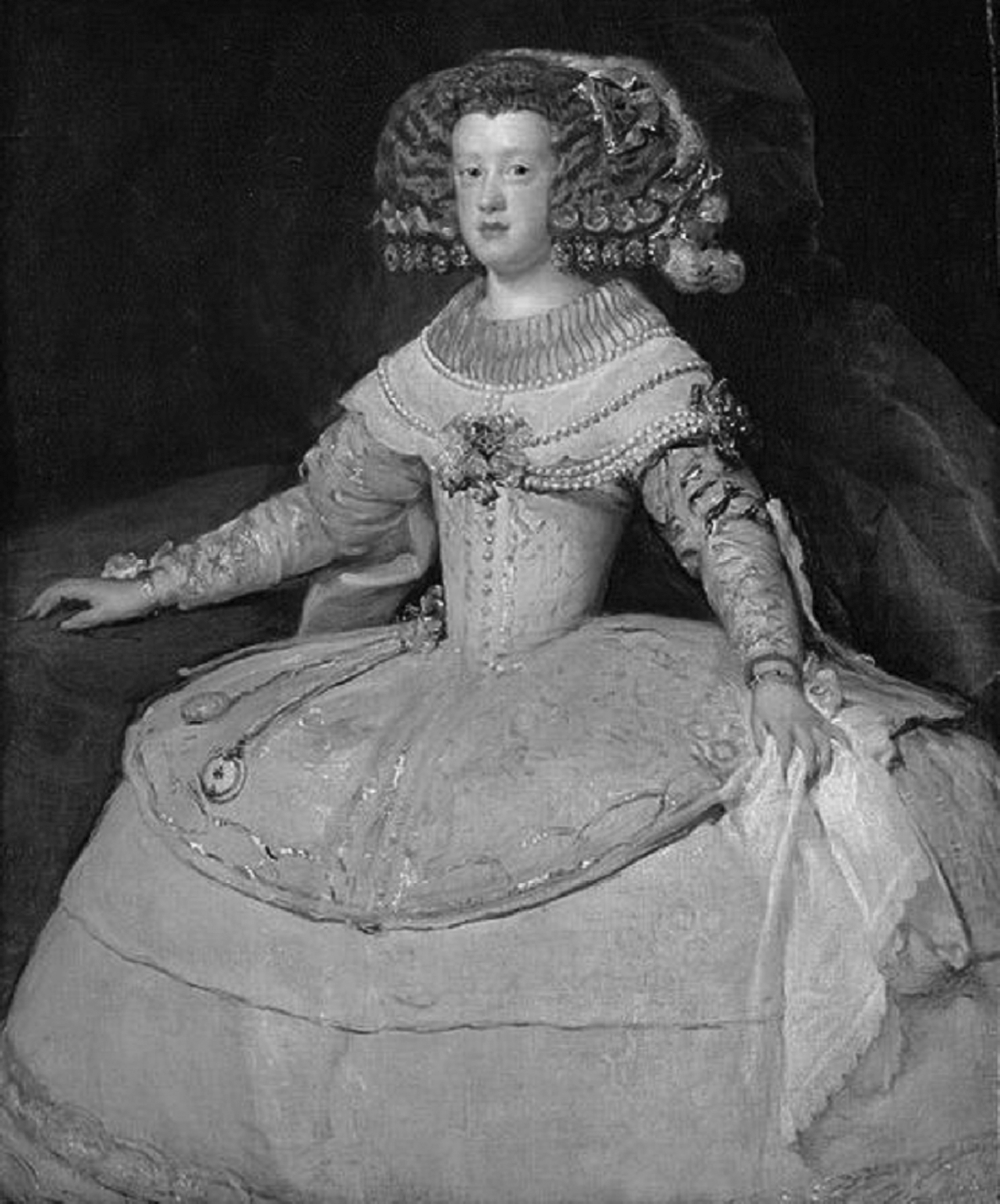
Velasquez, Infanta Maria Teresa
From Old to New
Novelty dazzles us. What is new is so striking and unexpected that the old, from which the new springs, is obscured from view.
A page from Facebook can strike us a completely novel way of picturing oneself. If we compare such a page with a traditional portrait, the differences are evident: The portrait is a static visual object, seeming inert and one dimensional, in comparison to the dynamic, multimedia, interactive Facebook page (Figure 2).

Facebook page of Elliott Friedlander
But both page and portrait are the product of similar human need to show one’s own face to the world, and underlying the differences between the two formats are many similarities of both intent and execution. Compare the Facebook page with what is perhaps the oldest preserved portrait of our culture, the statue of Rahotep and his wife Nofret from ancient Egypt (2575-2467 BCE) found in a tomb chapel in Meidum (Figure 3). Rahotep was a member of the Egyptian royal family (the king’s son perhaps) and, even more importantly, seems to have been the High Priest of Ra at Heliopolis, in other words the official in charge of producing the public art that transmitted the official values of the Egyptian state. Rahotep is depicted with his wife in painted limestone. The figures are more than 120 cm high and are sitting on high-backed thrones in a majestic frontal pose (Robins, 1997). To insure that observers would correctly “read” the representation, the sculptor has affixed to the side of the sculpture what is essentially a Facebook-like profile listing Rahotep’s position, status, and accomplishments. The text goes something like this:
Unique Chief of Seers of Heliopolis, Chief of the Shrine, Keeper of the Scepter, He being unique who guards Pe, Bodily Royal Son, Rahotep Chief of Pe. Overseer of construction and Vizier, Overseer of the Army, Controller of Squadrons, Bodily Royal Son, Rahotep Unique Chief of Seers of Heliopolis, Chief of the Shrine, Keeper of the Scepter. (Luban, http://www.egyptorigins.org/rahotepandnofret.htm)

Rahotep and Nofret
Here we find, some 4,500 years ago, sophisticated strategies of representation that prefigure Facebook. First, consider the intimate connection between word and image. The text is not merely an adjunct to an ontologically superior visual representation but collaborates with image to perform a complex representation of physical identity and social meaning. For the Egyptians, the line between word and picture was blurred: Words were art and art words, and both were in important ways real. The world was what was said and what was seen. “The close connection between text and representation is demonstrated by the way in which the offerings are represented by hieroglyphic writings of their names rather than by their visual images” (Robins, 1997, p. 23). Arranging text and image in carefully designed layouts is a very ancient strategy to suggest the complex interactions of mimetic representation and social meaning. The image needs to be read correctly, and the words gain presence and gravitas from the monumental sculpture. We need to fast forward to the digital age to find this intimate interchange between text and image again. As Livingstone and Lunt (IN PRESS) comment,
The turn to the visual is now remediating the significance of the verbal, ushering in an alternative conception of power (where centre wins over periphery, and image pushes text to the status of mere label) and demanding of users more multimodal and heterarchical forms of knowledge and literacy. (p. 1)
Second, Rahotep’s image functions as a site of interaction, inviting the viewer to respond to the subject. Statues served as portals that linked the worlds of the living and of the dead. Funerary statues housed the ka of the deceased, his vital spirit, which was nourished by the offerings of visitors. When statues were finished, they underwent an elaborate ritual that “woke them up” and made them breathe, so allowing souls to move into and through them. Sometimes, indeed, the statues were placed in a walled chamber separated from the worshippers by a door with two holes. “The ka could inhabit the statue and look out through the holes in the serdab wall, breathe the scented smoke of the burning incense and draw out nourishing essence from the offerings” (Robins, 1997, p. 44). In this way, the statue looked back at the viewers looking at it. The statue was a site for dynamic interactive communication and reminds us of the way we on Facebook represent ourselves to others and also talk back to the visitors. This article will focus on portraits of the early modern period, but the use of likenesses to broadcast status, power, and identity is very old. In the Roman period, for example, as Mary Beard (2001) shows, the deployment of images of the emperor throughout the vast regions of the polity was a mainstay of Imperial political strategy. “It was an emphatically Roman drive to surround available living-space with armies of abbreviated figures of prestige heads or busts” (Beard, 2001, p. 205). From Alexander on, autocratic power made itself manifest “in the saturation of the world with ‘portraits’ of successive rulers” (Beard, 2001, p. 207).
If we turn back to our Facebook example, we can see a feature that seems truly novel: its ability to present a self embedded in a web of interconnections. So the Facebook page shown above can be represented, using an app, as circles of connections tracing all the ways “friends” of the site are related to each other (Figure 4).
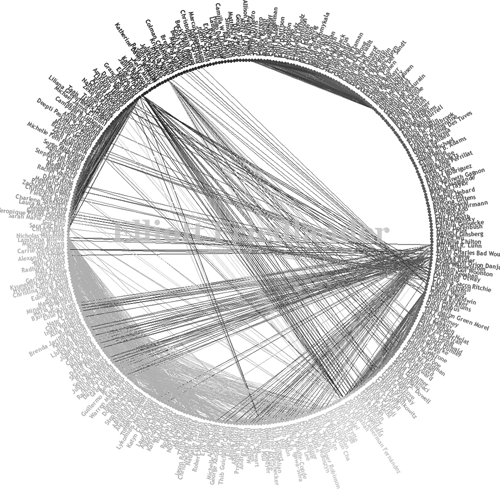
Connections in Elliott Friedlander’s Facebook site
But this feature is already part of the repertoire of traditional portraits. The great painting “Las Meninas” of Velasquez portrays the Royal Princess as a node in a complex and dynamically changing web of relationships (Figure 5). I will discuss this complex work below, but for now we can see how, although restricted to oil on canvas, the artist has managed to alert us to the shifting connections between the people who surround and give meaning to the Princess. This very early example alerts us to the dynamic of portraits.

Velasquez, Las Meninas
Understanding how traditional portraits work can give us insight into the even more complex world of digital representation.
The Aims and Strategies of Portraiture
A successful portrait reflects the subject’s sense of herself, but it must simultaneously convince a viewer. To do so, it must capture, synthesize, and convey a persuasive image of a subject, and legitimize these representations. As Cumming (2009) notes, “Self-portrait is an opportunity to put across one side of the story” (p. 7). Portraits are personal and public, so they must communicate in a recognizable language and employ public symbolic modes.
As private enterprises, portraits attempt to define an identity. In the past, people (usually wealthy) constructed their identity by stipulating the portrait’s settings, costumes, gestures, and attitudes: They could choose to be shown in grand royal isolation; or with wife, children, and pets; or with symbols of their trades and status, or posed against backgrounds that reflected their importance. Because portraits try to tell us what a person looks like and what a person is like, they are ambitious exercises in self-revelation and are correspondingly difficult and anxious affairs. Portraiture sits uneasily on the boundaries between the objective world and the recesses of our interiority. So too, the subject in a SNS must balance his or her desire for an acceptable public representation with a need to express himself or herself in some authentic and private way. In addition, he or she must do so within the range afforded by the specific affordances of the site he or she uses which dictates format, categories, and visual possibilities.
Both SNSs and traditional portraits are collaborations between the sitter’s desire and an enabling technology (the artist, the medium of oil, the formats of a particular site, and the enabling software). It is in this sense that someone (I am not sure who) noted that all portraits are, in part, self-portraits, even when the subject is not the artist. First, both the sitter and the artist must mutually agree on how the sitter is to be presented. The process of collaboration then involves a choice of rhetorical strategies designed to convince a potential viewer of the believability of the intended image. “All portraits envisage a complex transaction between the implied viewer and the subject” (Brilliant, 1997, p. 141). Because the portrait is in fact a way of advertising the self, it encounters the same demands that organize modern advertising: It has to convince the viewer that the claims it makes are authentic, it has to ensure that those claims are correctly interpreted, and it has to seduce and charm the viewer into caring about the claims. Every portrait therefore must answer to certain unsettling questions: How can the sitter find a single image adequate to his or her own multivarious nature? How does the portrait convey both the subject’s individuality and his or her membership in the common world? What supports the sitter’s claims to the viewer’s attention and approbation?
Even the most straightforward portraits utilize a host of strategies to respond to the above demands. Artists buttress the stature of sitters by depicting them with valuable objects, in expensive dress or ceremonial regalia, or amid exotic settings. They augment the isolated figures by linking them through iconography and symbol to gods, heroes, royalty, or famous courtesans. They appeal to their putative audiences’ prejudices and preconceptions. They aim to convince with all the powers at their disposal. As forms of portraiture, SNSs face many of the challenges of traditional portraiture. They inherit from the past many strategies and conventions that have evolved to convey the densely packed information required to convey the particulars of physical and psychological identity, social status, and interpersonal habits. Subjects augment their own importance by connecting themselves to others, their so-called “friends”; they post multiple images of themselves to convey a sense of their busy and multifaceted lives; and they place themselves within a network of relationships to demonstrate their social capital. Both a Velasquez picture and a Facebook page are complexly structured processes of communication, driven by anxiety and desire.
I cannot fully trace the developments in portraiture that lead to Facebook in this short article. Instead, I have selected some important examples from the history of portraiture that point forward to contemporary practice, working mainly with examples from the 16th and 17th centuries. I start with Van Eyck, an artist who straddles the divide between medieval and early modern practice. I then glance at Durer and Rembrandt, two of the greatest artists who produced self-portraits in the North European tradition, and at Titian and Velasquez, the prime portraitists of the Southern European tradition. (Indeed, Velasquez’ portrait of the royal family is considered by many as the most powerful and influential of such work of the entire early modern period.) In a subsequent article, I hope to discuss the radical changes in visual conventions ushered in by modernism (collage, surrealism, abstraction, conceptual art, and so on). As to non-Western art, whose conventions of portraiture are quite different from ours, we must only note that in spite of these differences, contemporary non-Western users have no more trouble deciphering Facebook than they do decoding a Hollywood Western.
Differences and Continuities: From the Early Modern to the Digital
The traditional Western portrait (from 1500 CE onwards) typically relies on one single image to convey a multitude of personal qualities. The image is simplified, concentrated, and easily graspable. This single image synthesizes the complex manifestations of a person’s life and “air” and in doing so seems to project a sitter’s essentialized self, one that can be isolated from a living context and still remain stable and reliable. “By the mid-16th century, the work of art was theorized as a creative imitation in which the essential or ideal character of things is rendered visible by the genius of the artist” (Woodall, 1997, p. 16). Gazing on the image, we have an impression that all of the pertinent information about the subject is there for us to see. The experience is complete, the representation clear and believable. This is how this person looks; this is what this person means.
In traditional portraiture pose, gesture, prop, costume, and glance provided the raw materials out of which a specific presence was evoked. For example, in the portrait by Rembrandt of Nicolaes Ruts (see Figure 6), the sitter presents himself to the viewer with admirable directness. Ruts (1573-1638) was a Mennonite fur trader and his sable coat and hat refer to his trade. Nothing extraneous distracts from the image’s message: this is a merchant, a rich man, evidently serious and respectable. The firm and stable pose, the candid gaze that meets our eyes unflinchingly, the paper proffered to us with every degree of forthright pride, all these bespeak Ruts’ self-assured and seemingly nonproblematic identity. Rembrandt focuses our attention on the sitter’s face and hands, a focus that stresses this burgher’s competence and intelligence. The painting, hanging in a domestic interior or some privileged public space, stayed put a longtime, so viewers lived with it and absorbed it into their consciousness. It became a fact of personal and social history. The coherence of the identity is linked to the coherence of the audience.
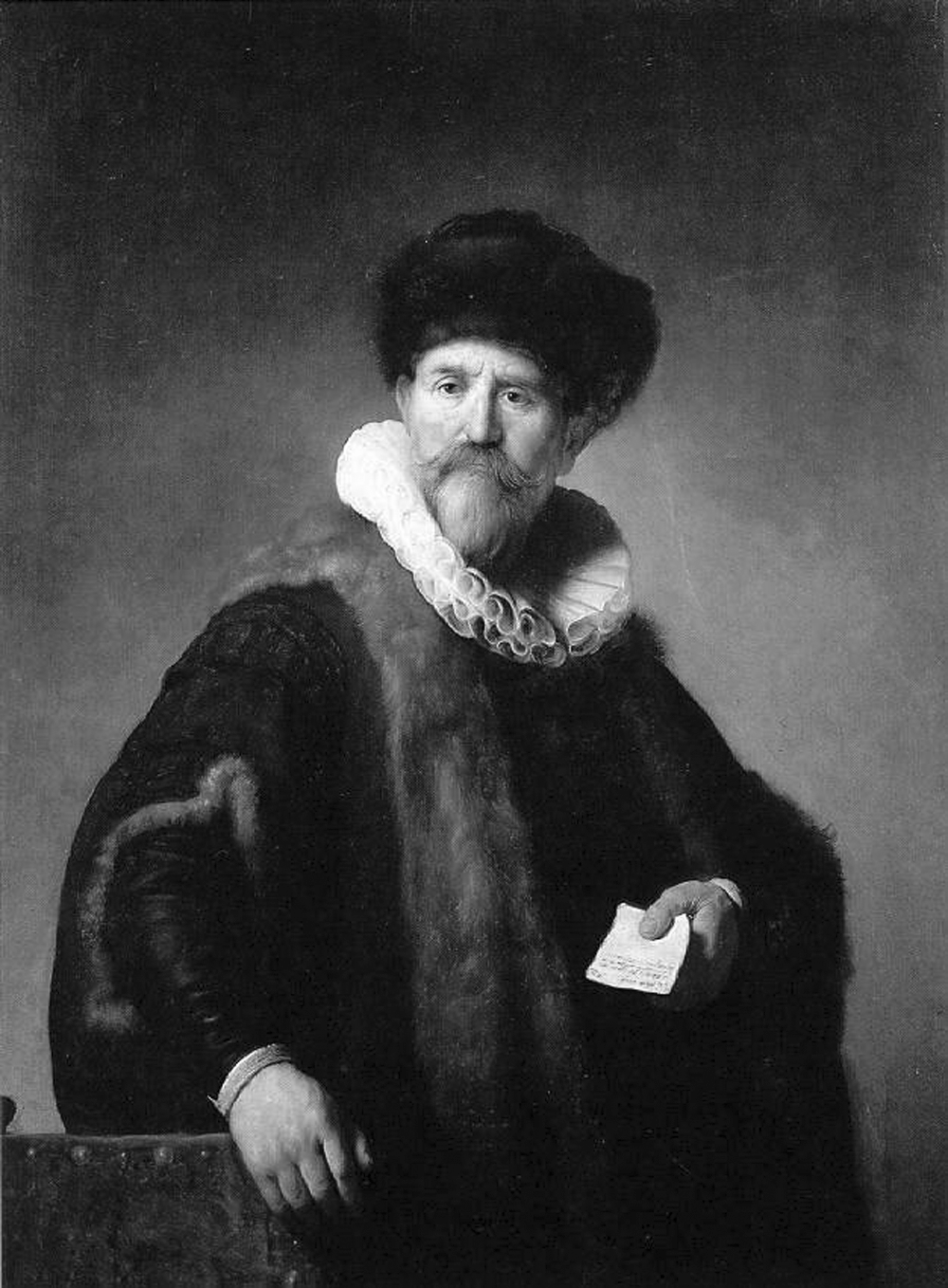
Rembrandt, Nicolaes Ruts
The subjects of 17th-century Dutch portraits had a very clear idea of who was going to view their paintings, and could trust that the viewers would recognize and understand its pictorial codes. Thus, within the confines of this single image, the painter has created a definitive face for all time (Cumming, 2009).
SNSs, in contrast, present the person in a dynamic, constantly changing, and multimodal environment. At first glance, it would seem the modern subject has immensely more powerful tools to convey a full and nuanced self-portrait than did Ruts. But in fact, many difficulties stand in the Facebook member’s way. First, the subject has to assemble an identity out of a mass of visual and textual data—a somewhat serendipitous conglomeration of photos, messages, and links—that flicker in and out of view without necessarily resolving into one stable picture. Second, as the site is linked to many others, the viewer’s impression of the subject will vary according to which links the viewer follows, how the viewer happens to feel about the “friends” who accompany the representation, and where the viewer chooses to linger. Third, the subject’s self-representation is not necessarily an end point but may function as a channel for others to move through, his or her “face” a kind of highway. Fourth, on Facebook, the subject must speak simultaneously to wildly differing viewers—family colleagues, sexual partners, and fellow hobbyists, in short to a globalized and often highly diverse community. Finally, as the shelf life of the site is short, the subject cannot expect viewers to spend any significant time absorbing or meditating on the presentation. So, the contemporary self-portrait seems to live in a decided more difficult representational world.
So, despite the evident differences between Rembrandt and a Facebook page, we can understand them both as responses to the fundamental anxiety of portrait painting. The Rembrandt portrait, for all its clarity and self-confidence, belies the many anxieties attendant on it. Although the artist stresses the calm certitude of the sitter, we know that in fact a merchant’s life and fortune were highly uncertain, dependent on the vagaries of weather, politics, and sometimes pirates. The Dutch Republic was shaken by war and religious dissension and political uncertainty. In response to all this uncertainty, Dutch portraits emphasize the sitter’s innate worth and “essential” self, conveying a sense of the timeless within a world where time and change have fixed their claws. Certainly, Rembrandt’s portrait of Ruts emphasizes the visual self-sufficiency of the sitter. The painter’s skillful rendering of the exquisite feel of fur and linen underwrites the value of the sitter, and Rut’s evident wealth calms any fear we might have about the mutability of fortune and the fur trade. Anxiety, the subject’s and the viewer’s, is hidden well beneath the surface. But it is there precisely in the artist’s effort to smooth those anxieties out of existence. We, in contrast, wear our anxieties on our sleeves. But both Rembrandt and Facebook strive for mastery over the challenges of representation.
Changing Codes
Portraits demand specific literacies. As West (2004) notes, “Likeness is not a stable concept. What might be considered a ‘faithful’ reproduction of features relates to aesthetic and social expectations of a particular time and place” (p. 4). Even portraits from the same era, if they are coded differently and address different audiences, need to be read differently. Compare this work by Titian (Figure 7) of Emperor Charles V with Rembrandt’s treatment of the fur merchant. As emperor and universal sovereign, Charles is the phallic father, a potent pillar of his culture. His elegant dress reminds us of his wealth and status, and the ease of his pose of his assured grasp of power, the extravagant codpiece of his fertility, and iron strength. The dog sniffing at his genitals both signals the Emperor’s aristocratic connection to hunting as well as his ability to subdue nature with his phallus. The portrait asserts the supremacy of role over person: The man is not only a personality; he is a living symbol, unassailable and unalterable. The portrait is not simply a good likeness; it is an icon of authority reminding viewers of the power structure they inhabited. The portrait disseminates the Emperor’s potent presence throughout his realm.
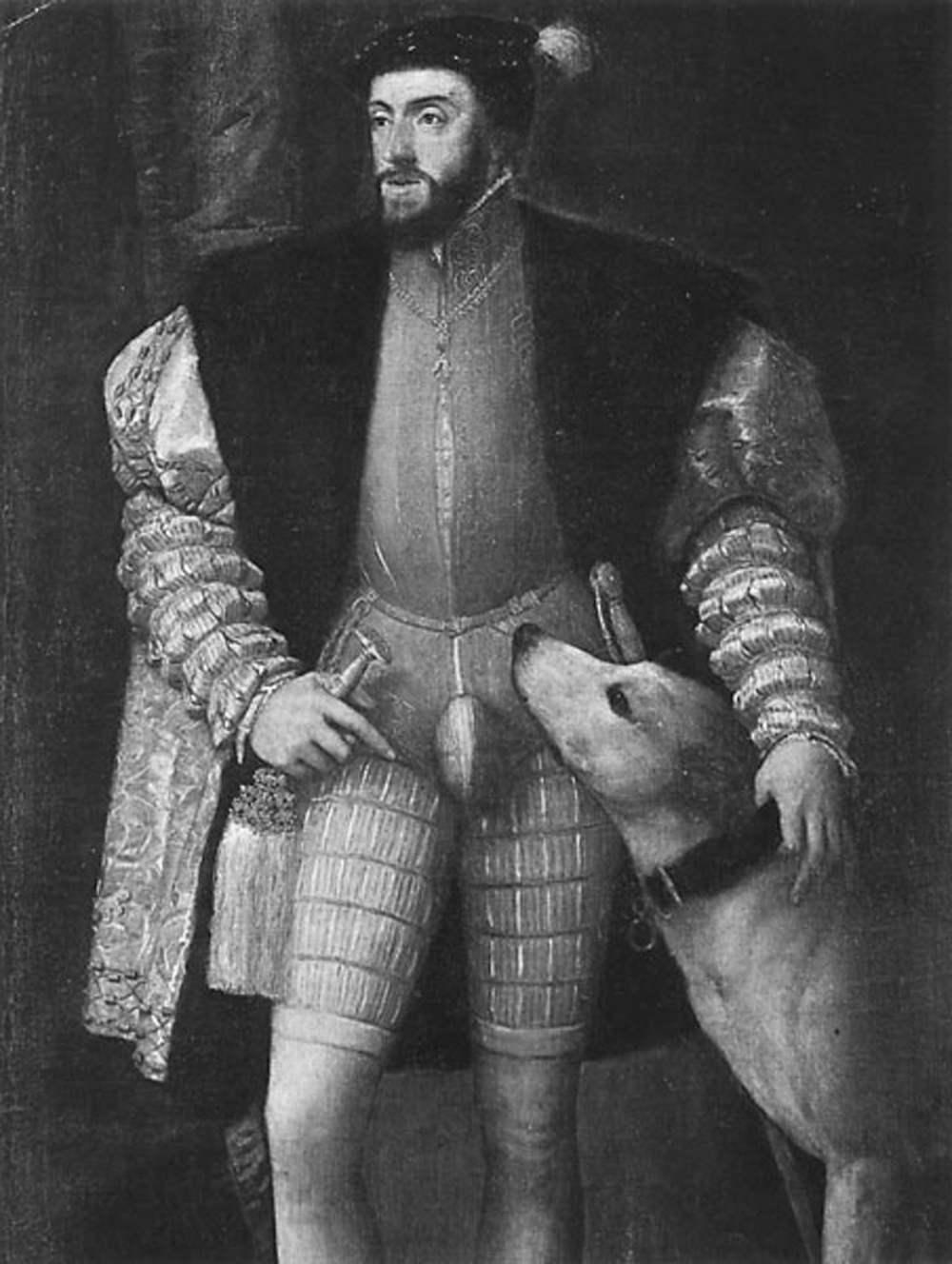
Titian, Emperor Charles V
For another example of portrait as icon, consider this famous image of Queen Elizabeth I (Figure 8). It is not her face but her divinely sanctioned body, clad in symbolic regalia, that defines her. Her position, astride a map of England, testifies to the power of image to virtually dominate a culture.
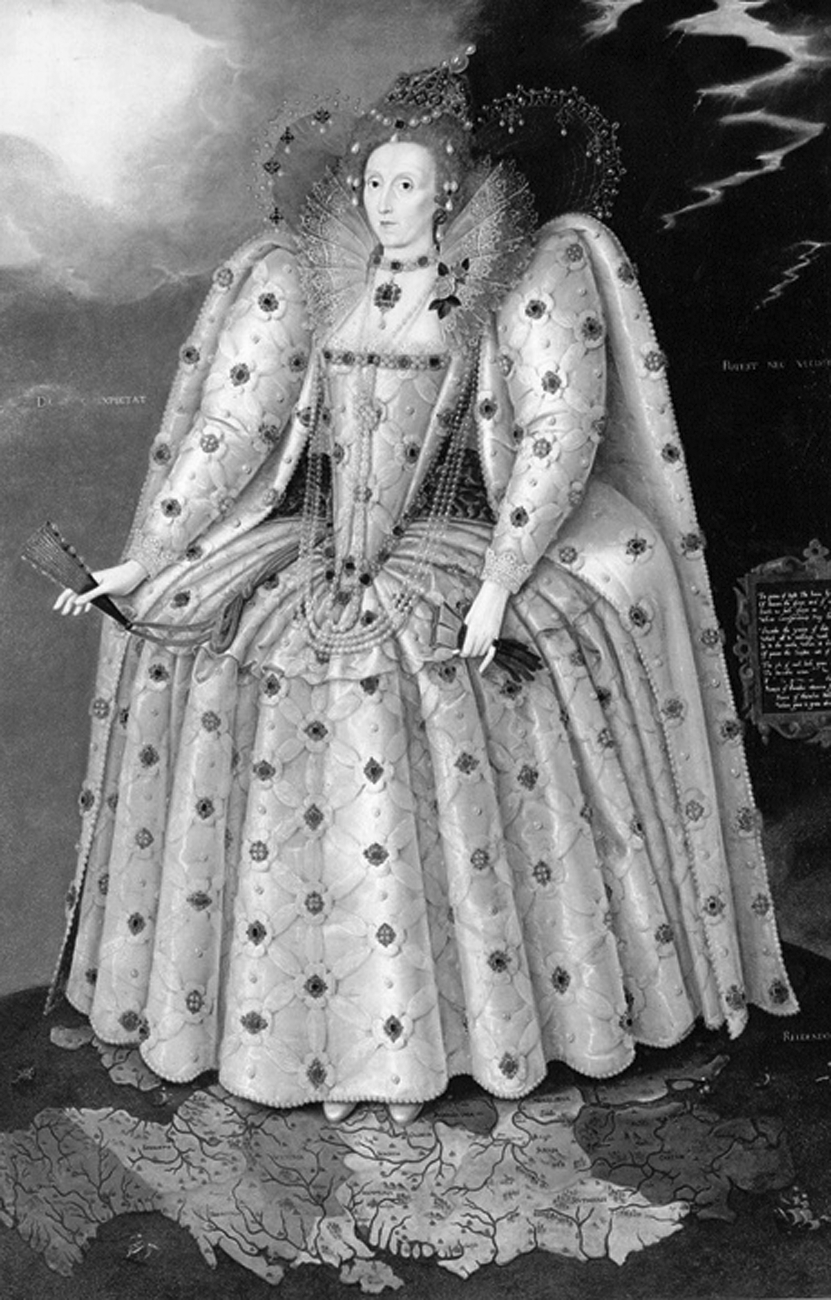
Anonymous, Queen Elizabeth
But the world was changing and the monarchs’ display of social power gives way to the bourgeois concern with status through “personality,” reflecting the replacement of an aristocratic culture by an early capitalist one. It was a bold step for people who were not official, imperial figures to display their images publicly. With such pictures, the private person proclaimed a not dependant on inherited right. It is no longer birth that determines identity but rather a complex of traits and particular experience, the “life story” of the individual as recorded in her face. As West (2004) notes, “The twenty-first-century notion of identity as those aspects of character, gender, race, and sexual orientation unique to an individual is the legacy of the seventeenth century, when the idea of the ‘self’ began to be explored philosophically” (p. 29). The focus of the portrait moves from the genitals and the assertive body to the face and hands of the subject, symbols of sociability and economic engagement. We are shown the unique person, unlike others but manifestly available to all. This bourgeois concept of portraiture is so taken for granted that we assume it is the inevitable aim of the exercise. Freeland (2010) states as a given that “the best portraits manifest a person’s ‘air,’ their unique essence or inner character” (p. 12). But the notion of a person’s “air” is really a cultural concept. We are instructed by Charles’ commanding codpiece, not his sweet personality.
The medium of early modern portraiture, the easel painting, assists this change in emphasis. The image moved from sacred contexts into private, domestic space, the realm of the bourgeois. The portrait in oils allowed “the adoption of intensely illusionistic, closely observed facial likeness” (Woodall, 1997, p. 1). Illusionistic painting is important if you have the opportunity to compare the subject in the work with the person you know in real life. The small scale of the painting allowed for intimate and protracted viewing in a setting controlled by the sitter. But this new setting sets up problems. A portrait in a church or palace had immediate cachet. But if the portrait hung in the home, what guaranteed its authenticity and objectivity? “In the Netherlands, from as early as the 17th Century, any with the necessary cash could commission a portrait” (Kanz, 2008, p. 9). If anyone with enough cash could get a fancy portrait painted, how could the viewer trust the message of the image? The artist needed to fashion an image that independently signaled the sitter’s value. Understanding this need as a central feature of bourgeois portraits helps explain the surprising strategies artists adopted, strategies still current on Facebook.
For example, a person could augment his or her importance by connecting his or her image to that of others more likely to receive the viewer’s respect, to “friend” the image in other words. Compare two portraits of Chancellor Nicolas Rolin (1376-1462). Rolin came from a bourgeois family and rose to be one of the most important and richest officials in Flanders. The first of the portraits (Figure 9) is by Rogier van der Weyden, painted on the exterior panel of the Beaune Altarpiece.
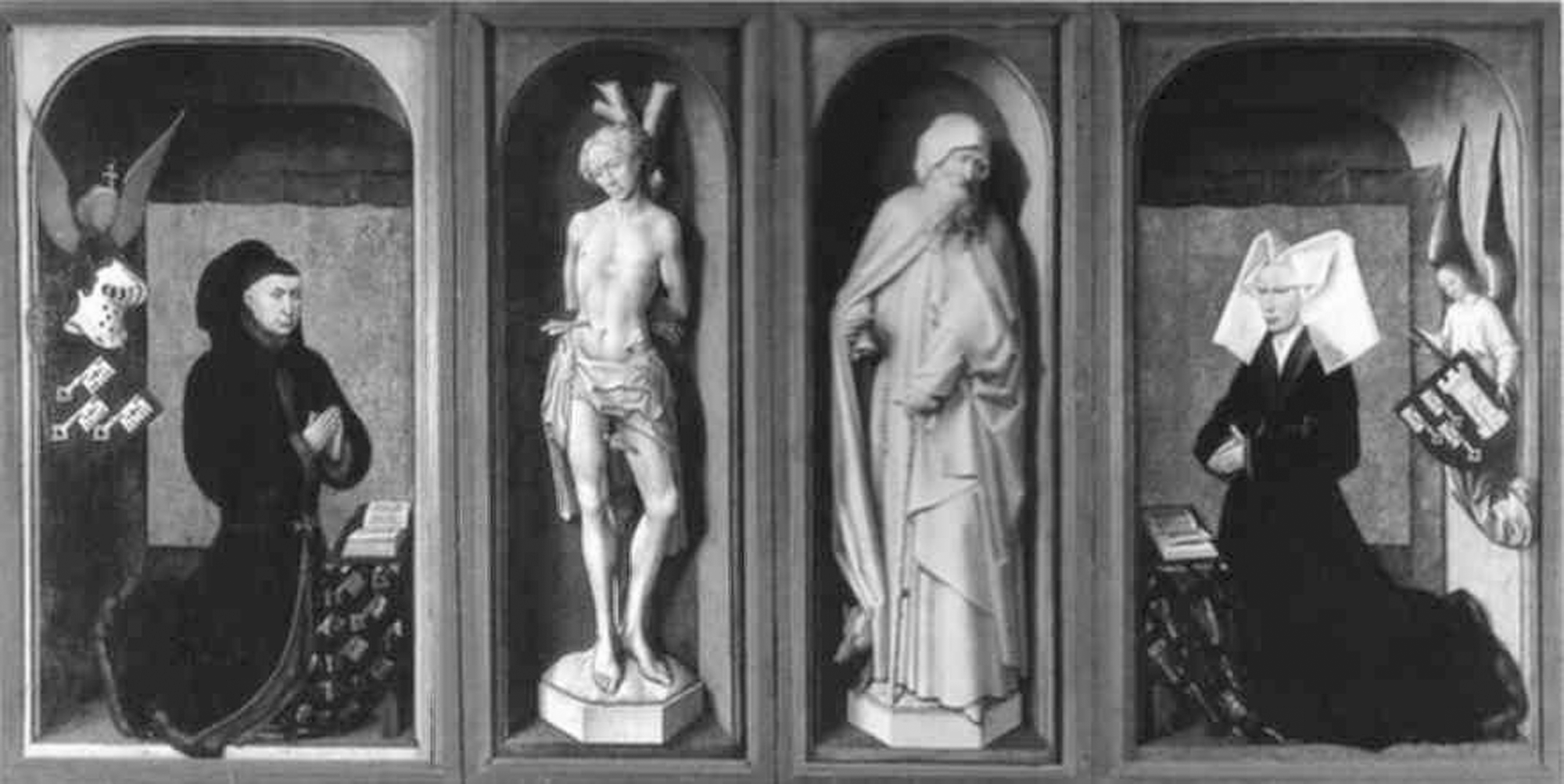
van der Weyden, The Last Judgment Polyptych in Beaune
Here, in traditional late-medieval fashion, the Chancellor, as the donor of the work, is shown in a pose that emphasizes his humble, prayerful relationship to the holy figures placed in the middle of the screen. The holy figures are distinguished by different painting techniques from those of Rolin and his wife: The Rolins, occupying the human, subordinate world, are painted in a realistic style, whereas the holy figures are depicted as statues in a church and thus seem to occupy a transcendental realm.
Now compare this portrait with one by Van Eyck of the Virgin with the same chancellor (Figure 10). In this painting, the Virgin is not depicted by herself nor with the Christ child. Instead, she is shown seated facing a mere human in what seems like an intimate domestic tea party. Unlike the earlier such depictions, where the donor is placed to the side or below the Virgin and shown in a much smaller scale, here the donor is full size and seems to occupy the same ontological space as the Madonna. He seems as physically real as she does and also seems quite unabashed by his close confrontation with the sacred. Of course the painter does try to minimize the audacity of this gesture by including small details that suggest the donor is in the fallen world and Mary in the sacred world: Images in the background taken from Old Testament stories and New Testament stories suggest that the donor is a fallen flesh and blood figure whereas the Virgin is a transcendent one. However, these small visual clues do not minimize the audacity of the donor’s attempt to his own status through his “friendship” with the mother of God. (It reminds us of the couple who gate-crashed the White House to have their portrait taken with the president.) Chancellor Rolin seems to have been aware that he was treading close to the line, for X rays of the picture show that he had been originally portrayed with a large purse at his side, an allusion to his wealth and his success as a high official. Perhaps he sought to mitigate his audacity through omission of the purse and through his kneeling posture, as well as by the way the picture space divides in two, placing him in effect on the other side of human/divine line. However, even this positioning suggests another act of “friending,” as his posture reminds us of pictures of the Annunciation, with Rolin occupying the space normally filled by the Archangel Gabriel.

Van Eyck, The Virgin and Chancellor Rolin
With the Van Eyck, we enter the precincts of modernity. Chancellor Rolin both celebrates himself through his friending of the Virgin and also displays his anxiety about his self-presentation by his need to associate himself with so public and impregnable (no pun intended) an image as that of Mary. He masters his anxiety by connecting himself visually to the most revered image of his time.
This mixture of anxiety and self-promotion is even more starkly present in the works of Durer, the first great self-portraitist of our culture. His series of self-portraits, in their variety and in their preoccupation with trying out identities, look forward to those of Rembrandt. Throughout his career, Durer restlessly painted himself in innovative poses: as a young lover, as an old naked man, as a rich and successful burgher, and, most astoundingly, as Jesus himself.
In this famous portrait (Figure 11) we see the artist in close-up, the face staring straight at us, boldly present. There are no extraneous iconic references; it is just a face, hair, beard, and eyes. But any contemporary viewer would immediately recognize in the disposition of the features, in the symmetrically arranged and striking hairdo, in the beard and the commanding gaze, the portrait of Jesus known from the tradition of Veronica’s Veil. The story goes that Jesus wiped his face on her handkerchief and left an impression of his visage there, so that the resulting image is “poised between icon and portrait.” Jesus’ face floats on Veronica’s napkin, not a depiction but an actual virtual visage created by ancient divine technology. Durer, by deliberately referring to the miraculously preserved image of Jesus, transfers the authenticity and immediacy of Christ’s image to his own, offering his face to you, the viewer, with the directness and unavoidable intimacy of a sacred icon.

Durer, Self-portrait
What was Durer up to? This question has puzzled critics ever since. For example, Cumming (2009) wonders, “Could this man actually have meant to make himself look like Jesus?” (p. 43). Some critics seek to soften or deny the audacity of the portrait by seeing it as an act of Christian humility, Durer in a sense submerging himself into God. Or, conversely, as an example of early modern artistic self-affirmation: The portrait proclaims that the artist is a kind of divine creator.
Dürer as we shall see fashions his likeness after icons of Christ. In analogizing the artist’s portrait and cult image of God, in celebrating his art as the vera icon of personal skill and genius, Dürer realigns the terms of artistic and human self-understanding. (Koerner, 1993, p. 53)
But, by any account, the artist has triumphed over the problematic nature of representation and its claims to validity by linking his image with God himself. By this visual “trick,” he fuses image-as-icon with the image-as-individual.
Van Eyck and Durer testify to artists’ subtle manipulations of depiction in service of complex rhetorical goals. These strategies function very much the same way as do use of friends and friending on Facebook. The number and type of friends augment and elaborate the authority of the site subject and expand the notion of a private self into a communal one.
The Multiple Self
In the early modern period, few people could afford to have more than one image painted (if that), so it had to be one that would synthesize many aspects’ of the sitter’s life and character. The situation with artists’ self-portraits is different. They were among the few (emperors and kings included) who could reproduce themselves in multiple images and at multiple times and therefore who had the luxury of tracing the evolving faces of the self, morphed by time and feeling. Rembrandt, Velasquez, Durer, Munch, the names are legion of artists who have used the self-portrait not merely to represent (mimesis) but also to explore the self. They probed the surfaces wrought by biology and time to reveal what is hidden deep within. “Artists depict themselves as they want to be seen by others, but also as they want to distinguish themselves from them” (Rebel, 2008, p. 6). Studying their work, we see that our contemporary interest in our multiple and contradictory appearances is age-old. Nowadays, of course, the SNS affords all its users almost infinite opportunity to present various, often contradictory, images of the self. We can all be Rembrandts, in effect.
Rembrandt, of course, is the great example of an artist who continuously painted himself in a bewildering variety of poses, costumes, expressions, moods, and activities. Two of his exploratory sketches of expressions (see Figures 12 A and B), for example, show how fascinated he was by the way expressions changed character. In part, he was trying to master human expressivity to enlarge his painterly repertoire. But he was also studying the mobile and feeling-haunted human visage because his art demanded a technique that allowed the outer self to express the inner one.
In his great series of self-portraits (almost 60 of them), as they move from youth to old age, he shows a prescient dissatisfaction with the essentialism of a single image and an intuition that the portrait was, in effect, an attempt to capture time itself, time as it twists and turns and distorts and reforms our faces and our being (Figures 12 A-E).

Rembrandt, Self-portraits
Above all, the last unforgettable self-portrait (Figure 13)—showing him grinning at the sad foolishness of it all—reveals a distinctive contemporary awareness, an ironic intuition, of the fragile temporality of the self. In it he captures, in a very modern way, the joy that is possible in the parade of selves, in their constant variety and festive transformations, in their very instability. In this he anticipates the strategies of the social networking sites. There we not only present ourselves augmented by our friendships but also celebrate the fleeting nature of our experiences and of our very selves through the multiplicity of our representations, through their tentativeness and quirkiness, through their ironic self-doubt. We turn representation into an acknowledgment of an unceasingly changing self.

Rembrandt, Self-portrait
Networking the Self
The most glaring difference between traditional portraits and SNSs lies in the latter’s networked features. A subject is presented as part of a vast and ramified network of people, events, and associations. This corresponds to our sense that we are constituted in great part by our connections to others, connections that are shifting, varied, and richly diverse. But this intuition is one shared by people of earlier times, and great portraits have striven to suggest this web-like context for the individual.
If we pass on to perhaps the greatest example of portraiture in the tradition of Western painting, to Velasquez and his group portrait of the Spanish royal family, commonly known as Las Meninas (Figure 14), we can see the artist intent on capturing the network of connections that constitute identity in ways familiar to us in SNSs. We can consider Velasquez’ painting as a record of the world as a networked event. The painting shows us Velasquez in his studio in front of a large canvas on which he is presumably painting a court scene, most probably a portrait of the young princess. The princess herself is being attended by her ladies-in-waiting, whereas other members of the court stand about. In the rear of the room hangs a mirror in which we see the reflection of the king and queen watching the scene. There is also a high official standing in the doorway.

Velasquez, Las Meninas
To gain a sense of how radical is Velasquez’ handling of a group portrait of a family, compare it with a more conventional treatment.
In this portrait by Nicholas Maes (he was a pupil of Rembrandt) of a wealthy family, the painter takes great care to establish fixed relationships between the subjects (Figure 15). The subjects are dressed in vaguely classical costume, signifying their status; the setting is an elegant Italianate garden with fountain, and the pater familias is seated at the center, the object of attention and control. Hierarchy is preserved, the occasion is clearly formal and ceremonial, and the intent is to celebrate and commemorate this family.

Nicholas Maes, Family in Italianate garden
When we turn back to the Velasquez, we immediately notice how ambiguously the artist stages the scene. First, it is hard to decide who is the central subject: the artist? The young princess? The royal couple mirrored in the back wall? The dwarf and the dog in the foreground? Somehow all can claim some kind of centrality but all are reciprocally placed and characterized by their position in a network of relationships. The Princess is gazing toward whom? Is she presenting herself to us or is she looking at the king and queen for approbation and direction? Her attendants look at her, but the dwarf and the dog are in their own world. Although hierarchy seems to be maintained, in that the King and Queen are observing the scene and in a sense blessing it, they are positioned all the way to the rear of the work and Velasquez confusingly foregrounds the least important members of the ensemble, the animal and the dwarf. The painter is painting the scene and painting himself painting the scene. The painting itself is turned away from us (some critics argue that the mirror in the back is reflecting not the king and queen watching the scene in real space but the king and queen on the painting). So the painting is both a self-representation and a record of the act of representation that authenticates him as an artist and as a valuable member of the court. “He (Velasquez) serves the picture, and dominates it at the same time” (Rebel, 2008, p. 48).
The viewer’s gaze cannot rest on any one figure but instead must follow a wavering line that moves from figure to figure, restlessly refusing to settle on any one subject or configuration. The painting depicts a closed world containing characters all of whom are clearly socially and individually differentiated within the strict decorum of the Spanish court. However, on inspection, this closed and nominally ordered and hierarchical world shows itself as an open-ended, bewilderingly interconnected, temporally inflected, field of relationships. In this world, connections are everything and nothing. There is a formal technology of representation and control—the artist controlling the representation, the king and queen controlling the world. But in fact, the viewer is constantly forced to construct individual hierarchies and to improvise relationships. We scan the scene as we would engage with a Facebook site, moving between different kinds of information, intervening and reacting spontaneously, according to whim and need. Livingstone and Lunt (IN PRESS) emphasize the new heterarchical quality of digital communication. With this painting, we enter a fully modern world, a world where the individual is enmeshed in dynamically changing relationships, whose instability marks each connection with anxiety and with power.
Conclusion: The Complexity of Self-Representation, Then and Now
As this brief review of traditional portraiture indicates, every likeness is also a “profile,” a compilation of traits, connections, values, and social stances. Even the most straightforward of portraits, such as those of the Emperor by Titian or the fur merchant by Rembrandt, are the result of complex negotiations between sitter, artist, and audience. At stake is the performance of identity in highly charged personal, social, and ideological contexts. Though all the portraits we have discussed lie within a broadly similar aesthetic tradition (traditional realism), even this brief excursus in the modes of portraiture within a restricted and relatively homogeneous period shows the varieties of forms and uses portraiture can assume.
These differences arise from the complex and often contradictory purposes of portraiture. Every portrait, notwithstanding its surface simplicity, is the result of negotiations between subject, artist, and intended audience. Each of these “performers” has specific interests and demands. The subject needs to decide what aspects of the self—physical appearance, mood and temperament, social or professional standing, and ideological commitment—she should reveal. Equally important, what should she conceal? Is the portrait a private or a communal representation? How do subjects balance the two aspects of their selves? The artist has to juggle the subject’s self-understanding with his view of the sitter. The artist also has to fashion these complex decisions into a visually immediate and forceful image. Yet this striking image must repay repeated viewings over a long stretch of time. Finally, the viewers must correctly interpret what is shown and also assess the veracity of the representation. The result of the sitter’s and artist’s struggle to answer all these demands is a distinctive and personal image, one that reveals much more than it perhaps intends.
So too, in our own time, SNSs are remarkably diverse in their features and uses. They all feature a “backbone . . . of visible profiles that display an articulated list of friends where one can ‘type oneself into being’” (Boyd & Ellison, 2007, p. 2). They vary in their different kinds of audiences, rules for inclusion, intended use, and so on. LinkedIn caters to a professional membership, seeking a business network; Myspace has found an audience in the music world; there are sites for Asian communities, for Blacks, Gays, and so on. Different sites have different rules about privacy and access, some feature apps that a member can use to individualize a site, whereas Facebook was originally designed “to support distinct college networks only” (Boyd & Ellison, 2011, p. 8).
Scholars have increasingly recognized that SNSs are complex performances.
This paper will argue that identities on SNS are deliberately constructed performances that straddle the frontstage and the backstage, the public and the private, and in doing so both support and rely upon webs of social connections which engage with fluid or playful identity constructions. With a heightened self-consciousness (Chan, 2000), online environments take this construction of performance to another level (Boyd & Heer, 2006). SNS platforms provide areas which are disembodied, mediated and controllable, and through which alternate performances can be displayed to others (Boyd, 2006). (Pearson, 2009, p. 1)
These authors, and many more, concur that SNSs need to be approached as multimodal, complexly organized, and heterogeneous sites of interaction (see Appendix). As the visual becomes increasingly important in digital personal presentations, we need to develop sensitivity to the complex issues involved in the choice of images and understand how the image contributes to a multifaceted communicative process. Here the history of portraiture, and the rich scholarly tradition that deals with its visual strategies, can be helpful. Without ignoring the novelty of digital self-portraiture, we should recognize that all visual representations share the full complexity of human communication.
Picture Credits
Anonymous. Rahotep and Wife http://egyptphoto.ncf.ca/meidum13.html
Durer. Self-Portrait at 28. 1500. http://www.ibiblio.org/wm/
Maes. (1623-1693) Group portrait of a family in an Italianate garden with a fountain
Rembrandt. Nicolaes Ruts, 1631, The Frick Collection, New York
Rembrandt. Self-portraits, all from Wikimedia Commons
Titian. Charles V with Dog 1532-1533 Museo del Prado
Van der Weyden. Exterior Panel, Beaune Altarpiece 1450 http://www.abcgallery.com/W/weyden/weyden29.html
Van Eyck. The Virgin and Chancellor Rolin http://www.louvre.fr/llv/oeuvres/detail_notice.jsp?CONTENT%3C%3Ecnt_id=10134198673225618&CURRENT_LLV_NOTICE%3C%3Ecnt_id=10134198673225618&FOLDER%3C%3Efolder_id=9852723696500812&baseIndex=118&bmLocale=en
Velasquez. Las Meninas 1656–57_Museo del Prado Madrid
Velasquez. Maria Teresa of Spain (with two watches) Kunsthistorisches Museum, Vienna
Footnotes
Appendix
The author(s) declared no potential conflicts of interest with respect to the research, authorship, and/or publication of this article.
The author(s) disclosed receipt of the following financial support for the research and/or authorship of this article:
The author received financial support from the Mediatized Stories Project of the University of Oslo financed by the Norwegian Research Council.