




Abstract
In the context of constructing regional education and talent hub, Macao’s higher education talent development strategy impacts the creation of a regional talent hub and the process of industrial diversification. This study adopts a text analysis approach. Through the analysis of 118 texts and the construction of the game model, it reveals that Macao’s talent development has been passing through a “market-controlled” and “policy-driven” stage due to the uniqueness of economic and social development. The model of cooperative game based on endosymbiosis implicates that the talent attraction strategy of higher education can play a leading role in socio-economic development to form a cooperative and symbiotic equilibrium with the region as a whole through the “climbing period” when the “actual state” catches up with the “expected value.” This paper proposes some policy recommendations, including: prospective discipline layout, breaking down of institutional barriers, cooperation and exchange of talent cultivation, and the creation of a talent-sharing mechanism for promoting the construction of a regional talent hub.
Keywords
Introduction
The industrial revolution of artificial intelligence is accelerating the global economic transformation in the 21st century. More emphasis is being placed on the contribution of human capital to both the advancement of national competitiveness and scientific and technological innovation. For every nation, the struggle for talent serves as the foundation of technological innovation and national comprehensive strength, regional innovation and talent management strategies have become the driving force behind future technological advancement and cultural prosperity. In February 2019, The Chinese government issued the Outline of the Development Plan for Guangdong-Hong Kong-Macao Greater Bay Area (hereinafter referred to as “Outline”), stating that it “will implement a more active, open and effective talent introduction policy, accelerate the path of construction of a demonstration zone for cooperation among talents from Guangdong, Hong Kong and Macao” and “build an education and talents hub” (Ye & Song, 2019). The regional strategies and frameworks for attracting global knowledge flow ultimately decide the extent to which expatriate knowledge embeds locally (Ewers, 2017). Injecting innovation factors such as venture capital and talents into a region positively affects creative knowledge flow and conversion (K. Xie et al., 2018). There is a critical shortage of talented personnel in the Guangdong-Hong Kong-Macao Greater Bay Area with the spirit of creativity, cross-border thinking, and capacity for innovation in science and technology (Huang & Huang, 2020). The exchange, collision, integration, and transformation of new information will have an accelerating effect and give power support for regional development when regional talents devote themselves to universities, industries, and research organizations (Zhuo, 2021). Consequently, talent is the primary productive element for building a world-class city cluster in the Guangdong-Hong Kong-Macao Greater Bay Area (GBA). This key factor suggests it is a significant strategic move that the country makes decisions to leverage the synergistic effect of human resources through the regional clustering of talents in higher education.
Macao is one of the four major cities in the GBA. The GBA is putting the four major cities: Hong Kong, Macao, Guangzhou, and Shenzhen as the core engines of regional development, which fully reflects the important position of Macao in the national development strategy under “one country, two systems.” However, the unique historical background, narrow geographical limitation, and single-industry structure make Macao’s talent development significantly different from the other three central cities. The gaming industry is in the leading place in Macao, accounting for 51% of the GDP in 2019 before the outbreak of the COVID-19 epidemic (Macao Statistics and Census Service, 2019). The supply of employment in Macao largely came from the public service and the gaming and tourism-related industries since their high demand and salary levels attract many college graduates and the local workforce. Macao residents rarely took up finance, engineering, technology, and other industries, further intensifying the contradiction in interdisciplinary talent structure (W. Wang, 2019). Because of the late start and small scale of Macao’s modern higher education, the foundation of talent cultivation and the reserve of high-end research talents are partly insufficient. The path of higher education talent development in Macao reflects its economic, social, and policy planning background. Against this background, the market demand restricts the development of higher education talents in Macao. The training of talent needs to respond to market requirements at all times. This situation forms a problematic dilemma: since a single industry drives higher education to cultivate corresponding disciplines, the talents can only serve the limited industry (H. Zhang, 2019). However, the role of the core engine of the regional talent hub inevitably places the requirements on the construction of talent in the central city. The bottlenecks in developing higher education talents in Macao and the process of integration into the region are typical problems. Breaking limits caused by solidified thinking, traditional paths, and institutional barriers in realizing the effective development of Macao’s higher education talents is not only a real need for Macao but also one of the core supports for the construction of the regional talent hub. The present paper focuses on Macao’s higher education talent strategy in a regional context. It also aims to explore the paths and core connotations of a city’s integration into the region through an in-depth analysis.
Literature Review
Regional Education and Talent Hubs
“Regional Education and Talent Hubs” is an important issue of current international research. Knight’s research on regional education hubs involves descriptions of the nature, variability, and classifications of regional education hubs. There is no “one size fits all” model for education hubs as local conditions, priorities, and rationales vary from country to country and from hub to hub, but the education hubs identify three major types—the student hub, the talent hub, and the knowledge hub (Knight, 2011). Further, several scholars have examined different approaches to building education hubs in different countries or regions from different perspectives (Knight & Lee, 2014; Mellander & Florida, 2011; Mok & Bodycott, 2014; Sidhu et al., 2011). Regardless of the connotations of education hub development, the long-term intention of the education hub initiative is to enhance and retain the needed human resources and to develop a research culture and capacity (Knight & Lee, 2014). Undoubtedly, the construction of a talent hub is the core of the connotation of the education hub. More than a decade ago, Livingstone and Hope (2010) set out the goal of making the UK the world’s leading talent hub in high-tech and fast-growing creative industries. While some emerging markets of international education, Asian countries ambitiously launched internationalization initiatives and strategies to attract international talent (Lin, 2020). Many elements need to be considered in the construction of the Talent Hub ecosystem, such as public governance, long-term strategies, and breaking through institutional barriers (Ranta, 2021). Talent clustering and development in the field of higher education address the regional talent shortage mainly through the establishment of higher education institutions that train digital and scientific skills (Niemi et al., 2021). In general, the construction of regional talent hubs is closely linked to regional innovation processes. Innovative talents, entrepreneurs, and investors were encouraged to work in collaboration with innovation hubs (Hannadige, 2021).
China’s Regional Higher Education Talent Hub
Regarding the construction of regional higher education talent hubs in China, relevant studies are represented in the literature on higher education cooperation or cluster development in the GBA. In the strategy of talent cultivation in the Greater Bay Area, some scholars proposed to relax the criteria for setting majors according to the “shortage talent list,” cultivate complex talents by enrolling in large categories of majors and teaching in small majors (Lu & Qin, 2021), and build a complex talent cultivation system (Huang & Huang, 2020). In the cultivation of innovative talents, some researchers believe that it is necessary to dovetail with the needs of industrial transformation and upgrading through “industry-education synergy” (X. Chen & Chen, 2019; Li et al., 2020). The “science and education integration” and “science-industry-education integration” are used to deeply participate in the science and technology innovation community (Lu, 2019), provide talents and technical support for international science and technology innovation centers (Lu & Chen, 2021), and strengthen the cultivation of innovative and entrepreneurial talents (Jiao, 2018). One of the important elements of higher education cooperation is the interaction and cooperation of talents, which includes firstly, interactive exchange of teachers within the Greater Bay Area and joint training under mutual recognition of credits (Z. Wang & Zhang, 2021), followed by the demand for internationalized talent supply and the creation of an international talent port (A. Xie et al., 2019; Xu & Lu, 2019). Finally, the formation of the collision of ideas and the flow of outstanding talents within the Bay Area with immigrant culture and open culture (Zhuo, 2021).
Macao Higher Education Talent Development Strategy
As a micro-city, Macao has special characteristics in higher education talent development. Some scholars have put forward the social adaptability of Macao’s higher education (Jiao, 2015), and the long-term mechanism of talent cultivation of Macao’s economy and industry (H. Zhang, 2017) respectively. Given the shortage of human resources in Macao, relevant studies have focused on the dilemma of talent introduction (Z. Chen & Liang, 2017), talent sharing, expertise introduction, talent return, and talent system (W. Wang, 2019) in Macao. In the light of the national “Thousand Talents Program,” Qu and Yu (2015) have given a comprehensive consideration to the management of talents in Macao and proposed how to “attract,” “use,” and “retain” talents. In short, the construction of Macao’s talents should focus on the parallel three-track approach of “introduction,” “cultivation,” and “return” to build a reservoir of Macao’s talents (X. Liu, 2021). To integrate Macao higher education into the development of the GBA, it is crucial to break down institutional barriers. Using structural equation modeling, Liang and Wang (2021) explored the factors influencing the entrepreneurial intentions of Hong Kong and Macao students. In the new era, the convergence of management systems, industrial transformation and upgrading, and the development of high-quality higher education in Guangdong, Hong Kong, and Macao are the keys to the construction of the talent hub (Qi et al., 2020).
In summary, foreign studies on the construction of talent hubs are relatively scattered but closely related to the construction of education hubs and innovation hubs; although many Chinese scholars have elaborated on regional talent construction in terms of regional higher education cooperation and cluster development, the integration of Hong Kong and Macao into the development of the GBA, and the development of Macao’s talents, there is still a lack of systematic research on talent topic. In addition, most of the studies focus on the dimension of literature exploration and theoretical explanation, and a few adopt quantitative research. But few adopt a standardized qualitative research method to explore talent development in GBA in depth. This study intends to make a breakthrough here by combining qualitative research with Macao’s perspective to explore the practical and theoretical logic of regional talent hub construction and Macao’s higher education talent development strategy and the perspective of Macao’s higher education future development policies and core strategies of regional talent hub construction.
Methodology
Description of Research Method
This study adopts a text analysis approach. Text analysis, especially the analysis of official documents, has a unique position in social science research (Tu, 2009, p. 22). It is a research method that compares, analyses, synthesizes, and refines the content of texts from superficial to deep. Also, it transforms disorganized raw texts into information that can be identified, processed, and counted, thus structuring textual information and giving it meaning (Marshall & Rossman, 2014, p. 111). The deeper connotation of text analysis lies in the fact that the analysis of a text must ultimately go beyond the text. Also, the process of going beyond the text is the process of abstracting and generalizing from the concrete, in which the reader uses a variety of approaches and perspectives to “read” the text through a dialogue between the text and the historical context in which it was produced to discover the “deep structure” of the text. As Fairclough (2003) pointed out, categories and logic work together in developing theory and analyzing texts. These approaches employ different forms of coding or systematic qualitative analysis and include classical hermeneutics, Ground Theory, and content analysis, etc. (Kuckartz, 2014). This paper is anchored in Ground Theory and provides pointers for problem solving by digging into the development, hidden logic, and deep structure of the issue through textual coding.
Data Collection
This study is based on three types of texts: Policy texts (No. P), Press and Magazine texts (No. N), and Academic papers (No. A). As Smith (2017) noted, the standard methodological process of text analysis is to propose a research question that can be tested, then select texts relevant to the research question and analyze them. To improve the reliability of the research, the text selection follows two principles: (1) The source of the text is authoritative. To select authoritative, reasonable, and convincing texts, the three types of texts selected in this study are all official texts issued or published in public. Among them, the policy texts are mainly official policies or legal documents issued by the Chinese government, the Guangdong Provincial Government, and Macao SAR. The Press and Magazine texts come from the authoritative media in Mainland China and Macao (such as Macao Daily and South Daily). The text of academic papers comes from high-quality papers written by scholars and published by core academic journals and (2) The content of the text is relevant to the topic. To select the texts relevant to this research, researchers focus on the selection of texts related to the development of higher education talents in GBA under the theme of “Regional higher education talent strategy.” Relevant texts include not only regional policies and relevant discussions on the development of regional higher education talents, but also policies, reports, or academic papers on the development of higher education talents in GBA and Macao respectively. Each of the three types of text was sampled using the following process:
First, Policy texts, including national policy texts, Guangdong Province policy texts, Guangdong-Macao joint policy texts and Macao SAR Government policy texts. The researchers select these policies because they reflect the plans of different levels of government for GBA construction and development. National policy texts are mainly official texts on the planning of GBA and the Guangdong-Macao In-Depth Cooperation Zone in Hengqin (IDCZ), which are the overall planning at the national level. Guangdong Province policy texts are official policy texts issued by Guangdong Province after GBA construction was proposed by the country. They contain the contents of Guangdong strengthening cooperation in higher education cooperation and talent development by relying on GBA construction. These policy texts are proposed from the perspective of Guangdong Province. Guangdong-Macao joint policy texts are joint policies proposed from the perspective of Guangdong and Macao, highlighting the mutual benefit and win-win situation in regional cooperation. Macao SAR government policy texts are administrative plans and legal documents issued based on the actual situation of Macao, highlighting the characteristics, current situation, and needs of Macao. These policy texts come from different levels of government, and the background and starting point of policy design is also different. The contents of policies can more comprehensively reflect the theme of this research. In this study, 42 policy documents related to this topic were selected through screening, and other policy documents that were less relevant to this topic or failed to provide useful information were excluded.
Second, Press and Magazine texts, including reports and articles published in relevant media platforms and magazines in Mainland China and Macao SAR. David Altheide and Schneider’s (2013) approach to media studies outlined the process of selecting text from media. The first step is to choose a question worth investigating and then familiarize yourself with the process and background of the text source (i.e., how news is produced through the medium), and the second step is to evaluate the categories or variables to determine the useful text. This study draws on the above steps in selecting Press and Magazine tests. Researchers first familiarize themselves with the text sources (relevant media platforms and magazines in Mainland China and Macao SAR) within the scope of the research topic, and then make sure that the media platforms and magazines are official, legal, and credible. The next step is to identify the main categories for the research question, that is, what the main content of the research might be (e.g., GBA, Higher Education, and Macao Talent). The researchers scan the text on the above specific topics and frameworks to determine which texts are useful for the research. Finally, a total of 29 Press and Magazine tests related to this study were selected.
Third, Academic papers, including reports and articles focusing on the topic of talent in the GBA. The sampling of academic papers selected in this study includes two steps: The first step is the preliminary retrieval of academic papers. To obtain more comprehensive information, the researchers searched the academic papers related to the research topic in the academic paper’s database. The search includes papers with titles containing GBA higher education talents or Macao higher education talents, as well as papers related to GBA higher education or Macao higher education. The second step is selecting the papers obtained in the first step. Through reading and keyword searching, academic papers accurately matching the research topic were selected, that is, academic papers containing dissertations about GBA talents or Macao higher education talents were reserved. Finally, a total of 47 academic papers were selected as text analysis samples. Through searching, screening, and categorizing, 118 texts were selected for textual analysis (see Table 1).
Classification Description of the Text Sources.

Coding and Data Analysis
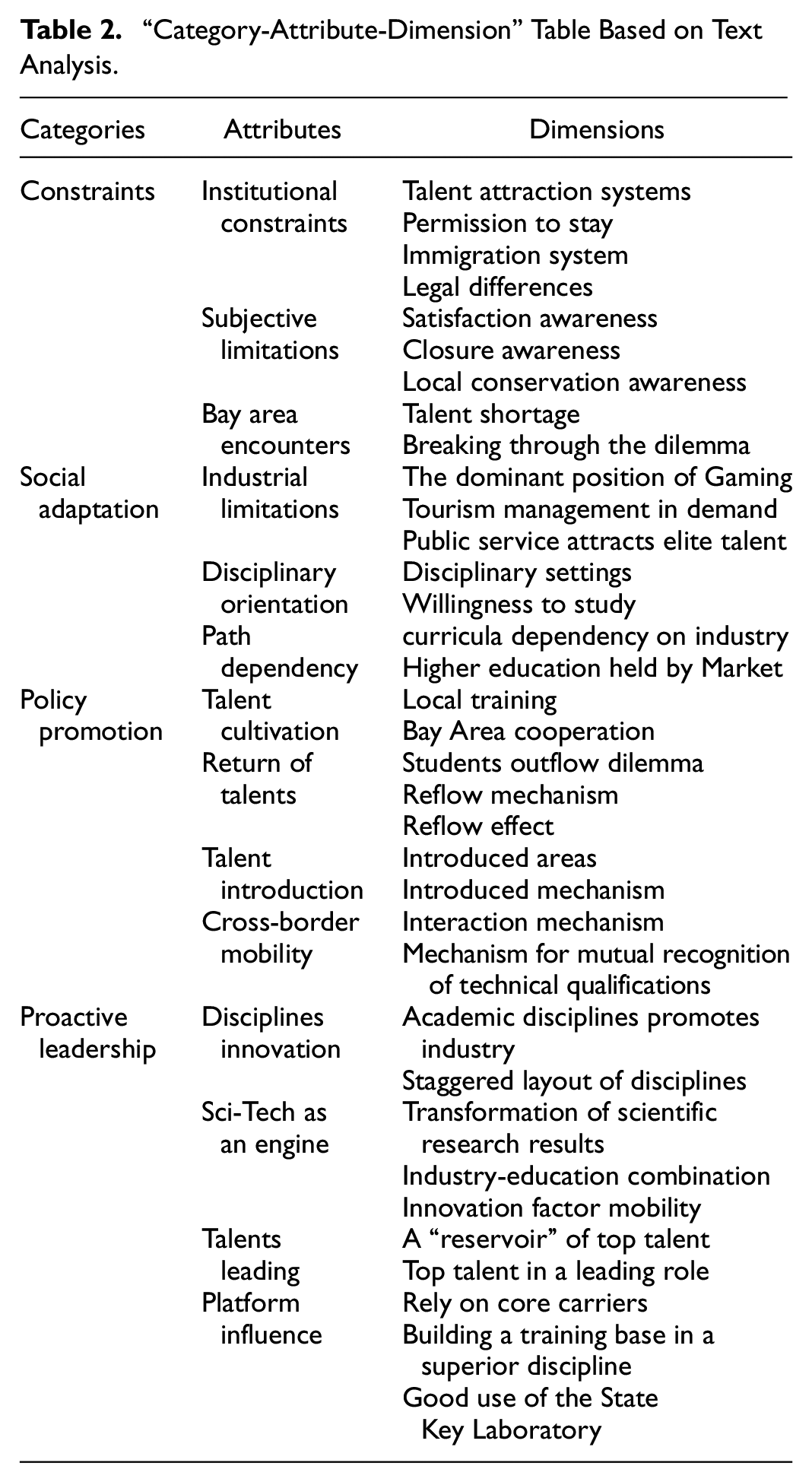
Step 1: Reading through the texts. The 118 texts were read through and the content corresponding to the theme of the study was selected and extracted to form a coding database of more than 12,000 words. Step 2: Using N-vivo12 software. The coding database is imported into the N-vivo12 software and uses the vocabulary cloud and auto-coding functions to create a high-frequency vocabulary cloud and 330 auto-coding reference codes, which will serve as a reference for further manual coding in this study. Step 3: Manual coding. The 35 initial concepts relevant to the study were coded at the first level by extracting the conceptualized words from the coding database and referring to the software-generated codes, presented as “dimensions.” Each initial concept (dimension) was listed with a related textual statement to straightly show the meaning of the dimension; the study further formed “attributes” by dimensionality reduction analysis of the first-level codes. This level of coding resulted in 14 attributes. Based on the emic understanding of the research topic, the researchers further integrated the 14 attributes to generate 4 main categories, which formed a “category-attribute-dimension” table (see Table 2) and the logical basis for the development of the research “story line.” Step 4: Model generation. The four main categories (including constraints, social adaptation, policy promotion, and proactive leadership) that were gradually generated during the manual coding process are a logical and systematic presentation of the textual information, also contain the overall path of Macao’s higher education talent development as discovered by the researchers during the coding process. The tangibility of the text as we can see depends on the perspective we adopt, which includes the particular social issue in focus and the social and discourse theories we draw on (Fairclough, 2003, p. 16). The research begins with an etic perspective of the researchers and the textual material and continues with the emic construct that emerges from the deeper logic of the text to generate a model of the pathway of talent development in higher education in Macao (see Figure 1).
“Category-Attribute-Dimension” Table Based on Text Analysis.
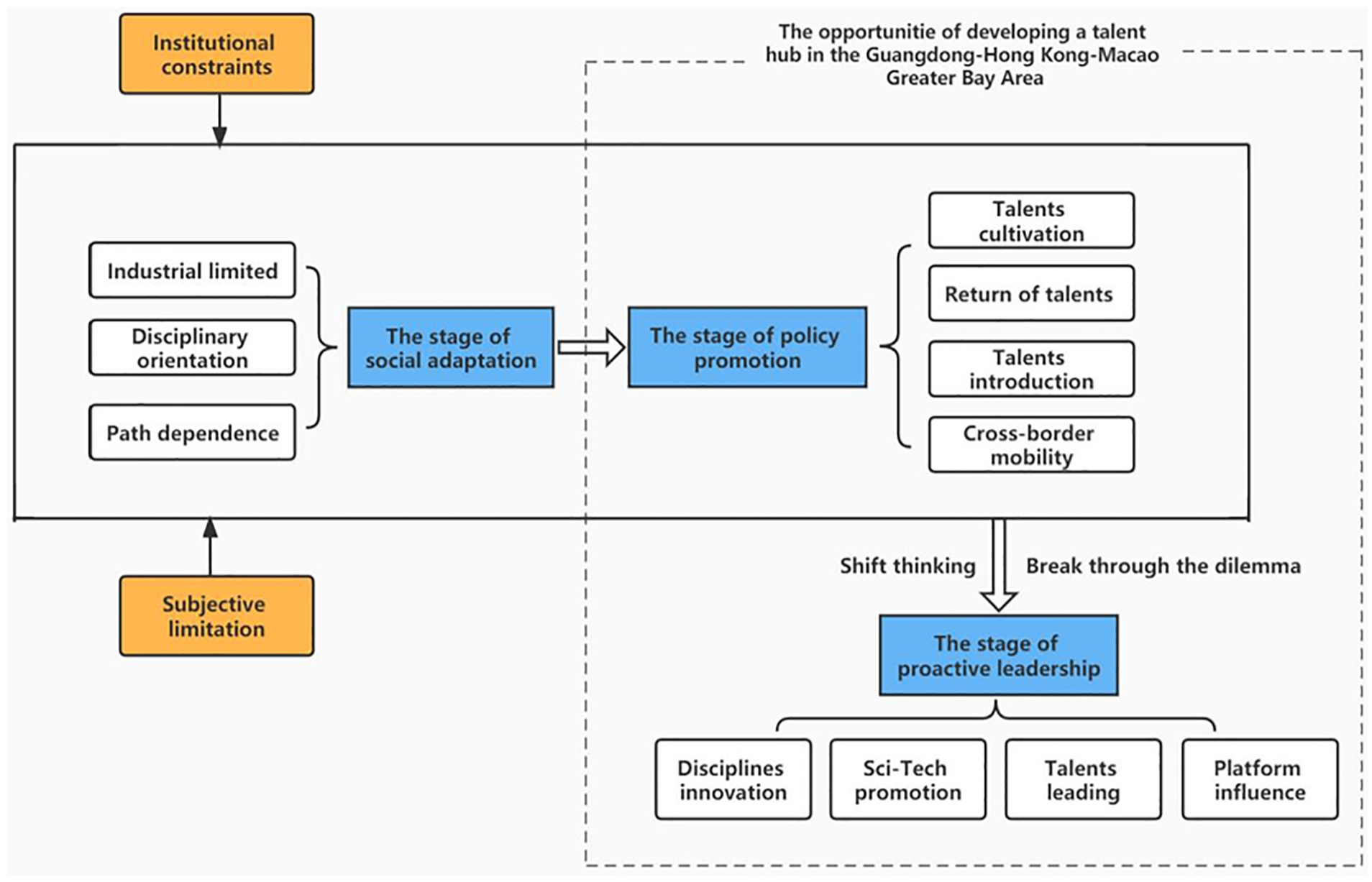
The path of talent development in Macao higher education Model.
Model Interpretation: The Path of Higher Education Talent Development in Macao in the Regional Context
Social Adaptation: The Uneven Stage in the Market Driven Situation
The gaming industry supports the whole economic structure of Macao. In 2002, the opening of gaming rights led to the economic take-off and comfortable living environment of Macao. It was as if the gaming industry, which was the industry alone in Macao, was like a source of wealth and food for life. (N-R-10) The high economic returns and the abundant supply of jobs from the tourism and gaming industry have increased the confidence and dependence of the community on the gaming industry. As a result, Macao’s tendency to a single industrial structure gradually takes shape and has a clear market-oriented trend in the cultivation of higher education talent.
The process of forming the disciplinary system of higher education in Macao is strongly influenced by the industrial structure, which severely constrains the curriculum structure of higher education in Macao (A-M-17). The disciplines of Macao’s higher education institutions are largely set up by the hold of the job market for graduates, so majors such as gaming, tourism, and hotel management are commonly offered in Macao’s higher education institutions. Majors that are closely related to practical applications such as business management and entertainment are highly sought after because of matching the single industrial structure of Macao. (A-M-16) For example, the percentage of students enrolled in “Business and Management” and “Tourism and Hospitality Services” during the 2020/2021 academic year was 40% of the total student population of the 10 higher education institutions (Macao Special Administrative Region [Macao SAR], 2020).
The limitations of a single industrial structure have led to a typical path of dependency in the development of higher education talent in Macao, which is demonstrated at two levels. At the micro-level, Macao’s higher education institutions have a clear disciplinary orientation under the market’s stranglehold. The curricula of Macao’s institutions are offered in whatever industry the society needs. (A-M-2) The direct effect of the disciplinary orientation is an imbalance in the structure of the teaching and research staffs of the universities and the skills structure of the exported talents. At the macro level, Macao has become a “market-driven higher education enterprise,” where the input of resources, the coordination of conflicts, and the balance of interests in higher education all revolve around market orientation.
The market shapes higher education, meaning that it is in a relationship of “adapting talent to society.” In Macao, the gaming and tourism market generates the demand and employment orientation of Macao society and potentially influences the perception of Macao residents. Macao has been accustomed to focusing on the immediate interests of society without considering long-term interests (H. Zhang, 2017, p. 190). Higher education institutions have responded to the needs of the gaming and tourism industry by training and clustering talents in the corresponding fields, resulting in an uneven distribution of disciplines in higher education institutions. Thus, industrial limitations, disciplinary orientation, and path dependence lead to the situation that talents are highly dependent on the market demand of the micro-society.
Policy Facilitation: A Stage of Adjustment in the Midst of Integrated Guidance
The dominance of the gaming industry has made it difficult for Macao to rely on bottom-up restructuring to break through the talent cultivation dilemma. In 2014, the Chief Executive of the Macao SAR Government issued Order No. 11/2014, approving the establishment of the Macao Talent Development Committee to “formulate, plan and coordinate the long-term development strategy of the Macao SAR’s talent development” (Macao SAR, 2014). In addition, the construction of the GBA and the IDCZ are central policy plans that bring unprecedented opportunities for the development of talents in Macao.
The transformation of Macao’s higher education talent cultivation strategy is mainly reflected in two aspects, local cultivation and regional cooperation cultivation. Facing the challenge of a narrow geographical area, Macao needs to rely on local advantages to cultivate local talents and establish the brand of Macao in the fierce competition. Universities in Macao are committed to building Macao as a center of Portuguese language teaching and research. (A-M-9) The Central Government has given Macao the positioning of “one center, one platform and one base,” which provides a clear idea and direction for Macao. Training Base for Bilingual Chinese and Portuguese Talents, 1 Tourism Education and Training Base, 2 as well as the planning and construction of a training base for cultural and creative talent training courses, are reflected in the relevant policy plans of the Macao SAR Government. After the issuance of the 2019 Outline, the channels for cooperation in talent training in the Bay Area are more open and the modes of cooperation are more diversified. The outline includes: encouraging mutual recognition of credits, flexible arrangements about exchange students, and sharing and constructing disciplines, laboratories and research centers. (P-C-1) This is a strategic deployment of the national policy that the Macao SAR Government has also fully grasped this development opportunity (P-M-21). Under the co-ordinate planning and guidance of the policy, Macao attempts to cultivate talents in the Bay Area in terms of various modes of cooperation in higher education.
The Talent Return Scheme was a policy plan proposed in the 2016 Policy Address in order to attract overseas talents (Macao SAR, 2015). A high proportion of Macao high school students went to study abroad, for example, 48.00% of those who went on to study in the 2018/2019 academic year were local to Macao, while the rest went to other countries or regions. The problem of the brain drain of senior secondary students and the shortage of local students in Macao needs to be addressed. (A-M-3) Through the establishment of the Task Force to Encourage Talents to Return to Macao, the “Study Tour Programme for Overseas Talents to Return to Macao” and the establishment of the “Consultation Platform for the Return of Macao Citizens,” the Committee aims to promote the return of outstanding overseas talents to Macao, encouraging the return of Macao citizens to Macao through institutional changes. For example, the exemption of overseas professionals from the professional certification examinations in Macao has reduced the resistance faced by potential top talents returning to Macao. (P-M-12) However, the effect of the return of talents is not significant. The development opportunities in Macao are not very diversified. (A-M-16) The number of successful cases of talent return is small. (N-R-8)
In 2021, the Macao SAR government launched the consultation text of the Talent Introduction Admission System. The priority areas for the introduction of talents are health, modern finance, high technology, and culture and sports, and the three special schemes, namely the “High-end Talents Scheme,” the “Outstanding Talents Scheme,” and the “Senior Professionals Scheme.” The four major areas in the policy plan provide pointers for the future recruitment of talents in Macao, which also means that Macao has given priority to the development of four major emerging industries in the policy design and promoted the industrial development with the recruitment and concentration of talents. (N-R-16)
With the promulgation of the Outline, the smooth flow of talents across the border and the improvement of the mechanism have become the most pressing issues to be addressed. On the one hand, the system should be more flexible to reduce the institutional barriers to the cross-border mobility of top talents, for example, top and outstanding talents, they should be allowed to serve Macao in a cross-border, mobile manner. (P-M-13) On the other hand, the regional clustering and sharing of top talents have made it an inevitable trend to achieve cross-border mutual recognition of professional qualifications of talents. Promoting unilateral recognition in key areas to drive two-way mutual recognition. (P-G-1)
The Macao SAR Government plays a leading role in adjusting the structural contradictions in the development of talents in Macao through policies and reversing the one-way talent development path of “market-driven higher education.” The construction of the GBA and the IDCZ, as well as Macao’s policy plans to break away from its mono-industrial structure, are also leading and coordinating the training, return, introduction, and cross-border mobility of Macao’s higher education talents.
Constraints: Why Has Talent Development Lagged?
Whether it is the market forces at work or the policy-driven forces, the constraints have to some extent slowed down the pace of talent development in higher education.
At the institutional level, “one country, two systems” brings about corresponding institutional barriers, which are reflected in the differences in the legal system and other barriers to the flow of higher education talents between the two places. For young people from Hong Kong and Macao, differences in laws and regulations related to labour and entrepreneurship can easily become “roadblocks.” (A-W-16) In addition, there are many loopholes in the skilled migration system, which aims to bring in senior technical personnel to Macao. The skilled migration mechanism has been revealed that the mechanism has major loopholes. (N-R-8)
From a subjective point of view, the subjective consciousness of Macao citizens directly restricts the formulation and promotion of talent policies. Most Macao residents enjoy the mentality of “a small amount of wealth is enough.” (A-M-17) And Macao is separated by a border has led to a sense of self-imposed isolation and local protection in the development of higher education talent over time. Fears that further liberalization of the admission of professionals will narrow the opportunities for upward mobility of locals. (A-M-14)
During market-driven adaptation and policy-driven adjustment, Macao is exploring a talent cultivation path that meets the needs of social development. However, the solidified market-led mindset and passive policy thrusts can hardly completely reverse the dilemma of talent cultivation in Macao. A proactive and leading role in higher education is the pathway to achieving a substantial breakthrough in Macao’s higher education talent development.
Proactive Leadership: A Breakthrough Stage for Higher Education to Lead Society
Self-restraint, external dependence, and passive feedback are not desirable ways of developing sustainable and innovative talent. The unbalanced structure of talent cultivation under market constraints and the passive feedback under policy orientation still cannot bypass the adaptive logic that Macao higher education is stuck with. Faced with the opportunities of the construction of the GBA, Macao’s higher education needs to play its strengths and advantages in the areas of discipline building, technological innovation, talent leadership, and platform building.
In a micro-society, the influence of university academic settings on the direction of social development is more direct and obvious. The cultivation of talents in curriculum needs to be more guided by characteristics to steer the direction of policies. (A-M-12) Promoting the cultivation of talents in core fields through disciplinary innovation and driving the development of socially relevant industries is an effective way to reverse Macao’s long-standing dilemma of a single industrial structure. The innovation of Macao’s higher education disciplines must focus on driving the development of industries, thus forming an advantage to influence the region.
Science and technology innovation is the core engine of regional development. Currently there are four State Key Laboratories in Macao. It is the embodiment of higher education research leading the industry that scientific and technological talents give full play to promote the transformation of achievements and the combination of industry-university-research. Macao’s narrow geographical constraints have been broken through under the opportunity of the development of the GBA. The positioning of Macao’s science and technology innovation development cannot be limited to Macao but should rely on the GBA. So, creating opportunities to enhance cooperation and talent flow in higher education and research in the Bay Area is fundamental. Proactively share with it state key laboratories, dual innovation spaces, tertiary institutions and private dual innovation forces, share resources, strive for win-win and mutual benefits, and jointly promote cross-border industry-academia-research integration matters. (A-M-19)
The shortage of top talents has been a long-standing challenge for Macao to overcome. However, the emergence of new industries from scratch and the availability of the talent resources they need is a chicken-and-egg problem (W. Wang, 2021, p. 29). For this reason, it is important to bring together top talents, play their role of leading and teaching and form a chain of “introduction - leading and teaching - output” for Macao’s higher education. The introduction of talents should focus on the four new industries and should play their role of leading and teaching to nurture local talents. (P-M-13) However, where will the top talents come from? On the one hand, attracting and recruiting outstanding talents from overseas through corresponding policy support is the basic way; on the other hand, within the regional scope, geographical, cultural, transportation, and other convenient factors form a great impetus to the flow of talents. Strengthening the sharing of resources of regional high-end talents through flexible means and giving full play to the influence of the Bay Area’s leading talents on Macao are the ways for Macao to achieve the embodiment of high-end talents in higher education leading social development.
Relying on the radiating effect of a certain platform will help the values, core technologies, and research results of higher education talents to be manifested in the corresponding vehicle. Macao should continue to develop its functional advantages of “one center, one platform and one base” to build corresponding training bases. (A-M-17) In addition, Macao should make use of the four key state laboratories to build cooperation with regional higher education institutions and manufacturing enterprises, to promote the mutual projection of cities on the west bank of the Pearl River (A-M-19). It is necessary to be strategically positioned as an important pivot point of the “Guangzhou-Shenzhen- Hong Kong-Macao” science and technology innovation corridor in the GBA. To be a regional base for the transformation of science and technology innovation and an important platform for Sino-Portuguese science and technology exchanges and cooperation. The radiating effect of the platform has led to its leading role in talent training and cooperation in the GBA.
Endosymbiotic Cooperation Game: Macao’s Higher Education Talent Development in the Regional Context
As one of the core cities in the GBA, Macao’s thinking on talent development has been inspired by the regional context. “Symbiotic theory” means that under the development opportunities of the GBA, Macao as an individual relies on the Bay Area and is interdependent and symbiotic with the cities in the Bay Area to achieve a win-win situation for higher education talent development. “Symbiotic” is a theory that originates from the field of biology and refers to the close relationship between different species of organisms based on certain interests (Adams, 2002). Biologists proceed to have discovered the endosymbiotic model (Witzany, 2006) - a cooperative symbiosis between the individual and the whole. The individual and the whole have different demands, with the individual living within the whole and paying “rent” to the whole by providing “energy.” Over time, the individual and the whole co-evolve, forming an “interdependent community.”
This theoretical model of endosymbiosis can be explained through a cooperative game way (Schelling, 1978), as shown in Figure 2. At Stage A, Macao’s higher education is autonomous under “one country, two systems.” The development of talents is constrained by industry, thinking, and geography, making it difficult to break through the gap between ideal expectations and the actual state of affairs. Also it is more difficult to break through the dilemma and form an equilibrium point where the stability line E intersects. At stage B, Macao’s higher education talent cultivation is at the policy-driven stage, where the cooperation and development of higher education talent are achieved through cooperation and cultivation of talent, cross-border flow of talent, and mutual recognition and sharing of talent information resources. These can give a strong impetus to Macao’s talent development dilemma. However, this stage is externally driven. Although it is in a period of “climbing up” where “actual” exceeds “expectations,” it is still not in an equilibrium position where it intersects with the stability line E. Stage C, Macao’s higher education has actively integrated into the GBA, taking actions like the gathering of leading talents, innovating university disciplines and deepening of research in science and innovation. These measures have laid the foundation for the development of Macao’s human resources in a way that leads to social development through higher education. Higher education is the innovation engine for the construction of the GBA, and universities should also grasp the opportunity to transform the role of keeping their position and superposition (Xu, 2018, p. 24). Macao’s brand characteristics and disciplines, which have been deeply explored and polished, will lead the development of related fields in the GBA. It will provide human resources to complement the construction of the regional talent hub, and intersect with the stability line E to form a balanced development trend of cooperation and symbiosis with the Bay Area. Retaining the autonomy of countries and higher education agencies in international cooperation produces the new forms of international higher education while it is also the major issue in promoting these programs (Sugimura, 2012, p. 85). Higher education in the Macao region needs to rely on the convenient condition that the government has strong autonomy to ensure and promote the quality of its own education while closely cooperating with the region and developing symbiotically with it.
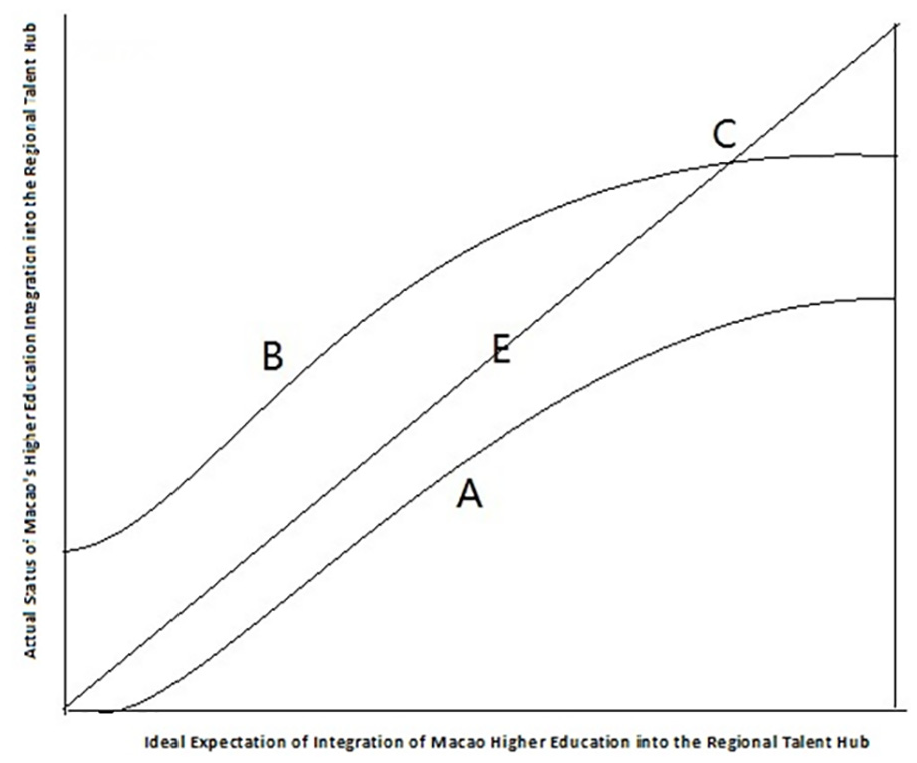
A game model of symbiotic cooperation within the integration of Macao higher education into regional talent development.
Within the regional development opportunities of the GBA, the cities are in a symbiotic environment. Yuan (1998, p. 9) applied symbiosis theory to the social field and defined three major elements of symbiosis, namely, symbiotic unit, symbiotic mode, and symbiotic environment. If the dynamic operation of symbiosis is flattened into formal equality, thus ignoring the strength of power and competition for survival therein, it is easy to fall into one-sided praxis (J. M. Zhang, 2021, p. 19). Symbiosis phenomenon commonly exists in the large social relationship, where the elements constrain each other and influence each other, making the stable development of the alliance, optimizing the use of resources within the alliance, minimizing the cost paid by members, and ultimately maximizing the benefits, making the members achieve win-win situation (S. Y. Liu et al., 2020, p. 67).
Macao is one of the endosymbiotic units, which forms an interdependent and mutually beneficial relationship with the whole region. This requires breaking down “barriers” and building a substantial community (Z. Qu, 2021, p. 27). The components of the GBA should not only achieve mutual benefit and symbiosis on the basis of competition and cooperation, but also focus on the intrinsic dynamics and characteristics of the region and bring into play Macao’s initiative to achieve stable and mutually beneficial development with the goal of long-term sustainability. Harrison et al. (2017) pointed out the importance of regional education for sustainable development, and some case studies of UK university consortia similarly noted the efforts of university administrators as members to establish and comply with cooperatives. The power of the initiative to establish and comply with the rules is a driving force for the development of educational alliances and regional education (Anand et al., 2015, p. 920). The autonomy and capacity of universities are critical for regional development and a good governance environment in the long run (Shin et al., 2022, p. 414), and the role of universities embedded in regional ecosystems as a knowledge integrator and consolidator is becoming increasingly important (Tolstykh et al., 2021, p. 13). Therefore, the university’s talent development strategy needs to be proactive. Undoubtedly, the GBA has brought an opportunity for Macao to break through the dilemma of higher education talents. The endosymbiotic cooperation has enabled Macao to draw on the nutrients of the GBA and also inject Macao’s characteristics and strength while gaining momentum.
In the context of the construction of the GBA and the IDCZ, the Central Government and the Macao SAR Government are directly or indirectly promoting the adjustment of the development path of Macao’s higher education talents through relevant policies and plans, to reverse the imbalance of the talent structure and the lack of human resources.
However, whether market-driven or policy-driven, the development of talent in higher education is all too vulnerable to a state of passivity. Universities are the best hope of humanity and should be consciously at the forefront of social reform and civilization progress (Sui, 2011, 70). Today it can be seen more clearly than in the past that colleges and Universities are primary agencies for the ongoing evolution of society (Brubacher, 1982, p. 70). Therefore, the logic of human resources development in higher education should be: higher education takes the initiative to lead society based on a rational layout of disciplines and bold innovation, with its “highly sophisticated” scientific researchers, moral and talented teaching staff, and far-sighted managers. Higher education proactively leads society, pointing not only to the diversification and innovation of a city’s industries, but also to the wider market of the broader region. As the former president of Beijing University Mr. Cai Yuanpei said, education guided the society but not chased it. It requires truly establishing a long-term mechanism for talent training and scientific research in the scope of higher education (H. Zhang, 2019, p. 6).
Conclusion
This study explores in depth the strategy, the influence factors and the contribution to the construction of a talent hub in Macao by taking the construction of a regional talent hub in China as the background. The paper mainly adopts a textual analysis approach, with data drawn from policy texts, press and magazine texts, and academic paper texts. Through the three-level coding of texts, the developmental context, latent logic, and deep structure of the issue are unearthed. The main findings include different stages in the process of talent development in higher education in Macao, including social adaptation, policy facilitation, constraints influencing, and proactive leadership. Further, by discussing and combing The endosymbiosis theory and The game theory, this study constructs “The endosymbiosis cooperation game model.” The model demonstrates integrating Macao higher education into regional talent development. The three stages of the model, A, B, and C, correspond individually to the talent development stages of social adaptation, external promotion, and proactive leadership. The initiatives of anindividual region can only be freed when Macao establishes an interdependent and cooperative symbiotic relationship with the whole region. These initiatives contribute to overcoming barriers in regional talent hub strategy and offering theoretical suggestions for higher education talent development.
Theoretical Contribution
In the construction of a regional talent hub, talent development in the region should be symbiotic and collaborative. It is necessary to take higher education leading social development as the logical starting point of the talent development path to create a strategic regional talent hub. This study’s theoretical contribution is the associated combination based on the empirical data of talent development paths generalized in the Macao case of The endosymbiosis theory and The game model. Aiming to balance the gaming situation, it discusses talent development strategies about the proactive innovations of an individual region and structure modification.
Theoretically, according to Schelling’s (1978) cooperative game model, the macro social environment is influenced by people’s personal initiatives. The interaction between the “actual” state and the “expected” state results in different levels of an individual region’s development. The stable equilibrium point is shown as the E line in Figure 2. The single individual region will get rid of the “passive” or “unstable” state by reaching the line E means. At the intersection point with the line E, the single individual region will achieve the status of “critical mass” and “self-fulfilling prophecies” of the theoretical model. This study argues that the social adaptability and policy facilitation of talent development separately corresponds to the mentioned “passive” and “unstable” states. In Figure 2, line A illustrates the “passive state” of talent development, in which the “actual” state is always lower than the “expected” state. Line B similarly shows the “unstable” status even though it initially already has a fixed output of talent development driven by policy. To achieve a balance of “self-fulfilling prophecies,” governments need to ally with the region to share benefits through integration into regional development, proactive innovation, and internal cooperation and symbiosis (S. Y. Liu et al., 2020). Achieving this balance will enable the realization of the cultural ecology of creative talent management while removing the initial internal and external barriers. The theoretical model shows that moving from A to B and then to C is not only the process of actions of a single individual region. In addition, it demonstrates the structural change made by rules, resources, cultures, and the regional talent development subjects, including government, universities, and enterprises. Practically, the regional talent development strategy concentrates on the result of the joint action of the object’s structure and the subject’s action.
Insights From Policy
Firstly, the strategic development of regional higher education talent is prospectively arranging and leading the adjustment of discipline policies. The forward-looking disciplines and the construction of the talent hub are synchronized. In this context, the standard set by discipline can enable talent development to overcome various limitations and effectively tailor to the region’s essential industrial needs. Secondly, cooperation and culture-sharing found the basis of talent clustering. The composite construction of online and offline social communication platforms and the breakthrough of ideological and institutional barriers are conducive to attracting talents, thus forming a magnet for the convergence of global elites (Douglass et al., 2011). Ultimately, working as a resource of innovation improvement innovation, the talent resource-sharing mechanism is beneficial to the promotion of collaboration between the game participants in making innovation strategies (Su et al., 2021, p. 15). The mechanism supports balancing the ideal expectations and the actual state of development at Stage C in the Endosymbiotic Cooperation Game. Accordingly, the innovative theories and models could help construct a regional talent hub, making universities operate as a source and force of innovation and technology (Cai & Geng, 2019, p. 46).
Research Limitations and Future Research Directions
There are two limitations in this study. Firstly, the study adopts a qualitative approach and collects three types of texts extensively. Although the study is more adequate in terms of data, everything is developing, and the study still lacks interviews and questionnaire research with people. In the future, semi-structured in-depth interviews and questionnaires can be adopted for data collection in regional research to further enhance the validity of the study and discover more causes behind the issues. Secondly, the regional construction of the GBA in China is unique in that Macao and Guangdong regions adopt separate legal systems, so this regional component can only be partially referenced to the construction of talent hubs in other regions, but this gap can be remedied in the future through other regional studies or by conducting regional studies in the context of the same system.
Footnotes
Acknowledgements
The authors gratefully acknowledge the support of Macao Polytechnic Institute (RP/ESCHS-04/2021).
Author Contributions
All authors contributed to the study conception and design. Material preparation, data collection, and analysis were performed by Hongfeng Zhang, Shaodan Su, and Yan Liu. The first draft of the manuscript was written by Hongfeng Zhang, Shaodan Su, and all authors commented on previous versions of the manuscript. All authors read and approved the final manuscript.
Declaration of Conflicting Interests
The author(s) declared no potential conflicts of interest with respect to the research, authorship, and/or publication of this article.
Funding
The author(s) disclosed receipt of the following financial support for the research, authorship, and/or publication of this article: This work was supported by Macao Polytechnic Institute (RP/ESCHS-04/2021) and Macao Polytechnic University (RP/FCHS-02/2022).
Ethical Approval
Ethics statement for animal and human studies is not applicable.
