




Abstract
This article investigates how populism in power influenced news media in Ecuador during leftist president Rafael Correa’s presidency (2007–2017). Correa’s administration triggered a bold media reform in Ecuador challenging traditional media and promising media democratization, but his government received sharp denunciations from press freedom and media organizations which considered Ecuador as a “not free” country, especially after the passing of a Communication Law in 2013 that regulated media extensively. Through content analysis of news and opinion pieces published in 2005, 2006, 2015, 2016, and 2018 by Ecuador’s main legacy newspapers, El Comercio and El Universo, different legal and political contexts are examined. The main observations suggest an increase in polarization and improvements in journalistic professionalism, two results consistent and divergent to mainstream academic approaches and public discussions about populism. This contradictory situation may be explained by the emergence of a new political parallelism, absent before Correa came to power, which combines consistent stances based on the rejection of Correa’s leadership, with an improvement in professional practices, especially when Correa was in power. These results, and novel approach adopting a detailed content analysis to explore the relationship between populism and journalism in a Latin American media system, may contribute to a better understanding of the influence of populism on news media. This study calls for more comparative and longitudinal analyses in different media systems and populist experiences, focused on the connection of professional practices and political positioning, with or without populist actors in power.
Plain language summary
This article investigates how populism in power influenced journalism in Ecuador during leftist president Rafael Correa’s incumbency (2007–2017) in a pioneering study using content analysis to observe what happened in the country after years of a populist presidency. One of the most complex cases of the so-called Latin American Pink Tide, also represented by the governments of Hugo Chavez in Venezuela, Cristina Fernandez in Argentina, or Evo Morales in Bolivia, Correa’s Ecuador revolutionized the media system, amidst Correa’s attacks to the “corrupt press,” promises of media democratization and sharp denunciations from most press freedom and media organizations. Through analysis of news and opinion pieces, this article presents findings of how polarization and professionalization performed in Ecuador’s main legacy newspapers, El Universo and El Comercio, before, during, and after Correa’s era. The main observations suggest an increase in polarization and improvements in professionalization, two results consistent and divergent to mainstream academic discussions. This contradictory situation may be explained by the emergence of a new political parallelism, which combines consistent stances based on the rejection of Correa’s leadership, with an improvement in professional practices, especially when Correa was in power. These results, and novel approach toward the relations between populism and news media, may contribute to a better understanding of the influence of populism on news media and to call for more comparative and longitudinal analyses in different media systems and populist experiences, focused on the connection of professional practices and political positioning, with or without influential populist actors in power.
Keywords
In September 2012 the president of Ecuador, Rafael Correa, summarized in a few sentences the nation’s greatest challenges before the upcoming presidential election of February 2013. “We must never be fooled again by this corrupt press that will be our main adversary in the next campaign; united we will defeat them. Corrupt press, partidocracia, imperial powers, international bureaucracy and groups that are opposed to our revolution and the progress of the free, sovereign and loving homeland.” Months after this quote was published by Reuters, Correa won the elections in a landslide; his candidacy was supported by 57% of citizens. In that paragraph, the “people” is plainly present (the “we” linked to the “loving Homeland”) and above all its enemies, the press takes center stage. Similar assertions are frequently used by a number of populist leaders, from Donald Trump to Victor Orban, Benjamin Netanyahu or Evo Morales. These leaders accuse the press of being unfair toward them, and of representing interests opposed to the will of the people. It seems logical that many studies have identified a problematic relationship between populism and the press.
However, few of those figures above-mentioned have challenged media to the same degree as Correa in Ecuador. Not only was the former President exercising a populist communication style himself, but his government also supported the enactment of media policies, such as the Ley Orgánica de Comunicación or Communication Law of 2013, aiming to democratize and professionalize journalism. Much criticized by the domestic private press and international media, Correa’s policy was discredited by international organizations, such as Freedom House, whose press freedom ratings of Ecuador went from 41 and labeled as “partially free” when Correa assumed his first year as president in 2007, to 66 and “not free” in 2017, the last year with Correa in power. Lenin Moreno, his former vice president, who succeeded him as president, surprisingly reversed most of Correa’s policies and became one of his fiercest enemies.
Yet, some scholars and public voices, especially in Latin America (Artz, 2017), agree that Correa’s policies against the press were somehow understandable. According to them, Latin American media systems are not characterized by the existence of a strong independent journalism, but by a “Captured-Liberal” press (Marquez-Ramírez & Guerrero, 2014) with opaque links with political and economic actors, forming what Segura and Waisbord (2016) call “pervasive patrimonialism.” In any case, relations between the press and populism in the Latin American context, and probably also elsewhere, are complex, and may be beyond an apparently simple fight between the “independent press” and authoritarian populists as is usually introduced in public discussions. In this article, drawing from content analysis of the years 2005, 2006, 2015, 2016, and 2018 of Ecuador’s most important newspapers, El Comercio and El Universo, populism’s influence on news media is examined with more detail beyond usual narratives reducing populism influence to a logical clash between populist presidents and news media. In fact, in Ecuador, after years of a widely influential populist leader in power, a consistent increase of political polarization, a persistent oppositional media, and improvements in professionalism are observed in the Ecuadorean legacy press. In this case, this article suggests, Correa’s populism in power in Ecuador didn’t suppress oppositional media as is often assumed in scholarly discussions (de la Torre & Ortiz-Lemos, 2016; Kellam & Stein, 2016; Kenny, 2020; Rogenhofer & Panievsky, 2020) but to some extend even improved journalistic professionalism. Additionally, there’s evidence indicating that polarization increased, mostly manifested in the establishment of a peculiar political parallelism nonexistent before Correa’s presidency and not usual in Latin American media systems (Albuquerque, 2013); finally, “media populism,” or the explicit mention of populist ideas in articles which has been the most common content analysis approach of examining populism influence in the press, had little presence over the years, although its characteristics existed and changed, contributing to a cleavage around Correa’s leadership.
This article is structured by, first, a theoretical section in which the use of content analysis in studies about populism is examined, together with the most common arguments defining the relationship between populism and journalism in the available scholarship, including populism’s association with polarization. Next, a section summarizing important aspects of the Ecuadorean case is added. Another section follows the introduction of main hypotheses and the research question, explaining the methods followed in the content analysis. Finally, a section shows the main results of the analysis, and a discussion segment completes the article, reflecting on the findings, limitations and potentialities presented by this research to understand important changes in the Ecuadorean media system, and perhaps transformations in other media systems with influential populist actor in the political arena.
Media Populism, Silencing, Polarization, and Professionalism
Thus far, the relationship between populism, here defined using Mudde’s (2004) widely used approach, and media has been mostly explored using a “media populism” approach in studies using content analysis. Researchers usually look at how populist ideas are expressed by the media (Esser et al., 2017, pp. 367–371) classified into three distinct associations: (a) populism by the media, when populism is consciously disseminated; (b) populism through the media, when populists convey their values via mainstream media not aligned with them; and (c) populist citizen journalism, when populists’ messages and views from the public/audience shape the values transmitted. There are a number of studies applying this strategy to content analysis; from assessing populist ideas in the Netherlands in the last 27 years (Hameleers & Vliegenthart, 2020), to exploring how different journalistic styles express populism (Hameleers et al., 2019).
However, there’s much less detailed literature focused on how populism influences media when a populist leader is in power. There’s not a single work using content analysis to study that question. And although populism in power seems to be perceived as a negative factor for the independent press’ role, how this materialized in news content appears much less obvious. In any case, it seems that several alternative and sometimes contradictory responses emerge in discussions of what happens to the press when populism is ruling or highly influential.
First, there is a body of literature, very influential in academia and the public discussion, that see populism as an authoritarian “silencing” force repressing the critical press and damaging press freedom and democracy. Rogenhofer and Panievsky (2020), for instance, develop a comparative analysis of the relations between populists in power and the press in Erdogan’s Turkey, Modi’s India and Netanyahu’s Israel, and they find striking similarities. The three leaders used the government to harass critical media, imposed regulations, promoted alliances with private media to receive positive coverage and triggered self-censorship. Kenny (2020), additionally, shows in a global study that populist rule seems to be associated with declines in press freedom that are particularly intensified in the case of left-wing populism, including Correa’s Ecuador. According to this author, since leftwing populists are inclined to intervene in the economy and media markets, they may use those policies to attack news media, framed as an oppositional agent, to sustain their political project. In a similar way, Kellam and Stein (2016), in an article entitled “Silencing critics,” claim a direct correlation between the rise of populist governments, such as Correa in Ecuador or Hugo Chávez in Venezuela, and restrictions in media freedom and harassment to the independent press that is seen as an oppositional force to their political project. Other authors have also acknowledged this aspect of populism’s negative relationship with the media, capturing, attacking (in Ecuador’s case via litigation against oppositional press) or censoring critical news outlets (de la Torre, 2017; Mudde & Rovira-Kaltwasser, 2012).
However, other scholars (Afonso & Papadopoulos, 2015; Handlin, 2018; Müller et al., 2017; Roberts, 2022; Waisbord, 2018) link populism with polarization, an approach that may be at odds with the previous theses, although a shared negative assessment of the effect of polarization on the press’ practices and institutional dimension prevails. Polarization is usually defined, following DiMaggio et al. (1996, as cited in Prior, 2013, p. 105) both as a state and a process materialized in different dimensions. Especially the facet in which “attitudes cluster around two contrasting positions with few moderate views in between” may be associated with populism. The literature confirms connections between “societal polarization” and populism in Europe (Afonso & Papadopoulos, 2015; Müller et al., 2017), or state crises, populism, and polarization in South America (Handlin, 2018). More specifically, Waisbord (2018) stresses a negative interpretation opposing populism’s ontology (the “us versus them” logic) to democratic communication, and highlights the case of Correa or Chavez as examples of damaging Manichean conceptions of the public sphere that constructs a pure people to combat some elite or out-group enemy. Roberts (2022) in his study on populist polarization emphasizes that the institutional deterioration resulting from populist polarization around “basic rules of the political game,” including “electoral institutions,”“the media,” or “watchdog agencies,” is especially pernicious for democracy.
The aforementioned works imply that populism in power has a negative impact upon journalistic professionalism linked to journalism’s democratic function acting as a control against power, and as a plural space for representation and deliberation. This conclusion is straightforward for those endorsing a “silencing” thesis, although perhaps less clear for those connecting increased polarization with a deterioration of professionalism, since polarization could imply an increase in pluralism and a critical role of the media. Nonetheless, if polarization hurts confidence in the press as an institution or transforms media into opposed partisan bullhorns, there would be arguments to think that populism in power influences negatively journalism’s autonomy, distinct professional norms and public service orientation, all of them basic dimensions of what is defined as journalistic professionalism (Hallin & Mancini, 2004, pp. 34–36). However, the qualitative analysis based on views expressed by journalists and media actors in Ecuador (Palos Pons & Hallin, 2021) points out to an improvement in journalistic professionalism during Correa’s era notwithstanding the increasing polarization of that period. It was produced by a double process of new positive rights granted to journalists by policies enacted during Correa’s presidency, and of intense scrutiny exercised by state agencies pushing journalists to be “better reporters” (Palos Pons & Hallin, 2021, p. 1033) against a hostile government by providing more sources and data to support their work. This research seeks to provide additional evidence from news content, asking questions about the press’ autonomy in relation to political power, public service orientation, and professional practices during Correa’s regime.
The Ecuadorean Case
Ecuador’s political and media transformations in the last decade can be seen as a critical case to study the relationship between populism and the press. Rafael Correa’s accession to power in 2007, after years of economic and political turmoil, was followed by a striking hostility between the new president and the private media. Correa, who can be included in the so-called Latin American Pink Tide alongside other leaders of the early 2000s, such as Hugo Chavez in Venezuela, Cristina Fernández in Argentina, or Evo Morales in Bolivia, developed a fierce aversion to private media, as it was noticed by several international organizations (such as Freedom House, Human Rights Watch, or the Committee to Protect Journalists) since the start of his tenure. The former professor in Economics launched his own presidential weekly address on television, Enlace Ciudadano, a show of around three and half hours of duration in which Correa launched stark accusations against the prensa corrupta of serving the interest of the traditional oligarchies.
At the same time, the president and his allies called for the promulgation of a new Constitution in 2008 and began to make decisions regarding communication policies. The Andean country had barely regulated media since the return to democracy in 1979. There was only one law regarding radio and television broadcasting passed in 1975 and the nation did not possess any public broadcaster. Furthermore, the Ecuadorean media market was strongly concentrated; for instance, 65% of the market was dominated by two newspapers, El Comercio and El Universo, and four broadcasters accounted for a similar percent of the television market (Kitzberger, 2017). Thus, reproducing some of the demands of media reform movements, active during the Constituent Assembly (Kitzberger, 2017), the new text introduced provisions which recognized the right to plural and free communication, and divided the broadcast spectrum into three equal parts (public, private and community media). The 2008 Constitution also banned financial institutions and foreign investors from media ownership. In October 2007 the new president created Ecuador’s first public television.
Finally, in 2013, after winning the elections in a landslide, Correa’s political party passed the Ley Orgánica de Comunicación (2013) that set up a new regulatory framework for media actors, including cultural industries but not the Internet. The law included regulations not only of media markets but also of media content, in contrast with most of the reforms in the region. It introduced for the first time in Ecuador the right of reply and rectification, which proved to be central in governmental monitoring of news, presented deontological principles, and incorporated a requirement of 5% of content dedicated to multi-cultural issues (information about indigenous or Afro-Ecuadorian communities, for example). Provisions regarding sex and violence in media content, journalists’ educational qualifications, and labor conditions were also addressed. Two important regulatory bodies were created: Consejo Ecuatoriano de Regulación y Desarrollo de la Información y Comunicación (Cordicom), which monitored allocation of frequencies, and Superintendencia de Comunicación (Supercom), which enforced those policies and had the power to sanction media for violations.
During this process, Correa justified the creation of public media and the new legislation as measures intended for media democratization and professionalization (Oller & Chavero, 2014). That idea, and the discussion about reforming problematic media systems, had a tradition in Latin America, starting in the 1970s and 1980s with the concept of “right of information” (Dinges, 2013). However, the new regulation and the strong state intervention in Ecuador was highly criticized, and Supercom’s activities, sanctioning media content, were intensively rejected, especially around the government’s use of right of reply and rectifications.
In the end, the country’s media system was divided into two big camps: public media (supporting the government’s stances) and private media (allegedly representing the political opposition). This dichotomous divide recalls asseverations of populism reducing public discussion and increasing polarization. The role of private media in that process will be explored in this research, as well as the influence, or lack thereof, of those policies established by Correa’s project. These debates and lines of investigation are here discussed assessing arguments considering populism as a danger “silencing” the independent press and claims associating populism with polarization. Logical conclusions, contested by previous research (Palos Pons & Hallin, 2021), of populism having a negative impact on journalist professionalism are also examined; finally, this study explores the unasked question of how media populism looks when populism is ruling. All this is summarized in three hypotheses and one research question:
H1: Critical stances from oppositional media were suppressed with Correa in power.
H2: Polarization increased during Correa’s presidency
H3: Populism under Correa led to an increase in journalistic professionalism
RQ: How was media populism expressed in news content before, during and after Correa’s regime?
Method
Sample
A longitudinal content analysis was designed to compare the pattern of specific variables before Rafael Correa came to power in 2007, during his tenure as president and after he left office. A total of 960 stories (192 per year), including 2,292 sources, were divided between the most important newspapers in the country, El Comercio (Quito based) and El Universo (located in Guayaquil), which have played a central role in the Ecuadorean media for decades (Gehrke et al., 2016). Eight articles per month, per newspaper were randomly selected from all stories published in the Politics, Ecuador/Society and Editorial/Opinion sections in two dates (four articles per date per month); five articles were selected from the Politics section, two from the Opinion pages and one from Ecuador/Society section. Stories were taken from both newspapers’ printed edition, since in years 2005 and 2006 Internet penetration in Ecuador was still very weak and the Communication Law didn’t cover the Internet directly.
The research was focused on years 2005 and 2006 (2 years before Correa came to power), 2015 and 2016 (2 years in which Correa had consolidated his presidency and the Communication Law was implemented) and 2018 (a year after Correa’s departure). 2005 and 2006 were two very interesting years in contemporary Ecuador, in which the popular revolts of 2005 (the so-called Rebelión de los Forajidos) and President Gutiérrez’s removal from power were followed by a contested presidential election in 2006. In 2015 and 2016, Correa was still popular, although the bad situation of oil prices started to hurt the economy; the president also faced indigenous’ opposition to his extractivist policies. Finally, 2018 was chosen to test the post-Correa situation in the press, once the leader was out of power, and the new president, Lenín Moreno, reversed many policies put in place by the previous government. There were calls to reform the Communication Law and Supercom’s activities were suspended.
Variables
As the main objective of this study is to examine populism’s influence on news content in Ecuador, a set of variables was selected to observe expected or probable repercussions according to the theoretical debates reviewed above. Since previous research points to the “silencing” of media’s critical stance, to the contrasting outcome of increased polarization, and changes in journalistic professionalism, the analysis was developed through the utilization of a total of seven variables to assess the hypotheses presented. In addition, as the main body of research in the field has been focused on “media populism,” references to the people and the people’s enemies were also coded.
In total, nine variables were tested; the main work was performed by a single coder, familiar with the local context, whose results were tested by an external coder; core variables held substantial and strong reliability (Table 1).
Reliability Tests (Kappa and *Krippendorff’s Alpha).

The most complex and informative was the source variable, which considered those actors, cited or quoted, that provided the information for the piece; it was designed to identify the voices more used by journalists, evaluating the press’ diversity and pluralism, and suggesting clues to understand changes in the political and legal context. With a similar goal, the subject variable coded the main topic covered in the story, detected by the presence of sources, issues and iterations manifested in the article.
Additionally, the tone variable examined newspaper’s stance regarding political actors, very important to evaluate the “silencing” thesis; it distinguished between deferential, neutral or adversarial reporting, depending on sources and the perspective used in the story. A deferential tone toward the government, for instance, expressed the use of only government sources to address an issue, without including critical remarks, or the perspective taken in the article, explicitly supporting the government. The same rationale was followed to assess an adversarial tone; a neutral tone expressed a balanced presentation of sources and perspectives. The variable target, designed to investigate media’s changes on targeting population segments, classified the content into “elitist” (made by specialized sources such as experts, lawyers, politicians, etc.), “popular” (non-specialized sources such as ordinary people, social movement leaders, etc.), “pluralist/civic” (a mix between specialized and non-specialized sources) and “partisan” (sources that explicitly reject or support, a specific political actor).
Furthermore, a genre variable considered the different styles and writing skills, the distinction between news and opinion, and, indirectly, the “comprehensive” value of reporting, important to determine aspects of professionalization, according to Quality Journalism literature (Lacy & Rosenstiel, 2015, pp. 17–18). Distinct genres denote different levels of difficulty; for instance, a reportaje, or in-depth story presenting many sources, voices and context, can be deemed the most difficult and comprehensive genre, followed by chronicles and interviews. A hybrid category, “analysis,” which appeared in the politics section (and not in opinion) expressing writer’s views on a topic, was especially useful to evaluate the performance of the formal distinction between news and opinion.
Observing the “polarization” premise, the study proposes an ideology variable coding ideological or partisan stances based on political actors cited, and on values presented in the story. Besides the political stance of the actor, the left was identified with progressive values, distrust in the market and focus on collective rights; the political right was linked to support of economic liberalism, praise of tradition and focus on individual rights. When different actors were cited in a story, ideologies were mixed, or agents were not identifiable, stories were labeled as “transversal.”
Secondly, a political parallelism variable reflected the support or rejection of political actors and institutions. This study is aware about the limitations of the concept of political parallelism in the context of very unstable Latin American party systems (Albuquerque, 2013). That is why this variable has to be understood here not as a marker of an assumed parallelism between the press and party system, but as an exploratory tool to observe over the years how relations between political actors, institutions, and the press evolved. The idea of exploring political parallelism in Ecuador to analyze polarization under populism originated from the usual depiction of Southern European countries as “Polarized Pluralist media systems” with high levels of political parallelism (Hallin & Mancini, 2004, pp. 129–131). It was thought that probably a sort of political parallelism would be associated to polarized positions. To make this variable as systematic and objective as possible, only very explicit rejection or supports were coded. For instance, when a political actor or institution (such as a leader, a party, or the government) was celebrated in a story, narrating its accomplishments without delivering any critical information, the story was considered a “support”; when the article vilified an actor or institution without providing any balancing angle, the story was coded as “rejection.” Articles without clear alignments were coded as “non-parallelism.”
Finally, people and antagonist references variables observed how populist ideas were expressed through media. The variable people coded references to the “people” under several positive meanings in Spanish; negative or neutral connotations were also coded. For the antagonist variable a number of alleged enemies of the people were coded, from the oligarchy or the political class to immigrants.
Results
H1: Oppositional Media Was Suppressed Once Correa Consolidated Power
If we look at the differences in the tone variable before, during and after Correa’s presidency, and at changes on the sources used among the different periods, in addition to what other variables (such as political parallelism, ideology or subject) show, we cannot confirm the hypothesis that critical or oppositional media were suppressed during Correa’s regime (Table 2). The tone variable was not statistically significant comparing Pre-Correa and Correa periods, “neutral” and “adversarial” orientations got their highest value with Correa, and “deferential” reporting decreased slightly during Correa. These results rule out a solid evidence of a press that muted its criticism toward political actors, including the government. And they present a clear contrast to Post-Correa values –which were statistically significant compared with previous periods– when the deferential tone increased, and the press seemed to openly support Moreno’s government.
Tone.
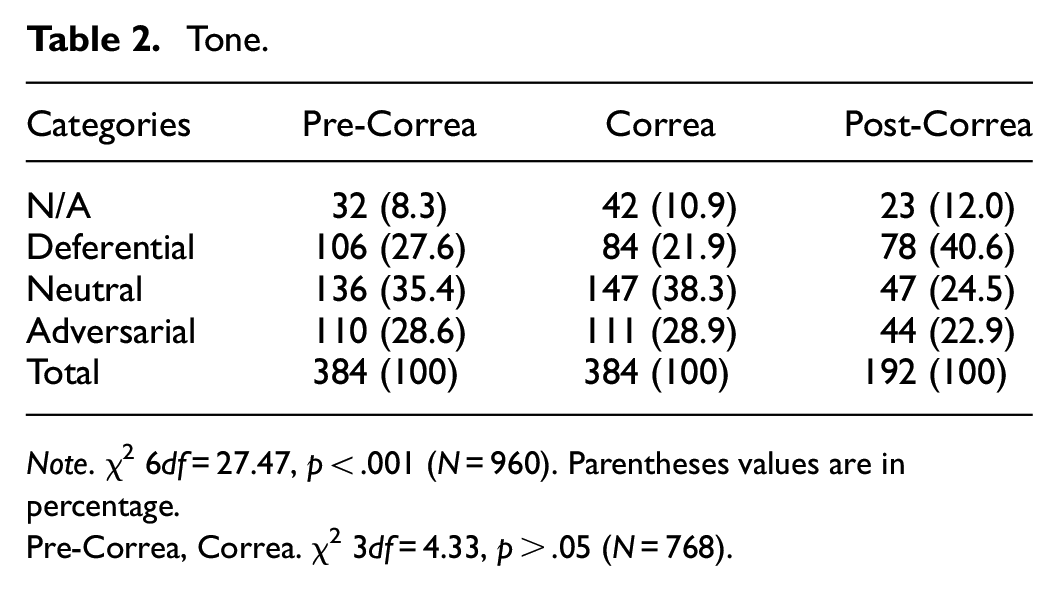
Note. χ2 6df = 27.47, p < .001 (N = 960). Parentheses values are in percentage.
Pre-Correa, Correa. χ2 3df = 4.33, p > .05 (N = 768).
On the other hand, with Correa in power, governmental sources (central government and state agencies) and local/provincial sources did increase sharply. This picture makes sense with Correa’s state’s expansion. Furthermore, the presence of oficialismo, or sources from politicians supporting the government, increased strongly, whereas right-wing politicians were also quoted more, and transversal politicians, or political entrepreneurs without a clear ideology, reduced sharply their presence. Oficialista citations may imply compliance with the Correa’s regime legal framework under which any story must be verified with several sources, government and oficialistas included, to avoid replies and rectifications, but analyzed under the light of the previous variable this doesn’t forcefully suggest a supportive approach toward the government. “Anonymous” or “unidentified sources” were also reduced during Correa’s period, and this may mean that reporters were more reluctant to use not clearly identifiable sources due to government’s rectifications, or that oficialista non-identified sources were unwilling to collaborate with the press (Table 3). In 2018 there was a drastic reduction of left-wing politicians’ sources, alongside the surge of anonymous citations.
Sources.
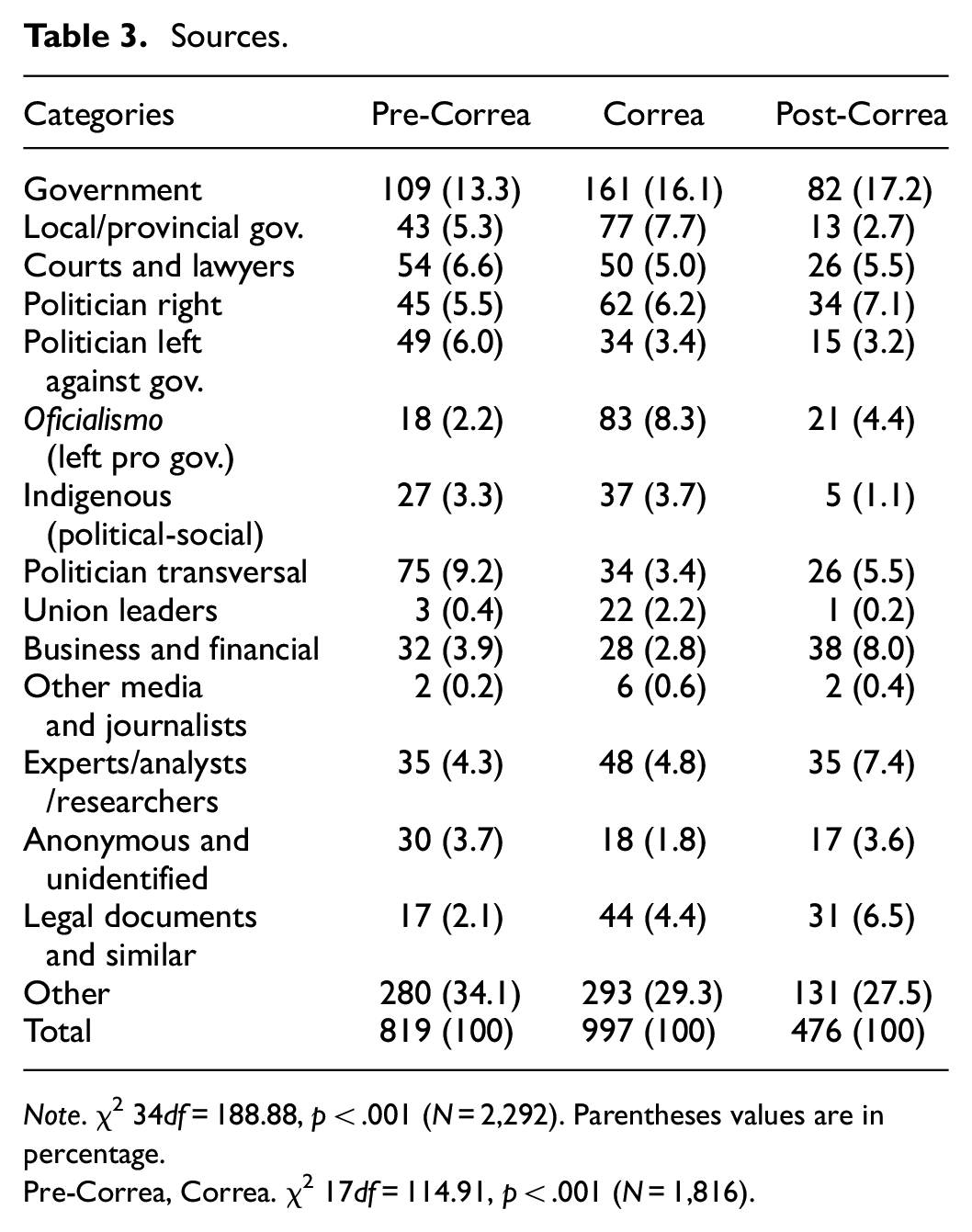
Note. χ2 34df = 188.88, p < .001 (N = 2,292). Parentheses values are in percentage.
Pre-Correa, Correa. χ2 17df = 114.91, p < .001 (N = 1,816).
In sum, these results don’t clearly show a silencing of the press under Correa, but a more complicated situation in which media performed a critical stance against Correa’s administration, but they used or cited sources from the government because they had to, to avoid rectifications. Perhaps this awareness of possible consequences impelled journalists to be more careful, observing professional practices more properly, but it did not discourage their active work as journalists criticizing the government. This picture is in clear contrast with what happens once Moreno is in power, a moment where media openly support the government.
H2: Polarization Increased During Correa’s Presidency
The polarization premise may be consistent with and could explain more the results from the previous hypothesis. In any case, we can confirm that polarization increased in news media content during Correa’s presidency. This happened mostly on the values observed in the political parallelism variable (Table 4). Differences for the variable ideology before and during Correa’s presidency were not significant due to the number of “transversal” cases, although they reflected a soft progression to the right in both El Universo and El Comercio—changes which, compared as such, were statistically significant—. It is very interesting to observe that the traditional left-right ideological cleavage does not seem to work; this result may make sense in a country with a very unstable political system, linked to the constant emergence of ad hoc political actors, and a high electoral volatility (Mainwaring et al., 2006).
Ideology.

Note. χ2 4df = 8.41, p> .05 (N = 960). Parentheses values are in percentage.
Pre-Correa, Correa. χ2 3df = 5.14, p> .05 (N = 768).
Notwithstanding the low significance of ideology, the political parallelism variable, highlighting support and rejection of political actors and institutions, did reflect a fully significant polarization around one specific political actor: Correa and his government (Table 5).
Political Parallelism.

Note. χ2 14df = 138.67, p < .001 (N = 960). Parentheses values are in percentage.
Pre-Correa, Correa. χ2 7df = 72.69, p < .001 (N = 768).
Besides the neat rejection of one political actor once Correa was in power, there’s a very interesting transition in the way El Comercio and El Universo show their relationships with political actors and institutions, defining the polarization in the country. Overall, in years 2005 and 2006 both newspapers distributed more evenly their support or rejection toward the government; also, their support or rejection toward political actors was more dispersed; even Correa appeared to be supported. The evolution of “non-parallelism” cases (articles that didn’t show explicit support or rejection) is also meaningful since they point out how stories displaying political parallelism increased with Correa in power and after the leader left office. All these values may reflect a transition from an absent or erratic political parallelism to a clearer case of political parallelism centered on the polarization around Correa’s government and his political figure. This finding confirms aforementioned claims connecting populism with polarization, and also may open a debate about the likely effect of populism in triggering a particular type of political parallelism. Albuquerque (2013), also working on Latin America, proposes two conditions to apply the category of political parallelism: “a competitive political system, with political cleavages clear enough to allow the media to reproduce them, and an institutionalized relationship between media and political agents” (p. 743). Here, we can say that in 2005 and 2006 political cleavages in Ecuador were not clear at all, and the relationship between media and politics was not as neat as it would be with Correa. With Correa out of office, the rejection of his political figure remained, but now reinforced by Moreno’s government, which seems to constitute an “anti-Correa” bloc with the press.
H3: Populism Under Correa Led to an Increase in Journalistic Professionalism
After analyzing results from tone, target, source, subject and genre variables we have evidence to claim that several aspects of professionalism improved during Correa’s period. Newspapers were more critical and neutral, as we have seen in the tone variable, and also the scope of both newspapers, their target, changed significantly during Correa’s presidency (Table 6).
Target.

Note. χ2 8df = 38.43, p < .001 (N = 960). Parentheses values are in percentage.
Pre-Correa, Correa. χ2 4df = 26.61, p < .001 (N = 768).
Two elite journals, very narrowly focused on political and technical sources, expanded their references, producing a kind of journalism more prone to reflect diverse voices and possibly to better explain the context of the news. This can be seen in the way “pluralist/civic” stories increased sharply in Correa’s era, with many articles using specialized and non-specialized sources, while “elitist” stories decreased during the same period. “Partisan” stories also increased during Correa’s years, which connected to the findings in the political polarization variable makes again difficult to support the hypothesis of a populist regime silencing media. Popular stories (citing non-specialized sources) were higher before Correa, a fact that correlates with the surge of protests of that period, especially in 2005, extensively reported by both newspapers.
Going back again to the variable sources, one of the first trends to jump out when looking at data is the number of references itself: the sum of sources increased 22% during Correa’s regime. Indigenous movement leaders were more used as sources during Correa’s presidency, perhaps echoing the legal requirement for inter-cultural content or reflecting indigenous opposition to Correa’s policies; unions were more present too, as were other media and associations, experts or analysts, or cultural figures, besides the military and legal documents. Sources from “transversal politicians,”“business,” and “courts and lawyers” were less used. After Correa, a reduction of oficialismo, indigenous and union sources must be underscored, alongside the surge of right-wing politicians, business leaders, anonymous, and legal document citations.
Regarding the subjects present in the stories, some things also changed (Table 7). Articles about government’s policies and actions were strongly reduced with Correa in power, as happened with stories about corruption and transparency, political parties and security/crime. On the other hand, stories about economic and social issues, education and arts, indigenous issues, natural hazards, media policy and foreign affairs increased.
Subject.

Note. χ2 32df = 132.96, p < .001 (N = 960). Parentheses values are in percentage.
Pre-Correa, Correa. χ2 16df = 68.51, p < .001 (N = 768).
The analysis of these results related to professional practices is complex. But if we look at the surge of sources, its expanded plurality, and the level of diversity of the subjects covered, we may think that with Correa in power important topics were more discussed than in a previous period, where political games’ stories dominated; something that matches higher levels of “elitist” reporting before Correa. This could suggest that public interest issues were reinforced. However, the lower coverage of government actions and stories about corruption may indicate some degree of self-censorship or limitation of deeper scrutiny on Correa’s administration. Yet corruption coverage remained similar once the populist leader was no longer president, and coverage of the government was even inferior to the Correa era.
The evolution of genres from before Correa’s era is quite interesting, and possibly this is the easiest variable to assess professional practices (Table 8). The number of reportajes, “chronicles” and “interviews,” genres more difficult to perform than news releases, almost doubled with Correa. And the hybrid category, “analysis,” which appeared in the news pages, was reduced to less than a half during Correa’s era. This situation remained once Correa left office, although declines in “in-depth stories,”“chronicles,” and “interviews” and the return of the hybrid “analysis” marked a problematic path for professionalism.
Genre.

Note. χ2 14df = 31.91, p < .05 (N = 960). Parentheses values are in percentage.
Pre-Correa, Correa. χ2 14df = 31.91, p < .05 (N = 768).
In sum, professionalism didn’t seem to suffer in aspects of autonomy, public interest orientation and professional practices during Correa’s presidency, but mostly the opposite. Media’s critical stance, the higher (and more balanced) number of sources, the addition of new actors to the public discussion, besides the purportedly more public service oriented agenda may have contributed to reinforce journalistic professionalism. Furthermore, the practice of these indicators was reflected in the expansion of complex genres. Something different can be said once Correa was out of power and professionalism seem to be damaged in many aspects: “deferential” reporting skyrocketed in 2018, the selection of topics and sources reduced their diversity, hybrid opinion pieces increased, and the target appeared to be more elitist and partisan.
RQ: How Was Media Populism Expressed in Content With or Without Correa?
The final question deals with how populist ideas expressed in Ecuadorean media were affected by the presence or absence of a populist president. There were several options to code “people” in Spanish with a positive meaning, from the more general pueblo to more specific types. “People” references could have also a negative and neutral connotation (Table 9). Something similar was thought for the “antagonist variable”; several options were available.
People References.
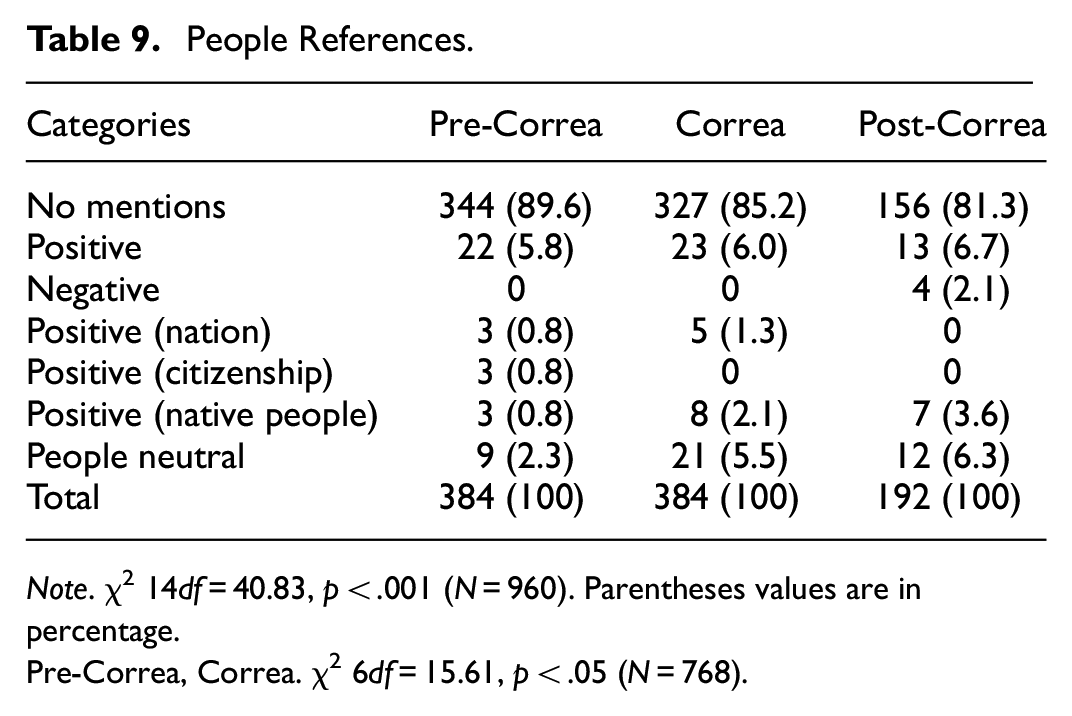
Note. χ2 14df = 40.83, p < .001 (N = 960). Parentheses values are in percentage.
Pre-Correa, Correa. χ2 6df = 15.61, p < .05 (N = 768).
About populist ideas in both newspapers one thing must be stressed from the beginning. There were very few references, something that is consistent with the nature of El Comercio and El Universo as elite media and with studies considering the tabloid format “as the most important media predictor for the extent and nature of populism in the news” (Wettstein et al., 2018, p. 491). However, there were some “people” mentions in all these years, and during Correa’s presidency the “people” was more quoted in news and opinion articles by both newspapers. It was also referred in a different way. Whereas in the former period “people” was mostly a positive reference speaking about the nation and citizenship; in Correa’s era, “people” was mostly a positive reference, praising the Ecuadorean people, or a neutral mention, when used in stories to only mention specific populations such as the indigenous nationalities without any positive or negative connotation. There was a similar percentage of positive mentions in 2018, albeit negative connotations were collected, when in news articles and in opinion pieces the notion of the “people” was associated with authoritarian populism or illiberal situations especially harmful to individual rights (Table 10).
Antagonist References.

Note.χ2 8df = 40.57, p < .001 (N = 960). Parentheses values are in percentage.
Pre-Correa, Correa. χ2 4df = 27.43, p < .001 (N = 768).
Looking at the “antagonist” references, the most striking feature is their low number, but there are differences, perhaps explained by the political context of each period. Before Correa, the enemy was the “rich” and, mostly, the “political class”; during Correa’s era, it was the populist president himself; in 2018 that trend remained: Correa was the enemy of the people. The years with most enemies’ references were 2005 and 2006, a “populist biennium,” one might say, by the combined number of “people” and “antagonist” references. These results suggest a correlation between the political regime and media populism, which would be a case of populism through the media in the first period (before Correa) and not so clearly in the second and third, due to neutral references and the nature of the “antagonist,” which happened to be the main populist actor, a situation that we will try to elucidate in the following section.
Discussion
In this article we have observed the relationship between populism and news media content when populism is embodied by a pervasive political actor in power, Ecuador’s Rafael Correa. The findings showed that political polarization did increase in news content during Correa’s presidency, whereas criticism from news media was reinforced and forms of professionalization progressed. Media populism performed differently depending on the period. These results are consistent if we pay attention to the variable designed to explore political parallelism, suggesting that a sort of stabilized parallelism emerged in the country, reflecting a cleavage that was absent before Correa. This situation, which comprised a deep media reform in Ecuador, shifted private media’s role, which positioned clearly against the government and performed more professionally in some respects; this context, additionally, was not clearly explained by the classic ideological cleavage, but expressed around a divide marked by Correa’s leadership. Media populism also behaved differently, first adopting the more studied form of populism through the media (Esser et al., 2017, pp. 367–371) changing to a sort of less explored “Antipopulist populism” expression during and after Correa’s rule, characterized by the paradoxical association of the populist leader defined as the enemy of the people. Once Correa was out of power, media appeared to be less critical and professional. These results may help to better understand the relationship between populist actors (in power and outside power) and news media in Ecuador, Latin America and perhaps elsewhere.
However, this study has also several limitations. First, this is a content analysis based on elite media and other media outlets should be brought to the table to have a more representative picture of the situation. Correa’s regulations also affected television and radio broadcasters, and they underwent probably similar dilemmas. Online media, on the other hand, were not covered by the Communication Law of 2013, and in 2005 and 2006 the Internet penetration was still very low. Other problems have to do with exogenous variables that probably also shaped journalism, such as education or economic growth. Nevertheless, El Comercio and El Universo samples do offer a key clue about the most prestigious places to work for a journalist in the country, and in doing so, a picture about what the press of reference was experiencing. Moreover, this content analysis complements qualitative research upon the same media system (Palos Pons & Hallin, 2021) that is consistent with the findings.
In any case, this article raises some conclusions:
First of all, populism’s influence on media may be far more complex than what is suggested in some studies and merits further and specific analyses. In the Ecuadorean context, and probably in other similar cases, a strong presence of populism in institutions, passing key legislation, didn’t seem to harm media’s adversarial role. There was polarization, but public discussion was not degraded to a simple binary struggle. Content was enriched with more sources and voices, and the writing was more complex. In other words, Ecuador may have stopped being a kind of a Latin American “Captured-Liberal” media system (Marquez-Ramírez & Guerrero, 2014) to become a sort of more plural “Polarized Populist System” where the press was more critical toward the government, used more sources (also more diverse) and performed more complex reporting genres. This picture is also congruent with how media populism changed with Correa in power, coinciding with political parallelism and polarization results, and possibly providing a fuller picture of the “populist” dimension of that system. Kitzberger (2022, p. 1) has found a similar trend of “antipopulist populism” content in Argentina during Fernández’s populist government and under Macri’s conservative administration; this pattern may potentially expand to other countries, with powerful populists interacting with the press. Regarding the more causal mechanisms increasing professionalism, it may be suggested that the existence of rectifications or the need of abiding to deontological norms, coinciding with the views expressed by local journalists (Palos Pons & Hallin, 2021, pp. 1032–1033) mentioned above, pushed journalists to change their traditional position.
However, this situation changed once Correa left the government and the press basically rallied with the government, eroding its professional practices. The question of whether journalism’s transformation was circumstantial, limited to the era with Correa in power, may be relevant here. The most direct response could be that the short life of the original Communication Law (only 4 years) impeded the institutionalization of principles and practices important for professionalism. However, the fact that the deep reform of the Communication Law in 2018 to 2019 kept affirmative actions and references to labor conditions and media democratization speaks of a nuanced return to “normal,” with provisions perhaps suspended by current administrations, but available for stakeholders in future different administrations (Kitzberger & Schuliaquer, 2021, pp. 11–15).
On the other hand, issues about self-censorship triggered by government’s reaction to critical stories may come up, possibly reflected in the increase of oficialismo citations or the lower coverage of corruption. It is certainly difficult to assess the depth of these insights through content analysis, but previous qualitative research (Palos Pons & Hallin, 2021) supports both the existence of self-censorship and improved professionalism. The more logical conclusion to these contradictory findings is that, probably, Ecuador with Correa developed a regime combining polarization with parallelism and a peculiar government-imposed professionalism for political reasons. Possibly this complex state-led transformation, clashing with an entrenched libertarian discourse of press freedom and media regulation among scholars, is an important reason behind arguments defining quite simplistically Correa and other leftist populists as threats to independent journalism without considering the context. Correa’s Ecuador, actually, could have been comparable, in some facets, to Polarized Pluralist systems in Southern Europe, with conditions marked by acute cleavages (different in Ecuador), combining political parallelism, mild levels of professionalism and aggressive governmental intervention (Hallin & Mancini, 2004, p. 36) that showed an improvement compared to the previous environment. Once Correa left power, and his media policies were suspended, Ecuador shifted to a path that seems to diminish power accountability, pluralism and representation. These findings reveal also the not-fully explored role of the state in developing journalistic professionalism and a more democratic media. Cases such as Ecuador under Correa must remind scholars how essential the knowledge of media’s conditions is, and how productive and complex the relationship between the state, journalism and news coverage can be.
This leads us, finally, to the discussion about the specificity of Ecuadorean populism and how it may differ from other cases. Correa’s leadership seems to fit in a left-wing populist category, presenting an inclination to a “positive freedom” perspective (Gandesha, 2018, pp. 61–63), translated into a particular relationship of the populist and the state, including media policy. Ecuador’s features may not be present or adopt different characteristics in right-wing populist rulers, such as Donald Trump in the United States, Jair Bolsonaro in Brazil or Victor Orban in Hungary. And Correa’s reform, covering media content, also differed from other Latin American experiences. This study calls for a comparative analysis of different types of populism to observe similarities and differences and keep unfolding the complexity of the interaction between journalism and populism today.
Footnotes
Declaration of Conflicting Interests
The author declared no potential conflicts of interest with respect to the research, authorship, and/or publication of this article.
Funding
The author received no financial support for the research, authorship, and/or publication of this article.

Data Availability Statement
Data sharing not applicable to this article as no datasets were generated or analyzed during the current study.