




Abstract
Despite the growing body of studies exploring the effect of corporate social responsibility (CSR) on business outcomes, there is still limited understanding of the mechanism through which CSR activities affect customer patronage (CP). This study modeled the mediating role of corporate reputation (CR) in the relationship between CSR activities and customer patronage (CP). The study further tested the moderating role of customer awareness. Data was drawn from 1,200 customers of a manufacturing company using Qualtrics online crowdsourcing company. A structural equation modeling (SEM) was used to actualize this study. We found that a company’s CSR activities promote CR. Specifically, community development and philanthropic responsibilities have more impact in promoting the CR of a company. CR was found to mediate the relationship between CSR activities and CP. Finally, consumer awareness (CA) of CSR activities moderates and increases the correlation between CR and CP.
Introduction and Background
Every corporation or organization that works within an environment bears certain social duties (CSR) to that environment, which if consistently met can increase the CR and long-term sales (patronage; Etuk et al., 2022). This implies that there is a relationship between CSR and CR (Abu Zayyad et al., 2021; Etuk et al., 2022). CSR boosts a company by improving reputation and customer patronage intention (Shehu et al., 2024). A company without a proven track record may find it difficult to stay relevant in the contemporary marketplace (Okeibunor et al., 2022). Therefore, our current study is significant to policymakers and companies that are attempting to increase their customer patronage. It shows that the relationship between the CSR initiative of a company and customer patronage is mediated by corporate reputation, which implies that a company needs to work on their reputation if it wants to increase patronage. Furthermore, creating awareness of CSR activities among the public strengthens the effect between reputation and customer patronage.
For emphasis, reputation is the overall perception and opinion customers have of a firm (Ogbonne, 2023; Xu et al., 2022). While, CSR has been defined in the literature as a company’s policies and practices that go above and beyond the demands of the business, its owners, and the law to promote societal and public expectations (Shin & Thai, 2015). CSR encourages companies to improve society and the environment (Feng et al., 2022). In other words, CSR is now a key component of company strategy that seeks to promote environmentally conscious growth by benefiting all stakeholders on all three levels including economic, environmental and social (H. Lee et al., 2019). CSR is universally acknowledged to be very essential for companies to pursue long-term success and gain an edge over others (Mohammad Shafiee & Tabaeeian, 2022).
The primary goals of CSR are to give back to society, participate in charitable endeavors, and benefit the local community. These initiatives also include social services, human capital development, and the preservation of the environment (Ben Abdallah et al., 2020). According to research, better CSR initiatives aid organizations in obtaining assets and generating maximum revenues (Peng et al., 2019). To be clear, corporate reputation is not the same as image and brand identity; it is the total of a consumer’s thoughts, impressions, and feelings toward an organization (Jung & Seock, 2016). Recent research has shown that people prefer to do business with organizations with good reputations (Feng et al., 2022), suggesting that reputation could enhance patronage intention. When a company execute certain social responsibilities, it improves its reputation, which in the long run boosts patronage (Abu Zayyad et al., 2021). Patronage is the duty a customer has to a company or brand that compels them to purchase goods or services and promote them to others (Barber et al., 2011). Patronage deals with repeat purchases and word of mouth, suggesting the willingness to repurchase or continue to purchase goods and services as well as tell others about them (Liu et al., 2019). It is highly related to customer retention and loyalty (Liu et al., 2019).
It is thus essential to explore deeply how CSR activities affect reputation and how reputation could help a company have better patronage. Therefore, in this study, we seek to understand how CSR affects patronage through the mediating role of the reputation of a company. We first tested the role of CSR on reputation and then examined its mediating role between CSR and patronage. We further tested the moderating role of customer awareness of CSR on the relationship between reputation and patronage. We used the largest multinational industrial conglomerate in Africa, the Dangote Group of Companies, which has its headquarters in Nigeria (Zakari, 2017). This manufacturing company produces salt, sugar, cement, pasta, and other packaged materials (Echobu & Echobu, 2023).
Statement of the Problem
Although businesses, particularly those in the manufacturing industry, have raised living standards for some people, increased employment, stimulated the economy, and increased wealth in society, they have also brought about several negative effects, including environmental harm, environmental degradation, carbon emissions, and disregard for constitutional laws, among many other ills (Abu Zayyad et al., 2021). Due to these problems, society is now holding corporations and businesses responsible by mandating that they carry out specific duties referred to as corporate social responsibility (CSR; Etuk et al., 2022). Most importantly, investment in CSR boosts a company by improving reputation and customer patronage intention (Shehu et al., 2024). An organization’s reputation is essential to its overall survival (Okeibunor et al., 2022).
Despite the growing body of studies exploring the effect of CSR on business outcomes, there is still limited understanding of the mechanism through which CSR activities affect customer patronage (Abu Zayyad et al., 2021), though the literature on customer patronage is growing (Macheka et al., 2024; Etuk et al., 2022; Liu et al., 2019; Zhou et al., 2020). The literature that understands the relationship between CSR and purchase intention with different mediators such as attitude and brand identity (Abu Zayyad et al., 2021; Jung & Seock, 2016; Wang et al., 2021; Z. Zhang et al., 2023; Q. Zhang & Ahmad, 2022) are abundant. However, little effort has been made to understand the relationship between CSR and customer patronage, which is also important in sustaining a company (Etuk et al., 2022; Liu et al., 2019; Zhou et al., 2020).
Furthermore, we found no study that has investigated the role of CSR on customer patronage intention through the mediating role of corporate reputation in Nigeria. A recent study found that a lot of organizations in Nigeria fail to rely on CSR, to realize if it will affect their sales, brand image, and patronage (Shehu et al., 2024). Okeibunor et al. (2022) call for more studies to be conducted from the Nigerian perspective, to understand the impact of CSR on reputation and patronage, since there is an increasing number of companies in Nigeria. Abu Zayyad et al. (2021) used CSR dimensions (stakeholders, society and environment) to predict patronage intention in Jodan banks, through brand credibility.
Therefore, the motive for conducting this study is to realize the link between CSR activities (philanthropic, legal, ethical, community and environmental responsibilities) and customer patronage intention through corporate reputation as a mediator. We also aim to test the moderating effect of CA of CSR in the relationship between CR and CP. We argue that the relationship between CR and CP will be stronger for those with higher levels of CSR awareness initiatives of a company. This extends research that has looked into the moderating role of customer CSR awareness in the relationship between carbon performance and corporate financial performance (Sun et al., 2023). It also extends the investigation on the moderating role of CSR awareness in the link between CSR activities and purchase intention (Zhang & Ahmad, 2021). Lastly, our focus on Nigeria is a plus to the literature, since there are just a growing number of studies (Echobu & Echobu, 2023; Okeibunor et al., 2022). This study finds expressions in signaling and stakeholders theory.
Aim and Research Questions
This study modeled the effect of corporate reputation on the relationship between CSR dimensions and consumers’ patronage intention in Nigeria. It also looked at the moderating role of customer awareness of CSR in the link between reputation and patronage. The following research questions govern the study:
What is the relationship between CSR activities and corporate reputation?
What is the relationship between corporate reputation and customer patronage intention?
What is the mediating effect of corporate reputation in the relationship between CSR activities and customer patronage intentions?
What is the moderating role of customer awareness of CSR activities in the relationship between corporate reputation and customer patronage intention?
Review of Related Literature
There are a growing number of studies that have looked at the impact of CSR on customer patronage, however, studies that examine the effect of corporate reputation on the relationship between CSR dimension and patronage are scarce. Furthermore, studies that introduced a moderator to influence the relationship between reputation (predicted by CSR) and patronage are scarce or even nonexistent. Using brand credibility as a moderator, Abu Zayyad et al. (2021) investigated the impact of CSR dimensions (stakeholders, society and environment) on predicting patronage intention in Jodan banks. The study found that CSR dimensions predict customer patronage through the mediating role of brand credibility. Although this study is related to our research, it only focused on three dimensions of CSR as well as used banking sector. Lastly, the study had no theoretical framework.
Etuk et al. (2022) examine the impact of CSR on telecommunication patronage. The study was guided by the social exchange theory and found corporate philanthropy to be the most significant predictor of patronage of telecommunication companies. A weakness of this study is that it lacks a moderator or mediator to extend our understanding of any factor that might have influenced CSR and patronage. Muden and Isa (2018) looked at the impact of CSR activities such as community development, environmental, ethical, and philanthropy responsibilities on customers’ perception and patronage of Ghanaian cellular firms. The outcome showed that the CSR activities predicted customers’ perception and patronage, however, the study failed to show which of the CSR activity is most significant. There was no moderator or mediator in the study to show a robust model that contribute to theory building.
Similarly, Agyamfii et al. (2019) found that of all CSR activities, only environmental responsibility had a significant effect on the patronage intention of customers of a manufacturing company. In a related study, Liu et al. (2019) examined whether CSR will influence the patronage intention of football fans regarding a club that practices CSR. The study was conducted in China among 451 home team fans. The study found that employee, customer, community, and youth development responsibilities predicted patronage intention. The weakness of these studies is that they lack a moderator or mediator to extend our understanding of any factor that might have influenced CSR and patronage
Theoretical Framework and Hypotheses Development
This study is embedded in signaling and stakeholders theory. The relationship between CSR activities and corporate reputation is explained using the signaling theory (Walker, 2010). The theory was formulated by Michael Spence in 1973 (Spence, 2002). According to the signaling hypothesis, if consumers and sellers encounter an information gap, they search for indicators that distinguish trustworthy organizations from fraudulent organizations (Boulding & Kirmani, 1993). Thus, the signaling principle suggests that a company’s various social responsibility efforts send out encouraging indications that improve the company’s reputation (Basdeo et al., 2006). Simply put, when consumers are presented with an abundance of data on the marketplace, for example, they look for indicators that will help them differentiate between companies who hold responsibility and those who are not (Wang et al., 2021). Using the signaling theory, it has been shown that CSR initiatives can therefore serve as an indication that boosts an organization’s reputation (Wang et al., 2021). For instance, using the signaling theory, Etuk et al. (2022) found that philanthropic, legal, ethical, and environmental responsibilities and community development when implemented properly, go a long way in increasing the reputation of a company.
Supporting the signaling theory, the stakeholder theory was propounded by Freeman (1984). The theory suggests that there is a symbiotic relationship between a company and its stakeholders, in which the acts of a company can affect them, and they can also affect the company’s overall output in many ways. Evidence has shown that customers are categorized as one of the most important stakeholders that could affect the output of a company (Le, 2023). Therefore, using this theory past evidence has shown that through CSR activities company/business could fulfill their responsibilities that could help stakeholders and in turn, this could positively affect stakeholder perception (boosting reputation) that leads to patronage of the company’s goods and services (Javed et al., 2020). Relating this theory to the study, it could be argued that as companies continue to strive toward their philanthropic, community development, legal, ethical, and environmental responsibilities, they continue to increase their reputation among stakeholders, thus, increasing the willingness for patronage (Agyamfii et al., 2019). According to earlier research that used stakeholder theory, a firm that rigorously practices CSR generates an excellent reputation with its clients, which results in a strong financial performance (Kim et al., 2017). Thus, drawing from the two theories and empirical studies, we proposed hypotheses linking philanthropic, legal, ethical, community development and environmental responsibilities with corporate reputation. Recent research has shown that there is no need to test the economic responsibility when testing reputation, therefore, we excluded it in our model (Abu Zayyad et al., 2021). Furthermore, we propose a link between corporate reputation and patronage. Then, the moderation hypothesis of customer awareness of CSR in the relationship between reputation and patronage. It should be noted that the moderation analysis variable is derived from past studies, while the mediator and predictor variables were derived from the two theories used in this study.
CSR Activities and Corporate Reputation
The term “CR” refers to the subjective visualization of an organization’s previous performance and prospects that explain the organization’s overall attractiveness to all of its primary stakeholders when contrasted to other top competitors (Pham & Tran, 2020). In other words, an organization’s business reputation represents an evaluation of its caliber. It represents how a company is seen by its stakeholders, who assess the firm’s activities considering those of other companies as well as their own pragmatic and moral standards of behavior (Love et al., 2017). Previous research divided a company’s reputation into three categories: being recognized, being renowned for a certain thing, and overall favorability (Lange et al., 2011).
There is research evidence to show that companies may enhance their reputation by implementing CSR programs. By implication, a company’s reputation is enhanced whenever it acts in a socially conscious way, which favorably affects people’s impressions of the company (Pham & Tran, 2020). Qasim et al. (2017) found that ethical impressions regarding a corporation provided by CSR activities increase reputation and as well increase reassurance for customers who wish to purchase goods and services. Consistent with this view, Pérez-Cornejo et al. (2020) found that environmental, social, and economic aspects of CSR positively predict a firm’s reputation. This view has also been shared by researchers investigating similar topics (Park, 2019; Siyal et al., 2022).
For instance, drawing from the stakeholder’s theory, Park (2019) investigated how CSR activities impact corporate reputation using 967 airline service users as the respondents. The study found that CSR activities such as environmental responsibilities (that improves recycling renewable energy consumption, water management and waste management) and customer welfare (achieved via charities, employing community people and retraining from falsehood) improve an organization’s reputation among its stakeholders. Similarly, Etuk (2022) found that philanthropic, legal, ethical, and environmental responsibilities and community development when implemented properly, have a long way in increasing the reputation of a company. Sharing the same viewpoint, Rodríguez et al. (2020) stated that the implantation of CSR responsibility to its stakeholders improves stakeholder perception of the organization. Yuan et al. (2020) found a positive link between CSR activities and an organization’s reputation. Feng et al. (2022) similarly found that an organization’s CSR activities correlate positively with its reputation, suggesting that the more firms implement good CSR, the better their reputation will be among stakeholders. Finally, O’Connor and Assaker (2022) found that CSR has a direct and positive impact on reputation. Drawing from these pieces of literature we proposed that:
H1. Philanthropic responsibility is positively associated with corporate reputation.
H2. Legal responsibility is positively associated with corporate reputation.
H3. Ethical responsibility is positively associated with corporate reputation.
H4. Community development responsibility is positively associated with corporate reputation.
H5. Environmental responsibility is positively associated with corporate reputation.
Corporate Reputation and Customer Patronage
There is evidence to show that the reputation of an organization has a relationship with customers’ patronage of the goods and services of such an organization (Burke et al., 2018). In this study, patronage covers repeat purchases and word of mouth (Abu Zayyad et al., 2021). Past research has shown that customers’ choice of firms to buy products and services all depend on CR (Maden et al., 2012). Consistent with this view, another prior research established a positive connection between retail reputation and consumer store patronage (Ou et al., 2006). This implies that the higher the positive perception of the reputation of an organization, the higher the willingness to patronize the services of such organizations or firms. In this view, O’Connor and Assaker (2022) found that a company with a good reputation attracts loyalty of customers to continue patronizing such a company. According to one research, potential customers rely on hotel’s reputation in deciding if they will patronize such hotel (Mariño-Romero et al., 2020). Similarly, Khan et al. (2022) study found that a company’s reputation is positively associated with retaining the patronage of a customer, suggesting that the higher the reputation, the better the patronage intention. Drawing from these studies, we proposed that:
H6. Corporate reputation is positively associated with customer patronage.
The Mediating Role of Corporate Reputation (CR) in the Relationship Between CSR and Customer Patronage (CP)
CR has been established to mediate the relationship between CSR and firm performance (Le, 2023). In another study, CR mediated the relationship between educational action of CSR and business confidence (Bolaños et al., 2022). CSR environmental responsibility and purchase intention have also been mediated by corporate reputation in one recent study (Hengboriboon et al., 2022). Drawing from these sets of literature, we assume that the connection between CSR activities and customer patronage will also be facilitated by corporate reputation, suggesting that for CSR activities to affect customer patronage, the reputation of a company has to be established and maintained. In other words, CSR activities’ effect on customer patronage can be explained through corporate reputation.
The mediating role of CR in the relationship between CSR and CP can be explained using the stakeholders theory (Freeman, 1984). From the stakeholder’s perspective, the socially responsible actions (CSR) taken by a company are a reflection that the company’s business activities are focused on serving stakeholders. This results in a favorable view of the company, thus, boosting reputation, which in turn leads to patronage (Le, 2023). According to one conceptual definition, CR is one of the firm’s most important and intangible assets that sets a specific organization above others in the competitive environment (Bahta et al., 2021). A recent investigation has supported the positive link between CSR and CR (Feng et al., 2022), and CR is linked with patronage intention (R. U. Khan et al., 2022).
It has been suggested that CSR activities create a positive image for an organization, which leads customers to react positively toward that organization which could be seen through patronage and loyalty (Shehu et al., 2024). This implies that there is a link between CSR and patronage intention. Mousa and Othman (2020) study concludes that the CSR’s main objective is to demonstrate positive acts toward stakeholders to build strong relationships with them. It is this strong association with the stakeholders that helps to improve the reputation of a company, thus creating more awareness of the company’s product and services, which in turn helps increase patronage and retain customers. Thus, we proposed that:
H7. The relationship between CSR activities (philanthropic, legal, ethical, community and environmental) and customer patronage will be mediated by corporate reputation.
Moderating Role of Customer Awareness
For a company’s CSR activities to be fully materialized, customer awareness of such CSR activities is paramount (Phan Thanh & Hoang Anh, 2023), which in turn has been shown to increase the company’s reputation leading to patronage as well as purchase intention (Liu et al., 2019). However, the level of awareness of CSR differs among consumers (Q. Zhang & Ahmad, 2021). Results have demonstrated that either customers are aware of a company’s CSR operations or they are artificially made aware in an experimental scenario (Tian et al., 2011). Additionally, it has been stated that although most customers are unaware of a company’s CSR initiatives, close communication will raise their knowledge (Kodua et al., 2022). Previous research investigations have demonstrated the necessity of providing information about the company’s general activities, including both legal and behavioral ones, to improve consumer awareness (Carrington et al., 2010). Therefore, when customers are unaware of a company’s CSR activities, the effectiveness of CSR will be limited, thus affecting patronage (Arachchi & Samarasinghe, 2023).
According to the signaling hypothesis (Spence, 2002), businesses aim to close the knowledge gap that exists between them and their customer by being transparent about their involvement and financial support for charitable causes. The firms benefit from this activity through higher sales and patronage (W. Su et al., 2016). In this view, it has been shown that disclosure of CSR activities through financial reports increases the awareness of customers regarding CSR activities, and this modifies their perception positively toward a company and in turn, increases patronage and sales (Daromes & Gunawan, 2020). Evidence has shown that whenever a company’s CSR becomes known and disclosed to everyone, it boosts trust and recognition (Javed et al., 2020). Consequently, consumers tend to be more inclined to make subsequent buying decisions when a company is linked with favorable characteristics and has an excellent track record (L. Su et al., 2014). Customers have been reported to buy more from a company when they are well equipped with its CSR activities (Q. Zhang & Ahmad, 2021). Therefore, we proposed that:
H8. The relationship between corporate reputation and customer patronage will be stronger among those with a high level of awareness of CSR activities, compared to those that are not.
Figure 1 shows the model developed in this current research.
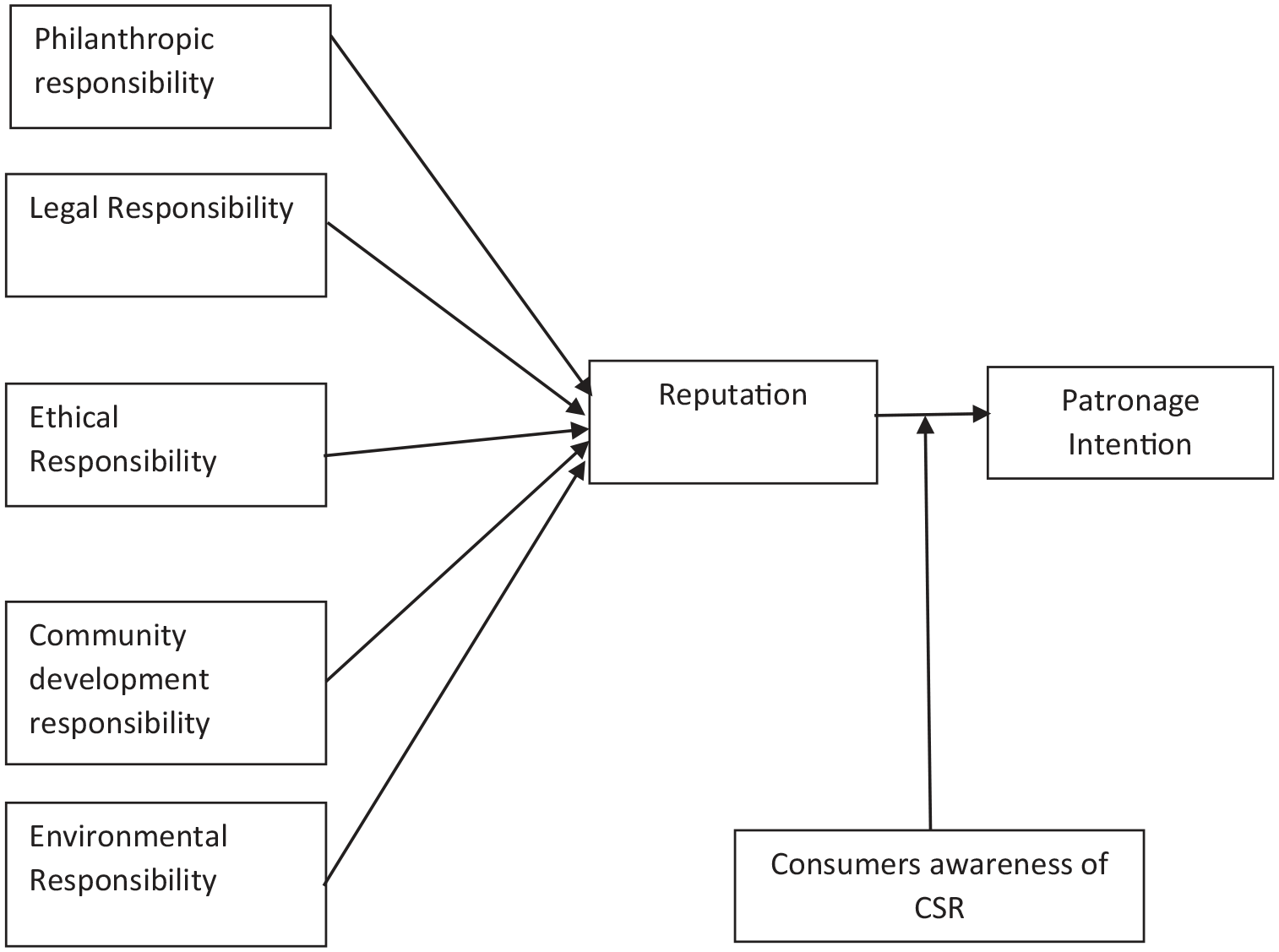
CSR model that predicts customer patronage.
Material and Methods
Research Design, Sample, and Process of Recruitment
We used the survey research design in this study to recruit participants across Nigeria (Okereka, 2024). Ethical clearance for this study was granted on the 6th of January 2023, by the Department of Mass Communication, Taraba State University, Jalingo, Nigeria. Our focus was on consumers/users of Dangote manufacturing company’s products and services. We focus on the Dangote manufacturing company as it is one of the largest in Africa with its Headquarters in Nigeria (Echobu & Echobu, 2023). They produce salt, pasta, sugar, tomato paste, flour, Ziza milk, Dansa juice, noodles, cement, and Sacks among many others (Echobu & Echobu, 2023). Since consumers are scattered across the six geopolitical zones in Nigeria, we decided to use an online survey to recruit participants (Firdaus et al., 2024). Our population comprises those who have or are currently using any of the Dangote products and services. We introduced screening questions that only focused on obtaining responses from 18 years and above as well as consumers/customers of Dangote products. A participant must not be a continuous customer/consumer to participate in the study but must have used any of the Dangote products. The number of populations is numerically unknown; therefore, we used the G*power sample size estimator, using an effect size of f2 = 0.25, power of (1−β) = .95, and error probability of α = .05, to arrive at a minimum sample size of 400.
A professional survey agency conducted the main survey online, reflecting the panel representations of the Nigerian population about age and gender. The recruitment agency randomly contacted 2,400 potential participants over a period of 60 days (between January and March 2023) and collected data from 1,200 respondents who passed the screening questions and were willing to participate. This recruitment process is consistent with the recommendation of Tarhini et al. (2016). Respondents filled a consent form online before they commenced filling the questionnaire. All the participants answered the items of the questionnaire on a 5-point Likert scale. After we eliminated outliers and responses that were not complete, we had a valid sample of 1,000, given a final response rate of 83%. The online survey’s introductory part introduced the essence of the study, and assured respondents of anonymity and leverage to quit the survey if they feel not comfortable. The meaning of CSR, types of CSR and examples of CSR activities that have been carried out by the manufacturing company were displayed on the introductory page of the questionnaire. The sample size was made of 52% men and 48% women. Concerning age, 65% were from the ages of 18 to 35 and the rest were 36 and above. There was no disparity with regards to region 26% were from the south, 25% were from the east, 24% were from the North/middle belt, and 25% were from the west. In respect of Education, 65% had a Secondary/Diploma and 45% had either BSc/MSc/PhD.
Questionnaire Development
To develop the questionnaire used in this study, we consulted prior related validated studies (See Supplemental File A) and modified the items to fit into the context of our research. We noticed that the items used for measuring community development responsibility were not adequate, therefore, we developed three items to add to the ones we adapted from prior research. The questionnaire was divided into two sections. The first section covered the demography of respondents, while the second section focused on our constructs. We sent out the proposed questionnaire to three experts for content validation. Two of the experts were from the University of Nigeria and the other one was from the University of Maiduguri. They vetted and suggested we re-simply the English as well as change the 7-point Likert scale to 5 to avoid fatigue. They also suggested we explain what CSR is in the introductory part of the questionnaire as well as show evidence pictorially what CSR dimensions are. To further strengthen the validity of our instrument, we carried out a pilot test with 30 participants outside our study frame, and the results showed a Cronbach’s alpha value above .70, indicating that our instrument was now ready to be administered (Hair et al., 2017). Supplemental File A captures the instrument along with its sources.
Data Analysis
Our data was analyzed using structural equation modeling (SEM). Specifically, we used Smart PLS 4.0 software to run our analysis. This software is suitable for theory building and non-normal data (Hair et al., 2017). It is also efficient in handling complex models with moderators (Hair et al., 2017). Concerning our descriptive statistics that covered demographic variables, we made use of SPSS version 25.
Common Method Bias (CMB)
The possibility for CMB could be present in a cross-sectional survey since only one type of respondent is used. Therefore, using Herman’s single-factor test, we found no issue with CMB, as a factor only accounted for 10% of the total variance which is lower than 50% (Hair et al., 2017). The variance inflation factor (VIF) values were below the threshold of 3.3, which supported this conclusion (Hair et al., 2017; See Table 1).
Constructs Reliability and Validity.

Results
The Measurement Model Evaluation
Convergence and discriminant validity are used in assessing the measurement model. We found no issues of convergence and discriminant validity in this study. With regards to convergence validity Table 1 showed that Roh_A values were above 0.70, composite reliability (CR) values were above the cutoff point of 0.70, and average variance extracted (AVE) values were above the recommended value of 0.50 (Khan et al., 2019). Furthermore, using the HTMT rules, as shown in Table 2, no value in a construct correlated above 0.85, suggesting no issues of discriminant validity (Khan et al., 2019).
Discriminant Validity Heterotrait–Monotrait (HTMT).


Structural Path Analysis
Direct and Moderating Effect Analysis
As shown in Table 3, we realized that all the direct hypotheses in our study were supported by our data (H1–H6). Specifically, environmental responsibility, community responsibility, ethical responsibility, legal responsibility, and philanthropic responsibility were all found to positively predict corporate reputation, thus, supporting H1–H5 respectively. Furthermore, corporate reputation positively predicted customer patronage, supporting H6. Furthermore, using the two-stage approach suggested for moderation analysis in PLS (Hair et al., 2020), we found customer awareness of CSR to positively moderate the relationship between corporate reputation and customer patronage, in the sense that the relationship was stronger for those with high CSR awareness. This supports H8. Our effect size for the study ranged from low to a large effect (Cohen, 1988) as shown in Table 3. We had no issues of predictive relevance, as our model showed an excellent value greater than zero Q2 = 0.411 (Hair et al., 2019). In respect of the R2 coefficients of determination, H1–H5 explained 76% of the variance in corporate reputation, while H6 explained 25% of customer patronage. This variance are adequate enough to suggest a good model (Cohen, 1988).
Structural Model Direct and Moderating Effect Results.

Significant at p < .05, ** at p < .01, and *** at p < .001.
Mediation Effect Analysis
To test our mediation analysis, the bootstrapping method was used (Zhao et al., 2010). The bootstrapping method involves examining the indirect effect to determine if there is a mediation. The rules state that if the indirect effect only is significant then there is a full mediation, however, if the direct and indirect effects are significant, then there is a complimentary partial mediation. As shown in Table 4, there was both indirect effect and direct effect between our predictors (philanthropic, legal, ethical, community and environmental responsibilities) and customer patronage, suggesting that corporate reputation acts as a partial mediator.
A Mediation Analysis.
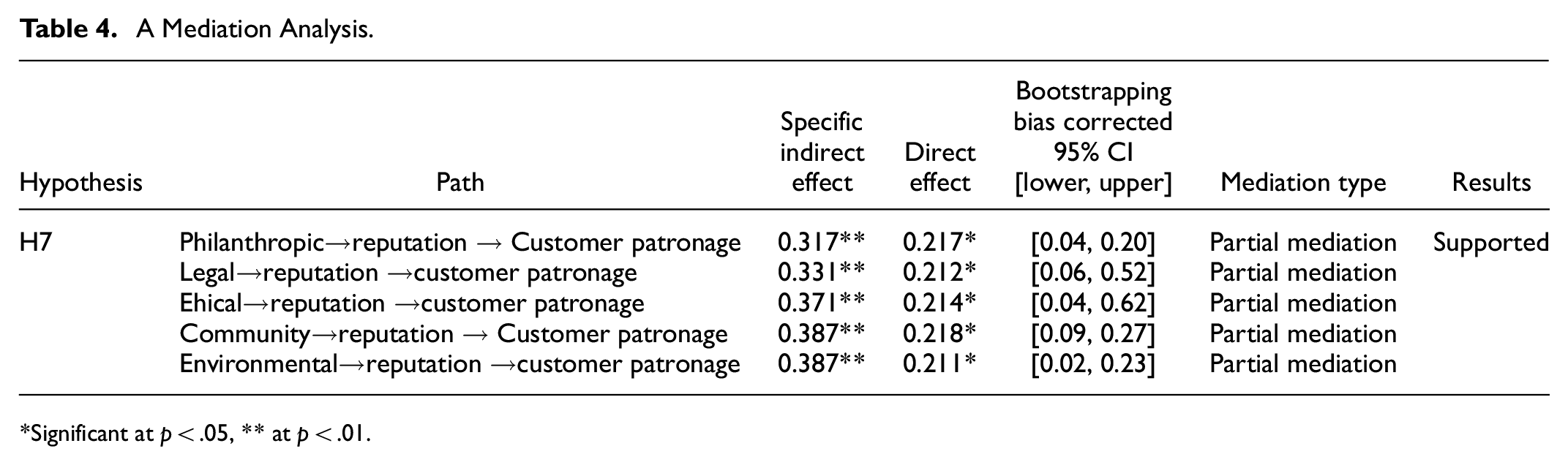
Significant at p < .05, ** at p < .01.
Discussion of Findings
Direct Effect Discussion
We found community responsibility as the strongest predictor of the corporate reputation of the sampled manufacturing company. This implies that in Nigeria, the more a company puts efforts into developing a community, improving the general living standards of community members, conducting social awareness campaigns, donating to local charities, and supporting cultural activities of the community, the better the residence will see it as a reputable company. This outcome supports evidence which shows that contributing to the well-being of a society in which a company exists enhances the reputation of the company (Zhao et al., 2021). This outcome also extends the study of Etuk (2022) which failed to show the most important factor that affects the reputation of a company. Furthermore, we found philanthropic responsibility to be the second most important factor that affects a company’s reputation. This implies that the more a company invests in its philanthropic aspect of CSR, the more it will build its reputation among members of society. Philanthropic activities may involve solving social problems, allocating resources for philanthropic activities, and playing a role in society beyond profit generation. This should not be mistaken for community development. Community specifically looks at the host community, while philanthropic looks at the society. This outcome extends studies that have only pointed out the relationship between CSR and reputation (Feng et al., 2022; O’Connor & Assaker, 2022; Yuan et al., 2020), without deepening our understanding. Feng et al. (2022) found that organizations’ CSR activities such as philanthropic correlate positively with their reputation, suggesting that the more firms implement good CSR, the better their reputation will be among stakeholders.
Another interesting outcome we found in this study is that the environmental responsibility associated with CSR is the third most important factor that enhances their reputation. This suggests that companies that put effort into protecting the environment from pollution and other issues that will degrade the environment are more likely to be seen as reputable in the eyes of the public. This outcome supports a study that has shown many organizations implementing environmental CSR to build their reputation. These findings strengthens past research which argued that CSR is now a key component of company strategy that seeks to promote environmentally conscious growth (Lee et al., 2019). Consistent with this view, Pérez-Cornejo et al. (2020) found that environmental CSR positively predicts a firm’s reputation. This view has also been shared by researchers investigating similar topics (Park, 2019; Siyal et al., 2022). Park (2019) investigated how CSR activities impact corporate reputation using 967 airline service users as the respondents. The study found that CSR activities such as environmental responsibilities (that improves recycling renewable energy consumption, water management and waste management) and customer welfare (achieved via charities, employing community people and retraining from falsehood) improve an organization’s reputation among its stakeholders.
We found ethical responsibility to be the fourth significant factor that promotes a company’s reputation. By implication, adherence to ethical standards in business has a long way to go to promote the reputation of a company. This is consistent with, Yuan et al. (2020) who found a positive link between CSR activities (ethical) and an organization’s reputation. However, our study contributes because it focuses on manufacturing companies in a developing country. We found the legal responsibility of a company in Nigeria to be the least factor that is associated with its reputation as far as customers are concerned. A possible reason could be that customers might not necessarily see or experience the legal adherence aspect of a company, but they believe that a reputable company should adhere to legal standards. This outcome is consistent with past research (Lee et al., 2020). Rodríguez et al. (2020) stated that the implantation of CSR responsibility to its stakeholders improves stakeholder perception of the organization. Additionally, we found corporate reputation to positively predict consumer patronage, suggesting that the higher customers see a company to be reputable the better they will patronize such a company. According to one research, potential customers rely on hotel’s reputation in deciding if they will patronize such hotel (Mariño-Romero et al., 2020). In this view, O’Connor and Assaker (2022) found that a company with a good reputation attracts loyalty of customers to continue patronizing such a company.
Mediation Analysis Discussion
Corporate reputation has been established to mediate the relationship between CSR and firm performance (Le, 2023) and between educational action of CSR and business confidence (Bolaños et al., 2022). In line with the findings, our study found that corporate reputation acts as a mediator between CSR activities (legal, philanthropic, ethical, community, environmental) and customer patronage. Further examination shows a partial mediation, which suggests that the relationship between the CSR activities tested in this study and customer patronage, can be partially explained through reputation. We thus argue that though CSR activities could directly lead to customer patronage, however, building corporate reputation is important if a company wants to increase patronage. This is consistent with the study of Mousa and Othman (2020). Thus, the connection between CSR activities and customer patronage is also facilitated by corporate reputation.
Moderation Analysis Discussion
For a company’s CSR activities to be fully materialized, customer awareness of such CSR activities is paramount (Phan Thanh & Hoang Anh, 2023). In line with this, we found that the relationship between corporate reputation and customer patronage is stronger when customer awareness of CSR activities is high. By implication, customers who are aware of CSR activities being carried out in their community will have a higher regard for a company thus boosting their chances of patronage. However, reputation’s effect on patronage will be low among those who do not experience any CSR activities in their community or society at large. Therefore, companies should strengthen their reputation which leads to patronage, by making known the CSR activities being carried out in a given community. Drawing from the signaling hypothesis (Spence, 2002), businesses should aim to close the knowledge gap that exists between them and their customer by being transparent about their involvement and financial support for charitable causes.
Theoretical Contributions
This study contributes to international business and marketing literature in many ways. First, it interweaves two theories to strengthen the notion, which suggests that CSR activities affect corporate reputation, in turn, corporate reputation affects customer patronage, which is a plus to the literature. A large number of past studies have either focused on CSR and corporate reputation (Famiyeh et al., 2016; Javed et al., 2020; Xu et al., 2022) or reputation to customer loyalty/purchase (O’Connor & Assaker, 2022) SME performance (Le, 2023), and business confidence (Bolaños et al., 2022). Therefore, a second notable contribution of this study is the introduction of a mediator between CSR and customer patronage. This implies that the association between CSR and customer patronage is solidified when an organization has a good reputation among its customers. This outcome has extended researches that only focused on linking CSR and customer patronage and purchase (Arachchi & Samarasinghe, 2022; Etuk, 2022). It also contributes to research that has looked into the moderating role of customer CSR awareness in the relationship between carbon performance and corporate financial performance (Sun et al., 2023), as well as the link between CSR activities and purchase intention (Zhang & Ahmad, 2021).
The third and most interesting contribution of this study is the testing of CSR awareness as a moderator between corporate reputation and patronage intention. This brings a fresh empirical understanding which suggests that the reputation of a company that leads to patronage can be strengthened when community members are aware of the CSR activities that occur around them. This outcome extends studies that have linked reputation to customer patronage, without testing any interactive effect (Liu et al., 2019; Zhou et al., 2020). The fourth noticeable contribution of this study that extends beyond current understanding is the findings which suggest community development and philanthropic responsibility to be the most significant factors that contribute to a company’s reputation, suggesting that when the welfare of community members is considered, it affects their view of the company. This contributes to the theories (signaling and stakeholders theory) we used in this study, as it specifically shows us which of the CSR activities could be more helpful in promoting reputation, especially in developing countries like Nigeria. This also extends beyond studies that only suggest or find a link between CSR and corporate reputation (Feng et al., 2022; O’Connor & Assaker, 2022; Park, 2019; Pérez-Cornejo et al., 2020; Pham & Tran, 2020; Siyal et al., 2022; Yuan et al., 2020). These studies used CSR as a unidimensional construct, thus limiting the understanding of which CSR affects corporate reputation the most. The final contribution of this study stems from its focus on Nigeria, which is less well-studied. This focus has shown that community development responsibility is very crucial in creating a corporate reputation that leads to customer patronage. We have answered the call of Okeibunor et al. (2022) which suggests more studies to be conducted in the Nigerian perspective, to understand the impact of CSR on reputation and patronage, since there is an increasing number of companies in Nigeria.
Practical and Managerial Implications
This study has some practical and managerial implications for manufacturing industries in Nigeria and across the globe. Manufacturing industries should make efforts to invest in their CSR as it regards legal, philanthropic, community, ethical, and environmental responsibilities. Regarding legal, they should endeavor that their companies follow the legal guidelines associated with manufacturing companies. Furthermore, community and philanthropic activities such as donations for charities, developing community, supporting cultural activities, providing health facilities, building schools, and health clinics and other forms of assistance that could promote the community and society at large should be the priority of manufacturing companies to promote their reputation that in turn leads to customer patronage. Ethical and environmental responsibilities should be implemented via following ethical guidelines for establishing and sustaining a company. Companies should be ethical in dealing with their customers as well as in their business, they should obtain legal backing for business and avoid illegal practices. Furthermore, they should promote the maintenance of the environment and reduce pollution and enhance waste management by supporting community sanitation, providing waste bins for the community and parking of waste for the community. They should on their own maintain a waste management system that reduces pollution. Most importantly, manufacturing companies should make it a priority to increase the awareness of CSR among their customers to increase reputation and customer patronage at large. Finally, they should strive to promote their corporate reputation since it has a large influence on customer patronage.
Limitations and Future Research
This study has some limitations. First, an online survey was used to collect data, and this might affect the generalizability of the study. However, we used a reputable crowdsourcing company that collected data keeping in mind the Nigerian sample. Future researchers could employ other forms of data collection that could have more generalizability. Second, we collected data only once, thus, our results should be interpreted with caution. Future studies could do longitudinal research to see if there are changes in behavior over time. Third, another major setback of our study is the lack of control variables, we therefore call on future studies to include gender, age, occupation etc., to see if it will affect the outcome. Fourth, our study focused on only Nigeria and used one manufacturing industry, this, might affect generalizability to other countries, as such, future researchers could make it a priority to extend our research. Finally, some other mediators and moderators might now have been accounted for in this study, future research could use brand equity and corporate image as mediators as well as corporate reputation as moderator.
Conclusion
The study concludes that an organization’s reputation is enhanced by its corporate social responsibility initiatives. More specifically, a company’s reputation can be enhanced by its involvement in community development and humanitarian endeavors. Furthermore, this research has demonstrated a clear correlation between a company’s reputation and client patronage. Equally, it has been demonstrated that the link between philanthropic, legal, community development, ethical, and environmental responsibilities, and consumer patronage is mediated by a company’s reputation. Lastly, the relationship between corporate reputation and consumer patronage of the products and services of manufacturing companies is strengthened when consumers are aware of their CSR initiatives.
Supplemental Material
sj-docx-1-sgo-10.1177_21582440241305320 – Supplemental material for The Mechanism Through Which Corporate Social Responsibility (CSR) Affects Customer Patronage of Manufacturing Companies: Modeling the Mediating Role of Corporate Reputation and the Moderating Role of Customer Awareness of CSR Activities
Supplemental material, sj-docx-1-sgo-10.1177_21582440241305320 for The Mechanism Through Which Corporate Social Responsibility (CSR) Affects Customer Patronage of Manufacturing Companies: Modeling the Mediating Role of Corporate Reputation and the Moderating Role of Customer Awareness of CSR Activities by Ruijie Shu, Hua Xia and Oberiri Destiny Apuke in SAGE Open
Footnotes
Declaration of Conflicting Interests
The author(s) declared no potential conflicts of interest with respect to the research, authorship, and/or publication of this article.
Funding
The author(s) received no financial support for the research, authorship, and/or publication of this article.

Data Availability Statement
The datasets generated during and/or analyzed during the current study are available from the corresponding author on reasonable request.
Supplemental Material
Supplemental material for this article is available online.
References
Supplementary Material
Please find the following supplemental material available below.
For Open Access articles published under a Creative Commons License, all supplemental material carries the same license as the article it is associated with.
For non-Open Access articles published, all supplemental material carries a non-exclusive license, and permission requests for re-use of supplemental material or any part of supplemental material shall be sent directly to the copyright owner as specified in the copyright notice associated with the article.
