




Abstract
This study investigates the institutional quality effects on the foreign direct investment (FDI)–regional integration nexus in the Community of Sahel-Saharan States (CEN-SAD). The novelty of our approach extends the regional integration theory in Africa by employing the Africa Regional Integration Index (ARII) and utilizes a dynamic panel data model based on the one-step system generalized method of moments (SYS-GMM) estimation to explore the institutional quality effects on the relationship between FDI location advantages and inflows and dimensions of regional integration. Our study highlights macroeconomic integration as the strongest indicator of regional integration as well as the most crucial determinant of FDI in CEN-SAD. We also discovered that FDI inflows into the lower-middle income countries (LMICs) were only slightly higher than in low-income countries (LICs). Our results infer that institutional reforms augment FDI location advantages and enhance FDI inflows irrespective of the level of integration in the Community.
Introduction
In 1994, the African Economic Communities (AEC) treaty of Abuja devised a roadmap committed to achieving African integration. To this end, two new regional blocs, the Intergovernmental Agency for Development (IGAD) and the Community of Sahel-Saharan States (CEN-SAD) were formed in 1996 and 1998 respectively to consolidate the efforts of six (6) already existing regional economic communities (RECs) toward the realization of a set of goals (free trade area, customs union, common market, economic union, and political union). Though perspectives surrounding the success of regional integration remain divided, extant studies report that regional integration results in increased foreign direct investment (Feils & Rahman, 2011), economic growth (Buckley et al., 2001), technology and innovation (Navaretti et al., 2004) as well as many others. Albeit African integration efforts have resulted in some positives, the fragmentation of the African market (54 separate markets) remains its greatest limitation (Deloitte, 2012). Another factor that has limited regional integration in Africa is the so-called “spaghetti bowl” complex resulting from overlapping REC memberships (Kiggundu and DeGhetto (2015). For instance, Kenya belongs to four out of the eight RECs whereas many other countries claim at least 2 REC memberships (UNECA, 2016). This phenomenon has largely been responsible for the ineffective management of the RECs and is responsible for the often double-counting of intra-REC trade (Sandrey, 2015).
Research is replete on the impact of institutional quality on FDI–regional integration nexus in various regions (Gherghina et al., 2019; Minović et al., 2021), regional economic communities (RECs) (Malovic et al., 2019), developed and developing countries (Freckleton et al., 2012; Jude & Levieuge, 2017), transition/emerging economies (Delevic & Heim, 2017), as well as individual countries (Shah et al., 2016). More recent studies concerning institutional quality dynamics and their impact on several variables in Africa have been conducted. The variety includes its impact on FDI and macroeconomic uncertainty (Asamoah et al., 2016), on natural resource and financial development (Dwumfour & Ntow-Gyamfi, 2018), on public debt and economic growth (Sani et al., 2019), on cultural and geographical factors (Zallé & Ouédraogo, 2020) and even on legal origins and disease endowments (Emenalo & Gagliardi, 2020).
The principal aim of this study is to investigate the impact of institutional quality on the regional integration–FDI nexus in Africa. Contributing to the regional integration literature, the novelty of our approach extends the regional integration theory (Haas, 1958) by incorporating institutional heterogeneity effects, drawing on institutional theory (Meyer & Nguyen, 2005; North, 1990). Specifically, we test how regional integration theory impacts the regional integration–FDI nexus moderated by the quality of institutions in CEN-SAD. Secondly, we test this new framework by employing the 2019 Africa Regional Integration Index (ARII) as our preferred composite indicator, to measure how well countries in Africa are integrated by utilizing a dynamic panel data model based on the one-step system generalized method of moments (SYS-GMM) estimator, for the period between 1998 and 2019. Thirdly, we present several contributions to the African integration literature in Africa. The justification for this study is briefly presented below.
Extant studies have bridged several gaps concerning how regional integration impacts the institutional environment and climate (Kiggundu & DeGhetto, 2015). Regional integration theories were initially developed in the early 1950s to explain European integration through the European Coal and Steel Community (ECSC) (Haas, 1958). Lindberg (1963) extended Haas’ classical study of the ECSC by intimating that the process of integration goes beyond persuading governments to shift their allegiances (loyalties and political activities) from national to regional settings whose institutions demand control over pre-existing national States. He suggested that the development of processes that result in collective decisions other than autonomous action by governments was central to integration. Acemoglu and Robinson (2008) contend that the determinants of differences in economic integration across countries relate to the differences in economic institutions. Earlier on, North (1990) advanced a systematic framework for explaining how institutions and institutional change impact the performance of economies, both in the short and long term.
The emergence of the institutional theory centered on the premise that institutional efficiency was critical for FDI attraction. Applied to regional integration literature, the institutional theory explains a host region’s institutional environment, including changes in the environment where firms invest (Kostova, 1999) and compete (Alhorr et al., 2008). While the theory significantly emphasizes the role and nature of institutions for FDI attraction (Popovici & Călin, 2014; Sabir et al., 2019), Rodríguez-Pose and Cols (2017) suggests that the role of institutions in this endeavor is largely absent in the African scene while others identify weak institutions are a barrier to investment (Abere & Akinbobola, 2020; Blonigen & Piger, 2014). Despite weak institutions, annual FDI inflows into the various RECs in Africa continue to increase. CEN-SAD is amongst the weakest RECs in terms of integration (UNECA, 2016). What factors then account for this phenomenon? Ross et al. (2019) suggest that a deeper understanding of the aspects of institutions that enhance and hinder FDI is required. Institutions form a significant part of location advantages, which in turn are one of the three pillars of the eclectic paradigm (Dunning, 1993). Drawing on Dunning’s eclectic paradigm (Dunning, 1980, 1998) location (L) advantages theory which explains how firms leverage resources to compete in host countries, this study makes an empirical contribution to the literature by exploring the impact of institutional quality on the location advantages of FDI into CEN-SAD. The location advantages consist of the host economy-specific exogenous factors such as market size, factor input costs and resource endowments which Dunning (2003) contends are subject to constant changes or are substituted by trade when absent in host countries (Dunning, 1988). By limiting our study to a REC, we elucidate the boundaries of the location advantages theory, test the limits of its applicability to CEN-SAD by drawing on institutional theory. Mainly, we contend that institutional reforms increase the location advantages of FDI and enhance FDI inflows irrespective of the level of integration in the Community.
Our second contribution to the literature relates to the construction, usage, and interpretation of regional integration indexes. Since not much has been done outside of the ARIIs with regards to Africa, perspectives remain fluid on what the most robust and comprehensive measurement of regional integration should comprise of, amidst the theoretical justification for such frameworks. Toward African integration, Wohlmuth (2017) proposed a novel Transformative Regional Integration Model (TRIM) as a harmonized regulatory framework of regional integration among the eight RECs in Africa. However, their model is based only on trade. Gygli et al. (2018) revised Dreher (2006) and Dreher et al. (2008)’s original KOF Globalization Index by introducing the differentiation between de facto (flows and activities) and de jure (policies that allow the flows and activities) measures along the different dimensions of globalization for 122 countries in the world. Their study found a bi-directional causality between de facto and de jure globalization. Our study however follows Huh and Park (2018) who developed the Asia-Pacific Regional Integration Index (APRII) as a composite indicator to measure regional integration among Asian countries. The APRII was modeled after the ARII in terms of its construction and interpretation but differ from the ARII in terms of the number and specifications of their dimensions and indicators (the APRII has 6 dimensions and 26 indicators while the ARII has 5 dimensions and 16 indicators). Gor (2017) conducted a systematic audit on the premier 2016 ARII and then presented a diagnostic of its theoretical basis and appropriateness, robustness, and relevance as a viable index to measure African integration. They discovered that the 2016 ARII was not founded on any sound theoretical framework, which the 2019 ARII partially admitted to (African Union [AU], 2019). Gor, however, failed to address how the deficiencies of the 2016 ARII could be interpreted in a real-world or economic setting through a formal study. To fill this gap, we adopted the more theoretically consistent 2019 ARII (UNECA, 2019) as our composite indicator to assess how well countries are integrated into a REC setting, using CEN-SAD as a case study. The relevance of our approach is also highlighted further by the many studies that completely ignore the role of regional integration in FDI–institutional quality discourse (Otieno et al., 2013; Ross et al., 2019). Finally, our study in part explores the impact of institutions on the location advantages of FDI and how those advantages enhance FDI inflows and regional integration in CEN-SAD by measuring the effects in the two different income groups, lower-middle income countries (LMIC) and low-income () countries (LICs) in the Community.
The rest of the study is organized as follows: section two provides a brief review of related empirical and theoretical literature conducted in the RECs in Africa, as well as a concise review of CEN-SAD. Section three is dedicated to methodology, model specifications, data, and descriptions. Section four presents and discusses the empirical results. Conclusions and policy recommendations drawn from the study are presented in section five.
Literature and Theoretical Review
The task of measuring abstracts such as institutional heterogeneity and integration comes with their fair share of challenges, especially when one must decide on the appropriate methodologies or techniques to employ that best suit the demands of such studies. Yet, many studies in the past have used a variety of techniques to explore the complexities of these variables. Pertaining to studies in Africa, the most employed empirical methodology to explore the linkages between institutions and variables of interest is the generalized method of moments (GMM) and its various specifications. According to Davidson and MacKinnon (2005), the SYS-GMM especially is more accurate in usage over the GMM or difference-GMM as it resolves the problem of endogeneity that often accompanies panel data and simultaneity biases. Alege and Ogundipe (2013) employed the SYS-GMM approach to explore FDI–economic growth linkages in ECOWAS from 1970 to 2011. Controlling for human capital and institutional quality, they discovered that FDI inflows were negatively correlated to growth, contrary to the results reported by others. On a study covering 50 African countries and spanning the period 1980 to 2009, Gui-Diby (2014) used a panel data estimation based on the SYS-GMM to investigate the FDI’s impact on economic growth and reported both a negative (1980–1994) and a positive linkage (1995–2009). Adeleye et al. (2017) employed the SYS-GMM to explore the role of institutions in the financial development–income inequality nexus in a study spanning 42 Sub-Saharan African (SSA) countries between 1996 and 2015. They reported that by controlling for institutions, financial development did not significantly reduce income inequality. Exploring how much institutional quality moderated the relationship between public debt and economic growth in 46 Sub-Saharan African countries between 2000 and 2014, Sani et al. (2019) used the GMM technique and revealed a two-way impact of institutions on the debt–growth relationship. Using the IV–GMM estimation, Dwumfour and Ntow-Gyamfi (2018), investigated how much institutions influence the relationship between private capital growth and real sector growth in 30 African countries from the period 1990 to 2017. They discovered that though capital flows had no direct impact on real sector growth, robust institutional frameworks can be positively impacted by capital flows. For the nature of this study, we expect to report a variety of results based on the estimations of different interactive terms of the interest variables. However, we do not expect institutional heterogeneity to have any significant impact on the FDI–regional integration nexus in the CEN-SAD.
Theoretical literature that explains the activities of FDI in host economies abound. Dunning (1980, 1998) developed the eclectic framework to evaluate the significance of the ownership, location, and internationalization (OLI) advantages and how firms leverage resources that make them competitive in host countries. According to the eclectic framework, the location advantages of the host country compensate for the deficiencies in the home country through large and stable markets, skilled human capital availability, and institutional quality. Many studies have extended Dunning’s theory over the years in different settings (Delevic & Heim, 2017; Narula, 2006; Stoian, 2013). Building on Dunning’s framework, Delevic and Heim (2017) argue against the conventional standpoint that European Integration results in increased FDI inflows for European economies in transition based on the OLI advantages. They insist that increased FDI is only possible when institutions are strong. Although the concept of institutions has not been formally incorporated into FDI theoretical models (Ross et al., 2019), FDI location choices are influenced by institutional distance (Shirodkar & Konara, 2017). Kang and Jiang (2012) add that institutional distance related to economic freedom, political influence, or FDI restriction affects FDI location. The location advantages of FDI according to Popovici and Călin (2014) in host economies are ultimately decided by the factor endowment, market structure, legal system, political and cultural environment, and market access between the host and home countries. In Africa, the relevant extant literature emphasizes the crucial importance of FDI to regional integration in the presence of multiple economic constructs such as economic growth and convergence (Te Velde, 2011), intra-Africa trade (Jordaan, 2014), and cross-border measures and acquisitions (Wilson & Pholo Bala, 2019). However, no existing study has been able to capture the distinct role and impact of institutions on the FDI–regional integration nexus in the various RECs. For instance, in a study concerning regional integration in the Intergovernmental Authority on Developmental (IGAD) region made up of countries in the Horn of Africa identifies among others, Yitay and Thobejane (2017) argues the central role of regional institutions in the regional integration agenda but falls short in expatiating the impact of the quality of those institutions on the development of the region. In another study, Otieno et al. (2013) by investigating the aggregate effects of regional integration on FDI in EAC countries cited only political stability as the institutional quality variable that influences FDI inflows into the EAC and ignores other vital institutional quality indicators. Our study fills this gap by examining all the constituents of institutional quality and their individual effects on the studied nexus.
A Synopsis of Institutional Quality, FDI and Regional Integration in CEN-SAD
The Community of Sahel-Saharan States (hereafter “CEN-SAD”) was formed in February 1998 as a charter for integration in the Sahel region. The Treaty that birthed CEN-SAD was signed by Sudan, Mali, Niger, Burkina Faso, Chad, and Libya as founding members. CEN-SAD in 2013 corresponded to 51% of Africa’s population (551.4 million), corresponding to US$973.5 billion in GDP (biggest in the RECs) and US$1,766.8 per capita (MIF, 2014). However, despite its size and accounting for nearly half of the total membership in the RECs, CEN-SAD was responsible for only 7.5% intra-REC trade and 4.1% with the rest of Africa in 2016 (UNCTAD, 2019) and less than 10% since its formation (UNECA, 2019). As conventional understanding goes, RECs with a larger membership are expected to have bigger intra-regional trade than those with a smaller membership. However, that is unfortunately not the case in the CEN-SAD. To elaborate further, much smaller RECs like EAC (5 members), ECOWAS (16 members), and SADC (15 members) corresponded to 11.5%, 10.7%, and 21% intra-REC trade respectively, all higher than CEN-SAD. In terms of REC trade with the rest of Africa, all the other RECs besides AMU and SADC fared better than CEN-SAD. Statistics however show that the Community has not been deprived of FDI and other forms of investment inflows. In fact, according to UNCTAD (2020), 8 out of the top 10 FDI destinations in Africa for 2019 were from the CEN-SAD, with Egypt, Nigeria, Morocco, and Kenya, all members of the Community rounding up the top 4. For a REC that receives such substantial inflows of capital investment, why is it then still less transformative, less progressive, and less inclusive?
CEN-SAD as a REC has been deprived of the kind of scholarly attention the other RECs have received. The most prominent regional integration studies concerning Africa are contained in UNECA, UNCTAD, and IMF reports. In 2016, UNECA (2016) released the first-ever Africa Regional Integration Index (ARII) report. The Index classifies a country within their respective RECs as either a high performer (higher score over), average performer (score within), or a low performer (lower score below) the average of countries. The 2016 ARII findings show an average REC score of 0.470 (on a scale of 0 (low) to 1 (high)) on regional integration for all the eight RECs in Africa, signifying that overall integration was moderate and thus could significantly improve. The average ARII score for all 8 RECs for 2019 was 0.327, signifying that countries in Africa were less integrated in 2019 than they were in 2016. CEN-SAD had an average overall ARII score of 0.395 and 0.377 according to the 2016 and 2019 ARIIs respectively, the lowest average score among all the 8 RECs over that span. UNECA (2019) introduced three different (new) boundaries to address some of the limitations of the 2016 ARIIs. The most prominent addition to the 2019 ARII was the ranking of countries not only within their RECs but also in the Africa context. Citing the new boundaries, a country was deemed poorly integrated if that country had a REC score between 0 and 0.33, moderately integrated with a score between 0.33 and 0.66, and well-integrated with a score between 0.66 and 1. Figures 1 and 2 below show the rankings of the 2016 and 2019 ARIIs various RECs highlighting CEN-SAD. Appendix I presents the composition and mechanics of the 2019 ARII.
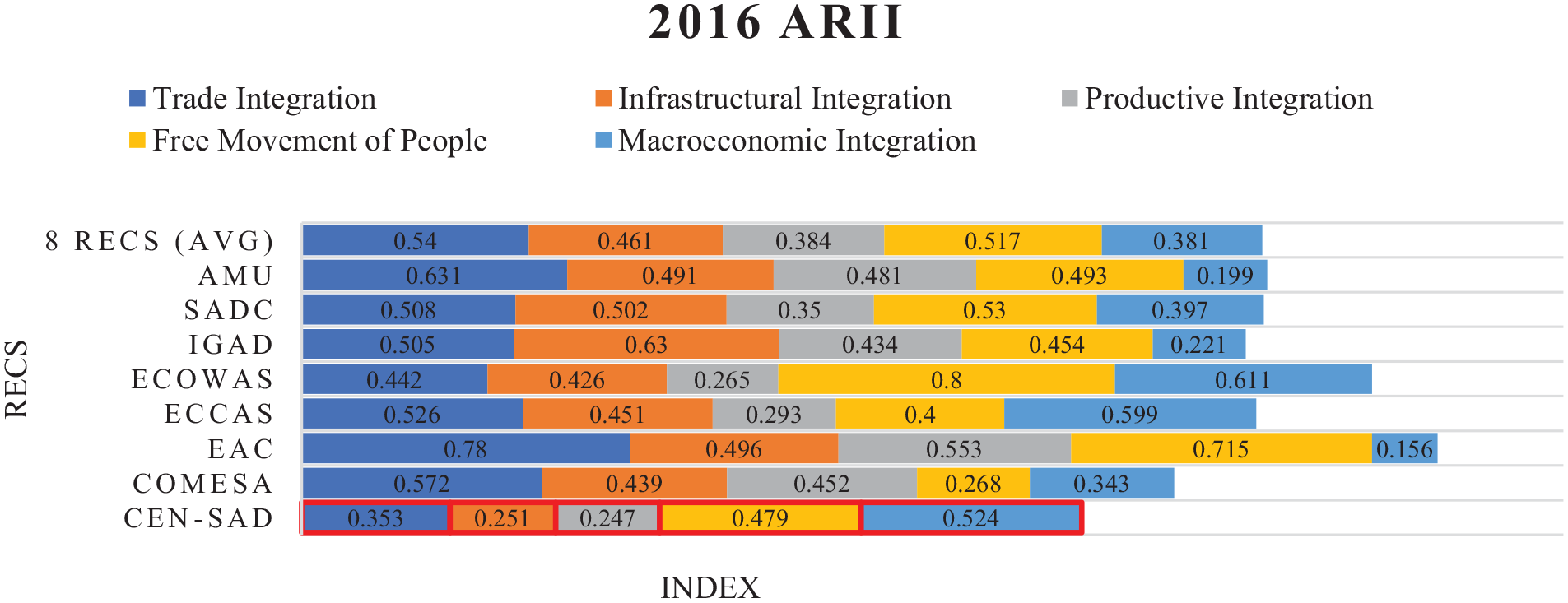
2016 Africa Regional Integration Index (ARII) for the 8 RECs.

2019 Africa Regional Integration Index (ARII) for the 8 RECs.
Methodology
Data
The datasets employed in this study span the period from 1998 to 2019. CEN-SAD comprises 15 West African, 3 Central African, 5 East African, and 5 North African countries. The variables employed in this study, FDI, regional integration dimensions (integration – trade (TINT), productive (PINT), macroeconomic (MINT), and infrastructural (IINT)), gross domestic product (GDP) growth rate and population can be sourced from the World Development Indicators (WDI) database of the World Bank. Institutional variables (control of corruption (CoC), government effectiveness (GovE), political stability and absence of violence (PSAV), regulatory quality (RegQ), rule of law (RuLaw) and voice and accountability (VAcc)), gross national income (GNI) and the free movement of people variables were sourced from World Governance Indicators (WGI), UNCTAD and the African Development Bank (ADB) databases respectively.
Model Specification
Following Delevic and Heim (2017), we investigate the factors that are responsible for FDI in the CEN-SAD by first estimating the following model where FDI inflows are dependent on institutional heterogeneity and the regional integration indicators as well as on country-control variables given as:

where
To capture the FDI effects, we estimate the baseline equation as:

where
Impact of Institutional Quality and Regional Integration on FDI
To measure the moderating effect of institutional quality and regional integration on FDI, we first suggest that regional integration may not have an independent impact on FDI, at least based on empirical evidence from regional integration agreements (RIAs) (Balasubramanyam et al., 2002; Bevan et al., 2004). We, therefore, measure this effect through the quality of institutions. To capture this, Alfaro et al. (2004) caution that as the interactive term of institutional quality and regional integration (

where
By making a partial derivative of equation (3), we can then estimate the net impact of institutional quality on regional integration for FDI. In other words, we can explore the impact of institutional quality on FDI based on the level of regional integration in CEN-SAD. Equation (4) is therefore given as:

The impact of regional integration conditioned on institutional quality can either lead to convergence or divergence (Te Velde, 2011). From observation, any possible divergence effect on FDI can be eliminated by setting equation (4) to zero.
Besides

The new dynamic panel model to estimate this effect is specified as:

where
Model Estimation
In estimating models to explore the enigmatic relationship between institutions and FDI, we casually agree with Ali et al. (2010) that the choice of methodology and measurement is largely responsible for the differences in outcomes and opinion.
Estimating multiple regression models (for instance our baseline model in equation (3)) usually results in variable biases and simultaneous biases which then can yield inefficient coefficient estimators (Baltagi, 2011). From the model, an exogeneity assumption is made for the variables representing institutional quality and regional integration as well as a probable bidirectional causality from institutional quality and regional integration to FDI and vice-versa. Additionally, the model may suffer from correlation between the country-control effects and the independent variables as well as autocorrelation as the past values of the independent variables are expected to have a significant impact on the present values. To address these issues, we employ the dynamic panel data model based on the SYS-GMM estimation approach proposed by Arellano and Bover (1995) and further developed by Blundell and Bond (1998).
This study specifies the one-step SYS-GMM estimator which can account for both difference and level equations by incorporating the lagged differences of the regressors as instruments. The one-step is preferred to the two-step GMM as it is more efficient due to its optimal weighting matrices. This study heeds Bowsher’s (2000) warning that the SYS-GMM estimator with a small cross-section dimension could lead to estimating parameters prone to bias and a weakened over-identification test. Roodman (2009) cites instrument proliferation as a probable cause for this problem, which can be solved by reducing the dimensionality of the instrumental variable matrix. This study employs a cross-sectional dataset of countries (N) = 28 and years (T) = 20 where we limit the instrument lag on the dependent variable to one. To ensure the consistency of the test results, we specify the Arellano–Bond post-estimation test (Arellano & Bond, 1991) to test for serial autocorrelation among the instruments. The rule of thumb is that the instruments are valid and the model is correctly specified when the null hypothesis (AR (1)) of no autocorrelation is rejected (prob. < .05) or the alternative hypothesis (AR (2)) is rather rejected (prob. > .05). The Hansen (1982) test is as well specified to check instrument over-identification.
Results and Discussions
Description Statistics and Correlation Matrix
In Table 1, we present the descriptive statistics of the panel data model estimations for the period under study. From our findings, the measure of central tendency shows a low mean for FDI inflows into CEN-SAD at 4.12%. These results confirm UNCTAD (2019) findings that even though CEN-SAD receives the biggest intra-REC FDI inflows, its contribution to overall GDP and regional growth over the same period, represented by GPD growth rate at 4.19% is the lowest among the RECs. For the measures of dispersion, it could be inferred that the range of the dataset is uniformly spread, the variances are not widely dispersed and the standard deviations (SDs) do not deviate too far from the sample means. All six institutional quality variables returned negative means with scores ranging from −0.73 to −0.92 and although the average institutional heterogeneity score of −0.81 is well within the conventional bounds of −2.5 (weak) and 2.5 (strong) as postulated by Kaufmann et al. (2010), it shows that institutions in the Community are still very weak. Our findings align with Dwumfour and Ntow-Gyamfi (2018) who argues that weak institutions are a bane to economic growth and development in Africa. Furthermore, over the study period, trade integration between CEN-SAD members was 0.68, productive integration 0.45 which is higher than the 2019 index score of 0.256 (UNCTAD, 2019). Macroeconomic integration, proxied by inflation (CPI) was around 6% which is lower than in most RECs. Finally, on the country-control variables, GDP growth rate, GNI and population grew by 4.19%, 1.65%, and 2.48% respectively signaling a positive relationship with FDI inflows and regional integration (AU, 2015; Fairuz et al., 2020).
Descriptive Statistics.
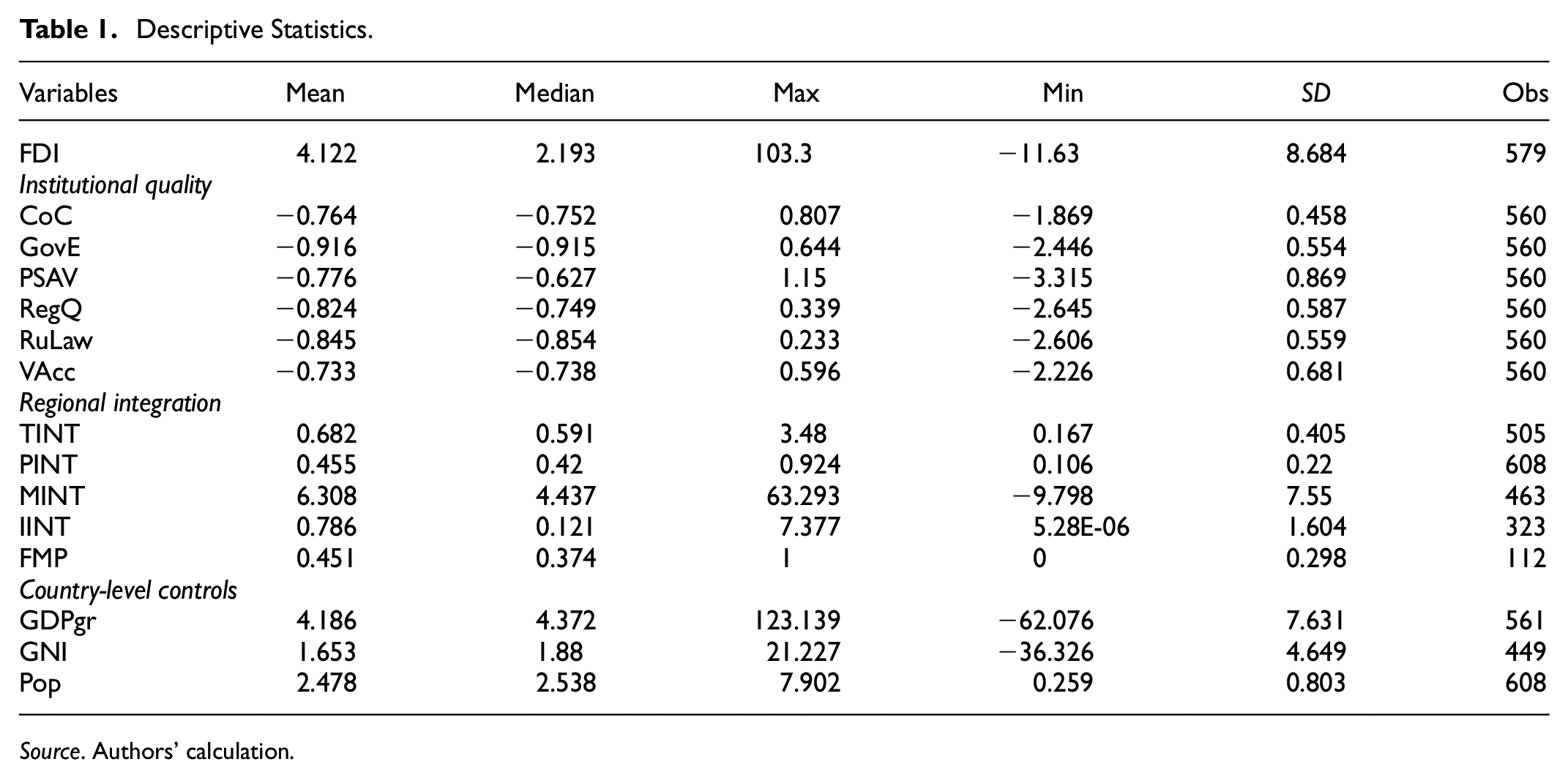
Source. Authors’ calculation.
From Table 2 below, the results from the pairwise correlation matrix show that besides the interactions between government efficiency and regulatory quality (.76), all other correlation coefficients fall below the .7 thresholds, signifying the absence of multicollinearity among the estimated variables (Kennedy, 2008). By excluding the regulatory quality variable, the mean vector inflation variance (VIF) for the remaining variables is 1.45, a further indication that the model is rid of multicollinearity.
Pairwise Correlation Matrix.

Source. Authors’ construct.
Impact of Institutional Quality on FDI–Regional Integration Nexus
The empirical results [models 1–7] in Table 3 below were obtained by employing various specifications of the SYS-GMM model. Model [1] in column [1] is the baseline model while columns [2] to [7] are controlled institutional heterogeneity impact on FDI and regional integration. In column [1], the coefficient of lagged FDI is statistically significant and positively correlated to trade integration (0.1132) and macroeconomic integration (0.1190) at the 10% and 5% level of significance respectively.
Institutional Quality, FDI and Regional Integration (Dependent Variable: Lagged FDI).

Source. Authors’ calculations.
Note. T-statistics in parentheses; Significance: ***p < .01. **p < .05. *p < .1.
We also report that between FDI and the country-control effects, lagged FDI is statistically significant and positively correlated with GDP growth rate at the 10% level of significance, an indication that a 1% increase in FDI inflows augments economic growth in CEN-SAD by 0.1%. Following equation 4, the coefficients of institutional heterogeneity (
Regional Integration and Institutional Quality Interactions and FDI
From equation 3, we investigate the net effect of regional integration on FDI inflows when interacted with institutional quality. In the context of Africa, probably besides Enowbi and Fabro (2009), not much has been done in terms of research exploring the institutional quality – regional integration nexus. We suspect the reason behind this gap in literature might be the general preference for those macro-level studies that make for easier economic analysis and interpretation over others like regional integration and institutional quality whose measurements are considered laborious as well as problematic (Peters, 2000).
To explore the moderating effects on the interactive term (IQ
Interactions Between Institutional Quality and Regional Integration (Dependent Variable: Lagged FDI).
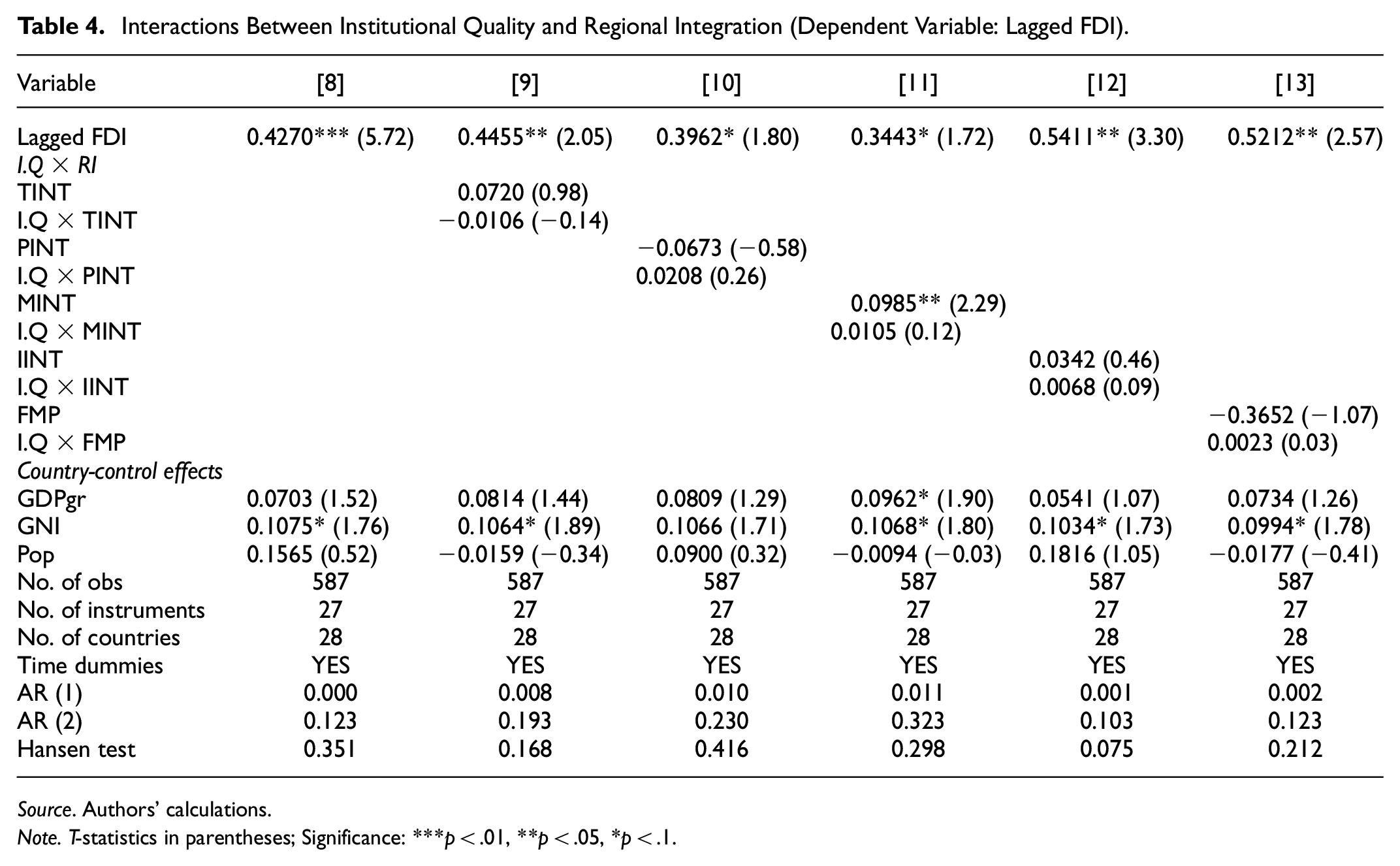
Source. Authors’ calculations.
Note. T-statistics in parentheses; Significance: ***p < .01, **p < .05, *p < .1.
Column (model [8]) is the fixed effects results on lagged FDI whereas columns [9] to [13] present the results of the I.Q
Impact of Institutional Quality, Regional Integration, and FDI in Income Groups
Currently, half of the countries (14) designated by the World Bank as low-income can be found in CEN-SAD. The remaining half of CEN-SAD are LMICs. This balance makes for any fair estimation for the two groups. At this stage, we employ equation 5 to study the role of institutions as a moderator of FDI inflows into the various income groups under CEN-SAD. Similar to the technique employed in equation 3, we begin by congregating all the six constituents of regional integration TINT, PINT, MINT, IINT, and FMP into a single variable (R.I) using Stata commands; thereby allowing for easier estimation and analyses. The interactive term is thus rewritten as IQ
Low-Income Countries and FDI (Dependent Variable: Lagged FDI) .

Source. Authors’ Computations.
Note. T-statistics in parentheses; Significance: **p < .05.
Lower-Middle Income Countries and FDI (Dependent Variable: Lagged FDI).

Source. Authors’ computations.
Note. T-statistics in parentheses; Significance: **p < .05
Overall, the coefficients of lagged FDI are positive and statistically significant for both LICs (0.4192) and LMICs (0.3227), showing that the income statuses of countries in CEN-SAD are not a requisite condition for FDI inflows. Also, the magnitudes of the coefficients of institutional heterogeneity and the country-control effects in LMICs are slightly higher than those in the LICs. This indicates that institutions and the level of integration play a slightly bigger role in FDI attraction in LMICs than in LICs. Columns [14] to [19] depict the role of institutional quality in the FDI–regional integration nexus in the LICs. In columns [14], [15], and [19] the coefficients of the various interactive terms are negative and statistically insignificant, signifying that in the LICs, FDI inflows are mainly impeded by high levels of corruption, government inefficiency, and lack of accountability. In columns [20], [22]–[25], high levels of corruption, political instability and violence, lack of regulatory quality, obstacles to the rule of law, and lack of accountability are reported to be associated with reduced FDI inflows in LMICs in CEN-SAD. The other interactive terms as well as country-control variables are negative but statistically insignificant, proof that regional integration can sponsor massive FDI inflows if institutions are efficient.
Robust Check
To confirm the robustness of our results, an additional test was conducted. Here, we introduced labor force participation rate (LFP) as a proxy for the working-age population in each CEN-SAD country as a new country-control variable into the baseline equation 3 to capture its effect on FDI, institutional heterogeneity, and regional integration. By adding LFP to the instruments set whiles controlling for institutional heterogeneity, we found the results to be consistent with the baseline model results. The results of the robust test are provided in Table 7 below.
Robust Check (Dependent Variable: Lagged FDI).

Source. Authors’ computations.
Note. T-statistics in parentheses; Significance: ***p < .01. **p < .05. *p < .1.
The aspect of regional integration that perhaps divides opinion the most relates to the definition, construction, computation, and interpretation of its dimensions and subsequent indicators. As Gor (2017) observes, the selection of components of a theoretically consistent regional integration index should be based on their analytical soundness, coverage, measurability, and undisputable relevance to integration agenda. Gor’s dismissal of the 2016 ARII as a “healthy” measure of how well countries in the RECs are integrated relates to its theoretical justification or lack thereof of a framework for the selection of indicators, variables, and indices that make up the composite index. The most observable element of the 2019 ARII not present in the 2016 ARII relates to the introduction of eligibility tests to the data normalization process to confirm data justification and suitability for weighting (the ARII uses the Principal Components Analysis (PCA) for weights and aggregates). Comparatively, Huh and Park’s (2018) APRII shares the same theoretical framework as the ARII. However, in terms of dimensions, their study accounted for a so-called “institutional and social integration” which comprises free trade agreements, embassies in host countries, business investment treaties, double taxation treaties, and cultural proximity. Konig (2017) developed an European Union (EU) Index which is similar to that of Wohlmuth (2017)’s Transformative Regional Integration Model (TRIM) in that both indexes highlight trade as the most effective guarantor of integration. Konig (2017)’s 5 indicators measure EU Openness (trade in goods, trade in services, capital movement, and labor migration) and EU Importance (trade in goods). The EU Index differs from TRIM, APRII, and the ARII by application. Whiles the TRIM, APRII, and ARII are employable at the regional level, the EU Index is only good for a country study.
Conclusion
Regional integration over the past decades has been suggested as a necessary instrument for sustained growth and inclusive development (Huh & Park, 2018). In Africa, various countries have adopted numerous reforms and policies toward achieving collective goals through integration. Over the years, a plethora of studies has evaluated the progress of countries against these goals vis-à-vis the reforms and policies instituted. However, most of the studies have largely focused on either Africa (Ngepah & Udeagha, 2018; Wilson & Pholo Bala, 2019) or regions (Otieno et al., 2013; Yitay & Thobejane, 2017) on a small number of integration variables with no attention to the RECs with regards to institutions and FDI. To fill this gap, this study adopted the 2019 Africa Regional Integration Index (ARII) and utilized a dynamic panel data model based on the one-step system generalized method of moments (SYS-GMM) estimator to investigate the impact of institutional quality on the FDI–regional integration nexus drawing on institutional theory, spanning the period from 1998 to 2019. Specifically, our study extends the regional integration theory by incorporating institutional heterogeneity effects on our studied nexus. The following is a summary of the outcomes reached in this study.
Firstly, by controlling for institutional heterogeneity effects, the study offers compelling evidence that macroeconomic integration, a basket of bilateral investment treaties, regional currency convertibility, and regional inflation differential was the strongest indicator of regional integration as well as the most crucial determinant of FDI in CEN-SAD, followed closely by trade integration. Secondly, the study established that institutional heterogeneity average score (−0.81) falls in the lower margins of the acceptable threshold (−2.5 ≤ IQ ≤ 2.5), an indication that institutions in the Community are weak and inefficient. Thirdly, on the interactions between institutional heterogeneity and regional integration, by controlling for each of the interactive terms, we discovered that the coefficient of lagged FDI is positive and statistically significant, an indication that at any given time, strong institutions in the presence of an inclusive and progressive regional integration drive will lead to an increase in FDI inflows. Fourthly, our study in part explored the impact of institutions on location advantages of FDI and how those advantages enhance FDI inflows and regional integration in CEN-SAD by measuring the effects into the two different income groups, lower-middle income countries (LMICs) and low-income countries (LICs) in the Community by interacting institutional heterogeneity with each of the indicators of regional integration, we discovered that the coefficients of lagged FDI and the interactive terms were slightly higher in the LMICs than in the LICs. Lastly, on the country-control effects, we discovered that overall, an increase in FDI corresponded to a greater increase in gross national income (GNI) than in gross domestic product (GDP) whereas population was found to have a negative correlation to FDI inflows in the Community.
From the outcomes reached in this study, we contend that an integrated CEN-SAD should augment the institutional environment in which firms compete as a result of increased scale and scope of operations and increased intra-regional FDI sponsored by the location advantages of FDI in the Community which ultimately have positive, long-term implications for the development of the Community. The prospect facing the Community to break through the seeming “institutional curse” is quite bright. Besides the usual caveat, we suspect two additional reasons could account for this possible turnaround. The first is that natural resource-wise, CEN-SAD is the most minerals-endowed and raw materials-rich REC in Africa which naturally appeals to multinational entities looking to invest in Africa. Secondly, geographically speaking, about 90% of CEN-SAD States lie in either the tropical zone or Sahel region, thereby making it easier for trade and macroeconomic integration and connectivity to the farther North and deeper South. This is the locus of the Community’s location advantages of FDI over the other RECs.
Policy Recommendations and Implications
In this study, we have emphasized the location advantages of FDI, drawing on institutional theory and the level of regional integration in CEN-SAD, and utilized the metrics of the 2019 ARII to measure regional integration in CEN-SAD. Based on the outcomes reached in this study, we make the following policy recommendations.
Firstly, the study is calling for policies that would enhance productive and infrastructural capital in the Community. For this to materialize, the adoption and implementation of several integration instruments that provoke discussions among member States leading to the adoption of new progressive production-efficient (value chains) and infrastructure frameworks that align with the overall development agenda of individual CEN-SAD States are necessary. The implication for the adoption of such frameworks in the short to medium term is that it will bring about an increase in intra-regional and inter-regional trade, reduce the production and infrastructure deficits in the Community, and boost employment. In the long term, the frameworks should ensure sustained economic growth, stimulate sectoral competitiveness, augment the complementary productive capabilities of individual CEN-SAD States, and reap scale economies for the whole Community.
Secondly, the study proposes the United Nations Economic Commission for Africa (UNECA) and other allied policymakers in Africa responsible for regional integration measurement tools to reconsider broadening the parameters that account for the selection and adoption of the dimensions that constitute the ARII to include unique country-specific indicators. Specifically, we contend that the “generalness” of the dimensions (in the context of its regional outlook) is a limitation to the ARII as it fails to account for unique country-by-country specific indicators which may be deemed inconsequential to the overall construction of the dimensions. In line with this recommendation, we encourage scrutiny of the 2019 ARII akin to that of the 2016 ARII to identify its possible flaws (both in theory and practice), toward guaranteeing a more robust and comprehensive tool for measuring African Integration.
This study emphasizes two main limitations. Firstly, our study falls short of addressing how the individual components of institutional heterogeneity could have different effects on the FDI–regional integration nexus in CEN-SAD. This limitation should lead to further studies that will explore how these individual components affect the nexus in the Community and other RECs in Africa, to further test the validity of our findings. Secondly, our choice and selection of regional integration indicators (5 out of 16) were down to data availability and consistency as opposed to conventional methodology. However, this limitation is impractical as it has no consequential impact on the findings in this study.
Lastly, the 2020 African Multidimensional Regional Integration Index (AMRII) (African Union [AU], 2020) is a new composite index that extends the 2019 ARIIs from 5 dimensions and 16 indicators to 8 dimensions and 33 indicators and also introduces thresholds for the indicators has been adopted by the African Union (AU) as a revision to the 2019 ARII. The AMRII incorporates new emerging dimensions such as climate change, migration, the environment, and social and cultural integration which are all central to the African integration agenda. The nature of present time globalization along with its growing diversities in society are ample proof that at least in practice, the “framework basket” that holds suitable and measurable dimensions of regional integration is still not full. To extend the literature on regional integration theory and practice in Africa, we encourage novel studies into the impact of these new dimensions of regional integration, their net connections to pre-existing dimensions, and their overall connectedness to other macroeconomic nexuses.
Supplemental Material
sj-xlsx-1-sgo-10.1177_21582440221148389 – Supplemental material for Institutional Quality, Foreign Direct Investment, and Regional Integration: Empirical Evidence From CEN-SAD
Supplemental material, sj-xlsx-1-sgo-10.1177_21582440221148389 for Institutional Quality, Foreign Direct Investment, and Regional Integration: Empirical Evidence From CEN-SAD by Enoch Kwaw-Nimeson and Ze Tian in SAGE Open
Footnotes
Appendix

| b. Mechanics of the 2019 Africa Regional Integration Index (ARII). | |
|---|---|
|
|
|
| 1. |
|
|
|
|
| Method | |
| where and are the maximum and minimum values of each indicator across all countries in CEN-SAD. | |
|
|
|
| Tests | |
| i. Cronbach Coefficient Alpha | |
| ii. Bartlett’s Test of Sphericity | |
| ii. Kaiser-Meyer-Olkin (KMO) | |
| 2. |
|
|
|
|
| Method | |
|
where represents the weight of the principal component for the variable. , and are linear combinations of the original variable sets to . |
|
|
|
|
| Method | |
| i. Scree Plot ii. Kaiser Criterion iii. Variance Explained iv. Jollife’s Rule v. Broken-stick model |
|
|
|
|
| Method | |
| i. Linear Aggregation ii. Geometric Aggregation |
|
Note. Computations of the index are based on the sum of the average of all dimensions. The indicators are weighted equally in the calculation of the scores for each dimension using the sum of the average of the indicators. The only exception is the Free Movement of People.
Declaration of Conflicting Interests
The author(s) declared no potential conflicts of interest with respect to the research, authorship, and/or publication of this article.
Funding
The author(s) disclosed receipt of the following financial support for the research, authorship, and/or publication of this article: This research, authorship and publication was supported by the Fundamental Research Funds for the Central Universities (Grant IDs: B210207018, B220207035).

Supplemental Material
Data used for this study are available online at the sources in the data section.
References
Supplementary Material
Please find the following supplemental material available below.
For Open Access articles published under a Creative Commons License, all supplemental material carries the same license as the article it is associated with.
For non-Open Access articles published, all supplemental material carries a non-exclusive license, and permission requests for re-use of supplemental material or any part of supplemental material shall be sent directly to the copyright owner as specified in the copyright notice associated with the article.
