




Abstract
The rate of organ donation for transplantation as well as the utilization rate of obtained organs are still low in Romania. We performed a sociological study which aimed to identify the reasons underlying the low organ donation and transplantation rate in Romania and to analyze whether changes in the opinions of the population regarding the donation of organs for transplantation occurred in the period 2012 to 2019. We applied a panel research strategy, data collection being done by means of a questionnaire applied to the same population in two different time periods: 2012 and 2019. Our research showed that during the 7 years period the attitudes of the participants toward organ donation and transplantation have not evolved to a great extent but we observed a process of crystallization of attitudes in 2019. We also observed that a more emphasis is placed by the participants on individual autonomy in decision-making process concerning organ donation and that the highest availability for organ donation is manifested when the life of a family member is at stake. We conclude that there is a need for coherent public information policies in which the main agents would be the doctors, the school and the family.
Introduction
Organ dysfunction is responsible for an increased mortality rate in the general population, the ideal solution for this problem being the replacement of dysfunctional organs with healthy equivalents through donation and transplantation. Organ transplantation is a form of treatment established since 1954, recognized as the best and sometimes the only life-saving therapy available (Jonsen, 2012). In the context of an increasing demand for organs for transplantation, the efforts to increase the number of organ donors must be accompanied by high standards of quality and safety and the improvement of efficiency and accessibility of transplantation systems.
Public perceptions of organ donation and transplantation are often based on multiple socio-demographic and cultural factors, which according to the Global Observatory on Donation and Transplantation (GODT, 2022) reports, lead to a major discrepancy in the availability and access to this type of medical services among different countries (Moloney & Walker, 2002). According to the data reported by the Global Observatory on Donation and Transplantation (GODT), in 2019 there were performed 157,301 solid organ transplants worldwide. From 2011 to 2019 the total number of organ donors increased by 58.5% (from 25,776 to 40,858), out of which 77.97% represented brain death donors, and 22.03% donors without cardiac activity (GODT, 2022).
Romania ranks 42nd out of 82 in the top of the states reporting GODT (2020b) data on donation and transplantation activity in 2020, with a donation rate of 3.44 donors per million inhabitants. By comparing the number of patients on the waiting lists reported in a year, with the number of transplant interventions performed during the same period is obvious that the real need for organs for transplantation in the Romanian system is much higher than the number of organs donated (Agentia Nationala de Transplant, 2022).
The evolution of donation and transplantation activity in Romania was marked by a certain inconsistency and a lack of resource management in the process of developing the national donation system. From the beginning of the 2000s until Romania’s integration into the European Union in 2007, the donation rate has remained below 1.12 pmp, meaning under 25 donors at the national level (Agentia Nationala de Transplant, 2022; GODT, 2022). The most prolific period in the Romanian transplantation activity was during 2013−2014 when the donation rate reached 6.38 per million inhabitants and the transplantation rate 20.74 per million inhabitants. Since then, an abrupt decline in transplantation activity was observed, with reported rates in 2018 that failed to reach more than half of the values previously mentioned (Agentia Nationala de Transplant, 2022; GODT, 2022).
Among the factors that underlie the poor functioning of the Romanian transplant system are the underfunding, the lack of specialized medical staff and the unequal distribution of resources between different medical centers. Moreover, there are no consistent ongoing campaigns to promote organ donation or any other information campaigns taking place in schools and universities, as recommended by the Council of Europe (Arredondo et al., 2018; Holman & Beatrice, 2016). High rates of viral infections, poor medical education, the absence of organ and tissue banks, the mandatory family consent, and a deficient communication between the different structures of the system are also reported as factors that contribute to a reduced rate of organ procurement (Grigoras, Blaj, et al., 2010; Grigoras, Condac, et al., 2010; Holman & Beatrice, 2016).
Given these aspects, our research aims to identify the reasons underlying the low organ donation and transplantation rate in Romania from the perspective of the general population of the municipality of Iasi, in order to provide elements that could shape public policies aimed at improving the donation and transplantation rate. The study also aims to analyze the way the opinions and attitudes regarding organ donation and transplantation have evolved and whether these changes are the underlying reason of the decline in donation rates after 2014. We conducted our study on the population of Iasi because it is the largest city in the northeastern region of Romania and an important university and medical center, concerned with the issue of organ transplantation.
Material and Method
This paper focuses on identifying several predictors that could influence the positive attitudes of the urban population regarding organ donation. Moreover, we proceed to estimate, beyond the socio-demographic factors, several implications for shaping positive attitudes. In this regard, the main themes for our research are: informed consent, family influence and decision making, and psychological factors such as altruism and motivation to save lives.
This research started from the following research questions:
Q1: How could organ donation be influenced in the case of brain death by the decision of the individuals’ family?
Q2: What is the impact of informed consent in the field of the positive attitudes toward organ donation?
Q3: How could attitudes regarding organ donation change over time?
The aim of this empirical study is to analyze the dynamics of the attitudes regarding the organ donation in the urban population. In this respect, the main objectives of the research are:
(O1) to determine the impact of consent (agreement or disagreement) on changing attitudes toward organ donation;
(O2) to investigate the role of the family in influencing the decision to donate organs for transplantation in the event of brain death;
(O3) to assess the effect of information gathering on positive attitudes toward organ donation;
(O4) to estimate the evolution of social attitudes toward organ donation between 2012 and 2019 using a comparative approach.
In accordance with the research questions and objectives we formulated the following research hypotheses:
H1: The positive attitudes regarding organ donation are related to gender (female).
H2: The positive attitudes regarding organ donation are related to people’s age (mature and older people)
H3: The positive attitudes regarding organ donation are related to an altruistic character and the willingness of saving lives.
Quantitative data were gathered using a standardized questionnaire that contained the research variables presented in the table below (Table 1):
Variables, Measures/Scales.

The questionnaire was applied in two cohorts recruited from the same target population in two different time periods: 2012 and 2019. The sample for both periods was a layered, multistage, representative sample for the studied population (793,559 citizens of Iasi); the calculated margin of error was ±3%. The method of applying the questionnaire was straightforward, using the statistical step.
The data analysis was undertaken using the SPSS program, version 17.0, and aimed to compare the data from the two periods of time to observe how the attitudes and perceptions of the respondents have been modeled during the 7 years.
For the quantitative data obtained through the questionnaire we used descriptive statistics as indicators of central tendency, dispersion, and distribution. Furthermore, we used the T-test and compared means (confidence level p < .05) to observe statistical differences in the dynamics of social attitudes toward organ donation in Iasi between 2012 and 2019.
Results and Discussions
In 2012, the research sample consisted of 265 people of which 42.6% men and 57.40% women as opposed to 2019 when there were 440 responders and the distribution between the two genders was equal. In both cohorts the age distribution was substantially equal: 30% of the respondents were between 18 and 35 years old, 40% belonged to the 36 to 55 age group, and 30% were over 55 years old. Regarding the education level of the participants, people with a high school degree prevail (54% in 2012 and 41% in 2019), followed by those with higher education (35% in 2012 and 32.7% in 2019). The socio-occupational status of the respondents in both samples indicates approximately equal values: 37% (2012) and 36% (2019) work in the public sector and 39.24% (2012) and 31.10% (2019) are employed in the private sector, the rest being represented by retirees, unemployed or under 1% non-respondents.
The presentation of the research results and their interpretation will be carried out on three levels as follows: perceptions and attitudes toward organ donation, information on organ donation, and personal decisions on organ donation.
Perceptions and Attitudes Toward Organ Donation
Depending on the socio-demographic data, the perceptions and attitudes of the investigated population regarding transplantation and organ donation were outlined. The results obtained in the two temporal moments of the research show more firm attitudes of the respondents regarding organ donation and, at the same time, an increase in the number of negative and prudent responses. Cumulatively, the answers in the negative area (never agree, mostly disagree, and sometimes agree) increased to 17.5% in 2019 compared to 13.9% in 2012 (Figure 1).
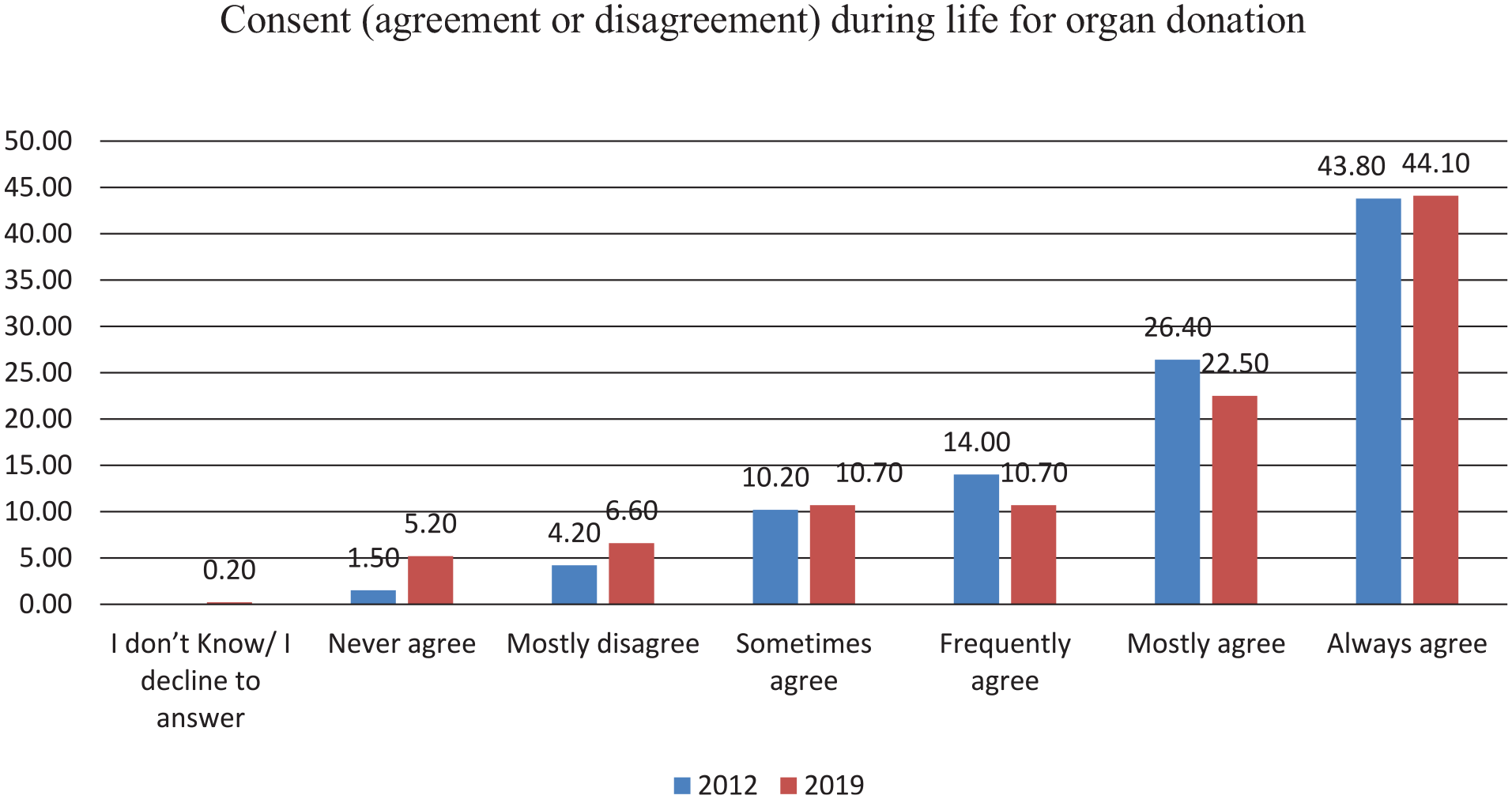
Consent during lifetime for organ donation for transplantation.
However, most of the responses received in 2012 and 2019 are in the area of favorable, positive attitudes.
There are no significant statistical differences between the attitudes toward organ donation in 2012 and 2019, and there is a strong linear correlation between consent in 2012 and 2019 (r 2 = .967, p < .01) (Table 2). In this respect, we can observe the same likelihood level in both years, 2012 and 2019 (t = 2.569, p = .05; t = 2.546, p < .05). More than 43% of the respondents have a positive attitude regarding organ donation in the context of their personal consent. Women have a greater predisposition to develop a positive attitude regarding organ donation for transplantation. Thus, 67.30% of the women would agree to donate their organs for transplantation (Figure 2). This result can be interpreted as a sign of a greater concern for their own body and health but could also be due to the traditional perspective on the role of the woman in the family, which determines them to be more careful and better informed about the possibility of organ donation and transplantation.
T- Tests Between the Consent for Organ Donation in 2012 and 2019.


Consent for organ donation for transplantation by gender.
Informed consent for organ donation is an option to which the respondents adhere in large numbers—over 70% in both studies mostly agree or always agree (Figure 3), fact that indicates that the participants prefer to be active agents, open and conscious partners in the decision regarding the acceptance of donation and transplantation. The need for clear information and knowledge also shows a particular concern of the respondents for their own fate or the fate of others. At stake are moral and ethical benchmarks experienced by the subjects when it comes to such an important issue as organ donation and transplantation.

Being informed about the risks and benefits of organ donation before giving the informed consent.
Acceptance and refusal of organ donation are decisions that people want to make freely while being fully aware of the implications and the consequences of donation on a physical, mental, family and professional level. In our study, 48.7% of respondents in 2012 and 55.7% in 2019 completely agree with this fact. Only 2.3% rejected this idea in 2012 and 3.2% in 2019. In essence, we’re talking about a clear polarization of opinions and attitudes, with some slight upward trends.
It should be noted that the absence of consent during lifetime is not associated with the agreement for donation. In this situation, the responsibility is transferred to the family. Firm attitudes toward this idea increased significantly in 2019 (49.10%) compared to 2012 (42.6%) (Figure 4). It is already known the fact that the family’s perspective has a significant impact on an individual’s decision to donate organs and is typically influenced by cultural and religious values and attitudes (Pelčić, 2005). A professional and sensitive approach of the potential donor’s family has been shown to be extremely important and efficient in decreasing the refusal rate for organ donation. Important investments in order to improve the communication skills of transplant coordinators has been shown to decrease the refusal rate for organ donation by less than 20% (Živčić-ćosić et al., 2013). A Croatian study conducted in the Rijeka region, has reported an increase in donation rates from 26.5 to 52.5 pmp, between two time periods 1986−1990 and 2010−2011 due to a decrease in family refusal from 46.5% to 7.1% (Orlić et al., 1991). The issue of consent is perceived as the result of a competent information and evaluation, but the responsibility of the decision is not assigned to an institutional and specialized field. It remains a matter of ethics and morality in which human beings manifest freely.
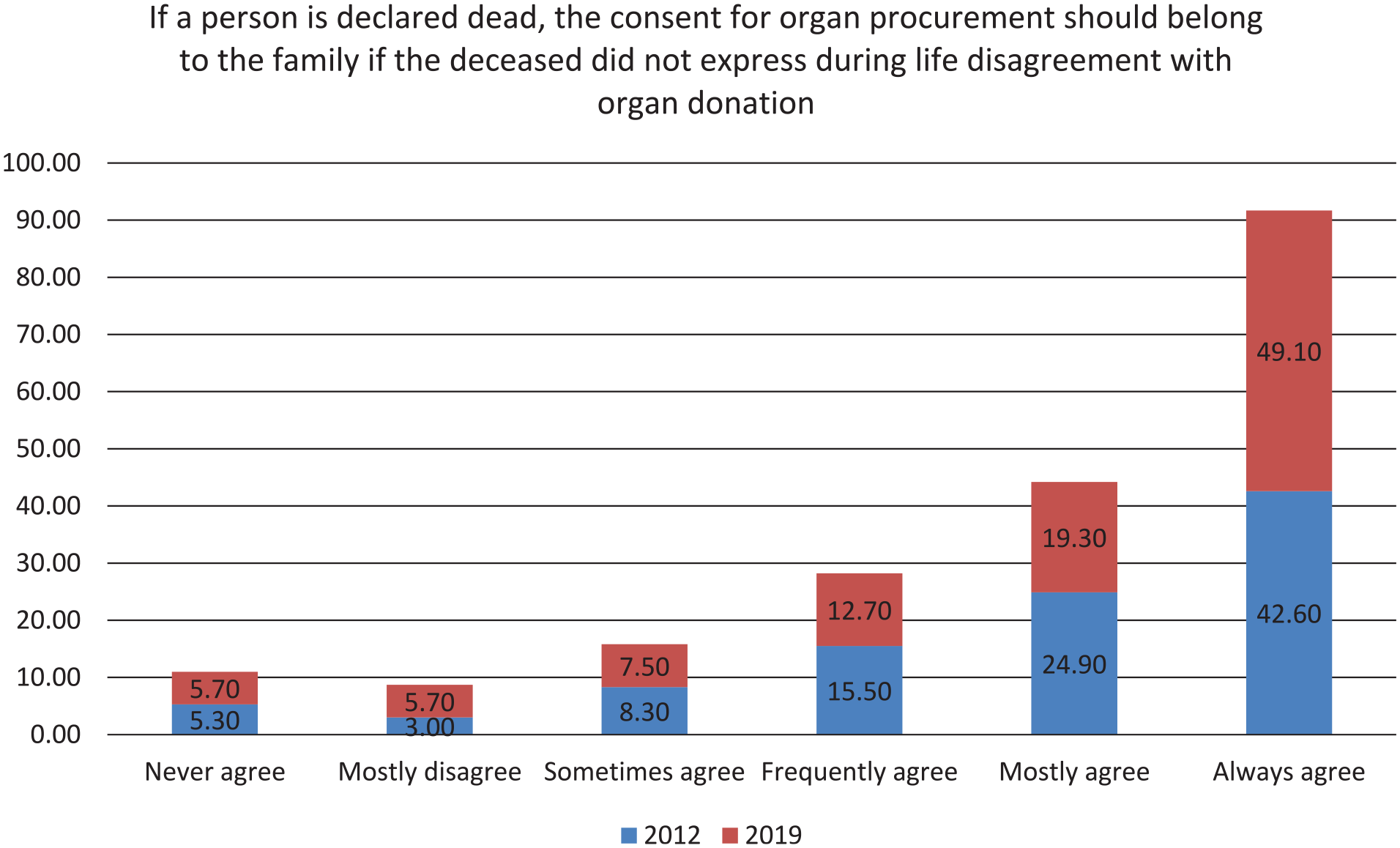
The consent for organ donation belongs to the family in the case of a braindead person.
This result reaffirms Romanian society’s unwillingness to accept legislation based on presumed consent to organ donation (Grigoras, Condac, et al., 2010). According to the opt-out strategy, organs may only be utilized for transplantation if the deceased did not make a written statement opposing organ donation (Saunders, 2012). The opt-out system has been implemented in many EU countries as it is considered a practical and efficient legal framework for a successful deceased organ donation program (Johnson & Goldstein, 2003). Low registration rates are more common in countries with explicit consent registration policies, as opposed to countries with presumed consent policies (Johnson & Goldstein, 2003), but although there are authors claiming that switching to an opt-out strategy appears to be a promising solution (Steffel et al., 2019), the impact on actual donations has shown mixed and inconsistent results due to, among other things, uncertainties about a deceased person’s donation preferences (Domínguez & Rojas, 2013).
As the probability of Romanians expressing disapproval toward a policy based on presumed consent is high, a viable solution is offered by the Croatian model. An extension to the opt-out law could specify that the decision of the family would always be honored after it is notified about the potential of organ donation and it is confirmed that the deceased person did not oppose donation. This approach has been able to prevent negative publicity, which might reflect on a reduction in the donation rate (Živčić-ćosić et al., 2013).
The Slovenian legislative framework is also based on the public right to choose between “opt-in” and “opt-out,” donation being only permissible if the deceased’s will is known or the family’s postmortem agreement is secured (Avsec & Simenc, 2021).
“Mandated choice” is another attractive alternative based on it’s potential of increasing donor registrations (Chouhan & Draper, 2003). It represents a public policy approach wherein people are required by law to state in advance whether or not they are willing to participate in a specific action. In the context of organ donation, under mandated choice, all adults would be required to decide whether or not they want to donate their organs after they die, and their decisions would be final (Harish et al., 2008).
Researchers like Spital (1992), reported that a large majority of people (90%) would prefer the mandated choice to the detriment of presumed consent, believing that the family should not be entitled to override their recently deceased loved one’s previously expressed wishes . But like in the case of any other policy the efficiency of mandated choice policies, is determined by the rate of compliance (Spital, 1992). Some authors have also questioned the ethical permissibility of the family veto, but the few available studies indicate that the public support for the family veto is limited (Albertsen, 2020; Downie et al., 2008). Albertsen (2020) emphasizes that there are no arguments that could justify the family veto and disregard the deceased’s wishes. The Romanian society’s attitude toward this concept represents a new research direction that deserves to be pursued.
Notably, our findings demonstrated a change in perceptions of the physician’s involvement in determining whether or not a braindead should be a donor. As a result, in 2019, 37% of participants disagree that the doctor has the right to make this decision compared to 18.9% in 2012. Instead, interesting scores, with significant differences are recorded when the need for a psychological evaluation of the potential donor before the consent was invoked. There is an increase of acceptance of psychological evaluation in 2019—51.40% compared to 39. 6% in 2012, women proving to be much firmer (54.50%) than men (48.20%). Such changes in attitudes can be explained by a familiarizing process in the population with the role of the psychologist in determining the ability to make significant judgments and highlight the credit that the specialists enjoy in the decision-making process.
The respondents show a great openness to the idea of a better legal regulation, the elaboration of norms and a successful management of the organ donation issue in the Romanian society. Thus, the majority of participants in both cohorts have positive or very positive attitudes toward the need of an unique national transplant registry (49.1% in 2012 and 41.1% in 2019 always agree with that and 39.6% in 2012 and 35.7% in 2019 mostly agree with this idea), the existence of a donor card (the percentage of those who agree decreased from 81.1% in 2012 to 60.3% 2019) or the involvement of a doctor or notary to certify the consent. However, opinions are divided (50% for and 50% against) when it comes to the contribution and role of the family physician in the registration process of people’s options as potential donors. It is worth mentioning that, unlike 2012, in 2019 we are seeing an increase in negative responses.
In this regard, Romania should follow in the footsteps of societies with similar levels of economic development and low donation rates at the dawn of the 21st century, who have since implemented a successful organ donation and transplantation model. The Croatian model has been internationally recognized as successful and there are already plans for its implementation in other countries (Živčić-ćosić et al., 2013). Among the key factors that contributed to the development of this successful model for organ donation and transplantation was the establishment of a national organization for organ procurement and transplantation (Narodne Novine, 1999), the implementation of a new financial model with donor hospital reimbursement, public awareness campaign, international cooperation, adoption of new legislation, and implementation of a donor quality assurance program (Živčić-ćosić et al., 2013) .
Slovenia is yet another example, where solid organ donation and transplantation were only done on a rare basis before 1998 due to many organizational and structural barriers that existed in the field of deceased donation (Avsec & Zupanic Slavec, 2016). A national competent institution established to oversee the development, management, and monitoring of the organ and tissue donation program, as well as the procurement and allocation of organs and tissue, was credited with having played a crucial role in the development of the donation system (Avsec & Simenc, 2021).
The Issue of Information Gathering
Attitudes regarding the topic of organ donation and transplantation are related to the level of awareness of the investigated population. In addition, the way the investigated subjects view the process of gaining information is linked to their level of knowledge on the subject. Public knowledge of organ donation could be improved by means of ongoing education, donor card promotion, and national public awareness initiatives coordinated by the Ministry of Health and non-governmental organizations. Increased information availability, particularly when information was provided by transplantation medicine experts and transplant recipients who shared their personal stories in the media has also shown great benefits (Živčić-ćosić et al., 2013).
In our study, the extent to which people are informed about organ donation and transplantation appears to be placed in a moderate and often negative context. In 2012, 55.8% of the respondents disagreed with the fact that Romanians were well informed about organ donation and transplantation. In 2019, the number of negative attitudes on the topic of information increased to 66.9%.
The need for being well informed in the decision-making process can be considered as a high priority, since the majority of the participants believe both in 2012 and in 2019 that it would positively influence the number of saved lives. The number of those who firmly believe this fact increased during the studied period from 37.4% to 41.60%, although there are some changes in the distribution of the answers in the negative area- the percentages are slightly higher, a fact which suggests an increase in skepticism (8.3% in 2012 and 15.2% in 2019)
When specific questions are asked, the answers demonstrate a lack of knowledge about normative and legislative aspects, without any significant differences related to age, level of education or religion, fact which indicates a lack of interest and also a lack of information campaigns on this topic.
Interesting answers were obtained when the subjects were asked about the circumstances under which the organs of a braindead person could be procured. The vast majority pointed out to the importance of the family consent and only to a small extent to the prior consent of the donor (Table 3).
The Consent to Organ Donation in the Case of a Braindead Person.

The respondents’ primary sources of information are the mass-media and the virtual environment, followed by the family doctor, the press and the church. The figures in both research periods do not vary significantly from each other (television is the main provider of information for 66% of respondents followed by the internet for 50%). Family doctors play a greater role in informing the citizens (34.1% in 2019 compared to 19.6% in 2012). The church has also become an important information source in 2019 (15%) compared to 2012 (3%).
Adequate organ donation information and altruistic motives have already been identified as factors that influence organ donation attitudes and intentions (Falomir-Pichastor et al., 2013; Radecki & Jaccard, 1997), but they may not necessarily translate into actual registrations (Radecki & Jaccard, 2006). For instance, while 90% of Canadians favor organ donation and 80% say they would be willing to register, just 23% have actually registered to be an organ donor in Canada (Robitaille et al., 2021). Despite these experiences, it has been reported that continuous promotion has been capable to influence the public opinion and attitude toward donation as well as to increase the adherence to the bioethical principles in the process of organ donation, allocation, and transplantation (Živčić-ćosić et al., 2013). Robitaille et al. (2021) affirm that providing individuals with promotional material at the point when people are deciding will make that information more salient to them and lead to an increase in new organ donor registrations .
In our research, although the mass-media is mentioned as the main provider of information, the respondents consider that information coming from a specialized source is more important, the family doctor being the most appropriate in this regard. The evolution toward such an opinion is quite obvious: 71.40% thought likewise in 2019 compared to 57.4% in 2012. Moreover, in both time periods, about 55% of the public agreed to confirm their acceptance or refusal to donate organs in front of the family doctor.
Building a high level of the general public’s trust in the transplant system is considered essential in the development of a strong system. Participation in interdisciplinary research projects aimed at discovering the public’s views on organ donation similar to the one we conducted, has been reported to assist the Slovenian authorities to gain useful insights into the contemporary social landscape, and to the process underlying the change in behavior to declare oneself as a donor (Avsec & Simenc, 2021).
The way respondents’ attitudes on organ donation evolves depending on the type of organ to be procured, suggests that this variable is losing its significance (from 44. 9% in 2012 to 22. 5% in 2019). It can also reveal a better informational status but also a fading of the connotations associated with certain organs. However, when respondents were in the position of choosing an organ they would be willing to donate, things changed radically. Most of them pointed to the kidneys and only a very small part to the heart, liver or other organs (Figure 5, Table 4). Our findings reveal that in 2012 the participants considered that the heart was the site of life or soul. Moreover, cultural anthropology researches note that the collective consciousness also functions in a symbolic register (Todeancă, 2019; Todeancă et al., 2019). Thus, the body and certain important stages of life (birth, adolescence, or death) often bear the mark of a symbolic interpretation and understanding (Gavriluţă, 2017). The symbols attributed may blur in manifestation or may migrate to different areas of human existence, but they never perish. What is important is that they can model human understanding, attitudes, and behaviors. Thus, the understanding of an organ in a symbolic register could cause a certain refrain from donating it.

The organ which participants would be more willing to donate.
The Organ which Participants would be More Willing to Donate-One-Sample Test.

In 2012 we can observe a higher willingness to donate kidneys than in 2019 (t = 1.799; p > .1; t = 1.318, p > .1). Moreover, the number of respondents who have not decided to donate an organ increased from 59.20% in 2012 to 80% in 2019. Such choices demonstrate that there is a significant distinction between perspectives that involve principles-based opinions and perspectives that involve decisions that have a direct impact on the respondent. Although it shows some openness for organ donation at the declarative level, the investigated population shows restraint when placed in the situation of playing the role of the donor.
The institutions most credited with carrying out information campaigns are the medical ones and the church. The number of those who believe that doctors should become more involved in information campaigns increased from 43% in 2012 to 54.1% in 2019 and is significantly higher than those who invoke the church as an information source (constantly 18.5%). This fact indicates that transplantation and donation would rather be related to a scientific, normative, and ethical approach, to the detriment of the religious perspective.
Organ donation is perceived by the participants as an expression of respect and love toward their peers and their lives (on average 78% of the respondents), and is placed under the sign of moral values, beyond the purpose of purely scientific explanation and justification. It engages values and principles deeply connected to the human nature or/and religiosity. The idea of sacrifice, altruism, and love represent strong motivations and can justify attitudes, gestures, and behaviors that involve a great emotional commitment. These attitudes clearly have become more firm in the two stages of the research (2012 and 2019) and are also nuanced by the refusal of any material reward in the case of donation. Therefore, 29.8% in 2012 and 27.3% in 2019 of the participants would categorically refuse any kind of reward for donating an organ. However, 14.7% in 2012 and 22.5% in 2019 would agree with some rewards, the rest of the participants being in an area of uncertainty, open to both possibilities. Basically, we are talking about a slight change in attitudes during the 7 years in favor of the possibility of having some kind of reward in exchange for organ donation. This evolution is understandable as long as the contemporary man is marked by consumerism and the impact of new technologies (Johnson & Goldstein, 2003; Steffel et al., 2019). They implicitly shape the way we think and perceive the world, our relationships with those around us and with ourselves, with our life and our own body. The body begins slowly to be perceived like any material good with a market value (Domínguez & Rojas, 2013; Johnson & Goldstein, 2003). Thus, although life is of inestimable value, the results of our research show that this aspect does not necessarily exclude a mercantile assessment of the body.
What Would You Do If You Found Yourself in This Situation …?
In the context of organ donation specifically, perspective taking has been already shown to correlate with positive attitudes and willingness to register (Cohen & Hoffner, 2013; Milaniak et al., 2018). Cialdini et al. (1987) found that asking people to envision themselves in a circumstance can promote both altruistic and self-interested motives, which some have claimed may be even more beneficial for increasing prosocial conduct and new registration rates (Batson & Shaw, 1991; Gershon et al., 2020).
Our research shows that there is an increase in negative and reserved attitudes toward personal organ donation in 2019 compared to 2012 (Figure 6), although in both cases the positive attitudes remain dominant. Basically, the number of those who do not agree to donate their organs doubles.

The attitude toward organ donation in case of brain-death.
While the distribution of the answers does not vary too much in terms of gender (Figure 7) and age categories (Figure 8), the differences are observed in terms of educational level. People who have higher education show favorable, clearly positive attitudes (41% always agree and 31% show positive attitudes, frequently and mostly agree, to donating organs in case of brain death) followed by those with high school education (35.7% always agree and about 32% mostly agree to donating organs).
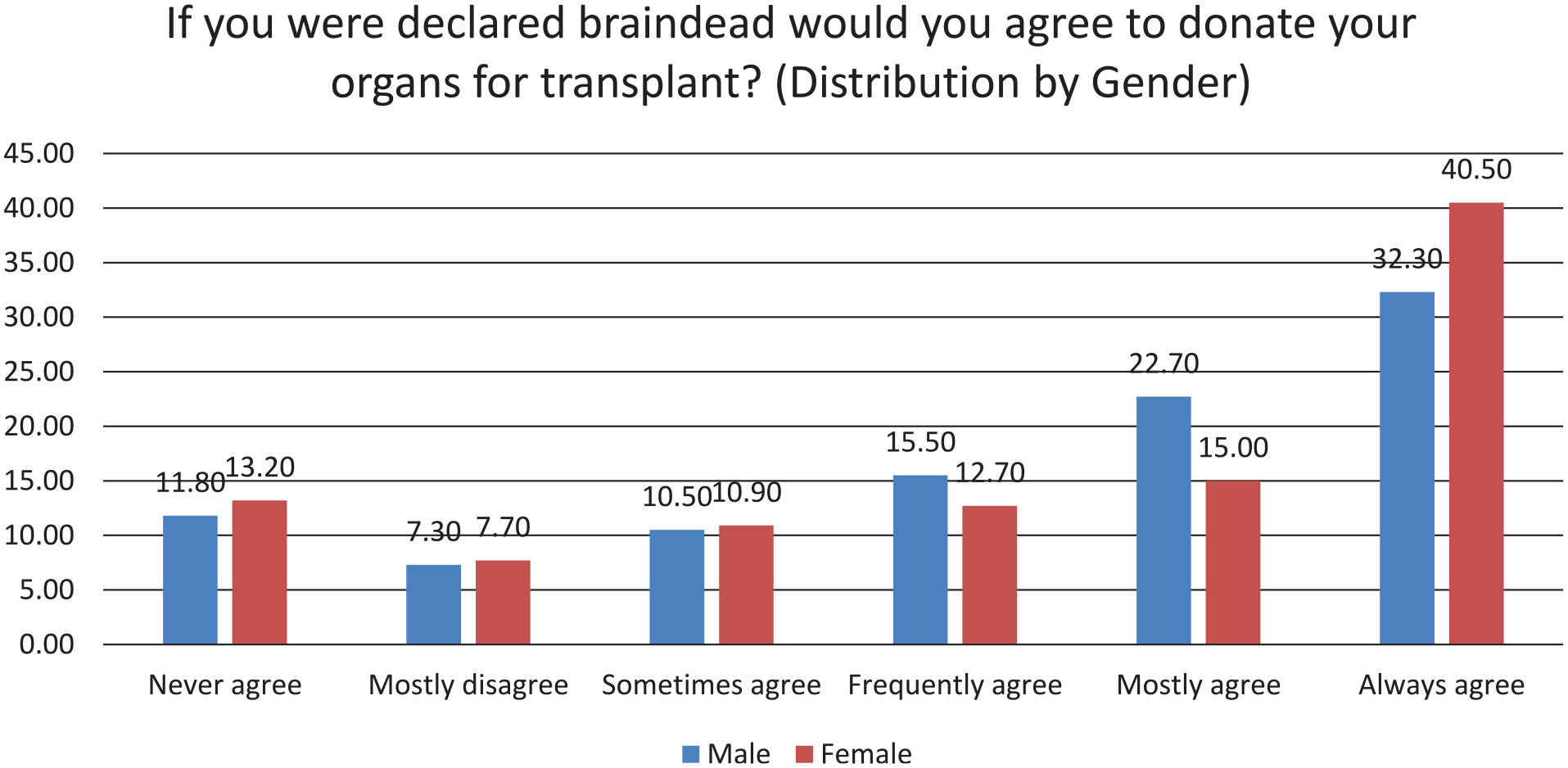
The attitude toward organs donation for transplant in case of brain-death by gender.

The attitude toward organs donation for transplant in case of brain-death by age category.
Religiosity does not have a big impact on positive attitudes. There were approximately equal distributions in different religiosity categories (31.4% were devout religious people, 39.7% declared a moderate religious practice and 35.8% of them considered themselves to a very small extent religious) all three with unequivocally positive answers. By contrast, we found that negative attitudes (17% of religious practitioners disagree and 12.2% rarely agree to organ donations) are influenced by religious practice.
Moreover, when the decision to donate involves a family member, the negative attitudes are influenced to a certain degree by religiosity (30% considered themselves as profound religious). However, when the life of a family member is at stake, attitudes become visibly positive, with reduced influence from education or religiosity (Figure 9).

The attitude toward organ donation for a family member.
Basically, when it comes to a strong attachment or affection for someone, a series of conditioning, reasoning, and judgments are suspended and instinctive mechanisms of saving the person’s life prevail.
Conclusions
During the 7 years period (2012–2019), the attitudes of the people of Iasi toward organ donation and transplantation have not evolved to a great extent, despite of the efforts through sporadic information campaigns on the existing media channels (promoting donation cases, saving lives through organ transplantation, successful transplant interventions and newspaper articles favorable to organ donation and transplantation). However, there are a series of changes in the distribution of firm attitudes. To summarize, the results of this panel research showed the following:
Throughout this period of time there is a predominance of positive attitudes toward organ donation and transplantation. Changes are mainly noticeable in the area of uncertain attitudes. Unlike in 2012, in 2019 a number of answers from this area migrate to a more sharp register, which leave no room for uncertainty or influence by other factors. We witness, therefore a tendency of establishing a more firm attitude toward organ donation and transplantation. This fact may also be due to the exposure to more informative content on this subject and is also influenced by the increasing number of high school graduates and those with higher education. It is worth mentioning that the answers in the area of “possibility” continue to hold an important share in the two analyzed periods, only to mention that the percentage decreases in 2019 by about 10%. Under these circumstances, we have discovered that there is an important part of the population (around 35%–40%) whose attitudes can be influenced by constant and well-coordinated strategies to provide better and more thorough information. Our research shows that over 60% of the respondents consider that informed consent is absolutely mandatory when it comes to the issue of organ donation, the emphasis being particularly on the person’s consent during life. Things are more nuanced when the family is in the position to decide the fate of a brain dead relative. These attitudes can also be interpreted as a form of respect for the liberty of others, but also as an invitation for decision-makers to design a coherent information system, as well a system of recording the population’s choices during lifetime. Thus, it is possible to explain the positive and very positive attitudes in the majority of the participants, regarding the need of a unique national transplant registry and the creation of donor cards.
Although in 2019 the attitude toward donation was less influenced by the donated organ itself, a direct correlation between the two variables can be reported. The highest willingness to donation is recorded for the kidney in a context where 80% of the respondents abstain or say they do not know how they would react in this situation. The results of the study conclude that, the highest availability for organ donation is manifested when the life of a relative is at stake.
We could summarize the following in relation to the research objectives and hypotheses presented at the start of the study:
The amount of information provided and the type of given consent (informed or presumed) are significant factors in shaping social attitudes toward transplantation.
The determinants of a favorable attitude toward organ transplantation are: material reward, altruism, and the policy of informed consent. Family doctors and transplant experts should play an important role in disseminating transplant knowledge since they are viewed as a specialized and accurate source of information. One can also argue that the Church should play a more important role in the process of spreading information.
The religious dimension is not relevant in the formation of favorable attitudes, resulting in a behavioral model that is dependent on altruism and other cultural values specific to the Romanian society.
The hypothesis of associating altruism with favorable attitudes toward transplantation is partially confirmed, with the effect being mitigated by the insertion of material rewards.
The hypothesis that specialized medical communication plays a significant role in expressing pro-transplant attitudes has not been proven. Strengthening the communication with the family doctor would probably have enough authority and accuracy to set a favorable attitude.
In conclusion, our panel research highlighted a slight change in the attitudes and perceptions of the population of Iasi regarding the organ donation and transplantation and at the same time, the need for coherent public information policies in which the main agents would be the doctor, the school, and the family.
Footnotes
Author Contributions
All authors have equal contribution to this manuscript.
Declaration of Conflicting Interests
The author(s) declared no potential conflicts of interest with respect to the research, authorship, and/or publication of this article.
Funding
The author(s) received no financial support for the research, authorship, and/or publication of this article.
Ethics Statement
This research was approved by the Research Ethics Commission of the Grigore T. Popa University of Medicine and Pharmacy, Iasi, Romania
