



Abstract
School self-evaluation (SSE) has emerged as a widely used approach to school evaluation in recent decades. This has occurred in the context of what is referred to as “New Public Management,” an element of which seeks to empower public institutions to make decisions locally about improving their processes and standards. Inspection regimes in many countries have developed legislative, methodological, and support mechanisms for schools to carry out SSE. This paper, by using the evolution of the SSE process in Irish education, analyses the efficacy of SSE by exploring teachers and school principals’ perceptions of both the challenges and supports concerning the integration of SSE in their schools. Results derived from this study suggest that respondents were, overall, fully aware of the support services available to them. However, support capacity challenges also emerged, in particular as it relates to data use and target setting. Importantly, it is argued that since there are striking resemblances between SSE as it has developed in Ireland and other systems, the challenges and solutions identified in this paper will have wide application in other contexts.
Keywords
Introduction
Self-evaluation has emerged as a key approach to empowering schools to make decisions internally to improve their administrative and academic standards. Inspection regimes have also developed legislative, methodological, and support mechanisms for schools to carry out School Self Evaluation (SSE). The research literature on school evaluation also highlights the role of stakeholders in the SSE and school improvement process (Brown et al., 2018; Kyriakides & Campbell, 2004), the role of critical friends and critical facilitation (Brown, 2013; O’Brien et al., 2017), the complementary nature of external evaluation and SSE (Brown, 2013; Nevo, 2002; Vanhoof et al., 2009), and student achievement (Brown et al., 2016a; Demetriou & Kyriakides, 2012). It is also argued that the effectiveness of SSE depends on a positive attitude toward SSE (Vanhoof et al., 2009) and the evaluation capacity of those who steer it in schools (O’Brien et al., 2017). However, a positive attitude toward an initiative emanates from the way it is introduced, and it is more likely to attract disapproval if imposed abruptly (Brown, Gardezi et al., 2021). Equally important is the availability of systems to support the launch of a new initiative that helps ease the anxieties of those expected to implement it. Andrews (2012), for example, highlights the limited self-efficacy of team members of a project, availability of resources, and cultural acceptance of a new paradigm as some of the challenges when undertaking an improvement initiative. Hence, the following questions that form the basis for this paper arise. Has SSE embedded in the school processes become a way of life in schools in the Irish education system, and have SSE support systems built the efficacy of the school teams to carry out such a process? This paper which is part of an EU Erasmus+ funded project entitled “Supervising Schools in the 21st Century: Digital Tools and Improvement Plans” (see selfevaluation.eu), presents a response to these questions. This paper argues that the gradual introduction of SSE in the Irish Education system, though contributed significantly toward the readiness of school leaders to accept it as a mandatory practice, comprehensive, and school-specific support is required to build the evaluation capacity of the entire staff to make SSE a way of life in schools. The study may seem circumscribed to the Irish context, however considering the similarities in ideology and methodology for school quality assurance systems across Europe and beyond (Brown et al., 2018), it provides insights to all the policymakers and inspectorates who regard SSE as a first step toward achieving better achievement standards and are developing or re-thinking school evaluation measures.
The paper begins by providing a review of the literature on SSE that was used to identify themes that influence the creation of a culture of SSE. They are, Understanding of SSE and school improvement, SSE as a whole school approach to school improvement, the capacity of educators to engage with SSE, and SSE as a tool for improvement in leading and management. Leading on from this, the methodology that consisted of a series of interviews with school principals and teachers in six Irish primary and post-primary schools is described. The penultimate section provides an analysis of principals and teachers responses to the four themes emerging from the literature. Finally, the paper concludes with a discussion of the key findings emanating from the research.
Literature Review
In recent decades, a key theme in the educational literature relates to a shift in the organization of public services from a centralized government to more localized “governance” in accordance with the principles of decentralization, devolution, and deregulation. In education, this shift has been operationalized through a greater emphasis on school autonomy and empowerment, but somewhat paradoxically, with an added framework of greater surveillance and accountability (Baxter, 2017; Brown et al., 2016b; Clarke, 2017; Janssens & van Amelsvoort, 2008; Lindblad et al., 2002; Nevo, 2002; Ozga, 2009). In this new realm of allegedly greater school autonomy, inspection regimes have emerged in most countries, even those with no such tradition but, again somewhat paradoxically, alongside a drive for control and regulation by external inspectors, most inspection regimes give greater or lesser emphasis to some form of internal regulation, often referred to as SSE (Brown et al., 2018). School self-regulation or SSE is expected to be conducted, at least to some extent and within an externally designed structure, by the “stakeholders,” school leaders, teachers, parents, and students (Brown et al., 2019, 2020a; Brown, McNamara et al., 2021; Skerritt et al., 2021). This, supposedly, “reflects the democratic values of participation and transparency” (Kyriakides & Campbell, 2004, p.24) of schools as the judgment about the quality of education provision is made by those who are most affected (students and parents) or who affect it the most (teachers and school leaders). However, it is argued that, for schools to assert their autonomy effectively, they need to have in place a strong SSE process that empowers them to make informed decisions for their improvement, while simultaneously, external evaluation is to be made more strategic instead of prescriptive (Brown et al., 2017; Ozga, 2009) thus, giving more space to schools in this regard.
A great deal of the research on SSE to date tends to endorse this shift and reports SSE as a cost-effective, context embedded process that is responsive to the needs of the schools (Brown et al., 2017; Kyriakides & Campbell, 2004; Vanhoof & Petegem, 2007). The literature suggests that through SSE, there is greater ownership and acceptance of change by school communities since initiatives benefit from a sense of ownership (Meuret & Morlaix, 2003; Nevo, 2002), making SSE a sustainable approach to school improvement (Boyle et al., 2020). As indicated above, most school inspectorates have linked SSE to external evaluation (Brown, 2013; Brown et al., 2016a, 2018; Freddano & Siri, 2012; Mutch, 2012; Vanhoof & Petegem, 2007) and use the findings of SSE both to inform inspections and to monitor whether internal systems of school evaluation are being implemented effectively (McNamara & O’Hara, 2006, 2008). However, this development in school evaluation also requires schools to have the necessary capacity to evaluate their practices, processes, and outcomes. Critics of SSE often suggest that limited research capacity results in evaluations being subjective and biased (Kyriakides & Campbell, 2004; Meuret & Morlaix, 2003; Vanhoof & Petegem, 2007) and argue that data collected and used by schools is unlikely to be reliable (Kyriakides & Campbell, 2004). In response, ongoing efforts are being made by most school inspection regimes to facilitate schools to build their evaluation capacity so that SSE is evidence-based and hence, valid and reliable.
Keeping pace with these developments in school inspection in the international context in general and in Europe in particular, Ireland’s school inspection system has developed steadily since the year 2000 (McNamara et al., 2020). The journey in the quest to create an effective SSE system, progressing from simply knowing one’s school to driving the school improvement process, has extended over more than two decades in Ireland. SSE in Ireland dates to the Education Act 1998 Section 22 that . . .placed the primary responsibility for the quality of the education provided to students on the school’s board of management and it envisaged that the school principal would have a major role in leading good practice and in monitoring the achievements of students in the school (Hislop, 2012, p.16).
The Department of Education undertook various initiatives to enhance school leaders and teachers’ capacity to carry out school improvement after this Act was passed. For example, in 1999, two dedicated support services were established that worked with schools for several years and provided them with a range of publications and support materials. Furthermore, Ireland also participated in an international project on SSE, funded by the European Commission between 2001 and 2003 (Hislop, 2012). With all these measures, SSE as an important means to achieve accountability and school improvement was gradually recognized by the inspectorate and is now considered an essential component of school improvement.
Ireland, along with other European countries, is adopting a model of quality assurance that emphasises school development planning through internal school review and self-evaluation with the support of external evaluation carried out by the Inspectorate (Department of Education and Skills [DES], 2003, p.viii).
As a starting point to creating a culture of SSE in schools, the inspectorate supported schools with the development of Looking at our schools—an aid to self-evaluation in second-level schools [LAOS] (DES, 2003). LAOS was based on five self-evaluation themes: school management, school planning, curriculum provision, learning and teaching in subjects, and support for students.
LAOS also served another significant purpose which was the alignment between internal and external concepts of quality. However, given that many schools were not familiar with the concept of SSE, inspectors, at first, wisely avoided the requirement for schools to show that SSE was embedded in the school development planning process. As stated by DES (2013) Recognising that the more impact-focused, school improvement-focused approach of SSE was one with which many schools were not yet familiar, inspectors did not generally apply SSE expectations to the planning processes of schools during the inspections they undertook (2013, p. 40).
In 2012 and partly in response to the decline in the Program for International Student Assessment (PISA) test scores, SSE moved to the center stage. The DES produced a set of guidelines for SSE with a specific focus on target setting and, in part, to enhance Ireland’s ranking in PISA.
The School Self-Evaluation Guidelines will support schools to evaluate their own work and to set targets to improve teaching and learning. This will help to achieve the targets set out in the Programme for Government and in the National Literacy and Numeracy Strategy, launched by the Minister last year (Quinn, 2012).
It now became a mandatory requirement for all schools in Ireland to engage with SSE (DES, 2012a, 2012b) and follow a process of evaluation described in the inspectorate guidelines (DES, 2012c, 2012d). The purpose of the guidelines was to guide schools in developing a short but specific SSE report and a school improvement action plan and include actionable targets for improvement in the first 3 years, with a required focus on literacy and numeracy. As stated by DES (2012a) in successive years, schools should select again from the above options so that, within the four-year period, a School Self-Evaluation report and a three-year school improvement plan (SIP) for literacy, for numeracy and for one aspect of teaching and learning across all subjects will be completed (p. 3).
The 2003 version of LAOS, according to McNamara and O’Hara (2006), provided schools with a template for undertaking SSE. However, the LAOS documents did not offer suggestions on how schools should collect the data or how SSE should link with school inspection. This all changed in 2012 when SSE became a component part of an expanded range of inspection procedures and was required to follow closely defined models and focus on areas chosen by the inspectorate.
In this new environment, the inspectorate became concerned about issues relating to the lack of data-informed decision making (DIDM) capacity in schools and commenced SSE capacity building initiatives which were deemed to be essential for the creation of a credible and reciprocal culture for the co-existence of SSE and inspection. Principals were subsequently provided with in-service training on the rudiments of DIDM by the school support services of the DES (The Professional Development Service for Teachers). Support in the form of SSE updates and case study exemplars was also provided to schools via a dedicated SSE website that was developed and is updated regularly by the inspectorate at school-selfevalution.ie. Inspection and SSE continued along these lines until the inspectorate carried out an extensive evaluation of SSE and Inspection criteria in the mid-2010s. This resulted in the redevelopment of SSE guidelines (DES, 2016d, 2016e) which, according to the DES, was developed “following extensive consultation with students, teachers, parents, school leaders, management bodies and other education professionals and a wide range of other bodies” (DES, 2016a, p.5). However, the main difference between LAOS 2016 and the second iteration of the SSE guidelines of 2012 is that there is a greater emphasis placed on DIDM in the areas that schools evaluate. Schools can focus on other national priority areas such as digital learning and Assessment for Learning that are core features of Junior Cycle reform.
To achieve a co-professional mode of evaluation between the inspectorate and schools, the inspectorate has also aligned its inspection judgements with the evaluation criteria set out in the LAOS 2016 framework (DES, 2016b, 2016c, 2016d). This increasing integration of SSE and inspection is very much informed by the direction which inspection has taken internationally toward a more participatory co-existent mode of evaluation (Brown, 2013; Nevo, 2002) coupled with the decentralization of evaluation and planning activities now influential in other jurisdictions (Brown et al., 2017). Thus, it can be argued that a dual-mode of interconnected co-existent school evaluation is on the way to being fully implemented in Ireland (Brown et al., 2018). They further explain this model of school inspection as the one resting on robust professional cooperation and understanding between inspectors and school staff regarding quality standards and valuing SSE as an integral element of school accountability and improvement process.
Nonetheless, even given the considerable range of supports available to facilitate the internal review and SSE process, doubts remain as to the extent to which schools are capable enough to carry out effective SSE. Following a description of the research method used in this study, the analysis in the proceeding sections of this paper provides some answers to this question.
Methodology
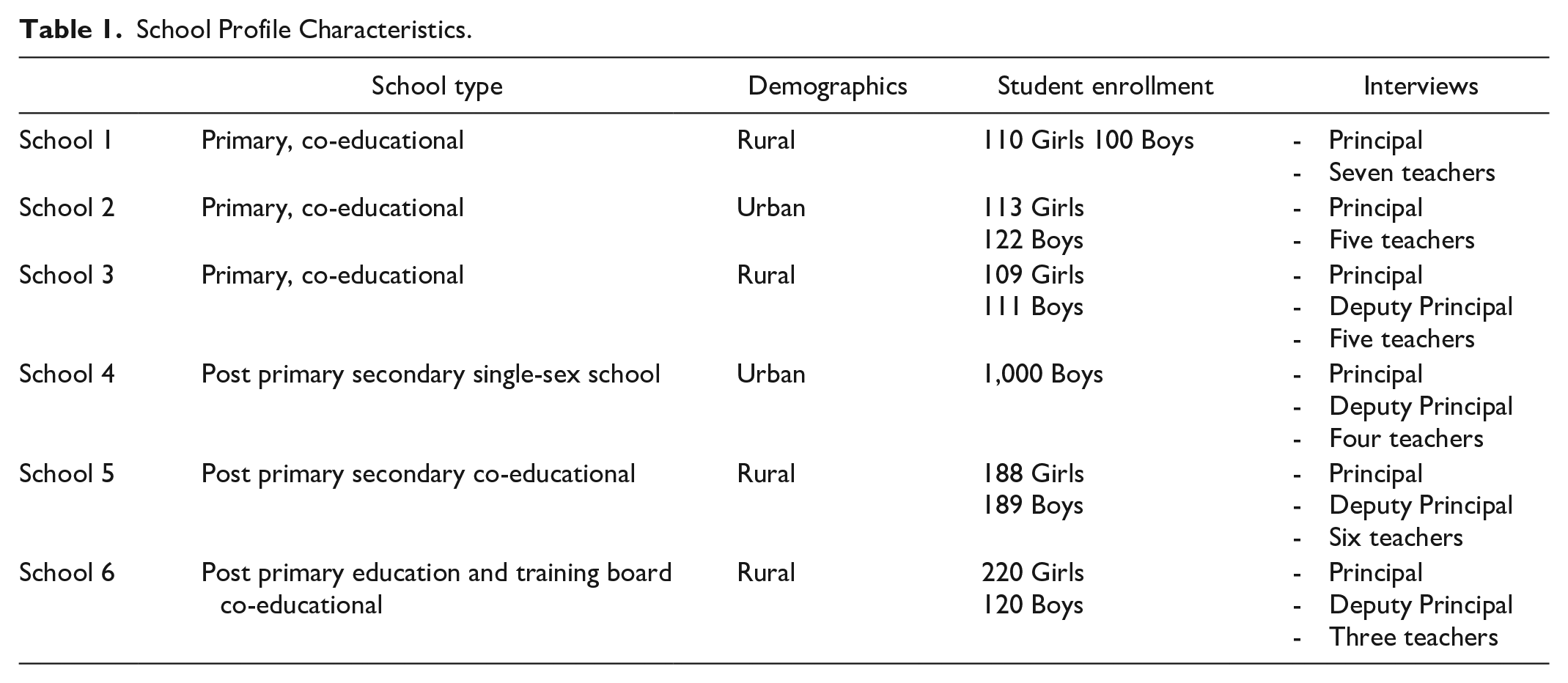
This study used two methods of data collection in the form of semi-structured interviews and focus groups that were carried out with a sample of principals (n = 6), deputy principals (n = 4), and teachers (n = 30) from six primary and post-primary schools in Ireland (Table 1).
School Profile Characteristics.
The decision to use interviews for this research was based on the view that interviews are “a way of accessing people’s perceptions, meanings, definitions of situations and constructions of reality” (Punch (2005), p.168). This method also aligns with a case study approach due to the “centrality of human interaction for knowledge production by emphasizing the social situatedness of research data” (Cohen et al., 2005, P. 267). Furthermore, the hallmark of focus groups is “the explicit use of the group interaction to produce data and insights that would be less accessible without the interaction found in the group” (Punch, 2005, p.171). These one-on-one and group interviews may be time-consuming research methods (Creswell, 2008), but they offer rich and authentic data that are neither contrived nor premeditated. Compared to individual interviews, while less demanding as far as time and other resources are concerned, focus groups still provide in-depth, rich information involving group interaction and non-verbal communication. In addition, through group interactions, participants can connect to the related topics that generally do not occur during individual interviews (Nagle & Williams, 2013).
Consequently, the data that a researcher gathers offers a more comprehensive understanding of the phenomenon under study. Furthermore, the semi-structured interview method allowed the researchers to stay consistent and focused across all cases and keep track of what was covered and what was still to be considered (Ribbins, 2007). This method also offered flexibility to use prompts and probes to elicit further information and use clarifying questions to check the meaning of a response or ask “a different question that approaches the same theme from another angle” (David & Sutton, 2004, p.88). All of these strategies were employed to get comprehensive information on the themes.
The six schools were selected using a purposeful criterion-referenced sampling strategy (Patton, 1990). The researchers have attempted to capture maximum diversity within the six cases regarding the schools’ type and location.
On the other hand, it is also acknowledged that there are limitations to this study. First, the study did not include other stakeholders such as parents and students who are increasingly required to engage in the process of SSE (Brown et al., 2020b; Faddar et al., 2021; O’Brien et al., 2021). Instead, this study focussed on principals and teachers who are required to implement and monitor the various steps involved in an SSE cycle (O’Brien et al., 2020). Finally, while the purposeful sampling technique that was used in the study attempted to provide in-depth interpretations of SSE as perceived by principals and teachers, it is acknowledged that there is considerable merit in using surveys and subsequent parametric and non-parametric analyses to attain an increased breadth of interpretations from a larger sample size to that which is presented in this study (see, e.g., Brown, 2013; Brown et al., 2017)
Data Analysis
Upon completion and transcription of the focus groups and interviews, the raw data was analyzed using Auerbach and Silverstein (2003) qualitative data coding and analysis technique that consisted of the following steps: (1) Reading the raw text and highlighting the relevant text; (2) Identifying the repeating ideas; (3) Grouping the repeating ideas in themes; and (4) Forming theoretical constructs from themes. These constructs were subsequently used to build the narrative in the findings section of this paper. To maintain each participant’s confidentiality, their responses are presented in the findings section using alphanumeric codes. For example, each interviewee has been coded with a unique identifier and according to their school (e.g., L1T1: School number 1, Participant number 1), while for focus groups, a number is assigned to each group (e.g., FG1: Focus Group number 1).
Results
Understanding of SSE and Improvement
All participants clearly knew about SSE and its avowed purposes, and the responses to the theory of SSE were overwhelmingly positive. Indeed, the concept of collaboration with all stakeholders was well received, as were other key conceptual elements of SSE, such as reflective practice and evidence-based processes that focused on enhancing teaching and learning.
School self-evaluation is the reflective and evidence-based process whereby schools identify areas for improvement and development [L2 P1].
It is a cyclical 6-step process focussed on improving the effectiveness of a school community in a variety of areas. [L4 P1].
Most participants were also of the view that there is a collective understanding of SSE in their schools and participated in the process.
Yes- we have broad agreement on the process and how to address it [FG6].
Yes, there is a collective understanding of the process in our school [L3 P1].
Yes, we are all involved [L4 P1].
We all contribute [FG5].
Yes- we are currently engaged in the process and have been since 2009, with a gap caused by the moratorium, though we did continue to bring about improvements, not necessarily through the SSE process [L1P1].
Yes, I have participated as Principal in my present school and in my previous school [L3 P1].
When asked if SSE should be an obligatory or optional process for school improvement, most participants believed that SSE should remain a mandatory process.
Must be obligatory. I think it is a very useful strategy and it should be obligatory. I don’t believe that teachers would fully engage with it otherwise [FG2].
It is a useful strategy that is now obligatory for schools in Ireland [L4 P3].
I think it should be obligatory as we need to keep abreast of all changes and act as necessary to provide the best service [L1P2].
SSE as a Whole School Approach
Collaboration, a hallmark of SSE theory, was not limited to a purely aspirational notion but is being practiced in all participating schools. In most cases, there seemed to be a whole-school approach to SSE where “a culture of professional collaborative interactions between teachers makes SSE easier to implement” [L2 P1].
The whole staff is involved in SSE although it is led by an SSE team [L2 P1] Whole staff, pupils, parents, BoM [FG1] We have an SSE team that leads the process (usually teachers who are on the ISM team) [L2 P1]
In most instances, the principal, deputy principal and post holders seemed to lead the SSE process, but quite often, a reference was made to a wider SSE team that was comprised of teachers and management.
The principal is in overall charge, but post holders with responsibility for various subjects take the lead in those areas. For example, our DP leads on literacy and improvements there have come about as a result of evaluation and action led by her [L1P1].
There is an SSE team made up of teaching staff and management [FG2].
Most of the participants also shared examples from their experience of SSE as it was taking place regularly in their schools for a number of years now. Their successes included promoting reflective teaching, improved learning outcomes, and increased collaboration among staff at every level. However, some schools and participants seemed to be a little more advanced than others and mentioned prioritizing certain areas for improvement.
Over the last ten years, we have made major strides in a number of areas. We have had a particular focus on literacy which has borne fruit in the impact on children`s learning [L5 P1, P2].
It contributes to teachers reflecting on their own methods in the classroom and up-skilling to bring new strategies to the children [FG1].
It means that all staff members focus on one particular aspect of learning which provides a universal improvement and agreement throughout the school [FG2].
The whole school approach encourages collegiality [L3 P1].
It is substantially underway and is having the desired impact as we have made a conscious decision to limit the number of areas addressed each year, deciding on a list of priorities and sticking to them [L1P1].
The interviewees also provided a substantial list of data forms that they were using for SSE, including various forms of student attainment data, surveys, and questionnaires of the stakeholders, lesson and general observations, and analysis of students’ work.
Standardised tests, teacher designed tests, diagnostic tests, teacher and other staff observation, surveys to all stakeholders, children’s work and observations [L1P2].
Questionnaires and surveys to ascertain the views of the entire school community – students, parents, teachers, BoM, ancillary staff. Obtained annually [L4P2].
There was also a general awareness among the participants about the guidelines and support materials devised by the Inspectorate to support SSE and school improvement, and they also acknowledged that they use those resources.
Yes. Looking at our school 2016 [FG1].
DES have issued schools with guidelines and has also developed a dedicated website for SSE. There is also support from the Inspectorate and the Professional Development Service for Teachers [L2 P1].
When planning school improvement, we use the framework for School Improvement provided by the DES. We also trust our own observations and bring about improvements accordingly [L1P1].
Except for a newly established school, all schools that participated in the study had a written school improvement plan.
Yes, a short document outlining our priorities and strategies for bringing improvements about [L1P3].
Yes. This is stored in a central database and shared with all staff members who can contribute to it [FG2].
The Capacity of Educators to Engage With SSE
Generally, school principals have all been provided with some training to carry out SSE, except where the school’s leadership team managed their own professional development.
No, I have personally undertaken courses that have helped greatly in my understanding of SSE [L6P1]; We have attended courses ourselves outside the school [L6P1, P2, P3].
However, even those who had received training were convinced that more training was required to involve the entire staff.
While some staff members, particularly those who have completed leadership courses, have good strategies for bringing SSE about, the issue is to get all staff on board with the execution of plans to make it all happen [L1P1].
Some staff members were given training but a minority [FG3].
Along with the limited training for staff, there appeared to be other implementation challenges, such as the time needed by staff to fully engage in the process of SSE.
Time constraints and work overload are the main barriers to SSE [L4P1].
I would say finding the time and making it a priority would be difficult. This can be made easier by the school setting aside particular time for the process [FG4].
Setting SMART [Specific, Measurable, Attainable, Relevant, and Timely] targets as required by the SSE guidelines also appeared to be where almost all participants communicated their training needs.
Setting specific targets can be the most difficult. There is also an expectation that SSE is aligned with the quality framework from schools, and that can present some difficulty [L2P1].
Training in the area of setting targets so that they are meaningful and achievable [FG1].
SSE as a Tool for Improvement in Leading and Management
In this research, it was found that SSE is clearly considered a beneficial tool for improvements in leadership and management by all interviewed participants. It should improve our performance as teachers and leaders [L6 P1, P2, P3]. For example, one participant was of the view that SSE allows the school to have a shared understanding of the “priorities of the school and how they can be improved” [IRL1P1]. This perspective is also in line with another principal who stated that: It will help us to shape a vision for the future [L6 P1].
The move toward a more participatory model of school leadership was also described as being a result of SSE. As stated by one principal: “It gives opportunities for distributed leadership and encourages younger teachers to get involved” [L1P3].
All schools were also of the view that SSE fosters ownership and collaboration and requires a whole school response to SSE initiatives. This inevitably has allowed for increased opportunities for collaboration among staff. According to one principal, “It has allowed all staff to work together collaboratively. It has given a voice to all. Everyone is working together for the benefit of the children and the school” [L3 P2]. By association, this also allowed for increased reflection by principals on their own practice as school leaders. As stated by one principal: I think it encourages more self-evaluation and reflection [L4 P2].
The SSE process also seemed to be offering increased leadership opportunities to those who want to develop professionally and take initiative. For example, one teacher stated that Teachers with new ideas now have a platform from which to share their reflections [FG5]. According to some principals, this has also resulted in middle leaders taking more responsibilities for school priorities than they would have in the absence of SSE.
Yes, I feel that the middle management team are more empowered and are more confident to take the lead. Leadership is better distributed [L5P1, P2, P3].
Yes – it has resulted in an increased level of distributed leadership across the organisation [L2 P1].
Finally, SSE is also viewed as a process that leads to better community involvement through enhanced communication. As stated by one teacher: It will provide an opportunity . . . that leadership and management build on the relationships with parents’ and wider community [FG2].
Discussion
The introduction of SSE firstly on a voluntary basis and subsequently as mandatory for all Irish schools has been a gradual undertaking. It can be argued that international developments have strongly influenced this policy, but in a sense, this hardly matters to schools attempting to enact it on a daily basis. In practice, schools face a fairly demanding set of obligatory SSE activities closely linked to the framework of inspection, which must be carried out with existing resources. Schools are supported in this task or at least attempts are being made to build their evaluation capacity, as mentioned in the literature review section, so that they can carry it out effectively. However, there has been limited research to date exploring how SSE is being received in schools both as a policy and concept and how successfully or otherwise it takes place. This research set out to explore both questions.
At the policy support or acceptance level, the interviewees responses present a surprisingly positive picture. Almost all participants had a high degree of understanding and supported the SSE process and its purposes and were confident of their collective understanding and whole-school approach to improvement. LAOS has successfully offered a shared understanding of the key elements of quality related to teaching and learning, which is reflected in the interview responses.
Generally, all participants in the study had taken part in SSE and expressed their willingness to maintain it as a mandatory activity. When we carefully study these responses, it appears that principals find it useful in meeting the challenges of the rapidly changing world and believe that if it is not mandatory, teachers might not fully engage with it. However, teachers were somewhat less supportive. This perhaps suggests some weaknesses in the system that has hampered teachers’ complete buy-in to the process. Both school leaders and teachers mentioned that training in SSE is provided to school management teams but not to the entire staff, and although the DES sends school inspectors to provide professional support to schools on request and have a number of publications and support materials related to SSE, still schools were of the view that more training is required. There seems to be a gap between the SSE training needs of schools and the support provided, and perhaps, not surprisingly, this is in the area, essentially, of research methodology. Specifically, schools did not perceive themselves to have all of the necessary competencies required for target setting, assessment and measurement, and data collection through such methods as surveying, interviewing, and so forth.
However, if we study the SSE documents for primary and post-primary schools, we find quite comprehensive information about two steps of the SSE and school improvement process, that is, Where our school is; and Where we want our school to be. There is also another supplementary publication, School Self-evaluation Guidelines, that offers practical advice on the evaluation approaches, methods, and tools to be used. An SSE dedicated website has an even more extensive repertoire of resources that includes advice on planning and the use of SSE methods, that is, focus groups, survey design, interviews, checklist video clips of schools engaged with some aspect of SSE, exemplars of SSE materials provided by schools. However, these support materials and services only partially address the third and most crucial step of SSE and the school improvement planning process: How to get there? The supports and materials have undergone significant developments since 2016 but remain weak in the more challenging areas such as DIDM. Indeed, the area where all schools request support is setting SMART targets. A question that arises here is, are they aware of their baseline to set meaningful targets grounded in data? Young et al. (2018) also point out that DIDM is new to Irish Education and schools. In this regard, there is a need to conduct a large-scale training needs analysis of schools leading to upgrading the SSE support mechanisms in light of these findings.
Recognizing SSE as a value-added practice and SSE actually adding value to school improvement endeavours present two ends of the SSE and school improvement planning continuum. The system has been successful in ensuring widespread acceptance of SSE by school leaders and staff; however, their reluctance to claim mastery over the process implies a need for further professional development and also the need for a re-evaluation of the support materials and mechanisms to not only increase their utilization but also to make them user-friendly.
Availability of time to engage in SSE has appeared as one of the significant challenges during the interviews and the focus group consultations. As mentioned in the DES circulars 0040/2012 and 0039/2012, schools have been provided with additional hours to allow for planning meetings and similar activities. However, it would be useful for school leaders to review how they are using this time and why a time constraint has arisen.
Conclusion
In conclusion, this research has presented a case study of a country where the evolution of the SSE process has spanned over two decades, and a considerable effort has been made to provide schools with a complete legislative and structural mechanism. Despite this, school leaders and teachers are reluctant to proclaim mastery of the process. In the pursuit of academic excellence, when many countries across the globe and European countries, in particular, are either initiating an SSE process or rethinking their school inspection practices, this Irish case study can be used by other countries who are either re-evaluating or in the early stages of introducing SSE. The Irish context makes it clear that SSE is a complex and time-consuming process, particularly as it relates to data collection and target setting. Done well, the research suggests that significant benefits can accrue, but most teachers are not primarily trained to conduct research and to develop that capacity is a significant undertaking.
Footnotes
Acknowledgements
The authors wish to acknowledge that this research was made possible by funding through the Erasmus+ project: Supporting Schools in the 21st Century. Digital tools and improvement plans. Project reference Number: 2018-1-ES01-KA201-049937.
Declaration of Conflicting Interests
The author(s) declared no potential conflicts of interest with respect to the research, authorship, and/or publication of this article.
Funding
The author(s) disclosed receipt of the following financial support for the research, authorship, and/or publication of this article: This research was funded via the Erasmus+ project: Supporting Schools in the 21st Century. Digital tools and improvement plans. Project reference Number: 2018-1-ES01-KA201-049937.
