




Abstract
Work-related use of information and communication technologies after hours (W_ICTs) has significant impacts on both organizations and individuals. However, limited research has explored the detrimental effects of W_ICTs behavior on work-family conflict. To fill this gap, based upon the job demands-resources (JD-R) model and daily diary design with a multilevel model method, we collected 76 employees who completed a 5-day investigation, resulting in 380 observations. Our study found that engaging in W_ICTs behavior positively influenced employees’ own work role overload, which led to an increase in work-family conflict. Furthermore, we found that the positive relationship between work role overload and work-family conflict is stronger when employees’ job autonomy is at lower levels. Our findings provide strong support for the proposed moderated mediation model and extend our understanding of W_ICTs behaviors consequences.
Keywords
In the last decade, psychology and organizational behavior scholars have shown an increasing interest in this work-related use of information and communication technologies after hours (W_ICTs; Gadeyne et al., 2018; Hongyu et al., 2016; Shi et al., 2018; Xie et al., 2018). One common form of work behavior based on constant internet connectivity, W_ICTs, refers to employees’ use of internet-connected tools such as smartphones and personal computers to handle work-related issues outside working hours (Hongyu et al., 2016; Xie et al., 2018). When working from home, employees may find themselves working later than usual, checking work-related emails during personal time and facing new job demands from their supervisor and others (Boswell & Olson-Buchanan, 2007). Previous studies have found pervasive and deleterious effects of W_ICTs on, for example, the blurring boundaries between work and nonwork, emotional exhaustion, and personal lives (Ďuranová & Ohly, 2015; Xie et al., 2018). Indeed, it is clear that engaging in W_ICTs via constant internet connectivity has negative consequences for employees’ well-being and health.
However, it is less clear whether and in what ways engaging in W_ICTs impacts issues related to the interface between work and family. Previous literature on W_ICTs predominantly focused on the effects of employee behaviors on work and organizations. In addition, some limited research has investigated the effects of engaging in W_ICTs on the work-family conflict and has found inconsistent effects. Particularly, some research has found that W_ICTs would lead to an increase in work-family conflict (Ďuranová & Ohly, 2015); however, the findings from other studies reported a negative association between W_ICTs and work-family conflict (Derks et al., 2016; Wajcman et al., 2010). To resolve these inconsistent effects, individual differences in boundary management preference have been introduced to theorize that employees with preferences of integration work and life together would have less work-family conflict when engaging in W_ICTs (Collins et al., 2015; Derks et al., 2016; Kreiner, 2006). This explanation provides insights into the relationship between W_ICTs and work-family conflict. However, it neglects the psychological mechanisms behind this relationship. Furthermore, since individual preference is a relatively stable personality trait, it is difficult to apply these conclusions for employees who prefer work and family separation (Derks et al., 2016). Finally, it has been argued that cultural differences are an important factor relating to W_ICTs. For example, the Chinese culture would also play a critical role in the consequences of W_ICTs (Hockx, 2015). Moreover, most research has focused on state models that tested the predictors associated with work-family conflict concurrently, which is a highlighted methodological limitation because work-family conflict is an inherently dynamic state that occurs and reoccurs within days (Allen et al., 2019). Thus, it is valuable to examine changeable job characteristics that moderate the relationship between W_ICTs and work-family conflict and its associated psychological mechanisms in Chinese people.
To address these questions, we examine the possible detrimental effects of engaging in W_ICTs for their work-family conflict. We focus on more immediate or proximal consequences of engaging in W_ICTs, as scholars have demonstrated that W_ICTs fluctuate on a daily basis (Quinones & Griffiths, 2017). To understand these fluctuations, we draw upon the job demands-resources (JD-R) model (Bakker & Demerouti, 2007; Demerouti et al., 2001), as it is particularly relevant and useful for understanding the proximal effects of daily behaviors (Ragsdale & Hoover, 2016). Based upon the JD-R model, we theoretically propose and empirically test a dual-stage moderated mediation model in which the relationship between W_ICTs and work-family conflict is mediated by work role overload, and job autonomy serves as the dual-stage moderator in the mediated effect (Figure 1). By integrating the JD-R model with the W_ICTs literature, our moderated mediation model illuminates the potential detrimental consequences of W_ICTs on work-family conflict and the boundary condition of this detrimental consequences. Although the literature has hinted at possible negative consequences of W_ICTs, our study is a preliminary attempt to theorize and empirically explore how and when W_ICTs hurts employees when they are at home.

Overview of the hypothesized moderated mediation model.
Theoretical Background
The main goal of the study is to explore the detrimental effect of W_ICTs behavior based upon the JD-R model. Therefore, our theorizing focuses on the proximal negative effects of W_ICTs for employees. We do so because such behaviors fluctuate daily, and these fluctuations are often caused by changes in job demands (Quinones & Griffiths, 2017). The JD-R model has been applied to explain proximal effects of daily W_ICTs behaviors (Bakker, 2014; Shin & Hur, 2019; Simbula, 2010). This model is particularly useful for understanding individuals’ work and family well-being.
We choose work role overload as a mediating variable and job autonomy as a moderating variable for both theoretical and empirical reasons. Theoretically, the JD-R model posits that every job can be categorized into two categories: job demands and job resources. In the JD-R model, job demands refer to “those physical, social, or organizational aspects of the job that require sustained physical and psychological costs” (Demerouti et al., 2001, p. 501); job resources refer to “those physical, psychological, social, or organizational aspects of the job that may do any of the following: (a) be functional in achieving work goals; (b) reduce job demands at the associated physiological and psychological costs; and (c) stimulate personal growth and development” (Demerouti et al., 2001, p. 501). Work role overload and job autonomy fit the corresponding definition and have been used as typical job demands or job resources, respectively. It is also appropriate from an empirical view because work role overload is a typical organizational aspect of the job requiring sustained costs (Brown et al., 2005; Jin et al., 2014). Similarly, job autonomy is a critical job resource that could help achieve work goals, promote individual growth and reduce job demands (Deci et al., 2017; Kubicek et al., 2017).
The JD-R model portrays the relationships between job demands and job resources. Specifically, the JD-R model portrays two psychological processes: the health damage process and the psychological motivational process (Bakker & Demerouti, 2007; Demerouti et al., 2001). High job demands lead to health damage such as role pressure, whereas job resources play a psychological motivational role, stimulating work engagement and buffering the negative effects of job demands (Bakker & Demerouti, 2007; Bakker et al., 2003). For example, meta-analytic structural equation modeling of longitudinal studies of the JD-R model confirmed these two psychological processes; that is, job demands cause negative psychological and physical consequences through burnout, while job resources buffer these negative consequences through flexible work engagement (Lesener et al., 2019).
Moreover, we use the JD-R model to choose the dependent variable. The JD-R model highlights the depletion of resources required by job demands (Schaufeli, 2017). Job demands and resource requirements in the nonworking domain directly decrease one’s available resources for family, further leading to conflicts between work and family roles. Therefore, based upon the JD-R model, with the increasing blurring boundary between work and nonwork (Allen et al., 2015), individuals are currently faced with many challenges as they try to navigate work and family responsibilities. Thus, work-family conflict is one of the most direct cross-domain behavior consequences of W_ICTs in the work-family interface (Allen & Martin, 2017) and is chosen as a dependent variable.
Based on the JD-R model, we propose that W_ICTs behavior may represent high job demands through constant internet connectivity, enabling employees to always be responsive to supervisors’ and organizations’ demands, which increases work role overload and work-family conflict. On the other hand, job autonomy represents one valuable job resource (Parker et al., 2001; Velez & Neves, 2016), especially in the internet constant connectivity age, which could buffer the detrimental effects of W_ICTs. Through this JD-R model, we may get a coherent picture of the negative consequences of W_ICTs behaviors and the positive effects of job autonomy.
Detrimental Consequences of W_ICTs
W_ICTs and work role overload
According to the JD-R model, individuals’ W_ICTs may contribute to employees’ work role overload. Role overload is defined as “expecting the role incumbent to engage in several role behaviors, all of which may be mutually incompatible in the abstract, within too short a time period” (Van Sell et al., 1981, p. 44). Role overload should be taken into consideration because it is closely associated with job performance and work-family conflict (Brown et al., 2005; Jin et al., 2014).
The JD-R model suggests that job demands could cause psychological and physical stress (Demerouti et al., 2001). As mentioned earlier, W_ICTs served as a job demand and could lead to additional time and energy demands when employees are at home. These demands are associated with two key work roles: the job-holder role and the organization-member role (Bolino & Turnley, 2005). The job-holder role refers to the formally prescribed responsibilities that employees should fulfill (Welbourne et al., 1998). In the constant connectivity work environment, W_ICTs has become a norm work rule shared by many supervisors (Mazmanian et al., 2013). Employees have to work everywhere all the time via ICTs. Thus, W_ICTs may increase the job-holder role in today’s work environment. The organizational-member role represents the expectations from supervisors and organizations to be good organizational citizens (Welbourne et al., 1998). The more responsive after work hours via internet connectivity, the more W_ICTs. Thus, W_ICTs represent expectations of a good organization-member role. The job-holder role and organization-member role induced by W_ICTs describe work states in which employees experience too many responsibilities and working activities expected for them in light of the time and energy available. Hence, W_ICTs increase work role overload. Thus, we propose:
H1a: W_ICTs will be positively related to work role overload.
W_ICTs and work-family conflict
Work-family conflict has been intensively investigated by management scholars in recent years as employees face telework (Allen & Martin, 2017). Consistent with previous classic research, we define work-family conflict as “a form of interrole conflict in which the role pressures from the work and the family domains are mutually incompatible in some respect” (Greenhaus & Beutell, 1985, p. 77). Work-family conflict is relevant because W_ICTs blurs the boundary between work and nonwork (Allen et al., 2015); thus, employees are currently faced with so many challenges, because it is hard to balance work and family responsibilities (Li et al., 2021). Moreover, work-family conflict is a critical research agenda in the context of COVID-19 (Andrade & Lousã, 2021; Karakose et al., 2021) because telecommuting is increasingly becoming a new routine.
Based on the JD-R model (Demerouti et al., 2001), we propose that W_ICTs creates additional time and energy stress. On the one hand, high W_ICTs means that employees are always responsive to work demands even when they are at home. These new demands associated with W_ICTs increase employees’ work stress (Xie et al., 2018). On the other hand, job demands with W_ICTs make it difficult to allocate enough time to family roles, which increases family stress. This increased perception of stress may be translated into behavioral consequences. At the behavior level, the stress perception triggered by W_ICTs also makes it difficult for late employees to fulfill the specific behaviors in their family domain required by the family role.
In sum, we propose that engaging in W_ICTs may increase job demands, which increases the perception of time and energy stress. This perception of stress increases work-family conflict. Taken together, we hypothesized:
H1b: W_ICTs will be positively related to work-family conflict.
Following a job demands argument, according to the JD-R model (Demerouti et al., 2001), we argue that work role overload mediates the relationship between W_ICTs and work-family conflict.
Work role overload may increase employees’ work-family conflict. High work role overload will require employees to spend more time and energy dealing with work-related activities and thus would consume their limited psychological and physical resources (Coverman, 1989). The consequences of this high work role overload are that the work role and family role become mutually incompatible in time and energy requirements; thus, the work role interferes with the family role (Greenhaus & Beutell, 1985).
Based on the aforementioned arguments, that is, W_ICTs is positively associated with work role overload and work-family conflict, and work role overload is positively related to work-family conflict, we propose the following:
H2: Work role overload mediates the relationship between W_ICTs and work-family conflict.
Beneficial Effects of Job Autonomy
Thus far, we proposed a W_ICTs mechanism—work role overload—through which W_ICTs may affect employees’ work-family conflict. In this section, based on the JD-R model, we explore the question of when W_ICTs will be more or less detrimental for employees. The JD-R model posits that job resources impact individuals’ job demands and that job resources work best when job demands are high (Bakker & Demerouti, 2007; Demerouti et al., 2001). In particular, job characteristics, such as job autonomy, could buffer the detrimental consequences associated with job demands (Bakker & Demerouti, 2007).
Job autonomy refers to “the discretion employees have over when, where in which order and with what means they pursue their work tasks” (Kubicek et al., 2017, p. 46). We consider job autonomy because it is an important job resource in the workplace and is important to work performance, health and well-being (Ryan & Deci, 2017). In the JD-R model, when job demands are high (as is the case of W_ICTs), if employees have high job resources (e.g., job autonomy), they would be better equipped to deal with these demands. Job autonomy represents one crucial job resource, with significant impacts on employees’ W_ICT-related job demands. Below, we propose, based on the JD-R model, how job autonomy serves as a dual-stage moderator of the mediating effect.
Job autonomy as a first-stage moderator
W_ICTs is likely to cause job stress, which depletes employees’ limited time and energy. This job stress from W_ICTs will require more flexible job resources. Accordingly, when individuals find themselves in a resource-scare context (e.g., those with high W_ICTs), the beneficial effects of job resources will be more salient (e.g., those with high job autonomy). Thus, the JD-R model suggests that job autonomy will buffer the detrimental effects of work role overload triggered by W_ICTs.
Employees with high job autonomy have more freedom to decide how to perform job (Morgeson et al., 2005), which is beneficial for buffering the stress associated with W_ICTs. Moreover, having high job autonomy may increase the sense of control (de Lange et al., 2003). This control perception may change the “forced” nature of job demands and give employees some degree of autonomy, which could help employees accomplish the task efficiently (Deci et al., 2017). As mentioned earlier, these positive effects caused by job autonomy give employees more psychological resources, which could buffer the stress associated with the job-holder role and the organization-member role (Bolino & Turnley, 2005) and thus decrease work role overload. In contrast, employees with low job autonomy may experience more stress and feel that they are forced to do extra tasks when engaging in W_ICTs, thus increasing the stress with the job-holder role and the organization-member role (Bolino & Turnley, 2005). Thus, we propose:
H3: Job autonomy will moderate the relationship between W_ICTs and work role overload such that the relationship will be stronger for individuals with lower job autonomy.
Job autonomy as a second-stage moderator
Individuals with high job autonomy should help employees buffer the stress experience of work role overload by allowing employees to decide for themselves their time and energy allocation between work roles and family roles (Bakker & Demerouti, 2007). Moverover, having the power to make decisions concerning the accomplishment of jobs may lead employees to be less sensitive to work role overload stress (Wang & Cheng, 2010). Moreover, high autonomy also increases employees’ sense of control, which may further buffer the adverse effects of work role overload (Niessen & Volmer, 2010). Thus, these increased resources, power perception, and sense of control may increase psychological resources that reduce stress associated with time and energy scarcity and cause work-family conflict reduction.
In contrast, individuals with low job autonomy have reduced choices in terms of when, where how and in what order and with what means to fulfill their tasks (Kubicek et al., 2017). Furthermore, low job autonomy also reduces employees’ psychological control over their jobs. These reduced choices and a sense of control would increase time and energy stress. That is, low job autonomy further induces additional stress associated with work role overload. This additional stress increases work-family conflict.
Combining this rationale with the above proposed hypothesis that work role overload is associated with work-family conflict, we further propose that job autonomy attenuates the detrimental consequence of work role overload. Thus, we propose:
H4: Job autonomy will moderate the relationship between work role overload and work-family conflict such that the relationship will be stronger for individuals with lower job autonomy.
Method
Participants and Procedure
We used a daily diary design for both theoretical and empirical reasons. Theoretically, JD-R is a dynamic model, as job demands ebb and flow both between and within employees (Demerouti et al., 2001; Quinones & Griffiths, 2017). Moreover, our focus in this study is on proximal detrimental effects of W_ICTs, which needs a daily diary design. Our design is therefore matching, given the theoretical perspective we employ and the dynamic nature of the W_ICTs phenomena. It is also matching from an empirical view because W_ICTs vary daily (Derks et al., 2016; Quinones & Griffiths, 2017; Simbula, 2010).
We recruited employees via email and a peer nomination procedure (Martins et al., 2002). Particularly, members from the researcher team were asked to send e-mail invitations to their acquaintances, friends, and colleagues who fit our sampling criteria. The inclusion criteria were that (1) employees should use information and communication technologies (e.g., smartphones or laptops) for work and (2) they should be full-time employees with regular work time (Derks et al., 2015). A letter soliciting voluntary participation and guaranteeing confidentiality was also sent with the e-mail. As a result, a total of 119 full-time employees agreed to participate in the study. We collected data in two phases. First, all participants completed a questionnaire on demographic variables and job autonomy. Second, participants completed daily surveys including the measurements of W_ICTs, work role autonomy, and work-family conflict once every weekday at 9:30 pm before they went to bed. The daily surveys last 1 week. Participants were provided with informed consent.
Out of 119 participants, 115 completed daily surveys (96.6% response rate). However, the missing responses in between days resulted in just 76 final samples completed during 5-day investigation with 380 observations. The majority of participants were female (52.6%). The average age was 29.32 (SD = 6.68). A total of 56.6% of employees had a bachelor’s degree, 67.1% participants were employees. Participants worked in different industries, including managerial, technical, and administrative positions, suggesting that our sample represents a very heterogeneous population of career types.
Measures
We used the translation/back-translation procedure to translate all measures from English to Chinese (Brislin, 1970). With the exception of the measure of W_ICTs, participants were asked to respond to all measures using a 5-point Likert scale ranging from extremely disagree to extremely agree. Specific items of each construct are presented in Table 1.
Specific Items of All Measures.

Job autonomy
We used the scale developed by Morgeson and Humphrey (2006) to measure job autonomy, which includes three interrelated aspects of autonomy (i.e., autonomy in work scheduling, decision-making, and work methods). The reliability for this scale was .92. Indices of confirmatory factor analysis (CFA) were χ2 (27) = 213.07, p < .01, CFI = 0.93, SRMR = 0.04, indicating good validity of this scale in the current study (Anderson & Gerbing, 1988).
Daily W_ICTs
We adopted the scale from Boswell and Olson-Buchanan (2007) and Gadeyne et al. (2018) to measure daily W_ICTs. In particular, three items were used to measure work-related smartphone use outside work hours, and three items were used to measure work-related PC/laptop use outside work hours. The three items were “Today, how often you use your smartphone (PC/laptop) outside work hours to complete your work-related tasks?”; “Today, I used __ minutes on my smartphone (PC/laptop) for performing my job during nonwork hours”; and “Today, I frequently use smartphone (PC/laptop) to perform my job during nonwork hours.” Respondents were asked to rate the first item on a 5-point Likert scale ranging from Never to Almost always, to choose an approximate time they used from five categories (1: 0 minutes; 2: 1–10 minutes; 3: 11–30 minutes; 4: 31–60 minutes; 5: +60 minutes) and to give their answer to the third item on a 5-point Likert scale ranging from Extremely disagree to Extremely agree. We then calculated the average score on all six items together. The Cronbrach’s a for this scale was .89. Indices of confirmatory factor analysis (CFA) were χ2 (9) = 126.58, p < .01, CFI = 0.94, SRMR = 0.07, indicating good validity of this scale in the current study.
Daily work role overload
A 5-item scale developed by Peterson et al. (1995) was used to measure daily work role overload. The reliability for this scale was .94. Indices of confirmatory factor analysis (CFA) were χ2 (5) = 14.26, p < .05, CFI = 0.99, SRMR = 0.01, indicating good validity of this scale in the current study.
Daily work-family conflict
Daily work-family conflict was measured by a 5-item scale developed by Derks et al. (2016). The reliability for this scale was .94. Indices of confirmatory factor analysis (CFA) were χ2 (5) = 30.74, p < .01, CFI = 0.98, SRMR = 0.02, indicating good validity of this scale in the current study.
Control variables
Extant research has suggested that age, gender, education, job position, and marital status impact work role overload and work-family conflict (Daskin, 2016; Grzywacz & Marks, 2000). Thus, these variables were measured as control variables.
Analytic Strategy
Given the nested structure of the data used in the current study, multilevel structural equation modeling was used to estimate the hypothesized model with Mplus 8.1 software (Muthén & Muthen, 2017). We specified a two-level model. At the within-individual level, two random effects were specified, including the effect of W_ICTs on work role overload and the effect of work role overload on work-family conflict. The covariance among random effects was estimated to test the hypothesized within-individual indirect effects (Bauer et al., 2006). Work role overload and work-family conflict on Day T − 1 were controlled on the same variables on Day T. Weekday was controlled on all within-individual endogenous variables. At the between-individual level, we specified the cross-level moderating effect of job autonomy on the random slope between W_ICTs and work role overload and the random slope between work role overload and work-family conflict, as well as the cross-level mean effects of job autonomy on work role overload and on work-family conflict. To facilitate interpretation of the findings, job autonomy and all demographic variables were grand-mean centered. W_ICTs and weekdays were all group-mean centered to obtain unbiased estimates of within-individual main effects and cross-level interaction effects (Hofmann & Gavin, 1998; Liu et al., 2015).
Results
The means, standard deviations, reliabilities, and correlations among all variables are presented in Table 2. A series of one-way random-factor analyses of variance were conducted to examine whether there were substantial variances in the focal variables at the within-and between-person levels. The results showed that the between-person variance was significant for daily W_ICTs, intraclass correlation coefficient (ICC)(1) = .14, F(75, 304) = 1.76, p < .01; daily work role overload, ICC(1) = .13, F(75, 304) = 1.78, p < .01; and daily work-family conflict, ICC(1) = .10, F(75, 304) = 1.56, p < .01. These results warrant the use of multilevel modeling to analyze the current data.
Means, Standard Deviations, Reliabilities, and Correlations Among All Variables.
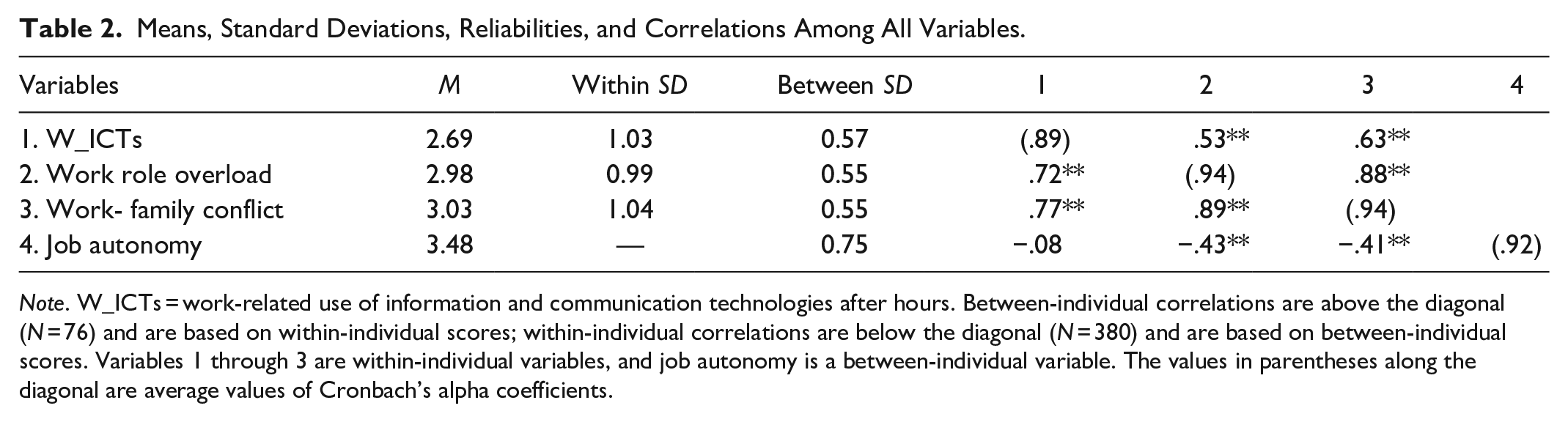
Note. W_ICTs = work-related use of information and communication technologies after hours. Between-individual correlations are above the diagonal (N = 76) and are based on within-individual scores; within-individual correlations are below the diagonal (N = 380) and are based on between-individual scores. Variables 1 through 3 are within-individual variables, and job autonomy is a between-individual variable. The values in parentheses along the diagonal are average values of Cronbach’s alpha coefficients.
Hypothesis Testing
Table 3 displays unstandardized coefficient estimates for the model.
Multilevel Path Model Tests and Results.
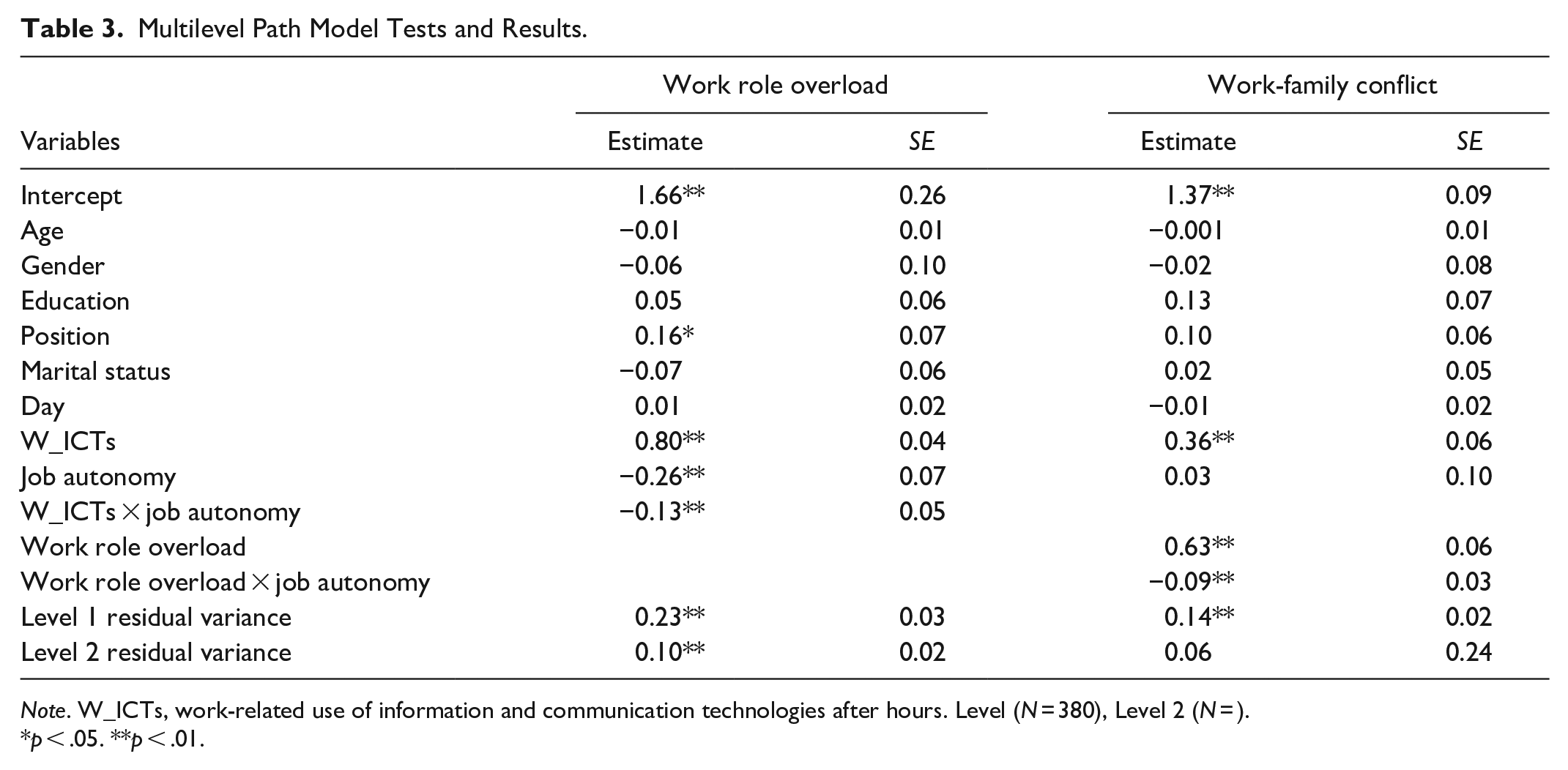
Note. W_ICTs, work-related use of information and communication technologies after hours. Level (N = 380), Level 2 (N = ).
p < .05. **p < .01.
Hypotheses 1a and 1b predict that W_ICTs has positive effects on work role overload and work-family conflict, respectively. As shown in Table 2, W_ICTs was positively related to work role overload (γ = .80, p < .01) and work-family conflict (γ = .36, p < .01), which supported Hypotheses 1a and 1b.
Hypothesis 2 predicts that work role overload mediates the relationship between W_ICTs and work-family conflict. To test this hypothesis, we used a Monte Carlo approach (Bauer et al., 2006). This method simulates random draws from the a (the first stage, x m) and b (the second stage, m y) distributions and calculates the products of a × b by using parameter estimates and their respective standard errors. That is, estimates of x on m and m on y are treated as random effects rather than fixed effects, and the random effects represent a dataset. The Monte Carlo approach allows n random draws to replace the dataset, which can produce a more accurate estimate (Bauer et al., 2006). With 20,000 Monte Carlo replications, we found that the estimate of within-individual mediation of work role overload was 0.50, with a 95% confidence interval that ranged from 0.40 to 0.64. The excluded zero from the confidence interval supported Hypothesis 2, suggesting that work role overload mediated the effect of W_ICTs on work-family conflict.
Hypotheses 3 and 4 predict that job autonomy serves as a dual-stage moderator on the mediation effect from W_ICTs to work-family conflict via work role overload. To test the moderating effect of job autonomy, we conducted cross-level interaction analysis, as job autonomy was a between-person construct, while W_ICTs was a within-person construct. The results found a significant interaction effect between W_ICTs and job autonomy (γ = −.13, p < .01), as well as a significant interaction effect of work role overload and job autonomy (γ = −.09, p < .01). The conditional effects were tested at high (+1 SD) and low (−1 SD) levels of job autonomy. Figures 2 and 3 depict the interaction plots. As shown in Figure 2, when employees’ job autonomy was at a low level, the effect of W_ICTs on work role overload was significant (γ = .90, p < .01). Although W_ICTs was positively related to work role overload when employees’ job autonomy was high (γ = .70, p < .01), the effect was significantly lower than the effect when job autonomy was low (γ = −.20, p < .01). Similarly, the difference between the conditional effect of work role overload on work-family conflict when individuals’ job autonomy was at a high level (γ = .56, p < .01) and the conditional effect of work role overload on work-family conflict when job autonomy was at a low level (γ = .70, p < .01) was significant (γ = −.14, p < .01). These results suggested that job autonomy would weaken the positive association between W_ICTs and work role overload and the association between work overload and work-family conflict. Thus, Hypotheses 3 and 4 were supported.

Cross-level moderating effect of job autonomy on the relationship between W_ICTs and work role overload.

Cross-level moderating effect of job autonomy on the relationship between work role overload and work-family conflict.
Discussion
Internet constant connectivity has created new ways for employees to communicate with each other (Glassman & Kang, 2010). It enables employees to work everywhere and anytime (Barley et al., 2011). Thus, work late after working hours has become a common activity at home. W_ICTs is conceptualized to capture this new phenomenon (Velez & Neves, 2016). Some research has found that W_ICTs has negative consequences for the family (Ďuranová & Ohly, 2015); however, the mechanism and its boundary condition remain unclear. To test the underlying mechanism, we introduced the JD-R model (Demerouti et al., 2001) into the W_ICTs literature to propose a moderated model that specified the mechanism and boundary condition of the relationship between W_ICTs and work-family conflict. Through a daily dairy design, we found that (1) W_ICTs would increase employees’ work-family conflict, (2) the relationship between W_ICTs and work-family conflict was mediated by work role overload, and (3) job autonomy serves as a dual-stage moderator in the indirect effect of W_ICTs on work-family conflict via work role overload. These results are consistent with previous findings on W_ICTs (Diaz et al., 2012; Gadeyne et al., 2018) and job autonomy (Deci et al., 2017; Kubicek et al., 2017).
Theoretical Contributions
Our research makes several key theoretical contributions to the W_ICTs and JD-R model literature. First, by showing how W_ICTs behavior indirectly affects employees’ work-family conflict through work role overload, our study broadens the understanding of the effects of W_ICTs. While previous research have established the consequences of W_ICTs on work-related outcomes (Arlinghaus & Nachreiner, 2014; Lanaj et al., 2014; Xie et al., 2018), the impacts of engaging in W_ICTs behavior on the interface of work and family have been largely overlooked (Boswell & Olson-Buchanan, 2007). Additionally, previous studies, including limited research on the negative consequences of W_ICTs, has found inconsistent results of W_ICTs, concluding both beneficial and detrimental effects of W_ICTs (Derks et al., 2016; Ďuranová & Ohly, 2015; Wajcman et al., 2010). This is problematic because it will cause misunderstanding of how to apply these findings in organizations. By combining the JD-R model with the literature on W_ICTs, we clarify the mechanism of the relationship between W_ICTs and work-family conflict. Specifically, W_ICTs could increase work-family conflict via work role overload.
Second, our results further contribute to the W_ICTs and work-family conflict literature by revealing when W_ICTs is more or less detrimental for employees. For a comprehensive understanding of the consequences of W_ICTs, it is critical to go beyond merely examining its consequences and to explore the boundary conditions under which job demands of W_ICTs have stronger or weaker impacts (Derks et al., 2016; Xie et al., 2018). Based on the JD-R model, we found that W_ICTs induced work role overload and that work-family conflict depended on job autonomy. Specifically, when job autonomy is low, W_ICTs increases work role overload, and work role overload increases work-family conflict. For employees with low job autonomy, engaging in W_ICTs behavior produces work role overload and work-family conflict. Thus, these detrimental effects of W_ICTs would be buffered by job resources of job autonomy.
Third, we also make methodological contributions. Based upon the JD-R model, we intend to explore the daily variations in W_ICTs. Thus, this question needs a daily design. With this design, we could reduce the frequent limitation with cross-sectional studies. Statistically, through multilevel analyses, it also enables a more rigorous test of the detrimental consequences of W_ICTs and its boundary condition because data are collected for 5 days; therefore, hypotheses about dynamic processes can be justified. In contrast, cross-sectional studies of W_ICTs have only theoretically proposed the dynamic process (Sonnentag, 2001; Spector & Meier, 2014).
Practical Implications
Our research has important practical implications for companies and employees. W_ICTs is very common in today’s internet constant connectivity workplace. The tools used outside work hours are widely accepted. For example, by December 2020, there were 346 million online office users, accounting for 34.9% of the overall Internet users (China Internet Network Information Center, 2021). Therefore, it is urgent to reduce the detrimental effects triggered by W_ICTs demands on the one hand and increase job resources to buffer these detrimental effects and promote personal growth on the other hand.
First, organizations should realize that W_ICTs would have adverse consequences, such as work role overload and work-family conflict. Hence, organizations should be cautious about W_ICTs and should not vigorously promote the “always online” corporate culture (Mazmanian, 2013; Mazmanian et al., 2013). This “always online” culture would significantly increase employees’ job-holder role and organization-member role and the corresponding work-family conflict.
Second, for employees, job autonomy is a critical job resource that helps to buffer the adverse effects of job demands (Morgeson & Humphrey, 2006; Velez & Neves, 2016). According to the JD-R model, job resources induce a motivational process that is beneficial to individuals’ work engagement, health, and well-being (Demerouti et al., 2001; Rafiq & Chin, 2019; Rafiq et al., 2019). Due to the rapid development of ICTs, employees can work everywhere anytime. This job environment requires organizations to provide more autonomy to employees to deal with uncertainty associated with this new form of constant connectivity of ICTs (Mazmanian, 2013). Employees would benefit if they have autonomy in deciding when and where to deal with the new job demands triggered by W_ICTs (Kubicek et al., 2017).
Strengths, Limitations, and Future Directions
Drawing upon the JD-R model, we conducted a daily diary study to examine the detrimental effects of W_ICTs on employees themselves and whether the job demand’s adverse effect was contingent upon one valuable job resource, that is, job autonomy. Although the current research has many strengths (e.g., theory-driven moderated model, daily design, and multilevel analysis, etc.), some limitations, and directions for future study are worth noting.
First, because the current study focuses on proximal or more immediate effects of W_ICTs, we collected employee reports of daily W_ICTs, work role overload, and work-family conflict. We followed a previous study to minimize common method variance (Podsakoff et al., 2012). To remove between-individual confounds such as employees’ stable traits and response tendencies, we mean-centered employees’ daily variables at the individual level when doing the data analyses (Koopman et al., 2016). Future studies may conduct experimental designs to explore the causality of W_ICTs on work role overload and work-family conflict.
Second, future study might consider examining the complex effects of W_ICTs on a wider spectrum of consequences. Based on the JD-R model, we identified work role overload as one adverse proximal outcome of W_ICTs, yet other consequences are likely as well. For example, W_ICTs may decrease autonomy perception. Prior research has found that employees using emails in the workplace have to be responsive all the time, and their autonomy has been reduced through interviewing employees (Mazmanian et al., 2013). However, in recent years, scholars have suggested that W_ICTs may have beneficial effects on work-related outcomes when employees have freedom to choose whether to engage in W_ICTs (Diaz et al., 2012; Mazmanian, 2013; Ragsdale & Hoover, 2016; Shi et al., 2018). Future research could simultaneously examine the benefits and costs of W_ICTs for employees to obtain a more comprehensive understanding of W_ICTs by revealing the dark and bright sides of W_ICTs.
Third, for theoretical reasons, we explored the moderating effects of job autonomy, capturing the consequences of job resources on the relationship among W_ICTs, work role overload, and work-family conflict. In addition to these job variables, future study may examine organizational context variables. For example, organizational culture may influence how employees perceive expectations from their supervisors and organizations (Thompson et al., 1999). In the paternalistic leadership style of many Chinese organizations, leaders have unbalanced power over their employees, and employees are highly dependent on their paternalistic leaders and expected to always be responsive to their leaders’ job demands as soon as possible (Pellegrini, 2019). This asymmetric power may be more likely to have increased the detrimental effects of W_ICTs. Future studies could explore the mechanisms and interventions that may reduce the adverse effects of W_ICTs in different cultural backgrounds.
Conclusion
Our research represents a preliminary attempt to examine when and how W_ICTs behaviors impact employees’ work-family conflict. Specifically, we explore the potential immediate detrimental consequences of W_ICTs, which include work role overload and work-family conflict. These detrimental effects were further buffered by job autonomy. This knowledge about the detrimental effects of W_ICTs can be leveraged to effectively reduce the potentially adverse consequences of W_ICTs through interventions that target employees’ work role overload and job autonomy. We contribute to the literature by clarifying the mechanism of the relationship between W_ICTs and work-family conflict. Based on the JD-R model, our study indicates that job autonomy represents one type of job resource that induces a motivational process that is beneficial to individuals’ work engagement, health, and well-being. Based on our findings, future study may conduct experimental design to explore the causality of W_ICTs on work role overload and work-family conflict and simultaneously examine the benefits and costs of W_ICTs for employees to obtain a more comprehensive understanding of W_ICTs by revealing the dark and bright sides of W_ICTs. We hope our study has aroused the enthusiasm of researchers to further explore the psychological mechanisms that harness constant connectivity tools, such as laptops or smartphones, that support W_ICTs in a beneficial manner while minimizing potentially adverse consequences.
Footnotes
Declaration of Conflicting Interests
The author(s) declared no potential conflicts of interest with respect to the research, authorship, and/or publication of this article.
Funding
The author(s) disclosed receipt of the following financial support for the research, authorship, and/or publication of this article: This work was supported by the Program of National Natural Science Foundation of China (grant number 72174075; 71571087; 71801109); Foundation Major Cultivation Project of Guangdong Province, China (grant number 2017A030308013); National Science Foundation for Post-doctoral Scientists of China (grant number 2018M640879); Program of Hunan Province Natural Science Foundation of China (grant number 2021JJ40143); General Project of Educational Department of Hunan Province in China (grant number 21C0834)
