




Abstract
This study proposes that there is relationship between transformational leadership and employee’s voice as well as relational identification as a mediation and proactive personality as a moderator. Structural Equation Modeling was used to analyze data gathered from employees at the Ministry of Law and Human Rights through questionnaires. The findings revealed that transformational leadership has a significant effect on employee’s voice and relational identification; relational identification mediates the relation between transformational leadership and employee voice behavior, and proactive personality will weaken the transformational effect on employee’s voice behavior. This study enriches empirical studies that employee’s voice can represent the opinions and ideas of employees with the presence of relational identification, proactive personality, and transformational leadership in the organization. Furthermore, transformational leadership can build relational identification that is strengthened by a proactive personality so that employees are happy to convey their voices.
Keywords
Introduction
Managerial behavior is one essential factor that might influence employee performance (Buil et al., 2019). Some of the impact that a manager may bring are on the organization success in achieving goals, employee performance, emotional attitudes and behavior at the workplace, as well as desire to state their voice (Avolio et al., 2004; Liang et al., 2017; Terglav et al., 2016). Employee voice is important as it can ease constant improvement, trigger new ideas that can form a starting point for innovation and prevent harmful consequences for the organization (Groeneveld, 2015; Qi & Ming-Xia, 2014). From a company point of view, employee voice specifically benefits to the workflow by providing new elements to work (Liang et al., 2017). Other studies have looked at the impact of employee voice on employee performance since it helps the organization grow by contributing opinions, ideas, and recommendations (Buil et al., 2019; Morrison, 2011).
Moreover, some studies have investigated factors that can affect employee voice, one study is from Duan et al. (2017) who stated that transformational leadership allows employees to have more chances and use more channels to encourage interaction or share thoughts with supervisors informally. Employees benefit more from their supervisor’s support and response in the workplace when they have more informal interactions and exchanges with them (Fix & Sias, 2006), in fact the potential of cultural barriers between supervisors and employees may also be reduced (Afsar et al., 2019). According to Lei et al. (2021), transformational leadership will favorably motivate employees to act as instruments in establishing and instilling a culture of innovation that stimulates creativity, risk taking, and positive feelings and readiness to find innovative solutions to problems.
Transformational leaders can increase employees’ confidence by providing opportunities to learn and by responding to employees’ performance and challenging them to provide new, innovative ideas. This type of interaction can help develop stronger relational identification so that it will provide better performance results (Walumbwa & Hartnell, 2011). Ashforth et al. (2007) stated that social influences on leadership processes are among the mechanisms that lead to meeting this type of identification. Relational identification becomes something important, especially for superiors, since the interactions will make the relationship between superiors and subordinates, especially on the psychological side, closer to the company (Liang et al., 2017).
Although manager and leadership style are the essential factors for performance, characteristics of employees, such as their individual characteristics are also related to attitude and behavior formation (Buil et al., 2019). One personality attribute that promotes employee role behavior has been identified as proactive personality (Bakker et al., 2012; Bergeron et al., 2014). This personality feature is described as “a stable disposition to take personal initiative under a variety of settings and activities” (Seibert et al., 2001). According to Urbach and Fay (2021) voice behavior as one representation of proactive behavior, shows a voluntary representation of creative thinking, information, or opinions that centered on constructive change and is considered a critical asset for the organization because it adds value to individual performance.
This study tested the effect of transformational leadership on employee voice through the mediation of relational identification and proactive personality as a moderator, whereas in previous studies, models with these variables were rarely found. The paper proceeds as follows. The literature review, which includes literature and previous research on transformational leadership, employee voice behavior, relational identification, and proactive personality, is presented in the next section. The presentation of study hypotheses and research methods follows. Following after is the presentation of research hypotheses and research method. Data analysis and results are presented subsequently, followed by results and discussion. The conclusion, limitations, and suggestions, as well as the managerial implications of this study, are discussed in the final parts.
Literature Review
Theoretical Background and Conceptual Bases of the Study
Transformational leadership
Leadership is defined as the ability to direct subordinates to achieve common goals and as a form of influencing leaders—which can be done through change (Wardani & Eliyana, 2020). Transformational type leadership is founded on the notion of subordinate growth, according to Bastari et al. (2020). Because transformational leaders can assess the potential of subordinates and recognize opportunities to extend their responsibilities and authority in the future. Burns (1978) cited by Groeneveld (2015) suggests that transformational leaders may inspire subordinates, seek to meet their higher requirements, and guarantee that each subordinate is adequately engaged in their task (Demirtaş et al., 2020; Lysova et al., 2019; Park, 2019). A transformational leader is someone who inspires their subordinates to go above and beyond what is expected of them. Similar to the mentoring style of leadership, which is a new sort of leadership that has evolved in recent years, when leaders apply a transformational style, employees’ intellectual capacity will be stimulated and developed (Y. Wang et al., 2018). Leaders who use transformational styles also mean leaders who are concerned with the aspirations, personal and professional needs of individual employees (individual considerations) to encourage employees to work beyond the job expectation standard. This leadership consists of four sub-dimensions, namely, idealized influence (how leaders are recognized, admired, and considered reliable), inspirational motivation (how leaders guide and encourage employees by providing challenges and meaning in their work), intellectual stimulation (how leaders stimulate employees’ innovation and creativity by reframing problems and approaching old situations in new ways), and finally individualized considerations (how leaders, through acting as coaches or mentors, pay closer attention to the needs of each individual follower for achievement and progress) (Bass & Avolio, 1993).
Employee voice behavior
Hirschman (1993) first presented the concept of voice, proposing that it is one means for employees to express their discontent with their employer. Voice behavior is defined by Svendsen and Joensson (2016) as speaking with suggestions and ideas in order to improve the transformation process. Voice behavior, according to Groeneveld (2015), can help with continuous improvement by generating useful ideas that can be used as a springboard for innovation. In summary, employee voice behavior is a proactive behavior intended to change current situation at work and prevent organizational damage (Li et al., 2017). Because one of the benefits of voice is that it encourages people to express themselves in the workplace, it has piqued the interest of organizational behavior experts. Liang et al. (2017) hypothesized two sorts of voices, promotive and prohibitive voices, based on the purposes of voice behavior. Prohibitive voice refers to employees who propose solutions that can prevent the organization from incurring undesirable or damaging impacts. While promotive voice refers to employees’ fresh ideas to continually refine their work unit or organization. Both are critical for organizational success and even organizational survival, according to Song et al. (2021), since they facilitate decision-making, innovation, and process improvement, as well as the resolution of problems and the prevention of crises.
Relational identification
Relational identification refers to how people describe themselves within the context of a relationship (Ashforth et al., 2007), and it represents the Confucian ideals’ relational role-based self-concept. Relational identification is also described by Ashforth et al. (2007) as the extent to which individuals internalize their role in a relationship and begin to realize that role as part of their own construction so that positive valence is considered to come from the role-based and person-based elements of the relationship (Batistič, 2018; Dada & Fogg, 2016; Methot et al., 2018). Thus, the individuals will focus on perceiving the level of unity with the relationship in such a way that the benefits of the relationship can be felt and are in line with self-benefits (Thompson & Audrey Korsgaard, 2019). Since hierarchy provide less potential social influence and motivation for people to perform and contribute to their organization (Shen et al., 2019), employees’ relational identification is critical to correlate leader conduct with performance results across cultures (Cai et al., 2019; Manzoor et al., 2019; Popli & Rizvi, 2016; Walumbwa & Hartnell, 2011). This is because each party values others’ interests as their own and this unity can result in a deeper level of trust (Thompson & Audrey Korsgaard, 2019).
Proactive personality
Proactive personality illustrates behavior tendency to change something in work by opening new possibilities (Nurjaman et al., 2019). It will reflect “a stable disposition to take initiative in various activities and situations” (Li et al., 2017). Active employees, as contrast to passive workers, will endeavor to meet standards and outcomes. They do not however sit around waiting for opportunities or information to come to them. Employees with a high proactive personality will actively seek new ideas and take initiatives to improve the situation, and they are more likely to change their situation individually than to allow themselves to be shaped by their environment (Newman et al., 2017). They are very valuable to organizations, because they will be characterized as individuals who find chances to shape environment by taking personal initiative to create a favorable environment (Z. Wang et al., 2017).
Hypotheses
Transformational leadership and employee voice behavior
Transformational leadership provides self-confidence, develops thinking, and communicates the vision of the organization well to employees (Liang et al., 2017). As indicated earlier, the concept of transformational leadership, according to Bass and Avolio (1993), comprises four dimensions; these four dimensions have a high relationship and construction on one another (Svendsen & Joensson, 2016; Walumbwa et al., 2008). Moreover, the dimensions of transformational leadership cover listening and communicating, providing space for expression, inspiring and empowering employees, which eventually help to motivate employees to achieve company goals (Liu et al., 2010). Thus, employees share in the leader’s vision and want to make sacrifices for that vision (House & Howell, 1992; Lovelace et al., 2019; Zaccaro et al., 2017; H. Zhang et al., 2017). Leadership, as part of a group mechanism, is a major determinant of individual behavior, according to the Colquitt Mechanism (Colquitt et al., 2018). Leaders have a role in persuading their followers to do or not do anything, such as change their voice behavior, in this example.
Employees are afraid of repercussions from their supervisors; therefore, they opt not to speak up (Milliken et al., 2003). Indeed, one of a leader’s responsibilities is to promote open communication throughout the organization (Cangemi et al., 2008). Even so, leaders are the main key for employees to voice because of the potential for rewarding and reacting to employee input (Liu et al., 2010). In one study by Liang et al. (2017), transformational leadership empowers hotel frontliners to examine old challenges in new ways, providing a stabilizing relationship and challenging current conditions. As a general target for voice behavior, transformational leaders will be responsible for encouraging employee voice behavior, where the leader’s behavior represents appreciation or openness to change. These leaders can foster the establishment of employee promotion focus by moral modeling, encouragement, and focused advice, according to the principle of self-regulatory focus. Employees will be motivated to pay greater attention to positive job results and to keep an open attitude to change in the workplace, demonstrating innovation and a readiness to take chances (Y. Wang et al., 2018).
Voice behavior, which is defined as the communication of employee wisdom on suggestions, ideas, and concerns in the workplace with a view to improving organizational functions, is essential for the change process (Svendsen & Joensson, 2016). Employees will have a high degree of trust and understanding of their supervisors under transformational leaders, which might enable them to communicate their thoughts freely and openly without fear of misinterpretation or judgment. (Afsar et al., 2019). For example, Duan et al. (2017) show that employees with transformational leadership have more chances and use more channels of contact to communicate and exchange information or ideas with supervisors informally. Employees gain more from their supervisor’s support and responsiveness in the workplace when they have more informal interactions and exchanges with them. Because of the possibility for cultural barriers, employees may require additional support from their superiors before engaging in voice behavior. Previous research has found a positive relationship between transformational leadership and the willingness of frontline hotels to express their voice to leaders (G. Zhang & Inness, 2019). It is also supported by recent studies which show that the perception of positive change-oriented transformational leadership behavior significantly influences voice behavior (Duan et al., 2017). Employees are more inclined to speak ideas to their superiors when they perceive the quality of their relationships to be high, according to research by Urbach and Fay (2021). The hypothesis can be derived as follows:
H1. Transformational leadership has a positive effect on voice behavior
Transformational leadership and relational identification
Relational identification, according to Ashforth et al. (2007), centers on one related connection between leaders and their direct underlings. Followers who have high relational identification will be more willing to talk about their ideas and opinions, and voluntarily change their self-concept for this purpose (Liang et al., 2017). Individuals who can prioritize keeping a good self-image when they begin their relationship will evaluate the other party’s personal and role-based identities. When they have a positive perception of the other party’s traits, it is possible that the connection will have an impact on their self-concept (Ashforth et al., 2007). Employees will more often interact with their leaders and observe their leaders’ actions and decisions (Zhu et al., 2015). In addition, referring to social identification theory, subordinates’ self-identification of their leader will emerge if it can fulfill the individual’s basic needs, such as a sense of belonging and affiliation (Zhu et al., 2015). Bass and Avolio (1993) stated that leaders can be said to be good when the leader can provide effective results to the company, guide organizational development in accordance with organizational goals and there is acceptance from employees or followers of the leader. Leaders who are seen by employees or followers as leaders who can provide them with knowledge, understanding, emotional, moral and can lead to the continuation of improving the overall performance of the company is a transformational leader (Walumbwa & Hartnell, 2011).
Identification with a leader is demonstrated by stimulating subordinates’ self-concept in the understanding that they share the leader’s ideals, as well as arousing subordinates’ desire to modify their self-concept so that their values and beliefs match the leader’s (Erkutlu & Chafra, 2019). For leaders to have an impact on their subordinates, they must have a main subordinate relational self-concept. Employees’ relational self emerges when they identify themselves with their superior, and they are motivated to preserve the connection, safeguard the leader’s interests, and promote their own success (Grant, 2008). As a result, having a high level of relational identification gives more reasons to strive more and be more productive at work (Shen et al., 2019). Furthermore, a high level of relational identification with a leader will motivate performance attempts since improving performance outcomes leads to a larger self-image that incorporates the leader’s success. Employees who identify with their leader also tend to consider the larger collective (e.g., company) as an extension of the role connection since the success of leaders is so directly tied to the performance of their unit (Ashforth et al., 2007). Liang et al. (2017) state that transformational leadership changes the view of the hotel frontline toward themselves, making the company mission or company goals part of their self-concept. So that transformational leadership can increase interest in organizational identification (Epitropaki & Martin, 2005).
H2. Transformational leadership has a positive effect on relational identification
Relational identification as mediator
Individuals who have had positive transformational leadership experiences will have a higher emotional connection and identification with their employment duties (Liang et al., 2017). According to social identity theory, when employees feel the leader may become a self-reference or self-definition, transformational leadership has a substantial impact on employee self-identification (Pratt, 2001). Giving courage to employees to interact with leaders is a result of transformational interactions that add relational identification (Liang et al., 2017).
Relational identification arises because transformational leaders’ relationship with their employees tends to be positive (Brown et al., 2005; Liang et al., 2017). High relational identification will provide additional reasons to do more efforts in work tasks (Shen et al., 2019). Transformational leadership incline to encourage employees to provide constructive suggestions. The attraction or desire of the connection determines how much followers will identify with the leader. The higher the level of identification with the leader, the more positive employees’ evaluations of the connection with the leader are (Erkutlu & Chafra, 2019). Leaders are known to shape their followers’ identities in order to influence their behavior (Lord & Hall, 2005). Lord and Hall (2005) suggested that “leaders greatly influence the self-concept of subordinates, and thus influence follower behavior and other social processes.” Furthermore, by being effective listeners, communicating directly with workers, and providing them the space and security to express themselves, transformational leaders may indicate and promote voice behavior (Svendsen & Joensson, 2016).
According to Liang et al. (2017), transformational leadership has a link to employee voice behavior, which can be further explained by using relational identification as mediation in testing. Previous study has demonstrated that relational identity mediates the impact of leadership on voice behavior (Zhu et al., 2015). In this case, employees with a high level of relational identification can speak up more effectively, and when combined with transformational leadership, they can establish good leader-subordinate connections.
H3. Transformational leadership has a positive effect on employee voice behavior mediated by relational identification.
Proactive personality as moderator
Transformational leadership can have an influence on employee voice directly or indirectly, this influence depends on the characteristics of employees or followers (G. Zhang & Inness, 2019). Proactive personality is a person’s tendency to be relatively unconstrained by situational strength in making environmental changes (Parker et al., 2010). Proactive individuals are individuals who seek opportunities and persist in their efforts to produce meaningful changes (G. Zhang & Inness, 2019).
Moreover, proactive individuals have an active orientation, seek information, and try to anticipate their future opportunities (Bateman & Crant, 1993; Thomas et al., 2010). Taking initiative in making decisions for the advancement of better conditions and adapting to conditions with the aim of being able to change for the better is one form of proactive behavior (Nurjaman et al., 2019). Thomas et al. (2010) stated that there is a significant correlation between proactive personality and performance, effective organizational commitment, job satisfaction, and social networking. According to Song et al. (2021), proactive people are more likely to interact with their surroundings in order to engage in their work. As a result, this study expects proactive employees to fully utilize their leader’s assistance in completing tasks and to be innovative in solving problems and generating new ideas.
Because they are more certain that proactive personality is successful, overqualified personnel can actively reinforce the process of positive influence on voice (Li et al., 2017). Individuals who are not confident, on the other hand, will not indulge in voice behavior even if they are eager. That is, when people with good influence believe they have the potential to communicate, they are more inclined to use their voices. This is also possible if you have the leader’s support. Because leaders are frequently the focus of voice behavior, which impacts workers’ desire to speak out (Morrison, 2014), leader behavior is viewed as a key predictor that encourages employees to speak up. Because it has been linked to personal and organizational change as well as excellent performance, transformational leadership may affect employee voice behavior (Bass & Riggio, 2005).
Based on leadership theory, proactive personality in employees will weaken the effect of transformational leadership on employee voice (G. Zhang & Inness, 2019). The results of previous research show that employees with proactive personality will naturally look for chances to improve the situation and bring change to the whole situation (Marinova et al., 2015). Bigger impact will occur on those with a low proactive personality since they do not have natural intention to change (G. Zhang & Inness, 2019).
H4: Proactive personality as a moderator weakens the relationship between transformational leadership and employee voice behavior
The conceptual model of this study can be seen in Figure 1, that is the effect of transformational leadership on employee voice with relational identification as mediation and proactive personality as a moderator.

Conceptual framework.
Methods
Sample and Procedure
Data was collected using a questionnaire which was distributed by online message (Telegram and WhatsApp) to respondents, that is the officers of the Ministry of Law and Human Rights. The data collection was done with permission from the supervisor and was completed outside of working hours so that the respondents can focus. Respondents were selected using a simple random sampling technique so that the entire accessible population has the same opportunity to become the research sample. In this case, the accessible population in question is the superiors (among them are the director, the division head, the section chief, and so on) and employees who received direct orders from these superiors. There were 475 respondents who filled the questionnaires and all of them were considered valid, meaning there was no missing data. In ensuring the validity of respondents, the distribution of questionnaires, and data collection were monitored and verified by the Ministry of Law and Human Rights officials authorized in this study.
Measure
The overall measurements in this study use a 5-point Likert scale (1 = “disagree,” 5 = “agree”). Thirteen statements to measure transformational leadership were taken from the Multifactor Leadership Questionnaire modified from Aga et al. (2016) which include four factor elements of transformational leadership. Next, the items for employee voice were based on theory by Van Dyne and Lepine (1998). The targets for employees’ voice behavior were the colleagues and the leaders. Furthermore, 10 statements for relational identification were taken from Walumbwa et al. (2011), and the last are measurements for proactive personality which were based on statements adapted by (Seibert et al., 1999).
Technique Analysis
The results of testing the criteria for validity, unidimensionality validity, and reliability in this study were carried out with the help of the SPSS v.24 program. The results of these tests are presented in Table 1 below:
Validity dan Reliability Statistics.
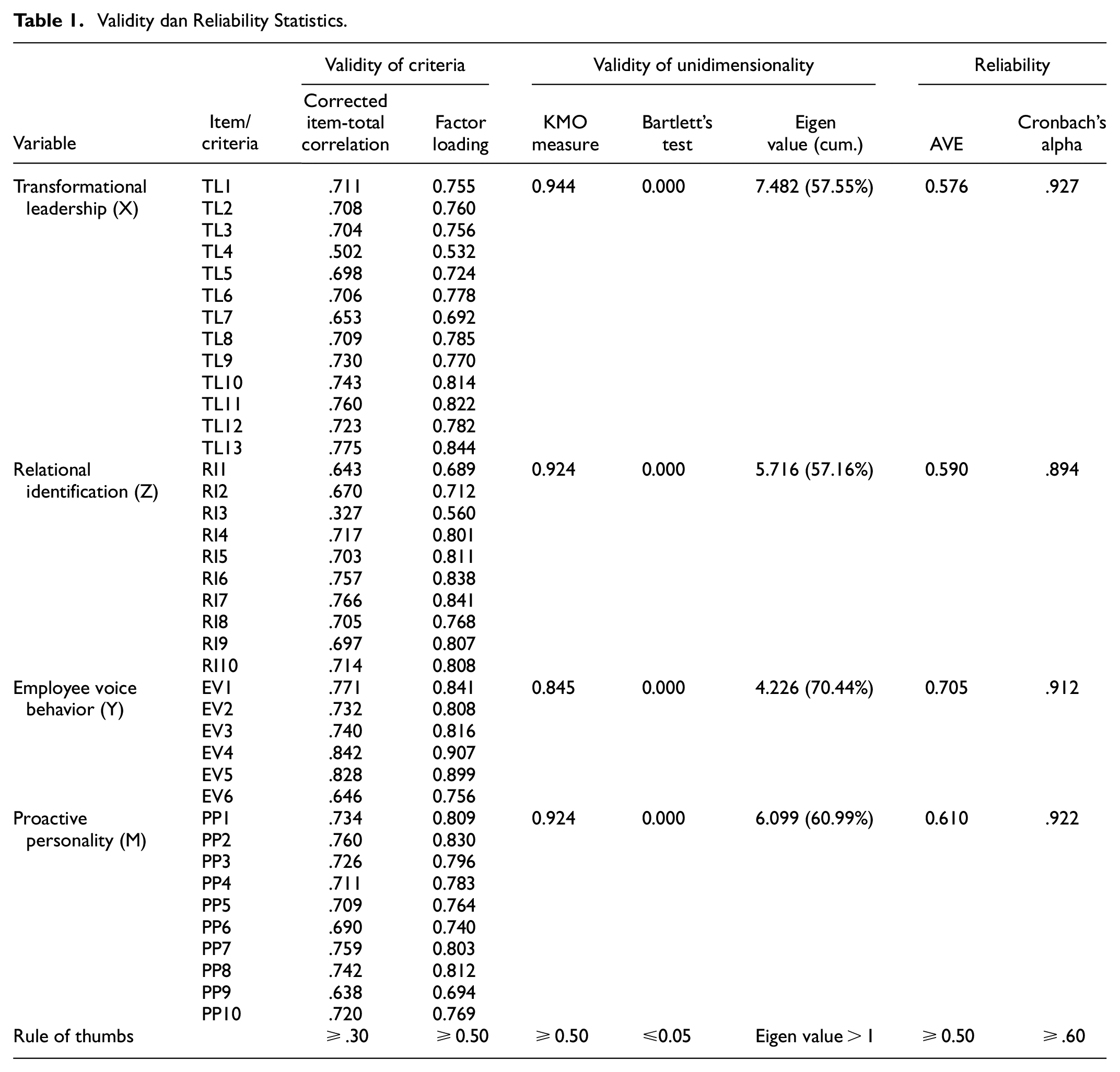
Table 1 has shown that the results of the validity criteria test are in the correlation value with each measurement item on all variables having a range between .327 and .842 (greater than .30) and also the factor loading value has a range between .532 and .907 (greater than .50). It can be concluded that all statement items have met the validity criteria for measuring all the variables used. Then the results of the unidimensionality validity test show that the KMO measure on each variable has a value greater than 0.50, the eigenvalue is greater than 1, and the Bartlett test is also significant at 5% alpha (sig. <.05). Thus, it can be concluded that all measurement items meet the validity of unidimensionality, in other words each item that measures all variables meets the requirements of unidimensionality or “represents a single concept.” Furthermore, the results of the reliability test show that the Cronbach’s alpha value for all variables has a value greater than .60, and also the AVE value is greater than 0.60, so it can be concluded that the preparation of the statement items used to measure all the variables used can be stated as reliable and trustworthy as consistent measuring tool.
Table 2 describes the characteristics of respondents in this study, most of them are aged 30 to 40 years (37.1%), male (83.2%), having the latest education S1 (46.9%), married (94.5%), tenure has been more than 15 years (97.3%), and the type of work position is structural (90.7%).
Respondents’ Profile.

Figure 2 shows the results of the evaluation of the suitability of the measurement model (revised model) resulting in absolute fit indices and incremental fit indices criteria, all of which are acceptable (good fit and marginal fit) and much better than the initial model, so the measurement model is acceptable.
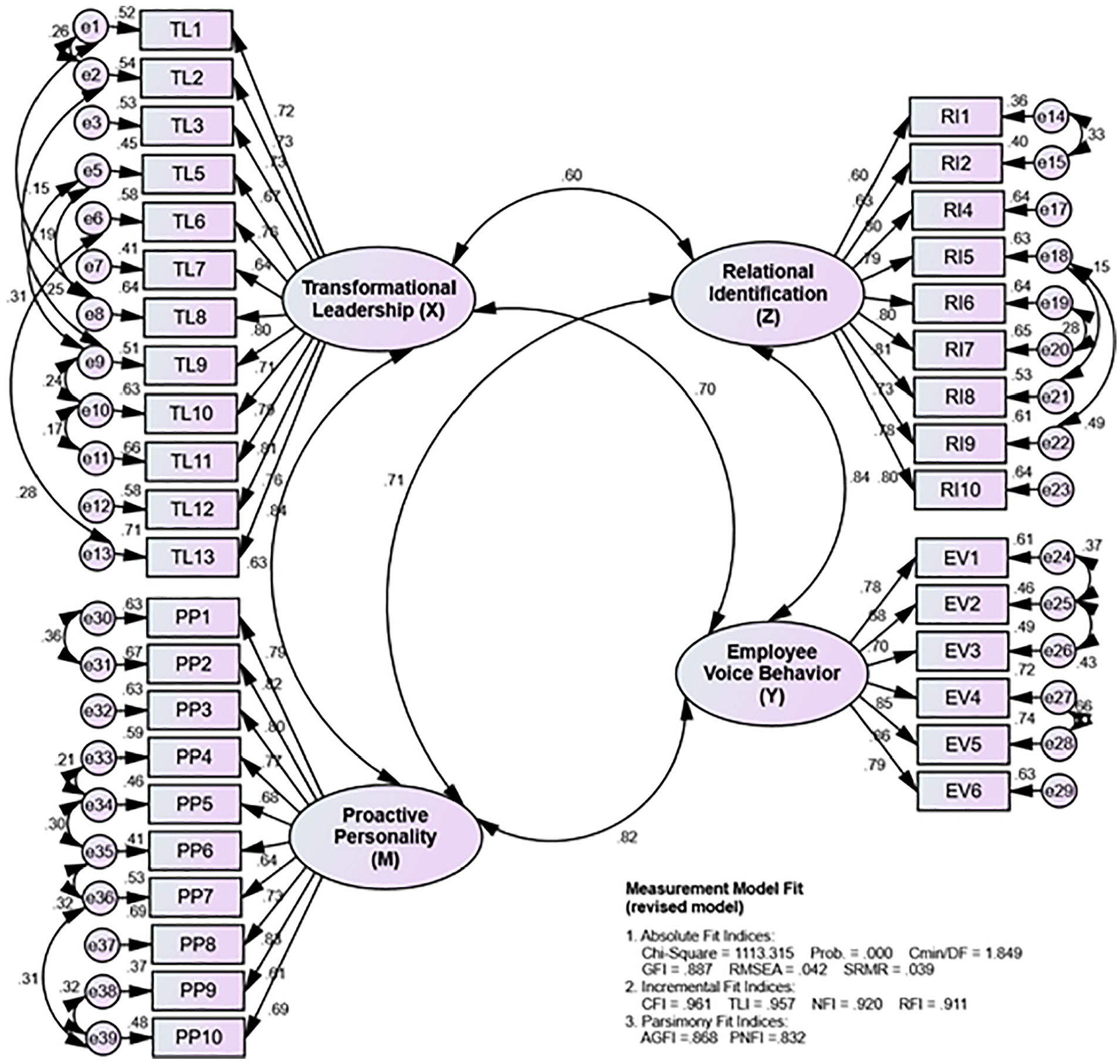
Assesing the measurement model (revised model).
The initial measurement model shows two invalid indicators so they were excluded from the model. The estimation results in the revised measurement model, show that each indicator already has a factor loading value greater than 0.50 (0.606 − 0.862) and the Average Variance Extracted (AVE) value is also above 0.50 (0.51 − 0.608), thus these indicators are valid in forming transformational leadership constructs, relational identification, employee voice behavior and proactive personality, and can then be used to build models. Meanwhile, each construct reliability value is 0.902 − 0.939 greater than 0.70, so it can be concluded that these indicators are reliable in reflecting the constructs of transformational leadership, relational identification, employee voice behavior, and proactive personality.
The results of the goodness of fit index values by the structural model are as shown in Figure 3. The results of the structural model suitability test showing that all criteria for absolute fit indices, incremental fit indices, and parsimony fit indices have met the requirements (marginal fit and good fit) with a chi-square probability of 0.000 < 5% significance level, cmin/df 1,968 < 3, GFI value of 0.880 in the range of 0.80 to 0.90, RMSEA value of 0.046 < 0.08, SRMR of 0.039 < 0.08, CFI value of 0.955 > 0.95, TLI of 0.95 > 0.95, NFI of 0.914 > 0.90, RFI of 0.905 > 0.90, and the AGFI and PNFI indices are only used for comparison between alternative models (not a single model), so they are not used. Thus, the structural model has been accepted and then tested the significance of the influence between variables, both direct and indirect effects.

Assesing the structural model.
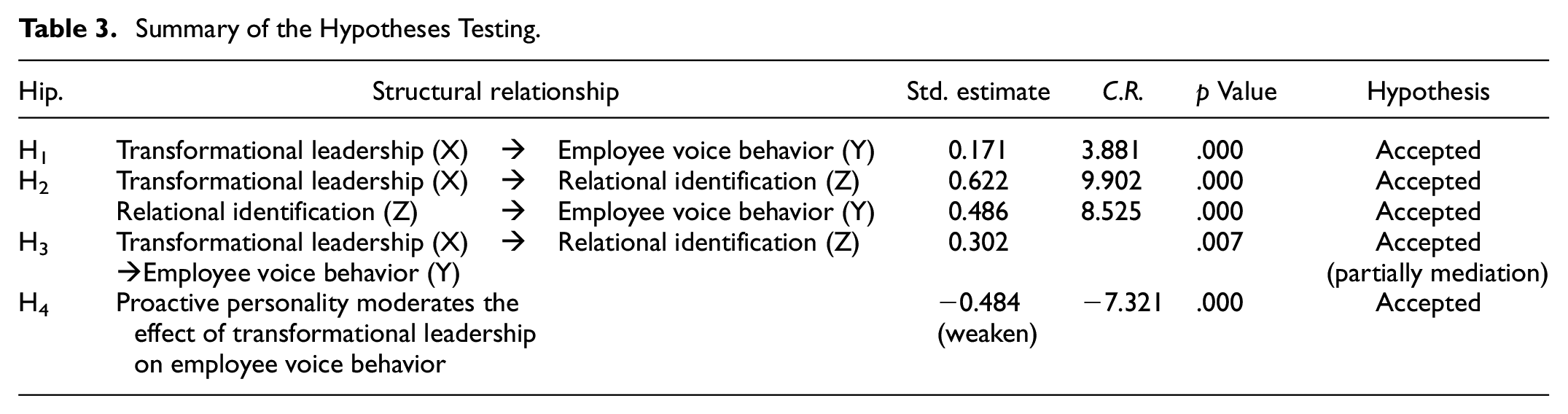
Table 3 points out that in testing structural relationships, hypothesis testing is said to be significant between variables using the critical ratio (CR) value and the probability value (p-value). It is said that there is a significant effect between variables if the CR value 1.96 or the p-value 5% significance level, and vice versa. The results of this study indicate that all hypotheses with a direct effect have entirely acceptable hypotheses. Then if the direct effect of exogenous variables on endogenous variables is significant, and the indirect effect through intervening variables is also through a significant path, then it is said to be partially mediation. On the other hand, if the direct effect of the exogenous variable on the endogenous variable is not significant, while the indirect effect of the intervening variable is through a significant path, then it is said to be fully mediation or perfect meditation. The results of this study indicate that the hypothesis with an indirect effect shows that there is partially mediation. In fact, it can be explained that the moderation effect test in this study used a two-stage approach, the results of which are presented in Table 3. The results indicate that the hypothesis with the effect of moderation has an acceptable hypothesis. The meaning of these results is that the effect of transformational leadership on voice behavior is weakened by proactive personality
Summary of the Hypotheses Testing.
The test results of direct effect, mediation effect, and moderating effect can be explained and summarized in Figures 4 and 5 below:

Summary of direct influence, mediation, and moderation.

Comparison between variable mean and total effect.
Based on Figure 4 above, the following structural equations can be arranged:


The total effect can be compared with the variable mean value. The total effect shows the total effect of the predictor variables in increasing the response (in this case employee voice behavior), while the mean shows the average value of the tendency to focus on each variable. The results of the comparative analysis of the mean and total effect variables conclude that in order to improve employee voice behavior for employees working at the Ministry of Law and Human Rights, relational identification is more prioritized, because although it has the same total effect as transformational leadership, respondents’ assessment of employee relational identification abilities is still much lower compared to the transformational leadership assessment which was considered very good.
Discussion
The findings of this study show that transformational leadership has a significant impact on employee voice behavior. The CR value of 3,881 (higher than 1.96) and the significance value (p-value) of .000 show this (smaller than the 5% significance level). The resulting coefficient of effect is 0.171 (positive), indicating that the more transformative the leadership, the more employee voice behavior occurs. Transformational leadership instills confidence, fosters critical thinking, and effectively communicates the organization’s vision to its employees. Employees perceive transformational leadership to possess charisma, inspirational motivation, intellectual stimulation, and good individualized consideration. In the context of this study, transformational leadership also establishes relationships with employees, listens and communicates directly, offers room for expression, and inspires and encourages staff to perform better. Furthermore, transformational leadership allows their subordinates to have more opportunity to discuss and exchange information or ideas with supervisors informally, as well as to use additional communication channels. In addition, these employees gain more from their supervisor’s assistance and responsiveness in the workplace since they have more informal interactions and exchanges with them. Due to the possibility of cultural obstacles, these employees may require greater assistance from their managers before engaging in voice conduct.
Transformational leadership has a substantial impact on employees’ relational identity. According to the findings, transformational leadership has an impact on workers’ relational identity. The CR value of 9.902 (higher than 1.96) and the significance value (p-value) of .000 indicate this (smaller than the 5% significance level). The resulting coefficient of effect is 0.622 (positive), indicating that the more transformative the leadership, the more relational identification. The relationship between superiors and direct subordinates is the center of relational identification. Employees’ relational identities become more evident when they identify with their leaders, and they are motivated to preserve these relationships, defend the leader’s interests, and encourage their success. As a result, having a high level of relational identification gives additional motivation to put in greater effort in professional projects. Employees with a high level of relational identification will be more willing to discuss ideas and adjust their self-concept for the sake of the company’s aims. They will interact with their leaders more frequently and monitor their actions and judgments. Furthermore, leaders are considered good when they are able to deliver successful outcomes to the organization, provide organizational development in line with organizational goals, and get employee acceptance.
Relational identification has a significant effect on the employee voice behavior. The findings show that relational identification has an impact on employees’ voice behavior. The CR value of 8,525 (higher than 1.96) and the significance value (p-value) of .000 show this (smaller than the 5% significance level). The estimated coefficient of effect is 0.486 (positive), indicating that the stronger the relational identification, the higher the voice behavior. The findings demonstrate that relational identification has an effect on the voice behavior. This is demonstrated by the CR value of 8,525 (greater than 1.96) and the significance value (p-value) of .000. (smaller than the 5% significance level). The calculated coefficient of impact is 0.486 (positive), suggesting that the greater the relationship connection, the more voice behavior is observed. Existing workers have had a positive experience with their company and are more likely to identify with their job positions. Employees produce better interaction results on the workings and relationships that exist within the scope of the company when they feel the organization may be a self-reference.
The indirect effect of transformational leadership through relational identification on employee voice behavior has a significant effect through a significance value (p-value) of .007 (smaller than the 5% level of significance). The nature of the mediator is known to be partially mediation, meaning that increasing employee voice behavior can only be done by increasing transformational leadership, but if it is also accompanied by strengthening the relational identification ability, the employee voice behavior of officers can be further improved. Employees who claim to be caring leaders are leaders who give employees the opportunity to speak. High relational identification will provide additional reasons to be more entrepreneurial and productive in job assignments for employees. Employees may be more willing to give constructive advise for their organizations if their leaders are transformational. Employees are more inclined to identify with the leader by adopting this relationship into their own definition if the relationship with the leader is rated positively. Furthermore, by being effective listeners, communicating directly with workers, and providing them room and security to express themselves, transformational leaders may send signals and promote voice behavior.
The effect of moderation between proactive personality and transformational leadership on employee voice behavior is known to weaken the dependent variable with the CR value is −7.321 (absolute value is greater than 1.96) and the significance value (p-value) is .000 (smaller than the 5% significance level). The resulting coefficient of influence is −0.484 (negative), meaning that proactive personality significantly weakens the influence of transformational leadership on employee voice behavior. The employees who have procative personality tend to take personal initiatives to deliberately change their situation, rather than waiting to respond to problems in their work environment, proactive individuals have an active orientation, seek information, and try to anticipate future opportunities. Overqualified employees can vigorously amplify the process of the positive influence on voice because they are more convinced that the procative personality is effective. However, those with a high level of proactive personality will weaken the transformational effect on employee’s voice. This can also be done if it has the support of the leader because leaders are usually the target of voice behavior that shapes the willingness of employees to speak up, leader behavior is considered an important antecedent that motivates employees to voice their thoughts. This means that leaders with the influence of procative personality tend to weaken voice behavior or it can be said that they feel that they cannot show the ability to speak.
Theoretical Contribution
After conducting tests and analysis, it is concluded that transformational leadership has a significant effect on employee voice behavior and on relational identification; relational identification has a significant effect on employee voice behavior; transformational leadership has a significant effect on employee voice behavior through relational identification, and the moderating effect of employees with a high level of proactive personality will weaken the transformational effect on employee’s voice behavior at the Ministry of Law and Human Rights. This study is significant because transformational leadership and relational identification can assist businesses in realizing employee voice behavior, which can aid in continuous improvement and produce helpful ideas as a springboard for innovation. Although the moderating effect of proactive employees weakens the transformational influence of employee voice, Ministry of Law and Human Rights employees have been able to seek opportunities and survive in their efforts to produce meaningful changes in the organization of the Ministry of Law and Human Rights institutions.
The results of this study show that proactive personality reduces the impact of transformational leadership on voice behavior. Although research has typically generated strong findings for proactive personality at work, proactive personality is a poor trait in organizations according to this concept.
Managerial Implication
The findings can be used as recommendations by the company’s management regarding the effect of Transformational Leadership, Proactive Personality, and Relational Identification on Employee Voice Behavior. This can affect the willingness of employees of the Ministry of Law and Human Rights to express their opinions, take personal initiative in various activities and situations, generate a deeper level of trust based on identification, and influence in dealing with a dynamic environment that contains a lot of uncertainty. The Ministry of Law and Human Rights is advised to use employee opinions or suggestions to help fix problems that the company leadership may not be aware of.
Limitations and Suggestions
This study, like previous studies, has limitations. First, the relationship between proactive personality and relational identification was not examined as a continuous aspect in the effect of transformational leadership on employee voice behavior by the researcher. That is, in this study, researchers solely evaluate how transformational leadership affects employee voice behavior using proactive personality and relational identification as independent factors. Future research can concentrate on this area, with the help of various logical theoretical foundations. Second, the proactive personality and transformational leadership in this study have a moderating influence on the employee voice behavior, which is known to weaken the dependent variable. As a consequence, this study contradicts the previously established idea that proactive personality might strengthen the link between transformational leadership and employee voice behavior. In the future, studies should be able to specify more exactly how proactive personality influences the relationship between transformational leadership and employee voice behavior. Furthermore, additional study is needed to look at the function of relational identification as a mediator in the impact of leadership style on other behaviors. Third, the researcher uses SEM analysis in a methodical way to look into the direct and indirect interactions between components, as well as the moderating effect. The researcher employed personnel from the Ministry of Law and Human Rights as a sample, and the questionnaires were distributed online. Future scholars might think about using a different sample to get a different perspective.
Footnotes
Declaration of Conflicting Interests
The author(s) declared no potential conflicts of interest with respect to the research, authorship, and/or publication of this article.
Funding
The author(s) received no financial support for the research, authorship, and/or publication of this article.
