




Abstract
The policy of developing remote area schools’ quality in Indonesia is getting stronger. The government has set minimum service standards as a reference for schools’ development quality while remaining based on local, national, global, and 21st-century values. This study revealed efforts to improve the 21st-century school’s quality through the contribution of superior leadership, school climate, total quality management implementation, and the school principal’s performance approached quantitatively and analyzed descriptively using Structural Equation Modeling. Participants involved in the study were 147 remote area principals and teachers in two provinces in Indonesia. Results show that (1) school climate had the most dominant contribution to school quality and (2) there was a significant simultaneous effect among superior leadership, school climate, total quality management implementation, and the school principal’s performance on the school quality. Implications of the study’s findings from a theoretical and practical lens as well as recommendations for future studies are also discussed.
Keywords
Introduction
Often, discussing education with remote area communities is challenging to get the expected agreement and understanding (Lamb et al., 2014; Toyamah et al., 2010). Being a school principal in a remote area means that they have to make themselves citizens under the character desired by the community (Estornell et al., 2013; Juharyanto, 2017). In short, in this context, personal agility (one’s ability to make changes quickly and accurately while moving without losing direction) becomes the main core of success. The success of principals in leading and managing schools is very dependent on their shrewdness in carrying out their integration into the community character inherently. That is, one of the important determinants of a principal’s success in remote areas is the integration of personality following the character based on local wisdom.
The presence of an effective principal as a school leader is more important than the readiness of other resources. As an organic or critical factor (Lunenburg, 2011), effective school principals are the primary determinant factor for the successful management of all school resources (Intxausti et al., 2016). Besides, the existence of an effective principal is needed to ensure that the school can provide quality work for all school members through the effective and efficient utilization of all resources (Brinia et al., 2014; Malakolunthu et al., 2014). There is a significant positive correlation between school principal leadership effectiveness and school-based management performance (Bafadal, 2016; Juharyanto et al., 2018).
As mandated in Law No. 20 of 2003, concerning the National Education System in Indonesia, School-Based Management (SBM) is implemented to emphasize improving the school’s quality by all stakeholders based on the real schools’ context under the school principal supreme command. SBM is a school management system that is oriented to improving the school’s quality based on the strengths, weaknesses, opportunities, and challenges of the school (Sallis, 1993). The implementation of SBM is oriented toward improving school quality by involving all school members in the entire system and process, where their understanding of quality of the SBM concept and practices is the major factor (Bandur, 2018). The experience from various countries teaches us about the effectiveness of the successful implementation of TQM that can significantly improve the schools’ quality (Moradi et al., 2016; Morgan & Murgatroyd, 1994; Murgatroyd & Morgan, 1993) as an organization (Sallis, 2005). In implementing SBM, the effective school principal is not only required to have managerial and supervision competence but also to have entrepreneurial competence, the ability to make breakthroughs, hard work, strong motivation, and never give up in meeting various challenges (Nir, 2002).
As managers, principals need to understand the interrelation of education elements as a system (Sefton-Green, 2011), including restructuring ways of thinking about different relationship types and how organizations change. As a manager and leader, the principal needs to have superior leadership skills to make effective change. The principal must emphasize the important role of education in social, cultural, economic, and political change. A principal should have the ability to bind all aspects of school management. With these capabilities, it is believed that conducive school culture and climate will be more easily created. In addition to being important, the school organization climate becomes a bridge in human resource management practices to be more productive. James and Jones (International Alert, 2007) divide the organizational climate in schools into three approaches: (1) multiple measurement-organizational approaches, (2) perceptual measurement-organizational attribute approach, and (3) perceptual measurement-individual approach. Litwin and Stringer stated that the organizational climate can be measured through five dimensions, which are: (1) responsibility, (2) identity, (3) warmth, (4) support, and (5) conflict (Chernyak-Hai & Tziner, 2016).
Theoretical and practical studies from various areas conclude that effective principal leadership is the main key to school success (Mulford, 2003; Urick, 2016). A quality school receives high support from the creation of a conducive organizational climate, quality management practices (Ah-Teck & Starr, 2014), principals’ performance, and teachers and staff quality (Schmidt, 2014), which very much depends on the quality of the principal’s leadership. The principal’s superior leadership is the main guarantee to ensure the overall quality of school achievement (Arifin et al., 2018; Juharyanto, 2012, 2017). Previous research found that the concept of school principals’ superior leadership is more based on local wisdom adaptation.
The leadership approach taken ought to be oriented to quality improvement through community inclusion to together construct and develop school acquirement, both academic and non-academic. There are four superior leadership behaviors for school principals, who are considered to support school achievement, including spiritual leadership, transformational leadership, entrepreneurial leadership, and instructional leadership (Juharyanto, 2017). The principal’s superior leadership orientation refers to the principal’s competency standards as in the Indonesia Minister of National Education Regulation No. 13 of 2007. Some of the above descriptions represent the background of this research that leads to the specific remote area’s schools’ characteristics.
This study aimed to analyze empirical information about elementary school quality based on the 21st-century values and remote areas characteristic in Indonesia, through the correlation between superior leadership, school climate, total quality management, and principals’ performance as independent variables, whereas school quality is the dependent one.
Some fundamental questions developed are based on contribution between the: (1) principal superior leadership on the principal performance, (2) school climate and the school principal performance, (3) TQM implementation on the school principals performance, (4). principal’s superior leadership, school climate, and TQM implementation on the school principal performance, (5) principal’s superior leadership on school quality, (6) school climate and school quality, (7) TQM implementation on school quality, (8) principal superior leadership, school climate, TQM implementation, and the principal performance together to the school quality, and (9) principal’s performance on the school quality.
The contributions of this research include, first, delivering an overview of the need for redefinition of school quality, quality school management, and supporting factors theoretically and practically in the context of 21st-century demands and remote areas local wisdom and second, as a suggestion to policymakers in determining measurement indicators of school quality, quality school management, and supporting factors following the principle of justice.
In short, the aspects of cultural, demographic, and geographical diversity, with 17,000 islands separated by oceans, require a wise and effective response from the government and other elements of society according to their respective characteristics. Central education policies should provide open opportunities for school strategic actions according to their local context. Equalizing quality targets nationally should accommodate contextual definitions so that the school system, both in urban and remote areas, is truly an autonomous representation of their respective local contexts.
Literature Review
21st-Century Quality School
The quality of the school definition is still debatable. The debate is related to differences in the angle in seeing the school by the school’s context. Garvin introduced the concept of quality from five perspectives (1) the transcendent approach, (2) the product-based approach, (3) the user-based approach, (4) the manufacturing-based approach, and (5) the value-based approach (Garvin, 1984).
First, in “the transcendent approach,” school quality is more dominant depending on the perception of individual stakeholders. Addressing individual perceptions tends to be difficult and uncontrolled (Braun et al., 2013; Kersten et al., 2004). Therefore, schools do not have strong, consistent, and measurable quality standards. The next impact is the management will always be incidental, easy to change, and certainly, the school is powerless. The school quality standard will be so weak. Second, in “the product-based approach,” the meaning of quality is directed at schools’ efforts to increase the outputs and services value based on the availability of quantifiable infrastructure or “continuous improvement” in Deming statement (Deming, 1986; Gartner et al., 1988) or zero-defect (Madu, 1998). For example, teacher quantity and qualifications, meeting frequency, number of schools’ programs, etc., all of which are seen as having a linear contribution to school quality. Third, “the user-based approach” interprets the school’s quality based on the extent to which school services or products meet the users’ needs or preferences. This concept was also conveyed by Juran, who stated that congeniality was determined by the customer (Best & Neuhauser, 2006). Stakeholders have a higher bargaining position against school programs. Forth, “the manufacturing-based approach,” views school quality as a unity of qualifications desired by schools and users. This approach tries to objectively measure the quality of school services that meet the standards that have been collectively determined by the school and its users. All school programs are essentially the result of a mutual agreement between them. At the same time, the fifth, “the value-based approach” interprets the quality of the added value of the product or service above the standards set or in terms of Armand V. Feigenbaum called the total quality (Feigenbaum, 1983). In this case, the weak infrastructure and certain resources do not become a barrier for schools to achieve goals above the set standards.
The comprehensive review presented by Garvin is certainly still very debatable (Garvin, 1984), for example, measuring the perception of objectivity, accommodating all user needs, providing more value than the standard set, including determining mutual agreement on a school program based on the school ideals and community needs. That is, the principle of flexibility, adaptability, process orientation, stakeholder’s involvement, and accommodation of all strengths and weaknesses remains important to consider. Assuredly, being a school principal with an orientation toward ideal school quality is not an easy job, especially in remote, poor schools (Arifin et al., 2018; Juharyanto et al., 2020).
Within the Indonesian setting, the ideal definition of quality must at least represent the needs of more than 17,000 islands with their uniqueness. That is, the meaning of quality in every region in Indonesia must be flexible (Nir, 2002; Winarti, 2011). Quality standards should be formulated through a common character similarity approach as a standardized benchmark to analyze their quality achievements, which the Indonesian government calls minimum service standards (Minister of Education and Culture, 2018). The minimum service standard is a shading union of common character in general, which must be referred to by local governments and schools in improving the school’s quality as well as being used as a reference in determining the education quality mapping throughout Indonesia. The school quality formula is related to the real conditions and demands of the community in which the school lives and operates, including the demands of 21st-century era change values that are known and experienced by Indonesians in remote areas. At least, there are five characteristics of 21st-century school quality, including being in harmony with the potential character of the community, accommodating to uncertain changes, integrating into technology and global aspects (Mebane et al., 2017), and never stopping learning and building a vision to move forward together, and always ignite the unyielding spirit in facing various challenges (Arifin et al., 2018; Juharyanto et al., 2020; Juharyanto et al., 2020).
In the Indonesian context, the meaning of quality is reflected in Sallis’ opinion about the characteristics of quality schools, among others (1) customer-focused; (2) focus on efforts to prevent problems; (2) human resources investment; (3) strategy to achieve quality; (4) managing complaints as feedback to achieve quality; (5) policy in planning to achieve quality; (6) work for a process of improvement by involving everyone; (7) encourage creativity; (9) clarify the roles and responsibilities of everyone; (10) has a clear evaluation strategy and criteria; (11) put quality for further service quality; (12) views quality as an integral part of work culture; (13) continuous quality improvement (Sallis, 2005). In short, school quality is formulated following the local context but continues to be developed in line with national-global community development interventions. Thus, school quality mapping becomes important information for improving school quality as a whole more clearly, measurably, and easily achieved together.
Superior Leadership, School Climate, Total Quality Management, and School Principal Performance
School quality that is integrated into 21st-century values is largely determined by the school principal ability as a school leadership and management key player, especially in creating a school climate conducive to school program development. The school’s quality is much more on the superior leadership it plays. Past research found that the concept of school principals’ superior leadership is more based on local wisdom adaptation. The leadership approach taken ought to be oriented to quality improvement through community inclusion to together construct and develop school acquirement, both academic and non-academic (Juharyanto et al., 2020; Teguh Triwiyanto & Desi Eri Kusumaningrum, 2017). There are four school principals’ superior leadership behaviors for supporting school achievement in remote areas, namely: spiritual leadership, transformational leadership, entrepreneurial leadership, and instructional leadership (Nurabadi et al., 2021).
Spiritual leadership is a combination of values, attitudes, and behaviors required to naturally motivate oneself and others to develop the organization to its full potential. A good school principal must be a role model for all school residents. Such a leadership process will provide high energy, motivation, commitment, and confidence to the school team. High organizational performance is determined by the quality of strong harmony between the personal values of employees, the organization, and the values that employees desire (Fry, 2005; Sami et al., 2016). The principal was the first person to believe in the goodness of the agreed values and implement it. The application of good values in everyday behaviors is a key capital for shaping favorable behaviors at school or according to Boyatzis & McKee (Boyatzis & McKee, 2006), called by the resonant leader.
Transformational leadership is carried out when a person mobilizes institutional, political, psychological, and other resources to arouse, involve and motivate followers (Paredes, 2002). Three principals’ transformational leadership behaviors, among others: (1) distribution of vision and mission; (2) integration of leadership values; (3) strengthening the schools’ organizational culture. Transformational leaders are leaders who have a deep understanding of the situation by communicating a clear vision of the team’s goals, being passionate about their work, and making team members feel recharged and full of energy (Cherry, 2017).
Instructional leadership is an action taken to develop a productive and satisfying work environment for teachers in order to improve the learning conditions of students (Eggen & Dan Kauchak, 2014). There are three models of instructional leadership to improve school performance effectively, including clarity of vision and mission, focus on learning, and improving a conducive work climate (Hopkins, 2013). The aim is to build a learning community while making the school a learning society/community. Whereas, the school principals’ leadership behavior in creating effective schools is manifested in (1) a strong independence culture, (2) clear vision understanding, (3) confidence in success, (4) lifelong learning culture, (5) the power of imagination (6) multidimensional values-based, (7) empowerment, (8) collegiality, and (9) fighting value (Juharyanto et al., 2019).
The implementation of the whole school’s superior leadership has an impact on the creation of a conducive school climate. The school climate is essentially a unique school personality that is formed from the perception of the school team (Murtedjo & Suharningsih, 2018). According to Litwin and Stringer (International Alert, 2007), a school’s organizational climate can be measured through these five dimensions: (1) responsibility, (2) identity, (3) warmth, (4) support, and (5) conflict. A positive school climate must certainly be built by through maximizing the school principal performance by making continuous improvements. Therefore, the school climate, in addition to being determined by superior leadership, is also determined by the shrewdness of the principal in implementing the total quality management principles, one of which is the application of continuous improvement to the managerial tri-logic (Feigenbaum, 1983). Total Quality Management is an approach to managing an enterprise that strives to maximize an organization’s competitiveness through the continual improvement of its products, services, workforce, processes, and working environment of the organization (Sallis, 2005).
The principal’s performance plays a key role in increasing the productivity of individuals and groups’ performance involved in school organizations. Performance contributions include: (1) giving satisfaction, (2) the implementation of a compact performance ethos, (3) encouraging to work in an orderly, calm, measured, and comfortable manner, and (4) ethos of performance carried out evenly (Kemdikbud, 2011; Kurniawan, 2012). Many studies have shown that the principal’s performance contributes positively to the school team’s performance (Kalkan et al., 2020; The Wallace Foundation, 2013; Urick, 2016). All excellent schools are always led by high-performing school principals. The principal’s superiority determines the excellence of the school (Juharyanto 2020; Juharyanto et al., 2019).
Methods
This study aimed to examine the relationship between variables that exist in a model, both between indicators and constructs or constructs relationships. This study used a causality model to test the hypotheses proposed using SEM (Structural Equation Modeling) which was operated through the AMOS 24.0 software. Besides, this study also aimed to test the models based on the theory that was built with direct and indirect relationships between exogenous and endogenous variables (In’Nami & Koizumi, 2013; Uslu & Arslan, 2018). The model of the theoretical framework in this study is shown in Figure 1.

Theoretical framework model.
In line with the above objectives, we employed AMOS 24.0 software for CFA and SEM for the data analysis. Furthermore, this study also aimed to determine the contribution of superior leadership, school climate, TQM implementation, and the school principals’ performance toward the school’s quality. The SEM AMOS 24 software was used to help build complex relationship models and analyze direct and indirect effects (Hair et al., 2009). The measurement model discussed and evaluated the reliability and validity of the indicators while measuring hypothetical constructs, whereas the structural model discussed the relationships between unobserved variables and associated with causal relationships between variables by the proposed hypothesis (Hair et al., 2009). The subjects of the population research were the 147 elementary school principals and teachers in remote areas which are spread out in three districts in two provinces in Indonesia. The location and school selection were based on the recommendation of the Indonesian Institute of Education Innovation Training and Consultant (LPKIPI), which has provided the assistance to these schools for at least the last 3 years.
Data was collected using a closed questionnaire using Google Forms. For the data validity and credibility, the results of the data analysis were verified through observations and discussed with respondents through Group Discussion forums. Observation and discussion activities also involved officials in the three Regency Departments of Education. With 147 respondents, the adequacy of data following SEM standards has been addressed, so the results of this study can provide satisfying statistical power (Hair et al., 2009; In’Nami & Koizumi, 2013). Thus, the sample size in the study was considered acceptable.
Results
Model Assumption Test
This study employed SEM analysis with the support of the AMOS version 24.0. The theoretical model was developed previously and then analyzed based on the collected data. SEM analysis method used covariance matrix input and the maximum likelihood estimation method. The data normality test and outlier test were carried out before performing a complete SEM model analysis.
Data Normality Test
The key assumption test in SEM is the initial evaluation criteria stage (Byrne, 2016), where data normality is the most crucial assumption test in SEM. A normality test is carried out to see whether the data is distributed normally or not. If the data is not normal, it can cause a significant bias on the parameters estimated within the model, there for the results of the analysis are less reliable (Byrne, 2016; Hair et al., 2009). A data normality test was performed using the critical ratio skewness value of ±2.58 at a significance level of 0.05 (5%). The data is avowed normally distributed if the value of the critical ratio skewness is below ±2.58 (Ghazali, 2011). Based on the normality test, the value of the critical ratio (C.R) for skewness and kurtosis of every indicator is not any greater than +2.58. It means that the data are distributed normally at the univariate level (Byrne, 2016). Likewise, the multivariate kurtosis line also shows a C.R value of 2.524 (<+ 2.58). It indicates that the data are distributed normally at the multivariate level. Thus, these data can be used for further analysis.
Outlier Test
The outlier test was conducted to see the uniqueness of the observation data and it looked different from the results of other observations and appeared in extreme forms, both for single and combination variables. (Hair et al., 2009). Outlier’s test was performed to see univariate and multivariate outliers. To see a multivariate outlier, was done by looking at the Mahalanobis distance value and then comparing it to the chi-square value. If the value of Mahalanobis distance (>chi-square) means that there is a multivariate outlier problem (Ghazali, 2011). Through the test, the chi-square value of 114.906 was obtained and 78.335 was the largest value in the Mahalanobis distance. It can be concluded that there were no multivariate outlier problems. The data was feasible and can be used for further analysis.
Evaluating the Measurement Model
The measurement model validity is based on determining the level of fit of the rational model and finding specific evidence of construct validity. To evaluate the measurement model validity, a construct validity test was conducted that consisted of convergent and discriminant validity. The variables of superior leadership, school climate, TQM implementation, school principal performance, and school quality were measured using 17 indicators. The convergent validity of the model was evaluated through Confirmatory Factor Analysis (CFA) using AMOS 24. Indicators that have a loading value >0.50 are included in the test (Hair et al., 2009) and the size of AVE (Average Variance Extracted) is required to be >0.50. Reliability was measured based on Composite Reliability (CR), each of which must exceed (>0.70). Table 1 shows convergent validity and satisfactory reliability because the factor loading values, CR, and AVE are satisfactory and significant.
Convergent Validity Test.
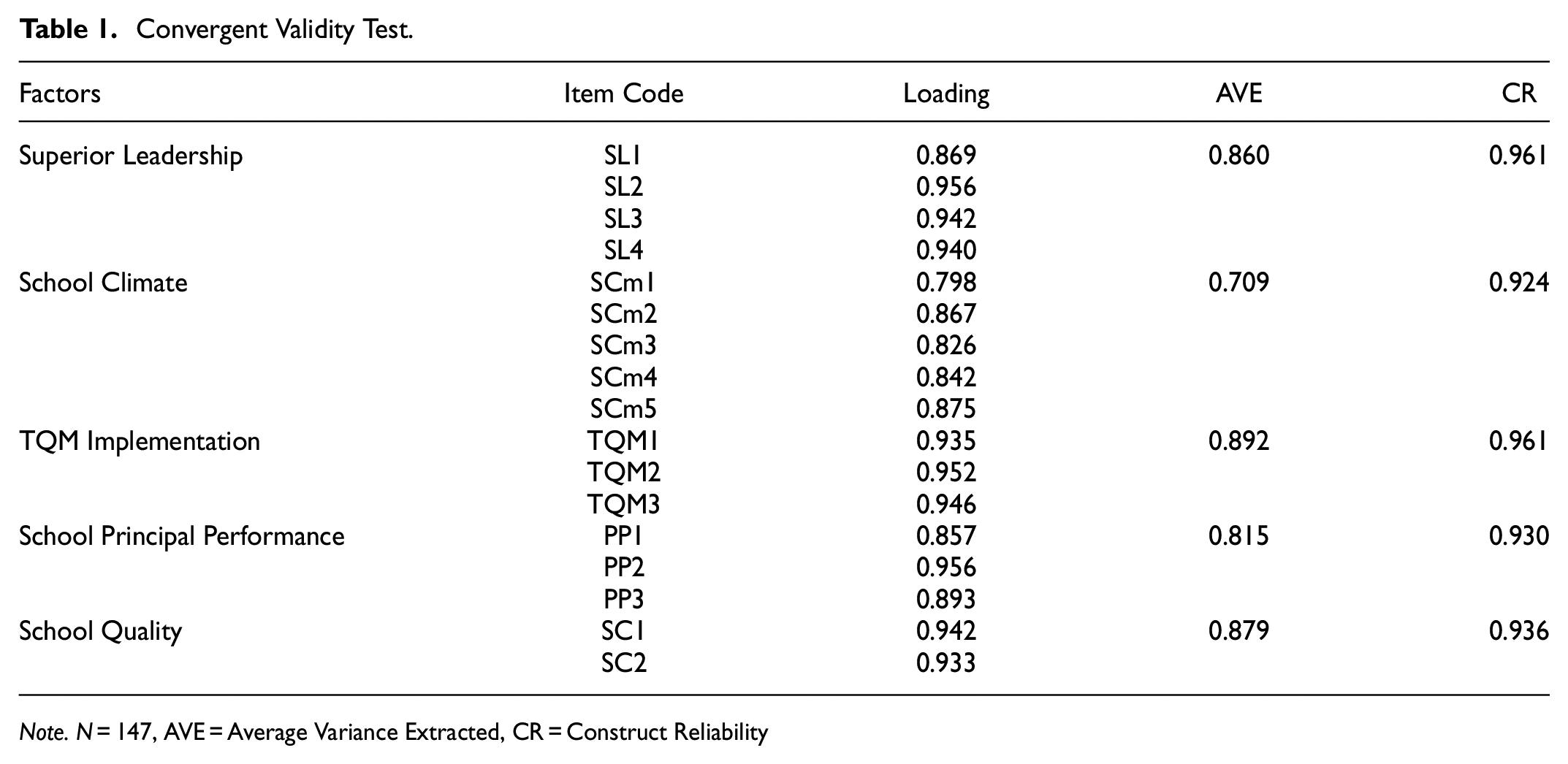
Note. N = 147, AVE = Average Variance Extracted, CR = Construct Reliability
Discriminant validity refers to the extent to which a construct is completely different from other ones. The main goal is to build internal consistency. Discriminant validity measurement was done by comparing AVE with a squared correlation between two constructs, where the AVE value must be greater than the squared correlation value between two constructs (Fornell & Larcker, 1981). Table 2 shows that the AVE value is greater than the squared correlation value between the two constructs. The goodness of fit indices was found to be acceptable as shown in Table 3. Table 3 also confirms that all indices are within the recommended criteria (Byrne, 2016; Hair et al., 2009), that is χ2 = 114.906; GFI = 0.911; TLI = 0.986; CFI = 0.989; RMSEA = 0.039.
Inter-Correlations.

The Fit Indices of the model.

Note. N = 147.
Evaluating the Structural Model
Next is testing the contribution of variables and interpretations of superior leadership models (X1), school climate (X2), TQM implementation (X3), the school principals’ performance (Y), and school quality (Z). As shown in Table 4, the model needs to be interpreted to determine the total effect, both direct and indirect effects of exogenous variables on endogenous variables, as summarized in Table 5. Figure 2 shows the results of SEM testing using the AMOS 24 software.
Hypothesis Testing Results.

Summary of Direct and Indirect Relations Between Research Variables.

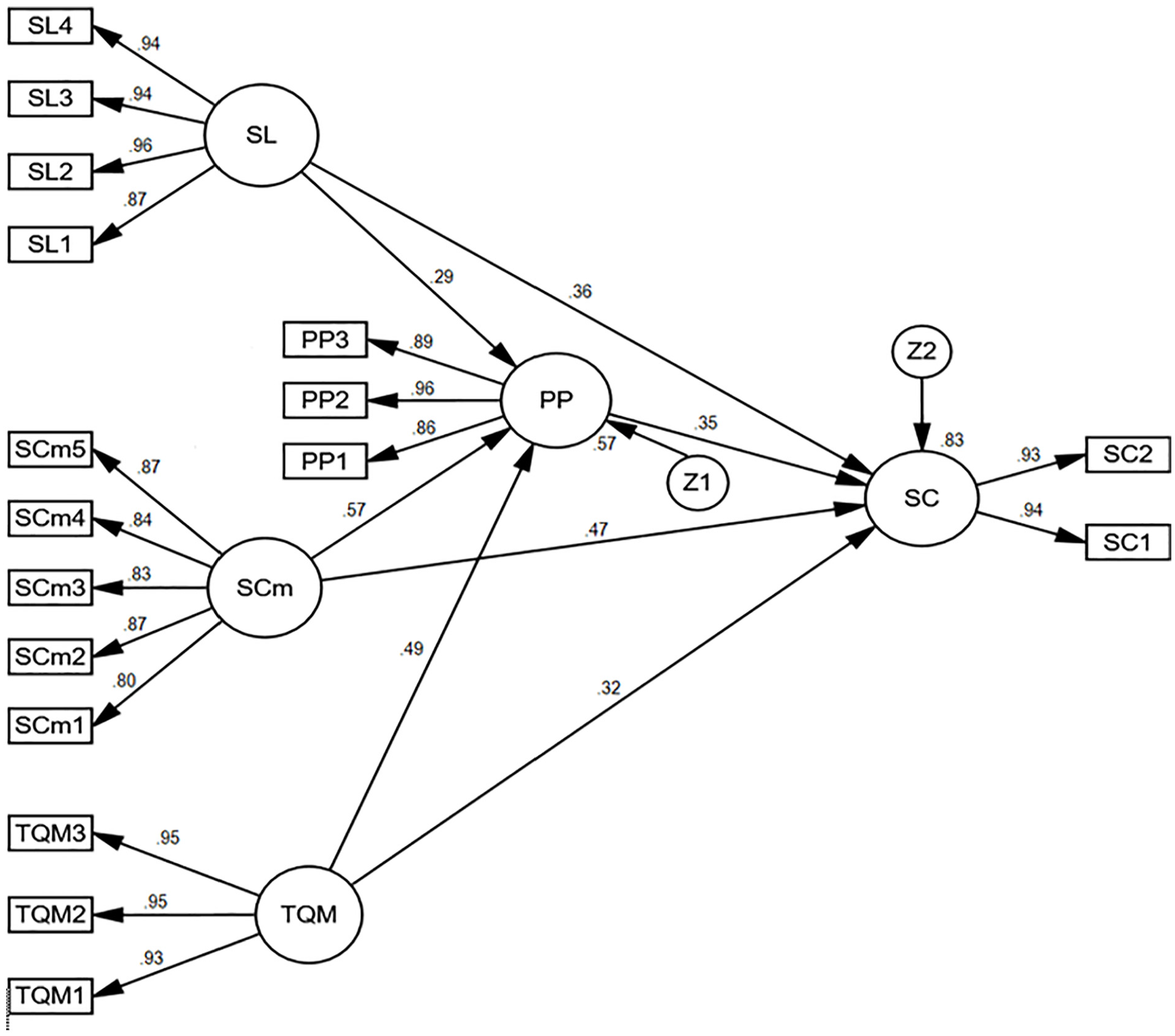
SEM test results.
Based on Tables 4 and 5, the interpretation is as follows.
The variable of superior leadership (X1) has a direct contribution to the performance of the principal (Y), with a magnitude of influence of 0.287 or 28.7%.
School climate variable (X2) has a direct contribution to the performance of school principals (Y), with the influence of 0.571 or as much as 57.1%.
The variable implementation of TQM (X3) has a direct contribution to the performance of the principal (Y), with a large influence of 0.493 or 49.3%.
The contribution of superior leadership variables (X1), school climate (X2), and the implementation of TQM (X3) to the performance of principals (Y) simultaneously was 0.566 or 56.6%.
The variable of superior leadership (X1) has a direct contribution to school quality (Z), with a magnitude of influence of 0.363 or 36.3%.
The School climate support variable (X2) has a direct contribution to school quality (Z), with a large influence of 0.465 or 46.5%.
The variable implementation of TQM (X3) has a direct contribution to school quality (Z), with a magnitude of influence of 0.319 or of 31.9%.
The school performance variable (Y) has a direct contribution to school quality (Z), with an influence of 0.353 or 35.3%.
Variable superior leadership (X1) has an indirect contribution to school quality (Z) through the performance of the principal (Y) of 0.101 (10.1%), with the contribution of total superior leadership (X1) to school quality (Y) of 0.464 (46.4%)
School climate variable (X2) has an indirect contribution to school quality (Z) through the performance of the principal (Y) of 0.202 (20.2%), with the contribution of the total school climate (X1) to quality school (Y) of 0.667 (66.7%)
The implementation variable TQM (X3) has an indirect contribution to school quality (Z) through the performance of the principal (Y) of 0.174 (17.4%), with the total contribution of implementation TQM (X3) to school quality (Y) of 0.493 (49.3%)
Contribution of superior leadership variables (X1), school climate (X2), implementation of TQM (X3), and performance of school principals (Y) to school quality (Z) simultaneously at 0.831 or 83.1%.
Discussions
School quality oriented toward the 21st-century values require an appropriate model of school leadership and management, especially in remote areas with inherent weaknesses. The results of this study indicate that there is a significant simultaneous effect between superior leadership (X1), school climate (X2), implementation of total quality management (X3), and school principal performance (Y) on school quality (Z) in remote areas in Indonesia. The 21st-century values have been known by all remote areas school principals through various internet media. The principal also understands that these values should be integrated with the school’s quality formulation. School quality based on contextual values integrated with 21st-century idealistic values is a new concept that continues to be developed to avoid a wide bias between government quality standards and school real quality standards, which in the Garvin concept is called a value-based approach (Garvin, 1984). A value-based approach means quality from the added value of a product or service above a predetermined standard or in terms of Armand V. Feigenbaum is called total quality (Feigenbaum, 1983). Establishing school quality concepts and parameters does not have to truly reflect the weaknesses of the remote communities’ conditions, but rather are integrated into other national and global value standards, at least remain oriented toward minimum service standards.
The accuracy of the quality formulation based on 21st-century values integration is largely determined by the ability of the principal as a key player in school leadership and management, especially in creating a school climate conducive to the development of school programs through total quality management principles implementation. That is, the quality of the school is very dependent on the superior leadership as it plays, where local wisdom has become the primary principal approach. The leadership approach taken is oriented toward efforts to improve academic and non-academic quality, through community involvement to jointly develop school achievement (Juharyanto et al., 2020; Maisyaroh et al., 2021). In short, improving school quality requires school principals’ superior leadership, school climate, total quality management implementation, and school principal performance (Ah-Teck & Starr, 2014; Brinia et al., 2014; Gibson, 2014; Morgan et al., 2004). The principal’s superior leadership is the main guarantee to ensure the overall quality of school achievement (Arifin et al., 2018; Juharyanto, 2012, 2017). In other words, the school principal superior leadership, the creation of a school climate conducive to conducting creative processes for both teachers and students, the total quality management implementation, and the principal performance supported by technological advancements that make it easier, as now, can improve school quality. The contribution of superior leadership, school climate, total quality management implementation, and the school principal’s performance simultaneously to the quality of 21st-century schools is very high, which is equal to 99.2%.
The data analysis showed that there is a significant influence of superior leadership (X1) on school quality (Y). There are four principal leadership behaviors that are considered to support school achievement, especially in remote areas, including spiritual leadership, transformational leadership, entrepreneurial leadership, and instructional leadership (Juharyanto et al., 2018). Various theoretical and practical studies conclude that the principal’s leadership is the critical key to school success (Marks & Printy, 2003; Mulford, 2003). No excellent school is led by a non-superior school principal. All excellent schools are led by principals who have superiority in leadership (Al-ghanabousi & Idris, 2010; Juharyanto et al., 2020). At least, there are five characteristics of 21st-century school quality, including potential character conformity with the community, accommodating to uncertain changes, integration with technology and global aspects (Mebane et al., 2017), and never stop learning and building a vision to move forward together, and always ignite the unyielding spirit in facing various challenges (Arifin et al., 2018; Juharyanto, 2020). The quality of the school certainly has to be fought for. This study shows that superior principals’ leadership contributes to schools’ quality by 28.7%.
This study indicates that there is a significant influence of the school climate on school quality. The creation of quality schools requires a conducive school climate that can support the creative process of both teachers and students (International Alert, 2007). The innovative and creative process of schools in the 21st century is needed to create quality school graduates in both comparative and competitive dimensions. The school climate is important as a bridge in human resource management practices and productivity (Lunenburg, 2011). The contribution of the school climate to school quality is 57.1%. The high contribution value shows that the school climate in a remote area is very important. The school climate directly affects the entire school team. The school climate does not only focus on the relationships between members of the school team but the building of trust between the team members themselves. When the school climate is pleasant, everyone feels physically, emotionally, and socially positive at school (Wang & Degol, 2016). A healthy school climate dramatically increases the sense of involvement of all parties in providing support for school programs sincerely and passionately (Edgerson et al., 2006; Murtedjo & Suharningsih, 2018). A healthy school climate is the hope of all teams that are physically, emotionally, and socially integrated for the benefit of the school.
Furthermore, this study also shows that there is a significant effect of the implementation of total quality management on improving school quality, with a contribution of 49.3%. Total quality management is believed can encourage school performance quality (Ah-Teck & Starr, 2014; Sallis, 1993). The application of TQM principles can improve organizational performance, including school organizations (Kanji & Asher, 1996; Morgan et al., 2004; Sallis, 2005). Implementation of the principles of SBM is oriented toward improving the quality of schools through the quality involvement of all school components in the systems and processes that are implemented or integrated into quality management. TQM’s high contribution to school quality is a key indicator of the need for the enforcement of total quality management principles. TQM is all about creating a quality culture where every team member strives to provide maximum service to customers (Sallis, 2005). In TQM, the school seeks to provide opportunities for the community to be involved in school programs. School quality is also determined by how high the community involvement is in school decisions (Teguh Triwiyanto & Desi Eri Kusumaningrum, 2017; Winarti, 2011). This involvement can certainly be interpreted as a concern for the school to make important decisions based on the potential and real aspirations of the community where the school lives.
Regarding the principal’s performance, this study shows that there is a significant effect of the principal’s performance on school quality. Effective principals are needed to ensure that schools can provide quality services for all school teams, through the effective and efficient use of all resources (Brinia et al., 2014; Malakolunthu et al., 2014). The principal is a critical or determinant factor in the success of school quality improvement (Lunenburg, 2010a, 2010b). There is a positive and significant correlation between the effectiveness of school-based management and the school principals’ leadership performance (Bafadal, 2016; Juharyanto, 2017). An effective headmaster can be measured by the performance he shows. The ability to work in the field of school management must be possessed by the principal so that the school’s goal of creating quality educational services can be achieved. The school principal’s contribution to the quality of the school is 35.3%. Theoretical studies on principals show that principals’ performance plays a key role in increasing the productivity of individual and group performance involved in school organizations. Performance contributions include (1) giving satisfaction; (2) implementing a compact performance ethos; (3) encouraging to work in an orderly, calm, measured, and comfortable manner; (4) ethos of performance carried out evenly (Kemdikbud, 2011). Many studies have shown that the principal’s performance contributes positively to the school team’s performance (Kalkan et al., 2020; Stoll et al., 2004; Urick, 2016). All excellent schools are always led by high-performing school principals. Furthermore, approaches to school quality formulated by Garvin can be used as an academic reference by principals, government, and all schools’ stakeholders in formulating excellent schools according to the character of the local context, especially schools in remote areas according to their unique strengths and weaknesses.
Conclusion
The 21st-century school quality is a concept and parameters that have been known, understood, and tried to be achieved by all schools in Indonesia, including in remote areas. The definition of 21st-century school quality by schools in remote areas is approached with a “value-based approach,” where the school program is not only based on the powerlessness of remote community resources but also integrated into schools’ ideals based on national-global standards and 21st-century values. The quality of the 21st-century school is created by the support of several factors, including the superior leadership of the principal, the school climate, the application of the principles of total quality management, and the quality of the principal’s performance. School climate is the most dominant variable in encouraging the quality of schools in remote areas. That is, the empowerment of remote schools toward quality schools should put more emphasis on creating a conducive school climate.
Based on the research findings, the solidity of education stakeholders in creating a conducive working climate is encouraged. A comfortable and exciting school atmosphere, the formulation of total quality standards based on the school context and humanist approaches, continuous improvement of a school team effort, including the establishment of major criteria of principals’ selection policy based on integrity values and the deep understanding of local cultural context are some of the important keys that need to be considered by policymakers. The government’s siding with remote schools can be seen from the flexibility of the formulation and performance standards that are adjusted to local values. Assistance to remote schools by policymakers in adapting to the demands of 21st-century values-based progress needs to be carried out intensively and sustainably through humanist approaches. The school team should realize the importance of making changes following the demands of 21st-century values. The principal, as the key person, is the critical factor in the change for better quality. The principal should convince the team that adaptation to 21st-century demands is an important indicator of school quality. This present study is exclusively enacted under a quantitative approach to the relationship between theoretical variables in remote schools. Thus, it is necessary to carry out more in-depth qualitative investigations or mixed with revealing various real problems and factors about the management and leadership of superior and quality remote schools.
Footnotes
Declaration of Conflicting Interests
The author(s) declared no potential conflicts of interest with respect to the research, authorship, and/or publication of this article.
Funding
The author(s) received no financial support for the research, authorship, and/or publication of this article.
