



Abstract
This study investigates the epistemic and effective stance strategies employed by EFL learners in reflective essays documenting their remote learning experiences. Drawing on a corpus of 298 essays, the research elucidates how students articulate their perceptions of remote learning, with particular attention to variations across gender and academic performance. Adopting a triangulated analytical approach, we examined the same set of written compositions through separate qualitative and quantitative lenses, integrating the findings at the interpretation stage. This enabled us to map key discourse-stance strategies and illustrate how individual reflections intersect with broader educational patterns. challenges. The findings illuminate critical aspects of EFL acquisition and underscore the pivotal role of pragmatic competence in language learning and communication, suggesting significant implications for EFL pedagogy. Moreover, by reframing students’ critical perspectives on remote learning as catalysts for pedagogical innovation, this research offers actionable strategies for enhancing online and hybrid EFL instruction and informs the development of adaptive, student-centered digital learning practices in an ever-changing educational landscape.
Introduction
The unprecedented global shift to remote learning during the COVID-19 pandemic has offered educators a unique opportunity to reexamine traditional pedagogical paradigms. This transformative experience has driven them to adopt innovative strategies for language instruction, paving the way for significant improvements in online EFL teaching both in the present and for the future (Bozkurt & Sharma, 2021; Hodges et al., 2020). This study explores the reflective essays of primary and secondary English as a Foreign Language (EFL) learners to uncover the epistemic and effective stance strategies they employ in articulating their experiences with remote learning. We hypothesize that analyzing these stance-taking strategies used by EFL students will yield valuable insights that not only enhance their linguistic skills in the EFL classroom but also inform the development of more effective tools, methodologies, and approaches for online or hybrid EFL instruction.
In the wake of the COVID-19 pandemic, EFL teaching and learning underwent profound transformations, prompting researchers to examine how learners perceive and adapt to new instructional modalities (He & Lin, 2023; Khan et al., 2021; Li & Walsh, 2023; Maldonado & De Witte, 2020). One particularly insightful approach has been the analysis of learners’ reflective essays, which provide nuanced perspectives on how emerging technologies, interaction modes, and instructional practices have affected learner engagement and outcomes. These essays not only document the immediate challenges of remote learning but also capture enduring changes that can inform the enhancement of online and hybrid EFL instruction today and in the future.
Furthermore, these essays serve as a rich source of data for exploring the stance-taking strategies employed by EFL students as they articulate their experiences with remote learning. In the realm of EFL learners’ reflective writing, a substantial body of research has examined stance-taking—focusing on the use of stance-related adjectives and adverbs—to enrich our understanding of how learners express their thoughts and reflections (Alramadan, 2020; Al Zumor, 2021; Djaidja & Mabrouki, 2021; Veličković & Jeremić, 2020; Zhang & Zhang, 2023). However, a notable gap remains in the exploration of epistemic and effective stance expressions in EFL reflective writing (Marín-Arrese, 2021a, 2021b), along with insufficient investigation into evidentiality expressions in undergraduate contexts (Huh & Lee, 2016; Kapranov, 2023; Nuyts, 1999). Existing literature predominantly focuses on these expressions within argumentative EFL writing (Gholami et al., 2014; Ramoroka, 2014; Shi et al., 2022; Wu & Allison, 2003; Yeh, 1998; Zhao, 2017), leaving reflective genres—especially at beginner and intermediate levels—comparatively underexplored (Kapranov, 2021a, 2021b).
Accordingly, this study examines how remote learning experiences have been framed through the use of stance expressions in EFL reflective essays. Using a corpus of 298 essays, we adopted a triangulated analytical approach. Quantitative corpus statistics and qualitative discourse analysis were conducted in parallel on the same texts, and the results were merged during interpretation. This approach shows how EFL learners use epistemic and effective stance to frame their views on remote learning and highlights significant differences by gender and academic performance. By situating these individual discourse stance strategies within the broader context of evolving educational practices, our findings underscore the critical role of pragmatic competence in EFL acquisition (Taguchi, 2019), and position learner reflections as catalysts for transformative pedagogical innovation. Ultimately, this research not only deepens our understanding of pragmatic competence and digital language education but also offers actionable insights to foster adaptive, student-centered instructional practices in an ever-changing educational landscape (Martin & Tapp, 2019).
Epistemic and Effective Stance Strategies
In this study, we adopt a cognitive-linguistic perspective (Langacker, 2009, 2013) to conceptualize stance as the speaker’s or writer’s positioning regarding knowledge about an event and their commitment to the validity of the conveyed information. This approach emphasizes the intrinsic link between cognition, language use, and social context, offering a robust framework for examining how EFL learners express varying degrees of certainty, authority, and agency in their reflective writing (Boye, 2012; Capelli, 2007; Kiparsky & Kiparsky, 1970; Marín-Arrese, 2021a, 2021b).
Building on this theoretical foundation, our study focuses on two key dimensions of stance: epistemic and effective. Epistemic stance strategies involve the use of epistemic modals, evidentials, and expressions of cognitive attitude that signal the writer’s beliefs, knowledge, or evidence supporting the truth or validity of a proposition (Boye, 2012; Capelli, 2007; Kiparsky & Kiparsky, 1970; Marín-Arrese, 2021a, 2021b). For example, learners may express certainty (“I am sure”), probability (“It could be the case”), or reference to external information (“According to what my instructor stated…”). These expressions are essential for understanding how EFL learners negotiate knowledge and construct meaning in reflective writing.
In contrast, effective stance pertains to the writer’s positioning regarding the realization of events and their capacity to influence outcomes. Effective stance strategies encompass expressions of norms, obligations, and compelling circumstances, as well as declarations of personal agency—such as intentions or decisions (“I must complete my assignment by tomorrow,”“I intend to revise my essay”; Marín-Arrese, 2013, p. 411; 2021a, 2021b). These expressions not only reveal how EFL learners perceive their role in shaping events but also contribute to identity construction and self-regulation.
Extending from the theoretical distinctions between epistemic and effective stance, it is essential to examine how learner characteristics, such as cognitive development and gender, influence discourse construction. Research in psycholinguistics suggests that linguistic maturity evolves in parallel with cognitive abilities, significantly shaping how individuals express certainty, evaluation, and positioning in written discourse (Biber & Conrad, 2019). Younger learners typically rely more on personal engagement and experiential narratives, while older learners increasingly adopt structured and analytical forms of stance expression suitable for academic contexts (Hyland, 2005). This developmental shift is particularly pronounced in EFL settings, where the cultivation of a formal academic voice is gradual and influenced by educational stage and cognitive growth. By comparing primary and secondary students, this study investigates how varying levels of maturity shape the use of stance-taking strategies in reflective writing.
In addition to cognitive maturity, gender differences also significantly impact stance expression, as extensively explored in applied linguistics. Research has consistently found that female students tend to incorporate interpersonal and epistemic expressions to communicate uncertainty and foster interpersonal alignment in their academic writing. Conversely, male students often favor more assertive, directive expressions indicative of effective stance strategies (Hyland, 2005; Nasri et al., 2018; Noroozi et al., 2022). Examining these gender-related patterns within remote EFL learning contexts can further illuminate how stance strategies differ and evolve across educational stages and between genders, thereby enriching our understanding of discourse construction among diverse learner groups.
The significance of examining these stance strategies in EFL learners’ reflective writing is threefold. Firstly, while previous research has extensively addressed stance-taking in argumentative writing, reflective writing offers a unique window into EFL learners’ internal cognitive processes, capturing how they negotiate knowledge, personal beliefs, and effective responses (Alramadan, 2020; Al Zumor, 2021). Recent studies have underscored the importance of stance-taking in shaping the rhetorical structure of EFL writing and the development of pragmatic competence, yet a gap remains in our understanding of how stance operates in reflective genres—particularly among novice and intermediate male and female EFL learners (Gholami et al., 2014; Ramoroka, 2014; Shi et al., 2022; Vildósola Campos et al., 2021). Secondly, by analyzing the relative prevalence of epistemic versus effective expressions, our study illuminates how EFL learners manage (un)certainty and assert personal agency in remote learning contexts—conditions that have become increasingly prevalent following the COVID-19 pandemic, and serve as a catalyst for essential information for present and future digitally mediated practices (He & Lin, 2023; Li & Walsh, 2023). Thirdly, these insights carry significant pedagogical implications. By identifying how stance expressions function in reflective writing on remote learning, we provide EFL instructors with actionable strategies to enhance students’ pragmatic competence and written communication skills through adaptive, student-centered digital learning practices.
For clarity, Table 1 presents the subcategories of both epistemic and effective stance (the labels used for the annotation of stance in the corpus are described in the methodology section), along with illustrative examples drawn from our corpus of 342 reflective essays authored by primary and secondary male and female EFL learner participants. By situating the notion of stance within both theoretical (Langacker, 2009, 2013; Marín-Arrese, 2013, 2021a, 2021b) and empirical (Huh & Lee, 2016; Kapranov, 2023) frameworks, this study addresses a key gap in the literature, elucidating the intricate interplay between individual reflections and broader educational challenges in the digital era, and ultimately contributing to a deeper understanding of how stance strategies inform identity construction, cognitive engagement, and discursive development in EFL writing.
Subcategories of Epistemic Stance and Effective Stance.

Objective and Research Questions
This section outlines the study’s objectives and corresponding research questions, which are designed to investigate similarities and differences in EFL learners’ use of stance expressions to frame their perceptions of remote learning across educational levels and gender.
Main Aim
The aim of this study is to investigate how EFL learners use epistemic and effective stance expressions in reflective writing on remote learning, with a particular focus on gender and developmental differences. In doing so, it also explores how learners perceive the advantages and disadvantages of remote learning and how these perceptions relate to their stance-taking strategies. Unlike prior research, which has primarily concentrated on argumentative writing, this study explores reflective writing as a means to access learners’ internal cognitive and emotional processes, revealing how they negotiate knowledge, belief, and agency. By examining the relative use of epistemic versus effective expressions, the study sheds light on how learners articulate (un)certainty and personal agency in the context of remote learning—an increasingly relevant setting in the post-pandemic educational landscape. Ultimately, the study seeks to generate pedagogical insights that inform the design of adaptive, student-centered instruction aimed at enhancing pragmatic competence in digitally mediated EFL classrooms.
Research Questions
Methodology
As previously mentioned, this study aimed to investigate how primary and secondary male and female English as a Foreign Language (EFL) learners expressed epistemic and effective stances in their written discourse during the COVID-19 pandemic lockdown. A corpus of student-generated reflective essays served as the sole data source. Although data were collected through a single instrument—the written compositions—the study followed a triangulated analytical approach. This approach involved conducting qualitative and quantitative analyses independently on different dimensions of the same dataset and subsequently integrating the results during interpretation to provide a comprehensive account of learner stance-taking strategies.
The rationale for this design lies in its capacity to triangulate findings and enrich interpretation. The qualitative component focused on learners’ subjective perceptions of remote learning, identifying recurring themes related to perceived advantages and disadvantages. In contrast, the quantitative component analyzed the frequency and distribution of epistemic and effective stance markers across educational levels and gender groups. The integration of these analyses enabled a more holistic understanding of how EFL learners position themselves cognitively and affectively in their writing, and how these stance strategies relate to demographic variables and broader pedagogical implications.
Participants
This study was conducted at an International Baccalaureate (IB) bilingual school in Chile, involving 298 participants from grades 7 to 10. The participants consisted of 171 girls and 127 boys, aged between 12 and 15 years old. Given the institutional structure of the school, the study employed a convenience sampling approach, where participants were selected based on accessibility and availability rather than randomization. Although this method limits generalizability, it provides the most feasible means of obtaining a representative dataset within the given constraints. To account for diverse perspectives, multiple grade levels were included, ensuring a broad range of student experiences were captured. It is important to note that all participants had been engaged in remote learning from home for over a year due to the pandemic restrictions. The school follows the IB curriculum, which places a strong emphasis on language skills and critical thinking. In grades 7, 8, and 9, students primarily focus on English and Spanish languages, while 10th-grade students are part of the Diploma program. This program aims to develop international-mindedness and communication skills in various contexts. All students are expected to produce well-structured and coherent texts that showcase creativity, critical thinking, and effective language use. Considering these factors, the study also addressed age and gender variables insofar as they may influence adolescents’ maturity levels, thereby potentially impacting the use of stance markers in their reflective writings.
Corpus Description
The corpus for this study was collected during two separate online sessions conducted as part of the students’ English lessons under emergency remote learning conditions. Data collection was facilitated by six teachers from the school’s English department, all of whom were trained to follow standardized procedures in alignment with the study’s objectives. During these sessions, participants were instructed to write a 300-word composition reflecting on the advantages and disadvantages of studying from home. Upon completion, students submitted their compositions via Google Classroom. This task provided an opportunity for EFL learners to express their thoughts and emotions regarding the remote learning experience.
The final corpus comprised a total of 93,874 words. Specifically, compositions written by 7th-grade students totaled 22,471 words, while those from 8th-grade students amounted to 23,971 words. Similarly, 9th-grade students contributed 21,605 words, and 10th-grade students produced 25,827 words (see Table 2 for details). The decision to focus on students from both primary (7th and 8th grades) and secondary (9th and 10th grades) education reflects the structure of the available school population and allows for a meaningful comparison of potential developmental differences in reflective language use and stance-taking.
Language Learner Corpus.

In addition, the compositions were analyzed with particular attention to gender-based variation, as gender has been proved to influence linguistic choices and stance-taking strategies in written discourse (Hyland, 2005; Nasri et al., 2018; Noroozi et al., 2022). Examining both educational level and gender provided a more detailed understanding of how EFL learners engage with the challenges of remote learning through language, and how demographic factors may shape their positioning.
Although female students produced a higher total number of tokens across all grade levels, this imbalance was addressed in the analytical design of the study. In the qualitative phase, the coding of advantages and disadvantages was based on idea units rather than word count. Each composition was examined for the presence of recurring thematic categories (e.g., online learning, social distancing, health), and frequencies were aggregated per category and gender. In the quantitative phase, all stance marker analyses were conducted using normalized frequencies (per 10,000 words), allowing for comparability across participants regardless of total output. This dual approach ensured that statistical differences reflect relative frequency or conceptual presence, rather than the absolute quantity of language produced by each group.
The stance markers retrieved from the corpus were identified with a label consisting of angle brackets <> comprising three indications:
Indications for the type of stance strategy followed: Epistemic (EP) and Effective (EF).
Indications for the subcategories of Epistemic and Effective stance markers used:
Instances of epistemic stance expressed by categories such as epistemic modality (EM); indirect inferential evidentiality (IIE); indirect reported evidentiality (IIR); cognitive verbs of mental attitudes (CGA); personal cognitive factives (PFV); impersonal cognitive factives (IFV); and aphonic expressions or ignorative predicates (APH). Instances of effective stance expressed by categories such as directivity (verbs used with a directive force); deonticity (DM); expressions of intentionality (INT); normativity (NRM; DIR); potentiality (POT); and volitionality (VOL).
Indications regarding the students’ proficiency levels are as follows: from year 7 to 9 (ages 12–14), the learning objectives focus on developing analysis, organization, text production, and language usage skills at the B1-B2 proficiency levels (pre-intermediate to intermediate levels according to Common European Framework Reference for languages [Council of Europe, 2020]). For year 10 (age 15), the learning objectives aim to foster international mindedness through the study of languages, cultures, and global issues, at the B2-C1 proficiency levels (intermediate to advanced levels according to Council of Europe, 2020)
Data Analysis Procedures
The corpus analysis, conducted following a triangulated analytical approach, proceeded in two distinct phases, each aligned with one of the primary objectives of the study. Initially, a predominantly qualitative investigation was conducted into students’ opinions and feelings. This qualitative study followed a content-based analysis approach (Corbin & Strauss, 2015). Each author engaged in repeated readings of the data to become familiar with its content. Initially, the comments were categorized into advantages and disadvantages to establish initial findings. This classification was further refined through an interactive process of coding and categorization, taking into account emerging content. The authors then engaged in discussions to establish final codes, ensuring greater reliability in the data analysis. In cases where there were coding discrepancies between the raters, a negotiated agreement process was followed to reach a consensus. This process resulted in the identification of five major themes (Leech & Onwuegbuzie, 2007): online learning (classroom interaction, learning environment, technology-mediated learning, academic performance), social distancing (family relations, relations with friends, entertainment, team activities), health (physical health, emotional health, physical activities), self-development (acquisition of new skills, time management, self-awareness, autonomous learning), and convenience (comfort, optimization of natural resources, time optimization). Subsequently, a predominantly quantitative study was undertaken to identify and quantify all epistemic and effective stance expressions used by the participating students. The annotation of stance expressions first involved manual reading, followed by an automatic search for occurrences of the previously identified markers.
The statistical analysis used in this study aimed to assess the significance of stance usage across different school levels and gender groups. In order to analyze advantages and disadvantages from the students’ essay, we used descriptive statistics to summarize the frequency of epistemic and effective stance markers and conducted inferential tests, specifically ANOVA and Kruskal-Wallis, to determine whether these differences were statistically significant. The choice of these tests was based on the characteristics of the data: ANOVA was used for normally distributed variables to compare means across multiple groups, while Kruskal-Wallis, a non-parametric alternative, was used for variables that did not meet normality assumptions. In all cases, a significance level of .05 was applied. Since our study involved comparing stance marker usage and perceptions across multiple independent groups (e.g., primary vs. secondary, male vs. female), these tests were the most appropriate to detect statistically significant differences across categories. These statistical methods are commonly used in educational research when analyzing linguistic and behavioral data that vary across demographic groups. Their use in our study aligns with best practices in corpus linguistics and EFL education research.
Ethical Considerations
This study was conducted in accordance with institutional and international ethical guidelines for research involving human participants, having obtained approval from the sponsoring institution. Given that participants were minors, parental consent and student assent were obtained following school protocols and national regulations. Every party was informed participation was voluntary, and that their responses would be used anonymously for research purposes only. To reduce any potential risk of harm, data collection was integrated into regular class activities and posed no deviation from students’ routine academic activities. Given the educational context and the minimal risk involved, the potential benefits of the study—for both learners and broader educational practice—were considered to outweigh any possible risks.
Results
EFL Learners’ Perceived Advantages and Disadvantages of Remote Learning
The general analysis of advantages and disadvantages across all groups indicated that the perceived disadvantages outweighed the advantages. Statistically significant differences were observed in Years 8 (p = .0020), 9 (p = .0006), and 10 (p < .0001), favoring the perception of disadvantages, whereas in Year 7, no statistically significant difference was found between advantages and disadvantages, as shown in Table 3. This trend may be attributed to differences in cognitive development, self-regulation skills, and academic workload. Younger students may have found remote learning less challenging due to stronger parental support and fewer academic pressures, whereas older students faced greater academic autonomy, requiring them to manage deadlines, motivation, and concentration independently. These findings align with research suggesting that younger learners tend to benefit more from structured learning environments with external regulation, whereas older learners experience higher levels of stress when learning independently (Law & Kaur, 2025).
Comparison of Advantages and Disadvantages Per School Level.

The perception of disadvantages was evenly distributed, with 53.97% reported by primary school students and 46.03% by secondary school students. In contrast, 67.10% of the reported advantages came from primary school students, while only 32.90% came from secondary school students, as detailed in Table 4.
Advantages of Primary and Secondary Participating Students.

In What Ways Do Primary and Secondary EFL Learners Differ in Their Perceptions of Advantages and Disadvantages of Remote Learning?
Table 4 presents the findings on the perceived advantages of emergency remote learning, highlighting differences between primary and secondary school students. Among primary school students, the convenience of studying from home emerged as a significant advantage, with 21.59% expressing this view, compared to 14.92% of secondary school students. In contrast, secondary school students placed greater emphasis on time optimization, with 5.75% citing it as a key benefit.
Another prominent advantage identified by participants was technology-mediated learning. Primary school students demonstrated a clearer recognition of this benefit, with 12.33% highlighting it, compared to 7.23% of secondary school students. Additionally, self-development was noted as an advantage, with 10.01% of primary school students acknowledging it, compared to 4.26% of secondary school students. Notably, within this category, primary school students placed the most emphasis on their ability to manage their own time, with 3.80% of the total 4.82% citing this as the most significant aspect.
Furthermore, primary school students perceived the social distancing measures imposed by the lockdown as advantageous, as they provided more opportunities to spend time with family and strengthen family bonds. This perspective was expressed by 6.95% of primary school students, whereas only 1.76% of secondary school students shared this view.
Overall, these findings suggest that primary school students were more likely to emphasize the convenience of studying from home, while secondary students placed greater importance on time optimization. This difference may be attributed to age-related variations in learning autonomy and home environment. Primary school students, who rely more heavily on parental guidance, may have perceived home learning as an opportunity to spend more time with family, reinforcing a sense of comfort and security. Conversely, secondary students, who must manage more complex academic tasks, may have prioritized time management and flexibility, reflecting a greater awareness of efficiency and academic responsibility (Grooms & Childs, 2021).
Table 5 presents the findings on the perceived disadvantages of emergency remote learning, as reported by the participants. Notably, primary and secondary school students exhibited distinct variations in their perceptions.
Disadvantages of Primary and Secondary Participating Students.

The most significant disadvantage cited by primary students in their essays was the experience of studying online, with 26.54% expressing this concern, compared to 20.34% of secondary students. Within this category, both primary (9.47%) and secondary (8.36%) students highlighted challenges related to the learning environment, including noise, interruptions, and distractions. Primary students also emphasized difficulties associated with technology-mediated learning, accounting for 8.98%, compared to 4.42% among secondary students.
Social distancing measures were perceived as a disadvantage, particularly among primary students (10.92%), compared to secondary students (7.19%). The inability to physically meet and interact with friends was identified as a major drawback, especially among primary students (7.67%), relative to secondary students (5.39%). However, disadvantages related to electronic device accessibility and internet limitations were more evenly distributed, with 5.81% of primary students and 5.32% of secondary students reporting these issues.
Interestingly, secondary students (7.46%) were significantly more likely to highlight health-related challenges than primary students (4.01%), with particular emphasis on mental health concerns. This underscores the need to address mental well-being in students across all levels of online learning.
A notable finding is that students reflected less on the self-growth demands inherent in online learning, which requires greater student involvement and autonomy. In this regard, primary school students perceived autonomous learning, the acquisition of new skills, and time management as significant disadvantages, while secondary students placed more emphasis on the need for self-awareness (0.55% secondary vs. 0.28% primary).
Overall, primary and secondary students expressed different concerns regarding the challenges of remote learning. Primary students reported greater difficulties with technology-mediated learning and social isolation, possibly due to their stronger reliance on structured, face-to-face interactions. In contrast, secondary students were significantly more likely to report mental health issues as a major disadvantage. This aligns with research from the COVID-19 lockdown, which found that adolescents were more likely than younger children to experience anxiety, depression, and stress due to the loss of peer interactions (Christ & Gray, 2024; Liu, 2023).
In What Ways Do Female and Male Primary and Secondary EFL Learner Participants Differ in Their Perceptions of the Advantages and Disadvantages of Remote Learning?
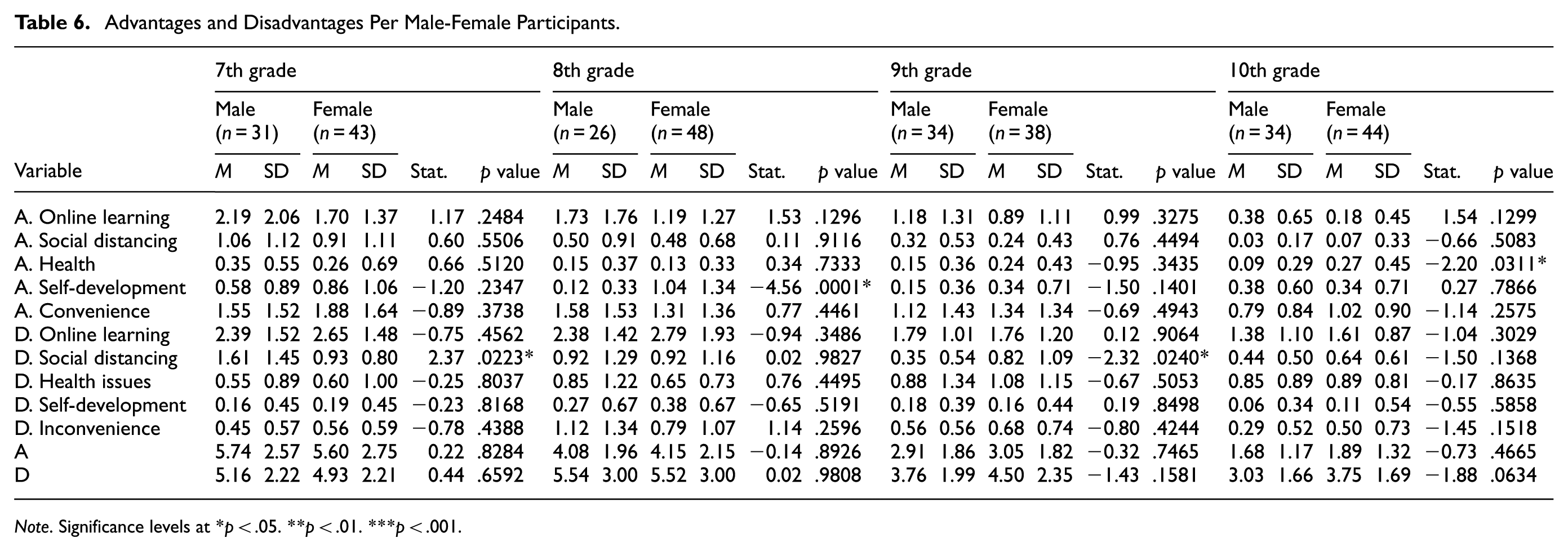
Addressing the second part of the first research question, the findings, presented in Table 6, unveil statistically significant differences between female and male participants across various levels in primary and secondary education when it comes to articulating the advantages and disadvantages of their experiences with emergency remote learning.
Advantages and Disadvantages Per Male-Female Participants.
Note. Significance levels at *p < .05. **p < .01. ***p < .001.
Specifically, significant differences emerge between primary and secondary education concerning the female and male perception of disadvantages related to remote learning. In the seventh grade of primary education, the male perception of social distancing is significantly more negative than the female perception (M = 1.61, SD = 1.45 for males vs. M = 0.93, SD = 0.80 for females, p = .0223). This is mainly attributed to the inability to socialize with friends, also impacting the entertainment and leisure aspect of free time, along with the adverse effect social distancing has on family relationships. Contrastingly, in the ninth grade of secondary education, the female perception stands out as negative, primarily highlighting the adverse impact of social distancing on friendships. Moreover, there is a notable difference, possibly attributable to both gender and maturity level disparities, where academic aspects are emphasized. The negative effect of social distancing on face-to-face collaborative class assignments and group work is highlighted. Entertainment and leisure take a third position in this case.
Significant differences also exist in terms of male and female perceptions regarding advantages such as health-related issues and self-development. Specifically, the results reveal that in the eighth grade of primary education, the female perception is considerably more positive than the male perception (M = 1.04, SD = 1.34 for females vs. M = 0.12, SD = 0.33 for males, p = .0001) when it comes to prioritizing the importance of aspects such as self-awareness, the acquisition of new skills, primarily related to technologies and autonomous learning, or time management. Similarly, in the 10th grade of secondary education, it is the female perception that emphasizes the positive impact of confinement on health (M = 0.27, SD = 0.45 for females vs. M = 0.09, SD = 0.29 for males, p = .0311), particularly referring to physical health in this case.
These results highlight gender-based differences in students’ perceptions of the advantages and disadvantages associated with remote learning. Male students, particularly those in primary education, viewed social distancing more negatively, as they placed greater value on in-person peer interactions and recreational activities. This finding aligns with prior research indicating that boys typically demonstrate higher activity-based social engagement, thereby making the transition to remote learning particularly challenging. Conversely, female students, especially those in secondary education, placed greater emphasis on opportunities for self-development and effective time management, reflecting studies suggesting that girls often exhibit higher levels of self-regulation and metacognitive awareness in academic contexts (Yu & Deng, 2022).
Use of Epistemic and Effective Stance Strategies in EFL Learners’ Reflective Writing on Remote Learning
Epistemic stance expressions are more prevalent in the corpus than effective expressions, with mean frequencies of 90.35 and 87.33, respectively. When disaggregated by gender and school level, female primary school students exhibit a slightly higher frequency of epistemic expressions (99.61) compared to their secondary school counterparts (96.74). These values are based on normalized frequencies per 10,000 words, with primary females producing 288 instances (99.61) and secondary females 250 instances (96.74). In contrast, male secondary school students show a significantly higher frequency of epistemic expressions (83.70) than male primary school students (71.59), with raw counts of 177 and 119 instances respectively.
Regarding effective expressions, the results indicate a modest decline among female students from primary (99.26) to secondary school (81.65). Among male students, the reduction is more pronounced, dropping from 112.49 in primary school to 58.16 in secondary school. These findings suggest that as female students progress to higher educational levels, they tend to decrease their overall use of stance expressions—particularly effective, as evidenced by a reduction in frequency from 99.26 to 81.65 per 10,000 words (R (‱) represents a 10,000-word ratio). Conversely, male students tend to increase their use of epistemic expressions (from 71.59 to 83.70), while their use of effective expressions is almost halved (from 112.49 to 58.16). Please refer to Table 7 for further details.
Female and Male Instances of Epistemic and Effective Stance Per Educational Levels (Raw Numbers and Normalized Frequency in a Ratio per 10,000 words).

The shift from effective stance markers in younger learners to epistemic stance markers in older learners suggests a developmental trajectory in academic writing skills. Younger students relied more on effective stance expressions (e.g., deontic “must,” potential “can”), which align with direct, action-oriented expressions commonly used in early language acquisition. In contrast, older students demonstrated a higher frequency of epistemic stance expressions (e.g., modal verbs “might,” evidential phrases “it is possible”). This aligns with findings in L2 development research, where epistemic modality increases as learners develop higher linguistic proficiency and metacognitive awareness (Shin & Won, 2024).
To What Extent Do Primary and Secondary EFL Learners Differ in Their Use of Epistemic and Effective Stance Strategies in Relation to Remote Learning?
Epistemic Markers Across Levels
The most frequent epistemic subcategories retrieved from the corpus are those of epistemic modality and cognitive attitude, with total ratios per 10,000 words of 39.12 and 25.40, respectively. Notably, the use of epistemic modals is more concentrated at the highest school levels, with frequencies of 48.29 and 40.92 compared to 33.35 and 34.27 at lower levels (Table 8). For example, common instances of epistemic modality markers include: “it
Instances of Epistemic Stance Per Group (Raw Number of Instances and Normalized Frequency in a Ratio Per 10,000 Words).

In contrast, cognitive attitude expressions are more prevalent at the lower school levels, with frequencies of 33.80 and 28.70 in primary schools versus 21.57 and 18.32 in secondary schools. Illustrative examples include: “
Regarding factives, impersonals appear more frequently than personals, with total ratios of 9.19 and 5.30, respectively, as show in Table 8. For instance, examples of impersonal factives include: “something super difficult is
Expressions of interpretation or reformulation of information, although occupying a much lower frequency overall, are also concentrated at the highest levels. An example of this is: “Studying at home
Effective Markers Across Levels
Potentiality is the most frequent subcategory of effective stance used by participants (61.28), largely due to their extensive use of “can.” This frequency decreases in favor of other expressions as English proficiency increases, with ratios ranging from 77.96 and 73.25 at the lowest levels to 53.45 and 42.48 at the highest levels (Table 9). For example, participants frequently state, “
Instances of Effective Stance Per Form Group (Raw Number of Instances and Normalized Frequency in a Ratio Per 10,000 Words).

Deonticity, which ranks second on the participants’ preference scale with a total ratio of 10.59, remains constant across the four school levels. The use of deontic expressions predominantly revolves around modal verbs such as “should,”“must,” and “have to,” as exemplified by “so you
Intentionality, with an overall ratio of 6.70, is slightly less constant, with higher usage at the lower levels (11.72 and 5.14) compared to the higher levels (3.75 and 6.24) (Table 9). Within this subcategory, expressions such as “going to” and “will” are preferred. Examples include: “
Volitionality expressions are slightly more frequent (3.67) than normativity expressions (3.13), with lower-level participants showing a greater tendency to express volition (4.06 and 6.43 vs. 1.41 and 2.73). For instance, they state, “
Regarding normativity, the most recurrent expression is “it is important,” as demonstrated in examples such as “
Directive expressions, which are mostly imperatives, are the least frequent, used primarily at the lowest level (3.61) with a total ratio of 1.95. Examples include: “
The data indicate a decline in the use of potentiality markers (“can”) as students advance in grade levels, while deontic markers (e.g., “must,”“should”) and intentionality markers (e.g., “going to,”“will”) become more prominent. This shift suggests a linguistic maturation process, where younger learners rely on basic modal verbs to express ability, while older learners adopt more complex expressions of obligation and intention. This aligns with research in academic writing development, showing that as students progress, they transition from general modal usage to more precise, structured modality reflecting argumentation and reasoning (L. Zhang & Zhang, 2023).
To What Extent Do Female and Male Primary and Secondary EFL Learners Differ in Their Use of Epistemic and Effective Stance Expressions Related to Remote Learning?
Epistemic Markers Across Levels and Gender
Significant differences in the use of epistemic modality across genders and grade levels are evident. In both 7th and 8th grades, female students employ epistemic modals at a higher rate than their male counterparts (24.34 vs. 9.01 in 7th grade, and 23.56 vs. 10.71 in 8th grade) (see Table 10). However, by 10th grade, this gap narrows considerably (24.14 vs. 16.76), with male students having shown their highest usage in 9th grade (21.57 for females vs. 26.72 for males).
Epistemic Stance Categories by School Levels and Gender.

Note. Inst. represents the number of instances the category was identified.
Similarly, cognitive attitude expressions are used more frequently by female students. The discrepancy in usage decreases from 7th grade (25.24 vs. 8.56) to a minimum in 10th grade (9.35 vs. 8.96), while remaining relatively constant in 8th grade (18.82 vs. 9.85) and 9th grade (15.00 vs. 6.56) (see Table 10).
Regarding impersonal factive expressions, female students consistently use them more frequently than their male peers across all grade levels. However, the differences are less pronounced in 8th grade (6.43 vs. 3.86) and 9th grade (3.28 vs. 0.94) compared to 7th grade (8.56 vs. 2.70) and 10th grade (7.79 vs. 2.73). For personal factive expressions, notable differences are observed in 7th grade (4.96 vs. 0.90) and 10th grade (5.07 vs. 1.95). Similar, albeit less pronounced, patterns emerge with aphonic markers (2.25 vs. 0.45 in 7th grade, and 4.29 vs. 1.17 in 10th grade) (Table 10).
Differences in the use of information interpretation and reformulation expressions appear only in 10th grade (3.12 vs. 1.17), while expressions of indirect inferential evidentiality show differences solely in 8th grade (3.86 vs. 1.71) and 9th grade (3.28 vs. 0.94) (Table 10).
Effective Markers Across Levels and Gender
Effective expressions of potentiality are the most prevalent among the effective stance subcategories in the corpus, with a ratio of 61.28, followed by deontic markers at 10.59. Female students consistently exhibit higher ratios of potentiality usage than their male counterparts at all educational levels examined. However, the differences are most pronounced at the lowest level—7th grade—where the ratio for female participants is 49.57 compared to 28.39 for males. A similar pattern is observed with intentionality expressions, with the highest ratios for females in 7th grade (7.21 for females vs. 4.51 for males) and 8th grade (3.86 for females vs. 1.29 for males). In the case of deontic expressions, the predominance of female usage is particularly notable in 7th grade (8.11 for females vs. 2.70 for males) and 10th grade (8.18 for females vs. 2.73 for males). Furthermore, female students display higher ratios of volitionality marker usage at all levels except 8th grade (see Table 11).
Effective Stance Categories by School Levels and Gender.

Note. Inst. represents the number of instances the category was identified.
Conversely, normativity expressions show a shift from a higher ratio of female usage in 7th grade (4.05 for females vs. 0.45 for males) and 8th grade (1.71 for females vs. 0.00 for males) to a similar ratio in 9th grade (2.34 for both), and eventually to predominantly male usage in 10th grade (0.78 for females vs. 1.17 for males). Similarly, male students demonstrate a higher ratio of directive usage, particularly evident at the lowest level—7th grade (1.35 for females vs. 2.25 for males) (see Table 11).
Gender-based differences in stance marking reflect distinct rhetorical styles between male and female students. Female students used more expressions of potentiality, indicating a more reflective discourse style. This type of discourse typically emphasizes personal growth, perceived ability, and future-oriented action, often articulated through modal verbs that express possibility and potential. In contrast, male students used more directive expressions (imperatives, deonticity), reflecting a more assertive, action-oriented rhetorical approach. This pattern aligns with findings in academic discourse analysis, where male students favor direct and authoritative language (T. Silvana Sinar et al., 2024).
Discussion
This study offers a comprehensive analysis of how EFL learners negotiate epistemic and effective stance expressions across gender and educational levels, providing critical insights into the developmental and social factors that shape linguistic expression. The findings indicate that epistemic expressions are slightly more prevalent than effective ones, suggesting that EFL learners tend to prioritize articulating beliefs, knowledge, and evidential support over explicitly asserting agency or influencing events.
A particularly noteworthy pattern emerging from the analysis is the gendered distribution of stance expressions. Female students—especially younger learners—consistently employ epistemic expressions, such as epistemic modality, cognitive attitude expressions, and factives, more frequently than their male peers, who tend to adopt these features later in their educational trajectories. This suggests that female learners engage earlier than males in a direct interactional style characterized by overt expressions of certainty, evidential support, and critical engagement with alternative perspectives to build credibility (Hyland, 2005; Myers, 1989). These tendencies align with broader English discourse norms that emphasize individualism, explicitness, and low-context communication, wherein directly addressing counterarguments is both expected and valued (Hofstede, 2001).
By contrast, male students exhibit a stronger preference for effective stance expressions, typically associated with directive and action-oriented approaches (Al-Otaibi & Hussain, 2024; Banihashem et al., 2023). These gender-based differences likely reflect divergent cultural expectations and educational practices. Female students are frequently socialized into cooperative and expressive communication styles, encouraging their greater use of epistemic stance expressions. Male students, on the other hand, are often encouraged to adopt assertive, directive language use, which reinforces their inclination toward effective stance expressions (Kapranov, 2023; Nasri et al., 2018; Taguchi, 2019). Supporting this distinction, Noroozi et al. (2022) and Alramadan (2020) report that female students actively use epistemic expressions to facilitate discussion and manage uncertainty, whereas male students tend to favor directive feedback and more assertive forms of communication. These distinct interactional patterns underscore the need for explicit instructional strategies that address stance-taking differences. Such targeted instruction can help both male and female learners develop balanced and efficient academic communication skills (Alqahtani & Abdelhalim, 2020).
From a developmental standpoint, a significant shift occurs as students progress through educational levels. The use of effective stance expressions decreases moderately among female students and substantially among males (Wu & Allison, 2003). This trend reflects EFL learners’ increasing linguistic proficiency and cognitive maturity, as they begin to adopt a more selective and refined discourse style. These findings emphasize the importance of pedagogical strategies that are closely aligned with learners’ developmental stages.
An analysis of effective and epistemic stance subcategories offers further clarity on these developmental trajectories. As an example, potentiality expressions—particularly the use of “can”—are most common among younger or lower-proficiency learners but decline as students’ linguistic repertoires expand (Shi et al., 2022). Similarly, intentionality and volitionality expressions (e.g., “going to,”“will”) are prevalent at early stages but gradually become more complex and diversified. While directive expressions are used relatively infrequently overall, they appear more commonly among younger male learners, indicating a potential gender-based tendency to assert authority or control more overtly. In contrast, expressions of deonticity—such as “should,”“must,” and “have to”—remain consistently employed across all educational levels, reflecting a sustained need to convey social or moral obligations, likely influenced by structured classroom norms (Veličković & Jeremić, 2020).
Regarding epistemic stance, higher-level EFL learners display increased use of epistemic modality, personal factives, and interpretation or reformulation expressions, indicative of enhanced analytical reasoning and more sophisticated linguistic engagement (Torres Martín et al., 2021). Secondary-level students also exhibit greater use of aphonic or ignorative predicates, potentially reflecting heightened frustration or motivational challenges associated with the transition to remote learning during the pandemic. As students mature academically, their interactional styles evolve, with a marked increase in the refinement and complexity of their epistemic stance expressions (Carretero et al., 2023; Carretero & Domínguez, 2024; Domínguez Romero, 2022; Gholami et al., 2014; Kapranov, 2023). These findings reinforce the value of explicit instructional strategies that are progressively aligned with learners’ developmental stages. Research by Fordyce (2014) and Suzuki (2024) supports the efficacy of explicit teaching in enhancing learners’ pragmatic competence with regard to stance expression.
At the same time, this study also aimed to examine participants’ perceptions of remote learning in order to draw pedagogical implications for the present and future of online and hybrid EFL instruction. Findings indicate that students generally perceived more disadvantages than advantages during emergency remote learning, with statistically significant differences observed in Years 8 to 10, but not in Year 7. These results point to developmental differences in cognitive maturity and self-regulation (Grooms & Childs, 2021), with younger students benefiting from greater parental support and structure, while older students faced increased demands for autonomy and self-management. Primary students most valued the convenience of studying from home and enjoying family time; secondary students prioritize time management. Reported disadvantages included distractions in the home environment and social isolation, with mental health concerns particularly prominent among secondary students.
Gender-based patterns also emerged: male students, especially in primary education, viewed social distancing more negatively due to reduced peer interaction, whereas female students—particularly in secondary education—emphasized self-development and health-related benefits. These findings highlight the need for age- and gender-responsive approaches to online and hybrid EFL instruction, with particular attention to supporting students’ emotional well-being and developing their capacity for self-regulated learning.
From a pedagogical standpoint, the results carry important implications for curriculum design. EFL educators should adopt age-appropriate instructional strategies that reflect learners’ cognitive, emotional, and linguistic development. Younger students, who often struggle with self-regulation, benefit from structured scaffolding and interactive, engaging activities (Nawastheen & Perera, 2021). In contrast, older learners are better supported by approaches that foster autonomy and self-directed learning, aligning with their growing capacity for independent academic engagement (Sanhueza et al., 2018; Walters et al., 2022). Designing online and hybrid learning experiences that reflect these developmental differences can contribute to more effective, inclusive, and equitable EFL education.
Therefore, explicitly structured and developmentally responsive stance-taking instruction—attuned to both gender-specific rhetorical tendencies and cognitive growth trajectories—can significantly enhance EFL learners’ pragmatic competence. This, in turn, equips them with the versatile and context-sensitive communication skills necessary for academic success. Moreover, targeted emotional and pedagogical support is vital in helping EFL learners adapt to digital and technology-mediated educational environments (Díaz et al., 2025; Maldonado & De Witte, 2022; Nuangchalerm et al., 2021; Prabawangi et al., 2021).
Conclusions
This study underscores the centrality of stance-taking in EFL education, demonstrating that epistemic and effective stance expressions are not merely linguistic choices but also powerful indicators of learners’ cognitive development, emotional positioning, and sociocultural engagement. Moving beyond descriptive analysis, the study offers pedagogical insights with direct implications for classroom instruction, curriculum design, and educational policy—both in conventional and digitally mediated learning contexts.
The findings reveal clear developmental and gender-based patterns in stance use. Younger learners, particularly female students, demonstrated an earlier and more consistent use of epistemic expressions, reflecting higher levels of metacognitive awareness. In contrast, male students—especially at the primary level—exhibited a stronger reliance on effective markers and expressed heightened concern over social isolation. These differences highlight the need for differentiated and gender-responsive pedagogy, where instruction is sensitive not only to students’ language proficiency and cognitive development but also to individual variation in communicative style, emotional engagement, and learner identity.
To translate these insights into instructional practice, EFL educators should integrate stance instruction systematically into linguistic skills curricula. For younger learners, scaffolded tasks should target the development of modality, obligation, and early expressions of voice. For older students, instruction should emphasize complex stance choices to support alignment with academic discourse norms and the development of critical rhetorical agency. Collaborative writing, peer feedback, and structured metacognitive reflection—especially in blended formats—can further support EFL learners in constructing stance as a socially situated, audience-aware discourse practice.
The study’s implications are particularly relevant to online and hybrid learning environments, where reduced interaction and challenges with self-regulation may hinder EFL learners’ ability to engage with academic language. Teachers and curriculum designers should make strategic use of digital tools—such as collaborative writing platforms, AI-assisted feedback systems, and metacognitive reflection apps—that promote interactive, feedback-rich, and reflective stance-taking. These tools can help mitigate the limitations of online and hybrid instruction by fostering learner autonomy while sustaining essential emotional and pedagogical support.
At the policy level, the findings point to the need for embedding stance-related objectives into language education standards and assessment frameworks. Pragmatic competence—particularly the ability to position oneself efficiently through language—should be treated as central to academic literacy and communicative success in both traditional and technology-enhanced educational settings. These pedagogical shifts must be reinforced by comprehensive teacher training initiatives.
While this study offers original insights, several limitations should be acknowledged. The research was conducted within a Chilean IB school during a unique period of emergency remote learning, which may constrain the generalizability of the findings. Moreover, the reliance on student-generated reflective writing, although rich in authentic data, introduces potential affective and contextual biases. Future research should address these limitations by expanding to more diverse educational contexts and triangulating data sources through interviews, classroom observation, and teacher perspectives to capture a fuller picture of stance as a socially situated practice.
Footnotes
Acknowledgements
The authors thank the students, teachers, and administrators of the participating school for their collaboration and support throughout the study.
ORCID iDs

Ethical Considerations
This study was approved by the Universidad de Concepción Research Ethics Committee, (approval no. FIDVRID1773) on August 2, 2021.
Consent to Participate
Written informed consent was obtained from all participants’ parents or legal guardians, and assent was obtained from the students themselves prior to their participation in the study.
Author Contributions
Elena Domínguez Romero led the application of the theoretical framework to the corpus analysis, spearheaded the drafting of the original manuscript, and contributed significantly to refining the study’s methodology. She also took an active role in data processing and provided critical revisions and editorial input throughout each manuscript version. Cristian Sanhueza-Campos conceptualized the study, led the methodological design, and led the writing of the original draft. Caterin Díaz-Vargas and Marcela Vildósola Campos contributed to data processing and interpretation and participated in drafting the manuscript. Katia Sáez Carrillo conducted the statistical analyses and prepared the visualizations. All authors read and approved the final manuscript.
Funding
The authors disclosed receipt of the following financial support for the research: Fondo Europeo de Desarrollo Regional (FEDER)/European Regional Development Fund and the Ministerio de Ciencia e Innovación, Gobierno de España (MCIN)/Spanish Ministry of Science and Innovation (Grant Number PID2021-125327NB-100; Project Number 4030263).
Declaration of Conflicting Interests
The authors declared no potential conflicts of interest with respect to the research, authorship, and/or publication of this article.