




Abstract
The Olympic legacy framework was proposed by the International Olympic Committee; however, it has not yet been discussed much in academia. This study identified a set of key dimensions and items out of 7 dimensions and 39 items from the Olympic legacy framework, along with the weight of each dimension and item. Based on the judgments of 12 Korean Olympic experts collected via the Delphi-analytical hierarchal process method, the results indicate that social development through sport is the most significant dimension, followed by economic value and brand equity, and urban development. The results also reveal that the most crucial of the 39 items are health and well-being benefits from the practice of recreational sport and physical activity from the social development through sport dimension, while the intangible cultural heritage of Olympism from the culture and creative development dimension was considered the least important. The results provide useful insight for evaluating the Olympic legacy framework for host or candidate cities and countries, as well as the International Olympic Committee.
Keywords
Introduction
The Olympic Games have become a massive sporting event with globalization, digitalization, and mediatization, and incur immense operating costs (Preuss, 2019). Every Olympic Games since 2007 has cost more than $10 billion on average, not including infrastructures such as airports, railways, roads, and hotels (Flyvbjerg et al., 2021). In addition, the overall costs often exceed expectations owing to underestimated expenditure and overestimated revenue and economic benefits (Flyvbjerg & Stewart, 2016; Whitson & Horne, 2006). This immense financial burden has led to recent difficulties in gaining public support for hosting the Olympic Games (Könecke & De Nooij, 2017).
To address this challenge, the International Olympic Committee (IOC) proposed the Olympic legacy to provide benefits to countries hosting the Games, which has already been covered by numerous studies (Brown, 2020; Chen & Henry, 2020; Grim-Yefsah et al., 2020; Karadakis et al., 2019; Preuss, 2019; Zhu & Zhu, 2018). While the Olympic legacy is a huge and complex concept covering all factors related to hosting the Games, the literature has not yet provided a concrete and consistent definition or range of the Olympic legacy, but has instead focused on a subset of the legacy, such as urban development and belief behavior (Scheu et al., 2021).
In response, the IOC has presented expected long-term benefits from the Olympics as a legacy framework (IOC, 2017). From consulting with various stakeholders and Olympic partners (e.g., hosted cities, national Olympic committees, organizing committees), the IOC (2017, p. 13) has defined the Olympic legacy as “[t]he result of a vision. It encompasses all the tangible and intangible long-term benefits initiated or accelerated by the hosting of the Olympic Games/sport events for people, cities/territories and the Olympic Movement,” and proposed 7 dimensions and 39 belonging items as the entire legacy framework. However, despite efforts from the IOC (2017), the legacy framework has not yet been examined in academic fields.
Three Olympic Games have been or will be held in Northeast Asia: Pyeongchang 2018 in Korea, Tokyo 2020 in Japan, and Beijing 2022 in China. While Korea, Japan, and China share similar geographical, cultural, and historical backgrounds that distinguish the region from any other worldwide, it is unclear whether the Olympic legacy will be shown in a similar way to what the IOC has proposed.
Therefore, this study aims to closely examine the expected long-term benefits from the Olympics proposed by the IOC (2017) in the Korean-Asian context. With a group of 12 Olympic experts from various fields, we applied the Delphi method and the analytical hierarchical process (AHP) to develop the Olympic legacy framework for Northeast Asia. As a result, this study identifies a set of key indicators, along with weights for the Olympic legacy, that shed light on government policies for hosting or preparing mega sporting events.
Literature Review
Recent studies related to the Olympic legacy have mostly been conceptual and focused on its meaning and components. Leopkey and Parent (2012) attempted to contextualize the concept of the legacy over time, and Chappelet (1970) addressed a broad overview of the Olympic legacy and its multi-faceted and far-reaching nature. In the case of the London 2012 Summer Olympics, several studies were conducted. Bloyce and Lovett (2012) took a close look at the legacy plans for London 2012 in official publications from selected organizations, Chen and Henry (2020) evaluated two London 2012 legacy programs with a lens of program and action theory, and Agha et al. (2012) demonstrated various legacy outcomes such as destination image, tourism, costs, venues, housing, and social legacies.
Scheu et al. (2021) demonstrated six aspects of the Olympic legacy framework: Urban development; environment enhancement; policy and governance; skills, knowledge, and networks; intellectual property; and beliefs and behavior. Chappelet (2019) suggested the Olympic diamond model to evaluate the performance of the Olympic Games, where the input is Olympic revenue and leveraging funds and the output is memorable Olympic Games and related programs. However, although those conceptual models can provide qualitative insights, they do not provide quantitative tools for measuring the Olympic legacy.
While conceptualization of the Olympic legacy is well studied, little measurement-related research conducted on the subject. To deal with this issue, a few studies attempted to identify the Olympic legacy for the measurement. Dickson et al. (2011) suggested that different frameworks are needed to evaluate the legacy of different Olympic Games, such as the summer and winter Games, and the Olympic and Paralympic Games. Gratton and Preuss (2008) described various dimensions of the Olympic legacy and Preuss (2019) identified long-term costs and benefits of hosting the Olympic Games and suggest a possible way to estimate and measure costs and benefits. However, studies that explicitly estimate the Olympic legacy is limited and several researchers have emphasized that many studies still face methodological problems although the number of studies on the Olympic legacy and its influence has increased (Chen & Henry, 2020; Scheu et al., 2021).
The value of the Olympic legacy is difficult to measure, as it is based on the context that has to meet the needs of multiple stakeholders (Preuss, 2019). Measures are inherently legacy-specific, and for each Olympic edition, the legacy measurable indicators should be tailored to the specific host city (IOC, 2017). For this reason, studies on estimating the Olympic legacy focused on the part of the legacy such as improved hosting nation and city’s image (Li & McCabe, 2013), increased sports participation (Veal et al., 2012), air quality (Chen et al., 2013), local employment (Feddersen & Maennig, 2013), and volunteering Legacy (Koutrou et al., 2016).
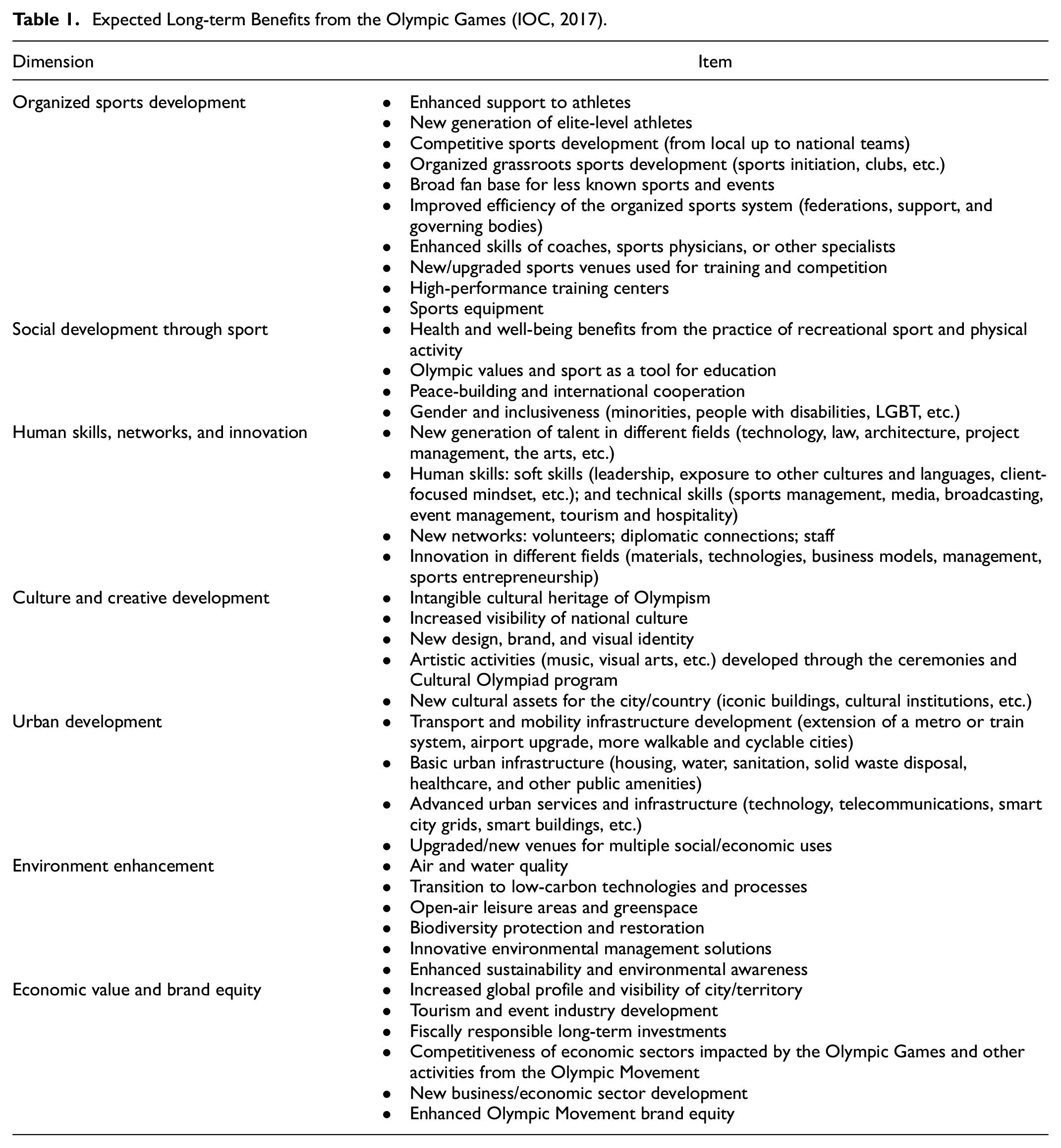
To solve this difficulty in defining and measuring the Olympic legacy, the IOC (2017) initially proposed the Olympic legacy framework as the “expected long-term benefits from the Olympic Games.” To develop the framework, the IOC set four objectives: (1) embed the legacy throughout the Olympic Games lifecycle; (2) document, analyze, and proactively communicate the legacy of the Olympic Games; (3) encourage Olympic legacy celebrations; and (4) build strategic partnerships. The IOC then consulted with various stakeholders, including city representatives from different nations; a sample of legacy entities and National Olympic Committees; a sample of international sports federations; the Organizing Committees for the 2018, 2020, and 2022 Olympic Games and the 2024 candidate cities; several experts, including academics and practitioners; the IOC administration; and two top Olympic partners. As a result, the IOC proposed the Olympic legacy framework with 7 dimensions and 39 belonging items. Table 1 summarizes the expected long-term benefits from the Olympic Games. Since this study explicitly examined the Olympic Legacy framework released by the IOC (2017), the exact same terminologies from the Olympic Legacy framework were used in the manuscript. The first dimension is organized sports development and it has 10 belonging items; social development through sport follows with four belonging items; human skills, network, and innovation is the next with four belonging items; culture and creative development has five belonging items; urban development contains four belongings; environment enhancement with five belongings; economic value and brand equity is the last dimension with five belonging items.
Expected Long-term Benefits from the Olympic Games (IOC, 2017).
However, limited studies in the academia have investigated the Olympic legacy framework by the IOC (2017) yet. The structure of 7 dimensions and 39 belonging items, and the relative importance of these are not known. Also, while the recent Olympic Games were held in Asia, studies on the Olympic legacy in the Asian region are limited. Therefore, this study attempts to identify the structure and relative importance of the Olympic legacy framework by the IOC (2017) by collecting opinions from 12 Korean Olympic experts.
Methods
We used the Delphi-AHP method to identify the relative importance of the Olympic Legacy framework developed by the IOC (2017). The AHP-Delphi method is often applied to collect various expert opinions from academics, professionals, and decision-makers in the public and private sectors (Chen et al., 2017; García-Melón et al., 2012).
The Delphi method was developed to derive a consensus from a group of experts on a specific topic via an iterative process (Dalkey & Helmer, 1963; Linstone & Turoff, 1975). The following steps are typical when applying the Delphi method: (1) Recruit the expert panel and develop the questionnaire; (2) send the first questionnaire to the panel; (3) collect responses from the first questionnaire and calculate summary statistics (e.g., mean and standard deviation) of the answers; (4) send the second questionnaire with summary statistics to the panel and collect answers; and (5) iterate Steps 1–4 until the panel reaches the proper degree of consensus. The Delphi method is used to prevent possible errors that can occur in face-to-face meetings via anonymity, an iterative structure, asynchronicity, and controlled feedback (Di Zio & Maretti, 2014).
The AHP was developed by Saaty (1980) to solve complex issues using multiple criteria. This method generally exploits comparisons between two items at each level with different measurements, and is used to form comparative matrices that represent the relative importance of the elements at a particular level of a certain structure (Saaty, 2008). The AHP typically comprises the following steps: (1) Define the decision, problem, or type of knowledge; (2) develop the structure of a complex problem in a hierarchy of criteria and alternatives; (3) construct a set of pairwise comparison matrices for each element at the same level of the hierarchy and obtain quantified judgments from the expert panel; (4) obtain weights for each element using the priorities obtained from the comparison matrices from the expert panel with arithmetic mean; and (5) perform a consistency analysis at an individual-expert level by computing the consistency index (CI). The CI is calculated as follows:

where
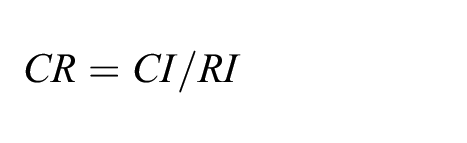
where RI is the random index, which is obtained from the average of the CIs. If CR is less than or equal to 0.1, the judgments of an expert are considered as being consistent, but if CR is greater than 0.1, the judgments are considered inconsistent and should be reviewed by the expert (Liao, 2010).
The Delphi method and the AHP can be integrated in to two ways. In the first case, the Delphi method is used in the preliminary stages to structure the hierarchy and define the criteria and alternatives. Subsequently, typical AHP steps are applied (Hsu & Chen, 2007; Liao, 2010; Taleai & Mansourian, 2008). In the second case, the Delphi process is applied during the AHP procedure. Members of an expert panel submit their judgments anonymously, asynchronously, and in multiple iterations (Di Zio & Maretti, 2014; Tavana et al., 1993). We applied the latter method, as the Olympic legacy framework was developed by the IOC (2017) and systematized in Korean context already (Lee et al., 2021). Instead, we applied the AHP process in three Delphi-rounds, following Tavana et al. (1993) and Di Zio and Maretti (2014).
In the first round, we sent a set of comparison matrices from the Olympic legacy framework (7 dimensions and 39 belonging items) to the expert panel, collected their responses, and calculated the weight of each element. We sent eight different comparison matrices; the first matrix contained the seven dimensions of the Olympic legacy framework, and the subsequent seven matrices covered the belonging items within each dimension. In the second round, we sent a set of comparison matrices to the panel again along with the results from the first round. In the last round, we identified experts with higher CRs than the criterion (0.1) and asked them to review their answers, following Liao (2010).
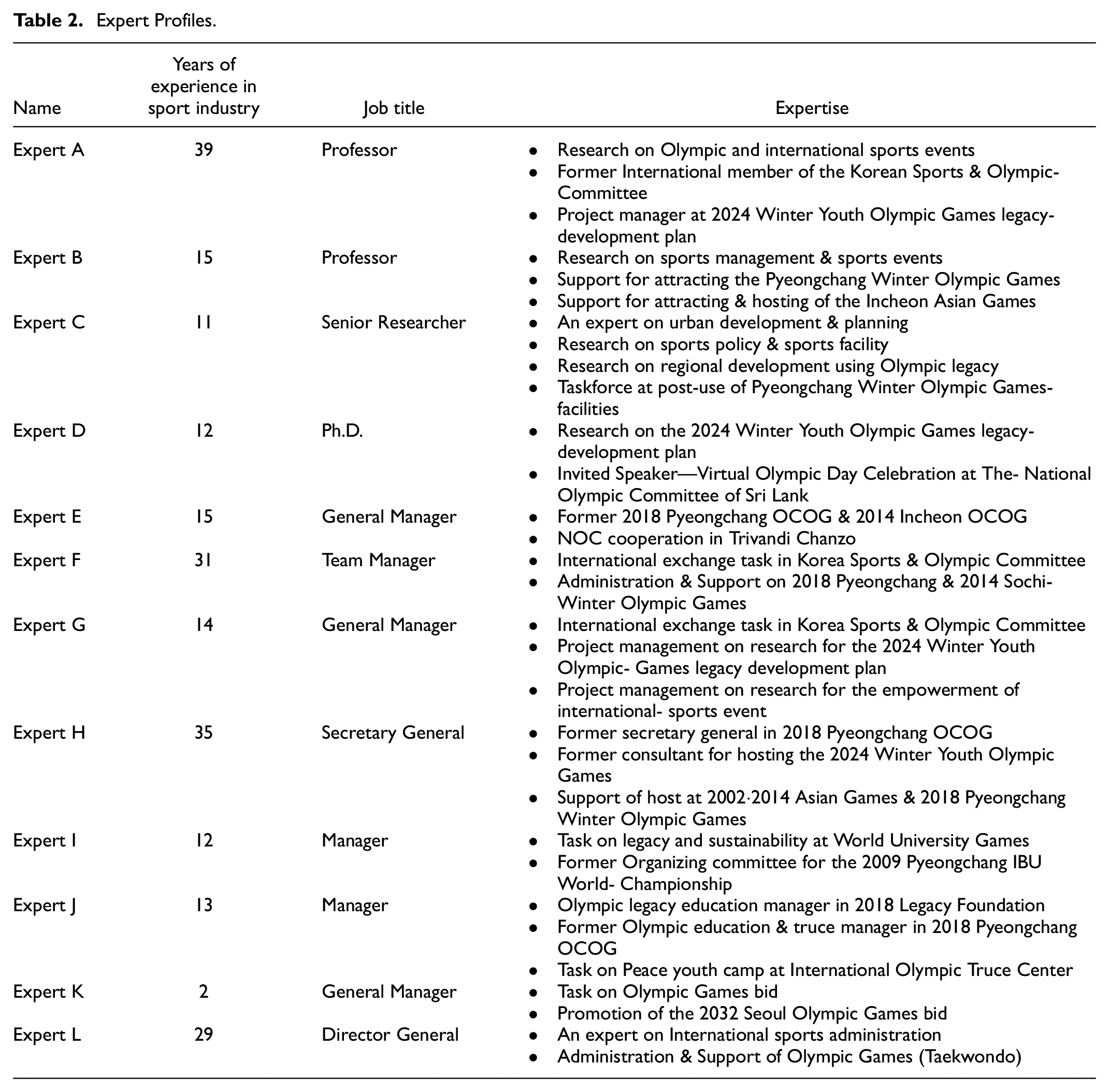
This study recruited 12 Korean experts, including government officials, academic researchers in related fields, and professional managers in private organizations and non-governmental organizations. The experts had participated in hosting mega sporting events in Korea, including the Olympic Games, at least once, and all but one had more than 10 years of experience. Table 2 provides brief profiles of the 12 experts. Note that 5 out of 12 experts also have international experience or career as well as a domestic one, such as working for overseas universities or organizations for hosting mega sports events in other countries.
Expert Profiles.
Results
We sent comparison matrices to 12 experts in two rounds. In both rounds, all experts submitted their judgments to us within the requested timeframe. After the second round, we calculated the CRs of the experts’ judgment in each comparison matrix and asked the experts to review their judgment if the CR was greater than 0.1 in the third round. After this round, all judgments were consistent enough to be used in the study (i.e., the CR was less than 0.1). The results of the third round are reported here.
First, we asked the experts to make a comparison among the seven dimensions of the Olympic legacy framework. Table 3 shows the estimated weights from the AHP analysis. Among the dimensions, social development through sport received the highest weight (0.253). The experts judged economic value and brand equity (0.187) and urban development (0.183) were the next most important dimensions in the Olympic legacy framework. Organized sports development was located at the median (0.127). Human skills, networks, and innovation (0.083) and culture and creative development (0.050) were regarded as relatively unimportant dimensions.
AHP Result: Seven dimensions.

Next, within the organized sports development dimension, there are 10 belonging items. We asked the experts to review the relative importance of those items within the dimension. Table 4 reports the weights from the AHP analysis for the 10 belonging items. Among the items, enhanced support to athletes had the highest weight (0.159), followed by organized grassroots sports development (0.147) and competitive sports development (0.143). New generation of elite-level athletes (0.068), high-performance training centers (0.046), and sports equipment (0.043) were the three lowest.
AHP Result: Organized Sports Development.

The social development through the sport dimension contains four items. Table 5 reports the weights obtained from the AHP analysis. Health and well-being benefits from the practice of recreational sport and physical activity gains had the highest weight (0.464), followed by peace-building and international cooperation (0.246) and Olympic values and sport as a tool for education (0.161). Gender and inclusiveness was regarded as the least important item (0.129) within this dimension.
AHP Result: Social Development Through Sport.

Table 6 reports the weight of the four items within the human skills, networks, and innovation dimension. New network was identified as the most important item (0.352), followed by human skills (0.292) and innovation in different fields (0.224). New generation of talent in different fields (0.132) received the lowest weight.
AHP Result: Human Skills, Networks and Innovation.

Table 7 reports the weights of the five items within the culture and creative development dimension. Increased visibility of national culture was identified as the most important item (0.349), and new cultural assets for the city/country (0.277) was second. New design, brand, and visual identity was located at the median. Artistic activities (0.115) and intangible cultural heritage of Olympism (0.110) were regarded as the bottom two items within this dimension.
AHP Result: Culture and Creative Development.

Table 8 reports the weights of the four items within the urban development dimension. Transport and mobility infrastructure development was identified as the most important item (0.365), followed by basic urban infrastructure (0.254) and advanced urban services and infrastructure (0.228). Upgraded/new venues for multiple social/economic uses (0.154) was weighted the lowest.
AHP Result: Urban Development.
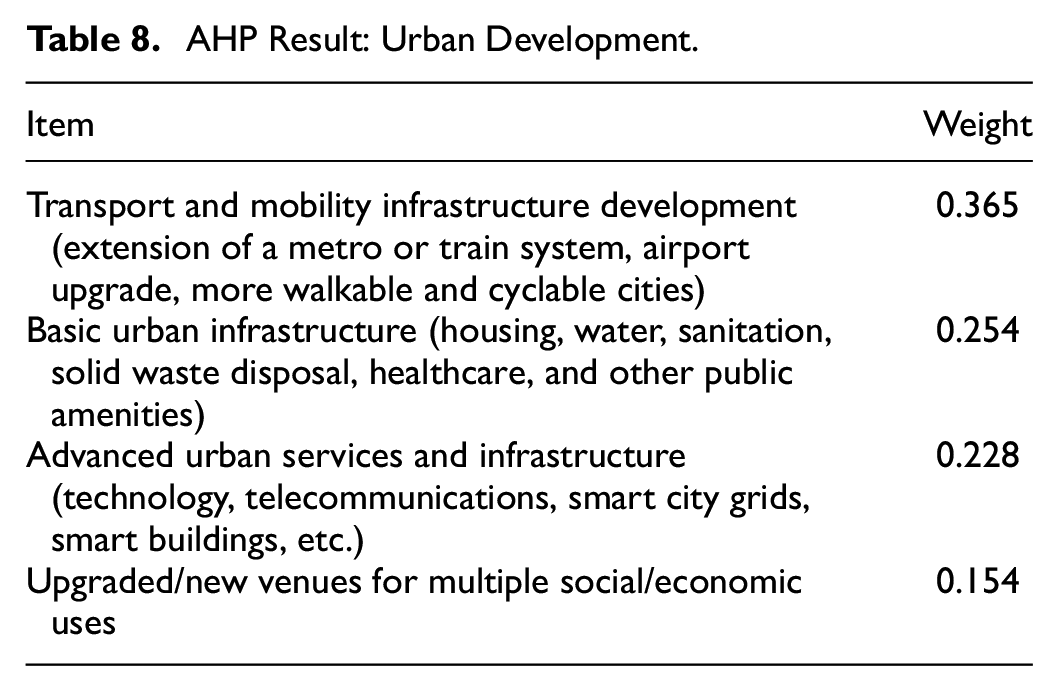
Table 9 reports the weights of the six items within the environment enhancement dimension. Open-air leisure areas (0.265) and greenspace and enhanced sustainability and environmental awareness (0.260) had the top two highest weights. Air and water quality (0.147) and transition to low-carbon technologies and processes (0.122) were in the middle, whereas innovative environmental management solutions (0.119) and biodiversity protection and restoration (0.087) were evaluated as the items with the lowest weights in this dimension.
AHP Result: Environment Enhancement.

Table 10 reports the weights of the six items within the economic value and brand equity dimension. Increased global profile and visibility of city/territory (0.319) received the highest weight, whereas tourism and event industry development (0.219) was the second highest. New business/economic sector development (0.158) and fiscally responsible long-term investments (0.131) were in the middle. Competitiveness of economic sectors impacted by the Olympic Games and other activities from the Olympic Movement (0.102) and enhanced Olympic Movement brand equity (0.072) were identified as having the two lowest weights.
AHP Result: Economic Value and Brand Equity.

Table 11 presents all dimension weights and item weights into a single table. To compare all 39 belonging items, we calculated the “global weight” that multiplies item weight by dimension weight. The last column shows the global rankings of 39 belonging items using global weights. Health and well-being benefits from the practice of recreational sport and physical activity (0.117) obtained the highest global weight, followed by transport and mobility infrastructure development (0.067), peace-building and international cooperation (0.062), increased global profile and visibility of city/territory (0.060), and basic urban infrastructure (0.046). Notably, the social development through sport dimension obtained the highest dimension weight, and two items within this dimension were in the top five. One item in the top five was the economic value and brand equity dimension (second highest dimension weight), and two items came from the urban development dimension (third highest). The bottom five items consisted of new design, brand and visual identity (0.007); high-performance training centers (0.006); artistic activities (music, visual arts, etc.) developed through the ceremonies and Cultural Olympiad program (0.006); intangible cultural heritage of Olympism (0.006); and sports equipment (0.005). The lowest-weighted dimension was the culture and creative development dimension, and three of the bottom five items were from this dimension. The organized sports development dimension was in the middle (0.127 dimension weight); however, two out of the bottom five items were from this dimension, as this dimension contains 10 items, which is the most, whereas other dimensions consist of four to six items. In addition, high-performance centers and sports equipment items obtained the two lowest item weights (0.046 and 0.043, respectively).
AHP Result: All 7 Dimensions and 39 Belonging Items.

Discussion and Conclusion
This study identified a set of key dimensions and items out of 7 dimensions and 39 belonging items from the Olympic legacy framework developed by the IOC (2017), along with the weights of all dimensions and items. Based on the judgments of 12 Korean Olympic experts, the results indicate that social development through sport is the most significant dimension, followed by economic value, brand equity, and urban development. The results also suggest that the most crucial item among the 39 belonging items is health and well-being benefits from the practice of recreational sport and physical activity, which is part of the social development through sport dimension. Intangible cultural heritage of Olympism from the culture and creative development dimension was considered the least important.
The study’s findings extend the existing literature on the Olympic legacy, specifically with respect to the identification of key dimensions and items. Compared to previous attempts to identify the Olympic legacy (Dickson et al., 2011; Gratton & Preuss, 2008; Preuss, 2019; Scheu et al., 2021), the IOC’s expected long-term benefits from the Olympic Games (IOC, 2017) propose more comprehensive structures and details with 7 dimensions and 39 belonging items. Our results indicate that social development through sport and economic value, brand equity, and urban development are relatively more important than other dimensions, which is consistent with previous findings which emphasize the key success of the mega sporting events is to evaluate economic, social, and environmental development (Chappelet, 1970; Chernushenko & van der Kamp, 2001).
In addition, new insights have been added to the literature by establishing specific weights for each legacy item, which host countries could use to self-evaluate their legacy performance after the event. Further, government or National Olympic Committees could use the results when preparing to host the mega sporting event to maximize their legacy effects given limited resources. The relative importance of each dimension and item helps them to figure out the optimal allocation of their resource when preparing the event. The results can also be of use to the IOC as well, as the IOC should understand what national governments want when promoting the Olympic Games.
We examined the Olympic legacy framework developed by the IOC (2017); however, further explanatory studies are needed to extend the legacy framework, which the IOC has not discussed. In this study, the key dimensions and items as well as their weight for the Olympic legacy framework are based on expert judgments provided in the Korean context. This suggests that the long-term benefits of the 39 items proposed by the IOC may have different priorities for each host city. Therefore, based on the long-term benefits proposed by the IOC, it is necessary to systematize the Olympic legacy from the perspective of long-term benefits for each host city (de Krepper, 2016) with quantitative results. Future studies can be conducted using groups of experts from other countries to provide different perspectives that can have significant comparative outcomes, which, in turn, can contribute to the comprehensive understanding of the Olympic legacy.
Finally, while the opening and closing ceremonies of the Olympic Games are known for their creative coordination of music, dance, video, and art (Qing et al., 2010), the experts in this study identified culture and creative development as the least important dimension. Thus, future research focusing on culture and creative development of the Olympic Games is clearly needed.
Footnotes
Declaration of Conflicting Interests
The author(s) declared no potential conflicts of interest with respect to the research, authorship, and/or publication of this article.
Funding
The author(s) disclosed receipt of the following financial support for the research, authorship, and/or publication of this article: This study was supported by the Ministry of Education of the Republic of Korea and the National Research Foundation of Korea (NRF-2020S1A5A2A03046802).
Ethics Approval
Ethics approval was not required for this study.
