




Abstract
The agro-industrial park (AIP) is developing rapidly all over the world and their industrial ecological characteristics have extensively promoted the development of the agricultural industry. However, academia and industry still lack a complete evaluation system to guide the sustainable development of AIPs. This study constructs a sustainable development evaluation system of the AIP that includes four parts of economic, social, technical, and sustainable criteria. Then, a multi-criteria decision-making (MCDM) method is employed for quantitative analysis based on a primary survey dataset; that is, the decision-making trial and evaluation laboratory (DEMATEL). In addition, a secondary dataset of 153 national AIPs in China from 2012 to 2014 is taken as a case study. The results of the DEMATEL analysis reveal some interesting findings. First, economic criteria still play an essential role in the sustainable development of AIP, and it is affected by almost all causal factors, which in turn affect most of the influencing factors. Second, there is no significant causal relationship between the criteria criterion and other criteria. Last, the case study reveals that the level of sustainable development of AIP in economically developed areas is significantly higher than the national average. The results of this study can also provide managers and policy planners with support for the sustainable management of AIP.
Introduction
Many new agro-industrial parks (AIPs) worldwide play a vital role in promoting the prosperity of agricultural industries (Spekkink, 2015). AIP is a recent phenomenon in today’s low—and middle-income countries in Africa and Asia (CASA, 2021). Guided by the government and operated by enterprises, AIP is a comprehensive demonstration park built based on the theory of industrial ecology (Nuhoff-Isakhanyan et al., 2017). In addition, based on modern equipment and science and technology, AIP takes intensive production mode and enterprise operation mode as management means. Its functions mainly include agricultural production, agricultural science and technology, and tourism. Thus, AIP can promote agricultural modernization, farmers employment, and the agricultural supply side structural reform (Ivanko et al., 2022). The exploration of the AIP by academia and industry is still in the initial stage, and some core research questions remain to be answered (Bai et al., 2014).
Among them, sustainable development is one of the most important challenges of the AIP. Most industrial parks lack long-term thinking about sustainable development (Pan et al., 2016). As early as 2010, an “National Modern Agriculture Demonstration Zone” program also was launched by the Ministry of Agriculture of China, which aims to boost the development of modern AIPs by “setting a benchmark, demonstrating, and stimulating vitality.” Besides, some national programs aim to alleviate these limitations of existing traditional parks, and also further improve the sustainability of park development and operations. 1 One of the most prominent attempts was the National Eco-Industrial Demonstration Park (EIP) project launched in the early 2000s. 2 The project envisions the development of new industrial parks (and the renewal of existing parks) following the principles of industrial ecology, working with tenant companies and other participants to maximize their economic, environmental, and social performance (Hong & Gasparatos, 2020). Like most industrial parks, AIPs in China face many challenges to sustainable development, mainly in the following aspects: (1) ignoring the contribution of the ecosystems to industrial or agricultural production activities (Bethwell et al., 2022); (2) ignoring the quality differences between different resources, energy, and labor forces (García-García et al., 2020; Liao & Li, 2022; Zhang, Wang et al., 2022; (3) insufficient attention paid to human subjectivity (Brown et al., 2021); (4) insufficient consideration of the impact of waste discharge (Chin et al., 2021; Rena et al., 2022; (5) undervaluation of the recycling benefits brought by industrial symbiosis or ecological agriculture (Farooque et al., 2022).
To solve these problems, scholars have made some efforts. Since the sustainable development of AIP is a complex concept, scholars with different backgrounds have given various meanings (Gerdesen & Pascucci, 2013). Generally speaking, sustainable development covers three facets, namely, economic, environmental, and social (Jung et al., 2013). However, these three dimensions point the way to measuring sustainability, the basic metrics for each dimension remain complex and unstandardized (Nuhoff-Isakhanyan et al., 2017). Previous studies, such as Wang, Wang et al. (2021), Yang et al. (2021), and Wang et al. (2022), adopt the multi-attribute decision analysis method for sustainability indicators, but they could not be applied to industrial parks. Therefore, this study attempts to fill this research gap.
Moreover, the connotation relation between AIP and sustainable development also needs to be further clarified. In this study, the multi-criteria decision-making (MCDM) method was applied to construct and test the sustainable development evaluation system of the AIPs in China. The system includes four criteria for economic, social, technical, and sustainability. To achieve the research goals, the decision-making trial and evaluation laboratory (DEMATEL) method was employed for quantitative analysis in this study. Specifically, we invite both scholars and experts in the field of agriculture to issue scores on the judgment matrix constructed by the indicator system. Through the calculation of the judgment matrix, the causal effect and importance among the indicator system are obtained. Then, based on the results of DEMATEL, a weight system for the indicator system is constructed, and a data set obtained from the agriculture department in China is used for a case study. In addition, the evaluation system has been tested, and the corresponding management and policy recommendations have been made.
The structure of the study is organized as follows. Section 2 provides some background on the development of AIPs and reviews the literature on sustainable development and methodologies used to evaluate AIPs. Section 3 discusses the DEMATEL method and constructs the indicator system for evaluating sustainable AIPs. Section 4 introduces data collection and gives empirical analysis results. Last, Section 5 discusses and summarizes this study, and provides related implications, and also prospects the direction for future work.
Literature Review
This study intersects with three main research streams: Eco-industrial park, industrial ecology, and agroecology in the field of sustainable development.
The first stream of research concerns EIP which is similar to AIP in the form of an organizational model. Society’s growing demand for sustainable production and operations has stimulated the need for inter-organizational collaboration (Albino et al., 2012). In this context, some network organizations oriented toward sustainable development have been established, such as eco-industrial parks (Lambert & Boons, 2002) and eco-agricultural industrial parks (Nuhoff-Isakhanyan et al., 2017). Among them, the main goal of the EIP is to transform the traditional linear system into a closed-loop system in order to improve the overall efficiency of the integrated system (Ehrenfeld & Gertler, 1997). In essence, the exchange of resources between systems is achieved in a win-win manner, thus striving for more reciprocity and sustainability in the industry (Chertow, 2000). In recent years, studies on EIP have been abundant and relevant conclusions have gradually matured (Boix et al., 2015; Butturi et al., 2019; Huang et al., 2019). For instance, Hong and Gasparatos (2020) synthesize key evidence currently relevant to the development and operation of eco-industrial parks, including institutional, sustainable, and operational implications. However, AIPs, which operate like eco-industrial parks but focus on agricultural production, this field calls for more research on sustainability.
The second stream of research concerns industrial ecology. For achieving the purpose of sustainable agriculture, some AIPs have been organized for the application of industrial ecology in agriculture (Nuhoff-Isakhanyan et al., 2017). In 1987, the World Commission on Environment and Development proposed the concept of “sustainable development” for the first time, and “sustainable development” has become the core concept of modern ecological economy and environmental policy analysis (Becker, 2014). In 2015, the United Nations adopted the 2,030 Agenda for Sustainable Development, which sets out 17 Sustainable Development Goals (SDGS) to address social, economic, and environmental development issues. Furthermore, Latruffe et al. (2016) and Tomich et al. (2004) believe that sustainable development indicators can be classified from three main dimensions, namely environment, economy, and society. Wang, Wang et al. (2021) introduce the dimension of agricultural extension service on the basis of environment, economy, and society to comprehensively evaluate the sustainable development of AIPs. However, it is necessary to identify and evaluate the key factors influencing the sustainable development of AIPs in China. On the basis of summarizing the existing research conclusions and combining them with the characteristics of sustainable agriculture in Jiangsu Province, this study will put forward a new method to comprehensively evaluate the sustainable development of AIPs.
The last stream of research involves the concept of agroecology. Agroecology, as a method of agriculture, utilizes a holistic view of agro-ecosystems; that is, each living and abiotic element of a system can interact with each other indirectly or directly (Dong, 2021; Padró et al., 2020). In addition to food production, services provided by farmland include air quality, water quality, soil health, disease control, pest control, and biodiversity (Chen, Yao et al., 2021). Agroecological agricultural parks therefore aim to create a robust food production system that can resist environmental disturbances such as disease and climate change. The Food and Agriculture Organization (FAO) has identified 10 elements of agroecology: efficiency, diversity, synergy, resilience, social and human values, recycling, sharing and co-creation of knowledge, responsible governance, culture and food traditions, and recycling and solidarity economies (FAO, 2016). Dalgaard et al. (2003) define agroecology as a comprehensive discipline integrating agronomy, ecology, sociology, and economics on the basis of reviewing the history, structure and objectives of agroecology, based on the concepts and concepts of agroecology, which is a long-standing term that has recently been revived in the analysis of climate issues (Hrabanski & Le Coq, 2022), the sustainable development of AIPs is further discussed in this study, in order to evaluate their sustainable development level in a more comprehensive and systematic way.
Research Methods and Indicators
Multi-criteria Decision-making Approach
Beginning with Wind and Saaty (1980) and Saaty (1987), MCDM models have been widely used to evaluate complex systems, in which scientific decisions involving multiple criteria and alternatives are made by a small group of experts. In previous studies, the MCDM method has been widely used in sustainability evaluation. For example, the sustainability assessment of green building manufacturing (Yadegaridehkordi et al., 2020), sustainability assessment of boxboard production (Man et al., 2020), sustainable road infrastructure performance (Song et al., 2021), and sustainable urban drainage system development (Yang & Zhang, 2021) and so on. In terms of the selection of the MCDM method, Hui (2011) evaluated eco-industrial park performance through the analytic hierarchy process (AHP) to assign the weight of indicators, and used a fuzzy comprehensive evaluation model to sort them. Wang, Wang et al. (2021) proposed an evaluation framework that combined the ordered performance evaluation technology (TOPSIS) with the entropy method based on the near ideal solution to evaluate the sustainable expansion service of modern AIPs. Fan et al. (2017) used data envelopment analysis (DEA) to evaluate and rank the eco-efficiency levels of industrial parks in China. According to the existing literature, some commonly used MCDMs are also widely applied in the evaluation of eco-industrial parks, including discounted cash flow (DCF) and multi-attribute global inference of quality (MAGIQ) methods (Jung et al., 2013), structural equation analysis (Hwang et al., 2016), gray-Delphi and fuzzy-VIKOR methods (Zhao et al., 2017). Thus, this study adopts the method of MCDM to evaluate the sustainable development level of the AIP, so as to find out the key factors affecting the sustainable development of the AIPs and their relations.
DEMATEL Method
In this study, we introduce another method to remedy these deficiencies, that is, DEMATEL (Gandhi et al., 2016). DEMATEL classifies factors as causal clusters, and then assesses their complex interrelationships on this basis, which leads to effective solutions in the form of a hierarchical structure (Yang et al., 2008). DEMATEL is also suitable for research related to sustainable or cleaner production, such as green marketing audits (Chen & Yang, 2019), and climate change mitigation (Balsara et al., 2019). Specifically, DEMATEL refines the causal structure of a set of identified factors and visualizes the direct and indirect relationships between these factors by comparing them in pairs. DEMATEL is also a good method of mind mapping. In general, causality between multiple factors is difficult to be captured by a method. DEMATEL is of great value in exploring the research questions of meaning and causation. Lee et al. (2010) also pointed out that the DEMATEL method helped to construct a causal relationship between the identified factors and determine the significance of each factor. Moreover, DEMATEL is a constructive modeling technique that explores the interdependence of system elements through causal diagrams. Causal graphs based on the directed graph provide a classical understanding of the relationship between the system elements and the influence between the elements (Wu, 2008). The detailed process of this method is exerted as follows:
Construction of Indicator System
To quantitatively and comprehensively evaluate the sustainable development of AIPs, it is necessary to build a set of reasonable and practical evaluation systems. In general, the healthy and sustainable development of AIPs is often based on clear functional positioning. The development goal of the park is to maximize the benefits and give full play to its display, demonstration, and radiation driving functions through technological transformation and social organization. In addition, by expanding the market, farmers can be provided with comprehensive services to realize the benefits of the park. Finally, farmers can achieve the goal of increasing their income. Therefore, the sustainable development level evaluation of an AIP mainly considers four aspects: economy, society, technology, and sustainability. Scholars show similar views on the sustainability evaluation of AIPs. For example, Quintero-Angel and González-Acevedo (2018) believe that a comprehensive evaluation of sustainable development should include social, economic, and ecological aspects. Latruffe et al. (2016) describe sustainability indicators used in the literature based on three sustainability pillars: environmental, economic, and social. Tomich et al. (2004) also point out that the main dimensions for evaluating sustainable agricultural development were society, economy, and environment. In view of the increasing importance of sustainable agricultural technologies on the sustainable development of AIPs in recent years (Li, Wang et al., 2020; Mwalupaso et al., 2019), the evaluation system established in this study incorporates the dimension of technology. Furthermore, the sustainability dimension is also adopted. Therefore, this study constructs an evaluation system for the sustainable development of AIPs from four perspectives. It consists of four criteria: economic, social, technical, and sustainability, and the subcriteria includes 19 indicators.
As shown in Table 1, the indicator system is constructed as follows. (1) Economic criteria (I1). The economic criterion of the AIP refers to industrial scale and industrial quality. In the selection of subcriteria, “scale management level (I11)” reflects the scale of the industry. For industrial quality, it is difficult to use a single sub-criterion to measure, so we use a comprehensive “agricultural standardization level (I12),”“agricultural industrialization level (I13),”“grain production level (I14),” and “agriculture labor productivity (I15)” as a total of four subcriteria to measure. (2) Social criteria (I2). The social criteria of AIPs refer to the social services of local governments or parks and the degree of socialization of farmers. Therefore, we use “socialized service level (I22),”“financial support level (I23),” and “financial investment level (I24)” to measure the social service level from three perspectives (i.e., social, fiscal, and financial). In addition, the “agricultural organization level (I21)” and “farmers’ income level (I25)” were used to measure the degree of socialization of farmers. (3) Technological criteria (I3). AIPs mainly focus on the demonstration, pilot, and other functions of ecological agriculture, emphasizing the improvement of park infrastructure and technical equipment conditions, the level of scientific and technological services and the quality of the agricultural labor force through information and modernization of green production. Therefore, we adopt five subcriteria, namely “agricultural infrastructure construction level (I31),”“agricultural machinery and equipment level (I32),”“agricultural science and technology service ability (I33),”“agricultural labor force quality (I34),” and “agricultural informatization support level (I35),” to comprehensively reflect the technical criteria of the AIP. (4) Sustainable criteria (I4). The sustainability of agricultural industrial parks emphasizes the management, protection, and sustainable use of natural resources to continuously meet people’s demand for the quality of agricultural products. Therefore, from the perspective of maintenance and rational use of land, water, and resources, we choose three subcriteria, namely “cultivated land protection level (I42),”“water resource utilization level (I43),” and “agricultural energy conservation and emission reduction level (I44),” to measure the sustainable criteria. In addition, “agricultural products’ quality and safety level (I41)” is selected as another subcriterion to measure the sustainable criteria from the perspective of meeting consumer’s demand for the quality of agricultural products.
Indicator System for Sustainable AIPs.

Source. Measures for Monitoring and Evaluating the Construction Level of National Modern Agriculture Demonstration Zones, The Ministry of Agriculture of China, 2013.
Empirical Analysis
Measurements and Data Collection
Given the above hierarchy of criteria for sustainable AIPs, the measurement and data collection shall be conducted in the next phase. We divide the data collection into two parts, one is to collect data for DEMATEL analysis, and the other is to conduct a case study based on DEMATEL analysis’s results. Firstly, a team of experts in the field of sustainable AIPs is invited to participate in this data collection activity. From July to October 2021, a total of 20 experts are invited and 12 of whom participate, including four from academia and 8 from the practical field. Academics in the team are scholars active in the field of agricultural economics or agricultural industry. The academics’ average work experience is 9 years with a standard deviation (SD) of 7.71 years. Practitioners mainly come from government departments and are positioned in agricultural administration. The practitioners’ average work experience is 8.38 years with a SD of 4.74 years. All the experts involved own knowledge about sustainable AIPs within an acceptable level, and they are also trained with the indicator system and their explanations. Before filling out the questionnaires formally, they are given face-to-face training to introduce the background of sustainable AIPs and this research. Table A.1 in the Appendix presents the expert team’s profiles and related information.
As described in Section 3, we inform the experts to evaluate the influence of each criterion or subcriteria on each other, which are utilized to generate direct-relation matrices (DRMs). In line with the typical way of DEMATEL analysis, a single DRM is combined with an algorithmic approach to obtain a consistent DRM for the whole team. Next, the DEMATEL method is conducted to analyze the causal interaction between the criteria of sustainable AIPs, which gives support for determining the long-term strategy for achieving sustainable development by AIPs. Then, the results of the DEMATEL analysis are used to determine the priority of AIPs standards for sustainability. This prioritization will help AIPs achieve short-term measures for sustainable development.
DEMATEL Analysis
As stated in step 4 of Section 3.2, the dataset (Di + Ci, Di − Ci) is calculated (see Table A.2) and a Cartesian coordinate system was generated. Note that the analysis begins by taking the average scores assigned by the experts, and the matrix A of the subcriteria is obtained (see Table A.3). Also, the matrix N (see Table A.4) and T (see Table A.4) can be calculated. As stated in step 5 of Section 3.2, here we take

DEMATEL subcriteria relationships for sustainable AIPs.
The values of (Di + Ci) (i.e., prominence) indicate each subcriteria’s overall effect in the hierarchy system, which also specifies the center of factors. Particularly, the higher a subcriteria’s value (i.e., position toward the right in Figure 1), the greater the subcriteria’s contribution to the realization of sustainable AIPs. From Table A.2, one can see that the agricultural industrialization level (I13) is evaluated to be the most crucial subcriteria, as it obtains the highest (Di + Ci) value, that is, 20.016. In contrast, the agricultural energy conservation and emission reduction level (I44) is evaluated to be the least, as it obtains the lowest (Di + Ci) value, that is, 15.909. Therefore, currently AIPs are still in the stage of industrialization, and the reduction of the use of resources and energy has not received enough attention compared with the improvement of the industrialization level.
Similarly, the “relation” values (i.e., Di − Ci) are used to classify the subcriteria into cause and effect groups according to their obtained values in the total relationship matrix; that is, the negative (net receive) values and positive (net cause) attained. The higher the (Di + Ci) value, the stronger the impact on achieving sustainable AIPs (i.e., the position upward in Figure 1). The net effect (i.e., Di − Ci) is used to rank the causal factors of sustainable AIPs as the impact of scale management level (I11), agricultural industrialization level (I13), agricultural organization level (I21), socialized service level (I22), financial support level (I23), financial investment level (I24), agricultural infrastructure construction level (I31), agricultural machinery and equipment level (I32), agricultural science and technology service ability (I33), agricultural labor force quality (I34), and agricultural informatization support level (I35). They can be applied to develop long-term measures. The negative factors are called effect factors. They are sorted as agricultural standardization level (I12), grain production level (I14), agriculture labor productivity (I15), farmers’ income level (I25), agricultural products’ quality and safety level (I41), cultivated land protection level (I42), water resource utilization level (I43), and agricultural energy conservation and emission reduction level (I44). Causal factors influence effect factors, leading to sustainable AIPs.
A Study of Real Case
The purpose of this study is to design a toolset for decision-makers to evaluate sustainable AIPs in China. For testing the toolset, we consider a data set from China as a real case example. The dataset released by the China Administration of Agriculture and Rural Affairs includes monitoring data of 153 national AIPs from 2012 to 2014. In order to facilitate comparison, this study selected Kunshan, Xiangcheng and “Taicang” AIPs located in Suzhou city of Jiangsu Province for case analysis. The criteria for selecting those three agro-industrial parks are as follows: (1) there are only three state-certified demonstration agro-industrial parks in Suzhou, Jiangsu province; (2) The three AIPs mainly produce grain and oil crops and are rich in water and aquatic resources, ranking among the top 100 regions with comprehensive strength in China (Wang, Wang et al., 2021). In addition, we also extract the average values of all AIPs’ data for comparison, namely, “National.” Through case analysis, the evaluation system of sustainable AIPs can be tested. Meanwhile, some management suggestions for sustainable AIPs are proposed. The final score of the corresponding year and AIP can be obtained by adding the score values of all subcriterion (see Table A.6). Figure 2 shows the comparison of scoring trends of AIPs in different years. We can see that, taking China as an example, the sustainable development level of AIPs in economically developed areas is significantly higher than the national average level. In addition, through the comparison of the investigation years, it can be found that the sustainable development level of China’s AIPs has a trend of increasing year by year.
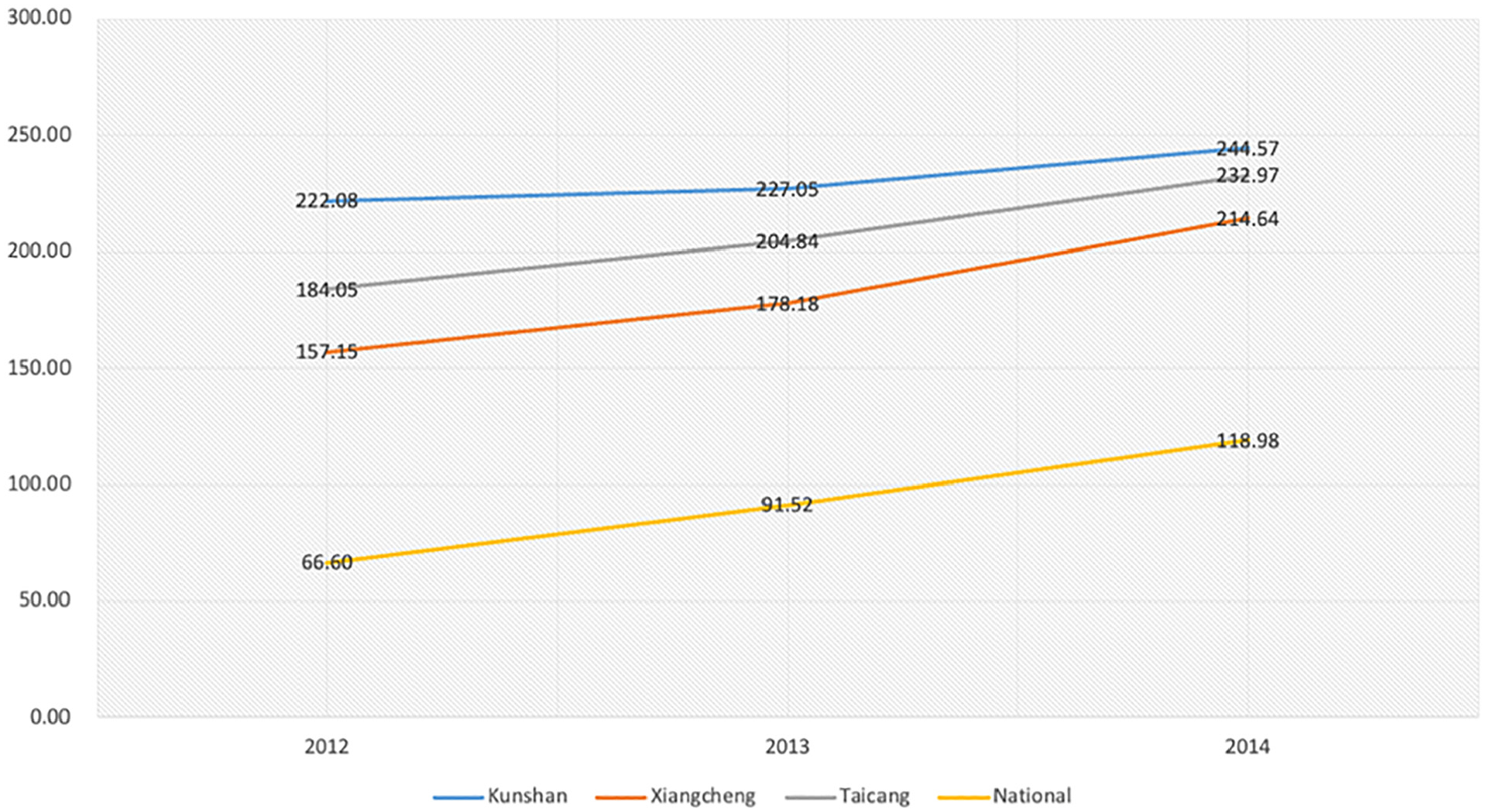
Scores of sustainable AIPs in the case study.
Discussions
In this study, the sustainable development evaluation system of AIPs is constructed and tested by using a multi-attribute decision making method. The results of this study yield several theoretical implications.
First, unlike existing studies, this study establishes a framework to examine the determinants of AIP sustainability. Recently, several pieces of research on AIPs have emerged from the angle of industrial ecology as applied to agriculture (Nuhoff-Isakhanyan et al., 2017). Differently, grounded in the literature on industrial ecology and AIPs, this study explores the comprehensive structure of sustainable AIPs. Moreover, the internal connection and causal relationship among the elements of the structure are further explored, as to make the decision makers more targeted to carry out scientific management of agricultural industrial parks. Second, on the basis of the existing evaluation of industrial parks from the main perspectives (economic, social, and technological), this study introduces the dimension of sustainability. At the same time, combined with the characteristics of agricultural production, the selected subcriteria are agricultural specific criteria; therefore, our evaluation system comprehensively reflects the level of AIPs in terms of industrial parks, agricultural industries, and sustainability, which is a new supplement to the existing studies on eco-friendly industrial parks. Last, this study uses the DEMATEL technique to analyze the relationship of the causal interaction between success factors, which would help to formulate the long-term success of blockchain application strategies. Meanwhile, the uncertainty caused by expert judgment can be minimized as well. Then, the results of the DEMATEL technique also provide factors for prioritizing sustainable AIPs. Based on this, the real data set is used to test the evaluation system and reasonable results are obtained.
This study generates several important managerial implications as well. First, based on the relationships of subcriteria for sustainable AIPs, economic criteria still play a key role in the sustainable development of AIPs (Wei et al., 2020). This finding also echoes the research of Singh et al. (2022), which highlighted the social and environmental aspects of development projects associated with economic criteria. According to DEMATEL analysis, “Agricultural standardization level” and “Agricultural industrialization level” are the most important economic subcriteria, followed by “Scale management level,”“Agriculture labor productivity,” and “Grain production level.” In addition, the level of agricultural standardization and industrialization is influenced by almost all causal factors, which in turn influence most of the effect factors. The findings suggest that managers of AIPs can focus on agricultural standardization and industrialization, and strive to improve the quality, ecology, safety level, and standardized production of agricultural products. In particular, the certification of pollution-free agricultural products, green food, and organic food should be strengthened to increase the proportion of these products in the total output of local edible agricultural products.
Second, further investigation of the relationships of subcriteria for sustainable AIPs shows that all subcriteria under technological criteria are cause factors, while all subcriteria under sustainability criteria are result factors. Moreover, there is no significant causal relationship between all the subcriteria under the sustainable criterion and the subcriteria under other criteria. The management implications of this finding are that it is difficult for managers to promote sustainability through economic, social, or technological measures. Therefore, it is necessary to establish a special sustainability management system to promote the various subcriterion of sustainability in a targeted manner, so as to improve the performance of the sustainability of AIPs, especially for the new technologies in Industry 4.0, such as blockchain (Lim et al., 2022; Nara et al., 2021; Singh et al., 2022).
Finally, by taking China as an example, it can be seen that the sustainable development level of AIPs in economically developed areas is significantly higher than the national average. In addition, through the comparison of the survey years, it can be found that the sustainable development level of China’s AIPs has a trend of increasing year by year. This is a welcome trend for policymakers, who need to maintain the favorable industrial policies already in place. At the same time, it can also learn from the policies or specific practices of economically developed areas and promote them nationwide, so as to improve the sustainable development level of the agricultural industrial parks all over the country. The Chinese government’s National Agro-Industrial Park Demonstration project is a model for other developing countries.
As with any study, this work has several limitations. First, the DEMATEL technique integrates the view of experts in multiple fields, but the limitations of generalization remain. Also, experts come from academia and industry; however, their fields have not yet covered all agro-industrial fields, and scholars may have their own preferences on industrial park or agricultural research. In general, future research should use experts from more positions and academics from a broader range of agricultural or industrial research fields. However, the results obtained by DEMATEL are acceptable, because the characteristics and processing capacity of its technology determine the corresponding data collection and analysis results from representative industry experts and related scholars. Second, three AIPs located in one city and a fictitious AIP representing the national average are analyzed through a case study. Future studies should use more data to verify its generality.
Footnotes
Appendix
Results of sustainable AIPs evaluation in the case study.

| Subcriteria | Weight | 2014 | 2013 | 2012 | |||||||||
|---|---|---|---|---|---|---|---|---|---|---|---|---|---|
| Kunshan | Xiangcheng | Taicang | National | Kunshan | Xiangcheng | Taicang | National | Kunshan | Xiangcheng | Taicang | National | ||
| I11 | 19.45 | 8.59 | 12.32 | 13.18 | 9.32 | 8.45 | 9.09 | 13.74 | 8.21 | 7.67 | 12.85 | 11.36 | 6.67 |
| I12 | 19.99 | 4.08 | 0.00 | 17.70 | 3.59 | 3.51 | 3.18 | 15.34 | 3.67 | 2.53 | 1.06 | 19.99 | 5.38 |
| I13 | 20.02 | 19.59 | 6.39 | 6.81 | 1.28 | 19.59 | 2.56 | 8.52 | 0.43 | 20.02 | 3.83 | 11.50 | 0.00 |
| I14 | 17.95 | 9.10 | 3.16 | 11.12 | 15.92 | 8.34 | 2.40 | 12.51 | 16.56 | 10.87 | 0.00 | 12.89 | 17.95 |
| I15 | 19.27 | 19.27 | 12.39 | 13.30 | 0.89 | 15.80 | 11.38 | 11.90 | 0.49 | 13.77 | 5.35 | 10.32 | 0.00 |
| I21 | 19.16 | 14.14 | 14.21 | 19.16 | 3.49 | 14.14 | 14.21 | 14.21 | 1.39 | 14.21 | 14.21 | 13.52 | 0.00 |
| I22 | 18.44 | 1.47 | 18.44 | 3.84 | 0.26 | 3.20 | 17.10 | 3.59 | 0.06 | 0.77 | 16.14 | 3.27 | 0.00 |
| I23 | 18.78 | 18.78 | 6.35 | 1.91 | 0.68 | 18.44 | 8.08 | 3.79 | 0.34 | 18.47 | 7.92 | 3.70 | 0.00 |
| I24 | 19.43 | 12.47 | 7.34 | 10.74 | 12.63 | 12.47 | 1.08 | 11.12 | 12.14 | 12.95 | 0.97 | 9.77 | 9.50 |
| I25 | 17.44 | 17.44 | 16.73 | 17.01 | 3.71 | 14.65 | 13.92 | 14.41 | 1.74 | 11.73 | 11.18 | 11.53 | 0.00 |
| I31 | 18.90 | 18.90 | 8.41 | 12.05 | 1.40 | 18.90 | 7.05 | 11.11 | 0.08 | 18.90 | 7.21 | 10.09 | 0.00 |
| I32 | 18.52 | 18.52 | 11.63 | 17.00 | 4.74 | 18.09 | 9.05 | 16.80 | 2.24 | 17.66 | 4.74 | 16.80 | 0.00 |
| I33 | 19.06 | 5.49 | 19.06 | 16.07 | 10.08 | 5.29 | 10.08 | 11.38 | 4.89 | 5.39 | 10.08 | 4.99 | 0.00 |
| I34 | 18.46 | 13.05 | 18.46 | 9.93 | 9.64 | 8.88 | 11.28 | 5.29 | 6.00 | 8.17 | 1.23 | 0.00 | 3.53 |
| I35 | 18.17 | 17.20 | 18.17 | 17.85 | 10.42 | 17.04 | 17.69 | 17.69 | 7.44 | 17.01 | 17.52 | 17.36 | 0.00 |
| I41 | 16.67 | 14.17 | 12.50 | 16.67 | 15.00 | 14.50 | 10.67 | 7.42 | 15.92 | 12.92 | 12.92 | 0.00 | 13.34 |
| I42 | 17.12 | 4.98 | 4.98 | 4.98 | 9.37 | 0.00 | 6.88 | 4.98 | 6.39 | 4.98 | 17.12 | 7.86 | 10.24 |
| I43 | 16.36 | 16.36 | 8.18 | 9.54 | 5.45 | 16.36 | 8.18 | 8.18 | 2.73 | 16.36 | 1.36 | 8.18 | 0.00 |
| I44 | 15.91 | 10.96 | 15.91 | 14.09 | 1.11 | 9.40 | 14.31 | 12.88 | 0.81 | 7.71 | 11.45 | 10.93 | 0.00 |
| Total score | 244.57 | 214.64 | 232.97 | 118.98 | 227.05 | 178.18 | 204.84 | 91.52 | 222.08 | 157.15 | 184.05 | 66.60 | |
Declaration of Conflicting Interests
The author declared no potential conflicts of interest with respect to the research, authorship, and/or publication of this article.
Funding
The author disclosed receipt of the following financial support for the research, authorship, and/or publication of this article: This work was supported by China Postdoctoral Science Foundation [grant no. 2021M690654]; Jiangsu University Philosophy and Social Science Research Major Project [grant no. 2021SJZDA033]; the Suzhou Agricultural Modernization Research Center Soft Science Project.
