



Abstract
The establishment of national experimental teaching demonstration centers (NETDCs) in China has played an important role in improving the experimental teaching level in universities and colleges, promoting scientific research, and cultivating innovative talents for national- and region-level innovations. However, how to promote the sustainable development of NETDCs in China is becoming a critical issue. This paper constructs a new theoretical model for evaluating the sustainable development of NETDCs in China. This model consists of 5 dimensions (i.e., environmental, structural, human, teaching, and output entropies), 11 primary indicators, and 34 secondary indicators. A multidimensional scale for evaluating the sustainable development of NETDCs was developed and validated based on 24,483 questionnaires from 895 NETDCs in China. The results show that the development level and overall level of NETDCs in China for all 11 primary indicators are uneven. Policy measures for promoting the sustainable development of NETDCs are proposed and discussed.
Keywords
Introduction
The Chinese government has been implementing national education reform plans to enhance the quality of undergraduate teaching in universities and colleges (Song, 2020). The project to establish national experimental teaching demonstration centers (henceforth, NETDCs) in China is a national education reform plan with Chinese characteristics aiming at improving undergraduate experimental teaching in universities and colleges nationwide. Establishment of NETDCs is an important measure of enhanced educational practice, higher level management, and better educational quality in China (Fan, 2016). The project started in 2005; after 15 years of continuous promotion and development, the construction of NETDCs has made remarkable achievements in training innovative talent for national- and region-level innovations (Yoon et al., 2020). There are currently 895 NETDCs in China, covering all 13 disciplinary categories and 31 province-level regions (Table 1); they are distributed in 392 universities and colleges (Chen et al., 2015; Gao, 2018; Gao & Li, 2017; Pan et al., 2015; Qian et al., 2019).
Province-Level Region Distribution of NETDCs in China.

Despite NETDCs’ periodic achievements, with the completion of the construction of NETDCs and the gradual deepening of teaching reform in China, high level sustainable development of NETDCs is still facing many bottlenecks and difficulties (Qian et al., 2019; Redclift, 2018). Sustainability is a critical national- and region-level issue (Bailey et al., 2018). In particular, sustainable development is an important goal of global universities and colleges (Lozano et al., 2013). Advancing the evaluation of the sustainable development of NETDCs is essential for the future of higher education. Therefore, the following issues have become the foci and difficulties in the construction of current NETDCs: How can the current development status of NETDCs be systematically evaluated? How can sustainable development of NETDCs be effectively promoted in the future?
At present, numerous scholars have conducted research on experimental teaching and laboratory construction from many different perspectives in Chinese universities (Chen et al., 2015; Gao, 2018; Gao & Li, 2017; Pan et al., 2015). For example, Qian et al. (2019) found that the degree of importance, management position, incentive methods, fund raising, management system, and collaborative development are the key issues facing the sustainable development of NETDCs in China. Zhang (2008) proposed the opening and sharing of university laboratory resources nationwide. Fan (2016) proposed measures to strengthen the training of experimental teachers in universities. Taking the “mechanical basis” and “mechanical engineering” NETDCs of Xi’an Jiaotong University as examples, Wang et al. (2018) elaborated the practice of the conceptual construction of NETDCs in the “new engineering” context from the aspects of the construction of the central hardware platform, the experimental teaching system, and the teaching mode. Although existing studies are insightful, they have not yet provided in-depth and systematic answers to the abovementioned foci and difficulties.
Therefore, this study aims to determine the core dimension of assessing the sustainable development of NETDCs, clarify the key factors to achieve sustainable development of NETDCs, and improve our understanding of the sustainable development pattern of NETDCs. Moreover, by constructing and validating the evaluation scale and metrics, this study provides monitoring tools to bridge the gap between the actual and the expected level of current sustainable development and offers the management basis and policy recommendations for the future development of NETDCs to NETDCs and their competent authorities. Overall, this study contributes to research and practice on the sustainable development of universities and the associated public policy measures.
Theoretical Model
Theoretical Foundation
NETDCs are social organizations and typical complex system organizations (Simon, 1977). Entropy theory has been widely applied to the study of the sustainable development of enterprises and social organizations (Martínez-Berumen et al., 2014). According to the management entropy theory, the irreversible process of organizational development from order to disorder also determines the process of decreasing management performance, which is the law of diminishing management efficiency (Ren, Yu et al., 2001). The main factors affecting management entropy are the organizational structure, people, information channels, policies, environment, culture, and systems (Ren, Zhang et al., 2001). Entropy theory, management entropy theory, and the accumulated research results in related fields provide a knowledge framework for exploring the sustainable development of NETDCs (Redclift, 2018). Therefore, this study builds a theoretical model of and index system for the sustainable development evaluation of NETDCs on this basis.
Model Construction Process
The model construction process consists of three stages.
Stage 1: Determining the core dimensions and indicators of the evaluation model based on management entropy theory. In this stage, the core dimensions for assessing the sustainable development model of NETDCs is determined and the evaluation indicators of each dimension are screened based on management entropy theory and previous research (Büyüközkan & Karabulut, 2018; Qian et al., 2019).
Stage 2: Revising the evaluation index system through expert interviews. In this stage, experts involved in the construction and management of NETDCs were interviewed to obtain their opinions and suggestions to revise the index system of the evaluation model in Stage 1.
Stage 3: Re-revising the evaluation index system based on the results of the questionnaire. The questionnaire was designed according to the index system of the evaluation model in Stage 2 and was distributed in China. From the results of the data analysis obtained, the index system is revised and adjusted again to form the theoretical model for assessing the sustainable development of NETDCs.
Model Construction Steps
This study adopts a three-step strategy. First, based on the above-mentioned ideas and management entropy theory, sustainable development of NETDCs is divided into five dimensions: environmental, structural, human, teaching, and output entropies. From the definition of management entropy, environmental entropy mainly refers to the social or internal environment of the system. The environment, including safety, instruments, equipment, and funds, is the material basis and external guarantee of the effective operations of NETDCs, which is equivalent to the “ecosphere” in which NETDCs operate. Structural entropy mainly refers to the organizational structure expressed by the management mode and the management rules and regulations of NETDCs. Human entropy mainly refers to human resources and behavior and is mainly expressed by the experimental teams of NETDCs. Teaching (operational) entropy mainly refers to the operating and production status of the organization, which is mainly expressed through the experimental teaching process of NETDCs. Output (economic) entropy mainly refers to the business results and income status expressed by the teaching results of NETDCs, students’ scientific research achievements, university–enterprise cooperation, and the sustainability of the experimental output. On this basis, combined with the related research and discussion of the sustainable development of NETDCs, this paper theoretically analyses and summarizes 11 primary indicators, including the management model, management rules and regulations, funds, experimental teaching, experimental team, personnel training, teaching results, physical output sustainability, equipment, environment and safety, and school-enterprise cooperation, and their corresponding 39 secondary indicators.
Second, this study selects relevant experts from Beijing, Zhejiang, Shanghai, and Jiangsu for interviews. The interviewees were engaged in the construction and management of NETDCs for a long period of time and have rich practical experience in education and management. After the investigation, the experts affirmed the research concept of drawing on management entropy, agreed with the 5 dimensions and the 11 primary indicators and also thought that the design was more reasonable than others. Simultaneously, the experts proposed suggestions for the secondary indicators. Based on their recommendations, this study further revised the indicator system built in the first step.
Third, a small sample questionnaire survey on NETDCs was conducted. In terms of the analyzed results of the survey data, a model of the NETDC for sustainable development evaluation of NETDCs was finally formed through the corresponding modification, deletion, and improvement of the indicators. The final model consists of 5 dimensions, 11 primary indicators, and 34 secondary indicators (Figure 1).

Theoretical model for the sustainable development evaluation of NETDCs.
Research Methods
Questionnaire Design
The questionnaire used in this study consists of three parts. The first part asks the respondents to provide their basic information. The second part asks the respondents to score the 34 secondary indicators in the sustainable development evaluation theory model (e.g., “The experimental teaching concept of the NETDC is clear with the goal of promoting the coordinated development of students’ knowledge, ability, and quality.”) using a five-point Likert scale (“1” indicates strongly disapprove and “5” indicates strongly approve). The third part asks the respondents to score one measurement item (i.e., “Overall, the sustainable development level of the NETDC where I am located (or administered or taught) is very good.”) using a five-point Likert scale (“1” indicates strongly disapprove and “5” indicates strongly approve) to comprehensively evaluate the overall level of the sustainable development of the NETDC.
Sample and Data Collection
With the support of the Laboratory Office of the Department of Higher Education of the Ministry of Education of China, the study conducted an online survey of 895 NETDCs in China from the end of 2018 to early 2019. The respondents were mainly managers, teachers, and students of NETDCs; university administrators; and provincial education administrative department management personnel. In this study, a total of 24,483 questionnaires were collected, of which 24,062 questionnaires were valid, for an effective response rate of 98.28%.
Results and Analysis
Reliability and Validity of Measures
We took several steps to ensure the reliability and validity of the measures. Table 2 shows that the internal consistency coefficients (Cronbach’s α coefficients) of the 11 primary indicators (experimental teaching, management rules and regulations, physical output sustainability, personnel training, management model, experimental team, environment and safety, university–enterprise cooperation, funds, instruments and equipment, and output of teaching results) in the theoretical model of the sustainable development evaluation of NETDCs are all above .7. This finding indicates that the measurement of these primary indicators has good reliability.
Measurement Reliability and Convergent Validity Test.

Confirmatory factor analysis was used to test the overall fitness of the theoretical model of the sustainable development evaluation of NETDCs and the validity of its 11 primary indicators. The results of the confirmatory factor analysis show that the measurement model of the 11 primary indicators has a good overall fit when each pair are correlated (χ2 [df = 418] = 7,882.34, p < .001; RMSEA = 0.03; SRMR = 0.01; TLI = 0.99; CFI = 0.99). Table 2 shows that each factor is attributed to the corresponding primary indicator and all the standardized factor load estimates are significant (p < .001). Moreover, their composite reliabilities are all above .7. Therefore, the measurement of these primary indicators has good convergent validity. The confidence interval of the correlation coefficient estimates of the 11 primary indicators in the above-mentioned measurement model does not contain 1. Therefore, the measurement of these primary indicators has good discriminant validity (Anderson & Gerbing, 1988).
Statistical Analysis
Table 3 shows the scores given by the respondents to the 11 primary indicators and the overall level of all samples. The table also shows that the average scores of the 11 primary indicators, from large to small, are experimental teaching, management rules and regulations, the management model, environment and safety, the experimental team, physical output sustainability, instruments and equipment, personnel training, teaching results output, funds, and university–enterprise cooperation. Moreover, only the scores of experimental teaching, management rules and regulations, and management mode are higher than the average scores. This finding shows that in China, the development and overall levels presented by the 11 primary indicators are uneven.
Scores of the 11 Primary Indicators and Overall Levels Reported by the Respondents in the Entire Sample.
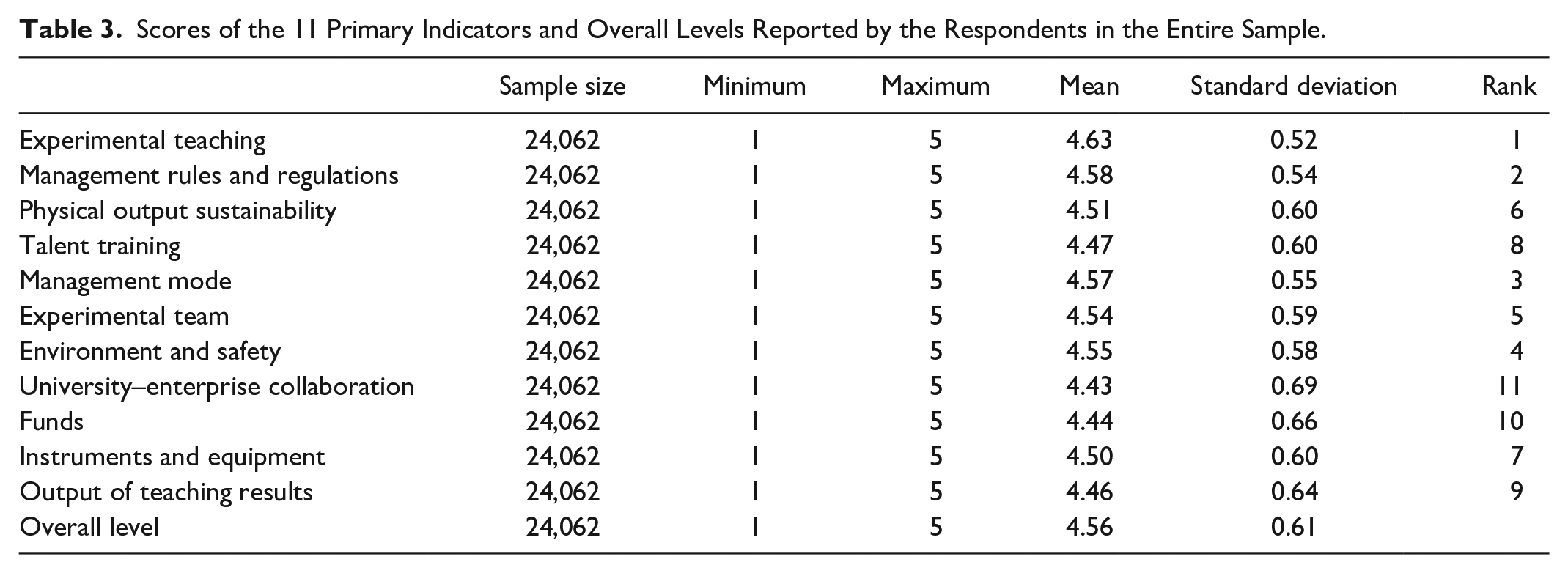
Table 4 shows the scores of the primary indicators and overall levels reported by respondents in different province-level regions in China. It shows that in different provinces, the development and overall levels presented by the 11 primary indicators are irregular.
Scores of the Primary Indicators and Overall Levels Reported by Respondents in Different Provinces.
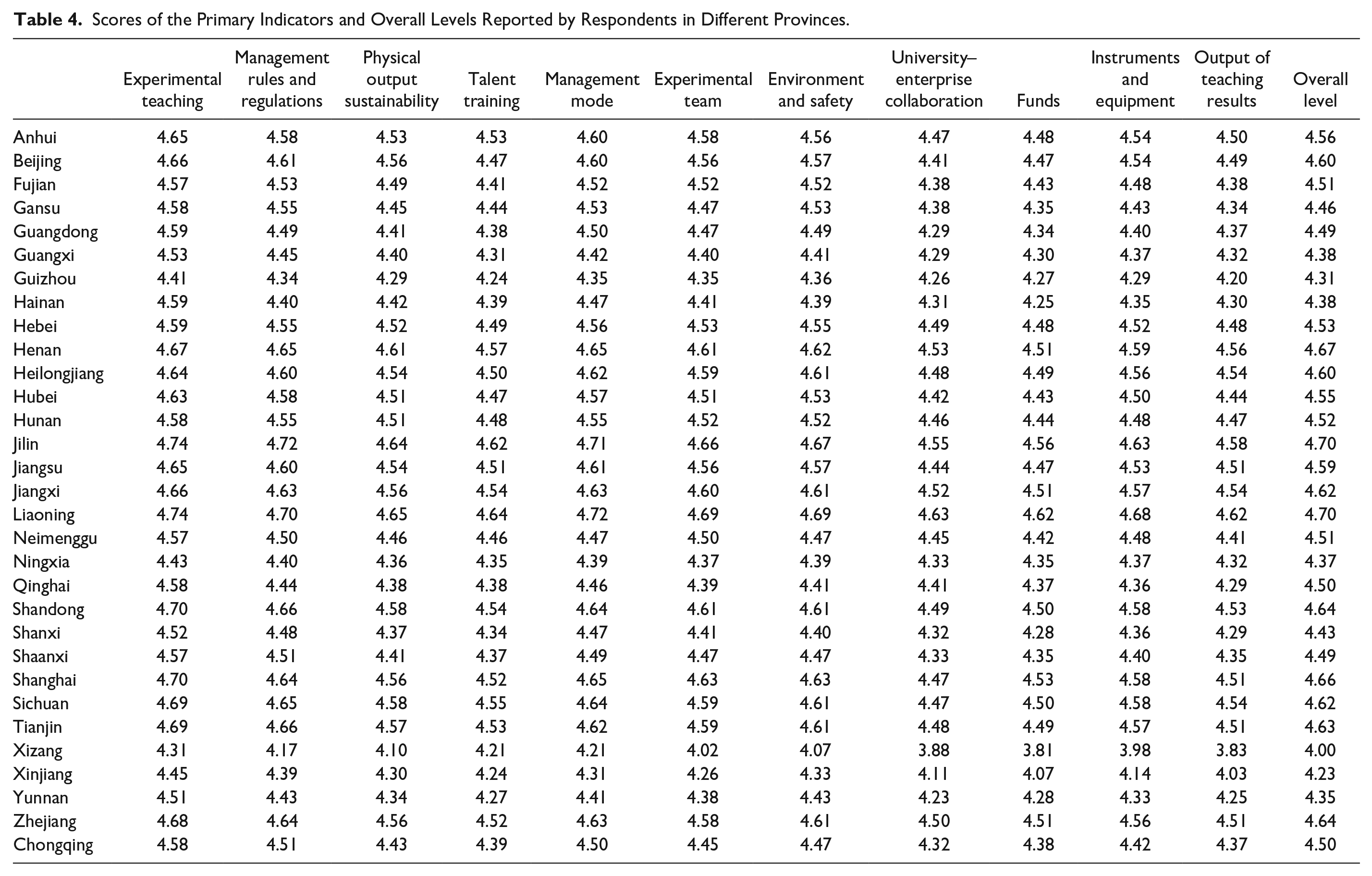
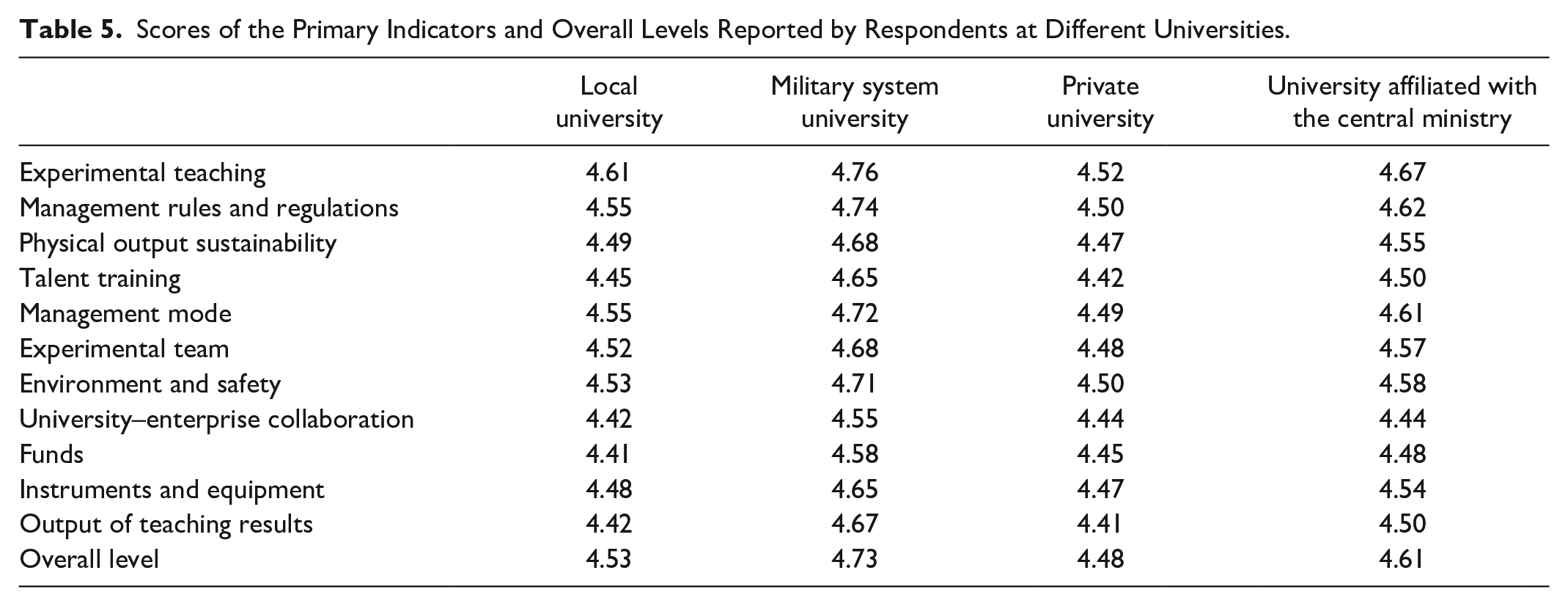
Table 5 shows the scores of the primary indicators and overall levels reported by respondents in different types of universities. The table shows that the top three types of universities regarding the average scores of university–enterprise cooperation and funds from large to small are: military universities, universities affiliated with the central ministry and private universities. Regarding the average scores of the other primary indicators, the top three types of universities from large to small are: military universities, universities affiliated with the central ministry and local universities. These results show that in different universities, the development and overall levels presented by the 11 primary indicators are different.
Scores of the Primary Indicators and Overall Levels Reported by Respondents at Different Universities.
Discussion and Policy Measures
Experimental teaching is an important method used to cultivate innovative talent (Yoon et al., 2020). The construction of NETDCs plays an irreplaceable role in cultivating university students’ innovation ability. Therefore, it is necessary to formulate corresponding policies to promote the sustainable development of NETDCs to ensure the sustainable innovation ability of future universities and promote “co-creation for sustainability.” We propose public policy measures for promoting the sustainable development of NETDCs from two perspectives, namely, higher education authorities and institutions (e.g., universities and colleges). We believe that these policy measures have important implications for the sustainable development of NETDCs or similar centers in other developing countries.
Higher Education Authorities
Higher education authorities need to constantly strengthen the construction of the concept and requirements of NETDCs. Presently, the construction and management of NETDCs should start with the following three aspects.
First, the construction of NETDCs is an important measure for the state to promote the overall level of undergraduate experimental teaching. More NETDCs that are highly detailed with timely development should be constructed. The future emerging new experimental means for the renewal plan (e.g., the current national virtual simulation experimental center construction plan) should be included in the construction of NETDCs, forming a unified “large NETDC” development mechanism. The objective is to form a complete undergraduate experimental teaching ecosystem in the near future. Therefore, the first aspect is to establish the “large NETDC” construction concept and to promote the four “beneficial” developments of NETDCs: (1) integrate the experimental teaching resources of undergraduates in universities and colleges and continuously improve the overall experimental teaching level; (2) promote experimental teaching methods to keep pace with the times and constantly form and reform the characteristics of innovative and entrepreneurial talent at universities and colleges; (3) establish a “flagship” college teaching structure as the national goal of experimental teaching reform with unified standards and a unified image; and (4) solidify the achievements and good experience of the previous NETDCs and form a stable, healthy, and advanced mechanism for the long-term development of undergraduate experimental teaching.
Second, it is very important to focus on the bottleneck factors in the development of NETDCs and improve their management. The current operating data of NETDCs show that their development is unbalanced. Some indicators are well developed; some are ahead of their time; and some key indicators are seriously lagging behind, which have become the bottleneck of the sustainable development of NETDCs. Therefore, we should strengthen the classification, stratification, and step-by-step management of various indicators. The construction resources should gradually shift and tilt toward the bottleneck indicators while ensuring the steady development of NETDCs to realize the dynamic management and rotational development of the various operational indicators of NETDCs. The focus should be on continuing to strengthen the core teaching positions of NETDCs, innovate assessment mechanisms, establish a team incentive system, and strengthen the standardized management and use of the mechanisms to promote the reform and innovative development of NETDCs. Educational authorities should consider formulating detailed rules for the management and evaluation of NETDCs; strengthen the developmental path of NETDCs’ platforms, informatization, and modernization; formulate standards for the coordinated development and assessment of teaching in NETDCs (Xie et al., 2019); establish rolling developmental mechanisms, such as coordination, leading, assessment, communication, and training; and promote the development of a targeted “development plan and management norms of demonstration centers” for universities and colleges.
Third, the imbalance in the development and distribution of NETDCs should be taken seriously, and a sharing and mutual assistance mechanism for NETDCs should be established. For now, the imbalance in the development and distribution of NETDCs will persist. More seriously, universities and colleges in remote provinces of China not only have fewer NETDCs and weaker development but also have weaker experimental teaching institutions. There is a large gap between universities and colleges in remote provinces and universities and colleges in developed areas. This gap has become a clear shortcoming of NETDCs’ development (Ouyang et al., 2012). In the long run, this shortcoming will greatly weaken the functional positioning and construction of NETDCs and seriously affect the improvement of the overall experimental teaching level of universities and colleges. Therefore, higher education authorities must attach great importance to this imbalance while promoting the sustainable development of NETDCs. Special support policies should be introduced, and the corresponding sharing and mutual assistance mechanism should be established. Moreover, the demonstration sharing efforts of existing NETDCs should be increased. The objectives are for NETDCs to actively develop the experimental teaching levels in less developed areas and the relevant teacher training tasks of universities (Wang et al., 2013), fully fulfill the obligation of “hand-in-hand” help and truly achieve the historical mission of the sustainable development of NETDCs.
Universities and Colleges
For universities and colleges, the initial intention of NETDCs must not be forgotten, and the tasks and challenges posed by the future changes in higher education for the sustainable development of NETDCs must be gradually realized. As the “national team” and “flagship” of Chinese undergraduate experimental teaching, NETDCs will face the following three tasks and challenges in the future.
First, according to the high standard requirements of “new engineering,” “new medical science,” “new agriculture,” and “new liberal arts,” the training positioning and specifications of experimental teaching will be reconstructed. A series of innovative educational reform actions, such as “new engineering” and “new medical science,” provide higher structural guidelines for the development of higher education in the new era (Ye & Zhang, 2020) and have a new interpretation and high standard requirements for the orientation and training of talents. Specific experimental teaching reform requires NETDCs to adopt high standards and urgently change the “theory cognition and knowledge transfer”-based traditional experimental teaching training model into a “problem discovery, problem positioning, problem solving”-based comprehensive capacity training target system (Mei et al., 2014) and actively explore the implementation of innovation training goals of the path and methods to continue to play the roles of “demonstration” and “leading” in the era of innovative education reform.
Second, according to the developmental trend of the “new form of industry,” the teaching methods and organization form of experimental teaching will be reconstructed. In the future, the “new form of industry” will show subversive developmental characteristics in terms of scale, politics, industry, technology, and humanities (Ye & Qian, 2017). In the field of higher education, this requires the integrated reform of education and the cultivation of talents. In addition, the integration of cross-disciplinary and cross-capacity has become the consensus of talent training in universities and colleges. This change requires that NETDCs bear the brunt and urgently innovate the existing model of experimental teaching. It is essential to use advanced technology to transform the concept of experimental teaching. This process includes changing of organizational form of the experimental classroom similar to the theoretical classroom, changing the teaching method with the “passive operation” of students (Yuan et al., 2019), and transitioning from teaching-centered to student-centered in teaching practice (Li et al., 2010; Norton & McCloskey, 2008). It is necessary to build new era experimental teaching content based on the completion of specific comprehensive experimental projects and a new era experimental teaching method for the organic convergence of knowledge and skills (Zhong et al., 2015). Furthermore, we should build a more flexible form of an experimental teaching organization (Li & Lin, 2011) and fully recognize the important roles of the student competition team, undergraduate college, teaching school alliances (Dowling, 2016), and other innovative forms in line with the future “new form of industry” development for integrated education.
Third, according to the talent demand of “problem solving,” the experimental teaching quality standards and evaluation methods will be reconstructed. Experimental teaching plays an increasingly important role in the cultivation of students’ innovative spirits and practical abilities (Antony et al., 2019; Hunter, 1977). The “problem solving” ability is the basic characteristic of talent in the new era. Moreover, the core of higher education reform is to improve the quality of personnel training and completely solve the problem that talent training is out of touch with the development of the times (Wu et al., 2012). Therefore, China has issued numerous documents and opinions to improve the quality of undergraduate teaching, and these have been strictly implemented in higher education. In this case, NETDCs must perform the following: grasp the pulse of the times; actively examine and reflect on the quality standards and evaluation models of experimental teaching; consciously set the requirements for the construction quality of “world class universities and disciplines”; reconstruct the evaluation standards of experimental teaching to be in line with the requirements of the development of the new era; completely change the evaluation of the specific knowledge of students in the past; change the old quality evaluation status of “performing an experiment, writing a report, and receiving a score” of students in experimental teaching; let students evaluate the teaching effect of the course (Antony et al., 2019; Barone & Lo Franco, 2009); and speed up the establishment of quality standards and evaluation systems with the main features of “student-centered, output-oriented, and continuous improvement” (Wei et al., 2019; Zhang et al., 2018; Wen et al., 2012).
Limitations and Future Research Directions
This research has limitations that may offer significant opportunities for future studies. On the one hand, we focused exclusively on the NETDCs in public universities and colleges and thus our theoretical model for evaluating the sustainable development of NETDCs might not be generalized to experimental teaching demonstration centers in private universities and colleges or other settings. Therefore, future research may use samples from different settings to ascertain the generalizability of our theoretical model. On the other hand, the adoption of our policy measures for promoting the sustainable development of NETDCs needs to be cautious. This is because China’s education regime is different from that of other countries. Although the construction, operation and management of China’s NETDCs are undertaken by public colleges and universities, China’s Ministry of Education has played a decisive role in guiding, evaluating and supervising. Therefore, we encourage future research to propose appropriate policy measures for specific education regimes in different countries.
Concluding Remarks
This study constructs a novel theoretical model for evaluating the sustainable development of NETDCs in China. The model consists of 5 dimensions (i.e., environmental, structural, human, teaching, and output entropies), 11 primary indicators and 34 secondary indicators. This study develops and validates the multidimensional scale for evaluating the sustainable development of NETDCs. This study demonstrates that the development level and overall level of NETDCs in China in terms of all 11 primary indicators are uneven and proposes policy measures for promoting the sustainable development of NETDCs. The sustainable development of NETDCs is fostered through strong higher education authorities and institutions and policy measures. We hope that this study will motivate future research to build on and further develop our evaluation metrics and public policy measures in different countries and region.
Footnotes
Declaration of Conflicting Interests
The author(s) declared no potential conflicts of interest with respect to the research, authorship, and/or publication of this article.
Funding
The author(s) disclosed receipt of the following financial support for the research, authorship, and/or publication of this article: This research is supported by the key project of laboratory management of Chinese Association of Higher Education in 2017 (Grant No. 2017syszd08). All views expressed are those of the authors and not of the sponsoring organization.
