




Abstract
Living spaces have been recognized as one of the functional spaces of housing. Materials and textures are regarded as some of the features of the space. The present study sought to analyze the components of the different materials (brick, stone, glass, metal, concrete, and wood) and their semantic role in living spaces. The materials’ characteristics were coded and then semantic differentials was conducted to quantify the measurement. The significant factors of materials were defined as acceptability, motivative, capability, and resistance for brick; persistence, admiration, and purity for concrete; creativeness, resilience, and capacity for wood; fatigue and limpidity for glass; strength and durability for stone; and minimal and interweaving for metal. The results of the present study indicated that the implicit meaning of acceptability in brick was based on nostalgia, traditionality, and warmth. Furthermore, the industriality, modernity, coldness, and artificiality of concrete represented the explicitness and transparency and the industriality of glass indicated limpidity. The resilience of wood was based on stagnation, strength, and solitude. Finally, the rigidity, beauty, and coldness of stone indicated the power and strength, while simplicity, solitude, and stress-induced demonstrated the tangle of metal that can affect the application and achievement of desired living space.
Introduction
The effect of the surrounding environment on different individuals varies depending on how they perceive the environment. Norenzayan and Heine (2005) found that psychological phenomena could be universal or nonuniversal. There has been prior studies on the importance of context in human–environment interactions (Gifford, 2014). According to Owe et al. (2013), individuals’ beliefs about the significance of context in understanding people differs cross-culturally. It has also demonstrated that the cultural milieu affects the physical reality of spaces. With this viewpoint, scholars can examine whether psychological processes regarding people’s interactions with their settings vary or not across culturally diverse populations (Tam & Milfont, 2020). Housing as one of the environments in which human spends most of their time includes several spaces by respecting the individuals’ needs. Living space is considered one of the most important spaces. Based on the experiences, the surrounding visual environment can influence individuals’ moods and behavior (S. Kunishima et al., 2005). Architects pay more attention to the aspects related to the concept of structural implementation and functional needs during the selection of materials (Fernandez, 2012; Hegger et al., 2008) and less attention to emotions and their effectiveness during their application. Considering observations, designers choose materials based on their experiences (Ashby & Johnson, 2014; Pallasmaa, 2012). The role related to the sensory aspects of materials begins by considering the action and interaction between materials and the user (Lederman et al., 1985).
The present study aimed to attain the architectural design solutions for the desired living space linking with the internal spirits of residents. Accordingly, the choice of the appropriate materials based on the individual spirit for the wall of living space was identified as important, and was consequently assessed. The three components of sensory, physical, and functional features were obtained for space, elements, and materials using the grounded theory method. Then, the components were converted to trait pairs through semantic differential technique and the estimation of these trait pairs were separately considered for each kind of material.
Literature Review
The term “interior architecture” emerged as a discipline that applies the history of architecture and architectural theory for design and creation of interior space in the 1970s. It is regarded as an activity to define space, create the effects and produce well-being through manipulation of three-dimensional space and using the sensory stimuli of sound, touch, smell, and sight as main parts of the interior experience (Coles & House, 2007).
Interior design includes the selection of interior elements and their syntax within spatial enclosure to fulfill specific aesthetic and practical needs. The syntax of elements in the space involves the action of construction patterns (Ching & Binggeli, 2018). Shaterian (2010) defined interior design as a set of actions to optimize or change the interior space of the building with respect to structure, the syntax of elements, light, and color. Interior architect deals with the details of the human living space at a more accurate level compared to that architect. In fact, interior architecture has brought life into the living space (Kasraei, 2009).
According to Ando (1997), good architecture is not just about primary functions. Architects must also consider secondary and tertiary functions, and even beyond that. The space is considered a place for many senses including sight, sound, touch, and the unaccountable things that occur in between. The selection of materials in architecture fulfills more than one purpose. During the material selection process for an architecture project, the material’s appearance and sensory behavior play a significant role in design, while also meeting technical requirements (Malnar & Vodvarka, 2004). Architects take into account aspects related to user’s experience or sensorial stimulation such as color or visual texture during the materials selection process, along with assessing the performance aspects such as the material’s durability and compression strength (Wastiels et al., 2007).
Soliman (2013) studied the different aspects that relate to material selection and the perception levels of the material as a standard for the spaces. Also, the material’s role in the building has been addressed, and assessed the perception levels of materials such as form (aesthetic), functional, interactive virtual, and non-perception level. The building material is classified into natural such as wood and leather, composite such as concrete and clay, and fabricated materials such as metals (steel, aluminum, copper, and bronze), glass, brick, ceramic, refractories, plastics, and paints. Due to the common orientation related to environmental sustainability and scarcity of natural resources, scholars resorted to the composite and fabricated interior materials giving an impression of natural ones.
In a survey study, Nyrud and Bringslimark (2010) extracted the features of interior space that result in protecting the health of users. Previous studies have focused on preferences toward natural and non-natural materials in the indoor environment and possible health benefits (Guo et al., 2002; Ikei et al., 2017). The respondents in Austria, Finland, Canada, Norway, and Sweden were asked to give their opinion of the materials. For example, wood often was perceived as warm and environment friendly. Another group believed that public buildings could be modern and minimal, while housing could be warm and cozy.
A group of experts focused on the functional aspects of interior materials and indicated that these materials induced less warmth. Wood possesses some tactile properties in indoor environments. For the purpose of this study, the components such as color, light, material, texture, form, pattern, attention, perspective, beauty, memory, age, and gender have been extracted from the related studies (Table 1).
Components Mentioned in the Related Studies.

Methodology
The grounded theory (Glaser & Strauss, 2017) has been used as a general theory in the first step of the study. This theory is related to the previous research mode and considered an inductive and exploratory research method that could allow the researcher to theory building. Scholars have used grounded theory to analyze qualitative data from interviews in different disciplines and professions (Bryant & Charmaz, 2007; Yamazaki et al., 2009). An extremely large number of studies (Boddy, 2016; Dworkin, 2012; Sandelowski, 1995) have demonstrated that from 5 to 50 respondents is the minimum sample size required to reach saturation (Mason, 2010) in grounded theory studies that use in-depth interviews. Regarding the first step of the present study, three different spaces with various materials were provided to 10 accredited specialists’ in Housing Architecture. The interior materials were presented to the interviewees in random order by computer (Figure 1). They were involved in the housing development process and interior design of housing. For the recruitment of interviewees, the invitation letter was initially sent by email to the potential participant on the basis of their respective areas of expertise. They were also told that the interview aimed to know their opinions about the interior design of their housing. In this regard, all participants recruited were local or native to the culture. Furthermore, the interviewees were unaware of the main study objectives to avoid specific conflicts during interviews.
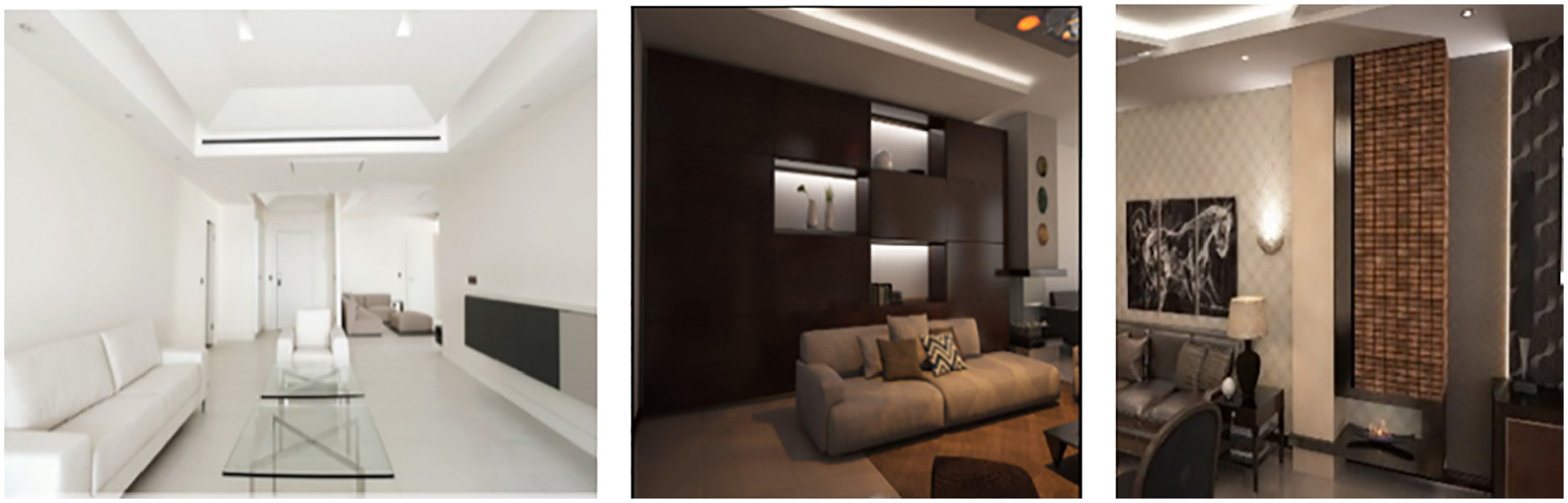
Different types of materials used for living spaces.
The interviews were transcribed and coded in terms of open, axial, and selective coding using the grounded theory. The results of the first interview were taken as a database consisting of the trait pairs of materials to 36 experts in the second step. These trait pairs were studied through semantic differential technique. This technique was developed based on the association of meanings, in which a stimulus such as the term “metal-concrete” is provided to the subject for assessing based on the bipolar features such as warmth-coldness and modernity-nostalgia and specifying what relationship can exist between stimulus and opposite features (Rafipour, 2019). Considering the level of participants’ understanding of the implicit and explicit meanings of terms, they selected their opinion for each material based on the initial assumption of the test for scoring, and finally mean was calculated. The data were evaluated by SPSS software, significant factors were specified and their relation was assessed. For each factor, the suggested categorical groupings involving its explicit and implicit concepts were obtained using experts’ opinions.
The semantic differential technique (Osgood et al., 1957) is considered the most common method to measure emotion and was used as an accurate and appropriate technique in psychological evaluation. Based on the suggestion, classifying words in the form of the traits placed along with each other determines an individual’s specific attitudes (Koleini Mamaghani & Khorram, 2008). The selected traits contain a set of semantic features of the topic under study to identify the main points. Semantic differential technique was developed to measure the emotional content of a word.
The scale describes the reaction of individuals to a concept and is constructed as a bipolar scale dealing with the sum of the scores related to each concept. In fact, it is also based on determining the degree of similarity between two concepts with respect to individual opinions. It has provided useful information regarding the individual’s attitude toward the concept. The scale development process can begin with the selection of the concept related to the study, while they are sensitive to the similarities and differences of the study group.
To attain the objective of the study, the trait pairs were selected for testing. Finally, the opposite traits were placed at the ends of the scale of intensity without any special arrangement among them.
These traits were assessed on an 11-point scale, scoring from 0 to 10. The mean of each feature is calculated after the end of the response period. Transforming qualitative concepts into quantitative values is considered one of its advantages. The semantic differential scale of material characteristics was coded into 14 categories. This type of rating scale can increase the accuracy of judgment.
The six materials of glass, concrete, stone, brick, wood, and metal were assessed in the present study. The characteristics were commonly defined for these materials and divided into opposite pairs. Further, the prepared instrument was sent to 36 experts in housing architecture and interior design through pre-existing contacts. The experts were the faculty members at the School of Architecture and Environmental Design. The possible cultural limitation of the sample was discussed by experts. There was a thoughtful argument for possible cultural and contextual factors. Samples of experts are usually nationally-representative.
Results
In the first step, a set of codes was obtained using the grounded theory and during the process of open coding, the codes from the interviews were sorted into categories. They were based on the same concepts. A phase of axial and selective coding led to the identification of new concepts. Finally, the three main categories, including sensory features, function, and form, were outlined for elements, space, and materials (Tables 2, 3 and 4).
Opinions About Materials and Their Coding Regarding Sensory Features.

Opinions About Materials and Their Coding Regarding Form.

Opinions About Materials and Their Coding Regarding Function.

Three categories were generally discussed for materials qualitatively in the previous section. In the second step, the components were quantified by the semantic differential method. In this regard, all features of materials were first extracted, grouped as opposite pairs, and finalized through Delphi rounds. Further, the significant factors of each material were tested, the relationships between features were recorded, and the significant factors related to each of the six materials were identified. It is worth noting that items having a factor loading of more than 0.60 were considered significant and each factor should have at least three variables with a factor loading of more than 0.40. For sample adequacy, the Kaiser-Meier-Olkin (KMO) coefficient was calculated as well as Bartlett’s test of sphericity. As the KMO coefficient was 0.78 and χ2 value was p < .05, it was decided that the factor analysis could be conducted.
Regarding brick, the five factors were generated by the factor analysis, among which four factors were retained. The first factor involved nostalgia/modernity, traditionality/industriality, and a sense of warmth/coldness. Beauty/ugliness, stagnation/dynamism, and opacity/transparency comprised the second factor, while the third factor was not formed. The fourth factor included simplicity/complexity, rigidity/flexibility, and tranquilizer/stress-induced. Finally, roughness/smoothness, weightiness/lightness, and strength/frangibility formed the fifth factor (Table 5).
The Factor Analysis Results of the Brick’s Characteristics.

Brick possessed four features: acceptability, motivative, capability, and resistance. Nostalgia (3.56), traditionality (3.06), and warmth (2.59) represented acceptability. The motivative of brick was based on the beauty (2.96), stagnation (7.96), and opacity (1.48). Rigidity (5.85), simplicity (7.19), and tranquilizer (2.81) indicated the capability of brick, and the resistance was based on roughness (3.04), weightiness (3.70), and strength (2.76).
Regarding concrete, the three factors were generated by the factor analysis. The first factor that was very similar to that of brick involved the components of artificiality/naturalness, modernity/nostalgia, coldness/warmth, and industriality/traditionality. Additionally, the components of rigidity/flexibility, smoothness/roughness, and strength/frangibility formed the second factor. Finally, the fifth factor included the components of beauty/ugliness, tranquilizer/stress-induced, and lightness/weightiness (Table 6).
The Factor Analysis Results of the Concrete’s Characteristics.
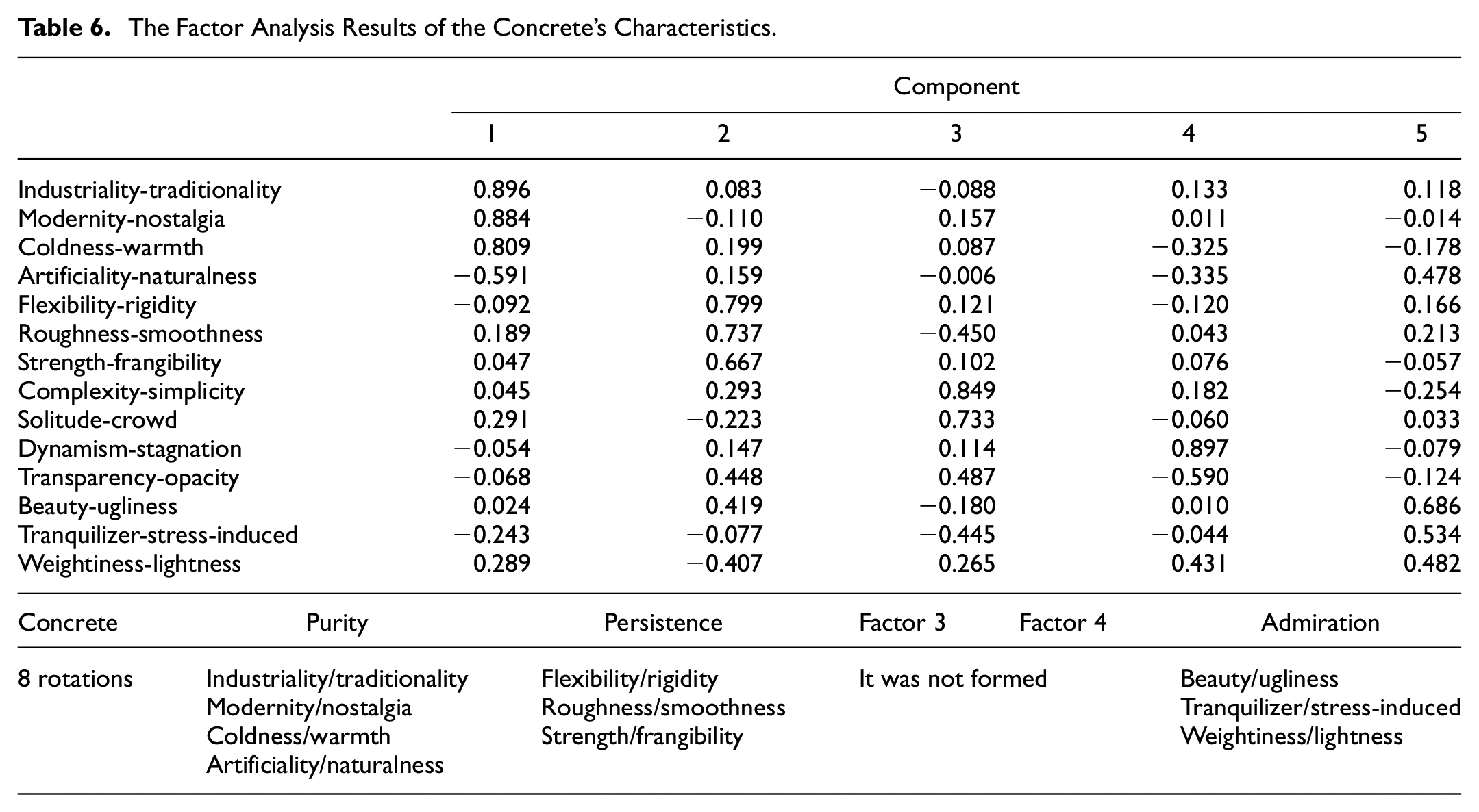
Purity, persistence, and admiration were regarded as the features of concrete. Industriality (8.83), modernity (8.72), coldness (8.22), and artificiality (7.63) represented explicitness, Persistence was based on rigidity (8.48), roughness (3.52), strength (1.56), beauty (3.46), stress-induced (5.09), and weightiness (2.17) referred to admiration.
The factor analysis produced three significant factors for wood. The first factor included the components of stagnation/dynamism, strength/frangibility, and solitude/crowd. The second and third factors were not generated. Further, traditionality/industriality, simplicity/complexity, and nostalgia/modernity formed the fourth factor. The fifth factor involved roughness/smoothness, beauty/ugliness, flexibility/rigidity, and lightness/weightiness. Furthermore, the sixth factor was not formed (Table 7).
The Factor Analysis Results of the Wood’s Characteristics.

The three factors of resilience, creativeness, and capacity were labeled for wood. The resilience of wood was based on stagnation (6.17), strength (3.72), and solitude (6.50). Traditionality (3.52), simplicity (7.22), and nostalgia (4.59) represented the factor of creativeness and finally, roughness (4.46), beauty (2.22), flexibility (4.85), and lightness (7.65) indicated the capacity of wood.
In the case of metal, two factors were constructed. According to Table 8, the first factor consists of three items, that is, simplicity/complexity, solitude/crowd, and stress-induced/tranquilizer. The second factor included modernity/nostalgia, industriality/traditionality, and coldness/warmth, while factors 3, 4, 5, and 6 were not significant.
The Factor Analysis Results of the Metal’s Characteristics.

For metal, minimal and interweaving were labeled as two factors. Simplicity (6.96), solitude (6.67), and stress-induced (7.41) represented the interweaving of metal and the minimal was based on modernity (9.30), industriality (9.41), smoothness (7.04), and coldness (9.22).
Two significant factors were identified for the stone. The first factor included rigidity/flexibility, beauty/ugliness, and coldness/warmth, as well as strength/frangibility, roughness/smoothness, and stagnation/dynamism formed the second factor, while other factors were not statistically significant (Table 9).
The Factor Analysis Results of the Stone’s Characteristics.

The power of stone was based on rigidity (9.28), beauty (3.74), and coldness (7.35). Additionally, strength (2.67), roughness (4.81), and stagnation (8.48) represented durability.
According to Table 10, two factors were formed for glass. The first factor involved smoothness/roughness, transparency/opacity, and industriality/traditionality and the second one was tranquilizer/ stress-induced, solitude/crowd, rigidity/flexibility, and strength/frangibility. Further, factors 3, 4, 5, and 6 were not constructed.
The Factor Analysis Results of the Glass’s Characteristics.

Smoothness (9.06), transparency (9.35), and industriality (7.80) indicated the limpidity of glass, and the fatigue was based on stress-induced (5.22), solitude (8.94), frangibility (8.48), and rigidity (6.07).
Considering these significant factors, a concept that involves all features and represents their relation is obtained using experts’ opinions. Figure 2 depicts the pairwise mean comparisons of materials.
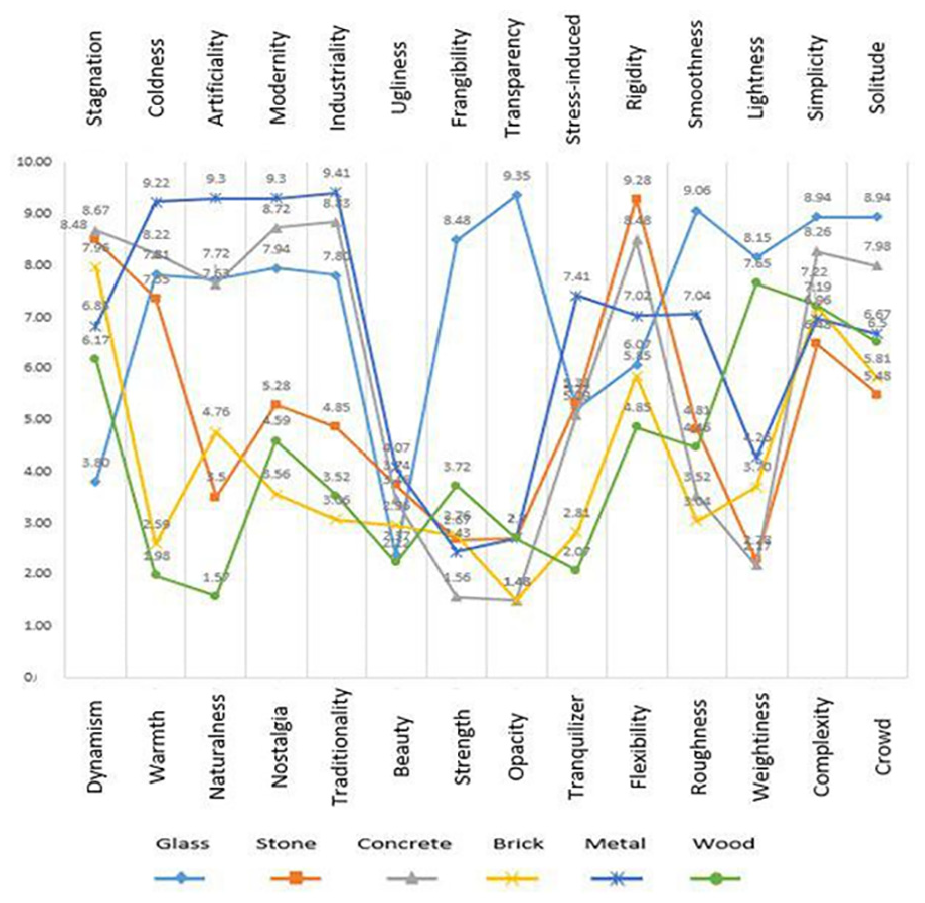
The pairwise mean comparisons of materials based on experts’ opinions.
In particular, Figure 2 shows the characteristic of each material, in which the materials having the score range of 0 to 5 and 5 to 10 define the sensory features of the materials. Additionally, a score closer to 0 or 10 indicates the intensity of its effectiveness.
Discussion
Study Overview and Results
Two techniques were used in the evaluation process to identify the perceptual-emotional effect of using materials in the living space. Function, form, and sensory features as the main fields of space, elements, and materials were specified in the first step. Regarding the second step, the sensory features of materials were assessed in a pairwise manner. Then, the identification of significant factors is obtained from the analysis of the pairwise comparison matrices. Finally, expressions were provided to elucidate intended factors based on the experts’ opinions. The results of the present study are summarized in Table 11.
Mean of the Set of Pairwise Comparisons of Material Characteristics Based on Experts’ Opinions.

Based on the results, each of the six materials induced different emotions in users in the living space. The most important emotions for each material are as follows: Glass possessed the most sense of dynamism, frangibility, transparency, smoothness, lightness, simplicity, and solitude as well as the maximum sense of rigidity, weightiness, complexity, and crowd were observed in stone. Concrete had the most sense of stagnation, strength, opacity, and weightiness. While nostalgia, traditionality, opacity, and roughness were identified for brick, and metal possessed coldness, artificiality, modernity, industriality, and stress-induced. Finally, the wood had the most sense of warmth, naturalness, beauty, tranquilizer, and flexibility.
The buildup of sensory loading used in the space could be considered to represent the sensory characteristics of materials to achieve desired functions in living spaces. To this end, the materials can be combined by considering the indices and components, and constituent factors.
Based on the profiles derived from the subjects’ evaluation of materials, brick is regarded as a material having resistance, capability, motivative, and acceptability. Brick is a warm, durable, and natural eco-friendly material in industrial structures that evokes a sense of nostalgia. Further, it strengthens the user’s motivation for activity and place of interest by its own beauty, dynamism, and opacity. Furthermore, experiencing its tranquility evokes a great change of mood in the space, and the brick has weightiness, roughness, strength, and rigidity which provides an attractive space for interaction and relaxation. Applying concrete material to the living space demonstrates persistence due to its rigidity, roughness, and strength that is aesthetically pleasing to the user’s experience. Weightiness and explicitness can be observed to make the cold and industrial space in a modern style.
In the case of wood, its creative capacity indicates the amount of resilience as a soft, light, beautiful, traditional, nostalgic, and strong material. The use of metal in the living space represents the minimal and interweaved application of modern, industrial, soft, and cold materials. Stone as a cold, stagnant, and rigid material possesses strength, and its use results in developing a specific dignity and durability in the space.
Finally, applying glass to the living space can reveal the limpidity of the space due to its coldness, smoothness, industriality, intrinsic transparency, and frangibility. The opposite and contradictory features of materials have served to direct the present study toward the important purpose of the use of different materials in interior spaces.
Limitations and Future Studies
While arguing the advantages of the current research, we need to also note some weaknesses and avenues for future research. Even though the selected settings contained many distinctive elements that are familiar to respondents, it might be the case that respondents had never been there. Therefore, one may argue that the cultural context in which the materials are used can induce different emotions. Since we are distant from the foreign participants, it is therefore difficult to run studies that require more sophisticated procedural setups or responses from the participants. However, we understand that this limitation is inherent to any perception study on housing properties that relies on visual stimuli. We are encouraged to reflect on the cultural limitation of the participants and to consider the extent to which the findings would generalize to other groups.
Future studies could include a wider set of social contexts far beyond them. Furthermore, the exploration of social values might also offer a relevant contribution to a new body of knowledge in interior/housing design. We should consider that interior design is related to cultural contexts and, namely, to the materials presented. For instance, living space decoration, and aesthetics have played main roles in influencing housing preferences. Moreover, future follow-up studies could put focus on cultural factors that might have an influence on the perception.
Conclusion
The current study focused on the role of interior materials and found that architects need to articulate new principles of review considering the intrinsic features and users’ needs. In addition, the designer’s intention to use a specific material in the interior space represents the intrinsic feature of the space. Since the meanings are defined in relation to each other, the relationship between the features is multivalent and may shift over time and across different contexts for different social purposes. The cultural factors should be considered throughout the user-needs analysis stage. Bringing a truly cross-cultural focus creates an opportunity for environmental design scholars to develop a body of knowledge that is more representative of all humanity. However, future follow-up studies should explore whether cultural networks associated with specific emotions are as well affected by social context. In sum, interior design theories should be more efficient for practical use when applied to a specific population, as well as when applied to groups in distinct cultural contexts.
Footnotes
Declaration of Conflicting Interests
The author(s) declared no potential conflicts of interest with respect to the research, authorship, and/or publication of this article.
Funding
The author(s) received no financial support for the research, authorship, and/or publication of this article.
