




Abstract
Reading a second or foreign language is a complex cognitive process influenced by various factors, with anxiety—often considered “reader affect”—playing a significant role in readers’ performance. Although past studies have identified various reading anxiety sources and classifications of reading anxiety levels, evidence from Vietnamese contexts is scarce. Furthermore, no studies have clarified reading anxiety levels. To address these gaps, the current study employed an explanatory sequential design involving 715 students from different majors at a private university to examine the factors contributing to reading anxiety and to assess its levels. The survey data revealed four primary factors causing students’ reading anxiety: reading topics and strategies, linguistic text issues, exams, and hands-on practice. Additionally, most students reported a moderate anxiety level. During semi-structured interviews, participants described a range of emotional responses emerging throughout their reading process and emphasized their anxiety levels using intensifiers as well as adverbs of degree and frequency. Integrating both quantitative and qualitative data, this study proposed a new scaling method for measuring reading anxiety levels and refined the definition and sources of reading anxiety. The study extends the reading-anxiety literature by incorporating evidence from Vietnamese learners and also discusses several pedagogical implications to help mitigate students’ reading anxiety.
Keywords
Introduction
There is no doubt that reading, as an input-oriented skill, is vital (Hamada & Takaki, 2021; Heyne et al., 2023). We rely on it to access vast knowledge for both practical needs and for pleasure and leisure (Heyne et al., 2023). Without it, managing many of life’s demands would be difficult (Mirasol, 2024). In scholarly settings, especially in second or foreign language (L2) acquisition, reading might be misunderstood as an introspective and individualized activity (Alderson, 2000) that is solitarily done and provides boundless opportunities for introspection and reexamination (Saito et al., 1999). It is also considered a passive process entailing effortless transfer of meaning from written language to reader’s mind (Aydinbek, 2021).
Indeed, reading remains a complex cognitive process in which learners incorporate “linguistic knowledge and literacy abilities, as well as strategic competence to approach different types of reading tasks depending on reading goals” (Tywoniw, 2023, p. 1). It is inherently a comprehension-driven activity (Ghaith, 2020) and can be affected by various factors (Chow et al., 2021; Septiyana et al., 2021), including readers’ emotional experiences (Bohn-Gettler & Kaakinen, 2022).
Anxiety, a negative emotional state, represents a form of “reader affect” impacting foreign language learners’ performance (Gan, 2021; Ghaith, 2020; Ismail et al., 2023; Solati et al., 2024). Since Saito et al.’s (1999) pioneering study on L2 reading anxiety (RA) using their RA scale, subsequent researchers (e.g., Hassaskhah & Joghataeian, 2016; Isler & Yildirim, 2017; Miao & Vibulphol, 2021; Tsai & Lee, 2018; Wijayati et al., 2021) have built upon this foundation. Various sources of RA have been identified, and Kuru-Gönen (2007) proposed a formula to classify RA levels into three categories: low, moderate, and high. However, reading anxiety remains underexplored in the Vietnamese contexts, including at the current research site, where English reading competence is a prerequisite for specialized majors. Moreover, many prior studies have reused Saito et al.’s (1999) scale without revalidating it for new populations or settings. While several studies have employed a mixed methods approach and incorporated qualitative data to better understand the sources of reading anxiety, they often fail to clarify the specific levels of anxiety experienced by students. Categorizing reading anxiety as low, moderate, or high based on the mean and standard deviation (Kuru-Gönen, 2007) appears imprecise, given that these terms are inherently gradable. Consequently, it remains unclear how anxious students truly feel. Without further investigation tailored to learners at this research site and validated measurement tools, educators might misinterpret students’ anxiety levels and overlook context-specific causes of reading anxiety. To address these gaps, this study adopts an explanatory sequential design and is guided by the following two research questions aimed at clarifying both the levels and sources of reading anxiety.
What are the underlying factors contributing to English language reading anxiety among Vietnamese university students?
What are students’ levels of English language reading anxiety?
The findings provide teachers at the research site with clear evidence of Vietnamese EFL learners’ emotional experiences in L2 reading classes, thereby designing differentiated support depending on reading anxiety factors to reduce stress and improve engagement. Theoretically, the study advances reading anxiety measurement by proposing a direct intensity rating scale that assesses reading anxiety on a continuum, rather than agreement-disagreement.
Literature Review
English Language Reading Anxiety
Anxiety is a natural occurrence that everyone experiences daily (Shen, 2022). Spielberger (1983, as cited in Horwitz et al., 1986, p. 113) defined it as “the subjective feeling of tension, apprehension, nervousness, and worry associated with an arousal of the automatic nervous system.”Zeidner and Matthews (2011) suggested viewing this emotional state under three facets to better understand the anxiety response. First, the cognitive aspect is linked to the way of handling information in stressful circumstances. Worry is considered the most influential component of this facet. Second, the affective or somatic aspect involves both observable physiological symptoms and subjective feelings of “bodily tension and emotions” (p. 17) such as eyes blinking, heartbeat, sweating, shaking, among others. Third, the behavioral facet should be measured through observations and include four types (Calvo & Miguel-Tobal, 1998): motor behaviors (e.g., touching hair and face), facial behaviors (e.g., sighs), verbal behaviors (e.g., “ah…” or “eh…”), and social anxiety (e.g., avoiding eye contact).
In L2 learning, anxiety emerges as a unique combination of beliefs, perceptions, and emotions related to learning a foreign language in the classroom, rather than just a collection of other types of anxiety (Horwitz et al., 1986). Later, MacIntyre and Gardner (1994) redefined foreign language anxiety as “the feeling of tension and apprehension specifically associated with second language contexts, including speaking, listening, and learning” (p. 284). However, these definitions ignored the phenomenon of anxiety in literacy, which was not addressed until the pioneering study by Saito et al. (1999).
Anxiety in literacy was first studied by Saito et al. (1999), who found that foreign language reading anxiety (FLRA) is “a phenomenon related to, but distinct from, general FL anxiety” (p. 211). However, Saito and his associates did not provide a clear definition of reading anxiety. Recently, Ramirez et al. (2019) define reading anxiety as “an acute fear or apprehension related to situations that require the processing of textual information” (p. 17). The current study focuses on English language reading anxiety (ELRA) and proposes a collective definition, based on previous literature: “English language reading anxiety is a domain-specific form of anxiety related to cognitive processing of information during foreign-language reading tasks. It is the subjective feeling of tension, apprehension, nervousness, and worry.”
English Language Reading Anxiety Factors
This study adapted Papi and Khajavy’s (2023) categorization of L2 anxiety to classify ELRA sources into internal and external factors.
Internal Factors
Among the internal variables, subjective feelings emerged as the most striking finding, with a variety of negative mental states identified. Feeling worried about making mistakes when reading aloud and when pronouncing words was identified as the primary cause in Limeranto and Subekti’s (2021) study. Additionally, feeling unconfident arises from reading demanding or prolonged texts (Limeranto & Subekti, 2021; Tsai & Lee, 2018) and from the absence of regular English reading habits (Isler & Yildirim, 2017). Fear of misunderstanding texts and fear of incompetence are two other subjective feelings found by Kuru-Gönen (2007) and Limeranto and Subekti (2021).
Another remarkable internal source concerns the reader’s skills and abilities. Feeling of insufficient reading abilities, such as the inability to recognize main ideas and details, provoked readers’ anxiety and nervousness (Miao & Vibulphol, 2021). Further, the improper use of reading strategies confused readers. Specifically, seeking support from dictionaries (Kuru-Gönen, 2007) or reading instinctively, namely reading word by word or stopping at every new word (Isler & Yildirim, 2017), are two of examples of ineffective reading strategies. The inability to concentrate also puzzled readers’ minds, leading to their tension while reading (Um et al., 2013). The last internal variable is the reader’s expectations. Unpleasant feelings arise when learners’ expectations for high achievements and native-like reading proficiency could not be met (Isler & Yildirim, 2017; Kuru-Gönen, 2007).
External Factors
Regarding external factors, students’ difficulties in reading are highly diverse. First, linguistic text issues are the most dominant cause. Specifically, readers’ stress and worry originate from unfamiliar, ambiguous, and polysemous vocabulary (Limeranto & Subekti, 2021; Miao & Vibulphol, 2021; Wijayati et al., 2021). In addition, unknown topics “torture” learners, making them anxious and discouraged (Hassaskhah & Joghataeian, 2016; Isler & Yildirim, 2017; Tsai & Lee, 2018). Unfamiliar cultural concepts, that is, “incomplete knowledge of the cultural material underlying the text” (Saito et al., 1999, p. 203), also generate reading anxiety (Wijayati et al., 2021), leading to students’ incomplete understanding of “a comprehensible or logical message entity” (Saito et al., 1999, p. 203). Another anxiety-provoking text issue is unknown and complex grammar, such as tenses and complicated structures (Al-Sohbani, 2018; Bensalem, 2020), while text length causes an increase in reading anxiety levels among Güvendir’s (2014) participants. While Um et al. (2013) found that text-layout factors—specifically narrow line spacing and particular font types and sizes—acted as sources of anxiety for their participants, Güvendir (2014) identified other text-related issues, including coherence, titles, and text genres.
Second, teachers’ methods also provoke readers’ anxiety. Teaching methods moderately generated reading anxiety in Miao and Vibulphol’s (2021) and Limeranto and Subekti’s (2021) participants. For example, research participants perceived the teacher’s support as inadequate because the instructional activities were overly monotonous (Limeranto & Subekti, 2021). However, teachers’ method was regarded as the lowest effect on readers’ psychology (Miao & Vibulphol, 2021). Parental and academic expectations were other hinderances. Parents’ and teachers’ expectations of high achievement unintentionally unsettled learners, which intensified their reading anxiety (Hassaskhah & Joghataeian, 2016).
Reading courses also contribute to readers’ psychology, where coursebooks are a prominent contributor (Kuru-Gönen, 2007). Furthermore, compulsory reading diminished students’ reading enjoyment and aroused their anxiety (Isler & Yildirim, 2017). If time constraints during reading practices and exams made students anxious (Güvendir, 2014), exam pressure triggered learners to read out of fear of failure rather than for comprehension (Isler & Yildirim, 2017). Additionally, classroom environments provoked readers’ anxiety when English was used as an instructional medium (Wijayati et al., 2021) and peer pressure disheartened them (Kamaruddin & Kaur, 2023).
Despite substantial contributions, existing literature has largely neglected several sources of anxiety inherent in reading environments, such as routine practice exercises, assessment modules, and technical problems emerging from online testing platforms. Furthermore, there remains a need to specify which reading topics, exam components, and vocabulary items most trigger students’ anxiety, as well as to explore emotional reactions beyond fear, worry, and self-doubt. This study will fill those gaps.
English Language Reading Anxiety Levels
In addition to investigating English reading sources, past studies have categorized anxiety levels using means and standard deviations based on the cut-off points proposed by Kuru-Gönen (2007) as follows:
“High Anxiety: Mean + standard Deviation = The score higher than this
Low Anxiety: Mean–Standard Deviation = The score lower than this
Medium Anxiety: The score between Mean–Standard deviation and Mean + standard deviation” (Kuru-Gönen, 2007, p. 1034).
As a result, most past studies reported a medium level of anxiety among their participants (Dang, 2024; Dang & Nguyen, 2023; Faruq, 2019; Mawardah et al., 2019; Wijayati et al., 2021). Specifically, Faruq (2019) reported that 22 out of 37 students (59%) in Economics, Laws, Social-Politics, and Engineering fell into the medium-anxiety range. Mawardah et al. (2019) identified 20 of 30 English majors (83.3%) as mid-anxiety readers, and 44% of Wijayati et al.’s (2021) respondents also reported moderate levels. Notably, the current researcher has conducted several studies at the same research site and observed generally moderate levels of reading anxiety among EFL students, reporting rates of 68.5% (Dang, 2024) and 96.6% (Dang & Nguyen, 2023). However, rather than developing and validating a context-specific instrument, both studies relied on Saito et al.’s (1999) foreign language reading anxiety scale, which was created for learners of French, Japanese, and Russian. As a result, several items, particularly those concerning orthography and writing systems, were not well aligned with the present context. Consequently, the interpretation of anxiety levels may be constrained by potential measurement non-equivalence. The current study addresses this limitation by employing a mixed-methods approach.
By comparison, evidence of low or absent reading anxiety is rare. Um et al. (2013) found a low reading-apprehension score among 232 Cambodian third-year students. However, Um et al. (2013) did not categorize participants into distinct anxiety groups, which limits its comparative value. Only Lu and Liu (2015) reported that none of their participants experienced reading anxiety. Similarly, reports of high anxiety are scarce. Bensalem (2020) found that 52.4% of 225 Arabic undergraduates exhibited high reading anxiety, and over 87.3% of Sabti et al.’s (2016) respondents were classified as highly anxious readers.
Despite contributions to existing literature, the sample sizes of most prior studies seem a bit insufficient according to Creswell’s (2012) suggestion of at least 350 samples for a survey, limiting these studies’ generalizability to other contexts. Moreover, none has examined students in Information Technology, Business, Multimedia Communication, and Graphic Design. More importantly, the formula by Kuru-Gönen (2007) seems problematic. The high and low levels are vague because they are gradable, and the formula ignores cases with no anxiety. These limitations will be solved in this study.
Methodology
The study employed an explanatory sequential design with quantitative priority to better understand the research problem (Creswell & Creswell, 2023). This approach aligned with the study’s aims: (i) to identify factors contributing to Vietnamese students’ reading anxiety and to gauge their anxiety levels and (ii) to further explain these patterns through in-depth discussions. The survey identified the sources and degrees of reading anxiety, while the follow-up interviews clarified why those patterns occurred. Moreover, the qualitative phase was crucial for validating and interpreting the survey results, which may be vulnerable to acquiescence bias (Taherdoost, 2019) and to erroneous data from non-genuine respondents (Bonnamy et al., 2025).
More specifically, data were sequentially collected and analyzed in two phases (see Figure 1). Phase 1 involved quantitative measures identifying factors contributing to reading anxiety and levels of readers’ anxiety. The quantitative results then informed the interview questions in Phase 2, which explained and elaborated the patterns identified in Phase 1. After both phases, the datasets were connected to show how the qualitative evidence explains the quantitative results and finally interpreted the integrated findings to draw inferences about ELRA factors and levels.

Explaining ELRA factors and levels: an explanatory sequential mixed methods design (adapted from Creswell, 2022).
Quantitative Phase
Sampling Method and Participant Characteristics
In the quantitative phase, the study applied convenience sampling method to recruit 715 first-year participants from various majors (see Table 1): Information Technology (n = 387; 54.1%), Business (n = 172; 24.1%), Graphic Design (n = 76; 10.6%), and Multimedia Communication (n = 80%–11.2%). Males (n = 534) outnumbered females (n = 172) by more than threefold. Fifty-four percent of the respondents rated their self-perceived English proficiency as Intermediate while the others were Pre-Intermediate (15.1%), Elementary (13.3%), Upper-Intermediate (12.2%) and Advanced (5.5%). Over half (51.3%) reported “sometimes” reading English materials, while 29.6% and 17.1% said they “often” and “rarely” did, respectively.
Demographic Information.

The instrument used in this phase was the survey questionnaire synthesized from the literature review and validated at the research site through a pilot test with 87 students. The pilot results showed that the KMO measure was 0.693 (above the 0.6 threshold), and Bartlett’s test was significant (χ2 (715) = 1125.081, p < .001), confirming the data’s suitability for factor analysis. Eight sub-scales were reader’s skills and abilities (RSA), reading topics (RT), expectations and motivation (EM), hands-on practice (HP), reading course (RC), exams (E), linguistic text issues (LTI), and non-linguistic text formats (NTF).
Data Collection Procedure
The data collection procedure was conducted face-to-face in the classroom. To do so, the researcher first contacted the academic staff to obtain the list of 1,110 students and then directly approached the students with the class teachers’ permission. The study was conducted at a young private university that has not yet established an Institutional Review Board. Consequently, the researcher obtained online consent directly from the students. Ultimately, 782 responses were returned, with a response rate of 64.41%. However, 715 were valid after responses violating acquiescence bias were eliminated.
Data Analysis
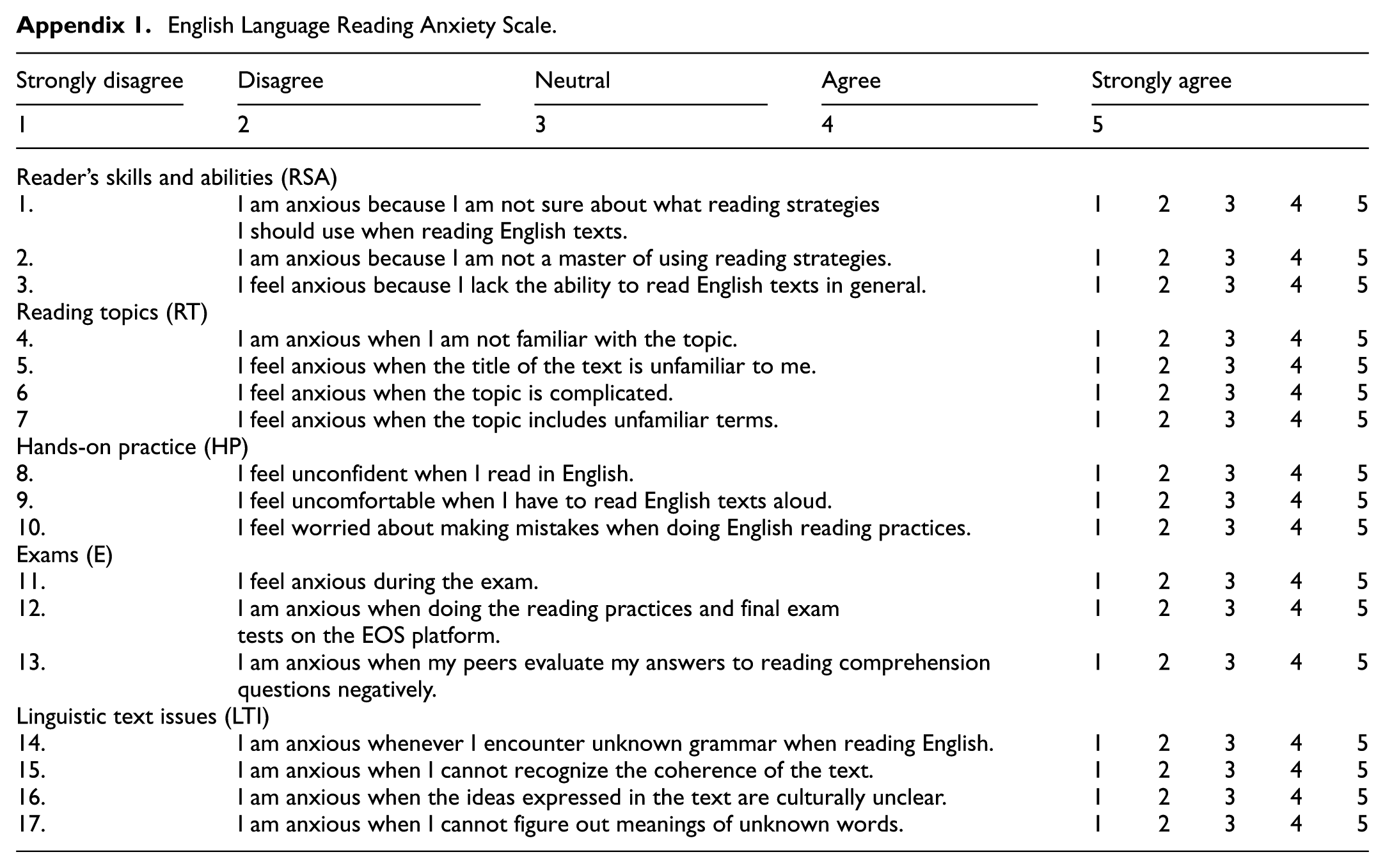
The researcher used SPSS software (Version 26) to analyze the descriptive data. The scale reliability was checked, using Cronbach’s alpha. Accordingly, three sub-scales were deleted due to their internal consistency being below 0.70 (DeVellis, 2017): EM (0.696), RC (0.601), and NTF (0.656). Five remaining factors are reader’s skills and abilities (RSA, α = .755), reading topics (RT, α = .777), hands-on practice (HP, α = .705), exams (E, α = .732), and linguistic text issues (LTI, α = .793) (see Appendix 1).
Qualitative Phase
In the qualitative phase, significant quantitative findings informed a semi-structured interview protocol. Because the main issue explored in this study is factors underlying reading anxiety and levels of anxiety, the principal interview question was: “How did you feel while reading English texts from coursebooks and Supplementary Materials provided by your teachers?” Follow-up probes (e.g., What made you feel that way? When did these feelings arise? Can you give a specific example?) were asked to clarify causes and contexts. Although the researcher initially intended to elicit information on students’ emotional intensity, they spontaneously conveyed intensity through their own word choice and descriptions. For example, they shared they felt “very” anxious while reading long passages. This will be further discussed in the discussion section.
Sampling Method
The study applied purposive sampling to recruit a subset of samples from the quantitative phase (Creswell & Plano Clark, 2018). The interviewees were three IT students, three Business students, three Graphic Design students, and two Multimedia Communication students. Six were male, and five were female.
Data Collection
The researcher contacted students to invite them to participate in the interview using the email addresses and phone numbers they provided in the survey. Students were interviewed consecutively as they were reached. Interviewing stopped at the 11th interviewee as no more new data were reported, indicating that the information was saturated (Seidman, 2019). Based on students’ expectations, nine interviews were conducted via Google Meet, and two were conducted on-site, in an empty classroom. Interviewees signed a consent form before the interviews began. The recorded information was then transcribed verbatim and translated into English, using AI-powered tools. The researcher rechecked the data by listening to the audio recordings repeatedly. All interviewees remained anonymous before the analysis and identified solely by their initials.
Data Analysis
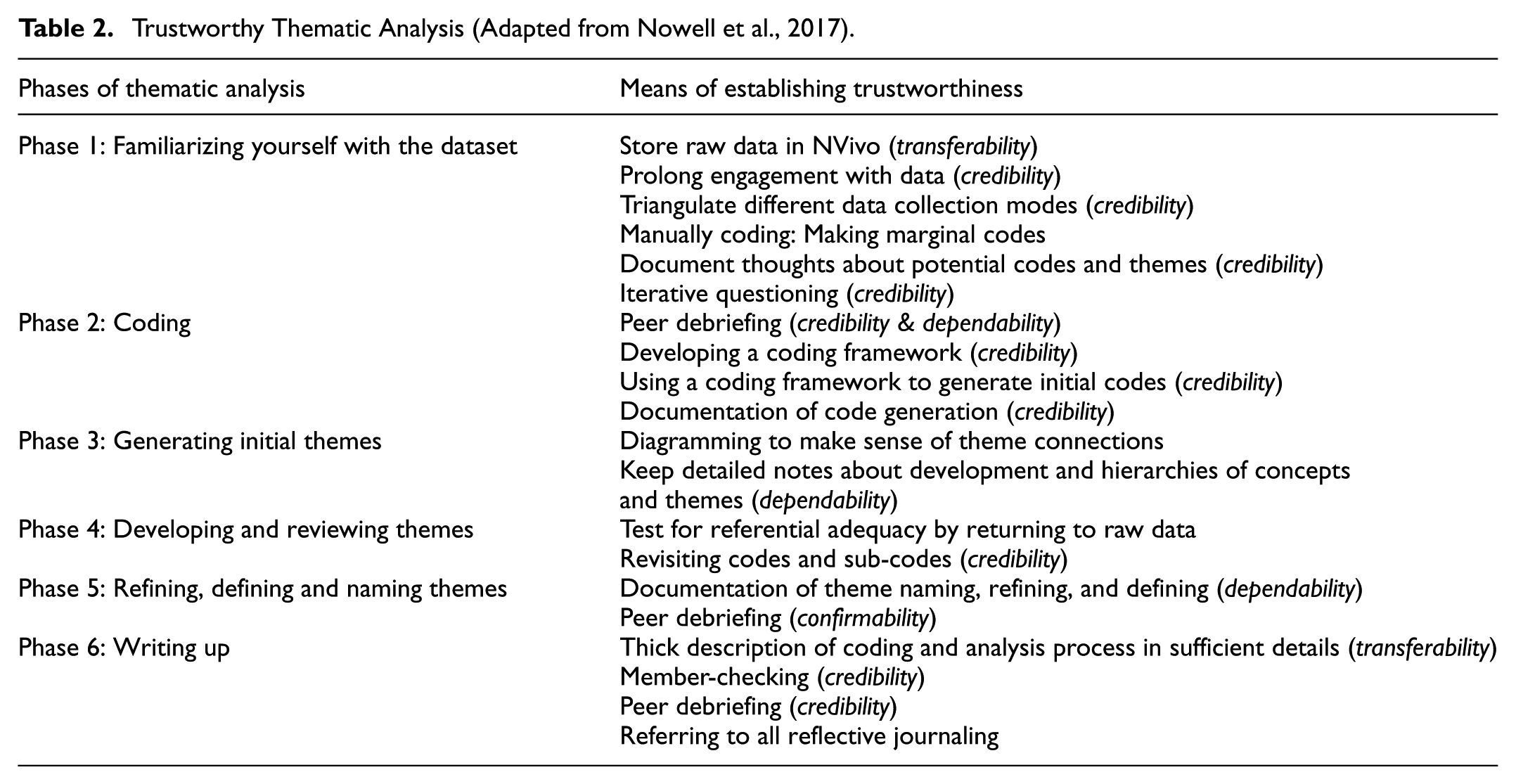
The study followed Lincoln and Guba’s (1985) trustworthiness criteria, such as credibility, dependability, confirmability, and transferability, to evaluate the study’s quality. These criteria were embedded in Braun and Clarke’s (2022) six-phase thematic analysis method to analyze the qualitative data (Nowell et al., 2017; see Table 2). In Phase 1, the researcher stored data in NVivo 14, engaged herself with data, triangulated the data with the quantitative ones, started manually coding, and iteratively questioned herself. Initial codes were generated in NVivo 14, using an initial coding framework in Phase 2. Peer debriefing sessions were held with two other PhDs who are experts in qualitative approach to discuss the codes. All changes of initially generated codes were documented in this phase. In Phase 3, the researcher searched for and diagrammed themes and noted down the development of concepts and themes before revisiting codes and sub-codes in Phase 4. In Phase 5, themes were refined, defined, and named, with the confirmation of two PhDs in other peer briefing sessions. In phase 6, the researcher started to write the report of the results with thick descriptions.
Trustworthy Thematic Analysis (Adapted from Nowell et al., 2017).
Integration Approach of Research Procedures and Data
This study followed Fetters et al.’s (2013) guidance on integrating quantitative and qualitative procedures and data. At the design level, the study employed an explanatory sequential design, in which qualitative inquiry was conducted to elaborate and explain the initial quantitative results. At the method level, the study connected the phrases through the sampling frame. Specifically, interviewees were drawn as a subset of the survey participants, and their data were analyzed in relation to the quantitative findings. At the interpretation and reporting level, integration was achieved narratively using a contiguous approach. It means qualitative and quantitative data were presented in separate sections. The data integration was discussed in the qualitative data presentation and in the discussion. The fit of integration was assessed in terms of (i) confirmation, when the qualitative findings confirm the quantitative ones, (ii) expansion, when the qualitative findings expand and complement aspects of the quantitative data, and (iii) discordance, when the two strands are “inconsistent, incongruous, contradict, conflict, or disagree with each other” (Fetters et al., 2013, p. 2144).
Results
Quantitative Results
Research Question 1: ELRA Factors
The researcher conducted Exploratory Factor Analysis (EFA) with five subscales, including reader’s skills and abilities (RSA), reading topics (RT), hands-on practice (HP), exams (E), and linguistic text issues (LTI), to identify reading anxiety factors. The third EFA procedure revealed that 15 items were appropriate for Principal Component Analysis (PCA). During the first and second procedures, two items (RSA3 & RT7) were eliminated, respectively. The Kaiser-Meyer-Olkin (KMO) value was 0.871, surpassing the recommended threshold of 0.6 (Kaiser, 1974), and Barlett’s Test of Sphericity was significant (p = .000 < .01). The PCA identified four components with eigenvalues exceeding 1, explaining 35.9%, 9.5%, 8.7%, and 7.1% of the variance, respectively. These four components accounted for 61.3% of the total variance. Based on these results, Component 1 was renamed as Reading Topics and Strategies (RTS) since it included both items from RSA and RT. As such, the analysis identified four factors contributing to students’ ELRA, including reading topics and strategies (RTS), linguistic text issues (LTI), exams (E), and hands-on practice (HP), at the research site (see Table 3).
Factors of ELRA.

Note. N = 715. The extraction method was principal components. Factor loadings: above 0.50.
Research Question 2: ELRA Levels
All factors’ mean values were initially calculated to preliminarily assess which factors caused the most anxiety in students (see Table 4). As a result, LTI was the dominant factor (M = 3.56, SD = 0.99), followed by RTS (M = 3.33, SD = 1.04) and E (M = 3.51, SD = 1.14), while HP was the least anxiety-provoking factor (M = 2.86, SD = 1.16).
ELRA Factor Mean Values.

Subsequently, the researcher calculated students’ ELRA levels. Based on the factors’ mean values in Table 4 and applying Kuru-Gönen’s (2007) formula, thresholds for three reading anxiety levels were detailed in Table 5. Precisely, RTS mean values of 2.98 and below indicate a low anxiety level, while values of 4.38 and above indicate a high anxiety level. Mid-anxiety corresponds to values ranging from 2.99 to 4.37.
Thresholds for ELRA Factors.

Note. Mid range excludes the cut points. Ranges rounded to two decimals. Low anxiety = below the cut points; High anxiety = above the cut points.
Next, the researcher employed SPSS’s “Compute Variable” and “Recode into Different Variable” procedures to derive each student’s ELRA level. The results in Table 6 revealed that most students experienced moderate reading anxiety. The highest proportion of readers suffering from LTI was 81.1%, followed by HP at 79%, E at 73.7%, and RTS at 66.7%. In RTS, 180 students (25.2%) reported low anxiety - nearly twice the numbers observed in HP (n = 97; 13.6%), E (n = 96; 13.4%), and LTI (n = 82; 11.5%). Meanwhile, the count of students with high anxiety was identical in HP and LTI (53 each), while RTS and E reported 58 and 92 highly anxious students, respectively.
Percentage of ELRA Levels.

Qualitative Results
In-depth interviews with 11 students yielded two primary themes related to
Theme 1: Students’ Feelings While Reading
Participants’ responses reflect the emotional valences categorized into positive, neutral, and negative. Figure 2 indicates that respondents were mostly absorbed in negative emotions (166 coded units), compared to 28 units for positive feelings and 6 units for neutral responses.

Students’ feelings while reading.
For negative feelings (see Figure 3), fear and anxiety preoccupied readers’ minds most (77 coded units), followed by confusion (40 units), lack of confidence (20 units), uncertainty (17 units), overwhelm (12 units), panic (10 units), and others. This finding indicates that students exhibit several distinct negative emotional states, including emotional reactions, cognitive-affective states, and states of being emotionally overloaded. Intriguingly, respondents used adverbial modifiers to describe their emotional states’ levels. Specifically, they frequently employed a range of intensifiers to qualify their emotional expressions: “a bit” appeared nine times, “very” five times, “quite” twice, and “a lot” and “extremely” once. They also used adverbs of frequency (“always” and “often”) to underscore how often they experienced those feelings. The following are some examples: I often feel quite anxious in reading exams. (DC) I get more confused… (AL) I felt increasingly discouraged… (VU) Topic sentences make me feel very nervous. (QA) I often feel uncertain about reading information. (KH) I will be extremely confused about which answer is the one that I feel is more correct and that I dare to circle. (TH)

Negative feelings.
For positive feelings, confidence, excitement, comfort, and calmness are respondents’ emotions. Similarly, students employed adverbs, intensifiers, and comparatives to escalate their feelings. Importantly, their positive states stem from their available prior knowledge, willingness to receive new knowledge, and their own personal traits:
I was quite confident with familiar topics. (QA) I feel quite comfortable with reading. Difficult readings do not affect my emotions. (GI) When reading, I feel very excited because I am quite confident about my reading skills. (MI)
Amid the two extremes of the continuum are neutral feelings which emerge when both positive and negative emotional responses are either absent or minimal (Gasper, 2018). Three interviewees in this study expressed that they “feel normal when reading” (AL, KL & QA) and “just read without worrying because scores are not important” (AL).
Theme 2: Sources of ELRA
Having mapped out students’ emotional valences, Theme 2 turns to their origins. As depicted in Figure 4, five sources emerged, with reading topics (38 coded units) and linguistic text issues, 37 coded units) being dominant sources. If familiar topics made students feel confident as they were “interested in exploring and reading new things” (KL), unfamiliar topics are “challenging,”“difficult,”“hard,”“tough,” and “strange” to them. Students’ discomfort with topics also stems from the topical diversity and unrelatedness:
Topics about research, science, and environment are quite challenging for me. I do not particularly enjoy them. (CH) I feel anxious when the topic is not related to my field of study. (DC)

Sources of reading feelings.
Regarding linguistic text issues, unknown vocabulary dominated readers’ minds, followed by unfamiliar grammar, unclear ideas, unknown text structure, and strange question types, respectively. Nine out of 11 respondents asserted that reading vocabulary are “very difficult, diverse, and specialized in specific fields” (VU), “extremely challenging” (GI), and polysemous with “completely different meanings” (TR). This vocabulary kind made them “struggle and feel anxious” (MI), leading to inability to “make sense of unknown words” (KL). Similarly, students’ nervousness originated from unknown grammar that “can cause contextual misunderstanding of a sentence” (MI) and from ideas in the passage that are “vague” (VU) and “hard to understand” (KL). Furthermore, the text layout is problematic to readers, making it impossible for them to follow or understand the texts. DC articulated, “Most passages include an introduction, body, and conclusion. However, I find passages that skip the introduction or place the main idea in a later sentence quite intimidating.” Additionally, “challenging questions like inference questions or questions about matching headings can easily confuse me,” shared VU.
Exams are the third source of reading anxiety. Students felt “pressured” due to proctors’ manners, the testing platform’s layout and technical problems, and time constraints. Below is some evidence:
The proctor moved around a lot. I understand their job, but their continuous moving causes my anxiety. (TH) I was nervous when doing the tests on EOS [Exams Online System]. The lines of reading passages are too close. Also, EOS’s screen sometimes turns red, completely removing the question number bar below. (TH) I feel a bit pressured by exam time. It is too short, just 20 minutes for a 2-page text. (GI)
Text length and distractions are two emergent findings. Lengthy reading passages cause readers’ feelings of being “overwhelmed,”“afraid,”“confused,” and “discouraged.” For example,
I tend to feel discouraged and reluctant to read long passages. (VU) When reading, I rely on the text length. If it is too long, I will be afraid. (TR) When I see a text with too many words and no images, I feel overwhelmed. (QA)
The qualitative data reveals two main categories of distractions: internal and external. The internal distractions were linked to a habitual wandering of the mind, inherent personal traits, and difficulties in applying effective reading strategies. For example:
I often get distracted due to thinking about unrelated things while reading. (CH) I got distracted because I did not know how to apply reading strategies. (KL) I am a person who often loses concentration while reading. (TR)
Meanwhile, the external distractions stem from noise, proctors, and digital devices. QA shared, “When the environment is too noisy, I think about things happening around me other than reading,” while TR articulated that he was distracted by “notifications from smartphones.” In addition, MI complained about proctor’s manners: “When something happens in the room, like the proctor calling out a student for a mistake, I get startled. At that moment, I lose track of where the answer is, and I become distracted.”
Theme 3: Emergent Findings
In addition to emotional valences, participants described concrete physical signs of reading anxiety, notably dizziness and trembling. For instance, AL admitted, “When I see the length, it hits me, and I feel a bit dizzy,” implying an immediate cognitive overload before even engaging with the text. Similarly, GI recounted a fear-induced shake when faced with dense, field-specific terminology: “Long readings, combined with the fact that I see academic or specialized words, specialized in a certain field that I do not understand the meaning of, makes me tremble in fear.” He explained that this trembling arises from a sense of being unable to tackle the material, and he even linked it directly to his performance: “If you get a low score, it is because you are shaky.” GI’s testimony thus highlights how the pressure of a difficult text can trigger both emotional distress and tangible somatic symptoms.
Discussion
Research Question 1: ELRA Factors
The first research finding addresses
Most importantly, in-depth interviews clarified how students were anxious due to these factors, which the quantitative data could not do. Regarding text issues, vocabulary that are “difficult,”“diverse,” polysemous, “extremely challenging,” and “specialized terms” made them anxious, which aligns with Wijayati et al.’s (2021) and Miao and Vibulphol’s (2021) findings. “Vague” ideas that are “hard to understand” and unknown grammar that caused “contextual misunderstanding” were also discussed. However, respondents provided no detailed explanations of what grammar points and what ideas were new or unclear to them, making this result different from Al-Sohbani (2018) and Bensalem (2020), who noted tenses and complex structure caused readers’ anxiety. Non-traditional text organizations that do not follow the outline of introduction, body, and conclusion provoked students’ reading anxiety, which has not yet recorded in past studies. Inference and matching heading questions that are not yet documented in preceding studies also generated their worry.
Additionally, respondents attributed exam anxiety mainly to “too close” text spacing and technical issues such as “red-turning screens” on the testing platform, aligning partially with Um et al. (2013), who found narrow spacing anxiety-inducing. Like Güvendir (2014), the current study also found that exam time constraints which was only “20 minutes for a 2-page text” pressured students while no previous studies have documented the role of proctors in inducing examinees’ anxiety in exam rooms.
In terms of reading topics (RT), respondents clarified that they dislike reading unfamiliar topics that are “challenging,”“difficult,”“hard,”“tough,” and “strange.” If Isler and Yildirim (2017) noted that unknown topics “torture” students without providing detailed evidence, the current study found that topics which are thematically diverse and unrelated to participants’ majors contributed to their anxiety. Interestingly, the participants also showed their preferences for familiar topics as they felt more comfortable and confident with these topics, making this result novel compared with previous studies.
Text length (TL) and distractions emerged as two emergent anxiety-provoking factors during in-depth discussions. The text length finding aligns with Güvendir (2014), who showed that overly long reading passages heighten students’ reading anxiety. Um et al. (2013) noted that difficulty concentrating left them perplexed, resulting in increased tension during reading. However, this study further identifies distractions stemming from both internal factors (such as personal habits and traits of “thinking about unrelated things while reading”) and external sources (including “noisy environment” and “notifications” from digital devices).
Research Question 2: ELRA Levels
The second research finding concerns
Connecting both databases, the researcher proposes using a new rating scale to measure anxiety for some reasons. First, deriving three anxiety levels (low, moderate, high) from means and standard deviations (Kuru-Gönen, 2007), is problematic. Although “low” and “high” represent opposite ends of a spectrum, these gradable adjectives require clarification regarding their intensity. Second, using traditional Likert scales with agree-disagree anchors as in Saito et al.’s (1999) scale is disadvantageous. Participants might “avoid extreme response categories,” leading to “central tendency bias” (Taherdoost, 2019, p. 4). Furthermore, the Likert scale can introduce acquiescence bias, as respondents may seek to satisfy the researcher by choosing “agree” or “disagree” (Taherdoost, 2019). Third, Saito et al.’s (1999) scale does not include “no anxiety” as found from the current study. For these reasons, it is necessary to create a new rating scale.
The researcher proposes adopting the semantic differential scaling method which is a versatile method for gaging attitudes via bipolar adjective pairs (Rosenberg & Navarro, 2018). Strictly following Rosenberg and Navarro’s (2018) guidelines for scale construction, as an initial step, intensifiers (“a lot,”“a bit,”“very,”“extremely,”) which appeared repeatedly in the interview data, were incorporated into the scale. To validate the chosen intensifiers, the researcher followed Quirk et al.’s (1985) suggestions about intensifier identification to categorize “extremely” as a maximizer, “a lot” as a booster, “a bit” as a diminisher, and “quite” as a compromiser. However, identifying intensifier categories is insufficient to construct the rating scale since the gradations between them are not yet balanced. To address this, the researcher relies on prior research’s scale, as Rosenberg and Navarro (2018) suggested. Consequently, the researcher further consulted the University of Arizona Assessment Toolkit guidelines (University of Arizona Student Success & Retention Innovation, Assessment & Research, 2025) and decided to use unipolar intensifiers that “indicate the presence and absence of a single attribute” (DeVellis, 2017, p. 124). This enables the revised scale to span every degree of English reading anxiety identified in the quantitative data and informed by the qualitative findings. Concretely, the low-anxiety category was labeled “not at all” and “a bit” or “slightly,” moderate anxiety was labeled “moderately,” and high anxiety was labeled with “very” or “a lot,” and “extremely.” (see Figure 5).

Semantic differential scale of anxiety.
Emergent Findings
The third research finding was emergent from the in-depth interview analysis. The current participants experienced a range of emotional states during the reading process, including fear, anxiety, confusion, overwhelm, uncertainty, pressure, shock, surprise, boredom, panic, and a lack of confidence. Previous studies have not documented this level of emotional diversity in reading. MacIntyre and Gardner (1994) described L2 anxiety as “the feeling of tension and apprehension” (p. 284) and Ramirez et al. (2019) defined reading anxiety (RA) as “an acute fear or apprehension” (p.17), while Saito et al. (1999) did not offer a clear definition of RA. Therefore, this study proposes a more comprehensive ELRA definition: “English language reading anxiety is a domain-specific form of anxiety related to cognitive processing of information during foreign-language reading tasks. It is characterized by a range of emotional states, such as worry, nervousness, overwhelm, confusion, pressure, shock, surprise, fear, panic, uncertainty, boredom, and related affective reactions.”
The fourth research finding concerns Zeidner and Matthews’s (2011) anxiety facets and has not been documented in any previous studies. Although reading anxiety is generally viewed as a cognitive phenomenon that interrupts mental information processing, the current qualitative evidence also surfaced a somatic dimension of reading anxiety. Participants described trembling, dizziness, and shakiness when tackling lengthy passages, echoing Zeidner and Matthews’s (2011) description of somatic facet of anxiety as “objective symptoms of physiological arousal” and self-reported “bodily tension and emotions” (p. 17). Crucially, no clear behavioral signs appeared in the interviews, implying that, in this context, reading anxiety chiefly presents as cognitive disruption accompanied by physical arousal.
Pedagogical Implications
Given that most learners fall within the moderate anxiety range across all four factors, the ELRA level classifications (low, mid, high) can serve as a classroom-based diagnosis and instructional tool. Teachers can use the new rating scale proposed in this study to identify at-risk students, thereby designing differentiated support depending on whether anxiety stems from linguistic text issues, exam pressure, topic familiarity, or hands-on learning tasks.
For linguistic issues, teachers should prioritize lexical pre-teaching, text chunking, and guided questions to simplify the text complexity. For exam pressure, providing students with exam-like practice such as weekly short quizzes on the school’s exam online system is a suggestion. This allows students to familiarize themselves with timed practice without support from online dictionaries and digital devices.
For topic unfamiliarity, teachers are suggested to build brief schema-activation routines in reading classes. For example, before every reading lesson, teachers ask students to fill out the “What I Know” section of a K-W-L chart to activate their prior knowledge before reading, then discuss what they have known about the topic in small groups. This activity can benefit students’ comprehension, not only before, but also during and after reading (Hattan et al., 2024).
For hands-on tasks, teachers should reduce students’ uncertainty and increase reading confidence by using think-aloud protocols. Using think-aloud technique can provide students with targeted feedback and accelerate students’ strategic reading development. This technique offers direct insight into one’s thinking during tasks and provides rich data to analyze readers’ strategies and patterns (Yoo, 2024). It is suggested that, during a reading task, each student is instructed to note the reading strategies they apply, either independently or using a printed list of strategies provided. Teachers then collect these handouts, discuss them with the students, and offer targeted feedback.
Conclusion
By integrating quantitative and qualitative evidence, this study identified six factors underlying students’ reading anxiety, including linguistic text issues, exams, hands-on practice, reading topics and strategies, text length, and distractions. Furthermore, the study showed that the anxiety levels caused by these factors lie on a continuum from “not at all” to “extremely.”
The study findings make significant contributions to the theory of English language reading anxiety. It is the first study to propose a new rating scale by integrating both quantitative and qualitative databases, providing a more accurate measurement of reading anxiety levels. Additionally, the study reveals that reading is accompanied by positive, negative, and neutral emotional valences. It also highlights that reading anxiety affects not only the reader’s cognitive processes but also physiological responses. Practically, the current findings showed that readers in EFL reading classes experience various emotional states linked to distinct anxiety sources. This finding enables teachers to provide factor-specific support for students. Together, these contributions offer a coherent basis for diagnosing and targeting reading anxiety in comparable EFL settings.
Apart from contributions, the study proposes several suggestions based on its limitations. First, in terms of research problems, future research should focus on the impact of ELRA factors and anxiety levels on students’ reading performance to better understand the research phenomenon in various aspects. It also recommends investigating whether reading strategy usage can mitigate ELRA or mediate its effects on reading performance and examining differences in ELRA across various majors. Using convenience sampling method to recruit 715 out of 1,100 students in the quantitative phase may be sufficient for a survey, as Creswell’s (2012) suggestion of at least 350 participants for a survey. However, this sampling method limits the generalizability of the findings (Memon et al., 2025). Therefore, following research should employ a population-based probability sampling method, specifically stratified sampling, to account for the uneven distribution of students across different majors. Finally, it should be noted that this research has put forward a new semantic differential scale whose measurement qualities are still untested. Future scholars might therefore carry out a full validation process such as evaluating its reliability, investigating its construct and criterion-related validity, assessing its ability to predict relevant outcomes, and determining whether it holds up across different contexts.
Footnotes
Appendix
English Language Reading Anxiety Scale.
| Strongly disagree | Disagree | Neutral | Agree | Strongly agree | ||||
|---|---|---|---|---|---|---|---|---|
| 1 | 2 | 3 | 4 | 5 | ||||
| Reader’s skills and abilities (RSA) | ||||||||
| 1. | I am anxious because I am not sure about what reading strategies I should use when reading English texts. | 1 | 2 | 3 | 4 | 5 | ||
| 2. | I am anxious because I am not a master of using reading strategies. | 1 | 2 | 3 | 4 | 5 | ||
| 3. | I feel anxious because I lack the ability to read English texts in general. | 1 | 2 | 3 | 4 | 5 | ||
| Reading topics (RT) | ||||||||
| 4. | I am anxious when I am not familiar with the topic. | 1 | 2 | 3 | 4 | 5 | ||
| 5. | I feel anxious when the title of the text is unfamiliar to me. | 1 | 2 | 3 | 4 | 5 | ||
| 6 | I feel anxious when the topic is complicated. | 1 | 2 | 3 | 4 | 5 | ||
| 7 | I feel anxious when the topic includes unfamiliar terms. | 1 | 2 | 3 | 4 | 5 | ||
| Hands-on practice (HP) | ||||||||
| 8. | I feel unconfident when I read in English. | 1 | 2 | 3 | 4 | 5 | ||
| 9. | I feel uncomfortable when I have to read English texts aloud. | 1 | 2 | 3 | 4 | 5 | ||
| 10. | I feel worried about making mistakes when doing English reading practices. | 1 | 2 | 3 | 4 | 5 | ||
| Exams (E) | ||||||||
| 11. | I feel anxious during the exam. | 1 | 2 | 3 | 4 | 5 | ||
| 12. | I am anxious when doing the reading practices and final exam tests on the EOS platform. | 1 | 2 | 3 | 4 | 5 | ||
| 13. | I am anxious when my peers evaluate my answers to reading comprehension questions negatively. | 1 | 2 | 3 | 4 | 5 | ||
| Linguistic text issues (LTI) | ||||||||
| 14. | I am anxious whenever I encounter unknown grammar when reading English. | 1 | 2 | 3 | 4 | 5 | ||
| 15. | I am anxious when I cannot recognize the coherence of the text. | 1 | 2 | 3 | 4 | 5 | ||
| 16. | I am anxious when the ideas expressed in the text are culturally unclear. | 1 | 2 | 3 | 4 | 5 | ||
| 17. | I am anxious when I cannot figure out meanings of unknown words. | 1 | 2 | 3 | 4 | 5 | ||
Acknowledgements
The author acknowledges the voluntary participation of 715 EFL students.

Ethical Considerations
The study was conducted at a young private university that has not yet established an Institutional Review Board; consequently, the researcher obtained online consent directly from the students to ensure voluntary participation.
Funding
The author received no financial support for the research, authorship, and/or publication of this article.
Declaration of Conflicting Interests
The author declared no potential conflicts of interest with respect to the research, authorship, and/or publication of this article.
Data Availability Statement
The datasets generated and analyzed during the current study are not publicly available because they will be used in forthcoming manuscripts.