To understand the interactive mechanisms behind citizens’ collective action against the project implementation of local governments of authoritarian regimes, we develop a global game model in which the decisions of local governments, media outlets, and citizens are endogenous. The methodology of theoretical game model focuses on the relationship between media capture and citizens’ belief formation and how it affects the citizens’ decision to participate in a demonstration. Our results show that if the information jamming effect dominates the capture cost effect, then increasing the supervision efficiency of media helps local governments implement unpopular projects that bring negative externalities to citizens. Otherwise, increasing the supervision efficiency would make it more difficult for local governments to implement projects. Based on the results of game model, policies such as relaxing media control, developing the media market, strengthening the judicial system, and perfecting the information disclosure system of local governments could increase the cost of media capture and thus effectively constrain the behavior of local governments, which helps prevent the occurrence of mass disturbances.
Due to financial pressures and promotion requirements, the local governments of authoritarian regime in developing countries usually have strong incentives to implement industrial projects and carry out demolition, which can rapidly increase fiscal revenue in the short term but also cause many social problems, such as pollution and corruption (X. Chen, 2012; Lorentzen, 2013). Hence, citizens choose to protest to show their discontent, or called “Not in my Backyard.” Some researchers analyze different cases of the NIMBY activities in developing economies, such as the China’s protests against the PX (Para-xylene) chemical projects in many Chinese cities, including Xiamen, Dalian, Ningbo, Kunming, and Maoming (Deng & Yang, 2013; R. Huang & Yip, 2012; Johnson, 2010, 2013; Lang & Xu, 2013; Li et al., 2012). Those PX projects are welcomed by local governments because they could bring huge amount of fiscal revenue. On the other side, the concern and fear of the residents about environmental and health risks of PX cause them to participate in the protests against the PX projects. The political studies of environmental protests have shown the reasons why the citizens in some areas choose to participate in the protest, how do they protest, why some protests succeed, and how can the government deal with protests. However, a formal theoretical model of the environmental protests, in particular the study of the mechanism of information transmission in a protest, remains to be studied.
To analyze the citizen’s decision-making of participating in the collective action and the effects of media information transmission, we use the global game model, which was introduced by Carlsson and Van Damme (1993) and Morris and Shin (1998, 2003). There are three types of players in the model: the local government, media outlets, and citizens. When media outlets observed the true type of project, they may choose to receive the bribes from local government and keep silent, which is called media capture. The local government may need to pay the repression cost if some citizens choose to participate in a protest, and pay the media capture cost if some media outlets want to make the report about the industrial projects. In our paper, the presence of media has two opposite effects on the government’s implementation of projects. (1) The information jamming effect: when media keeps silent on the project type, the probability of media capture increases as the supervision efficiency of media increases, which makes citizens increase the estimation of the project type and weakens their incentive to participate in the protest; less citizens will choose to protest against the government and the repression cost decreases (Berg, 2008). (2) The capture cost effect: as the supervision efficiency of media increases, the government is more likely to pay the media capture cost, which increases the expected media capture cost (Besley & Prat, 2006; Petrova, 2008).
In the creation process of collective action as protest, media plays an important role. Besley and Prat (2006) present a simple but useful model, in which the government uses the tool of media capture to influence the political outcome in a democratic regime. The media reports may change Bayesian citizens’ beliefs and thus their behaviors. Goldstein and Ridout (2004), Gehlbach et al. (2016), and Allcott and Gentzkow (2017) provide reviews of studies related to such “media effects” in American media market and political contests.
Although many scholars make the assumption that protest reflects instability, Lorentzen (2013) argues that authoritarian regimes can use some restricted economic protests as the effective information gathering tool because they often lack the informative feedback provided by competitive elections, a free press, and an active civil society, which make it difficult to identify which social groups have become dangerously discontented and to monitor lower levels of government. Edmond (2013) uses a global game model to study how authoritarian regimes can distort reporting about their true type by making costly effort, thereby making fewer citizens to participate in a revolution and helping the regime to survive. H. Huang (2008) shows that a free media may benefit the government by reducing the probability that citizens mistake a competent government for an incompetent one. Edmond and Lu (2020) provide a model in which a politician tries to prevent the collective action of the informed citizens, and citizens’ beliefs can be confused by the manipulated information. In short, existing theoretical studies focus on how high-level political power uses the media to spread noise information to citizens in order to achieve the political goals.
There are two main differences between previous research of authoritarian regimes and our paper. The first difference is about the objectives. To survive is the primary objective of authoritarian regimes that face the threat of revolution. However, in our model of protest to against an industrial project, the local government will not be overthrown even if the protest succeeds. The worst outcome for local government is that the project is abandoned and its fiscal revenue decreases. Hence, we assume that local government will always survive no matter the protest succeed or not and its objective is to increase the fiscal revenue, although the officers may receive some limited punishment after the event. The ways of media control are also different. The central government in an authoritarian regime can use media as propaganda and punish any media outlet who does not follow the line. Without such a power, lower-level governments have to pay bribes to capture the media outlets in a competing media market. These differences may uncover some new insights about the collective action and governance in authoritarian states.
Apart from the previous research, the contribution of this paper is that we introduce media and the government’s capture behavior into a global game, and apply the game to the analysis of the collective action against the lower-level government. We focus on the effects of media information and the actions of lower-level governments on citizens’ belief formation, which also affect the decisions of citizens to participate in collective action.
The effects of media information, that is, information jamming effect and capture cost effect, have opposite influences on citizens’ decision making in participating a demonstration to against the implementation of some industrial project. Then the total number of protesters is determined and collective decision making will be determined by comparing government’s revenue and the sum of repression and capture costs. When media keeps silent on the project type (i.e., the tax revenue that the lower-level government can collect from the project), the reason could be that either media has not observed the project type or media observed it but has been captured by the government. When citizens estimate the tax revenue of the project, they may consider that the probability of media capture increases as the observation accuracy of media increases, which weakens their incentive to participate in the protest; less citizens will choose to protest against the government, and this is the information jamming effect. However, as the observation accuracy of media increases, the government is more likely to pay the media capture cost, which is the capture cost effect.
We find that media reports and information disclosure may benefit local governments. The ambiguity between media reports and the capture action of the government makes citizens enhance their estimation of the project types and thus weakens their incentive to participate in the protest. Hence, the government’s repression cost is reduced, and the government can implement more polluting industrial projects.
To regulate the behavior of local governments, we introduce the central government at the end of our model. We find that in some situations, when the central government requires local governments to disclose more information, the ambiguity may increase and help local governments to implement more high pollution projects, leading to more losses of social welfare. Policies such as relaxing media control, developing the media market, strengthening the judicial system, and perfecting the information disclosure system of local governments could increase the cost of media capture and thus effectively constrain the behavior of local governments, which helps prevent the occurrence of mass disturbances.
The paper is arranged as follows: the second section gives the basic assumption of the global game model, the timing of the game and the equilibrium concept; the third section introduces a benchmark model without media, as a reference for comparison; in the fourth section, we introduce media into the model and analyze the mechanism of collective action; the last section concludes and give some policy recommendations.
Model Setup
Local governments benefit from the construction of new industrial projects, by collecting more tax revenue in the near future. Such construction also improves the record of achievements of local officers, and increases their probability of promotion. However, those projects may bring environmental pollution and cause negative externalities to local residents. We assume that the government permits the construction of a project, which increase the tax revenue by . Meanwhile, the pollution caused by the project results in a disutility to every citizen. Hence, the type of a project can be summarized as . We assume that to ensure the project does cause negative externalities and assume that is uniformly distributed on the real line, which implies that projects may bring profits or losses to local governments. The second assumption in the global game is called “improper priors,” which ensures that the statistical discrimination does not appear in the process of the bayesian belief formation. See Hartigan (1983) for more specific discussions about the assumption (Hartigan, 1983). For the purpose of constructing a tractable model that contrasts the impacts of a higher probability of media observation on information jamming and capture cost, we assume that the disutility is the public information to every citizen and tax revenue is the private information of local government and may only be observed by media. The type of project could be a more complicated concept which includes more dimensions rather than tax revenue and disutility. For example, it could reflect some concepts of environmental damage of project. However, are the most direct and important variables in the payoff functions of government and citizens. Focusing on the relationship of these two variables can shed some lights on the fundamental mechanism that how the government influences the collective action by media capture.
Because of negative externalities, after the completion of a project, citizens have motivation to take part in demonstrations to protest the project. This increases the cost for local governments to suppress the masses. To simplify the analysis, we assume that the repression cost of government to deal with each protester is 1. Then, we use to denote the total number of protesters and also the total repression cost of the government. The government implements the project and then receives a tax revenue , while the repression cost is S. Hence, we derive the following: if , the government has an incentive to implement the profitable project; and it will not implement any project if .
In the following section, we introduce the specific assumptions of players in the model, that is, local governments, media, and citizens, as well as the timing of the game and equilibrium concepts.
The Government’s Problem
A local government can collect the tax revenue from the project, it also represent the incentive to implement a project and ability to deal with collective action of citizens. As increases, the government is willing to pay more the repression cost , such that the project is more likely to be implemented successfully. We assume that the government does not use its tax revenue to buy off the citizens, such as providing roads, schools, health care, or to either increasing transfers or reducing taxes; the only strategy to deal with the protest is to suppress the protest with the repression cost . Because the buying off strategy which increases the citizens’ benefit of accepting the project or increasing the citizens’ cost of participating in a protest make the same effect to citizens, which is to reduce their incentives to against the government. Hence, we use the current assumption to simplify the expressions.
When there is no media, the government will receive a payoff , if . However, if the government chooses to implement the project but find out , there are more citizens choose to participate in the protest than expectation, they should also pay the repression cost . We assume that in this case, the government can still receive the tax revenue before terminating the project, and it suffers a loss . To keep the consistence of the payoff function of the government, we need to make this assumption. Normally, the terms of local governments’ leaders are relatively short, which makes they only care about the governments’ short-term tax revenue that can be considered as their record of achievements for future promotion.
The Media’s Problem
We assume that there exist identical media outlets , that report the local news. All media outlets can observe the true type of a project with the same probability . As Besley and Prat (2006), we assume that all media outlets share the same sources of news. If one outlet obtains the information, other outlets also observe it. The observation accuracy represents the supervision efficiency of media. We can relax this assumption and allow each outlet has its own independent sources of information. However, it does not affect the basic conclusions of the model, so we use this assumption for simplicity. We assume that in the media market, the greatest possible profit from the consumer side is . When media outlets do not report any news about the project (denote as ), citizens are not interested in media products, which causes media outlets’ profits goes to zero; if media outlets observe the true type of the project , and make reports (denoted as ), citizens pay attention to media reports and purchase their products; therefore, each outlet receives a profit . If one media outlet reports the project type , the project type becomes public information and all citizens are informed.
After media outlets observe the project with type , the government has an incentive to capture media by paying each outlet a secret payment , to ask them not to report. In reality, local governments cannot directly control the report content of media outlets, especially for those national-level media. Considering their reputation and future profits, media outlets that have received the bribe lack, the incentive to report misinformation with extra costs and just choose to remain silent. Hence, we assume that all media outlets does not make false or biased reports, which means all media reports are hard information, as discussed by Milgrom and Roberts (1986). Media outlets make either true reports or report nothing about the project type.
Therefore, the government captures the media and implements the project, and its payoff is
The presence of the media compels the local government to pay the additional capture cost , in addition to the repression cost . If the government chooses to capture the media with cost , all media outlets will keep silence on the project type even if they have observed it. This information jamming effect will make less citizens choose to against the government, and reduce the repression cost . Hence, the government faces the tradeoff between reducing the media capture cost or reducing the repression cost by information jamming. Note that, to implement a project successfully, inequality must be satisfied, which means must hold.
The Citizen’s Problem
Following the technical appendix to Edmond (2013), we assume that there is one unit of citizens, denoted as . They are ex ante homogeneous, and their observation accuracy of media is , but not the result of media observation. Due to her personal social network, citizen receives a private signal about project type , where is the noise produced in the process of signal transmission, and it has an independent and identical uniform distribution . We can also use the normal distribution assumption here, which brings us the similar results. Hence, we choose to adopt uniform distribution assumptions to simplify the formula expressions. Even though the boundedness of the uniform distribution makes us have to discuss two parameter spaces of equilibrium, the Proposition 2 in next section shows that the equilibrium results in two parameter spaces are the same.
Each citizen decides whether to participate in a protest against the government or not, we denote as the choice of participation, and the opposite choice is . Hence the total number of citizens who choose to participate in the collective action is . We assume that the cost of citizens to participate in a protest is:
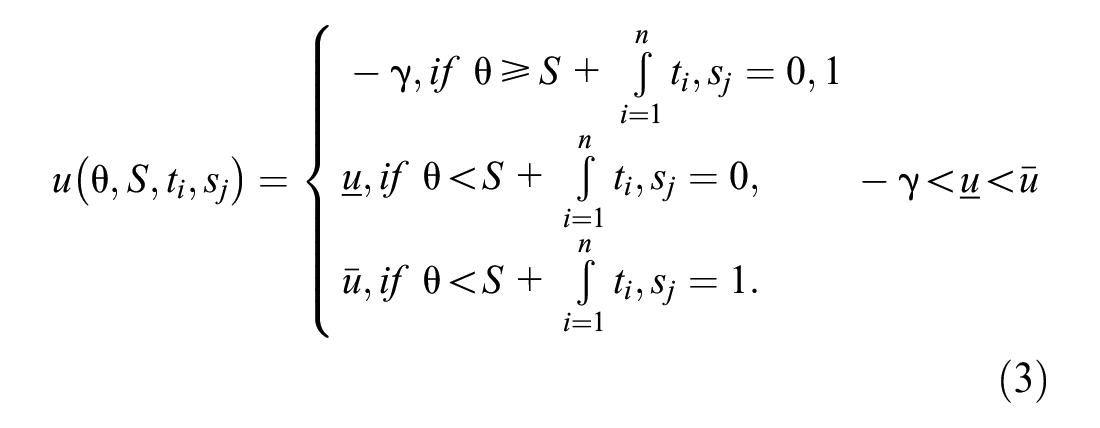
The Formula (2) means that the citizens’ costs of participating in a protest are different in the successful and failure scenarios. When the protest fails, a citizen who chooses to protest against the government may have higher opportunity cost and may receive revenge from the government after the event. On the other side, there is no such cost if citizens do not participate. We also assume that the citizen’s benefit changes depending on the protest is successful or not and whether the citizen participates in the protest or not:
Citizens choose to protest against the government to gain a more comfortable environment and to maximize their expected utility. If there are enough protesters to force the government to terminate the polluted projects, citizens will obtain higher utility from the better environment. As Formula (3) indicates, regardless of whether a citizen participates in a protest or not, all citizens receive a negative externality when the protest fails. One may assume that protesters and non-protesters experience different disutility if the project is built. Because protesters and non-protesters have different costs in equation (2), the total costs of two types of citizens are already different. Hence, we use this simplifying assumption, without affecting the main results of the model. However, after a successful protest, citizens achieve a higher benefit if they chose to protest against the government, that is, . A reasonable explanation should be that citizens who haven’t been involved in the protest may feel guilty for their behavior. We can assume that the guilt () is an increase function of disutility , implying that the greater the externality, the more guilty one feels for not participating, which provide us more insights on the relationship between the guilt and disutility of project. However, it will not affect the main results of the game model. Therefore, we can derive the inequality, . Combining Formulas (2) and (3), we put the costs and benefits of citizens’ choices together in the following Table 1, which shows the four possibilities of citizens’ utility:
Four Possibilities of Citizens’ Utility.
Participating
Not participating
When proteset succeeds
When proteset fails
Note that the welfare improvement of a successful protest is a public good, even for those citizens who did not participate in the protest. This leads to the possibility of free-riding, which weakens citizens’ motivation to participate in a protest. As Edmond (2013) notes, we need to add an additional assumption to avoid the free-rider problem. To deduce this condition, we first assume that the possibility of the successful protest is , so that the citizen’s expected utility of participating in the protest () is
In addition, the expected utility of not participating in the protest () is
Considering the large number of total citizens, the participation choice of a single citizen does not affect the possibility of winning the protest significantly. Hence, in the above two expected utilities, the term can be considered to be equal. Rearranging them, we derive the necessary and sufficient condition for citizens to choose to participate in the protest:
We denote , which is the opportunity cost of citizens to participate in a protest. When the possibility of winning the protest is relatively high, that is, , citizens should choose to protest against the government. However, if the free-rider problem is very serious, causing the opportunity cost to be too high, that is, , then the citizen’s rational choice must be not to participate in any protest. To avoid such a situation, we need the assumption , which implies that must hold. To address the free-rider problem, we need an additional assumption:
Assumption 1.The incentive of free-riding for citizens is small enough, .
Note that cost can represent the incentive to free-ride; greater values of makes citizens more likely to choose not to participate in the protest. The benefit gap comes from the citizen’s sense of guilt. As long as the gap is large enough, citizens will be willing to participate in a protest to avoid feeling guilty. In particular, when the cost , any citizen who has a sense of morality will stand up against the government. When assumption 1 is satisfied, the individual choice and the total number of protesters are strategic complements: the more citizens who choose to protest, the more likely the project is terminated, and the more likely the citizen’s optimal choice is to participate in the protest.
Through the above analysis, we also find out that the negative externality does not appear in formula (4), it was eliminated in the process of deriving the formula. This suggests that in our model, as long as the inequality is satisfied, the negative externality does not affect the incentive of citizens to participate in collective action. Because the participation of a single citizen does not affect the possibility of the successful protest , the expected disutility of pollution is the same value in cases that the citizen either chooses to participate in the protest or not. Hence, the choice of whether to participate in the protest or not only depends on the comparison of benefit and cost, (i.e., the incentive of free-riding is small enough or not), no matter how much citizens dislikes the pollution of project.
Of course, in real life, citizens may be more concerned about the pollution level of the project, rather than the government’s revenue. However, any rational citizen must first estimate the possibility of wining the protest before she makes the optimal choice. According to the previous analysis, we show that this possibility is directly affected by government revenue , but it does not depend on pollution level . However, citizens can terminate the project by engaging in collective action, but they cannot influence the pollution level directly. Therefore, in following sections, the characteristics of the project type can be simplified as . Because of the great influence of industrial projects and harm of the pollution to environment, the local government cannot simply transfer a part of the tax revenue θ to citizens, as the compensation for environmental pollution to prevent the protest. However, such a capture strategy to citizens may be adopted in other collective action, such as the demolition. How citizens build their belief function of project type based on the private signal and media reports and how to make the optimal choice are the focus of the global game model.
The Timing of the Game
(1) Nature decides the project type, that is, the local government’s tax revenue from the project ; then the government decides whether to implement the project or not. If the government rejected the project, the game ends; otherwise, the game continues.
(2) The project type is observed by media outlets with probability . The government knows the media observation result, and decides whether to capture each media outlet by offering a transfer .
(3) The media outlet decides to accept or reject the capture offer . If the outlet accepts the offer, it must destroy all news materials and evidence about the project type to avoid the problem of moral hazard and does not report . The profit of a captured outlet is ( is the transaction cost during the media capture). If the outlet rejects the offer, it will report the observed information . Media outlets cannot make false and biased reports; they just choose to report the truth or keep silent.
(4) The citizen builds her belief function about the project type based on the private signal and the media report . Then, she decides whether to participate in the protest or not , and the total number of protesters is determined.
(5) If , the government’s revenue is less than the sum of repression and capture costs, and it will choose to terminate the project. Otherwise, if , the government chooses to capture the media and implements the project successfully.
Equilibrium Concepts
In the present study, the Perfect Bayesian Nash equilibrium of the global game consists of the belief function about the project type , the citizen’s choice to participate or not , the total number of protesters , and the government’s media capture transfer :
The first formula shows that citizens use their private signal and media report to construct the probability density function of the project type . The second formula shows that citizens choose whether to participate in the protest or not to maximize their expected utility, given their beliefs. The third formula represents the total number of protesters. The last formula implies that the government wants to maximize its expected payoff by making the media capture choice .
In the next section, we will first introduce a benchmark model without media, which is based on Morris and Shin’s (2003) work.
Benchmark Model Without Media
When there is no media in the market (i.e., the case that media outlets never observed the project type, ), each citizen obtains information only from her private signal . Because noise follows a uniform distribution , the citizen who has received a signal will estimate the project type uniformly distributed on the interval . As a result, the citizen’s belief function of the project type , and the corresponding participation choice are as follows:
For the convenience of proof, we denote , as the candidate equilibrium thresholds, that is, is the indifferent project type and is the indifferent private signal in the equilibrium. Then, we can write the citizen’s belief function of facing a project type less than if she has a private signal :
Note that is the probability distribution function on the interval . The sufficient and necessary condition for a citizen with private signal to participate in the protest is that the possibility of wining the protest is not less than her opportunity cost, that is, . Because the probability is monotonically decreasing in , for any project type , there must only exist the private signal , which makes some citizen with this signal is indifferent between participating in the protest or not. Therefore, given a private signal , citizens choose to participate in the protest, and given a private signal , citizens choose not to participate.
Similarly, when the project type is , the private signal of citizens is uniformly distributed on the interval . Given an indifferent signal of , the total number of citizens who participate in the protest is
Because there is no media, the sufficient and necessary condition of a successful project is that the government’s revenue is not less than the repression cost . Because the total number of protesters is monotonically decreasing in , for any private signal , there must only exist the project type , which makes the government is indifferent between implementing the project or not. Therefore, the projects with type would be implemented, and projects with type would be given up by the government.
Combining equations (5) and (6), we can write down the sufficient and necessary conditions for equilibrium {, }:
The relevant equilibrium properties can be illustrated by solving equations (7) and (8):
Proposition 1. In the benchmark model without media, there is one Perfect Bayesian Nash equilibrium , which , .
Note that these are all previous results from the literature. In the benchmark model, the meaning of equilibrium thresholds is that there exists the only project type , such that projects with type would be given up by the government; and there exists the only private signal , such that citizens with signal will participate in the protest. The following corollary is directly derived from Proposition 1:
Corollary 1., .
When increases, the citizen’s opportunity cost of participating in the protest increases, and less citizens will choose to protest against the government, which is why ; meanwhile, the local government expects that larger causes less citizens to participate, which means that more projects with less tax revenue are more likely to be implemented successfully, which is why .
Model With Media
When Media Reports the True Type
Because we assume that the media outlets cannot lie, when media outlets report the project type, becomes public information, that is, all citizens receive it. The model is simplified into a global game model with several equilibria:
(1) When , any citizen can stand up and stop the implementation of the project. Therefore, the optimal choices of all citizens are to participate in the protest, and the project is terminated. The government has no motivation to implement projects with type .
(2) When , the project cannot be prevented by all citizens (i.e., total number of protesters is 1). Therefore, every citizen’s optimal choice is not to participate in the protest, and the government can implement any project with type successfully.
(3) When , projects can be considered as “fragile”; because citizens have different beliefs in participating in the protest or not, there could be multiple self-fulfilling equilibria. Among all the possible equilibria, if every citizen believes that others will choose to against the government, everyone will choose to participate in the protest and receives a utility ; if every citizen believes nobody will choose to against the government, no citizen will choose to protest and everyone receives a utility , and the government has no inventive to capture the media. These are two extreme cases out of all possible equilibria, implying the most and least participants in the protest. Here we assume that every citizen believes that others will choose to protest against the government. Then the optimal strategy of citizens is to participate in the protest and the total number of protesters , which makes the government decide not to implement any project with type , and the result is consistent with the citizens’ initial expectation. Hence, the government has an incentive to capture the media for the purpose of implementing projects with type .
When Media Reports Nothing
As shown in the previous section, any project with type can be implemented successfully, so that the government has an incentive to reveal the project type to the media and reduce the repression cost to 0. For any project with type , the government has no incentive to implement. Hence, we focus on the projects with type . For these projects, the government may choose to capture the media. Similarly, we can denote the candidate threshold values of equilibrium as and , which can be considered as the indifferent project type and indifferent private signal respectively. According to the definition of the equilibrium in a global game, the government would choose to capture the media to implement projects with type , and citizens with private signal would choose to participate in the protest.
Because we assume that the noise in private signal follows an uniform distribution in a bounded interval , we should pay special attention to the range of the parameters, when forming belief function based on the private signal and media information. First of all, the probability density function is the positive value , when , and otherwise. The corresponding project type must also fall on the interval . Therefore for and , the inequality must be hold. Citizens also know that the government has an incentive to capture the media to implement projects with type . Because we are not sure which one of and is larger, there are two possible cases: (1) and (2) .
For a given private indifferent signal , the total number of protesters is:
After receiving the results of media observation, the government makes the capture offer to each media outlet. If a media outlet accepts the offer, it receives a transfer because there exists the transaction cost . We can use the classic conclusion of Besley and Prat (2006) on media capture:
Lemma 1.In every Perfect Bayesian Nash equilibrium, the media outlet with true information accepts the capture offer , and rejects the offer .
According to the lemma above, the optimal capture offer of the government is , which means that only if , the government has the ability to capture all media outlets. Given that the government has made the choice to implement the project before media observation, the expected payoff of the government is:
Because the total number of protesters is monotonically decreasing in , for any private signal there must only exist the project with type to make .
When the project type is observed by the media, and the government cannot afford all of the repression cost and capture cost (i.e., ), it will choose to terminate the project. However, in such a situation, the government still has to capture all media outlets, instead of letting them report the true project type that causes all citizens to participate in the protest, which increases the government’s repression cost to 1. In fact, this is the worst situation that a government may faces. Hence, when the project fails, the government suffers a loss .
As long as some media outlet reports , all citizens will receive this information and believe that the true project type is . If all media outlets report nothing about the project type (), the citizens know the reason may be that the media did not observe the true project type, or the media has been captured by the government. Therefore, according to the Bayesian rule, we can write down the citizen’s belief function based on the private signal and the media report:
In equation (11), the first row on the right-hand side is the probability density function when the parameters satisfy . When the media reports nothing, the reason may be that media did not observe the project type, as shown in the first part , or the media has been captured by the government, as shown in the second part . In addition, the second row on the right-hand side of the equation (11) is the probability density function when the parameters satisfy ; its property is similar to the first case, with the only difference being that the upper limit of the integral changes from into 1.
Let us start the analysis of the first case of coefficients (i.e., ). According to the first row of the equation (11), we can derive the probability distribution function of a citizen with the private signal facing an indifferent project :
Note that the second part on the right-hand side actually equals to zero, which means that when facing an indifferent project , the possibility of media captured is zero because for any project with type , the government has no incentive to capture the media. Recall that the necessary and sufficient condition for the citizen with signal to participate in the protest is . Because the probability is monotonically decreasing in , for the project type , there must only exist the private signal which is the indifferent signal.
The Equilibrium
According to the analysis of the indifferent project type and the indifferent private signal , combined with equations (10) and (12), we can write down the the sufficient and necessary conditions of the equilibrium {, }:
Then, we can derive the following Proposition of the equilibrium:
Proposition 2.In both cases, when the accuracy of media observation is relatively small, , there exists the unique Perfect Bayesian Nash equilibrium , such that , .
From the proof of the Proposition 2, we can learn that the equilibrium thresholds are the same in the two possible cases of parameters: (1) and (2) . As long as the accuracy of media observation is relatively low, that is, , there must only exist the equilibrium . This implies that the project with type will be implemented by the government; and that the citizen with private signal will choose to participate in the protest. Rearranging the inequality , we can show that , so that . The indifferent project type should cover at least the media capture cost.
To guarantee the accuracy is sufficiently small , we need to assume that . Comparing the equilibrium with the results of the benchmark model, we found that when (i.e., ), the indifferent project type , which implies that when the media capture costs () is low, the government can increase the signal noise of citizens by capturing media. When the media does not report, citizens will think that one possible reason is that the government has captured the media, and enhance their estimation of the project type, thereby weakening the motivation of participating in the protest. As a result, the government can implement more projects with lower revenue successfully. Conversely, when the capture cost is high (), the government will find that projects are more easily to be implemented in an environment without media. Furthermore, taking the partial derivatives of with respect to , , , and , we can derive the following:
Corollary 2., , , .
We found that the indifferent project type is monotonically decreasing in the opportunity cost . The greater the opportunity cost of citizens, the weaker their incentive to protest against the government, so that less citizens choose to participate in the protest. With the reducing repression cost, the government can introduce more unpopular projects.
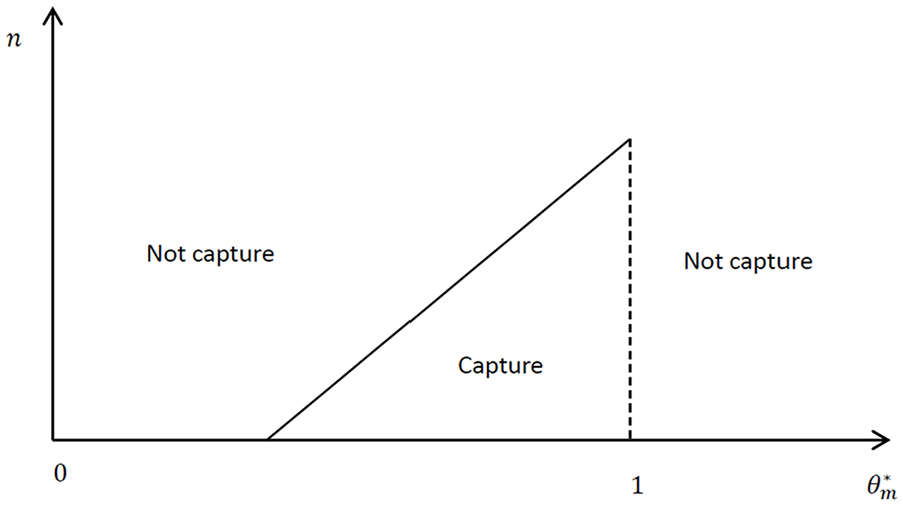
The indifferent project type is monotonically increasing in the number of media outlets . As the number of outlets increases, projects become harder to be implemented, because of the government need to pay more media capture cost. In Figure 1, we can see that the government’s optimal choice is media capture only in the area of the triangle, which are cases that the project type is relatively high or the number of media outlets is relatively less. In other cases, the government’s optimal choice is not to interfere in media reports.
Numbers of media outlets and the government’s capture behavior.
The indifferent project type is also monotonically increasing in the transaction cost and the media profit from consumers because the government has to pay more capture cost () if these two variables increase. The results are similar to Besley and Prat (2006): increasing media capture cost make it harder for the government to achieve its goal.
In this paper, the most important result is the relationship between the indifferent project type and the accuracy of media observation . Note that there are two reasons why media keeps silent on the project type, either the media has not observed the project type, or the media observed it but has been captured by the government. Increasing the accuracy of media observation has two opposite effects on the government’s implementation of projects. (1) The information jamming effect: when media keeps silent on the project type, the probability of media capture increases as the observation accuracy increases, which makes citizens increase the estimation of the project type and weakens their incentive to participate in the protest; less citizens will choose to protest against the government and the repression cost decreases. (2) The capture cost effect: as observation accuracy increases, the government is more likely to pay the media capture cost, which increases the expected media capture cost. The following corollary summarizes the two effects:
Corollary 3.The accuracy of media observation creates the information jamming effect and the capture cost effect on the indifferent project type :
When , the capture cost effect dominates; when , the information jamming effect dominates.
When the accuracy of media observation is relatively small (), the government’s marginal expected benefit from information jamming is lower than the marginal expected cost of media capture, . The capture cost effect dominates, which make the government has no incentive to capture the media. Hence, , implies that as the media observation becomes more efficient, less projects can be implemented by the government. When the accuracy of media observation is relatively large (), the government’s marginal expected benefit from information jamming is higher than the marginal expected cost of media capture, . The information jamming effect dominates, which make the government has an incentive to capture the media and implement the project. Hence, , shows that as the media observation becomes more efficient, more projects can be implemented by the government.
From the analysis above, we notice that the government may benefit from the ambiguity between media reports and the government’s action. In particular, when , increasing the efficiency of media observation will help the government to implement more unpopular projects than that of the benchmark case. Media can be used to deliver more noisy information to citizens and disrupt their incentives and decision-making in collective action.
To grantee the existence and uniqueness of the threshold equilibrium , parameters should meet the requirement . However, when the accuracy of media observation becomes larger, there are other types of equilibria with different properties other than .
Another Possible Equilibrium
In this section, we analyze the case that the accuracy of media observation is relatively large, that is, . We use the following Proposition to describe the other possible equilibrium:
Proposition 3.When the accuracy of media observation is relatively large (), in the Perfect Bayesian Nash equilibrium, any project whose revenue can cover the expected capture cost () will be implemented successfully.
Now there is no threshold equilibrium as , all citizens choose not to participate in the protest, so that the government’s repression cost reduces to zero. The only cost that the government may pay is the media capture cost . Note that when media observes, the government may suffers a loss up to However, the project types are implemented successfully.
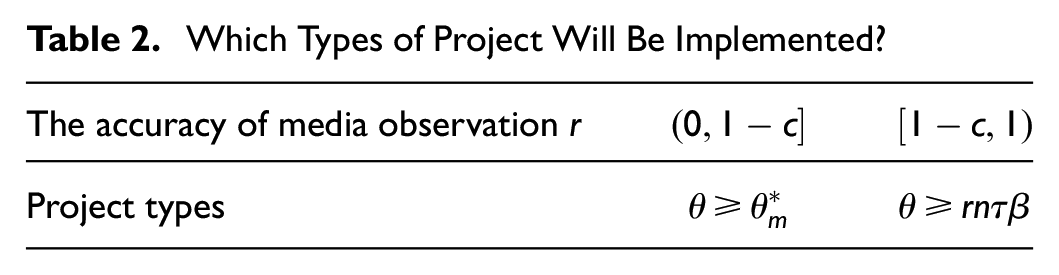
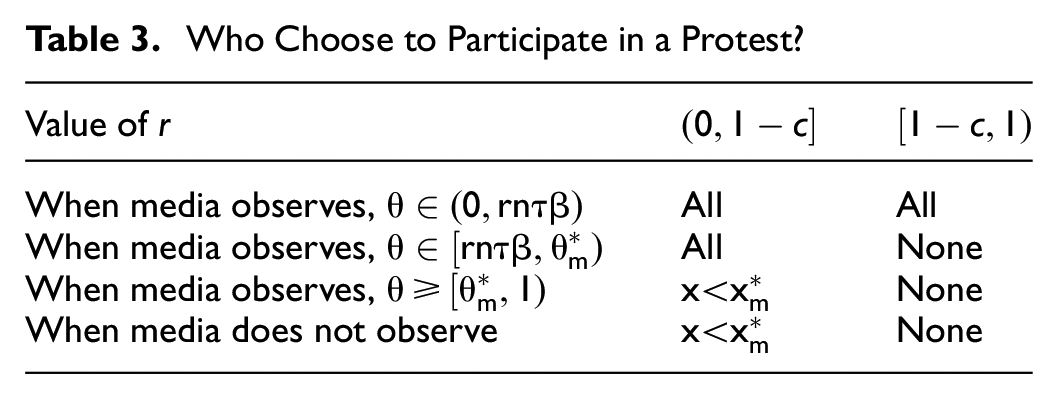
Based on Propositions 2 and 3, Table 2 provides a summary on the projects that will be implemented successfully, and Table 3 provides a summary of the participation choice of citizens.
Which Types of Project Will Be Implemented?
The accuracy of media observation
Project types
Who Choose to Participate in a Protest?
Value of
When media observes,
All
All
When media observes,
All
None
When media observes,
None
When media does not observe
None
In the previous model setting, the accuracy of media observation is an exogenous variable, which cannot be influenced by local governments, media outlets, or citizens. In this part, we add the role of central government that wants to regulate local governments to reduce the number of local protests. Given the design of national and local taxation system, the central government may not receive enough benefit from those environmentally hazardous projects, unlike local governments. However, the central government pays more attention on local protests which may threaten its political regime. Hence, the central government has an incentive to regulate local governments and requires them to disclose more information, which makes the media more easily to observe true type of projects. This makes the local government able to increase the accuracy of media observation . From Proposition 2, we know that when , the equation (13) holds. Given any project with type , the indifferent private signal is , and the total number of protesters is . Therefore, the expected payoff of the government is:
In equation (16), the first term is monotonically decreasing in , larger decreases the total number of protesters , which shows the information jamming effect. The second term () is the expected capture cost and monotonically increasing in , which shows the capture cost effect. The following Proposition summarizes two effects in all possible equilibria:
Proposition 4. When the accuracy of media observation , the capture cost effect dominates, the government’s expected revenue decreases as increases; when , the information jamming effect dominates , the government’s expected revenue increases as increases; when , the information jamming effect disappears and the capture cost effect dominates, the government’s expected revenue decreases as increases.
Note that when the accuracy of media observation goes up to , there is no citizen choose to participate in the protest. The repression cost of local governments becomes zero, and no collective action will happen. However, any project with type will be implemented and cause a lot of pollutions and disutility to citizens. The local governments have no incentive to increase higher than , because it will increase the expected media capture cost, given that the repression cost is already zero.
Conclusion
In this paper, by building a global game model with three types of players—local governments, media outlets, and citizens—we analyze the mechanisms of collective action. We found that media reports and information disclosure may help local governments to implement more unpopular projects because the ambiguity between media reports and the capture action of the government makes citizens enhance their estimation of the project types and thus weakens their incentive to participate in a protest. Then, the government’s repression cost is reduced, and it can implement more polluting industrial projects. Furthermore, when the efficiency of media increases to a certain value, no citizen will choose to participate in the protest, and the repression cost is reduced to zero. Although no collective action occurs, the citizen’s welfare may have been deteriorated sharply. This makes it is necessary for the central government to introduce a series of media policies, judicial supervision, and information disclosure systems to regulate the behaviors of local governments.
To analyze the behavior of masses, we use a global game in this paper. We believe that it is a powerful tool. By making some modifications, the global game model can also be used to analyze other collective actions, such as demolition. The process of citizen’s belief formation and decision-making regarding participation in the collective action are the main points of the research. The relationship between the guilt of not participating in the collective action and the group size of participants can be considered in a modified model which may reflects Olson (1973)’s proposition that small groups have an easier time resolving collective-action problems.
Another interesting direction is the information transfer process, especially in the digital age. By using modern information technology such as social network services by the Internet and mobile phones, citizens can publish and receive information in their personal social network conveniently. Each individual citizen is not only the receiver of information; she may also be the disseminator. The individual information plays an important role in forming the citizen’s belief. However, the authenticity of individual information is harder to evaluate because the opportunity cost of sending false information in personal social networks may be very low. How to address this problem should be the key question of research in the future.
Based on the results of this paper, the propositions can be modified to some hypotheses for empirical analysis. One can also collect some data about collective actions from authoritarian regimes and use empirical methods to investigate the propositions of this study, which could enrich our understanding the media effect on the collective action and governance in an authoritarian regime.
Footnotes
Appendix
Declaration of Conflicting Interests
The author(s) declared no potential conflicts of interest with respect to the research, authorship, and/or publication of this article.
Funding
The author(s) disclosed receipt of the following financial support for the research, authorship, and/or publication of this article: The authors declare no conflicts of interest. The authors acknowledge financial support from the National Natural Science Foundation (41861042, 71864013, 72073054, and 72163006), the Natural Science Foundation of Jiangxi Province (20202BABL205024), and the Science and Technology Fund of Jiangxi Provincial Department of Education (GJJ180260 and GJJ190275). We also thank Dr. Bruce A. McCarl at Texas A&M University and Dr. Chi-Chung Chen at Taiwan’s Council of Agriculture for their insightful comments and modeling assistance.
ORCID iD
Chih-Chun Kung
References
1.
AllcottH.GentzkowM. (2017). Social media and fake news in the 2016 election. Journal of Economic Perspectives, 31(2), 211–236.
2.
BennettL.LivingstonS. (2018). The disinformation order: Disruptive communication and the decline of democratic institutions. European Journal of Communication, 33(2), 122–139.
3.
BergJ. S. (2008). Broadcasting on the short waves, 1945 to Today. McFarland.
4.
BergemannD.MorrisS. (2016). Information design, Bayes persuasion and Bayes correlated equilibrium. American Economic Review, 106(5), 586–591.
5.
BesleyT.PratA. (2006). Handcuffs for the grabbing hand? The role of the media in political accountability. American Economic Review, 96(3), 720–736.
6.
Bueno de MesquitaB.SmithA. (2009). Political survival and endogenous institutional change. Comparative Political Studies, 42(2), 167–197.
7.
CarlssonH.Van DammeE. (1993). Global games and equilibrium selection. Econometrica, 61, 989–1018.
8.
ChenJ.XuY. (2017). Information manipulation and reform in authoritarian regimes. Political Science Research and Methods, 5(1), 163–178.
9.
ChenX. (2012). Social protest and contentious authoritarianism in China. Cambridge University Press.
10.
DengY.YangG. (2013). Pollution and protest in China: Environmental mobilization in context. The China Quarterly, 214, 321–336.
11.
EdmondC. (2013). Information manipulation, coordination, and regime change. The Review of Economic Studies, 80(4), 1422–1458.
12.
EdmondC.LuY. (2020). Creating confusion. Journal of Economic Theory, 191, 105145.
13.
EgorovG.GurievS.SoninK. (2009). Media freedom in dictatorships. Mimeo.
14.
EnikolopovR.PetrovaM.ZhuravskayaE. (2011). Media and political persuasion: Evidence from Russia. American Economic Review, 101, 3253–3285.
15.
GehlbachS.SimpserA.SvolikM. (2016). Formal models of nondemocratic politics. Annual Review of Political Science, 19, 565–584.
16.
GehlbachS.SoninK. (2014). Government control of the media. Journal of Public Economics, 118, 163–171.
17.
GentzkowM.ShapiroJ. M. (2004). Media, education, and anti-Americanism in the Muslim world. Journal of Economic Perspectives, 18(3), 117–133.
18.
GoldsteinK.RidoutT. N. (2004). Measuring the effects of televised political advertising in the United States. Annual Review of Political Science, 7, 205–226.
19.
HartiganJ. A. (1983). Bayes theory. Springer-Verlag.
20.
HuangH. (2008). Media freedom, governance, and regime stability in authoritarian states. Mimeo.
21.
HuangR.YipN. (2012). Internet and activism in urban China: A case study of protests in Xiamen and Panyu. Journal of Comparative Asian Development, 11(2), 201–223.
22.
JohnsonT. (2010). Environmentalism and nimbyism in China: Promoting a rules-based approach to public participation. Environmental Politics, 19(3), 430–448.
23.
JohnsonT. (2013). The health factor in anti-waste incinerator campaigns in Beijing and Guangzhou. The China Quarterly, 214, 356–375.
24.
KuangX. (2020). Self-caging or playing with the edge? News selection autonomy in authoritarian China. SAGE Open, 10(2), 1–11.
25.
KuangX.WangH. (2020). Framing international news in China: An analysis of trans-edited news in Chinese newspapers. Global Media and China, 5(2), 188–202.
26.
KuangX.WeiR. (2017). How framing of nationally and locally sensitive issues varies? A content analysis of news from party and nonparty newspapers in China. Journalism, 19(9–10), 1435–1451.
27.
LangG.XuY. (2013). Anti-incinerator campaigns and the evolution of protest politics in China. Environmental Politics, 22(5), 832–848.
28.
LawsonC.McCannJ. A. (2005). Television news, Mexico’s 2000 elections, and media effects in emerging democracies. British Journal of Political Science, 35, 1–30.
29.
LiW.LiuJ.LiD. (2012). Getting their voices heard: Three cases of public participation in environmental protection in China. Journal of Environmental Management, 98, 65–72.
30.
LiebmanB. L. (2011). The media and the courts: Towards competitive supervision?The China Quarterly, 208, 833–850.
31.
LorentzenP. L. (2013). Regularizing rioting: Permitting public protest in an authoritarian regime. Quarterly Journal of Political Science, 8(2), 127–58.
32.
LorentzenP. L. (2014). China’s strategic censorship. American Journal of Political Science, 58(2), 402–414.
33.
MartinG. J.YurukogluA. (2017). Bias in cable news: Persuasion and polarization. American Economic Review, 107(9), 2565–2599.
34.
MilgromP.RobertsJ. (1986). Relying on the information of interested parties. Rand Journal of Economics, 17(1), 18–32.
35.
MorrisS.ShinH. S. (1998). Unique equilibrium in a model of self-fulfilling currency attacks. American Economic Review, 88(3), 587–597.
36.
MorrisS.ShinH. S. (2003). Global games: Theory and applications. In DewatripontM.HansenL. P.TurnovskyS. J. (Eds.), Advances in economics and econometrics: Theory and applications (pp. 57–114). Cambridge University Press.
37.
OlsonM. (1973). The logic of collective action: Public goods and the theory of groups. Social Forces, 52(1), 123–125.
38.
PetrovaM. (2008). Inequality and media capture. Journal of Public Economics, 92(1–2), 183–212.
39.
SantoP. E.CostaB. (2016). Party newspapers perspectives and choices: A comparative content analysis view. SAGE Open, 6(2), 1–15.
40.
ShirkS. (2011). Changing media, changing china. In ShirkS. (Ed.) Changing media, changing China (pp. 1–37). Oxford University Press.
41.
SunsteinC. R. (2018). Republic: Divided democracy in the age of social media. Princeton University Press.
42.
WhiteS.OatesS.McAllisterI. (2005). Media effects and Russian elections, 1999–2000. British Journal of Political Science, 35(2), 191–208.
43.
ZhaoY. (2000). Watchdogs on party leashes? Contexts and limitations of investigative reporting in post-Deng China. Journalism Studies, 1(4), 577–597.