




Abstract
The socio-psychological variables that affect bilinguals’ choices of code-switching (CS) and code-mixing (CM) as a verbal strategy make prediction of their occurrence almost impossible. This research investigates the social motivations and socio-pragmatic aspects of Chinese-English CS/CM among Chinese undergraduate students. Using a questionnaire survey and interviews, the paper investigates attitude-behavior relations by considering patterns of language use and CS/CM patterns between Chinese and English in this group. The results demonstrate that the participants’ highly positive attitudes toward English and the CS/CM process play a major role in CS/CM use in their daily interactions. Chinese-English bilingual students draw on their proficiency and knowledge of the two language systems to precisely and effectively convey their thoughts, intentions, experiences, solidarity, emphasis, and other aspects that affect interaction outcomes.
Introduction
Code-switching (CS) is defined as the use of more than one language in the same utterance (Broersma et al., 2020; Kootstra et al., 2020) or the alternation between two or more languages in a single conversation (Aabi, 2020; Alhamami, 2020; Goodman & Tastanbek, 2020; Smolak et al., 2020). Gumperz (1982) defined CS as “the juxtaposition within the same speech exchange of passages of speech belonging to two different grammatical systems or subsystems” (p. 59), and Cook (2008) considered it the process of “going from one language to the other in mid-speech when both speakers know the same languages” (p. 174). Moradi and Chen (2019) explain that CS and CM are considered “dynamic conversational phenomena in interpersonal interaction, that is an alternation between two or more languages, dialectal variants, language registers” (p. 122). Laoire (2016), focused on Irish-English CS and asserted that CS is “the most visible and marked of language contact features and it forms part of the active linguistic repertoire of most speakers of Irish” (p. 81). Proficient bilingual speakers sometimes engage in CS/CM by producing discourses either in the same conversational turn or in consecutive turns, using morphemes from two or more languages or language varieties in their linguistic or verbal repertoire (Coulmas, 2013).
An ongoing concern for linguists and researchers in bilingualism and language contact research is exploring how individuals regard CS/CM1 between languages, particularly with English as a lingua franca in different contexts. Gafaranga (2016), in his study on the socio-interactional dimension of language use and CS, asserts that the study of bilingualism, and specifically language alternation, responds to previous negative attitudes toward bilingualism, language use, and language alternation. Language alternation has often been seen to reflect laziness and a lack of proficiency in the languages involved. Gafaranga (2016) notes, however, that attitudes toward bilingualism and language alternation have improved in recent years so that CS “is gradually gaining acceptability,” and “bilingualism is reported to have communicative, cultural and cognitive advantages” (p. 3). One possible reason for this improvement is the trend toward more tolerant attitudes toward “cultural, racial, musical, culinary and other types of hybridity in today’s society” (Gardner-Chloros, 2009, p. 82). These social and cultural developments mean that a large body of research conducted since the twentieth century has questioned previously held beliefs and negative attitudes toward CS and CM (Gafaranga, 2016). Gafaranga (2016) accentuated the inherently interactional nature of bilingualism and the expressive communicative and interactional function of CS/CM. He dismissed negative views of CS/CM and misconceptions about its arbitrary nature that suggest a lack of proficiency—or idiosyncratic and deviant language use. Instead, he highlighted CS/CM as conversational strategies that involve organized interactional practices, playing significant roles in managing and manipulating organizational issues in interactional contexts. Gafaranga underlines bilingual speakers’ high levels of linguistic competence—they exhibit specific CS/CM patterns in social contexts to structure their conversational activity.
Some older studies (e.g., see Auer, 1984; Brice et al., 1998; Gumperz, 1982; Pennington, 1995) also considered CS/CM as positive indicators of bilingualism, and regarded language mixing/switching as typical and significant aspects of bilingualism. For instance, Brice et al. (1998) asserted that the use of CS/CM indicates a sophisticated language user who “exhibits sound cognitive and linguistic functioning” (p. 11). In their extensive studies on language use, language choice and CM in Hong Kong, Pennington et al. (see Pennington, 1995, 1998; Pennington et al., 1992) endorsed CS/CM as typical communicative linguistic phenomena in the speech of proficient bilingual speakers who are able to overlap the grammatical and syntactic rules of the participating languages. Schroeder (2016) argues that CS/CM processes can help individuals expand their social identities and successfully manage challenges associated with cultural differences. CS has also been regarded from a psychological viewpoint as having a micro transition role through which individuals can adopt one role while engaging in another (Anicich & Hirsh, 2017).
Dewaele and Wei (2014, p. 235) note that “language attitudes permeate our everyday lives” and thus, language attitude research attempts to provide a summary of individuals’ attitudes toward languages or language varieties, and is concerned with revealing what determines and defines these attitudes (Garrett, 2010). In other words, researchers try to understand why certain languages—or even particular phonological variables—are positively or negatively regarded by particular speech communities. This study aims to examine the participants’ attitudes toward CS/CM, that is, to find out how young Chinese-English bilinguals perceive this communicative linguistic phenomenon and elucidate the relationship between linguistic attitude and CS/CM in daily conversations. The research questions explored in this study were:
RQ1: Do Chinese college students report switching between Chinese and English in their daily interactions, and if so, what is the nature of the switching?
RQ2: What are the motives of Chinese bilingual students for switching between languages?
RQ3: Do they have positive or negative attitudes toward CS/CM?
Literature Review
Language behavior and attitudes toward language are closely related and can influence the choice of languages (Amin, 2020). For many years, attitude-behavior relations have been the main concern in social psychology and education research. Researchers have questioned whether attitudes stimulate specific kinds of behavior.
Baker (1992, p. 10) demonstrated that attitude is “a hypothetical construct used to explain the direction and persistence of human behavior.” Individuals’ attitudes toward a second language (L2)/foreign language (FL) or toward the native speakers of the target language are important socio-psychological factors influencing language learning and language use. Positive or negative attitudes can also affect motivation to use or learn a language. Therefore, a positive attitude toward an L2/FL and its speakers may affect the process of language use in social contexts.
Some studies of attitude-behavior relations (see Amin, 2020; Berger, 2020; Gwinn & Krajbich, 2020; Moradi & Gupta, 2017; Passafaro, 2020) have regarded attitudes as determinants of how individuals behave in their daily affairs. In contrast, other researchers (see Karahan, 2007; Luttrell & Sawicki, 2020; Woolard & Gahng, 1990) have questioned the relationship between attitudes and behavior, arguing that it is more likely that attitudes do not always predict behavior and may only be minimally correlated or not even linked at all. Gwinn and Krajbich (2020) highlight the vital role of attitude in everyday decisions and assert that different dimensions of attitudes can significantly affect the choice process. Karahan (2007), in her study of relations between language attitudes and language learning in Turkish contexts, demonstrated that despite having relatively positive attitudes toward English as a foreign language (EFL), Turkish learners were not engaged in learning and using English and did not achieve desired proficiency levels in English. Momani’s (2009) investigation of Jordanian secondary students’ attitudes toward EFL and their progress in reading comprehension revealed that the learners had positive attitudes toward learning EFL, and there was a significant correlation between the respondents’ attitudes toward learning English and their progress and actual performance in reading comprehension. However, Dehbozorgi’s (2012) study on the effects of attitude toward language learning revealed a less significant correlation between participants’ attitudes toward English language learning and their proficiency.
Attitudes cannot be observed directly but must be inferred and assessed from observable responses or behavior (see Proctor & Capaldi, 2012; Salma et al., 2020; Somblingo & Alieto, 2020). To elicit observable responses, researchers can use direct methods and presentation of stimuli such as questionnaires and interviews aimed at revealing individuals’ reactions toward particular objects (Faiz & Karasu Avcı, 2020; Gupta & Moradi, 2015; Nukapangu, 2020). The present article links sociolinguistics and social psychology, combining the study of CS and attitude to enable further insights about the intricate relationship between attitudes and behavior. It may also contribute to a clearer perception of the role of socio-psychological processes in the production of language.
CS/CM is a common linguistic phenomenon amongst Chinese bilingual students who frequently switch between Chinese as their native language (NL) and English as their FL. Over the past century, CS/CM has been investigated from diverse perspectives, including grammatical or structural linguistic, sociolinguistic, psycholinguistic, and neuroscientific perspectives (Broersma et al., 2020). Most studies of CS/CM have adopted a linguistic perspective, analyzing formal or structural linguistic characteristics and functional issues of this phenomenon (see, for example Baker, 1980; Kachru, 1978; Gumperz, 1982; Myers-Scotton, 2005; Poplack, 1980). In contrast, there are relatively few sociolinguistic investigations of CS/CM between different language pairs in social contexts, although the need for such analysis continues to be asserted (see Gardner-Chloros, 2009). Nartey (1982) explained that “a universal theory of code-switching would need to look beyond mere linguistic behavior and examine the socio/political environments of the code-switchers” (p. 187). Highlighting that CS is derived from bilinguals’ behavior and that sociolinguistic factors are a key source of variation in CS behavior, Gardner-Chloros (2009) notes that CS needs to be investigated foremost from a sociolinguistic perspective, that is, a perspective where language use and behavior are related to bilingual speakers’ characteristics, attitudes, social identity, or aspects of social life in the broadest sense.
Drawing on a sociolinguistic perspective, this paper contributes to the discussion on the relationship between attitudes and behaviors, where attitudes are considered as determinants of language behavior or language use. It evaluates how attitudes toward a language can affect its use and language behaviors such as switching to the target language, that is, English. The observations made are based on informants’ responses to the questionnaire and interviews conducted during the research.
There has been considerable research on Chinese-English CS/CM (e.g., Chan et al., 2009; Ding & Zhang, 2020; Long et al., 2020; Lyu et al., 2010, 2015) and some early studies investigated aspects of Cantonese-English CS/CM in Hong Kong (e.g., see Gibbons, 1979, 1983, 1987; Hyland, 1997; Pennington, 1995).
However, most studies investigated the occurrence of CS/CM through corpus/speech corpus analyses or automatic speech recognition. Relatively little research has focused on CS/CM between English and Chinese among bilingual college students in China from a sociolinguistic perspective. This paper, therefore, attempts to fill this gap and considers attitudes, perceptions, and motivations of students about two typologically distinct languages and the process of switching between them in social settings.
Methods
Fieldwork and empirical investigation of attitude-behavior relations and language use focused on language alternation between Chinese and English by Chinese undergraduate students. We evaluated the relationship between language attitude and complexity of language switching in social settings using qualitative and quantitative methods. A sequential mixed methods design was followed in which the researchers attempted to elaborate on the findings of one method using another. A mixed methods approach encourages versatility and flexibility by integrating results from qualitative and quantitative approaches into a convergent set of findings (Creswell & Creswell, 2017). Mixed methods enables simultaneous informative explanatory and confirmatory inquiries or questions within the same study.
Within the sociolinguistic perspective, the research focused on the social motivations and social correlates of CS/CM. A questionnaire was developed to investigate: (a) the attitude of Chinese undergraduate students toward mixing languages and toward the target language (English). These attitudes are likely to play key roles in CS/CM between L1 and FL in daily conversations, and (b) to investigate the socio-pragmatic reasons and appropriate settings for Chinese-English CS/CM. We used three resources for the questionnaire design, including (a) available literature on sociolinguistic aspects of CS/CM, and socio-psychology of language learning and language use (e.g., Edwards, 1982; El-Fiki, 1999; Gardner-Chloros, 2009; Gardner & Lambert, 1972; Garrett, 2010; Grosjean, 1982; Gumperz, 1977; Laoire, 2016; Liu, 2020; Nortier, 2020; Preston, 2002; Reyes, 2004), (b) informal interviews with the participants to elicit their points of view (some of them listed below) and combine the elicited data with previous research for preparation of a valid questionnaire, and (c) experts’ advice and suggestions for confirming the validity of the research instrument.
Prior to designing the questionnaire (see Appendix), we conducted informal interviews with participants. We divided them into groups with each one consisting of approximately 15 to 20 students. The main language used during the interviews was Chinese, but—stimulated by the nature of the research—interviews were conducted in an informal bilingual atmosphere, using both English and Chinese. These interviews not only helped us to prepare and design the questionnaire but also enhanced the validity of responses to the questionnaire in later stages of the analysis. During the informal interviews, researchers explained the theme and purpose of the research and extracted the participants’ opinions about language switching and real examples of Chinese-English CS/CM in social contexts. Selected extracts from the interviews are presented below, along with examples from the participants.
(a) I usually use English words in my Chinese sentences when I talk to my friends in Chinese. For example, I ask my friends “你有没有
(b) When I don’t want to answer my friend’s questions or don’t know how to answer, I switch to English and say, “
(c) When my roommates discuss or argue with me in Chinese and repeat their sentences and ideas again and again, I switch to English and say, “
(d) I usually switch to English words and phrases in my daily interactions with my friends. Sometimes I feel some English words or expressions come to my mind faster than their Chinese equivalents, for example: “
(e) I think switching between Chinese and English makes my communication smooth and easier, and also [in] some contexts I feel English words come to my mind faster, especially when I discuss my university work, activities, and assignments and so on. Such as “这个学期我们有几个
(f) Sometimes, some Chinese words sound very similar in connected speech, like 中and 东. I use English words to explain and make them clear.
(g) I usually mix English words in simple Chinese sentences, “我没有
(h) I usually switch to English while talking in Chinese. For example, “
(i) When I recently learned or recited new English words, I use them in our Chinese talks and interactions. I think it helps me to remember and learn the words better. I think it’s normal to switch to English, which is our second language, and nowadays we are more exposed to English in different ways and we also have more English courses per week. In addition, most of my classmates or friends are also learning English. So, I think switching to English is helpful to all of us because we all are English language learners, and it can be a way of practicing and learning English.
The informal interviews highlighted the participants’ positive perceptions of CS/CM and provided some reasons for switching between languages and situations in which it was likely to occur. Reasons for CS/CM use included facilitating daily interaction, communicative purposes, being more precise and emphatic, demonstrating proficiency in their FL, and for practicing English.
Before the main data collection, we conducted a pilot questionnaire survey to examine and evaluate the questionnaire. The questionnaire consisted of 15 questions. Question one examined participants’ attitudes to linguistic and social stereotypes of Chinese and English as FL, for example, “powerful” and “good for career prospects” (nine positive attributes). Questions 2 to 15 explored the reported patterns of Chinese-English CS/CM and attitudes toward the occurrence of CS/CM in daily interactions (38 items of which 14 were unfavorable (negative) attitudes). We set out to determine whether the questions were clear, unambiguous, and explicit to the respondents. Responses were obtained from 22 students, of which responses from 4 were discarded because of incomplete or inappropriate answers. Hence, responses from 18 participants (7 males and 11 females) were used for the purpose of questionnaire analysis. The preliminary analysis of the responses indicated some shortcomings in the questionnaire survey. Some of the questions were ambiguous or difficult for the informants to understand, and the questionnaire could be more systematically arranged. These shortcomings were addressed for the final survey by modifying and redesigning the questionnaire. The final questionnaire was logically sequenced with clear questions that facilitated respondents’ participation and enabled a meaningful analysis of responses. The reliability of the questionnaire was calculated using Cronbach’s alpha and found to be very good (r = .856).
Instruments
Data were collected from respondents via the structured questionnaire. The questionnaire aimed to evaluate Chinese undergraduate students’ attitudes toward English and Chinese-English CS/CM, social motivations, socio-pragmatic and linguistic reasons for switching between the two languages, and whether attitudes stimulate specific behaviors. Social psychologists have long assumed that attitudes are related to social behavior—in this case using two languages in the same conversation.
The semantic and pragmatic level of CS/CM was also considered, to investigate the process of meaning-making among bilingual speakers in social contexts. We investigated the semantic and pragmatic reasons and appropriate setting of Chinese-English CS/CM, analyzing social and socio-pragmatic aspects influencing occurrence of this sociolinguistic phenomenon. As participants and researchers were based at the same institution, the researchers were present with respondents while they completed the questionnaire and could clarify any doubts and record discussions that might inform the analysis.
The questionnaire was divided into two main sections. The first aimed to extract participants’ attitudes to linguistic and social stereotypes toward the Chinese and English languages (Question 1: 10 attributes). The second explored attitudes toward CS/CM and the reported patterns of CS/CM in daily interactions (Questions 2–15; 41 items of which 14 were unfavorable (negative) attitudes). Section 1 (Question 1) consisted of 10 attributes (e.g., “rich,” “pure,” and “prestigious”) with a 5-point scale used for each attribute where 1 to 2 represented highly favorable, 4 to 5 represented least favorable, and 3 was a neutral opinion. Therefore, if a respondent, for instance, indicated 1 to 2 for the parameter “rich,” this suggested they viewed Chinese as a very rich language. In contrast, if they marked 3, it implied that the language is neither rich nor poor and a mark of 4 to 5 indicate that the language was considered “very poor.”
For the second section (Questions 2–15), different types of analyses were used depending on the variables of each question. For question 4 (consisting of 17 items), a 5-point Likert scale was used (1 = strongly disagree, 2 = disagree, 3 = neutral, 4 = agree, and 5 = strongly agree). Participants’ positive responses to the statements were the result of combining the categories “strongly agree” and “agree” while negative responses were the combination of “strongly disagree” and “disagree” categories. For questions 5, 6, 8, and 10, a 7-point rating scale was used to analyze variables. Some questions (2, 3, 7, 9, and 11–15) used an optional Likert scale and Yes/No questions where participants were required to choose the options that best represented their views. Wherever necessary we separately clarify the method of analysis and the variables of the questions.
Participants
Completed questionnaires were collected from 78 Chinese undergraduate students (aged 19–23 years) studying at Nanfang College of Sun Yat-sen University in Guangzhou, China. The responses of 29 male and 49 female students were used for the analysis.
Participants were all non-English major students recruited from our advanced level students or elite class. Based on students’ English scores in their college entrance examination and their proficiency in English, College English Education Center divides non-English major students into levels, including “Advanced or Elite level students” who are considered the most proficient, “A or upper-intermediate level,” and “B or intermediate level,” and “C or lower-intermediate level.” Each level has its own curriculum, English courses, textbooks and syllabus. Compared with other groups of students in terms of English language exposure, elite students have more English courses per week. We randomly selected the study participants from advanced level or elite students in Nanfang College of Sun Yat-sen University in Guangzhou.
Previous studies (e.g., Grosjean, 1982; Gumperz et al., 1999; Kuzyk et al., 2020; Nortier, 2020; Poplack, 1980; Reyes, 2004) demonstrated that language proficiency is a significant factor for switching between languages. Elite students are considered to be the most proficient non-English major students in the college. Bilingual speakers proficient in both their languages use fewer cognitive resources to talk in both their languages as “the mental effort is lower and relatively switching between languages is easier and more expected” (Moradi & Chen, 2019, p. 124). Speakers who are highly proficient in one language but have relatively low proficiency in the other need to use more mental effort when switching between languages, especially when switching to their L2/FL. All our participants had already passed the College English Test Band 4 (CET-4), an important large-scale standardized national EFL test administered by the Ministry of Education in China. It examines the English proficiency of non-English-major university students. Therefore, the participants, randomly selected from the advanced or elite group, possessed a relatively homogeneous and high English proficiency level. Extensive analyses of the intricate linguistic structures of CS/CM demonstrate that switching between languages in different social contexts requires high levels of linguistic proficiency and sociolinguistic knowledge and perceptions (Gardner-Chloros, 2009).
Results
Social and Linguistic Attitudes
This section considers the social and linguistic attitudes of Chinese college students by examining their responses to linguistic and social stereotypes. The aim was to evaluate whether the students’ attitudes reflect the attitude-behavior relationship pattern.
Question number 1 focused on linguistic stereotypes toward Chinese and English, examining them in terms of 10 attributes, namely: “rich,” “prestigious,” “logical,” “pure,” “easy to learn,” “literary,” “powerful,” “useful for social gains,” “useful for personal gains,” and “good for career prospects.”
Table 1 shows that the bilingual Chinese students did not rate any of the languages unfavorably—scores ranged between 1.1 and 2.4 (where scores 1–2 indicate highly favorable). Chinese students have positive attitudes about the inherent quality of their native language. For instance, they think that Chinese is as “rich,” “logical,” and “useful for personal gains” as English, and more “literary” and “pure” than English. It was only in the case of “easy to learn,” “powerful,” “useful for social gains” and “good for career prospects” that Chinese scores exceeded 2. For these attributes—the instrumental domains of employment and career opportunities—the Chinese language received less positive evaluation than English and may be why Chinese was rated less “powerful” than English. English was rated highly, except for the attributes “pure” and “literary” for which Chinese was more favorably rated.
Linguistic Attitudes of Bilingual Chinese Students.

Note. Scores are the mean scores from the 5-point Likert scale where 1 to 2 represented highly favorable, 4 to 5 represented least favorable, and 3 was a neutral opinion.
CS/CM: Reported Patterns and Attitude
The number of Chinese-English bilinguals is increasing rapidly in China as the society develops and English language education becomes more widespread. College students represent this group well because they have a good command of English as their FL and “are not only speakers but also listeners in code-switching” (Ding & Zhang, 2020, p. 65). This section deals with the patterns and contexts of CS/CM reported by the participants. It also considers their attitudes toward CS/CM and the motivational factors behind their reported use.
Questions 2 to 15 of the questionnaire asked about the occurrence of CS/CM in participants’ daily interactions. Question 2 focused on the general attitudes of the respondents toward language switching. Table 2 summarizes the general attitudes of the respondents toward CM/CS. The attitudes were favorable, with 91% considering switching as normal, and no respondents considering CS/CM as irritating, stylish, or a bother.
Chinese-English Students’ Attitudes Toward Code-Switching/Mixing (CS/CM).

Question 3 dealt with the reported use of CS/CM in various contexts. Table 3 shows that CS/CM is employed by Chinese bilingual students in various social contexts including both formal and informal situations. Most (91%) of the participants use CS/CM when talking to friends, and 83.3% mentioned that CS/CM is used in informal situations. However, CS/CM seems to be used less frequently (19.2%) in writing. Approximately half the participants refrained from language switching in work and educational environments and during interactions in classes and meetings. Therefore, we can infer that CS/CM usually occurs in informal situations, rather than formal ones. Ding and Zhang (2020), in a similar study of college students’ attitudes toward Chinese/English CM, found that students “tend to use code mixing of Chinese-English in informal situations with more intimate people” (p. 64). Interestingly, a large number of participants ascribed significant roles and conversational functions to CS/CM and believe that switching between Chinese and English helps them be more precise. They apply it in their informal interactions to be more emphatic when necessary. This is in line with our participants’ assertions and examples during the informal interviews conducted before the questionnaire survey. A similar finding was reported by Ding and Zhang (2020), who noticed that Chinese-English bilingual students choose different languages and switch between Chinese and English in different social settings “to achieve satisfactory communicative effects” (p. 66). Table 3 depicts the conversational and sociolinguistic functions that Chinese college students give to CS/CM in their daily interactions. CS/CM is a meaningful communicative signaling device that helps bilingual speakers convey meaning to listeners or interlocutors.
Context of Code-Switching/Mixing (CS/CM).

Question 4 consisted of statements related to stereotypical opinions toward CS/CM, the motives of Chinese college students for switching between languages, and the direction of switching. As noted, the informants’ positive responses to the statements are the result of combining the “strongly agree” and “agree” categories, while their negative responses are the combination of “strongly disagree” and “disagree.” These responses are presented in Table 4.
Chinese-English Students’ Attitudes Toward Code-Switching/Mixing (CS/CM).

Overall, CS/CM was positively viewed by Chinese college students. It is clear from Table 4 that, in contrast to previous studies (see Berthele, 2012; De Houwer, 2009; Martin-Jones, 2000), CS/CM is not viewed as a lack of language proficiency or competence. Some studies suggested CS/CM is a haphazard behavior resulting from semi-lingualism or incomplete language acquisition, and associated stigma (see Dewaele & Wei, 2014; Grosjean, 1998). However, the Chinese bilingual students in our study did not consider CS/CM to signal a lack of education or limited language proficiency.
Most participants considered that mixed languages are not grammatical. CM involves elements from two linguistic systems, and the grammatical features and lexical items of the two languages appear in the same unit of discourse. Thus, there is potential for production of utterances that violate the structural properties and rules of one or both languages. As noted by Cantone (2007, p. 53), it is common for bilingual speakers to mix their two languages in interaction. However, “it is not always regarded as a grammatical way of speaking” because it involves the exchange of passages of speech and components of two linguistic or grammatical systems in the same conversation. This idea that CS/CM is non-systematic prevailed and was not abandoned for many years (Cantone, 2007). CS/CM was long viewed as a “grammarless mixture of two languages” (Grosjean, 1982, p. 146). Schmidt (2014, p. 39) commented on the spontaneous and natural occurrence of CS/CM in interaction, indicating that fully grammatical sentences and constituents are seldom found in mixed language data sets.
However, research suggests that CM by adult bilinguals is subject to grammatical constraints and is not merely the random mixing of two languages. Rather, it is very orderly—although its orderliness may be distinct from that of the two participating languages (see DiSciullo et al., 1986; Poplack 1980; Sankoff & Poplack, 1981; Sebba, 1998). For example, Poplack (1980) and Sankoff and Poplack (1981) examined Spanish-English mixed utterances of Puerto-Rican bilingual speakers in New York, focusing on the importance of linear order in language mixing. The authors claimed that mixing between languages mostly occurs “at points in discourse where juxtaposition of L1 and L2 elements does not violate a syntactic rule of either language” and that CS/CM is governed by grammatical constraints (Poplack, 1980, p. 586). Poplack and Sankoff (1988) explained that “proficient adult bilinguals incline not to produce monolingually ungrammatical fragments” (p. 1175). In other words, adult bilinguals are able to integrate their two languages into a single utterance without violating the grammatical rules of either language. This can occur even though the two participating languages might be syntactically different and incompatible with respect to word order, subcategorization patterns, inflectional morphology, semantic differences, and idiomatic constructions (Poplack, 1980; Poplack & Sankoff, 1988; Sankoff & Poplack, 1981).
More than half the participants (64.8%) disagreed that a pure language retains the identity of a community. It is surprising that a “pure” language is not necessarily seen as a symbol of one’s identity, and this view challenges traditional socio-psychological theories of “language = identity” (see Echeverria, 2003; Fishman, 1991; Heller, 2001; Jaffe, 2001; Tajfel, 1981). Our participants’ perception thus confirms the general consensus of recent studies in linguistics and bilingualism (see Fei et al., 2012; Pavlenko & Blackledge, 2004; Young, 2008) which regard this theory as overly simplistic because it fails to consider bi- or multilingual contexts or language contact phenomena. Pavlenko and Blackledge (2004) consider that the social-psychological theory of identity “obscures hybrid identities and complex linguistic repertoires of bi- and multilinguals living in a contemporary global world” (p. 5). Young (2008) explains that many languages are not necessarily connected to ethnic, local, or national identities, like the use of English as a lingua franca among non-native speakers in many countries around the world.
Statement (f; Table 4) sought to extract the informants’ attitudes about whether mixing Chinese with English leads to the loss of Chinese. The participants did not hold negative views regarding the mixing of Chinese and English. Traditionally, bilingualism in general—and CS/CM in particular—have been regarded as “diseases,” intimidating, and undermining the purity of the participating languages (Keller, 1979, p. 131), stigmatized with pejorative terms such as “verbal salad” (in Nigeria), “still colonized” (Morocco), and “very irritating” (Hong Kong; Dewaele & Wei, 2014, p. 237). Even neutral sounding labels like “Konglish,” “Tex-Mex,” and “Japlish” often have negative connotations. These terms reflect the orientation toward monolingualism and language purism, or “one language at a time,” manifesting as attitudes against CS/CM (Wei & Wu, 2009). Our participants disagreed or were neutral regarding CS/CM as a cause of language loss, suggesting positive attitudes of Chinese college students toward CS/CM.
The following statements (g & h, Table 4) aimed to extract respondents’ attitudes regarding segregation or integration with other Chinese students when they mix their L1 and FL. Responses show that the majority feel neither integrated with nor segregated from their community when mixing the two languages. Their responses demonstrate that the participants, in general, do not seem to relate CS/CM to any negative social effects or consequences. This is similar to the results found in other bilingual communities (see Koç, 2016; Montes-Alcalá, 2000). However, there are studies (see Akynova et al., 2012) that have found the opposite, asserting that bilingual students with negative attitudes toward CS/CM typically feel segregated from the community in contrast to those with positive attitudes who feel more integrated with the society.
Although CS/CM was viewed favorably in our study, in certain contexts (e.g., in literature, formal education and formal situations) it was not judged as favorable. This was noted in responses to the “i, j, and k” statements of Question 4, shown in Table 4.
The next three statements of Question 4 (l, m & n, Table 4) sought responses to depict participants’ attitudes and motivations toward CS/CM in their daily conversations. The statements reveal why participants switch between languages in their daily interactions. CS/CM was seen as a useful medium for specific purposes. Chinese bilingual students consider CM/CS a helpful strategy enabling them to communicate easily and precisely, and hold positive attitudes toward this phenomenon.
The statements in (o) and (p; Table 4) focus on reported uses of switching, specifically about the direction of CS/CM. CS/CM direction is mainly from Chinese to English. Because participants have positive attitudes toward English, they easily mix English words and phrases into the Chinese language. This does not mean that they do not have positive attitudes toward their native language. However, they asserted that they try to be precise when communicating with other bilingual speakers, and CS/CM makes the communication easier. CS/CM occurs less from FL to L1, that is from English to Chinese while talking in English. They may consider this mixing connotes a lack of knowledge and proficiency in English. This finding confirms that Chinese bilingual students favor CS/CM in specific contexts.
The final statement of Question 4 (q, Table 4) aimed to determine whether Chinese undergraduate students consider CS/CM as a learning strategy. English is considered an FL in China, and therefore, it was predicted that students may also use CS/CM as a strategy for learning and improving their English. The participants’ responses to this statement revealed that CS/CM is employed by students in their daily interactions as a communicative strategy and as a learning strategy that contributes to improvement of their English proficiency. Chinese-English CS/CM is used to improve and foster competence in English, exactly as participants asserted during the interviews.
Questions 5 and 6 sought responses about the frequency of CS/CM from Chinese to English, and from English to Chinese. Table 5 shows these two questions aimed at investigating how often Chinese undergraduate students switch between their L1 and L2, or vice versa. We confirmed the direction of switching between the languages involved and noted the perceived frequency of its occurrence in their daily interactions. The participants’ responses are summarized in Table 5.
Frequency of Occurrence of Code-Switching/Mixing (CS/CM) by Chinese-English Students.

Table 5 shows that all participants frequently switch from Chinese to English. In contrast, the majority of the participants (71.8%) asserted that they “rarely” switch from English to Chinese.
New technology-based facilities such as Weibo, Email, Blogs, WeChat, and other social media have led to new trends and platforms for CS/CM in written language among bilingual speakers, and the emergence of these technologies has made new types of mixed-language data available. Therefore, Question 7 investigated whether Chinese-English bilingual speakers switch between Chinese and English in the written language. The participants’ responses to this question indicated that most respondents (73.3%) believe they also use CS/CM when writing.
Question 8 sought responses about the frequency of Chinese-English CS/CM in written language in daily communication. Participants’ responses are summarized in Table 6 which shows CS/CM rarely occurs in written language—in contrast with findings for spoken language.
Frequency of Code-Switching/Mixing (CS/CM) in Written Language of Chinese-English Students.

Question 9 dealt with the frequency and use of FL in daily life. Participants agreed that the use of English as an FL is increasing in their daily life interactions.
In Question 10, the respondents rated the effect of switching in their daily communication. The very positive attitude of participants regarding this question are shown in Table 7.
Effect of Code-Switching/Mixing (CS/CM) as Perceived by Chinese-English Students.

Question 11 aimed to extract the participants’ general ideas toward bilingualism and switching. A large proportion of the respondents (88%) believed that knowing two languages and switching between them is good.
Question 12 set out to determine whether CS/CM is helpful and to further understand the switching function in communication. The majority (85%) believed that CS/CM is helpful to them and builds their communication process. They believe that CS/CM positively affects their communication, highlighting the participants’ positive attitudes toward CS/CM. Table 7 reported the same result, with most participants describing positive effects of language switching in their daily communication.
Question 13 investigated the language processing or language access of Chinese bilingual students when switching between the languages. We sought to understand whether switching facilitates respondents’ communication processes. Most respondents (80.7%) indicated that, compared with one language, moving between languages does not take longer, that is, they believe that switching facilitates their interactions and when they switch between languages the conversation is easier and faster, and time to access lexical items is reduced. Hence, language retrieval is a linguistic reason for Chinese undergraduate students to switch between their L1 and FL. Other studies (e.g., J. Chen & Liu, 2020; Costa & Santesteban, 2004; Heredia & Altarriba, 2001) have similar findings, asserting that in CS situations some words and concepts become more accessible.
Question 14 investigated the extent or level of language switching among Chinese bilingual students. Their responses are summarized in Table 8.
Level of Code-Switching/Mixing (CS/CM) by Chinese-English Students.
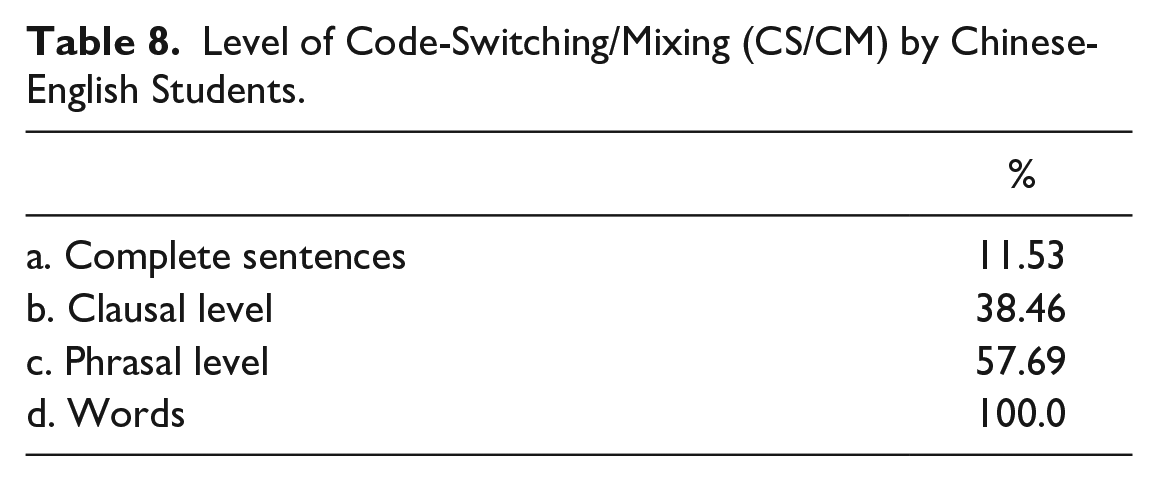
As seen in Table 8, Chinese bilingual students mostly switch languages at word and phrasal level, in other words, they switch at an intra-sentential level termed code-mixing (CM). Less frequently they switch languages at clausal or sentence levels, that is, inter-sentential level or code-switching (CS). The participants’ responses to this question confirmed the findings from the interviews.
Question 15 aimed to understand factors leading to switching from one language to another. Results are summarized in Table 9.
Factors Inducing Code-Switching/Mixing (CS/CM) in Chinese-English Students.
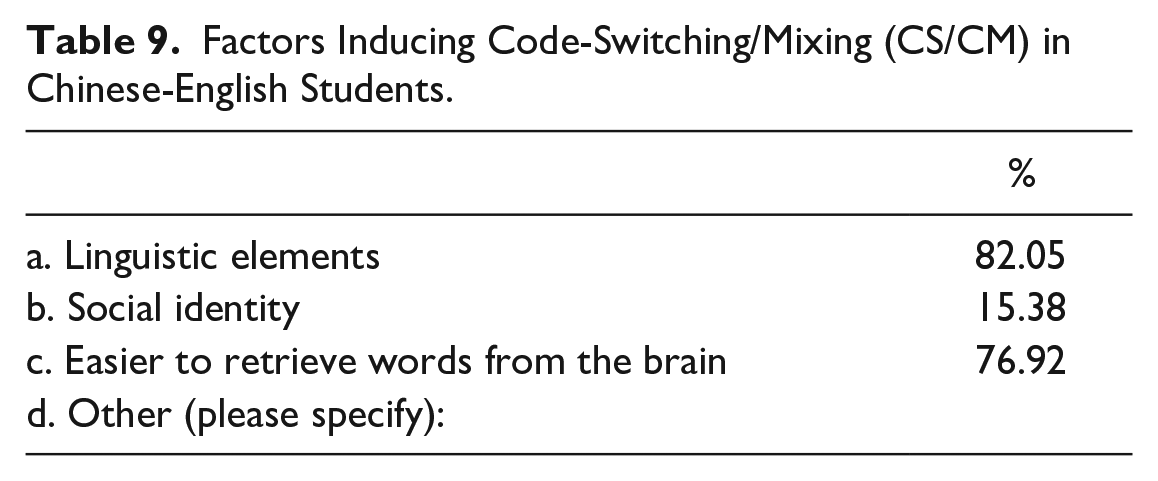
Almost all the participants related switching from one language to another to linguistic elements and retrieval factors that facilitate language use and interaction. Previous research indicates that bilinguals’ two languages are simultaneously active during interactions or language use (e.g., Kroll et al., 2015). This means that the L1 or more dominant language remains active when using L2/FL, and that the converse is also true. When bilingual speakers listen to speech, read words, plan speech, or read words in either language, both languages are always active (e.g., Kroll et al., 2006; Marian & Spivey, 2003). Kroll et al. (2015, p. 378) explain the parallel activation of two languages means there are influences of the language not in use, even when bilinguals are unaware of those influences. The bilinguals’ two languages potentially compete for cognitive access and resources. Thus, bilingual speakers need to regulate that competition so that they do not mistakenly use the unintended language or lose fluency in either language (Kroll et al. 2015). Regardless of the languages spoken, including those with completely distinct written scripts, such as Chinese and English (Thierry & Wu, 2007), this cross-language or parallel activation appears to be present in all bilingual speakers.
Grosjean (1989) examined whether switching between languages is a normal or pathological feature of bilinguals’ interactions and daily language use. He asserted that a bilingual is not two monolinguals in one. We know that CS/CM is a typical bilingual feature and a significant linguistic skill that effectively influences and fosters cognitive abilities (e.g., Green & Abutalebi, 2013; Green & Wei, 2014; Kroll et al., 2015). The cross-language or parallel activation of bilinguals’ two languages is likely to be a primary mechanism that contributes and leads to language switching, and differentiates bilingual and monolingual language use (see Kroll et al., 2015). To explain the range of contexts in which language processing differences are reported for mono- and bilingual speakers, and language contexts that could influence switching behaviors, Green and Abutalebi (2013) proposed the adaptive control hypothesis (ACH). This theory suggests that multiple factors of cognitive control are recruited to perform language tasks, such as language switching. For instance, a distinct set of mechanisms may be involved when CS/CM occurs between bilingual speakers. The difference in language context and use, in level of proficiency and linguistic skills, and the nature of language pairing will significantly affect how control networks are engaged (Kroll et al., 2015). Therefore, bilingual speakers are not only different from monolinguals, but also from other bilingual speakers whose linguistic circumstances differ from theirs.
Green and Abutalebi (2013) use CS to illustrate how such differences may emerge. Some bilinguals may use intra-sentential CS between languages while others may not. These two groups of bilingual speakers may be similar in linguistic competence and proficiency, but habitual CS may involve a subset of control mechanisms that non-switching bilinguals do not acquire and perform with the same level of expertise. Therefore, more experimental research is needed on cognitive aspects of language processing and CS/CM among Chinese-English bilinguals.
For this question, participants were able to indicate option (d; Table 9) and mention other significant reasons for switching between Chinese and English. Their responses included: intention of clarifying speech content for interlocutor (85.8%, f = 53), because of lexical need (80.7%, f = 63), and talking about a particular topic (43.5%, f = 34). Switching between Chinese and English may occur when Chinese-English bilingual students try to clarify their speech for the interlocutors. This may occur either from their FL to L1 or from Chinese to English. Another significant reason for switching between Chinese and English is lexical need which mostly occurs from English to Chinese, possibly when the speakers do not know the exact equivalent of the words or phrases in English. In line with Myers-Scotton (2005), bilingual speakers may use embedded language elements when they talk about a particular topic because these elements sometimes convey meaning or connotations that are better understood by their interlocutors. Hence, while talking about a particular topic, the embedded language elements are sometimes better options for particular registers.
Discussion
Research Questions
To fulfil the objectives of the research, this paper set out to answer the following research questions (RQs). Due to the inter-relatedness of the research questions, some of the answers were found to be relevant to more than one research question. The main research questions that directed data collection are discussed in subsequent sections.
RQ1
Do Chinese college students report switching between Chinese and English in their daily interactions, and if so, what is the nature of the switching?
From the quantitative (questionnaire-based) analysis of the participants’ responses, it was observed that Chinese undergraduate students frequently switch languages in their daily conversations and Chinese-English CS/CM is a very common and normal phenomenon in their daily interactions. Chinese-English bilingual students favor smaller linguistic constituents. They switch more frequently at the lexical level with smaller constituents. In other words, switching is usually at an intra-sentential level (code-mixing) with only a few words or phrases involved. Inter-sentential switching (code-switching) occurs less frequently and involves clauses or sentences.
The direction of switching is mostly from Chinese to English, that is, Chinese is the dominant or matrix language (ML) and Chinese college students switch to English vocabulary when talking in Chinese. Chinese provides the syntactic and morphosyntactic frame, while English is the embedded language providing only content morphemes embedded in the morphosyntactic frame of the matrix.
RQ2 and RQ3
What are the motives of Chinese bilingual students for switching between languages?
Do Chinese-English bilinguals have positive or negative attitudes toward CS/CM?
Chinese-English bilinguals employ CS/CM in their daily interactions for several reasons. They use CS/CM in social contexts as a communicative strategy and a learning approach to improve their competence in English, as their target language. This is in line with research on educational sociolinguistics of CS/CM (e.g., Gumperz et al., 1999; Read et al., 2020; Reyes, 2004; Sabri, 2020; Shafi et al., 2020; Zimmerman, 2020) that identified the use of CS/CM during cooperative learning environments as a useful strategy that L2/FL learners adopt to create opportunities for learning. Further research is needed to investigate how CS/CM can influence the linguistic repertoire of young Chinese-English bilinguals during peer interaction for greater pragmatic, linguistic and academic competence. Other questions that need to be investigated further include: How does switching to the target language influence the proficiency of Chinese-English bilingual students? And, which aspects of language, bilingual communicative competence or language skill can be improved by applying CS or CM in daily interactions?
Questionnaire responses indicated that CS/CM is used in daily conversations because (a) the students believe that CS/CM can convey their intended meaning precisely, (b) it makes communication easier and faster, thereby facilitating the communication process, (c) it takes less time to access lexical items, and language retrieval is, therefore, faster when switching between languages, and (d) they switch languages because some ideas and concepts seem to be better expressed in English. These findings support Schreuder and Weltens’ (1993) study on the bilingual lexicon, and Hoffman’s (1991) study on CS, together with more recent studies on bilingual attitudes and CS/CM (e.g., T. P. Chen, 2019; J. Chen & Liu, 2020; Ding & Zhang, 2020; Kiss, 2020). These recent studies assert that switching can serve as an effective solution to a word-finding problem, for being emphatic or for clarification, and because sometimes embedded language elements are retrieved faster than ML elements.
The participants’ responses to the questionnaire revealed their attitudes toward English and Chinese-English CS/CM were highly positive. As an important socio-psychological factor, this may affect individuals’ motivation for language use and language learning (see Migge, 2007; Myers-Scotton, 1993). This finding concurs with conclusions from studies on CS/CM and language attitude (e.g., Dewaele & Wei, 2014; Gupta & Moradi, 2015; Vana, 2020) that reveal a link between language attitudes and language behavior. Dewaele and Wei (2014) point out that “attitude affects behavior, and the attitude-behavior correspondence is a psychological process” (p. 236). In their study of attitudes toward code-switching among mono- and multilingual speakers, they revealed that “participants with more positive attitudes toward CS reported using CS more frequently” (p. 250). Vana’s (2020) research on learning attitudes, and Gupta and Moradi’s (2015) investigation of socio-psychological aspects of language use had similar findings.
Attitude is clearly a significant factor affecting language performance and language use in social contexts, and attitudes emerge as one of several factors that affect language use, language choice or switching between languages in multilingual contexts. Nevertheless, questions remain about the relationship between language attitude and behavior, and why attitudes do not always predict behavior and are sometimes only minimally related to behavior (e.g., see Karahan, 2007; Luttrell & Sawicki, 2020; Woolard & Gahng, 1990).
The respondents in our study described CS/CM as a learning strategy in their daily interactions for fostering their proficiency in their FL. Many mentioned that switching between their L1 and FL helps them to practice and learn more of their target language. This finding requires further in-depth investigation to find out how CS/CM can help language learners enhance their linguistic proficiency and to understand which language skills can be improved. Future research could focus on this aspect of Chinese-English CS/CM and the structural analysis of Chinese-English CS/CM produced in social settings.
As the study was mainly based on participants’ responses to a questionnaire, we acknowledge the limitations of the methods used, such as challenges in establishing causal relations between variables such as attitude and linguistic behavior. We also acknowledge that bilingual speakers vary widely (e.g., Luk & Bialystok, 2013). Future research on language attitudes and bilingual interactions, and language use of diverse groups of bilinguals will shed light on how bilingualism and language attitudes may shape bilinguals’ cognition and linguistic behavior. For example, there could be Chinese-English bilingual students highly proficient in both languages who seldom engage in CS/CM. More investigation of those with a lower proficiency in English as their FL is needed to explore if they also show positive attitudes toward CS/CM and report similar responses regarding CS/CM and language behavior.
The study participants were 78 undergraduate students with high levels of English proficiency. Future research should use larger and more diverse samples of participants such as bilingual speakers with varying levels of language proficiency. A large-scale investigation of Chinese-English bilinguals’ attitudes toward CS/CM would enhance the findings and demonstrate perceptions of diverse groups toward language switching. This would elucidate facets of Chinese-English language switching and shed light on patterns of variation in CS/CM as a communicative linguistic phenomenon among diverse groups of bilinguals.
Conclusion
In direct opposition to traditional viewpoints, the participants of our study did not assign negative values to CS/CM. They did not consider it to signal a lack of education or language proficiency, and did not think it will lead to loss of the Chinese language. In contrast, they reported a strongly positive attitude toward English and the process of CS/CM between the languages. This positive attitude influenced their daily language use and frequent switching between Chinese and English in their interactions.
The participants demonstrated that switching occurs mostly for a few words or at lexical and phrasal levels (intra-sentential switching) while clause and sentence level switching (inter-sentential switching) was less frequently used. They considered CS/CM as a facilitator in their daily interaction, and believe language retrieval is faster and easier when switching between languages. The direction of switching was mainly from Chinese to English. Therefore, in Chinese-English CS/CM, Chinese remains the dominant or matrix language while English is the embedded one that supplies the lexical items or content morphemes.
The occurrence of CS/CM is affected by sociolinguistic factors, socio-psychological factors, the properties of the lexical items, phrases, and sentences that are used during the social interactions, and the relative language proficiency of bilinguals in both languages. The ability to switch between languages in social contexts requires not only linguistic knowledge and proficiency but also sociolinguistic and sociocultural sensitivities. CS/CM is also used as a learning strategy for the target language, that is, English.
Chinese-English bilingual students reported that language retrieval is faster and easier when switching between languages. However, there is a lack of experimental research in this regard. Further research is needed to investigate how bilingual or multilingual lexical systems deal with the distinct lexicalization patterns for different languages and how L1 and L2/FL lexical items are stored and accessed in bilingual lexicons.
Future studies could also examine Chinese-English CS/CM from a linguistic or structural perspective. Focusing on grammatical and structural rules that govern bilingual speech production would help identify syntactic, morphosyntactic or structural constraints governing switching between Chinese and English and show how differences between two typologically different languages can affect the process of language switching.
Footnotes
Appendix
Declaration of Conflicting Interests
The author(s) declared no potential conflicts of interest with respect to the research, authorship, and/or publication of this article.
Funding
The author(s) received no financial support for the research, authorship, and/or publication of this article.
