




Abstract
This study investigates language attitudes held by Chinese-English bilinguals toward two types of switching to English in mandarin Chinese discourse, that is, intraclausal and interclausal switching. Participants with varying degrees of English proficiency were sampled from four cities in mainland China and one oversea city, London. A variation of matched-guise technique, open guise technique, was used to collect attitudinal responses toward code-switching. Quantitative analyses showed that the participants generally downgraded code-switching on social likability, with interclausal switching receiving the lowest ratings. In terms of social-economic status, however, interclausal switching was rated the highest and the intraclausal type the lowest. Such evaluative responses were consistent across genders and the cities of interest. The theoretical and methodological implications of the study are discussed.
Introduction
As one of the most common outcomes of language contact, code-switching (hereafter CS) is defined as the alternate use of two or more languages/language varieties in the same conversation, discourse, or even utterance (Gardner-Chloros, 2009). The purpose of this study is to show that research on social psychology of CS should differentiate attitudes toward various types of CS. Grammatical and sociolinguistic studies make distinctions between different types of CS, such as between intrasentential and intersentential CS (Poplack, 1980), or between marked and unmarked CS 1 (Myers-Scotton, 1993). These different types of CS are not treated equally by linguists in terms of their theoretical importance and social significance. For example, intrasentential CS is considered to be a hallmark of bilingual language processing and studies of intrasentential CS can contribute to the understanding of neurocognitive mechanism involved in the language switching process (Van Hell, Fernandez, Kootstra, Litcofsky, & Ting, 2018; Van Hell, Litcofsky, & Ting, 2015). Marked and unmarked CS can index different sets of rights and obligations perceived by conversation participants (Myers-Scotton, 1993).
However, in attitude studies on CS, language switching is usually treated in a sweeping manner, that is, attitudes are often discussed in relation to the overall practice of switching (however, see Anderson & Toribio, 2007) and there is very little mentioning of how and whether various types of switching are evaluated differently by code-switchers and other language users. Language attitudes are multidimensional and sensitive to the internal variation of linguistic practices (Garrett, 2010). Therefore, it is safe to assume that speakers are likely to hold different opinions toward various patterns of language switching. Without examining how different types of CS are evaluated, we cannot confidently predict how the production of a particular type of CS is informed by speakers’ attitudes (cf. Montes-Alcalá, 2000; Parafita Couto, Deuchar, & Fusser, 2015) unless we know how that particular type is subject to evaluation.
Recent experimental studies on grammaticality judgment of CS also call for a more refined treatment of attitudes toward different types of CS. Badiola, Delgado, Sande, and Stefanich (2018) argue for the consideration of speakers’ attitudes in both experiment design and results interpretation when probing subjects’ judgment of CS grammaticality. They show that attitudes toward CS can accentuate the rule-governed nature of CS. Positive attitudes elevate ratings in acceptability judgments, whereas negative attitudes can lead speakers to perceive code-switched sentences allowed by their linguistic systems as ill-formed. The rejection of grammatically acceptable code-switched sentences might impede the propagation of these code-switched patterns within the social cohort of those speakers. This can help us understand why bilinguals do not freely switch their languages even at some grammatical legitimate places and why some forms of CS get propagated and some do not. Therefore, further identifying how different patterns of CS are evaluated respectively can contribute to a deeper understanding of the interaction between extralinguistic and grammatical factors in the production of CS.
Documenting what kinds of attitudes are widely held toward different types of CS is also helpful in understanding how individuals’ sociopsychological locale responds to social changes (Dewaele & Li, 2014). CS is the outcome of two languages/cultures coming into contact with each other as a result of some changes in population mobility and social policies. Different types of CS observed in a speech community may be considered as manifestations of these social changes at discursive level. Thus, understanding how various types of CS are perceived by individuals who are conditioned and constrained by their material and symbolical position in society and their psychological disposition is helpful in understanding how these social changes are diffused among these individuals (cf. Coupland & Kristiansen, 2011).
This article investigates attitudes toward two types of Chinese-English CS, intra- and interclausal (Deuchar, 2012). The differences between these two types will be shortly discussed in the “Method” section. Previous research shows that English is not perceived as a threat in China where Mandarin Chinese is an extraordinarily high-vitality language. Instead, it is linked to success and many speakers even associate it with humanist and culture-aware ideas and behaviors (He & Ng, 2013). In contrast, people in many other countries (such as the United States and Canada) often perceive a similarly influential language (not necessarily English) as a threat when they have equal high-vitality languages (Dragojevic, Giles, & Watson, 2013). Therefore, the striking differences as such make studying variations in reactions to English in China (including CS to English) a fertile ground for further research on social psychology of language (Gallois, 2013). The primary goal in the work presented here is to examine whether the two patterns of switching to English in Chinese discourse are treated differently. If so, how and to what extent evaluations vary with subject demographics, such as gender and regional background. By differentiating two types of CS in the discussion of speakers’ attitudes, the present article attempts to capture the more nuanced interplay between language practices and social realities they are perceived to represent, and argues that a more refined focus on attitudes toward different types of CS can also inform some long-standing theoretical questions in CS studies.
Past Research on Attitudes Toward CS
Given the purpose of the current article, the review of the literature on social psychology of CS will be limited to those studies conducted outside the classroom context. Despite the “few and far between” nature of the systematic studies on attitudes toward CS (Gardner-Chloros, 2009), the current literature in this regard has provided some useful insights into how speakers orient toward this linguistic practice. Evaluations of CS are heavily influenced by the “standard language ideology” (Milroy, 2001) and linguistic purism that is central to language standardization process. Negative remarks on switchers’ language ability litter in the relevant literature and many pejorative terms have been associated with CS use. For example, Spanglish and Tex-Mex were used in contact Spanish contexts to indicate speakers’ deficiency in their intellectual and linguistic abilities (Anderson & Toribio, 2007). Those who mix language varieties were labeled “tuti futi” (i.e., broken up) in the Panjabi-speaking community in Chana and Romaine’s (1984) study. Pena’s (2004) participants from two different generations expressed similar negative opinions on CS which they believed signaled a lack of language proficiency. Other unfavorable evaluations also extend to switchers’ personality traits. In Gibbons’s (1987) study, Hong Kong students displayed overt hostility against English-Cantonese CS and considered it as “showing off” and “irritating.” In their matched-guise experiment, Lawson and Sachdev (2000) reported that their participants rated the Tunisian-French CS guise less favorably compared with other non-CS varieties, on both status and solidarity. Sometimes, the perceived threat of CS to maintaining ethnolinguistic identity can also contribute to the negative evaluation of CS (Karimzad & Catedral, 2018).
However, there are also studies which have documented some positive evaluations. Montes-Alcalá (2000) provided some evidence to support the claim that there was a shift toward the acceptance of CS among the Spanish-English young participants. The expression of their bilingual identity through CS promoted their positive evaluation. Reported positive attitudes toward CS are also often related to utilitarian consideration as CS can facilitate understanding and enable speakers to exploit their linguistic repertoire for discourse effects. Bouy and Nicoladis (2018) reported that CS was viewed as polite and considerate if it facilitated communication. In Koch, Gross, and Kolts (2001), positive views were provided by the participants toward appropriate CS behavior, that is, appropriate to the social norms of interaction context.
What is worth pointing out in attitude studies of CS is that there often exists a mismatch between overt evaluation and actual linguistic practice. Speakers holding overt negative attitudes can nevertheless exhibit a considerable degree of CS usage. CS was still practiced by those Hong Kong students in Gibbons’s (1987) study despite some unfavorable tags such as “showing-off” and “irritating.” Speakers of contact Spanish accepted the stigma attached to their way of speaking and nevertheless continued with it (Anderson & Toribio, 2007). Some participants in Pena’s (2004) study considered CS negative but this did not discourage their mixed style of speaking. Lawson and Sachdev (2000) also reported that the negative evaluations gathered in the matched-guise experiment were not supported by the observation of actual linguistic behavior. The incongruence between overt negative attitudes and the actual frequent usage prompted the proposal of “covert prestige” of CS (Anderson & Toribio, 2007; Gibbons, 1987; Lawson & Sachdev, 2000). CS can signal dual identity and strengthen in-group solidarity, and at the same time, it can also borrow status (such as “modernity” and “westernization”) from the participating languages.
The lack of correspondence between overt attitudes and the actual switching behavior also raises some questions, such as how attitudes are conceptualized and what kinds of attitudes are measured. Attitudes collected by questionnaires or interviews are more likely to be symbolic attitudes (LaPiere, 1934), which do not necessarily reflect context-dependent nature of attitudinal disposition in more complicated social situations. In addition, language attitudes are also sensitive to fine-grained distinctions made among various types of the same linguistic phenomenon. In Chana and Romaine (1984), different types of Panjabi-English CS elicited different opinions regarding, for example, how well the switcher can express himself/herself and the suitability of the speaker being a language teacher. Anderson and Toribio (2007) showed that their participants favored lexical insertions over intrasentential switching, as commensurate with their language proficiency. Liu (2015) also presented some empirical evidence of different types of Chinese-English CS being evaluated differently by some overseas Chinese. However, in most attitude studies on CS, only attitudes toward the overall practice of switching have been investigated. Such general attitudes are nevertheless used to account for various uses of different types of CS. In Montes-Alcalá (2000), attitudes toward CS were not found to affect the types of CS that bilinguals produced. Parafita Couto et al. (2015) concluded that the speakers’ reported attitude to CS, which was measured by simply asking whether people should mix Welsh and English in the same conversation, can predict the degree of their use of mixed determiner phrases. It would be of interest to know whether the same findings would still be supported by a more fine-grained treatment of attitudes toward CS.
Attitudes Toward CS in Mainland China
China hosts the largest population of English-learners in the world (He & Ng, 2013; Pan & Block, 2011). The status and significance of English as a global language is widely acknowledged in China. English has been held as an important tool to link China to the outside world and also to modernize the country. Good proficiency level in English is highly praised and desirable, and a good command of English is considered necessary for obtaining access to social prestige and mobility. Overall, favorable attitudes toward English are evidenced among teachers, learners, and the general public, echoing the positive language policy on English (He & Ng, 2013).
When it comes to attitudes toward the insertion of English elements in Chinese discourse, most studies in this regard have been carried out in classroom settings. To the author’s best knowledge, empirical and systematic studies on how the general public views the CS practice from Chinese to English in noneducation contexts are scarce. A few available studies reported both positive and negative attitudes (e.g., Bi, 2011; Cai, 2011; Xu, 2008).
Bi (2011) examined the general public’s attitudes toward mixing English in Chinese Internet language. The author confirmed that the mixed use of English in Chinese Internet language was an unavoidable trend and also concluded that a majority of participants (77.5%) showed very positive attitudes toward English mixing. Xu (2008) investigated some young speakers’ attitudes toward different language varieties spoken in Guangzhou (a southern city in mainland China), including mixing English in Chinese. Two groups of participants were examined. Sixty-nine percent of subjects of the first group, which consisted of college students, did not approve of mixing English in Chinese. They believed that this can harm the purity of Chinese language. The second group, mainly comprising young white-collar workers employed in foreign-invested companies, had more positive attitudes toward using English words. The author suggested that this may be related to their perception of English use as a prerequisite to individual success in their work environment.
Attitudinal responses of the public observed on Internet and through other channels of social media seem to support the negative evaluation demonstrated in these studies. For example on Zhihu, 2 a search with key words “English in Chinese” can retrieve more than 100 questions on this topic. On another popular social media SinaWeibo, 3 a search with the same key words retrieves a long list of posts by various users. Ridicule and criticism of English insertions are common in the comments on these websites. Some frequently observed comments are “zhuang bi” (showing off), “re ren yan” (annoying), “qian chou” (deserving a slap on the face), and “zhe shi bing, dei zhi” (this is a disease which needs treatment). Of course, not every piece of evaluation observed on social media is negative. Some of them attempt to justify the legitimacy of English insertions by resorting to utilitarian reasons. But overall, the negativity toward CS is obvious.
Given the scarcity of studies on attitudes toward Chinese-English CS and the fact that the observed attitudinal responses cannot be fully accounted for by the current research findings, more systemic and empirical research is called upon. Opinions held by a wider section of population stratified along more social and demographic factors should be incorporated to help us better understand how Chinese speakers respond to the infiltration of English in Chinese discourse when they publicly show positive attitudes toward the English language per se.
Method
The present article examines attitudes toward two types of Chinese-English CS, intra- and interclausal switching, a distinction made in Deuchar (2012). These two types are found to be typical among Chinese-English bilinguals, especially intraclausal switching, of which the frequency of use was found to have significantly overtaken that of interclausal type in speech (Liu, 2015, 2017). The categorization of intra- or interclausal switching depends on their position within or between clauses. 4 Intraclausal switching refers to insertions of mainly nouns, noun phrases, and, sometimes, discourse markers within clausal boundaries. Different from intrasentential switching which is considered to be the more complex form of switching practiced by advanced bilinguals (Poplack, 1980), intraclausal switching in this study does not necessitate a mastery of advanced linguistic knowledge of the target language (English). The switched elements are freer of syntactic restrictions than other word-classes. In addition, whenever there is a potential conflict between Chinese and English grammars, the switched element is always dictated by Chinese rules. Examples 1 and 2 demonstrate the difference between the more complex intrasentential switching in Poplack’s (1980) typology and the simpler intraclausal switching defined in this study. Example 1 is taken from Poplack (1980) where switching to Spanish is in capital and the English translation is in brackets. In other examples illustrating data from this study, each sentence is broken down into clauses, with the beginnings and ends of clauses marked by square brackets. Switching to English is marked in capitals. Free English translation follows each example.
1. Intrasentential switching between Spanish and English from Poplack (1980):
Why make Carol SENTARSE ATRAS PA’ QUE (sit in the back so) everybody has to move PA’ QUE SE SALGA (for her to get out)?
2. Intraclausal switching between Chinese and English in this study:
[suoyi women yiding yao zhiding yi ge STANDARD PROCEDURE] [ranhou jiu neng ba zheng ge EVENT zuo xialai le]
“So we must have a standard procedure, and then we can organize the whole event.”
Interclausal switches, on the contrary, involve a complete switch at both lexicon and grammar. They consist of complex constituents and involve not only conceptual words but also an advanced knowledge of how to combine the conceptual and function words in the right serial order. In this sense, linguistic demands of practicing interclausal switching are higher. Example 3 illustrates interclausal CS in this study:
3. Interclausal switching between Chinese and English in this study:
[tamen zong juede [zhe shi hen jiandan de shiqing] [dan zhiyou jingji guo de ren cai zhidao] [IT’S NOT THAT EASY]
“They always think this is very easy, but only those who have experienced it know it’s not that easy.”
The method used to elicit attitudinal response toward CS in this study uses a variation of matched-guise technique (MGT) originally developed by Lambert, Hodgson, Gardner, and Fillenbaum (1960/1972). With MGT, participants are asked to listen to identical speech samples produced in different language varieties and then to rate the speaker of each speech sample on some personality traits. Participants are not told and are not aware that the speech samples are actually produced by the same speaker, who is equally proficient in the language varieties involved. The rationale is that any difference in participant’s judgment should be traced back to variation in language use instead of other idiosyncratic speaker qualities. MGT and variations of MGT have been adopted in many attitude studies on CS (e.g., Bentahila, 1983; Chana & Romaine, 1984; Gibbons, 1987; Lawson & Sachdev, 2000) for the benefit of tapping into subjects’ more covert attitudes. However, in the present study, as the speaker who produced the speech stimuli needed to repeat some identical contents in the same language 3 times, it would be very difficult to conceal the identity of the speaker. Therefore, the present study adopted a variation of MGT, open guise technique (Soukup, 2012), where the subjects were told that the speech samples were produced by the same speaker in different linguistic varieties. Soukup (2012) argues that open guise is helpful, even arguably more convincing in eliciting attitudes toward multilectal speakers’ interactional style-shifting and CS. When the participants are aware that they are evaluating the same speaker, they nevertheless give differential ratings on the personal traits of the speaker. This can inform and highlight the role of CS in impression management.
However, caution needs to be taken when considering providing auditory stimuli using MGT or other variations. The criticism associated with MGT, especially the exclusion of contextual factors (Garrett, 2010), is more pronounced in the case of CS. This is because the evaluation of CS is very context-dependent and positive evaluation of CS is particularly sensitive to the appropriacy of choice (Koch et al., 2001). Therefore, when presenting speech samples, attention should be paid to the availability of some contextual information to subjects for more meaningful interpretation of attitudes elicited.
The Speech Samples
In the present study, three speech samples produced by the same speaker were presented to the participants. As the study examines attitudes toward Chinese-English CS practiced by Chinese-English bilinguals, most of whom are second language learners of English, a L2 English learner was chosen to produce the speech samples. The speaker was a 26-year-old male who was doing his PhD in London at the time of experiment preparation. He had been living in London for a year and half by then. This speaker spoke English with a recognizable Chinese accent and he self-reported that his English proficiency may fall between 4 and 5 on a Likert-type scale of 7, with 1 representing very low proficiency and 7 near-native English abilities. His English skills were very much domain sensitive, that is, he was more proficient when discussing study- or work-related topics. He also reported that he had more Chinese-speaking ties in his networks and English was only used at work and other brief service-based encounters, such as in shops and restaurants.
Each recording lasted about 22 s. The contents of the recordings were manipulated as neutral as possible. The samples remained identical except for a gradual increase of CS to English in both amount and type. The scripts can be found in Appendix A. Recording 1 (R1) was in monolingual Chinese. Recording 2 (R2) contained three English insertions in the form of noun, adjective, and verb, demonstrating the intraclausal type of switching. In Recording 3 (R3), a case of interclausal switching (i.e., a switch to full English clause) was added in addition to the simple insertions. The speaker was allowed to vary the choice of words whenever he felt necessary as long as he kept consistent across the speech samples. In other words, once he opted for a different word choice in any recording from the one written in the script, he would use the same word in other recordings as well. He was instructed to speak with mid-range daily conversation speech rate and to remain consistent across the three recordings in terms of voice quality, speech rate, pitch, and intonation. He had a few practices until he felt natural enough to start recording.
The speech samples were also presented to two small groups of Chinese-English bilinguals for quality testing. Before the experiment with London participants, the speech samples were reviewed by six Chinese students studying in London. The speech samples were also subjected to review and comments by another group of 12 students from a university in northwest China before they were sent out to participants from mainland China. For both groups of pilot judges, they were invited to rate independently the recordings on a 7-point scale, with 1 representing the lowest acceptance level and 7 the highest. Items on the scale asked about the naturalness of the speech, the neutrality of the topic, the familiarity of the two types of switching, and the language proficiency of the speaker. Table 1 presents the pilot judges’ scores on these scales. Both groups of judges gave similar ratings on these items, expect for on their familiarity with interclausal switching which showed that interclausal switching was slightly more common among London judges. Overall, it was considered that these ratings indicated an acceptable quality of the recordings. The perception of the speaker’s proficiency by these judges was also consistent with the speaker’s self-report.
The Mean Scores on the Item Scales Asking About the Quality of the Recordings in the Pilot Testing.

The Subjects
The participants of this study were sampled from London and four other cities in mainland China, that is, Beijing, Xi’an, Lanzhou, and Pingliang. 5 These four cities represent first-tier, second-tier, third-tier, and fourth and below-tier cities in mainland China. The classification of cities into different tiers is based on the combination of five socioeconomic factors, that is, the degree of capital concentration, the development of public transportation, the size of urban population, the diversity of population lifestyle, and the potential of future development (Yicai, 2018). On the tier scale, a smaller number indicates a higher socioeconomic development in terms of these five factors. Thus, first-tier cities (in the present case, Beijing) represent the highest level and fourth and below-tier cities (Pingliang in this case) the lowest. Sampling participants from these different cities can potentially increase the heterogeneity of attitude data, as previous studies show that cultural, social, and demographic differences between different regions seem to contribute to attitude-related difference (Liang, 2015). In addition, previous studies show that differences in attitudes toward CS can emerge between indigenous and transplanted populations due to the operation of different symbolic forces (Gardner-Chloros, McEntee-Atalianis, & Finnis, 2005). Therefore, the participants from London were also included in the sample to test whether any attitudinal difference will emerge.
The 33 participants from London were sampled between 2012 and 2013 for a wider project investigating how network type and attitudes jointly influence CS among Chinese immigrants. As the population of overseas Chinese was dispersedly distributed, the friend-of-a-friend method was used to contact potential participants (see L. Milroy & Gordon, 2003). For the four mainland Chinese cities, it was hoped that the recruited sample can be as much diversified as possible to better represent the population in each city. For this reason, the friend-of-a-friend method may not be the best choice as it may draw together speakers with similar traits, such as age and occupation, thus producing a skewed sample. Therefore, in each of these four cities, one student was hired to approach potential participants by sending out a link for an online survey to every fifth person walking by at a local city-center shopping mall entrance between 2:00 p.m. and 4:00 p.m. on two consecutive Saturday afternoons in May 2018. The link was printed out on a paper in the form of QR code which can be scanned by phone and then led the participants to the webpage where the survey was hosted. The reason for choosing shopping centers is that they may provide an ideal participant pool that can gather together speakers with various ages and occupations.
About 1,200 copies of the link were sent out but only 199 were filled out and submitted online. Those participants who were tourists and whose length of residence in the city of data collection was lesser than 3 years were removed to reduce unnecessary variables. Thus, there remained 118 participants in the data set of mainland China. In total, 151 participants were recruited from both mainland China and London, and Table 2 summarizes the general information of these participants.
Descriptive Information of the Participants.
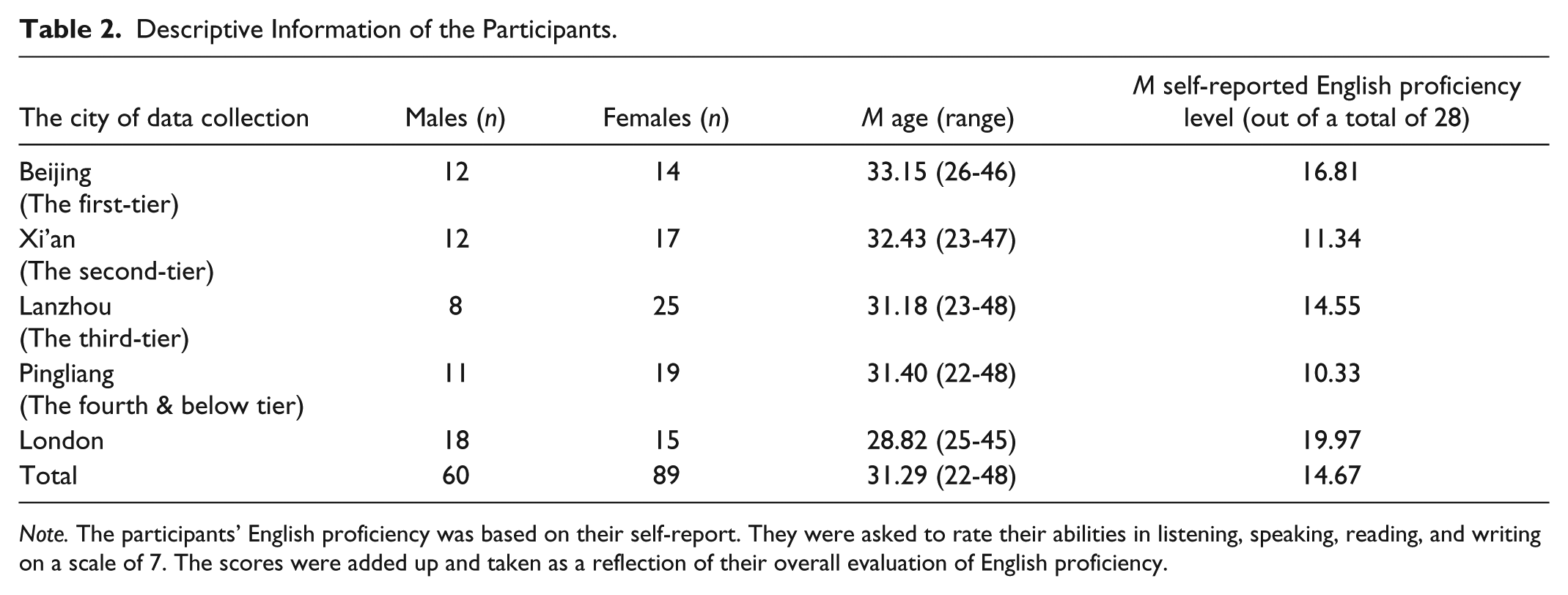
Note. The participants’ English proficiency was based on their self-report. They were asked to rate their abilities in listening, speaking, reading, and writing on a scale of 7. The scores were added up and taken as a reflection of their overall evaluation of English proficiency.
The Procedure
When the participants scanned the link, they would be taken to be the webpage hosting the survey. They started with a question that asked them to rank 15 common occupations in China in terms of social position and economic prospect. These 15 occupations were selected from Zong, Li, and Sun (2016) which ranked 30 occupations commonly seen in China in terms of their political, social, and economic status. The order of the options has been randomized, and they were presented in a horizontal format to avoid the possibility that the participants may follow the order of vertical presentation. For each participant, the highest ranked occupation was assigned a value of 15 and the lowest 1.
The results of the aforementioned pilot testing showed that the judges’ evaluation of CS took into consideration of how well they knew the speaker. The past literature also shows that the evaluation of CS is sensitive to context. Therefore, in the survey, before the participants listened to the speech samples, a short piece of contextual description was provided. The participants were asked to imagine that they were having a casual conversation with some friends. What they would hear shortly was a new friend describing his morning experience in three different versions. The description directed the participants’ attention to the informal nature of the context and the role of CS in impression forming.
After reading the short description, the participants can click to move on to the speech samples. The order of the three recordings was randomized. After listening to each recording, they were asked to evaluate the speaker on a scale of 7 on the dimensions of social likability, social status, and the perceived English proficiency. There were four questions on social likability (i.e., how they perceive the speaker in terms of friendliness, sincerity, trustworthiness, and humbleness), three on status (in terms of education, leadership, and occupation 6 ) and one on the speaker’s English proficiency level (only applicable to the two recordings with CS). These evaluative questions remained identical across the three recordings. Again, on all the scales of 7, 1 represented the lowest level on the qualities examined and 7 the highest. See Appendix B for a full version of the experiment questions. English translation is also provided in Appendix C. When the participants finished rating the three recordings, they were taken to the page of a questionnaire where they were asked to provide some sociobiographical information. The data from the questionnaire will not be discussed in this article. When the participants finished all the questions, they can click to submit. The whole survey was self-paced but the average time taken was between 12 and 15 min.
Results
Comparison Between the Monolingual Chinese Recording and the Code-Switched Recordings
I first present how the participants overall evaluated code-switched discourse compared with monolingual Chinese on social likability and status. A Cronbach’s alpha analysis revealed a high level of internal consistency among the four questions on social likability (α = .896) and also among the three questions on social status (α = .817). Therefore, for each participant, a mean rating was calculated for these two dimensions respectively for each recording first. The ratings of the two recordings with CS were then collapsed and averaged to produce new mean ratings for code-switched discourse on social status and social likability respectively. As the calculated mean ratings for code-switched discourse and the ratings for the monolingual Chinese were both on a scale of 7, their comparisons were placed on the same coordinate axis, with the y-axis indicating the ratings for social likability (Figure 1) or for social status (Figure 2). Higher ratings mean more favorable opinions. As shown in Figure 1, the participants liked CS much less than monolingual Chinese, which means that they considered code-switchers were less friendly, sincere, reliable, and helpful. This difference between their ratings of the Chinese recording and the mean ratings of the code-switched recordings was significant (t = 12.503, p < .001). However, it seems that the participants have not carried over their differentiated treatment of CS and monolingual Chinese to the social status dimension, as can be seen in Figure 2 which shows a small marginal difference between the ratings. Although code-switched recordings were rated slightly higher, the difference was not significant (t = −1.6019, p = .1113). It appears that the participants did not assign code-switchers with any significantly higher or lower status compared with monolingual Chinese speakers.
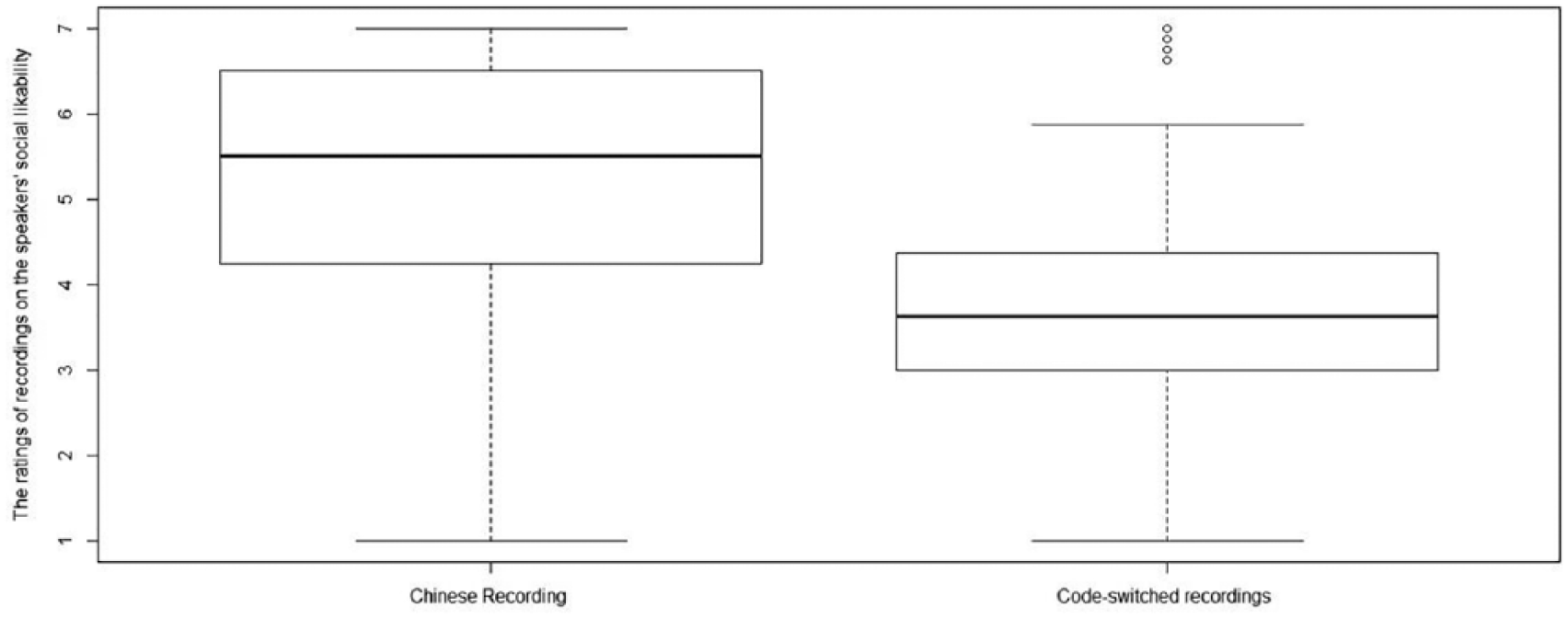
The comparison between the ratings of the Chinese recording and the ratings of the code-switched recordings on social likability.

The comparison between the ratings of the Chinese recording and the ratings of the code-switched recordings on social status.
Comparison of the Three Recordings
The next step is to see whether there was any difference between the participants’ treatment of the monolingual Chinese and the two types of CS. Figures 3 and 4 show visual inspections of the comparisons on social likability and status. Figure 5 illustrates how the participants rated the speaker’s English proficiency when he used the two types of CS respectively.
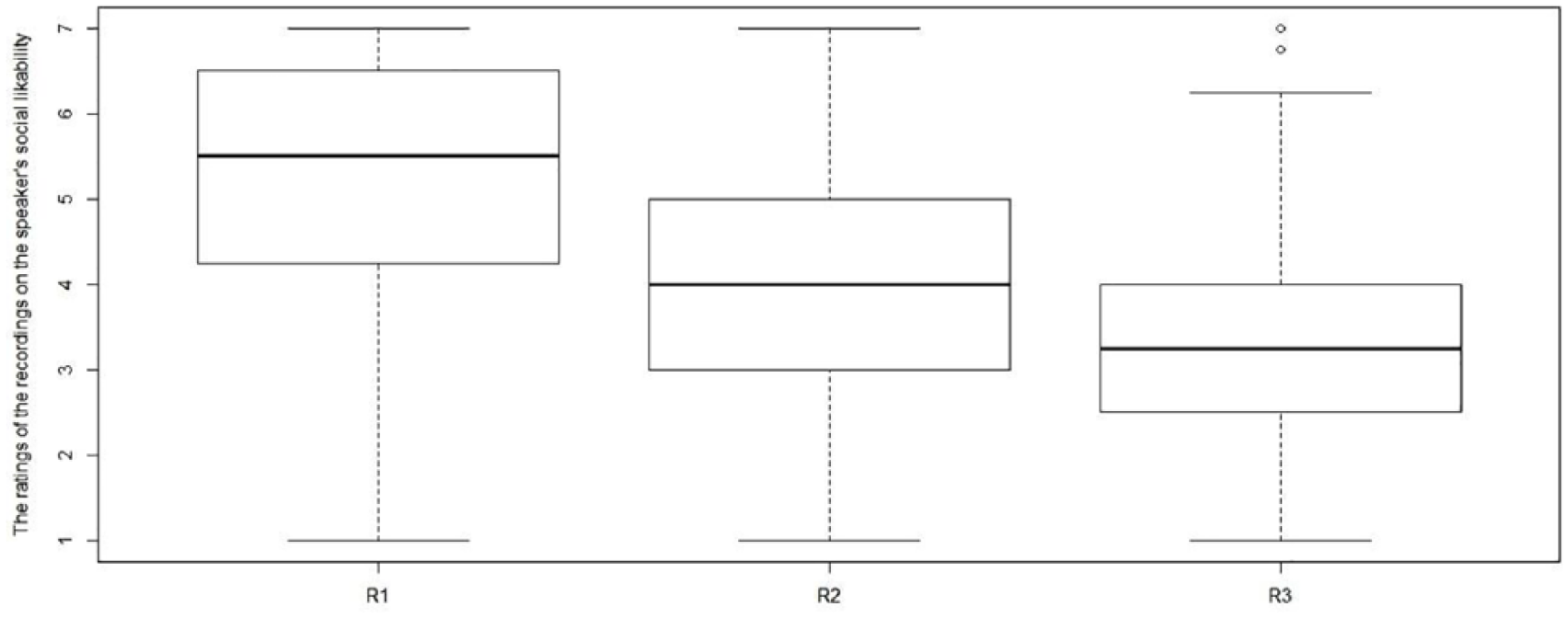
A comparison between the three recordings on the speaker’s social likability (N = 151, R1: M = 5.22, SD = 1.37; R2: M = 4.01, SD = 1.47; R3: M = 3.41, SD = 1.33).

A comparison between the three recordings on the speaker’s social status (N = 151, R1: M = 4.39, SD = 1.07; R2: M = 4.35, SD = 1.09; R3: M = 4.72, SD = 1.02).

A comparison between the two code-switched recordings on the speaker’s perceived English proficiency (N = 151, R2: M = 4.00, SD = 1.54; R3: M = 4.59, SD = 1.60).
A visual inspection of the three figures suggests that the participants rated the three recordings differently in these three dimensions. Their ratings of the speaker’s social likability decreased as the recording type moved from no switching to interclausal switching. As for the perceived social status of the speaker, R3 with interclausal switching has received the highest ratings while R2 with intraclausal switching the lowest, but it should be noted that the status difference between the monolingual Chinese and the intraclausal switching was negligible. Between the two types of switching, the participants gave higher ratings to the interclausal type in terms of English proficiency. To test whether these differences were due to chance, a one-way repeated measure analysis of variance (ANOVA) was performed for the ratings of social likability, status, and English proficiency with recording type as the within-subjects variable. For the social likability of the speaker, the results of the ANOVA tests showed that the differences in the ratings between the recordings were significant (F = 97.514, p < .001, based on the corrected results of Greenhouse-Geisser as sphericity was violated). Post hoc tests indicated that the recordings were significantly different from each other on the dimension of social likability (R1 vs. R2: t = 9.813, p < .001; R2 and R3: t = 4.84, p < .001; R3 and R1: t = 12.291, p < .001). For the social status of the speaker, it was shown that R3 was significantly different from R1 and R2 (R3 and R1: t = −3.03, p = .00286; R3 and R2: t = −3.4823, p < .001) but there was no significant difference between R1 and R2. For the perceived English proficiency of the speaker, the results suggest that the participants regarded interclausal switching (R3) as representing higher English proficiency (F = 23.242, p < .001). It is worth mentioning that the participants’ ratings of the three recordings in different dimensions were not correlated with their proficiency level. This is different from Anderson and Toribio (2007) where their more proficient participants held more positive attitudes toward CS.
Gender Difference in the Ratings
To test whether the differences in the ratings of the three recordings also emerged across genders, a repeated 2 × 3 ANOVA with gender as the between-subject variable and recording type as the within-subject variable was run for social likability ratings. The results showed that the ratings were not significantly different between males and females. In addition, there was no significant interaction between recording type and gender, as shown in Figure 6. For both males and females, the likability of the speaker dropped as the switching increased. The same test was also run for social status and English proficiency ratings and similar results emerged, that is, both males and females assigned similar ratings to the three recordings on these two dimensions, and the differences in ratings between the recordings were also of similar pattern across genders, as illustrated in Figures 7 and 8. Despite the insignificant results, it seemed that women participants tended to give higher ratings to the recordings except for on social status. On this dimension, they rated R1 and R2 even lower than men did but rated R3 higher.
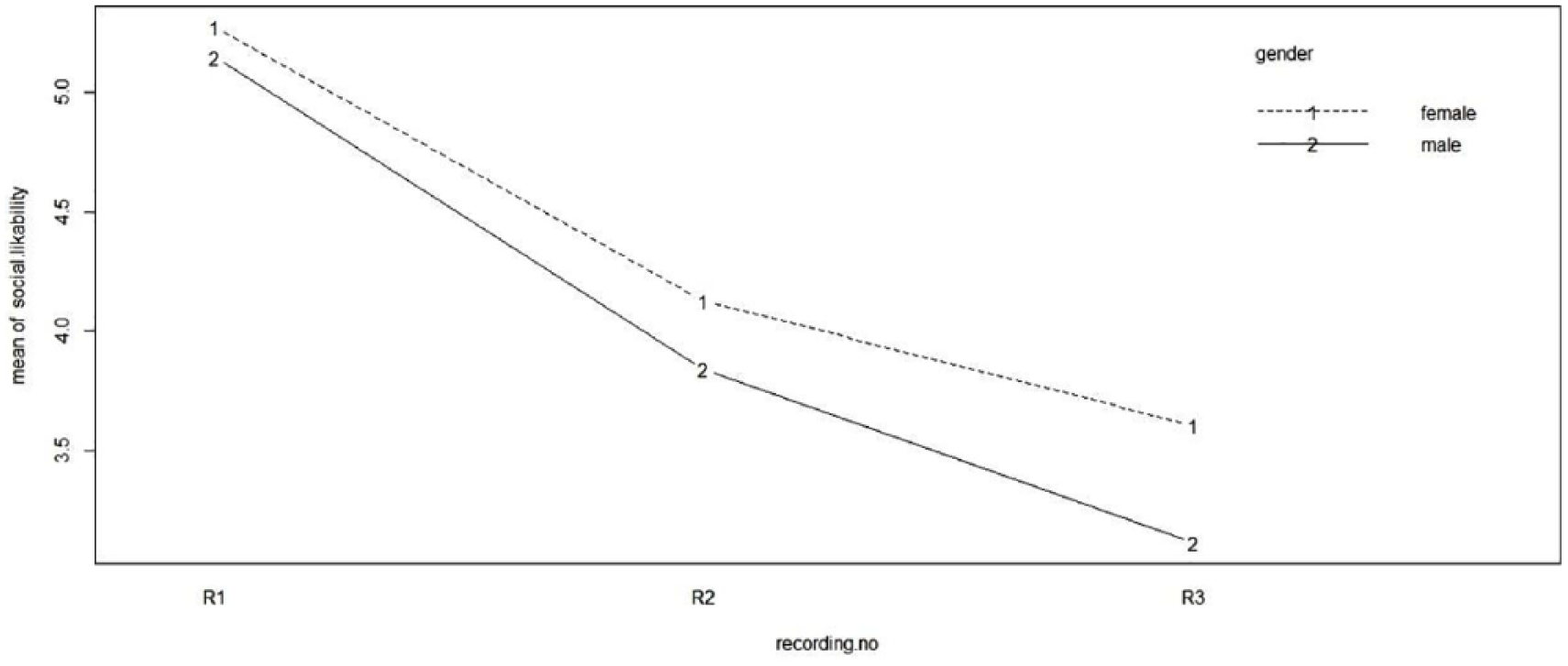
The interaction between gender and recording type on social likability ratings.

The interaction between gender and recording type on social status ratings.

The interaction between gender and recording type on English proficiency ratings.
Regional Difference in the Ratings
Another series of repeated ANOVA tests were run to test whether the participants from the five cities responded differently to the three recordings. The results indicated that there were no significant differences in the ratings by the participants from different cities and the interaction between the city of residence and the ratings on the recordings was not significant either, as shown in Figures 9 to 11. However, there are two points worth mentioning. First, Figure 9 indicates that the participants from London gave higher ratings to the three recordings on social likability. Second, the participants from the second-tier city gave the highest ratings of social status to R2, the one with intraclausal switching, whereas the participants from other cities rated the speaker from R2 as the lowest on social status dimension, as shown in Figure 10.

The interaction between the city of residence and recording type on social likability ratings.

The interaction between the city of residence and recording type on social status ratings.

The interaction between the city of residence and recording type on English proficiency ratings.
Discussion
The results show that CS from Chinese to English was viewed overall more negatively compared with monolingual Chinese in terms of social likability. This is in line with the previous attitude studies on CS (Gibbons, 1987; Lawson & Sachdev, 2000). It also appears that the participants’ judgment of the speaker’ social-economic status was not affected by CS. However, when different types of CS were distinguished, the results looked slightly different. Compared with monolingual Chinese discourse, the two types of CS were disfavored, confirming the overall negativity toward CS. On the contrary, interclausal switching emerged as enjoying the highest status.
It seems that differentiating attitudes toward subtypes of CS can reveal a fuller picture of speakers’ sensitivity toward language practices. The negativity against CS was not held in a sweeping manner but increased with the growing amount and complexity of English elements inserted in the Chinese discourse. This is also corroborated by Anderson and Toribio’s (2007) finding that CS was rated less positively than lexical insertions. Their lexical insertion examples correspond to the intraclausal CS in this study. Anderson and Toribio (2007) suggested that the speakers had their anticipated level of language juxtaposition as a result of the influence of language contact and that the markedness of foreign elements in an otherwise monolingual piece of discourse increased from insertion of specialized lexical items to CS. When the increasing markedness differed from their anticipation, speakers’ evaluation of these marked forms tended to become negative. In the present study, we may also be able to invoke the anticipation level of language juxtaposition to account for the increasing negativity toward CS.
In China, English is mainly associated with foreign language learning in school context. For the majority of learners, the use of English is limited to L2 classroom. Outside school context, domains where English can compete with or supplement Chinese are very few and there are not many occasions where concepts cannot be precisely described in Chinese. In some other cases, employment in foreign-invested companies and experience of studying or living abroad may justify the insertion of English elements. The attribution of CS to lexical or semantic gap for the concepts under discussion may diminish the salience of CS. However, these cases represent a very small portion of conversations where we can only expect CS to be justified to some extent. Overall, English is expected to be only used when English-speaking people are present or when English is specified as the language of communication as in L2 English classroom. Therefore, in day-to-day life, speakers’ anticipation level of Chinese-English juxtaposition may be very low. More English elements and more deviating forms elicit more negative feelings. This may explain why the stimuli speaker’s likability dropped when he moved from the monolingual Chinese to the simpler form of intraclausal type of insertion, and further to the more complex interclausal type of switching.
Although CS elicited negative opinions in both studies, the source of negativity differs, depending on the direction of switching and the relative status of the participating languages, especially the status of the language switched into. In Anderson and Toribio (2007), the direction of switching is from English (a mainstream language) to Spanish (a minority language in the language contact situation), and the negative opinion relates to the perceived language deficiency associated with switching/mixing. In the current article, the direction of switching is from Chinese, the participants’ L1 and the default language of daily communication, to English, a later acquired foreign language which is related to upward social mobility and individual success (He & Ng, 2013; Pan & Block, 2011). Language deficiency was not mentioned in the elicited attitudes toward CS (as a matter of fact, more switching indicates higher proficiency in English). Instead, the results show that the negative evaluation toward switching to English was related to some solidarity qualities of the speaker, such as reliability and sincerity.
This source of negativity links unexpected language juxtaposition to less solidifying interactions and lends support to the classical finding in language attitudes literature that the use of in-group variety enhances solidarity between speakers, whereas the failure to conform to the speech norm often results in marginalization (Dragojevic, 2016). The anticipated language use, in the current context, Chinese, can be considered as the in-group variety and the speech norm, at least outside learning contexts of L2 English and among speakers who are not engaged with English speakers on a frequent basis. Deviation from the expected use of Chinese gives rise to the impression of the speaker being less sincere, less reliable, and less humble.
Despite the hostility received, interclausal CS was actually rated highest on the status dimension. It was related to higher education, better jobs and more potential for leadership. It seems that interclausal CS can borrow status from English, which is associated with modernity, social mobility, and individual success, as reviewed in the previous research (He & Ng, 2013). This mismatch between solidarity and status in the perception of CS is recorded in Gibbons (1987). In spite of the negative evaluation of CS as a “showing off” and “irritating” practice, Hong Kong students linked it with modernity and westernization. This was also the case in Lawson and Sachdev (2000) where CS between Tunisian Arabic and French was rated less favorable but nevertheless associated with modernity. The past literature on language attitudes has documented many cases where prestigious standard varieties are downgraded on solidarity qualities but upgraded on status dimensions (Dragojevic, 2016; Giles & Billings, 2004). This is especially the case when prestigious standard varieties are not the speech norm of the community of interest. This pattern is also observed in this study. Though CS cannot be considered as the standard or correct variety, the practice of switching to the more prestigious variety (in this case English) can borrow status from this language, but at the same time switching away from the indigenous/local/regional variety (in this case Chinese) attracts negative evaluation as it moves away from the default community language.
It should be noted that CS being upgraded on the status dimension, but at the same time making the interaction less solidifying is not observed universally. It is more typical in communities where monolingual language practice is the standard and CS is regarded as some sort of deviation from the norm of interaction. The status of the language switched into also contributes to how the relative weight of status and solidarity qualities is attributed to CS. There are many other cases where CS actually promotes in-group solidarity and is considered as a marker of bilingual identity (Montes-Alcalá, 2000; Toribio, 2002; Zentella, 1997). Again, this depends on whether CS is the unmarked choice among the members of the community under discussion. When CS is practiced by a majority of the community members on a daily basis, CS can actually enjoy some kind of solidarity-related “covert prestige” among members of their own linguistic community, even when CS is overtly frowned upon (Anderson & Toribio, 2007; Gibbons, 1987; Lawson & Sachdev, 2000).
However, not all types of CS were able to borrow status from English successfully in the present study. Intraclausal switching did not enjoy the same positive evaluation in terms of social status. In fact, it was rated the lowest on this dimension. There can be several reasons to account for this. On social media, intraclausal switching is actually the type commented upon most often. When there is a discussion on the appropriacy of switching behavior, the intraclausal type of insertion is always cited as examples. When CS is ridiculed and parodied, the examples are still insertions, mostly of nouns, adjectives, and verbs. As discussed earlier in the article, intraclausal types of CS require minimal English proficiency on the part of the switcher. People might be more familiar with this type of switching and it is more accessible to a larger population. Indeed, intraclausal switching does not necessarily indicate high proficiency in English, as shown by the mean ratings (4.00 out of 7.00) of English proficiency of the speaker in the intraclausal switching recording. When the general public has the ability to insert some English words in their Chinese discourse, the practice might have lost its borrowed status from English. At the same time, the answers to the multiple-choice question in the survey, which asked the participants to judge the speaker’s occupation suitability, reveal that intraclausal type of switching was more related to jobs such as sales and gym staff, which were among the bottom professions ranked by the participants. Some of them added extra comments that this type of switching reminds them of those “Kevin, Tony, Tina, and Linda in the gym and in the hair-dressing shops.” This might explain why intraclausal switching did not receive as much social status rating as the interclausal type did and it might have become an identity marker of a specific group of people who attempt to appear internationalized but fail to do so.
Gender did not interact significantly with either CS type or personal traits. In regard to gender effects on the evaluation of CS, previous studies have shown different results. Dewaele and Li (2014) have found out that female participants held more favorable attitudes toward CS, while Doss and Gross (1994) showed that men rated CS as well as other vernacular varieties more positively. Koch et al.’s (2001) results indicated that both men and women provided similar evaluative response toward the linguistic varieties under study, including CS, thus showing no gender effects. The present study has identified a trend where women tended to give higher ratings to the recordings but not to a significant extent. Both men and women converged on their evaluation of the three recordings in terms of social likability and English proficiency. However, in terms of social status, they displayed somewhat different patterns. They both favored interclausal switching more, but women showed even more positive disposition toward it. Both genders gave low ratings to intraclausal switching, but women disfavored it even more. Thus, it appears that women were more sensitive to status-indicating linguistic features and showed stronger responses, either positive or negative. This is in line with the previous research on gendered speech where women subscribe more to speech features symbolic of social power and social prestige (Coates, 2004; Trudgill, 1983).
Likewise, there was no significant interaction between the city of residence and CS type and personal traits. Regardless of their regional background, the participants similarly rated the interclausal switching as the most statusful but the least likable. Except for the participants from the second-tier city, the participants from other cities rated the status of the intraclausal switching slightly lower than monolingual Chinese, making it the lowest among the three. The lack of interaction between the city of residence and attitudes toward CS suggests that attitudes held toward different types of CS between the supra-local standard Mandarin Chinese and the global language English may be more or less shared by speakers across a larger area. This is somewhat surprising, especially when previous studies show that the evaluation of CS differs between indigenous and diaspora communities (Gardner-Chloros et al., 2005) and cultural, social, and demographic differences tend to give rise to attitudes-related differences (Liang, 2015).
However, we need to note that the method of recruiting participants may have unintentionally biased the sample, especially that the friend-of-a-friend method was used to sample London participants. Although special care was taken to avoid a skewed sample when approaching mainland participants, the choice of shopping mall may nevertheless have limited the randomness of the sample and resulted in a certain degree of skewness. For example, Lanzhou and Pingliang have higher representation of females in the sample. This limitation in method may have contributed to the pattern that evaluations of CS were invariant with gender and regional background. On the contrary, there is still a great deal of variability in the participants’ background. The participants differ in their general sociopsychological orientation and some participants may frequently cross city borders. Regional background or gender only provides some crude evidence that there is a trend for people from different regions and across genders to view different types of CS in a similar way. But inter- and intraspeaker variation is expected to appear when more individual or contextual information is available (Dewaele & Li, 2014).
It is difficult to reconcile the results reported here with the findings from some previous studies on attitudes toward Chinese-English CS (e.g., Bi, 2011; Xu, 2008) in any straightforward way. Bi (2011) reported positive attitudes among the student subjects toward English mixing in Chinese Internet language. However, the source of positivity cannot be interpreted because only highly abstracted options such as “negative” and “positive” were provided when the participants were asked of their attitudes. However, the author also reported that the participants believed that a large number of adoptions of English words in Chinese can impurify Chinese language and there should be some kind of regulation to supervise this language practice. This seems to echo the negative opinion held by the student subjects in Xu’s (2008) study where 69% of them did not approve of English insertions for the concern that this can harm the purity of Chinese. In the present study, CS also received negative evaluation but the source of negativity lies in the speaker’s solidarity qualities. The previous studies were conducted among students who were placed in formal educational settings where the standard language ideology is stressed. This may explain why the concern for the purity of language is a recurrent theme. In the present study, the recruited participants were from various walks of life and their evaluation may add more insights into how CS is evaluated by the general public.
On the contrary, Xu (2008) showed that the young white-collar workers were more positive toward using English in Chinese and explained that this positive evaluation was a reflection of their sensitivity to the socioeconomic advancement that can be brought along by the use of English in the work environment. This fits well with the current finding that high regard was held toward CS (interclausal CS) because of its association with better education and more prestigious jobs. Therefore, the difficulty to reconcile the findings seems to lie in the methodological design adopted by different studies, especially in their choice of participants. The current study has revealed a more complex and more comprehensive picture of attitudes displayed on different dimensions as a result of its more diversified subject sample and more focused theoretical questions.
So far, it seems that making a distinction between different types of CS in attitude study is helpful. Various types of CS not only represent the possibilities of how different language varieties can be combined together, they can also be considered as different manifestations of how language/cultural contact penetrates into different aspects of social life. The display of language users’ attitudes toward various types of CS on different dimensions in this study demonstrates how speakers in a fast-changing country as China try to maintain a balance between keeping social structure and social order intact and taking advantage of the new opportunities that may be presented by social changes brought by language/cultural contact. Therefore, a refined treatment of attitudes toward different types of CS provides a fuller picture of how speakers perceive the social changes brought by language/cultural contact and how their individual life may be involved in and affected by such changes. It also helps capture the more nuanced interplay between language practices and social realities they are perceived to represent.
As one of the early attempts to document Chinese bilinguals’ (with English as a learned language) attitudes toward switching to English in Chinese discourse in noneducational context, this article also has some theoretical and methodological implications for future CS studies. Theoretically, differentiating speakers’ attitudes toward various types of CS can be helpful in understanding the refined sensitivity of language users toward language practice, which can inform some of the long-standing theoretical controversies in CS studies. For example, the line drawn between CS and borrowing has long been fussy. The judgment of borrowing or CS has always been made based on the degree of assimilation of foreign words, which is measured by phonomorphological adaption (Poplack, Sankoff, & Miller, 1988). However, more recent studies argue that assimilated words can also carry pragmatic markedness and thus be considered as CS (Backus, 2015; Backus & Dorleijn, 2009). Speakers’ own attitudes, especially in relation to their anticipated level of language juxtaposition, could be helpful in undecided situations as such. The more positive attitudes toward mixing of foreign elements (either assimilated or unassimilated) could be a sign of speakers acknowledging the necessity or utility of these foreign elements, hence their status of borrowing.
Another contribution of the present study comes from the methodological design of recruiting participants with as diversified backgrounds as possible. Most previous studies were carried out with small samples recruited from formal education contexts where the standard language ideology is stressed. It is possible that opinions held by participants in such environments cannot represent how CS is perceived at the societal level; for example, they may have more concerns of keeping languages separated to maintain the structural or form integrity advocated by the standard language ideology or they may exaggerate attitudinal status differentials in favor of standard varieties. However, CS is not confined to educational settings; it is a form of language contact outcome manifested at the societal level. A true understanding of how CS is evaluated and what future changes may be predicted in terms of CS use cannot be obtained unless we have a more ecological valid sample to collect data from. In this regard, the current study has demonstrated some useful methodological considerations in recruiting participants that can contribute toward an ecological valid subject sample.
Limitations and Future Directions
The present study suffers from a few limitations which can also be considered as directions for future research. The results of the perception experiment demonstrated the role of CS in impression management between speakers who are not familiar with each other. Understanding this kind of attitude is useful as it can inform us in what direction the interaction may evolve. However, attitudes toward CS are multidimensional and sensitive to social and contextual information. For example, when the same type of CS is practiced in situations where conversation participants are more aware of each other’s background in terms of social networks and life experience, the interpretation of CS can take very different forms. Future research can present stimuli accompanied with more speaker background information. In addition, situating CS in a more daily-life like conversation could increase the naturalness of CS and thus the ecological validity of the stimuli.
Given the quantitative and preliminary nature of the present study, the dynamics and complexities underlying the general attitudinal trend are somewhat concealed. Without qualitative data, it is difficult to speculate the reason(s) why the participants from London gave higher ratings in terms of social likability and why the participants from the second-tier city rated the insertional switching as enjoying the highest status, contrary to the pattern that emerged among the participants from other cities. The following-up research should aim for qualitative data so that not only we know what the identifiable trends in attitudes toward CS are, we can also be informed what the participant and contextual contributions are.
The study also suffers from the single-stimuli experiment design, which affects the generalizability of the results and increases the possibility that listener-judges’ evaluative responses are actually due to their (dis)favoring the speaker’s voice and other idiosyncratic features instead of the practice of CS. Future research can address this problem by providing speech samples from more than one speaker, preferably from both sexes, which can increase the validity of the design and also introduce the variable of the speaker’s gender in the evaluation of CS. The drawback of the single-stimuli experiment design can also be overcome by having other types of Chinese-English bilinguals as stimuli speakers, such as balanced bilinguals with no recognizable foreign accent. The current study had a L2 English learner as the stimuli speaker for the reason that he can to some extent represent the majority of Chinese-English bilinguals. The perceived English proficiency of this speaker, that is, between intermediate and advanced, may have led the participants to consider him as one of them and then make their judgments accordingly. Having other types of Chinese-English bilinguals may alter judges’ evaluation and thus sheds light on how perceived language proficiency and accent affect the evaluation of CS. This will also make it possible to have both Chinese and English monolingual conditions as baseline for attitude comparison, which can provide more solid evidence of how the behavior of switching works either independently or jointly with subjects’ perception of individual languages to affect their evaluative responses to language practices in contact situations (cf. Ebert & Koronkiewicz, 2018).
Footnotes
Appendix A
Appendix B
Appendix C
Acknowledgements
The author would like to thank all the participants who spared time to fill out the online questionnaire.
Declaration of Conflicting Interests
The author(s) declared no potential conflicts of interest with respect to the research, authorship, and/or publication of this article.
Funding
The author(s) disclosed receipt of the following financial support for the research, authorship, and/or publication of this article: This research is supported by the Fundamental Research Funds for the Central Universities, and the Grant No. is 18LZUJBWZY098.
