



Abstract
This article examines secondary school learners’ motivation to learn English as a foreign language (EFL) in relation to two contextual factors: school type and school location. Data were collected from 352 Polish learners who attended English instruction in general and technical secondary schools in a large city and a small town in western Poland. Learners’ motivation, conceptualized as a continuum from fully autonomous to fully controlled, was measured through a survey at two time points, 2 years apart, which provided an assessment of motivational change. The second measurement was followed by interviews with selected learners. Our results show that learners from general secondary schools in the two locations exhibited different motivational patterns, while those from technical schools were similarly motivated regardless of their schools’ locations. A decrease in extrinsic motivation over time was observed in both types of small-town schools. Based on these results, we discuss the implications for EFL pedagogy.
Plain Language Summary
We investigate how the location and type of school may influence students’ motivation for learning English as a foreign language. We compared general and technical schools located in either a town or city in Poland. In total 352 Polish students completed a survey. Students from technical schools were similarly motivated regardless of their schools’ location. Students from general schools showed different motivational patterns depending on whether they were located in the town or in the city. Additionally, we investigated changes in students’ motivation and asked students how they would explain changes in their motivation. Over the period of 2 years, regardless of the type of school, the students from the town started perceiving their English classes less as an obligation and less as something to do as there is no other choice. Motivating students can at times require considerable effort from the teacher. Based on our findings, we advise teachers to take into account the type and location of school when designing their motivational teaching.
Introduction
For teachers, motivating their pupils can be an everyday challenge. This situation is the case across subjects, including the teaching of English as a foreign language (EFL). Motivation is vital within educational settings, as it influences a range of variables relevant for the well-being and educational career of pupils (OECD, 2017; Ryan & Deci, 2017). Motivated learners exhibit higher performance and life-satisfaction levels and show higher levels of perseverance (OECD, 2017). Several studies have investigated what teachers should do (Ahn et al., 2021; Dalehefte & Canrinus, 2023; Domen et al., 2020) and how classrooms should be organized (Fokkens-Bruinsma et al., 2020; Jong, 2020) to optimize learners’ motivation (Bećirović et al., 2022; Owen & Thomas, 2021). Adaptive teaching and differentiated instruction have been shown to play a role in motivating pupils (Guay et al., 2017; Sapan & Mede, 2022). Yet, when attending school, pupils go to a specific location and often to a specific type of school. This aspect is often overlooked in the advice to teachers on how to adapt to and motivate their pupils. English usage might be more relevant in a school within a more diverse context compared to one located in a place where pupils will mainly encounter people who speak the native language. Additionally, schools that focus on educating professions in which English seemingly might not be particularly relevant might have pupils who struggle with their motivation to learn English. Having awareness of how the “school factor” affects pupils’ motivation for learning English may offer teachers insights into how they can fine-tune their pedagogies based on the location and type of school they teach in, which in turn may lead to higher levels of motivation to learn English among their pupils.
Theoretical Background
Self-determination theory (SDT; Ryan & Deci, 2017) posits that motivation can be perceived as a continuum, starting with fully controlled motivation and moving toward fully autonomous motivation. These types of motivation then influence learners’ behaviors toward EFL (Ryan & Deci, 2017). Since the more autonomous types of motivation are related to more positive outcomes (Janke, 2020; Rump et al., 2017), the aim for teachers is to support and stimulate the autonomous types of motivation among EFL learners. The SDT offers concrete suggestions on how to stimulate the autonomy of learners, thus making it a relevant theory to take as a point of departure in studying motivation
In the light of the theory, motivation is perceived as ranging from fully autonomous to fully controlled. Firstly, when motivation is fully autonomous, learners are learning out of interest and enjoyment. Called intrinsic motivation, this type of motivation is likely to be the cause of most learning across one’s life (Ryan & Deci, 2017).
Next are several forms of external motivation, depending on what regulates the motivation of the learner. The first type of regulation is identified regulation. With such regulation playing an important role, learners might aim to learn a language because it could help them in achieving personal goals. Phrased differently, their motivation is regulated by future, external goals, yet these goals are of importance to the learner. The second type of regulation is related to learning because of social norms or the expectations of others. An example would be pupils who study hard for an English test because they fear others will look down on them if they fail to perform well on the test. This type of regulation is called introjected regulation. Lastly, fully controlled motivation is regulated by external regulation. In this case, learners learn simply because of rewards or punishments (Noels et al., 2019; Ryan & Deci, 2017). An example of this type would be pupils studying hard for an exam because they will receive material rewards from their parents if they do well. Within the SDT, Deci and Ryan (2000) also proposed integrated regulation, a regulation slightly less autonomous than intrinsic motivation yet less controlling than identified regulation. This regulation is not included in the present study, as previous studies have shown that as a scale, integrated regulation has not accounted for additional variance (Van den Broeck et al., 2016). In line with others, we incorporate this regulation with the assessment of identified regulation (Gagné et al., 2015).
Previous Research Results
Research within education has shown that the existence of more controlled motivation is related to lower degrees of well-being and higher risks of dropping out of school (Fryer et al., 2014; Janke, 2020), whereas more autonomous motivation has the opposite effect and is related to more positive outcomes (Janke, 2020; Rump et al., 2017). While previous research has shown that levels of motivation drop during students’ career in school, it is important to understand whether (and if so how) the type of motivation changes over time for learners. Most observed changes have been in unwanted directions of less motivation or more controlled motivation (Hayenga & Corpus, 2010; Tuominen et al., 2020), although some researchers have observed changes toward more autonomous motivation (Oga-Baldwin & Fryer, 2018). Fluctuations in the level of motivation may depend on age and educational levels. For example, Lee and Kim (2014) found that South Korean learners’ motivation to learn English dropped during the middle school years but increased during the high school years, since learners had started to recognize the importance of being able to speak English. Still, how and to what extent context—in particular the school context—plays a role in these changes remains unclear.
As recently underlined by Kruk (2022), and previously by others (Dekker & Fischer, 2008; Liu, 2003), it is vital to understand the influence of context on learners’ motivation. This scenario applies to research on large groups of learners within specific instructional and national contexts (Dörnyei & Csizér, 2002) and to studies that focus on individual students or small groups and their motivational profiles (Campbell & Storch, 2011; Kruk, 2022; Pawlak, 2012; Pawlak & Mystkowska-Wiertelak, 2018; Waninge et al., 2014). Researchers have examined various contextual aspects. Lamb and Wedell (2015), among others, have examined context in the sense of cross-cultural differences in what motivates language learners. In their survey and observational study, they found similarities but also clear differences in what Chinese and Indonesian language learners perceived to be inspiring teaching. In a survey study, Iwaniec and Ullakonoja (2016) uncovered differences between Polish and Finnish EFL learners in a number of motivational components; in most cases, the scores of the Finnish learners were higher. For example, the Finnish students obtained higher scores on the intrinsic motivation and knowledge orientation scales. As the authors admit, however, one factor partly responsible for this result could have been the sampling procedure, which resulted in the Polish sample including more learners from rural areas than the Finnish sample. One area in which the Polish group’s scores were high was parental encouragement. As Iwaniec and Ullakonoja (2016) observe, these results are consistent with those of studies that have examined this factor in other post-communist countries, for example Hungary (Kormos & Csizér, 2008).
Moving to contextual factors relevant within the borders of a country (and the focus of the present study), Ghanizadeh and Rostami (2015) investigated Dörnyei’s L2 motivational self system in two types of school in Iran: public high schools and private language institutes. They observed significant differences between the two types of schools regarding language learners’ motivation (Ghanizadeh & Rostami, 2015). The influence of family on the “ought-to L2 self,” for example, was much stronger for students from the private language institutes. Similarly, Lee and Kim (2014) observed significant differences between four school types (general, elite academic, vocational, and art and sports) in the level of pupils’ motivation during the high school years. Pupils from vocational and art and sports schools were less intrinsically motivated to study English than those from elite academic schools. The researchers attribute this result to selection bias instead of the difference in type of school, as elite academic schools admit outstanding students who display high levels of intrinsic motivation to study English. Although researchers have observed differences between types of school, too little is known to be able to conclude that such differences actually influence EFL learners’ motivation.
In addition to examining cultural context and type of school, various studies have shown a difference between urban and rural schools in learners’ motivation to learn a foreign language (Lamb, 2012; You & Dörnyei, 2016). Iwaniec (2020), who used school location as an indicator of Polish learners’ socioeconomic status, investigated its effect on various concepts related to the learners’ motivation to learn English based on Ford’s (1992) motivational system theory (e.g., instrumentality, self-efficacy, and self-regulation). Her results showed that learners from urban schools rated themselves higher on the motivational concepts than learners from rural schools (Iwaniec, 2020). Similarly, Muslim et al. (2020) showed that when schools were located in more rural areas, pupils tended to put less time and effort into learning English.
Still, researchers have criticized these findings. Often, when differences are observed in a study, the effect sizes are small, revealing little impact of the observed differences (Iwaniec, 2020; Pavón Vázquez, 2018). In addition, Gan et al. (2019) did not observe a significant effect of school location on student learning motivation in EFL. It thus remains unclear if and to what extent the location (and, as argued above, the type of school) influences EFL learners’ motivation.
Aims of the Present Study
While a few studies have investigated school location in relation to the motivation to learn English (Gan et al, 2019; Iwaniec, 2020; Muslim et al., 2020), such studies have generally operationalized motivation either based on Ford’s (1992) motivational systems theory, which includes goals, personal agency beliefs, and emotional arousal processes (Iwaniec, 2020), or Dörnyei’s (1994) L2 motivational system, which includes motivation at the language level, learner level, and learning situation level related to the course, teacher, and group (Gan et al., 2019; Muslim et al., 2020). In the present study, we use a different theoretical lens to understand motivation by operationalizing motivation based on the self-determination theory, or SDT (Ryan & Deci, 2017), which does not perceive motivation as a unitary construct, but rather as a continuum, starting with fully controlled motivation and moving toward fully autonomous motivation. Despite abundant research on different types of motivation and their influence on learners’ behavior, the role played by school location and school type in changing the motivation for EFL remains unknown.
Explanations for how the various types of motivation for EFL may vary across time also remain unclear. Some researchers have observed stability in motivational profiles (Tuominen et al., 2020), while others have observed change in motivation over time (Liu, 2003; Oga-Baldwin & Fryer, 2018). Other researchers have observed that learners’ motivation, measured over periods as short as 2 weeks, can contain both stable and dynamic phases (Waninge et al., 2014). Motivation for academic achievement has been shown to decrease over time (Taylor et al., 2014; Wigfield et al., 2019). Hence, more research into the flexibility or change of motivation is necessary (Wigfield et al., 2019). In order to understand changes in motivation, when changes are observed, one should include the voice of those who have undergone the changes. Again, doing so will illuminate the phenomenon of what influences motivation for EFL and may help teachers to fine-tune their pedagogies to increase students’ motivation for their subject.
The main aim of this paper is thus to increase our understanding of how school factors may influence EFL learners’ motivation and what this motivation looks like over time. Against this background, we investigate the following research questions (RQs) in this longitudinal comparative mixed-methods study:
RQ1: What is the influence of school type and school location on different types of EFL motivation?
RQ2: How do different types of EFL motivation change over time in relation to school type and school location?
RQ3: How do learners describe changes over time in their EFL motivation?
Method
Context of the Study and Participants
This study involved an explanatory sequential mixed-methods design in which quantitative data collection and analysis were followed by a qualitative phase (Creswell, 2014). The data for the study were collected at two time points, in 2019 and 2021. The data were drawn from two types of secondary schools in western Poland, selected through convenience sampling: two general secondary schools, or liceum (one in a large city, with around 600,000 inhabitants, and one in a small town, with around 13,000 inhabitants), and two technical secondary schools, or technikum (one in the same large city, and one in the same small town). Learning a foreign language in Poland is compulsory for all students from year one through the end of high school. Although the foreign language is not specified, the majority of students learn English. The data for the 2021/2022 school year show that 95.8% of pupils in all types of school in Poland received English instruction (Central Statistical Office, 2022).
Students attending general secondary schools in Poland take the final secondary education exam (matura), which gives them access to university education. Students in technical secondary schools can also take the final matura examination, but they are also awarded a vocational diploma in areas such as accounting or logistics. At the time of the study, secondary school education lasted 3 years in general secondary schools and 4 years in technical secondary schools, so the data were collected in the first and final years of study for students in the former and in the first and third years of study for those in the latter.
In 2019, we approached participants directly by visiting each school and administering paper questionnaires in classrooms. This resulted in a nearly 100% response rate and provided us with data from 352 students. In 2021, due to the COVID-19 pandemic, we administered the questionnaires online via SurveyMonkey and asked teachers to distribute links among their students. This approach resulted in data from 136 pupils (almost 42% of the 2019 students). Table 1 provides the exact numbers of participants from each type of institution at the two time points.
Participants per Location and Type of School per Year of Data Collection (Percentages in Parentheses).

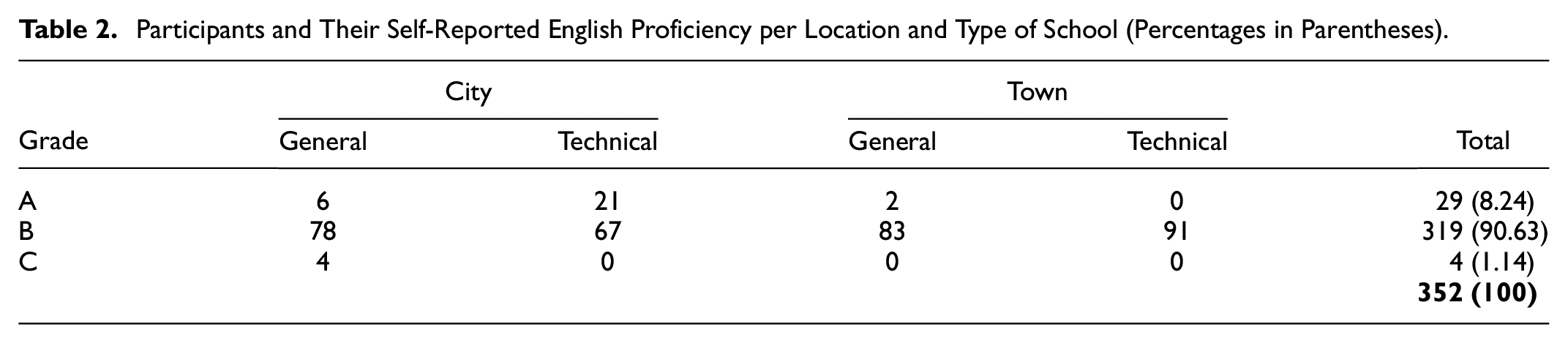
At the first time point, the students consisted of 130 males (36.9%) and were 16 to 17 years old. The students’ self-assessment of their English proficiency ranged from levels A to C of the Common European Framework of Reference for Languages. There were only four C-level students (1.14%); the lowest level was A2 (i.e., there were no beginners). The majority (90%) of the students reported B-level English proficiency. When assessing their proficiency, the students often referred to the course books they were using at the time. Table 2 shows the distribution of the levels in the specific schools.
Participants and Their Self-Reported English Proficiency per Location and Type of School (Percentages in Parentheses).
At the second time point, 25% (n = 34) of the 136 students who completed the survey were male, with ages ranging from 18 to 19 years old. The majority of these students (93.4%, n = 127) had reported B-level English proficiency at time point 1.
In the qualitative part of the study only nine students consented to be interviewed: four whose motivation had increased and five whose motivation had decreased. This group had six females and three males, with ages ranging from 18 to 19 years. Table 3 shows the location and gender of the interviewees.
Location and Gender of the Students Interviewed.

Note. Only students from general secondary schools were interviewed.
Materials
The questionnaire consisted of two parts. In the first part, we asked for the participants’ demographic data, such as age, school, grade, level of English, gender, year of birth, and native language. Additionally, to anonymize the data and to be able to link the surveys at both time points, each participant was asked to generate a unique code that consisted of a sequence of letters and numbers (the first letter of the mother’s, father’s, and participant’s names and the participants’ month of birth). The second part of the questionnaire, which was a Polish adaptation of the survey instrument used by Oga-Baldwin et al. (2017), consisted of 12 statements rated on a five-point Likert scale targeting different types of motivation to study English. Statements 1, 6, and 12 concerned intrinsic motivation, for example, “English is fun.” Statements 2, 5, and 9 concerned identified motivation, for example, “English will help me in other parts of my life.” Statements 4, 8, and 10 concerned introjected motivation, for example, “I want other people to praise me.” Finally, statements 3, 7, and 11 concerned extrinsic motivation, for example, “Participating is one of the rules.” (See Supplemental Appendix 1 for the full list of items per scale.) The response options ranged from “strongly disagree” (1) to “strongly agree” (5). The internal consistency of the scales was sufficient at both time points, with Cronbach’s alpha coefficients either closely approaching or exceeding the .70 acceptability level (see Table 4). All statistical analyses on the numerical data were performed using IBM SPSS Statistics, version 27.
Descriptives and Internal Consistency of the Survey Scales Across Time Points.

For the qualitative part of the study, we used two versions of the interview guide: one for the students whose motivation level had dropped and one for those whose motivation level had risen. Thus, the interview guides contained questions referring specifically to the students’ responses in the questionnaire. The two examples below are English translations of questions that illustrate the two types of questions that were asked: Some people study English because it’s a compulsory school subject. From your questionnaire, it follows that the fact that English is a compulsory subject is less important for you now than it was when you started secondary education. How would you explain that change? From your questionnaire, it follows that now you believe more strongly than when you started secondary education that knowing English will help you develop, that it will help you in various areas of life. How would you explain that change?
Procedure
In 2019 and 2021 we collected quantitative data by administering the questionnaire in person (2019), or online (2021). We explained the purpose of the study, ensured anonymity, and clarified that participation was voluntary before distributing the questionnaire. In 2019 the students completed the questionnaire during their regular classes, while in 2021 they were asked to complete it in their own time since the questionnaire was available online.
After collecting quantitative data, we conducted follow-up semi-structured interviews with eight students from the general secondary school in the large city and one student from the general secondary school in the small town. We also approached the two technical schools with the intent to conduct interviews. However, neither responded to our request.
We used purposeful sampling to select students for the interviews. Because we wanted the interviews to illustrate any changes in motivation that had occurred, we selected 15 students whose motivation levels differed at the two time points. The student codes were given to the teacher, who then presented them to the class and asked if any of the students who recognized their own codes would be willing to be interviewed. Because students were only known to the researchers by their student codes, we knew no further background information on them, such as their names. We performed the interviews online in Polish, audio-recorded them, and transcribed them verbatim in standard orthography. The quotes in this paper have been lightly edited for clarity in English.
Data Analysis
In order to investigate the influence of school type and school location on different types of EFL motivation (RQ1), we analyzed the data from the first time point using descriptive statistics and a two-way analysis of variance (ANOVA). We used data from both time points to understand how different types of EFL motivation change over time in relation to school type and school location (RQ2). In addition to descriptives, we performed a series of mixed ANOVAs.
Two of the authors analyzed the qualitative data by means of thematic analysis (Braun & Clarke, 2006) to determine how learners described changes over time in their EFL motivation (RQ3). The relevant sections of the transcripts were then translated into English. Intercoder agreement was established through subjective assessment (Guest et al., 2012). This step involved two sessions in which all the transcripts were reviewed, and any discrepancies were resolved.
Results
RQ1: School Type, School Location, and Motivation at a Single Time Point (2019)
The descriptive results for 2019 showed that, in general, students rated identified motives relatively highly (M = 4.57), followed by intrinsic, extrinsic, and introjected motives (see Table 4). The standard deviation (SD) for identified motivation (0.62) was also the lowest of the four categories, which indicates that, in this category, the students’ scores clustered most closely around the mean.
A two-way ANOVA was then performed on the questionnaire data collected in 2019 to determine if the variables of school type and location interacted with EFL learners’ motivation levels. The analysis revealed statistically significant interactions between the learner background variables (type of school and location) and intrinsic (F [1,348] = 14.751, p < .001), identified (F [1,348] = 8.268, p < .01), and extrinsic (F [1,348] = 7.454, p > .01) motivation types. Figures 1 to 3 illustrate these interactions and the findings of follow-up analyses.
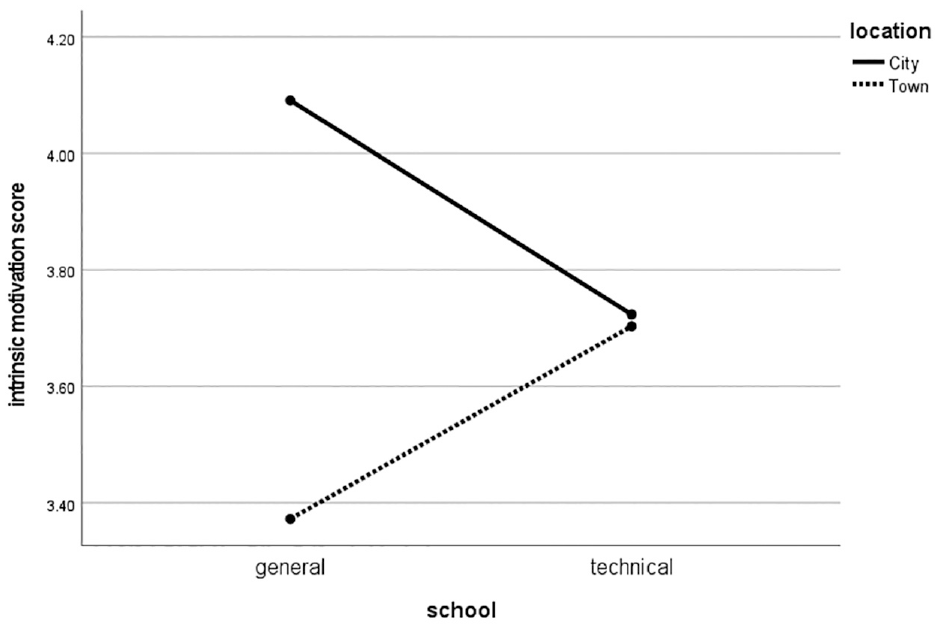
Intrinsic motivation and learner background variables.

Identified motivation and learner background variables.

Extrinsic motivation and learner background variables.
As shown in Figure 1, school location affected the level of intrinsic motivation for learners in general secondary schools; those from the large city were significantly more motivated intrinsically than those from the town (p < .001). In contrast, students in technical schools showed no statistically significant difference between the two locations (p = .874).
Regarding identified motivation, Figure 2 illustrates the same type of interaction between the background variables as in the previous case. Students in general secondary schools in the large city significantly differed from those in the town in the degree of identified motivation they exhibited (p < .001), although we noted no statistically significant difference between technical school students in the two locations (p = .138).
Figure 3 also demonstrates an interaction between the variables. The location of the school affected extrinsic motivation only for students in general secondary schools; the level of this type of motivation was significantly higher in the town (p < .001). For students from technical schools, the location of the school had no bearing on how extrinsically motivated they felt (p = .579).
RQ2: School Type, School Location, and Changes in Motivation Over Time
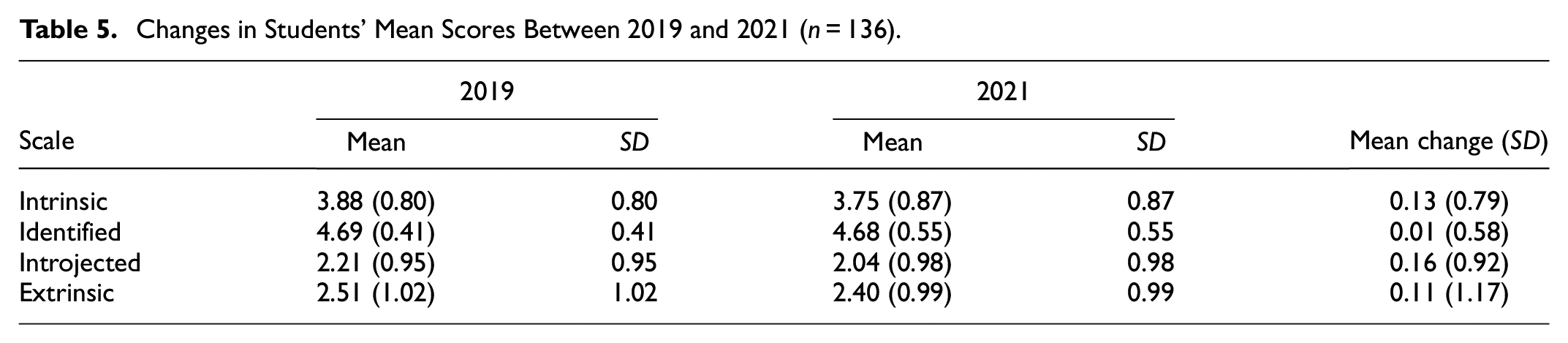
The juxtaposition of the questionnaire results from the two time points revealed that in most cases, only a very slight decrease in the level of each motivation type occurred between 2019 and 2021. Table 5 illustrates this phenomenon for all 136 participants, regardless of school type and location.
Changes in Students’ Mean Scores Between 2019 and 2021 (n = 136).
A series of mixed ANOVAs was performed to examine the changes that took place in motivation levels in relation to school type and location. The analyses found only one statistically significant interaction between the time factor and the location variable (F [1,134] = 5.369, p = .022), which occurred in the case of extrinsic motivation. As shown in Figure 4, the level of extrinsic motivation dropped over time for students who received their secondary education in the town. A follow-up analysis found this change to be statistically significant, with p = .013.

Extrinsic motivation and school location over time.
RQ3: Learners’ Descriptions of Changes in Motivation Level
The next sections present the results of the interviews with the nine students described in the methods section, where we investigated the changes in their motivation for EFL learning. In the following, we present changes in the students’ intrinsic, identified, introjected, and extrinsic motivation. The most prominent theme behind students’ increased intrinsic motivation was having more extensive exposure to English outside the classroom. Students who reported increased intrinsic motivation said that, during the pandemic, they had started watching movies and reading books in English, which made them realize how useful English was. The ability to understand spoken or written language in the media or during an occasional trip abroad had given them a sense of satisfaction and pleasure, and it spurred them to improve their general proficiency in English.
I think that since then, I’ve started to watch more films and series – anything in English. I’ve also started to read books in English instead of in Polish; plus, when I went abroad, I noticed that it gave me pleasure when I could communicate with foreigners. (Student 9)
In the area of identified motivation, Student 5 attributed its increase in his case to the role of English in the world and in the European Union in particular. He referred to closer ties being developed between countries in Europe, resulting in the need for “a common language,” a lingua franca. He also mentioned future career opportunities in multinational corporations functioning in the Polish market.
A prominent theme in the responses of students who reported a drop in their level of introjected motivation was maturation. These students claimed that they felt different about English classes at the beginning of their secondary school education and in the final year. Initially they had wanted to make a good first impression on the teacher as well as their new classmates; later on, they became more self-confident, took less notice of other people’s attention, and realized the importance of learning English for other purposes (e.g., future professional careers or travelling).
I’m older now, and I don’t really care what other people think about me, and I just do it for myself. (Student 4) It was more important to me to be liked by the teacher in the first year so that things would somehow be easier in the subsequent years. (Student 3) At the very beginning, I often studied for my teachers, for my parents, to make them proud of me, et cetera. But later, I decided that there was no point in doing that because it wouldn’t be their life, only mine, and it was up to me what marks I would get and what school I would get into. So that was the key factor, and making the first impression was the reason why at the very beginning I cared much more about other people’s opinions than I do now. (Student 6)
We also noted students whose introjected motivation had increased between 2019 and 2021. One was Student 2, who pointed out the importance of having a good rapport with the teacher, since this rapport could contribute to the teacher giving the student more attention. The same student also referred to the fact that in grade 2, a new teacher had arrived whom she got to know well and liked.
Students whose extrinsic motivation dropped over time contended that, with time, they realized that English was not as difficult as they had initially believed it to be. They also understood that they needed to learn the language to be able to communicate with others and travel abroad, and not just because it was a compulsory subject. In other words, they realized the practical value of English.
Despite the fact that English is an obligatory subject, so learning it is compulsory, I don’t consider it compulsory, mainly because I want to learn to communicate well in this language, since it will be useful for me in the future. (Student 6) I think I noticed that I needed it [English] and I was learning more on my own, like outside of school, rather than actually in class, as I felt like I had a real chance to use it in my life, rather than just in tests. (Student 3) I discovered that English is actually pretty cool, and that you can do a lot of things with it, and it’s not even that hard to learn. (Student 4)
Discussion
Motivation matters in education, as underlined in numerous previous studies (OECD, 2017; Ryan & Deci, 2017). Less clear is the role played by the type and location of the school, particularly the combination of the type and location—even less so when combined with a longitudinal perspective with the aim of understanding the change and/or stability of motivation. In the present study we hoped to determine the influence of school type and location on different types of EFL motivation. The results of our EFL learning sample of Polish secondary school students show that including both location and type of school in the equation is necessary when trying to understand students’ motivation for EFL learning. The motivation of the students in our sample depended on the influence of the interaction of location and type of school.
In particular, the students from the general school in the city perceived EFL as more fun, more likely to be relevant for a future job, and less of a chore imposed by the school system than the students from the general school in the town. The students from the technical schools, on the other hand, had similar levels of the various types of motivation, regardless of their location. A similar contrast between urban and rural areas was observed by Lamb (2012) in the Indonesian context and by Iwaniec (2020) in the Polish context. In both cases, students who attended urban schools tended to view English as part of their future professional careers more often than their counterparts from rural areas. But because these studies did not include the type of school, the authors may have missed the nuances revealed in our study. Our findings clearly underline the importance of context in research on global motivational patterns. The results do not simply confirm the relevance of contextual factors such as school location and type; they also indicate that researchers should investigate how these factors interact and should make more fine-grained distinctions.
One potential explanation for the differences we observed between the town and the city for the students in the general school might lie in their professional career plans and a difference in international posture (Yashima et al., 2004). Students in the general school tend to have less specific professional career plans than their peers in the technical school, who study for a specific profession or education afterwards. As such, the instrumental purpose of learning English, which taps into identified motivation, might disappear. Yet the international posture of the students from the city might be higher due to more exposure (Aubrey & Nowlan, 2013). Although a fully agreed-upon definition of international posture is lacking (Botes et al., 2020), it includes having an interest in international affairs, a readiness to interact with foreigners, and a willingness to travel abroad (Yashima et al., 2004). Other researchers have observed a positive relation between international posture and motivation for EFL learning (Fallah & Mashhady, 2015; Poupore, 2013). A higher level of international posture in the city group could potentially have compensated in general education for a lack of seeing the purpose (identified motivation) or joy (intrinsic motivation) of EFL solely based on career plans.
In addition to examining the influence of school type and school location on EFL motivation, we investigated how different types of EFL motivation changed over time. More specifically, we investigated this change in relation to school type and school location and to learners’ descriptions of the change over time. We observed only one statistically significant change, namely a decrease in the level of extrinsic motivation exhibited by the students in the town. This finding implies that, over the two-year period and regardless of the type of school, the students from the town started to perceive their English classes less as an obligation and less as something to do because they had no other choice. This finding contrasts with those of previous studies that have observed change toward more controlled motivation over time (Hayenga & Corpus, 2010; Tuominen et al., 2020) but corroborates the findings from primary education (Oga-Baldwin & Fryer, 2018).
In our surveyed sample, the other types of motivation remained stable across the years. This stability has also been observed in other studies, for example in primary education (Corpus & Wormington, 2014) and at the undergraduate level (Gillet et al., 2017). One possible explanation for finding change specifically in the town might be related to the move toward more digital activities during the COVID pandemic. Online, students might have been exposed more to English than they previously were, possibly attaining a similar level of exposure as their city peers. As such, the relevance of learning English might have become more visible to them.
Although no significant changes were visible for the whole sample, individual students who did experience change in their motivation were asked to reflect upon these changes to obtain a better understanding of such fluctuations. Due to the nonresponse from the students from the technical schools, these reflections are from general school students only. In these interviews, the students also mentioned their increased exposure to English due to the COVID pandemic. More exposure to the language was a strong reason for an increase in intrinsic motivation. Students experienced the joy of understanding the language used online. This finding aligns with the value of exposure to English and engaging in intercultural activities underlined elsewhere (Aubrey & Nowlan, 2013; Busse & Walter, 2013; Tsang et al., 2023). Some researchers have also observed that students actively used social media during the pandemic to maintain their motivation (Adara & Puspahaty, 2021).
Perceiving the practical value of English instead of perceiving it as “an obligatory subject,” maturation, and thoughts of a career within a multinational company were all explanations for changes toward more autonomous types of motivation. Based on these answers, the students seem to have obtained a stronger international posture (Yashima et al., 2004) by showing an increased interest in international knowledge and collaboration, which in turn may have strengthened the autonomous forms of motivation.
Practical Implications
The self-determination theory has led to numerous investigations into how intrinsic or more autonomous forms of motivation can be stimulated (Davis & Printer, 2022; Reeve & Cheon, 2021). Studies within the field of education have shown that students’ autonomy should be supported, for example by offering them sufficient room for choices and initiatives (Kingma et al., 2018; Reeve & Cheon, 2021). Students’ feelings of competence should also be supported, for example by adjusting the pace and workload to their needs and providing them with optimal challenges (Mullet et al., 2018; Reeve, 2016). Supporting a sense of relatedness has also been shown to be an important aspect in supporting autonomous motivation (Ryan & Deci, 2017). Teachers may support a sense of relatedness by paying attention to and discussing diversity with their students and by including collaboration and teamwork in their teaching (Bott-Knutson et al., 2020; Sparks et al., 2015).
Based on our findings, we believe that teachers may find value in addressing students’ international posture as well; specifically, doing so might be valuable for students enrolled in general education in towns. In their review study, Botes et al. (2020) concluded that international posture is malleable and appears to be susceptible to the teaching practices used when teaching EFL. Several studies have shown that both offering direct contact with an international community and strengthening the imagined international community through the creation of a community of practice can contribute to students’ international posture (Botes et al., 2020). This latter aspect may be particularly relevant for teachers in towns and rural areas, where students might have less direct contact with an international community.
Based on our findings, we suggest that teachers, when aiming to motivate their students for EFL learning, should keep in mind the location and type of school they are working in. Our results have shown that the interaction of these two school factors is relevant for understanding what motivates students for EFL. Teacher educators might want to address this issue as well when teaching student teachers about motivation. Teachers and student teachers need to be aware that in particular, students in general schools located in a town may need support to establish more autonomous motivation for EFL learning.
Limitations and Further Research
Our findings contribute to a more fine-grained understanding of the influence of contextual factors on students’ motivation for EFL learning. Still, these findings should be understood in light of their limitations. In 2019, our sample was of a good size, and students were distributed equally across locations and types of schools. Unfortunately, in 2021, in addition to the regular challenges related to attrition in longitudinal research (Goodman & Blum, 1996; Graham, 2009), the COVID-19 pandemic hindered us in reaching all the students who had completed the questionnaire in 2019, resulting in a lower number of participants in 2021. The distribution of the participants across contexts also differed between 2019 and 2021. Whereas we had an equal distribution across location and school types in 2019 (and thus a good base for comparison), most of the participating students in 2021 came from general schools in the city. The low number of students included from the technical school in the town in 2021 may have influenced the power of our analysis to detect differences. To corroborate our longitudinal findings, we encourage other researchers to investigate the potential interaction between location and type of school in further longitudinal studies into motivation for EFL learning.
The COVID pandemic might also have influenced the motivation of our sample. Students mentioned in their interviews that they had started to engage with literature and movies in English during the pandemic, leading to an increase of intrinsic motivation. As mentioned earlier, this finding is in line with those from other studies (Adara & Puspahaty, 2021). The drawback of this finding lies in the fact that more exposure might have influenced other students as well, perhaps not leading to more intrinsic motivation, but at least perceiving English to have more relevance to them. The pandemic was a special unforeseen contextual factor. To what extent the change and stability we observed would have been observed without the pandemic remains unclear.
Lastly, our study focuses on motivation for EFL learning. The extent to which our findings can and may be generalized to other subjects remains an avenue for further research. Previous research has shown that the intrinsic and identified types of motivation are differentiated across school subjects, whereas the introjected and extrinsic types of motivation are not (Chanal & Guay, 2015; Guay & Bureau, 2018). This observation suggests that our findings on the latter types of motivation might be generalizable to other subjects. Lee and Kim (2014), who focused on intrinsic motivation only, observed a difference between subjects in the development of motivation. They observed a continuous decrease in intrinsic motivation in mathematics but an increase in intrinsic motivation after high school for English. Again, further research is needed to understand how motivation changes, depending on the subject taught and the interaction between location and type of school.
Conclusion
Motivating students can sometimes require considerable effort from the teacher, and our study has shown that no single fix-all solution exists for all English as a foreign language learners. Teachers should take into account the location they are teaching in, as well as the type of school where they teach. In our study, general secondary students from a small town exhibited lower levels of intrinsic and identified motivation and a higher level of extrinsic motivation than those from a big city. Second, the level of extrinsic motivation decreased over time for students in a small town, regardless of the type of school they attend. Understanding that both location and type of school are relevant for how and the extent to which students are motivated may help teachers adjust their teaching to the context in which they work.
Our study has also shown that the interaction between location and type of school has an effect on several types of motivation, and that some types of motivation may change over time. Most importantly, we found that extrinsic motivation decreased in the case of students from the town, which means that even students from rural schools who do not perceive learning English as an important activity may change their perception over time and recognize learning as something more than a necessary evil. It seems that the drop in extrinsic motivation that we observed is something on which teachers can capitalize in their effort to boost less controlled types of motivation, which general secondary students in towns are in particular need of. Teachers’ attempts to demonstrate to students that learning English can be a fun activity that is of great use in various spheres of life could be made to work in tandem with learners feeling less and less like they attend English classes because they have no other choice.
Our research clearly underlines the importance of context, and our fellow scholars should consider closely which aspects of the context they should include in their research The present study can be taken to imply that describing motivational patterns in terms of the traditional urban—rural divide may not be accurate enough: learners from cities, like the ones investigated in the present study, may exhibit patterns which can also be observed in rural areas depending on the type of school. Thus, researchers should include more fine-grained distinctions in their designs when investigating how various factors interact.
Supplemental Material
sj-docx-1-sgo-10.1177_21582440241248354 – Supplemental material for Locating Motivation for English as a Foreign Language Over Time: The Influence of School Location and Type
Supplemental material, sj-docx-1-sgo-10.1177_21582440241248354 for Locating Motivation for English as a Foreign Language Over Time: The Influence of School Location and Type by Esther T. Canrinus, Paweł Scheffler and Karolina Baranowska in SAGE Open
Footnotes
Acknowledgements
NA.
Declaration of Conflicting Interests
The author(s) declared no potential conflicts of interest with respect to the research, authorship, and/or publication of this article.
Funding
The author(s) received no financial support for the research, authorship, and/or publication of this article.
Ethical Approval
NA.

Data Availability Statement
Please contact the authors for questions about the availability of the data.
Supplemental Material
Please contact the authors for queries on supplemental material.
References
Supplementary Material
Please find the following supplemental material available below.
For Open Access articles published under a Creative Commons License, all supplemental material carries the same license as the article it is associated with.
For non-Open Access articles published, all supplemental material carries a non-exclusive license, and permission requests for re-use of supplemental material or any part of supplemental material shall be sent directly to the copyright owner as specified in the copyright notice associated with the article.
