




Abstract
The personality trait of openness has been shown to contribute to a person’s ability to function effectively. Additionally, scholars have suggested that openness to experience and foreign language experience were related to music preference. Extending from earlier scholarship, this study examined the relationship between openness to experience and the various types of musical and language experiences reported by undergraduate music majors in Turkey and the United States. Participants (N = 380) were surveyed using the Openness to Experience domain of the NEO-PI-R and an author-designed survey with questions about participants’ musical backgrounds and interests, foreign language abilities, age, and sex. Results showed that U.S. students rated significantly higher in four of the five dimensions of the Openness domain than their Turkish counterparts (Wilks’λ = .57; F(5, 374) = 55.37, p < .001). Factor analysis results showed that (a) experiences in foreign languages, (b) listening to Turkish traditional, pop, and folk music, and (c) listening to American (pop and folk) and Western classical music cumulatively explained 68.49% of the variance in openness. Correlation analyses suggested that listening to Western classical, American folk, and American pop music was associated with higher openness scores, and listening to Turkish traditional, folk, and pop music was associated with lower openness scores. Additionally, the number of foreign languages participants studied correlated with four of the dimensions. Results suggest that both groups could benefit from increased, broader, and deeper exposure to different musical genres from diverse cultures.
Keywords
Introduction
As opportunities for people of diverse backgrounds and value systems to interact with each other increase, the personality characteristic of openness is often regarded as key to a person’s ability to function effectively (Ang et al., 2006). Openness has been defined in various ways, such as “the quality of being willing to accept new ideas or people” and “the quality of not being enclosed” (Longman Dictionary of Contemporary English, n.d.), and “acceptance of or receptiveness to change or new ideas” (Lexico, n.d.). Openness to experience represents an individual’s level of comfort with, and preference for, new experiences and situations, as opposed to familiar ones (Flynn, 2005). Those with high levels of openness to experience “tend to be more creative, cultured, curious, imaginative, original, intelligent, broad-minded, and artistically sensitive than others” (Flynn, 2005, p. 817). In contrast, individuals with lower levels of openness to experience tend to be more conservative (Angel, 2010), conventional, and inflexible (Feist, 1998). This study explored how this personality trait is related to musical and language experiences.
Literature Review
A body of literature over the past four decades has examined openness to experience in relation to a wide range of topics. Much of this research utilized data gathered via a personality inventory referred to as the Big Five, Five-Factor Model, or Neuroticism, Extraversion, Openness Personality Inventory (NEO-PI) or a revised, concise version featuring updated norms, the NEO-PI-R (Costa & McCrae, 1992; McCrae & Costa, 1986). Among the measured personality traits in this model, the one that is most related to music preference is openness to experience (Schäfer & Mehlhorn, 2017) although the magnitude of the relationship is rather small.
Open individuals derive pleasure from cultural and aesthetic experiences (Veltri, 2010) and enjoy a variety of musical styles (Delsing et al., 2008; Dunn et al., 2011; George et al., 2007; Rawlings & Cinacarelli, 1997; Rentfrow & Gosling, 2003; Veltri, 2010). Openness to experience has been shown to be positively related to a preference for multiple musical genres, such as chamber, jazz, blues, ethnic/world, folk, alternative, heavy metal, opera, and/or rock musics (Delsing et al., 2008; Dunn et al., 2011; George et al., 2007; Griffith, 2006; Rentfrow & Gosling, 2003; Yoo et al., 2018; Zweigenhaft, 2008). This means that as the level of openness to experience increases, so does the preference for these genres. However, findings differ for the genre of Western classical music, with some research showing a higher level of openness to experience as Western classical music is preferred (Delsing et al., 2008; George et al., 2007; Griffith, 2006; Rentfrow & Gosling, 2003), and other research showing a lower level of openness to experience as Western classical music is preferred (Dunn et al., 2011). Although the cited studies used the term “classical music,” the authors meant “Western classical music”; we use the latter throughout this paper for consistency. Positive relationships (George et al., 2007) and negative relationships (Rentfrow & Gosling, 2003, Zweigenhaft, 2008) have also been found for the genre of pop music. Dunn et al. (2011) suggest that these mixed results may be due to ambiguity of genre labels, as well as differences across studies and samples as to how genres are viewed.
Researchers have also identified relationships between openness to experience and preferences for specific musical qualities or characteristics. A meta-analysis of 28 studies of personality traits and music preference (Schäfer & Mehlhorn, 2017) showed that openness to experience was the most prominent personality trait associated with preferences for musics that were mellow (soft rock, R&B: rhythm and blues) (r = .16), sophisticated (Western classical, avant-garde) (r = .21), and intense (punk, heavy metal) (r = .12). However, all effect sizes, or magnitude of differences across these musical styles, were small. In a study involving students in Turkey and the United States, Sigg (2009) discovered a positive relationship between the trait of openness to experience and preference for music that is reflective and rhythmic. This finding is also supported in the research of Rentfrow and Gosling (2003), who found openness to experience to be positively related to a preference for music that was reflective and complex or intense and rebellious, and negatively related to music that was upbeat and conventional. Additionally, in a study of public school band students, Payne (2009) identified openness to experience to be a significant predictor of preference for the musical timbre of specific instruments; the higher the level of openness, the more likely someone is to prefer the sound of woodwind instruments and the lower the level of openness, the more likely someone is to prefer the sound of brass instruments.
In a study of New Horizons (older adult) band members in the United States and Canada, Griffith (2006) found that participants with high levels of openness to experience generally liked to listen to music. However, differences have been shown concerning openness to experience and how people utilize and listen to music in daily life. In an examination of the relationship between personality characteristics and uses of music in daily life, Chamorro-Premuzic and Furnham (2007) found that people with higher levels of openness to experience, as well as those with higher IQ scores, tended to use music in rational and cognitive ways (e.g., listening to music as an intellectual and analytic activity rather than as an emotional activity or as background).
A limited body of research has been conducted on personality traits and various psychological and social factors related to music performance. Griffith’s (2006) research found that openness to experience was positively related to preferences for performing music from specific genres, particularly opera, ethnic/world music, and chamber music. She also found significant correlations between openness to experience and willingness to perform a solo or in a small ensemble, as well as willingness to participate in specific musical activities within rehearsals, such as playing a short passage individually, moving to music, or practicing music in pairs. Additionally, Gillespie and Myors (2000) studied a sample of 100 rock musicians and found participants to have higher levels of openness to experience than are found in general population norms. This finding was corroborated by Angel (2010) in a large-scale study that found performing musicians of various musical genres and groups to have higher levels of openness than population norms. As a whole, these studies clearly demonstrate that there is a relationship between personality traits and varied musical experiences.
Besides music, language is often a means to experience different cultures and value systems. Discussions of relationships between music and language have focused on various perspectives, such as sound structure, prosodic structure, grammatical structure, meaning, memory, learning mechanism, perception (McMullen & Saffran, 2004), and cognitive science and neuroscience (Patel, 2008). While exploring language experiences and world music preference with undergraduate nonmusic majors in the United States, Fung (1994) found that world music preference was correlated with the number of foreign languages studied (r = .46, p < .01) and total number of years a foreign language was studied (r = .38, p < .01). However, when familiar music was used in the background, regardless of familiarity with the language used in the lyrics of the music (English or Italian), it was shown to contribute to better word memory in adult students in Singapore (Chew et al., 2016). As sporadic research is found between musical and langauge experiences, contribution of foreign language experience to music preference should be explored further.
From an acculturation perspective, studies have shown that music listeners of various age groups perform better on music memory of music of their familiar culture (Demorest et al., 2008, 2010; Morrison et al., 2008, 2013). These studies involved Western and Turkish classical music. Turkish classical music was selected in comparison with Western classical music because of its “distinctive use of timbral, modal, and textural material” (Morrison et al., 2008, p. 121). The term “Turkish classical music” was used in the four cited studies in this paragraph, but in the current study we instead adopted the term “Turkish traditional music” to be distinguished from Western classical music. Western and Turkish musical traditions were characterized as distinctively different musical cultures. An investigation of musical and language experiences in these distinctively different environments could help fill a gap in the literature.
Purpose and Research Questions
This study expanded on previous research related to personality traits and musical experiences. While we acknowledge the wide range of potential variables that could contribute to these factors, a sufficiently large enough sample within a reasonably well-defined and narrow age group should minimize the effect of such variables. A comparison of samples between two nations would show the differences in culture, education, and diversity in relation to personality traits and musical experiences. The purpose of this study was to determine the relationship between levels of openness to experience and the various types of musical and language experiences reported by undergraduate music majors in Turkey and the United States. We anticipate that findings may contribute to undergraduate students’ cross-cultural understanding and inform instructors of the value of varied musical and language experiences. In the current study, research questions were formulated based on the state of knowledge evidenced in the literature:
To what extent do scores in openness to experience differ by country and sex?
What are the correlations between (a) musical and foreign language experiences and (b) personality trait scores in Openness to Experience?
To what extent do music and language experiences contribute to openness to experience?
Method
Participants
Participants in this study were a convenience sample of 380 undergraduate music majors from Turkey (n = 190) and the United States (n = 190). The Turkey subsample comprised 50.5% females and 49.5% males, and the U.S. subsample comprised 44.2% females and 55.8% males. Ages of participants ranged from 18 to 23 years, with averages at 20.47 (SD = 1.21) and 19.84 (SD = 1.41) years for the Turkish and U.S. subsamples respectively.
Instruments
NEO-PI-R (Neuroticism, Extraversion, and Openness Personality Inventory—Revised)
To measure openness to experience, we used the Openness to Experience domain of the NEO-PI-R (Costa & McCrae, 1995). The domain contains 48 items, each with a five-point Likert scale, within five dimensions: Fantasy (receptivity to the inner world of imagination, 8 items), Aesthetics (appreciation of art and beauty, 8 items), Feelings (openness to inner feelings and emotions, 8 items), Actions (openness to new experiences on a practical level ideas, intellectual curiosity, 16 items), and Ideas and Values (readiness to re-examine own values and those of authority figures, 8 items).
Translations to languages other than English have made it possible for the NEO-PI-R to be used for cross-cultural comparisons. For example, Gülgöz (2002) translated the NEO-PI-R into Turkish and validated it. Secondary analysis of data from 36 different cultures using the NEO-PI-R in various languages yielded an observation that there were geographic and cultural differences in personality traits (Allik & McCrae, 2004); however, “variation across cultures tends to be small” (p. 15). The researchers also noted that “bilingual studies had been conducted in four of the cultures, and none had shown serious distortions as the result of translation” (p. 14). This work has lent strong support for a cross-cultural study using NEO-PI-R in different languages.
Survey of musical experiences/interests and language abilities
Another instrument we used was researcher-designed and contained questions about participants’ musical backgrounds and interests, foreign language abilities, ages, and sex. Participants were asked about the types of (a) music they listened to, (b) music they wished to learn more about, (c) music history and theory they had studied, and (d) music they currently played or sang. Specific styles addressed in these questions were Western classical, American folk, American pop, Turkish traditional, Turkish folk, and Turkish pop. Participants also had the opportunity to list other musical styles. Additionally, participants were asked about the languages they knew and their fluency level in each. See the Appendix for the English version of this survey.
Procedures
Data collection took place over a 2-year period within undergraduate music classes in three universities in the United States and one university in Turkey. Data were collected by the researchers, via procedures that adhered to the research ethics standards of each university. Informed consent was obtained from participants, who were given the opportunity to ask questions. Surveys were then distributed in hard copy, and approximately 20 minutes were allowed for completion. The names of participants or other identifying factors were not collected via the survey or in any other form. Survey data were stored securely in password-protected files on the researchers’ password-protected computers. The computers were stored securely in locked offices. Only the researchers and one research assistant had access to the data.
Data Analysis and Results
Data were analyzed using quantitative techniques. Cronbach’s alphas for foreign language questions, listening to Turkish musical styles, and listening to American and Western styles were acceptable, at .87, .85, and .68 respectively. Cronbach’s alphas for the five dimensions of openness were acceptable given the smaller number of items involved, at .73, .66, .71, .61, and .59 for Fantasy, Aesthetics, Feelings, Actions, and Value respectively. These values support the reliability, or internal consistency of the survey instruments. We excluded one item (no. 24) to yield a better Cronbach’s alpha for the Value dimension, changing from .59 to .63. This step made the reliability of all five dimensions acceptable. Results are presented according to the three research questions.
1. To what extent do scores in openness to experience differ by country and sex? A MANOVA (multivariate analysis of variance) was performed to determine whether Openness dimension scores differed by country and sex. Results showed that the country of residence had a significant main effect (Wilks’λ = .57; F(5, 374) = 55.37, p< .001, η2 = .42), meaning that country of residence significantly affected openness scores. Follow up univariate F tests showed that students from the U.S. scored significantly higher than their Turkish counterparts on the Fantasy dimension (F(1, 378) = 19.89, p < .001), Feeling dimension (F(1, 378) = 108.75, p < .001), Actions dimension (F(1, 378) = 68.45, p < .001), and Value dimension (F(1, 378) = 165.55, p < .001). The difference in the Aesthetics dimension was non-significant. These mean differences are presented in Table 1.
Openness to Experience Dimensions by Country.

Significant main effect (country), p < .001. Scale: 1 = strongly disagree, 5 = strongly agree. Turkey n = 190, USA n = 190, N = 380.
Furthermore, we found that openness dimension scores did not differ according to sex (Wilks’λ = .99; F(5, 374) = .88, p > .05, η2 = .01). The interaction between country and sex was also not significant (Roy’s Largest = .03; F(5, 370) = 2.19, p > .01, η2 = .03). In other words, sex did not have an effect on reported Openness to Experience.
2. What are the correlations between (a) musical and foreign language experiences and (b) personality trait scores in Openness to Experience? To determine whether variables in the study correlate with Openness to Experience dimensions, a Pearson Product-Moment Correlation matrix was calculated (see Table 2). For dichotomous variables, a point-biserial model was used. Correlation analyses demonstrated that students who listened to Western classical, American folk, and American pop music were associated with higher scores across all five dimensions with all positive and significant coefficients (r range from .11 to .40; mostly p < .001 and only two p < .05). In contrast, those who listened to Turkish traditional, folk, and pop music were associated with lower openness scores across all five dimensions with negative (r range from −.13 to −.49; mostly p < .001 and one p < .01) and four non-significant (p > .05) relationsips. The data revealed that those who listened to Western classical, American folk, and American pop were predominately music majors in the U.S. and that those listened to Turkish traditional, folk, and pop were predominately music majors in Turkey.
Pearson Product-Moment Correlation Coefficients Among the Study Variables.

Note. Variables 1–5 are dimensions of Openness to Experience, variables 6–11 are music listening experiences, and variables 12–17 are language experiences.
p < .05. **p < .01. ***p < .001.
Positive correlations were also found between the number of foreign languages the students learned and the Aesthetics dimension (r = .16, p < .01), the Feelings dimension (r = .11, p < .05), the Actions dimension (r = .11, p < .01), and the Value dimension (r = .12, p< .01). Additionally, students’ speaking and reading abilities had similar correlations with the same four dimensions (r = .08–.14). The Fantasy dimension of the Openness to Experience domain was not correlated with any of the language variables.
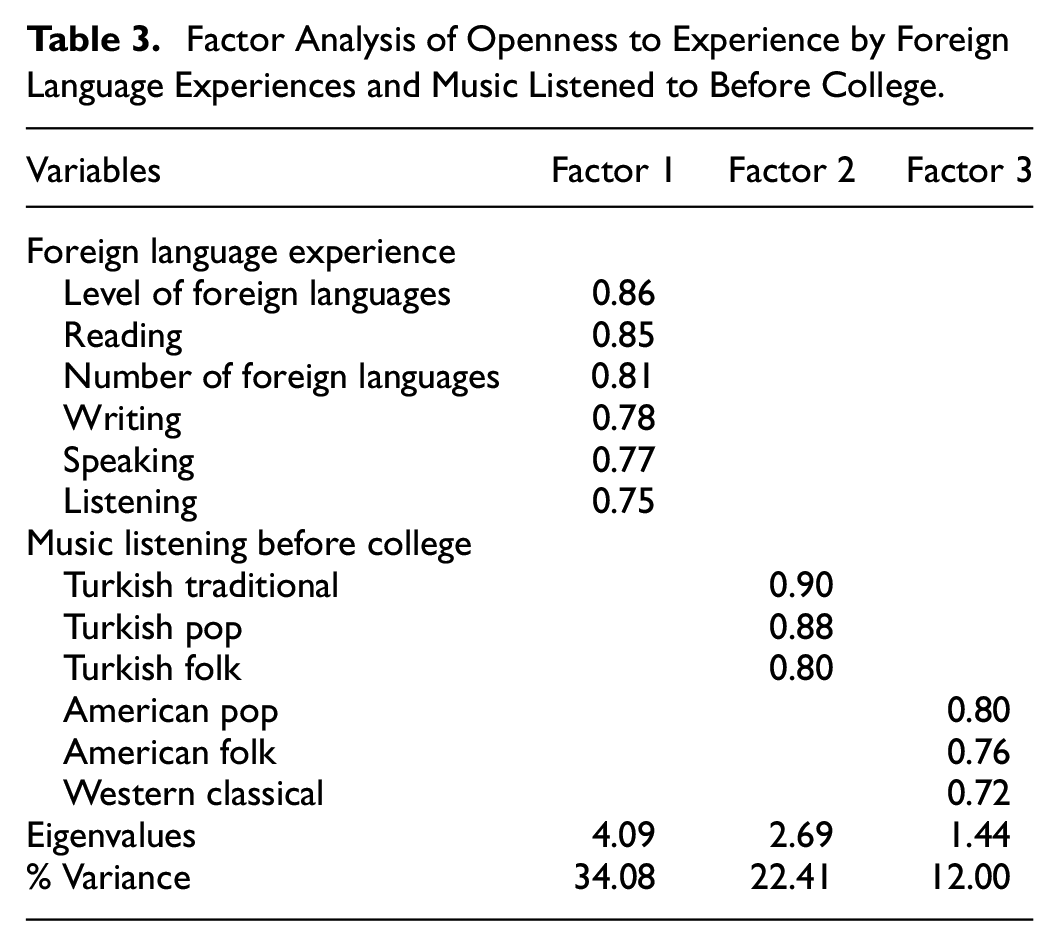
3. To what extent do music and language experiences contribute to openness to experience? We computed the Kaiser-Meyer-Olkin (KMO) value to test the data for eligibility for a factor analysis. The KMO value was found to be 0.81, which meant that the data were suitable for principal component factor analysis. The principal component analysis helped us to identify three factors with Eigen values larger than one, at 4.09, 2.69, and 1.44 for the factors of (a) foreign language experiences, (b) Turkish traditional, pop, and folk music experience, and (c) American pop, American folk, and Western classical music experience respectively. They cumulatively explained 68.49% of the variance. This demonstrates that language and musical experiences contributed substantially to undergraduate music majors’ trait of Openness to Experience. The result of the analysis performed using the Varimax rotation technique is shown in Table 3.
Factor Analysis of Openness to Experience by Foreign Language Experiences and Music Listened to Before College.
Discussion and Conclusion
The domain of Openness to Experience was found to be significantly different across two countries. Results showed that U.S. music majors achieved significantly higher ratings in the Fantasy, Feeling, Actions, and Value dimensions than did their Turkish counterparts. The Aesthetics dimension showed no significant difference. No significant interaction effect of country and sex was shown. These results suggested that female and male undergraduate music majors in these two countries did not have a significant difference in their openness to experience, but students in the U.S. environment were more receptive than Turkish students to most new experiences and situations. The exception to this was the Aesthetics dimension, which meant that there was no difference in the appreciation of art and beauty despite distinctively different environments between the two countries.
The data supported the assumption that of the participants, undergraduate music majors in Turkey listened to various types of Turkish music and that those in the U.S. listened to Western classical and American folk and pop. However, it was interesting to see that those who listened to Turkish music had lower Openness to Experience scores than those who listened to Western classical and American music. We speculate that this difference could be explained by the distinctive difference in cultural diversity between the two countries, as reflected in their demographics (70%–75% Turkish, 19% Kurdish, and 7%–12% other minorities in Turkey; and 72.4% White, 12.6% Black, 4.8% Asian, 7.1% other, and 2.9% with two or more races, and among various races were 16.3% Hispanic in the U.S.) (Central Intelligence Agency, n.d.). This difference could explain the results of Greenberg et al. (2022) in that their U.S. sample (r = .18, p < .00001) had a stronger correlation between openness and preference for sophisticated music, defined as “inspiring, complex, and dynamic features as heard in [Western] classical, operatic, avant-garde, and traditional jazz genres” (p.287) than did their Turkish sample (r=.14, p< .00001). Similar correlations were found between openness and preference for mellow music, defined as music with “romantic, slow, and quiet attributes as heard in soft rock, R&B, and adult contemporary genres” (p.187), at r = .20 and .15 for the U.S. and Turkish samples respectively. It is important to note that all correlations found in our current study were between modest and moderate at best, which is in line with previous studies of similar variables (e.g., Fung, 1994; Greenberg et al., 2022; Schäfer & Mehlhorn, 2017).
While Turkey in its entirety has a rich multicultural history, its diversity is noticeably evident in the region referred to throughout history as Anatolia. Since antiquity, various civilizations have lived on Anatolian lands, which compose most of the modern-day Turkey. The architectural, archaeological, and artistic works they left behind may have created a richness related to the aesthetic tendency of those currently living in Anatolia. Cultural diversity is also evident in the United States but at a global level. The U.S. population includes many different ethnicities and immigrants, providing residents with rich opportunies to share their cultural experiences within vastly diverse communities.
Despite the differences between the two countries, it is intriguing to see the similarities in perception of the Aesthetics dimension of the Openness to Experience domain. If openness to experience is a key to the ability to function effectively (Ang et al., 2006) and feel comfortable with new experiences and in new situations (Flynn, 2005), and since the Aesthetics dimension was the only indifferent dimension, aesthetic cultivation could be a helpful avenue for students to further explore the cultural differences across the two countries. Experience in different musical genres (Western classical, American folk and pop; Turkish traditional, folk, and pop) and foreign languages provided significant explanations for the students’ Openness to Experience. These findings support previous research showing a relationship between Openness to Experience and a preference for multiple musical genres (Delsing et al., 2008; Dunn et al., 2011; George et al., 2007; Griffith, 2006; Rentfrow & Gosling, 2003; Yoo et al., 2018; Zweigenhaft, 2008).
Previous research shows that open individuals enjoy cultural and aesthetic experiences (Veltri, 2010), as well as listening to music (Griffith, 2006) of a variety of genres and styles (Delsing et al., 2008; Dunn et al., 2011; George et al., 2007; Rawlings & Cinacarelli, 1997; Rentfrow & Gosling, 2003; Veltri, 2010). Relative to these findings, results of this study suggest that music educators might consider increasing, broadening, and deepening the opportunities for participation in varied musical experiences. If experiencing different types of music is related not only to Openness to Experience but also to increased knowledge of musical styles and genres, it also may provide a major contribution to music education. If multiple musical styles and genres are included in music curricula of Turkey and the U.S., students could benefit from the increased breadth and depth.
Additional research could be conducted with a guiding question, “Could people who listen, learn, or perform only one type of music be low or unstable in Openness to Experience?” The correlation between the impact of varied music experiences on other personality traits can be further investigated alongside with other variables such as grade and achievement levels. Studies along these lines could contribute to a deeper understanding of the effects of varied musical and language experiences and how the trait of openness could be developed. They could also inform undergraduate instructors of the value of varied musical and language experiences.
Footnotes
Appendix
Declaration of Conflicting Interests
The author(s) declared the following potential conflicts of interest with respect to the research, authorship, and/or publication of this article: Cumhuriyet University had no role in the study design; the collection, analysis, and interpretation of data, or the writing of the research report. Cumhuriyet University encouraged the submission of the article for publication.
Funding
The author(s) disclosed receipt of the following financial support for the research, authorship, and/or publication of this article: This work was supported in part by Cumhuriyet University, Sivas, Turkey.
Ethics Statement
This work was in compliance with the human subjects research guidelines of the affiliated institutions.
