




Abstract
The United States has often been viewed as a leading force in technological advancement and scientific innovation. However, that may soon change with the low number of postsecondary degrees being awarded to students in science, technology, engineering, and mathematics (STEM). Without an adequate number of qualified individuals fueling the innovative drive of the nation, we are at risk of stagnation. Further compounding this issue is the low number of minority students awarded STEM degrees and jobs. Several researchers have addressed external and internal goal-related factors that lead to student attrition from STEM, but few have explored students’ personal factors that influence academic behavior (PIAB) and, subsequently, achievement. This study aimed to expand the current literature by developing a new model to assess the influence of PIABs on student success.
Keywords
Literature Review
Science, technology, engineering, and mathematics (STEM) drive the United States forward in world industry. Unfortunately, in the United States, there are too few STEM professionals receiving adequate training to meet the nation’s workforce need (Atkinson, 2013; Bybee, 2010; Metcalf, 2010; National Science Foundation, 2014; Palmer, Maramba, & Dancy, 2011). Researchers posit that this may be the result of many undergraduate students who are raised in underresourced settings not receiving the opportunity to learn skills necessary to handle the new set of demands that arise when studying at the postsecondary level (American Psychological Association [APA], Task Force on Resilience and Strength in Black Children and Adolescents, 2008; Mega, Ronconi, & De Beni, 2014; Spencer, Dupree, & Hartmann, 1997; Zimbardo & Boyd, 2008). These students naturally learn to limit themselves to the here-and-now and lack the necessary coping strategies to manage the very different challenges of higher education (APA, Task Force on Resilience and Strength in Black Children and Adolescents, 2008; Mega et al., 2014; Spencer et al., 1997; Zimbardo & Boyd, 2008). As such, when students are faced with new stressors for which they do not have the resources to cope, such as exams or long-term projects, they experience diminished cognitive ability to attend to the academic task at hand. Repeated exposure to such situations may eventually lead the student to switch majors or drop out all together due to an overwhelming experience of poor achievement (Bertrams, Englert, Dickhäuser, & Baumeister, 2013; Blankstein, Flett, & Watson, 1992; National Science Foundation, 2010; National Science Foundation, 2014; Ramirez & Beilock, 2011).
Several theories exist that aim to identify the factors which increase the risk of STEM attrition. Several models and research frameworks aim to address student perceptions of STEM at the high-school level, develop STEM education curricula that include real-life research opportunities and everyday application, foster positive academic habit formation, improve emotional intelligence (EI), address lack of belonging in the culture of a field of study, improve growth mind-set, shift students’ time perspective (TP), provide students with a higher sense of purpose, aid students in managing test anxiety, mitigate self-handicapping behaviors, and provide academic support in a welcoming environment, among others (Bybee, 2010; Rattan, Good, & Dweck, 2012). Moreover, early research in psychology and more recent longitudinal studies have indicated that within the scope of academics, noncognitive factors (which will be referred to as personal factors influencing academic behavior, PIABs) are able to predict academic, economical, psychological, and physical well-being (see Duckworth & Yeager, 2015, p. 2, for a discussion regarding the use of the term “noncognitive” as inaccurate nomenclature; Binet & Simon, 1916; Farrington et al., 2012; Jackson, Connolly, Garrison, Levine, & Connolly, 2015; Moffitt et al., 2011; Wechsler, 1943; Yeager & Walton, 2011).
Although there are several theories that focus on specific factors leading to STEM attrition, few models exist that take the holistic or person-centered approach found in the phenomenological variant of ecological systems theory (PVEST; APA, Task Force on Resilience and Strength in Black Children and Adolescents, 2008; Spencer, 2006; Spencer et al., 1997; Spencer, 2006; Talley, Fife, Harris, & Hill, 2015). The PVEST was derived from Bonfenbrenner’s Ecological Systems Theory and expounded upon by Spencer et al. (1997). According to the APA taskforce on resilience, “Resilience in African American Children and Adolescents: A Vision for Optimal Development” (APA, Task Force on Resilience and Strength in Black Children and Adolescents, 2008), the PVEST theory serves as one of the most integrative approaches for assessing academic resilience and identity formation for young African American adults. This model has been praised by researchers for linking “multiple contexts and individual perceptions in a recursive, cyclical fashion . . . [and] central to the theory are individuals’ perceptions of their experiences and their self-appraisal throughout their development” (APA, Task Force on Resilience and Strength in Black Children and Adolescents, 2008, p. 24). PVEST aims to provide insight into life stage specific coping outcomes by looking at the ways individuals weigh “(1) new risks against protective factors, (2) encounter new stressors, (3) establish new coping strategies, and (4) redefine how they view themselves” (Spencer, 2006, pp. 642-643).
The theory highlights the elements of a person’s perception of her or his development and frames them within the scope of critical mindedness, active engagement, flexibility, and communalism. In addition, important areas of personal growth addressed by this model include identity development, emotional development (which encompasses knowledge, competency, and regulation), cognitive development, and physical health.
According to the PVEST, the emotional domain provides a lens through which the examination of oppressive and marginalizing conditions can occur. Specifically, one can assess the impact of these negative factors on an individual’s overall ability to cope and operate within a situation and with other people. The theory provides a framework for addressing the expression of negative emotions and cultivation of more appropriate ways of expressing both negative and positive emotions. In addition, the theory states that high academic achievement is important for optimal personal development, within the scope of the cognitive domain. It explains that African American students raised in underresourced areas should be able to develop a strong sense of motivation for learning that is accompanied by a critically minded approach to the application of knowledge, if an individual is provided a positive context conducive to this (Spencer, 2006). Unfortunately, many students from underresourced environments attend college without the academic and emotion regulation (ER) skills necessary to succeed while attempting to balance difficult life situations and personal stressors in an environment that is unable to provide the necessary support to do so (APA, Task Force on Resilience and Strength in Black Children and Adolescents, 2008; Marra, Rodgers, Shen, & Bogue, 2012; Spencer et al., 2008; Talley et al., 2015). The study described in this article focused on exploring the emotional and cognitive domains in the context of critical mindedness, active engagement, and flexibility to create a new model to guide the development of academic interventions for minority STEM students attending a Historically Black College or University (HBCU). Following this section are the theoretical components that constitute PIABs, such as the temporal perspective of one’s environment and behaviors, motivation to achieve goals, ER, and metacognition conceptualized as mindfulness skill, as they relate to academic success.
TP and Academic Success
The perspective of time is considered a powerful PIAB that can affect many aspects of an individual’s decision-making process. TP is operationalized as an individual’s perception of her or his psychological past and future that exist at a given time (Lewin, 1948). One of the most commonly researched theories of time orientation in the field of academic success is Zimbardo’s model of TP (Kauffman & Husman, 2004; Zimbardo & Boyd, 2008).
In a seminal article published in 1999, Zimbardo and Boyd crystallized their conceptualization of TP. The authors identified TP as a nonconscious process responsible for categorizing personal and social experiences into several temporal frames that are relatively stable over time. They posited that these frames serve to help individuals organize and bring meaning to experiences and events. Frames of temporal reference provide a foundation for individuals to develop alternative goals and assess the likelihood of desirable outcomes for a course of action over time.
Mello and Worrell (2006) explored the link between academic success and TP with a sample of 815 adolescents from various ethnicities who, at the time of the study, had completed eighth, ninth, or 10th grade. Students were identified as “academically talented” (mean Grade point average [GPA] = 3.8). Participants completed the 56-item Zimbardo Time Perspective Inventory (ZTPI), the Measure of Perceived Life Chances (MPLC), which measures an individual’s perception of several major events coming to pass (e.g., “graduating from high school,” p. 491), and the State Hope Scale (SHS), a measure of an individual’s current goal-directed thinking pattern. They found a small, but significant, negative relationship between low academic achievement and present hedonistic perspective and a significant, small, positive relationship between academic achievement and future orientation. However, the authors cautioned that the sample of self-selected, high achieving students may have restricted the range of reporting across all inventories and skewed the results.
The link between future TP and academic success has been replicated several times by researchers (Adelabu, 2007; Barber, Munz, Bagsby, & Grawitch, 2008; Mello & Worrell, 2006; Perkins, Scherer, Palmer, & Talley, 2015; Zimbardo & Boyd, 1999). Adelabu (2007) explored the association between TP and academic success in a sample of 232 African American adolescents. Students’ age ranged from 14 to 20 years, and they were enrolled in Grades 9 to 12 at the time of assessment. Adelabu administered the 22-item ZTPI, which is an abbreviated version of the 56-item ZTPI and is limited to measuring present and future TP. In addition, students were given the Psychological Sense of School Membership Scale, an 18-item inventory that assesses students’ feelings of acceptance in school. Adelabu found a small positive relationship between future TP and GPA (r = .12, p < .05), future TP and school belonging (r = .17, p < .05), and future TP with school acceptance (r = .14, p < .01). In addition, she found a negative link between present TP and academic achievement (r = −.31, p < .01). She also found, using a regression analysis, that present TP accounted for 9% in the variance in academic achievement.
To better understand the impact of TP on emotion, Avci (2013) included 508 first-year undergraduate students across 15 different majors in a study that aimed to assess the predictive relationships between self-regulation, future TP, and academic delay of gratification. Participants were asked to complete the ZTPI, the Academic Delay of Gratification Scale (ADOG), and the Motivated Strategies for Learning Questionnaire (MSLQ), which measures an individual’s motivational beliefs and cognitive and metacognitive self-regulations (for the purposes of this discussion, only moderate associations with TP will be outlined, r = .30 and above; see Avci, 2013, p. 532, Table 1 for a detailed correlation matrix). Avci found a moderate and positive relationship between future TP and the follwoing: ADOG (r = .46, p < .001), self-regulation (SR) strategies of Intrinsic Goal Orientation (r = .37, p < .001), Task Value (r = .30, p < .001), Self-Efficacy (r = .32, p < .001), Elaboration (r = .38, p < .001), Organization (r = .32, p < .001), Metacognitive Self-Regulation (r = .39, p < .001), and Time and Study Environment Location (r = .31, p < .001). These results suggest a link between TP and aspects of delay of gratification, metacognition, which is the ability to think about one’s own thought content and personal goals. Results of the regression analysis showed that future TP explained 21% of the variance in ADOG (R2 = .209, β = .458, t = 10.918, p = .000). Furthermore, future TP explained 15% of the variance in Metacognitive Self-Regulation, 14% of the variance in Elaboration, and 13% of the variance in Intrinsic Goal Orientation. This suggests that future TP is influential in the expression of self-regulation and the metacognitive activities in which a student engages. These findings supported earlier research conducted by Avci (2008) in addition to Mischel and Ayduk (2002).
Factor Loadings and Communalities for PIABs.
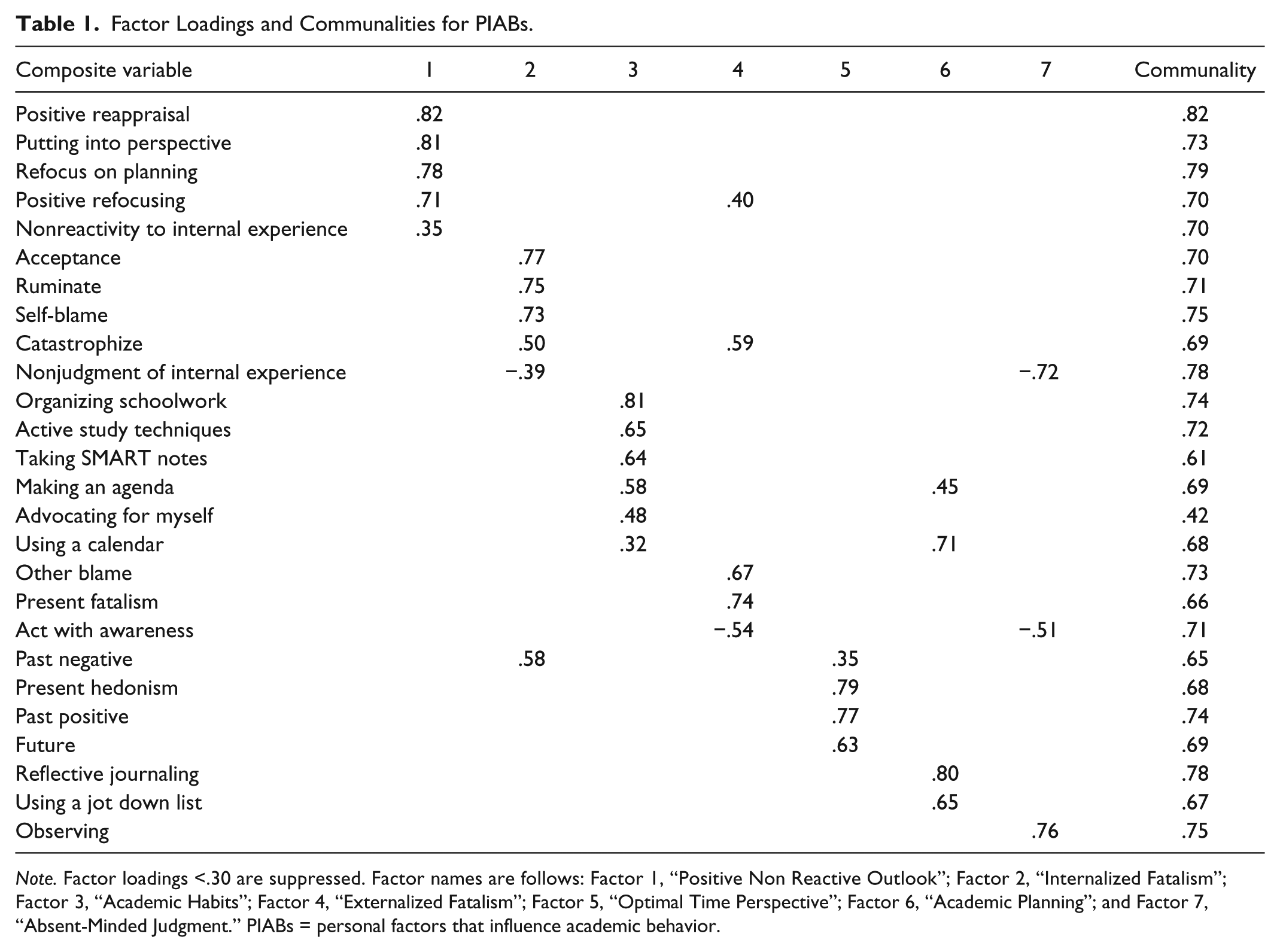
Note. Factor loadings <.30 are suppressed. Factor names are follows: Factor 1, “Positive Non Reactive Outlook”; Factor 2, “Internalized Fatalism”; Factor 3, “Academic Habits”; Factor 4, “Externalized Fatalism”; Factor 5, “Optimal Time Perspective”; Factor 6, “Academic Planning”; and Factor 7, “Absent-Minded Judgment.” PIABs = personal factors that influence academic behavior.
Moreover, a recent study published by Perkins et al. (2015) found that in a cross-sectional sample of 378 undergraduate students at a Southeastern HBCU, high ZTPI scores on future TP were better able to predict high GPA as compared with other facets of the ZTPI. In addition, the authors found that higher scores on present fatalism predicted low GPA for these students more accurately than the other subscales. However, the authors also cautioned that the ZTPI is a multidimensional measure and that addressing specific constructs may not fully explain the variation in GPA, as originally proposed by Zimbardo and Boyd (2008).
The Role of Grit in Academic Success
Many researchers who have set out to determine the root of the STEM attrition issue theorize that motivation plays a strong role in whether students persist or drop out of STEM programs. Academic habits, grit, self-efficacy, self-handicapping, sense of belonging, and TP are several theoretical bases that researchers have used to explain STEM attrition (Bybee, 2010; Duckworth, Peterson, Matthews, & Kelly, 2007; Dweck, 1986; Hossain & Robinson, 2012; Perkins et al., 2015; Schwinger, Wirthwein, Lemmer, & Steinmayr, 2014; Talley & Scherer, 2013; Walton, Cohen, Cwir, & Spencer, 2011).
Duckworth et al. (2007) developed a theory of motivation specifically attuned for academics and long-term goal persistence. Through her research, she coined the term “grit.” This construct was developed in response to the question “Why do some individuals accomplish more than others of equal intelligence?” Stemming from this inquest, Duckworth et al. theorized that grit included a core set of personality traits that may be essential to success across all careers and defined it as “perseverance and passion for long-term goals” (p. 1087). The construct “entails working strenuously toward challenges, maintaining effort and interest over years despite failure, adversity, and plateaus in progress” (p. 1088) and evolved out of numerous interviews with individuals in various careers, including academia, art, entertainment, investment banking, journalism, and medicine (Duckworth et al., 2007).
Duckworth et al. (2007) found a strong link between grit and conscientiousness. Additional studies into conscientiousness revealed that grit is actually a “sub-factor” of this trait. As an overarching personality trait, conscientiousness contains several facets, including self-control and perseverance, which are also linked to academic success, although only modestly (Ivcevic & Brackett, 2014; MacCann, Duckworth, & Roberts, 2009; Roberts, Chernyshenko, Stark, & Goldberg, 2005). Early work with grit certainly pointed toward the need for continued development and understanding of an overlooked and under studied personality construct. Strayhorn (2013) endeavored to translate the concept of grit to the study of academic success for Black male college students at primarily White institutions (PWIs). Specifically, he tested the relationship between grit and grades, in addition to the predictive ability of grit when added to a traditional model of academic success for his population. A sample of 140 full-time Black male students from 4-year PWIs in the Southeastern United States was used. One third of the sample (approximately 47 students) had declared a STEM major at the time of data collection. Results of the analysis revealed a moderate correlation between grit and GPA (r = .38, p < 0.01). The final analysis indicated that grit accounted for 4% of the variance in GPA. Although promising, this model does not account for additional factors that affect academic success.
Ivcevic and Brackett (2014) expanded upon the work of Duckworth et al. (2007) by comparing conscientiousness, grit, and an individual’s ability to regulate her or his emotions. The authors recruited 213 middle class students studying at a private high school in England, enrolled in Grades 9 to 12. Students completed the Emotion Regulation Ability (ERA) subtest of the Mayer, Salovey, and Caruso Emotional Intelligence Test–Youth Version (MSCEIT-YV). The ERA subtest is a measure of student’s knowledge regarding strategies that influence emotions within the context of the individual attempting to reach a higher level of personal well-being, build successful relationships, and achieve other important personal goals. Additional measures included the 12-item Grit scale, the Big Five Inventory, the Multidimensional Students’ Life Satisfaction Scale, and student GPA. The authors discovered a moderate correlation between conscientiousness and grit (r = .44, p < .001) and for conscientiousness with ERA (r = .30, p < .001), but not grit and ERA. GPA was positively correlated with conscientiousness (r = .30, p < .001) and ERA (r = .27, p < .001). The results of a hierarchical linear regression indicated that conscientiousness was a significant predictor of school outcomes and as an independent factor, ERA explained 5% of the variance for GPA, and grit was not found to predict GPA in the sample.
Alone, grit demonstrated a low to moderate relationship with GPA and academic success across several studies and no relationship to GPA in others (Day & Carroll, 2004; Duckworth & Gross, 2014; Duckworth et al., 2007; Duckworth & Quinn, 2009; Fujita, 2011; Ivcevic & Brackett, 2014; Mischel, 2014; Strayhorn, 2013). This may be due to the relative newness of grit as a clearly defined and researched concept; however, it is clear that grit is related to academic success and motivation in students across many fields of study and developmental levels. It seems more likely that the addition of another predictor of GPA, ER may provide one of the missing pieces that will enable researchers to better understand the STEM attrition issue for African American students within the context of the PVEST model.
ER and Its Impact on Academic Success
Individually, many of the pioneers in psychological science theorized that person’s ability to regulate attention, emotion, and behavior were absolutely essential for success in academic efforts, in addition to long-term and everyday endeavors (Binet & Simon, 1916; Freud, 1920; Galton, 1869; James, 1890; Wechsler, 1943). As defined by Webb, Miles, and Sheeran (2012), ER refers to a set of automatic and controlled processes involved in the initiation, maintenance, and modification of the occurrence, intensity, and duration of feeling states. Many models of ER exist and new ones are continuously being developed in both research and clinical psychology (Webb et al., 2012). This is of particular interest due to the ever-increasing application and implication of ER in education research (Duckworth, Gendler, & Gross, 2015; Gross, 2015).
Arguably, one of the most widely accepted models of ER is the extended process model, developed by Gross (Gross, 1998, 2015; Webb et al., 2012). Gross theorized that an individual can use various strategies to alter the impact an emotion has on her or his subjective experience. The proposed process of ER involves several stages, each being dependent upon the individual’s current “valuation system,” that is, the set of goals or values the individual chooses to operate under at the time of appraisal. Gross distilled each stage into three substages: perception, valuation, and action, each of which can be affected by a specific coping strategy. Gross theorized that an individual may use various coping strategies to alter the impact an emotion will have on her or his subjective experience. This is accomplished through the stage-based process of elaboration. Stages are dependent on initial perception, which may be guided by observation, judgments, or “valuation systems” and are followed by a decision to take action. Theoretically, this supposition fits directly within Beck’s Cognitive Theory appears to expand upon it (Beck, 1964). The prevention of secondary elaboration—which occurs when an individual begins a ruminative loop, according to Beck (1964; Beck, 2011), and when they appraise a situation, as theorized by Gross (2015)—may play a key role in halting the rumination process and subsequent secondary elaboration that interferes with the individual completing academic behaviors (Durlak, Weissberg, Dymnicki, Taylor, & Schellinger, 2011; Mega et al., 2014). A simplistic description of the extended process model may characterize it as a process whereby an individual evaluates and reevaluates her or his situation and the appropriateness of various coping strategies for which to manage it and any evoked emotions (Gross, 1998; Gross, 2015).
The inclusion of an empirically supported framework for ER is of particular importance to the STEM retention issue. Consequently, the link between poor ER and cognitive difficulties leading to lackluster academic performance has been well documented (Barchard, 2003; Levens, Devinsky, & Phelps, 2011; Mega et al., 2014; Ramirez & Beilock, 2011; Reyes, Brackette, Rivers, White, & Salovey, 2012; Villavicencio & Bernardo, 2012; Zins, Weissberg, Wang, & Walberg, 2004). A study conducted by Mega et al. (2014) sought to test a model which aimed to tie emotions, self-regulated learning, and motivation to academic achievement. They used a sample of 5,805 undergraduate students in Italy. Participants completed the Self-Regulated Learning Questionnaire (LQ), Emotions Questionnaire (EQ), and Motivation Questionnaire (MQ). The LQ is an instrument that measures organizational skills, self-evaluation, metacognition, and strategies for studying. The EQ evaluates the individual’s positive and negative emotions related to her or his self, academic achievement, and study time. The MQ measures an individual’s malleability of intelligence (i.e., it assesses if the individual believes that intelligence can be changed or is fixed), confidence in intelligence, confidence in who the individual is as a person (personality), self-efficacy, and approach achievement goals. Academic achievement was measured by ability as expressed through GPA and productivity (the average number of exams an individual has passed during their college matriculation). Results from structural equation modeling (SEM) indicated that the overall model was significant at p < .001. The most compelling results from this investigation included the observed impact that positive emotions had on learning (β = .53) and motivation (β = .70) as opposed to the impact seen from negative emotions on learning (β = −.25) and motivation (β = −.35).
Two studies conducted by MacCann, Fogarty, Zeidner, and Roberts, and published in 2011, expanded upon the investigation of ER into the interactions of EI, coping skills, and academic achievement. During Study 1, 159 community college students were given the MSCEIT and the Coping with School Situations Scales and found that emotional management was able to predict GPA. In Study 2, the authors endeavored to replicate their findings using the Situational Test of Emotion Management for Youths (STEM-Y) instead of the MSCEIT with middle school students. They found similar results as in Study 1, which suggested that emotional management and coping skills, regardless of the measure, can predict GPA. The authors posited that adequate emotional coping skills may be more important for academic achievement than any other facet of EI. Therefore, an analysis of cognitive ER skills is indicated.
Metacognition and Academic Success
Research focused on metacognitive techniques for ER, such as mindfulness, has become increasingly widespread. Mindfulness, as defined by Kabat-Zinn (2003), involves “paying attention on purpose, in the present moment, and nonjudgmentally, to the unfolding of experience moment to moment” (p. 145). Mindfulness techniques encourage a cognitive state of continuous refocus of one’s awareness (Cahn & Polich, 2006). Several researchers have studied the cognitive elements of mindfulness and have found that five subskills exist: describe (labeling internal experiences with words), act with awareness (attending to one’s activities of the moment), nonjudgment (taking a nonvaluative stance toward one’s thoughts and feelings), nonreactivity (allowing thoughts and feelings to come and go without passing judgment), and observing (noticing or attending to internal and external experiences and allowing them to pass) (Baer, Smith, Hopkins, Krietemeyer, & Toney, 2006; Baer et al., 2008).
Researchers have identified widespread cognitive changes in individuals that practice mindfulness. These changes include reduced impact of repetitive and negative thinking, improved mood and attention, improved ability to sustain attention for long periods of time, improved working memory, and lower instances of “mind wandering” (Baer, 2009; Jha, Stanley, Kiyonaga, Wong, & Gelfand, 2010; Morrison, Goolsarran, Rogers, & Jha, 2014; Mrazek, Franklin, Phillips, Baird, & Schooler, 2013; Ortner, Kilner, & Zelazo, 2007). Mindfulness training can increase an individual’s insight into automatic and habitual patterns of cognitive and emotional overreactivity. In addition, the increased insight may lead to an understanding of how maladaptive reactive patterns act to increase perceived stress and emotional distress. Consequently, it serves to help the individual reduce her or his susceptibility to overreact in response to emotionally charged stimuli which may be of particular interest to academic researchers (Linehan, 1994; Teasdale, 1999).
Current Study
This study proposes a new theoretical model to guide the development of academic interventions targeted at improving retention and academic success for African American STEM students. The theoretical model suggests that TP, grit, ER, and mindfulness comprise the core PIABs. Each of these overarching factors is composed of several subcomponents that act to affect an individual’s propensity to engage in pro academic behaviors, which then affect GPA and student retention.
An individual trained in the metacognitive techniques of mindfulness is able to effectively intervene with the automatic thought process and alter her or his resulting cognitions (Beck, 2011; Gross, 2015; Kabat-Zinn, 2013; Kanai & Rees, 2011; Moors, Ellsworth, Scherer, & Frijda, 2013; Segal, Williams, & Teasdale, 2013). Moreover, mindfulness training may allow the individual to attend to stressful thoughts or emotions and break the cycle of rumination before it begins. This may effectively block emotional escalation, which is likely to distract an individual from current and long-term goals, such as studying, working on an assignment, or the completion of other future-oriented tasks (Butler et al., 2008; Gu et al., 2015; McCloskey, 2015; Misra & McKean, 2000; Segal et al., 2013; Stolarski, Bitner, & Zimbardo, 2011). Therefore, incorporating a mindfulness-based perspective into the PVEST framework of self-regulation of emotion may be a highly effective way of conceptualizing students’ potential to manage maladaptive PIABs, improve GPA, and affect her or his internal environment and experience. Mindfulness, as measured by the FFMQ is theorized by this investigator to play an integral role in self-regulation of PIABs in the proposed model.
In addition, the established links between TP and ER and the connection between mindfulness and a shift to present centered thinking suggests that TP may shift after individuals undergo mindfulness training (Kabat-Zinn, 2013; Stolarski et al., 2011; Toneatto & Nguyen, 2007; Zimbardo & Boyd, 2008). According to Avci (2013), future TP is influential in the expression of self-regulation and metacognitive activities in which a student engages, which further suggests the existence of a link between TP and mindfulness. Moreover, from a theoretical standpoint, grit is a construct based on future orientation and has already been linked to ER and GPA, similar to Zimbardo’s TP (Duckworth & Gross, 2014; Zimbardo & Boyd, 2008). Based on this observation, this model posits that mindfulness-based metacognitive strategies may affect grit as well (see Figure 1).
This study was conducted in two phases. Phase 1 served as a pilot to clarify the emotional regulation and academic components of the PVEST model through the integration of TP, grit, ER, and the components of mindfulness based on the following research hypotheses:

Study 1 model of PIABs’ impact on GPA.
Study 2 was aimed at exploring the nature of these factors how they interrelate and whether they can predict academic success as measured by GPA.
Study 1
Method
Participants and materials
Study 1 served as a pilot and served to identify initial factors which may affect student achievement. This pilot included a sample of 33 first-year STEM students who were previously randomly selected for inclusion in an NSF funded HBCU-UP Grant (Award Number 1238757). The sample is comprised of 26 female and seven male students. In all, 95% of the sample identified as African American or Black and 5% identified as Latina. The grant intervention, named Project Knowledge (PK), aimed to improve STEM students’ academic performance and retention at a small, urban, Southeastern HBCU. Students in this program received adaptive academic skills training, provided peer-to-peer mentoring, and various interventions aimed to promote identity development and emotional development. These interventions were delivered during weekly sessions, for 1 hr during participants’ first year of matriculation. All interventions in PK were developed to address various aspects of development within the PVEST framework and provided students support to help them address developmental issues.
Students were asked to complete the ZTPI, FFMQ, Cognitive Emotion Regulation Questionnaire (CERQ), Self-Report Habit Index (SRHI), and Grit-S prior to the start of the PK intervention, at the end of the first semester, and at the end of the second semester of matriculation, which included the data used for subsequent analyses. Participants were also asked to complete the assessment battery after the end of the initial intervention week; however, data from this collection time appeared to be inconsistent and random response patterns were evident. This sample was not included in any analysis in this study.
The ZTPI is a multidimensional inventory that measures the propensity for individuals to interpret events within the scope of several TPs. As previously stated, the ZTPI includes 56-items and yields a profile which includes a score for one of five facets. Test–retest reliability scores for each subscale are as follows: Future = .80, Present Fatalistic = .76, Past Positive = .76, Present Hedonistic = .72, and Past Negative = .70.
The FFMQ is a multidimensional questionnaire designed to measure several facets of mindfulness. It includes 39-items, each of which is scored on a 5-point Likert-type scale (1 = never or very rarely true through to 5 = very often or always true). The inventory has demonstrated a relatively high level of internal consistency, with alpha coefficients ranging from .72 to .92 in most studies. It has been used in a number of studies and has been validated with a wide range of populations. Several versions of the FFMQ have been validated for use in a large number of populations. In addition, it has been validated for use with meditators and nonmeditators and with individuals suffering from a wide range of clinical psychological and medical conditions (Adam, Heeren, Day, & de Sutter, 2014; Barros, Kozasa, Souza, & Ronzani, 2014; Cebolla et al 2012; Christopher, Neuser, Michael, & Baitmangalkar, 2012; de Bruin, Topper, Muskens, Bögels, & Kamphuis, 2012; Deng, Liu, Rodriguez, & Xia, 2011).
The CERQ is a 36-item, multidimensional inventory designed to identify the coping strategies an individual uses while attempting to manage her or his emotional reaction to a negative environmental stimulus. Results from the questionnaire yield nine scores for different coping strategies. These include self-blame, which refers to the individual’s thoughts of taking responsibility for an experience regardless of fault or responsibility; acceptance, which refers to thoughts of resigning to what has transpired in a situation; rumination, meaning the individual consistently entertains thoughts of a situation or outcome and dwells on personal feelings regarding what happened; and positive refocusing, a skill that involves the individual shifting the content of cognition to that which is more pleasant. In addition, an individual may use the skills of the following: refocus on planning, characterized by taking a solution-focused approach to an issue as opposed to concentrating on the feelings behind it; positive reappraisal, which refers to finding the positive elements of an upsetting situation; putting into perspective, which provides the individual a realistic comparison with the magnitude of past events; catastrophizing, whereby the individual emphasizes the worst elements of the situation; and other blame, which involves the individual externalizing the cause of the negative experience on someone other than the self. The CERQ was developed and normative data produced for early and late adolescents, adults, elderly people, and psychiatric populations; however, the adult population was most relevant for this study. Alpha coefficients for the factors range between .75 and .86 for the adult population. Test–retest reliability from a 14-month follow up range from .48 to .65 on the coping subscales for adults, which is expected for individuals as the way they cope with different situations frequently changes as a result of adaptation (Garnefski, Kraaij, & Spinhoven, 2002).
The Grit-S is a short form of the Grit inventory that was developed using a sample of 1,554 participants who were aged 25 and older, with a mean age of 45.64. Confirmatory factor analysis found support for the same two-factor structure of grit as the original questionnaire, which includes Consistency of Interest and Perseverance of Effort. The inventory and each individual factor showed high internal consistency: .70 for Perseverance of Effort, .77 for Consistency of Interest, and .82 for the overall inventory (Duckworth & Quinn, 2009).
The SRHI is a measure designed to assess students’ use of specific academic habits. The instrument contains 10 items and measures participants’ responses on a Likert-type scale, which ranges from 1 (agree) to 7 (disagree). The inventory was designed to measure any habit that an individual may have, but does not test behavioral frequency estimates of the test taker, which may contribute to higher reliability scores. Rather, it queries participants on history of repetition, automaticity of the habit, and expression of identity through the habit. Over the course of several studies, the validity of the measure was tested with different habits and was found both reliable and valid during each round of testing. Alpha coefficients ranged from .82 to .93 across all studies. In addition, 3-week test–retest correlations ranged from .43 to .63 for each study (Verplanken & Orbell, 2003).
Procedure
Data for this analysis was collected as part of PK, a larger study funded by the NSF (Award Number 1238757), which focused on improving academic performance by providing students with an immersive learning experience with nonacademic skills development, delivered for 1 hr per week during their freshman year. As previously stated, participants were asked to complete the ZTPI, SRHI, FFMQ, CERQ, and Grit-S at three points during the academic year to measure change in students’ attitudes and skill use. Data from the end of the second semester was used as it contained the fewest missing values across all participants.
Preliminary data screening indicated that the scores on all variables were normally distributed. Data for the FFMQ Observe and CERQ Ruminate factors appeared to display some positive kurtosis; however, a z test was performed which confirmed it was not significant. Data for the factors CERQ Refocus Plan and CERQ Put in Perspective displayed a negative kurtosis; however, the values were not significant. Data for FFMQ’s Describe factor appeared to be positively skewed; however, a z test showed this was not significant. An assessment for the randomness of missing data was performed using a Little’s test. Results showed that any incomplete data was missing completely at random, χ2 = 11.553 (14) p = .642.
A correlation matrix was computed to explore relationships between the subfactors of each measure, as applicable. Most notably, GPA was negatively associated with ZTPI Present Fatalism (r = −.39, p = .024) and CERQ Catastrophize (r = −.46, p = .007). ZTPI past negative was related to CERQ Self-Blame (r = .56, p = .001), and past positive was related to CERQ Positive Reappraisal (r = .51, p = .003). In addition, Present Fatalism, past negative, past positive, and future orientation were related to Active Awareness, Non Judgment, Non Reactivity, and Observe factors of the FFMQ. In addition, several academic habits measured by the SRHI were positively associated with FFMQ Observe (r = .38, p = .037), Describe (r = .47, p = .006), and many of the CERQ constructs.
Based on data obtained from the correlation matrix, a stepwise linear regression was performed to evaluate how well factors in TP, Mindfulness, Grit, and Cognitive Emotion Regulation predicted spring semester GPA and to determine which variables would be included in the final model. Each predictor variable was entered in one step. The overall model, which was statistically significant—R = .740, R2 = .548, adjusted R2 = .500, F(3, 31) = 11.32, p < .000)—included CERQ Catastrophize, b = −.79, t(28) = −5.32, p < .000; ZTPI Past Negative, b =.57, t(28) = 3.65, p = .001; and ZTPI Future b =.39, t(28) = 2.88, p = .008.
To assess multivariate outliers, the standardized residuals from the regression analysis were entered into a scatterplot with the standardized predicted values. There was no indication of a pattern, trend, or heteroscedasticity within the data.
A hierarchical linear regression was performed in one step in an order that was contingent on the beta values determined during the stepwise linear regression for each variable. Variables were entered as follows: Step 1, ZTPI Past Negative; Step 2, ZTPI Future; and Step 3, CERQ Catastrophize. The overall regression, which included the three above predictors, was statistically significant, R = .734, R2=.539, adjusted R2=.491, F(1, 29) = 28.86, p < .000. Standardized beta values are reported as follows: ZTPI Past Negative, b =.556, t(29) = 3.60; ZTPI future, b =.373, t(29) = 2.80; and CERQ Catastrophize, b =.9, t(28) = −5.37. In addition, a second layer analysis was conducted using ZTPI future and past negative as predictors for CERQ Catastrophize. Results from this regression showed that ZTPI Past Negative was a positive predictor of CERQ Catastrophize, b = .540, t(30) = 3.29.
Correlational data supported Hypothesis 1, “TP is associated with mindfulness.” The link between past positive and Observe; past negative, future, Present Fatalistic and Active Awareness; past negative and Nonjudgment; and past positive and Non Reactivity suggest that these constructs of the ZTPI and several from the FFMQ have a moderately positive relationship. As such, it may be possible to influence an individual’s time orientation, previously hypothesized by Zimbardo and Boyd (2008) as largely intractable, through mindfulness training. Interestingly, Zimbardo, Marshall, and Maslach (1971) found that using hypnosis, participants expressed an increase in present-mindedness. Kabat-Zinn, (1982, 2011, 2013) theorized that mindfulness training results in an increase in an individual’s attention to the present moment, further suggesting that mindfulness may affect TP. Additional research specifically measuring the relationship between mindfulness and TP is necessary to further understand the link between these two constructs.
The results of the pilot hierarchical regression analysis partially supported Hypothesis 2: “Personal factors influencing academic behaviors (PIABs) can predict GPA, TP can predict GPA, ERA can predict GPA, Mindfulness can predict GPA, Grit can predict GPA,” and the proposed model. The regression analysis showed that future, past negative, and CERQ Catastrophize were significant predictors of GPA, despite the small size of the pilot group. Unexpectedly, past negative was a positive predictor of GPA. This may be due to students’ learning from past failures and setting positive future goals to avoid reliving past experiences (Fishbach, Eyal, & Finkelstein, 2010). Although promising, these results must be interpreted with caution due to the small sample size and subsequently low power. Further research is necessary to investigate the model further. Study 2 addressed this issue by including a broader sample of not only STEM students but non-STEM majors as well as students in different levels of matriculation through their programs.
Study 2
Method
Participants and materials
This study was conducted independently from the NSF Grant in Study 1. Study 2 included a sample of 125 undergraduate students studying in both STEM and non-STEM majors. In all, 72% of participants identified as female (90 students) and, approximately, 81% (101 students) of the sample identified as African American or Black. Participants were recruited from various introductory and higher level courses across various departments of study in the fall semester of 2015, and 74% of participants were enrolled as a STEM major. Participants received extra credit at the discretion of the course instructor for their participation. Data from Study 1 was not included in this study due to the difference in data collection time and because students in Study 1 participated in the PK academic success intervention in 2013.
Participants were asked to complete the ZTPI, FFMQ, CERQ, and SRHI at one point in the semester. Participants completed these assessments on Qualtrics software. Each individual received extra credit by emailing a confirmation code which was provided at the end of the questionnaire battery to this author, and the course instructor was then notified of the student’s successful participation in the study.
Results
Preliminary data screening indicated that the scores on all variables were normally distributed, and Z tests confirmed that the data was not significantly skewed. An assessment for the randomness of missing data was performed using a Little’s test. Results showed that any incomplete data was missing completely at random. Subsequent analysis of the missing data revealed that approximately 0.9% of the total data was missing; however, 42.4% of the items were missing at least one response. Due to almost half of all items missing at least one or more data points, a multiple imputation analysis was conducted with five imputations. Due to the low number of total missing cases, no significant variation between each imputation was observed.
Multivariate outliers were assessed using the standardized residuals from a regression analysis. These residuals were entered into a scatter plot with the standardized predicted values which showed no indication of a pattern, trend, or heteroscedasticity within the data. A hierarchical linear regression was performed in one step to assess the relationship between PIABs and GPA. A stepwise linear regression was performed in one step and included each composite score for all 21 factors. This analysis initially yielded nine significant predictors of GPA with standardized beta values above .2; however, the results from this analysis also suggested the presence of several latent factors in the model. Therefore, a factor analysis and SEM were performed in lieu of a path analysis.
To assess the nature of the latent variables in the model, a principle components factor analysis was performed using an equimax rotation to limit the number of factor loadings on each latent variable. Items entered into the analysis included the composite scores for factors measured by the ZTPI (Past Negative, Present Hedonistic, Future, Past Positive, and Present Fatalistic), FFMQ (Observing, Describing, Acting with Awareness, Nonjudging of Inner Experience, and Nonreactivity to Inner Experience), and CERQ (Self-Blame, Acceptance, Rumination, Positive Refocusing, Refocus on Planning, Positive Reappraisal, Putting into Perspective, Catastrophizing, and Other Blame). Grit was excluded from the model due to unexpected and unrecoverable data loss for this construct. The initial factor solution consisted of nine variables with eigenvalues greater than one; however, a scree plot suggested the inclusion of seven latent variables in the model. These seven variables accounted for 58.7% of the total variance within the model. Composite scores with loadings above .31 were included (see Table 1). Factor 1 was identified as “Positive Non Reactive Outlook,” Factor 2 was identified as “Internalized Fatalism,” Factor 3 as “Academic Habits,” Factor 4 as “Externalized Fatalism,” Factor 5 as “Optimal TP,” Factor 6 as “Academic Planning,” and Factor 7 as “Absent-Minded Judgment.”
SEM was conducted using the AMOS software, Version 23. Factors 2 and 4 were highly correlated and subsequently combined into one latent variable identified as “Helpless, Fatalistic Perspective.” Overall, goodness-of-fit indices were low for the model (χ2 = 3809.788, degrees of freedom [df] = 318, p < .000; comparative fit index [CFI] = .629, root mean square error of approximation [RMSEA] = .122). An adjusted model which included “Helpless, Fatalistic Perspective,” “Academic Habits,” and GPA improved the goodness of fit, but was still poor (χ2 = 505, df = 63, p < .000; CFI = .850, RMSEA = .096; see Figure 2).

Revised model of PIABs and GPA.
Discussion
Results from the initial regression analysis suggested that TP can predict GPA, ERA can predict GPA, and mindfulness can predict GPA; however, this could not be accurately tested due to the presence of several latent factors that influenced the analysis. The SEM analysis attempted to explore the nature of these relationships, but due to poor model fit, this was not clarified. As suggested by Hooper, Coughlan, and Mullen (2008), post hoc analyses for the model included individual and combined exploration of each latent variable to determine goodness of fit for each possible variable combination to inform future research. “Academic Habits” and GPA was the only factor combination that yielded acceptable goodness-of-fit index scores (χ2 = 273.616, df = 20, p < .000; CFI = .918, RMSEA = .098). “Helpless, Fatalistic Perspective,” “Academic Habits,” and GPA showed a low, but improved, goodness of fit compared with the first model iteration (χ2 = 505, df = 63, p < .000; CFI = .850, RMSEA = .096). Although the model does not fit the data well, these two adjusted models show promise. The appearance and better fit for “Academic Habits” and “Helpless, Fatalistic Perspective” suggest that through the impact on GPA, African American students at this HBCU may not matriculate through college if they do not possess the ability to regulate strong and self-defeating emotions or thoughts or to use adaptive study and work techniques (Duckworth & Carlson, 2013; Fujita, 2011; Perkins et al., 2015; Talley & Scherer, 2013; Zimbardo & Boyd, 2008). Research has shown a strong link between hope and academic achievement (Johnson, 1981; Snyder et al., 2002). According to Zimbardo and Boyd (2008), individuals who are high in present fatalism and past negative perspectives do not experience strong feelings of hope in the face of difficult situations, such as performing poorly on exams or experiencing highly challenging personal situations. Moreover, a classic study conducted by Diener and Dweck (1980) showed that when faced with academic failure, children with high helplessness often undervalued and underestimated her or his personal successes and overvalued and overestimated the salience and importance of failure. The authors posited that “for helpless children, successes are less salient, less predictive, and less enduring—less successful.” Although it was not formally measured, Helplessness, as a latent variable, was comprised of Present Fatalism, Catastrophizing, Self-Blame, Ruminating, Past Negative TP, and Acceptance, and consistently appeared to affect GPA during model development in both the pilot and main study. However, due to the low overall model fit, more exploration of this finding may be warranted.
Several factors may play a part in the lack of fit for the proposed model. The relatively small sample size for the number of studied variables (20 variables were included in the factor analysis of the model) may have limited the statistical power necessary to accurately explore the relationship between each factor. In addition, participants were asked to complete a questionnaire battery which included approximately 260 individual items. Participants completed the battery between 10 min to several hours. Participants who completed the battery under 10 min tended to respond to less than 50% of items, and as such were not included in the analysis (n = 25). Participants who worked continuously to complete the assessment in one period may have suffered from mental fatigue which could have reduced performance, as suggested by van der Linden, Frese, and Meijman (2002). In the future, participants should be provided the questionnaire battery in shorter segments, and validated short versions of each assessment should be used that include the same composite factors as the long versions.
Despite low model fit and small sample size, the results of this study suggest that future analysis of students’ PIABs may be beneficial for the development of programs which aim to improve academic success and retention in STEM majors.
Conclusion
Considering the results from both Study 1 and Study 2 and the theoretical justification for the adjusted model, it seems plausible that students may benefit from coursework developed to include basic stress reduction techniques, ER skills, and coursework in academic habits, time management, and behavioral self-regulation. Courses aimed to address students’ PIABs may be assessed at several times during a semester to determine personal growth and to provide support for individuals who may benefit most from these interventions. Quite actually, literature suggests that focusing on noncontent specific skill development may actually improve student success in difficult STEM courses (Talley et al., 2015; Talley & Scherer, 2013). Established courses in psychological science, such as mental hygiene, may provide a foundation for the development of such classes. However, before this can be accomplished, future research should aim to clarify the nature of the interactions between PIABs and GPA to clearly understand which PIABs would be most beneficial to address in an intervention for underserved student populations (Gutman & Schoon, 2016). The addition of such coursework for students may help to close achievement gaps for underserved youth and improve STEM outcomes (Gutman & Schoon, 2016; Talley et al., 2015).
Footnotes
Declaration of Conflicting Interests
The author(s) declared no potential conflicts of interest with respect to the research, authorship, and/or publication of this article.
Funding
The author(s) received no financial support for the research, authorship, and/or publication of this article.