




Abstract
The modern apprenticeship system is an essential strategy for human resources development in China. It is the institutional carrier for training high-level technical and skilled talents. Based on the perspective of the Theory of Planned Behavior (TPB), a survey of 495 first-year college students’ willingness and behavior to participate in modern apprenticeship in N vocational college in Jiangsu Province found that perceived benefits, prescriptive norms, exemplary norms, external conditions, and self-efficacy have significant positive effects on college students’ willingness to participate in modern apprenticeship. Behavioral willingness and external conditions have a significant positive impact on college students’ participation in modern apprenticeship. Situational factors have a significant positive moderating effect on college students’ willingness and behavior to participate in modern apprenticeship. For this reason, the article proposes the following actions to push on modern apprenticeship. We should establish a high-quality employment security mechanism to enhance the inherent attraction of modern apprenticeship, attach importance to career planning education to improve students’ self-cognition, pay attention to career cognition education to enhance students’ career development awareness, improve the modern apprenticeship “1+X” certificate system to enhance college students’ sense of academic achievement.
Plain Language Summary
Behavioral willingness and external conditions have a significant positive impact on college students’ participation in modern apprenticeship. Situational factors have a significant positive moderating effect on college students’ willingness and behavior to participate in modern apprenticeship. For this reason, the article proposes following actions to push on modern apprenticeship. We should establish a highquality employment security mechanism to enhance the inherent attraction of modern apprenticeship, attach importance to career planning education to improve students’ self-cognition, pay attention to vocational cognitive education to enhance students’ career development awareness, improve the modern apprenticeship “1+X” certificate system to enhance college students’ sense of academic achievement. The limitation is that this article selects the freshmen of the same vocational colleges as the objects of investigation, the total sample is relatively thin, and the sample source is relatively single, which may be different from the large sample data.
Keywords
Introduction
Modern apprenticeship is a primary system for vocational education to deepen the integration of industry and education comprehensively; it is also an important strategic choice to promote the high-quality development of vocational education in China and an important measure to build a skilled society in an all-around way. Since implementing the Opinions on the Pilot Work of Modern Apprenticeship issued by the Ministry of Education in 2014, China has selected three batches of 562 pilot construction units, covering more than 1,000 specialties and benefiting more than 90,000 students in school yearly. Up to now, 534 pilot units have passed the acceptance of the Ministry of Education, with a passing rate of 95.02%. The modern apprenticeship system has become important for cultivating high-quality technical and skilled talents in China.
Modern apprenticeship is the product of the organic combination of traditional apprenticeship and modern school education. It is a modern technical talent training mode based on integrating industry and education, characterized by the alternation of school-based and work-based, and based on institutionalized learning plans and stable teacher-student relationships (Li & Li, 2020). Relevant research has focused on the following aspects: First, the research on the connotation, essence, and characteristics of modern apprenticeship. For example, Guan (2022) systematically summarized the characteristics of modern apprenticeship with Chinese characteristics, with high-quality education as the development vision. Xu (2017) discriminated and analyzed the connotation and essence of China’s modern apprenticeship system from the four dimensions of talent training mechanism, mode, system, and master-apprentice relationship. Second, research on modern apprenticeship in developed European and American countries. For example, John and Nneka (2015) found that the modern apprenticeship system in the United States is mainly characterized by a registration system, emphasizing “market-oriented, government-driven” interest-driven, “specialized coordination, alliance platform” coordination and communication, “multi-party collaboration, standard guidance” curriculum development, and “certificate standardization, industry certification” quality assurance. Steedman (2005) found that the modern apprenticeship system in the UK is essentially a cross-border cooperation system, with schools emphasizing establishing a diversified education network with enterprises, emphasizing the dominant position of enterprises in collaborative education, especially in evaluation methods with outstanding results-oriented characteristics. The third is the practical research on the modern apprenticeship in China. For example, Chen and Shi (2021) comprehensively summarized the modern apprenticeship education model in Jiangsu Province. He (2017) systematically analyzed the characteristics of modern apprenticeship in Guangdong Province. The fourth is the research on the promotion strategy of modern apprenticeship. For example, Tao and Pang (2021) proposed the promotion strategy of modern apprenticeship from the three dimensions of delocalization, re-embedding, and community. These achievements provide valuable references for comprehensively deepening the reform of technical and skilled personnel training in the field of vocational education in China.
The existing research achievements have focused on the theoretical origin, practical summary, model reference, and experience promotion of modern apprenticeship. Still, only some scholars paid attention to students, the critical group in modern apprenticeship. Few achievements analyze students’ knowledge acquisition, skill development, rating methods, and participation status under the modern apprenticeship model. Still, most focus on logical and speculative research, needing more exploration on the empirical level. For example, some studies have pointed out that nearly half of the students in a certain pilot college still need to participate in any project in the modern apprenticeship system (Han & Zhang, 2020). The students’ overall recognition of modern apprenticeship could be higher. Their willingness to participate in modern apprenticeship could be more vital, their participation process could be more active, and some even quit halfway (Niu, 2021). However, the reasons behind this are the need for more in-depth discussion. So, what is the cause of this problem? From the TPB perspective, this research explores and answers which factors may affect students’ participation in modern apprenticeship, how various factors affect students’ behavior, and how they interact. The answers to these questions will help explain the formation mechanism of students’ modern apprenticeship behavior and continuously improve the training mode of technical and skilled talents.
Theoretical Model and Hypothesis Development
Theoretical Model
The Theory of Planned Behavior (TPB) was developed based on Theory of Reasoned Action (TRA) jointly proposed by American scholars Ajzen and Fishbein. According to TPB, all factors that may affect individual behavior indirectly affect behavior through behavioral willingness. In contrast, the direct factors that affect behavioral willingness include attitude, subjective norms, and perceived behavioral control. Precisely, attitude reflects the individual’s preference for performing a specific behavior. The more positive the attitude is, the stronger the behavior will be; Subjective norms reflect the external pressure individuals feel when implementing a specific behavior. The stronger the subjective norms, the stronger the behavioral willingness; Perceived behavior control reflects the individual’s assessment of the difficulty of implementing a specific behavior. The stronger the perceived behavior control, the stronger the behavior will be (Saraih et al., 2020). It is clear that TPB is a pre-factor to predicting the occurrence of behavior from the psychological structure of individual behavior decision-making, so it is also suitable for analyzing the mechanism of students’ participation in modern apprenticeship behavior.
Hypothesis Development
The outstanding feature of the modern apprenticeship system in China is that “enrollment means the recruitment, school means factory and then school enterprise joint training.” On the one hand, the modern apprenticeship system in China mainly belongs to the category of vocational education. For a long time, due to factors such as social “stereotypes,” organizational “stigmatization,” and distorted information transmission, vocational education in China has always been at the bottom of the higher education reputation system, making it challenging to form indeed recognition, attention, and reputation based on social “symbol” resources. On the other hand, because modern apprenticeship came from abroad to China, the implementation time in China is short, and students’ understanding of modern apprenticeship is still not deep. In reality, due to simultaneous enrollment and recruitment difficulties, most pilot colleges still adopt the “enrollment before recruitment” (Meng, 2021). For example, after the first-year had completed military training, a pilot college in Jiangsu cooperated with cooperative enterprises to conduct a centralized lecture on campus. It formed a modern apprenticeship class by combining voluntary application and enterprise selection. Students who enter the modern apprenticeship class sign a tripartite agreement with the enterprise and the school to clarify the dual identities of employees and students, as well as specific job positions, teaching contents, and rights and interests (Geng, 2022). In this two-way recruitment process, some students enter the modern apprenticeship class. In contrast, some students stay in the original class. As a result, organizing classes while implementing the modern apprenticeship system is complicated. Some schools even cancel the organization of classes because the number of students enrolled-needs to meet the requirements of the organization of classes. From the perspective of TPB, the differences that affect students’ behavior mainly come from three aspects: first, students’ attitudes toward participating in modern apprenticeship. Hu Xiujin believes that the behavior attitude of rational individuals is rooted in the subjective evaluation of behavior results. When the cost is specified, it mainly depends on predicting perceived benefits and perceived risks (X. J. Hu, 2022). The perceived benefits of students’ participation in the modern apprenticeship system mainly include economic benefits, professional competency upgrades, and obtaining stable jobs. The perceived risks mainly include the risks brought by limited career choices, enterprises’ midway exit, and uncertainty of enterprises’ future development. The second is students’ subjective norms for participation in modern apprenticeship. Cialdini et al. (1991) viewed that two indicators could measure subjective norms: prescriptive norms and exemplary norms. The central prescriptive norms for students to participate in modern apprenticeship include support from schools, teachers, and parents, and the exemplary norms mainly include the exemplary effect of seniors, classmates, and successful alums. The third is students’ perception and behavior control of modern apprenticeship participation. Zhang Song supposes that perceived behavior control is an individual’s subjective judgment of the external conditions and self-efficacy in implementing specific behaviors (S. Zhang, 2015). The external conditions for students to participate in the modern apprenticeship system mainly include whether they meet the application qualification and enterprise selection criteria and their awareness of the school enterprise dual subject collaborative education model. Students’ self-efficacy mainly includes their confidence and ability to pass the selection, complete their studies and achieve their dreams. In addition, some scholars pointed out that the relationship between willingness and behavior is not just a simple linear relationship (Sutton, 1998). The transformation of students’ willingness to participate in modern apprenticeship into actual behavior needs certain scenarios to induce, including the training mode maturity, talent competitiveness, and social recognition.
Based on TPB, this paper brings eight indicators into the observation category: perceived benefits, perceived risk, prescriptive norms, exemplary norms, external conditions, self-efficacy, behavioral willingness, and situational factors. It builds a conceptual model of the influencing factors of students’ participation in modern apprenticeship behavior (Figure 1), and puts forward the following assumptions:
H1: Perceived benefits positively impact students’ willingness to participate in modern apprenticeship.
H2: Perceived risk harms students’ willingness to participate in modern apprenticeship.
H3: Prescriptive norms positively impact students’ willingness to participate in modern apprenticeship.
H4: Exemplary norms positively impact students’ willingness to participate in modern apprenticeship.
H5: External conditions positively impact students’ willingness to participate in modern apprenticeship.
H6: Self-efficacy positively impacts students’ willingness to participate in modern apprenticeship.
H7: External conditions positively impact students’ behavior to participate in modern apprenticeship.
H8: Self-efficacy positively impacts students’ behavior to participate in modern apprenticeship.
H9: Behavioral willingness positively impacts students’ behavior to participate in modern apprenticeship.
H10: Situational factors positively moderate students’ willingness and behavior to participate in modern apprenticeship.

Research model.
Research Methodology
Instrument
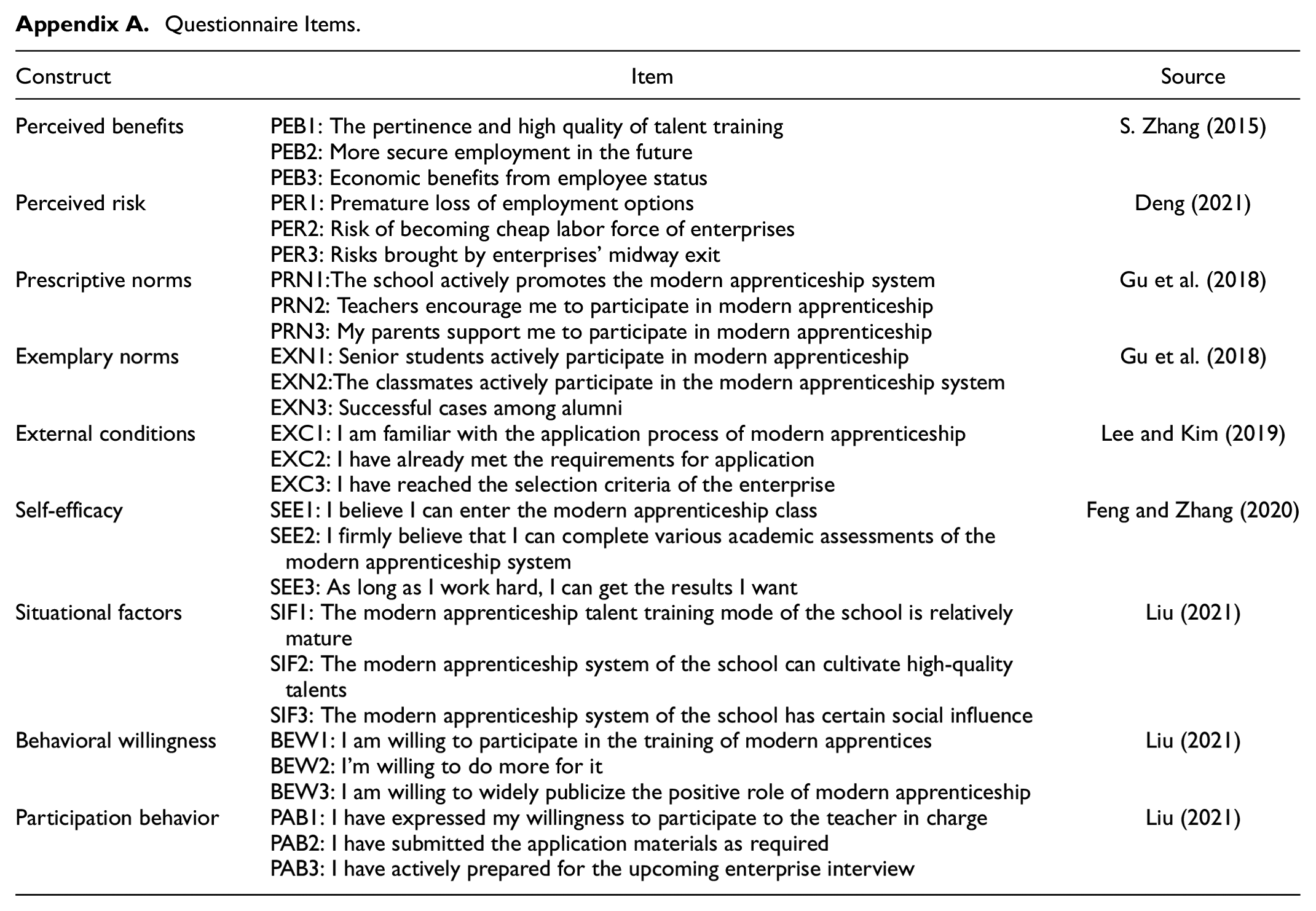
All items used for measurement are adapted from existing literature and appropriately modified according to the research purpose and the actual situation of the research object, which proved the scientificity and validity of the questionnaire. Specifically, the project used to measure the perceived needs of college students is adapted from H. L. Zhang (2020). The project for measuring college students’ perceived risk is adapted from Deng (2021). The project for measuring college students’ prescriptive norms and exemplary norms is adapted from Gu et al. (2018). The project of measuring college students’ prescriptive norms and exemplary norms is adapted from Gu et al. (2018). The project for measuring college students’ self-efficacy is adapted from Lee and Kim (2019). The project for measuring college students’ behavioral willingness is adapted from Feng and Zhang (2020). The project for measuring college students’ behavior and situational factors is adapted from Liu (2021). The final questionnaire is presented in Appendix A. All projects adopted the Likert 5-point scoring method, and the range from “1” to “5” respectively represents “very disapproval, basically disapproval, general, approval, and very approval.”
Data Collection
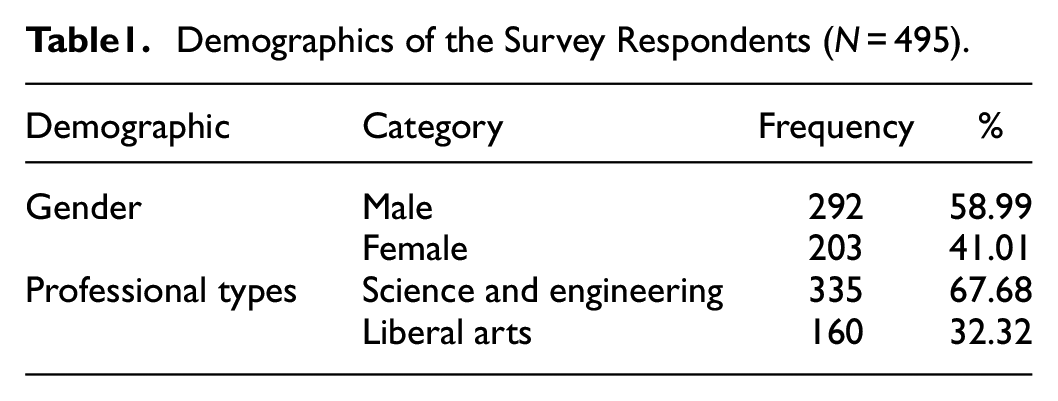
This study investigated first-year students from N school, a pilot college of the Ministry of Education for modern apprenticeship. In September 2022, these students participated in the modern apprenticeship enrollment lecture jointly organized by the college and enterprise, and they began to register and accept the enterprise interview. We collected the data within 1 week after the lecture. With the help of the online survey platform “wenjuanxing,” we received 531 questionnaires, excluding 36 invalid ones, and 495 valid ones were finally obtained, with an effective rate of 93.22%. In the survey sample, there are 292 male students, accounting for 58.99%, and 203 female students, accounting for 41.01%; there were 335 science and engineering majors, accounting for 67.68%, and 160 liberal arts majors, accounting for 32.32% (Table 1).
Demographics of the Survey Respondents (N = 495).
Data Analysis and Results
Reliability and Validity
We used Spss 22.0 software and Amos 22.0 software to test the questionnaire’s reliability and validity. According to the reliability test standard proposed by Straub and other scholars (Cronbach’s α > .7, CR > 0.7) (Straub et al., 2004), Kronbach’s coefficient value of each potential variable in the scale (Cronbach’s α) was between .816 and .947, both are higher than the recommended threshold of 0.7, indicating that the questionnaire is highly reliable; The combined reliability (CR) was between 0.816 and 0.948, which was higher than the recommended threshold of 0.7, indicating that there was a high consistency among the measurement indicators of each potential variable. According to the validity test standards (Standard loading > 0.7, AVE > 0.7) proposed by Fornell and other scholars (Fornell & Larcker, 1981), the standard loading value of each potential variable in the scale is between 0.742 and 0.940 (and p < .001), which is higher than the recommended threshold of 0.7; The average extracted variance (AVE) is between 0.6 and 0.858, which is higher than the recommended threshold of 0.5, indicating that the scale and measurement model has good convergence validity (see Table 2). In addition, the square root value of AVE of each potential variable in the scale is between 0.775 and 0.926, more prominent than the diagonal Pearson correlation coefficient, indicating that each measurement index has good discrimination validity (see Table 3).
Results of Confirmatory Factor Analysis.

Results of Discriminant Validity Testing.

Note. Diagonal bold entries are square root of AVE; All others are correlations coefficients. PEB = perceived benefits; PER = perceived risk; PRN = prescriptive norms; EXN = exemplary norms; EXC = external conditions; SEE = self-efficacy; SIF = situational factors; BEW = behavioral willingness; PAB = participation behavior.
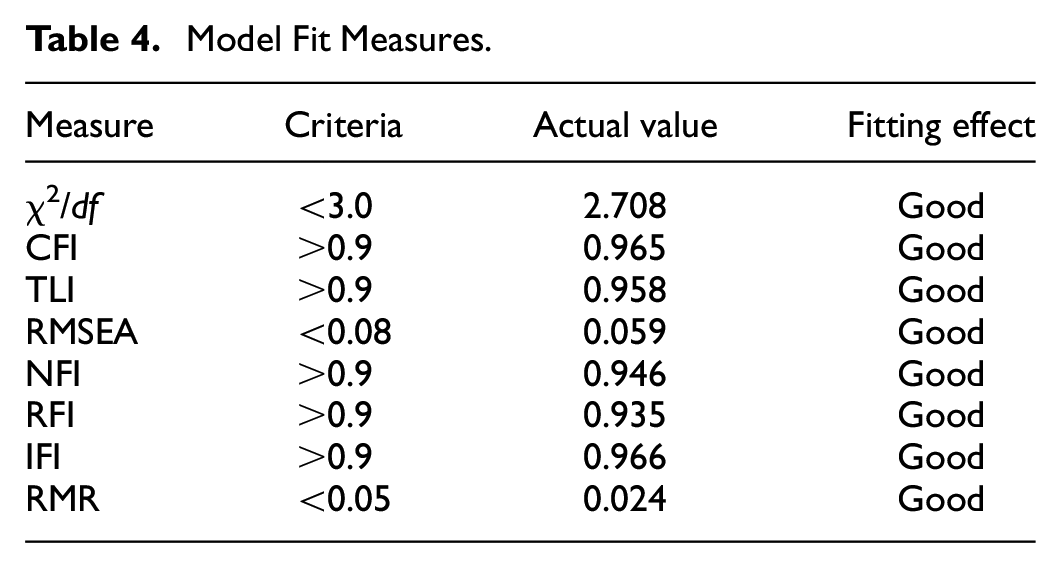
The model fitting degree reflects the degree of adaptation between the conceptual model and the observation data. The higher the fitting degree, the stronger the availability of the model and the greater the practical significance of its parameter estimation. We used The maximum likelihood method to test the model fitting, and the results show that: χ2/df = 2.708, CFI = 0.965, TLI = 0.958, RMSEA = 0.059, NFI = 0.946, RFI = 0.935, IFI = 0.966, RMR = 0.024. Thus, all indicators in the conceptual model meet the model-fitting standard, indicating that the model has a good fitting degree and that the model is highly consistent with the sample data (see Table 4).
Model Fit Measures.
Hypothesis Testing
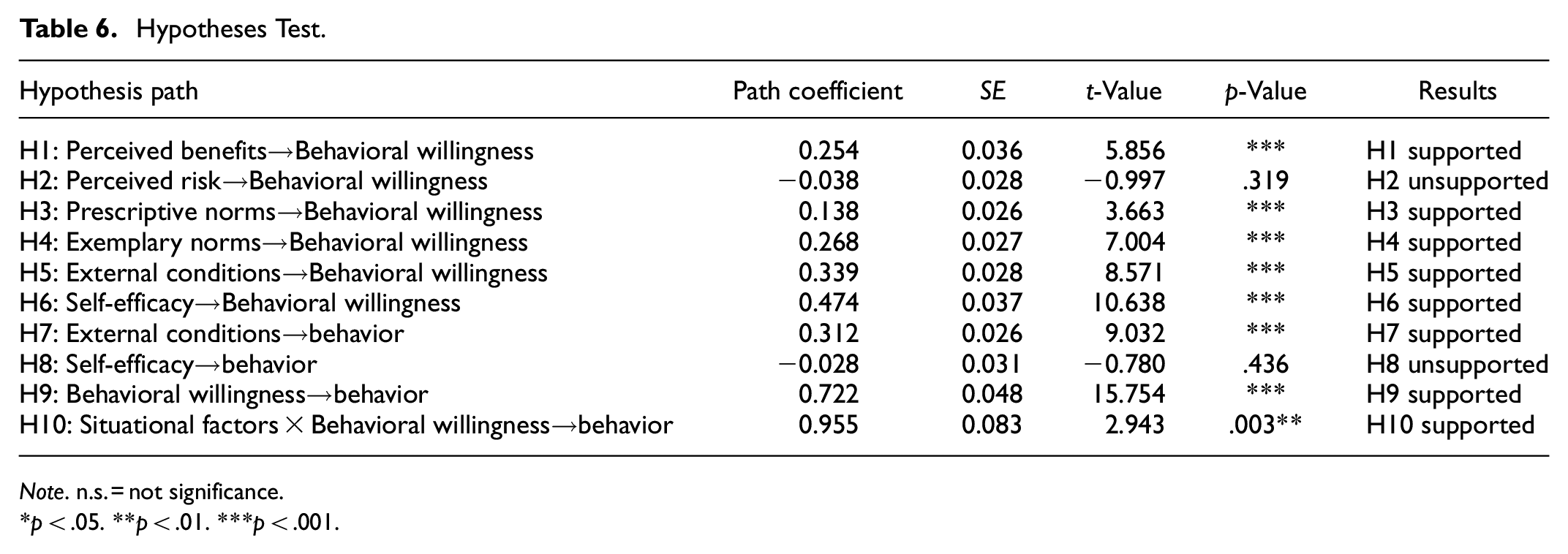
We used the Amos structural equation model to conduct a confirmatory analysis of the relationship between potential variables in the research hypothesis (Figure 2). The results show that perceived benefits, prescriptive norms, exemplary norms, external conditions, and self-efficacy significantly impact students’ willingness to participate in modern apprenticeship. In contrast, self-efficacy and perceived controllability significantly positively impact students’ willingness to participate in industrial colleges, thus supporting the research hypothesis of H1, H3, H4, H5, and H6. Behavior willingness and external conditions significantly impact students’ participation in modern apprenticeship, which supports H7 and H9 in the research hypothesis. Perceived risk has no significant impact on students’ willingness to participate in modern apprenticeship, and self-efficacy has no significant impact on students’ behavior to participate in modern apprenticeship, thus refusing to study H2 and H8 in the hypothesis. Situational factors have a significant positive impact on students’ willingness to participate in modern apprenticeship and their actual behavior (β = .955, p < .01), thus supporting the H10 hypothesis (Table 5). Among the five antecedents that affect students’ modern apprenticeship willingness, self-efficacy has the greatest impact (β = .474, p < .001), followed by external conditions (β = .339, p < .001), exemplary norms (β = .268, p < .001), perceived benefits (β = .254, p < .001), and prescriptive norms (β = .138, p < .001). Between the two antecedents that affect students’ participation in modern apprenticeship behavior, the influence of behavioral willingness is the largest (β = .722, p < .001), followed by external conditions (β = .312, p < .001) (Table 6).

The results of the research model.
Adjustment Variable Analysis.

Note. n.s. = not significance.
*p < .05. **p < .01. ***p < .001.
Hypotheses Test.
Note. n.s. = not significance.
*p < .05. **p < .01. ***p < .001.
Discussions and Implications
Discussion of Findings
Based on TPB and its analytical framework, this paper constructs a conceptual model of the impact mechanism of vocational college students’ participation in modern apprenticeship. Combined with 495 students’ questionnaire data. We use Amos structural equation model to conduct a confirmatory analysis. First, we find that perceived benefits, prescriptive norms, exemplary norms, external conditions, and self-efficacy have different effects on students’ willingness to participate in modern apprenticeship. Among them, self-efficacy has the most significant impact, followed by external conditions, exemplary norms, perceived benefits, and prescriptive norms. In addition, the perceived risk does not significantly affect students’ willingness to participate in modern apprenticeship. College students who have just entered higher vocational colleges need to gain knowledge of their future career development, and they mostly complete their significant choices with the help of their parents and elders. This discovery also confirms Zhong and Wang’s (2022) research conclusion that college students’ academic behavior results from the comprehensive effects of academic achievement, important others’ support, group demonstration effect, resource control ability, and academic self-confidence.
Secondly, behavioral willingness and external conditions significantly impact students’ participation in modern apprenticeship. In terms of the effect degree, behavioral willingness has the greatest impact, followed by external conditions. At the same time, we also find that self-efficacy does not directly affect students’ participation in modern apprenticeship behavior. The modern apprenticeship system is still in the pilot stage, and the threshold for student participation is low. This finding is consistent with the research conclusion of Krueger et al. (2000): behavior willingness is the dominant factor influencing individuals to perform a specific behavior. In addition, this study also confirmed that situational factors have a significant positive mediating effect between students’ willingness and behavior to participate in modern apprenticeship.
Theoretical Contribution
With the help of the TPB model, this study better explains the formation mechanism of vocational college students’ participation in modern apprenticeship behavior. Previous TPB model research focused on three levels: behavioral attitude, subjective norms, and perceived behavioral control (Ji et al., 2021). These studies show that college students’ behavior attitudes, subjective norms, and perceived behavior control have different degrees of influence on academic behavior. However, most of these studies explore the individual psychological factors, and they need more attention to the specific behavior of college students. Unlike previous research conclusions, in addition to individual psychological factors, the maturity of talent training mode, the quality of talent training, and social influence in situational factors also primarily affect college students’ academic decision-making behavior largely when they participate in modern apprenticeship behavior.
Based on the TPB model, we identified seven pre-factors that affect the participation of vocational college students in modern apprenticeship: perceived benefits, prescriptive norms, exemplary norms, external conditions, self-efficacy, behavioral willingness, and situational factors. Specifically, first, perceived benefits, prescriptive norms, exemplary norms, external conditions, and self-efficacy positively and significantly affect students’ willingness to participate in modern apprenticeship. The motivation of students to participate in the modern apprenticeship mainly comes from the sense of individual academic achievement, important others’ support, the peer group demonstration effect, resource control ability, and academic self-confidence. It is similar to the conclusion drawn by Zhao and Wang (2020) in studying students majoring in e-commerce in a higher vocational college in eastern China. Second, behavioral willingness and external conditions positively and significantly affect students’ participation in modern apprenticeship behavior. The stronger the students’ willingness, the fewer uncontrollable factors they perceive, and the higher the possibility of their participation. Third, situational factors have a significant positive regulatory effect on students’ willingness to participate in modern apprenticeship and their actual behavior. Modern apprenticeship’s talent training mode maturity, social influence, and high-quality talent output are important driving forces to stimulate students to convert their willingness to participate into practical action. Previous studies have yet to pay special attention to situational factors. The reason is that modern apprenticeship systems in foreign countries are relatively mature. Unlike foreign countries, China’s modern apprenticeship system is still in the pilot stage, and its comprehensive implementation still requires institutional environment support. This research supplements the academic literature on the generation mechanism of college students’ learning behavior. Also, it provides a new perspective for university education managers to evaluate the modern apprenticeship talent training model.
Managerial Implications
This study offers functional managerial implications from four aspects. First, establish a high-quality employment security mechanism to enhance the inherent attraction of modern apprenticeship. From the perspective of behavior and attitude, perceived benefits significantly impact students’ willingness to participate in modern apprenticeship. Effectively improving the pertinence of talent training, professional competence, and employment competitiveness is an important internal motivation for students to participate in modern apprenticeship, and the root of these motivations is to achieve high-quality employment. Therefore, the school-running concept guided by high-quality employment should have a more distinct manifestation in modern apprenticeship talent training. On the one hand, based on regional industrial clusters, higher vocational colleges should select leading enterprises with high matching degrees with disciplines and majors or high-quality enterprises with certain popularity as the cooperative objects of modern apprenticeship to lay a solid foundation for high-quality employment of students. On the other hand, based on the professional chain and industrial chain, optimize the post group, establish the main job groups and candidate job groups suitable for students’ future career development, and improve the “pre-employment mechanism,”“quasi-employment mechanism” and “full employment mechanism” (Liu, 2021) to ensure the matching, flexibility, security, and extension of students’ choice of employment positions.
Second, attach importance to career planning education and improve students’ self-cognition. From the perspective of subjective norms, prescriptive norms and exemplary norms significantly positively impact students’ willingness to participate in modern apprenticeship. In essence, subjective norms are internalized social norms; individual experiences gain self-motivation by choosing behaviors consistent with social norms (Zhang et al., 2018). The internalization of social norms by individuals is a gradual process, and it is a process from “external traction” to “internal self-discipline,” which needs to be guided and intervened by corresponding education. The key to improving students’ sense of standardization is to strengthen career-planning education, help students establish correct values and career outlooks, and eliminate academic confusion and confusion about future careers. Presently, vocational colleges in China have found a curriculum system for students’ career planning. However, most colleges need more professional teachers; they have a single curriculum system, intermittent processes, extensive guidance, etc. Their career planning education is often a mere formality, and it takes work to provide targeted guidance for students (Du et al., 2021). Therefore, vocational colleges should put vocational planning education ahead and effectively integrate it into professional curriculum education so that it can run through the whole process of vocational education, to realize the systematicness, pertinence, timeliness, and foresight of vocational planning education.
Third, pay attention to career cognition education and enhance students’ awareness of development career. From the perspective of perceived behavior control, self-efficacy and external conditions significantly positively impact students’ willingness to participate in modern apprenticeship. In other words, when students perceive that they have the confidence and ability to enter the modern apprenticeship class as well as can successfully complete various studies, they will be more willing to participate. The students’ confidence and ability based on self-realization originates from career development awareness, rooted in the continuous improvement of professional knowledge structure and ability structure. Especially for vocational skill learning, in addition to structural knowledge, it includes much nonstructural knowledge. The key to the formation of vocational skills lies in the ability of individual experience and learners to assimilate and adapt to the original knowledge structure in the real work environment (X. T. Zhang, 2022). Colleges and universities should supplement effective career cognition education. For this reason, on the one hand, higher vocational colleges should constantly strengthen the construction of professional practice teaching bases inside and outside the school, as well as build a diversified base group that connects the industrial chain with the professional chain and provides basic guarantee for students’ career cognition education. On the other hand, higher vocational colleges should continue to deepen the connotation of professional practical education, effectively integrate college students’ knowledge, skills, technologies, emotions, attitudes, and values based on career development into the practical education system, and make students understand the true meaning of the profession in real situations under situational education such as cognitive practice, production practice, and innovation and entrepreneurship activities, to stimulate the sense of professional honor, mission, and responsibility. Feinstein (2021) found a similar result when they analyzed the cognitive apprenticeship model of psychotherapy training and supervision.
Fourth, improve the “1+X” certificate system of the modern apprenticeship system to enhance college students’ academic achievement. From the perspective of behavior occurrence, external conditions and behavioral willingness have a significant positive impact on college students’ participation in modern apprenticeship behavior, and situational factors have a significant positive regulatory effect on students’ participation in modern apprenticeship willingness and actual behavior. The training model maturity, the training process accuracy, and the training results satisfaction are, in essence, an affirmation of the new talent-training model of modern apprenticeship and ultimately to the students’ academic achievement. To this end, higher vocational colleges should continue to optimizing the modern apprenticeship talent-training mode and improving the modern apprenticeship “1+X” certificate system. Then students can obtain several professional skill grade certificates nationally recognized while obtaining academic certificates, which can not only enhance students’ academic attainment but also effectively enhance the social influence of modern apprenticeship.
Limitations and Future Research
Based on the TPB model, this paper constructs a decision-making model of vocational college students’ participation in modern apprenticeship behavior. It tests the model through the questionnaire data of 495 college students from N College in Jiangsu Province. The results show that the constructed model is highly competent in explaining the problem. However, this research still has the following limitations: First, this article selects the first-year students of vocational colleges as the object of investigation, which may differ from the seniors of the same school and other types of undergraduate college students. Secondly, the questionnaire data of this study are all from the same vocational college, the total sample is relatively thin, and the sample source is single, which may be different from the large sample data. In future research, we would further expand the total number of samples according to research needs and use the types of schools and majors to regulate students participate in modern apprenticeship behavior.
Footnotes
Appendix
Questionnaire Items.
| Construct | Item | Source |
|---|---|---|
| Perceived benefits | PEB1: The pertinence and high quality of talent training | S. Zhang (2015) |
| PEB2: More secure employment in the future | ||
| PEB3: Economic benefits from employee status | ||
| Perceived risk | PER1: Premature loss of employment options | Deng (2021) |
| PER2: Risk of becoming cheap labor force of enterprises | ||
| PER3: Risks brought by enterprises’ midway exit | ||
| Prescriptive norms | PRN1:The school actively promotes the modern apprenticeship system | Gu et al. (2018) |
| PRN2: Teachers encourage me to participate in modern apprenticeship | ||
| PRN3: My parents support me to participate in modern apprenticeship | ||
| Exemplary norms | EXN1: Senior students actively participate in modern apprenticeship | Gu et al. (2018) |
| EXN2:The classmates actively participate in the modern apprenticeship system | ||
| EXN3: Successful cases among alumni | ||
| External conditions | EXC1: I am familiar with the application process of modern apprenticeship | Lee and Kim (2019) |
| EXC2: I have already met the requirements for application | ||
| EXC3: I have reached the selection criteria of the enterprise | ||
| Self-efficacy | SEE1: I believe I can enter the modern apprenticeship class | Feng and Zhang (2020) |
| SEE2: I firmly believe that I can complete various academic assessments of the modern apprenticeship system | ||
| SEE3: As long as I work hard, I can get the results I want | ||
| Situational factors | SIF1: The modern apprenticeship talent training mode of the school is relatively mature | Liu (2021) |
| SIF2: The modern apprenticeship system of the school can cultivate high-quality talents | ||
| SIF3: The modern apprenticeship system of the school has certain social influence | ||
| Behavioral willingness | BEW1: I am willing to participate in the training of modern apprentices | Liu (2021) |
| BEW2: I’m willing to do more for it | ||
| BEW3: I am willing to widely publicize the positive role of modern apprenticeship | ||
| Participation behavior | PAB1: I have expressed my willingness to participate to the teacher in charge PAB2: I have submitted the application materials as required PAB3: I have actively prepared for the upcoming enterprise interview |
Liu (2021) |
Acknowledgements
The authors wish to sincerely thank the editor-in-chief, guest editors, and anonymous reviewers for their comments and helpful feedback.
Declaration of Conflicting Interests
The author(s) declared no potential conflicts of interest with respect to the research, authorship, and/or publication of this article.
Funding
The author(s) disclosed receipt of the following financial support for the research, authorship, and/or publication of this article: This research was supported by the Research Project of Humanities and Social Sciences of the Ministry of Education in China (Project No. 23YJC880148).
Ethical Approval
The studies involving human participants were reviewed and approved by Changshu Institute of Technology. In accordance with national legislation and the institutional requirements, this study does not require written informed consent.

Data Availability Statement
Data sharing not applicable to this article as no datasets were generated or analyzed during the current study.