




Abstract
The purpose of this article is to examine the level of social capital and global citizenship in Taiwan. In this study, we argue that high social capital and political self-efficacy promote the outcomes of global citizenship. We review the development of global citizenship education policy and its association with social capital and political self-efficacy. Based on the nationwide survey dataset collected from Taiwanese universitiy students, we carefully examine the relations between social capital, political self-efficacy, and global citizenship. We adopt a multiple mediation analysis with a bootstrapped method to validate our conceptual research model. The results show that there are significant positive relationships between the nine observed variables (i.e., social trust, social proactivity, political self-efficacy and six global citizenship outcomes). In addition, our findings of mediation analysis reveal that social capital, indicated by social trust and social proactivity, indirectly affects the five outcomes of global citizenship through political self-efficacy, except for the outcome of global environmental sustainability. In light of the empirical results, this article also discusses the implications of global citizenship education policy and the formation of sustainable global citizenship.
Keywords
Introduction
The Aim and Importance of This Research
In recent years, there have been various issues related to globalization, including issues such as global citizenship identity, global civil society, post-national citizenship and transnational flexible citizenship (Abowitz & Harnish, 2006; Beck, 2006; Keane, 2003; Ong, 1999). Global citizenship and its identity are even more crucial in the field of citizenship studies and political science. Veugelers (2011) along with Oxley and Morris (2013) have thoroughly discussed the typologies of global citizenship to enrich its meaning and conceptual spectrums. Global citizens can only be conceived, linked, combined and rebuilt in a profound and meaningful way through the interaction of individuals and communities (Gilroy, 1993; Hall, 2011; Spivak, 1988).
The inclusion of Global Citizenship Education (GCE) into educational systems around the globe (Hahn, 2015; Moon & Koo, 2011; Ramirez & Meyer, 2012; Schweisfurth, 2006; Yemini, 2014) is often seen as a response to the emerging modern, globalized workforce (Brown, 2003; Goren & Yemini, 2016, 2017). Dill (2013) suggested two main approaches to GCE: the global competencies approach that focuses on the necessary skills for students to compete in the global society, and the global consciousness approach that features a global orientation, empathy, and cultural sensitivity based on humanistic values and premises.
After experiencing a series of global disasters, in addition to the mutual support and trust highly espoused by global citizens, actual social and political participation has become the key to fulfilling the perceived responsibilities of global citizens. In the past, the mobilization of social capital and political self-efficacy were often placed at the center of local public affairs, but rarely considered within the context of the discussion on global issues. In order to bridge such a gap, the main aim of this article is to articulate the relationship between social capital, political self-efficacy and global citizenship. Therefore, the first concern of this article is to discuss how social capital can facilitate the formation and development of global citizenship among young adults within the increasingly globalized world. Second, traditional discussion on civic education involves political self-efficacy that stresses the importance of citizens’ political capability to carry out their social and political duties. Therefore, it seems relevant to explore the question of in what ways political self-efficacy serves as a potential mediator to enhance the various outcomes of global citizenship, a question that represents the second focus of this article. Third, in dialog with the results of our model, we will further reflect on the sustainability of global citizenship education as not only a subject of civic education in the process of schooling, but an indispensable part of students’ civic life, as well.
Literature Review
The Concept of Global Citizenship and Its Impacton Education
The notion of global citizenship represents a sense of belonging to broader communities and common humanity in which emphasized cultural, social, political and economic interdependency between local, national and global (UNESCO, 2015). Dower and Williams (2003) argued that conceptualizing global citizenship is a self-conscious active engagement in asserting universal rights, responsibilities and attitudes toward humans.
Requiring engagement in an institution or network, it has certain ethical and political connotations. To prepare adolescents to develop this layer of their identity and to navigate in our modern global society, several countries such as the United States, China, Canada, and several European nations have begun incorporating elements into their curriculum in order to develop a global consciousness for students (Evans, 2019; Li, 2018; O’Connor, 2012; Rapoport, 2009). The global-oriented curricular content is frequently titled as Global Citizenship Education (GCE) and realized in different forms such as through formal, state-wide policy, as well as local programs and individual teachers’ initiatives (Bamber et al., 2016; Davies, 2006; Gaudelli, 2016; Goren & Yemini, 2017; Myers, 2016; Rapoport, 2010). Here education plays a curial role in the global dimension of citizenship as students are required to learn about identities and how they are placed within multiple relationships such as family, friends, school, local community, and country (UNESCO, 2015). In line with this perspective, global citizenship is connected to education, the most universal experience in the modern world (Robertson & Dale, 2003). This new emphasis on Global Citizenship Education (GCE) represents the education systems’ direct response to the globalized workforce’s nature (Brown, 2003; Goren & Yemini, 2016, 2017; Pashby, 2008).
Previous literature found that once GCE is established in a country, teachers play a pivotal role in applying GCE to classroom regardless of how it was codified into official objectives of the curriculum (Rapoport, 2010; Reilly & Niens, 2014). When the goals or policy of GCE are absent or vague, teachers’ agency and willingness to teach GCE is more often than not driven by their own experiences, resistance and dispositions (Goren & Yemini, 2016, 2017). Variances in students’ GCE learning experience may therefore arise from the role of teachers and the greatly diverse pedagogies. As Rapoport (2010) indicated, teachers’ perceptions and practice in GCE can be summarized as teaching with what they are unfamiliar with - The study found an aversion to teaching GCE among social studies teachers as they themselves lack the knowledge of global citizenship. Schweisfurth (2006) and Reilly and Niens (2014) revealed similar struggles in the US context. It is also possible for the students’ characteristics to shape teachers’ partiality in the other way round. In Germany, it is indeed found that those teachers with more immigrant students in their class tend to favor GCE models and claim that the national and European models are less relevant (Ortloff, 2011).
Global Citizenship, Social Capital and PoliticalSelf-Efficacy
Citizenship education has been identified as a powerful generator of social capital (Print & Coleman, 2003). Scholars suggested that many governments and non-government organizations seek to enhance social capital through societal enhancement such as in the form of global citizenship education (Chenhall et al., 2010). In order to encourage citizens, which is ultimately beneficial to governments, it is argued social capital should be accumulated through education (Behtoui, 2017; Print & Coleman, 2003).
To illustrate the relationship between global citizenship education and social capital, the range of variation regarding the understanding of the concept of social capital should first be investigated. The definitions are varied (e.g., Burt, 2019; Coleman, 1990; Putnam, 2000), but generally equally emphasize how individual well-being is associated with community membership. According to Putnam, social capital features social networks that refer to connections among individuals, and social trust that refers to the norms of reciprocity and trustworthiness arising from those connections. In the absence of the ability to bridge social capital across diverse stakeholders, inequality could be produced with the bonding of social capital by which the privileged can hoard opportunities in their closed social networks (Murray et al., 2020).
In this connection, Ball et al.’s (1999) motivation studies found that Australian students with higher SES tend to choose International Diploma (IB) as opposed to the local curricula in preparation for their future tertiary studies. The imagination of a globally mobile future plays a curial role in their choice of curriculum (Doherty et al., 2009), that is, parents’ desires for cosmopolitan capital in their children (Igarashi & Saito, 2014; Weenink, 2008). At the same time, the choice of school is a key process to reproducing social inequality. Students’ socio-economic and cultural backgrounds are found to determine the degree of internationalization and the means available (Brooks & Waters, 2015; Yemini, 2014).
This fits Democracy’s Discontent (1996) concept of citizenship, which posits that community membership conceives citizenship as an activity to achieve a common good as the pre-political, primary constitutive attachment of individuals. Divergent GCE strategies at schools is a typical case of how schools adjust their internationalization strategies to accommodate student from different family backgrounds regarding the accumulation of cosmopolitan capital. This creates strong bonding social capital in GCE in which high-SES (socio-economic status) students are more active in participatory citizenship, while non-participatory citizenship is characterized by the lower-SES groups. A study by Wood (2010) on four diverse educational communities in New Zealand provides compelling evidence that social studies education is an important arena to accumulate different forms of social capital, that is, how teachers may perceive citizenship, along with how students learn and perceive social, cultural, and global forms of capital, and teachers place a greater emphasis of global dimensions toward the high-SES students in their curriculum. The above evidence suggests that global citizenship education features an accumulation of social capital through education. This can be regarded as an effort to develop both youth’s skills to participate in politics and their knowledge about it, essentially through civil engagement.
Political efficacy refers to the citizens’ faith and trust in government and their belief that they can understand and influence political affairs (Rasmussen & Nørgaard, 2018). The participation in groups achieving common goods can benefit individuals by generating social capital and represented in the form of relationships between individuals and groups (Gedajlovic et al., 2013; Hazleton & Kennan, 2000). Youth are involved as active constructors of meaning in civic engagement (Torney-Purta, 2002). In Wilkenfeld et al. (2010)’s studies, they identified four key principles of civic formation: youth participants are active in the process, development occurs in a bidirectional interaction between the youth and her/his environment, civic formation continues/discontinues in a variety of settings, and opportunities for civic development differ based on contexts. Such political efficacy research paints a picture of a strong connection between political efficacy and social capital in terms of youth’s development through citizenship or civic education since youths are being influenced to engage or disengage with political processes by education (Becker, 2004; John & Morris, 2004; Whiteley, 2014).
The Framework of Research Model
We argue that mutual trust between social members and their social connectedness, the preconditions for establishing social capital, are based on a sense of self-efficacy of individuals. The theory of planned behaviors has suggested that the initiation of behavior is predicated by a personal sense of control and feelings of self-efficacy (Ajzen, 1991, 2012; Bandura, 1977; Dalrymple et al., 2013; Krampen, 2000). In particular, response–outcome expectancy (Bandura, 2000) facilitates the creation of public goods through collective actions, enabling all actors to share the benefits of their actions as it associates the assessment of one’s ability to his or her expectations for the outcome of a particular behavior (Pajares, 1996; Zimmerman et al., 1992). International surveys have shown a positive association between citizenship self-efficacy and adolescents’ expectations to participate in civic activities (Manganelli et al., 2015; Schulz et al., 2010).
In this connection, the “deliberative participation hypothesis” (Gastil et al., 2008) has also suggested that social connectedness can “increase participants’ political efficacy … raise participants’ interest in politics … and increase the frequency of participants’ political information seeking and political activity” (Gastil, 2000, pp. 117–118). A core argument implied in this hypothesis points to the indirect effects of social connectedness on civic engagement through self-efficacy. Myers et al.’s (2020) study of a deliberative field experiment in the context of a Michigan Medicaid program also found that interpersonal political discussion enhances political engagement only when it is intensive and directly empowered. In addition, the effects of interpersonal political discussion on civic engagement are found to be mediated through political self-efficacy (Chan, 2018; Jung et al., 2011).
While empirical studies in the past decade have indicated the significance of political self-efficacy in mediating the association between social capital and civic engagement, many are limited to a national level. Whether such an effect of social capital on citizenship can manifest coherently on the global level still lacks empirical evidence.
Based on the above empirical studies and policy review, we proposed the following research hypotheses and model (Figure 1):

Conceptual research model.
Method
Participants and Procedure
In late April and early May of 2020, around 1,760 students from higher education institutions in Taiwan were invited to participate in a self-administered online survey. We randomly sampled one university from each of Taiwan’s 22 counties and issued 80 online questionnaires to each institution. The final dataset was collected from 22 institutions of higher education (including 12 public and 10 private universities). There were 1,260 undergraduates who consented to participate in this survey without receiving any compensation (response rate = 71.59%). To identify careless responses and assure a high-quality dataset, we only included respondents who completed the entire survey in 10 minutes or less, resulting in a final sample of 1,260 individuals (781 females, 64.80%; mean age = 20.83, standard deviation of age = 0.17, age range = 18–24 years).
Measures
Political self-efficacy
Political self-efficacy was statically examined using four validated measures (Vecchione et al., 2014). Four items were meticulously translated and back-translated by two distinct Chinese–English bilinguals, and the final Chinese version was confirmed after a cross-check by two linguists. Respondents were asked if each statement (e.g., Promote public initiatives to promote political programs that you believe to be just) described their internal political efficacy (1 = strongly disagree, 3 = some agreement, and 5 = fully agree). Alpha Cronbach equals 0.89.
Social capital
We utilized the validated the Chinese version of the social capital scale, which is intended to measure crucial components of social proactivity and social trust (Chen, Chang, et al., 2007; Onyx & Bullen, 2000). Each participant assessed each item on a four-point Likert scale ranging from 1 (strongly disagree) to 4 (strongly agree) (strongly disagree). Social proactivity items include: “If you disagree with what everyone else agreed on, would you feel free to speak out?” and those of social trust include “My social relationships are supportive and rewarding” The Cronbach’s alpha values are .68 and .79. The results should be understood and discussed with caution due to the moderate reliability of two constructs.
Global citizenship
A Chinese version of the 12-item global citizenship scale was used to measure global citizenship (Reysen & Katzarska-Miller, 2013). All items were translated and back-translated by separate Chinese-to-English bilinguals, and all discrepancies were resolved by a well-rounded discussion between them. Respondents were instructed to score each item on a five-point Likert scale ranging from 1 (strongly disagree) to 5 (strongly agree) based on their personal experiences. Under each of the six subscales, each global citizenship outcome was measured by two items, namely global empathy (e.g., I am able to empathize with people from other countries), global diversity (e.g., I would like to join groups that emphasize getting to know people from different countries), global justice (e.g., Those countries that are well off should help people in countries who are less fortunate), global environment sustainability (e.g., People have a responsibility to conserve natural resources to foster a sustainable environment), global intergroup helping (e.g., If I had the opportunity, I would help others who are in need regardless of their nationality), and global responsivity to act (e.g., Being actively involved in global issues is my responsibility). The Cronbach’s alpha α = .89, .84, .82, .89, .71, and .86, respectively (Table 1).
Summary of Constructs and Its Corresponding Scale Items.

Background variables
The questionnaire also asked about age, gender, region of hukou (a document that proves a person is a legal resident of an area in Taiwan), and household income which indicates socioeconomic status. When it came to household income, people were asked things like, “How much is your parents’ average gross monthly income?”.
Data Analysis
All statistical calculations were performed using SPSS 27.0 (IBM Corp., Armonk, N.Y., USA). Before testing our proposed model, we investigated the descriptive statistics and inter-correlation among all variables. Then, a mediation analysis was performed to examine whether political self-efficacy would statistically mediate the association between social capital and global citizenship among Taiwanese undergraduates. Mplus 8.0 was used to estimate the coefficient of direct, indirect and total effect. For the bootstrapped mediation test, we also ran 5,000 bootstrapped resamples.
Descriptive Profile
Table 2 displays descriptive statistics of our variables of interest. In terms of gender, 35.2% of respondents were female and 64.8% were male. The age of most respondents was 19 (28.5%) and others were 20 (25.4%), 21(20.4%), 22(10.8%), 18 (8.4%) 23 and above 23 (6.6%) respectively. As for household income, 16.0% identified their income as TWD 70,000 to 100,000, 15.3% identified TWD 100,000 to 200,000, 14.2% identified TWD 50,000 to $70,000, 12.2% identified TWD 30,000 to 50,000, 11.9 identified below 30,000 and 5.0% identified above TWD200%, 000%, and 3.6% reported no household income. In terms of hukou, 35.8% reported living in the Middle region of Taiwan, 32.8% in the North region, 26.5% in the South region, 1.1%in the East region and 3.3% in the outer island and others.
Survey Respondent Profile (N = 1, 260).

Results
Intercorrelational Analysis
Correlation coefficients among variables are presented in Table 3. The results showed that the indicators of political self-efficacy were positively correlated with social proactivity, r(1, 258) =, p < .001, social trust, r(1, 258) =, p < .001, global empathy r(1, 258) = .154, p < .001, global diversity, r(1, 258) = .153, p < .001, global justice, r(1, 258) = .145, p < .001, global environment sustainability, r(1,204) = .083, p < .001, global intergroup helping, r(1, 258) = .165, p < .001, and global responsibility to act, r(1, 258) = .171, p < .001. In term of the correlation between social capital and global citizenship outcomes, the correlational results also demonstrated that social proactivity was positively correlated with global empathy r(1, 258) = 0.219, p < .001, global diversity, r(1,258) = .269, p < .001, global justice, r(1, 258) = .227, p < .001, global environment sustainability, global intergroup helping, r(1, 258) = .186, p < .001, and global responsibility to act, r(1, 258) = .255, p < .001. Social trust was also positively correlated with global empathy r(1, 258) = .199, p < .001, global diversity, r(1, 258) = .183, p < .001, global justice, r(1, 258) = .195, p < .001, global environment sustainability, r(1, 258) = .167, p < .001, global intergroup helping, r(1, 258) = .176, p < .001, and global responsibility to act, r(1, 258) = .196, p < .001. These results were primarily consistent with our hypotheses, and thus we proceeded to test them in a proposed mediation model.
Summary of Means, Standard Deviations, and Intercorrelations for the Measures (N = 1,260).

Note. a Male = 1, Female = 2. b Northern region = 1; Middle region = 2; Southern region = 3; Eastern region = 4; Outer Islands = 5; Other = 6. c No income = 1; below TWD 15,000 = 2; TWD 15,000 to 30,000 = 3; TWD 30,000 to 50,000 = 4; TWD 50,000 to $70,000 = 5; TWD 70,000 to 100,000 = 6; TWD 100,000 to 200,000 = 7; TWD 200,000 to 300,000 = 8; TWD above 300,000 = 9. The reliability coefficients are shown along the diagonal line. *p < .05. **p < .01. ***p < .001.
Mediation Analysis
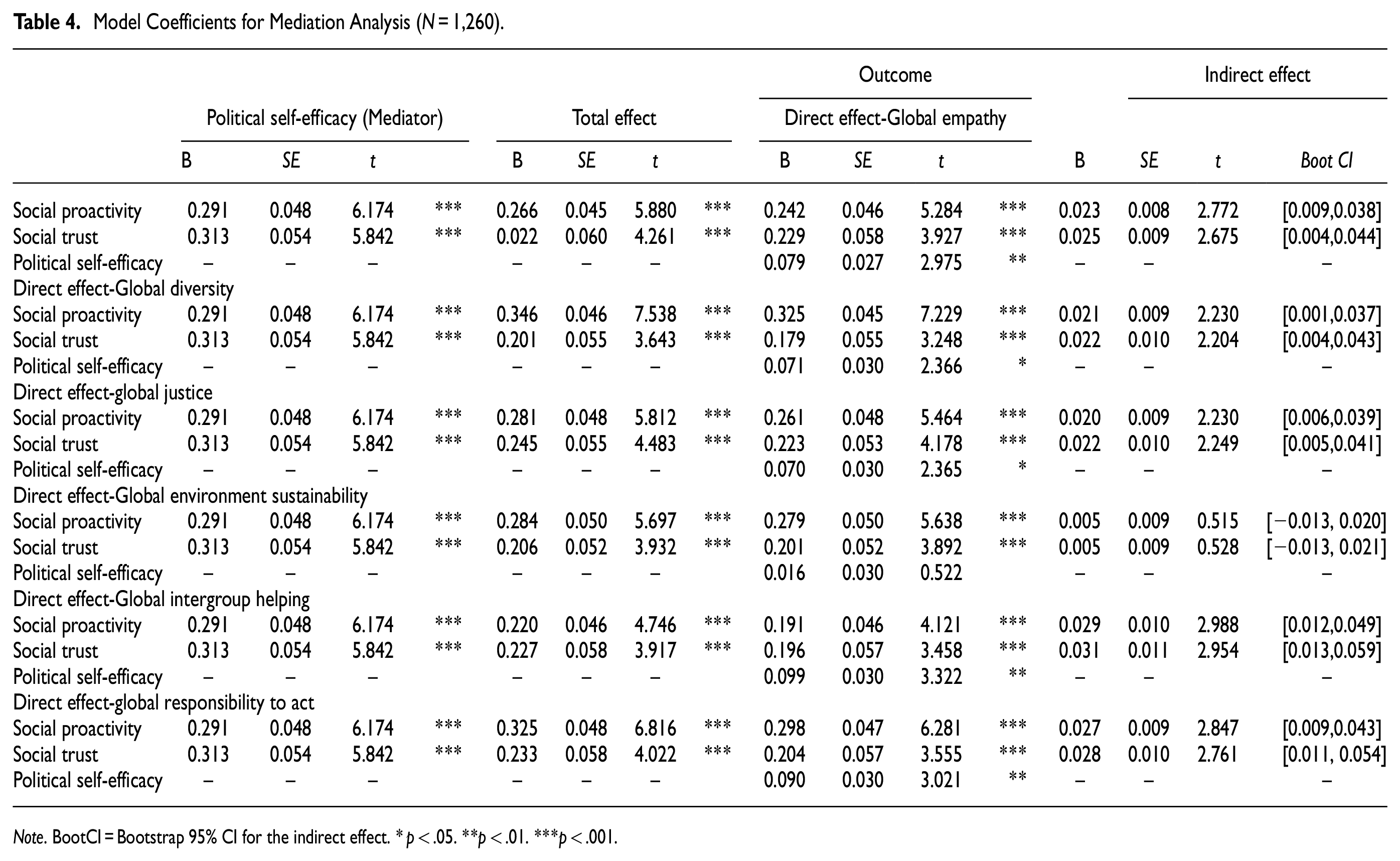
To account for the shared association among predictors in the mediation model estimated, the two social capital variables (i.e., social proactivity and social trust) are included in the models for political self-efficacy (mediator) and global citizenship outcomes. All model coefficients are shown in Table 4. With three degrees of freedom, it produces a normed chi-square of 8.806 (p < .001), a root mean square error of approximation (RMSEA) of.080, a comparative fit index (CFI) of 0.900, a Tucker-Lewis index (TLI) of 0.900, and a standardized root mean square residual (SRMR) of.0592. All of these indicators are regarded as an optimal fit for the data (Kline, 2015). The results showed that (1) global empathy was significantly predicted by social proactivity, B = 0.24, p < .001, social trust, B = 0.23, p < .001, political self-efficacy, B = 0.08, p < .001; (2) global diversity was significantly predicted by social proactivity, B = 0.33, p < .001, social trust, B = 0.18, p < .001, political self-efficacy, B = 0.07, p < .001;(3) global justice was significantly predicted by social proactivity, B = 0.24, p < .001, social trust, B = 0.23, p < .001, political self-efficacy, B = 0.07, p < .001; (4) global sustainability was significantly predicted by social proactivity, B = 0.26, p < .001, social trust, B = 0.22, p < .001; (5) global intergroup helping was significantly predicted by social proactivity, B = 0.19, p < .001, social trust, B = 0.20, p < .001, political self-efficacy, B = 0.09, p< .001; (6) global responsibility to act was significantly predicted by social proactivity, B = 0.30, p < .001, social trust, B = 0.20, p < .001, political self-efficacy, B = 0.09, p < .001; The mediator of political self-efficacy was significantly and positively predicted by social proactivity (B = 0.29, p < .001) and social trust (B = −0.31, p < .001).
Model Coefficients for Mediation Analysis (N = 1,260).
Note. BootCI = Bootstrap 95% CI for the indirect effect. * p < .05. **p < .01. ***p < .001.
Thus, we moved on to investigate the indirect effects of the social proactivity and social trust on nine global citizenship outcomes through the designated political self-efficacy components. Bootstrapping results revealed that (1) the indirect effect of social proactivity on global empathy through political self-efficacy was significant (B = 0.023, with a 95% CI excluding zero [0.009,0.038]); (2) the indirect effect of social proactivity on global diversity through political self-efficacy was significant (B = 0.021, with a 95% CI excluding zero [0.001, 0.037]);(3) the indirect effect of social proactivity on global justice through political self-efficacy was significant (B = 0.020, with a 95% CI excluding zero [0.006,0.039]); (4) the indirect effect of social proactivity on global intergroup helping through political self-efficacy was significant (B = 0.029, with a 95% CI excluding zero [0.012,0.049]); (5) the indirect effect of social proactivity on global responsibility to act through political self-efficacy was significant (B = 0.027, with a 95% CI excluding zero [0.009,0.043]); (6) the indirect effect of social trust on global empathy through political self-efficacy was significant (B = 0.025, with a 95% CI excluding zero [0.004,0.044]);(7) the indirect effect of social trust on global diversity through political self-efficacy was significant (B = 0.022, with a 95% CI excluding zero [0.004,0.043]); (8) the indirect effect of social trust on global justice through political self-efficacy was significant (B = 0.022, with a 95% CI excluding zero [[0.005,0.041]); (9) the indirect effect of social trust on global intergroup helping through political self-efficacy was significant (B = 0.031, with a 95% CI excluding zero [0.013,0.059]); (10) the indirect effect of social trust on global responsibility to act through political self-efficacy was significant (B = 0.028, with a 95% CI excluding zero [0.011, 0.054]). We compared the results with and without the covariates of gender, age, hukou, and household income to make sure that the covariates in our proposed models didn’t cause spurious associations between the core variables. It’s clear that these covariates didn’t change the substantive effect on the results (See Figure 2).

Unstandardized coefficients of a mediation model (controlling for age, gender, hukou, and household income) depicting political self-efficacy as a mediator between social capital and global; citizenship.
Discussion
The study shows that while Taiwan has been largely excluded from the global community due to cross-strait relations, Taiwan university students in general have a high level of self-awareness of global citizenship and regard themselves as global citizens. Other studies similarly find that Taiwanese students generally value cultural differences entailed in global pluralism and care about social justice (Davies, 2006; Dower, 2002a, 2002b; Gibson et al., 2011; Oxfam, 1997; Pike, 2008; (Reysen et al., 2012; Schattle, 2008). Although universities in Taiwan have full autonomy when it comes to liberal education, under the direction of the Ministry of Education (MOE), courses such as globalization, service learning, university social responsibility and community engagement are nonetheless offered at many universities. Many students have taken these courses and gained knowledge on these topics, which likely enhances their global citizenship awareness and understanding of related domain knowledge, as well as their ability to take part in public affairs.
The study also demonstrates that university students maintain an active interest in public affairs despite the fact that the somewhat nebulous international status of Taiwan over the past few decades. Perhaps Taiwan’s identity as the only democratic nation in the ethnic Chinese regions, its long-practiced political democracy, and political socialization have a significant impact on social proactivity and social trust. It further shows a positive correlation among categories of global empathy, global diversity, global justice, global sustainability, intergroup help, and a responsibility to act. The results resonate with the studies of Brehm and Rahn (1997), Paxton (1999), and Booth and Richard (1998), and reflect the point of view that social proactivity and trust come primarily through people’s experiences within a democratic society and the process of political socialization (Erikson, 1968; Newton & Norris, 2000). It can thus be seen that the liberal education of university students in the democratic society of Taiwan has not only equipped them with the knowledge and skill set to solve problems, but also the confidence to engage in global care and reciprocity.
Taiwan is a democratic society. Thanks to the successful implementation of liberal education in Taiwan, university students develop a strong sense of political self-efficacy based on social proactivity and social trust. The concept of political self-efficacy emphasizes the self-awareness of one’s ability and judgment, denoting the idea that the assertion that people’s belief and judgment of participation can change politics (Caprara et al., 2009; Lane, 1959). Taiwanese university students generally believe the society and political system can be changed as long as they dedicate effort to such an undertaking. The strong sense of political self-efficacy also enhances their social proactivity and social trust. Social proactivity and trust affect one another and form political self-efficacy (Brehm & Rahn, 1997; Foley & Edwards, 1998; Stolle & Rochon, 1998).
There has been little research on global citizenship and political self-efficacy in the past, and this study attempts to expand the current body of literature. From the studies of Callan, Abramson and Lee, it is clear that both global citizenship and a sense of political self-efficacy can be fostered by education, and our study resonates with these results (Abramson, 1983; Callan, 1997; Lee, 2006). However, the relationship between a sense of global citizenship and political self-efficacy is yet to be elucidated: It is a missing link that should be explored further. In this study, it is found that there is a significant positive correlation between political self-efficacy and global empathy, global diversity, global justice, intergroup help, and responsiveness to act among university students in Taiwan. However, political self-efficacy shows no positive correlation with global sustainability. There are several possible explanations: Firstly, despite achievement attained in the area of global citizenship education, global sustainability might be overlooked due to the uncertainty of cross-strait relations. In other words, their sense of global citizenship is somewhat limited. They are comparatively more concerned about the present issues rather than potential future problems. Secondly, the concept of global sustainability is the awareness and consciousness that grows in citizens after the economy has matured into a developed country. Taiwan did not become a developed country until 2000, which is also the year when sustainable development began to become a central point of emphasis of the international community. Therefore, Taiwan’s education should focus more on global sustainability in the future to develop a complete sense of global citizenship. The study also resonates with the preliminary results of the international civic and citizenship education study 2016 conducted by the International Association for the Evaluation of Education Achievement (IEA) (ICCS, 2016). Taiwan’s high school’s global citizenship awareness ranked second in the world.
Nearly 90% of the respondents were high school students who reached level A, which is second to Denmark. Taiwanese students surprisingly were outperforming students from Finland, Sweden, and South Korea. Taiwan topped the category of “using resources from the internet” and “posting a comment or image on political and social issues on the internet or social media’’. However, Taiwan respondents engaged much less in “social & political participation” than the international average. They only participated in school activities related to the school routine.
This study also provides an important suggestion for the future of global citizenship and education. It has a preliminary finding that global citizenship can increase the sense of political self-efficacy, which can serve as a focus of future academic research on related issues. Taiwan’s cultivation of global citizenship needs to place greater emphasis on the issue of sustainability (e.g., issues such as global sustainable development and other related issues.) According to the ICCS 2016 survey, it is also suggested that the secondary school students are bound by lack of mobility, and limited by school-based activities. However, at the tertiary level, the universities can create programs for international exchange, social engagement, and learning, which can remedy the issue to some degree.
Recommendations
Despite such positive findings, the study also indicates Taiwan’s global citizenship education does not perform well on the global sustainability indicator despite its great achievement. This issue also points to the need to change the current direction of global citizenship education in Taiwan, and topics such as sustainable development must be included in liberal education studies to cultivate better global citizenship education in Taiwan. To be more specific, universities should increase the number and vision of courses on sustainable development to make up for the missing part in global citizenship education. Secondly, since Taiwan embraced democracy, the Ministry of Education (MOE) has heavily promoted localized education and yielded good results. In the future, MOE and universities will need to allocate some of their resources from localized education to global citizenship education for a better overall global citizenship awareness.
Since Taiwan has not been able to participate in international organizations and has long been excluded from the international community, such as the United Nations, it seems Taiwan has been unable to become a part of globalization to any significant extent. However, the findings demonstrate that the influence of global citizenship education can break down political constraints, but it can also encourage university students in Taiwan to internalize responsibility for participating in global affairs and to consider themselves a global citizen. This finding also resonates with the mandate of the UN’s Global Education First Initiative in 2012 and the UNESCO Associated Schools Network, underscoring the importance of both projects expanding their scope to those countries that are not currently involved.
The preliminary findings show a positive correlation between a sense of political self-efficacy and global citizenship, but it lacks a theoretical explanation, and thus requires further analysis. Furthermore, the survey on Taiwan’s university students is an inherent limitation of the study. Although both reliability and effectiveness have been taken into consideration, some questions were not included due to the limitation of online questionnaires. In the future, a face-to-face interview might be helpful to solve the technical difficulty.
Conclusion
In this paper, the sample of our study is aimed at evaluating young adults in Taiwan. Preliminary findings showed that students generally have an awareness of global citizenship. Furthermore, the results of this study serve as a partial gauge of how successful liberal education is in Taiwan universities, as well as point to the concrete results of global citizenship in Taiwan’s education. This achievement has allowed university students in Taiwan to extricate themselves from the limbo of external cross-strait politics, made them feel like a member of the global community, and given them the courage to take on the responsibilities of global citizenship.
Also, the established democratic system has made Taiwan’s university students’ performance regarding political self-efficacy undergo significant changes. The implementation of a democratic political system has had a profound impact on the civic education and political attitudes of Taiwanese university students, almost reaching the point of a mature civic culture (Almond et al., 1963). The high sense of self-political efficacy of Taiwanese university students can have an impact on many indicators of social capital, especially on social proactivity and social trust. Similarly, it can increase their willingness to participate in public affairs in the future, strengthening Taiwan’s democratic political system.
In summary, this study found that university students in Taiwan not only have a high sense of social proactivity, but also have a high sense of social trust, and demonstrate a willingness to participate in global affairs. It also showed they can tolerate different views, demonstrate social pluralism, adhere to social justice, and demonstrate their willingness to take on global responsibility.
Footnotes
Declaration of Conflicting Interests
The author(s) declared no potential conflicts of interest with respect to the research, authorship, and/or publication of this article.
Funding
The author(s) received no financial support for the research, authorship, and/or publication of this article.
