




Abstract
Home language (HL) effects on academic language literacy have been extensively discussed. However, previous research has mostly focused on Indo–European languages. This study extends the literature by using data (n = 17,600) collected in a diversified language area: Guangxi, China. We examined the effects of four HLs and four socioeconomic factors by using modern standard written Chinese literacy as an outcome across three developmental levels (ages 10.45, 12.31, and 14.72). School clustering effect existed and adding the predictors of HL and socioeconomic status did not change the variance proportion in literacy performance accounted for by the school groupings. The findings indicate that (a) Putonghua-only speakers performed poorest in school Grades 5 to 6 and 7 to 8, (b) dominant Putonghua speakers performed best in Grades 7 to 8, (c) heritage-only speakers performed best in Grades 5 to 6, and (d) the contribution of the parents’ socioeconomic factors depended on the participants’ developmental levels. Our study supports the bilingual literacy advantage and explains why a heritage-only acts as a type of bilingualism.
Keywords
Introduction
Home language (HL) is the language a person speaks at home. Children learn their HL before learning the academic language at school. For several decades, the influence of the HL on academic language has been studied from different perspectives including comparisons of reading performance among different HL speakers (Jang et al., 2013; Worswick, 2004). However, a consensus regarding the influence of HL on academic outcomes has not been reached (Cummins, 2008).
Chinese is a subfamily of the Sino–Tibetan languages. In Mainland China, Putonghua (also known as Mandarin) is the standard pronunciation of the national common speech and the de facto government language (Chen, 2013). Modern standard written Chinese (MSWC) is the writing system. Putonghua and MSWC are used at school as academic languages (Chen, 2013; Li, 1997) in the acquisition of new knowledge and a deeper understanding of course content (Bailey & Heritage, 2008). Although the strong positive correlation between greater familiarity with academic language and reading performance has been well documented (Craig et al., 2009), previous studies have overwhelmingly focused on the Indo-European languages such as English, German, and Spanish. Thus, in the context of the Chinese language, is speaking the academic language of Putonghua at home advantageous to achieving higher MSWC literacy? Or, do children who speak Putonghua outperform other HL speakers in literacy? Moreover, what is the effect of HLs on MSWC?
The purpose of the present study is to investigate the above questions by sampling schoolchildren in Guangxi, Mainland China. It begins with a brief introduction of the language context in China and Guangxi which is followed by a literature review. Then, we present our study methods and the statistical analysis results. Finally, the findings, discussion and conclusions are presented.
Language Context in China and the Sampled Region
HL Definition and Status
Linguistically, the HLs spoken by Chinese children are connected to ethnic group status and place of birth. China has 56 ethnic groups. The largest group is the Han people, and the other 55 groups are minorities. The Han people speak the Chinese language, which has nine dialects: Mandarin, Wu, Gan, Xiang, Cantonese, Hakka, Min, Pinghua, and Huizhou (Chen, 2013). Because Chinese dialects are mutually unintelligible (ISO 639 Code Tables, n.d.), the Chinese government decreed Putonghua (which is based on Mandarin) as the standard pronunciation to overcome obstacles to communication (Chen, 2013). The languages spoken by minority people are minority languages, and there are over 80 minority languages and 54 minority scripts (Chen, 2013). In China, “all 55 national minorities have constitutional and legal rights to use and develop their languages and cultures” (Sybesma, 2015, p. 16) The HLs include Putonghua as well as various dialects and minority languages (Wang, 2004; Zhang, 2012).
Our participants came from Guangxi, one of the most linguistically diverse areas in China due to the number of languages and interactions of the languages (Putonghua Promotion Research Program [PPRP] & Dai, 2012). In Guangxi, the Han people and the 30 minority people constitute approximately 62% and 38% of the total population, respectively. Six main dialects are spoken in Guangxi, and almost every minority has its own language. Approximately 80% of the population in Guangxi are bilinguals who can speak any two languages (Putonghua, dialects and minority languages; PPRP & Dai, 2012; Wang, 2004). Similar to the worldwide situation where monolinguals are outnumbered by bilinguals (de Bot & Kroll, 2002), monolingual schoolchildren are outnumbered by bilingual schoolchildren in Guangxi (Li, 2018). However, it may not be tenable to posit a simple dichotomy of bilinguals and monolinguals in Asian countries (Lim et al., 2008).
In Asian countries, bilinguals typically speak one dominant language (Lim et al., 2008), which may be explained by the complementarity principle (Grosjean, 2016). This principle states that bilinguals use different languages with different people based on different purposes and different aspects of life, and they become dominant in one language when they use it significantly more than other languages based on their domains of language (Wei, 2007). Before the 1980s in Guangxi, the vast majority of people used dialects or minority languages as their dominant language (Yuan & Huang, 2005). Today, Putonghua monolingualism has generally become the norm in important domains (Jiang & Dewaele, 2019) while both Putonghua monolingualism and Putonghua dominance exist at home (Jiang & Dewaele, 2019; Zhang, 2012). Hence, the diversity of HLs in Guangxi falls into four main groups: monolingual dialect or minority language, dominant dialect and/or minority language, dominant Putonghua, and monolingual Putonghua.
Classification of Four HL Groups
In English-speaking countries, if a language other than English is associated with one’s cultural background and identity, the language is referred to as a heritage language (Chinen & Tucker, 2005; Haynes, n.d.). The Zhuang, Miao, and other minority peoples are the ancestors in Guangxi. Long before they were conquered by the first Chinese Emperor of Qin (259–210 BC), they had spoken their own minority languages. After Qin’s conquest of Guangxi, the Han people with their own Chinese dialects moved to Guangxi, leading to the cultural and language communication. Thus, the minority languages and dialects spoken by the Guangxi people are associated with their cultural backgrounds.
The term heritage language is dynamic (Willey, 2001); it is related to the term dominant language (Valdés, 2001). For example, Putonghua is the dominant or monolingual language for the Chinese people whereas it became the heritage language if the Chinese immigrated to the USA, where English is the dominant language (Wong & Yang, 2010). According to Polinsky and Kagan (2007), “any other dominant language can be substituted for English,” and “English” is equivalent to Putonghua, so Chinese dialects and minority languages are heritage languages in China. Hence, in Guangxi, schoolchildren’s HLs are classified as monolingual heritage, dominant heritage, dominant Putonghua, and monolingual Putonghua. However, since the status of “monolingual” is specific to home use in this paper, these four HL groups are used in the current study as heritage only, dominant heritage, dominant Putonghua, and Putonghua only and will be further explained in Section “4.2.1.1 Current HL.”
HL Landscape in the Sampled Cities
Our participants came from Chongzuo, Fangchenggang, Laibin, Liuzhou and Qinzhou, 5 of 14 cities in Guangxi. Table 1 presents the participants’ HL status in each participating city. For example, we sampled 5,061 children in Chongzuo, constituting 0.25% of its population. The speakers of four HLs were 17.5%, 32.1%, 24.2%, and 24.4%.
Situation of Ethnic Groups in the Five Participating Cities and HL Distribution of Sampled Participants.
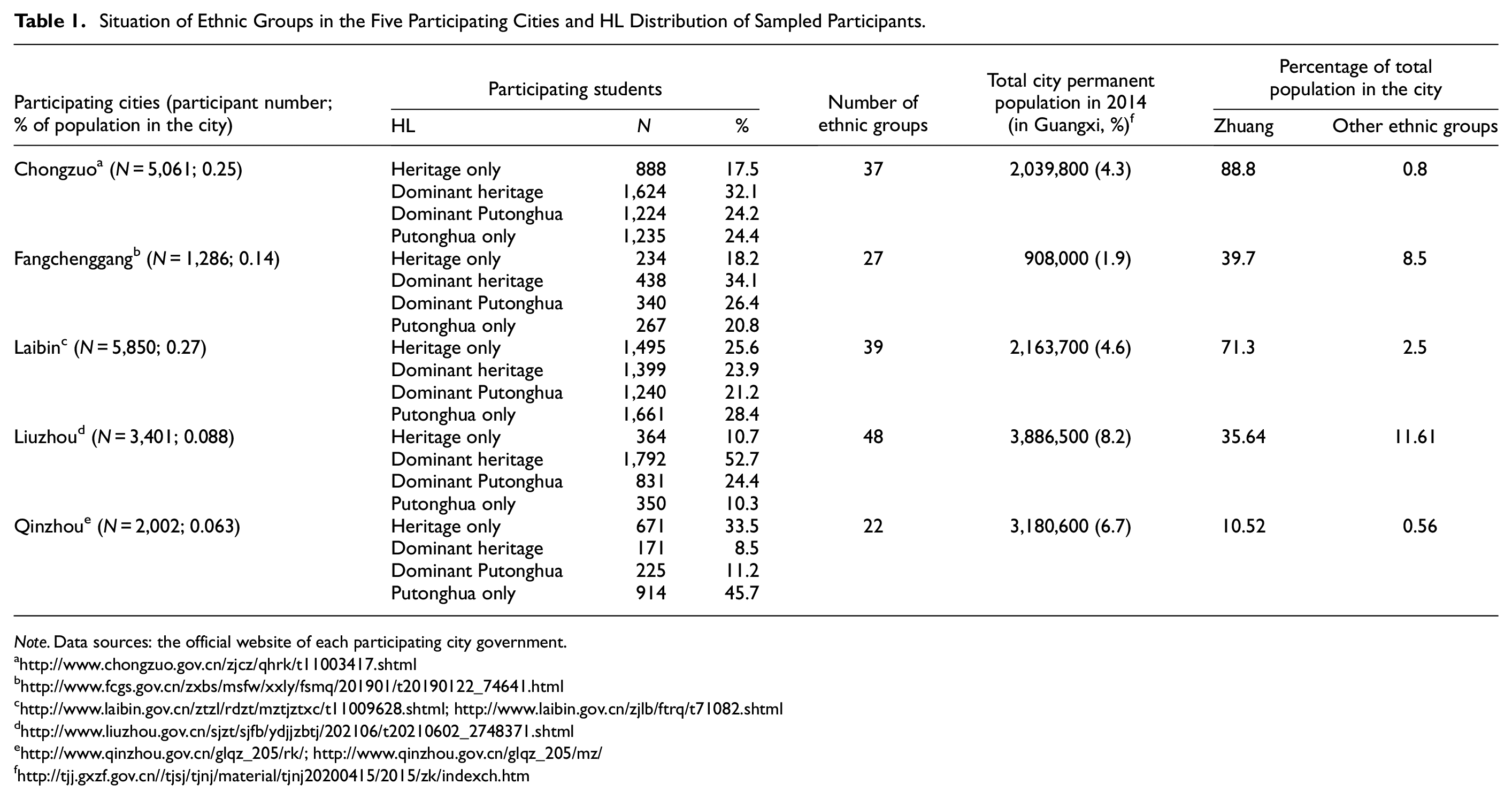
Note. Data sources: the official website of each participating city government.
Five main dialects are spoken in the participating cities; Cantonese is spoken in all five cities; Hakka is spoken in all except Chongzuo; the Min dialect is spoken in Laibin, Liuzhou, and Qinzhou; and Southwestern Mandarin and Pinghua are spoken in Liuzhou (Deng, 2008). To date, no data have been reported about the proportion of each dialect spoken in the five participating cities.
Almost every minority has its own language and the distribution of minority languages is basically the same as that of the ethnic groups (http://www.gxzf.gov.cn/mlgxi/gxrw/ftrq/t1003602.shtml), so the number of ethnic groups and their respective populations basically represents the minority language landscape. For example, 37 ethnic groups live in Chongzuo, suggesting that Chongzuo has 37 minority languages (Table 1). It is a common phenomenon that the same word sounds different in areas only 10 mi apart (Chen, 2005), suggesting that people in the same town might not understand each other.
The positive effect of speaking the dominant language on reading literacy performance is well documented in the context of Indo–European languages, however the Chinese ethnic minority speakers have been underrepresented. This study sampled participants speaking diversified heritage languages in Guangxi to understand the situation in China and enrich the extant literature.
Literature Review
Literacy Outperformance by Academic Language Speakers
Standardized tests have consistently shown that students who speak an academic language at home tend to have higher reading literacy than students who speak a heritage language at home (August & Hakuta, 1997). The Program of the International Student Assessment (PISA) compared the literacy performance of 15-year-old native children who speak the assessment language at home and immigrant children who speak a heritage language (Chinen & Tucker, 2005; Haynes, n.d.; Organization for Economic Cooperation and Development OCED [OECD], 2010). The results generally showed that the children who spoke the assessment language performed better than did the children who spoke the heritage language in the PISA 2009 (OECD, 2010). For example, for students from OECD countries, the average score of those who spoke the assessment language at home was 52 points higher than that of those who spoke the heritage language; and in Denmark, Greece, and Spain, the performance difference was fairly large, reaching as high as 80 points.
Researchers have suggested that greater exposure predicts more developed linguistic output (Grosjean, 2016; Hoff & Ribot, 2017) and that more familiarity with English is strongly and positively correlated with English reading performance (Craig et al., 2009). English is a phonetic language, and its written form is close to its spoken form (Kumar, 2015). The National Institute of Child Health and Human Development (2000) identified six variables as important predictors of reading literacy, all of which were connected with the quality and volume of verbal exchange activities in the home.
Although the stages of acquisition are the same for heritage speakers and their monolingual peers (Flores & Barbosa, 2014), heritage speakers receive less input from native speakers of English (Hoff & Ribot, 2017), and the aforementioned effect of familiarity (Craig et al., 2009) and exposure (Grosjean, 2016; Hoff & Ribot, 2017) on literacy performance suggests the opposite direction, indicating a deficit of language input (Hoff & Ribot, 2017) and leading to delayed language development (Flores & Barbosa, 2014; Mullis & Martin, 2015). Underperformance mostly affects young heritage speakers, for example, during preschool (Hoff & Ribot, 2017), at 10 years old (Mullis & Martin, 2015), and during junior elementary school (Kindler, 2002). Thus, while monolingual academic language speakers might have an early advantage, their literacy performance after they enter junior high school remains an open question.
Advancement of Heritage Language Speakers
Heritage speakers are to some degree bilingual in English and the heritage language (Valdés, 2001). Moreover, heritage (bilingual) students initially lag behind monolinguals (Cazden, 1992). Worswick (2004) and Jang et al. (2013) found that years of residence positively predicted the performance of heritage speakers on reading literacy. Previous studies have discussed the length of time over which the benefit of bilingualism came into play (Broomes, 2013; Coelho, 2007; Garcia, 2000; Worswick, 2004).
Concerning how many years it takes heritage speakers to surpass or catch up with academic language speakers, the answers have varied. Coelho (2007) and Garcia (2000) suggested five or more years. Jang et al. (2013) and Broomes (2013) supported this suggestion. Based on data from Ontario’s Assessments of Reading, Writing, and Mathematics in Canada, Broomes analyzed the reading outcome of participants who had immigrated to Canada 5 years prior and found that those less proficient in Grade 3 were more likely to be proficient in Grade 6. However, based on national data from the National Longitudinal Survey of Children and Youth from Statistics Canada for the survey years 1994–1995, 1996–1997, and 1998 to –1999, Worswick (2004) found that 7-year-old children who had 4 years of residence and spoke a heritage language at home underperformed their peers who spoke the academic language at home, although the significant differences disappeared by the time the children reached age 14. Yeung and Marsh (1998) analyzed data from the National Education Longitudinal Study of 1988 and found that the underperformance of heritage speakers occurred only in early high school and did not persist to Grade 12. Thus, the performance gap between heritage speakers and monolingual academic language speakers was the largest during the lower elementary grades, although heritage bilinguals often caught up or outperformed after receiving support for 3 to 5 years (Jang et al., 2013) or 4 to 7 years (Collier, 1987).
The effect of bilingualism on reading performance is due to cognitive advantages of bilingualism (Bialystok et al., 2012; Cook, 1997). Past behavioral evidence has shown that learning a second language confers benefits rather than creates learning problems (Best et al., 2011; Cook, 1997; Marion & Shook, 2012). Support also comes from neuropsychological studies (Best et al., 2011; Bialystok et al., 2012). Best et al. (2011) analyzed the executive functions (such as mental flexibility, attention inhibitory control, and task switching) of participants (5–17 years old) and found a possible link between higher skills and bilingualism. Bialystok et al. (2012 found that this link was supported by neuropsychological studies on the neural correlates of bilingual processing in which (i) the general executive control system accompanied language switching and oriented itself in the dorsolateral prefrontal cortex, (ii) bilingualism was correlated with plasticity in cortical gray matter, and (iii) the network in the bilingual brain was broader than that in the monolingual brain.
In our sampled region, people who can speak any two languages are defined as bilingual (Putonghua, dialects and minority languages; PPRP & Dai, 2012; Wang, 2004). However, except Putonghua, almost none of the heritage languages have a written form. This situation is different from that in the above-cited literature, in which the participants are biliterate in the English-speaking context. Therefore, the bilinguistic effect needs to be verified on reading performance in the Chinese ethnic minority context.
Context-Sensitive Role of HL
Some studies have challenged the general assumption of the supremacy of instruction in the HL while denying the underperformance of heritage language speakers (Dixon, 2005; Dixon et al., 2012; Dixon, 2009; Nag et al., 2018). Nag et al. (2018) tested the “HL advantage” hypothesis by examining 40 studies published in the most recent 26 years on literacy with participants from low-to middle-income countries. Their conclusion was that HL advantage depended on context. For example, although the majority of Singaporean students did not speak English at home, their English reading literacy performance in the 2001 Progress in International Reading Literacy Study (PIRLS) compared favorably to that of students in countries where the majority of students spoke predominantly English at home (Dixon, 2005). In other words, speaking test language at home was not academically advantageous to developing English literacy in the multicultural and multilingual context of Singapore (Dixon, 2009). However, Dixon et al. (2012) supported the effect of familiarity (Craig et al., 2009) and exposure (Grosjean, 2016; Hoff & Ribot, 2017) by sampling 282 Singaporean children whose ethnic languages (or mother tongues) were Chinese, Malay or Tamil. They found that speaking the mother tongue at home had a strong positive effect on children’s mother language vocabulary, while speaking English at home exerted a negative effect on children’s mother language vocabulary.
In the above literature, Dixon (2009) tested the hypothesis that the HL advantage depended on context (Nag et al., 2018). However, the participants that Dixon compared were heterogeneous, one coming from Singapore with multicultural and multilingual context, and the other from Indo–European countries. Our study compared participants coming from the same language context, Guangxi, China, which could enrich our understanding of home-language advantage.
SES in the Relationship between HL and Reading Literacy
The Hollingshead Four-Factor Index of Social Status, which includes marital status, retired/employed status, educational attainment, and occupational prestige, is one of the most commonly used SES measures (Edwards-Hewitt & Gray, 1995). However, some researchers have used only one factor or added other factors and found different effects. For example, mothers’ educational level were found to only weakly predict participants’ scores (Verheyden et al., 2010) whereas having a better-educated father predicted a higher literacy rate (Mehryar & Tashakkori, 1984). The three factors of marital status, occupation, and educational experience significantly copredicted reading comprehension (Twitchell et al., 2015), and after Craig et al. (2009) added sex, the predictive power remained significant (r = .192, p = .015). Some researchers have called parental education, occupation, and intelligence and family income distal variables and unexpectedly found that distal variables had only “an indirect influence on children” (Molfese & Molfese, 2002, p. 123).
The above literature shows that SES has no unified criteria or definition, but the literature generally agrees on the SES effect on literacy. SES variables are typically calculated by assigning scores ranging from 1 to 9 to different levels of, for example, occupation, and obtaining a single combined weighted SES score that exerts a collective effect on literacy. We considered that Chinese society represents a hierarchy of social relationships (Su et al., 2007), and the respective and integrated contributions of certain SES factors must be investigated. We discuss our approach in “Methods.”
Chinese Language Features and the Relationship Between HL and MSWC
Su (2001) summarized over 30 opinions about the Chinese language feature, including ideographical writing, pictographic writing, and ideophonographic writing. Zhou (1998) endorsed the idea of an ideophonographic writing system, because approximately 80% to 90% of Chinese characters are combinations of semantic radicals representing meaning and phonetic radicals indicating pronunciation (Ho et al., 2003). However, other linguists (Wang, 2014; Wu, 2014) think that the position and distinguishing function of phonetic radicals in phonogram characters are reflected by the existence of semantic radicals, and only 7.1% of phonetic radicals can accurately express the pronunciation of characters(Li, 2015). Most Chinese scholars (Wang, 1997, 2014) and most Western scholars such as de Saussure (1985) tend to support the idea of ideographical writing (Wang, 2014; Zhou, 1998).
According to de Saussure (1985), a Chinese character represented by only one symbol that does not depend on the sound made by the spoken word, suggesting that the spoken form provides no cues about the written form. MSWC is the only script, and the dialects (spoken languages) are diverse. Take as an example the Chinese word 阅读 (read in English). Its pronunciation in Putonghua is [yuè][dú]; in the Min dialect, it is [iat7] [diou6]; in Cantonese, it is [jyut6] [dau6]; and in Hakka, it is [yet6][tiu4] (http://cn.voicedic.com/). Chinese written and spoken forms need to be learned separately (Tse et al., 2007). Putonghua speakers have no advantage over heritage speakers in learning the Chinese written forms. Therefore, do the models of “more familiarity with English, better reading performance in English” (Craig et al., 2009) and “greater exposure to English, more developed linguistic output in English” (Grosjean, 2016; Hoff & Ribot, 2017) fit the Chinese context? This topic is worthy of study.
In China, there are two opposing ideas concerning the relationship between the HL and MSWC literacy. The first approach is to regard heritage language as an obstacle to learning MSWC and Putonghua. For example, (i) the failure to speak standard Putonghua was attributed to the incorrect pronunciation, nonstandard wording and incoherent sentences of heritage languages (Li, 1997) and (ii) the daily vocabulary and grammar of the heritage languages was thought to hinder children from constructing the correct wording and the systematic writing structure (Zhang, 2006). The second approach concerns heritage language as an aid. For example, (i) children’s daily heritage vocabulary and grammar can benefit them in expressing their ideas (Wang, 2006) and (ii) ancient vocabulary and wording can benefit children in understanding Chinese literary texts (Shi, 1998). The above analysis suggests that the first approach emphasizes the benefit of bilingualism (Bialystok et al., 2012; Cook, 1997; Marion & Shook, 2012) whereas the second does not. However, neither approach considers the effect of SES factors.
Until recently, empirical data have not been available to analyze the relationship between the HL and MSWC reading performance in Mainland China. Tse et al. (2007) used Hong Kong data (n = 4,867, Grade 4, the participants lived and attended schools in Hong Kong for over a year) from the 2001 PIRLS in which the test was presented in traditional Chinese and the participants could choose to write in traditional or simplified Chinese. The researchers unexpectedly found that migrant participants from Mainland China whose HL was monolingual Putonghua performed the worst in MSWC literacy. Since Cantonese is used almost exclusively at home and in public domains, including at school in Hong Kong (Tse et al., 2007), the language situation in Hong Kong is different from that in mainland China. Therefore, the current study seeks to examine the relationship between HL use and academic language literacy in a linguistically diverse sample from Guangxi.
Purpose of the Study
The existing studies have overwhelmingly focused on the relationship between the HL and reading performance in Indo-European languages such as English, German, and Spanish, and most of them did not describe the HL subgroups or developmental levels in detail.
The present study used a more diversified sample from the Guangxi region of China to better examine the complex relationships between demographic and reading-related variables. We propose the following three specific questions:
What are the differences in MSWC literacy among speakers of different HLs (i.e., heritage only, dominant heritage, dominant Putonghua, and Putonghua only) at three developmental levels (i.e., school Grades 3–4, 5–6, and 7–8)?
To what extent can SES factors (i.e., fathers’ and mothers’ positions in the occupational hierarchy, Household Learning Condition Index, and availability of books) affect the relationship between HL status and MSWC literacy?
To what extent does HL status affect the relationship between SES factors and MSWC literacy?
How do the effects exerted by HL status and SES factors on MSWC literacy vary with the schools where the participants learned?
Methods
Over the past two decades, reading literacy has been of increasing importance in Mainland China. In 2015, the Guangxi Educational Science Bureau (ESB) and Guangxi Jieli Publishing House coinitiated the Guangxi Reading Literacy Improvement Program. This program seeks to investigate the reading status of students. The principal author was then invited to design a student background questionnaire and three MSWC literacy tests for students at each developmental level, that is, Grades 3 to 4, 5 to 6, and 7 to 8.
Participants
Rationale for participant selection
Our test category was Grades 3 to 4, 5 to 6, and 7 to 8, which was based on the Chinese educational situation and the use of the PIRLS. In the 2011 Chinese Curriculum Standards for Compulsory Education (Chinese Educational Ministry [CEM], 2011), the learning objectives and content of (i) vocabulary knowledge, (ii) reading, (iii) writing, and (iv) comprehensive learning are specified and categorized into four levels of Grades 1 to 2, 3 to 4, 5 to 6, and 7 to 9. The program initiator suggested that the test category should comply with this level so that the study would be more helpful in understanding the students’ present reading status to aid in future educational interventions. As in PIRLS, our test began with Grades 3 to 4 (age 10.45) because by Grades 3 to 4, students have developed the literacy foundation of “read to do” whereas students in Grades 1 to 2 are still learning to read (Mullis & Martin, 2015).
Sampling stages and criteria
The first stage was to sample voluntary cities and schools. The Guangxi ESB issued a notice about recruiting schools to take part in the Guangxi Reading Literacy Improvement Program. Five subordinate local ESBs, namely, Chongzuo, Fangchenggang, Laibin, Liuzhou, and Qinzhou, showed interest in this program and forwarded the notice to the principals of primary and middle schools, who then encouraged Chinese curriculum teachers to attend the program. Then, the participating Chinese teachers informed the schoolchildren and their parents of the questionnaire and the literacy test. Thus, the sampling in the first stage was characteristic of voluntary participation. The sample distribution from the five participating cities is shown in Table 1.
The second stage was to randomly sample the test papers to grade. Approximately 53,000 participants from 104 schools were recruited in five participating cities. The test monitors bound the tests and put them in a bag by class, and the specialized staff of each participating school delivered the test bags to the respective local ESB. The local ESB recruited teachers to grade the tests (see more details in “4.2.2.5 Reliability and Validity”). Because not enough teachers were available to grade all the test papers, we randomly selected roughly one-third of the test bags from each school and ensured that each participating school was included. Altogether, we obtained 17,600 participants from 64 schools for inclusion in the study.
The coding methods of the background variables are shown in Table 2.
Categorical Variable Descriptions and Coding Methods for Student Background.

Distribution of participants’ HL based on age, sex, and ethnicity
Table 3 shows the differences in the participants’ current HL distribution based on developmental levels, sex and ethnicity.
HL Distribution Based on Developmental Levels, Sex and Ethnicity.
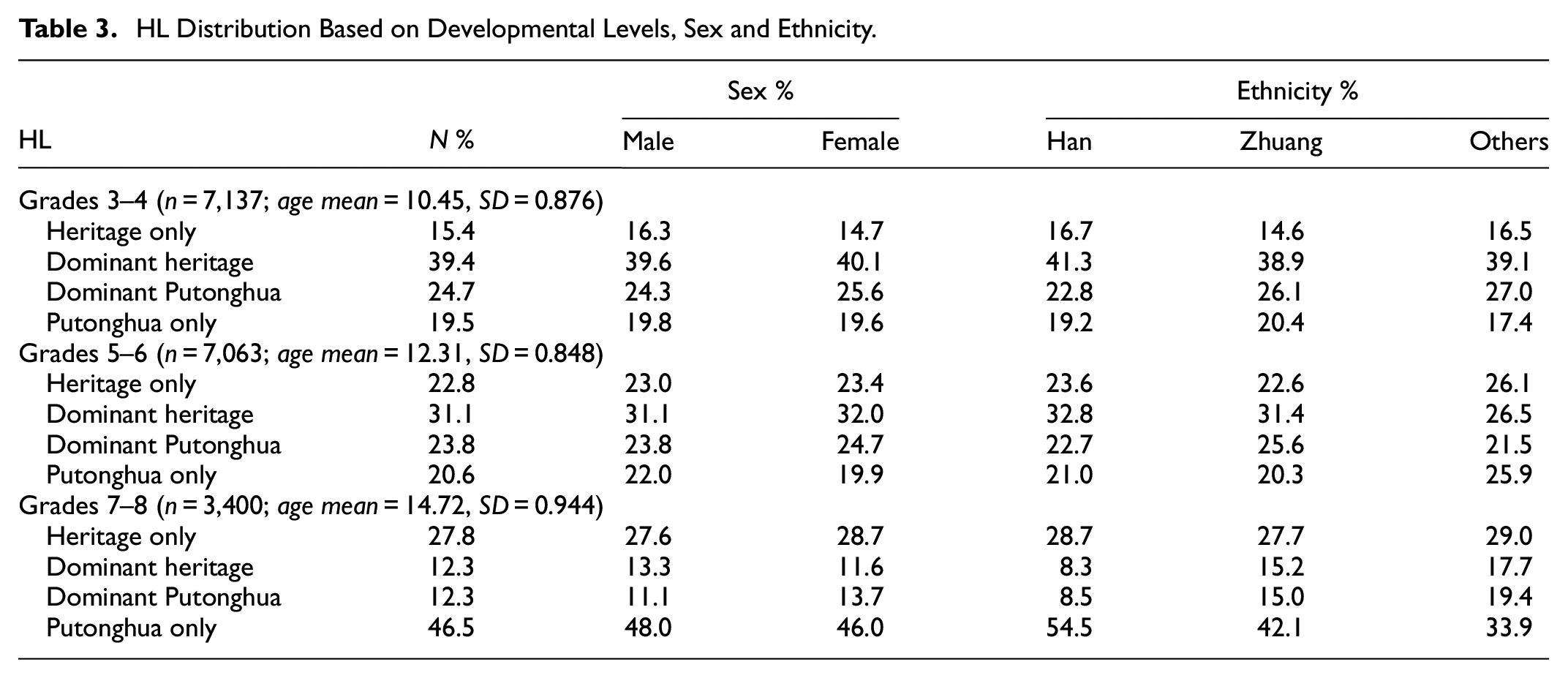
The distribution was imbalanced. For example, (1) the number of participants in Grades 7 to 8 (N = 3,400) was only half of those in Grades 3 to 4 (N = 7,137) and 5 to 6 (N = 7,063), and (2) Grades 3 to 4 had the most children speaking dominant heritage (39.4%) while Grades 7 to 8 had the most children speaking Putonghua only (46.5%), approximately 20% to 35% higher than the percentage of other HL speakers. As the developmental level increased, the percentages of dominant heritage and dominant Putonghua decreased while the percentage of monolingual children increased.
This voluntary sampling principle might result in imbalance. Generally, students in Grades 7 to 8 are required to prepare for the High School Entrance Examination (Zhongkao), which they take in Grade 9. Since the Zhongkao outcome determines the high school to which the students will have access, principals try to avoid arranging any unscheduled or non-pedagogic activity for students in Grades 7 to 8. Therefore, the principals who were interested in this program preferred that younger students take part in the test.
The common phenomenon of the complementarity principle (Grosjean, 2016) in Asian countries (Lim et al., 2008) might be another reason for this imbalance. For example, the 19.5% Putonghua-only speakers in Grades 3 to 4 (Table 3) (i) might very well be living with Putonghua-only parents who were unable to speak or did not want to speak the heritage language with the participants and (ii) might have spoken the heritage only when they lived with their heritage-only grandparents before being taken care of by their parents. As another example, Grade 7 to 8 children usually move to a (boarding) middle school located in a central area, and some children start to speak Putonghua for convenient social communication. Some parents moved with their children and had to shift to Putonghua in the new environment (Fan, 2011). The children’s current HL reflected neither their language ability status nor their mother tongue. The current HL must be considered dynamically based on the complementarity principle.
The definition of HLs is shown in the “Student background questionnaire” section.
Participants’ HL distribution based on SES factors
As demonstrated in Table 4, more Putonghua-only speakers originated from low occupational hierarchy families which had the fewest learning facilities and books whereas more dominant heritage children originated from high occupational hierarchy families which had the most learning facilities and books. For example, in Grades 7 to 8, on average, approximately 44% dominant heritage speakers came from the government official and public functionary class while 50% Putonghua-only speakers came from the unemployed and working class. Wang (2004, pp. 8–11) also found that the government official and public functionary class represented the highest percentage of bilingual speakers and that a positive relationship existed between academic level achievement and bilingual ability.
HL Distribution based on the Parents’ Occupational Hierarchy Position, Mean of Available Books and Household Learning Condition Index.

Note. F = father; M = mother.
Instruments
The principal author designed two instruments: the background questionnaire and the MSWC literacy test for each developmental level (Grades 3–4, 5–6 and 7–8) based on former studies (Yu & Luo, 2013) due to the lack of standardized MSWC literacy tests in Mainland China.
Student Background Questionnaire
The self-report questionnaire was the same for all three developmental levels. The questionnaire was attached to the MSWC test and was required to be completed within 10 minutes before the test. We chose three parts (i.e., current HL, demographic information, and SES variables) for the analysis. Table 2 provides a description of the variables and their coding methods for student backgrounds.
Current HL
In the questionnaire, the question item “What language do you currently speak at home?” had four choices, and the choices were the definitions of HLs we defined based on the extant literature: (a) heritage-only speakers who always, primarily, or usually speak heritage languages (Jang et al., 2013; OECD, 2010); (b) dominant heritage speakers who have a percentage of exposure to the heritage language between 70% and 90% (Hoff & Ribot, 2017); (c) dominant Putonghua speakers who have a percentage of exposure to Putonghua between 70% and 90% (Hoff & Ribot, 2017); and (d) Putonghua-only speakers who always, primarily, or usually speak Putonghua. The participants self-selected the appropriate option according to their current HL status. The descriptions are shown in Tables 3 and 4.
SES variables
There were four self-reported SES variables: fathers’ and mothers’ occupational classes, the Household Learning Condition Index and available books. Their distribution is shown in Table 4.
We did not use income or educational level for the following three reasons. First, our pilot study revealed that the participants were unaware of information about family income and parents’ educational level. Second, the survey was a self-reported, on-site questionnaire attached to the test, and the participants had no time to consult their parents for this information. Third, similar to other researchers in Mainland China, we excluded income factors because “the positive relationship between educational level and income might be rather weak” (Zhu & Zhang, 2013, p. 120).
We adopted the factor of parents’ position in occupational hierarchy, which was classified by Lu (2010) according to access to resources. Lu (2010) ranked the government official and public functionary class the highest because “the long Chinese tradition (in which he who excels in learning can be an official) has encouraged the best minds, especially young talent, to pursue the social prestige from this hierarchy, which is quite different from that in other developed countries” (p. 10). Therefore, we ranked this class first (coded as 5). The last class was the unemployed and working class (coded as 1) including clerk, privately or individually owned business, business service industry (similar to industrial class and clerk), industrial class, agricultural class and unemployed or semi-unemployed. We provided examples to the children to help them understand the groupings. The occupational hierarchy distribution is shown in Table 4.
Concerning the Household Learning Condition Index, we followed the PISA (OECD, 2010) and required the participants to identify 14 types of observable household learning facilities (a desk, private room, quiet learning place, etc.). When the participants indicated having more facilities, the Household Learning Condition Index was higher, and the family economy was better.
The final SES measure was the number of available books at home. The participants were asked to choose one from five book levels (0–10, 11–25, 26–100, 101–200, and over 200 books). The question item highlighted that such “available books at home” did not include magazines, newspapers, or school textbooks. This category was obtained from the PIRLS 2011 student questionnaire, which was found useful in our former study (Yu & Luo, 2013).
MSWC literacy test
Reading passages and items
The test employed four passages with 20 items for Grades 3 to 4 (2,449 characters), five passages with 19 items for Grades 5 to 6 (3,070 characters), and eight passages with 27 items for Grades 7 to 8 (3,907 characters). The children completed the test in 90 minutes in the classroom supervised by their Chinese teacher and the test director.
Response formats
Multiple-choice and constructed-response items (the participants provided written answers) were used. The percentages of multiple-choice and constructed-response items in Grades 3 to 4 were 55% and 45%, respectively; those in Grades 5 to 6 were 47% and 53%, respectively; and those in Grades 7 to 8 were 51% and 49%, respectively.
Reading process domains
The reading process domains were access and retrieve, integrate and interpret, and reflect and evaluate (Schleicher et al., 2009). The percentages of the items assessing the three domains in Grades 3 to 4 were 60%, 30%, and 10%; those in Grades 5 to 6 were 37%, 47%, and 16%; and those in Grades 7 to 8 were 33%, 44%, and 22%.
These terminologies originated from the PISA framework (Schleicher et al., 2009). However, this framework and how the domain was defined potentially overlapped with that of PIRLS and the National Assessment of Educational Progress (NAEP) and the differences were relatively minor (Stephens & Coleman, 2007). The 2015 PISA and 2016 PIRLS frameworks remained largely the same as that of the 2009 NAEP (McKeown, n.d.). Concerning convergent points of reading literacy on the three tests, reading literacy was (i) a tool for achieving individual goals, (ii) a basic ability of individual development, and (iii) based on cognitive psychology (Luo & Gong, 2016). In practice, the PISA (targeting 15-year-olds), NAEP (targeting fourth, eighth, and twelfthstudents) and PIRLS (targeting fourth children or 10-year-olds) are three sources of American nationally representative data on student achievement in reading literacy (Stephens & Coleman, 2007). Therefore, the PISA, NAEP and PIRLS frameworks are largely the same for the tests targeting Grades 4 to 8 or 10- to 15-year-olds. The PISA framework is suitable for our test, which targeted students in Grades 3 to 4, 5 to 6, and 7 to 8.
Additionally, we adopted the PISA framework because the PISA has been extensively discussed theoretically in China since Shanghai participated in it in 2009; and our previous study determined the feasibility (Yu & Luo, 2013).
MSWC literacy
MSWC was the literacy outcome represented by the total score. The full score in each test was 100.
Reliability and validity
We conducted a pilot test involving 200 samples of each subgroup. The second author marked the test script. The Rasch model was used to examine the test’s Wright Map, multidimensionality and bubble diagram for subsequent revisions.
After the formal test, the local ESBs recruited teachers to grade the tests, and the principal author provided training to the teachers to mark the test script. We led a team of master’s students majoring in education to grade 300 tests in each subgroup to provide scoring guides for the first step. We then held a workshop in each participating city in which we (i) explained the scoring guides, (ii) organized the recruited teachers to pre-grade 30 tests, and (iii) discussed and improved the scoring guides together. Before the formal grading, we also tested scorer reliability measuring the agreement among the 10 raters, and Kendall’s W was 0.880 (p < .001), indicating a high level of agreement among the judges (Rust & Golombok, 2009).
We calculated the reliability and validity of the total score at each developmental level. For the tests used in Grades 3 to 4, the Cronbach’s α and KMO values of the total score were .747 and .841, respectively. In Grades 5 to 6, the Cronbach’s α and KMO values of the total score were .68 and .83, respectively. In Grades 7 to 8, the Cronbach’s α and KMO values of the total reading score were .78 and .91, respectively. All Bartlett test values exhibited significance at p < .001. These values indicate that the tests were valid and reliable.
Analytical approaches
Descriptive analysis
We ran a statistical descriptive analysis of the variables and presented the variable coding methods. The results are shown in Table 2.
Bivariate relationship
We performed a crosstab analysis to examine different bivariate relationships between the HLs and background variables including the sample size, ethnicity, sex, age (see Table 3) and SES factors (see Table 4).
One-way ANOVA
To answer the first research question, one-way ANOVAs were run to examine the effect of the HL on reading literacy. We compared the means based on the four HL groups and ran the omnibus test and post hoc analysis. Tukey and Howell criterion for significance was used for the post hoc analysis when the variance was equal and unequal, respectively.
One-way ANCOVA and the hierarchical regression model
To answer the second and third questions, we ran an ANCOVA considering the SES status as a separate factor with an interaction term between the SES and HL. As other researchers did (Fan & Hou, 2019; Shi & Shen, 2007; Twitchell et al., 2015), we computed the aggregate score by summing the coding values that were assigned to each category of SES factors (see Table 2) and adding the sum to the Household Learning Condition Index.
If the ANCOVA assumption was violated, we ran a hierarchical regression model instead. The covariates were entered at stage one of the regression as controlling variables. The independent variable was entered at stage two. Please see the summary in Tables 6 and 7.
Two-level multilevel modeling
This method was conducted to answer the fourth question. The level 1 variables were HL and SES score. The level 2 variable was the 64 school groupings. We centered the SES aggregate score
We first ran the unconditional model to determine the clustering effect on MSWC literacy by calculating the intraclass correlation (ICC) coefficient. If the school clustering effect existed, we then ran two models to account for the nesting. The first model assessed the effect of the first-level variables (as fixed effect) on MSWC literacy while the second checked whether the significant effect and starting point for reading literacy varied between the different schools.
Results
Performance Difference in MSWC Literacy by the HL Speakers
A one-way ANOVA was run to answer the paper’s first question: What were the differences in MSWC literacy among speakers of different HLs at three developmental levels? The results are shown in Table 5.
Summary of the One-Way ANOVA for Reading Literacy Based on the HL Status.

Note. DV = the difference between the highest and the corresponding reading score in each grade group; when the DV was zero, the corresponding score was the highest.
The mean reading literacy differed significantly between the HL speakers in Grades 3 and 8 (see Table 5 for F(p) values) and therefore we ran a post hoc test to confirm which groups differed.
The post hoc test showed that (1) Putonghua-only speakers performed the significantly poorest in Grades 3 to 8; (2) the speakers of dominant heritage and dominant Putonghua performed the significantly best in Grades 3 to 6 and Grades 7 to 8, respectively; but (3) no significant differences in reading literacy were found between any of the speakers of heritage-only, dominant heritage and dominant Putonghua in Grades 3 to 8.
HL Status Effect on MSWC Literacy When Controlling for the SES Factors
This analysis was performed to answer the paper’s second question: To what extent can SES factors affect the relationship between HL speaking and MSWC literacy? The results showed that the interaction effect between the HL status and SES factors on reading literacy was significant in Grades 3 to 4, Grades 5 to 6, and Grades 7 to 8, suggesting that the assumption was violated of the homogeneity of the regression slopes. We then ran a hierarchical linear regression. The values are shown in Table 6.
Hierarchical Analysis of the HL Predicting Reading Literacy Adjusted for the SES Factors.
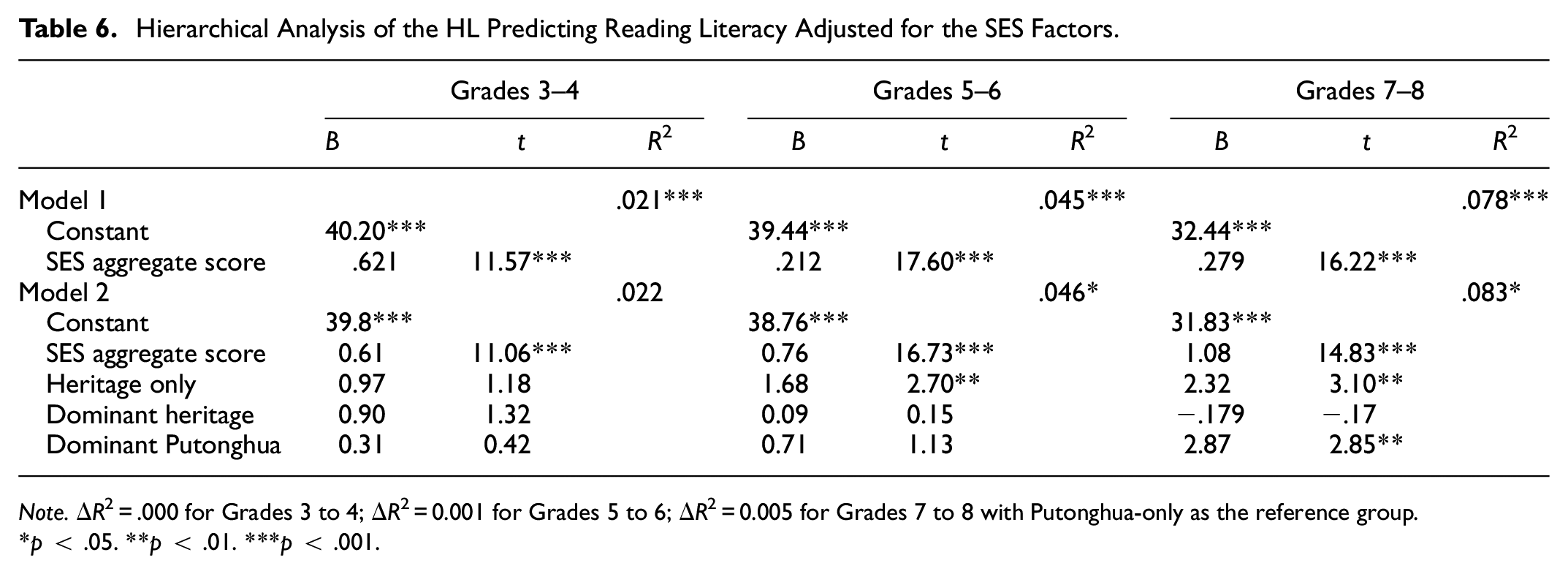
Note.ΔR2 = .000 for Grades 3 to 4; ΔR2 = 0.001 for Grades 5 to 6; ΔR2 = 0.005 for Grades 7 to 8 with Putonghua-only as the reference group.
p < .05. **p < .01. ***p < .001.
In Model 1, the SES factors significantly accounted for 2.1%, 4.5%, and 7.8% of the variation in reading literacy in Grades 3 to 4, 5 to 6 and 7 to 8, respectively. In Model 2, introducing the HL variable neither significantly contributed to the regression model in Grades 3 to 4 nor altered the results that the Putonghua-only speakers performed the poorest whereas the heritage-only speakers and the dominant Putonghua speakers outperformed the other groups in Grades 5 to 6 and Grades 7 to 8, respectively These results suggest that the significant effect of HL was weak when controlling for the SES factors in Grades 5 to 8.
SES Factors Effect on MSWC Literacy When Controlling for the HL Status
We ran a hierarchical linear regression to answer the paper’s third question: To what extent does HL status affect the relationship between SES factors and MSWC literacy? The B coefficients and constants are shown in Table 7.
Constant and B Values of the SES Factors Predicting Reading Literacy when the HL is and is not Controlled for.

Note: F = father; M = mother; Category of 0 to 10 books and class of unemployed and working represent the reference groups.
p < .05. **p < .01. ***p < .001.
In Model 1, the HL significantly accounted for 0.1%, 0.3%, and 0.9% of the variation in reading literacy in Grades 3 to 4, 5 to 6, and 7 to 8, respectively. In Model 2, introducing the SES factors significantly explained an additional 3.5%, 5.1%, and 10.9% of variation in Grades 3 to 4, 5 to 6, and 7 to 8, respectively. These findings suggested that the HL effect was very small on the relationship between the SES factors and reading literacy. In the higher grades, the SES factors effect was greater.
None of the father’s occupational class entered into the models in Grades 5 to 6, and the two highest classes were not significant in Grades 3 to 4 but contributed the most in Grades 7 to 8. Concerning the mother’s occupational class, the coefficients of management and executive class did not enter into the model in Grades 7 to 8, and the government official and public functionary class was significantly positive only in Grades 5 to 6. These findings suggested that the mother’s and the father’s occupational classes played a more important role in Grades 3 to 6 and Grades 7 to 8, respectively.
Concerning the factor of available books, the coefficients significantly increased as the book level increased from 11 to 25 books to 101 to 200 books in Grades 3 to 6. However, the coefficients continued to decrease in Grades 7 to 8, becoming significantly negative for the level of over 201 books. These results generally suggested that books were more important for the reading scores in Grades 3 to 6 than they were in Grades 7 to 8.
Effect of HL Status and SES Factors on MSWC Literacy Varying With School Groupings
This model was to answer the paper’s fourth question: How do the effects exerted by HL status and SES factors on MSWC literacy vary among the schools where the participants learned?
In Table 8, the ICC coefficients in the unconditional model indicated that 42.3%, 26.9%, and 47.7% of the variance in MSWC literacy could be attributed to the differences between schools for Grades 3 and 4, 5 to 6, and 7 to 8, respectively. The first model assessed the fixed effects of HL and centered SES score. In the second, we added the random effect of the centered SES score. The ICCs in Model 1 were .434, .269, and .479 for Grades 3 to 4, 5 to 6, and 7 to 8, respectively, while the ICCs in Model 2 were .423, .269, and .479 for Grades 3 to 4, 5 to 6, and 7 to 8, respectively. The ICCs were nearly exactly the same in the three models, suggesting that adding the HL and SES did not change the variance proportion accounted for by the school groupings. The effects of the HL status and SES factors on MSWC literacy was small, and the clustering effect of the school groupings was large.
Model Summaries of How the Effects of HL and SES on MSWC Literacy Vary Between School Groupings.

p < .05. **p < .01. ***p < .001.
Table 9 shows the estimates of the fixed effects. Take Grades 3 to 4 as an example. The intercept values were 47.92 and 48.07 in Models 1 and 2, respectively, representing the expected literacy performance. The value of .47 was the linear function using heritage-only to predict the literacy performance when we control for the SES factors. However, no significant difference was found between children speaking any HLs in Grades 3 to 4. The value of .41 was the linear function using the SES factor to predict literacy performance when we controlled for HL, and for every unit of the SES factors, we predicted an increase of approximately 0.41 on average in points.
Estimates of Fixed Effects of HL and SES on MSWC Literacy Varying between school groupings.
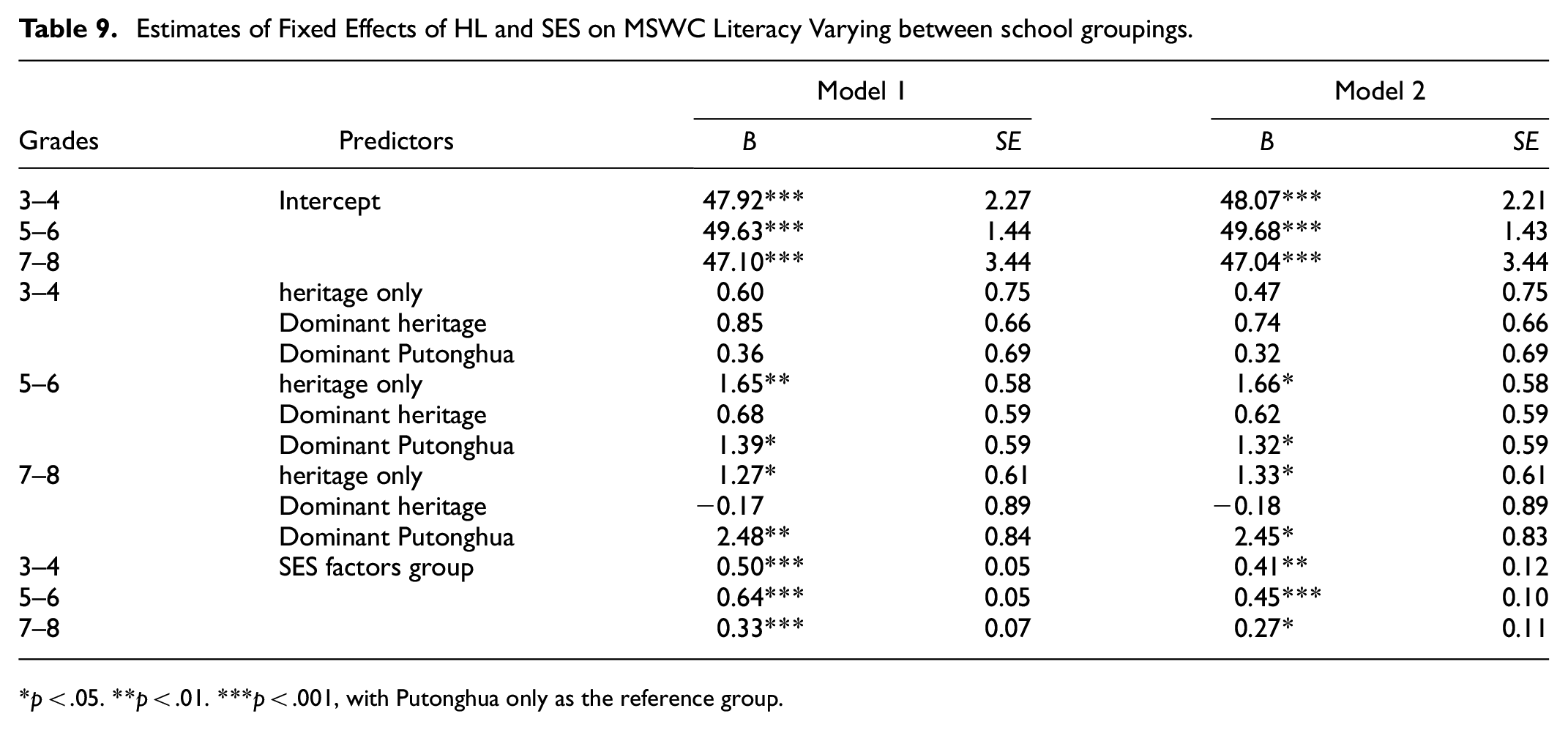
p < .05. **p < .01. ***p < .001, with Putonghua only as the reference group.
Except Dominant heritage in Grades 7 to 8, the values of the heritage only, dominant heritage, and dominant Putonghua were positive, revealing the Putonghua-only speakers performed the poorest. The dominant Putonghua speakers and the heritage-only speakers performed the best in Grades 7 to 8, and Grades 5 to 6, respectively.
Discussion
This study sampled 17,600 participants in Grades 3 to 8 in Guangxi, China and investigated how four HLs and SES factors predicted MSWC literacy before and after covariates were included. In this part, we first summarize the results of our study and then describe how the Chinese context contributed to the related research field.
Main Findings
There existed a large clustering effect on literacy between the school groupings. Regardless of the SES factors, the Putonghua-only speakers performed significantly poorest in Grades 5 to 8; and the heritage-only speakers and the dominant Putonghua speakers performed the best in Grades 5 to 6 and Grades 7 to 8, respectively. The significant effect size of the predictors (except available books) was generally larger in Grades 7 to 8 than that in Grades 3 to 6. The maternal and paternal occupational classes were more influential in Grades 3–6 and Grades 7–8, respectively.
The Poorest Performance of Putonghua-only Speakers
Unexpectedly, Putonghua-only speakers achieved the lowest reading literacy in this study, providing no support for the well-documented correlation between greater familiarity with or exposure to the academic language (Hoff & Ribot, 2017) in Indo-European language context. However, this finding supports the studies conducted by Tse et al. (2007) and Nag et al. (2018). In the former research, Putonghua-only speakers who migrated from Mainland China to Hong Kong performed the poorest; and in the latter, the advantage of speaking the test language as the HL depended on context.
As Table 4 shows, Putonghua-only speakers had the fewest learning facilities and fewest books. Moreover, the percentages of the participants’ parents coming from the two highest occupational hierarchies were the lowest. We speculated that Putonghua-only speakers might well be among the intraprovincial migrants for the following two reasons
The fifth and sixth national demographic censuses showed that the intraprovincial migrants of ethnic minorities in Guangxi accounted for the largest proportion in China (He & Cheng, 2016, Table 3). Additionally, the 1% Sampled Census of Guangxi (2015) showed that (1) of all the Guangxi children, 10- to 14- and 15-year-old intraprovincial migrants constituted 9.8% and 14.1%, respectively (see Tables 12-2 and 3-2), and (2) of the total population of the five participating cities, (i) intraprovincial migrants constituted 11.9%, 16.7%, 11.2%, 22.3%, and 8.7%, and (ii) migrants from the villages constituted 62.4%, 48.8%, 44.8%, 63.3%, and 50.5% (see Table 12–9). We speculated that many Putonghua-only participants might have lived in villages before they became intraprovincial migrant children.
Local people usually express a sense of belonging and social identity by speaking the local language (Cao & Li, 2010). Since China is an acquaintance society (Fei, 1998) and Chinese people tend to regard people as friends or acquaintances based on the language they speak and where they speak it, fellow townspeople identify their initial social networks and familiarity through accents (Jia, 1993). For example, migrants who lack fluency in the Cantonese dialect in Hong Kong, China, were found to feel isolated and considered themselves social outcasts at school (Tse et al., 2007). When leaving their hometowns to pursue a new social status and sense of identity (Fan, 2011), local people shift to using Putonghua as the HL with their children because speaking Putonghua is the most advantageous skill when looking for new jobs and engaging in social interactions (Fan, 2011). So, we speculated that Putonghua-only speakers might be from intraprovincial migrant families in Guangxi.
Advancement of Bilingual Speakers in Grades 5 to 6 and 7 to 8
Bilingual children initially lag behind monolingual children (Cazden, 1992), but years of residence in English-speaking countries—for example, 5 years or more (Coelho, 2007; Garcia, 2000;), 4 to 7 years (Collier, 1987), or 7 years (Worswick, 2004)—help them to catch up, showing the benefit of bilingualism. Our study shows that heritage-only speakers and dominant Putonghua speakers spent 5 to 6 and 7 to 8 years to show the benefit of bilingualism, respectively. We considered heritage-only to be its own form of bilingualism for the following reasons.
First, people in Guangxi are highly proficient in some heritage languages. Of all government officials investigated, 91.07% (the largest proportion among all the occupations) could speak a native language (Wang, 2004, p. 25), and 91.2%of Zhuang school children (N = 1,514), could speak one or two heritage languages (Li, 2018).
Second, people in Guangxi are highly proficient in Putonghua. Putonghua is the government and academic language, medium of instruction, and compulsory school language (Chen, 2013). Putonghua monolingualism has become the norm in important domains (Jiang & Dewaele, 2019), whereas at home, both Putonghua monolingualism and Putonghua dominance exist (Jiang & Dewaele, 2019; Zhang, 2012). Speaking Putonghua has become an important life skill and an academic tool.
Third, according to the CEM (2011), Chinese schoolchildren began to learn Chinese as compulsory curriculum in Grade 1, and students in Grades 3 to 4, 5 to 6, and 7 to 9 are required to recognize and write 1,600 to 2,500, 2,500 to 3,000, and 3,500 words, respectively. According to Norman (1988), gaining knowledge of 3,000 to 4,000 characters is a sign that functional literacy has been reached, suggesting that the children in Grades 5 to 8 in our study could perform complicated academic language reading and expression. At this time, incorporating diverse heritages can enrich and animate students’ MSWC learning (Wang, 2006; Zhang, 2006), contributing to their high reading literacy and suggesting the bilingualistic effect.
The statistical results that the effect of dominant Putonghua appeared in Grades 7 to 8 might also be due to the above three reasons. However, the data did not provide further information, and we did not find related literature.
Significant Influence of the Parents’ Occupational Classes
Our study supported the documented result that SES is a strong indicator of reading literacy performance (Twitchell et al., 2015), and further detected that the contribution of the parents’ SES factors depended on the participants’ developmental levels. The present data cannot explain this finding, and we speculated this influence through a psychological perspective.
The mothers’ occupational classes exerted a stronger influence on MSWC literacy in Grades 3 to 6. At this age, children are young and likely consider their mothers to be models; moreover, children’s social referencing is traditionally based on their mother’s responses to and feelings about events or objects (McDevitt & Ormrod, 2010). Mothers with different occupations produce different models and social behavior experienced by their children. Mothers with higher positions in the occupational hierarchy may be much more involved in their children’s social and learning activities than mothers with lower positions in the occupational hierarchy, and such involvement might influence their children’s literacy outcomes.
This study supported that “fathers could have remarkable effects on children’s literacy” (Karther, 2002, p. 184) and further detailed the influence of professional class and government official and public functionality class in Grades 7 to 8. Children in Grades 7 to 8 are approximately 15-year-olds and are typically entering young adolescence. They are in the process of constructing a self-identity (McDevitt & Ormrod, 2010) and need peers with whom to identify themselves through same-different comparisons. In contrast to mothers, fathers are usually considered children’s one-on-one companions (McDevitt & Ormrod, 2010). During the company, young adolescents could experience the values of work and social roles embedded in fathers’ occupational class (McDevitt & Ormrod, 2010) and are sufficiently intelligent to infer that fathers’ high occupational hierarchy are typically related to a college education. We speculate that this influence likely activates the children’s learning motivation and, therefore, indirectly improves literacy.
Large Clustering Effect of the School Groupings in China
Our study supports the PISA result (OECD, 2005) that the school students attend is strongly predictive of their reading performance Roughly 42.3%, 26.9%, and 47.7% of the overall variation in MSWC literacy lies with school groupings for Grades 3 to 4, 5 to 6, and 7 to 8 respectively. The large clustering effect of the school groupings was likely due to three kinds of educational inequality in China.
The first is the imbalanced regional educational development. China’s basic education is managed overall by the local government at the county level, and the State Council and local government share the expenses. The economic power differs widely in cities and counties, and a county’s economy is weaker than that of a city. Take the government data in 2016 as an example. Of all the 14 cities in Guangxi, the GDP ranking of Chongzuo, Fangchenggang, Laibin, Liuzhou, and Qinhzou was 10th, 12th, 13th, 2nd, and 7th, respectively. The general average school budget per student in Liuzhou (¥ 6,396.56) was 1.38 times that in Fangchenggang (¥ 4,236.05); and it was 4,591.82 and 5,689.25 in Wuxuan and Xincheng (two counties in Qinzhou), respectively (http://jyt.gxzf.gov.cn/zfxxgk/fdzdgknr/xjfb/sjtj/t7354428.shtml). The wide regional disparity probably led to different school development in different regions, resulting in large clustering effect of school groupings on MSWC literacy.
The second is the imbalanced urban-rural educational development. It results from China’s household registration system (hukou), which divides the urban from the rural and results in social stratification and greatest urban-rural educational inequality (Chinese Educational Ministry, 2011; Yang et al., 2014; Zhang, 2016). According to the urban hukou in 2016, the average urban population percentage in Guangxi was 30.67, with Chongzuo at 22.86, Fangchenggang at 36.69, Laibin at 23.11, Liuzhou at 49.32, and Qinzhou at 14.78 (http://www.gxzf.gov.cn/gxsj/sjyw/20170407-600588.shtml). Most of the population was rural, and the urbanization percentage is different in each city. The different urban-rural school development might lead to large clustering effect of the school groupings.
The third one, imbalanced interschool development, has existed since the 1950s in China, represented by the key school system. When China emerged from civil war in 1949, the Chinese government established one or two key schools at each educational level in every administrative region to improve educational efficiency in cultivating talents. All the best resources were put into key schools, and the schools have gradually become the privilege of advantaged groups and test takers who do well (Yang et al., 2014; Zhang, 2016). The government continues this tradition today, leading to a seriously unbalanced allocation of educational resources in schools within counties and urban cities (Chinese Educational Ministry, 2011) and hence the large clustering effect of the school groupings in the same region.
Conclusion
This paper supports the bilingual literacy advantage, with its effect appearing in Grades 5 to 6 and becoming greater in Grades 7 to 8. However, Putonghua-only speakers obtained the lowest MSWC literacy. Adding HL and SES predictors did not change the variance proportion in literacy accounted for by school groupings. We discussed these findings mainly from the social perspective.
The poorest performance of the Putonghua-only speakers supported the findings concerning Hong Kong data (Tse et al., 2007). However, Cantonese is the dominant language in Hong Kong, while heritage languages and Putonghua are spoken in Guangxi based on the complementarity principle (Grosjean, 2016). Researchers need to further design specific and more elaborate studies to analyze the poor performance of Putonghua-only speakers in Hong Kong and Guangxi.
Additionally, since native-born people usually speak a local language in their daily lives in their hometown, we speculated that Putonghua-only children came from migrant families. This speculation was also supported by the government data concerning intraprovincial migrants in Guangxi. Linguistically, since Chinese characters do not depend on the sound made by the spoken word (de Saussure, 1985) speaking Putonghua could not directly help migrants promote their script-reading.
There are some possible limitations in this study. First, the HL and SES factors were self-reported, and the participants might have felt compelled to respond in particular ways. Second, we substituted the parents’ income with the Household Learning Condition Index, which might bias the accuracy of economic status. Third, we combined dialects and minority languages as one variable of heritage language and did not investigate which heritage language the participants speak. This method might decrease the opportunity to study the bilingual literacy effect based on researching one particular heritage languages. Finally, concerning the parents’ position in the occupational hierarchy, the last class (unemployed and working) had a very wide range. We should have considered dividing it into multiple categories to improve its accuracy.
We suggest researchers conduct experiments in which teachers substitute the heritage language for Putonghua as the teaching medium and investigate the relationship between MSWC literacy and the new teaching mediums. In a future study, we will recruit participants from bilingual and nonbilingual schools to investigate the reading performance of Putonghua-only speakers and engage in longitudinal research to investigate the trajectory of the bilingualistic advantage.
Footnotes
Acknowledgements
We thank Guangxi Jieli Publishing House and Guangxi Educational Science Bureau for data collection assistance. We thank American Journal Experts (AJE) for English language editing.
Declaration of Conflicting Interests
The author(s) declared no potential conflicts of interest with respect to the research, authorship, and/or publication of this article.
Funding
The author(s) disclosed receipt of the following financial support for the research, authorship, and/or publication of this article: This research was supported by the National Natural Science Foundation of China (No. 31360236). Dehong Luo hosted the project.
