



Abstract
Short-video social media is becoming a major advertising tool in the digital age. Covert advertising is increasingly used as a major strategy to effectively promote a product. This study aims to explore the genre of covert short-video advertisements launched in Douyin—the Chinese version of TikTok. It integrates Bhatia’s critical genre analysis approach with Kress and van Leeuwen’s Multimodal Discourse Analysis approach as the conceptual framework. The researchers selected 100 covert short-video advertisements in Douyin for analysis. The findings demonstrate how this genre is manipulated to exploit consumerism, to shape consumer culture and to drive business growth through rhetorical moves, interdiscursivity and exploitation of multimodal resources. This study not only gives insight into the less explored deceptive new media genre but also contributes to recognition of covert short-video advertising and methods in analyzing genres in the age of “new media.”
Introduction
Advertisements help businesses to increase their market share and to lure consumers to patronize products (Keller, 2012; Leone, 1995). Nevertheless, the world has become a huge traffic hub of advertisements (Rosengren, 2008). Most of people are so accustomed to hard-sell advertisement that they are skeptical of advertising messages, thus ignoring them (Petty & Andrews, 2008). As a result, many commercial messages are lost in the flood of advertisements (Rosengren, 2008).
These developments contribute to the rise of covert communication and its role as an effective strategy to overcome adverse reactions toward advertisements (Muthukumar, 2013; Owen et al., 2014; Tanaka, 1999). In covert advertisements, the advertising message is normally masked, and the promoting intention is secretly attained (Gould et al., 2000; Rotfeld, 2008; Russell, 2002). Unrecognizing the persuasive intent, consumers are likely to avoid a skeptical approach to commercial messages (Darke & Ritchie, 2007; Roy & Chattopadhyay, 2010).
The effects of covert advertising lie in its trick in deceiving consumers into positively processing the advertising messages (Sabir et al., 2014). The extent to which consumers engage in a specific message processing is determined by their recognition of advertising intent (Friestad & Wright, 1994), because discovering of advertising intent causes consumers to guard themselves against it. In order to mask the persuasive intent, advertisers deliberately manipulate sponsorship disclosure and content formats
With the proliferation of social media in recent years, advertisers have been increasingly exploiting formats that are congruent with content of the corresponding social media platform (Tutaj & van Reijmersdal, 2012; Wojdynski et al., 2018), and this is primarily manifested by the prevalent use of short-video social media (Zhao & Wang, 2020). These advertising formats often carry hidden persuasion intents and are not easily recognized as commercials by consumers (van Reijmersdal, 2009). Previous studies have shown that only a small proportion of respondents who were exposed to covert advertising successfully recognized it as commercial (e.g., Amazeen & Muddiman, 2018; Amazeen & Wojdynski, 2020; Kim & Hancock, 2017; Wojdynski & Evans, 2016). Therefore, covert advertising deceives consumers to their detriment, which is an unfair marketing practice (Campbell & Evans, 2018; Campbell & Grimm, 2019; Choi et al., 2018). Consumers should be reminded about the cues and hints of covert advertising to process and understand the real intent of the masked commercials (Amazeen & Wojdynski, 2019; Nistor et al., 2018). Research of bottom-up features and strategies of covert short-video advertising gives consumers more insights into the persuasive intent (Wojdynski & Evans, 2020).
This article alerts consumers’ awareness of bottom-up cues and strategies of covert short-video advertisements through exploring the linguistic and multimodal features as well as interdiscursive strategies. Practically, the significance of the study lies in that it helps recognition of social media covert short-video advertising and facilitates a more fair transaction between consumers and businesses. It also adds new insights into the body of knowledge of covert advertising recognition.
This article focuses on covert short-video advertising published in the Chinese counterpart of TikTok—Douyin, a short-video platform launched in September 2016 by a Chinese internet technology company—ByteDance (2019). TikTok is the most promising social network and it is currently one of the most downloaded apps in the world (Anderson, 2020). Marketing professionals view the app as the most accessible and effective resource for advertising because it is rapidly expanding and has increasingly high engagement (Guarda et al., 2020). Douyin, the Chinese counterpart of TikTok, has become the second-largest online advertising platform in China (Handley, 2019). In order to increase advertising effectiveness, short-video advertisements launched in this app are creative and implicit (Enke & Borchers, 2019). Therefore, it is important to investigate covert short-video advertising launched in Douyin, because it is a noteworthy new media genre which is creatively used by businesses to reach an extremely large number of potential consumers.
Bhatia’s (2004, 2017) critical genre analysis approach is employed as the primary theoretical framework to explore the structural patterns and interdiscursive strategies of covert short-video advertisements, while Kress and van Leeuwen’s (2006) multimodal discourse analysis is integrated to reveal the multimodal features. Guided by this analytical framework, the researchers identify the move patterns of this genre, explore interdiscursivity to elaborate how manipulative strategies are exploited to deceive consumers and analyze how multimodal strategies are employed for covert communication of persuasive intent.
Literature Review
Covert advertising is a type of contemporary advertising which appropriates formats resembling non-promotional content, and these forms make an advertisement recognizable to the consumers obscured (Einstein, 2016). The past several decades have seen an increasing academic attention to covert advertising (Evans & Wojdynski, 2020). Previous researches primarily focused on several aspects and dimensions, including the apparent characteristics of covert advertising, the effects of covert advertising, the impact of disclosure transparency on covert advertising recognition, persuasive knowledge activation and covert advertising recognition, ethics on covert advertising, and development of covert advertising recognition scale and models.
Covert advertising is characterized with exploitation of formats that are consistent with content of social media platform (Tutaj & van Reijmersdal, 2012; Wojdynski et al., 2018) and deliberate design of ambiguous disclosures (Evans & Park, 2015; Wojdynski, 2016). These new forms of advertising trigger low levels of persuasive knowledge activation (van Reijmersdal, 2009) and hampers consumers’ recognition of the commercial intent (Amazeen & Wojdynski, 2020). Persuasive knowledge refers to “peoples’ knowledge and comprehension of persuasive messages, including commercials” (Friestad & Wright, 1994).
According to a number of previous studies (e.g., Kim & Hancock, 2017; Lee et al., 2016; Tutaj & van Reijmersdal, 2012; van Berlo et al., 2021), covert advertising compared with more prominent advertising was more unlikely to activate persuasion knowledge, triggered a more positive attitude from consumers and drove commercial behavior, because covert advertising formats disguised the cues consumers were normally contingent upon to identify a persuasive attempt (Kim & Hancock, 2017; Wojdynski et al., 2018).
Previous researches have shown that persuasion knowledge activation triggered more negative consumer attitude and response to advertisements, brands, intention to share or purchase intent in covert advertising than in commercials with sponsorship transparency (e.g., Evans et al., 2019; Göbel et al., 2017; Wei et al., 2008). However, the negative effects of covert advertising recognition could be mitigated when the sponsorship disclosures were clear (Evans et al., 2017, 2019).
It is widely believed that covert advertising is an unethical marketing practice because it deceives consumers (Campbell & Evans, 2018; Campbell & Grimm, 2019; Choi et al., 2018) and controls consumers’ engagement into the commercial content (Skiba et al., 2019). Ethical concerns regarding the duplicitous strategies of covert advertising have been constantly discussed (e.g., Nistor et al., 2018).
Academic efforts were made to facilitate consumers’ covert advertising recognition. Wojdynski et al. (2018) created a Sponsorship Transparency Scale to facilitate a top-down recognition of covert advertising. Wojdynski and Evans (2020) proposed Covert Advertising Recognition and Effects (CARE) Model and suggested the disclosure-driven pathway and the bottom-up pathway for covert advertising recognition. In other words, besides using sponsorship disclosure as a top-down pathway, characteristics of the message and peripheral features can also be used as bottom-up cues to identify covert advertising. Boerman and Müller (2022) proved that the level of persuasive knowledge activation in covert short-video adverting recognition was affected by a bottom-up factor—“brand tags in pictures.”
Previous studies in the context of covert advertising recognition mostly investigated top-down pathway such as disclosure transparency (e.g., Boerman et al., 2017), whereas limited studies focused on bottom-up cues such as message characteristics and peripheral features (Wojdynski & Evans, 2020). As the formats of many covert short-video advertising are standardized by the platform and the disclosure is deliberately manipulated, research on linguistic characteristics and manipulative strategies is especially important to facilitate consumers’ recognition of covert short-video advertising. This study explores the manipulative strategies, linguistic characteristics and the visual strategies of the genre of covert short-video advertising, with an attempt to facilitate bottom-up covert short-video advertising recognition.
From a linguistic perspective, many of the previous and even current researchers still attach importance to the investigation of academic genres and genres of cultural practices (e.g., Amnuai, 2019; Liu, 2015; Sharif & Yarmohammadi, 2013). Although some studies have critically explored promotional genres, such as advertising (e.g., Bhatia, 2004; Kathpalia, 1992), covert advertising (e.g., Zhou, 2012), and new media advertising (e.g., Feng, 2019; Lam, 2013), these studies either only explicated advertising genres published in traditional media or only focused on advertising genres of hard-sell type. Limited linguistic research is carried out to highlight the deceptiveness of social media covert short-video advertising. This study extends beyond the conventional genre analysis by investigating the complexity of covert short-video advertising. In-depth and critical investigation of new media covert advertising genres adds substantial weight to promotional genre studies, which interprets most of the world’s discourses.
Theoretical Background and Data Selection
Because this research is exploratory in nature, it primarily adopts a qualitative research method, with a minor integration of statistic description to generalize the move patterns of the genre. Counting is integral to qualitative analysis process, especially to the recognition of patterns in data, and to making analytic generalizations from those patterns (Sandelowski, 2001).
Theoretical Background
According to Bhatia (1993), “genre” is conceptualized as a perceptible communicative event marked by a group of communicative intents mutually recognized and understood by the members of a particular discourse community in which it constantly occurs. Normally it is well organized and somehow standardized with restraints on permissible contributions regarding the form, functional value and communicative purpose(s). However, these restraints are usually covertly manipulated by professional members of the discourse community to realize personal or institutional intentions within the framework of socially acknowledged purpose(s). In this regard, covert short-video advertisements can be categorized as a genre with its typical communicative purposes, conventional form and constraints, and the constraints are probably exploited by businesses or advertisers to achieve private purposes.
Bhatia (2004) proposes a critical genre analysis approach of analyzing genres from four perspectives, which are textual perspective, ethnographic perspective, socio-cognitive perspective, and socio-critical perspective. The textual perspective refers to how genres are a reflection of the discursive practice of disciplinary communities. The ethnographic perspective refers to genres in action, grounded in narrated insightful experience of expert members of the community. Social-cognitive perspective primarily explores the cognitive strategies employed to achieve the communicative purposes. Social-critical perspective examines social conditions in which genres are constructed and interpreted.
The researchers apply Bhatia’s (2004) critical genre analysis approach as the primary theoretical as well as analytical framework, with a focus on the textual perspective and the socio-cognitive perspective. For a more comprehensive investigation into the covert short-video advertisement which is also a multimodal digital genre, Kress and van Leeuwen’s (2006) multimodal discourse analysis is integrated into the analytical framework. From the textual perspective, the moves of the covert short-video advertisements are analyzed. Based on analysis of functions of the moves, the communicative purposes of this genre are unmasked. From the socio-cognitive perspective, the rhetorical strategies used for covert advertising purpose are examined.
Specifically, the explication of rhetorical strategies consists of analysis of interdiscursive strategies and appropriation of multimodal resources. “Interdiscursivity can be viewed as the appropriation of text-external semiotic resources across genre conventions, specific aspects of professional practices, disciplinary and professional cultures or identities” (Bhatia, 2010, 2017). Multimodality is a typical feature of digital genres. Multimodality is conceptualized as “the adoption of dissimilar semiotic modes in the design of a semiotic event or product, as well as the specific way in which the modes are integrated and interacted” (Kress & van Leeuwen, 2001). Advanced technologies make the multimodal texts in smart phone screen more complex, dynamic and interactive through the interaction of various modes: text, visuals, speech, sounds, and music.
Data Selection
Purposive sampling method is used for selection of data. Purposive sampling is defined as the deliberate choice of participants or cases with particular characteristics, according to the needs of developing analysis (Morse et al., 2004). Purposive sampling is widely used in qualitative research, which is a very effective data selection method used to select information-rich cases (Patton, 2002). The researchers of this article intentionally selected 100 short videos that possess the features of covert advertising as the data. The selection of data is based on the researchers’ knowledge and perception on the particular features of covert short-video advertising. The details of data selection is elaborated as follows.
In order to represent typical advertising strategies exploited in Douyin short videos, the researchers locks advertising of four categories of products as research scope: fashion, clothing, cosmetics and cultural entertainment. Young generations account for the largest group of users in TikTok (AppTrace, 2020; Sensor Tower, 2020), and users aged below 35 account for over 80% of the total users of Douyin. This group of people are the major force of online consumption (QuestMobile, 2019). Young people are likely to spend on fashion, clothing, cosmetics and cultural entertainment. In catering to the target group, many of the advertisements launched in Douyin are about products of the four categories.
The researchers selected 100 covert short-video advertisements on these products launched in Douyin, with an equal number for the four categories. The data were determined from February 10th, 2020 to April 25th, 2020. Considering there are various types of short videos launched in Douyin, such as entertaining short videos, overt advertising short videos and covert advertising short videos, the researchers refer to Wojdynski and Evans (2020) covert advertising recognition model, Akdoğan and Altuntas (2015) explication of covert adverting techniques and Bhatia’s (2004) generic description of advertisements as guidance to sort out 100 covert short-video advertisements. For example, although neither “advertising” nor “sponsored” label is disclosed, the researchers rely on the following cues to identify covert short-video advertising: visual prominence of products, color of moving pictures, font of texts, judgment of the message’s intent after watching a video, as well as “masked,”“social network,” and “conditioning” covert advertising techniques (Akdoğan & Altuntas, 2015; Wojdynski & Evans, 2020).
The identifications of the 100 short videos as covert advertising is supported by the researchers’ preliminary investigation. The 100 covert advertising short videos are published under the account of 10 internet celebrities, and they all have thousands of followers. By typing the 10 digital celebrities’ name in search engine, the researchers read various news on how the 10 celebrities creatively endorse products for businesses. Companies strategically cooperate with digital influencers to get close to the target audience, and their products are shown in the influencers’ short videos in a covert way (Guarda et al., 2020).
The researchers separately watch and select 100 covert short-video advertisements. Afterward, they share and discuss about these videos. Finally, 100 covert adverting videos are confirmed after agreement is reached among them. These short videos are reconfirmed as covert advertising after analyzing the moves, interdiscursivity and multimodal strategies.
Analysis of Moves
Bhatia’s (2004) move structure model of advertisements is referred for analysis of moves because his model is most relevant to the present study. This model is shown as follows:
Bhatia’s (2004) move structure in advertisements
Headlines (for reader attraction)
Targeting the market
Justifying the product or service by indicating the importance or need of the product or service and/or by establishing a niche
Detailing the product or service by identifying the product or service by describing the product or service by indicating the value of the product or service
Establishing credentials
Celebrity or typical user endorsement
Offering incentives
Using pressure tactics
Soliciting response
There is no consensus regarding the frequencies needed to distinguish obligatory moves from optional moves (Swales’ personal communication with Onder on, April 11, 2011). The present study considers moves with 80% of occurrence as obligatory moves while moves below 80% of occurrence as optional moves. This criteria is also used in previous studies to explore promotional genres (e.g., Onder, 2013). The moves of this genre are in a flexible move structure because digital genres enable a non-linear transmission of information (Askehave & Nielsen, 2005).
The researchers examine the 100 short videos one by one and identify the moves. The moves are primarily determined according to functions of the sub-sections and the icons of the videos. After identifying the moves of all the videos, they manually count the occurrence of each move. Then they conclude the obligatory moves and optional moves based on frequency of occurrence.
Results
By roughly reviewing the 100 short-video advertisements, the researchers find that these commercial videos seemingly fit into the spectrum of “entertaining” while keeping a distance from the realm of hard-sell advertising. This is compatible with the brand slogan of Douyin which is “Recording the Good Life” and “interesting, entertaining and relaxing” features of short videos published on this platform. However, after an in-depth investigation into these short videos, they discover that this seemingly entertaining genre primarily functions to advertise a product in a covert way. The covertness is unveiled after analyzing the rhetorical moves, identifying the communicative purposes and elucidating the rhetorical strategies. The findings also show a prevalent practice in promotional genres, that is, interdiscursive strategies as well as multimodal resources are constantly exploited to creatively promote a product (Cheong, 2013; Chow, 2017; Yong & Mei, 2018).
Move Structure and Interdiscursive Strategies
The following Table 1 illustrates the moves, type of moves, and frequency of occurrence:
The Moves, Type of Moves, and Frequency of Occurrence.
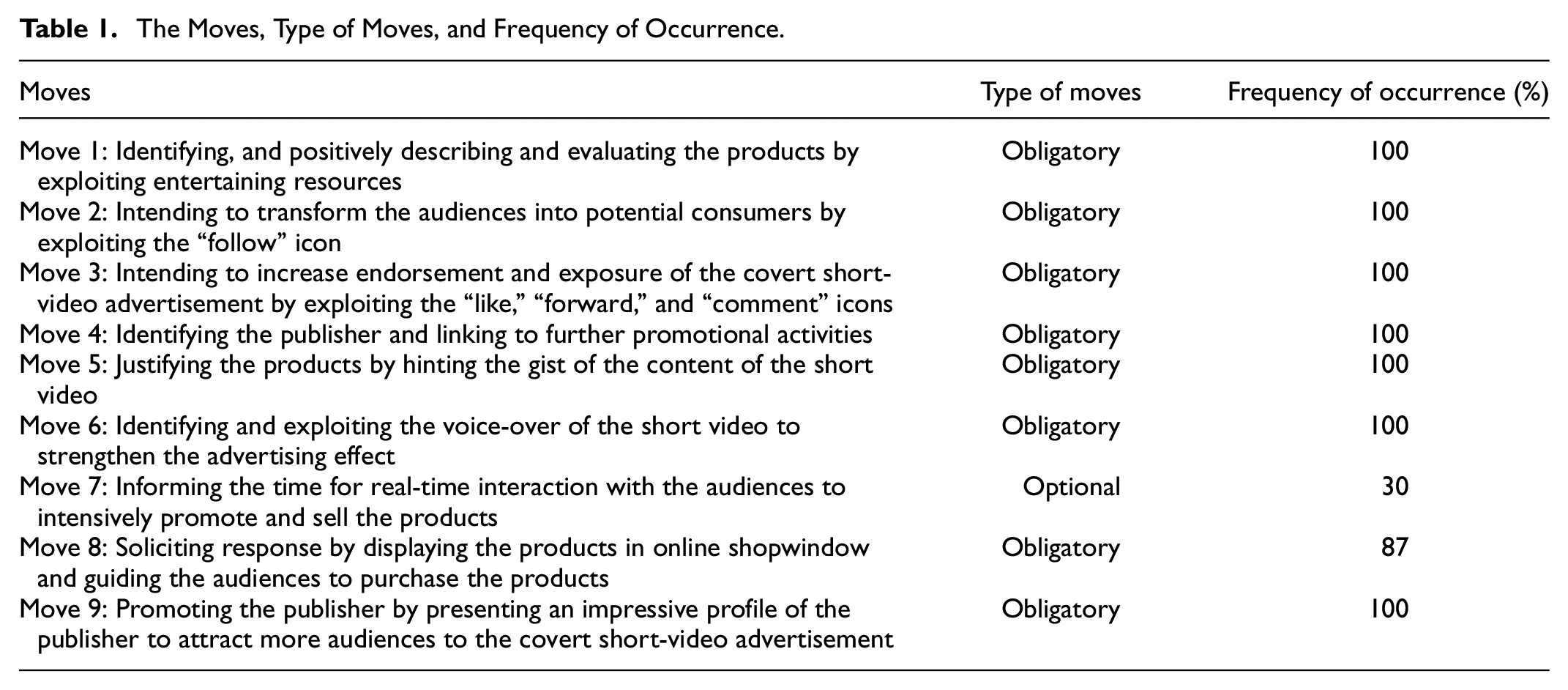
After a detailed analysis of the moves, it was found that eight out of the nine moves were obligatory, while only move 7 was optional with 30% of occurrence. This finding shows that the 100 short videos have a promotional-inclined move structure and all the moves primarily function to indirectly promote a product.
In order to give a detailed description of these obligatory and optional moves and expound the interdiscursive strategies, some covert short-video advertisements are selected as examples for convenience of analysis. These examples demonstrate some covert advertising strategies identified in the moves.
Move 1: Identifying, and positively describing and evaluating the products by exploiting entertaining resources.
In this move, entertaining resources, such as short story, skit, sitcom, and dancing, are exploited to positively describe the product. For instance, in the covert advertising short-video launched by “Grandma Wang who only wears high-heel shoes,” an interesting and entertaining short story is told to promote the “PWU laundry fragrance booster beads.” The following picture is a screenshot of the covert short-video advertisement of “PWU laundry fragrance booster beads.” (Figure 1).

The screenshot of a short-story video exploited to advertise “PWU laundry fragrance booster beads”.
In the short story, Grandma Wang’s neighbor is a young lady, who is glamorous for her natural and fresh charisma. Grandma Wang ran across this young lady and found she wore an old-fashioned dress and strong perfume. She asked her why she changed her dressing style. The young lady replied that she dressed in this way because her boyfriend like mature and sexy lady. Grandma Wang came up with an idea to help this young lady. She requested this lady to pick a present online for her granddaughter’s birthday, but she said she would not send her granddaughter the present if she was not obedient. The young lady retorted that Grandma Wang should not spare love even if her granddaughter was disobedient. Grandma Wang agreed with this lady and implicated that love is unconditional. She told this young lady: “Someone loves you just because of who you are, and you do not need to change to fawn upon your lover.” She sent this lady the “PWU laundry fragrance booster beads” and said this PWU fragrance beads have fresh and delicate fragrance, which matches her charisma. Finally, she told the young lady that there must be someone who loves her fresh and delicate fragrance and charisma.
The product, the “PWU laundry fragrance booster beads,” is creatively integrated into the short story by connecting the features of the product with the unique charisma of the young lady, both of which are “natural,”“fresh” and “delicately fragrant.” In this way, the “PWU laundry fragrance booster beads” is covertly and positively described. This connection shows the usage of interdiscursivity to link the charisma and characteristics of the young lady with the positive features of the product.
The short story is exploited to covertly convey the advertising message of “PWU laundry fragrance booster beads,” which is “natural,”“fresh,”“delicately fragrant,” and “suitable for young ladies.” The advertising message is embedded in the short story. Genre embedding refers to the embedding of one generic form within the other (Bhatia, 1995). After analyzing these covert short-video advertisements, the researchers found that all the advertising messages are embedded within other generic forms, such as short stories, skit, and dance. These entertaining generic forms are appropriated for advertising purpose. The following examples show how the advertising messages are embedded in these generic forms (Figures 2 and 3):

The screenshot of a dance video exploited to advertise “Chengdu I-box creative park”.

The screenshot of a skit video exploited to advertise “Loreal facial cleanser for men”.
These pretend genres are loaded with entertaining content so that the audiences are less likely to recognize the advertising intention (Wojdynski & Evans, 2020). For example, in the short video published by Grandma Wang who only wears high-heel shoes, the 78 years old grandma Wang has blonde shiny long hair, who also makes up and wears a light-yellow shiny dress and high-heel shoes, looking young and stunning. Her appearance gives the audiences an unexpected and pleasant feeling. The young lady’s beauty also attracts the audiences’ attention. Besides, the fancy background music, the development of the short story and the various bright colors hold the audiences’ attention and keep them watching this. These elements seem entertaining to the audiences. In fact, they are appropriated for covert advertising, because they are designed as the bait to engage the audiences into the covert short-video advertising. The pretend genres hypnotize and mesmerize the audiences by directing them to pleasurable and entertaining content, thus making the promotional intentions of the commercials less noticeable. Being unaware of the promotional intentions of these advertisements, the audiences are tricked to positively access these advertising messages.
Among the pretend genres, “short story” is used most frequently. Around 90% of the 100 advertisements are embedded in intriguing short stories. These short stories are always composed of several characters, a sequence of plots, conflict, climax, resolution, and a theme. The characters are usually played by beautiful young ladies and handsome young men, and they wear luxury clothes and fancy makeups to catch the audiences’ attention. The theme is always related to a specific commercial product and the product is the resolution of a created conflict. The short stories are usually backed with emotional music. When the eye-catching performers, the melodious music, the scene and the plot are synchronized, the audiences are offered with a feast for eyes, ears, and heart. These features build emotional connections with the audiences and strike a chord that resonates with the audiences, making the pretend genres extremely tempting, appealing, and impressive.
Once the audiences are obsessed with these short videos, their perceptions toward the products are susceptible to these advertisements. Based on “Halo effect” in marketing research (Beckwith et al., 1978), a person’s opinion about one dimension of an event, object or people influences his perceptions about the other dimensions. As a result, the audiences are manipulated to positively process the commercial messages.
Move 2: Intending to transform the audiences into potential consumers by exploiting the “follow” icon.
This move is represented by the “follow” icon, and the icon is a circular-shape close-up shot of the publisher. The icon symbolizes “following” action, which is a conventional practice in Douyin short videos. The “follow” icon is placed at the right side of the short videos. A hyperlink is used for this move. The clicking of the icon enables the audiences to follow the publisher. The following screenshot exemplifies this move, which is marked with a red rectangle (Figure 4).

The screenshot of a short-story video exploited to advertise “Meiji Hello Panda biscuit”.
This move seemingly functions to enable the audiences to follow the publisher. However, the real intention of this move is to transform the audiences into consumers through Douyin’s covert short-video advertisements. By following the publisher, the audiences will be informed about the further live streaming of the product. In the live streaming, the publisher intensively promotes the product by using various strategies. In this way, the audiences are more likely to buy the products.
In this move, the interdiscursivity strategy used is to connect the audiences, the publisher, and the live streaming. In particular, interdiscursive strategy is used to lure audiences to watch the viral streaming, in which the publisher more intensively promotes and sells the product. The interdiscursive strategy is realized by the hyperlink added to the “follow” icon.
Move 3: Intending to increase endorsement and exposure of the covert short-video advertisement by exploiting the “like,”“forward,” and “comment” icons.
This move is represented by the “like icon,”“comment icon,” and “forward icon,” which are vertically sequenced at the right side of the short video. The icons are in the shape of a heart, a circle with three points inside and an arrow, respectively. Three hyperlinks are respectively added to the three icons. The tapping of the three icons enables the audiences to give a like, make a comment and forward the short video to more audiences, which is a conventional practice in Douyin short videos. This move is exemplified in the following screenshot (Figure 5).

The screenshot of a dance video exploited to advertise “Oral-B 3D smart electronic toothbrush”.
As the above screenshot shows, this move seems to encourage interaction and sharing activities of entertaining content. However, it is exploited to maximize the exposure of the covert short-video advertisement. If a short-video advertisement gains numerous likes and is forwarded to more audiences, the advertising of the product is accordingly exposed to more audiences, who become the potential consumers of the product.
In this move, interdiscursive is used to strengthen the audiences’ commitment to the covert short-video advertisement by encouraging support and endorsement via tapping the “like,”“comment,” and “forward” icons. The activities of “giving likes”, “making comments”, and “forwarding” increase the endorsement commitment. This increases positive perception, trust, and engagement toward the product and the publisher. In addition, interdiscursivity is also used to increase exposure of the commercial message when the audiences endorse the short video and forward it to other internet users.
Move 4: Identifying the publisher and linking to further promotional activities.
The publisher who launches the video is identified at the lower part of the short video. A hyperlink is used for this move, which functions to bring the audiences to more information of the publisher and further advertising activities. The following screenshot exemplifies this move (Figure 6).

The screenshot of a skit video exploited to advertise “Enchanteur shower gem”.
As the above screenshot shows, this move is marked with a red rectangle. The Chinese characters “@  ,” which is “@Liang Xiaoxiao” in English, function to identify the publisher. Most importantly, it is exploited as a gateway to more information about the publisher and especially to more advertising intentions. A hyperlink is added to “@
 .” The clicking of the hyperlink exposes the audiences to the publisher’s main page, where they can find the detailed information of the publisher and further commercial activities, which are shown by the following screenshot (Figure 7).
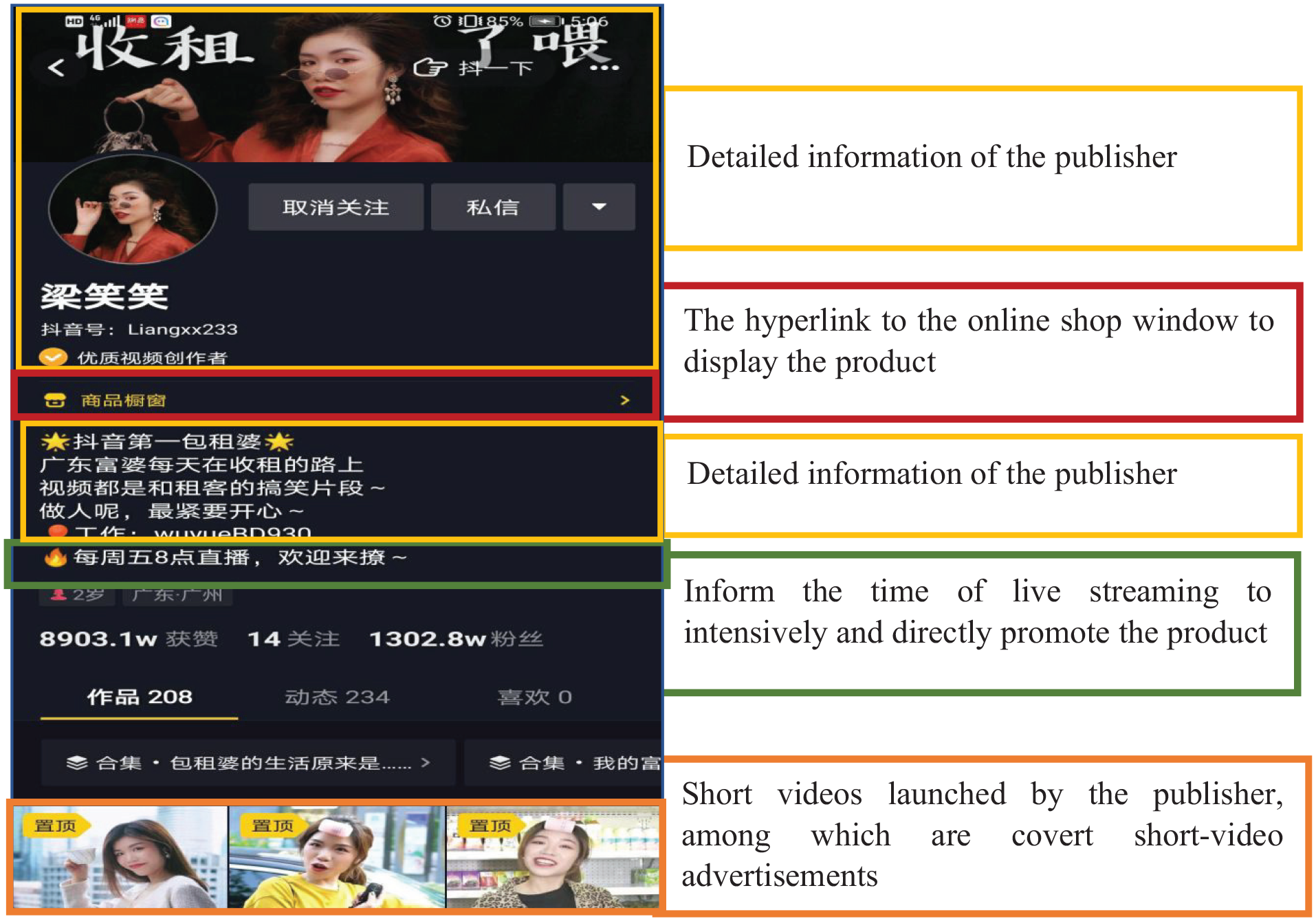
The screenshot of the publisher’s main page (in this case, Liang Xiaoxiao’s main page).
Move 5: Justifying the products by exploiting the gist of the content of the short video.
This move is placed at the bottom of the short video, which is represented by Chinese characters suggesting the gist of the short video. It seemingly functions to state the gist of the short video. In fact, it is exploited to justify the product that is covertly advertised in the short video. The following screenshot is cited as an example to elaborate this move (Figure 8).
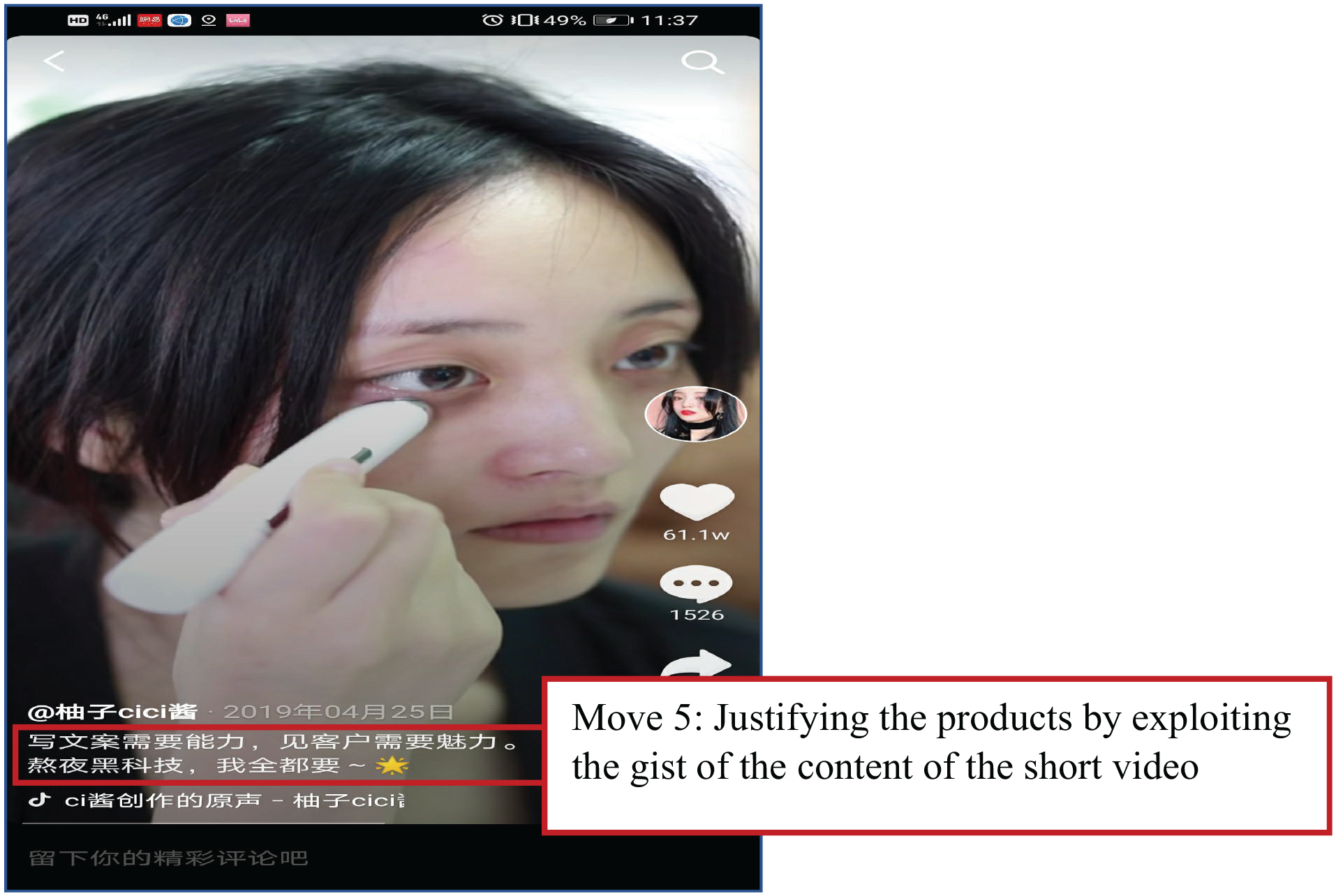
The screenshot of a short-story video exploited to covertly advertise “Mushu eye bag and dark eye circle removal massager”.
As the above screenshot shows, this move is represented by the Chinese characters highlighted in a red rectangle. In this covert short-video advertisement, a short story is exploited to advertise the product. In the short story, Youzi and her colleague worked overnight to write the proposal of a business project. They both got dark eye circle because of a whole night’s hard work. They were summoned to the boss’ office the next morning. Before entering the office, Youzi used “Mushu eye bag and dark eye circle removal massager.” In the meeting with her boss, she looked fresh and beautiful while her colleague looked exhausted. Youzi was given the opportunity by her boss to take charge of the project, whereas her colleague was sent home for a good rest and she lost the chance to lead the project.
The Chinese characters marked with the red rectangle are “ ,
,  ,
,  ,
,  .” The literal meaning of “
 ” is “it requires competence to write business proposals”; the direct meaning of “
 ” is “it needs charisma to meet the clients”; “
 ” literally means “stay up black technology”; “
 ” means “I want them all.” The connotative meaning of these Chinese characters is “the competence required to write business proposals, the charm and glamor required to fascinate the clients, and the new technology gadget (Mushu eye bag and dark eye circle removal massager) required to tackle the problems from working overnight are all important for working ladies”, which is the gist of the short story. This indicates that “Mushu eye bag and dark eye circle removal massager” is as important as working competence, because it helps office ladies to look fascinating and gain opportunities even if they work overnight. In this way, this move is exploited to justify “Mushu eye bag and dark eye circle removal massager” by indicating the importance and need of the product.
In this move, interdiscursivity is used to link the gist of the content of the short video with the importance and necessity of the product. The product is implicitly justified by using of interdiscursive strategy.
Move 6: Identifying and exploiting the voice-over of the publisher in the short video to strengthen the advertising effect.
This move is placed at the very bottom of the short video. It is represented by an icon symbolizing sound and Chinese characters suggesting the voice over of the short video and the name of the publisher. The following screenshot is cited as an example to illustrate this move. As the screenshot shows, this move comprises an icon symbolizing sound and Chinese characters meaning “the voice over of the covert short-video advertisement of Colorkey lipstick—Youzi cici Jiang” in English (Figure 9).
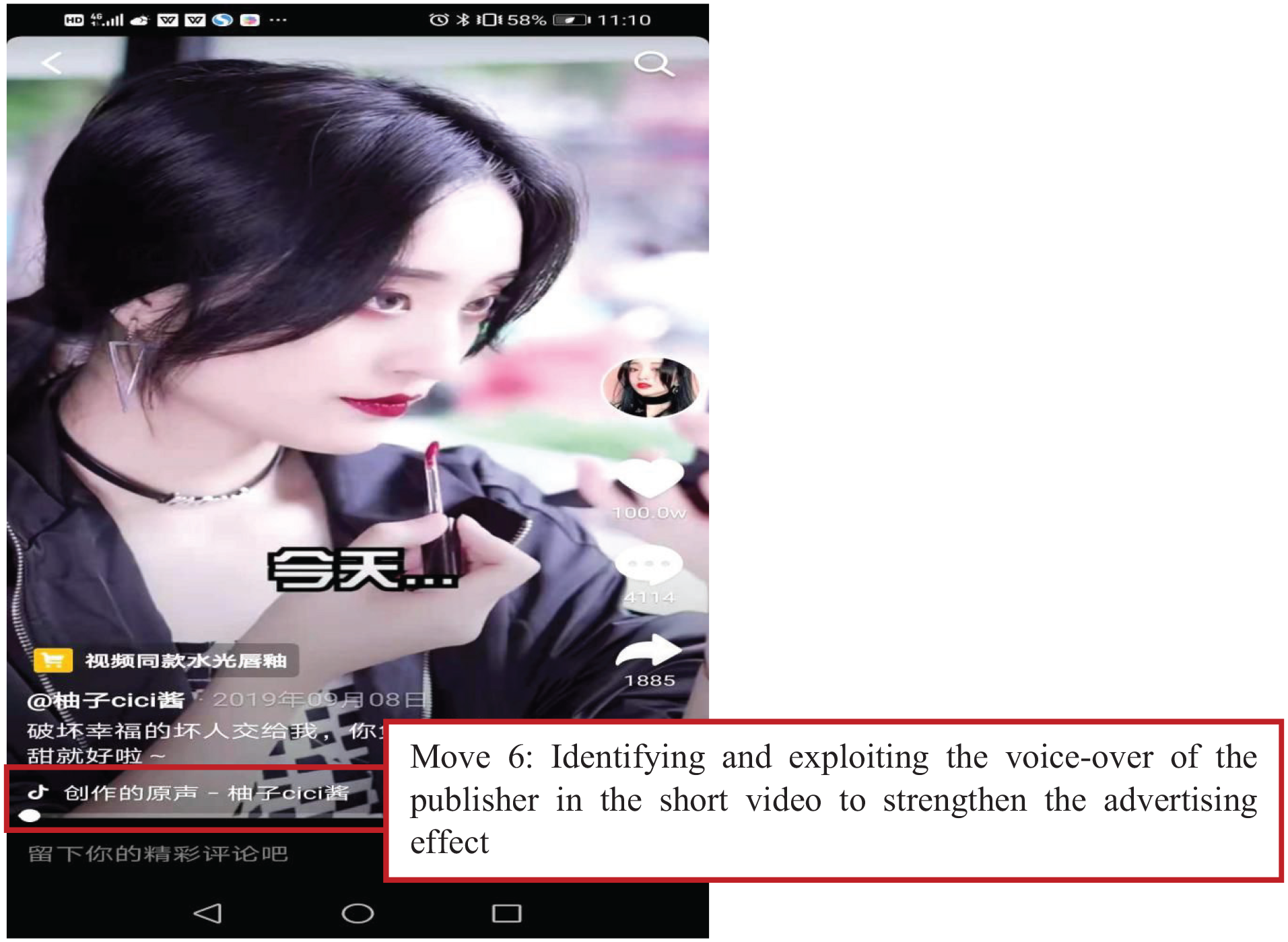
The screenshot of a short-story video exploited to covertly advertise “Colorkey lipstick”.
A hyperlink is used for this move. By clicking the hyperlink, the audiences navigate to another webpage, where they can view other short videos which used this voice-over and create short videos by using this voice-over. This move seemingly functions to inform the audiences about the voice-over of a short video and provoke online interaction and entertaining activities. In fact, it is appropriated to increase the exposure of the short-video advertisement. When the voice-over is used as a source for online interacting and entertaining activities, the audio form of the advertising message spreads to more internet users.
Interdiscursivity is used to connect online interacting and entertaining activities with the advertising message, which is realized by the voice-over of the covert short-video advertisement. The audiences use of the voice-over as a source for online interacting and entertaining activities is exploited to strengthen advertising effect by increasing the exposure of the covert short-video advertisement.
Move 7: Informing the time for real-time interaction with the audiences to intensively promote and sell the products.
This move coveys the message about the time for the coming live streaming. It is represented by Chinese characters, which is embedded in the publisher’s main page. The following screenshot exemplifies this move (Figure 10).
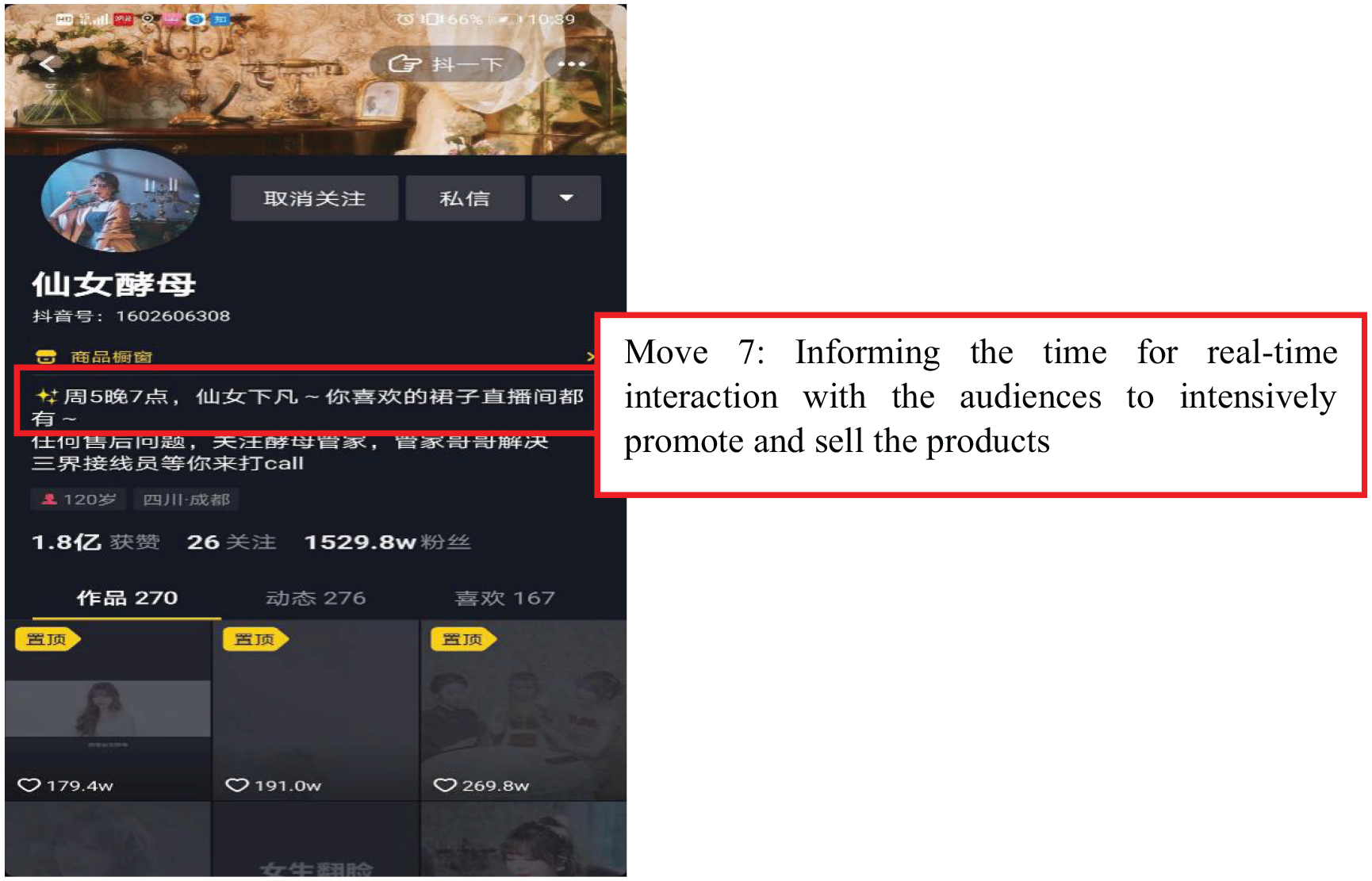
The screen shot of the main page of “Xian nv jiao mu”— a publisher of covert short-video advertisements in Douyin.
As the above screenshot shows, this move is represented by the message identified by the red rectangle:“ 5
5 7
7 ,
, .”“
.”“ 5
5 7
7 ” means “at 19:00 on Friday”; the literal meaning of “
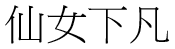 ” is “the fairy will come to earth”; the literal meaning of “
 ” is “we have all the dresses that you like in the live streaming.” The pragmatic meaning of these Chinese characters is “the publisher will launch a live streaming at 19:00 on Friday to promote and sell the dress she wore in her covert short-video advertisements.”
When the audiences are lured to the publisher’s live streaming, the publisher intensively promotes the product by using various strategies. If the audiences are engaged in the interdiscursivity of two genres, the covert short-video advertisement and the live streaming, they will be exposed to more intensive advertising activities, and they are more likely to purchase the product.
Move 8: Soliciting response by displaying the products in online shopwindow and guiding the audiences to purchase the products.
This move is represented by an icon suggesting shopwindow and the Chinese characters “ ,” which means “shopwindow display of products” in English. It functions to solicit the audiences’ purchasing action by displaying the products. This move is unique to short-video advertisements, which never appears in non-promotional short videos launched in Douyin. A hyperlink is used for this move. By clicking on this hyperlink, the audiences navigate to the online shopwindow display of the products that are covertly promoted in the short videos. A screenshot of a publisher’s main page is cited as an example to illustrate this move (Figure 11).

The screenshot of the main page of “Ai yu er wai”— a publisher of covert short-video advertisements in Douyin.
As the above screenshot shows, this move is placed in the middle of the publisher’s main page. By clicking the hyperlink added to “ ” which means “commodity shop-window,” the audiences navigate to the shopwindow display of the products that are covertly promoted in the short videos. The following screenshot exemplifies this (Figure 12).

The screenshot of shopwindow display of the products that are covertly promoted in the covert short-video advertisements.
As the above screenshot shows, detailed information is presented in “the online shopwindow display of the products.” From “the online shopwindow display”, the audiences can locate the product that they need. For instance, the viewer can identify the “Mask Family 1908 facial mask” in “the online shop-window display”. The picture marked by a red rectangle in the following screenshot showcases this product (Figure 13).

The picture marked in the red rectangle showcases “Mask Family 1908 facial mask”.
By clicking on the name of a product in “online shopwindow,” the audiences navigate to another webpage in Douyin. In this webpage, the audiences can view detailed information of the product. This is exemplified by the following screenshot (Figure 14).

The screenshot of the webpage in which the details of “The Mask Family 1908 facial mask” are introduced and promoted.
If the audiences decide to purchase the product, they can click the hyperlink added to “ —go to buy it,” which brings them to an e-commerce platform. From that platform, the audiences can claim the coupon and buy the product. This is exemplified in the following screenshot (Figure 15).

The screenshot of the e-commerce platform where the audiences can claim coupon and buy “The Mask Family 1908 facial mask”.
In this move, the interdiscursivity activity solicits audiences to purchase the product by offering convenience of online shopwindow. The commercial messages presented in online shopwindow is another advertising genre that is embedded in the covert short-video advertisement. Once the audiences navigate to the online shopwindow, they are exposed to another form of advertisement which is embedded with more covert marketing strategies.
In addition to displaying the products in online shopwindow, another strategy is exploited to solicit purchasing action. In 15% of the short videos, a shopping cart icon and the name of the product are presented at the lower part of the short video, which suggests the online shopping access of the product. A hyperlink is added to the shopping cart icon, which functions to guide the audiences to a certain e-commerce platform to purchase the product. The following screenshot illustrates this strategy (Figure 16).

The screenshot of a skit video exploited to advertise “Enchanteur shower gem”.
Move 9: Promoting the publisher by presenting an impressive profile of the publisher to attract more audiences to the advertisement.
The publisher’s profile is presented to the audiences in the publisher’s main page. The profile is composed of eight parts: a photo of the publisher, the name and Douyin account of the publisher, the personalized signature of the publisher, the contact information of the publisher, the popularity of the publisher, the short videos created by the publisher, the current status of the publisher and the collection of short videos that the publisher gives a “like.” The photo is an attractive visual with a fascinating posture of the publisher. It is taken in a close-up shot from a frontal angle to promote the characteristics of the publisher and to engage the audiences, because a close-up shot suggests individualization and a frontal angle connotes engagement (Kress & van Leeuwen, 2006). The name and the signature are carefully designed to highlight distinctive characters and positive points of the publisher. Besides, the degree of popularity of the publisher is indicated by presenting the number of “likes” and “follows” that he/she has gained. The following screenshot is cited as an example to demonstrate this move (Figure 17).
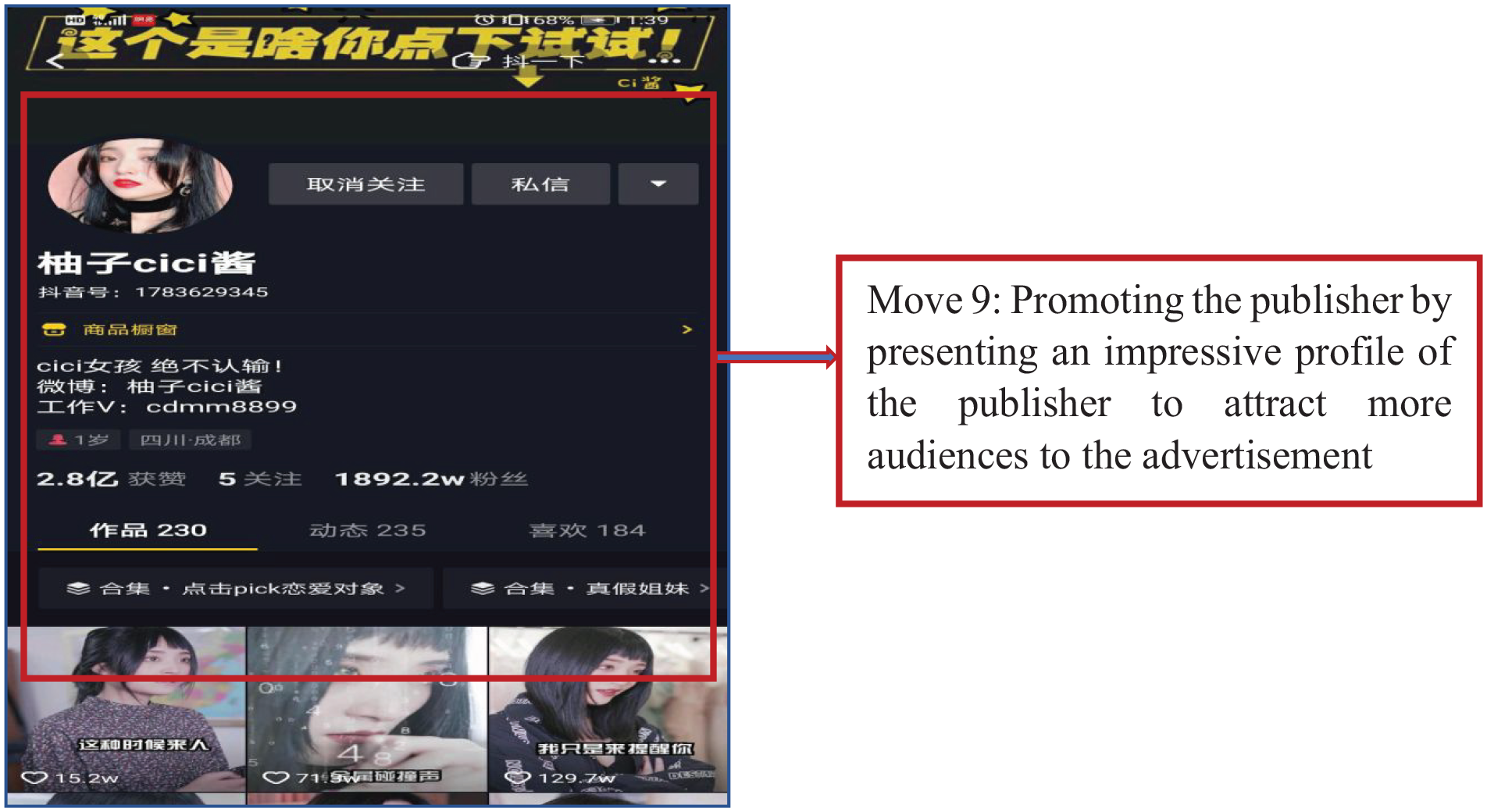
The screenshot of the main page of “Youzi cici jiang”.
All the information is combined to promote the publisher and impress the audiences. In fact, the combined information also indirectly maximizes the advertising effect of the products promoted in the short videos. As the publisher attracts more audiences, his/her covert short-video advertisements increase exposure accordingly.
In this move, interdiscursivity is used to build a link between the audiences, the publisher and the businesses. The personalization of the publisher is exploited to attract as many audiences as possible to the covert short-video advertisements. In other words, professionalism as well as personalization is embedded as a part of covert advertising to the audiences.
The communicative Purposes of the 100 Short Videos
As entertaining resources and conventional practices of Douyin are exploited for covert advertising, the advertising short videos seem identical to entertaining short videos launched in Douyin. In order to discover the underlying communicative purposes of these short videos and highlight the distinctive features of the moves, the rhetorical moves of hard-sell advertisement (Bhatia, 2004) are cited for comparison, which is shown in the following Table 2.
The Comparison of the Rhetorical Moves Between the Genre of Hard-Sell Advertisement (Bhatia, 2004) and the Genre of Covert Short-Video Advertisement.

As the above table shows, all the moves occurred in these short videos primarily serve advertising functions. Three of Bhatia’s (2004) rhetorical moves of advertisements were identified in the present study. These three moves are: detailing the product, justifying the product, and soliciting response. According to Bhatia (2004), the generic identity of advertisements is symbolized by two essential features: a positive description and evaluation of the product, and almost always solicit response from the intended audiences. Because both two moves, which are detailing the product and soliciting response, were identified as the obligatory moves in the present study, these 100 short videos and Bhatia’s description of advertisements display an overlapping communicative purpose. Therefore, the 100 short videos primarily serve an advertising purpose.
The moves of the covert short-video advertisements show distinctive features, that is, the advertising functions of the moves are mostly realized by exploiting entertaining resources and conventional practices in Douyin. This contributes to the secondary communicative purpose of this new media advertising genre, which is to entertain the audiences. These entertaining resources and conventional practices mask the advertising intention, making the advertising short videos resemble non-promotional entertaining short videos. Being deceived by these entertaining resources and conventional practices, the audiences tend to actively access and positively process the advertising messages.
Multimodal Strategies Used in the 100 Short Videos for Covert Advertising
Besides interdiscursive strategies, multimodal resources are exploited for covert advertising in the short videos. It is found that multimodal strategies are prominently used in six out of the nine moves of these covert short-video advertisements. According to Bhatia (2004), multimodality can be used to attract attention, to highlight a move and to realize a move. The multimodal strategies used in this genre and their functions are summarized in the following Table 3.
Moves, Multimodal Strategies, and Functions of Multimodal Strategies.

As the above table shows, besides using the respective icons to represent and realize some of the moves, more prominent multimodal strategies are used in move one and move eight for covert and creative advertising. In order to elaborate on how these multimodal strategies are exploited in these two moves, some frames are clipped from these advertising videos for convenience of analysis.
Exploit narrative patterns to project the positive features and a pleasant experience of the products.
In these short-video advertisements, the visuals exploited to demonstrate the positive experience of the products are mostly narrative images. The following screenshot is an example cited to explicate how the product is positively demonstrated and covertly promoted by the visuals (Figure 18).

The screenshot of a short-story video exploited to covertly advertise “Smeal Noto meal substitute”.
The above picture shows an internet celebrity drinking “Smeal Noto meal substitute” to demonstrate the product. This picture is a narrative image. The internet celebrity is the actor, the action of drinking is the vector, and the product is the goal. These visual elements combine to narrate the process of using and enjoying the product.
The picture is a close-up shot, which enables the audiences to have a clear view of the product. Many advertisements use a frontal angle to involve and engage the audiences (Hu & Luo, 2016; Li, 2016). However, in these covert short-video advertisements, the pictures that are exploited to demonstrate the products are taken from an oblique angle.
In the above picture, the lady’s oblique view is shown, and she is in the motion of drinking “Smeal Noto meal substitute.” In this case, the audiences are invited into the thoughts and feelings of the lady because a side view suggests inner thoughts (Machin, 2007). With her eyes half closed, the lady is constructed as being engaged in drinking and enjoying the taste of the product. The audiences are invited to sense the good taste, the soothing feeling and the pleasant experience the product brings. As an oblique angle suggests detachment and create objectivity (Kress & van Leeuwen, 2006), this image projects objectivity in experiencing the products and evaluation of the products. In this way, the projection of the good taste, pleasant feelings and pleasurable experience of the product is justified as objective and reliable.
Exploit the interplay of verbal text, visuals and music to covertly covey the advertising intention and intensify the appeal of the covert advertisements.
Most texts, including advertisements, involve a complex interaction of written text, visuals and other graphic or sound elements, designed as systematic entities by strategic ways of layout in contemporary society (Kress & van Leeuwen, 2006). In these covert short-video advertisements, the covert advertising intention is achieved through interaction of meanings among instantiations of different semiotic resources. Although positive lexicons are hardly used to explicitly praise the products, the interaction of visuals, music, and verbal text constructs the intended meaning and even strengthen the appeal and pervasive force of these covert advertisements. The following example is cited to elucidate how the intended meaning of advertising messages are covertly constructed and conveyed through synchronization of multiple meaning-making resources (Figure 19).

The screenshot of a short-story video exploited to covertly advertise “brown sugar and ginger tea”.
The above picture is one frame of the covert short-video advertisement of “brown sugar and ginger tea.” In this image, two ladies stand by a vast and beautiful lake, with their backs facing the viewers. The cloudy and dark sky in the picture suggests that a storm is approaching. The sky as well as the ripples in the lake connote challenges and setbacks in life. The two ladies stand arm in arm and each raises one hand over the head with the gesture of victory. The way they stand with their hand gesture and the way they dress indicate that they feel on top of the world. They are in such a good state because they know how to enjoy themselves, and the consumption of “the brown sugar and ginger tea” is one of the most critical ways, which brings them care, love, and happiness.
Ed Sheeran’s emotional song “perfect” is exploited as the background music for this short-video advertisement, which is very popular among the women listeners. The beautiful melody, the infectious tunes, the slow and swaying tempo and the emotion-invoking lyrics invoke a sense of “loving, caring, and warmth.”“Vocal music enables vivid communication of verbal message in an unspoken way” (Huron, 1989, Kuo et al., 2013). Backgrounded and associated with this song, the advertising message of “the brown sugar and ginger tea” is constructed and conveyed as “bringing consumers care, love and warmth” in an indirect subliminal way.
The written text of this short-video advertisement presents: “the brown sugar and ginger tea” can always accompany you in different phases of life. Through the interaction of visuals, music and written text, the intended meaning of the short-video advertisement is constructed and conveyed: “even if there are challenges and setbacks in life, the consumption of “the brown sugar and ginger tea” can make women as happy as on top of the world. This product brings women care, love and warmth. Therefore, women always need “the brown sugar and ginger tea” in different phases of life.” The interplay of visuals, music and written text, rather than use of positive lexicons to explicitly praise the product, contributes to the covertness of this short-video advertisement. The covertness is strengthened by the song because melodious music sugarcoats the advertising intention by entertaining the audiences and invoking their emotions (Huron, 1989; Figure 20).

The screenshot of a short-story video exploited to covertly advertise “brown sugar and ginger tea”.
Use bright colors to highlight the purchasing access and stimulate the audiences’ purchasing desire.
In this genre, color is used as a semiotic resource to solicit the audiences’ purchasing action. Color differentiation is used to classify dissimilar segments of information. The contrast of bright color and dark color is a typical characteristic of these short-video advertisements. Move 8 is designed with bright color typeface, which functions to solicit response by guiding the audiences to purchase the product. As bright color is associated with clarity while dark color is associated with obscurity (Machin, 2007), move 8 is more foregrounded to direct the audiences’ attention to purchasing of the product.
Discussion
Positive words are widely used to praise the products in hard-sell advertisements (Bhatia, 2004) and even in less explicit advertising genres (Zhou, 2012). In these short-video advertisements, entertaining resources, such as short stories, skits, sitcoms, music and dance, are exploited to positively describe the products. Due to these resources, the advertising messages are more interesting and engaging. Under the guise of the entertaining resources, the advertising intent is far less remarkable and receives less critical intrusion. This contributes to the covertness of these covert short-video advertisements.
All the moves except move 8 seemingly serve for non-promotional functions, such as entertaining, short-video sharing, interacting, identifying, socializing and introducing. In fact, these moves are manipulated for advertising purpose in covert short-video advertisements by using interdiscursive strategies. These moves are also some of the conventional practices of Douyin short videos, irrespective of promotional or non-promotional short videos. The manipulation of rhetorical moves and conventional practices of Douyin also contribute to the covertness of these short-video advertisements.
Besides using interdiscursive strategies, multimodal resources are substantially used to creatively and covertly construct and covey the intended meaning of the short-video advertisements. This is manifested by the strategic use of colors, tactical use of narrative patterns of visuals and interplay of visuals, music, and written text.
Conclusion
This study aims to explore the generic features of covert short-video advertisements launched in the Chinese version of Tik Tok and expound how this genre is manipulated for covert and effective advertising. The distinctive moves of this genre are unveiled. The communicative purposes of this genre are unmasked. Rather than entertaining, this genre primarily functions for advertising purpose. It has been found that interdiscursive and multimodal strategies are creatively and covertly exploited to engage and lure the audiences into favorably perceiving the advertising messages and purchasing the products. In addition, it has also been found that entertaining resources are covertly exploited and manipulated to mask the advertising intent and deceive the audiences. These manipulations of generic resources as well as the exploitation of interdiscursive and multimodal strategies effectuate the covert advertising techniques stated by Akdoğan and Altuntas (2015).
Practically, this study not only illuminates the way on how this genre is manipulated to trick the audiences into indulging in the covert short-video advertisements but also provides consumers with novel ad-specific persuasion knowledge for covert short-video advertising recognition. In traditional consumer culture, the consumers have the power to make decisions on accessing advertising messages and to make purchasing decisions (Arnould & Thompson, 2005). With the new manipulative genre of covert short-video advertisements nowadays, the consumers’ right on making decisions to access commercial messages and purchase commodities is covertly deprived because the advertising intent is masked by other generic resources. Consumers are maneuvered and tricked into a passive situation in the consumption markets and culture, and the consumer culture has been shaped to the businesses’ advantage. The linguistic and multimodal features as well as the manipulative strategies explored in this research facilitate consumers’ recognition of new-media covert short-video advertising, providing them with freedom for message consumption and products purchasing.
Theoretically, an in-depth analysis of this genre updates genre studies of advertisements. This research addresses textual characteristics, multimodal features, and especially interdiscursivity of new media covert advertising, which not only renews genre analysis of advertisements but also contributes to methods and approaches of genre studies.
Limitations and Future Scope
The limitation of this study lies in not investigating the production process of this genre due to a lack of access to professionals of the discourse community. A detailed investigation into covert short-video advertising production process can detect on how brands exploit influencers in TikTok for advertising (Guarda et al., 2020), reveal the nature of the seemingly entertaining short videos and decipher the strategies of this covert advertising. Future studies are expected to get the insiders’ narratives on the production process of this genre through interviewing the pertinent professionals to detect the bottom-up strategies of social media covert short-video advertising. In addition, as different types of covert advertising have different features, future studies can use this analytical approach to identify the bottom-up strategies of other types of covert advertising, such as Advergames.
Footnotes
Declaration of Conflicting Interests
The author(s) declared no potential conflicts of interest with respect to the research, authorship, and/or publication of this article.
Funding
The author(s) received no financial support for the research, authorship, and/or publication of this article.

References
 80
80 90
90 00
00 (Generation competition among people born after 1980s, 1990s, and 2000s). QuestMobile. http://www.199it.com/archives/933273.html