




Abstract
As “digital existence” emerges as a new paradigm of human civilization, disseminating intangible cultural heritage (ICH) among China’s ethnic minorities urgently needs to transition from physical spaces to digital media platforms. This research examines short video content showcasing Guangxi Zhuang culture on Douyin (the Chinese version of TikTok). Using Python web scraping technology, it collected 2,126 video accounts presenting Guangxi Zhuang culture. Employing the Elaboration Likelihood Model (ELM) as its theoretical framework and utilizing multiple research methods (Python scraping, structured interviews, and content analysis), the research conducts a multidimensional analysis of ICH visual samples from the Guangxi Zhuang community on Douyin. The study examines how the intangible cultural heritage of the Zhuang—China’s most populous ethnic minority—is represented in digital media. Findings reveal a phenomenon termed “struggling representation”: a necessary yet compromised form of cultural expression emerging from creators’ ongoing negotiation between their “internal drive to preserve cultural continuity” and “powerful external pressures from platform algorithms and the attention economy.” Simultaneously, this study explores the ecological restructuring logic of ICH dissemination within digital media environments. By grounding our analysis in the critical case combination of “China’s largest ethnic minority” and “most representative digital platforms,” we construct and propose a “Dual-Pathway-Six-Dimensional” ecological model for ICH visual dissemination. This model provides a robust theoretical foundation and transferable practical strategies for the sustainable digital dissemination of intangible cultural heritage.
Plain Language Summary
In today’s digital world, protecting cultural traditions increasingly means sharing them online. This study aims to explore how the culture of the Zhuang ethnic group, the largest ethnic minority in China, is presented on Douyin (the Chinese version of TikTok). We collected over 2,000 related accounts and conducted in-depth interviews analyzing videos from representative accounts to understand the characteristics of Zhuang cultural content and its modes of dissemination. We found that creators face a difficult balance, which we call the “struggling representation.” They wish to share their authentic culture while also having to produce short, eye-catching videos favored by platform algorithms. This often leads to their cultural heritage being simplified or overly beautified. Based on these findings, we propose a new model called the “Dual-Path-Six-Dimension” model. This model can serve as a practical guide to help cultural creators and related institutions use platforms like Douyin to attract a broad audience while also sharing the profound and authentic connotations of their cultural traditions. Our goal is to provide effective strategies for cultural heritage not only to “survive” online but to thrive.
Keywords
Introduction
The UNESCO Convention for the Safeguarding of the Intangible Cultural Heritage (ICH), adopted in 2003, represents a global commitment to protecting living cultural practices, especially among younger generations (UNESCO, 2003). This commitment faces a critical challenge today: adapting from physical spaces to rapidly evolving, algorithm-driven digital media environments. This transformation is particularly apparent on short video platforms like Douyin (the Chinese version of TikTok). These platforms present opportunities and challenges for the ICH of ethnic minorities. On one hand, Douyin provides unprecedented visibility and a stage for “living heritage,” empowering communities to express themselves, bypassing traditional gatekeepers (Guo & Li, 2015). On the other hand, the platform’s preference for brevity, viral trends, and instant visual appeal creates risks. These include decontextualization and superficial presentations. In the context where “digital living” gradually replaces industrial logic as the dominant paradigm of human society (Castells, 2009), the preservation and dissemination methods of cultural heritage are undergoing profound transformations. This is particularly true for ICH, which relies on group activities and the transmission of traditions between generations. The move from local, face-to-face transmission to multimodal, platform-based dissemination is a key issue in global cultural studies and policymaking (UNESCO, 2020). In a multi-ethnic country like China, the digital representation of ethnic minority cultures is becoming increasingly common yet complex. This makes it a critical topic that warrants further research.
This research focuses on the Zhuang ethnic group, the largest ethnic minority in China. The group’s rich ICH is now visible on digital platforms, yet still faces the challenges described above. We chose the Zhuang as our case study for several strategic reasons. In addition to their large population, the Zhuang have an extremely rich ICH. They primarily negotiate their modern identity on domestic digital platforms. The struggles they face are typical of those experienced by other ethnic groups in China. On Douyin, Zhuang culture sustains a diverse ecosystem shaped by both grassroots creators and institutional actors. While the Chinese government promotes ethnic culture protection nationally, on Douyin, algorithmic priorities take precedence over policy. This study argues that the resulting digital ecology creates a tension between authentic cultural expression and platform-driven performance, making Zhuang culture an ideal case to investigate the negotiations between cultural identity, platform logic, and community acceptance.
To analyze this paradox and find feasible strategies, this paper introduces an innovative analytical framework: the “Dual-Path-Six-Dimension” ICH communication model. We use the Elaboration Likelihood Model (ELM) to analyze the interaction between platforms’ preference for peripheral path superficial cues and audiences’ potential for deep processing of central path cultural connotations. This model helps us to identify the key factors that influence ICH communication, and it also elucidates the potential practical effects of a more balanced and sustainable communication strategy. This research not only provides an empirical analysis of the Zhuang ethnic group, but also offers a theoretical and strategic tool that ICH inheritors can use to navigate the complexities of the platform era.
Literature Review
Research on Cultural Heritage in the Digital Environment
Digital media has fundamentally transformed the representation, management, and dissemination of cultural heritage, both tangible and intangible. Yehuda E. Kalay, drawing on Lev Manovich’s five digital media principles (digital representation, modularity, automation, variability, and transcoding), argues that digital media has become the preferred and most influential medium in heritage creation and distribution (Kalay et al., 2007). Its increasing international use shows its role in not only preservation and management but also education and social services related to cultural heritage. This includes historical sites, archival materials, and folk arts. Integration of digital tools and communication technologies enables digital media to reinterpret and reconstruct heritage, shaping cultural perceptions more deeply than ever before. As a result, digital media is embedded within the broader heritage complex and influences the cycle of heritage value, consumption, and institutional practices (Kalay et al., 2007).
However, international research over the past 5 years has far surpassed the early paradigm centered on archiving and exhibition, presenting more diverse and critical perspectives. Firstly, the research focus changed 5 years ago from institution-led digitization to community-driven co-creation. International scholars emphasize the potential of digital platforms as spaces for “living heritage” practices, where community members are not merely passive bearers of ICH but active interpreters, creators, and disseminators of it. This participatory archiving model utilizes tools such as social media and crowdsourcing platforms to empower communities to record and share their own memories and practices, thereby challenging top-down, authoritative heritage narratives (Roued-Cunliffe & Copeland, 2017). For example, Italian scholars have proposed using digital methods to analyze the network structures of ICH, constructing semantic wiki platforms through social media and public collaboration (Severo & Venturini, 2016). The European ICH database, “Europeana,” integrates folk resources via crowdsourcing (Theofanous et al., 2015). Furthermore, over the past 5 years, digital technologies have become increasingly prevalent in the field of ICH research. These technologies, such as virtual reality (VR), augmented reality (AR), 3D modeling, and artificial intelligence (AI), are applied not only to preserve ICH digitally but also to enhance the public’s immersive experience and interactivity. Specifically, in the context of immersive perception and its social impact on users’ willingness to adopt digital ICH, the immersive experience is one of the key factors promoting user adoption (X. Ye et al., 2025). The use of immersive technologies such as VR and AR no longer merely pursues visual “representation,” but attempts to convey the “embodied knowledge” inherent in ICH. Alrihani examines how interactive mixed reality experiences can transform visitor engagement with cultural heritage by combining digital representations of tangible and intangible assets with immersive technologies (Alrihani, 2022). In South Korea, digital technology is primarily used to preserve and promote ICH, with digital exhibitions such as those featuring the traditional craft of Jultagi utilizing VR technology. Enhancing public participation through interactive experiences promotes the sustainable transmission of ICH (Kim et al., 2019). Of course, ICH’s digital protection also faces unique challenges. These include the intangible nature of transmission methods, pronounced regional characteristics, and a diverse range of participants.
Compared with cutting-edge international research, China’s studies on ethnic culture and digital media, although also focusing on the application of new technologies, present different emphases, and characteristics. Western scholars’ research is technology-innovation-oriented, aiming to explore innovative applications of frontier digital technologies, with an emphasis on user experience design and participatory cultural creation. Chinese scholars emphasize localization and cultural adaptability, focusing on addressing specific practical issues in the protection of ICH. In digital media social application research, the West has established a theoretical foundation, while China focuses more on the practical application level of ethnic culture and digital media, primarily concentrating on low-threshold short video media platforms. For example, young members of a Shui ethnic group in rural Guizhou use short videos to share their culture. This highlights the important role local cultural spaces play in connecting cultural and media spaces (Teng & Liu, 2022). Research on mobile live streaming and short videos by Yi youth from Liangshan’s “Cliff Village” in Sichuan shows that short videos have become a key cultural practice. They boost self-awareness among Yi youth and support cultural consciousness in minority areas (Jiang & Yan, 2020). Examining short videos in Guangxi, researchers have found that these videos have real value today. They contribute to local economic growth, foster unity among China’s ethnic groups, and enhance international communication capabilities (Li, 2022). Compared to the in-depth international research on community empowerment, embodied experience, and critical reflection, Chinese research has several shortcomings. First, there is a lack of analysis on how platform algorithms influence the presentation, dissemination, and risks of bias or homogenization in ICH content. Second, there is a lack of focus on cultural practitioners as subjects, particularly in terms of their identity negotiation, cultural recreation, and resistance in digital spaces. Third, ethical issues in ICH digitization, such as data sovereignty and intellectual property rights, are still in the early stages in China, whereas they are already focal topics internationally.
In summary, literature shows a shift in digital ICH research—from preservation and display to user participation, immersive experiences, and social impact. However, a gap remains concerning the digitalization of ICH among China’s ethnic minorities. International academics are increasingly critical, but this has limited engagement with China’s pragmatic, platform-focused discourse. Recent studies aim to enhance public understanding and participation by utilizing digital technology. Yet, most research centers on countries with significant national power and overlooks regions rich in ICH (Lian & Xie, 2024). To address this, our main argument is for a deeper, contextually grounded understanding of digital ICH among China’s ethnic minorities. This study seeks to bridge theory and practice by viewing Douyin both as a technical tool for ICH “reproduction” and as a cultural ecosystem. Examining the transmission and reconstruction of Zhuang ICH on Douyin, we provide a critical empirical analysis to advance understanding of ethnic minority ICH transmission in the digital era.
Short Video Platforms as Cultural Arenas
In recent years, short-video platforms (SVPs) like Douyin and TikTok have become pivotal cultural forces, fundamentally reshaping how content is produced, disseminated, and consumed worldwide (Karizat et al., 2021). Their hallmarks-highly fragmented short clips, dynamic visual emphasis, strong interactivity through features such as likes and duets (Zulli & Zulli, 2022), and powerful algorithm curation-define a unique media environment. While these platforms personalize cultural experiences, they also risk creating filter bubbles and echo chambers (Bucher, 2019; Ciampaglia & Menczer, 2018). Together, these features establish SVPs as crucial spaces for examining ongoing cultural transformation in the digital era.
Douyin has rapidly accumulated a vast user base in China. Its audience ranges from teenagers to middle-aged and elderly individuals. This growth is due to its first-mover advantage, precise algorithmic recommendations, and localized operational strategies. As a result, Douyin has become a national-level application. Its sociocultural influence is clear in several areas. The platform is not only a main source of entertainment but also a significant creator of popular phrases, internet memes, and fashion trends. These trends have a profound influence on the linguistic habits and esthetic preferences of younger generations (Chen, 2021). While Douyin and TikTok are both owned by ByteDance and share similar technology, significant differences exist in their practical applications. These stem mainly from China’s unique sociocultural context, content ecosystem, and regulatory environment (Creemers, 2019; Roberts, 2018). Unlike TikTok’s global content pool, Douyin has a more complex and diverse content ecology. It includes a wide range of user-generated entertainment, as well as promotional content, educational materials, and ICH promotion from official media and government agencies. This mix shows a balance between commercial aims and national governance (Liu & Yang, 2022). Douyin also faces stricter content review and regulatory oversight in China. These regulations directly affect the scope of speech, content diversity, and potential biases in algorithmic recommendations. Therefore, viewing Douyin simply as the Chinese version of TikTok overlooks its distinct features within China’s context.
According to the 54th “Statistical Report on the Development of China’s Internet Network” (China Internet Network Information Center [CNNIC], 2024), China’s internet user base has reached nearly 1.1 billion, with 1.05 billion of them (95.5%) being short video users. Short videos are now a major way for new users to access the internet and have become an integral part of daily life. The 2023 Short Video User Value Research Report (China widely depending on the CSM media research [CSM], 2023) cites Douyin as the most frequently used platform, with 45.0% of users naming it their top choice. As of December 31, 2023, iiMedia Research reports that 74.2% of Chinese short video users opt for Douyin/Douyin Lite. As of March 2025, Douyin (including Douyin and Douyin Lite) has surpassed 1 billion monthly active users (QuestMobile Research Institute, 2025). This indicates that Douyin has become the most influential and widely used platform in China’s short video field, serving as an important medium for cultural communication in the Country.
Ethnic Minorities, Digital Media, and Representation in China
The growth of digital media is transforming cultural practices and social interactions among China’s ethnic minority groups, actively shaping their visibility and image in the public domain. Understanding this shift demands examining China’s distinct ethnic minority policies and cultural practices. The official policy of a “unified multi-ethnic state” asserts equality and unity, while implementing regional autonomy to protect and promote minority cultures (Gladney, 2004; Sautman, 1999). Yet, this “unity within diversity” inevitably creates friction between state-led cultural integration and authentic local expressions. Minority cultures are often put on display, but risk being absorbed into broader national narratives (Bulag, 2010; Harrell, 2012).
Entering the digital age, ethnic minority groups are not merely passive recipients of information; they are also active participants in shaping it. Research shows that many members use internet tools, such as social media, to communicate, maintain community ties, engage in economic activities, and preserve ICH, demonstrating significant agency (Wallis, 2013). For instance, establishing WeChat groups, online forums, and live streaming helps ethnic languages and cultural practices evolve online. However, this agency is constrained by factors such as the digital divide between urban and rural areas as well as among different ethnic communities (Qiu, 2009), content censorship (Roberts, 2018), and algorithmic biases. Language barriers, gaps in digital literacy, and network costs also affect the extent to which these groups can participate equally online.
Digital media platforms, particularly short video platforms, are now essential for representing ethnic minorities. These platforms offer both oppotunities and risks. They provide ethnic minorities with direct ways to express and display their cultures and perspectives, thereby challenging raditional stereotypes (Zeng, 2023). Many creators use short videos to promote ethnic costumes, dances, handicrafts, and cuisine. This spreads their cultures and supports tourism. However, platforms often simplify and sensationalize minority images to attract attention. This reinforces stereotypes, presenting minorities as exotic and detached from modernity (Leibold, 2013; Notar, 2006). These representations are often selectively integrated into national narratives of ethnic unity and harmony, serving specific political propaganda objectives and potentially obscuring the real challenges and diverse demands faced by ethnic minorities during the process of modernization (Z. Ye et al., 2025).
Research on the portrayal of specific Chinese ethnic minorities and their cultural practices on short video platforms, such as Douyin, is emerging. However, this research remains relatively limited in international (particularly SSCI/SCI) journals. Existing studies have started to explore how some ethnic minority users leverage platforms like Douyin for cultural performance, identity negotiation, and community interaction. For instance, Hao (2025) explored the populist identity shaped by ethnic minority internet celebrities on Douyin in China. Research on Chinese short video platforms reveals their potential and complexity in cultural dissemination, social mobilization, and commercial monetization. These findings provide a macro-level background for understanding the circumstances of ethnic minorities on these platforms. However, current academic research remains insufficient regarding the specific practices of ethnic minority groups on digital platforms. There is an urgent need for in-depth investigations into the specific practices, image evolution, and the reconstruction of new communication ecosystems for representative ethnic minority groups on particular digital platforms. This need is especially acute for the Zhuang ethnic group, which has the largest population among Chinese ethnic minorities. Dissemination through digital platforms is also urgently needed. This study aims to develop a digitally vibrant communication system for the ICH of Chinese ethnic minorities, serving as a reference for future use.
Research Design
Theoretical Framework
This study adopts the Elaboration Likelihood Model (ELM) as its core theoretical framework (Figure 1). ELM began as a key theory in social psychology to explain two main pathways of attitude change (Petty & Cacioppo, 1986). Its core logic is the idea that both central and peripheral paths of information processing shape attitudes. This logic helps us understand complex cultural communication. This research extends ELM from its traditional use in persuasion and attitude change to the context of ICH dissemination on short video platforms. We analyze how cultural cognition forms, how emotional resonance happens, and how willingness to inherit emerges. Although ELM was first designed to explain attitude formation in consumer and persuasion contexts, its dual-path logic remains a strong tool for studying cultural communication in the digital age. We adapt ELM and argue that cultural cognition is more complex than consumer choice; both operate along a similar “engagement continuum.”

Theoretical framework. The figure primarily illustrates the overarching conceptual framework of the study and the analytical methods used. Table 1 provides detailed explanations of the abbreviations in the figure.
Description of the Variable Vocabulary in the Peripheral Path.

During this adaptation process, we redefine “attitude change” as a series of cultural engagement steps, ranging from shallow to deep. The bottom of this ladder is the peripheral path—initial attention, fleeting liking, and shallow cognition triggered by heuristic cues (such as “This outfit looks really nice”). The top of the ladder is the central path—long-lasting understanding, value identification, and willingness to share the culture formed through deep thought (e.g., “I understand the historical story behind this song and am willing to share it with more people”).
However, in Douyin’s media environment, the central and peripheral paths (i.e., persuasive cues) must be redefined and operationalized. The peripheral path is the shallow consumption of easily digestible cultural symbols. Its cues, common in short videos, quickly capture attention when users are disengaged. These include: (1) source attractiveness—creator’s looks, personal charm, and the “authentic” local identity label; (2) shallow message features—popular background music (BGM), vibrant visuals, fast-paced editing, humor, and appealing scenery; (3) social proof—high likes, shares, and active comments suggesting popularity. The central path reflects a deeper understanding of the history, narrative, and values within cultural practices and requires more cognitive effort. In short videos, this appears in dense, sophisticated content, such as reveals of historical origins or cultural symbolism of ICH projects (e.g., Zhuang brocade patterns or mountain song) through captions, narration, or skits, helping explain deeper meanings; stories about inheritors, craft processes, or full festival ritual, enriching authenticity; and prompts for user engagement through thought-provoking questions in the video or comments, spurring discussion beyond surface content.
This adapted ELM framework will directly support the design and core hypotheses of this research. Instead of serving only as background theory, it provides a powerful analytical lens that guides us in answering the research questions posed by this study. The framework highlights the central tension of “living heritage transmission” in the digital age: how to embed central path arguments while also meeting platform algorithms’ preference for peripheral paths. This is essential in guiding users from superficial “seeing” to deep “understanding” and cultural “recreation.” With the help of ELM, this study aims to reconstruct a more dynamic media communication ecology. It offers a theoretical basis and practical strategies for digitally disseminating ICH.
Research Questions
This research aims to address the following key questions:
Methods
This research uses several methods to answer the questions above. It captures both the “frontstage” performances and the “backstage” logic of the Zhuang ethnic ICH dissemination on Douyin. For the frontstage, it presents the visible dissemination landscape using data statistics and content analysis. Behind the scenes, it reveals creator motivations, strategies, and challenges through in-depth interviews. The research focuses on Douyin due to its large user base, significant cultural influence in China, and effective recommendation algorithm. As described in Section 2.2, this algorithm has a significant impact on the production and dissemination of cultural content, making it a key component of the digital ecosystem examined.
In the first research phase, we used Python web scraping to collect data from Douyin (https://www.douyin.com/). From July 2023 and March 2025, we gathered metadata from 2,126 accounts using the keywords “#ZhuangCulture,”“#GuangxiZhuang,”“#ZhuangFolkSongs,”“#ZhuangBrocadeClothing,”“#ZhuangScript,” and “#ZhuangLanguage.” We employed a multi-stage, purposive sampling strategy to narrow the dataset to manageable and representative sample, and then selected 27 core accounts (Table 2) for analysis. We screened accounts using three main criteria: (1) sustained thematic relevance—accounts that consistently posted about Zhuang ICH, excluding those that rarely did; (2) audience interaction—looking at likes, comments, and shares to find influential accounts; and (3) content type—selecting accounts representing diverse cultural categories like music, handicrafts, language, and festivals. For each topic, we picked the most representative and popular videos for multimodal content analysis, based on likes, shares, and favorites (Table 3).
Accounts with High Activity Levels.

Analysis of Multimodal Content in Representative and Most Popular Videos.

Additionally, 1 week before the 2025 “March 3rd” Song Fair in Guangxi, the researcher identified and analyzed the most popular videos related to the pre-set six keywords on the Douyin platform (Table 4). For each keyword, the first video under “comprehensive ranking” after searching was selected. The “March 3rd” Song Fair is one of Guangxi’s most representative traditional folk festivals. It embodies rich ICH of the Zhuang ethnic group and acts as a key promotional point for local governments and national mainstream media. Therefore, analyzing the most popular video content around this time helps identify critical factors influencing the effectiveness of ICH dissemination. It also reveals the mechanisms by which ICH content is represented under high-attention contexts on digital platforms. This analysis provides both theoretical support and practical pathways for building a more adaptive digital ecosystem for ICH dissemination.
The Most Popular Visual Content Across All Platforms Prior to March 3rd, 2025.

In the second research phase, we used multimodal content analysis and semi-structured interviews. Multimodal content analysis examines the video text, analyzing how images, text, sound, and editing combine to create representations of Zhuang culture. Semi-structured interviews focus on content production, exploring individual motivations and structural forces that influence how Zhuang culture is represented on digital media.
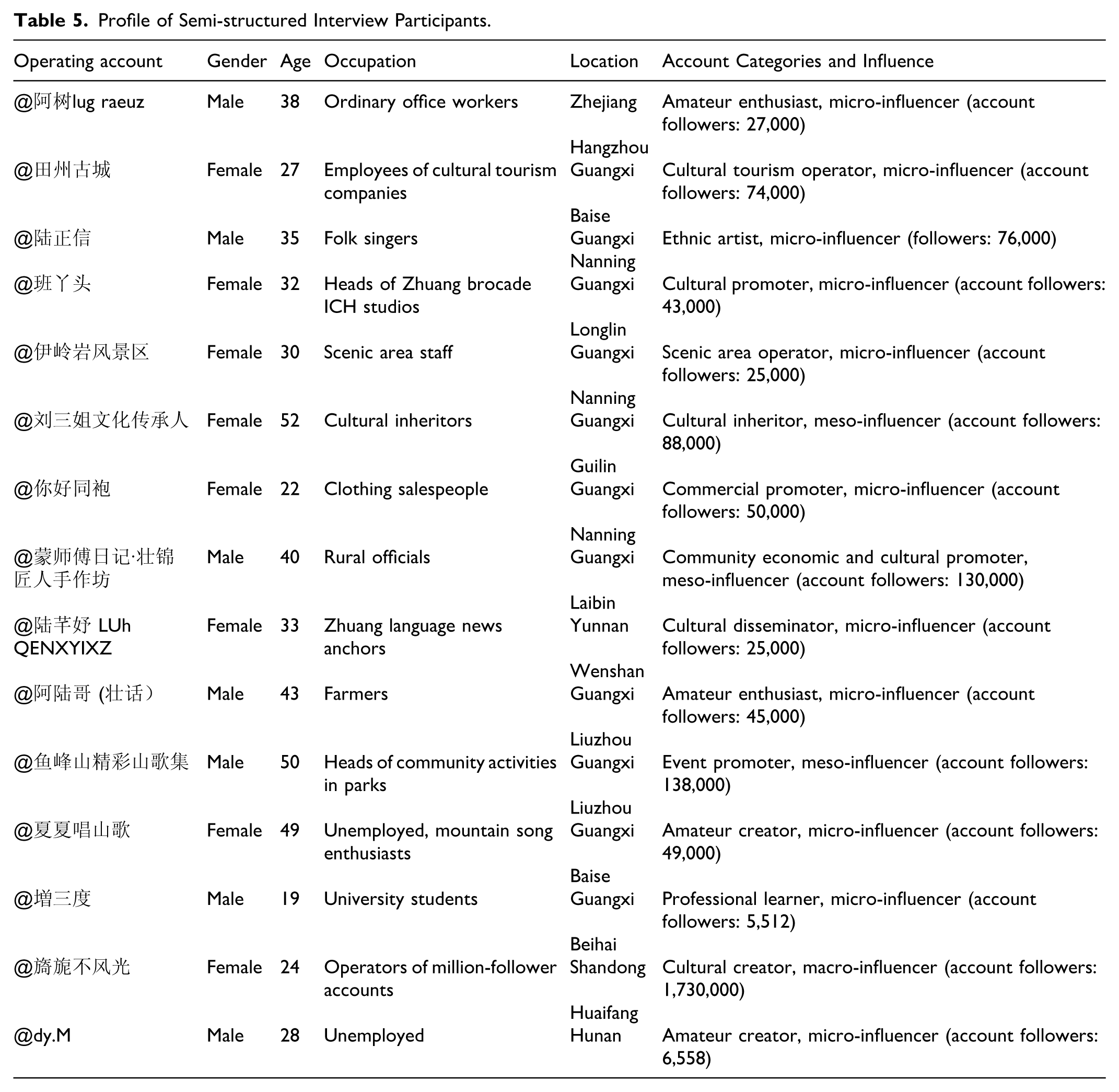
First, we employed purposive sampling to select interviewees who could provide rich and diverse information to address the research questions. The sampling criteria included: (1) creator type and influence, spanning “micro-influencers” with tens of millions of fans to “meso-influencers” with hundreds of thousands, from amateur enthusiasts working individually to institutional operators focused on commercial promotion; (2) age and generational distribution, with a primary focus on young creators but also including some middle-aged inheritors to compare generational differences in digital media usage; (3) occupation and identity background, such as students, young entrepreneurs returning to their hometowns, ICH inheritors, cultural tourism practitioners, and ordinary office workers, to show how social identities affect cultural practices; (4) regional distribution, involving creators long living in Guangxi Zhuang ethnic communities and “dispersed” Zhuang youth in other provinces. We conducted in-depth interviews with 15 core Zhuang content creators (Table 5), each lasting about 60 to 90 min. Data collection ended upon reaching information saturation.
Profile of Semi-structured Interview Participants.
Secondly, the interview outline centers on this study’s framework—the ELM. It examines how creators utilize the “central” and “peripheral” paths in their practice. The outline has four core modules: (1) Creative motivation and initial impetus, which explores why creators share Zhuang culture (e.g., personal interest, identity recognition, business opportunities, documenting life, etc.). (2) Content strategy and negotiation of “authenticity” (central path), focusing on how creators ensure cultural depth and accuracy. Sample questions: “How do you choose ICH themes?”“What research do you do for an authentic presentation?”“What content conveys Zhuang culture’s essence?” (3) Visual presentation and platform adaptation (peripheral path) focus on how creators use short video features to attract traffic. Questions: “What matters when choosing music, editing, or visual?”“Do trending memes affect your creation?”“How do you grab attention in 30 seconds?” (4) Algorithm experience and audience interaction consider how creators interact with the platform and fans. Questions: “How do you view likes/comments numbers?”“How does fan feedback (e.g., curiosity or skepticism in the comment section) influence your creative directions?”“What content does the algorithm prefer?”
Finally, after getting interviewee consent, we recorded and transcribed all interviews. We used thematic analysis (Braun & Clarke, 2006) and NVivo software to code and analyze the data. The process had four steps: First, the research team read all transcripts multiple times to gain a deeper understanding of the context; Second, we coded line by line and extracted key concepts. For example, “I feel the current stage costumes are too exaggerated” was coded as “criticism of commercialized performances.” Likewise, “wanting children from other places to see their hometown” became “comfort of digital nostalgia.” Third, we grouped related codes into potential themes. For instance, the themes “pursuit of visual impact,”“following popular music trends,” and “simplifying cultural symbols” formed the concept of “peripheral path–dominated communication strategies.” Fourth, we refined and renamed themes based on the research questions, ensuring clear boundaries and accurate data reflection. Core themes such as “superficial performance of content,”“interactive reproduction in catering,” and “reclaiming digital nostalgia” emerged and formed the study’s main arguments.
Data Analysis Strategy
The data analysis for this research used a two-pronged strategy. We first analyzed the data from the web scraping phase to identify macro patterns. We then sought to understand the underlying meanings and processes by analyzing qualitative data, including video content and interviews. For data analysis, we used descriptive statistical analysis and comparative analysis methods. For example, we identified platform algorithmic preferences by comparing the performance of short, visually driven videos with long, knowledge-based content. We focused on interaction metrics, including likes, shares, and favorites. For qualitative data such as interviews and videos, we conducted a four-step thematic analysis: (1) familiarizing with the data; (2) generating initial codes; (3) searching for themes; and (4) reviewing and refining themes. To ensure objectivity, we also adopted peer debriefing. We discussed emerging themes and ambiguous codes with a colleague experienced in qualitative research to challenge assumptions and enhance the credibility of our interpretations.
Findings
Digital media platforms are now central to representing and sharing ICH. They transcend the one-way dialog of industrial culture since the 20th century, enabling people to exercise their cultural rights and express social relations (Castells, 2011). Douyin, for example, shows how short video platforms with large user bases and visual storytelling can both help and challenge minority cultures wanting visibility and continuity (Van Dijck, 2013). By analyzing Douyin accounts and videos in this article, we explore this digital representation. We demonstrate that Zhuang ICH on Douyin is portrayed as a “struggling representation,” where authentic expressions compete with platform-driven performances in three key areas: content, interaction, and space.
The Reproduction of Content: Superficial Ethnic Characteristics
In the selected Zhuang cultural short videos (Table 3), each video is paired with a relevant hashtag. The content’s playback reenacts Zhuang cultural elements on digital media platforms. However, these reenactments often remain superficial. They are primarily performative and symbolic, lacking substantial cultural depth. An analysis of Zhuang ethnic culture content on Douyin reveals a dominant pattern of superficiality and a reliance on simplified, decontextualized symbols. This is driven by the platform’s design and the creators’ need for quick engagement. Observations of the most popular videos (Table 4) indicate that they are typically brief, lasting only 30 s to 1 min. Time limits force creators to select highly symbolic and visually striking cultural elements, often detaching them from deeper contextual meanings (Baudrillard, 1999).
Accounts like “@田州古城” show people in Zhuang attire performing the Tianqin, a traditional musical instrument, at scenic landmarks. “@伊岭岩风景区” briefly presents Zhuang customs, including the Black Cloth Village, origin myths, symbolic farming tools, bronze drums, and festivals. These videos primarily serve as brief cultural markers, often featured in tourism promotions. An analysis of the videos in Table 4 reveals that while some minority ICH videos gain a wide reach due to platform algorithms, their content often deviates from the authenticity inherent in ICH. The themes are characterized by a “scattered” and “fragmented” (Figure 2), and a deep, systematic presentation of ICH’s core values and history is lacking. This results in a significant disparity between “dissemination heat” and “dissemination quality.” Although this is a modern way to share culture, can a 1-min video truly capture the depth of Zhuang culture? The accuracy and origins of the content remain unclear.

Topic network relationship diagram. View of the topic relationship network based on Table 4.
During the interview, the video producer discussed the distinctions between genuine Zhuang traditional attire and its current representation:
Traditional Zhuang attire is detailed—each element, including how it’s worn, matters. On Douyin and in certain tourist areas, people treat Zhuang headwear as a regular hat, wearing it without any adornments. In reality, the traditional Zhuang headwear is a cloth shaped to look like a hat...... (@班丫头) In Guangxi today, many traditional ethnic costumes have disappeared, replaced by more vibrant and varied versions. The costumes on stage differ greatly from our ethnic heritage. Authentic Zhuang attire is not the ornate performance costumes...... (@阿树lug raeuz)
The pursuit of visual appeal in visual works may lead to inaccuracies in cultural representation. Through interviews, we identified discrepancies between authentic traditional Zhuang attire (including specific methods of headscarf wearing) and the simplified or dramatized versions frequently seen on Douyin, which sometimes resemble stage costumes rather than everyday or ceremonial garments. This process of simplification and aestheticization results in a replication that captures only the surface (or Shallow) aspects of Zhuang culture, sacrificing depth and nuance in exchange for visibility and instantaneous dissemination within Douyin’s attention economy (Couldry & Hepp, 2018). Cultural connotations, considered crucial indicators of ethnic vitality, are essentially absent in these ephemeral digital representations.
British sociologist Featherstone (1995) described the “second image” in the context of globalization, where different cultures come into contact and coexist, but due to a lack of clear organizational principles, they accumulate in layers, making the cultural landscape overly complex and unmanageable, thus hindering the formation of unified belief principles and guiding directions. Just as we encounter various forms of culture today, the superficial representation of Zhuang culture under digital media further obscures or fragments the already elusive cultural connotations, potentially leading to superficiality and reliance on simplified, decontextualized symbols.
The Reproduction of Interaction: Reproduction Within Accommodation
In the digital era, “interaction” holds a prominent position. However, it should not be construed as an evolution or a product unique to the digital age, but rather as a “reproduction” or a return to a previous state. The representation of Zhuang culture within digital media is often influenced by social dynamics, which in turn affects the content’s reproduction. During this process, there is a tendency to cater to the audience or maintain interpersonal relationships, which is also indicative of one aspect of the survival context.
Douyin’s interactivity directly shapes how Zhuang ICH is represented. Content creators regularly adapt their videos in response to audience feedback. Analysis of comment section texts in Zhuang short videos (Figure 3) reveals that most reactions are emotionally positive, with comments such as “good,”“beautiful,”“like,” and “love” being common. In-depth discussions of cultural details appear less frequently. However, when users highlight linguistic similarities between Zhuang, Thai, or Vietnamese, or express curiosity about Zhuang customs, they influence creators’ content choices. For instance, “@阿树lug raeuz” posted a video on October 5, 2022, comparing the pronunciations of “eating,”“drinking,”“sleeping,”“waking up,” and “goodbye” in Bangkok Thai, Northern Vietnamese, and Southern Zhuang dialects (Figure 4). This video responded to user questions from August, such as “Why does it sound so similar to Thai?” and “Like Vietnamese.” Thus, this interactivity (even if superficial) will influence the production cycle of video content (Jenkins, 2006).
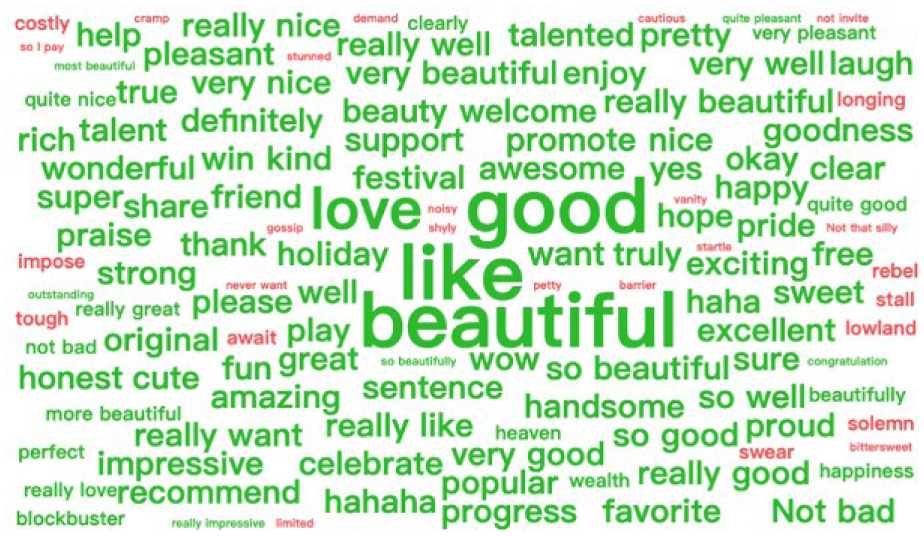
Sentiment text analysis in video commentary sections. Based on the analysis of the video comment section content as presented in Table 4, green signifies positive emotions, while red denotes negative emotions.

Comment section of the video released by @阿树lug raeuz in August 2022.
Within the analytical framework of multimodal content, interactive commentary on images reflects the social atmosphere. These interactions generate meanings similar to those found in interpersonal communicative, primarily through the interplay among image creators, the information in the images, and the receivers. This also implies the attitudes of information receivers (audiences) toward the content. Data shows that engagement metrics (likes, comments, view counts) for professional Zhuang content (like language tutorials or folk singer performances, e.g., “@陆正信”) are generally low. These posts typically receive only a few hundred likes, and live-stream viewers often do not exceed 100. Even the most popular promotional videos from official accounts have a geographically concentrated audience, with the majority of user IP addresses located in Guangxi (Figure 5). This geographical limitation suggests that, while media supports interaction, a lack of alignment with media platforms’ logic may reinforce cultural boundaries or filter bubbles. This can hinder the wider dissemination and understanding of Zhuang ICH (Rowland, 2011).

Official government account @广西文化和旅游厅 comment section.
On digital media platforms, the “presence” interaction of traditional culture has transformed into “hands-on” digital interaction (liking, commenting, sharing, private messaging), whereby engagement can be initiated from anywhere through fingertip touches on a screen. This shift alters the patterns of cultural participation and dissemination. While such mediated interaction can foster a sense of group or organizational identity among geographically dispersed individuals, it often lacks the richness and depth of face-to-face cultural activities, rendering these group relationships relatively fragile. Furthermore, the algorithms of media platforms prioritize engagement metrics, which may incentivize creators to produce content that caters to popular tastes or pre-existing stereotypes, potentially leading to increased homogeneity and further dilution of cultural specificity (Gillespie et al., 2014).
The Recreation of Space: The Relief and Revival of Homesickness
The production of spatial representation signifies an exploration of the self and an examination of the world, yielding a product that is distinct from natural and actual spaces. This product can manifest as a representation of social relations or production environments, or it can constitute a representational space, produced through imagery and symbols. Spaces and environments are existential and reflective manifestations of regional ethnic cultures. In the dissemination via digital media, the regionality of ethnic cultures often subtly “enters” or “disembodying,” yet during its sedimentation, it more profoundly re-presents and alleviates the cultural significance of nostalgia.
For instance, the account “@班丫头” was established during the COVID-19 pandemic, sharing old family photographs and documenting traditional handicrafts, such as embroidery, that have been passed down through the generations. This practice of “recording a beautiful life” is common on Douyin, aiming to preserve and share family experiences. Similarly, Zhuang individual “@阿树lug raeuz,” living and working in Zhejiang, uses Douyin to track his journey of learning and sharing the Zhuang language, driven by his unfamiliarity with his mother tongue and a desire to reconnect with his heritage. The creators’ stories show how Douyin acts as a digital “third space” (Bhabha, 1994). Here, people negotiate their identity and sense of belonging by engaging with and performing cultural content. This digital reclamation is viewed as a response to cultural shifts resulting from modernization, migration, and the rapid pace of contemporary life. While the digital space comforts Zhuang people far from home and gives a sense of connection, mediated nostalgia (Boym, 2008)—though powerful personally—inevitably breaks up and turns traditional ICH into digital content. Consequently, Zhuang culture’s online representation is a “struggling re-presentation”—an effort to bridge distances using media that can, ironically, weaken the essence of heritage.
In summary, the representation of Zhuang ICH on Douyin currently exhibits the following characteristics across three dimensions: content, interaction, and space:
The “visibility” power inherent in visual works, along with the intrinsic logic of short video platforms—which emphasize brevity, rapid dissemination, and immediate engagement—often leads to the decontextualization, oversimplification of cultural connotations, and even commercialization of Zhuang ICH imagery. This tension reflects challenges that minority cultures face in the digital age. They must utilize new media to preserve cultural traditions by sharing videos, while also resisting the forces of simplification and homogenization that media platforms create. This requires the application of the ELM in ethnic ICH dissemination, balancing the core elements of the central route with the aid of the peripheral path. Only with strategic reflection and adjustment based on media ecology logic can a new ecosystem for cultural transmission be established.
Discussion: The Intelligent Chain Leap in Ethnic ICH Image Communication
The empirical reality of Zhuang ICH dissemination on Douyin was documented with the mentioned research methods. Section 4 presents research findings that reveal a consistent pattern, referred to as “struggling representation.” This pattern shows superficial content, accommodative interactions, and nostalgic spatial reconstruction. This section transitions from describing data to interpreting theory, clarifies the causes behind the phenomenon, proposes a new analytical model, and considers its impact on the digital-era dissemination of ICH.
The lifestyles and behavioral habits of various ethnic groups in Guangxi have undergone changes in response to the emergence of the “global village.” The external world has influenced them. However, some members of Generation Z are awakening to counter-cultural consciousness. They use digital platforms to promote Zhuang culture. These individual practices are vibrant, but a deep digital “re-presentation” of Zhuang culture is still lacking. The primary challenge now is how to integrate scattered cultural agency into a sustainable communication ecosystem. How can the living space of ethnic cultural heritage be expanded through an “intelligent chain leap”? In turn, how can a new ecological chain for spreading ethnic ICH through visual media be formed?
Our study on the “struggling representation” of the Zhuang people connects with international research on Indigenous and minority cultures in digital spaces. For example, a study of TikTok users’ responses to a racism incident at Stellenbosch University in South Africa shows that TikTok provides young people with a platform to share their political views and strengthen their voice and visibility through targeted content strategies. Yet, their engagement with local complexities can be limited. On TikTok, radical activism often becomes “memefication” or “templatibility” into memes (Schoon and Bosch, 2024). Indigenous activists may reach more people online, but algorithms and user preferences can reinforce stereotypes and reduce complex events to simple symbolic ones (Petray, 2011). Scholars have also critiqued the concept of “cultural blindness” in the digital humanities. They note that mainstream tools (such as databases and visualization software) are built on Western frameworks and therefore cannot accurately reflect Indigenous, nonlinear knowledge systems, resulting in superficial cultural expression (Cocq, 2022).
Although digital repatriation can help Indigenous communities reconnect with their cultural heritage, power imbalances in “circulation and transformation” need to be addressed. Projects by the Smithsonian Institution, for example, demonstrate that without deep tribal involvement, digitized cultural materials may be institutionally dominated. This often leads to detachment and superficialization of knowledge outside its original context (Bell et al., 2013). The Chinese context, however, presents unique dimensions. The representation of the Zhuang ethnic group’s ICH on Douyin is shaped by both the logic of a global platform and the state-led narrative of “diversity in unity” within the “Chinese national community” (Leibold, 2013). This political framework steers online cultural expressions toward a “safe” folklorization, emphasizing harmony and esthetics. This approach differs from many Western contexts, which often focus on sovereignty or resistance in expressions by ethnic minorities (Hao, 2025). Combating superficial, platform-driven content is a global challenge. In China, the socio-political framework is a key factor that shapes this struggle. This research clarifies why the phenomenon of superficiality occurs, but more importantly, our model provides cultural practitioners with an actionable perspective to address this challenge, thereby advancing the academic dialog from “problem diagnosis” to “strategic intervention.”
Through the previous research and data analysis, we identified the key factor influencing the effectiveness of ICH dissemination: cultural authenticity within the core pathway. We also revealed how ICH content performs on digital platforms in high-attention contexts. Based on this, we constructed a “Dual-Pathway-Six-Dimension” adaptation model (Figure 6). This model is grounded in the ELM theory and represents a theoretical framework specifically designed for the largest ethnic minority group in China, as presented on its most representative media platform. We have refined and expanded this model to align with the current media landscape and the distinct characteristics of ICH. The model examines six interconnected dimensions: content, audience, media, subject, interaction, and evaluation of effect. It emphasizes dynamic adaptation to specific contexts. Its aim is to more effectively and profoundly achieve the dissemination goals of ethnic ICH imagery, fostering cultural understanding, identity, and inheritance.

“Dual-Path-Six-Dimensional” compatibility model.
To ensure clarity of analysis and avoid conceptual overlap, the operability of this model is as follows: The “dual-path” mechanism is its core analytical engine. The “central path” refers to the depth and substance of cultural information that is disseminated and processed. This requires a high level of cognitive engagement and focuses on “authentic ethnic elements.” These elements stimulate profound cultural identification through authentic ICH symbols (such as traditional clothing, language and script, folk rituals, and other 10 traditional categories of ICH). In this research, the central path appears in content that explains the history of Zhuang brocade, the linguistic details of mountain songs, or the authentic procedures of rituals. In contrast, the peripheral path refers to the dissemination of information based on shallow, heuristic cues. However, it relies on the “six dimensions” for technical adaptation. The “six dimensions” represent six key areas within the ICH digital ecosystem. The tension between the central and peripheral paths is continuously negotiated within these areas. Each dimension’s unique positioning and adaptation during dissemination are as follows:
Conclusion and Limitations
This research examines how Zhuang culture spreads on Douyin. It employs in-depth interviews and multimodal content analysis to examine cultural communication from three perspectives: content, interaction, and context. In this digital era, it is considered how ICH communication might transition from “cultural preservation” to “ecological reconstruction.” The Dual-Path mechanism of the ELM model demonstrates that ICH can achieve global survival and continued heritage. The “Dual-Path-Six-Dimensional” adaptive model built in this research helps ICH projects to truly “reappear” and “recreate,” and explores cultural identity, communication mechanisms, and their innovative pathways.
The innovation of the “Dual-Path-Six-Dimensional” adaptation model lies in applying the classical ELM persuasion model to cultural communication. It surpasses limitations by integrating key variables: media ecology, content characteristics, interactive participation, and diverse effects. This creates a multidimensional, systematic analytical framework that avoids the determinism of single factors and more accurately reflects the complexity of the current media environment. The model also emphasizes cultural specificity factors, such as the cultural coding of ethnic ICH content, audience cultural relevance, and the cultural stance of communication subjects. This provides operational analytical tools and strategic planning frameworks for producers, disseminators, researchers, and policymakers of ethnic ICH images. The model expands the scope of communication effects. It moves from single attitude changes to broader dimensions, including cognition, emotion, behavior, community empowerment, and cultural heritage. The core of the “Dual-Path-Six-Dimensional” adaptation model is “adaptation.” In rapidly changing media environments, communication strategies must continually adjust and optimize. This calls for flexible combinations and adjustments based on the adaptability of objectives, content, audience, platforms, and resources.
The theoretical contribution of the “Dual-Path-Six-Dimension” adaptation model lies in its integration of psychological persuasion theory with digital communication theory. Specifically, the model articulates the digital ecological dynamics of ICH by presenting creators, audiences, and platform algorithms as interdependent players engaged in competition governed by distinct logics. Additionally, the model directly engages the challenges of cultural platformization (Van Dijck, 2013), where the drive for platform-oriented visibility (the peripheral path) often clashes with the preservation of cultural authenticity (the central path). Our model provides a concrete framework to address empirical challenges identified in existing research by strategically balancing these two paths. Thus, it deepens theoretical insight and sharpens practical strategies for the sustainable dissemination of cultural heritage in the digital age.
In addition to its theoretical contributions, the “Dual-Path-Six-Dimension” model holds significant practical value. For ICH inheritors and creators, it serves as both a diagnostic tool and a strategic guide. They can use this framework to consciously balance the “peripheral path” elements that attract initial attention (such as visual appeal and popular music), with the “central path” elements that achieve deep cultural transmission (like authentic narratives and informative explanations). This approach helps creators shift from intuitive creation to more sustainable dissemination strategies. For cultural policymakers and platform regulators, the model underscores the need to cultivate a digital ecosystem that transcends the “traffic-centric” paradigm. It suggests that corresponding policies or adjustments to algorithmic recommendation mechanisms can incentivize content that activates the “central path.” This promotes deeper cultural understanding and helps address the dilemma of “struggling representation” found in our research. The model does not view superficiality as an advantage, but rather as a strategic entry point. It provides a framework that leverages the strong appeal of peripheral paths to guide audiences toward a substantive cultural understanding of the central path. As a result, it helps address the challenge of people’s fleeting attention in modern times.
Although this study offers some insights, several limitations remain, suggesting future research directions. First, Douyin is a representative platform, but focusing on a single case provides only a partial view of ICH’s digital ecosystem. The applicability of the “Dual-Path-Six-Dimension” model and its possible variations need to be explored on other platforms with different affordances and community norms, such as Bilibili, Kuaishou, or international platforms like TikTok and YouTube. Research should also extend the analysis to the transnational context, examining how overseas Zhuang diaspora communities participate on global platforms such as TikTok. Second, this study centers on the Zhuang ethnic group. Future research should apply and revise the model by examining its relevance to other ethnic minorities with different cultures and representation challenges. Such comparative work can test the model’s extensibility and enrich our understanding of the ties between platform culture and ethnic identity in diverse contexts. Future research will build on this study by conducting immersive fieldwork in ethnic minority communities, exploring local production processes and their integration into leisure experiences that foster cultural identity and heritage transmission.
Finally, while the reproduced content often aligns with the state-led narrative of ethnic harmony, this study focuses on observable digital practices and their theoretical implications. It does not directly examine the deeper influences of state ideology or explicit censorship, which are intentionally outside the scope of this paper. Future research could use critical discourse analysis or policy analysis to explore these macro-political dimensions. Similarly, this study applies the ELM model to analyze communication strategies, but a deeper philosophical reflection on cultural meaning construction and consumer persuasion at the cognitive level represents another valuable research path.
Footnotes
Acknowledgements
We would like to express our sincere gratitude to all the Zhuang cultural creators who generously shared their time and experiences with us for this research. We also thank the anonymous reviewers for their insightful and constructive feedback, which has significantly improved the quality of this manuscript.
Author Note
Figure Share: All charts presented in this manuscript are originally created by the author based on data collected in this study. These charts are the intellectual property of the author. If you need to reuse, reproduce, or share any charts in this paper, please provide appropriate source attribution by citing this publication as the original source.

Ethical Considerations
Given that this study exclusively uses non-sensitive public data, no formal ethical approval is required.
Consent to Participate
Informed consent was obtained from all interview participants included in the study.
Author Contributions
Weiwei Qin: Conceptualization, Methodology, Formal Analysis, Investigation, Writing–Original Draft, Writing–Review & Editing. Yanlong Tang: Investigation, Software, Visualization, Writing – Review & Editing.
Funding
The authors received no financial support for the research, authorship, and/or publication of this article.
Declaration of Conflicting Interests
The authors declared no potential conflicts of interest with respect to the research, authorship, and/or publication of this article.
Data Availability Statement
Due to ethical restrictions protecting participants’ privacy, the datasets generated/analyzed in this study are not publicly available. The corresponding author can provide the relevant data upon reasonable request.