




Abstract
Ethnic identity exists within multiple cultural societies and is beneficial for individuals of an ethnic minority to build eudaimonic well-being. For ethnic identity research concerning ethnic minorities, it is critical to understand the drivers and effects of ethnic identity on eudaimonic well-being. Drawing on the perspective of narrative identity development, this study aims to investigate whether narrative writing of genealogy and a life story would improve the ethnic identity for the individuals of the Hakka ethnic minority and consequently facilitate fostering in them eudaimonic well-being. A total of 128 Hakka participants with the experience of writing genealogy were recruited by purposive sampling. The findings support the proposition that minorities through narrative genealogy writing about their identity can lead them to identify with their family and ethnic group, and thereby foster in them a sense of eudaimonic well-being. The Hakka minority can construct their ethnic identity through narrative genealogy writing.
Keywords
Ethnic identity is the degree to which individuals identify as members of an ethnic group (Phinney, 1989). The ethnic identity of minority individuals has been acknowledged as an important driver for the development of a multicultural society. In recent years, increasing attention has been paid in social science literature to the development of ethnic identity (Gong, 2007; Hwang & Murdock, 1991; Sánchez & Fernández, 1993). How to establish ethnic identity is an important issue for the multicultural society. It has long been recognized that ethnic identity exists within multiple cultures, societies, and countries. Previous researchers seem to agree that ethnic identity may serve as a buffer against psychological distress by providing a shield against negative or stressful circumstances (Cross et al., 1998; Mossakowski, 2003). While considerable attention has been paid in the past to research issues surrounding the establishment of minority individuals’ ethnic identity, a literature on issues of understanding the drivers and effects of ethnic identity has emerged only very slowly and in a more scattered way, especially in the context of the minority migration, in this study the Hakka people.
How can ethnic identity development lead to better outcomes for minority individuals in the long-term over a life-span? Previous research revealed that ethnic identity plays a major role in obtaining a higher quality of life, thus making it a common indicator of eudaimonic well-being (Utsey et al., 2002). Eudaimonic well-being is the positive feeling that accompanies obtaining the material objects that one desires or accessing the action opportunities one wishes (Keyes & Waterman, 2003). Eudaimonic well-being appears to lead to many positive things and outcomes in people’s lives. Put more simply, ethnic identity together with its development is likely to associate with the construct of eudaimonic well-being of minority individuals.
A recent surge in ethnic identity research has provided us with new opportunities and challenges for disclosing the ethnic identity of minority individuals. In this regard, narrative identity may provide a theoretical foundation for explaining ethnic identity development. Narrative identity refers to the means of identity development, in which an individual makes sense of one’s life by constructing the internal and dynamic story of his/her life. Generally, narrative identity can offer fruitful insights into how individuals explore ethnic identity and develop a sense of ethnic pride (Pasupathi et al., 2012).
How can ethnic identity development be achieved by virtue of narrative identity? To develop a narrative identity, people must first learn how to share stories in accord with particular cultural parameters and within families. Through narrative identity, family members convey to themselves and to others who they are now, how they came to be, and where they think their lives may be going in the future (McAdams & McLean, 2013). Thus, the outcomes of narrative identity in terms of memorizing family history and writing genealogy may drive ethnic identity development for minority immigrants. On the one hand, genealogy writing can be read as a process of identity construction; still, on the other hand, the creation of a narrative identity by genealogy writing depends upon an individual having a willingness to check with others to obtain information about his/her identity (Barnwell, 2013). As revealed by internet use survey, genealogy research reportedly accounts for the second largest use of the Internet. The popularization of family history via the Internet further promotes new images of ancestral ties to place and ethnic identifications (Meethan, 2008).
Significant progress has been made in understanding that a sense of family identity together with ethnic identity may play a vital role in fostering within an individual the sense of eudaimonic well-being (Erikson, 1994; Yasui et al., 2004). Also, scholars noted that narrative identity is positively related to eudaimonic well-being (Bauer et al., 2008). The mounting evidence is worthy of further investigation because it offers sociological insight into the process of collating a narrative identity (Barnwell, 2013), which involves putting together and organizing the parts of the narrative and may that process itself may be associated with the development of identity and eudaimonic well-being. Accordingly, an identity model concerning narrative identity development and eudaimonic well-being was proposed and tested. We postulated that narrative identity development should be likely to lead to proximal outcomes, that is, family identity and ethnic entity, and a distal outcome, that is, eudaimonic well-being. In this regard, little is known about the relationships between narrative identity, family identity, ethnic identity, and eudaimonic well-being, especially in the context of an ethnic minority—in this study the Hakka people.
The Hakka people are one branch of the Han Chinese. They live predominantly in Taiwan and the provinces of Guangdong, Jiangxi, and Fujian of China. There are around a total of 52 million Hakka people in the world (Au et al., 2008; Kiang, 1991). Among these, more than forty million Hakka people reside in China, but others are scattered in over 50 countries around the world. Hakka language is known by its ethnic name. Hakka language has many tones; instead of becoming a barrier to the development of Hakka culture, different tones make the Hakka people come together. As the interest in pluralistic ethnic group identification increases, the study of Hakka culture has increasingly become the object of ethnic minority study in recent years, especially in Taiwan. The focus on processes of ethnic group identification and cultural production, on several different levels, has attracted growing interest (Zhou, 2007).
In response to the general loss of minority immigrants’ ethnic identification with his/her ethnic group, the purpose of this study was to scrutinize whether narrative identity development, by using genealogy and life story writing, can improve family identity and ethnic identity and thereby imbue an individual with a higher sense of eudaimonic well-being, all in the context of Hakka ethnic minority. To our knowledge, the present study is one of the few studies to attempt to disclose the key drivers and the effect of clearer ethnic identity, especially in the context of an ethnic minority composed of immigrants. Thus, this study takes Hakka people as the research population in order to investigate empirically the effects of the narrative identity awareness—exemplified by the four features of awareness, temporal coherence, causal coherence, and thematic coherence (Singer & Kasmark, 2015)—on ethnic immigrants’ identity.
The purpose of this study concerns the following questions. Do people have different narrative identity within different spheres for the same ethnic identity among the same minority immigrants such as the Hakka people? What are the antecedents of ethnic identity, such as being descended from Hakka people? In this study, we present an attempt to supplement the findings of these earlier studies. It is similar to previous studies discussed above, in that the focus is on ethnic groups’ identification. It differs from previous studies, however, in the way in which we analyze this topic, doing so from a narrative identity awareness perspective to conceptualize the formation of minority individuals’ ethnic identity with its effect on eudaimonic well-being.
Theoretical Background
Narrative identity studies clearly and definitely address the development of the self in the context of an unfolding life story (Meeus, 2011). Narrative inquiry with respect to minority individuals, such as the Hakka people, must focus on identities, located in the socio-cultural contexts of cross-border movement and migration (Bhatia, 2011). The Hakka are one branch of the Chinese whose ancestors were often said to have arrived from northern China or central China centuries ago. It remains an unanswered issue as to where the Hakka originated. The name of Hakka literally means “Guest People”; that is, they are immigrant, non-indigenous people in the area where they reside. Awareness of family history is a fundamental issue for the Hakka people to establish ethnic identity. However, the issue has generated relatively little discussion in the considerable amount of literature on the cultural prevalence of family history to provide a theoretical foundation to enable a response for Hakka. By exploring genealogical records relating to the previous historical family data, genealogy research brings to light and articulates an eradicated past, which then becomes a means of gaining an individual and transpersonal identity (Watson, 1996). Genealogy writing may serve as a means to manifest how minority individuals, such as the Hakka, can use narrative inquiry concerning their family history with the aim of creating or strengthening their identification with their ethnic group. It is expected here in this study that the aim is to employ genealogy from a narrative identity perspective to explain the formation of Hakka ethnic identity.
Hakka Genealogy and Ethnic Identity
The Hakka are an ethnic minority in Taiwan and live all around the world. Originally, Hakka Chinese were an ethnic group who were concentrated in the provinces of Fujian, Guangdong, and Jiangxi as previous mentioned, mostly characterized by their own unique Southern Chinese culture. They were spread widely within these three provinces. Due to their long history of socio-cultural interaction and inter-ethnic marriages, the Hakka group now faces the issue of defining what authentic Hakka culture is (Michael Hsiao & Chang, 2015). The Hakka have had a significant influence on the development of modern Chinese and overseas Chinese history. They have been exceptional in having always been aware of their migratory successes (Wang, 2009). The reason why Hakka people pay special attention to genealogy records is that they frequently leave their original hometown and wish to investigate the roots of their family tree prior to the point when their ancestors migrated overseas, such as to Taiwan (Wolinsky, 2006). Migration accompanied by globalization, transnationalism, and deterritorialization has driven the rapid transformation and reformation of Hakka identity. Hakka people, through cultural adaptation, have created an elastic identity among the global Hakka and the different kinds of Hakka communities around the world (Leo, 2015).
Ethnicity stands out as a powerful force for binding people together in the sense of shared origins and a mutual worldview. There is a growing recognition that ethnicity is a process that is dynamic, on-going, formative and transformative (Spickard & Burroughs, 2000). Hakka genealogy covers the migration process of the family, genetics, marital status, family instructions, and so on. Since the dominant group often disregards the rights of ethnic minority groups, the stress associated with this occurrence can impact members of an ethnic minority negatively (Cross & Fhagen-Smith, 2001; Kim, 2012), such as to lead to the crisis of ethnic identity. Genealogy writing by narrating family history, while remaining a hitherto under-explored field for research, can be very interesting and is not a new activity, as it is linked with basic human curiosity. This study suggests that narrative genealogy writing may serve as an active way for an ethnic minority, such as the Hakka, to overcome their identity crisis and construct their ethnic identity.
Eudaimonic Well-Being
Well-being is a latent construct that concerns optimal experience and functioning. Current research on well-being has been derived from two general perspectives: hedonic and eudaimonic well-being (Crous, 2017). On the one hand, the hedonic approach (e.g., pleasure, enjoyment, comfort, and absence of distress) focuses on happiness and defines well-being in terms of pleasure attainment and pain avoidance. Hedonia refers to the subjective experiences of pleasure, irrespective of the sources from which that pleasure is derived (Waterman et al., 2010). On the other hand, eudaimonic well-being reflects alternative conceptions of overall quality of life (Ryan & Deci, 2001). Eudaimonia refers to a process of both continuous construction and growth in complexity toward the achievement of the higher good (Delle Fave et al., 2011) and, put differently, it refers to the quality of life derived from the development of a person’s best potential (Sheldon, 2002). Compared with the concept of hedonic well-being concentrating on subjective well-being (Crous, 2017), the eudaimonic approach (e.g., growth, meaning, authenticity, and excellence) focuses on meaning and self-realization, defining well-being in terms of the degree to which a person is fully functioning.
Scholars have built several theoretical and multidimensional models of well-being, which stress the role of positive affect on building the function of well-being. For example, Ryff and Keyes (1995) theorized psychological well-being as six distinct dimensions of wellness, comprising autonomy, environmental mastery, personal growth, positive relations with others, purpose in life, and self-acceptance. Seligman (2011) highlighted the willingness of people to flourish in life and proposed the PERMA theory of well-being with five constructs, encompassing positive emotion (P), engagement (E), relationship (R), meaning (M), and accomplishment (A). The above conceptualizations of well-being move beyond short-term pleasure, hedonic well-being, and highlight the positive psychological dimensions of well-being, such as meaningfulness and growth in life, which is the idea of eudaimonia well-being and can lead to ones’ experience of more enduring happiness (Bauer et al., 2008).
Research on eudaimonia and its distinction from hedonia is growing rapidly, as previous studies have recognized that both concepts are central to the study of well-being (Huta & Waterman, 2014). Currently, the focus of well-being research has shifted over the past few decades, from an emphasis on hedonic well-being to more focus on eudaimonic well-being (Knobloch et al., 2016; Turban et al., 2016). Since this study focuses on family and ethnic identity, eudaimonic well-being is the research subject of this study. For people from the same ethnic minority background, ethnic identity might have a critical and broad influence on their well-being development, both directly and indirectly, thereby affecting their eudaimonic well-being (Roberts et al., 1999; Sellers et al., 1997). Several studies have noted that ethnic identity can influence individuals’ lives positively by providing a foundation that acts as a resource from which they can draw when dealing with negative or stressful events (Kiang et al., 2006). A strong ethnic identity can thus be called upon to help individuals cope with stressful experiences, thereby indirectly predicting adjustment and eudaimonic well-being (Phinney, 1996; Sellers et al., 2003).
Hypothesis Development
As mentioned above, ethnic identity has been particularly influential in contributing insights into eudaimonic well-being. Theoretical links between ethnic identity and eudaimonic well-being have long been established and have recently emphasized the positive and protective consequences of identifying with and feeling connected to one’s ethnic group (Cross, 1991; Cross et al., 1998; Umaña-Taylor et al., 2002). Several studies have noted that the concept of ethnicity consists of cultural narratives that are used to place immigrants and other ethnic groups within the ideological framework of the nation (Laird, 2000; McDonald et al., 2007; Pierre, 2004). Empirical work has supported these theoretical views by documenting the positive associations between ethnic identity and eudaimonic well-being (Kiang et al., 2006). Therefore, ethnic identity and eudaimonic well-being are positively linked (Gray-Little & Hafdahl, 2000; Umaña-Taylor, 2004). Higher levels of ethnic identity are therefore likely to be associated with higher levels of eudaimonic well-being as we propose in the following hypothesis:
H1: Ethnic identity is positively related to the eudaimonic well-being of Hakka individuals.
Family Identity and Eudaimonic Well-Being
Family identity refers to the meaning that family members attach to the family as a group (Weigert & Hastings, 1977; Zellweger et al., 2010). Individuals may react by asserting or strengthening their group identity and that, in turn, can create a sense of affiliation or support that buffers against threats to eudaimonic well-being (Phinney, 2003; Tajfel & Forgas, 2000). Several studies have noted that “grandparent identity meanings” may encourage eudaimonic well-being (Reitzes & Mutran, 2004) and have discussed the relationship of individual and family factors to eudaimonic well-being (De Haan & MacDermid, 1998). It is expected that family identity is likely to be more strongly associated with eudaimonic well-being as we propose the following hypothesis:
H2: Family identity is positively related to eudaimonic well-being of Hakka individuals.
Family Identity and Ethnic Identity
Family is a crucial agent of socialization and ethnic identity development. It provides the function of ethnic-racial socialization (Hughes et al., 2006; Juang & Syed, 2010). Under the shelter of family, the information about race and ethnic origin is transmitted, for example, from adults to children (Hughes et al., 2006), to achieve ethnic identity development (Juang & Syed, 2010). Scholars have noted that family identity is associated with ethnic categorization and ethnic identity (Fuligni et al., 2007; Oyserman et al., 2007). We postulate an intimate connection between family identity and ethnic identity, with the former effectively fostering the latter. Hakka people with a strong family identity are inclined to the maintenance of their Hakka ethnic identity; family identity is likely to be strongly associated with ethnic identity, so we propose the following hypothesis:
H3: Family identity is positively related to Hakka ethnic identity.
Narrative Identity and Family Identity
Narrative identity is (1) coherent but fluid and changeable, (2) historically grounded upon human interaction, and (3) reinterpreted and constructed by an individual through interaction and dialogue with others (Ezzy, 1998). Therefore, narrative identity may be manifested by a person telling the family’s life story in which the reconstructed past and imagined future have been integrated by an individual to provide his/her own life with some degree of unity and purpose. As family members tell stories about their experiences to and with others, narrative identity among family members builds, but it will have evolved slowly over time. As such, family stories may reflect and preserve family identity from generation to generation (Fivush et al., 2011).
Through creating and maintaining the family stories, an individual can preserve his/her family’s identity over time (Fivush et al., 2010). The rationale is that narrating family stories allows the adolescent to feel a sense of connectedness to previous generations and, therefore, to develop an identity that is embedded within both a personal and family history, including his/her role in belonging as part of the family history (Fivush et al., 2011). From the perspective of narrative analysis, an individual can experience what can be identified as the contents of a number of small stories and thereby create a shared family identity (Tovares, 2010).
As Thompson et al. (2009) suggested, the narrative of family stories both enables and constrains family members’ sense of their own identity. Therefore, the narrative identity through telling the family story is likely to be related to family identity. The manifestation of narrative identity can be regarded as the process of how globally coherent one’s autobiographical stories are perceived to be (Hallford & Mellor, 2016). Narrative coherence can include temporal sequences, causal connections, thematic repetitions, and cultural touchstones that reflect the societal norms within an atypical life story (Singer & Kasmark, 2015). A more modern interpretation of a cultural touchstone is that it is a cultural phenomenon that simply links different generations in a society. As Greig et al. (2008) revealed, however, it is narrative awareness that is central to the passing on of human ideas, concepts, fantasies, and beliefs; hence, narrative awareness is suitable to explain genealogy writing. Therefore, this study takes narrative awareness instead of a cultural touchstone in explaining how narrative genealogy writing is likely to relate to family identity.
According to one perspective of narrative identity, argued by Hallford and Mellor (2017), narrative genealogy writing can be characterized by the four features of narrative awareness, temporal coherence, causal coherence, and thematic coherence. Attempting the establishment of coherence in the life story is a changing process, in which the individual creates meaning from experiences (Pals, 2006). Narratively structuring the family history by temporal understanding and causal reasoning from the life experiences should be viewed as a social cognitive skill. Narrators can, thereby, consciously to integrate their autobiographical memories into an overarching life narrative, thus leading to the formation of their emerging identity (Watson, 1996) as well as their family identity and ethnic identity as this study proposed.
Narrative awareness refers to the degree to which individuals perceive from their own individual life stories the insight to realize what kind of person they are. Narrative awareness is the ability for individuals to write their genealogy to reflect what they are. Temporal coherence refers to the ability for individuals to perceive accurately the time sequences of occurred experiences in their life span (Hallford & Mellor, 2017). Through temporal coherence, a basic type of order can be created by narrators in setting forth their life story. Like other narrations, the life story should follow a temporal order, imitating the flow of time (Bluck & Habermas, 2000). Capable narrators should realize that temporal sequences must be respected in writing a coherent life story, such as the family tree of genealogy. Causal coherence is a process of interpretation in which the individual continually attempts to make meaningful connections between life stories and the sense of the self (Linde, 1993; McAdams, 2001b). Causal coherence may be the most significant type of coherence in writing the well-crafted life story. Thematic coherence refers to the ability to create overarching themes in a narrative and to establish thematic similarities between various family events (Bohn & Berntsen, 2008). Through thematic coherence, events, life periods, and the self are completely linked together into the narrators’ life stories (such as the genealogy) in terms of motivation, causes, or explanations (Bluck & Habermas, 2000), thus making their family identity.
Taken all together, we suggest that the four features of narrative awareness, temporal coherence, causal coherence, and thematic coherence in writing genealogy are likely to be related to family identity. This study thus formally proposes the following four hypotheses to examine the effect of narrative identity in writing genealogy on family identity:
H4a: Narrative awareness in genealogy writing is positively related to Hakka family identity.
H4b: Temporal coherence in genealogy writing is positively related to Hakka family identity.
H4c: Causal coherence in genealogy writing is positively related to Hakka family identity.
H4d: Thematic coherence in genealogy writing is positively related to Hakka family identity.
Narrative Identity and Ethnic Identity
Previous studies have shown the effect of narrative and multiplicity (such as individuals with more than one ethnic connection, often represented as having a hyphenated ethnic identity) in constructing ethnic identity (Spickard & Burroughs, 2000). Developmental psychology research into ethnic identity has emphasized the role of a narrative approach by telling about lived experiences with respect to ethnic identity processes, wherein emerging adults experience ethnicity in their life (Syed & Azmitia, 2010). This narrative approach to identity originated from McAdams’s autobiographical life-story approach, which primarily focuses on how individuals’ identity can be developed through telling their life stories (McAdams, 2001a, 2001b). Syed and Azmitia (2010) proposed that the narrative approach by telling lived experiences has been particularly influential in contributing insights into understanding the connection between ethnic identity content and ethnic identity processes. Although other approaches may also be suitable, the narrative life-story approach may be particularly useful for understanding the developmental processes of ethnic identity (Syed & Azmitia, 2010). As this study proposed using genealogy writing as the way in which narrators tell their family stories, abilities in writing genealogy—entailing narrative awareness, temporal coherence, causal coherence, and thematic coherence of genealogy contents—are likely to be related to ethnic identity. This study thus formally proposes the following four hypotheses to examine the effect of the narrative identity in writing genealogy on ethnic identity:
H5a: Narrative awareness in genealogy writing is positively related to Hakka ethnic identity.
H5b: Temporal coherence in genealogy writing is positively related to Hakka ethnic identity.
H5c: Causal coherence in genealogy writing is positively related to Hakka ethnic identity.
H5d: Thematic coherence in genealogy writing is positively related to Hakka ethnic identity.
Overall, these arguments from narrative identity theory suggest that narrative identity, in terms of awareness, temporal coherence, causal coherence, and thematic coherence, are positively related to the level of the family identity and ethnic identity, in turn relating to eudaimonic well-being. The roles of family identity and ethnic identity in creating eudaimonic well-being may not be differentiated theoretically because prior theory on this issue is limited. However, in conjunction with the arguments for H1, H2, and H3, this analysis leads to the following hypothesis:
H6: The higher the level of family identity achieved the higher the levels of eudaimonic well-being through Hakka ethnic identity.
Research Methodology
Research Model
This study focuses on how identity held by the members of a family and ethnic group exerts an influence upon eudaimonic well-being. The purpose of this study was to determine whether the awareness derived from narrative genealogy writing can improve the development of family identity and ethnic identity. Drawing upon the narrative approach to identity, the research model, as depicted in Figure 1, is composed of four features of good narrative genealogy writing, in terms of awareness, temporal coherence, causal coherence, and thematic coherence. Specifically, the narrative genealogy writing has been theorized and expected to explain the causes of proximal ethnic identity and family identity which, in turn, have a significant impact on distal eudaimonic well-being.

Research model.
Measurement Development and Data Collection
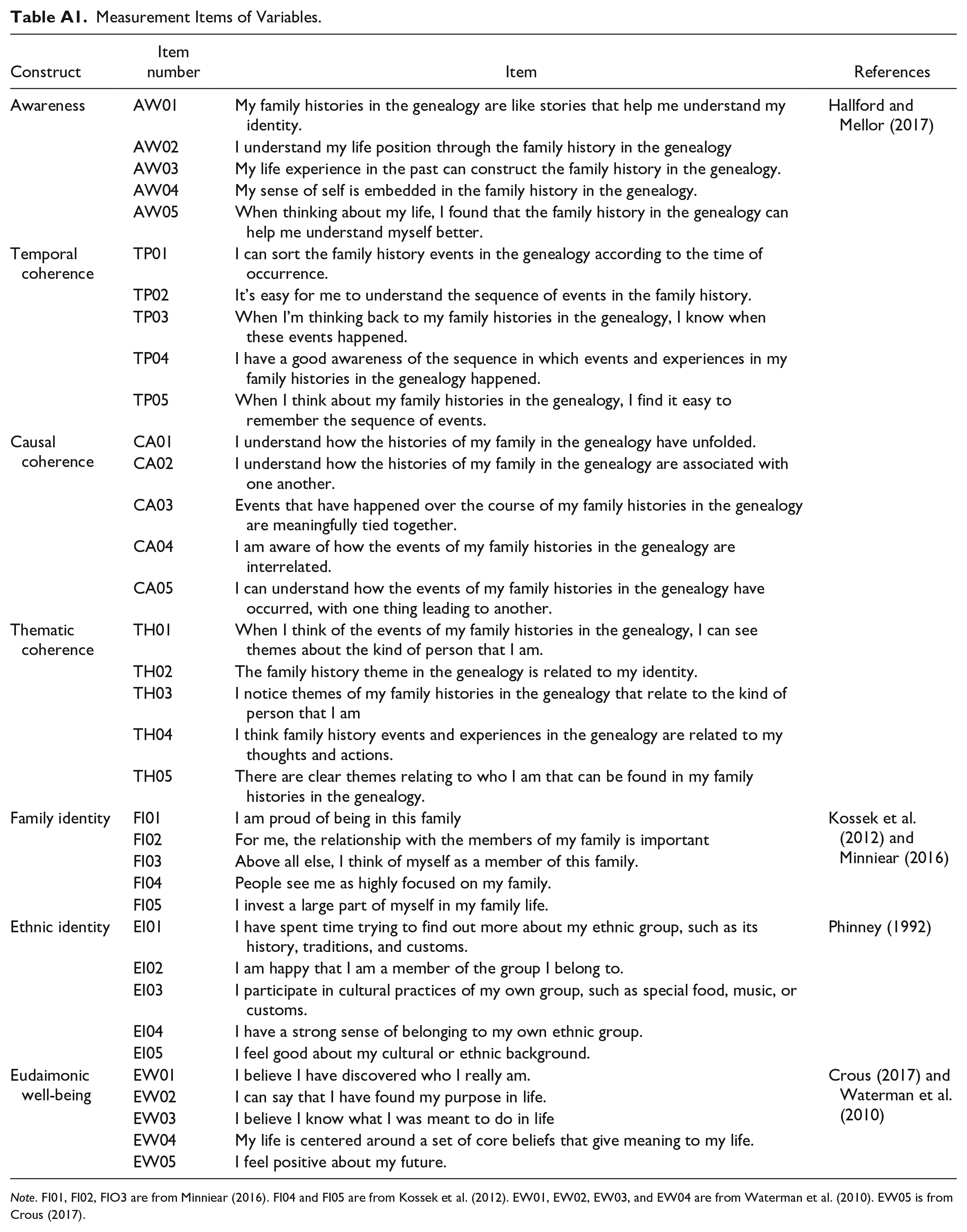
This study adopted a back-translation process in developing the Chinese questionnaire. First, the first author is responsible for adapting and translating the questionnaire from the original English version into the Chinese version. Next, the second author is responsible for translating the Chinese questionnaire into the English questionnaire. Finally, two authors reviewed and compared the two versions of the English questionnaires, confirming the semantic meaning of the items in the Chinese questionnaire that can reflect the concepts of the variables in the proposed research model and fit the research context. All measurement items are listed in the Table A1.
Four subscales measuring narrative identity—that is, awareness, temporal coherence, causal coherence, and thematic coherence—were adapted from the Awareness of Narrative Identity Questionnaire (ANIQ; Hallford & Mellor, 2017) and modified to fit the context of Hakka genealogy writing in accordance proposed research area of this study. The scales with respect to ethnic identity were adapted from the Multigroup Ethnic Identity Measure (Phinney, 1992). The scales were slightly shortened and the items were modified to be relevant to the context of the Hakka ethnic group. The scale items of family identity were drawn from previous studies (Kossek et al., 2012; Minniear, 2016). The items measuring Hakka people’s eudaimonic well-being were adapted from a previously developed questionnaire for eudaimonic well-being (Crous, 2017; Waterman et al., 2010).
The respondents were asked to assess the extent of their agreement with each item by using a 5-point Likert scale, with the range being from strongly agree/high, gaining five points, to strongly disagree/low, receiving one point. Purposive sampling was selected to invite participants who belong to a Hakka family and have had the experience of writing genealogy beforehand.
The questionnaire was distributed from July to November 2016. The online and paper questionnaire was employed to collect data. The paper questionnaires were distributed in the Hakka language seminar. In the seminar, a total of 100 Hakka people whose family had a genealogy at home and who had read it were invited to fill the questionnaires. Also, other people who had participated in genealogy editing in the past and their relatives and friends were invited to fill the online questionnaire. A total of 100 online questionnaires were distributed for them. There are 72 online questionnaires and 56 paper questionnaires that were received. They all identify themselves as the Hakka group, and 82.8% of them have participated in genealogical editing. The t-test shows no significant difference between the means of the paper questionnaires and the online questionnaires. Table 1 shows the profiles of the respondents. Of the total of 128 valid respondents of Hakka people, 51.8% were male.
Profiles of the Respondents.

Data Analysis
The sample of 128 cases in this study, while relatively small, is adequate for Partial Least Squares (PLS) analysis. As previous studies have suggested, smaller samples are suitable when using PLS as an analysis technique for assessing the proposed structural modeling (Chin et al., 2003). Additionally, the sample size of the proposed study also satisfied the guideline that the sample size for using PLS technique should be at least 10 times the largest number of structural paths directed at any one construct (Barclay et al., 1995; Hair et al., 2012). Therefore, structural equation modeling procedures exemplified by SmartPLS 2.0 (Ringle et al., 2005) were used to perform the simultaneous assessments of both the quality of the measurement parameters in the measurement model and the construct interrelationships in the structural model.
The data analysis consisted of the following steps. First, confirmatory factor analysis (CFA) was applied to assess the validity and reliability of the research instrument, including the four dimensions of narrative identity plus family identity, ethnic identity, and eudaimonic well-being. Then, the structural model analysis using SmartPLS was applied to examine the relationships among the research constructs.
CFA was conducted to assess the construct validity of the seven proposed variables at the individual level. As presented in Table 2, the Cronbach’s alpha of the seven research variables ranged from .92 to .97, indicating that the measurement items of seven variables achieve acceptable levels of reliability.
Summary of the Measurement.

The following criteria were applied to assess the construct validity of the seven proposed variables: (1) the standardized indicator loading for certain constructs should exceed 0.50; (2) the average variance extracted (AVE) should exceed 0.50; (3) the square root of the AVE should be greater than the correlation between a particular construct and other constructs; and (4) the construct reliability should exceed 0.70 (Hair et al., 1998). As shown in Table 2, all of the loadings were above the threshold. The AVE values for each construct were above 0.50, ranging from 0.75 to 0.89. As presented in Table 3, all of the square roots of the AVE for each construct were greater than the correlations among the constructs. Accordingly, the measurement model of this study revealed good convergent validity and discriminant validity. The composite reliability (CR) of the research constructs ranged from 0.94 to 0.98, while their Cronbach’s α ranged from 0.92 to 0.97. The results indicate that the scales for assessing all variables have sufficient measurement reliability. Tables 2 and 3 present the results of the measurement validation.
Latent Variable Correlations.

Note. The values in the grey cells of the diagonal line are the square root of AVE for seven constructs.
Structural Model
With the aim of testing the structural model, the bootstrap re-sampling procedure was conducted to examine the statistical significance of the research hypotheses. The model shows a substantial amount of the explained variance in family identity (R2 = .621), ethnic identity (R2 = .776), and eudaimonic well-being (R2 = .597). As shown in Figure 2, the results of path testing support the significance of six research hypotheses, but do not confirm five of the proposed hypotheses.

Research results.
In path testing of the relationships among four features of good narrative genealogy writing, ethnic identity, family identity and eudaimonic well-being, six hypotheses were supported, except for H2. The path coefficient from ethnic identity to eudaimonic well-being is significant (β = .72, p < .001), thus supporting H1. The coefficient on the path from family identity to eudaimonic well-being is not significant (β = .07, p > .1), thus not validating H2. The path coefficient from family identity to ethnic identity is positively significant (β = .60, p < .01), thus providing support for H3.
In path testing of the four features of good narrative genealogy writing and ethnic identity, only thematic Coherence is shown to be positively related to ethnic identity (β = .29, p < .01), but awareness, temporal coherence, and causal coherence are not related to ethnic identity (β = .6, −.04, and .03, p > .1), thus confirming H4d and not supporting H4a, H4b, and H4c. In path testing of the four features of good narrative genealogy writing and family identity, the coefficients on the paths from awareness, causal coherence, and thematic coherence to family identity are positively significant (β = .27, .37, and .35, p < .01), thus supporting H5a, H5c, and H5d. However, the effect of temporal coherence has not been confirmed (β = −.14, p > .1); thus, H5b is not supported. Figure 2 presents the results of the proposed research model in detail.
Mediated Effects Analysis
The proposed research model shows that ethnic identity was assumed to mediate the relationship between family identity and eudaimonic well-being. The result indicated that family identity has no direct effect on eudaimonic well-being (β = .07, p > .1), but might have an indirect impact on eudaimonic well-being by way of ethnic identity. However, the significance assessment of the mediation in the relationship between the independent variable and the dependent variable cannot be directly assessed through a visual inspection of the coefficients from independent variable, to mediation variable, and then to dependent variable. Therefore, the Sobel test, a traditional method for testing the significance of mediation effects (Sobel, 1982), was employed to inspect whether ethnic identity mediates the effect of family identity on eudaimonic well-being. The Sobel test is the most commonly employed method for examining the statistical significance of the mediation effect (Cheung & Lau, 2008). The significance of the Sobel test is measured by the following formula:

where a is the path coefficient from the independent variable to the mediation variable, b is the path coefficient from the mediation variable to the dependent variable, and SEa and SEb are the standard deviations of a and b, respectively.
The magnitude of the mediation is the product of the path coefficient from the independent variable to the mediator and the path coefficient from the mediator to the dependent variable. The unstandardized regression coefficient of a is equal to 0.857 and its corresponding standard error (SEa) is equal to 0.02; the unstandardized regression coefficient of b is equal 0.716 and its corresponding standard error standard error (SEb) is equal to 0.128, thus yielding z = 5.509 (p < .001). The results reveal that ethnic identity fully mediates the relationship of family identity with eudaimonic well-being, thus validating H6.
Discussion and Conclusion
Discussion
This paper develops and tests theory related to Hakka genealogy editors’ use of the narrative approach to construct ethnic identity for the purpose of fostering eudaimonic well-being. These findings are worth summarizing as follows: First, the partial validation of H4 suggested that family identity can be strengthened through awareness (confirmed H4a), causal coherence (confirmed H4c), and thematic coherence (confirmed H4d) in genealogy writing. The result is similar to the finding of Thompson et al. (2009). However, Thompson et al. (2009), using semi-structured interviews, disclosed that intergenerational storytelling with respect to family legacies affects family members’ sense of their own identities. The present study using a survey revealed that narrating the family story in genealogy can enable family identity. Specifically and differently, the finding of the present study suggested that Narrative awareness helps minorities to get the idea of their past, wherein there is a story to help them find their sense of self. The findings thus suggest that developing a sense of self by genealogy writing in terms of narrative awareness can shape family identity. Causal coherence and thematic coherence have been found to be important to determine the qualities of family history description in genealogy writing. The rationale is that the well-done narrative family history contains the well-established records of generational linkages, the migration progress, settlements, and external events relating to the family, which is based on genealogy editors’ abilities to write genealogy with causal coherence and thematic coherence. Thus, the confirmations of H4a, H4b, and H4d suggested that the ability of narrating family history in terms of awareness, causal coherence, and thematic coherence is a key driver of family identity.
Second, among the four features of good genealogy writing, thematic coherence is the only one that has been found to strengthen Hakka ethnic identity (H5d). The finding is somehow in line with the argument of Syed and Azmitia (2010) that narrating lived experiences is related to the developmental processes of ethnic identity. Particularly, Syed and Azmitia focused on narratives of ethnicity-related experiences. Differently, this study shed light on narrating family history in genealogy. As Bluck and Habermas (2000) argued, life narratives are organized through thematic coherence and may exhibit a continuing theme throughout or may develop a theme that emerges as the individual story is told (Bluck & Habermas, 2000). Thematic coherence in genealogy writing, as this study confirmed, should serve as the ability to create overarching themes in a narrative and to establish thematic similarities between various family events. Further, taken together, thematic coherence plays an important role in developing both family identity (H4d) and ethnic identity (H5d). It establishes the framework and whole picture of family history, and then involves ethnic historical events. In exploring the effect of narrative genealogy upon identity development, there needs to be increased focus on thematic coherence.
Third, the facts of not supporting H4b and H5b reveal that temporal coherence did not appear to have a significant effect on either family or ethnic identity. Such results may be partly because people tend to be largely unaware of the sequence in which the family history in the genealogy happened. However, narrative identity development can still be achieved by the awareness, causal coherence, and thematic coherence of family stories manifest in genealogy writing, as we validated H5d, H4a, H4c, and H4d.
Fourth, as H3 is confirmed, ethnic identity has been verified to be strengthened by family identity. The finding is consistent with the perspective of the previous studies (e.g., Fuligni et al., 2007; Oyserman et al., 2007). That is, people learn about their culture from their families. Genealogy, known as family history, is the study of families and the tracing of their lineage and history. They may learn their shared identity from genealogy writing regarding the family histories. In other words, a sense of ethnic identity is developed from a shared culture and history. As people start to write their genealogy, they will recover their ethnic culture and family history. Therefore, according to the confirmations of H3, H4a, H4c, and H4d as a whole, narrative identity by genealogy writing can improve family identity and in turn develop ethnic identity.
Finally, H2 is not supported while H1 is supported. The results indicated that there is no direct effect between family identity and eudaimonic well-being but a relation of ethnic identity to eudaimonic well-being exists. The testing showed that the mediating effect proposed in H6 is supported revealing that the effect of family identity on eudaimonic well-being is fully mediated by ethnic identity. That is, the higher the level of family identity, the higher the levels of eudaimonic well-being are achieved through the mediation of ethnic identity. Because the capacity to narrate genealogy about family experiences differs across different minorities, the conclusion drawn above should be interpreted in relation to Hakka culture with caution. However, as to the present study, the finding is that Hakka people’s well-being, individually and collectively, is closely linked to the values that arise from a strong sense of Hakka cultural identity.
Conclusion
In conclusion, narrative identity, such as by genealogy writing, plays an important role in developing ethnic identity. It has been argued that narrative identity corresponds to eudaimonic well-being (Bauer et al., 2008). Nevertheless, the mechanism of how narrative identity develops and facilitates eudaimonic well-being is not well understood. It is here that this study develops the integrated model on the narrative identity approach and a fuller understanding of how narrative identity by genealogy writing can facilitate ethnic identity. As the study revealed, ethnic identity reconstruction is the result of the narrative of historical family memory. This study provided evidence to suggest minorities improve their ethnic identity effectively through narrative and family identity.
The findings of the study, by establishing a link between ethnic identity and eudaimonic well-being, support the idea that minorities may enhance their eudaimonic well-being by use of narrative genealogy writing to achieve family identity and ethnic identity. Family identity is significantly related to ethnic identity, even though three narrative constructs, including awareness, temporal coherence, and causal coherence, have no significant effect on or link to ethnic identity. Therefore, the most important finding is that ethnic identity has a full mediation effect between family identity and eudaimonic well-being. Without ethnic identity, members of a minority, even if they have family identity cannot feel a good sense of the overall quality of their life, that is, their eudaimonic well-being. They can feel fulfillment, however, by engaging in genealogy writing because the sense of the thematic coherence of the family histories obtained in that way drives an improvement in ethnic identity. The finding suggests that in practice, the minority, such as Hakka people, can construct their family identity and ethnic identity through narrative genealogy writing, as this research revealed. In other words, narrative genealogy writing may serve as a means for the ethnic minority to enhance their family identity and ethnic identity, thereby being good for them in pursuit of eudaimonic well-being.
In sum, the present study demonstrates the model of eudaimonic well-being from the perspective of narrative identity. It takes an initial step toward discovering the relationship between narrative genealogy writing and ethnic identity development in terms of family identity and ethnic identity. We empirically confirm the role of family identity and ethnic identity in the association of narrative identity with eudaimonic well-being. Taken together, the present study has contributed to narrative literatures by theoretically addressing the pathway of narrative identity for achieving eudaimonic well-being. Future research can extend this model to explore the pathway of narrative identity development to eudaimonic well-being in different contexts, thereby gaining a more comprehensive understanding of how narrative identity can lead to eudaimonic well-being.
The present study enhances the previous studies’ findings by providing, with respect to the Hakka, a much more detailed examination of ethnic identity reconstruction. This study, however, has its limitation. The data were collected from members of the Hakka ethnic group. As this sampling choice was limited to those from a particular genealogy, it limits the generalizability of the results. More studies with the cross-ethnic and minority samples are needed in future research to inspect the generalization and for a better understanding of how narrative identity leads to eudaimonic well-being.
Footnotes
Appendix
Measurement Items of Variables.
| Construct | Item number | Item | References |
|---|---|---|---|
| Awareness | AW01 | My family histories in the genealogy are like stories that help me understand my identity. | Hallford and Mellor (2017) |
| AW02 | I understand my life position through the family history in the genealogy | ||
| AW03 | My life experience in the past can construct the family history in the genealogy. | ||
| AW04 | My sense of self is embedded in the family history in the genealogy. | ||
| AW05 | When thinking about my life, I found that the family history in the genealogy can help me understand myself better. | ||
| Temporal coherence | TP01 | I can sort the family history events in the genealogy according to the time of occurrence. | |
| TP02 | It’s easy for me to understand the sequence of events in the family history. | ||
| TP03 | When I’m thinking back to my family histories in the genealogy, I know when these events happened. | ||
| TP04 | I have a good awareness of the sequence in which events and experiences in my family histories in the genealogy happened. | ||
| TP05 | When I think about my family histories in the genealogy, I find it easy to remember the sequence of events. | ||
| Causal coherence | CA01 | I understand how the histories of my family in the genealogy have unfolded. | |
| CA02 | I understand how the histories of my family in the genealogy are associated with one another. | ||
| CA03 | Events that have happened over the course of my family histories in the genealogy are meaningfully tied together. | ||
| CA04 | I am aware of how the events of my family histories in the genealogy are interrelated. | ||
| CA05 | I can understand how the events of my family histories in the genealogy have occurred, with one thing leading to another. | ||
| Thematic coherence | TH01 | When I think of the events of my family histories in the genealogy, I can see themes about the kind of person that I am. | |
| TH02 | The family history theme in the genealogy is related to my identity. | ||
| TH03 | I notice themes of my family histories in the genealogy that relate to the kind of person that I am | ||
| TH04 | I think family history events and experiences in the genealogy are related to my thoughts and actions. | ||
| TH05 | There are clear themes relating to who I am that can be found in my family histories in the genealogy. | ||
| Family identity | FI01 | I am proud of being in this family | Kossek et al. (2012) and Minniear (2016) |
| FI02 | For me, the relationship with the members of my family is important | ||
| FI03 | Above all else, I think of myself as a member of this family. | ||
| FI04 | People see me as highly focused on my family. | ||
| FI05 | I invest a large part of myself in my family life. | ||
| Ethnic identity | EI01 | I have spent time trying to find out more about my ethnic group, such as its history, traditions, and customs. | Phinney (1992) |
| EI02 | I am happy that I am a member of the group I belong to. | ||
| EI03 | I participate in cultural practices of my own group, such as special food, music, or customs. | ||
| EI04 | I have a strong sense of belonging to my own ethnic group. | ||
| EI05 | I feel good about my cultural or ethnic background. | ||
| Eudaimonic well-being | EW01 | I believe I have discovered who I really am. | Crous (2017) and Waterman et al. (2010) |
| EW02 | I can say that I have found my purpose in life. | ||
| EW03 | I believe I know what I was meant to do in life | ||
| EW04 | My life is centered around a set of core beliefs that give meaning to my life. | ||
| EW05 | I feel positive about my future. |
Note. FI01, FI02, FIO3 are from Minniear (2016). FI04 and FI05 are from Kossek et al. (2012). EW01, EW02, EW03, and EW04 are from Waterman et al. (2010). EW05 is from Crous (2017).
Declaration of Conflicting Interests
The author(s) declared no potential conflicts of interest with respect to the research, authorship, and/or publication of this article.
Funding
The author(s) disclosed receipt of the following financial support for the research, authorship, and/or publication of this article: This research was supported financially by the Ministry of Science and Technology (MOST), Taiwan [Grant number: MOST 103-2410-H-239-004-MY2].
