




Abstract
Online user-generated content continues to attract the attention of practitioners and academics. However, there is limited research on the fundamental motivations and psychological factors underpinning users’ urge to post online. Thus, the objective of this study is to investigate the impact of users’ existence, relatedness, and growth needs on intrinsic and extrinsic motivations and their urge to post online reviews. In addition, it examines the moderating effect of website features (i.e., perceived critical mass, brand awareness, and information quality) on such an impact. A regression analysis reveals that existence and growth needs have a significantly higher and more positive impact on intrinsic motivations than on extrinsic motivations. Relatedness needs, on the other hand, has a significantly higher and more positive influence on extrinsic motivations. Further, this study shows that existence, relatedness, and growth needs have a significant direct effect on the urge to post online reviews. It also confirms that website features significantly moderate the relationship between intrinsic motivations and the urge to post online reviews. In particular, perceived critical mass has a significantly moderating effect on the relationship between extrinsic motivations and the urge to post online reviews. The study concludes with the academic and managerial implications of its findings, its research limitations, and directions for future research.
Keywords
Introduction
With proliferating technological advancements and growing prosumer power, the impact of online reviews on physical and online stores can no longer be ignored. Such reviews continue to receive attention from practitioners and academics, with a majority of recent research examining their authenticity (e.g., de Gregorio et al., 2021; Hlee et al., 2021) and impact (e.g., Xu, 2021; Zafar et al., 2021). However, there is limited work on the reasons and motivations underpinning individuals’ desire to post their thoughts on the Internet.
Existing research suggests that eagerness to interact with society (Hennig-Thurau et al., 2004), self-realization (Yoo & Gretzel, 2008), care for others, and sense of belonging (Cheung & Lee, 2012) motivate users to post online reviews. Fu et al. (2015) and Dixit et al. (2019) are examples of studies that have adopted theoretical frameworks to examine such conduct. While the former adopts the theory of planned behavior (TPB) for this purpose, the latter extend TPB to predict consumer intentions to write online reviews. However, neither of these addresses the fundamental motivations driving such conduct. Hu and Kim (2018) discuss the relationship between the motivation to post online reviews and actual behavior, but they do not apply a holistic theoretical framework in their analysis. Similarly, Thakur (2018) only focuses on satisfaction, trust, and customer engagement to predict the intention to post online reviews. Thus, only a few studies use a comprehensive theoretical framework to explore the antecedents of online posting behaviors and motivations. Moreover, these works focus on a product type, industry, websites, and applications. The present study attempts to address these gaps in the literature.
Motivation theory can be divided into content and process theories: the former focuses on content motivating individual behaviors, while the latter emphasizes the role of processes (Campbell et al., 1970). Thus, content theory appears to be an appropriate tool for exploring the factors driving individuals to post their thoughts online. From the existing content theories, this study adopts the existence, relatedness, and growth (ERG) theory, which evolved from Maslow’s hierarchy of needs (Alderfer, 1972). The key difference between Maslow’s theory (Maslow, 1943) and ERG theory is that the latter simultaneously pursues three types of needs without a strict hierarchical sequence (Alderfer, 1972). Further, while Maslow’s theory suggests that any level of need becomes a dominant force influencing individual behavior when all lower-level needs are satisfied, the fact that individuals have various needs and attempt to satisfy multiple needs simultaneously means that the pursuit of needs at a specific level limits progression to higher levels.
In view of its less restrictive approach, ERG theory is more suitable for the purpose of this study. This is because individuals’ efforts to gain knowledge about the physiological and safety aspects of an event through online reviews are consistent with the theory’s definition of existence needs. Similarly, posting online reviews to interact with others satisfies relatedness needs, and using an online platform to express creativity and achieve productivity at a personal and environmental level addresses growth needs.
Research on the motivation to share e-business content (Vilnai-Yavetz & Levina, 2018) identifies six dimensions of motivation: helping others (HO), supporting websites (SW), feeling interested (FIT) (i.e., intrinsic motivations or IM), recognition from others (RFO), social connections (SC), and financial incentives (FIC) (i.e., extrinsic motivation or EM). According to Lussier and Achua’s (2007) definition of process motivation, individuals’ behaviors are contingent on their motivations to fulfill their needs. Therefore, this study aims to explore whether intrinsic psychological factors such as existence, relatedness, and growth needs, as well as intrinsic and extrinsic motivations, influence a person’s urge to post online reviews (UTPOR). Urge in this sense is defined as a state of desire experienced upon encountering an object in an environment (Beatty & Elizabeth Ferrell, 1998). Some studies consider the urge to do something as a proxy for actual behavior in online and social commerce environments (Chen et al., 2016; Xiang et al., 2016). Thus, this research focuses on users’ urge to post online reviews.
A question that arises in this context is whether, in addition to psychological factors, external factors such as website features affect individuals’ urge to post online reviews. To address this, the study examines whether the relationship between motivation and the urge to post online reviews is moderated by website features (i.e., perceived critical mass [PCM], website brand awareness [WBA], and information quality [IQ]). Perceived critical mass means that a higher number of users reassure individuals and increases their willingness to use the system (Van Slyke et al., 2007). Website brand awareness influences users to trust a website and increases their willingness to use it (Abdul-Rahman & Hailes, 2000). Both perceived critical mass and website brand awareness are related to existence needs. Moreover, websites with higher information quality tend to evoke a more positive user satisfaction (Chen & Chang, 2018) and willingness to participate (Ashfaq et al., 2020), illustrating the relationship between information quality and existence, relatedness and growth needs. Therefore, this study incorporates into its analytical framework the three websites features of perceived critical mass, brand awareness, and information quality as moderators.
In sum, this study explores the relationship between needs, motivations, and behaviors, and at the same time examines the moderating effect of website features. The research contributes toward deepening the existing understanding of the psychological factors influencing an individual’s urge to post online reviews and offers key managerial implications for website designers and administrators.
Literature Review and Theoretical Background
Needs Versus Motivations to Post Online Reviews
Studies have shown that need is an essential condition for human beings irrespective of will (Kotler, 1984), whereas motivation is an intrinsic state in which individuals may feel energized and gain a sense of direction to maintain a given behavior or engagement in an activity (Maehr & Meyer, 1997). Maslow (1954) demonstrates that motivation emanates from unmet physical or psychological needs and reflects an individual’s personality traits. According to Arshadi (2010), autonomous support can predict the satisfaction of psychological needs, which critically influence the motivation to work. Lussier and Achua (2007) suggest a positive causal relationship since individuals’ experience motivation when their needs are met.
ERG theory assumes that human beings strive to meet the three core needs of existence, relatedness, and growth by obtaining materials, maintaining relationships, and seeking opportunities for unique personal development, respectively. These needs have a positive causal relationship with, and serve as the basis for, motivation (Alderfer, 1972). Both motivation levels and orientation (i.e., types of motivations) differ by individual (Ryan & Deci, 2000). The types of motivations can be traced back to Deci and Ryan’s (1985) self-determination theory, which divides motivation into intrinsic and extrinsic motivation depending on various causes or goals leading to action. Intrinsic motivation is endogenous rather than extrinsic, and is manifested in situations where people’s actions are driven by interest or pleasure. Extrinsically motivated individuals, on the other hand, are stimulated by rewards and punishments and not happiness or dissatisfaction.
Alderfer (1972) argues that existence, relatedness, and growth needs are fundamental and constitute the inner needs of human beings. Yin and Zeng (2020) apply ERG theory to investigate the inner needs of nurses caring for patients with coronavirus disease 2019 (COVID-19) and to offer corresponding interventions. In addition, Yang et al. (2011) use ERG theory to explore the factors affecting consumers’ selection of mobile value-added services. Caulton (2012) also propose that ERG is a motivational construct and can be used to realize what internal perspectives move humans to certain behaviors. Besides, Vilnai-Yavetz and Levina (2018) show that actions that are not motivated by financial incentives are generally associated with positive normative beliefs. The authors also find that users of social networking services are likely to prioritize intrinsic motivation (e.g., altruism) over extrinsic motivation (e.g., financial rewards) to engage in social sharing. Ryan and Deci (2000) explain that individuals experience intrinsic motivation to satisfy intrinsic psychological needs. From the foregoing theoretical and empirical findings, this study proposes the following hypothesis.
Motivations Versus the Urge to Post Online Reviews
An urge is a sudden feeling or push to do something (West & Hardy, 2006) and is characterized by spontaneity, irresistibility, and sudden behavioral desires (Beatty & Elizabeth Ferrell, 1998). It has been described as an irrational desire and the intention to act without prior planning (Song et al., 2015). The urge to display certain behaviors is driven by a combination of cue responses, which are highly automated (Chan et al., 2015). Therefore, cues related to inner desire forces individuals to act on their intentions.
The psychology literature suggests that motivation influences the initiation, direction, intensity, and persistence of a behavior. Organizational behavior research finds that motivation is a psychological process that stimulates human behavior (Denhardt et al., 2012). Motivation levels vary when individuals experience an intrinsic driving force toward a desired goal. In this connection, those who can maintain a given level of motivation can sustain not only the pursuit of a goal but also the psychological desire for the goal until it is achieved (Denhardt et al., 2012). Motivation is, therefore, often considered a key driver of behavior. McDavid et al. (2014) find that the needs fulfillment and motivation variables positively predict physical activities. Plecas (2018) also reveals that different motivations for posting reviews online generate different customer behavior. In sum, these findings establish a causal relationship between motivation and behavior.
As previously mentioned, intrinsically motivated individuals are driven by cues related to inner desires that create the urge to act. While the sources and types of intrinsic and extrinsic motivations differ, motivation is a fundamental aspect underpinning psychological processes. Rogers (1995) suggests a causal relationship between intrinsic motivation, extrinsic motivation, and behavioral intentions. Other studies have also shown that intrinsic (enjoyment) and extrinsic (utility) motivations influence individuals’ use of information technology (Kim et al., 2007; Lu & Su, 2009). This study draws on Vilnai-Yavetz and Levina (2018) to explore the motivation to share e-business content and to classify motivation into intrinsic motivation (i.e., helping others, supporting websites, feeling interested) and extrinsic motivation (i.e., recognition from others, social connections, and financial incentives). Accordingly, this study proposes the following hypotheses:
Mediating Effects on the Motivation to Post Online Reviews
In their examination of learning behaviors, Zhou et al. (2019) find that the fulfillment of students’ overall needs may critically contribute to their motivation and engagement. Studies have explored the mediating effect of intrinsic motivation on the relationship between gamification artifacts and crowdsourcing participation (Feng, Jonathan Ye et al., 2018). Intrinsic motivation mediates certain situational factors and behaviors. Satisfying users’ basic psychological needs will develop their intrinsic motivation to engage in gamification information systems (Suh et al., 2018), whereas failure to do so will negatively affect their engagement. This is in line with the findings of Mitchell et al. (2020).
For extrinsic motivation, Wang, Lin, et al. (2019) show the significant and positive impact it has on the intention to contribute information, suggesting a causal relationship between both factors. Similar to Maslow (1954) and Lussier and Achua (2007) state that unmet needs generate the motivation to perform and sustain certain behaviors.
Thus, both intrinsic and extrinsic motivations play a mediating role between various needs and behaviors. Accordingly, this study presents the following hypotheses:
Moderating Effects of Website Features
Perceived critical mass denotes individuals’ willingness to use a communication technology tool when a perceived significant number of users is reached (Van Slyke et al., 2007). Thus, the concept can be applied to gain an understanding of the influence of individuals’ technology usage (Lin & Ha, 2010). Lee et al. (2013) find that the critical mass of users indicates the state of successful group acceptance, which significantly influences the individual use of technology. Shen et al. (2013) demonstrate that perceived critical mass positively influences the “we-intention” (i.e., collective intention) to use instant messaging (Shen et al., 2013). Simply put, the perception of a large number of users motivates individuals to use a given technology (i.e., behavior). This study attempts to understand if the relationship between motivations and the urge to post online reviews is strengthened when perceived critical mass is high and weakened when it is low.
Brand awareness is a reliable indicator of reputation and service. It influences consumer trust (Ubilava et al., 2011), increases consumers’ purchase intentions (Graciola et al., 2020), and plays a key role in consumers’ decision-making process (Hutter et al., 2013). Users can determine if they trust a website based on their previous experiences and website popularity (Abdul-Rahman & Hailes, 2000). Website brand awareness implies familiarity, according to which the higher the degree of users’ familiarity with a website, the more willing they are to use it (Page & Lepkowska-White, 2002). In other words, website brand awareness motivates user behavior. Thus, this study explores whether website brand awareness strengthens or weakens the relationship between motivation and behavior.
Information quality represents the output quality of information systems. Users are more likely to accept a website that provides correct information and conforms to their desired content and format (Delone & McLean, 2003). Ashfaq et al. (2020) show that information quality positively influences consumer satisfaction and predicts user intention to continue using chatbots. Research has also shown that information quality significantly influences users’ utilization of a digital library (i.e., online library platform) (Moorthy et al., 2019) and socialized e-commerce platforms (Jiang et al., 2021). Thus, a website’s information quality influences users’ acceptance and use behaviors. Further, McClure and Seock (2020) suggest that both brand awareness and information quality significantly affect consumers’ engagement on a brand’s social media page.
In sum, perceived critical mass, brand awareness, and information quality affect an individual’s use of technology tools. Using a website as a technology tool, this study examines whether website features strengthen or weaken the relationship between intrinsic and extrinsic motivation on the urge to post online reviews. Accordingly, it proposes the following hypotheses:
Figure 1 illustrates the research model based on this study’s hypotheses.
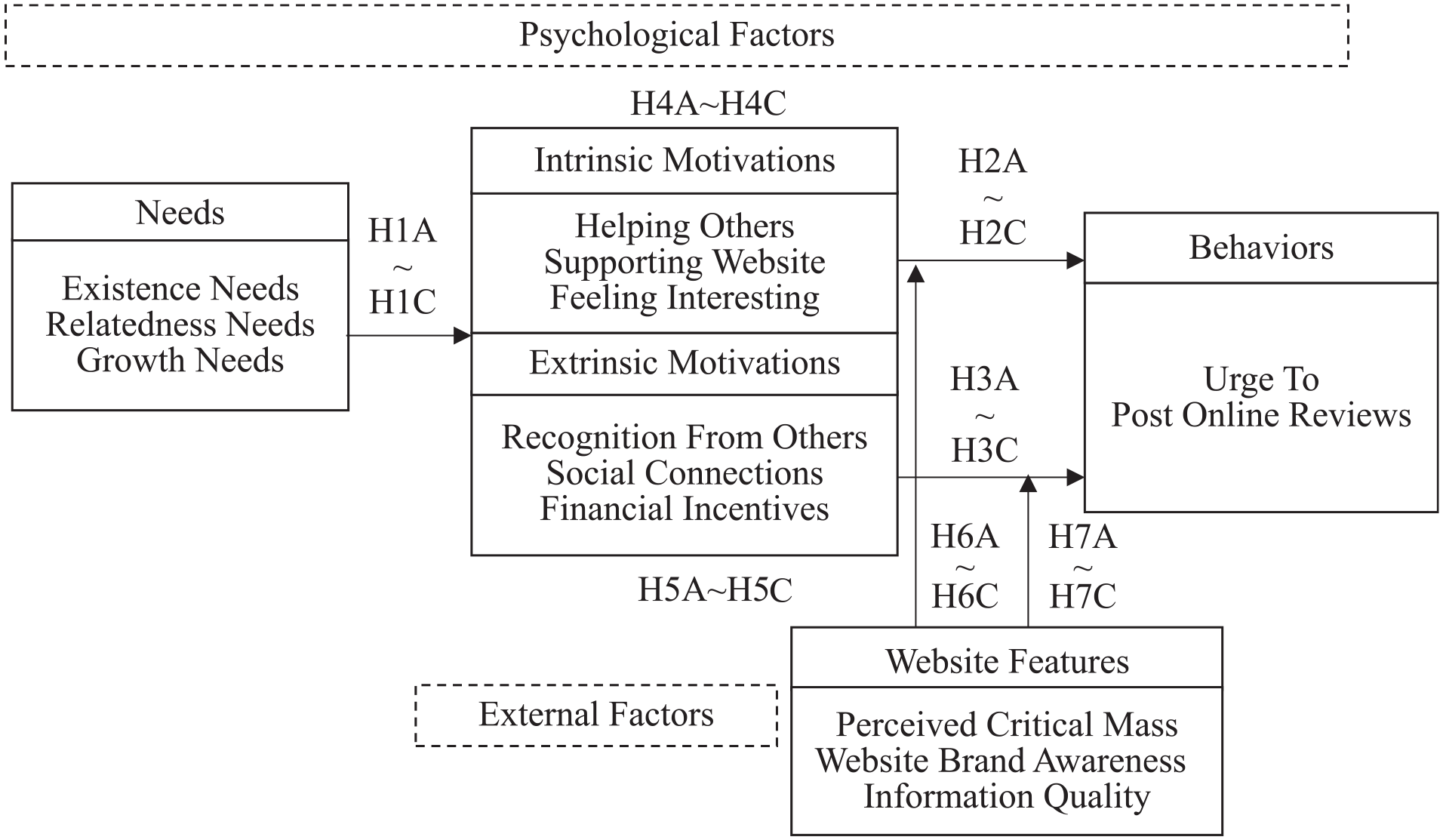
Research model.
Methodology
Data Collection
A convenience sampling approach was adopted for this study, using a paper-based questionnaire in the Chinese language to gather the opinions of individuals who have or have never posted online reviews. The questionnaires were distributed at the Chinese Culture University and two adult education campuses in Taiwan. The participants included full-time students, students with full-time jobs, professors, and faculty members. The authors informed the participants about the study’s purely academic objective and that they would take the survey anonymously. They had to select options provided in the questionnaire that aligned with their opinions. The time required to complete each questionnaire was roughly 10 minutes. Finally, all completed questionnaires were turned over and submitted to the authors, who then arranged them in a randomized order to ensure confidentiality.
Questionnaire
The questionnaire was divided into two parts. Part A focused on participants’ demographic information (e.g., gender, age, occupation, education level, marital status, and average monthly income). It also solicited information about participants’ posting behaviors and categories of online reviews (i.e., product purchase, restaurant, travel, cosmetics and beauty, news, medical, sports, and video games). Part B recorded data on the study’s variables; specifically, participants were asked about the websites they used most frequently during the immediately preceding year. All items in this part were measured using a seven-point Likert scale, where 1 denotes “strongly disagree” and 7 is “strongly agree.”
A pilot survey was conducted, which produced 39 valid responses, based on which the questionnaire was modified. For the final survey, 774 questionnaires were returned, 135 of which were found to be invalid. Thus, this study is based on data from 639 valid questionnaires, indicating a response rate of 82.6%.
Measures
Table 1 presents the definitions and sources for all variables used in this study.
Definition and Sources of Variables.

The questionnaire was developed based on the relevant concepts and variables in the existing literature on the topic, and can therefore be considered to have incorporated valid measurement items appropriate to the research (see Appendix A). Some items were originally in Chinese, while others were in English. To remove any semantic biases, the authors first translated the English items into Chinese, and qualified experts from the related fields back translated these.
Data Analysis and Results
Based on 639 valid questionnaires of final survey, the four parts are described in detail below (1) sample structure, (2) common method bias, (3) reliability and validity analysis, and (4) regression analysis results of research hypothesis.
Sample Structure
The number of respondents who had posted online reviews (61%) was higher than those who had never done so (39%). The main respondent groups were women (62.1%), those younger than 30 years (80.5%), and students (69.6%). A notable proportion of respondents were from the service (11.3%) and commerce (10.0%) industries. About 80% of all participants had a university degree, 83.7% were unmarried, and 72.7% reported an average monthly income of less than TWD 30,000. Of the respondents who posted online reviews, a majority did so for products (41.5%), followed by restaurants (40.5%), travel (33.6%), and news (26.4%).
The cross-table results reveal that women accounted for a majority of the participants who posted online reviews. Further, such reviews by women were more diversified in terms of categories, whereas those by male participants were largely based on sports and videogames. A higher number of the online reviews were posted by those aged 20 to 30 years. In contrast, participants aged 40 years and above were more likely to have never posted an online review. The results are in line with the finding that those born between 1979 and 1995 (also known as generation Y) belong to the Internet era (Issa & Isaias, 2016) and are more familiar with digital technology (Hasbullah et al., 2016).
Common Method Bias
This study followed Podsakoff et al.’s (2003) approach to minimizing the effects of common method bias (CMB) by using constructs developed and validated in top-tier journals. To avoid language problems, the items for each construct were revised and pre-tested to remove such problems, as recommended by Iacobucci and Churchill (2018). In addition, respondents were asked to answer the survey questions as honestly as possible (Conway & Lance, 2010). Finally, this study performed Harman’s single factor test to identify the potential for CMB in the data (Podsakoff et al., 2003) by loading all variables used in the study with a single factor in an unrotated exploratory factor analysis. The results confirmed that the single factor does not explain a majority in variance (32.15%).
Reliability and Validity Analysis
Hair et al. (1995) recommend a Cronbach’s α value greater than .7, which indicates that a scale has a high degree of internal consistency and is acceptable (Hair et al., 1995). In this study, Cronbach’s α ranged between .704 and .928, suggesting that the final questionnaire has high reliability.
To confirm the questionnaire’s effectiveness in measuring the required traits and functions, this study tested the convergent and discriminant validity of the constructs in the final questionnaire. SPSS AMOS 24 was used to conduct a confirmatory factor analysis to obtain factor loadings. In line with the suggestion of Fornell and Larcker (1981) to delete items with factor loadings less than .5, this study omitted one item for the urge to post online reviews. Again, consistent with the same authors’ finding that an average variation extraction (AVE) less than .5 and a combined reliability (CR) score greater than .6 denote convergent validity (Table 2), this study obtained a CR score of greater than .7 and an AVE higher than .5 (only one variable’s score was approximately .5), thus confirming that the questionnaire has convergent validity.
Results of the Convergence Validity Analysis.

Pearson’s correlation analysis was performed using SPSS 22 to test for discriminant validity. An item has discriminant validity if the correlation coefficient between variables is less than the AVE square root (Hair et al., 1998). Accordingly, the diagonal value for one variable was changed to the AVE square root (Table 3). All variables in this study were found to be consistent with the above-mentioned standards, indicating that the final questionnaire meets the criteria of discriminant validity.
Results of the Discriminant Validity Analysis.
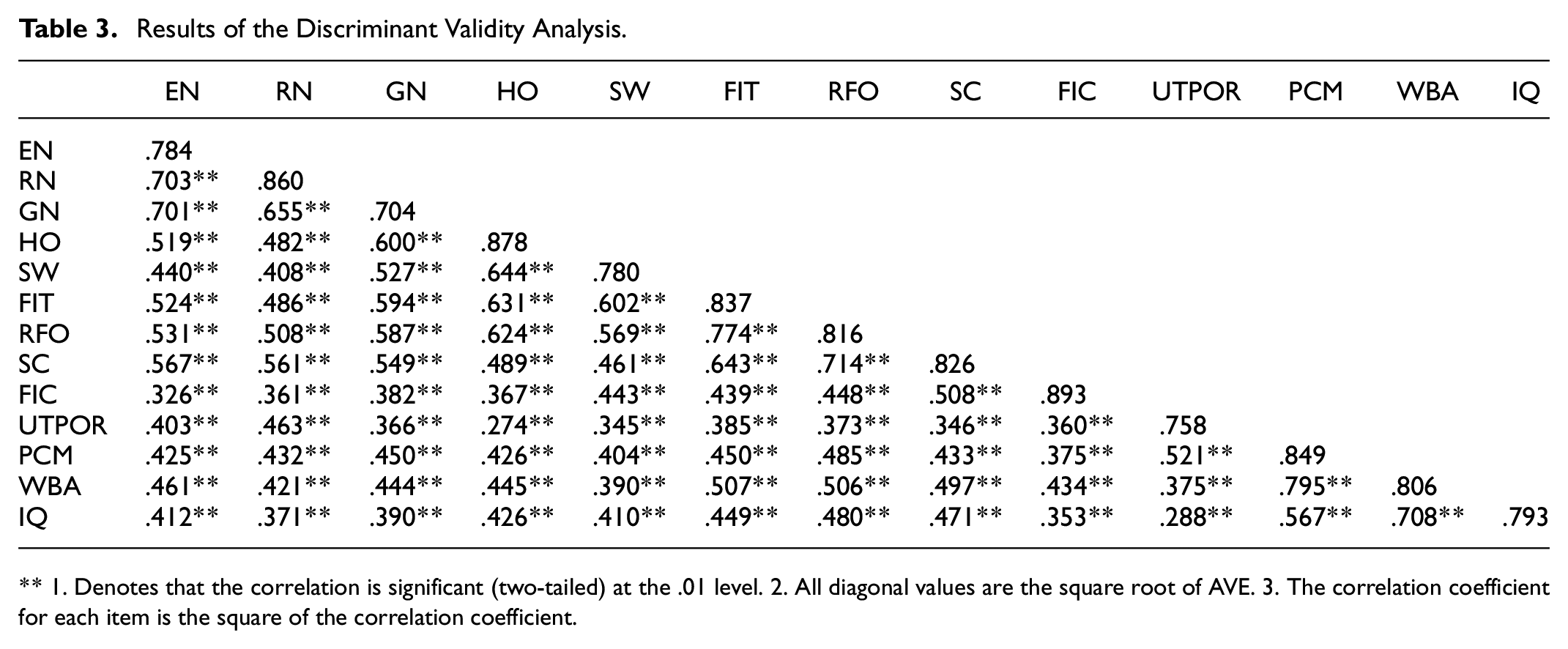
1. Denotes that the correlation is significant (two-tailed) at the .01 level. 2. All diagonal values are the square root of AVE. 3. The correlation coefficient for each item is the square of the correlation coefficient.
The following continues to explain the regression analysis results of research hypotheses, which are the relationships between (1) needs and motivations, (2) motivations and urge to post online reviews, (3) mediating effect of motivations, (4) needs and urge to post online reviews, (5) moderating effects of website features (i.e., received critical mass, brand awareness, and information quality).
Results for the Relationship Between Needs and the Motivations to Post Online Reviews
This section describes the linear regression analysis results of “H1. Existence (A), relatedness (B), and growth (C) needs have a positive impact on both motivations to post online reviews, higher for the intrinsic motivation to post online reviews comparing to the extrinsic motivation to do so.”
Regarding the H1(A), the result shows that the relationship between existence needs and the intrinsic/extrinsic motivations to post online reviews, both are significant (t-value > 2.58, p-value < .001).
Comparing the normalization coefficient β distribution of the two, it is found that intrinsic motivations (.572) is higher than extrinsic motivations (.557). In other words, existence needs have a significantly higher and more positive impact on the intrinsic motivation to post online reviews than on the extrinsic motivation to do so, thus supporting H1(A).
For the H1(B), the result shows that the relationship between relatedness needs and the intrinsic/extrinsic motivations to post online reviews, both are significant (t-value > 2.58, p-value < .001).
The normalization coefficient β distribution of extrinsic motivations (.562) is higher than intrinsic motivations (.530). That is, relatedness needs have a significantly higher and more positive impact on the extrinsic motivation to post online reviews than on the intrinsic motivation to so. However, this result does not support H1(B).
As for the H1(C), the result shows that the relationship between growth needs and the intrinsic/extrinsic motivations to post online reviews, both are significant (t-value > 2.58, p-value < .001).
Regarding the normalization coefficient β distribution, the results show that intrinsic motivations (.663) are higher than extrinsic motivations (.596). Namely, growth needs have a significantly higher and more positive impact on intrinsic motivation than on extrinsic motivation, thus supporting H1(C). Table 4 presents the analysis results.
Results for the Relationships Between Needs and Motivations.

Denotes p < .001
The shaded values marked in the table are text descriptions mentioned above for easy viewing.
Results for the Relationship Between Motivations and the Urge to Post Online Reviews
This part describes the linear regression analysis results of “H2. intrinsic motivation helping others (A), supporting websites (B), and feeling interested (C) to post online reviews have a positive impact on the urge to post online reviews.” For the impact of intrinsic motivation helping others/supporting websites/feeling interested on the urge to post online reviews, all of them are significant (t-value > 2.58, p-value < .001). In other words, all three variables for intrinsic motivations have a significant and positive impact on the urge to post online reviews, thus supporting H2(A), H2(B), and H2(C). Table 5 shows the analysis results.
Results for the Relationship Between IM and UTPOR.

Denotes p < .001
The shaded values marked in the table are text descriptions mentioned above for easy viewing.
This part describes the linear regression analysis results of “H3. extrinsic motivation recognition from others (A), social connections (B), and financial incentives (C) to post online reviews have a positive impact on the urge to post online reviews.” In respect of the impact of extrinsic motivation recognition from others/social connections/financial incentives on the urge to post online reviews, all are significant (t-value > 2.58, p-value < .001). Thus, all variables of extrinsic motivation have a significant and positive impact on the urge to post online reviews. These results support H3(A), H3(B), and H3(C). Table 6 presents the results.
Results for the Relationship Between EM and UTPOR.

<.001
The shaded values marked in the table are text descriptions mentioned above for easy viewing.
Results for the Mediating Effect of Motivations
In this section, we present the two-step hierarchical regression analysis results of “H4. intrinsic motivation helping others (A), supporting websites (B), and feeling interested (C) to post online reviews positively mediates the relationship between existence (a), relatedness (b), and growth (c) needs and the urge to post online reviews.”
Through hierarchical regression analysis, the results reveal tolerance values greater than .5 (between .64 and 1) and a variance inflation factor (VIF) less than 2 (between 1 and 1.408). In other words, there is no collinearity between the variables, and thus, the results are not biased by collinearity.
As regards the mediating effect of intrinsic motivation helping others (A), supporting websites (B), and feeling interested (C) on the relationship between existence needs (a) and the urge to post online reviews, all of them are significant.
The standardization coefficient β distributions for the three variables in Model 1 (.403) are greater than those in Model 2 (.356, .311, and .277). Thus, the intrinsic motivation to post online reviews significantly and positively mediates the relationship between existence needs and the urge to post online reviews. These results partially support H4(Aa), H4(Ba), and H4(Ca).
Regarding the mediating effect of intrinsic motivation helping others (A), supporting websites (B), and feeling interested (C) on the relationship between relatedness needs (b) and the urge to post online reviews, all of them are significant.
Further, the standardization coefficient β distributions for the three variables in Model 1 (.463) are greater than those in Model 2 (.431, .386, and .361). Thus, intrinsic motivation significantly and positively mediates the relationship between relatedness needs and the urge to post online reviews. These results partially support H4(Ab), H4(Bb), and H4(Cb).
As for the mediating effect of intrinsic motivation helping others (A), supporting websites (B), and feeling interested (C) on the relationship between growth needs (c) and the urge to post online reviews, all of them are significant.
In addition, for all three variables, the standardization coefficient β distributions in Model 1 (.366) are greater than those in Model 2 (.316, .256, and .213). Thus, intrinsic motivation significantly and positively mediates the relationship between growth needs and the urge to post online reviews. These results partially support H4(Ac), H4(Bc), and H4(Cc). Table 7 presents the results.
Results for the Mediating Effects of IM and UTPOR.

, **, and *** denote p < .01, p < .05, and p < .001, respectively
The shaded values marked in the table are text descriptions mentioned above for easy viewing.
Next, we describe the two-step hierarchical regression analysis results of “H5. extrinsic motivation recognition from others (A), social connections (B), and financial incentives (C) to post online reviews positively mediates the relationship between existence (a), relatedness (b), and growth (c) needs and the urge to post online reviews.”
Through hierarchical regression analysis, the results show tolerance values greater than .5 (between .656 and 1) and VIF less than 2 (between 1 and 1.525). Thus, there is no collinearity between the variables in this study.
As for the mediating effect of extrinsic motivation recognition from others (A), social connections (B), and financial incentives (C) on the relationship between existence needs (a) and the urge to post online reviews, all of them are significant.
Moreover, the standardization coefficient β distributions for the three variables in Model 1 (.403) are greater than those in Model 2 (.285, .304, and .319). Therefore, extrinsic motivation significantly and positively mediates the relationship between existence needs and the urge to post online reviews. These results partially support H5(Aa), H5(Ba), and H5(Ca).
Regarding the mediating effect of extrinsic motivation recognition from others (A), social connections (B), and financial incentives (C) on the relationship between relatedness needs (b) and the urge to post online reviews, all of them are significant.
The standardization coefficient β distributions for the three variables in Model 1 (.463) are greater than those in Model 2 (.368, .393, and .383). In other words, extrinsic motivation to post online reviews significantly and positively mediates the relationship between relatedness needs and the urge to post online reviews. These results partially support H5(Ab), H5(Bb), and H5(Cb).
For the mediating effect of extrinsic motivation recognition from others (A), social connections (B), and financial incentives (C) on the relationship between growth needs (c) and the urge to post online reviews, all of them are significant.
Further, the standardization coefficient β distributions for the three variables in Model 1 (.366) are higher than those in Model 2 (.225, .253, and .268). This suggests that extrinsic motivation to post online reviews significantly and positively mediates the relationship between growth needs and the urge to post online reviews. These results partially support H5(Ac), H5(Bc), and H5(Cc). Table 8 presents the analysis results.
Results for the Mediating Effects of EM and UTPOR.

, **, and *** denote p < .01, p < .05, and p < .001, respectively
The shaded values marked in the table are text descriptions mentioned above for easy viewing.
Results for the Relationship Between Needs and the Urge to Post Online Reviews
To understand the direct effects more clearly, the results of linear regression analysis are shown that existence, relatedness, and growth needs have a significant and positive impact on the urge to post online reviews. Namely, there is no need to through the mediating effects of intrinsic and extrinsic motivations. Table 9 shows the results.
Results for the Relationship Between Needs on UTPOR.

Denotes p < .001
The shaded values marked in the table are text descriptions mentioned above for easy viewing.
Results for the Moderating Effect of Perceived Critical Mass
This section explains the three-step hierarchical regression analysis results of “H6(A). perceived critical mass positively moderates the effect of intrinsic motivation on the urge to post online reviews,” and “H7(A). perceived critical mass positively moderates the effect of extrinsic motivation on the urge to post online reviews.”
To avoid collinearity, this analysis estimated Z-scores for all variables used in this study. Through hierarchical regression analysis, the results show that the tolerance values are greater than .5 (between .710 and 1) and VIF is less than 2 (between 1 and 1.408). Thus, there is no collinearity between the variables.
Next, the result shows that for Z-IM × Z-PCM in Model 3, t-value is 3.148 > 1.96 and p-value is .002 < .05. This indicates that perceived critical mass has a significantly positive moderating effect on the relationship between intrinsic motivation and the urge to post online, thus supporting H6(A).
In comparison, for Z-EM × Z-PCM in Model 3, t-value is 2.879 > 1.96 and p-value is .004 < .05. Here as well, perceived critical mass has a significantly positive moderating effect on the relationship between extrinsic motivation and the urge to post online reviews, thus supporting H7(A). Table 10 details the results.
Results for the Moderating Effects of PCM on UTPOR.

Denotes p < .001
The shaded values marked in the table are text descriptions mentioned above for easy viewing.
Considering these results, this study further examined the differences in the moderating effects of perceived critical mass in higher and lower score groups. The higher and lower score groups are defined, respectively, by the average number of PCM + 1 standard deviation and the average number of PCM − 1 standard deviation. Figure 2 shows that the moderating effects of higher perceived critical mass are significantly stronger than those of lower PCM.
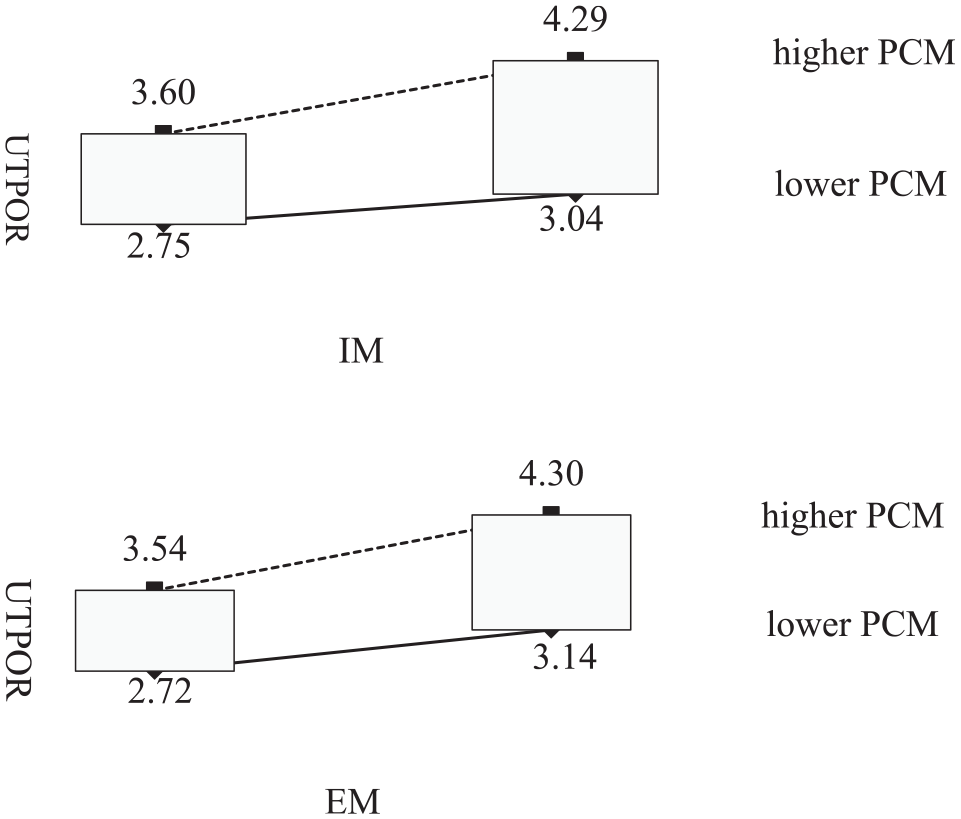
Moderating effects of PCM on UTPOR (i.e., H6A, H7A).
Results for the Moderating Effect of Website Brand Awareness
This part describes the three-step hierarchical regression analysis results of “H6(B). website brand awareness positively moderates the effect of intrinsic motivation on the urge to post online reviews,” and “H7(B). website brand awareness positively moderates the effect of extrinsic motivation on the urge to post online reviews.”
The results for the hierarchical regression analysis show that the tolerance values are higher than .5 (between .658 and 1) and VIF is lower than 2 (between 1 and 1.519). Thus, there is no collinearity between the variables.
Next, the results show that the t-value for Z-IM × Z-WBA is 2.664 > 1.96 with a p-value of .008 < .05. This means website brand awareness has a significantly positive moderating effect on the relationship between intrinsic motivation and the urge to post online reviews, thus supporting H6(B).
In comparison, for Z-EM × Z-WBA, t-value is 1.624 < 1.96 and p-value is .105 > .05, indicating that website brand awareness has no significant moderating effect on the relationship between extrinsic motivation and the urge to post online reviews. This result does not support H7(B). See Table 11 for the results.
Results for the Moderating Effects of WBA on UTPOR.
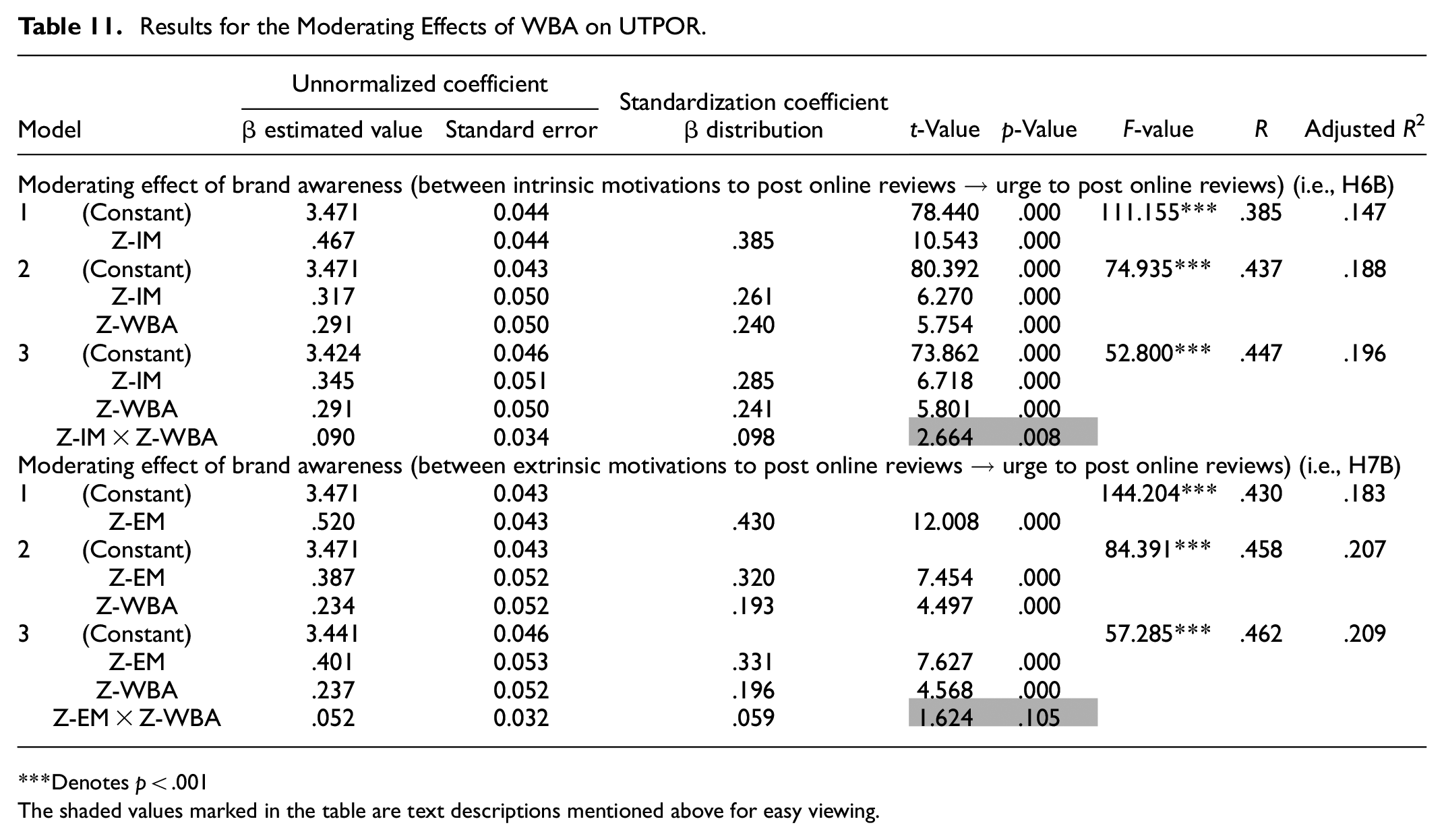
Denotes p < .001
The shaded values marked in the table are text descriptions mentioned above for easy viewing.
In view of these results, this study further investigated the differences in the moderating effects of website brand awareness in higher and lower score groups. Figure 3 shows that higher website brand awareness has a significantly stronger moderating effect than lower website brand awareness.

Moderating effects of BA on UTPOR (i.e., H6B).
Results for the Moderating Effect of Information Quality
Finally presented about the three-step hierarchical regression analysis results of “H6(C). information quality positively moderates the effect of intrinsic motivation on the urge to post online reviews,” and “H7(C). information quality positively moderates the effect of extrinsic motivation on the urge to post online reviews.”
The results for the hierarchical regression analysis show that the tolerance values are greater than .5 (between .729 and 1) and VIF is less than 2 (between 1 and 1.371). Thus, there is no collinearity between the variables.
Next, the results show that for Z-IM × Z-IQ, t-value is 2.028 > 1.96 with a p-value of .043 < .05. This means information quality has a significantly positive moderating effect on the relationship between intrinsic motivation and the urge to post online reviews, thus supporting H6(C).
In comparison, for Z-EM × Z-IQ, t-value is 1.946 < 1.96 and p-value is .052 > .05. In other words, information quality has no significantly positive moderating effect on the relationship between extrinsic motivation and the urge to post online reviews. This result does not support H7(C). Table 12 presents the results.
Results for the Moderating Effects of IQ on UTPOR.

Denotes <.001
The shaded values marked in the table are text descriptions mentioned above for easy viewing.
Considering these results, which show that information quality has significant positive moderating effects on the relationship between intrinsic motivation and the urge to post online reviews, this study further examines the differences in the moderating effects of information quality in higher and lower score groups. Figure 4 shows that higher information quality has a significantly stronger moderating effect than lower information quality.
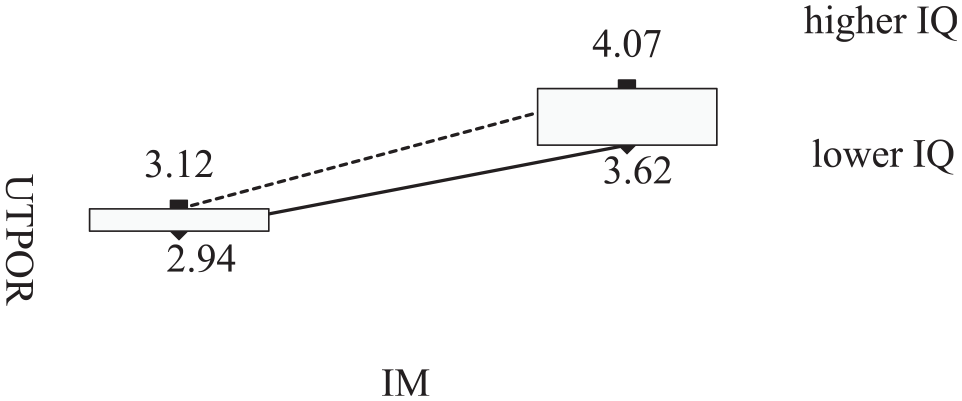
Moderating effects of IQ on UTPOR (i.e., H6C).
Discussion and Conclusions
Research Findings
This study sought to examine the impact of individuals’ needs (i.e., existence, relatedness, and growth) on intrinsic motivation (i.e., helping others, supporting websites, and feeling interested) and extrinsic motivation (i.e., recognition from others, social connections, and financial incentives) to post online reviews, which in turn influence the urge to post online reviews. In addition, it examined whether website features (e.g., perceived critical mass, website brand awareness, and information quality) have a moderating effect on the relationship between intrinsic and extrinsic motivation and the urge to post online reviews.
The findings show that existence and growth needs have a significantly higher and more positive influence on intrinsic motivation than on the extrinsic motivation to post online reviews, a result consistent with those of Alderfer (1972) and Lussier and Achua (2007). In contrast, relatedness needs have a significantly higher and more positive influence on extrinsic motivation than on intrinsic motivation. In other words, when individuals’ relatedness needs are met, extrinsic motivation has a stronger impact than intrinsic motivation.
In addition, this study demonstrates that both intrinsic and extrinsic motivation have a significant and positive influence on the urge to post online reviews. This finding is consistent with those of Rogers (1995) and Lussier and Achua (2007).
The results also confirm that motivations have a significant and positive partial mediating effect on the relationship between needs and the urge to post online reviews, a finding that differs from those of Lussier and Achua (2007), Suh et al. (2020), and Mitchell et al. (2020). This is possibly because there is no need to through the mediating effect of intrinsic and extrinsic motivations on the urge to post online reviews. A further examination reveals that existence, relatedness, and growth needs have a significant and positive effect on the urge to post online reviews. This result is in line with the notion of general cognition, wherein the strong relationship between independent and dependent variables can be explained by mediating variables. The finding is also consistent with those of Kaplan et al. (2018), who demonstrate a relationship between human needs and the intention to use conventional or electric bicycles, and Chen et al. (2012), who find that growth needs have a significant direct effect on turnover intention.
Finally, this study confirms the significant and positive moderating effects of website features on the relationship between intrinsic motivation and the urge to post online reviews. However, only perceived critical mass has a significant and positive moderating effect on the relationship between extrinsic motivation and the urge to post online reviews. These results are consistent with the definitions of extrinsic motivation and perceived critical mass. Website features, such as brand awareness and information quality, however, do not contain the characteristics of interpersonal interactions. In line with this notion, this study shows that brand awareness and information quality do not moderate the relationship between extrinsic motivation and the urge to post online reviews.
Theoretical Contributions
Studies on the tendency to write online reviews largely focus on a single variable or do not use a complete framework to explore the impact of fundamental motivations and psychological factors. Moreover, a majority of research is focused on specific products, industries, websites, or applications.
By adopting a motivation theory perspective, this study constructed a broader research framework to examine the role of needs, motivations, and behaviors in a psychological motivation process using website features as moderators. More specifically, it attempted to understand if external factors such as website features strengthen or weaken the relationship between motivation and behavior. This study was designed in response to calls by scholars to broaden the research scope beyond specific products, industries, and technological media platforms. Accordingly, drawing on ERG theory, it explored the influence of existence, relatedness, and growth needs on intrinsic and extrinsic motivation to post online reviews and subsequent influences on the urge to post online reviews. For this purpose, it uses three website characteristics, namely perceived critical mass, brand awareness and information quality, as moderating variables.
While existing studies confirm the causal relationship between needs, motivations, and behaviors (Lussier & Achua, 2007), this study provides further insight on the matter by demonstrating that the relationship between needs and motivations vary depending on the type of motivation. It also shows that users will experience the urge to post online reviews as long as they are motivated. Further, while motivation plays a partial mediating role, needs have a direct effect on the urge to post online reviews, which is consistent with the finding of Kaplan et al. (2018).
Few studies examine the impact of website features on a user’s urge to post an online review. In its contribution to the topic, this study finds that perceived critical mass moderates the relationship between intrinsic psychological factors, intrinsic and extrinsic motivations, and the urge to post online reviews. However, website brand awareness and information quality only moderate the relationship between intrinsic motivation and the urge to post online reviews. In other words, the number of perceived users is a key factor moderating the motivation to post online reviews and the urge to post online reviews, with the characteristics similar to extrinsic motivation being more related to interpersonal interactions.
In sum, this study explored user behaviors pertaining to posting online reviews from the perspective of individual psychological factors, while accounting for the impact of external factors such as website features, thereby providing significant additional insight on the topic.
Managerial Implications
The findings have key managerial implications for website managers who, in reliance upon these results, could create a platform on which users feel connected with and noticed by others, thus encouraging them to share information and learn. These conditions may also help users feel that their needs are being met, which will motivate them to post online reviews. Website managers could choose the type of motivation on which to focus depending on their target audience, considering that users are likely to experience higher intrinsic and extrinsic motivation when their existence and growth needs are met, and higher extrinsic motivation when their relatedness needs are satisfied.
Thus, to reinforce user motivation to help others, website managers could design public discussion forums or incorporate a reply feature at the bottom of each message. A sharing function strategically positioned near website announcements, information, or feedback messages could generate website support. Managers could enhance feelings of interest by incorporating interactive methods such as videos, audios, images, and virtual reality aspects to encourage users to share information. Features that permit a user to show approval, such as emojis, could also make users feel recognized by others. Fields that display personal information, interests, and previous product purchases also contribute to social connections among users with similar preferences, thereby encouraging information sharing. Financial incentives associated with a particular order or in the form of discounts and money-saving offers could also increase the tendency to make additional purchases in the future.
The study demonstrates that both intrinsic and extrinsic motivations have a significant and positive partial mediating effect on the relationship between needs and the urge to post online reviews; in other words, needs have a significant and positive effect on such an urge. Thus, there is no need to through mediating effect of intrinsic and extrinsic motivations to post online reviews. Accordingly, website managers can influence users’ urge to undertake such an activity through two paths: EN, RN, GN → UTPOR or IM, EM → UTPOR.
Finally, website managers should focus on the quantitative aspects of website users. Since a person’s perception of the number of users does not necessarily reflect actual numbers, the managers should create awareness among users by displaying the number of visitors (e.g., total or daily counts), members, articles, and responses. They can enhance website brand awareness by organizing voting and sponsorship activities to create public awareness about the website, since coverage of such activities in the advertising media generally increases the degree of identification. Lastly, they should pay careful attention to the clarity, credibility, and readability of the information provided, which can be achieved by encouraging users to mention reviews or posts that were the most beneficial.
Limitations and Future Directions
This study is subject to certain limitations that provide avenues for future research. First, its adoption of a cross-sectional approach using self-reported data does not precisely establish the causal relationship between variables. Thus, future research could employ longitudinal and experimental methods to establish a firmer conclusion regarding such a relationship.
Second, the study does not examine other factors such as biological (e.g., personality and inheritance) (CAIE, 2013) and demographic variables (e.g., gender and age) (Leong et al., 2018) that influence the urge to post online reviews. This could be covered in later research studies.
Third, the concept of urge is subjective and based on respondents’ cognitive levels. Thus, future research should consider more objective or other non-subjective characteristics, such as individuals who have never posted online reviews, to examine and compare varying participation levels.
Finally, the moderating variables in this study are based on ERG theory and are used to identify external factors influencing a website. The external factors selected in this study are open and observable to users, and apply to the vast majority of websites. Future research could consider other factors such as the actual number of website visitors, which reflects popularity, attention, attractiveness, and repeated browsing; the frequency of website updates; and the average time taken to respond to users.
Footnotes
Appendix
Measurement Items.

| Variables | Items | Measures | Original | |
|---|---|---|---|---|
| Existence needs | I post online reviews because | Zhou et al. (2016) | ||
| 5 | #there is a sense of personalness | |||
| #there is a sense of sociability | ||||
| #there is a sense of human warmth | ||||
| #there is a sense of human contact | ||||
| #there is a sense of human sensitivity | ||||
| Relatedness needs | I post online reviews because | La Guardia et al. (2000) | ||
| 3 | #I feel loved and cared for | |||
| #I feel a lot of closeness and intimacy | ||||
| #I often feel a lot of distance in relationships | ||||
| Growth needs | I post online reviews because | Alderfer (1972) | ||
| 3 | #it gives me the opportunity to share what I know | |||
| #I can learn new things | ||||
| #it feels like a challenge | ||||
| Intrinsic motivation | I post online reviews because | Vilnai-Yavetz and Levina (2018) | ||
| Helping others | 3 | #I want to help others find a great product | ||
| #I like to help others by giving advice | ||||
| #I want to point out good offers to others | ||||
| Supporting website | 3 | #I want to support an online shop or a brand that I like | ||
| #I look forward to a product and want to reward the online shop or brand | ||||
| #I really like this product or shop and want to contribute to its success | ||||
| Feeling interesting | 3 | #I enjoy sharing information | ||
| #I enjoy sharing my findings with others | ||||
| #I think it is enjoyable to collect products or images in this manner | ||||
| Extrinsic motivation | I post online reviews because | |||
| Recognition from others | 3 | #I feel good telling others about my finds | ||
| #I am happy if others like my content and comment on it | ||||
| #it shows that I know about a certain topic or a product | ||||
| Social connections | 3 | #it allows me to communicate with friends | ||
| #it helps me feel connected with my friends | ||||
| #I like to exchange views about shared interests | ||||
| Financial incentives | 3 | #I get a reward with my current order | ||
| #I get a discount on my next purchase | ||||
| #I can save money on my next purchase | ||||
| Urge to post online reviews | I post online reviews because | Leong et al., 2018 | ||
| 3 | #I feel a sudden urge to post online reviews | |||
| #I experienced many sudden urges to post online reviews | ||||
| # I suddenly had an idea, although I did not want to a post online review | ||||
| Perceived critical mass | I post online reviews because | Hsu and Lin (2010) | ||
| 5 | #many people visit this website compared with other websites | |||
| #many people post articles or respond on this website compared with other websites | ||||
| #I think this website has a lot of members compared with other websites | ||||
| #I expect to see more reviews or articles from this website in the future | ||||
| #I expect more people to join this website in the future | ||||
| Website brand awareness | I post online reviews because | Chen et al. (2013) | ||
| 6 | #many people know this website | |||
| #this website is recognized by the public | ||||
| #this is my favorite website | ||||
| #this website is often introduced and reported on social media | ||||
| #this website is highly recognized among other websites | ||||
| #I heard about this website before I could use it | ||||
| Information quality | I post online reviews because | Zha et al. (2018) | ||
| 3 | #the information provided on the website is up-to-date | |||
| #the information provided on the website is correct | ||||
| #the information provided on the website is extensive | ||||
Declaration of Conflicting Interests
The author(s) declared no potential conflicts of interest with respect to the research, authorship, and/or publication of this article.
Funding
The author(s) disclosed receipt of the following financial support for the research, authorship, and/or publication of this article: This work is partially supported by the Ministry of Science and Technology, Taiwan, R.O.C. under grant MOST 107-2410-H-034-014.
