




Abstract
This cross-sectional study aimed to examine factors associated with Japanese undergraduate nursing students’ motivations and needs to study English. An online survey at one university in Tokyo was conducted from July to October 2018. This survey included students’ basic interest in and reasons for learning English, attitude toward communicating with non-Japanese people, willingness to study English, which could be related to motivations and needs to study English. Structural equation modeling was used to map the association among variables. Overall, 167 students completed the survey. The most frequently cited motivation and needs to study English were for “daily use,” such as traveling. Participation in a study tour through the university was associated with willingness to study English, which was associated with both motivation and needs. Improving curriculum and systems is necessary so that students realize the necessity of English in their clinical or professional activities, and find willingness to study English.
Introduction
Japan’s Ministry of Education, Culture, Sports, Science, and Technology (2018) announced the necessity of strengthening foreign-language education, including English, in Japan to cope with globalization. In Japan, the number of foreign residents is increasing, and reached almost three million in 2019 ~ 2020 (Immigration Services Agency of Japan, 2020). This represents the highest number ever recorded in Japan; however, the percentage of foreign residents in the country is still lower than the corresponding percentages for other countries in the Organization for Economic Co-operation and Development. According to the national survey (Ministry of Health Labour and Welfare, 2021), among non-Japanese residents, 87,565 outpatients and 20,122 inpatients were treated in Japanese hospitals in October 2020, though not all patients are represented by the survey data. While the majority of the non-Japanese patients were Chinese, the most frequent language spoken by patients was English, followed by Chinese and Japanese (Ministry of Health Labour and Welfare, 2021). A study involving international students who visited Japanese hospitals reported that their primary difficulty was communication with staff, and that they would prefer that the medical staff communicate with them in English (Soneta et al., 2021). According to a survey conducted with nurses in two hospitals in Tokyo, the most necessary training for them to care for non-Japanese patients was “English daily conversation” (Kambayashi et al., 2020).
Effective English training that increases study motivation should be necessary for Japanese nurses and nursing students. Nurses who have difficulties communicating with patients from other countries could lose their motivation to attempt communication, which may negatively impact the nurse–patient relationship (Higuchi & Nonaka, 2010). Nurses who have been abroad on study tours (typically short-term professional training or language study) are more confident in their English-language ability than are nurses who have been abroad for tourism purposes (Chiba & Nakayama, 2016). Nursing students who have studied abroad report a perceived benefit in their English-language proficiency and motivation to improve their English; knowledge of global health, health-care systems, and nursing practices; cultural sensitivity and awareness; and identity development (Huffman et al., 2020). Although nursing students in Japanese universities want to use English for hobbies and work, those who experience difficulty learning English often do not perceive English as being important or necessary (Kondo, 2006). Atkinson’s “achievement motivation theory” states that an individual’s motivation to perform a task is dependent on his/her expectancy of success, and the perceived value of such success (Ichikawa, 2014). Thus, students’ expectations regarding the degree to which they can improve their English skills and their perceived benefit of acquiring a proficient level of English affects their motivation to study English.
In order to consider students’ perceived value or benefit, it is essential to understand students’ English learning needs. A study that examined students’ self-perceptions of their English-language ability reported statements such as “I do not have confidence in my English,” “I am anxious speaking English,” and “I do not like English” (Matsuzaki & Sugiyama, 2011), which underlines the need for effective English education. Sugiyama (2010) examined needs for English education among physical and occupational therapist students in a junior college using an English for Specific Purposes (ESP) model; ESP is defined to meet the specific needs of learners, and ESP makes use of underlying methodology and activities of the discipline it serves (Anthony, n.d.). In this regard, health care students learn English to care for patients in English. Sugiyama (2010) reported that, although both teachers and students felt that English was necessary for therapists, they differed in regard to the level of English they felt was necessary. It is necessary to analyze the English-related learning needs of nursing students, set clear goals, and explain to students the level of English they require (Matsuzaki & Sugiyama, 2011; Yasunami, 2005).
Although many studies have reported the educational challenges of non-native English-speaking nursing students in English-speaking countries (Sailsman, 2021), only a few recent studies have considered the challenges regarding English education in non-English speaking countries (Choi, 2021; Kim et al., 2020; Liu et al., 2020). Choi (2021) reported that English-only classroom policy, limited academic literacy in English, and non-localized materials of English for Medical Purposes were not fully fit with South Korean nursing students’ needs and expectations.
Although English-language ability and international experience may influence attitudes toward communicating with people from other countries, few Japan-based studies have investigated the relationships among students’ demographics, such as school year, English-language ability, interest in English, grades in English in high school, experience interacting with people from other countries, and attitudes toward communicating with people from other countries, in this regard. This study explored Japanese undergraduate nursing students’ motivations and needs regarding studying English based on the hypothesis that nursing students’ English levels are related to their attitudes toward interacting with people from other countries. This study also examined factors associated with such motivations and needs, as well as students’ willingness to study English. The aim of this study was to obtain information that can help develop not only an effective English-education curriculum but also a culturally related nursing curriculum for Japanese undergraduate students.
Research Questions
What are undergraduate nursing students’ motivation and needs to study English?
What are the factors associated with nursing students’ attitude toward communicating with people from other countries, and willingness, motivations, and needs to study English? We hypothesized for research question 2 as follows: (1) Basic characteristics, including English level and interaction with people from other countries, and daily interest and reasons for learning English are related to attitude toward communication with people from other countries. (2) In addition to basic characteristics and interest and reasons for learning English, attitude toward communication with people from other countries may be related to willingness to study English. (3) Basic characteristics, interest, and reasons for learning English, attitude toward communication with people from other countries, and willingness to study English are related to motivation and needs to study English. Motivation and learning needs to study English can also be predictors of willingness to study English.
Method
Design
This was a descriptive and cross-sectional study in one medical university located in Tokyo, which used an online self-administered questionnaire. Figure 1 is the research framework, which included all variables used in this study and arrows indicate the analysis of association.

Research framework.
Setting
In the university that served as the setting for this research, freshmen are divided into classes based on their level of English. During first year, they take compulsory English classes for four credits: oral communication classes given by native English-speaking teachers, and reading and writing classes given by Japanese teachers. Sophomores and juniors take a compulsory English reading class for one credit in the first semester, but have no compulsory English classes in the second semester. Seniors do not have any compulsory English classes. Six total credits are available for the compulsory English classes (90 minutes, 15 lectures per credit). Two elective classes, “Practicum of English for Nursing” and “Learning Medical English,” are open to all students from sophomores to seniors, with the former being available during the first semester, and the latter during the second semester.
Participants
All undergraduate nursing students (from first to fourth year) enrolled in the university were targeted, and those who completed the questionnaire were included in this study. The university offers both undergraduate and graduate programs, but the goals and curriculums of the programs differ: the undergraduate program prepares students for basic clinical practice and the graduate program prepares students for research careers. Therefore, we focused on the undergraduate education in this research.
Necessary Sample Size and Power
We used G*Power (Heimrich Heine Universitat Dusseldolf, 2007) to calculate necessary sample size. With an alpha error of .05 and power of .8 in correlation point biserial model in two tails, 120 participants were necessary to detect the effect size of ρ = .25 and 191 participants were necessary to detect the effect size of ρ = .20. When multiple regression with three predictors was used, a sample size of 55 was necessary to detect the effect size of .25 with an alpha error of .05 and power of .95.
Data Collection
Students from each year were asked to participate by the first author who used a PowerPoint presentation to describe the study to the students and distributed a flyer that provided details regarding the aim of the study, the methods involved, contact information for the researchers, and the QR code and URL for the Google Form that linked to the questionnaire. The questionnaire was in Japanese. The study period was from July to October 2018.
Definition of Words
In this paper, “studying English” represents not only study in the classes in the university, but also individuals’ interests related to studying English. “Motivation” is defined as incentive to achieve something and strong will to do something (Pearson, 2008); thus, in this study “motivation to study English” represents the “reason” students want to study English. We categorized motivation based on Ichikawa’s (2014) two-factor learning motivation model (Figure 2). According to Ichikawa (2014), motivation cannot be divided into merely spontaneous or extrinsic; it is related to an individual’s long-term experiences and social environment. There are two factors in the learning motivation model: the importance and utility of the study contents. Both are evaluated from high to low. If the importance of the content is high, it is regarded as “content-involved motivation.” Content-involved motivation comprises fulfilment (i.e., studying itself is fun), discipline (desire to acquire knowledge and culture), and practical reasons (use in one’s professional and general life); meanwhile, “content-separate motivation” includes relationships (conforming with peers), self-esteem (pride and competitive spirit), and rewards (passing exams, acquiring credits). If the utility of the content is high but its importance is low, the motivation is regarded as reward-based, which means that the individual studies in order to get rewards, such as English course credits in university.
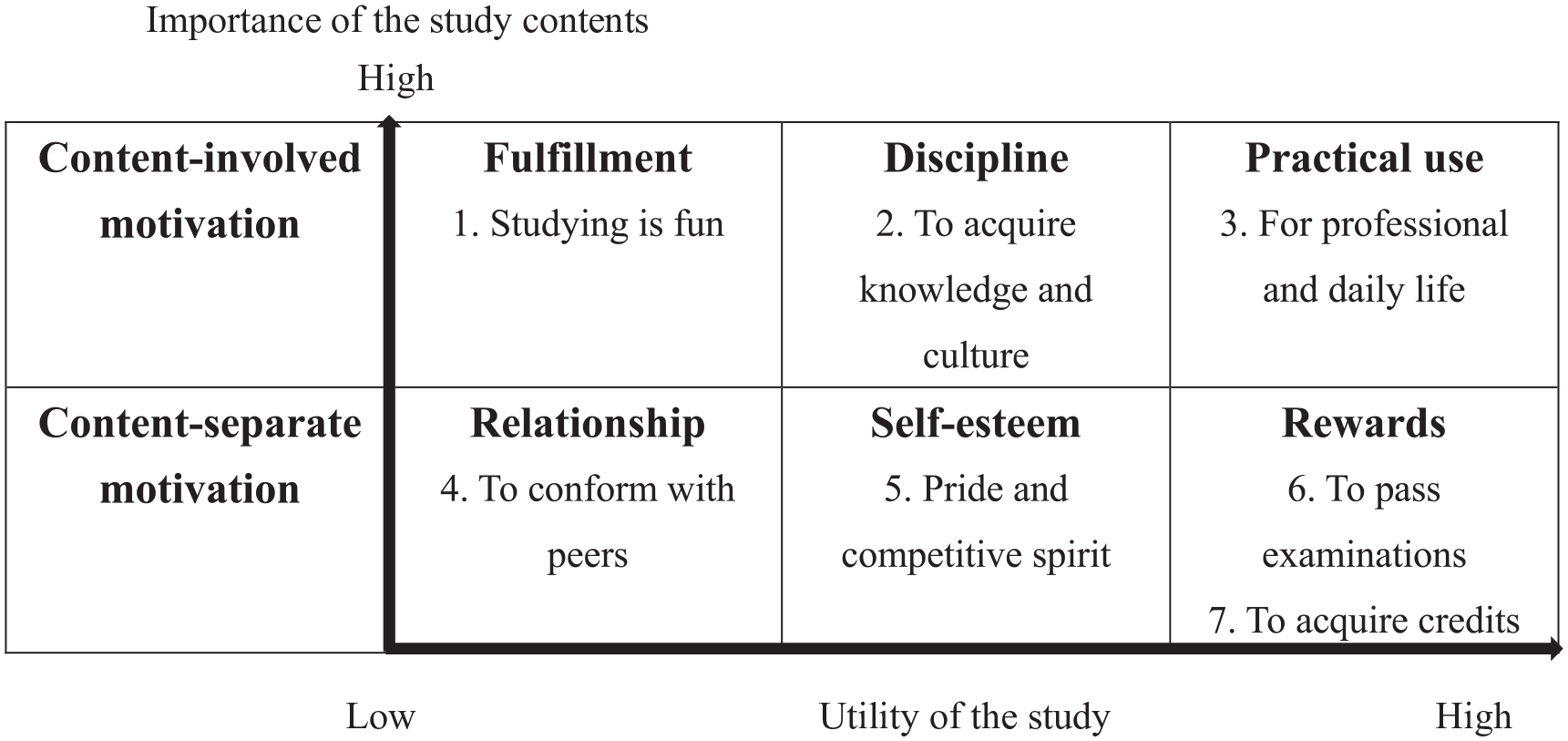
Ichikawa’s two-factor learning motivation model.
Learning needs vary depending on social norms and individual differences, and are defined as “learning methods and contents that, based on individuals’ characteristics, are perceived as necessary to achieve an educational purpose and/or goals” (Furuta, 2007). In this study, we defined student nurses’ needs in relation to English-language ability in the form of 14 “goals” for students to achieve by the time they graduate from university. Seven goals were sourced from Sugiyama (2010): English is necessary for “traveling,” “reading general English,” “writing general English,” “understanding medical and nursing terms,” “reading theses and technical books,” “professional activities,” and “taking examinations through English.” A further five goals were sourced from Matsuzaki and Sugiyama (2011): English is necessary for “having daily conversations,” “managing patients from other countries,” “interacting with colleagues from other countries,” “writing research papers,” and “taking English-proficiency examinations.” We added two further goals: “listening to general English” and “studying abroad.” “Listening to general English” was added because language ability includes not only writing, reading, and speaking but also listening (EST, 2022). “Studying abroad” was added because the study university encourages students to study abroad during and after graduation to become internationally-minded.
Attitude toward communicating with people from other countries in this study refers to how actively students interact with non-Japanese people. Self-efficacy is a potential mediator of the goal-performance relationship. Perceived self-efficacy is the belief a person has that he or she has the capability to accomplish what he or she has set out to do in a task situation (Bandura, 1997; Schmidt, 2019). For example, if students feel difficulty or have interest in communicating with people who do not speak Japanese, it can be a motivation to learn English and they may feel a need to study English. We included this because nurses who have difficulties communicating with patients from other countries could lose their motivation to attempt communication (Higuchi & Nonaka, 2010), and it is necessary to assess the attitude of nursing students and analyze the related factors.
“Willingness” means to have a will to do something. Here we defined “willingness” as “strength” of will to study English. “Interest in and reasons for learning English” means students’ basic or voluntary reasons for studying English, not a goal to achieve by the time they graduate from university. There were 15 variables such as “I am interested in traveling abroad,” and “I would like to travel to English-speaking countries” (Figure 1). The 15 items were selected based on Sugiyama (2010), Kondo (2006), and Garone and Van de Craen (2017). These variables were included because they were considered to be related to their motivation and needs to study English regardless of studies or experiences during the university, and needed to be included in the analysis.
Survey Contents
The survey collected data regarding the students’ basic characteristics (11 items), basic interest in and reasons for learning English (measured using 15 items), attitude toward communicating with people from other countries (1 question), and their willingness (1 question), motivations (1 question), and learning needs regarding studying English as a goal (14 items; Figure 1). The questionnaire was pilot tested with four fourth year nursing students.
In relation to demographic information, characteristics such as school year, English level, grades, interest in English before entering university, and opportunities to interact with people from other countries were collected because these factors were considered to be related to students’ attitude toward communicating with people from other countries, willingness, motivation, and needs to study English (Chiba & Nakayama, 2016; Higuchi & Nonaka, 2010; Sugiyama, 2010).
Self-evaluated English language skill was measured as four levels: native-speaker level, daily conversation level, can speak a few words, and can only greet others.
To score the items concerning whether they had good grades in English in junior high school and high school, respondents used a 4-point scale (1 = “strongly disagree,” 2 = “disagree,” 3 = “agree,” and 4 = “strongly agree”).
Each item regarding their interest in and reasons for learning English were asked using the same 4-point scale (1 = “strongly disagree” and 4 = “strongly agree”).
Attitude toward communicating with people from other countries (Figure 1) was assessed using the same 4-point scale (1 = “strongly disagree” and 4 = “strongly agree”) for the statement “I actively interact with people from other countries.”
Willingness to study English was assessed by asking the students how strongly they would like to study English. Respondents used the same 4-point scale (1 = “strongly disagree” and 4 = “strongly agree”).
Students chose one of seven motivations (Figure 2) for studying English (based on Ichikawa’s two-factor learning motivation model).
To determine their learning needs in regard to studying English, students were asked the above-mentioned 14 goals for graduation (Figure 1). Respondents used the same 4-point scale (1 = “strongly disagree” and 4 = “strongly agree”) for each item.
Analysis
Descriptive and inferential statistics were determined using SPSS version 27 (IBM, n.d) and AMOS version 26 (IBM, n.d). Initially, all data were analyzed using descriptive statistics (Analysis 1). Figure 1 shows Analyses 2 to 5.
For inferential statistics, school year, English level, grades in English in junior high school and high school, interest in English before attending university, past opportunities to converse with people from other countries, experience of other countries, attitude toward communicating with people from other countries, and willingness to study English were regarded as ordinal variables, and Spearman’s correlation coefficients were used to analyze their interrelationships. The Mann-Whitney U test was used to examine the relationship between dichotomous variables (e.g., participation in international events or study tours) and ordinal variables. The Chi square test was used to analyze the association between the two nominal variables. The Shapiro-Wilk test indicated that the total score of needs were normally distributed (p = .055), and a t-test was used to compare the total score of needs between content-involved and content-separate motivation. Responses for the variable concerning attitude toward communicating with people from other countries and the variable concerning willingness to study English were categorized into two groups (“strongly disagree and disagree” and “agree and strongly agree,” respectively), and were used as outcome variables for logistic regression analysis.
The six types of motivation (as the number of selections varied widely across the types; 0–68) were classified into two categories: content-involved motivation and content-separated motivation (Table 1, Figure 2), and were regarded as nominal variables. The utility of learning English was categorized into three categories: low utility (fulfilment and relationships), middle utility (discipline and self-esteem), and high utility (practical and rewards), which were regarded as ordinal variables.
Participants’ Characteristics and Motivation for Studying English N = 167.

Note. TOEFL iTP = Test of English as a Foreign Language—Institutional Testing Program.
The reliability of 14 items of learning needs was confirmed by a Cronbach alpha of .809 and calculated the total score of needs. The 14 items were classified into three domains by factor analysis with varimax rotation: “prepare for professional,” “clinical practitioner,” and “daily use” (Figure 1). Factor loading of all variables in each domain were >0.5. Factor loading of “writing general English” on “prepare for professional” was slightly higher than on “daily use” (0.503 vs. 0.502); therefore, it was classified into “prepare for professional.” “Prepare for professional” included six items (Cronbach alpha = .878), and “clinical practice” (Cronbach alpha = .818) and “daily use” (Cronbach alpha = .832) included four items, respectively. The average score of each domain was calculated. The Shapiro-Wilk test indicated that the average score of each domain was not normally distributed (p < .05); therefore, the Mann-Whitney U test was used to analyze the association with content-involved motivation, and Spearman’s correction coefficients were used to analyze association with utility.
In Analysis 2, factors associated with attitude toward communicating with people from other countries were selected using bivariate analyses, from the respondents’ basic characteristics and their interest in and reasons for learning English (p < .05); these were entered into logistic regression analysis (forward selection: likelihood ratio). If covariates were strongly correlated ρ > .5, one variable that was more highly related to the outcome variable was selected in order to avoid multicollinearity.
In Analysis 3, using bivariate analyses, factors related to willingness to study English were selected from basic characteristics, interest in and reasons for learning English, and attitude toward communicating with people from other countries (p < .05), and were entered into logistic regression in a manner similar to that for Analysis 2. Then, content-involved motivation or utility, and the total score of learning needs were added as predictor variables for willingness (outcome) to study English in the analysis.
In Analysis 4, the association between motivation (outcome) and basic characteristics, attitude toward communicating with people from other countries, willingness to study English, and learning needs were analyzed. Since more factors were associated with content-involved motivation or content-separated motivation rather than level of utility in bivariate analyses, logistic regression was used to analyze the factors related to content-involved motivation.
In Analysis 5, factors related to total score of learning needs (outcome) were analyzed. Initially, bivariate analyses and then linear regression (step-wise) was used.
In Analysis 6, based on the previous logistic and regression analyses, structural equation modeling (SEM) was used to identify the associations among the variables. Model fit was confirmed by chi-square test (p > .05), Comparative fit index (CFI) > 0.97, and Root mean square error of approximation (RMSEA) < 0.05 (Schermelleh-Engel & Moosbrugger, 2003). An alpha error at <.05 was set for significant level in SEM.
Ethics
This study was approved by the Medical Ethics Committee of the university (No. M2018-080). Prospective participants were informed orally and in writing of the aim of the survey, that their responses would remain private and confidential, that participation was voluntary, and that they would not incur any demerits for refusing to participate, although answering all questions on the form was required. The investigator also explained that their answers would not impact their grades. The Google Form was set to be unable to locate email address or IP address. The form featured a consent form, on which the students checked a check box to indicate their consent to participate.
Results
Participants’ Basic Characteristics
Table 1 summarizes the participants’ basic characteristics. The survey was completed by 167 of the 224 students approached (response rate: 74.6%). Since answers to all questions were required, there were no missing data. Regarding their self-evaluated English level, approximately half of the students answered that they could speak “a few words.” Almost 30% of the students reported scoring 500 or above in Test of English as a Foreign Language—Institutional Testing Program score. Most respondents reported having high grades in English in high school and junior high school. Almost 30% reported having opportunities to converse with people from other countries “a few times a month.” Approximately 15% to 16% of students had participated in international events in school or outside of school, while approximately 10% had participated in a study tour through the university.
Among the 15 items regarding interest in and reasons for learning English, three items received the maximum median score (4): “I am interested in traveling abroad,” “I would like to visit English-speaking countries,” and “I am interested in English-language music, movies, and dramas” (Table 2).
Interest in and Reasons for Learning English (N = 167).

Note. SD = standard deviation.
1 = “strongly disagree,” 2 = “disagree,” 3 = “agree,” and 4 = “strongly agree.”
Students’ Motivation and Needs to Study English (Analysis 1)
Among six types of motivation, practical use was most selected (40.7%), followed by rewards (28.7%; Table 1). No student selected self-esteem. Among 14 items of learning needs, “traveling” had the highest average score (3.8), followed by “listening to general English.” “Taking examination” and “using for professional activities” had lowest scores. Table 3 shows the median and mean scores for each learning need. “Traveling” had the highest score, followed by “Listening to regular English.” “Taking examination through English” and “professional activities” received the lowest and second lowest scores, respectively. The median of average scores in each domain of learning needs was highest in “daily use” at 3.75, followed by “clinical practice” at 3.25, and “prepare for professional” being the lowest at 2.33.
Learning Needs (English-Language-Related Goals to Achieve by Graduation; N = 167).

Note. D = daily use; C = clinical practice; P = prepare for professional; SD = standard deviation
1 = “strongly disagree,” 2 = “disagree,” 3 = “agree,” and 4 = “strongly agree.”
Factors Related to Attitude Toward Communicating With People From Other Countries (Analysis 2)
The median score for “I actively interact with people from other countries” was 2 (disagree). Table 4 shows the factors, based on the logistic regression analysis, related to the variable. “Self-evaluated English level” was significantly positively related to attitude (OR = 3.828, 95% CI [1.786, 8.203]).
Factors Associated With Attitude Toward Communicating With People From Other Countries (N = 167).
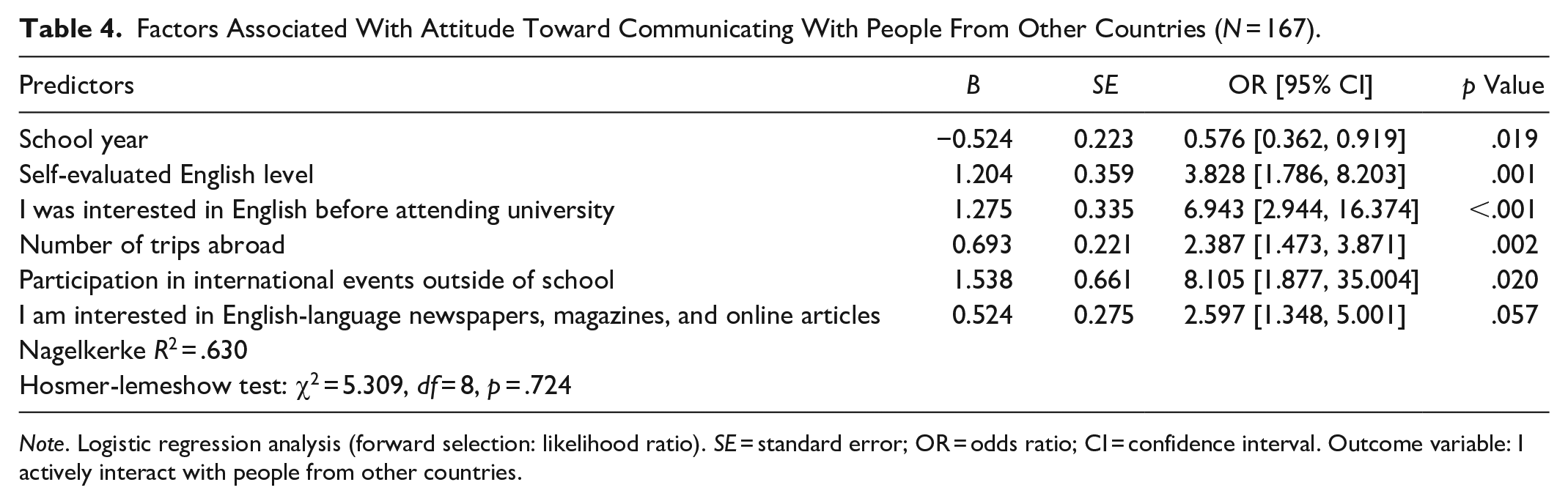
Note. Logistic regression analysis (forward selection: likelihood ratio). SE = standard error; OR = odds ratio; CI = confidence interval. Outcome variable: I actively interact with people from other countries.
Factors Associated With Willingness to Study English (Analysis 3)
The median score for “I have a willingness to study English” was 2 (disagree). Lower school year (OR = 0.525, 95% CI [0.371, 0.742]), higher self-evaluated English level (OR = 2.167, 95% CI [1.211, 3.880]), interest in English before attending university (OR = 3.403, 95% CI [2.018, 5.737]), and participation in a study tour through the university (OR = 6.738, 95% CI [1.240, 36.60]) were related to a higher willingness to study English. In the bivariate analysis, “I actively interact with people from other countries” (ρ = .468, p < .001)), content-involved motivation (ρ = .494, p < .001), utility (ρ = −.126, p = .005), and total score of needs (ρ = .542, p < .001) were correlated with willingness to study English, but all of them were excluded from the final logistic regression model.
Factors Related to Motivation (Analysis 4)
Factors significantly associated with content-involved motivation were willingness to study English (OR = 2.975, 95%CI [1.401, 6.318]), and three interest in and reasons for learning English items: “university nursing students need to study English” (OR = 2.265, 95% CI [1.044, 4.915]), “it is fun to study English” (OR = 3.279, 95% CI [1.628, 6.607]) and “I study English to obtain credits” (OR = 0.525, 95% CI [0.319, 0.864]). The total score of learning needs was not included in the final model, although students with content-involved motivation had significantly higher total score of needs (44.2 vs. 36.1, t = −6.860, p < .001). Total score of needs was not associated with utility.
Factors Related to Learning Needs (Analysis 5)
Factors related to total score of learning needs were “I am interested in a job in which English is used” (β = .486, p < .001), “English is needed in clinical practice” (β = .268, p < .001), “I am interested in English-language newspapers, magazines, and online articles” (β = .191, p = .011), and “willing to study English” (β = .181, p = .005). Motivation was not included the final model.
Association Among Variables (Analysis 6)
Figure 3 shows the SEM that indicates the association among variables. “I was interested in English before attending university” was related to self-evaluated English level (β = .382, p < .001), three interest in and reasons items, “I actively interact with people from other countries” (β = .296, p < .001) and willingness to study English (β = .377, p < .001). Higher self-evaluated English level was associated with participation in a study tour through the university (β = .158, p = .043), which was associated with willingness to study English (β = .175, p = .008). Although higher school year was associated with participation in a study tour through the university (β = .251, p < .001), higher school year was negatively associated with “I actively interact with people from other countries” (β = −.151, p = .013), willingness to study English (β = −.263, p < .001), and “I am interested in English-language newspapers, magazines, and online articles” (β = −.207, p < 0.001). Willingness to study English was positively related to content-involved motivation (β = .151, p = .039). Three items of interest in and reasons items and willingness to study English (β = .187, p < .001) were positively associated with learning needs.

Association among basic characteristics, interest in English, attitude toward non-Japanese people, willingness, and motivation to study English.
Discussion
This study reported Japanese nursing students’ motivation and needs to study English and examined factors associated with them. This is the first study that mapped association among basic characteristics, basic interest, attitude with people from other countries, and willingness, motivation, and needs to study English among non-native English speaking nursing students in their own country.
The most frequently cited motivation was practical use, such as in one’s professional or daily life. In terms of needs, students reported a strong need to study English for “daily use” such as traveling abroad, listening to general English, and engaging in daily conversation. Having had interest in English before attending university was the most influencing factor, which was related to self-evaluated English level, basic interest in and reasons items, attitude with people from foreign countries, and willingness to study English. Higher self-evaluated English level was related to both positive attitude toward communicating with people from other countries and willingness to study English, which was related with higher needs and content-involved motivation. Higher school year was negatively associated to interest in and reasons items, attitude with people from other countries, and willingness to study English. Most of the factors related to motivation and needs were basic interest in and reasons items.
What Are Students’ Motivation and Needs to Study English?
Majority of the undergraduate nursing students at the study university had the motivation and needs to study English for mainly daily use, especially for traveling. Individual’s motivation to perform a task depends on his/her expectancy of success, and the perceived value of such success (Ichikawa, 2014). Travelling abroad should be an important initial step to learn English for the majority of undergraduate nursing students. The result of SEM indicated that traveling abroad was negatively associated with studying to obtain credit (not study just to obtain credit), which can lead to content-involved motivation.
What Are the Factors Associated With Nursing Students’ Attitude Toward Communicating With People From Other Countries, and Willingness, Motivations, and Needs to Study English?
Hypothesis 1
We confirmed the first hypotheses that basic characteristics (opportunities to converse with people from other countries, self-evaluated English proficiency, trip abroad, lower school year, and participation in international events outside of school) and daily interest and reasons for learning English (interest in English before attending the university, and interested in English-language materials) were related to attitude toward communication with people from other countries. Students who had an interest in English before attending the university and higher self-evaluated English level voluntarily interacted with people from different cultures and had positive attitude toward communicating with people from other countries. Previous studies reported that Japanese students who participated in a study tour in the U.S. improved their communication and social skills (Miyazawa, 2020), and traveling abroad increases cultural sensitivity (understanding different cultures and customs; Huffman et al., 2020), which may decrease anxiety regarding interacting with people from other countries by understanding how to interact with them. Although the investigated university had a study tour program, less than 10% of students attended, which did not lead to positive attitude. It is important to participate in study tours to understand different cultures, but common reasons students do not participate in such tours are financial problems and a perceived lack of language skills (Kato et al., 2018). Therefore, both scholarship and language-support systems are needed to increase the number of students participating in study tours.
Hypothesis 2
We hypothesized that attitude toward communication with people from other countries may lead to willingness to study English. However, the hypothesis was not supported. The median score for “English is needed in clinical practice” was 3 (agree), but only four basic characteristics of having interest in English before attending university, lower school year, higher self-evaluated English level, and participation in a university’s study tour were associated with willingness to study English. This might be because students had few opportunities, or they were not used to communicating with people from other countries, and they had not realized the necessity of studying English to communicate with people from other countries. Higher school year was associated with lower willingness to study English and negative attitude toward people from other countries. In the study university, students in higher years have fewer English classes. Senior students are busy with clinical nursing practice and studying for the national licensure examination, which does not include English; therefore, unless they have a specific goal or purpose associated with studying English, their willingness to study English may decrease. Although the subject “International Health Nursing” is taught during the fourth year, where students learn the importance of communicating with people from other countries, it may not be sufficient. If students meet more non-Japanese patients in clinical practice, students may realize the importance.
Participation in the university’s study tour was associated with willingness to study English; therefore, students may at least realize the necessity to study English even though it was not related to positive attitude. Huffman et al. (2020) also reported that nursing students who have studied abroad report a perceived benefit in their English-language proficiency and motivation to improve their English.
Hypothesis 3
The third hypothesis was partly supported. Factors directly related to content-involved motivation and learning needs were three different basic interest in and reasons for learning English and willingness to study English. Education in the study university at that time does not seem to be effectively associated with students’ motivation or needs to study English since school year or participating in study tour was not positively related to motivation or needs. Willingness to study English and thinking it fun to study English were associated with content-involved motivation. It is important to provide an English training program that students enjoy and gain willingness to study English.
Students who had interest in using English in their job, who believed English is necessary in clinical practice, and who had willingness to study English may have considered that they needed to study English to achieve various goals. In Japan, caring for people from different cultures is not usually taught in subjects other than those pertaining to international nursing, but there is a specific domain of “Nursing integration and practice” that includes the subject “International Nursing” (Ministry of Education and Ministry of Health Labour and Welfare, 2020). It may be necessary to incorporate curriculum regarding caring for international patients into each subject in the nursing curriculum so that students can continually be aware, up to the time of graduation, of the need to study English for professional reasons.
According to Atkinson’s “achievement motivation” (Ichikawa, 2014), an individual is not motivated to perform an action if he/she lacks either an expectation of successfully performing the action or does not value the consequence of successfully performing the action. More senior students can be motivated to learn English if they realize that it is needed in clinical situations, such as when conversing with international patients; this may help them perceive value in studying English. In addition, students who think they are unable to improve their English skills also may lack motivation to study. This indicates the importance of developing an English training program that can fit each student’s English level and interest, and that is also based on individual students’ motivation and needs.
Some students may initially have content-separate motivation; therefore, it is important to provide flexible and appropriate education to help them gradually develop content-involved motivation (Ichikawa, 2014). Students with low English levels in the study university reported difficulties interacting with people from other countries, and such students perceived a need for English for daily use rather than clinical or professional use. It would be effective for these students to practice general listening and speaking in English classes. Students may be able to maintain their willingness to study if they have achievable goals and expect that they can improve their English. In this study, students who had high self-evaluated English level had strong willingness to study English. Thus, students should be classified into different classes or receive elective English classes to help them fulfil their needs.
Issues regarding English in nursing education have also been reported in other countries. Liu et al. (2020) examined an English-language nursing course administered in postgraduate international education in China: although almost 90% of the students were satisfied with the course, less than half understood the course completely. Further, Kim et al. (2020) reported that nursing undergraduate students in Korea do not think that the English curriculum available to them is sufficient for them to effectively manage patients from other countries in the future. They feel that the most effective approach is team teaching involving a nursing expert and a native English-speaking teacher, rather than just a native English-speaking teacher who lacks sufficient medical expertise. Nearly half of students preferred ESP in nursing courses should be taught in English with occasional usage of Korean (Choi, 2021). These studies indicate the necessity of nursing faculty members being involved in teaching nursing through both English and local language.
Limitations, Strength, and Further Studies
As this study was conducted in only one university in Japan, there are limitations to the generalizability of the findings. Moreover, the response rate was approximately 75%, but students who were not interested in studying English may not have participated in this study. Traditionally 5 to 10 cases per variable were considered to be necessary for SEM (“What is the minimum sample acceptable for structural equation modeling using AMOS?,” 2014; Wolf et al., 2013). This study included 17 variables in SEM; therefore, sample size was sufficient for the analysis. Although this was a cross-sectional study, we used SEM and mapped the potential causal association of variables from basic characteristics and interest to current motivation and needs to English.
Higher school year was not associated with better outcomes; however, it is unknown whether this was a result of differences between individuals, or whether individual students decrease their willingness and needs as they spend more years in school. Prospective studies in more universities are needed to investigate nursing students’ motivations and needs regarding studying English. It is also necessary to conduct a qualitative or mixed method study to deeply understand students’ motivation and needs to study English. Changes to pre-university education may change students’ motivations and needs; thus, it is necessary to continuously monitor students’ motivations and needs.
Conclusion and Implications
The most frequently cited motivation was practical use, such as in one’s professional or daily life. Students reported a strong need to study English for “daily use” such as traveling abroad, listening to general English, and engaging in daily conversation. Having had interest in English before attending the university was the most influencing factor, which was related to self-evaluated English level, attitude with people from foreign countries, and willingness to study English. The influence of having had interest in English before attending the university on motivation and needs to study English seemed greater through basic interest in and reasons for learning English rather than through studies in the university. Higher self-evaluated English level was related to both positive attitude toward communicating with people from other countries and higher willingness to study English. Higher school year was negatively associated to interest in English and study needs, attitude with people from foreign countries and willingness to study English.
It is necessary to improve nursing curriculum and educational methods so that nursing students realize English is necessary in their clinical and/or professional activities. The university’s study tour program can be improved so that more students can attend and experience different cultures using scholarships and language-support systems. Contents of English classes can be improved by classifying students depending on each student’s level of English proficiency and interests. Simulations featuring patients from other countries, which focus on communication in English and cultural competence, can help students transition from classroom English to the real-life English required in clinical settings (Huffman et al., 2018). It is necessary to investigate whether incorporating education regarding caring for international patients into each subject on the nursing curriculum help students continually be aware of the need to study English for clinical practice.
Footnotes
Acknowledgements
This study was conducted as a graduation thesis in Nursing Science, School of Health Care Science at Tokyo Medical and Dental University in 2018. Abstract was submitted to the 6th International Nursing Research Conference of World Academy of Nursing Science.
Declaration of Conflicting Interests
The author(s) declared no potential conflicts of interest with respect to the research, authorship, and/or publication of this article.
Funding
The author(s) disclosed receipt of the following financial support for the research, authorship, and/or publication of this article: This study was conducted using International Nursing Development’s field cost of the university.
