




Abstract
Despite an increasing expectation of sports’ potential as contributors to society, not many studies have longitudinally examined their social, economic, and cultural outcomes. This study proposes an integrated conceptual model to enhance the holistic understanding of sports-based development initiative. Applying this model to the “Vision 2030: Live Better through Sport” road map in Singapore, the longitudinal study empirically shows that the public’s participation in grassroots sports activities is a fundamental engine of sports-based holistic development for multi-dimensional outcomes among grassroots, elite, and mega sports dynamics. Also, this study presents a general sport system model to describe the mechanism for social impacts and longitudinal outcomes in the sports-based development initiatives, which provides strategic guideline for project monitoring and evaluation for the actual outcomes. Importantly, the findings offer policy insights into the public’s transformation by having a meaningful story through sport as a high leverage point in the sport-based holistic development system.
Increasing expectations of sports, leisure and recreation in society exist in the areas of social capital development and social change, health and well-being, economic and cultural vibrancy, and, in terms of tourism, and sustainability (e.g., Bright, 2000; Fix & Loomis, 1997; Raw et al., 2022; Wankel & Berger, 1990; Zhou et al., 2021). Myriad entities including governments, corporations, non-profits, sports organizations, athletes, and celebrities are engaged in sports-based initiatives via a range of collaboration forms including strategic philanthropy, patronage, sponsorship, partnerships, and corporate social responsibility programs (Lee & Cornwell, 2011; Webb & Orr, 2021). For example, the United Nations uses sports as a tool to promote the various developmental outcomes of social cohesion, HIV/AIDS prevention, skill transfers, youth development, and gender equality in developing countries (UNOSDP, 2015). It collaborates with many different entities in various sectors, including the International Olympic Committee, UNICEF, Korean Air Lines, Serena Williams, and so forth. One example in developed countries is the Australian Sports Commission (ASC), the Australian government of the sports sector, which aims to enhance national pride, improve health and economic activities, and build stronger communities (ASC, 2015). Developing partnerships with various organizations from different sectors, it focuses on grassroots sports involvement and elite sports excellence (ASC, 2015).
Meanwhile, policy regarding sports is typically found in two interrelated spheres, elite sports and mass participation sports (Nicholson et al., 2011). Government policies value elite sports for the profile they offer, and many countries spend generously for facilities and programs and events that allow engagement in elite sports. On the other hand, mass participation sports have been valued for the matriculation to elite sports, as well as the value they offer everyday citizens. Endless controversy over how sports programs influence outcomes of interest exist; for example, scholars have shown that elite sports can inspire mass sports participation (e.g., Veal et al., 2009; Weed et al., 2008). It has also been suggested that elite sports siphon money from the sports system to the detriment of grassroots sports (Eurostrategies, 2011). There has been little empirical evidence offering policy insights into the interrelationships between the grassroots sports and elite sports spheres. Further, a systematic review shows that there has been little evidence that hosting mega sports events such as the Olympics can lead to increased participation in grassroots sports activities and the resulting health benefits at the population level for host countries (Mahtani et al., 2013).
These contemporaneous relationships among elite sports, grassroots sports, and mega sports events might be better examined in a holistic model because such a model could integrate fragmented relationships into a large, albeit complex, system. Importantly, such a model could enhance the holistic understanding of sport-for-development to use sport as a development tool for achieving positive outcome for society at large (Lyras & Welty Peachey, 2011; Peachey et al., 2015), offering a map of interrelationships and dynamic interactions within a group of stakeholders. By development, we intend to adopt the idea “that certain actors and institutions can intervene, organize, and shape the economies and societies of a target population, with the ostensible aim of improving a particular aspect of economic and social life of the target group” (Figueiredo et al., 2015). Thus, the objectives of the current study are (1) to propose an integrated conceptual model of sports-based holistic development and (2) to empirically examine the usefulness of the model through the case study of the “Vision 2030: Live Better Through Sport” road map (subsequently referred to as “Vision 2030”) in Singapore. The model proposed here is called “The Sports-Based Holistic Development Model” and is referred to subsequently as SBHDM.
This study focuses on the three spheres of sports, including grassroots sports, elite or professional sports, and mega (or large-scale) sports events, to efficiently reflect the ubiquitous features of sports throughout society. Downward et al. (2009) discuss these three main spheres of sports to gain an integrated understanding of the national sports economy. Grassroots sports are defined as “physical leisure activities, organized and non-organized, practiced regularly at non-professional level for health, educational or social purposes” (Andreeva et al., 2016, p. 4). Elite sports are sports at the highest level of competition, with elite athletes as the competitors, which have an inspiration effect among the general public as role models (De Rycke & De Bosscher, 2019). College sports in the United States would fall into elite sports. Mega sports events are “exceptional and extraordinary sport events on a global scale, attracting extensive media coverage and massive attention and being expected to influence the host cities, regions and countries” (Woźniak, 2019, p. 367). The enormity of each sector makes integration a difficult task, but without it a holistic picture of interrelationships cannot be examined.
Theoretical Foundation for SBHDM
Dynamic Relationships in SBHDM From a Value Network Approach
This study employs the “value network” concept introduced by Peppard and Rylander (2006). The value network portrays how value is co-created by a combination of different social and economic actors (e.g., partners, supplier, allies, and customers), particularly in service sectors such as banking, music, advertising, entertainment, and telecommunications (Peppard & Rylander, 2006). The value network is distinguished from the value chain concept (Porter, 1985), which has been a dominant mechanism to describe the chained linkage from origins to the end product within traditional industries for over three decades (Peppard & Rylander, 2006). In the value network concept, relationships with other collaborators can influence the qualities of values and outcomes created in the network. In addition, the action of a member can directly and/or indirectly influence the other members in a positive or negative way by affecting their competitiveness in the business environment (Peppard & Rylander, 2006). Relating this thinking to the sports context, for example, corporate sponsors can provide resources to enhance the outcomes of sports events, although they are not necessarily indispensable collaborators in delivering sports programs. In addition, corporate engagement in sports events can influence other stakeholders’ attitudes and behaviors related to sports, such as the performance of partnering members (e.g., sports teams, athletes, donors) in society.
Therefore, we propose that the sports-based holistic development model can be appropriately thought of as an open system that includes network participants in business and society when they can influence or be influenced by each other directly or indirectly in a sports-based development initiative (Mitleton-Kelly, 2003). This complex and interrelated structure and the resulting interplays comprise the dynamic relationships of SBHDM. Developing this structure allows one to capture the complex mechanisms of values sought and gained by network participants.
Multi-Dimensional Outcomes for Network Participants
First, studies have examined the intangible values of sports to justify government investment in sports events, facilities, or teams. These studies often use an economic, non-market based valuation method. For example, Johnson et al. (2007) used the contingent valuation method (CVM) to estimate the value of civic pride and community spirit produced by the NFL Jacksonville Jaguars. Johnson et al. (2012) estimated the downtown public good value related to housing, entertainment, and culture from a sports arena. Wicker, Hallmann, Breuer, and Feiler (2012) examined values related to honor, prestige, pride, and recognition from Olympic success. In all these contexts, the various values are found to gain from sports investments.
Second, various corporate benefits have been investigated in the sponsorship of sports, including consumer impact, advertising, brand image, B2B partnership-building, and financial values. Additionally, internal marketing effects including employee satisfaction, loyalty and organizational commitment and competencies and capabilities development, including knowledge interchange and learning, have been considered. Many of these are interim values or indirect values that are not accounted for in traditional value chains.
Third, researchers have examined the impact of corporate-nonprofit partnerships on charitable giving behavior, volunteering, corporate donations, and public awareness of non-profits (e.g., Lee & Babiak, 2017). Non-profit brand equity should also be discussed as a benefit to non-profits in holistic development through sports, because sponsorship fit between nonprofits and business influences non-profit brand equity (Becker-Olsen et al., 2006) and non-profit brand image influences charitable giving (Michel & Rieunier, 2012).
Lastly, as broad societal values for the general public, Lawson (2005) identified five core areas in which sports and physical activities can contribute to sustainable and integrated social economic development as social capital, collective identities, health and health-enhancing environment, well-being, and human capital development. Similarly, Chalip et al. (1996) and Chalip (2006) proposed five themes for sport legitimations that bestow positive public outcomes: health, salubrious socialization, economic development, community development, and national identity. Adapting these seminal works, in order to provide a standardized and systematic measurement instrument for the intangible societal values of sport, Lee et al. (2013) developed an instrument to measure the multi-dimensional social impact of sports in terms of social capital, collective identities, health literacy, well-being, and human capital with the paraphrased definitions. For example, they define social capital as “social relationships and conditions including trustworthy and diverse networks, social proactivity and participation in community to conducive to cooperation for mutual success in society”; collective identities as “ the sense of belonging to a social group or community reflecting self-categorization with positive attitude and important self-concept in a social context”; and health literacy as “an individual’s functional, interactive and critical abilities to understand and use healthcare information to make appropriate health decisions” (p. 26). Further, they quantitatively found that frequency of exposure to community-oriented sports activities and participation in recreational sports activities have positive effects on the perceived values of social capital, collective identities, and health literacy. This multidimensionality in societal values such as social capital, collective identities, health literacy, well-being, and human capital development from sports should be included in a model for the holistic understanding of sports’ contribution to society. Thus, in the current study, the measurement of each components of societal values is based on the psychometric instrument of the social impact of sport (Lee et al., 2013).
System Dynamics Approach for SBHDM
System dynamics is a way of system thinking (Gharajedaghi, 2011) and has given rise to computer-based simulation modeling methodologies used to understand the dynamic behaviors in large and complex systems by visualizing the structure of causal relationships among variables in a longitudinal way (Sterman, 2000). A system is a combined set of actors or components having interactions and relationships with each other toward a specific value purpose within a bounded network. Dynamic relationships within the system can be created by a structure of interrelated feedback loops. Causal loop diagrams (CLD) are utilized to efficiently describe the hypothesized dynamic relationships and interactions among actors and variables. Given the integrated nature of sports in society, the selection of system dynamics is an appropriate methodological approach. Importantly, the contribution of system dynamics modeling would be to empirically examine the ways in which the three spheres of sports function synergistically, as has been suggested (Veal et al., 2009; Weed et al., 2008).
Integrated Conceptualization of SBHDM
Dynamic Hypotheses Development in Partial Causal Loops Diagrams
As previously stated, Downward et al. (2009) discussed the three spheres of sports, including mass sports participation, elite/professional team sports, and large-scale sports events, which embrace the full scope of the sports economy. Thus, three CLDs are drawn as “grassroots sports dynamics,” “elite sports dynamics,” and “mega sports dynamics,” to conceptualize complex causal relationships and inter-relationships in SBHDM.
Grassroots sports dynamics
Previous research states that the public’s participation in sports activities in daily life should be a fundamental factor influencing various developmental outcomes in grassroots sports dynamics (Kenny, 1999; Schulenkorf, 2012). The societal values perceived and experienced by participants in grassroots sports activities will likely be related to health and social capital. Based on previous studies (Chalip, 2006; Lawson, 2005; Lee et al., 2013), we hypothesize that the frequency of the general public’s participation in grassroots sports activities can positively influence their perceived societal value of social capital and health literacy (
Elite sports dynamics
The frequency of the general public’s participation in grassroots sports activities can also influence various outcomes of elite sports development. The fundamental values of elite sports development to communities and nations may include the civic pride and community spirit brought by professional sports teams (Johnson et al., 2007), prestige, national identity and pride brought by the success of Olympic sports (Wicker, Hallmann, Breuer, & Feiler, 2012), and role modeling (Payne et al., 2003). According to the Stigler and Becker’s (1977) consumption capital theory, repetitive sports consumption increases an individual’s consumption capital related to sports. Subsequently, the increased consumption capital is positively correlated with increases in the individual’s utility from sports, which can be seen in the willingness-to-pay (WTP) for sports (Wicker, Prinz, & Hanau, 2012). Therefore, we hypothesize that the general public’s frequency of participation in grassroots sports activities can positively influence their stated WTP for intangible values related to civic pride, community bonds, national pride and identity, and inspiration from sport heroes from elite sports development (
Mega sports dynamics
Mega sports comprise “large-scale cultural sporting events with a dramatic character, mass popular appeal, and international significance, typically organized by a combination of multiple organizations from governmental and non-governmental sectors, both at a national and an international level” (Roche, 2000, p. 1). To justify government spending in hosting mega sports events, policymakers tout both tangible and intangible values (e.g., Kaplanidou & Karadakis, 2010). Economic growth, employment increase, and gross domestic product growth have been discussed as tangible effects of mega sports (Atkinson et al., 2008; Kaplanidou & Karadakis, 2010). For intangible values, a “feel-good factor” and national well-being (e.g., Kavetsos & Szymanski, 2010), enhanced image of the host city/country and national pride (e.g., Atkinson et al., 2008), and vibrancy with tourists and visitors (e.g., Kaplanidou & Karadakis, 2010) have been discussed as values of hosting mega sports.
The intangible outcomes of mega sports to individuals, organizations, and society are difficult for government agencies and their partners to communicate when support for these projects is needed. However, as people experience or perceive how sports generate positive societal benefits by participating in grassroots sports activities, they are more likely to support the intangible values touted by organizers in the broader context of mega sports (Grix & Carmichael, 2012; Weed et al., 2008). Thus, we hypothesize that the frequency of the general public’s participation in grassroots sports activities can also influence their stated WTP for the intangible values of mega sports (
Formulation of an Integrated Causal Loop Diagram
We integrate the three partial CLDs of grassroots, elite, and mega sports dynamics and propose an integrated conceptual SBHDM (see Figure 1). It proposes that the frequency of the general public’s participation in grassroots sports activities is a fundamental common causal factor that influences various outcomes (e.g., social capital, health literacy, WTPs), dynamic interrelationships, and feedbacks created among the three spheres of sports dynamics as previously hypothesized. Accordingly, the integrated conceptual SBHDM addresses various behaviors, interactions, and interrelationships of the micro-, meso-, and macro-levels in sports-based development system. Admittedly limited, we intend to measure all these variables and factors based on individuals’ perceptions (e.g., frequency of sport participations, social capital, health literacy, WTPs) over time and examine the hypothesized relationships and interactions of SHBDM.

Integrated causal loop diagram (CLD) of sport-based holistic development model.
Methods
Overview of a Case Study
With Vision 2030, Sport Singapore, the national sports government agency of Singapore, aims to transform the nation through sports by inspiring people and uniting communities. As one of the fundamental engines of Vision 2030, “Active Singapore” was launched in April 2014. It aims to create a sporting ecosystem with sports programs available, accessible, and affordable to everyone, regardless of their skill level and age. Also, in September 2013, they launched a new national “High Performance Sports” system, which includes Sports Excellence Scholarships, to provide high potential athletes an enhanced level of support, including coaching, sports science and medicine, living allowance, training allowance, and support for competitions and international exchanges. Another key catalyst behind the holistic development approach of Vision 2030 is the “Singapore Sports Hub,” the largest dome stadium in the world. As a national icon of Singapore, the complex aims to be an integrated sports, entertainment, and lifestyle hub for Singapore.
Therefore, the objective of the case study is to examine any developmental processes, relationships, and outcomes over time under Vision 2030. The objectives of the first survey in February of 2014 were to (1) measure the initial conditions to establish a base for comparison enabling the examination of changes in social and economic environments over time and (2) examine the conceptual model of the proposed sports-based holistic development (Figure 1). The objectives of the second, third, and fourth surveys in June 2014, October 2014, and February 2015 were to enhance the confidence-building process for the structural validity of a system dynamics model by repeatedly testing the conceptual model.
Participants and Procedure
The study utilized a longitudinal approach based on separate random samples at different points of time to attempt a historical documentation for the national sport-based development initiative, not a panel study measuring certain attributes from a given sample of persons at difference points in time. It would be more advantageous to be continuously representative of the general public in Singapore and evaluate the national impact of sport initiative for the whole country, compared to the panel study. Each random sample was obtained from the Department of Statistics Singapore at a charge. Each survey has been administered through face-to-face interviews with an independent and random sample (n = 500) representative of Singapore residents in terms of gender, race, income, education, and age (20–60). If an eligible respondent was not available for interview, he/she was replaced by the next household with the “nearest door.” This procedure was followed until all the interviews were conducted.
Measures
Psychometric measures
Psychometric measures using 10-point Likert scales were developed to assess the constructs of social capital, health literacy, role modeling, significance of mega sports, accessibility, availability and affordability for grassroots sports, and motivation for grassroots sports, adapting established measurements and previous studies (see Table 1). All these measures were assessed for content validity and face validity by a cross-cultural panel of experts, consisting of five faculty members from five different sport management at universities in Michigan, Ohio, Oregon, Singapore, and Korea.
Descriptive Statistics for Variables, Scale Items of Constructs, and Cronbach’s Alpha Values.

Econometric measures
CVM is a survey-based approach to estimate monetary values placed on public goods or non-market goods (Haab & McConnell, 2002). We adopt the CVM definition of “intangible public goods of sport” as measured by stated willingness-to-pay (WTP) from the general public toward a sports-based development initiative. CVM elicits WTP using a carefully designed contingent scenario. It allows respondents to place monetary values on a difficult-to-measure construct. For example, a WTP of $10 means that individuals are willing to pay $10 from their disposable income to retain the utilitarian values (e.g., community spirit) of a sports team.
A contingent scenario eliciting WTP by the general public was designed to monetize intangible values including civic pride, community bonds, national pride and identity, and inspiration from sporting heroes from elite sports development by the Football Association of Singapore. Another contingent scenario eliciting WTP of the general public was designed to estimate intangible values including an image as a global sports city, cultural and economic vibrancy, and synergistic effects with other industries from mega sports development by the Singapore Sports Hub. All the respondents were exposed to two separately designed contingent scenarios regarding elite sports development and mega sports development. They were asked to provide their WTP as a monthly donation to two separate elite sports and mega sports development initiatives.
To reduce hypothetical bias in the measurement of willingness to donate, we adapted the donation format of CVM using the multiple bounded discrete choice elicitation developed by Welsh and Poe (1998). This approach required respondents to express a level of decision certainty for each amount of their WTP by selecting one of five levels including “definitely no,” “probably no,” “don’t know,” “probably yes,” and “definitely yes.” The maximum dollar amount indicating “definitely yes” was chosen as the dependent variable of an individual’s WTP to reduce the hypothetical bias found in the donation format of CVM. The approach of treating only yes with “definitely sure” as yes responses and treating yes with “probably sure” the same as no responses removed hypothetical bias in eliciting WTD (Blumenschein et al., 1998, 2001).
Measures of antecedent, mediating, and moderating variables
As discussed in the conceptual model previously, the frequency of the general public’s participation in, exposure to, and awareness of activities related to the sport-based development initiative of Vision 2030 were measured as antecedent variables that influence various outcomes in grassroots, elite, and mega sports dynamics. For example, the frequency of participation in both individual and group-based grassroots sports activities (e.g., jogging, swimming, yoga, soccer, basketball, volleyball, tennis) were measured as: never (0), once every quarter of a year (0.08 per week), once a month (0.25 per week), once every other week (0.5 per week), 1 time a week (1 per week), 2 to 3 times a week (2.5 per week), 4 to 5 times a week (4.5 per week), or 6 to 7 times a week (6.5 per week). In addition, agreement with the value statements of Vision 2030 (e.g., we believe sports can help to maintain Singapore’s social integrity and economic strength, overcoming the challenges of a multiracial society) was measured with a 10 point-Likert scale (1 = strongly disagree, 10 = strongly agree).
Note that, according to Scharmer and Kaufer (2013), improving or changing the interactions and relationships of actors and stakeholders in a system without changing their fundamental perception and the quality of interest toward objects is difficult. In the same context, whether individuals have a fundamental change in their perceptions in sports or the quality of sports experiences might be a key factor to influence various relationships and interactions with stakeholders in a system of sports-based development. Therefore, we measure whether an individual has had a meaningful story through sports regarding how sports has helped, strengthened, refreshed, or recovered his/her life by a “yes” or “no” answer. Many social impact organizations identify stories as a vital marketplace tool to offer insight into the intersectional social problems and utilize transformational stories as “a bridge between their cause or mission and their audience in a compelling, memorable and authentic way” (Bublitz et al., 2016, p. 237)
Results
Structural Validity of System Dynamics Model
We used structural equation models to repeatedly test the proposed conceptual model as a snapshot at each point in time (Pagani & Fine, 2008) and the causal assumptions for plausibility (Pearl, 2012). As discussed previously, given that the variables and factors of micro-, meso-, and macro-levels of the system model were measured based on the general public’s perceptions (e.g., frequency of sport participations, social capital, health literacy, WTPs), structural equation modeling is appropriate to examine the hypothesized relationships across the four time periods in sports-based development model.
Figure 2 shows the four structural equation models (first survey: n = 500, χ2/df = 3.481, CFI = 0.910, IFI = 0.911, TLI = 0.899, RMSEA = 0.071; second survey: n = 500, χ2/df = 2.993, CFI = 0.921, IFI = 0.922, TLI = 0.908, RMSEA = 0.064; third survey: n = 500, χ2/df = 3.166, CFI = 0.918, IFI = 0.918, TLI = 0.908, RMSEA = 0.066; fourth survey: n = 500; χ2/df = 3.322, CFI = 0.905, IFI = 0.906, TLI = 0.895, RMSEA = 0.069). A chi-square per degree of freedom ratio in the range of 2 to 3 indicates acceptable fit (Carmines & McIver, 1981). RMSEA values less than 0.06 indicate that a model has close fit (Hu & Bentler, 1999). CFI values close to 1 are indicative of a very good fit (Bentler, 1990). Thus, the overall fit of the models was found to be good based on fit indices. The models empirically show that the frequency of the general public’s participation in grassroots sports activities directly or indirectly influences social capital and health literacy across the four time periods, supporting
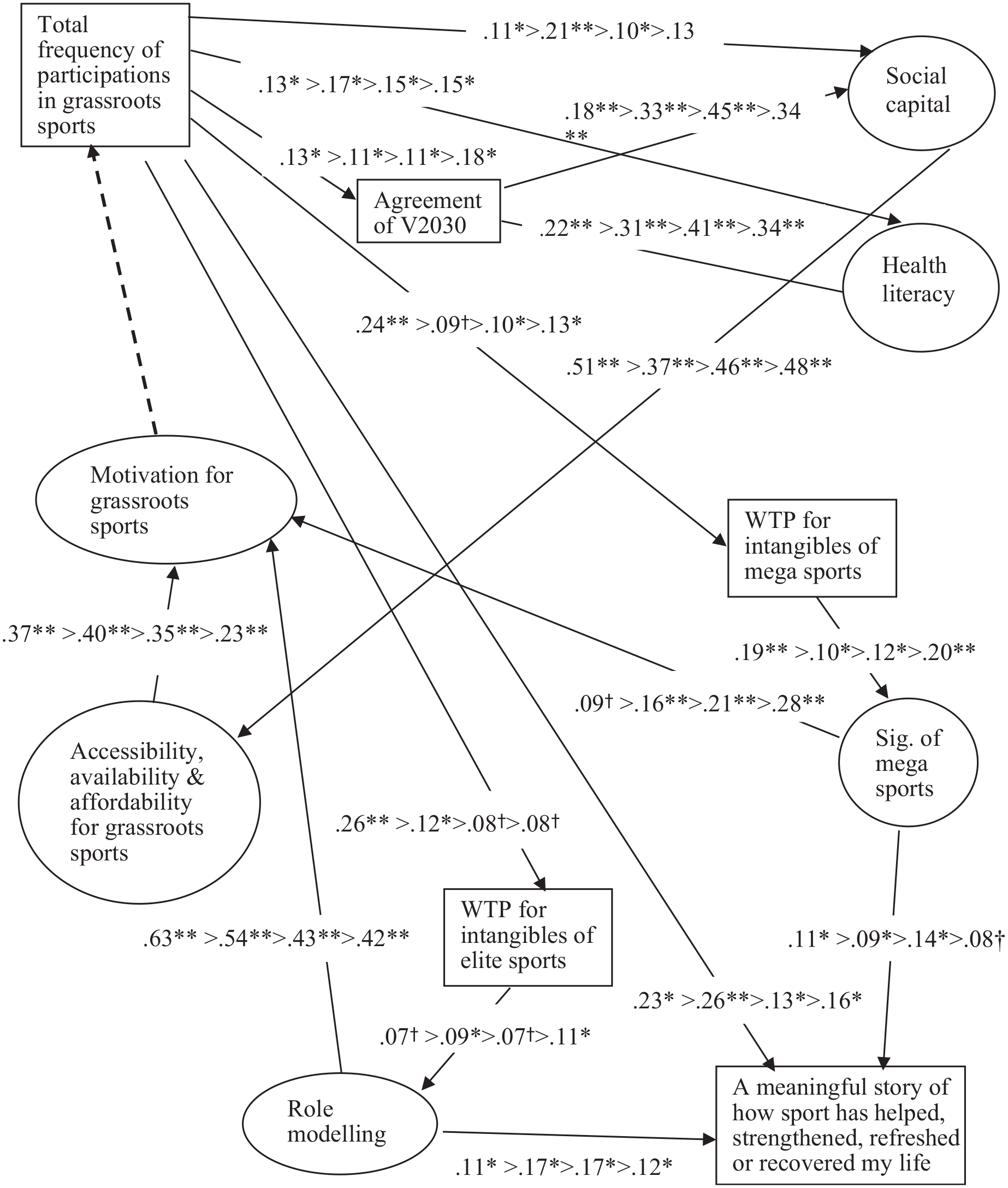
Structural equation models for structural validity testing for the causal relationships.
Importantly, the models demonstrate that the frequency of grassroots sports participation also positively influences WTPs for both elite sports and mega sports development across the four time periods, supporting
The four separate structural equation models support the proposed conceptual model of sports-based holistic development and identify “the frequency of participation in grassroots sports” as a significant causal factor to influence dependent variables (e.g., social capital, health literacy, and WTPs) in the dynamics of grassroots, elite, and mega sports over time. Most importantly, the four separate structural equation models consistently identified three factors to influence on the general public’s transformation into having a meaningful story through sports: (1) frequency of participation in grassroots sports dynamics, (2) role modeling from elite sports dynamics, and (3) personal, sociological, and historical significance of mega sports dynamics. Admittedly, we have not discussed the directional relationships among these three variables and the transformation into having a meaningful story in the causal loops diagram of dynamic hypotheses development. The four separate equation models repeatedly testing the causal assumption for plausibility, however, strongly support that the three factors of (1) frequency of participation in grassroots sports dynamics, (2) role modeling from elite sports dynamics, and (3) personal, sociological, and historical significance of mega sports dynamics influence the transformation into having a meaningful story through sports.
In summary, all these procedures and tests support the confidence building processes relating to the structural validity of a system dynamics model for an integrated sports-based holistic development model consisting of grassroots, elite, and mega sports dynamics.
Initial Conditions and Changed Outcomes of Vision 2030 Over Time
The first national survey conducted in February 2014 reports the initial conditions as a basis for comparison. The second, third, and fourth surveys of June 2014, October 2014, and February 2015 examine changed outcomes in social or economic conditions among grassroots, elite, and mega sports. For example, as for grassroots dynamics, using 10-point scales, the four surveys with independent random samples for the past 12 months showed that the total frequency of participation in grassroots sports activities improved from 5.90 (in February 2014) to 6.08 (in June 2014), 7.61 (in October 2014), and 8.13 (February 2015) and agreement with the Vision 2030 value statements improved from 6.16 to 6.53, 6.60, and 7.05 out of 10.00 for the same time intervals. Additionally, social capital improved from 6.92 to 7.10, 7.10, and 7.17; health literacy improved from 7.41 to 7.55, 7.64, and 7.68 for the same time intervals; accessibility, availability, and affordability of grassroots sports improved from 6.14 to 6.51, 6.66, and 6.70; and motivation to continue participation in grassroots sports improved from 5.17 to 5.77, 5.77, and 5.61 for the same time intervals (see Figure 3).
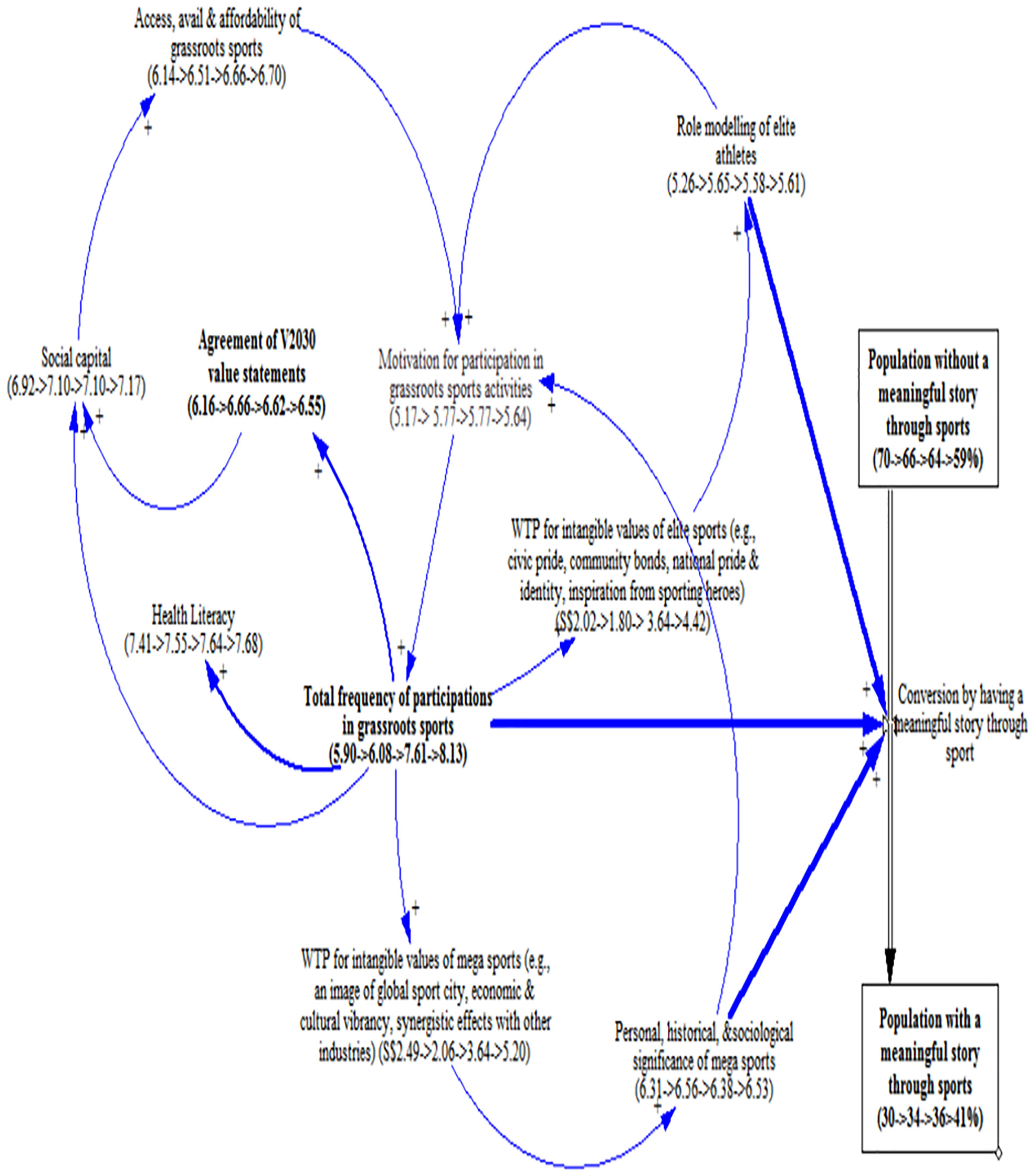
System dynamics model for “Vision 2030: Live Better Through Sport.”
Notably, the first survey (February 2014) reports that only 30% of respondents answered “yes” to the question item (I have a meaningful story about how sport has helped, strengthened, refreshed, or recovered my life) and 70% of respondents answered “no” to the question item. Interestingly, individuals with a meaningful story through sports have much higher WTPs for intangible values from elites sports development than individuals without such a story (Mwithoutameaningfulstory = 1.22, Mwithameaningfulstory = 3.89, t = −3.896, p < .001). Additionally, individuals with a meaningful story through sports have much higher WTPs for intangible values from mega sports development than individuals without such a story (Mwithoutameaningfulstory = 1.35, Mwithameaningfulstory = 5.14, t = −4.282, p < .001). Further, individuals with a meaningful story through sports have significantly higher values in social capital and health literacy in grassroots sports dynamics than individuals without such a story.
The second, third, and fourth surveys report that the population with a meaningful story through sports continuously increased from 30% in February to 34% in June 2014, 36% in October 2014, and 41% in February 2015 (see Figure 3). The results from the four surveys confirm that people with a meaningful story through sports consistently have significantly higher WTPs for elite sports and mega sports dynamics, as well as higher value perceptions of social capital and health literacy in grassroots sports dynamics. For example, the result from the fourth survey shows that individuals with a meaningful story through sports have much higher WTP for elite sports development (Mwithoutameaningfulstory = 3.10, Mwithameaningfulstory = 6.34, t = −3.950, p < .001), mega sports development (Mwithoutameaningfulstory = 3.25, Mwithameaningfulstory = 8.06, t = −5.093, p < .001), and social capital and health literacy in grassroots sports dynamics (e.g., Mwithoutameaningfulstory = 7.03, Mwithameaningfulstory = 7.36, t = −2.464, p = .014 for social capital) than individuals without a meaningful story through sports.
These findings suggest that increasing the percentage of the population with a meaningful story through sports in their life over time is critical to strategic goals to be highly leveraged to drive dynamic and multidimensional outcomes in the grassroots, elite, and mega sports dynamics of Vision 2030. That is, the findings present the general public’s transformation into having a meaningful story through sports as a high leverage policy point in the sports-based holistic development system.
System Dynamics Model for Vision 2,030
Based on the initial conditions and improved/changed outcomes through four national survey administrations and the validated structure of causal relationships across four time periods, we build a system dynamics model using a stock and flow diagram for Vision 2030 (Figure 3). The system dynamics model gives us a better visualization regarding how major on-going interventions, including “Active Singapore” (launched in April 2014), and “WTA Championship at Singapore Sports Hub” (held in October 2014), influence these dynamic interplays and outcomes with multiple stakeholders under Vision 2030. Active Singapore launched in April 2014, aiming to create a sporting ecosystem with sports programs available, accessible, and affordable to everyone, regardless of their skill level and age. It is considered to be effective in increasing the general public’s participation in grassroots sports activities from 5.90 to 8.13 gradually over the past 12 months. For example, a t-test shows that Active Singapore membership has a significant impact on the frequency of participation in grassroots sports activities (Mwithout membership = 7.51 vs. Mwith membership = 9.69, p = .002) in the fourth survey in February 2015. In addition, the WTA Championship 2014 held in October 2014 at the Singapore Sports Hub is considered to effectively increase the WTP for intangible values of mega sports from S$2.06 (in June 2014) to S$3.64 in (October 2014) and S$5.20 (in February 2015). For example, a t-test shows that watching WTA Championship 2014 has a significant impact on WTP for mega sports (MnowatchingWTA=4.66 vs. MwatchingWTA = 8.51, p = .005). As shown in Figure 3, through various feedback loops, the these interventions ultimately enhance the dynamic and multidimensional outcomes among the grassroots, elite, and mega sports dynamics, including by increasing social capital from 6.92 to 7.17; increasing health literacy from 7.41 to 7.68; increasing role modeling from 5.26 to 5.61; and increasing personal, historical, and sociological significance from 6.31 to 6.53 for the past 12 months. Importantly, the system dynamics model highlights the general public’s conversion mechanism to having a meaningful story through sports over time as a key outcome in sports-based holistic development.
This format of historical time series data in grassroots, elite and mega sports dynamics provides a consistent basis for a sport system model (Shreckengost, 1985). It is also especially useful in predicting how the sport system would behave when policies of interest are implemented (Shreckengost, 1985). Predicting via simulation and exploring policy levers are two main objectives of system dynamics modeling. Given the limited number of four sets of data, however, predicting behaviors via simulation is beyond the scope of the study. Also, it is not meaningful to examine any differential changes during the time intervals. Thus, we focus on exploring any policy levers to improve the development outcomes based on the established structural validity. Importantly, the system dynamics model highlights the general public’s transformation into having a meaningful story through sports over time as a key outcome in sports-based holistic development, which is mostly influenced by (1) grassroots sports participation, (2) elite sports’ role modeling, and (3) mega sports’ personal, sociological, and historical significance.
Discussion
Contributions and Significance
The study makes several significant contributions in the area of social marketing and policy for the government sector and its partnering organizations in sport, leisure, and recreation management literature. First, the study developed an integrated conceptual model of sports-based development as a holistic and self-reinforcing sport system by encompassing both tangible and intangible outcomes (e.g., participation in sports, social capital, and role modeling). Particularly, the study applied the developed instrument for the Social Impact of Sport of Lee et al. (2013)’s work into the real industry of a sport-based development initiative in Singapore. Further, the measured societal values of social capital and health literacy can help stakeholders justify their investment and engagement in the sport-based national development initiative of Vision 2030 with empirical evidences. This is particularly valuable when we try to find empirical evidence that sports have actually contributed to society from the perspective of sustainable community development through sport and sport-for-development (e.g., Chalip, 2006; Coalter, 2007; Schulenkorf, 2012). For example, according to Schulenkorf (2012), although many sport and event projects are laudable with the highlighted capacity and impact on people and communities, they do not provide strategic guideline, frameworks and models for project monitoring, and evaluation for the actual outcomes. As an attempt to address these challenges, this study presents a general sport system model to describe the development mechanism and assess social impacts and longitudinal outcomes. This is also particularly valuable, considering that there was a call for longitudinal research and appropriate measurement tools to evaluate the psychological and social benefits of sports and physical activities in leisure research by the previous work of Wankel and Berger (1990).
Second, through its application into the real sport initiative of Singapore, the study discusses the usefulness and practicality of the model in generating strategic guidelines and leverage policy points. In addition, integrating fragmented relationships into a large system, the model empirically demonstrates how the holistic sports-based development system can lead to synergistic relationships among the three spheres of grassroots, elite/professional, and large-scale sports. Further, it presents the general public’s transformation into having a meaningful story through sports regarding “how sports has helped, strengthened, refreshed or recovered their life” as a high leverage policy point in the sports-based holistic development system.
Also, the findings of the study offer important policy insights that focus on the general public’s transformational change into having a meaningful story through sports in their perceptions and experiences as a high leverage policy point in achieving sports-based development outcomes. Specifically, the findings show that individuals’ conversion to having a meaningful story through sports regarding how sports has helped, strengthened, refreshed, or recovered their life could be an effective indicator of their transformational change in sport experiences. Frequently, the public’s expectation and perception of sports might be limited, with its focus on just a fun activity for pastime and entertainment, which is less essential for the survival of individuals and organizations. This limited value perception of sports is one of the biggest challenges in sports-based development initiatives aiming to enhance the significant societal, educational, and health benefits. It might undervalue the potential of sports to stakeholders such as governments, corporate sponsors, non-profit partners, and the general public. In light of this challenge, an important finding of the study is that 30% of the national population had a meaningful story through sports regarding “how sports has helped, strengthened, refreshed, or recovered their life,” which has increased to 41% over time. Thus, based on this empirical evidence, public policy makers and practitioners can communicate with the public and stakeholders the essential values of sports as “helping, strengthening, refreshing, and recovering the public’s life,” and not just a fun activity or pastime. As the public recognizes and perceives sports as a meaningful contributor to their life, the potential of sports can be greater, and it can be leveraged for the stakeholders. Accordingly, policymakers and practitioners can encourage the general public to recognize and consume sports activities as more essential activities for their successful life.
Another important contribution of the study is to longitudinally visualize the underlying complex mechanism of sports-based development as a virtuous cycle relationship with multiple stakeholders, validating the causal structure of the dynamic relationships, social impacts and desired outcomes through multiple procedures and tests. Specifically, the study utilized structural equation models to test the conceptual model as a way of capturing a snapshot at each point of time in a longitudinal development process. This is more significant, considering that “organizing bodies such as government agencies, local communities and NGOs need to monitor the social relationships and cooperation between communities during all stages of the management process to achieve improved social outcomes” (Schulenkorf, 2012, p. 8).
As briefly discussed in the introduction, sports policies in most developed nations to date have focused on the two spheres of elite/high performance and grassroots/mass participation sports (Nicholson et al., 2011). However, a mega sports event (e.g., the Olympics, FIFA World Cup, Pan American Games, or Asian Games) is held for its lucrative benefits for host cities and countries, such as tourism and legacy values, at least once a year somewhere in the world (Fourie & Santana-Gallego, 2011). These objectives and benefits are clearly distinguished from those of elite sports performance or professional team sports. Therefore, developing policies in the three spheres of grassroots, elite, and mega sports is more relevant than in the two spheres, especially when cities or countries plan to host a mega sports event for societal and economic values. In addition, the highlighted mechanism of the system dynamics model is useful for policymakers and practitioners to articulate the prioritized roles and synergistic relationships among participation in grassroots sports, role modeling effects from elite sports, and significance from mega sports in the complexity of sports-based holistic development.
Limitations and Future Studies
Although the current system dynamics model does not include any balancing/negative feedback loops in a system due to its focus on exploring reinforcing relationships, it still effectively captures meaningful growth in relationships and outcomes. For example, the measures of social capital and health literacy, the frequencies of participation in grassroots sports activities, and the WTPs continued to grow for the last 12 months (see Figure 3). This might imply that the model is still in the beginning stage of the developmental process (i.e., the measures have not reached their equilibrium points yet). As time goes by, over 3 or 5 years, the outcomes cannot continuously grow and will face balancing/negative relationships within the system. Perhaps, this is mainly due to the limited resources and opportunity costs for individuals and organizations’ investments in sports activities (i.e., there must be an equilibrium point for each variable’s growth in the interrelated relationships of the developmental system). Another important objective of simulation analysis is to find these equilibrium points to optimize the outcomes with the limited resources in the model. Future study is required to develop the model with more details including balancing/negative feedback loops on participation and investment in sports activities for individuals and organizations.
Also, some variables were measured and analyzed in a limited way. For example, the general public’s having a meaningful story through sports regarding how sports has helped, strengthened, refreshed, and recovered his/her life were measured by a “yes” or “no” answer. Admittedly, only two options were not sufficient to measure the full variance of the factor and what the stories are specifically. Thus, future research is required to fully examine the relationships among various kinds of meaningful stories through sports, their antecedents and impact in society. In addition, in order to estimate monetary values for various kinds of intangible benefits for elite sports, the study utilized a contingent scenarios describing civic pride, community bonds, national pride and identity, and inspiration from sporting heroes from elite sports development as a whole. Admittedly, it is limited to examine the specific relationships between elite sports and each category of intangible values. Thus, the future research needs to develop the contingent scenarios more specifically and carefully in the experimental setting to ensure more specific and clear relationships.
Although the current study’s application to Singapore provides interesting findings and important mechanisms in sports-based holistic development initiatives, several factors should be discussed further before we apply the model and generalize the findings to other cities and countries. Singapore has several advantages in initiating sports-based holistic development and experiencing successful developmental relationships and outcomes within 2 years. First, Singapore’s government has strong leadership and the public has a high level of trust in government (Jones, 2018). This is one factor influencing the public’s support and participation in the government-leading national initiative. Second, Singapore has become one of the richest countries in the world and has a vibrant economy. Naturally, there has been a growing interest in well-being and health, and the public can afford various sports activities for those purposes. Third, Singapore’s weather is consistent throughout the year. The longitudinal study has few seasonal effects influencing participation and consumption in sports activities. Future studies must at least consider external factors such as the public’s trust in government, economic situation, and weather as macro variables in building a system dynamics model for other cities and countries.
Footnotes
Declaration of Conflicting Interests
The author declared no potential conflicts of interest with respect to the research, authorship, and/or publication of this article.
Funding
The author(s) disclosed receipt of the following financial support for the research, authorship, and/or publication of this article: This work was supported by Hankuk University of Foreign Studies Research Fund 2020.
